



Abstract
The interest in Data Envelopment Analysis (DEA) has grown since its first put forward in 1978. In response to the overwhelming interest, systematic literature reviews, as well as bibliometric studies, have been performed in describing the state-of-the-art and offering quantitative outlines with regard to the high-impact papers on global applications of DEA and the higher education system (DEA-HE). This study examines 75 systematic literature review (SLR) studies published between 2018 and 2022 and 508 bibliometric studies published between 1992and 2022. Four performance-focused areas are identified through SLR analysis: institutional performance, departmental performance, performance of study program, and performance of other higher education (HE) activities. This study highlights issues, methods, and resolutions in selected SLR literature. Bibliometric analysis revealed an increasing trend in DEA-HE since 2003, with the highest number of publications in 2021. Tommaso Agasisti was the most productive author, and Jill Johnes was the most influential. The journal Scientometric had the most publications in the area. This study lays the groundwork for future research. Future reviewers may find the common practises, constraints, and underlying assumptions presented in this study useful for the selection and analysis of relevant studies.
Plain language summary
This study undertakes a comprehensive review of the evolution of Data Envelopment Analysis (DEA) in the field of higher education. The aim is to conduct an in-depth examination, encompassing 75 systematic literature reviews (SLRs) published between 2018 and 2022, along with 508 bibliometric studies spanning from 1992 to 2022. In the SLR analysis, we have identified four main areas of research: institutional performance, departmental performance, study program performance, and performance in other aspects of higher education (HE). This detailed investigation helps us discover important issues, research methods, and solutions frequently found in the SLR literature. Our bibliometric analysis shows a clear increase in DEA-HE research since 2003, peaking in the number of publications in 2021. Tommaso Agasisti is the most prolific author, and Jill Johnes is the most influential in this field. The journal Scientometric has the most publications in this area. In summary, this study provides valuable insights for future research endeavors. Researchers and reviewers can leverage the established practices and duly acknowledge the inherent limitations when assessing relevant studies. This contribution lays the foundation for a more informed exploration within this academic discipline.
Keywords
Introduction
The field of higher education (HE) has a well-established history of adjusting to changing societal and labor market needs. During the 1980s, there was a notable decrease in public expenditure across several developed nations, which sparked a discussion regarding the efficiency of HE. This conversation has continued to evolve as student enrollments surged, prompting concerns about higher education institutions’ (HEIs) performance (Kupriyanova et al., 2018). The recent emergence of the COVID-19 pandemic has heightened the challenges currently faced by HE. These new challenges have placed HEIs under unprecedented pressure, testing their adaptability and resilience.
For HEIs and decision-makers, increasing efficiency is acknowledged as a highly desired goal. The challenge of meeting the increasing demand for HE has compelled governments to prioritize increased efficiency as a central policy objective. Efficiency demonstrates responsible management by making the most use of available resources and minimizing waste.
A nonparametric Data Envelopment Analysis (DEA) is a common tool used by researchers in evaluating efficiency and productivity. Over four decades, DEA has evolved into a key tool for assessing the performance of entities engaged in diverse activities. It excels in analyzing complex relations that involve multiple inputs and outputs. Initially established in 1978 through the seminal contributions of Charnes, Cooper, and Rhodes, DEA has found significant application across various fields, including transportation, finance, healthcare, agriculture, tourism, construction, and education. In their originating article, DEA is described by Charnes et al. (1978) as a data-driven tool that uses mathematical programing for performance evaluation and benchmarking. The article also introduced the initial DEA model, which is commonly referred to as the CCR model. In another study, Banker et al. (1984) introduced the BCC model, which is a second DEA model. Both models are classical DEA models. There are now several DEA extensions available for evaluating performance.
In academia, various researchers have explored different aspects of the DEA literature. Cooper et al. (2007) explored the development of models and methodologies designed to address issues within DEA formulation. Kao (2014) conducted a review of the network DEA (NDEA), scrutinizing both the models employed and the structure of the network systems under investigation. Mardani et al. (2017) reviewed DEA models related to energy efficiency. Mariz et al. (2018) conducted a comprehensive review paper on the existing literature pertaining to the evolution of dynamic DEA. Cui and Yu (2021) conducted a detailed review of the literature pertaining to the application of DEA models in assessing airline efficiency. Panwar et al. (2022) address the benefits, drawbacks, and uses of several distinct DEA models. Additionally, a paper authored by de Oliveira et al. (2023) undertook a thorough examination of DEA, Multi-criteria Decision Analysis (MCDA), and Cluster Analysis models. The objective was to identify existing and potential applications, as well as emerging trends.
Setting the Stage: Context and Objectives
With the continuous expansion of the HE landscape, there has been a corresponding increase in the amount of literature available in this field. Over the years, numerous studies have extended, proposed, and applied DEA models to assess efficiency in various aspects of HE across different countries. As this body of work continues to grow, it becomes increasingly imperative to gather and synthesize the insights derived from research employing DEA methodology in this field. This study, therefore, embarks on an examination of the application of DEA in evaluating the performance of HEIs, referred to as DEA-HE, through a systematic literature review (SLR) and bibliometric analysis. Throughout this review, we present examples of how various models have been utilized to gage HE efficiency, shedding light on both the identified issues and their corresponding solutions within each selected paper. Notably, research encompassing SLR and bibliometric analysis that delves into the implementation of various DEA models within HE is currently scarce. Hence, we endeavor to fill this gap by conducting a review of this topic. Consequently, the primary aim of this study is to compile existing literature related to the application of DEA in HE, evaluate the current research landscape, and offer insights into potential opportunities for future research within this domain. To address our primary research objective, we have structured five key research questions (RQ):
RQ1: What is the current research on DEA-HE areas under investigation, and what are the different emerging variants of DEA that have arisen in this field in recent years?
RQ2: What key information can be collected from these studies, and how have publication trends evolved over time in the field of DEA applied to HE?
RQ3: Which journals are the most relevant, and how do they influence and impact DEA-HE studies? Furthermore, which articles have the most significant influence, who are the most prolific authors, and what impact have they had on the field of DEA-HE studies?
RQ4: What are the trend topics of DEA-HE studies?
RQ5: What are the bibliographic diagrams and graphs for studies of DEA-HE?
SLR and bibliometric analyses are performed through systematic framework and expert evaluation to understand various applications of DEA in HE. Data from two datasets (N = 74 and 508) sourced from the Thomson Reuters Web of Science (WoS) database were used to address the research questions. The first research question is addressed through SLR on 75 articles published between 2018 and 2022 to validate the recent information in DEA-HE. The remaining research questions (2–5) are addressed through a bibliometric analysis of 508 articles published between 1992 and 2022. This study covers both descriptive and network analysis of bibliometrics to gain an understanding of the present state of the field and guide future research directions. This process helps to identify gaps in the existing literature and highlights areas that can be explored in future research. Moreover, there exists an opportunity to enhance the understanding of DEA as an instrument for appraising the efficiency and productivity of HEIs, as well as its prospective utilization across various domains. The outcomes of this study are anticipated to provide policymakers, administrators, and academics with valuable insights regarding the integration of DEA into the decision-making and performance evaluation disciplines.
The following is how the paper is set up. The study’s objectives and research questions are described in the first part. The methodology and search techniques used to locate DEA-related publications in the field of HE are described in the second section. The third section presents and discusses the results of the bibliometric and SLR analyses. In the final section, conclusions are made, and recommendations for future research are offered.
Methodology
This study follows Preferred Reporting Items for Systematic Reviews and Meta-Analyses (PRISMA) standards when conducting systematic literature reviews and bibliometric analyses.
As Figure 1 illustrates, we initiated the process by conducting a literature search of the WoS Core Collection database, utilizing the “topic search” option. This feature allowed us to search across titles, abstracts, author keywords, and keywords plus fields. The search was performed on October 3, 2022. The reason why we mainly prefer WoS over other databases is because it looks up information across publishers and is not biased against them (Bartolacci et al., 2020). More importantly, WoS ensures the inclusion of the most significant journals (Bartolacci et al., 2020; Kullenberg & Kasperowski, 2016).

Workflow for analyzing DEA-HE literature.
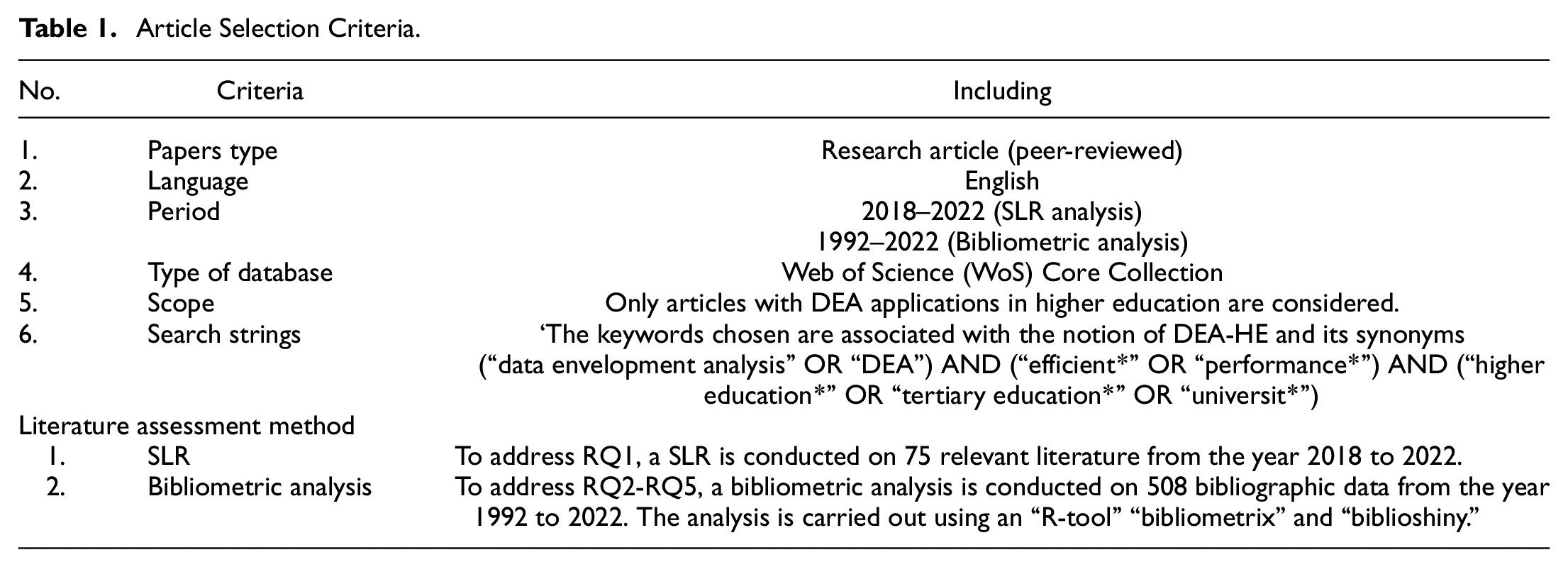
Our article selection process adheres to specific criteria, which we have conveniently summarized in Table 1. This screening process narrows down our findings to encompass only peer-reviewed articles in English published between 2018 and 2022, resulting in a total of 398 articles. Articles that did not align with the research topic were flagged for removal after the titles and abstracts had been independently read. If the titles and abstracts did not provide sufficient information for screening, we conducted a full-text review. At the conclusion of this rigorous process, we selected 75 recent studies on DEA in HE for inclusion in our SLR analysis.
Article Selection Criteria.
In Joshi’s (2014) paper, he discussed how one can evaluate the quality and quantity of publications using statistical and mathematical measures called bibliometric indicators. Additionally, within his work, he made distinctions among three types of bibliometric indicators: quantitative, performance, and structural. Quantitative indicators are used to gage a researcher’s productivity. Performance indicators, on the other hand, consist of metrics like the Impact Factor that assess the quality of journals or researchers. Nevertheless, structural indicators help find connections between publications, authors, and study areas. This study specifically focuses on quantitative and structural bibliometric indicators. This choice stems from the fact that quantitative indicators can evaluate researcher productivity based on variables such as the number of articles, citations, and the prevalence of highly cited papers. In contrast, structural indicators, such as network analysis, are used to reveal the relationships between publications, authors, and research fields. Consequently, these indicators provide a deeper understanding of the field of academic research.
In this study, the identification of bibliographic data follows a process akin to the search method used for obtaining data for the SLR, with the exception of excluding time filtration. This means that, in arriving at the bibliographic data, the records are identified using the same keywords in the WoS Core Collection database, and articles are filtered to only include English peer-reviewed articles without any limitation on the period of publication. The search process initially resulted in the identification of 805 articles. From these values, 297 articles are removed after thorough screening, and finally, a total of 508 articles are included for bibliometric analysis. The process of data retrieval from the WoS database for SLR and bibliometric analysis is shown in Figure 2.

Data retrieval process.
Findings
The SLR findings of the current DEA-HE efforts are presented in the first subsection. The bibliometric analysis findings, which include descriptive and network analyses, are covered in the second subsection.
Findings on SLR Analysis
The review resulted in four performance-based themes or areas that are dependent on decision-making-unit (DMU) or entities. The definition of DMU is broad and flexible, and because of that, this study is constructed around the performance of various DMUs being evaluated, institutional performance, departmental performance, performance of study program, and performance of other HE activities. We highlight the issues of each study, the DEA-methods used, and the strategy used to address the issues, as displayed in Tables 2 to 5.
Institutional Performance.

Departmental Performance.

Performance of Study Program.

Performance of Other Higher Education Activities.
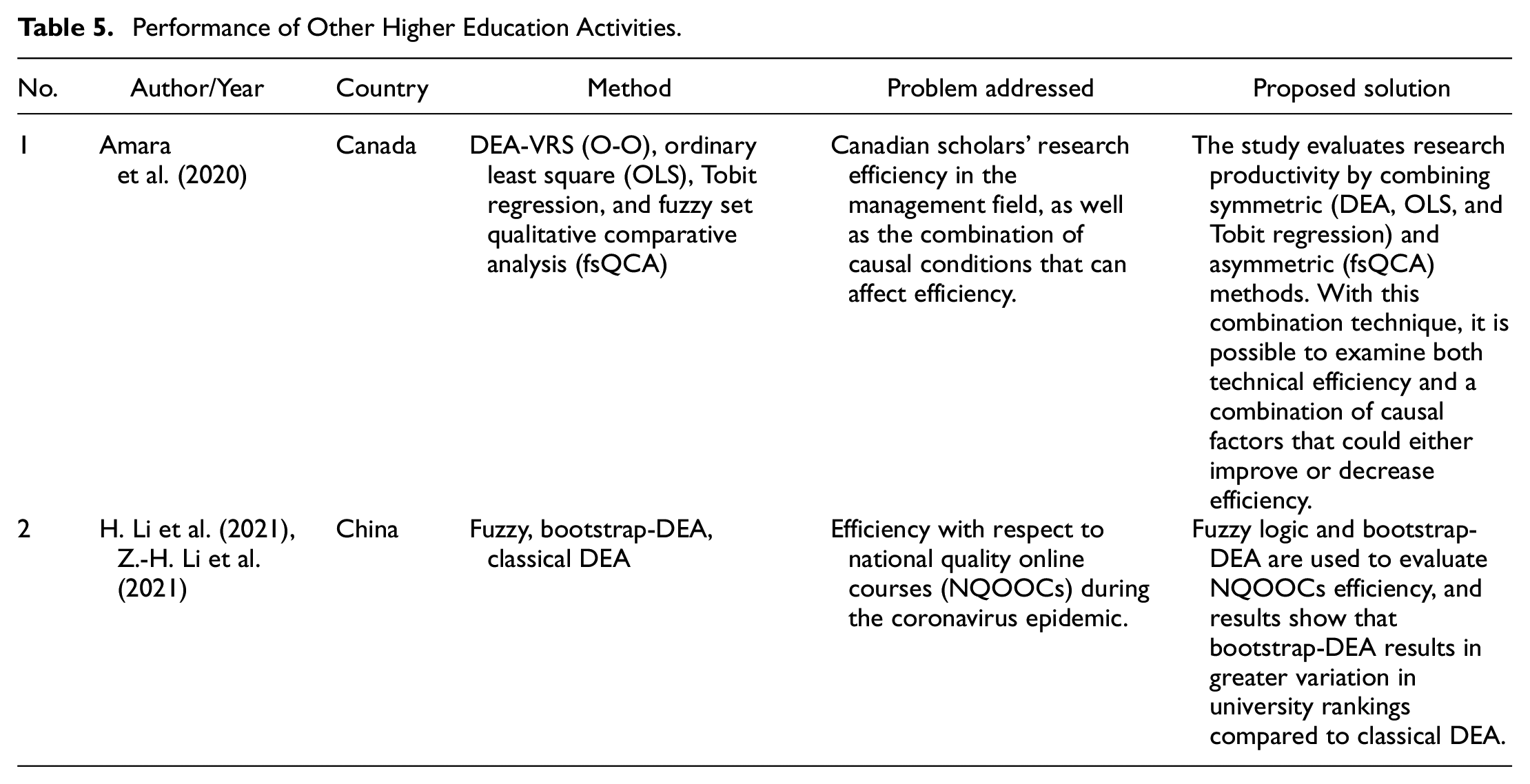
Data exploration revealed that in 2018 and 2019, there were 14 similar publications. In 2020, this number decreased by 2, but in 2022, it increased to 16. The peak year for DEA-HE publications was 2021, with 19 articles indicating a growing interest in the topic in recent years. Notably, China contributed the most, with 30% of the articles, followed by Australia at 7%.
The performance and qualities of an institution’s educational offering are determined by assessments of activities in HE. Such activities include research, teaching, technology, innovation, and more. As shown in Tables 2 to 5, 81% of the works published between 2018 and 2022 are heavily focused on institutional performance, 11% on department or faculty performance, 5% on study program performance, and the remaining 3% on the performance of other higher educational activities. Looking at the important aspects the recent works with regards to the performance of HE had focused on, we noticed that most recent studies focused on evaluating the total performance with regards to HE. Apart from total performance, individual evaluations of research, teaching, and their combinations were superior to performance evaluations of other activities.
Recent works have made substantial use of both classical DEA and DEA extensions. It was discovered that classical DEA was applied in more than half of the literature, and it is mostly used in conjunction with other techniques. Multi-criteria decision-making (MCDM), extensions of DEA like NDEA, super-efficiency DEA, cross-efficiency, and more are observed to be used alongside classical DEA. However, it is mostly used in conjunction with statistical techniques like regression analysis, Analysis of Variance (ANOVA), correlation analysis, cluster analysis, and more. Besides classical DEA, 44% of articles reported the usage of DEA extensions, and 15% reported the application of the Malmquist productivity index (MPI). Generally, the reported figures may not add up to 100 because there may be more than one method utilized in an article.
Findings on Bibliometric Analysis
Table 6 shows the main information that sums up the data. As evidenced by more than twenty average citations per paper, the findings indicate that DEA and performance in HE are popular topics in research. Moreover, as addressed in the first research question on the trend of publication of this topic, Figure 3 confirms the growing interest in understanding this topic in recent years. Although the first publication was in 1992, approximately more than 90% of the papers were published after 2003. The publication of research on DEA and HE performance peaked in 2021, with 52 papers.
Main Information.


Annual publication trends.
Most Relevant Journals, Their Influence, and Impact
Table 7 lists the most relevant journals based on their publications on DEA and HE performance. The journal Scientometrics tops the list, representing approximately 4.33% of the papers in this study. The second-most appropriate journal is the Journal of the Operational Research Society, which contributes about 3.74% of the papers. It is interesting to note that the top 10 journals account for 24.21% of the total number of papers examined.
Most Relevant Journals, Their Influence and Impact.

Total citations, which represent journal influence, show that the journal Economics and Education Review is the most influential (Total citation (TC) = 1,062), followed by the European Journal of Operational Research (TC = 966). In terms of h-index, which measures the impact of a journal, the European Journal of Operational Research (h-index = 15) is the most influential journal, followed by the Journal of the Operational Research Society (h-index = 12) and Omega-International Journal of Management Science (h-index = 11).
Most Prolific Authors and Authors’ Impact
Figures 4 and 5 enlist prolific authors and authors’ impact. Tommaso Agasisti tops the list with 23 publications between 2006 and 2022, followed by Jill Johnes and Guo-liang Yang with 13 and 12 papers, respectively. From the perspective of author influence, Jill Johnes is the author with the most citations (TC = 1,132), followed by Tommaso Agasisti (TC = 695) and Geraint Johnes (TC = 576).
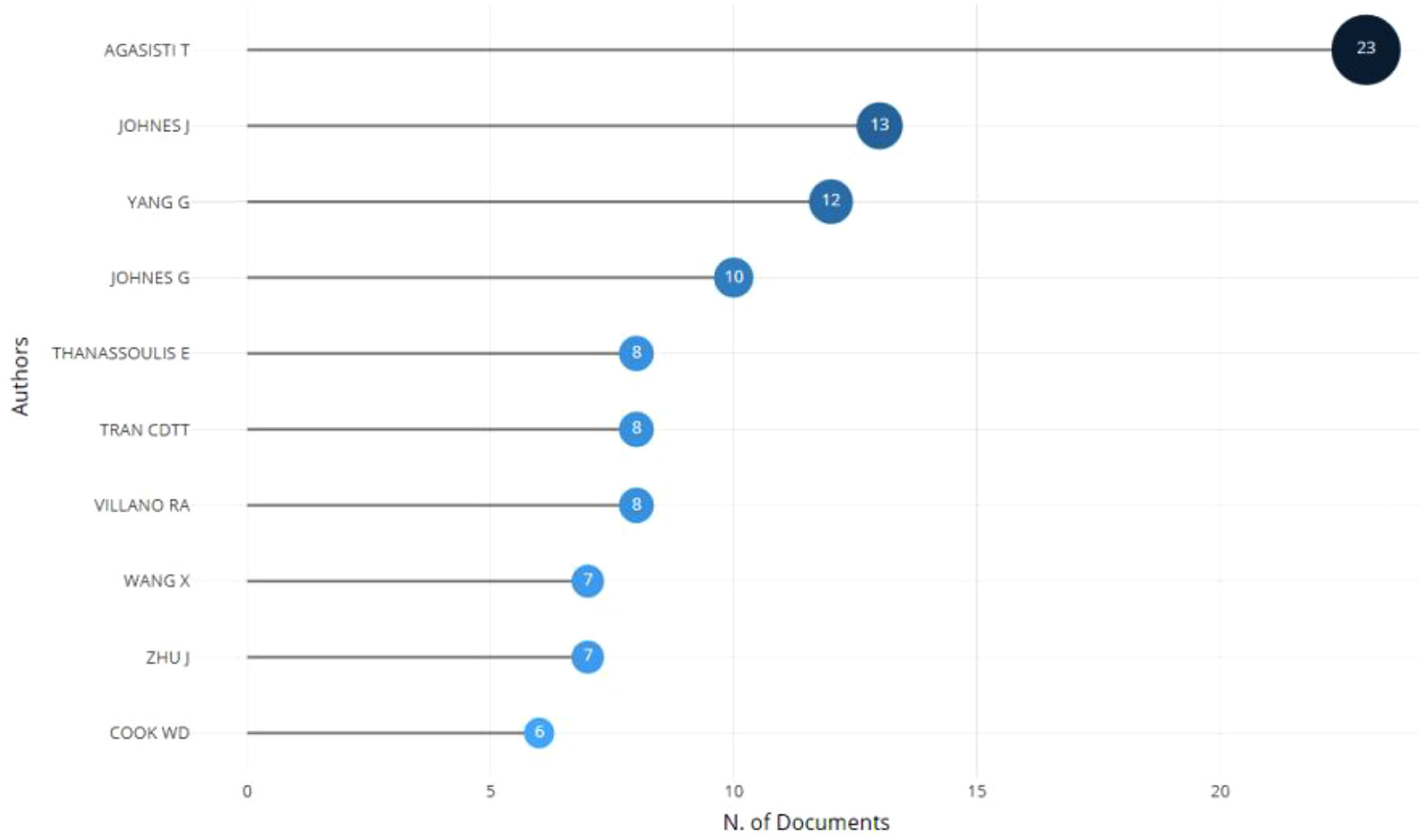
Authors with most publications.
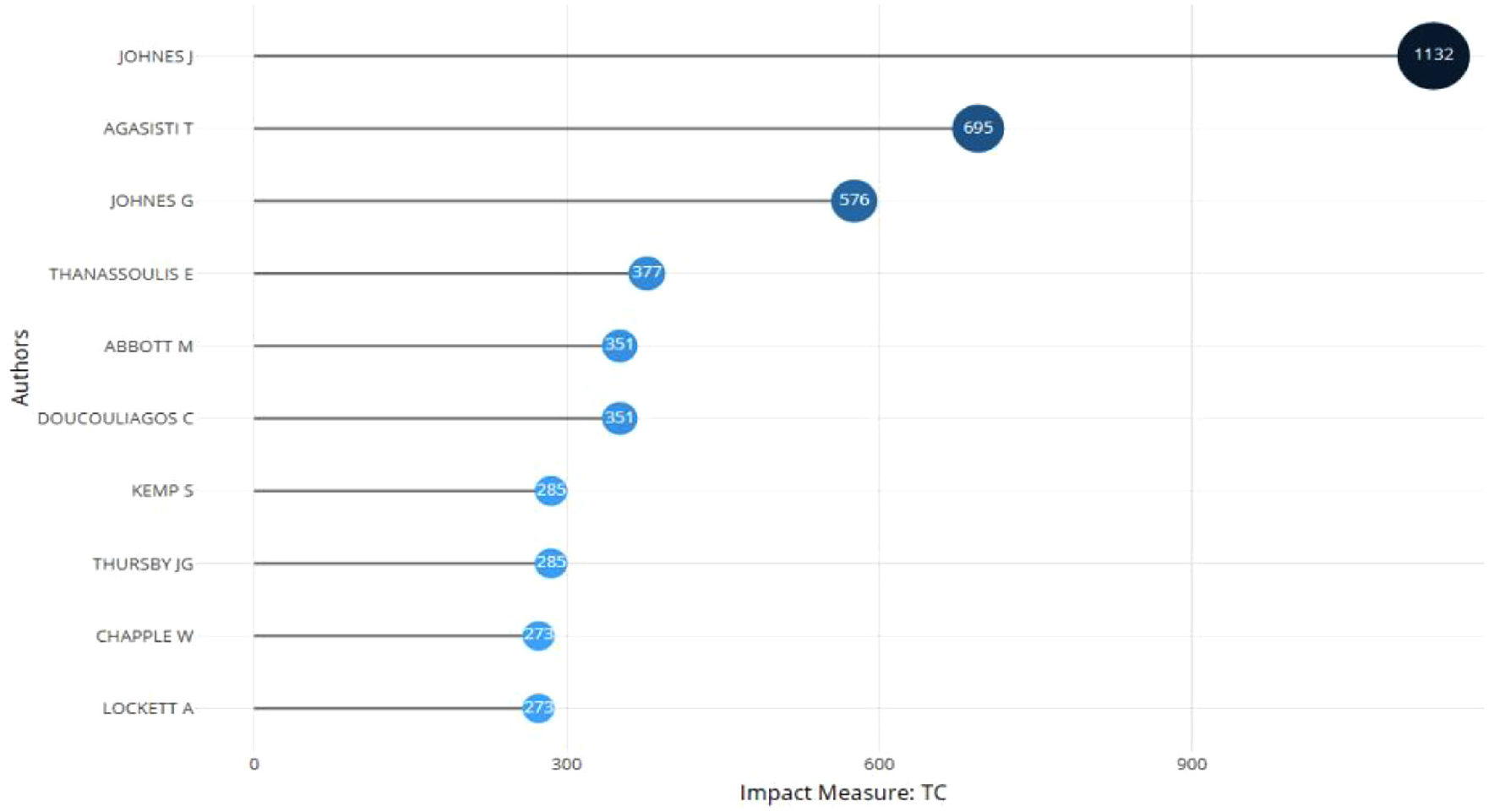
Most influence authors.
Most Influential Articles
Table 8 lists the top ten most influential articles in terms of local (LC) and global citations (GC). The most influential article, with the highest LC and GC, is “The efficiency of Australian universities: A data envelopment analysis” by Abbot and Doucouliagos, which is followed by Jill Johnes’ article, “Data envelopment analysis and its application to the measurement of efficiency in higher education.” Among these top ten papers, it is interesting to note that Jill Johnes’s work appears in half of them.
Top Ten of Most Influential Articles and Their Cited References.

Trend Topics
The trend of the topics, as in Figure 6, shows that in the earlier research years, the main topics were about the performance, efficiency, and productivity of the decision-making units, for instance, universities, as well as departments and processes, such as research. However, recent topics starting from 2019 have shifted to quality, impact, cost, innovation, model, scope, and knowledge-transfer. The interest in knowledge transfer, in particular, has been rising since 2021.

Trend topics.
Network Analysis of the Literature
Keyword co-occurrence analysis is used to investigate research trends and knowledge structures. In this analysis, the size of the nodes denotes the number of documents, and a link between two nodes is resembled by a line. A strong link is shown by a short line connecting two nodes.
In keyword plus co-occurrence network analysis, three clusters represented by three different colors (green, red, and blue) are observed. According to Rojas-Sánchez et al. (2023), each cluster denotes a keyword and displays the most linked and repeated keywords in the publications. In this bibliometric analysis, the keywords given in every cluster are identified. In a green-colored cluster: data envelopment analysis,’“performance,” and “efficiency”; red-colored clusters: “DEA,”“higher education,”“models,” and “departments”; blue-colored cluster: “productivity,”“universities,”“institutions,” and “scale.” As illustrated in Figure 7, three groups had a stronger relationship: “Performance or efficiency assessment through data envelopment analysis,”“Higher education or departments models using DEA,” and “University or institution productivity.”

Co-occurrence network based on keywords plus.
Finally, we visualized the evolution over time of this area through a Sankey diagram—as illustrated in Figure 8. This diagram aids in understanding the thematic flow, the direction of thematic flow, as well as conversion relationships in the field of DEA and HE performance (Rojas-Sánchez et al., 2023; Soundararajan et al., 2014).

Thematic evolution.
Concluding Remarks and Directions for Future Research
This paper reviews the application of DEA methods in the context of HE performance evaluation. To accomplish this, we conducted two primary analyses: an SLR of 75 articles published between 2018 and 2022 and a bibliometric analysis of 508 articles spanning the past 30 years, with a particular emphasis on those published in high-impact journals.
During this study, we organized the articles chosen for the SLR into four categories based on performance. Most recent literature has primarily focused on institutional performance, with the next emphasis being on departmental performance. Consequently, upcoming research should investigate the performance of study programs or other educational activities.
Also, our findings reveal that classical DEA is often complemented by other methods, especially statistical techniques. While classical DEA is a prevalent method in the assessment of HE performance, the adoption of EBM, SBM, and Fuzzy DEA models remains limited. In comparative terms, the findings of this study demonstrate both similarities and distinctions in relation to the research conducted by Cui and Yu (2021), who explored DEA models in the airline industry. Both studies concur regarding the widespread utilization of classical DEA in conjunction with other methods. However, a noteworthy discrepancy arises as Cui and Yu (2021) reported an extensive prevalence of SBM models within the airline industry alongside a limited adoption of EBM. In contrast, within the HE sector, both SBM and EBM applications remain restricted.
Additionally, we observed a rise in the use of the MPI to investigate productivity changes and the application of DEA extensions like NDEA for evaluating HE performance over the past 5 years. Within the NDEA structure implemented in HE, significant opportunities for further exploration have emerged. Beyond the conventional roles of teaching, research, and services provided by the HE sector, other aspects, such as other operational processes or subprocesses related to HE performance, demand exploration. Furthermore, it is essential to assess whether any previously overlooked outputs or shared inputs require thorough examination.
Subsequently, this study embarks on a more comprehensive exploration of the research landscape within this domain. The bibliometric analysis serves as a robust foundation for our investigation, unveiling a significant surge in publications. This surge, commencing in 2003 and peaking in 2021, is particularly noteworthy, with over 90% of these articles published after 2003.
Additionally, this review identifies the most influential journals, authors, publications, and trending topics. That being said, Scientometric tops our list, followed by the Journal of Operational Research. Among authors, Tommaso Agasisti has produced the most written material, while Jill Johnes has had the most significant influence on DEA-HE research. The article titled “The efficiency of Australian universities: A data envelopment analysis” by Abbott and Doucouliagos (2003) is identified as the most influential article.
Trending topics include quality, impact, cost, innovation, model, scope, and knowledge transfer. The study also explores bibliometrics’ network analysis, revealing three groups with strong relationships: “Performance or efficiency assessment through Data Envelopment Analysis,”“Higher education or departmental models using DEA,” and “University or institution productivity.”
In essence, this study touched on various DEA applications in an effort to increase the readers’ understanding of how DEA is used in evaluating HE performances. By providing a comprehensive review and addressing fundamental research issues essential to this field, it provides a solid framework for further investigation. Nevertheless, some limitations provide opportunities for future review papers. This review does not include scholarly works that examine HE efficiency through parametric approaches. Additionally, studies from other fields were not considered, as the focus was strictly on DEA in HE. Another limitation of this review is its focus on English-language literature, which excluded publications in other languages. However, the majority of the assessed papers were from international journals.
This study meticulously selected articles from various publishers within the WoS Core Collection database. However, some content may have fallen outside the scope of this review paper. Therefore, future researchers might consider evaluating works that were not included in the current analysis. Future bibliometric investigations could benefit from creating new techniques and utilizing new keywords to incorporate additional relevant publications for more comprehensive metadata analysis.
Footnotes
Declaration of Conflicting Interests
The author(s) declared no potential conflicts of interest with respect to the research, authorship, and/or publication of this article.
Funding
The author(s) received no financial support for the research, authorship, and/or publication of this article.

Data Availability Statement
Data sharing not applicable to this article as no datasets were generated or analyzed during the current study.