



Abstract
Millions of people in developing countries lack access to modern energies and for long, these countries have relied on energy subsidies to scale up their access rate. However, there is no evidence that those energy subsidies contribute to energy poverty reduction. Similarly, while good governance and strong institutions are touted as critical for implementing energy policy and improving access rate, empirical evidence of their impact remains very scanty. This study assesses the impact of energy subsidies and institutional quality on access to electricity in selected developing countries. Result from the Praise-Winston regression revealed that energy subsidies as a policy tool for achieving universal electrification do not hold in the selected developing countries. We also found that energy subsidies accompanied by a strong governance mechanism can help developing countries scale up their electricity access rate. We recommend practical ways to help developing countries achieve universal access to modern energy solution.
Plain language summary
The study aims to investigate the impact of fuel subsidies on energy access in developing countries using secondary data collected from the World Bank and International Energy Agency. Findings from the research showed that fuel subsidies are detrimental to expanding electricity access in developing countries. However, when these subsidies are accompanied by a strong regulatory quality that blocks all forms of leakages and inefficiencies, they could actually help to promote access to electricity in the selected developing countries. This result implies that governments in developing countries providing subsidies on energy products need to strengthen the administration of such subsidies in order to maximize its developmental potentials. However, one limitation of our research is that we consider only 14 developing countries owing to the paucity of comprehensive panel data.
Keywords
Introduction
Access to clean and affordable energy stands as a major concern for the sustainable development of developing countries. With the inception of the United Nations Sustainable Development Goals (SDGs) in 2015, energy access received significant attention, with the goal of extending electricity access to those living in energy poverty (Tarekegne, 2020). SDG-7 specifically targets the provision of affordable, reliable, sustainable, and modern energy for all by 2030, encapsulating the global commitment to energy access (Progress Toward Sustainable Energy, 2015). However, despite progress, 770 million people still lack access to electricity (IEA, 2022). The rate of electrification has slowed in recent years, with global access growing at 0.8 percent annually from 2010 to 2018 but declining to 0.5% between 2018 and 2020. At the current rate, the latest IEA forecast shows that 670 million people would still lack access to electricity by 2030, much of which would come from developing countries. To close the electricity access gap, 100 million people, including 80 million from Africa, would need to be electrified every year until 2030 (IEA et al., 2022).
Access to electricity is vital for eradicating extreme poverty and promoting shared prosperity. People without access to electricity suffer developmental setbacks including adverse consequences for their health, education, gender equality, food security, livelihood, and poverty reduction (Hussain et al., 2023). Increased access to electricity is important not only for ensuring sustainable, inclusive, and resilient growth but also for fully exploiting synergies with other SDGs. For example, there are over 2.4 billion people lacking access to clean cooking technologies (Shittu et al., 2024a; UNDP, 2021). The World Bank’s Energy Sector Management Assistance Program (ESMAP) explained that this number can be slashed if more people gain access to electricity and use modern cooking technologies (ESMAP, 2020). In turn, this can help to avert the adverse effects of cooking with solid biomass fuels causing deforestation, diseases, and even death (Zheng et al., 2023).
However, with the current global energy, health, and food security crises, accelerating access to electricity has become unprecedently daunting. Closing the energy access gap requires both grid and off-grid solutions. Yet, there are huge constraints in exploiting each of these options.
Energy subsidies, as a policy tool, have been used to improve energy access, especially in developing countries, by making energy more affordable and accessible to a larger population (Sen et al., 2020). Energy subsidies have proven instrumental in extending access to energy poor households, thereby promoting energy security, poverty reduction, and economic development (Hussain et al., 2023; Tarekegne, 2020). Various studies have documented that energy subsidies improve energy affordability, particularly in developing countries and rural areas with limited energy access (Cheon et al., 2013; Vandeninden et al., 2022). Moerenhout (2022) further highlights that energy subsidies play a critical role in maintaining low living costs, thereby enhancing energy security, and fostering industrial development. This reduction in living costs and improved energy affordability translates into enhanced energy access. Furthermore, by providing financial support to energy production and distribution, subsidies have facilitated the expansion of energy infrastructure, increased electrification rates, and encouraged the adoption of cleaner and more sustainable energy sources (Barnes et al., 1997). In past, energy subsidies have been used to ensure energy access to rural and underserved areas, where access to electricity is difficult to attain, thereby covering the energy access deficit and improving the quality of millions of people around the world. In many developing countries, these energy subsidies have also been used to redistribute wealth and serve as a binding social contract (see e.g., Cheon et al., 2013; McCulloch & Moerenhout, 2021). Hence, through targeted subsidies, governments in developing countries have been able to address market failures, stimulate investments in renewable energy technologies, and promote energy diversification. Consequently, these efforts contribute to the attainment of sustainable development goals.
However, a growing body of empirical research highlights the regressive nature of these subsidies. For instance, Giuliano et al. (2020) found that energy subsidies disproportionately benefit wealthier households over poorer ones, while Rao (2012) identified an urban-rural disparity, wherein urban households receive greater benefits. Additionally, Vandeninden et al. (2022) underscored that these subsidies exacerbate income inequality. Moreover, the IMF (2022) contends that such subsidies divert crucial public funds from investments in clean and sustainable energy sources necessary for bridging the energy access gap. Other studies (IMF, 2022; Park et al., 2021; Shittu et al., 2024b) have observed that energy subsidies impede the development and deployment of renewable energy by competing for and draining significant government finances, thereby undermining the market viability of clean energies. Glemarec (2012) emphasized that conventional energy subsidies represent the primary obstacle to the growth of clean energy technologies. Additionally, past studies have underscored the strong correlation between technological innovations and renewable energy generation, which in turn positively contributes to environmental quality (Usman et al., 2023). Furthermore, Rentschler and Bazilian (2017) noted that energy subsidies siphon vital funds from flagship projects, ultimately hindering economic development.
Proponents of energy subsidies argue that the subsidies themselves are not inherently harmful; rather, they attribute any negative impacts to a deficient institutional and regulatory environment (Onuegbu, 2015). For instance, numerous instances of government officials inflating subsidy bills or diverting funds for personal gain have been documented in the literature across various countries (Pleeck, 2022). Ajide et al. (2023) highlighted that besides the technical and financial hurdles restricting full electrification, both on-grid and off-grid projects are hindered by inadequate policies, weak regulatory environments, and a lack of effective planning and institutional support. In support of this, Akinola and Wissink (2018) advocate for strengthening institutional and regulatory infrastructure as a means to mitigate the adverse effects of fuel subsidies. Studies by Bhattacharya et al. (2017) and Chang et al. (2018) have documented that effective energy policy implementation requires strong government institutions. Similarly, Ahlborg et al. (2015) demonstrated the vital role of institutions in providing and expanding access to electricity. Moreover, Njoroge et al. (2020) found that in areas with poor institutional infrastructure, such as Mathare in Nairobi, up to 50% of households were unmetered and illegally tapping electricity, highlighting the significance of institutional improvements in ensuring equitable access to electricity.
A strong institutional infrastructure, characterized by control of corruption, government effectiveness and regulatory quality, is vital for accelerating energy access and optimizing the impacts of energy subsidies on energy access. For instance, control of corruption not only improves the overall investment climate, but also attracts local and international investments into the green and conventional energy markets (Chowdhury et al., 2021). The mechanisms in placed to control corruption can also moderate the unfavorable impact of subsidies on electricity access (Cummins & Gillanders, 2020) by facilitating efficient allocation and management of resources earmarked for energy subsidies. As for the government effectiveness, which ensures that government actions are effective, transparent, and aligned with strategic energy objectives, thereby directly impacting the energy sector (Sarkodie & Adams, 2020). Moreover, higher government effectiveness through favorable energy policies improves resource mobilization and budget allocation as well as attract investment into the energy sector (Mahmood et al., 2021). In terms of regulatory quality, robust regulations not only enhance investor confidence, resulting in increased investment in energy infrastructure development such as power plants and grid expansions (Mahmood et al., 2021), but they also foster innovation and reduce costs, including those associated with renewable energy technologies (Costantiello & Leogrande, 2024). Hence, institutional quality, particularly in terms of control of corruption, government effectiveness, and regulatory quality, can significantly enhance energy access. In addition, quality institutions can also favorably moderate the impact of energy subsidies on energy access, especially in developing countries.
Aside from the technical and financial bottlenecks, grid and off-grid projects have been hampered by poor policies, weak regulatory environments, and a lack of effective planning and institutional support (Ajide et al., 2023). For example, in Nigeria, due to the government reneging on its power purchase agreements and poor energy market regulations, the country experiences perpetual intermittent electricity supply making it the largest underserved country in Africa (IEA et al., 2022). This is despite having excess electricity generation capacity and holding the largest gas reserve in Africa (Sowande, 2022). The inability to avail adequate transmission and distribution lines has also slowed the rate of new access to electricity in countries like Ethiopia, Uganda, Sudan, and Pakistan (IEA et al., 2022). For instance, Pakistan’s electricity generation capacity stood at 41,557 MW against the energy demand of 31,000 MW, but the transmission and distribution capacity of power stood at 22,000 MW, leaving a power deficit of about 9,000 MW (Pakistan Economic Survey 2021–2022). Together, these challenges point to the undermining role of weak governance in accelerating access to electricity, especially in developing countries.
Based on the above discussions, the current study makes three important contributions. First, the study fills a crucial gap in understanding the direct impact of energy subsidies on energy access, highlighting the mixed findings in the literature. While there is a prevailing belief that energy subsidies enhance energy access by improving energy affordability and accessibility (e.g., Cheon et al., 2013; Sen et al., 2020; Vandeninden et al., 2022). However, the relationship between subsidies and energy access is complicated and many studies witnessed the negative impact of subsidies on energy access and renewable energy development (see e.g., Glemarec, 2012; Giuliano et al., 2020; IMF, 2022; Rao, 2012; Rentschler & Bazilian, 2017; Vandeninden et al., 2022; Zinecker et al., 2018). This study seeks to deepen our understanding of this relationship by synthesizing existing literature, identifying key conditions under which energy subsidies effectively contribute to improved energy access outcomes, and thereby informing more targeted and effective policy interventions toward achieving universal energy access goals.
Secondly, our study investigates the critical role of institutional quality, encompassing control of corruption, government effectiveness, and regulatory quality, in shaping energy access outcomes. Institutional quality significantly influences the energy sector by encouraging investments (Chowdhury et al., 2021; Mahmood et al., 2021), facilitating effective resource mobilization and allocation through strategic policies (Mahmood et al., 2021), and fostering innovation and cost reduction, especially in renewable energy technologies (Costantiello & Leogrande, 2024). Thus, institutional quality emerges as a key determinant positively impacting energy access. Finally, our study explores the moderating effect of institutional quality on the relationship between fuel subsidies and energy access. This investigation is crucial as institutional quality plays a pivotal role in facilitating the efficient allocation and management of resources designated for energy subsidies and promoting the development of renewable energy, as evidenced by various studies (Costantiello & Leogrande, 2024; Cummins & Gillanders, 2020; Mahmood et al., 2021; Sarkodie & Adams, 2020). In summary, we investigate the impact of fuel subsidies and institutional quality on energy access. Moreover, we explore the moderating effect of institutional quality on the relationship between fuel subsidies and energy access in 14 developing countries.
The remaining part of the paper is structured as follows: Section 2 reviews theoretical and empirical literature. Section 3 describes materials and methods, and Section 4 presents empirical results. Finally, Section 5 concludes the article and draws policy implications.
Literature Review
Energy access is important because a lack of reliable energy service can impede social (Tanaka, 2010) economic, and human development (Brini, 2021; Bourdais & Chung 2022). It is widely believed that energy access is vital for addressing food security, human well-being (Surroop et al., 2018), and socioeconomic development (Nathaniel et al., 2020). Sarkodie and Adams (2018) documented that lack of energy access costs the African region 2% to 4% of annual GDP, besides the loss of jobs and economic development. However, over-exploitation of energy sources can be detrimental to the climate and environment because energy access heavily depends on the use of fossil fuels (Vo et al., 2019). Hence, for sustainable development, developing countries need access to clean and reliable energy sources.
The literature identified significant disparities in energy access, especially between developed and developing countries, and rural and urban populations. Khanna (2012) reported that the rural poor bear the social and environmental cost of energy infrastructure, while the benefit either goes to the people living in urban areas or foreign households when energy is exported. For instance, Johansson et al. (2012) documented that Mozambique, Lesotho, and the Democratic Republic of Congo are electricity exporters, but their electrification at home is well below 15%. As is generally expected, a higher level of income is associated with higher energy access, developing countries struggle to provide electrification to all populations. It is more complicated to attain universal electricity in countries with a lower level of electrification compared to countries with medium and high levels of electrification (Surroop et al., 2018) because countries with less than 50% of electrified households have fewer taxpayers and electricity consumers to finance further electrification (World Bank, 2010). Further, energy access is predominantly a rural problem, as 85% of the population without electricity access lives in rural areas (Bhattacharyya, 2012). The rural-urban disparity is due to lower income; and lack of proximity causing higher infrastructure costs. Besides, energy access also has a unique regional dimension, as most of the developing Asia and sub-Saharan Africa experience severe energy problems (IEA, 2011).
The literature has identified several factors as potential determinants of energy access (or electrification). Among them, Cooke (2011) reported that political will and government approach are at the forefront of electrification. Similarly, Blechinger et al. (2015) highlighted the need to address political barriers to increasing electrification. Another strand of studies reported grid extension (on-grid and off-grid) as an important contributor to energy access. Others credited poor infrastructure and geographic factors such as households clustering in remote areas to the lower level of energy access (Oda and Tsujita, 2011). Among others, a lack of finance is also found to be a major bottleneck in scaling up electrification (Pelz et al., 2022). For instance, IEA (2022) forecasted an annual investment of $35 billion to achieve universal access to electricity by 2030.
Several researchers documented the role of energy consumption subsidies in increasing energy affordability and accessibility (Cheon et al., 2013; Sen et al., 2020; Vandeninden et al., 2022; Moerenhout, 2022) leading to enhanced energy access. For example, Burkina Faso has long relied on energy subsidies to foster energy access (Vandeninden et al., 2022). Moerenhout (2022) further highlights that energy subsidies play a critical role in maintaining low living costs, thereby enhancing energy security, and fostering industrial development. Importantly, consumption subsidies have also been used as a tool of wealth redistribution due to weak institutional capability for social welfare especially in developing countries (Cheon et al., 2013). However, recent studies raised the concern that energy subsidies might be regressive due to the wealth effect where wealthier households spend more on energy and benefit more from energy subsidies as compared to poor households (Giuliano et al., 2020). For instance, Rao (2012) found out that Kerosene subsidies are regressive, and they benefit the urban population more than the rural poor, which often lack affordable electricity access. Further, for import-dependent countries, these subsidies become a financial burden when commodity prices increase in international markets and governments function under budget constraints. In the long term, countries suffer to maintain these subsidies and becomes difficult to phase out populist subsidies (Bhattacharyya, 2013) due to their political cost and direct impact on the poor. Accordingly, empirical evidence depicts that energy subsidies are often inefficient in extending support to the poor and even propel income inequalities (Vandeninden et al., 2022). Moreover, these energy subsidies might not be beneficial in accelerating electrification, especially in developing countries where the institutions are weak. Consequently, the literature presents conflicting evidence on whether energy subsidies improve or worsen energy access, underscoring the need for further investigation, especially in resource-constrained settings with limited innovation and lack of quality institutional infrastructure.
In the academic literature, one of the central questions in the provision of public goods is the ability of the institutions that provide public goods- weak or strong institutions. From an economic perspective, strong institutions provide higher public good- energy access- at a lesser cost. Whereas weak institutions often fail to provide public goods with higher efficiency, partly because of resource leakage in the form of corruption or ineffective governance. Institutional quality refers to the legal position of individuals and businesses, the quality of government regulation, and public services (Schmidt, 2019). Studies for instance, Ahlborg et al. (2015) advocated that a well-functioning institutional and governance framework is key for the provision and access to electricity. In the case of developing countries, Brown and Mobarak (2009) reported that democratic institutions increase the share of residential sector electricity consumption. Moreover, SDG-7 compliance of attaining clean energy solutions requires the attainment of SDG-16, which deals with strong institutions. Strong institutions are needed to enforce policy initiatives (i.e., energy access) in order to achieve sustainable development goals (Ahmad et al., 2022). Given the relationship between institutional quality and the attainment of SDG-7, it is important to investigate the impact of institutional quality on energy access.
Differences in the energy sector performance, that is, energy access, across countries depend on several factors including quality of institutions. For instance, Sun et al. (2019) highlighted that the differences in energy efficiency across countries are partly due to the quality of government institutions. Their analysis, spanning 71 developed and developing countries from 1990 to 2014, underscores the significant role that governance plays in shaping energy efficiency outcomes. Similarly, utilizing data from the same time frame and focusing on 31 OECD countries, Chang et al. (2018) advocated for institutional empowerment to effectively implement energy-efficient policies. Whereas, in the small Island developing states, Surroop et al. (2018) found that independently selected regulators (regulatory effectiveness) with the necessary expertise, academic competence, and methodological understanding can better meet the goals of electrification. Therefore, the literature suggests for quality institutions especially in terms of regulatory quality, government effectiveness and control of corruption to enhance energy access particularly in developing countries.
Institutional quality in terms of regulatory quality plays a critical role in enhancing energy access. Mahmood et al. (2021) highlighted that robust regulations enhance investor confidence, leading to larger investments necessary for energy infrastructure development such as power plants and grid expansions. Costantiello and Leogrande (2024) outlined that regulatory quality foster innovation and reduces costs, including those related to renewable energy technologies. Apart from costs, clarity in regulations can help settles land disputes and reduces illegal tapping of electricity (see for discussion Njoroge et al., 2020). Bhattacharya et al. (2017) and Chang et al. (2018) elaborated that strong governmental institutions are instrumental in effective energy policy implementation. An effective regulatory framework also enables the implementation and monitoring of on-grid and off-grid energy extensions, underpinned by clearly formulated rules and regulations. Ajide et al. (2023) highlighted that on-grid and off-grid projects are hindered by inadequate policies, weak regulatory environments, and a lack of effective planning and institutional support across 45 African economies from 2001 and 2018. Similarly, Ahlborg et al. (2015) demonstrated the vital role of institutions in providing and expanding access to electricity. Akinola and Wissink (2018) advocated for strong institutional and regulatory environment to mitigate the adverse effects of fuel subsidies. Therefore, the energy sector requires the functioning of a strong regulatory body to lay down standard operating procedures, thereby facilitating increased electrification rates.
Another critical factor which cannot be overlooked when discussing the nexus between institutional quality and energy access is government effectiveness. Government effectiveness which ensures that government actions and procedures are transparent, effective, and aligned with the broader energy objectives, thereby directing important resources to the energy sector (Sarkodie & Adams, 2020). Government effectiveness boosts energy access by streamlining and optimizing the development and management of energy infrastructure. For instance, effective governmental institutions can utilize resources efficiently and deliver timely energy projects leading to better energy access. Moreover, higher government effectiveness through favorable energy policies improves resource mobilization and budget allocation as well as attract investment into the energy sector (Mahmood et al., 2021). Hence, regulatory quality can significantly influence energy access, especially in developing countries.
Government effectiveness can play a pivotal role in efficiently utilizing fossil fuel subsidies aimed at enhancing access to modern energy sources by improving affordability for hydrocarbon fuels. However, in many countries, this objective remains unmet due to substantial leakages from the economy. For instance, the Asian Development Bank (ADB) highlighted challenges faced by governments, such as Malaysia, Bangladesh, and Indonesia, where cases of significant fuel smuggling, adulteration, dilution, and outright theft have been recorded (Asian Development Bank, 2016). Such occurrences not only undermine efforts to increase access to modern energy but also hinder the expansion of both grid and off-grid electrification, leading to inefficient use of public funds and exacerbating energy poverty. Additionally, weak government effectiveness may foster practices like unmetered billing and energy theft, impeding returns on investment and deterring new power project developments (Mertzanis, 2018). Therefore, government effectiveness can favorably moderate the impact of energy subsidies on energy access in selected developing countries.
Another institutional dimension is control of corruption which can significantly improves resource utilization and positively contribute to energy access especially in developing countries where institutions are generally weak. Chowdhury et al. (2021) highlighted that control of corruption not only improves the overall investment climate, but also attracts local and international investors into the green and conventional energy markets. Control of corruption can also favorably influence the impact of energy subsidies on energy access. For example, Cummins and Gillanders (2020) elaborated that the mechanisms in placed to control corruption can moderate the unfavorable impact of subsidies on electricity access. This can be done by facilitating efficient allocation and management of resources earmarked for energy subsidies. Ruth (2002) advocated that effective anti-corruption measures ensure that the funds allocated for subsidies are used as intended rather than being siphoned off through corrupt practices. Hence, institutional quality, particularly in terms of control of corruption, government effectiveness, and regulatory quality, can significantly enhance energy access. In addition, quality institutions can also favorably moderate the impact of energy subsidies on energy access, especially in developing countries.
The empirical literature has also extensively explored the role of institutional quality in environmental and renewable energy outcomes. Regarding environmental outcomes, Makhdum et al. (2022) found that institutional quality reduces ecological footprints in China, while Jahanger et al. (2023) observed a similar trend with reduced carbon emissions in 73 developing countries. However, Usman and Jahanger (2021) reported contrasting findings, noting that institutional quality increases ecological footprints in 93 countries. In terms of renewable energy outcomes, institutional quality promotes renewable energy consumption in OECD economies (Rafiq et al., 2023) and 19 emerging countries (Rahman & Sultana, 2022). Additionally, Tabash et al. (2023) found that institutional quality negatively impacts fossil fuel consumption while positively influencing renewable energy consumption in the South Asian Region.
In the literature on energy price reform, three competing perspectives emerge regarding the nexus between fuel subsidies, institutional quality, and energy access. Some argue that fuel subsidies are inefficient, retrogressive, and fiscally burdensome, diverting essential funds from flagship projects (Giuliano et al., 2020; Glemarec, 2012; Park et al., 2021; Rentschler & Bazilian, 2017; Vandeninden et al., 2022). Conversely, others advocate for subsidies, citing their role in improving energy affordability, accessibility, reducing the cost of living, and accelerating industrial development (e.g., Cheon et al., 2013; Moerenhout, 2022; Sen et al., 2020; Vandeninden et al., 2022), thereby leading to enhanced energy access. A recently emerged perspective suggests that fuel subsidies might not be inherently detrimental to energy access but could be attributed to institutional voids, regulatory inefficiencies, and lack of effective policies (see for instance, Ajide et al., 2023; Costantiello & Leogrande, 2024; Njoroge et al., 2020; Sarkodie & Adams, 2020; Surroop et al., 2018). However, despite these conflicting findings and discussions, a notable gap exists in understanding how variations in institutional quality influence the effectiveness and impact of fuel subsidies. While some attribute adverse effects to institutional voids and corruption, the nuanced interactions between institutional quality and fuel subsidies, and their joint role in energy access, remain underexplored. Further research is warranted to elucidate this relationship and inform policy interventions aimed at enhancing energy access and promoting sustainable economic development. To bridge this gap in the literature, our study investigates the influence of fuel subsidies and institutional quality on energy access. Moreover, we explore the moderating effect of institutional quality on the relationship between fuel subsidies and energy access in 14 developing countries, spanning from 2010Q1 to 2020Q4.
Materials and Methods
In this study, we used a balanced quarterly panel data from 14 developing countries. These countries were selected because they have some of the highest energy access deficit in the world, their government allocate significant share of its finance to subsidizing petroleum, and comprehensive country-level panel data are available for the countries. Regarding the time period, the data spans from 2010 to 2020. Specifically, data on petroleum subsidies published by the IEA (2022) began in 2010. However, because data on other control variables used in the model for the selected sample countries were mostly missing beyond the year 2020, we limit the sample period to 2020. This helps to ensure that we maintain a balanced panel data. Table 1 presents these sample developing countries. In order to allow for more degrees of freedom and leverage the benefit of a larger panel, we apply a quadratic match-sum approach to convert our annual data into quarterly frequency from 2010Q1 to 2020Q4 following Razzaq et al. (2021). This data transformation helps to minimize outliers coming from the COVID-19 pandemic when both energy subsidies and electricity access rate declined. By taking the quadratic match-sum of the data, all outliers are smoothed out and their impact on the result is averted. In our model, the dependent variable, energy access is proxied by the percentage of population with access to electricity.
Selected Sample Countries.

On the other hand, one of our independent variables is petroleum consumption subsidies expressed in nominal USD and sourced from the International Energy Agency (IEA, 2022). This data measures the difference between the end-user price of petroleum products and the full cost of their supply, often referred to as the “price gap” (Gasima & Matara, 2023). This gap typically results from government market regulation and price supports mechanisms (Moerenhout, 2022). Next, we include institutional quality captured by three governance indicators namely: regulatory quality, government effectiveness, and control of corruption. The dataset of these three governance indicators is compiled by the Political Risk Services-International Country Risk Guide (PRS-ICRG) and extracted from the World Bank. Furthermore, the control variables are economic growth and population measured by GDP per capita and millions of total populations, respectively. Table 2 depicts the details of variables, sources, and measurements. All data points were transformed into natural logarithms before empirical estimation to ensure parameter stability.
Data Description.

As is generally regarded, panel data estimators are efficient as compared to cross-sectional and time-series estimators due to their ability to deal with complex error compositions (Alam et al., 2022). However, in the estimation process, it is important to consider cross-sectional dependency (CSD), panel serial correlation, and heteroskedastic residuals (Reed & Ye, 2011) to ensure efficient and reliable coefficients and standard errors (Alam et al., 2022).
The basic panel data estimators such as random and fixed effects often fail to accommodate CSD, autocorrelation, and heteroskedasticity which leads to unreliable findings (Marques and Fuinhas, 2012). Thus, when dealing with panel data it is important to select an appropriate estimator which can accommodate given data properties and generate reliable estimates.
From the preliminary diagnostics, we found that our data suffer from cross-sectional dependence, heteroskedastic residuals, and panel-wise serial correlation. Since there are significant disparities across selected sample countries in terms of population size and growth rate, CSD was highly expected. Given the data properties, we apply the panel-corrected standard errors (PCSE) estimator developed by Beck and Katz (1995). The PCSE estimator obtains reliable estimates because of its lower sensitivity toward outliers in the data, compatibility with autocorrelated residuals, and the ability to provide corrected standard errors (Ikpesu et al., 2019). In addition, the PCSE method generates consistent results when the cross-sections are dependent. Moreover, Sundjo and Aziseh (2018) documented that the PCSE method adjusts the deviations arising from spherical errors and helps in improving inferences in the linear models. It is important to point out that the feasible generalized least square (FGLS) method also can provide consistent estimates when the data properties are CSD and heteroscedastic. However, Hoechle (2007) argued that it produces unacceptably small standard error estimates. Hence, given the data properties and preliminary diagnostics, we applied the PCSE estimator.
Our objective is to investigate the impact of energy subsidies and institutional quality in determining access to electricity. Additionally, we test the interaction of energy subsidies and institutional quality in determining developing countries’ electrification. To meet the first objective, we introduce the basic model specifications in Equation 1:

In equation (1), energy access (EA) is the outcome variable, and energy subsidy (Sub), regulatory quality (REQ), government effectiveness (GOE), and control of corruption (COP) are the regressors. Gross domestic product per person (GDP) and population (POP) are the control variables.
The second objective of this study is to examine the interacting effect of energy subsidy and institutional quality on energy access. Therefore, we introduce interaction terms in subsequent equations. As we measure institutional quality from three different dimensions namely, control of corruption, government effectiveness, and regulatory quality, we introduce each of the interaction terms in Equations 2 to 4. These interaction terms are the product of energy subsidy and control of corruption (



In Equations 2 to 4 the specifications are similar to equation (1) except for the inclusion of the interaction term. The models estimating these four equations are labeled as M1-M4 in the result and discussion section. Lastly, in Equation 5 we introduce the partial derivatives for these interaction terms.

Where ∂ is the partial derivative term measuring the marginal role of institutional quality on the impact of fuel subsidies on electricity access.
Lastly, the interaction between fuel subsidies and regulatory quality (
Results and Discussion
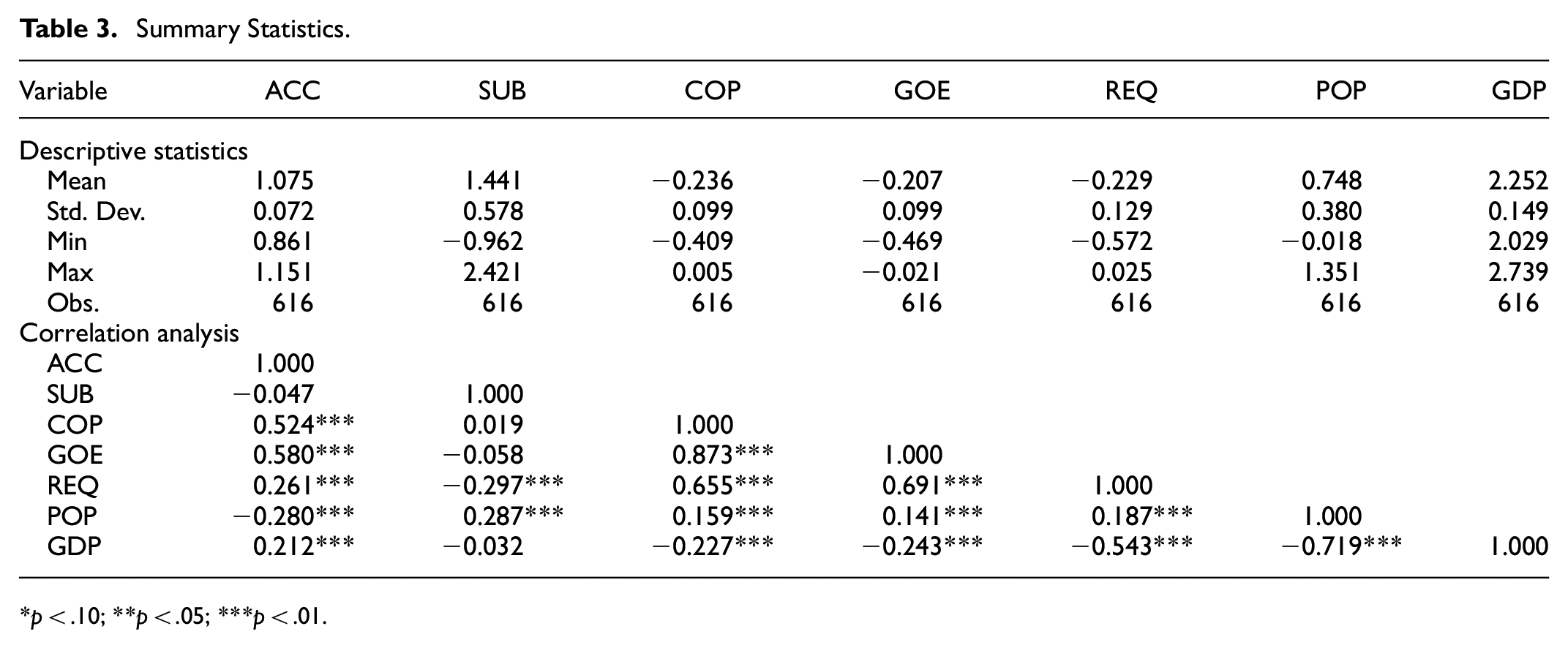
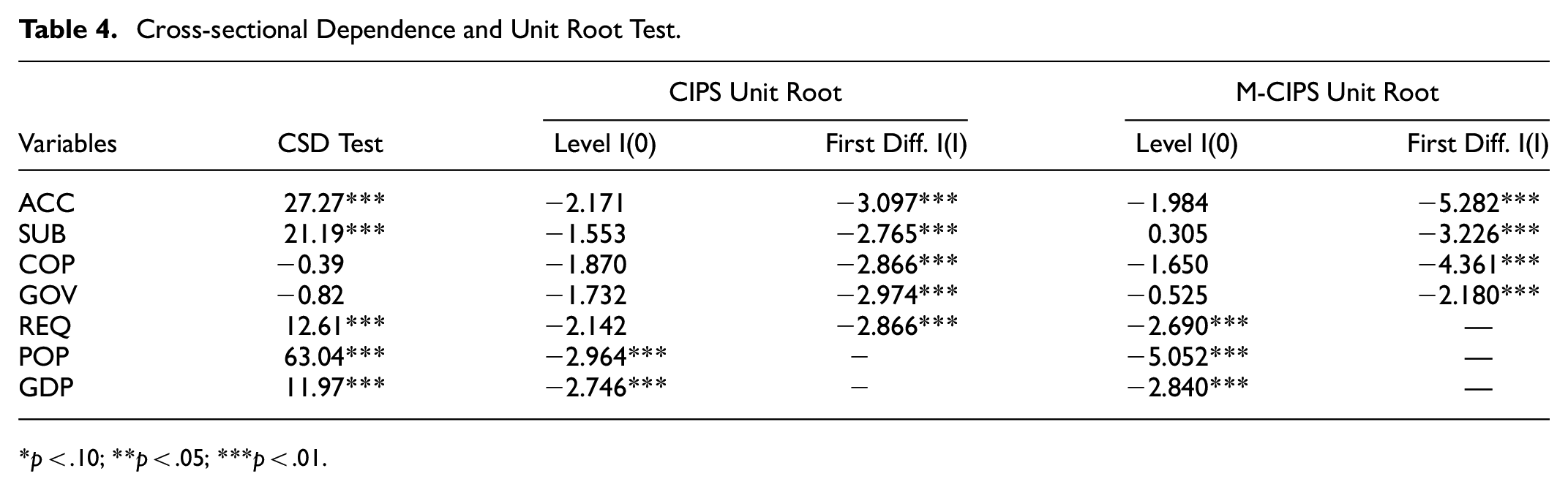
We present two summary statistics in Table 3. The first part shows the descriptive statistics of the data. In the second part, we summarize the pairwise correlation matrix between our variables. In Table 4, we show the result from the Pesaran test of CSD and two variants of the Pesaran unit root test (Cross-sectionally Augmented Im, Pesaran, and Shin, CIPS and Modified CIPS unit root tests, M-CIPS). The CIPS and M-CIPS are vital test of unit roots particularly when cross-sectional dependence is detected in the data. Specifically, the CIPS test incorporates a cross-sectional average of lagged levels and first differences of the individual series in the unit root testing equation, effectively capturing, and mitigating the impact of common factors that might induce cross-sectional dependence (Pesaran, 2007). However, the M-CIPS introduces further modifications to the latter test to enhance test performance by allowing for the heterogenous impacts of unobservable common effects across units. It is also robust to serial correlation and heteroskedasticity (Burdisso & Sangiácomo, 2016).
Summary Statistics.
p < .10; **p < .05; ***p < .01.
Cross-sectional Dependence and Unit Root Test.
p < .10; **p < .05; ***p < .01.
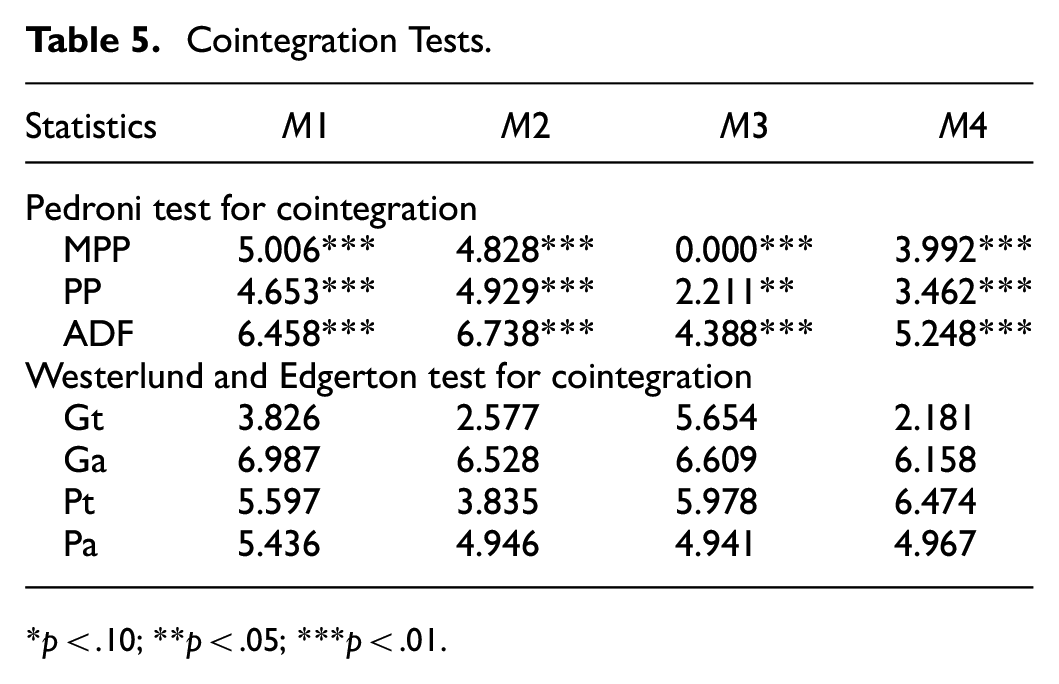
From the result, the CSD test revealed that all the variables except control of corruption and government regulatory quality are cross-sectionally dependent across the panel. Given the presence of cross-sectional dependence, we adopted the CIPS and M-CIPS unit root test. Based on the result from the CIPS test, all variables except population and GDP were unit stationary. In the M-CIPS test, in addition to the latter two variables, regulatory quality, was also found to be unit stationary. Next, we proceed to examine the cointegrating property of the data. Given the existence of a mixed order of stationarity in the data, it may be instructive to apply the ARDL bond test. However, this test assumes that the error terms are independent across cross-sections. In the presence of cross-sectional dependence, the ARDL bond test would lead to biased and inefficient parameter estimates and mislead inferences about the existence and nature of cointegration. To address this issue, we employ the Pedroni and Westerlund & Edgerton test for cointegration which are robust to cross-sectional dependence. Specifically, the flexibility of the M-CIPS also allows for completely heterogeneous specification of both the long-run and short-run parts of the error correction model. 1 This property allows the test to accommodate variables of mixed order stationarity in the ECM and helps to minimize bias in the result.
The result from the cointegration test is presented in Table 5. Based on the Pedroni (2004) test result, we reject the null hypothesis of no cointegration between the variables. However, as Neal (2014) noted, this test cannot account for sophisticated forms of CSD involving mixed stationarity and error correction mechanisms. For this reason, we employ the Westerlund and Edgerton (2008) test which is robust to heteroskedasticity, serially correlated errors, unit-specific time trends, CSD, and unknown structural breaks. Based on the results from this test, we fail to reject the null hypothesis of no cointegration in the panel. Thus, we account for the varying levels of integration and proceed to estimate a static panel model that addresses the CSD present in our data.
Cointegration Tests.
p < .10; **p < .05; ***p < .01.
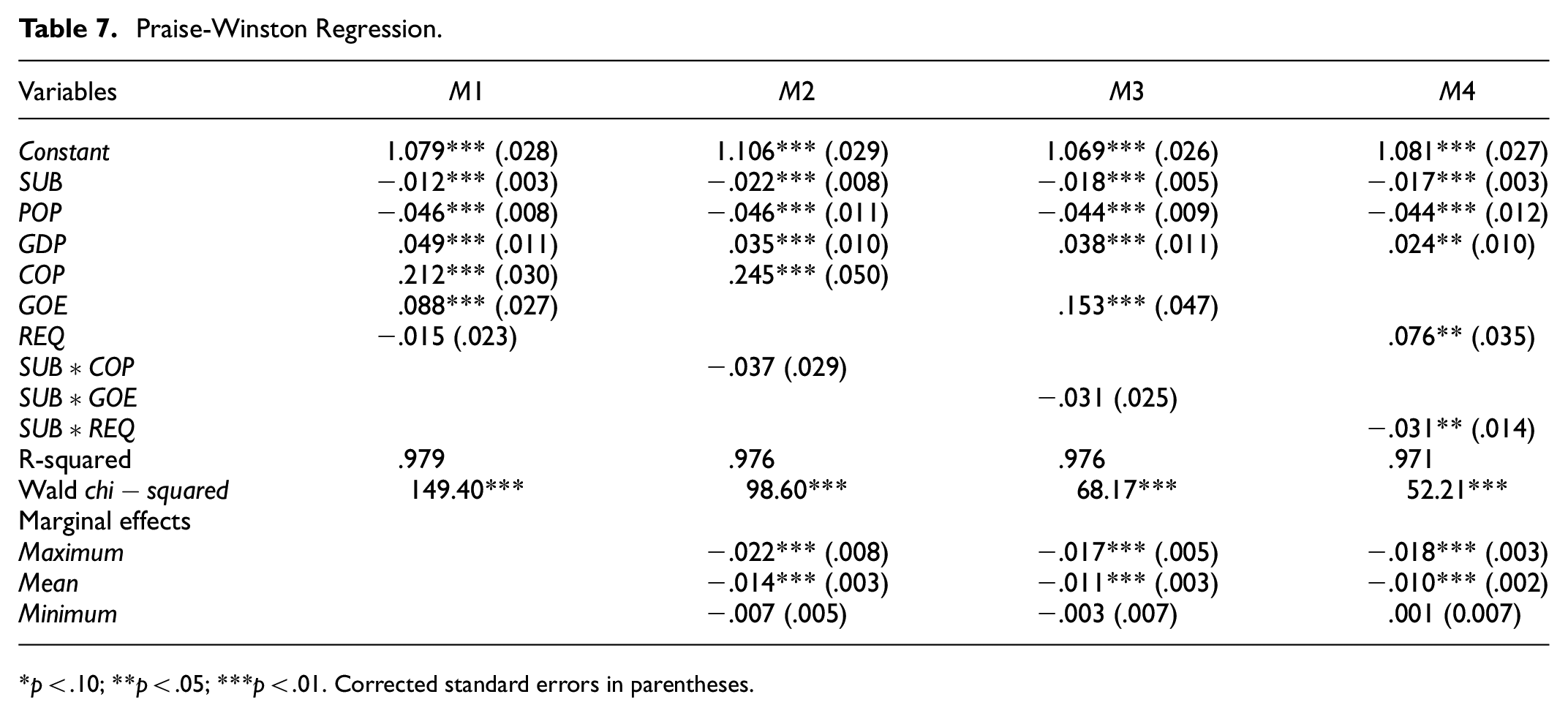
As a preliminary to our analysis, we begin by estimating an auxiliary fixed effect to check for the existence of other potential model robustness problems. From this estimation, we ran a Modified Wald test for groupwise heteroskedasticity in fixed effect regression, and a Wooldridge test for autocorrelation in panel data. Based on the results from both tests (see Table 6), we reject the null hypothesis of homoscedasticity and no serial correlation. Thus, to address the triple problem of cross-sectional dependence, heteroskedasticity, and serial correlation, we estimated a Praise-Winston regression model based on panel-corrected standard errors proposed by Beck and Katz (1995). Hoechle (2007) argued that compared to FGLS which produces unacceptably small standard errors, the Praise-Winston regression is immune to this problem and robust to heteroscedasticity, contemporaneously cross-sectional correlation, and autocorrelation of type AR (1). The result from the Praise-Winston regression is presented in Table 7. We examine the impact of petroleum subsidies and institutional quality on energy access by systematically introducing the three measures of institutional quality and their respective interaction with petroleum subsidies. Column M1 of the table controls for all three measures of institutional quality namely control of corruption, government effectiveness, and regulatory quality. Column M2 to M4 individually and respectively introduces these measures and their interaction with the subsidy variable. However, in each column, we account for the fuel subsidy variable and control for GDP and population.
Fixed Effect Model.

p < .10; **p < .05; ***p < .01. Standard errors are in parentheses.
Praise-Winston Regression.
p < .10; **p < .05; ***p < .01. Corrected standard errors in parentheses.
Across all four models presented in Table 7, the result showed that petroleum subsidies negatively and significantly impact access to electricity. This can be explained by the fact that petroleum subsidies compete for government finance and sap investment in renewables and grid network extension, in addition to undermining the market lucrativeness of clean energies (IMF, 2022; Park et al., 2021; Shittu et al., 2024b). For example, in the recent past, studies have identified that small-scale energy generation systems such as small hydropower plants and home solar systems have significantly improved access to electricity and the quality of life of small households in developing countries (Zhang et al., 2021). This is because the remoteness, isolation, high investment cost, and low electricity demand of rural households in developing countries make them very unlikely to be reached by power grid extension. Consequently, off-grid generation systems (i.e., solar systems) become an ideal solution for higher electricity access to these isolated rural communities (for discussion see Pode, 2013). However, conventional petroleum subsidies discourage investment in these small off-grid power systems by creating unfavorable energy market competition which in turn negatively affects their scale-up. Moreover, since these subsidies are often provided based on energy consumption, households with higher incomes and energy consumption levels benefit more from blanket fuel subsidy policies.
Looking at the effect of control of corruption on access to electricity, the result confirms a positive and significant relationship between the two. This implies that a strong control of corruption helps to promote access to electricity. Indeed, controlling corruption in a country significantly enhances access to electricity by fostering a more inviting environment for both domestic and international investment (Gençsü et al., 2022). With reduced corruption, the risks linked to bribery, unpredictability, and fraud diminish, which in turn boosts investor confidence and leads to increased capital flow into the electricity sector (Chowdhury et al., 2021). This investment is crucial for expanding existing power generation capacities and developing new infrastructural projects like transmission lines and distribution networks. Moreover, with stricter corruption control, public funds allocated for the energy sector are more likely to be used as intended, supporting necessary expansions and maintenance efforts (McCulloch et al., 2021). This proper allocation and use of resources ensure that projects critical to enhancing electricity access are not only initiated but are also completed efficiently and on schedule (Cummins & Gillanders, 2020).
Moving to the nexus between government effectiveness and electricity access, the result shows that an increase in government effectiveness promotes access to electricity. This result can be explained by the fact that an increase in government effectiveness significantly boosts access to electricity by streamlining and optimizing the development and management of energy infrastructure. Effective governance means that government actions are efficient, transparent, and aligned with clear strategic objectives, which directly impacts the energy sector (Sarkodie & Adams, 2020). Enhanced governmental capabilities lead to better planning and execution of energy policies and projects. This includes the ability to implement large-scale infrastructure projects, such as building power plants, laying transmission lines, and expanding distribution networks to underserved areas. Effective governments are also more adept at mobilizing resources, whether by allocating budget efficiently or by attracting foreign and domestic investment through favorable policies (Mahmood et al., 2021). This ensures that the financial and human resources necessary for expanding electricity access are available and used judiciously, leading to timely and cost-effective project completion.
Concerning the effect of regulatory quality on access to electricity, the result shows that improvement in government regulatory quality helps to increase access to electricity. This is because improving regulatory quality can foster a more conducive investment climate, streamline project approvals, promote competition, and ensure sustainable practices within the energy sector (Cubbin & Stern, 2005). High-quality regulation instils confidence among investors, leading to increased capital for infrastructure development, such as power plants and grid expansions (Mahmood et al., 2021). Efficient regulatory processes accelerate project execution, crucial in regions facing rapid demand growth, while competitive frameworks encourage innovation and drive down costs by breaking monopolistic hold and lowering barriers for new entrants, including renewable energy technologies (Costantiello & Leogrande, 2024). Moreover, robust regulatory standards ensure environmental and safety compliance, balancing the expansion of electricity access with sustainability goals. Transparent and fair regulation also builds public trust, garnering support for governmental energy policies and community cooperation in local energy projects, thereby broadening electricity access and supporting overall economic and social development (Mohsin et al., 2021).
Now we turn to the discussion of the interaction terms. The coefficients on the interaction terms between petroleum subsidies and measures of institutional quality are negative as expected. However, Wooldridge (2019) recommends that these coefficients should be interpreted at critical values of the interactive variables typically at their maximum, mean, and minimum values. As such, we compute the marginal effects at these critical values and summarize the result in the lower panel of Table 7. Observably, the role of the three measures of institutional quality in moderating the impact of fossil fuel subsidies on electricity access depends on the critical levels of these variables. For example, only beyond values from the average and above does their impact seems to be significant. This implies that low levels of control of corruption, government effectiveness, and regulatory quality do not significantly help to mute the adverse impact of fuel subsidies on electricity access.
However, at average and maximum levels, their impact becomes significant, implying that, stronger institutional quality in these countries decreases the adverse impact of petroleum subsidies on electricity access. Take control of corruption for example. In developing countries, petroleum subsidies often distort energy markets by encouraging overconsumption of fossil fuels and diverting crucial financial resources away from investments in electricity infrastructure. However, strong control of corruption can moderate the negative impact of these subsidies on electricity access (Cummins & Gillanders, 2020). Effective anti-corruption measures ensure that the funds allocated for subsidies are used as intended rather than being siphoned off through corrupt practices, thus maintaining a greater level of fiscal discipline and resource allocation efficiency (Ruth, 2002). This oversight reduces financial leakages and allows for some of the subsidy expenditure to potentially be redirected toward enhancing electrical infrastructure and services. Additionally, reducing corruption improves the overall investment climate, attracting more private and international investments into renewable and traditional energy sectors (Chowdhury et al., 2021). Such investments are critical for expanding electricity access, especially in underserved areas. Strong governance and corruption control also foster better policy making and implementation, ensuring that subsidies do not excessively burden the state's finances to the detriment of essential public services like electricity.
With regard to the moderating role of government effectiveness on the nexus between fuel subsidies and electricity access, improvement in government effectiveness can significantly moderate the adverse effects of petroleum subsidy expenditure on electricity access in developing countries by enhancing the efficiency and strategic allocation of financial resources (Cubbin & Stern, 2005). When government operations are more effective, there is a greater capacity for robust policy analysis and implementation, allowing authorities to better understand and manage the economic impacts of petroleum subsidies. Effective governments can redirect funds saved from reduced subsidies toward critical infrastructure investments, particularly in the electricity sector (Sarkodie & Adams, 2020). This shift not only balances fiscal priorities but also promotes sustainable energy solutions, which are essential for long-term energy security and accessibility. Additionally, an effective government can implement and enforce policies that encourage energy efficiency and diversification away from over-reliance on subsidized petroleum. Such policies might include incentives for renewable energy development, which not only broadens the energy mix but also reduces the burden on the state’s finances from subsidies, freeing up resources for expanding electricity access (Mahmood et al., 2021). Improved government effectiveness also leads to enhanced transparency and accountability in subsidy management, ensuring that any remaining subsidies are targeted and do not encourage wasteful consumption that can exacerbate energy shortages. Thus, by strengthening policy frameworks, reallocating resources, and fostering responsible energy consumption, improvements in government effectiveness help mitigate the negative impact of petroleum subsidies on electricity access.
Lastly, improvement in government regulatory quality moderates the adverse impact of fuel subsidies on electricity access because it ensures a more strategic and efficient oversight of energy policies and subsidies. High-quality regulations enhance the management of petroleum subsidies by ensuring they are targeted and do not disproportionately divert funds from essential infrastructure projects, including those in the electricity sector (Costantiello & Leogrande, 2024). Effective regulatory frameworks also facilitate the reallocation of resources, whereby savings from potentially reduced or better-managed petroleum subsidies can be redirected toward the expansion and modernization of electrical infrastructure. Moreover, robust regulatory systems introduce and enforce policies that promote energy efficiency and the development of alternative energy sources, lessening the dependency on subsidized fossil fuels and supporting a more diverse and sustainable energy portfolio (Cubbin & Stern, 2005). This shift not only improves the stability of electricity supply but also encourages investments in renewable energy projects, which are crucial for broadening access to reliable electricity. Additionally, improved regulatory quality ensures that the impacts of subsidies on the market are continuously assessed, and adjustments are made to prevent market distortions that could hinder the growth and effectiveness of the electricity sector (Mohsin et al., 2021). Through these mechanisms, enhanced regulatory quality provides a framework for balancing economic, environmental, and energy priorities, thereby safeguarding electricity access even in the context of substantial petroleum subsidy expenditures.
Regarding our control variables, we found that an increase in population size adversely affects access to electricity. This is because increase in population size often poses significant challenges to increasing access to electricity, primarily due to the strain it places on existing infrastructure and the heightened demand for energy (Sarkodie & Adams, 2020). Rapid population growth can outpace the development of electrical infrastructure, especially in regions where the expansion of power generation, transmission, and distribution capacities is already lagging. This discrepancy between population growth and infrastructure development results in a larger number of individuals competing for the same, if not dwindling, energy resources (Chowdhury et al., 2021). On the other hand, the result also shows that an improvement in GDP helps to improve access to electricity. This is because increase in GDP provides the financial resources necessary for expanding and upgrading electrical infrastructure. Higher GDP means that both the government and private sectors have greater capital at their disposal to invest in energy production and distribution projects (Bercu et al., 2019). Economic growth also tends to drive technological advancements and the adoption of efficient energy solutions, facilitating the integration of renewable energy sources into the national grid, which can expand and stabilize electricity supply. Additionally, a stronger economy improves the purchasing power of consumers, enabling more households and businesses to afford electricity and related services.
Our findings overlap with existing evidence in the literature. For example, Bhattacharya et al. (2017) and Chang et al. (2018) have also documented that effective energy policy implementation requires strong government institutions. Similarly, Ahlborg et al. (2015) showed the vital role of institutions in providing and expanding access to electricity. Moreover, given the poor institutional infrastructure, Njoroge et al. (2020) found that 50% of the Mathare households in Nairobi were unmetered and illegally tapping electricity. The authors concluded that electricity provision requires strong government institutions which uphold the sanctity of public funds by discouraging corruption, ensuring effective energy policy implementation and a strong regulatory environment. In three different studies, Dagnachew et al. (2017), Poloamina and Umoh (2013), and Tehero (2021) found that expansion in per capita GDP increases access to electricity because higher income means more and more households can afford the cost of grid and off-grid connection, and government can subsidize the development and deployment of green technologies to expand access to electricity in hard-to-reach areas.
Conclusion, Policy Implications, and Study Limitations
Conclusion
This study examines the impact of petroleum subsidies and institutional quality on access to electricity in 14 developing countries between 2010Q1 and 2020Q4 using a Praise-Winston regression. The result revealed that petroleum subsidies significantly decrease access to electricity. However, improvement in institutional qualities such as control of corruption, government effectiveness, and regulatory quality all helped to promote access to electricity. The result from the interaction of subsidies and all three measures of institutional quality shows that a strong institutional quality is vital for moderating the adverse impact of fuel subsidies on increased electricity access. Thus, this finding supports the idea that fuel subsidies are unhealthy for economic development, particularly with regard to accelerating access to electricity. A strong institutional quality only helps to minimize this adverse impact but cannot mitigate it. Other factors such as economic growth was found to promote electricity access while population growth hampered it.
Policy Implications
Given the findings that petroleum subsidies impede access to electricity, it is crucial for policymakers to reassess and recalibrate their approach to energy subsidies. To address this issue, a practical policy recommendation would be the gradual reduction and targeted realignment of petroleum subsidies toward more sustainable energy initiatives. This approach involves redirecting funds saved from these subsidies to support the expansion and modernization of the electricity infrastructure, particularly in underserved areas. Additionally, the government should implement subsidy reforms that encourage energy efficiency and the adoption of renewable energy sources. By making subsidies more conditional and focused on promoting renewable technologies, such as solar and wind energy, not only can dependence on petroleum be reduced, but also a more sustainable and resilient energy system can be fostered. Such policy shifts should be communicated clearly to the public, highlighting the long-term benefits of reduced reliance on fossil fuels and increased investment in renewable resources.
Improving regulatory quality is another critical step that can significantly enhance electricity access. Governments should focus on strengthening the regulatory frameworks governing the energy sector to ensure transparency, efficiency, and fairness in the distribution and consumption of electricity. This could involve the establishment of independent regulatory bodies tasked with overseeing and regulating power generation and distribution, ensuring that these processes meet high standards of operational efficiency and are free from political interference. These bodies should also have the authority to enforce compliance with regulations and to penalize breaches to deter malpractices. Furthermore, upgrading legal frameworks to support private investment in the energy sector can lead to an influx of domestic and foreign direct investments, crucial for scaling up electricity infrastructure and capacity.
Finally, enhancing government effectiveness and control of corruption are pivotal in mitigating the adverse effects of petroleum subsidies on electricity access. To this end, governments need to implement stringent anti-corruption measures and improve public sector management and accountability. This can be achieved through the adoption of comprehensive governance reforms, including the digitization of public services to reduce human error and opportunities for corruption. Promoting greater transparency in budget allocations and expenditures in the energy sector will ensure that financial resources are used appropriately and efficiently. Moreover, engaging with civil society and stakeholders in a transparent decision-making process can enhance public trust and support for energy policies. By increasing government effectiveness and rooting out corruption, policymakers can ensure that resources meant for improving electricity access are used judiciously and effectively, leading to better overall outcomes in energy service delivery and sustainability.
Limitation and Future Research Direction
Our study faces a number of limitations. Firstly, our sample size is limited to 14 developing countries. While we transform the annual data into quarterly to increase the degree of freedom, this only helps to remedy the small sample size to a limited extent. Additionally, we utilized a a static model as suggested by preliminary test result. Our analysis therefore does not provide insight into the short run dynamics and adjustment process of the variables under consideration. Nonetheless, future research can focus on addressing these challenges. Moreover, researchers can study the economic and environmental impacts of directing fuel subsidies to renewable energy expansion. Investigating the socio-economic outcomes of this resource allocation would also be crucial to ensure that the transition from fossil fuels to clean energy system is inclusive and equitable.
Footnotes
Declaration of Conflicting Interests
The author(s) declared no potential conflicts of interest with respect to the research, authorship, and/or publication of this article.
Funding
The author(s) disclosed receipt of the following financial support for the research, authorship, and/or publication of this article: This work was supported by Ministry of Higher Education Malaysia for Fundamental Research Grant Scheme [Project Code: FRGS/1/2022/SS06/USM/02/26].

Data Availability Statement
Data will be made available on request.