



Abstract
We explored the moderated mediating effect of the causes of corruption in schools on its consequences through prevention and control promoted by leaders’ moral impetus. We surveyed 81 Taiwanese elementary and secondary schools; 1,024 school principals, administrative staff, teachers, and parents completed valid questionnaires, which we analyzed using structural equation modeling. Corruption prevention and control promoted by leaders’ moral impetus partially mediated the relationship between the causes and consequences of corruption. Plundering (non-criminal form) increased and law-breaking behavior (criminal form) weakened the intensity of corruption prevention and control promoted by leaders’ moral impetus. Educational leaders should use moral leadership to decrease plundering and establish whistleblowing mechanisms on social media to support corruption prevention and control to hinder law-breaking behaviors.
Despite existing systems designed to limit corruption in American traditional public schools having been shown to be inadequate (Maranto, 2020) and corruption in schools being a “producer” of organizational pathology and dysfunction (Segal, 2004), researchers generally persist in the neglect of corruption in schools as a research subject (Maranto, 2020). Because corruption in schools leads to waste and misuse of resources (Segal, 2004), which in turn are associated with low performance in schools, the challenges regarding the tackling of low performance in schools continues to show up in many countries (Mosoge et al., 2018), and the response to this low performance differs by country.
Taiwan is one of the countries where corruption in schools hinders school performance. In Taiwan, K-12 schools are under the jurisdiction and supervision of the education bureaus at the county and city levels. As the Department of Education of Taiwan is part of the national political system, politics greatly affect education nationwide and can be a source of corruption in schools (Suleiman, 1991). Further, officials in the Department of Education, principals, parents, and teachers may attack each other politically during a principal’s election (Segal, 2004); this cited research also shows that such conflicts can lead to bribery, extortion, political pressure, alliances, “secret” recruitment (e.g., principals recruiting teachers to substitute active teachers without the knowledge of other administrative stakeholders in the school), and competition among school groups (e.g., over high-quality senior high school programs). Members of parent-teacher association committees, most of whom are engaged in business enterprises, may also get schools involved in corporate interests and teachers may collect money from students for personal use (Segal, 2004). These scenarios harm the condition of Taiwanese schools, endanger students’ rights to education, and encourage the internalization of “bad” values (McCornac, 2012). Against this backdrop, we see importance in reducing corruption within the Taiwanese K-12 educational setting and the need for empirical research on this topic.
To discuss the causes and consequences of corruption, it is necessary to understand the power relationships among stakeholders (Belschak et al., 2018). As discussed in the prior paragraph, the Department of Education of Taiwan is the institution responsible for supervising schools and its budget is controlled by councilors, who are not education professionals. Meanwhile, school stakeholders (e.g., parents, teachers, and Department of Education officers) can influence principal elections; then, once the election is finalized, these stakeholders may find ways to subject elected principals to their influence. People in Taiwanese society also often use their “relationships” to promote hypocrisy, indecision, and to enable others to gain improper advantages (J. Li, 2013), potentially easily leading to excessive ambition, vanity, bragging, and arrogance in society (H. C. Hu, 1944). To deal with these problems, one researcher describes that examining the impact of the causes of corruption in schools on its consequences can facilitate the promotion of solutions based on accountability and the diagnosis of the root causes by educational leaders and other concerned/invested stakeholders (Segal, 2004).
Studies also show that school leaders’ moral impetus toward positive values and the formulation of moral norms can inhibit stakeholders’ abuses of power and reduce corruption in schools (Belschak et al., 2018). Leaders can also serve as moral motivators that promote justice (Bali, 2018) and the internalization of ethical behavior by stakeholders (Osafo et al., 2021). Maranto (2020) demonstrated that schools which rely more on moral values owing to having moral leaders have excellent outcomes pertaining to student achievement and limiting corruption, underlining how moral leaders can help advance the prevention and control of corruption in schools. Accordingly, leaders’ moral impetus is expected to optimally safeguard student interests (Crick & Wilson, 2005).
Albeit the democratic model of local and school governance is theoretically appealing to explain these forms of governance and the corresponding reactions to a wide variety of forms of corruption in schools, in practice, pluralist and elitist models can serve these purposes better (Maranto, 2020). For example, Segal (2004)’s pluralist model distinguishes between criminal and non-criminal forms of corruption. In Taiwan, bribery, encroachment, and fraud are all law-breaking corrupt behaviors, whereas although bullying (S. H. Wang, 2020), class injustice (Huang, 2017), unfair promotions, monopolies, factionalism, and plundering are morally wrong and perhaps even badly regarded by society, they are still common in the country and not illegal (Sophia, 2021). These cited studies also show that monopoly, unfair promotion, and bullying are common corrupt behaviors in Taiwan, even though they are illegal.
Research Purpose
First, this study aimed to discuss the causes and consequences of corruption in schools. Second, to examine leaders’ moral impetus for the prevention and control of corruption in schools. Third, to explore the moderating effect of the interaction between the causes of corruption and various forms of corrupt behavior on the impact of the causes of corruption on its consequences by corruption prevention and control promoted by leaders’ moral impetus.
Research Questions
We shaped our inquiries and conceptualizations around the following questions:
Do the causes of corruption in schools affect its consequences?
Do the causes of corruption in schools affect its prevention and control promoted by leaders’ moral impetus?
Does corruption prevention and control promoted by leaders’ moral impetus affect its consequences?
How do the causes of corruption in schools affect its consequences through prevention and control promoted by leaders’ moral impetus?
How does the interaction between various forms of corrupt behavior (law-breaking behavior and plundering) and the causes of corruption in schools moderate the effect of causes of corruption on its consequences through prevention and control promoted by leaders’ moral impetus?
Research Hypotheses
The hypotheses are:
Literature Review
Corruption in Schools
Corruption in schools has several definitions (Waite & Allen, 2003): the abuse of organizational power that endangers people’s contractual activities, violates public interests (Bandaranayake, 2014), and promotes private/organizational interests (Köbis et al., 2015); as well as authority that enables non-transparent organizational operations and powerful stakeholders to seek private gains (O’Brien, 2020). Hence, it generally involves relevant stakeholders abusing power to seek private and material gains (Miari et al., 2015). Material interests include money and equipment, whereas private interests include power, prestige, promotion, and strategic advantage (Mangafić & Veselinović, 2020). Those with power may be predatory and divert public resources for private use and for ensuring that those privileged (i.e., who have both economic resources and personal connections) maintain their advantages (Peters, 2018) and have their desired individual outcomes achieved (Maranto, 2020). Further, Segal (2004) considers that power abuse is a conduct meant to deliberately advance individual or group interests at the expense of the formal goals of an organization.
Maranto (2020) viewed corruption in schools as an illegal action that undermines the ability of the organization to fulfill its mission: to serve students. That is, corruption in schools refers not just to a sense of illegality but also to the definition of the term corruption, meaning perversion of purpose (Segal, 2004). For the current paper, we defined corruption in schools as stakeholders’ active seeking of private/material gains by illegal actions or perversion of purpose, and the wasting of school resources for such private purposes at the expense of the formal goals of the organization. Still, since illegal behaviors can sometimes facilitate the quest for accountability (Segal, 2004), we did not define illegal behavior that enables schools to serve students (e.g., unauthorized but valid use of resources to enhance student learning outcomes) as corrupt behavior.
In a democratic society, abusers of power within school settings include, but are not limited to: principals, school administrative staff, teachers, and parents (B. I. Spector, 2012). When these and other abusers take the public resources of the school for their private use (Dartey-Baah, 2016), they jeopardize students’ right to learn. Further, a study shows that examining corruption in schools can enhance stakeholders’ awareness of the distribution of power abusers and the problems pertaining to such corruption (Zekos, 2004).
Causes and Consequences of Corruption in Schools
The causes of corruption in schools include hierarchical authority, loose management, social fragmentation, and market competition. First, hierarchical authority in an organization may leave some people unsatisfied because of the related oppression and induce them to seek their private interests (López & Santos, 2014), resulting in the plundering of resources (Sabic-El-Rayess & Mansur, 2016). This condition enables abuses of power such as favoritism, partiality, unfair discrimination, improper use of materials or prestige (Rosenblatt, 2012), and cultural intimidation, creating a pattern through which the person in power enjoys a continuous monopoly that ensures the achievement of own interests (Lumby, 2012).
Second, loose management in an organization can result in covert activities, failure of quality control systems, a lack of incentives, weakened monitoring, the information made public to be of poor quality (Karp, 2007), abuse of power, bribery (Rosenblatt, 2012), and alliances that plunder resources and perpetuate favoritism, embezzlement, and fraud (Bendahan et al., 2015). Loose management also leads to a lack of political awareness among the leadership and to the failure of leaders’ and stakeholders’ endeavors to address ethical decay and auditing malfunctions (Hallak & Poisson, 2007).
Third, social fragmentation can prompt organization members to form cliques aimed at pursuing selfish interests and the misappropriation of public resources by individuals for private gain (Sabic-El-Rayess, 2013). Additionally, clique members in schools may suppress others’ contributions and persuade superiors and the public to accept a definition of performance beneficial to clique members, thereby affecting students’ education, distorting people’s definition of success, and leading to unequal learning (CMI, 2019).
Fourth, one study shows that the effect of corruption on market competition is dependent on the organizational environment (Bologna, 2017), and another that the evidence on the relationship between market competition and corruption is somewhat ambiguous (Alexeev & Song, 2010). Maranto (2020) stressed that American charter schools face market competition and that the more diverse are their interests, the less corruption there is in these schools. Nonetheless, the situation in Taiwan is different, as the country is facing declining birthrates and schools are facing pressure pertaining to the lack of students. Meanwhile, teachers face the constant risk of being forced to teach in schools which they do not like or to resign owing to the lack of students in their current school (Hamelin et al., 2020). Administrative staff also often use fraudulent marketing strategies to increase parents’ motivation to choose specific schools for their children (Hamelin et al., 2020). Thus, despite the remarks by Alexeev and Song (2010) above, the reality of Taiwan may somewhat relate to the notion that greater market competition is often associated with greater corruption (Diaby & Sylwester, 2015). Market competition can also entice organization members to shift from budget-planning to self-interest-related activities, leading some to even break the law to achieve own private goals (Hodgkinson, 1997). Further, it can prompt abuses of power—wherein stakeholders make deceitful claims about market competitiveness to the public (Osipian, 2009)—or the acceptance of bribery (O’Hara, 2014).
The consequences of corruption in schools include the distortion of own professional personality (Cheung & Chan, 2008), the breakdown of social efficacy (S. P. Heyneman, 2007), the accumulation of cultural pathology (Osipian, 2009), and organizational dysfunction (O’Hara, 2014;). Professional personality distortion can even cause student unions to reflect the related corrupt behaviors, deteriorating students’ learning conditions (Osipian, 2008). Corruption also eventually increases the cost of education (Waite & Allen, 2003), dismantles organization legitimacy (Hallak & Poisson, 2007), paralyzes the normal operation of schools (Graycar, 2015), and prompts amoral behavior, corruption-oriented attitudes, and the wearing down of the intention to serve students (Taaliu, 2017).
Corruption Prevention and Control and Leaders’ Moral Impetus
The moral impetus of leaders is defined as the expectation that they will seek to use the moral norms of the organization to shape the judgment of their followers (Kautzman, 2018). Some researchers demonstrated that leaders’ impetus toward the formulation of moral norms can reduce corruption in schools (Belschak et al., 2018). A document by the Corporate Research and Investigations Group (2021) also describes that moral agents (e.g., leaders) must be: impartial; willing to adhere to a moral norm; consider the welfare and interests of all; and make decisions based on holistic information and the problem at hand. Furthermore, by using moral leadership, which encompasses authenticity, balance, and system thinking, educational leaders can successfully create a healthy community (Quick, 2021). After achieving a healthy community, leaders will then consider others’ welfare in their decisions; base their decisions on the most complete information; and become aware that their moral judgments are prescriptive (Challens et al., 2018). Thus, leaders with personal integrity (Maranto, 2020) can help restore corrupt systems through their enthusiasm for improvement and inclusive attitudes.
Moreover, even if such leaders act in isolation from the mainstream culture, their principles can warn those in power not to abuse such power (S. Heyneman, 2015) and guard against the spread of corruption (Johnston, 2013). Leaders can also inspire democratic participation processes, encourage open and dialectical social interactions, unite stakeholders to establish common goals, and promote ideas appropriate for a specific topic (Johnston, 2013). Some researchers also remarked that leaders should establish ethical rules as these can encourage stakeholders’ professionalism, which then enable leaders to promote open discussions that help improve stakeholders’ morality (Gambrell, 2000), school inspection transparency (Gregory, 2015), and children learning, all which serve to reduce power abuse by the promotion of integrity and the quest for accountability (CMI, 2019).
Therefore, leaders may enhance stakeholders’ ability to develop a lean culture through: promoting positive organizational politics (Mahmoudi & Majd, 2021); the disclosure of abuses of power (Lumby, 2012); enabling anti-corruption voices to be heard in the organization (B. I. Spector, 2012); encouraging increased empowerment; establishing professional learning groups; and promoting ethical practices, professional growth, and prudence in practice (Berkovich & Eyal, 2020). By inciting stakeholders to act with discipline (Johnston, 2013), leaders can also inspire stakeholders’ willingness to challenge corruption in schools (Hurnyak & Kordonska, 2018). Furthermore, leaders may practice morality, expand their transparent knowledge (The World Bank, 2021), and reinforce their moral judgments in order to end corruption, support pure motivations (Sabic-El-Rayess, 2013), and reduce power abuse.
Leaders can also promote the diagnosis of corruption, its prevention and control (K. H. Yu et al., 2020), and drive educational progress (Kimura & Nishikawa, 2018). Specifically, they can establish anti-corruption rules that promote compliance with and reinforce fair professional standards (S. P. Heyneman, 2007), as well as motivate decision-making concordant with ethical principles among interested parties (Karp, 2007). Accordingly, leaders could facilitate school reform (Neves et al., 2018) by motivating people to contribute (Efobi, 2015), improving their performance (Sabic-El-Rayess, 2014), promoting moral relationships, reducing pathologies in schools, and facilitating enhanced organizational functioning ( Mo & Shi, 2018). Moreover, by establishing a trustful environment (López & Santos, 2014), leaders can help make stakeholders be willing to disclose corruption and create positive values (Miari et al., 2015). They can also encourage powerful individuals to endow staff with a professional status, discipline themselves to serve stakeholders’ interests (Mozumder, 2018), and motivate stakeholders to make decisions that promote students’ learning (Hartlep et al., 2016).
School leaders can serve as moral motivators (Tan, 2008) who abide by their integrity (Geijsel et al., 2007), and many leaders view moral motivation as a calling (Kautzman, 2018). Principals, as moral role models, should work to create a climate/culture/community that embraces the very value that they espouse (Quick, 2021); then, leaders’ moral impetus can promote moral awareness and courage in others to disclose hidden corruption within a given setting (Maranto, 2020).
Additionally, well-intentioned leaders can accept others’ criticism, behave in a disciplined manner, and promote a sense in the organization that members should undertake responsibilities as a group in order to prevent corrupt behaviors (Sergiovanni, 2005). The promotion of collective responsibility entails that leaders will raise awareness about the responsibility of groups in the organization, encourage collaboration against corruption, and unify power for progress, in turn correcting the organizational environment and discouraging those who seek profits through improper means (Ciulla et al., 2018). Researchers also describe that school leaders should be moral exemplars who can incite shame in stakeholders (Grobler & Holtzhausen, 2018), increase their moral aspirations/values (Voliotis, 2017), willingness to reveal hidden corruption and unfairness, and encourage the evaluation of stakeholder greed (K. H. Yu et al., 2020).
The Interaction Between the Causes and Forms of Corrupt Behavior
Corruption in schools includes bribery, factionalism, plundering, encroachment, monopolies, fraud, unfair promotion (Bandaranayake, 2014; Graycar, 2015), illegality (Maranto, 2020), bullying (Vickers, 2014), and class injustice (Waite & Allen, 2003).
In Taiwan, the promotion of teachers is decided by school performance committees, which are usually monopolized by school factions; these factions then force teachers who want a promotion to do favors for committee members (Zhao, 2020). In the context of Taiwanese education, such corrupt behaviors are not illegal, and research shows that the consequences of corrupt behaviors may differ significantly by whether they break the law. Specifically, Zyglidopoulos et al. (2017) show that prevention and control measures differ by form of corrupt behavior, in that a law-breaking corrupt behavior can induce the moderated mediating effect of the causes of corruption on its consequences and be used to determine the efficacy of corruption prevention and control measures. Law-breaking corrupt behaviors can also determine whether the corruption is controllable, and if not, allow for new prevention and control interventions to be developed (Zyglidopoulos et al., 2017). In Taiwan’s K-12 educational system, stakeholders often avoid engaging in law-breaking behaviors pertaining to sensitive issues (Z. Wang, 2021). As aforementioned, bribery, encroachment, and fraud are all law-breaking corrupt behaviors, whereas bullying (S. H. Wang, 2020), class injustice (Huang, 2017), unfair promotions, monopolies, factionalism, and plundering are non-law-breaking corrupt behaviors (Sophia, 2021).
Both law-breaking and non-law-breaking corrupt behaviors in schools result from stakeholders’ abuses of power, through which the causes of corruption interact with its consequences (Segal, 2004). Thus, determining whether a behavior breaks the law can clarify the interaction between a form of corruption and its causes; helps elucidate the impact of the causes of corruption on its prevention and control promoted by leaders’ moral impetus; and the impact of such prevention and control on corruption consequences (Segal, 2004). Moreover, defining whether a form of corruption and its associated behavior (e.g., law-breaking behaviors and plundering) is illegal can help clarify the moderating effect of the causes of corruption on its consequences for different forms of corruption (Baron & Kenny, 1986).
Previous Studies
Thomson (2014) conducted a study with elementary and secondary school principals and found that examining power abuse among these leaders could arouse awareness of the causes and effects of such abuse. Graycar (2015) conducted a questionnaire among government officers to assess their awareness of corruption-related hazards, determining that the possibility of gaining advantages for the self through such hazards increased the risk of them engaging in corrupt behaviors. Bendahan et al. (2015) studied company employees, finding that a solid power foundation among leaders is a relevant predictor of organizational corruption. Sabic-El-Rayess (2013) analyzed students in five public universities, observing that corruption prevented 20 students from speaking up and caused them to experience mental withdrawal. Finally, Maranto (2020) pointed out that the limits of corruption in schools depend on educational leaders’ integrity, and that these leaders should react to various forms of corruption in schools differently. This author also described that increasing educational leaders’ integrity can reduce corruption in schools because their integrity, when coupled with the market competition that schools face, promotes transparent resource utilization.
Still, explorations on the causes and consequences of corruption in elementary and secondary schools in Taiwan are lacking in the literature, and the few that have been conducted on corruption and organizational transformation have had higher education as the study setting (Waite & Allen, 2003). Thus, this study examined the causes and consequences of corruption in elementary and secondary schools in Taiwan and the motives that lead to organizational transformation. We also explored how leaders’ moral impetus affects the prevention and control of corruption in schools and the interaction between corrupt behavior and the causes of corruption; these examinations were aimed at providing knowledge and a systematic methodology on how to diagnose and reduce the causes of corruption and encourage leaders/stakeholders to jointly assume responsibility for corruption prevention and control.
Although regulations based on democratic processes are relevant to tackle corruption, they have been shown to be insufficient to limit corruption in schools (Maranto, 2020). Thus, this study highlights the role of educational leaders’ awareness of corruption in schools on anti-corruption actions (e.g., formulation of moral norms) and on encouraging stakeholders to prevent and control corruption and help build long-term corruption prevention mechanisms. Further, a prior study has documented that the implementation of some interventions aimed at curbing corruption in schools have instead ended up increasing it (Segal, 2004); we hope that the findings of this study help educational leaders provide correct remediation measures that reduce/avoid the implementation of these interventions that increase corruption.
Methods
Conceptual Framework
Figure 1 illustrates the conceptual framework of this study. This study examined the impact of the causes of corruption (independent variable) (Taaliu, 2017) on its consequences (dependent variable) (Corporate Research and Investigations Group, 2021) via corruption prevention and control (intervening variable) promoted by leaders’ moral impetus—a promotion mentioned in Maranto’s study (2020). Researchers also show that leaders’ moral impetus can prevent and control corruption and enable the moderated mediation effect of the causes of corruption on its consequences (Baron & Kenny, 1986).
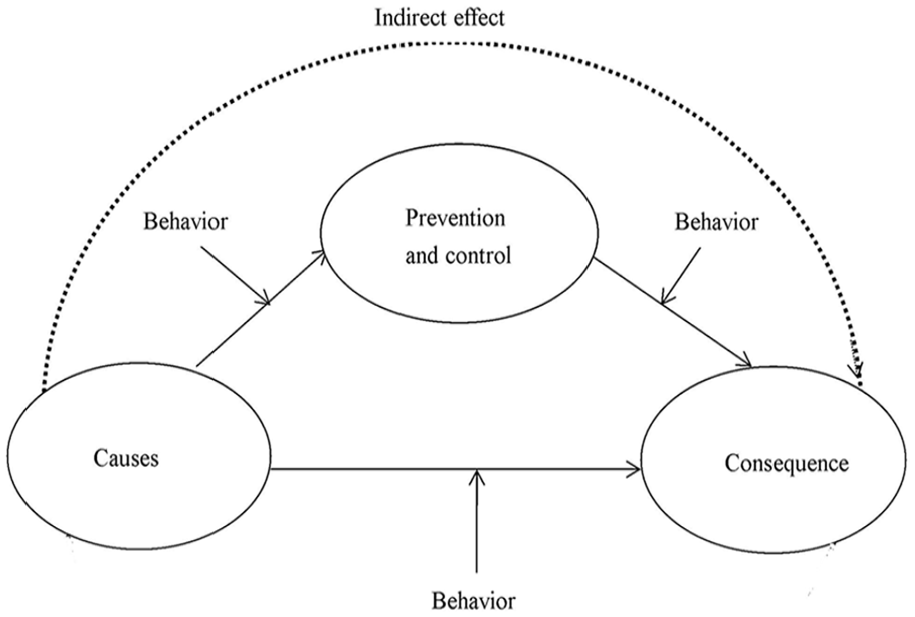
The conceptual framework.
However, owing to the negative correlation between the theoretical relationships and structural equation modeling (SEM), the correlation we set in the statistical software and the positive effects of the model were not determined by the positive or negative signs of the coefficients, but by the positive or negative meanings of the signs for corruption prevention and control. For example, if the coefficient of the prevention and control for both the cause and consequence of corruption is negative, then corruption is weakened. Accordingly, a specific positive indirect coefficient (negative coefficient × negative coefficient) indicates the strengthened effect of corruption prevention and control, while the other form of a positive indirect coefficient (positive coefficient × positive coefficient) indicates the weakened effect of such prevention and control. Similarly, a negative indirect coefficient (positive coefficient × negative coefficient or negative coefficient × positive coefficient) indicates the weakened effect of corruption prevention and control.
Further, research shows that the causes of corruption and corrupt behaviors interact, with law-breaking behaviors and plundering being capable of more clearly stimulating the causes of corruption than other corrupt behaviors (Maranto, 2020), then arousing the responses of the affected variables (M. N. Li, 2019). These theoretical assumptions, coupled with Segal’s study (2004), led us to analyze the intensity of the impact of the causes of corruption on its consequences through corruption prevention and control promoted by leaders’ moral impetus in the context of different corrupt behaviors: one which is subject to prevention and control (plundering) and one which is not (law-breaking behaviors). Therefore, we set corrupt behaviors as the moderating variables.
For these moderating variables to be assessed, they must be clearly defined stimuli. Nonetheless, and despite the Taiwanese culture being related to corruption in schools and containing various examples of corrupt behaviors, it is almost impossible to distinguish different types of corrupt behaviors in practical settings. Hence, when designing the questionnaire, the researchers invited six educational administrators and 10 teachers to promote discussions on how to operationalize these moderating variables. The outcomes of these discussions were the integration of all corrupt behaviors regarding the non-criminal form of corruption into the plundering variable, and that of all corrupt behaviors regarding the criminal form of corruption into the law-breaking behaviors variable. This served to improve the clarity of the questionnaire for respondents.
Then, our analysis of the impact of the interaction effect of corrupt behaviors and causes of corruption on its consequences—through corruption prevention and control (Davidson & Hughes, 2020; Quick, 2021), such as attempts to increase integrity (Maranto, 2020)—showed statistically significant results; thus, we built a moderated mediation model (Baron & Kenny, 1986). A positive value for the indirect effect would suggest that leaders’ moral impetus can help prevent and control corrupt behaviors.
In this study, the effects of corruption prevention and control on both its causes and consequences showed negative values, suggesting the positive effects of prevention and control; this enabled for the establishment of the mediation model. Further, the interaction between the causes of corruption in schools and corrupt behaviors (moderator variables) were found to increase the intensity of the effect of the causes of corruption on its consequences via its prevention and control. In sum, if the indirect effect has a negative value, this would mean that leaders’ moral impetus increases the intensity of the impact of the causes of corruption on its consequences, describing that the corruption prevention and control efforts have failed. This finding would not support the theoretical assumption that moral behavior can facilitate corruption prevention and control (Bendahan et al., 2015).
Sample
Sampling was conducted based on data from the Ministry of Education of Taiwan’s website on elementary and secondary schools. We used a two-stage sampling method. First, random sampling was conducted in medium- or small-sized schools (according to the county’s scale for school size). To ensure representativeness in our sample, five cities in northern Taiwan were selected as the mother group ([blinded for review] City, [blinded for review] City, [blinded for review] City, [blinded for review] City, and [blinded for review] City), and schools with 31 classes or more (hitherto medium-to-large schools) and those with 30 classes or fewer (hitherto medium-to-small schools) from each city were selected for investigation. Sample schools were then selected by school type (primary or secondary schools) and size (medium-to-small or medium-to-large schools) using the stratified proportion random sampling method. We analyzed data from 17 primary and 20 secondary medium-to-small schools and 21 primary and 23 secondary medium-to-large schools, totaling 81 schools.
One questionnaire was sent to the principal of each school; five and seven questionnaires were sent to the administrative staff in medium-to-small and medium-to-large schools, respectively; 11 and 14 questionnaires were sent to teachers in medium-to-small and medium-to-large schools, respectively; and one questionnaire was sent to the parent-teacher association of each school. In total, 18 and 23 questionnaires were sent to each medium-to-small and medium-to-large school, respectively; and 666 and 1,012 questionnaires were sent to primary and secondary schools, respectively.
Given the sensitivity of this questionnaire, calls were made to the teachers responsible for collecting the questionnaires in each school by the researcher to increase recovery rate. When one administrative staff refused, another administrative staff was contacted until all schools agreed to distribute the questionnaire and allowed participants to send back the questionnaires. Two weeks after receiving the questionnaire, an online reminder was sent to anyone who failed to return the questionnaire. All questionnaires were recovered by the end of the third week. The collected questionnaires were examined manually and rigorously, step by step. Questionnaires missing an answer to a continuous variable, with illegible handwriting, and where the questions were all answered with similar responses were all excluded; the software also excluded questionnaires if the single-choice questions in Part 1 were answered as multi-choice questions. After coding, we first performed SEM and then multi-group analysis (MGA) for validating the questionnaires.
The elementary and secondary schools in the five cities were regarded as a single system, and their stakeholders included principals, administrative staff, teachers, and parents. We distributed 1,678 questionnaires and recovered 1,024 valid samples (valid return rate: 61.03%), and 823 samples were further validated via MGA. This study was reviewed by the Ethics Center of the National University. After signing the consent form, which informed participants that the results would be published on a public academic platform, they were tested.
Measures
To prepare the questionnaire, the author first analyzed the content and research scope of the relevant data, reviewed a number of studies on the topic, drafted the questionnaire following relevant theories based on the literature review, and prepared scales for corruption in schools, which included single-choice questions.
The scale of the causes of corruption, including the subscales of hierarchical authority, loose management, social fragmentation, and market competition; each subscale included five questions, totalizing 20 questions. The scale of the consequences of corruption included the subscales of professional personality distortion, breakdown of social efficacy, accumulation of cultural pathology, and organizational dysfunction; each subscale included five questions, totalizing 20 questions.
The scale of prevention and control of corruption included the subscales of the establishment of anti-corruption rules, application of measurement systems, active reflection, mutual inquiry, will for moral practice, democratic participation, leadership with integrity, performance responsibility, and an environment of universal trust. Each subscale included five questions, totalizing 45 questions.
After exploring the relevant literature and experts’ opinions, we decided that the questionnaire would be self-reported. The researchers analyzed the explanatory factors and internal consistency to establish the questionnaire’s reliability and validity, and then created the final version. The questionnaire included a four-point Likert response scale for all scales, corresponding (in descending order from 1 to 4) to strongly disagree, disagree, agree, and strongly agree.
Further, because the acknowledgment of corruption in schools depends on stakeholders’ awareness about it (B. I. Spector, 2012), the questions of our questionnaire were designed in a way to ask for the perceptions of principals, administrative staff, teachers, and parents, rather than to ask for specific facts (Vredenburgh & Brender, 1998).
Preliminary Testing
Six education administration experts participated in the first consultation to test the newly developed questionnaire; this led to the first questionnaire draft. After completing this draft, a second consultation was conducted with 10 school members to examine the questionnaire and its content validity. Further, six schools (two elementary and four secondary schools) were selected via intentional sampling, and 178 questionnaires responded by teachers from these schools were used in the pretest to establish the questionnaire’s reliability and validity. A four-point Likert scale was used in this preliminary test (4 = strongly agree, 3 = agree, 2 = disagree, and 1 = strongly disagree).
Using principal component analysis as an extraction method, Kaiser-Meyer-Olkin (KMO) and Bartlett’s tests were conducted to verify the items. KMO was used to examine the relationships between questions and factor analysis applicability; Bartlett’s test was used to verify the null hypothesis of whether the correlation matrix is an element matrix. A significant result for Bartlett’s test indicates that there are common factors in the correlation matrix of the parent group, and after confirming factor analysis applicability, factor loading tests can be conducted for all questions at all levels. Each construct—the causes of corruption, corruption prevention and control, and the consequences of corruption—had a KMO ≥ 0.70, a factor loading ≥0.60, and a Cronbach’s α of .961, .950, and .970, respectively, indicating good validity and reliability (M. L. Wu, 2009).
Reliability and Validity
After acquiring good pretest results, we tested questionnaire reliability and validity using a sample of 1,024 responses; SEM was performed without bias (Tables 1 and 2).
Reliability Results for the Subscales.

Factor Loadings of the Measurement Model (N = 1,024).
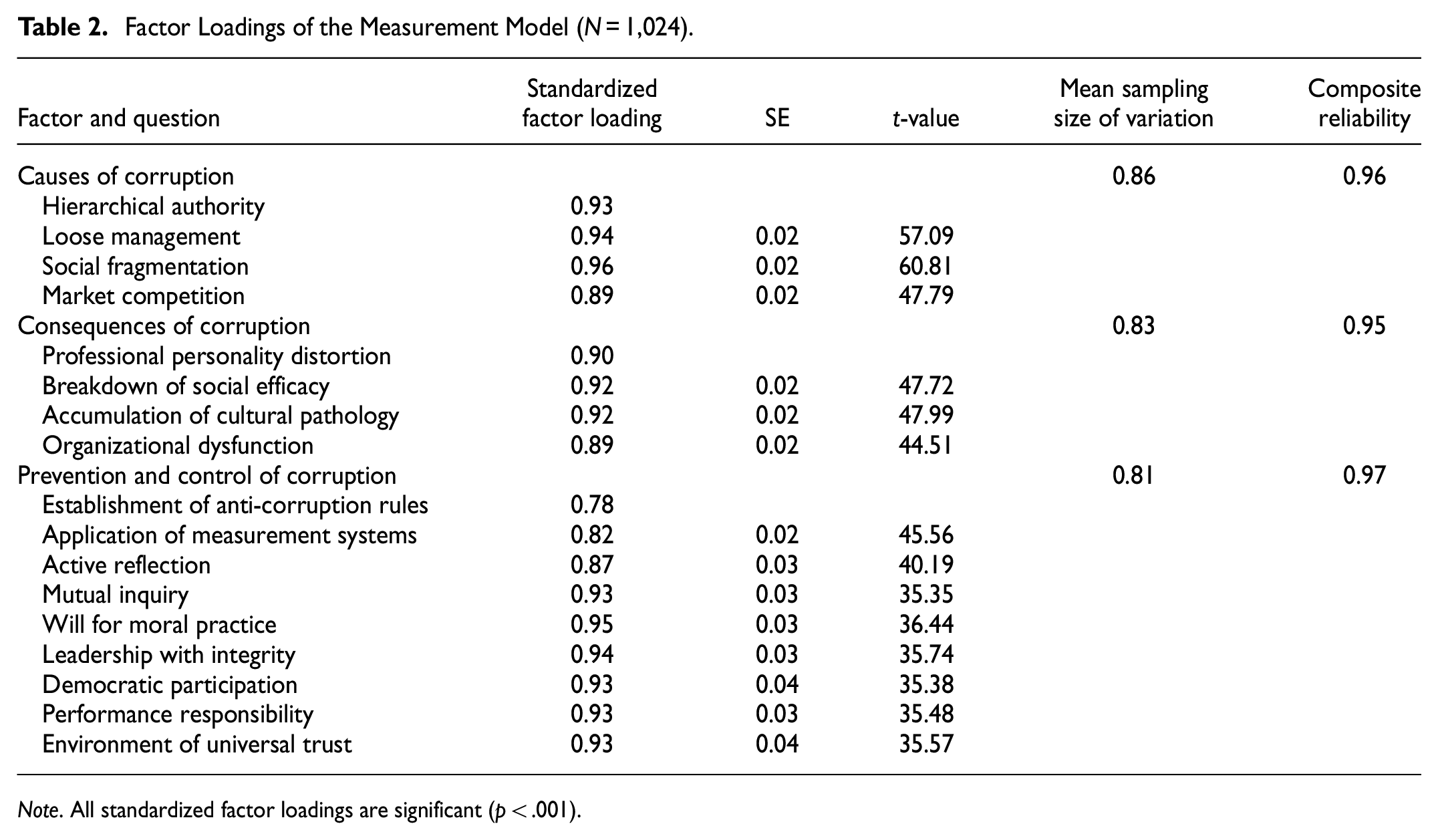
Note. All standardized factor loadings are significant (p < .001).
Anderson and Gerbing (1988) suggested that the measurement model should be tested before the structural model, and that the latter can be validated only after the measurement model has an acceptable degree of fit. The results of the measurement model testing showed that all standardized factor loads were between 0.78 and 0.95 and significant (p < .001); all mean sampling size of the variation of the potential variables were between 0.81 and 0.86; and the composite reliability was between 0.95 and 0.97. These values met the standards suggested by Kline (1998) and Fornell and Larcker (1981). Thus, the tools used had good reliability and validity and the structural model verification would not be seriously affected by measurement errors.
Analyses
The direct effect of the independent on the dependent variables; of the independent on the intervening variables; and of the intervening on the dependent variables were used to verify the mediating effect (Baron & Kenny, 1986). Bootstrapping was also used to verify the significance of the indirect effect and calculate sampling variability (Shrout & Bolger, 2002). A new confidence interval was constructed in the process of re-sampling. The confidence interval (95%) did not pass 0, indicating a significant indirect effect, which was then analyzed using the three steps proposed by Baron and Kenny (1986) to examine the existence of a mediating effect. Given the relationships in the SEM results, there were positive and negative influencing factors; therefore, the results will be explained conceptually.
Considering the sensitivity of the questionnaire, some respondents did not answer them; therefore, valid samples were limited to 823. Amos, version 22.0 (IBM), was used for MGA to: verify the moderating effect by group; investigate the effects of the causes of various forms of corrupt behaviors on their consequences through the influence of corruption prevention and control promoted by leaders’ moral impetus; and analyze whether the intensity of these effects increases by such prevention and control. Together, these analyses led to H5.
Results
Correlation Matrix
Based on the hypothesis model and questionnaire subscales, Figure 2 illustrates a structural model composed of three latent variables and three measurement models comprising four, nine, and four observed variables. Thereafter, the structural model was employed to explain the causal relationships between the latent variables (Table 3).

Hypothetical model for the main research variables and their subconstructs.
Descriptive Statistics of the Variables of Interest and the Correlation Coefficients (N = 1,024).

p < .001. **p < .01.
The hypothesis model revealed that χ2/df = 9.220, p < .05. Moreover, CFI, TLI (>.90), RMSEA (<.08), SRMR (< .05), GFI = 0.881 (<.90), AGFI = 0.843 (<.90), and RMSEA = 0.090 (>.08) (Byrne, 1994; L. Hu & Bentler, 1999; M. N. Yu, 2006); these indicators failed to reach the standards, meaning that the hypothesis model required improvement. When the fit between a model and the data is poor, the model modification index (MI) of Amos, version 22.0, can be used for model revision (Chen, 2021). The MI correction is the chi-square value by which the overall model may be reduced by when parameter estimation is added. Thus, the projections with a larger variation of the MI value were determined after the residuals were set.
We released the covariation parameters of the residual errors of the observed variables, such as “establishment of anti-corruption rules ↔ application of measurement system,”“application of measurement system ↔ active reflection,” and “establishment of anti-corruption rules ↔ active reflection” in three amendments. In the initial hypothetical model, the chi-square value was 1,069.542 (df = 116). After the three amendments, the chi-square value greatly decreased by 582.149, reaching a final value of 487.393 (df = 113). After these parameters were removed, the data fit test for the overall model was conducted (Table 4).
Overall Fitness Assessment for the Model Before and After the Revision.

p < .001.
Verification of Hypotheses
The structural model is shown in Figure 3. If H1–H3 are true, a significant indirect effect in H4 would support the mediating effect. Table 5 presents the results of hypotheses verification.

Structural model of the Structural Equation Modeling with standardized parameter estimation.
Summary of the Direct Effect for the Coefficients of the Structural Equation Modeling.

p < .001.
However, conceptually, the decrease in the causes of corruption resulted from prevention and control; therefore, both were negatively correlated. Prevention and control also had a positive effect on mitigating the consequences of corruption. The bootstrap 95% confidence interval of the indirect effect was between 0.02 and 0.12 and did not pass 0, verifying a significant mediating effect. Specifically, the impact of the causes of corruption on its consequences dropped from 0.85 to 0.77; that of the causes on its prevention and control was −0.68; and that of prevention and control on its consequences was −0.11. Therefore, the indirect effect reduced both the causes and consequences of corruption. Finally, corruption prevention and control through leaders’ moral impetus could influence the effect of the causes of corruption on its consequences.
MGA
To test H5 and verify the three different paths of the impact of the causes of corruption, we conducted an MGA. The moderating effect was further investigated based on the interaction effect between law-breaking behavior and plundering and the causes of corruption. The corruption prevention and control responses to law-breaking behaviors and plundering were also examined to further assess the three aforementioned paths.
The interaction between law-breaking behavior and causes of corruption increased the effect of the causes of corruption on its consequences; on its prevention and control; and of corruption prevention and control on its consequences (Table 3). Both forms of corrupt behaviors moderated the mediation.
Regarding H1 and H3, the difference in the chi-square value (△χ2) between both forms of corrupt behaviors was statistically significant (p < .001; Table 3). Therefore, the form of corrupt behavior was a grouping moderator variable that influenced the impact of the causes of corruption on its consequences, as well as influenced the effect of prevention and control of corruption on its consequences (Figure 4).

Standardized estimations of different corrupt behaviors by corruption cause, prevention and control, and consequence.
Law-breaking behaviors increased the intensity of the impact of the causes of corruption on its consequences, reduced the intensity of the impact of causes of corruption because of its prevention and control by −0.70, and reduced the intensity of the impact of corruption prevention and control on its consequences by 0.39. The causes of corruption also affected the corruption prevention and control mechanisms, causing their impact on the consequences of corruption to have a negative indirect effect of −0.27. Therefore, the interaction between law-breaking behaviors and the causes of corruption drove the effect of its prevention and control and reduced the causes of corruption; meanwhile, prevention and control increased the intensity of the negative impact of the causes of corruption on its consequences (indirect effect of −0.27), causing corruption prevention and control to fail.
Plundering increased the intensity of the impact of the causes of corruption on its consequences, reduced the intensity of the impact of the causes of corruption because of its prevention and control by −0.68, and reduced the intensity of the impact of corruption prevention and control on its consequences by −0.14. Plundering stimulated the causes of corruption, thereafter increasing its prevention and control, which reduced the impact of both causes of corruption and its consequences (indirect effect of 0.10). Regarding this corrupt behavior, the significant impact of the causes of corruption on its consequences through corruption prevention and control rendered effective the moral mechanism of corruption prevention and control.
In this study, the effects of corruption prevention and control on its causes and consequences were found to be negative, while the indirect effect was found to be positive, thus strengthening the effect of leaders’ moral impetus on corruption prevention and control.
Discussion
Corruption in schools in Taiwan is based on the characteristics of the country and its educational system: collectivist authoritarianism; principal selection by stakeholders; factionalized school democracy; and high competition in the educational market owing to low birthrates. We found that the causes of corruption in schools include hierarchical authority, loose management, social fragmentation, and market competition, all of which encourage stakeholders to abuse power and spread organizational corruption. Then, this corruption leads to the consequences of professional personality distortion, accumulation of cultural pathology, the breakdown of social efficacy, and organizational dysfunction. The outcomes of this setting are resource wastage and low efficiency, which then hinders school reform and reduces students’ opportunities for learning and development (Mosoge et al., 2018).
Our results showed that leaders’ moral impetus may be capable of decreasing the causes and consequences of corruption in Taiwanese schools. Similar to previous studies (Maranto, 2020), this study shows that educational leaders should react to the different forms of corruption (criminal and non-criminal) in different ways. To reach this evidence, we used effective contingency approaches to intensify corruption prevention and control promoted by leaders’ moral impetus and then analyze how it reacts to various forms of corrupt behavior. Because we explore the moderated effect of the interaction between the causes of corruption and forms of corrupt behavior, these corrupt behaviors should be concrete stimuli. In the Taiwanese school context, law-breaking behaviors and plundering are associated with the criminal and non-criminal forms of corruption, respectively, as proposed by Segal (2004). As a result, our study shows that leaders’ moral impetus can associate with different corrupt behaviors in different ways, strengthening the prevention and control of plundering—a result similar to that in Maranto (2020)—and weakening that of law-breaking behavior. In relation to this weakening of law-breaking behaviors, research indeed shows that school leaders’ moral impetus, which is based on democratic processes, has been insufficient to limit corruption in schools (Maranto, 2020; Trines, 2017).
Let us explore an example to show the meaning of these results more clearly. Given the low national birthrates in Taiwan, schools must strive to secure student enrollment and a relevant share of the market, making it easy for junior schools that are constantly competing in the market to encourage collusion among its stakeholders (Stein, 2015). These causes of corruption then lead to consequences, such as initiatives to curb corruption in the organization by invested stakeholders. Furthermore, under the pressure of market competition, the principals of Taiwanese schools often require teachers in their schools to join research competitions (held by the Department of Education). Then, principals may use the results (e.g., which teachers may obtain by copying others’ research work) of these competitions to prove for the government/public that the school has excellent performance (S. Wu, 2019), thereafter leading to enhanced student recruitment (Taaliu, 2017). Such actions make the manipulation of student performance by teachers a popular behavior and ultimately result in cultural pathology (Xu, 2022).
Such a reality makes school leaders’ moral impetus important for school reform, and our results corroborate this understanding. Moral leadership in schools can cultivate a belief in solidarity and cooperation, promote personal, social, and organizational intellectual growth (Quick, 2021), and reduce cultural pathology. Further, all of these can serve as corruption prevention and control mechanisms. This moral influence can also stretch beyond a single school, and if it is to ensure education reform, it should actually reach a large cadre of principals that stand by their morals and lead to broad systemic changes that influence high and low levels of the organization (Davidson & Hughes, 2020). As aforementioned, we decided to refer to Solinger et al.’s (2020) definition of school leaders’ moral impetus: a situation wherein individuals take a moral stance on an issue, convince others to do the same, and together spur change in a moral system. That is, the socially-situated emergence of moral leadership and its development into a broader movement that affects moral systems within and across the organization (Solinger et al., 2020). The citations in this paragraph highlight how moral leaders can serve as bridges between the micro- and macro-levels of morality; be both principled and pragmatically savvy; and construct connections between their convictions and those of others that promote common groundings toward change.
A prior study provides an excerpt that concurs with the assumption above that leaders’ moral impetus can enhance collective efforts to curb corruption in schools, specifically by showing that ethical leaders can enhance the “psychological state comprising the intention to accept vulnerability based on positive expectations intention, or behavior of another” (Mozumder, 2018, p. 169), where “another” in the case of our study would be school stakeholders. In general, our results show that leaders’ moral impetus, when used to construct a collective effort toward curbing corruption in schools, can stimulate: prevention and control for plundering; meaningful social interactions for educational development; school reform; effective resource allocation; support for reducing corruption among stakeholders; moral identity in stakeholders; the integration of individual and organizational targets to improve school efficiency; and the practice of actions that lead to these targets (Greenfield, 2004).
Researchers have shown that school leaders can use their moral impetus to prevent and control law-breaking behaviors by stakeholders and the causes and consequences of corruption. Still, the literature also demonstrates that stakeholders’ law-breaking behaviors compel them to hide their wrongdoings and whitewash their image (Russell & Graham, 2016), making the prevention and control of law-breaking behaviors more difficult than that of plundering. Further, when school leaders create an environment of universal trust around the prevention and control of corruption, this trust can easily be used for private gains. For example, stakeholders can use illegal means to conduct black-box operations in the name of morality (Belschak et al., 2018); take advantage of others’ kindness for private gains (Y. Hu et al., 2018); and exchange the private gains obtained from law-breaking behaviors to form corrupt groups, which is a problem that requires great efforts from leaders to be addressed. Therefore, securing the proper internal management of a school alone may not be sufficient for the prevention and control of law-breaking behaviors.
Still, there may be a potential solution to this problem: whistleblowing mechanisms. One study remarks that school leaders are regarded as moral agents who should initiate and implement changes (Quick, 2021). However, the fact that school leaders are regarded as moral agents does not ensure development toward an end-state of enlightened moral goods (B. Spector, 2019). In Taiwan, when faced with corrupt individuals, school leaders may require the Department of Education to play a positive role at the school level. For example, the Department of Education can formulate special laws to encourage schools to establish a comprehensive whistleblowing mechanism for the reporting of law-breaking behaviors (Ambler, 2022) through social media (Bandaranayake, 2014). Whistleblowing has been shown to potentially empower stakeholders to disclose criminal behaviors (Lewis & Kern, 2018), so it can serve as a collective accountability mechanism for increasing public interest in the curbing of corruption (Okafor et al., 2020). Then, whistleblowing can reduce law-breaking behaviors (Schultz & Harutyunyan, 2015). From the perspective of law-breaking behaviors in schools, an ideal whistleblower mechanism would include incentives that appeal to people’s greed (such as material bonuses for whistleblowers), encourage whistleblowers (both inside and outside schools) to report, strengthen law enforcement and its anti-corruption effects (Polinsky & Shavell, 2001), and protect whistleblowers from retaliation.
Recommendation for Educational Leaders and Stakeholders
This study shows that educational leaders or school stakeholders should prevent and control the causes of corruption and its consequences in schools through moral leadership, as well as point to the possibility that school leaders should strengthen prevention and control of plundering through moral leadership and that of law-breaking behavior through whistleblowing. This is because our discussions highlight that leaders’ moral impetus strengthens prevention and control of plundering but weakens that of law-breaking behavior, and prior studies show that securing the proper internal management of a school may not be sufficient to prevent and control law-breaking behaviors completely.
To tackle plundering, formal and informal leaders should inspire and mobilize others to take on a moral stance regarding issues affecting other organizations and society by providing good examples. There should also be efforts at expanding the proposed norms beyond the individual-level to ensure that they reach the communal moral system, thus affecting collectives of actors in the institutional field. Then, leaders’ moral impetus will be given space for transforming stakeholders’ relationships through stimulating mutual peer support toward moral elevation, potentially converting followers into leaders and moral agents.
Additionally, school leaders should strengthen their moral leadership by highlighting moral standards and motivating stakeholders to pursue common goals; these may include the establishment of anti-corruption rules, corruption measurement systems, and performance responsibility. Leaders who show respect for the voices of multiple stakeholders may also encourage negotiation and be capable of employing proper multi-perspective anti-corruption mechanisms that enhance people’s acceptance of anti-corruption plans. School leaders’ moral norms should also compel people to avoid others’ criticisms and maintain a good reputation; to achieve this, school leaders can set good examples and hold themselves to high moral standards. These actions may influence others to improve school conditions, encourage moral behaviors, and enhance school growth, which then maximizes school benefits and minimizes private gains.
To tackle law-breaking behaviors, school leaders should encourage whistleblowing in schools. Then, when and if whistleblowers face lawsuits, the government should take their part and hire lawyers for them. This governmental action may encourage the continued reporting of law-breaking behaviors even in the face of potentially lengthy litigations. Moreover, leaders can use educational laws to empower themselves, which may then enable them to improve: social equity and law-breaking behavior reporting in schools; a culture of positive feedback in the school; and the perception that whistleblowing brings positive consequences (and counters contrary perceptions) for curbing corruption. These actions may then encourage stakeholders to try and maximize public gains, report law-breaking behaviors, promote appropriate conducts, and eliminate stakeholders’ intentions to break the law.
Furthermore, in the face of stakeholders’ law-breaking behaviors, educational leaders should compel the public to report corruption in schools on social media and uphold educational values (Miari et al., 2015). As a “visual” whistleblowing mechanism, social media can facilitate open reporting and discussion. Educational leaders should also provide financial incentives for people that report law-breaking behaviors anonymously on social media to strengthen their willingness to disclose and ensure that they accept the related risks. Moreover, they should encourage key opinion leaders to report law-breaking behaviors.
However, although social media may be useful for whistleblowing, it also has limitations, and its use may entail various drawbacks, including lying, slandering, and other related behaviors (Jian, 2019); thus, social media may be useful for such topics, but also requires certain precautions and its use within this context remains to be examined.
Conclusions
School stakeholders’ capitalistic greed, unprofessional political interventions, election competitions, and parents’ conflicts of interest in school operations are the foundations of the causes of corruption in schools in Taiwan, negatively affecting students’ right to learn. Further, this study shows that invested stakeholders should consider that such corruption is not limited to higher education and give proper attention to corruption alleviation in elementary and secondary schools nationwide.
Specifically, school leaders should formulate moral norms for corruption prevention and control, albeit establishing the role of stakeholders in corruption prevention first requires the identification of corrupt behaviors. Our findings show that the law-breaking nature of the behavior can serve as a distinguishing characteristic to better define the needed prevention and control mechanisms in a school. In this regard, school leaders’ moral motives and norms can help clarify the interaction between the plundering of resources and the causes of corruption, and a better understanding of this interaction can help reduce the consequences of corruption. However, our results also showed that only the internal pressure of moral leadership may be insufficient to effectively reduce corruption. Therefore, it may be wise for educational moral leaders to focus their efforts to reduce corruption on promoting moral norms not only internally but also externally to the school (e.g., in the nearing communities or stakeholders external to the school environment). Future research can examine whether such external efforts yield positive results for reducing corruption in schools.
Our results also show that school leaders’ moral impetus may be unable to inhibit stakeholders’ law-breaking behaviors, resulting in poor corruption prevention and control. These law-breaking behaviors, thus, require higher-level leaders (e.g., the Director of the Education Bureau in Taiwan) to take the responsibility for prevention and control. Educational leaders should also formulate effective norms for corruption prevention and control and establish whistleblowing systems, which may encourage stakeholders to report law-breaking behaviors. We also see space for the recruitment of professional lawyers to protect whistleblowers and quell potential retaliations.
Limitations
This study used questionnaires to examine corruption in schools from stakeholders’ perspectives, so our data were based on their perceptions, not facts, entailing that the conclusions drawn should be considered with care.
Moreover, we used SEM to test the moderated mediation effect of the interaction between the causes of corruption and corruptive behaviors; however, it is hard to test the effect of various forms of corruption in schools through SEM because these are concrete stimuli. In the future, qualitative case studies should be conducted to investigate corruption in schools more in-depth; they should rely on documents from court trials, research various forms of corruption, and develop a litigation strategy.
Another limitation of this study is that its results cannot explain the prevention and control of law-breaking corrupt behaviors. Future studies could analyze media reports about such behavior to determine feasible and appropriate prevention and control mechanisms.
Although we used SEM to verify the validity of the mediation hypothesis, we still want to highlight its limitations; SEM cannot be used for unquantifiable background variables, and SEM testing requires a rigorous theory as its foundation (S. F. Lin, 2011). Therefore, before applying SEM, researchers should establish a rigorous theory through extensive literature discussion, deliberations with academic experts, and ensure good construct validity and reliability in the preliminary test.
Footnotes
Acknowledgements
I would like to thank SAGE Author service for English language editing.
Declaration of Conflicting Interests
The author declared no potential conflicts of interest with respect to the research, authorship, and/or publication of this article.
Funding
The author disclosed receipt of the following financial support for the research, authorship, and/or publication of this article: the research reported in this paper was supported by National Science and Technology Council, R. O. C. (Taiwan)
Ethics Statement
Approve by the Center for Research Ethic of National Taiwan Normal University.
Consent
An informed consent statement was included in the cover letter of the questionnaire. Only those participants who consented to participate completed the questionnaires. Furthermore, the email addresses of the researchers were provided on the cover page of the questionnaire to aid feedback and ethical review and approval.
