




Abstract
The purpose of this study is to determine whether governance has an impact on per capita income. The governance-prosperity hypothesis was validated using data from 48 high-income countries. This study examines all governance indicators in sample countries rather than one that addresses specific effects. We find that good governance enhances prosperity, while FDI, exports, and urbanization positively impact effective governance outcomes using homogeneity and heterogeneity panel methodologies. In contrast, household expenditures exhibit a diverse relationship that requires a combination of saving policy and spending to increase per capita income. We found that effective governance attracts foreign direct investment, leading to high exports and urbanization trends. Therefore, countries should strengthen their governance apparatus to reap the benefits of sustainable economic growth.
Keywords
Introduction
Increasing and maintaining economic development to improve social welfare is one of the most vital socio-economic goals any country strives to achieve. Many nations experienced a severe economic decline in the new millenium owing to periodic international crises and poor macroeconomic management. However, economic development has traditionally been studied in physical & human capital formation, technical invention, and global economic integration, while the governance role is critical but neglected. The importance of governance at the economic, social, and political levels can catalyze development (Azam, 2022). For centuries, governance and prosperity have been inextricably intertwined, and the concept of a prosperous state that sprang from this relationship is crucial in today’s global scenario (Kaufmann et al., 2009). This study examines the relationship between governance indicators and prosperity arising from economic development. Kaufmann et al. (2006) and Daude and Stein (2007) evaluated the governance-prosperity nexus, albeit with a limited data set. Recent literature reveals that governance positively impacts the economy, but these studies are contextual. Many researchers have empirically tested GPH using a variety of economic indicators, including FDI, urbanization, exports, policies, regulation, and terrorism, or a single governance dimension; however, to our knowledge, all governance dimensions and their relationship to per capita income of people in a heterogeneous context have not been studied In the African region, governance positively impacts prosperity (Bah et al., 2021; Effiong & Okijie, 2021; Iddawela et al., 2021; Møller & Roberts, 2021) while Mahmood et al. (2021) endorsed the positive nexus in Asia. Similarly, X. Xu et al. (2021) reveal that governance quality improves economic growth, reinforcing the relationship, especially in a globalized world due to corruption-free or transparent policies in the accountability framework. Nevertheless, one of the critical limitations of these studies is the economies’ homogenous assumption, which is naive and troublesome in such a dynamic-globalized world. Therefore, the concept’s viability in heterogeneous settings is yet unknown, one of the driving forces behind this research.
In this study, Governance Prosperity Hypotheses (GPH) assume governance is a catalyst for boosting per capita income in sample countries. Different scholars tested the GPH and discovered a positive association between a country’s governance and per capita income under the homogeneity assumption (Azam, 2022; Kaufmann et al., 2009; Kaufmann & Kraay, 2002). However, economic homogeneity is a naive notion rarely believed due to social, economic, and governance disparities. Therefore, empirical studies based on the assumption of homogeneity are incapable of capturing the complexity of governance and per income per capita mechanism. Our study aims to demonstrate that either governance improves people’s living standards or is a myth or reality. Since 1996, Worldwide Governance Indictors have included more than 200 nations, with six composite measures reflecting broad governance dimensions. These are political stability, corruption control, government effectiveness, regulatory quality, voice and accountability, and law and order situation. Researchers claim that the dimensions are crucial in each economy for attaining development goals (Daude & Stein, 2007; Kaufmann et al., 2006). We tested the dimension’s relationship with prosperity at the disintegrated level and a single aggregate score based on the equal weighting principle (Gerged et al., 2023). Other secondary aims include determining the effects of a high degree of FDI, consumption expenditure, export, and urbanization on per capita income in sample nations.
We argue that governance simultaneously impacts the economy at the micro and macro levels (Abdo Ahmad & Fakih, 2022). Microelements turn into macro and boost a country’s social and economic well-being, attracting foreign direct investment and increasing economic activity and enterprises. This situation promotes urbanization intensity coupled with economic activities for businesses that can export, increasing exports beyond saturation and providing prosperity. This link is being strengthened by improved export, infrastructure, urbanization trends, and an increase in household savings. Well-established governance structures enhance the success of an economy by increasing people’s purchasing power and raising their living standards. To summarize, governance is a tool for transforming a capitalist economy into a welfare economy, sometimes known as a conversion mechanism from “how to wow” (Kaufmann et al., 2011).
There are variances in prosperity and governance due to the size of economies and policies adopted by different regions. After years of debate, a consensus has evolved that the governance structure is vital for the capitalistic economic system’s success. We endorse it empirically and find better governance enhances prosperity; likewise, FDI, export, and urbanization positively contribute to prosperity under homogeneity and heterogeneity panel methodologies. In contrast, household expenditures show a diverse relationship requiring a blended saving policy and spending to uplift per capita income. Our results indicate good governance attracts foreign direct investment, delivers high exports, and increases urbanization trends.
The main contribution of this study is empirical; literature follows the homogeneity of economies which is far from reality. Indeed, mean-value differences in per capita income, governance, and the Effect (PANSEE) contribute to country heterogeneity. This empirical study employed the cutting-edge Panel Correct Standard Error (PCSE) method to investigate the connection between better governance and economic development. At the same time, similar research has been done using more traditional methods of panel data analysis, like random effects or fixed effects, which cannot simultaneously deal with the issues of contemporaneous correlation and autocorrelation. Furthermore, we provide an aggregate ranking index that incorporates all the governance dimensions rather than titles toward some specific aspect. The first innovation of the study reveals that governance for prosperity by assuming heterogeneity assumption is appealing as it controls the country’s specific effects. The second innovation discloses an aggregate governance score with equal weight rationale because of its importance to all governance dimensions because the individual dimension may mislead or superfluous the results. The PCSE method is a robust approach that considers country dependence and delivers efficient estimates. Additionally, we conducted diagnostic tests to ensure that each model was appropriate. This article makes several contributions to the existing literature: (i) utilizing heterogeneous modeling to determine the GPH validity in conjunction with the PCSE method, (ii) incorporating diagnostic tests to determine the best model selection; (iii) establishing an aggregate ranking percentile score based on its dimensions; and (iv) utilizing rigorous modeling and expressive interpretation in the event of each statistical issue. We also contribute to two theoretical concepts in the public policy domain. First, Institutionalism refers to and emphasizes the role of institutions in governance; second is Incrementalism, which refers to the decisions that are not made all at once and are refined through trial and error to reach the output of good governance. This research endorsed the two theoretical underpinnings of Incrementalism and Institutionalism for good governance.
Literature Review
Governance and Prosperity
Powerful lobbies and lucrative business incentives impact economic growth and lure the organizations for their gains. Besides other factors, Varese (1997) explored that relaxation in monetary benefits provides opportunities to commit corruption and fraud. He further explored powerful lobbies, and tax exemption was vital to Russia’s corruption. Asiedu (2006) argued that corruption has a more negative effect on real GDP per capita than political stability, whereas Blackburn et al. (2006, 2008) proved corruption as the architect of poverty traps. One school of thought claims that a mild level of corruption enhances economic growth by promoting business. It says corruption and economic growth have a negative relationship in a well-governed country, but in poor-governed countries, the scenario shifts (Aidt et al., 2008; Méndez & Sepúlveda, 2006). Aidt et al. (2008), another opponent of corruption, empirically showed corruption reduced growth by inefficient usage of FDI in politically unstable economies. D’Agostino et al. (2016) concluded that corruption negatively impacts economic growth when interacting with investment and spending. The researchers established that corruption affected growth directly and indirectly. Boussalham (2018) advocated that corruption harmed economic growth, and controlling corruption is a vital factor in enhancing economic growth. He devised a broader corruption perception index for Mediterranean countries and empirically proved it. Corporations and people feel more freedom, more economic confidence, and limited unwanted cash flow in a less corrupt country. So, we expect a positive impact on economic growth and per capita income. Corruption control is one of the essential elements of governance indicators, so we expect corruption to link with people’s prosperity directly.
La Porta et al. (2000) proved that poor law and enforcement policies restrict institutional efficiency and result in smaller secondary markets. Later, Demirgüç-Kunt and Maksimovic (1998) extended it to the country level and advocated the notion that “A robust legal system is beneficial for the country and institutions.”Acemoglu et al. (2001) endorsed that well-governed financial institutes are compulsory for economic growth and a better mechanism that reduce poverty. Rammal and Zurbruegg (2006) investigated the fragility of regulatory quality and ineffectiveness hurt the development of countries and hindered the efficient FDI flow. Haidar (2012) empirically tested business, regulatory reforms, and economic growth in 172 countries by handling heterogeneity across countries and found a positive nexus. Mira and Hammadache (2017) endorsed this notion and pinpointed that efficient institutions were crucial for distributing political power for uplifting economic growth. In a more regulated country, corporations and people feel more freedom and high confidence of corporations and people. Regulatory is one of the essential elements of governance indicators, so we expect a well-regulated economic environment to link with people’s prosperity. So directly, we expect a positive impact on economic growth and per capita income.
Although negatively related to economic growth, the voice and accountability are better in the policy development and implementation phase. Voice and accountability mechanisms foresters better economic policies, especially in revenue collection, and thus enhance economic growth in the long run to uplift wellbeing and corruption reduction (Bird et al., 2008).
Kaufmann et al. (1999) found that government effectiveness and law & order were positive factors while voice and accountability were negative for economic growth. Alam et al. (2017) found a positive nexus between government effectiveness-growth relationships in 81 countries. They found an asymmetry in the finding that government effectiveness promotes economic growth with different control variables, with important ones being FDI and trade. An efficient and well-governed economy is an engine to accelerate people’s living standards. Beck et al. (2000) and Levine et al. (2000) endorsed by extending that implementing such factors is key to growth. Samarasinghe (2018) studied all dimensions of governance established by the World Governance Indicators (WGI) and proved that controlling corruption and political stability is crucial to economic growth. Walking On his footprints, Kraipornsak (2018) asserted that good governance should be the millenium goal of the economy because of its unchallenged significance. Measurement of governance is debatable, and researchers used specific variables or an index with theoretical justification. Liu et al. (2018) devised a comprehensive governance quality index for provinces and concluded that governance and its quality positively impact economic growth. Abdelbary (2018) asserted that the positive nature has a long-run relationship with social inclusion. Lahouij (2016) deviated from mild perspectives by adding economic freedom and FDI, but their long-term relationship varies.
Ellahi et al. (2021) revealed that crisis and recession are results of f liberalization directly or indirectly either impact directly or indirectly in the SAARC region. However, institutional and legal factors are vital in financial and economic growth. Agyei and Idan (2022) examined the moderating role of institutions in trade and growth relationships in 39 African countries from 1996 to 2017. They found institutions strengthen the relationship between trade and growth. Extending the indirect relationship discussion, Osarumwense and Igor M (2023) tested the mediating role of institutions in 161 economies from 1998 to 2019. They found that institutions stimulate higher economic growth and accelerate economic integration. These studies endured the Institutionalism approach that refers to and emphasizes the role of institutions, especially in governance.
The governance role is not limited to economic prosperity, but recent environmental considerations integrated the governance relationship with environmental and economic well-being simultaneously. Arif et al. (2022) studied the dimension of governance and their impact on pollution prevention and ecological welfare. He found government effectiveness, voice and accountability, and regulatory quality played an important role in pollution prevention, and the governance dimensions by index approach reduce pollution in Pakistan. Similarly, Sun et al. (2023) revealed that a sustainable governance structure is crucial for achieving sustainable development objectives. He found government effectiveness and corruption control affect ecological footprints in the BRICS region, except in China and India. They found political stability and regulatory quality enhanced energy efficiency, thus contributing to sustainable economic development. Following the Sun footprints, Y. Zhang (2023) studied the ASEAN regions in the context of energy transition and governance by rigorous empirical estimation. They found that “political stability, the rule of law, and regulatory quality significantly and positively affect energy transition, whereas government effectiveness and control of corruption play negative roles in energy transition.”
Manasseh et al. (2022) examined the relationship of debt, debt volatility, economic growth, and governance dimensions. They found that debt reduced the economic growth in African countries, but with better governance, it provided positive results. They found with the interaction of governance dimensions, the relationship chances, which means governance is a positive element for rational debt management. Zeqiraj et al. (2022) assumed the dimensions of governance as institutional quality in 73 developing countries and found institutional quality promotes access and use of financial services by enhancing the trust element, thus contributing to economic growth indirectly. Beyene (2024) examined the governance dimension and their index on economic growth in 22 African economies. They found law and regulatory quality has a positive relationship with growth, while corruption control and government effectiveness show a negative relationship. However, they found “a unit improvement in the aggregate governance index leads to a 3.05% increase in GDP.” Similarly, Mahran (2023) examined the nexus between governance and economic growth in 116 countries and found “1% increase in governance raises the economic growth on average by 1%.”
The above literature pinpoints the positive impact of governance and economic growth. Economic growth and living standards are logically connected, but checking per capita income is still missing in the existing literature. This study uses the aggregate governance score of all dimensions of the WGI with equal weightage simultaneously and isolation with per capita income to fill the gap. In this study, the concept of governance is based on WGI like political stability, corruption control, government effectiveness, regulatory quality, voice and accountability, and law and order situation in the economy. All the dimensions have the potential to increase the per capita income of people, so we devise the hypothesis
H1: As the governance of the country increases, the per capita income increases (Governance Prosperity Hypothesis)
How FDI, Urbanization, Export, and Government Spending Impact Per Capita Income
Besides governance, some critical factors can impact the per capita income in any country: export, FDI, and government spending. These variables increase the economic activity and business opportunities that ultimately affect per capita income. Hansen (1990) explored that main cities are becoming bigger while towns and small cities were ignored in developing economies. It leads to the difficulty of implementing effective policy and disproportions in urbanization. Henderson (2003) empirically endorsed the nexus of urbanization-prosperity with a panel of 100 countries. He found more inclination toward a road infrastructure that boosted economic growth in countries with low PCAPI. A rural-urban income gap impels the rural to settle down in urban densities where job opportunities exist to mitigate labor shortages and thus enhance businesses and export and uplift per capita income on individual and collective scales (K. H. Zhang & Song, 2003).
The expansion of business activities increases PCAPI, although income-expenditure inequality arises during the period. A recent study shows that a high degree of urbanization enhances efficiency in economic growth in the early stages of economic growth (Nguyen & Nguyen, 2018). Rapid urbanization brings an infrastructural shift from an agricultural economy to an industrialized economy. The infrastructural development shifts the consumption pattern upward, expands businesses, provides new opportunities, and brings economic efficiency by reducing labor shortages. So, we expect urbanization brings prosperity export undoubtedly improves economic growth in developing and developed countries with better economic infrastructure (Dollar & Kraay, 2002; Vohra, 2001). Different empirical time-series and panel studies had confirmed the export–economic growth nexus and found it prominent in developed and developing countries. Export paved the way for globalization and increased trade with limited trade barriers (Dollar & Kraay, 2003). So, we expect export brings prosperity Hellman et al. (2003) found a positive relationship between governance and FDI and causal feedback effect in transitional economies. Many empirical studies focused on the FDI as an essential factor for economic growth. For example, Razin et al. (1999) show that in an environment with asymmetric information, FDI can have positive welfare effects in credit markets.
Rowland and Tesar (2004) and Hull and Tesar (2000) found that FDI is a mechanism for risk diversification. B. Xu and Wang (2000) found FDI influenced growth. Alfaro et al. (2004) investigated the relationship of FDI on the panel data set of 39 countries from 1981 to 1997. Hermes and Lensink (2003) worked on 69 economies and found a positive relationship between FDI and economic growth, while Borensztein et al. (1998) endorsed the positive nexus in f industrialized countries. FDI improves domestic production and brings new entrepreneurial activities into a financial setup that could boost economic growth (Alfaro et al., 2004). However, FDI volatility impacts long-term decision-making for foreign portfolios (Fernández-Arias & Hausmann, 2001).
Data and Methodology
In this study, GDP Per Capita Income (PCAPI) measured by Purchasing Power Parity (PPP) method is a proxy of prosperity used as an outcome variable. In contrast, the Aggregate Governance Score (AGS) is a proxy of governance, while Foreign Direct Investment (FDI), Export, Household consumption expenditure (EXP), and urbanization (UB) are control explanatory variables. AGS consists of equal weights of political stability (PS), corruption control (CC), government effectiveness (GE), regulatory quality (RQ), law & order situation (LOS), and voice and accountability (VA). World Bank Indicators and World Governance Ranking reports are this study’s primary data sources. Table A.1 provides the Variables’ description operationalization and measurement method.
To tackle the issue of multicollinearity, we used a single proxy of AGS based on equal weighting reflected below.

This procedure produces a single percentile ranking score for each observation consisting of Equal weightage to all governance dimensions based on the rationality of equal importance to all aspects and the unavailability of previous literature about its weighting. Zero or near-zero scores of this method reflect the deplorable condition of a country’s governance in the respective year, and a hundred or near hundred scores show the excellent condition of the country’s governance in the specific year. This new formulated explanatory variable removes the issue of multicollinearity; it is easy to handle and interpret and provides robust use in complex models in further analysis. We present the newly formulated explanatory variable graphically for details (Figures A.1 - A.8). AGS has a significant 67% correlation with outcome variables which justifies the role in equations. PCAPIit denotes GDP per capita income, AGSit governance ranking is measured by percentile scores, and FDIit represents Foreign Direct Investment to GDP. Governance, PCAPI, AGS, and FDI are used as continuous variables. At the same time, exports, consumption, and urbanization are dummy variables coded as one if the variable value is more than the 50% threshold in the sample.
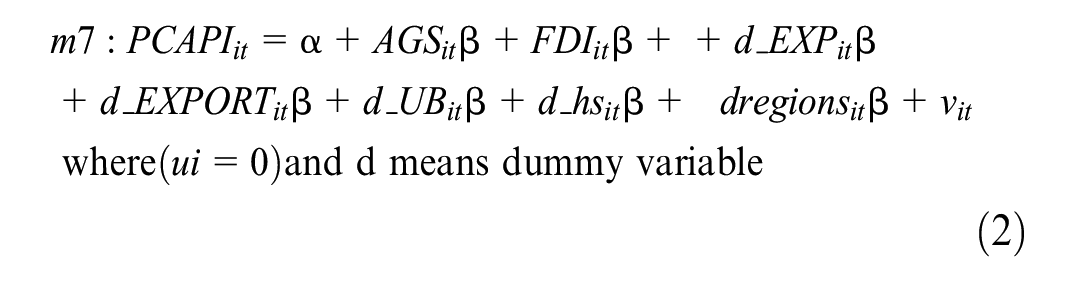
We applied a linear panel method after pre-estimation, which is revealed in Figures A.9–A.12. After that, the model evolution phase starts from simple (m1) to complex (m7) tested in the panel setting. This study applied OLS estimation assuming homogeneity among countries (Table A.3). It is a simple method but provides a significant finding. Usually, panel data faces heterogeneity issues, so FE (Table A.4) and Random RE modeling are also performed to select the best one. F-test gives us a clue of countries’ effects, while the Hausman test suggests the results are random. Unfortunately, the RE model (Table A.5) cannot incorporate cross-country dependence and auto-correlation existing in our study; therefore, keeping all of the above in view, to find the relationship between governance and prosperity, this article applies model m1–m7 and test the connection under homogeneity and heterogeneity panel settings
In the modeling evolution stage of this article, we begin with pooled regression, that is, ordinary least squares (OLS), and gradually evaluate the potential problem of observed or unobserved heterogeneity in the models. Diversity of countries based on some economic, social and regulatory environment. These can be as Policies, Ability, Norm, Sociology of civilization, Education, Enforcement of policies; these reasons are abbreviated as PANSEE effects in this study. The PANSEE effect leads us to adopt a method which control omitted variables biases and time invariant biases of such unobserved effect. The heterogeneity issue arises due to the uniqueness or individuality of countries PANSEE effect arises due to country diversity. The final model (i.e., m7) proposes a hypothesis stating that in case of a high degree of consumption expeditors, export, and urbanization, a better country governance system enhances the people’s living standard by attracting foreign direct investment.

Panel-Corrected Standard Error Method (PCSE)
Panel-corrected standard error (PCSE) method has been applied because of auto-correlation (ar1), heteroskedasticity in vit, and cross-section dependence in countries (Ω). In the case of no ar1 and Ω, parameters estimation and their respective standard errors would be accurate, and the final hypothesis testing under FE modeling. The PESE method is adopted to get efficient standard errors by fitting linear panel when Vit is dependent on the i.i.d. property. It is an alternative method of FGLS that assumes Vit is correlated and constant across the group but different for each group (country). We can write it as follows:
Here i and t denote country and year, respectively, while vit is correlated and known as contemporaneously correlated groups. This method uses Prais–Winsten regression for standard errors and the variance-covariance estimates in heteroskedasticity and contemporaneously correlation. Table A.6 shows the post-estimation of data that justifies the PCSE methodology because of three data problems: auto-correlation (ar1) and heteroskedasticity in vit and cross-section dependence in countries (Ω). Although the FE model provides consistent results in our model, the PCSE method offers more effective results.
Results and Discussion
Results
Descriptive analysis reveals that the minimum PCAPI and the highest rural population are found in Bangladesh, while the highest PCAPI is found in the case of the United Arab Emirates. Minimum export in the sample is found for Iraq, while it was the maximum in the case of the Netherlands. Minimum consumption expenditure and highest industry value-added are witnessed for Saudi Arabia, while the highest EXP is found in Nigeria. The highest export was in Singapore with no rural population; the lowest net FDI was witnessed in Belgium and the highest in Hong Kong. Severe fluctuation during the study period is found in PCAPI while lowest in FDI; in other words, PCAPI is the most volatile variable while FDI is the most stable variable. Table A.2 reveals the relationship of the governance dimension with per capita income. All dimensions are significant highly correlated (between 50% to 93%), which can cause the problem of multicollinearity.
Table A.2 shows the relationship between the governance dimension and per capita income. The governance dimensions show a significant relationship with per capita income through different homogenous panel modeling methods. There is a significant positive relationship between political stability, corruption control, regulatory quality, voice and accountability, and per capita income. This indicates that these factors are beneficial for per capita income. In contrast, voice and accountability affect it negatively. It is justified because people’s voice and accountability are vital obstacles in formulating and implementing the policies because of the differences of opinions.
The first innovation of the study reveals that governance for prosperity by assuming heterogeneity assumption is appealing as it controls the country’s specific effects. The second innovation discloses an aggregate governance score with equal weight rationale because of its importance to all governance dimensions because the individual dimension may mislead or superfluous the results. Both innovations would help us achieve the study’s core objective, “Is the governance prosperity hypothesis valid or only a myth.”
All pool methods in Table A.3 reveal that political stability, corruption control, and regulatory quality significantly impact people’s living standards in the sample countries. It is also evident that most of Europe and advanced countries have better mechanisms and robust policies with effective control, so per capita income is higher. However, our analyses show a statistically insignificant relationship between law & order situation and living standards (Kaufmann et al., 1999). This relationship should be positive because peace leads to more economic activities, which are the engine of economic growth. One possibility of this insignificant relationship may be a geographical issue. An issue in any specific area of the country could significantly influence counties’ Law and Order score, even if it could not halt the economy at the aggregate level. The relationship between voice & accountability and per capita was negative. It is logical because people’s voices are vital obstacles in formulating and implementing the policies due to differences of opinion (Kaufmann et al., 1999).
The result shows that governance positively impacts the per capita income in the sample countries. A well-governed country enhances residents’ per capita income, and in case of high FDI inflow, more export, and rapid urbanization, the relationship further improves. Different studies validated that the inflow of FDI, Export, and higher Urbanization was a booster for economic growth that will enhance the income of people (Alfaro et al., 2004; Dollar & Kraay, 2002; Henderson, 2003). We find an anomaly from the results that household consumption expenditures show a conflicting relationship in inhomogeneity and heterogeneity modeling. This diversity indicates that we should not focus only on more consumption; instead, a blended policy of expenditure and saving is suggested to improve the per capita income. Future and in-depth research on this aspect is needed for generalization.
Regional analysis shows Oceania, Asia, and Europe performing better than South & North America, South & North Africa, and the Middle East. Asian countries and some of the European nations have performance of less than 40 percentile AGS Values. The aggregate and dimension level scores reveal that Europe and Oceana perform better than Asia. All at once, many countries in the Middle East and South-North Africa have poor governance conditions. All panel methodologies provide different coefficient vectors and statistical significance of regional dummies except the FE marginal method. All regional dummies are statistically significant at (p < .01), with the lowest standard error in Europe and the highest in Oceana. We concluded that the countries should pay attention to the dimensions of governance to strengthen the living standard of their people.
Under the homogeneity assumption, one percentile ranking improvement in AGS enhances $349.3 PCAPI, while other variables remain constant. Table A.2 reveals that regulatory quality has positive nexus with per capita income. Similarly, the country’s political stability and Law & order situation improve per capita income, and the findings are well-aligned with literature (Ibrahim, 2012; Kaufmann et al., 1999; Rammal & Zurbruegg, 2006). The results show a negative relationship between voice and accountability per capita income (Kaufmann et al., 1999). In heterogeneity assumption, improvement in one percentile ranking of AGS enhances from $94.4 to $254.6 per capita income. All panel methodologies conclude that the governance prosperity hypothesis is valid.
In the next step, we analyzed low- and high-score counties in the context of AGS with PCAPI. Panel methods reveal that nexus is positive and significant, but its magnitudes vary by adopting different methods. Under PCSE modeling, the countries with >50% of AGS have more PCAPI, while other variables remain constant. In heterogeneity assumption, 1% FDI improvement enhances $150.8 to $254.6 PCAPI, while other variables remain constant. All panel methodologies agree that FDI enhances PCAPI, except in OLS, where the relationship is positive but not statistically significant. This study endorses the results of Alfaro et al. (2004) regarding FDI with economic growth. Under homogeneity assumption, the countries with >50% exports to GDP have more PCAPI of $25876.3. This relationship remains positive and significant with a low coefficient in other methodologies. It is also well supported by many researchers like Dollar and Kraay (2002).
Under homogeneity and heterogeneity assumption, the countries with more than 50% urban population to the total population have more PCAPI of $5307.1 than the base category (Hansen, 1990; Henderson, 2003). Under PESE methodology, the countries with >50% have more PCAPI of $3213.4–$5812.8. Under heterogeneity assumption, the countries with >50% consumption expenditure to GDP have more PCAPI of $2194.6–$2476.3. At the same time, other variables remain constant; the hypothesis of Consumption-led-prosperity is accepted. Various panel methodologies confirm that governance, FDI, Export, and urbanization have a positive and significant relationship with PCAPI, and improvements in explanatory variables have a positive average effect on the PCAPI of people in different countries. We find an anomaly from the results that household consumption expenditures show a conflicting relationship with per capita income in PESE, FE, and RE modeling. This diversity indicates that we should not focus only on more consumption; instead, a blended policy of expenditure and saving is suggested to improve the per capita income.
Discussion
Literature shows a logical connection between governance and prosperity, but heterogeneity arises because of the country’s diverse socio-economic policies. We hypothesize that governance can boost prosperity by increasing resource utilization effectiveness and efficiency for people’s wellbeing. It is an important topic, and we found a research gap in the context of all dimensions of governance in 48 high-income countries with a diverse set of econometric methods. The dynamics among governance, prosperity, and essential factors are the motivation of the study and a great challenge to people’s economic wellbeing. This study has two imperative objectives; the first is to test the direct relationship between governance and prosperity at the individual and aggregate levels of the dimension of governance; the second is to try the relationship by homogenous and heterogeneous estimation methods.
We find a consensus of the direct positive relationship between governance and prosperity at <5% significance; similar behavior in well-governed countries is revealed (see Tables A.3–A.5 and A.7). The pooled method shows that political stability, corruption control, regulatory quality, voice, and accountability have a significant positive relationship with per capita income, so these factors enhance prosperity. In contrast, voice and accountability affect it negatively. It is justified because people’s voice and accountability are vital obstacles in formulating and implementing the policies due to differences of opinion. Table A.2 reveals that regulatory quality has positive nexus with per capita income. Similarly, the country’s political stability and Law & order situation improve per capita income, and the findings are well-aligned with literature (Ibrahim, 2012; Kaufmann et al., 1999; Rammal & Zurbruegg, 2006). The findings align with Azam (2022), who concluded that corruption control improves prosperity, while in contrast with Bitterhout and Simo-Kengne (2020), who favor the mixed result. Our results are consistent with studies like Aisen and Veiga (2013), who assume political instability hurts economic growth, and Uddin et al. (2017), who consider political stability essential for economic development and prosperity. Regulatory quality improves prosperity by devising better policies, and our results align with the findings of Agyei and Idan (2022) and Osarumwense and Igor M (2023), who indicate that institutes enhance growth. Similarly, our negative relationship between government effectiveness and GDPPC is endorsed by Kesar et al. (2023).
The analysis of the relationship, presented in Table A.3–A.6 (presented in the appendix), is for robustness purposes, while Table A.6 consists of post-estimation. The analysis of Table A.7 is the final one because its coefficients are efficient, and it tackles the cross-section dependence of countries and other issues. AGS is statistically significant and positive with GDPPC, so our hypothesis of governance-led prosperity is accepted and in line with the following studies (Al-Faryan & Shil, 2022; Beyene, 2024; Kesar et al., 2023; Singh & Pradhan, 2022). Furthermore, Pooled, Fixed Effect, Random Effect, and PESE accept the H1 and favor the governance-led prosperity hypothesis and conclude that governance enhances per capita income. However, we find an anomaly from the results that household consumption expenditures show a conflicting relationship with per capita income in PESE, FE, and RE modeling. The contradictory relationship shows that we should not focus only on more consumption; instead, a blended policy of expenditure and saving is suggested to improve the per capita income. This anomaly provides grounds for future research for in-depth understating the consumption expenditures pattern, which helps further theory building and policy-making.
Literature endorses that Sustainable Development Goals are crucial for economic prosperity. Yet, reaching the goals is contingent on good governance, as governance helps communities build an efficient government by applying sustainable development principles. Thus, a country may create a positive difference through government effectiveness, political stability, regulatory quality, rule of law, accountability, and corruption control. These factors collectively create an environment where a nation can thrive and prosper. An effective, stable, and accountable government with strong institutions, laws, and regulations can create economic and social development and an improved quality of life for its citizens. Therefore, this study provides insight into establishing policies regarding achieving sustainable development goals through governance indirectly.
We faced two thee types of limitations in our study. The first is the sample size; our sample size is purposive based on 48 countries ranked by per capita income in ascending order. The governance data was unavailable before 1998, so the sample size is limited to <1,000 observations. We restrict the data before 2019 because COVID19 impact the GDP of all countries that ultimately impact per capita income, so the inclusion of recent data may provide misleading results. We recommend increasing the sample size for better generalizability. In the future, this study can be extended by using different control variables that can impact relationships using long-run methodologies. Future research applies moderator variables like globalization effect, economic uncertainty, and nation aptitude at a macro level for a thorough understanding of the relationship.
Conclusion
This paper examines the impact of governance dimensions like political stability, corruption control, government effectiveness, regulatory quality, voice & accountability, and law order on GDP per capita income by aggregation and segregation level. We control the specific effects of counties and test the GPH in the presence of significant covariates. Differences in mean values of income, governance, and the policy level diversity effect are the sources of heterogeneity across countries. Fixed Effect panel methodology provides better results in the heterogeneous panel settings but cannot tackle the issue of contemporaneous correlation in estimation. We applied the pool, FE, RE, and PCSE methods to analyze the Governance-Prosperity hypothesis for the robustness of results in forty-eight high-income countries from 1996 to 2018. The PCSE method is final and best, incorporating the country dependence and providing efficient estimation. We performed diagnostics tests also to check the appropriateness of each model. This paper offers some unique additions to existing literature: (i) applying heterogeneous modeling to determine Governance-Prosperity-Hypothesis along with the PCSE method that incorporates dependence at the country level; (ii) incorporating the diagnostic tests for best model selection; (iii) establishing an aggregate ranking percentile score based on its dimensions; (iv) applying rigorous modeling and expressive interpretation in case of each statistical issue.
We applied heterogeneous and PCSE models to analyze the relationship between governance, per capita income, urbanization, FDI, exports, and household consumption expenditures. All OLS models reveal that political stability, corruption control, and regulatory quality have a significant positive impact on per capita income in the sample countries. However, our analyses show a statistically insignificant relationship between law & order situation and living standards and a significant negative link between voice & accountability and per capita income of the sample countries. It is justified because people’s voices and accountability mechanisms are vital obstacles in formulating and implementing the policies due to differences in opinions. Further, we devised an aggregate governance percentile ranking (AGS) based on equal dimensions weights and test relationships in a high degree of FDI, exports, and urbanization.
Our empirical findings reveal that country governance percentile scores at the individual and aggregate level positively affect the prosperity of people in inhomogeneity and heterogeneity settings. Various panel methodologies agree that aggregate governance, FDI, exports, and urbanization positively affect per capita income. This study validates the GPH, which states that a better country’s governance system enhances people’s prosperity. While in the presence of high FDI, rapid urbanization, and higher export, the governance-prosperity nexus improves.
The research indicated a significant commitment to policy and reform on all governance dimensions. The commitment is needed for participatory corruption control mechanisms, careful monitoring of government effectiveness factors like policies and reforms, and a strong commitment to implementing the rule of law at all levels of government so that citizens can trust and follow social norms. We also found a negative link between voice & accountability and prosperity. Therefore, policymakers should focus on this aspect and limit the impact via legal and ethical approaches for channeling its impact for prosperity. However, the data limitation of this study is unable to address all the world’s economies, but sample countries may gain maximum benefits from the results. The prominent implication suggests that the government should create a regulatory authority or think tank to promote good governance and encourage stakeholders to give their best to achieve the objective of prosperity.
Footnotes
Appendix 1: Table
Results of Panel Corrected Standard Error Method.

| Variable | m1 | m2 | m3 | m4 | m5 | m6 | m7 |
|---|---|---|---|---|---|---|---|
| (Log GDPPC) | |||||||
| AGS | .025*** [.001] |
.025*** [.001] |
.025*** [.001] |
.0246*** [.001] |
.0156*** [.001] |
.0127*** [.001] |
.0131*** [.001] |
| FDI | .005*** |
.001*** |
.001* |
.−.0124 |
.−.01172 |
.0117* |
|
| d_exp | −.04422[.041] | −.4149** |
−.272** |
−.287*** |
−.286*** |
||
| d_export | .1830*** |
.2303*** |
.221*** |
.223*** |
|||
| d_ub | .024*** |
.024*** |
.025*** |
||||
| d_hs | .188*** |
.188*** |
|||||
| Region dummy | YES | YES | YES | YES | YES | YES | YES |
| N | 911 | 911 | 911 | 911 | 911 | 911 | 911 |
| R 2 | .44 | .46 | .47 | .51 | .58 | .79 | .81 |
| 154*** | 331*** | 370*** | 577*** | 458*** | 1,265*** | 5,043*** |
Note. Table shows results of PCSE incorporate hetero, and ar1 m1–m7 and adjacent to M1–m7 incorporate hetero and ar1 and country dependence. Symbol “***,”“**” and “*” represent <.001, <.05, <.1 significance level indicates in bold, value is coefficients while the value in [ ] is a standard error, R2 for the explanatory power of the model, MF for overall model fit.
APPENDIX 2: Figures
Acknowledgements
We would like to thank Ijaz Butt, Muhammad Toseef Aslam, and Atif Khan Jadoon for their support and initial input during the early stages of this research. Their assistance is sincerely appreciated.
Declaration of Conflicting Interests
The author(s) declared no potential conflicts of interest with respect to the research, authorship, and/or publication of this article.
Funding
The author(s) disclosed receipt of the following financial support for the research, authorship, and/or publication of this article: This research was financially supported by the Anhui Provincial Major Project of Humanities and Social Sciences Research in Universities (SK2020ZD20), awarded to ZX, and by funding from Anhui Polytechnic University (S022023048), awarded to SA.
