




Abstract
Green practices of companies related to Green supply chain management should also demonstrate their positive impact on companies’ performance. This paper’s goal is to investigate the impact of greening the supply chain on the competitiveness and economic performance of companies in the context of forest-based industry. The study empirically examines the relations between the greening of the phases of the supply chain, related environmental performance and companies’ competitiveness and economic performance. A questionnaire-based survey was performed and data collected among the 333 companies engaged in the forest-based sector in Slovakia to apply a structural equation model. The findings show that companies’ greening supply chain activities, emphasized by requirements for the environmental properties of purchased products and services, contribute to the improvement in environmental performance, which ultimately leads to improving their competitiveness and economic performance.
Keywords
Introduction
Nowadays, due to global recognition of the climate emergency, a personal interest in the environment has also risen. The general public is far more aware of climate change and sustainability is a more and more important issue for many people (Fang & Zhang, 2018; Mageto, 2021; UNDP and University of Oxford, 2021; World Development Report, 2015). That is also reflected in the environmental concerns of consumer markets. The constantly growing interest of consumers, in addition to the steadily increasing pressure from government rules, is now bringing an ecological perspective into companies’ management of their activities (Fang & Zhang, 2018; Luthra et al., 2017; Seuring & Gold, 2013). It results in the development of a number of environmentally friendly programs by companies (Chiou et al., 2011), additionally including environmental considerations into their strategic plans (Gawusu et al., 2022; Sarkis, 2003). However, according to Fang and Zhang (2018) and Khan et al. (2022), environmental sustainability is pushing businesses today to build internal green initiatives as well as to expand toward Green Supply Chain Management (GSCM). According to GSCM, businesses and organizations must balance their economic and environmental performance in order to maintain their competitiveness and adhere to societal and governmental demands (Gawusu et al., 2022).
The concept of green supply chain refers to the idea of integrating sustainable environmental processes into the current supply chain (Abdul Rehman Khan, 2019). GSCM is an exact form of environmental improvement integrating an environmental dimension into the supply chain management (SCM) organizational practices, representing an example of an evolutionary innovation that influences the relationships of actors in local supply chains to improve overall efficiency (El Khatib et al., 2022). GSCM deals with the relationship between SCM and the natural environment (Notteboom et al., 2022; Zhu et al., 2008), focusing on the improvement of the environmental performance of suppliers and customers by integration of the company’s purchase plans with the environmental activities in SCM (Bowen et al., 2001). It can therefore comprise all environmental initiatives made to create, develop, produce, and distribute a product to the end consumer (Golicic & Smith, 2013). GSCM can generally be categorized as: internal and external environmental management (Adusei et al., 2023; Chiou et al., 2011; P. Rao, 2002; P. H. Rao, 2019; Zhu & Sarkis, 2004). The internal category is connected to the organization’s use of EMS (environmental management systems). An integrated database and system known as EMS enables businesses to collaborate with internal and external stakeholders to meet standards by sharing information and resources (Aslam et al., 2021; Liu et al., 2021; Zhang et al., 2022). It focuses on internal support and commitment for GSCM and compliance with certification (Ilyas et al., 2020; Kitsis & Chen, 2021). The external category is related to the greening of suppliers to involve them in the organization towards achieving environmental goals (Chiou et al., 2011; Lee et al., 2015), incorporating environmental standards, green purchasing, investment recovery, customer cooperation, and eco-design (P. H. Rao, 2019; Rao & Holt, 2005).
With regard to the considerable literature review of Sezen and Çankaya (2016), the concept was more specifically addressed in the original definitions of GSCM, however, later definitions extended the GSCM concept by including more dimensions. According to their research (Sezen & Çankaya, 2016) green purchasing is the most frequently researched dimension, since it is the first activity of SCM and therefore it is crucial to have an effect on the environmental issues faced by the businesses. Nevertheless, in order to preserve the environment, all supply chain activities must be green. Then, through green procurement, green design, internal management of environmental activities, green manufacturing, ecologically friendly packaging, and environmentally friendly transportation, GSCM ensures businesses do the least amount of environmental harm across the whole product life cycle (Sezen & Çankaya, 2016). At the end of a product’s life cycle, reverse logistics actions (such as reuse or recycling) can make items more sustainable (Sezen & Çankaya, 2016).
When compared to competing items that fulfil the same purpose, environmentally preferable purchasing (EPP) or green purchasing is commonly defined as making a purchase of a product that either has more good effects than negative ones on both the environment and human health. When integrating EPP into the procurement process, consideration is given to the raw material procurement, production, fabrication, packing, distribution, repurposing, maintenance, product disposal, etc. This term is used to mean either environmentally preferable purchasing or an environmentally preferable product and includes sourcing recyclable/recycled/reusable products, as well as energy saving products or natural resources, etc. (NASPO, 2022). Green procurement and the related supply chain sustainability require coordination and cooperation with internal and external supply chain partners to review delivery methods, products, packaging, and measurement systems. As an organizational philosophy, green supply chain management seeks to boost the market share and financial capability of companies while reducing adverse environmental effects and boosting ecological efficiency (Govindan et al., 2015). As a result, the majority of businesses are searching for techniques and solutions to enhance the performance of GSCM. In this respect, suppliers play a significant part in creating GSCM (Al-Aomar & Hussain, 2017). The environmental performance of suppliers has a significant positive impact on GSCM performance (Fu et al., 2012). Thus, companies improve the performance of GSCM by choosing current green suppliers.
The main groups of internal and external drivers of GSCM implementation are identified in the literature (Walker et al., 2008), including organizational factors, regulation, customers, competitors, and society. However, as Oelze (2017) highlights that there is broad agreement on what facilitates efficient implementation, but the research indicates that internal communication must be thorough across all departments. Simultaneously the external collaboration and the supplier relationship are core categories in terms of external drivers. The barriers to GSCM tend to be also internal and external. Internal barriers comprise cost and lack of legitimacy, whereas external barriers comprise regulation, weak supplier commitment, and barriers specific to industry (Walker et al., 2008) or lack of IT implementation, resistance to change, and lack of top management support (Rupa & Saif, 2022). Meanwhile, external factors such as government regulation play an important part in adopting GSCM (Dzikriansyah et al., 2023). Favorably, more drivers than barriers are identified (Walker et al., 2008). However, the level of implementation of GSCM suffers the more barriers there are, the less effective it is (Ashraf et al., 2020). The perceived barriers might be eliminated by cooperating in the industry, learning from best practices, and committing to structural developments through certification (Oelze, 2017).
Overall, it is proven that the GSCM practices differ in different industrial sectors. The food industry is one of the main industries that faces considerable environmental concerns (El Ayoubi & Radmehr, 2023). According to Susanty et al. (2017), the relationship between the implementation of GSCM practices and environmental performance differs due to the different scales and type of enterprise. For example, Susanty et al. (2019) states that in the furniture industry GSCM ensures a decrease in the demand for wood and discarded wood waste due to the use of wood waste for raw material by some industries. This scenario may thus result in a greater proportion of wood waste being utilized as raw materials. The specification of GSCM models brings use to value creation by firms (Gawusu et al., 2022). Explicitly, Huang et al. (2012) confirmed the differences in adopting GSCM practices in the wood processing and furniture sector compared to other different industrial sectors. The wood processing and furniture industry are a part of the forest-based industries that are highly related to environmental sustainability. Companies producing wood furniture must overcome obstacles to meet rising consumer demands related to environmental issues (Djunaidi et al., 2018). The study of Tukamuhabwa et al. (2023) examining performance in wooden furniture firms revealed that supply chain integration partially mediates the relationship between institutional pressures and supply chain performance, which is favorably and strongly correlated with institutional pressures. Additionally, component level analysis of institutional pressures reveals that normative pressure only positively affects supply chain integration, while coercive pressure has a discernible positive influence on both supply chain integration and performance. These findings highlight the need of comprehending how specific institutional pressures and integration needs affect strategic supply chain management practices in order to improve supply chain performance. The implementation of GSCM practices in the wood furniture industry has been the subject of research by the authors such as Handfield et al. (1998) in US, Alvarenga et al. (2015) in Brazil, Susanty et al. (2017) in Central Java, Djunaidi et al. (2018) in Indonesia, Likumahwa et al. (2019) in Jepara. From the above it is obvious, that the research covers most of the South East Asian countries, which follows the gradual increasing popularity of the GSCM concept in that Asian region, as Rao and Holt (2005) stated. According to Djunaidi et al. (2018), there are numerous internal and external elements that affect the implementation of GSCM in the wood furniture sector. Handfield et al. (1998) examined the use of green supply chain strategies by furniture manufacturers. The results show that the majority of the companies considered environmental factors when choosing their suppliers, which is a step that is essential for every supply chain network’s design. Based on the data obtained from a specific group of furniture enterprises, Juliandina et al. (2022) suggest greater geographical applicability in assessing GSCM activities with a sustainability efficiency approach. Likumahwa et al. (2019) develops a theoretical framework to evaluate the impact of GSCM on business performance and competitiveness in the wood furniture sector. The conceptual model indicates that the practices of GCSM (internal environment management, green procurement, cooperation with customers, eco-design, and investment recovery) influence the company performance, as well as the company competitiveness (Likumahwa et al., 2019).
An overview of the literature on the ideas behind greening the supplier, environmental performance, competitiveness and economic performance follows the next section of this study. The study’s hypothesis will be followed by the creation of a conceptual model of the variables. Then, a description of the research methodology is provided in order to test the validity and reliability of the theoretical model by seeking for the key connections identified in this conceptual framework, where the relationship between greening the specific phases of the supply chain and the environmental performance, competitiveness and economic performance is examined. Using the results of a research of Slovak companies operating in the forest-based industry, the conceptual model is then put to the test using structural equation modelling (SEM) techniques to see whether there are any causal relationships between the model’s constructs.
Methods
Literature Review and Hypothesis Development
Greening the Supplier
Companies are essential to preserving the sustainability of the supply chain (Manavalan et al., 2021). Clearly, support of executive managers is a basic prerequisite for a firm to develop environmental products, and a key choice is which supplier will strengthen the green supply chain of an enterprise (Kannan et al., 2014). To assist suppliers to become more “green,” there is evident the requirement for companies to collaborate with their suppliers (Lee et al., 2015). Companies should make a significant effort to help suppliers establish environmental management systems by offering technical support, assistance, and guidance (Chiou et al., 2011). As Govindan et al. (2015) stated, the majority of the literature maintains that that one of the key criteria for choosing environmentally sound suppliers is the deployment of environmental management systems. The management of suppliers is essential in moving towards sustainability, as well as key components of sustainable SCM include stronger and closer ties with a longer part of the supply chain (Seuring & Gold, 2013; Stefan Seuring, 2013).
Lee et al. (2015) emphasize supplier education, supplier support, and joint ventures as the important supplier environmental collaboration activities. To participate in GSCM, suppliers need to invest in environmentally friendly equipment, processes, and human resources training. Seuring and Gold (2013) highlight stakeholder management as crucial for driving sustainability performance. When selecting environmentally suitable suppliers, cooperation and mutual information exchange are required (Németh, 2020; Wong et al., 2020). The creation of partnerships and coordinated efforts aimed at enhancing supplier’s know-how, capacity, and performance may then be thought of as additional steps (Seuring & Gold, 2013). Supplier development and supply chain collaboration supported by the input, oversight, and active inclusion of stakeholders improves sustainability performance and reduces environmental impact (Ghosh et al., 2020; Seuring & Gold, 2013).
Govindan et al. (2015) underline that the numerous additional dimensions (such as reputation, extended stakeholder influence, continuity of business, and social impact) brought in by efforts to create a green supply chain will compel the decision models to become more complex. It is well acknowledged that a variety of environmental criteria is used to measure environmental impact (Igarashi et al., 2013). In addition to traditional factors like price, quality, and delivery, they are included in the supplier selection process (Igarashi et al., 2013; Tsai et al., 2023). The most recent research takes into account both conventional and ecological factors when choosing suppliers (Govindan et al., 2015). According to Kannan et al. (2014) the senior management’s commitment to GSCM; product designs that reduce/reuse/recycle/reclaim materials, components, or energy; compliance with legal environmental requirements and auditing programs; products without using harmful or toxic materials are just a few examples of criteria influencing GSCM practices in choosing green suppliers.
However, choosing a suitable supplier is not enough to create environmental performance on its own. In the context of a green purchasing strategy, more practices can be employed to reduce environmental impact such as working with suppliers with environmental certificates and an environmental management system; auditing the supplier; incorporating environmental considerations into the supplier evaluation process as well as purchasing products with eco-labels (Patil et al., 2022; Sezen & Çankaya, 2016).
Selecting a supplier can be seen as a crucial decision in terms of enhancing the company’s environmental performance, for instance by avoiding hazardous products or taking into account alternate solutions that use less resources and/or energy (Igarashi et al., 2013) as well as using eco-friendly raw materials (Nozari et al., 2019). A current management style today is green supply chain management (Zeng et al., 2022). Developing new methods for choosing supplier could aid businesses overcome ongoing difficulties in the process of selection of green suppliers and thus improving their environmental performance (García Alcaraz et al., 2022; Handfield et al., 2002). In order to establish a connection between green suppliers and environmental performance, the factors that make up the environmental constructs are: improvement in environmental compliance, decreased consumption and decrease of hazardous waste and emission (Chiou et al., 2011; Jaaffar & Kaman, 2020; Lee et al., 2015). According to numerous studies (Jabbour & Jabbour, 2016; Kannan et al., 2014; Lamming & Hampson, 1996; Lee et al., 2015) a level of company’s environmental performance is substantially connected with its adopting green supplier selection procedures. Hence, as a result, the first hypothesis is established as:
H1: Greening the supplier is positively associated with environmental performance.
Greening the Production
One of the most crucial phases of green supply chain activities is “green production,” which tries to make that industrial processes and products continue to grow while creating the least amount of waste and resources (such us energy, materials, and water; Sezen & Çankaya, 2016). Through innovative business strategies, eco-friendly design, reuse and recycling of products, new technologies, material inputs and waste production must be decreased (Rosyidah et al., 2022). Sezen and Çankaya (2016) list the following practices to be implemented in the green production process: decreasing input resources; decreasing dangerous emissions and decreasing or preventing waste.
There are several concepts that can be investigated at the production stage of a green supply chain, including cleaner production, design for the environment, remanufacturing, and lean production (Rao & Holt, 2005). Through practices like reduction of general waste and limiting hazardous wastes, lean production is also anticipated to enhance the environmental performance of the businesses (Bhattacharya et al., 2019; Rao & Holt, 2005). Through continuous improvement and process changes for reducing non-value-added activities, lean production seeks to reduce waste from the firm’s production systems (Mathiyazhagan et al., 2022; M. G. Yang et al., 2011). Firms might use lean manufacturing techniques to apply environmental management principles, which would broaden the scope of waste reduction efforts beyond internal organizational efficiency (Roh et al., 2022; Singh et al., 2020; Zhu & Sarkis, 2004).
Because the avoidance of pollution is accomplished through the manufacturing process, the production phase is essential in ensuring that the goods or services produced by a company are environmentally friendly (Rao & Holt, 2005). In order to make certain that wastes are processed and recycled throughout the production stage, it is essential to implement cleaner manufacturing techniques and utilize reverse logistics as much as feasible. Repeated use and recycling of materials are desirable to be maximized while material usage is reduced and product then has more recyclable material. Products are redesigned to lessen their harmful effects on the environment, and production processes are improved to reduce the generation of waste, whether hazardous or not (P. H. Rao, 2019; Rao & Holt, 2005). Thus, it is essential from the firm’s point of view to ensure that the production process is environmentally friendly. The suppliers are essential to the company’s efforts to redesign the production process and achieve environmental performance in order to reduce the environmental effects (Geffen & Rothenberg, 2000). Environmental collaboration enhances mutual understanding and ultimately increases environmental performance (Qiao et al., 2022).
Therefore, the second hypothesis is proposed as:
H2: Greening the production is positively associated with environmental performance
The Relationship Between Greening the Phases of the Supply Chain, the Environmental Performance, Competitive Advantage, and Economic Performance
Most of the numerous previous studies related to the GSCM from large-scale industries were conducted in developing countries. However, a few researchers continue to discuss the impact of GSCM on the competitiveness of companies (Likumahwa et al., 2019; Samad et al., 2021). Environmental improvement and competitiveness have been brought together by the new paradigm. More and more businesses are collaborating with partners in supply chain partners in order to comply with environmental laws, lessen their effects on the environment, and jointly strive toward environmental goals in order to boost their competitiveness in the global market (C.-S. Yang et al., 2013). The prevailing consensus is that GSCM fosters efficiency and synergy among business partners, it is critical to maximizing performance (Akhtar, 2019; Rao & Holt, 2005). According to Rashid et al. (2018) and Sharabati (2021) it also helps to develop a sustainable competitive advantage. According to Lee et al. (2015), the environmental performance and competitive advantage of green suppliers are positively and significantly correlated. The environmental performance simultaneously has a positive and significant impact on competitive advantage.
Implementing environmental management, often known as GSCM, allows businesses to generally enhance their environmental performance (Chiou et al., 2011; Qiao et al., 2022), which ultimately aids to open up new business opportunities and improve competitive advantage (Y. S. Chen, 2008; Chiou et al., 2011). Indeed, the studies (Chiou et al., 2011; Golicic & Smith, 2013; M. G. Yang et al., 2011) specifically found positive relationships between competitiveness and environmental practices, which are believed to boost business performance while also offering sources of competitive advantage. Based on these findings the next hypothesis is formulated as:
H3: Environmental performance is positively associated with competitive advantage.
It has be proven by Rao and Holt (2005) and P. H. Rao (2019) that greening the various supply chain stages results in an integrated green supply chain, which in turn promotes competitiveness and economic performance. Companies can significantly reduce costs by greening their supply chains, increase sales and market share, and take advantage of new market opportunities all of which improve profit margins, all of which contribute to the economic performance of the firm Rao and Holt (2005). This finding is supported by C.-S. Yang et al. (2013) who indicate that internal green practices have positive effects on external green collaboration, which then positively influences green performance as well as firm competitiveness, and green performance has positive effects on firm competitiveness. Additionally, there is a positive and strong correlation between environmental supply chain practices and market-based, operational-based, and accounting-based indicators of corporate performance, according to Golicic and Smith (2013). In the study of Samad et al. (2021) it was discovered that environmental, operational, and economic performance of the enterprises and GSCM were found to be positively and strongly correlated. As Sugandini et al. (2020) state, the collaboration between companies and customers regarding clean production processes, eco label design and efficient logistical resources motivates businesses to adopt green business practices. Adequate collaboration with green product customers improves performance and provides more opportunities for economic competition.
Cutting down waste output at the source can be greatly supported by requiring suppliers to have their own EMS and greening their business practices. As a result, the company benefits from producing less or no environmentally hazardous waste and other emissions, which lowers waste disposal costs, ensures regulatory compliance, reduces pollution, improves resource utilization, and boosts economic performance (Rao & Holt, 2005). A green supply chain is both economically and environmentally advantageous (Li & Zhou, 2022; Zeng et al., 2022). As regards the relationship between environmental and economic performance, a dominating view is that an organization’s increase in environmental performance can lead to improvements in its economic performance. The company’s environmental performance strongly influences its Environmental, Social and Governance (ESG) approach (Tampakoudis & Anagnostopoulou, 2020; Wang & Sun, 2022; Zeng et al., 2022). To reduce carbon emissions and enhance social development simultaneously, ESG is important for supply chain management. Corporate ESG performance is now used to evaluate a company’s environmental and social responsibility efforts (Shakil, 2021; Zeng et al., 2022). The cost-saving nature of environmental performance, such as more effective utilization of resources, as well as better environmental performance of a company results in an improved reputation and increased customer satisfaction, can finally lead to an increased market share and better economic performance (Fang & Zhang, 2018; Tang et al., 2012). Based on these findings the last hypothesis is put forward as:
H4: Environmental performance is positively associated with the competitive advantage that leads to economic performance.
Based on the above, the GSCM concept, in general, is associated with the main variables such as greening the phases of the supply chain, environmental performance, competitive advantage, and economic performance which positively correlate with each other (Figure 1).

Conceptual model of research relations.
The conceptual model involves four hypotheses, proposed according to the relationships resulting from the extensive literature reviews and several studies’ findings. The framework is based on the presumed relations, where greening the supplier is thought to improve the environmental performance and competitive advantage and at the same time, it is also hypothesized that environmental performance can also have a positive impact on competitive advantage, which will then have a positive impact on economic performance.
Empirical Study
The study aims to identify and examine the possible linkages between greening the suppliers and the environmental performance, competitiveness, and economic performance in the sample of wood processing companies in Slovakia. For this purpose, a conceptual model was developed based on the literature review presented above following the formulated theoretical presumed relations between the constructs of the model with the aim to verify the formulated research hypotheses. Empirical data was collected using a broader questionnaire survey.
The questionnaire survey focused on trading and manufacturing companies operating within the forest-based industries in Slovakia. According to Kovalčík (2018), the census consisted of 15,513 companies in Slovakia. A database of forest-based businesses with contact information was built, offering a total of 3,824 companies that could be contacted for the survey. Data was collected in September and November 2022. To determine the minimum sample size, we assumed 5% margin of error and 90% confidence interval; thus giving the total number of 266 respondents. Development and implementation of the survey were based on the modified methods recommended by Dillman (2007) including pre-notification email, first and second mailing so as to increase response rates. The questionnaire was distributed via electronic mail as well as through an online questionnaire created in the Google form. Totally we collected 333 complete responses suitable for further analyses.
The questionnaire consisted of two parts. Firstly, to obtain information concerning the business profile of respondents the survey allowed for collection of data on the legal form of the business, sector of operation within the forest-based industries, number of employees, annual turnover, ownership structure, geographical position of the market and implementation of any environmental requirements in the supply chain. The second part reflected the structure of conceptual framework of the research and the formulated hypotheses for those respondents who reported green activities in terms of requirements for their suppliers. To investigate the influence of greening the supplier through the implementation of environmentally friendly purchasing on environmental performance, competitiveness and economic performance the questionnaire involved questions related to the particular green purchasing requirements the companies have in place and their impact on related areas. Greening the supplier was measured using several items based on the above presented literature. In particular the following environmental requirements for suppliers were considered: the established environmental management system; established forest certification system; use of environmentally friendly procedures, technologies and materials; the supplier’s ability to reduce material and energy consumption; minimization of pollution and harmful waste; production of green products (recycling, environmentally friendly packaging) by suppliers; suppliers’ ability to support ecological solutions in supply chain management; supplies of recyclable products; use of recyclable packaging/product packaging; environmental labelling of products and product life cycle assessment by the supplier. This spectrum of identified variables covered a whole range of requirements considered under the green cooperation in the supply chain. Green production was represented by variables: reduction of consumption of materials and raw materials; reduction of energy savings; and reduction of waste production by recycling (separation, recovery). Environmental performance was measured by considering items such as the improvement of business innovation processes, environmental performance of products and the improvements of the company’s image. The competitiveness construct of the conceptual model was denoted by increased productivity; cost reduction; streamlining the performance of business processes; increased competitiveness; and improvement of the quality of production. Finally, increases in sales volume; profit margin; selling price of products; market share; and new market opportunities were considered the variables of economic performance. A 4-point Likert scale (ranging from strongly agree—1 to strongly disagree—4) was used to collect responses for each question to force the respondents to provide a response that is either negative or favorable. The data was processed and evaluated by the SPSS statistical software. Frequency analysis and average values (mean, standard deviations and reliability) were used as a baseline analysis. The Cronbach’s alpha indicator evaluates the consistency of the questionnaires. In general, a value of .7 or more is considered an acceptable level of consistency, because lower correlations indicate less accuracy and reliability of interpretation (Zulkipli et al., 2022). The consistency of the questionnaire was very high with a value of Cronbach’s alpha of .95. Environmental requirements for greening the supply chain represent a wide range of datasets. In case that all variables focused on environmental supplier requirements were applied, the constructed structural equation model was not statistically significant. Therefore, the extraction method of principal component analysis (PCA) was applied to identify the most representative variables. The methods reduce the dimensionality of such datasets and increase interpretability, moreover limit the loss of information and create new uncorrelated variables that successively maximize variance (UCLA, 2023). As indicated in Table 1, this approach divided variables regarding the supply chain input requirements into two basic groups of components. The first component of variables was mainly represented by the requirements for suppliers (e.g., environmental management system, ability to support ecological solutions, etc.) and the second component by the requirements related to the properties of supplied products and services (e.g., labelled products, recyclable products, etc.). The variables of the factor matrix table (Table 1) are called loadings and represent the correlation of each item with the corresponding factor. Both group of variables were tested in the model, however, the suppliers’ requirements were not statistically significant, so that only the product requirements (component 2) were included in the final model.
Principal Component Analysis—Component Matrix of Environmental Requirements for Greening the Supply Chain.
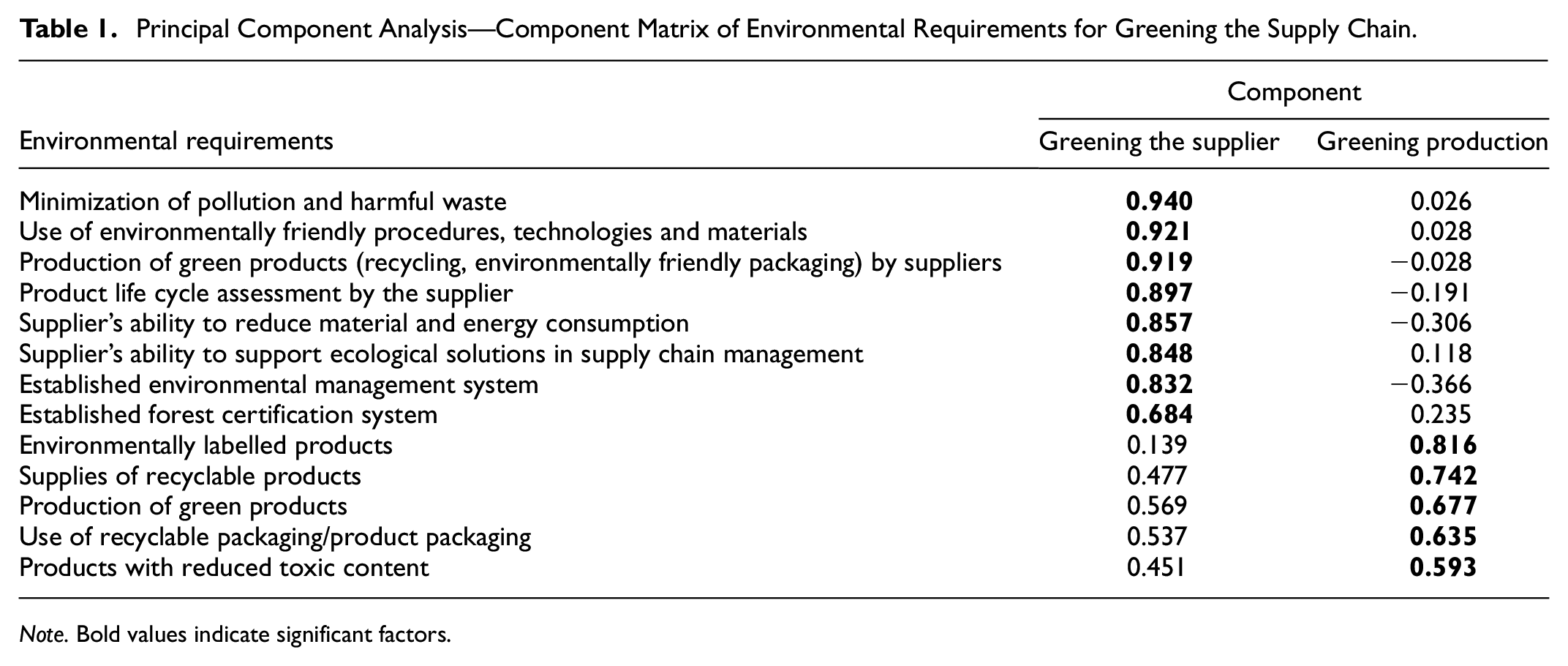
Note. Bold values indicate significant factors.
Structural Equation Model Development
Based on the chosen methodology approach, the proposed hypotheses underwent measurement and testing using a structural equation model (SEM). The model applied regression analysis to investigate multiple relationships simultaneously (Legate et al., 2023). SEM tests the relationships comprehensively, ranging from confirmatory factor analysis and incorporating the measurement error and unobserved concepts into the estimation process (Kline, 2006). The methodology of SEM includes model specification, parameters estimation, model evaluation and modification (Becker et al., 2023; Byrne, 2016). Based on one’s knowledge, the model specification specifies the hypothesized relationships between the variables in a SEM. In our case, the model applied latent variables that represented the five model constructs. SEM describes the relationship between different constructs, namely between the greening the suppliers and economic performance, greening the suppliers and environmental performance, green production and environmental performance as well as between environmental performance and competitiveness, and competitiveness and economic performance.
Factor analysis has been used to obtain relevant data for a model. Factor analysis is multivariate data analysis based on projection methods and a model of the quantification of a latent variable. The most important advantage of factor analysis is to represent multivariate data focused on input requirements as a smaller set of variables (summary indices suitable for the model) in order to observe trends and interactions. These latent variables are not possible to directly measure and may uncover and analyze the relationships between observations and variables, and among the variables in the model. In our study, factor analysis reduced the dimensionality of data collected related to individual constructs in an effort to preserve as much of the information contained in the original responses to the questionnaire as possible.
According to Fan et al. (2016), the fit indices for the test of a single path coefficient (p-value and standard error) and the overall model fit (Chi-square test) provide the foundation for SEM evaluation. We also validated the model to improve its reliability and stability. In the analyses of a single path, the critical ratio (CR) is identified as a value that describes the statistics formed by dividing an estimate by its standard error. The critical ratio is compared with a normal distribution with a probability of 95% at a significance level of p = .05. In this case, a value of 1.96 indicates two-sided significance at the “standard” 5% level. The chi-square test checks if the original covariance matrix and the model’s suggested covariance matrix agree. As a result, it is desired that the divergence be non-significant (Bentler & Bonett, 1980; Mulaik et al., 1989). The main advantage of the above mentioned methodology is that all of the analyses and tests are realized simultaneously in one statistical estimation procedure, where the errors are calculated using all information from the model. This approach illustrates the errors more accurately than if we were to calculate each part of the model separately.
Results
The frequency analysis represents the starting point for evaluating the survey results. The first part describes the information concerning the business profile. The most frequently represented companies were limited liability companies (78%), natural persons accounted for 14% of respondents and joint stock companies for 6%. According to the sector of operation within the forest-based industries, the biggest group among the respondents was represented by companies trading wood and wood products (39%), followed by the sawmilling industry (27%), furniture industry (13%), pulp and paper industry (4%) and the production of wood-based panels (2%). Other industries involved in the forest-based sector accounted for the remaining 15% and represented, for example, wooden buildings designers, manufacturers of garden cottages, E-commerce in the field of seating furniture, office furniture supplies, firewood production, printing industry, design of wooden packages, etc. The number of employees was used for determining the size of the company. Particularly we identified micro companies (1–9 employees) representing 46% of respondents, followed by small companies (10–49 employees) (36%), medium-size companies with 50 to 249 employees represented 12% and only 6% of respondents were represented by large companies (over 250 employees). More than half of the respondents (59%) stated an annual turnover more than 2 million €, 30% of respondents had a turnover of 3 to 10 million €. Companies with a turnover of 11 to 50 million € represented 6% and over 50 million € 5% of all respondents. Data was collected among forest-based companies representing either entirely domestically owned operations (86%) or companies with some foreign capital participation (14%). The last part of the business profile of respondents analyzed geographical position of the market, where the majority (73%) of companies have been oriented on the domestic market and the remaining 27% of companies have focused mainly on foreign markets. A complete business profile of respondents is shown in Table 2.
The Business Profile of Respondents.

Responses collected via survey are summarized in Table 3. Each set of variables represents a particular model construct. On one side the respondents provided answers to the applied green practices and requirements in their supply chains, on the other side they stated their influence on different stages, processes and areas.
Applied Environmental Requirements in the Purchasing Process and Their Influence on Examined Areas.

Note. 1—strongly agree, 4—strongly disagree.
It is statistically significant that the final model’s overall convergence with unstandardized estimates of the relationships between key components. First, the model’s variables’ multivariate normality assumption has been verified. For that reason, the measure of chi-square (χ2 = 102.511) and degrees of freedom (5) represent values which fall within the recommended levels. At the same time, the overall convergence of the model and associated p-value indicate that the model is very appropriate from the statistical viewpoint. For model testing, we considered the values of the comparative fit index (CFI) and confidence interval for RMSEA and expected cross validation index (ECVI). The CFI describes the discrepancy between the degrees of freedom and the noncentrality parameter estimate for the evaluated model and the baseline model. In our case CFI has reached the value over 0.9 and the value of ECVI and RMSEA reached 0.79 and 0.031, respectively. From the statistical point of view all these values are appropriate and tests confirmed the suitability of the model designed in Table 4.
Regression Weights and Critical Ratios (CR) of Individual Relations of the SEM.

Note. χ2 = 102.511, Degrees of freedom = 5, RMSEA = 0.031, CFI = 0.906, ECVI = 0.791.
p < .001.
Table 4 and Figure 2 describe the individual relationships within the structural model. The results show that all CRs are much higher than the required 1.96. Based on the mentioned, hypothesis H1—Greening the supplier is positively associated with environmental performance, is accepted.

Final non-standardized model of the green supply chain management influence on competitiveness and economic performance.
As we expected greening the suppliers (requirements related to the properties of supplied products and services) leads to green production, the critical ratio for this link is 11.106 and β is .648. Green production has the highest significant and positive relationship with environmental performance (CR = 29.54, β = .809, p < .001). On the basis of the above, hypothesis H2—Greening the production is positively associated with environmental performance, is confirmed. At the same time, the model confirmed the theory of less direct influence of greening the suppliers to environmental performance (CR = 7.84, β = .215, p < .001).
Environmental performance has a positive influence on competitive advantage (CR = 13.49, β = .719,p < .001), therefore the hypothesis H3—Environmental performance is positively associated with competitive advantage is accepted.
The results additionally revealed that competitiveness has a significant and positive (CR = 16.15, β = .611, p< .001) relationship with economic performance, thus showing the overall effect of greening the supplier on competitive advantage, as well as economic performance is mediated through the environmental performance. Therefore, the hypothesis H4—Environmental performance is positively associated with the competitive advantage that leads to economic performance, is confirmed.
Discussion
This empirical study is meant to look into the relationships between greening the supplier, environmental performance, competitive advantage and economic performance among the companies in forest-based industries in Slovakia. A developed conceptual framework assumed that greening the supplier can positively enhance the competitive advantage of the companies and their economic performance. Empirical results from the SEM analysis revealed that greening the supplier was found to correlate positively and significantly with greening the production processes, environmental performance and economic performance of companies in the sector. Additionally, it has been discovered that environmental performance and competitive advantage are positively and strongly related and that consequently had a positive impact on increasing economic performance. This confirms the definition of GSCM by Gawusu et al. (2022) to maintain competitiveness, company must balance economic and environmental performance.
Accepted hypothesis H1: Greening the supplier is positively associated with environmental performance
Integrating suppliers into a green supply chain is a necessary step in greening the supply chain. Because as stated by Handfield et al. (1998) and Likumahwa et al. (2019), implementing an ecological dimension into the supplier selection process is a crucial step in designing any supply chain network. Selecting a supplier might be viewed as a crucial choice in terms of improving its environmental properties with materials or considering alternatives that use less materials or energy (Igarashi et al., 2013), as well as using ecologically-friendly raw materials (Nozari et al., 2019). Getting the suppliers to provide input products and services with the required environmental properties helps companies greening their production operations and to reduce consumption of materials and raw wood materials and thus reduce energy consumption. This is enabled through the input requirements aimed at the purchase of the natural, recycled and environmentally labelled products using recyclable packaging and products with reduced toxic content. When choosing an environmentally suitable supplier, cooperation and mutual exchange of information for suitable input requirements is therefore necessary, as Németh (2020) and Wong et al. (2020) also emphasized. Within the forest-based industry supply chains these requirements are related to the raw wood material itself due to its natural and ecological properties as well as additional requirements linked, for example, to its certified status in terms of meeting the sustainable forest management principles and proving traceability, which is also stated by Oelze (2017) as best practice and commitment to structural progress through certification. Requiring certified status of suppliers providing certified forests products can ensure several benefits for the chain of custody certified companies such as the improved state of external company image and several business performance factors including penetrating new markets, increased sales volume, expanded market share and increased profit margin (Paluš et al., 2018). In line with the results of Govindan et al. (2015) or Seuring and Gold (2013) this may help move companies towards sustainability in supply chains. Moreover, in contrast to, for example, P. Rao (2002), who lacked enough evidence to establish the significant link between greening the supplier and green production, our model provides a clear and statistically verified relationship between these two constructs, which were expected to be interrelated. Compared to some earlier research studies (e.g., Chiou et al., 2011; Lee et al., 2015) requirements for suppliers to implement their own environmental management system seem not to be among the most important factors.
Accepted hypothesis H2: Greening the production is positively associated with environmental performance
As indicated by our model, the indirect effect of green input requirements from suppliers through green production on environmental performance is statistically significant and stronger than its direct effect on environmental performance. As reported by Rosyidah et al. (2022), through eco-friendly design, product recycling and reuse, new business models, and new technologies, material inputs and waste generation must be decreased, that represent the development of a circular economy, as an intermediate link between suppliers and environmental performance, through green production. In the circular economy, GSCM is considered a solution to environmental problems, not only in production, but within the entire supply chain. By developing a better relation with the suppliers, the adverse effects on the environment can be minimized (e.g., requesting green products, requiring a third-party SFM or COC certification) and thus a company’s environmental performance can be improved. At the same time, the success of such activities must be measured in terms of educating and enlightening customers (Rocchi et al., 2023). Purchasing products with eco-labels in the context of a green purchasing approach with the aim of minimizing environmental impact is also recommended by Sezen and Çankaya (2016). Our results are in line with a number of studies (e.g., Chiou et al., 2011; Igarashi et al., 2013; Jabbour & Jabbour, 2016; Kannan et al., 2014; Lee et al., 2015; Sarkis, 2003) demonstrating that a company’s environmental performance level is highly correlated with the implementation of practices related to involving green suppliers in the purchasing decisions, especially through continuous process improvement and change, as argued by M. G. Yang et al. (2011) and Roh et al. (2022). In particular, Chiou et al. (2011), Seman et al. (2019), and Roh et al. (2022), emphasize that since there is a better correlation between green product and process innovations and environmental performance, top management of companies should prioritize these. Our modelled relations also confirmed that companies place more emphasis on the environmental requirements of the purchased products and services (e.g., products with reduced toxic content or green products) than on the requirements for the suppliers themselves in terms of implementing green processes and systems (e.g., product life cycle assessment by the supplier or implementation of environmental management systems). At the same time, requiring specific green properties of input products and services has a greater impact on improving environmental performance. Green suppliers together with green production processes are clearly and closely related to environmental performance, which is demonstrated through the improvement of business innovation processes, better environmental performance of products and improved company image. Regarding GSCM, suppliers play an important role in environmental collaboration in redesigning the production process to reduce environmental impacts and to achieve environmental performance, as stated by Qiao et al. (2022). In GSCM, environmental management, which is essential to reducing carbon emissions, is supported by product selection, production process, and upstream and downstream supplier selection (Zeng et al., 2022).
Accepted hypothesis H3: Environmental performance is positively associated with competitive advantage
Most significant findings of the applied model are demonstrated by positive and strong links between the environmental performance, which is positively associated with the competitive advantage that leads to economic performance of companies. As stated by Sharabati (2021) and Akhtar (2019), GSCM aids in the creation of a long-lasting competitive advantage for performance optimization or maximizing. Companies that perform well environmentally have the ability to increase their green image and innovation processes, leading to enhanced competitive advantage through increased productivity, cost reduction, streamlining the performance of business processes and improved quality of production. Several previous earlier empirical studies (e.g., Y. S. Chen, 2008; Rao & Holt, 2005; Vachon & Klassen, 2008) as well as more recent ones, for example, by Zanotti et al. (2018) confirmed that an improved environmental performance is positively linked with competitive advantage and that the involvement of green supply chain influences sustainable competitiveness (Qiao et al., 2022; Rashid et al., 2018; Sharabati, 2021). The competitiveness of pulp and paper industries is largely based on the sustainability features of the forest industry, according to Korhonen et al. (2015).
Accepted hypothesis H4: Environmental performance is positively associated with the competitive advantage that leads to economic performance
Further, it is confirmed by our findings, that an increase in the competitive advantage of a company is linked with an improved economic performance as indicated mainly by model variables such as the enhanced market opportunities, sales volumes and market share. The mentioned facts are also confirmed by the studies of Rao and Holt (2005) and later P. H. Rao (2019), who claim that by greening their supply chains, companies achieve increased sales, market share and take advantage of novel market opportunities, etc., which contributes to the economic performance of companies. The enhanced market opportunities, as also stated by Sugandini et al. (2020), and increased market share are seen to be more important results of the implemented green supply chain requirements than the other economic factors directly related to, for example, product price or profit margin, as also reported by Rao and Holt (2005) and P. H. Rao (2019). However, even in high levels of competition a significant proportion of market share can result in higher profit as argued by S. Y. Chen and Lu (2015). Tang et al. (2012) as well as Fang and Zhang (2018) and Samad et al. (2021) also concluded that the cost saving from improved environmental performance can lead to an increased market share and better economic performance.
The results of this research can add to the scientific conversation on establishing and managing green supply chains in this specific sector. First of all, it is necessary to emphasize that the applied research concept is fully based on theoretical assumptions about the known relationships in building green supply chains and, at the same time, it provides outputs based on empirical research in the sectors of processing and utilizing wood raw materials. Green supply chains are considered in their entirety. However, research has pointed out the importance of their selected part that is related to the requirements applied in the concept of green purchasing of inputs. The result of this effort is a fully functional structural model that shows statistically significant parameters confirming the empirical analysis of determined relationships. The relationships between the various stages of supply chain management and its impact on other business processes, environmental and economic performance as well as the competitiveness of companies in the forest-based sector are based on the theoretical assumptions available so far. Logical as well as statistical verification of the resulting model confirms the basic assumptions about the impact of green supply chain management on the competitiveness of companies through increased environmental performance. At the same time, an improved competitive position helps to improve economic performance. Our results also confirm the conclusions of Likumahwa et al. (2019), who claim that the GCSM practices influence company performance (environmental, economic and social) as well as company competitiveness.
The research presented on the basis of these analyses provides both theoretical and practical information for all interested actors within the forest-based industry supply chains. Information on the supply chain can help all stakeholders in the supply chain work together to reduce the negative environmental effects of their logistics operations, as reported by El Ayoubi and Radmehr (2023) and Zeng et al. (2022). The stated findings can be used for stakeholder management as key to performance management in the area of sustainability, as Németh (2020) also states. Acquiring this knowledge can subsequently lead to their real implementation in practice and help reduce costs, compliance with regulation and enhancement in environmental and economic performance. As noticed by Gawusu et al. (2022), the specification of GSCM models brings use for value creation by firms. These findings have important implications for designing GSCM strategic plans for the forest industry in the country (Jiang et al., 2020). The results help to comprehend the relationship between the studied parameters within the green supply chain in the forestry industry more clearly as a whole. It allows decision makers to improve the quality of the examined parameters and optimize strategies for better establishment, adaptation and management of green supply chains in this specific sector. As stated by Sardanelli et al. (2022) and Zeng et al. (2022), the construction of a supply chain evaluation model enhances the evaluation comprehensiveness. The enhancing green supply management of chain partners is conducive to promoting the successful integration of the entire supply chain, minimizing the impact on the environment (Ghosh et al., 2020; Zeng et al., 2022). As consumers become more environmentally conscious, as stated by Samad et al. (2021), green innovation has been given a chance for green supply chain management (Zeng et al., 2022).
Conclusions
As the results are region specific, they should not be generalized to all forest-based sector companies in the European area all over the world, however, to enable comparative investigations, future research should empirically examine the links proposed in this work in various countries. From an industry perspective, companies operating in the forest-based sector are constantly working to boost their ability to compete in home and international markets for their products and services. Companies that operate in the forest-based business may become more competitive and perform better economically by greening their supply chains. According to the research, companies that green their supply chains not only make significant environmental improvements but also improve sales, market share, and take advantage of new market opportunities, which increases profit margins and improves the company’s economic performance. Out of the comprehensive set of greening the supply chain activities the responding companies focus rather on the environmental requirements of the purchased products and services than on the performance and system requirements for the suppliers. Moreover, our verified SEM confirmed that mediated effect of competitiveness and environmental performance on economic indicators of companies resulting from green supply chain requirements.
The concentration on a sample of forest-based companies in Slovakia is this study’s limitation, on the other side, an absence of empirical studies in this region is one of its key advantages. Moreover, most of these companies do not a have formal environmental management system in place but have well-developed environmental purchasing policies and rules and our research indicated there is not a strong and direct interconnection between environmental management certification ISO 14001 and green supply chains. In summary, the SEM model confirmed that a green supply chain including all three phases clearly leads to significant values for competitiveness and economic performance compared to the direct impact of supplier greening on economic performance.
As the results are region specific, they should not be generalized to all forest-based sector companies in the European area around the world, however, to enable comparative investigations, future research should empirically examine the links proposed in this work in various countries.
Footnotes
Declaration of Conflicting Interests
The author(s) declared no potential conflicts of interest with respect to the research, authorship, and/or publication of this article.
Funding
The author(s) disclosed receipt of the following financial support for the research, authorship, and/or publication of this article: This work was supported by the Scientific Grant Agency of the Ministry of Education, Research, Development and Youth of the Slovak Republic (Grant Numbers 1/0494/22, 1/0495/22); Slovak Research and Development Agency (Grant Number APVV-20-0294).

Data Availability Statement
Data sharing not applicable to this article as no datasets were generated or analyzed during the current study.