




Abstract
The increasing world population has placed tremendous pressure on global production systems, which has created a disjoint between the production and sustainability related goals of this sector. Several studies have confirmed this notion via Environmental Kuznets Curve, but this study envisages proposing a possible solution. It is hypothesized that competitive supply chain ecosystems (cluster development & production process sophistication) could help in reducing growth based CO2 emissions globally. An assessment of 135 countries between 2008 and 2018 is conducted. The estimates showed that the supply chain competitiveness has the potential in greenification of our production systems. Here indicators like value chain breadth and cluster development can reduce the CO2 emissions at each production level. Further regions from the geographic map, like North America and Asia Pacific, can adopt a green supply chain from other regions.
Introduction
Business sustainability focus has shifted to the synthesis view of business processes and contextual dynamics in a region. Sustainability encompasses three main considerations, including economic, social and environmental factors that reinforce each other (Vos, 2007), and their strategic handling determines the impact on the current life ecosystem. Industries have been omitting fossil oils using conventional supply chain activities, affecting environmental quality. Further, CO2 emissions increase their effects on climate change in developing technologies, which must be instantly addressed and solved. As from the beginning of industrial age, CO2 emissions are rising due to the increased use of fossil oils, fuels, and gasses, which are the major reason for climate changes. The government, organizations, and policymakers need certain attention to focus on and control the increased CO2 emissions.
The existing global business environment is encouraging organizations to focus on quality management to add globalization as a part of their strategy for quality (Lin et al., 2013; Li, Su et al., 2011; Soltani et al., 2011; Wiengarten et al., 2013). This has inspired to focus on and report its need in the operations and supply chain management (SCM) scholars. Green supply chain management activities have been empirically proven to contribute to better environmental efficiency (Zhu et al., 2008) and improved organizational performance (Green et al., 2012). The required antecedents for the introduction of the practices of supply chain management should be established. More research is required that recognizes and examines the influence of such influences, implementing quality through the breadth of the supply chain (Foster et al., 2011; Kaynak & Hartley, 2008). However, logistics are necessary to survive, but it produces undesired by-products frequently. Examples of undesired by-products are the widespread use of fossil-burning fuels and the resulting pollution. These undesired by-products have increased global warming, putting human well-being in danger (Guiffrida et al., 2011).
Scholars and logistics practitioners pay for green supply chain management (GSCM) to eliminate global warming. As per the report by Srivastava (2007), several edited books and almost 1,500 articles have been published in the previous two decades despite the limited scope of GSCM. However, there is huge literature available on GSCM, organizational environmental performance should be given preference as given to other factors of business performance, for instance, time, quality, and cost. Many previous studies have shown that businesses prefer to passively accept environmental policies only when the governments approve them (Del Brío & Junquera, 2003; Holt & Ghobadian, 2009; Zhuang & Synodinos, 1997; Zhu et al., 2007; Zhu & Cote, 2004). Governments must also mentor by setting environmental standards and enforcing necessary regulations to make businesses more responsible for their environmental commitments. Research focuses on collaboration among supply chain partners to improve environmental performance (Tseng et al., 2019).
While explaining the supply chain processes, quality control standards are important for operational efficiency. Supply chain quality management (SCQM) has already been defined by a body of research to identify the uncertain themes in this field (Robinson & Malhotra, 2005). The prospective benefits have been discussed in the literature regarding the application of quality management (QM) concepts that are accepted and methodologies. This included the total quality management in supply chain framework (Lee & Whang, 2005); the relation between the practices of SCM and QM and how they impact the efficiency of the organization and supply chain was investigated and examined (Flynn & Flynn, 2005; Kaynak & Hartley, 2008; Park et al., 2001; Sroufe & Curkovic, 2008; Yeung, 2008). However, limited research has focused on addressing the current challenges within clusters and related supply chain processes, such as quality of value chain processes. Business processes demand innovation rather than focusing on conventional regulatory compliance.
The quality of products provided by the suppliers depends on their efforts to ensure the quality, such as investing in quality management systems, high-quality materials and tools usage, and production process improvements (Lee & Li, 2018). The buyers do not directly observe the quality efforts of suppliers, but they can provide monetary benefits to the suppliers to improve the quality. Supplier quality can also be increased by directly investing in their assistance programs to enhance their capabilities. Suppliers improve their production processes and systems to improve the quality and reduce the cost (Sako, 2004). In developing countries, suppliers are not aware of the quality standards and management policies. Thus, the buyers in those areas provide support and education facilities to upgrade supplier quality standards (Wharton, 2009). Supply chain and logistics operations improve economic development through trade openness, increased per capita income, and value-added industry activities (Khan et al., 2019).
In environmental economics, one of the significant relationships between the development of economy and environmental pollution, this concept assumes that as the country is in the development phase, income of the country arises, quality of the environment reduces at that time, but later on, quality of the environment rises as the country make more progress and income increases with time. The economics literature is named Environmental Kuznets Curve (EKC), as this empirical association is an inverted U-shaped in the graphical form (Jardon et al., 2017). The EKC’s intuition stems from three main effects that decide the relation between the growth of economy, and the quality of environment during the development procedure: (i) The effects of the scale explains that as the output increases, the demand of the inputs also increases, resulting into the increase of pollutant emissions, therefore, growth of the economy damages the quality of environment; (ii) composition effect, with the expand of economy, the structure may shift, so cleaner or dirtier practices may be more involved, so it affects the quality of the environment in uncertain way; (iii) technique effect, elaborates that the preferences for the environment of the civils get changes as change occurs in the per capita income, as incomes increases, people demands for the higher quality of the environment conditions that requires the alteration in the policies of environment, that forces the organizations to use the production techniques that are less harmful for the environment (Grossman & Krueger, 1995; Panayotou, 1997).
It has become a challenge for humans to select the growth of the economy or protect the environment. Numerous studies have presented that human activities result in global warming associated with CO2 emissions (Al-mulali, 2012; Azomahou et al., 2006; Dinda & Coondoo, 2006; Jaunky, 2011; Lee & Lee, 2009; Liddle, 2012). For instance, supply chain development becomes inevitable to control environmental pollution because economic activities demand carbon consumption. Regional development in terms of higher production level, local and international market accessibility and large suppliers’ networks (e.g., Alibaba) require controlling environmental pollution using sophisticated technological supply chain processes. Organizations must make internal and external modifications to compete in the global environment, and Green supply chain management activities are the key sources of increasing organizational performance (Suryanto et al., 2018). A study indicated that research has more focused on the benefits of green supply chain management than the barriers in the implementation of GSCM activities, so the research should also focus on the barriers or the problems in the implementation of green supply chain management (de Oliveira et al., 2018).
According to Jaunky (2011), the development of the economy negatively affects the quality of the environment, and the relation between income and emissions is monotonic. However, as per the research results by Lee (2006) of 11 countries, the relationship between energy consumption and income is unbiased. Niu et al. (2011) described a long-term equilibrium relationship among energy consumption, growth of GDP, and CO2 emissions in eight Asia-Pacific countries. Lee et al. (2008) also reported that 22 organizations are working in the Economic Cooperation and Development (OECD) countries, in which a strong relationship exists between the consumption of energy and income levels. CO2 emissions are produced in many ways, including the petrol, burning of gas, coal, oil as a supply factor and deforestation as decreasing absorption factor (Sanglimsuwan, 2011).
Two of this century’s most important issues are energy and the environment. Fossil fuel combustion will be the prominent energy source that produces more than 80% of energy in the upcoming years. Carbon dioxide is the anthropogenic greenhouse gas produced from combustion and contributes to global warming. Since their pre-industrial era, atmospheric CO2 concentrations have more than 35 Gt emissions annually that is arisen by 100 ppm, reaching 384 ppm in 2007. Therefore, quick global action to address the crisis of CO2 is required (Yu et al., 2008). The main variables are temperature and CO2 emissions, which have been changed in the past and will change in the coming future, and they affect the development and plant growth. The increase in atmospheric CO2 meditation is an undeniable indicator of the change in the global environment (GEC) (Morison & Lawlor, 1999).
At this stage, global economic activities demand sophisticated production processes. This study focuses on the supply chain ecosystem in which firms as production actors interact with the environment, such as clusters. In a region, these factors interact with economic activities and determine the level of environmental sustainability. For instance, the leather garment industry generates economic activities, and their supply chain processes affect the economic activities. At one side, the regulatory bodies strictly monitor supply chain activities; on the other hand, customers’ awareness has increased and demand for clean products. As production activities are increasing in the world, pollution is rising, which causes an increase in CO2. Countries with a higher economic size, also have higher pollution, lower environmental quality and higher CO2. However, such countries can develop their infrastructure and sophisticated production systems to lower CO2 and improve environmental quality. Countries with lower economic activity suffer most from environmental pollution. In developed countries, advancements in technology increase emissions, but implementing environmentally friendly technology for cleaner production can also reduce emissions (Mardani et al., 2019). Based on the literature and other findings, this study hypothesizes that competitive supply chain systems could help reduce growth based CO2 emissions globally and improve supply chain quality tends to align economic activity with ecological capacity to reduce detrimental environmental effects.
Research Gap and Research Objectives
It is evident that CO2 emissions are higher in the countries with high economic activities, and with the increase in the size of economic activities, countries tend to develop cleaner practices and processes. Literature has pointed out that CO2 can be decreased further in developing their infrastructure and supply chains. For the past two decades, previous studies in the majority have confirmed the association between the growth of the economy and energy effects on CO2 emissions significantly (Alam et al., 2016; Antonakakis et al., 2017; Bekhet et al., 2017; Bildirici, 2017; Chaudhary & Bisai, 2018; Chiu, 2017; Han et al., 2018; He, Xu et al., 2017; Riti et al., 2017; Robaina-Alves et al., 2016; Song et al., 2018; Zhang, Zeng et al., 2017; Zhao, Zhang et al., 2017).
This study proposes that while the EKC relationship has been widely assessed for different regions, no studies have assessed the role of moderating factors using envelop theorem. This study explores the potential of different dimensions of supply chain competitiveness in managing the CO2 emissions within the EKC framework.
The objectives proposed by this research study will help clear the gap by analyzing the data from several countries to inspect the non-linear relations between economic activity and CO2 emissions and the moderating role of different indicators of supply chain management like local supplier quality, production process sophistication, value chain breath, control over international distribution and state of cluster development etc.
Research Questions and Hypothesis
Based on the above discussion, this study will answer the following question:
How competitive could supply chain systems help in reducing growth based CO2 emissions internationally?
And the research alternative hypothesis are
Ho1: Production has a positive linear effect on CO2 emissions
Ho2: Production has a negative curvilinear effect on CO2 emissions
Ho3: Supply chain competitiveness linearly affects CO2 emissions
Ho4: Supply chain competitiveness negatively moderates the linear effect of CO emissions
Ho5: Population density has a positive effect on CO2 emissions
Significance of the Study
The contribution of this paper is to create a theoretical justification for CO2 by drawing on the literature in production process sophistication, supply chain design, value chain breath, and cluster development. Previous studies focus on a cluster and underlying processes in isolation. However, in reality, all factors interact simultaneously with each other. Therefore the holistic view of this study brings forth business related factors. This study reveals that countries with high product sophistication, higher supplier quality, more value chain breath and developed clusters, and higher imports/exports will have higher CO2 emissions. By eliminating CO2 to balance the economic growth and the quality of the environment, this study will help provide a new vision for designing the key policy instruments. This study will help the government policymakers, organizations, and suppliers develop strategies to improve green economic growth using the supply chain to eliminate CO2 to improve environmental quality.
Literature Review
Experts expect that the global population will be increased by 9 billion by 2050 (Bastein et al., 2013). Natural resources consisting of water, energy, raw materials, and fertile land will be scarce commodities. When such resources are spread thin, it puts pressure on the environment (Franklin-Johnson et al., 2016). With an increase in consumption behavior, luxury products are more demanded due to middle class rise. Global consumption of materials in the 21st century will be raised by eightfold; it is also anticipated that demands for the resources will be triple by the end of 2050 (Kok et al., 2013; Reh, 2013). In literature, research has defined circular economy in many ways. The main two definitions of the circular economy are the flow and utilization of energy and materials (Franklin-Johnson et al., 2016), and it is also defined as an economy that has a basis of a “spiral-loop system” to reduce matter, flow of energy, and declining in the environment without any decline in the development of the economy or technical and social progress (Geng et al., 2009). In developing economies, green practices and circular economies are at the early stages, but in developed economies, authorities charge heavy penalties to the firms which practice polluted activities and CO2 emissions in the air (Khan, Razzaq et al., 2021).
Recycling the products keeps their highest value and reduces the risk level related to price instability, resource shortage, energy demands, and environmental effects (Gerner et al., 2005). The European Union report exposes that the total in 2010, waste production was 2520 million tonnes, which, compared with other world, is relatively progressive. Technical materials, including plastics and metals, can be restored in the technical cycle. These must be recycled to avoid pollution (Govindan & Hasanagic, 2018). Organizations need to develop eco-friendly products to improve the environment. Eco-friendliness refers to the techniques used in supply chain processes and manufacturing operations to reduce carbon emissions to improve environmental quality (Khan et al., 2022).
No doubt, there are numerous advantages of economic growth, but it is also a driving force for the growth of environmental pollution. CO2 emissions are growing due to economic growth, income, urbanization, and lifestyle changes. So, to control CO2 emissions in regions, efficiency and technology developments are not enough (Feng et al., 2012). A study in South Africa demonstrates a long-term relationship between energy consumption, growth of economy, openness of trade, urbanization, and CO2 emission. This study result shows that policies aiming to eliminate energy consumption and control the CO2 emissions in South Africa could slow down growth. This indicates that any energy preservation measures undertaken should consider the adverse impact on economic growth (Khobai & Le Roux, 2017). Though in very poor countries, increases in GDP may worsen the environmental conditions when a country reaches a certain level of their income, then the quality of air and water benefits from the growth of the economy (Grossman & Krueger, 1995).
The increase in CO2 emissions is because of moving toward more carbon-intensive production structures. Due to the increase in air conditioning systems, and the electrical devices used for the households structures, the production of electrical products has been increased (Feng et al., 2009), and energy demand has been increased due to the increase in the production (petroleum processing and non-metal mineral production sectors). CO2 emissions in the regions have been raised due to these (Feng et al., 2012). By consuming any energy type, developing and developed countries make their shares in the growth of CO2 emissions. This relation of CO2 and GDP corresponds to the base hypothesis that production activity has a major role in CO2 emissions.
Policies should be made to eliminate the CO2 emissions at country levels and their changes rates (Coondoo & Dinda, 2002). Literature and empirical studies have made it clear that global pollution contributors are mainly the developed countries, and the developing countries also have to tolerate the consequences of the pollution. The results of the pollution vary in each country based on the importance of the energy sources for an economy. In developed countries, technological developments are the main reason to increase pollution, but they can also reduce pollution if technologies are used in environmentally friendly manners (Mardani et al., 2019).
In the present globalization and increasing competition, the prime emphasis for SCM is the strategic management of all the internal and external stakeholders, including from the suppliers of raw materials to the end-users, therefore, to sustain the organizational performance, SCM has a strong position as a substantial management method (Reefke & Sundaram, 2017). A supply chain involves collecting activities ranging from ordering, receiving raw materials, manufacturing goods, distribution, and delivery to the consumer and enterprise functions. The material flow and knowledge flow are related to these operations (Li & Wang, 2007). Supply chain management (SCM) is a collection of coordinated operations to integrate suppliers effectively, distributors, carriers, and consumers, so the product or service should be placed right in the right amounts at the right time. SCM’s goal is to gain a sustainable competitive advantage (Li & Wang, 2007). In the current constantly changing business environment, organizations are expected to change their operations internally and externally to remain in the competitive business markets. Organizations are currently focusing more on total quality management and supply chain management practices, resulting from organizational learning and experiences (Suryanto et al., 2018).
As indicated in the literature, Bio-heating (Hagos et al., 2014), incineration (Pavlas et al., 2011), and co-digestion (Pagés-Díaz et al., 2014) have been widely used for the creation of the waster to energy (WTE) supply chain in the industrial park. The commonality of these approaches is that bio-based energy or fuel converted from a bio-based waste can be utilized for energy and heat supply. WTE techniques are divided into four categories: thermal, chemical, physical, and biological. Various forms of biomass, including forestry, agricultural waste, domestic and household waste, energy crops, livestock remainders, and industrial waste, can transform into bio-energy products (bio-gas, fuel and chacha) using the correct techniques.
Several methods have also been used to improve the WTE supply chain, for instance, the bioethanol supply model (Avami, 2013), mathematical programing (De Meyer et al., 2014), the taxonomy criterion (Sharma et al., 2013), and decision making with multi purposes (Cambero & Sowlati, 2014). This investigation briefly demonstrated the widely used methods, including gasification, burning, and anaerobic digestion. In ecological industrial parks, there are examples of WTE supply chains (Munir et al., 2012), where companies collaborate in a group to minimize pollution and waste by sharing of the resources to maximize economic benefits and enhance environmental quality (Behera et al., 2012).
CO2 emissions are increasing due to the industrial activities of all the firms. To reduce the CO2 emissions, all industries from upstream to downstream are responsible as their supply of raw materials and other modules are directly linked to the increase in CO2 emissions (Minx et al., 2009; Wiedmann, 2009). Identification of supply chain tracks is necessary to reduce the CO2 emissions, and information on efficiently reducing the CO2 emissions should be provided to policymakers so that CO2 emissions can be reduced without harming the industrial developments. To reduce CO2 emissions and other harmful gasses, conservation of energy and other energy intensive materials are required (Suh, 2009). Shared responsibility analysis should be used by the upstream and downstream industries in the supply chain to reduce the life cycle emissions (Gallego & Lenzen, 2005; Lenzen et al., 2007). Input-output structural path analysis can be used to identify the life cycle of CO2 emissions in supply chain (Defourny & Thorbecke, 1984; Lenzen, 2003; Peters & Hertwich, 2006; Strømman et al., 2009). To identify the significant supply chains linked with the life cycle of CO2 emissions, SPA methods can be used.
Several studies conducted a systematic literature review (SLR) of green supply chain or sustainable supply chains. A systematic literature review by de Oliveira et al. (2018) stated that green supply chain management has become very challenging for organizations. All the involved stakeholders of the firms, including customers, suppliers, legal, and government institutions, are looking for solutions to the problems impacting the environment and climate caused by the firm’s activities. Another SLR study conducted by (Badi & Murtagh, 2019) demonstrated that environmental humiliation is raising unexpected changes in the climate changes and resource depletion in the entire globe. Due to the environmental changes, there are transformative variations in how business and humans interrelate with the natural environment. Organizations have different attitudes, that is, proactive, preventive, and reactive toward environment sustainability around the globe. Their reactions toward environment is not only because of the external forces, but cultural factors are major drivers of sustainable changes (Elbaz & Iddik, 2020). Sustainability results include implementing social and environmental practices besides the social, economic and environmental performance achievement. Environmental practices for sustainability should be fostered, including pollution prevention and control investments, adoption of environmental management systems, and environment certification achievement, that is, ISI14001 (Awaysheh & Klassen, 2010; Delmas & Montiel, 2009; Koberg & Longoni, 2019).
Impact of Supply Chain Quality on Environment Quality
Supply chain management is a process organizations use to make finished goods from raw materials and then transport those products to the end users (Beamon, 1999). This method includes natural resource production and exploitation (Srivastava, 2007). However, we should know that in our society, for the business organizations, the protection of the environment is very critical. Environmental issues such as acid rain and global warming are rising due to increased pollution and waste of supply chain processes. Supply chain policies are required to get competitive advantages and develop proactive strategies. As GSCM has taken the researchers, and organizational practitioners attention. Supply chain management is transforming into supply chain quality management as SCQM focuses on the quality management practices such as product design and process control (Chau et al., 2021). Firms that focus on supply chain quality management can avail quality performance and impact the environment quality (Soares et al., 2017).
The objective of developing supply chains practices is to balance marketing efficiency with the problems of the environment. To reduce pollution and make energy more efficient, organizations are developing supply chains, that is, building supplier networks to buy environmentally superior goods or developing traditional methods to increase efficiency. In the 21st century, improving the supply chain is increasingly a problem for business organizations. Of special interest is, how to increase corporate awareness of the environment and bring sustainability activities into operation in their supply chains’ logistics activities. By developing long-term buyer-supplier relationships, green supply chains simultaneously boost the efficiency of both the economy and the environment within the chains (Kumar & Chandrakar, 2012).
Green supply chain management is structured to assimilate the environmental concerns by post-consumer disposal into the decision making related to the management of materials and functions of the logistics of a company at every level (Handfield et al., 2005; Simpson & Power, 2005). GSCM can involve both upstream and downstream influences external to the organizational boundaries. Upstream variables include the green buying and vendor management of inbound logistics (materials management) (Min & Galle, 2001; Zsidisin & Hendrick, 1998). For example, things include offering suppliers design specifications, including environmental standards for purchased items, collaborating with the suppliers for environmental goals; environment audits for internal supplier management; and ISO 14001 certification.
Greening the outbound logistics with operations such as distributing and marketing elements of the supply chain of a commodity or company are downstream influences. Researchers claimed that in South Asia, the relations of customer-supplier supply chain and cooperation on the issues of the environment are much related to the success of the environment (Rao, 2002).
Sila et al. (2006), in their empirical research analysis, looked for the significance of related issues to the quality of an organizational supply chain study, as quality in the supply chain: and they analyzed the state of SCQM in the American manufacturing company. The outcome of this analysis reveals that even though the businesses join their main customer in the quality of the supplier’s parts.
Positive Effects of Supply Chain Management
Increases in supply chain power, production efficiency (e.g., cost, quality, distribution and flexibility) of organizations belonging to the supply chain are expected to be greater (Chen et al., 2004; Liker & Wu, 2006; Shin et al., 2000). Such productivity increases are also recognized to benefit the natural environment (King & Lenox, 2001). Using the Porter hypothesis, this connection between the performance of the environment and production was built (Porter & Van der Linde, 1995) and based on the theoretical development of the company’s natural-resource-based view (Hart, 1995). In addition, the positive relationship between the performance of the environment and financial indicators is now widely accepted (Hamilton, 1995; King & Lenox, 2002; Klassen & McLaughlin, 1996). Porter and Van der Linde (1995) have noted that the supply chain greening process facilitates environmental innovation to enhance environmental efficiency.
Interestingly, in network theory, technical advancement, and the number of links are correlated positively and the quality of these links in a network (Ahuja, 2000). For example, pollution reduction and advanced environmental technologies have been related to collaboration with suppliers and customers (Klassen & Vachon, 2009; Vachon & Klassen, 2006). Geffen and Rothenberg (2000) found a link between environmental innovation and the participation of suppliers in the purchasing organization’s processes. Such participation is not feasible unless suppliers have good operating capabilities. Therefore, increasing the strength of the supply quality increase the strength of the supply chain in more than one aspect (increasing the number of links, links quality, and relation with suppliers/customers), leads to less pollution in the environment (Gilbert et al., 2017; Vachon & Mao, 2008). Supply chain could also help in developing renewable energy production by the firms. GSCM practices positively affect economic development, FDI, GDP per capita, and trade openness. While public health expenses, water and air pollution, and carbon emissions are negatively linked to green supply chain practices. By adopting a green supply chain, countries can improve their environmental sustainability without compromising economic development (Khan, Yu et al., 2021).
Negative Effects of Supply Chain Management
Economically viable in supply chains, logistics, and transport operations, have some negative environmental impacts. Resource conservation (such as materials and energy), noise, pollution, and waste removal are the negative impacts (Development, 2004). Some of the key sources of greenhouse gas emissions, mainly CO2, are logistics and transport operations. Moreover, the transportation sector is the fast growing greenhouse gas source (Browne, 2005).
Supply chain quality management has a challenge to information management. Quality management of the supply chain has faced complications in the predictions and monitoring of the factors to enhance quality because of short access to reliable information (Coyle et al., 2009; Li, 1997; Li & Collier, 2000; Wang et al., 2007a; Xu et al., 2005, 2007). It is expected that these difficulties will increase as the supply chain scale grows, where the difficulty is much greater. Obviously, without effective information sharing and architecture, the quality operations of the supply chain are not feasible. As supply chain management focuses the quality management execution, adequate information sharing and quality management architecture have become an important competitive factor in quality management.
Supply Chain and State of Clusters
Intelligent manufacturing growth has drawn the interest of academics in intelligent clusters of manufacturing. Goldfarb and Trefler (2018) were the first to inspect intelligent manufacturing in light of industrial clusters and highlighted that intelligent manufacturing influences economies of scale and rigorous expertise. They also mentioned policies on the intelligent production clusters. Yu (2019) explained the theoretical implications of the intelligent manufacturing clusters with four dimensions (industry, enterprise, region, and network organization) and explained the four-dimensional upgrading process space-integrated intelligent manufacturing cluster. The European Commission presented a world-class industrial cluster as an ecosystem to promote innovations and growth in the regions (Cluster, 2011).
Literature has presented industrial clusters to obtain a competitive advantage and increase developments (Bialic-Davendra, 2011; Wahdan et al., 2019). For instance, Faller and Feldmüller (2015) have deliberated the methodology for optimizing and upgrading intellectual production in Germany’s small and medium enterprise (SME) clusters. Giret et al. (2016) recommended that intelligent manufacturing systems should be used for service-based enterprise clusters.
Clusters have many advantages, including reduced risk, economies of scale, quality improvement, sequencing, and waste reduction. For instance, rework, waste, and time can be saved by using the suspended ceilings in the electrical and mechanical work. For cluster development, strong leadership and teamwork are required. Other tasks, however, will not easily into building-oriented clusters, for instance, the maintenance of site plant, or trades, for instance, bricklaying, required by many distinct clusters (Nicolini et al., 2001). This leads to the hypothesis that the state of clusters helps in reducing CO2 emissions within production activities.
Supply Chain and Value Chain Breath
Management of the supply chain refers to organizational regulation outside core business operations (Carter & Rogers, 2008; Crum et al., 2011; Svensson, 2007; van Tulder et al., 2009). The value chain consists of the activities performed to transform the idea into production, distribute those manufactured products to customers, and dispose of them (Kaplinsky & Morris, 2001). Sustainable supply chain management focuses on improving the organizational long-term success and its supply chains with strategies, and aligning the organization’s social, economic, and environmental goals is systematic (Carter & Rogers, 2008). Firms should focus on the global value chain policies to improve the environment and economic positions (Pietrobelli et al., 2021).
The theory of stakeholders manifests itself both in theoretical and functioning terms, primarily through the management and involvement of various parties, but the basis of this is that moral principles are the basis for the engagement of stakeholders (Clarke, 1998; Donaldson & Preston, 1995). Similarly, the institutional theory is value based theory. But the viewpoint is doing the things correctly that is the basis for the principles, whether for the stakeholders or for the leading to value chain tensions and disputes. These tensions are characterized by conflict and cooperation between different stakeholders, including businesses, NGOs, state and foreign agencies, and industry relations, interests and agendas are for everyone (Levy, 2008). Organizational credibility must be developed or reaffirmed by organizations under supply and value chain pressure, and institutional theory is based on this principle (DiMaggio & Powell, 1983). Organizational credibility may also be achieved by effective stakeholder management and participation, considering the pressures of stakeholder groups. It leads to the hypothesis that value chain breath help in reducing CO2 emissions within production activities.
Supply Chain and Production Process Sophistication
The more advanced Master Production Scheduling (MPS) methods lead to the plans which are feasible and practicable, along with the use of manual MPS methods, which are less sophisticated, negatively impacts the efficiency of the delivery service after the sophistication of the planning setting and the maturity of the processes of MPS (Jonsson & Kjellsdotter Ivert, 2015).
A systematic body of literature analyses at the business level how companies in host countries get affected by FDI spillovers in their decision making about exports, production, and wage-setting (Görg & Greenaway, 2004). Still, there is little research available about how multinational corporations (MNEs) involvement impacts the company’s production of sophisticated goods. Downstream MNEs in local Indian companies enhance product sophistication through vertical backward linkages. In comparison, upstream MNEs presence, through vertical forward linkage, can harm product sophistication. Upstream MNEs have impacted the company product’s sophistication in a strongly negative way (Eck & Huber, 2016).
Stokey (1988) and Young (1991) present models in which they stated a company would produce the more sophisticated products, the more they will learn by doing, and all more sophisticated products can be produced if the spillovers are higher. As a result, more sophisticated products should be introduced to get sustainable development. A model was developed by Hausmann et al. (2007), elaborating that the production of highly sophisticated goods expands the country’s technological frontier and stimulates development. They also presented proof of cross-country analysis of the positive effect on growth in developed countries of the sophistication of goods. Jarreau and Poncet (2012) confirmed a strong association between product sophistication and development in China. It leads to hypothesis that production process sophistication help in reducing CO2 emissions within production activities.
Theories of Supply Chain Quality and Cleaner Production
In strategic management, the RBV model has its roots. RBV states that the recognition and proprietorship of the capabilities of internal strategy lead to the capacity of an organization to generate and sustain a competitive advantage and enhance results (Barney, 1991; Crook et al., 2008; Hart, 1995). If it meets certain requirements, a resource is considered strategic, important, unique, and inimitable to help boost a company’s performance (Barney, 1991; Crook et al., 2008). Value represents the degree of the resources if matched with the external environment to take advantage of possibilities and minimize risks. Substitutability is the degree to which rivals can generate similar resources. The resource shortage is the assumed lack of the resource with factor markets. Inimitability is the degree to which rivals cannot, or can only do so at a substantial cost disadvantage, obtain or duplicate the capital (Hoskisson et al., 1999). According to RBV, businesses aim to define strategic tools that make the business more market competitive and use resources to take advantage of their importance (Sirmon et al., 2007). Given the changing external conditions an enterprise faces in the dynamic market climate, resources should be managed and used efficiently (Lippman & Rumelt, 2003).
Several organizational theories explain how businesses implement, integrate, and grow initiatives for operational strategy. Including resource-based view, network theory, transaction cost economics, agency, and institutional theory, such as total quality management (Anderson et al., 1999), lean manufacturing (Ketokivi & Schroeder, 2004), supply chain management (Lee & Cheong, 2011; Zailani et al., 2012; Zhu et al., 2005; Zhu, Geng et al., 2010), and Six Sigma (Braunscheidel et al., 2011), successfully. Under the framework of GSCM, the supply chain participants work to satisfy both customer and legal criteria. Implementing environmentally friendly actions would also be influenced by pressure from national/international regulators and government agencies (Delmas & Toffel, 2004; Rivera, 2004; Zailani et al., 2012).
Theoretical Model
This study uses background model of the Environmental Kuznets Curve (EKC), which points toward the inverted U or U shaped relationship between the economic activity with environmental quality (Wang et al., 2021). Most of the empirical studies which explored the EKC ignored the scope of interacting factors that could moderate the EKC curve (Arshed et al., 2021; Haans et al., 2016). This outcome could be handy for the researchers in improving the efficiency of increased economic activity or expediting the greenification of the economic activity process.
This study proposes using supply chain quality interaction with the EKC. It is hypothesized that improvement in the supply chain quality tends to align the economic activity with ecological capacity to reduce the environmentally detrimental effects; otherwise, the industrialization process will undermine environmental quality (Janjua et al., 2021). Ecological capacity determines the potential of a region to handle complexity in terms of diversity, resilience, and adaption. A competitive supply chain process reflects in the form of cluster development, value chain competitiveness, and network with international distributions. This study explores the role of different indicators of supply chain quality in terms of their empirical contribution to reducing the ecological burden of increasing economic activity, as shown in Figure 1. This study is instrumental in proposing strategies to greenify the supply chain processes.
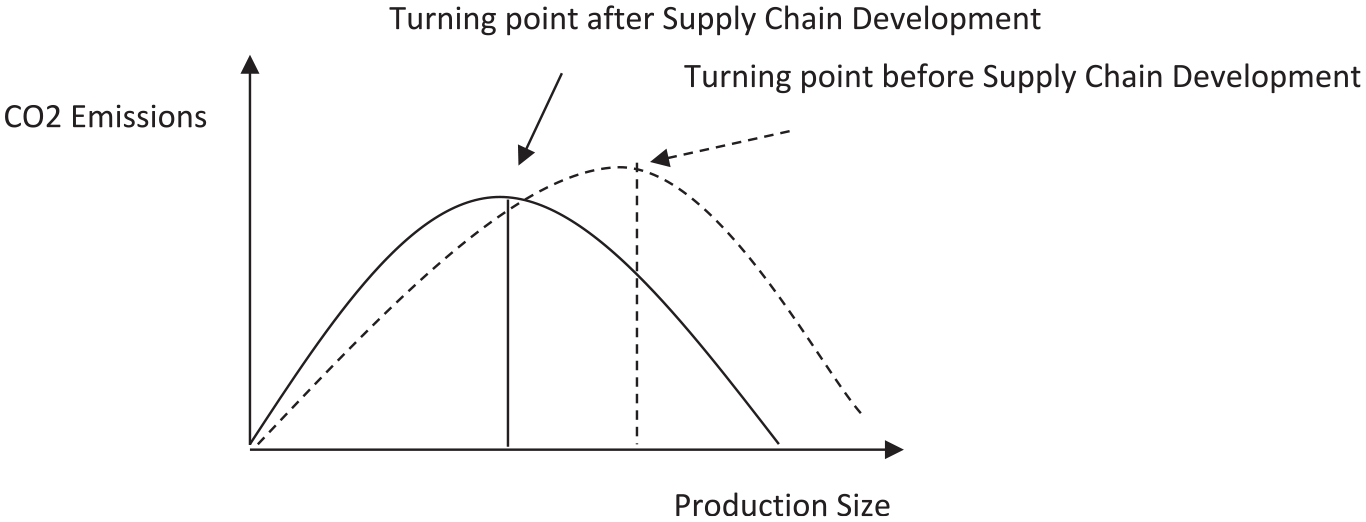
Theoretical model of EKC with moderation.
Data and Methods
Variables and Transformations
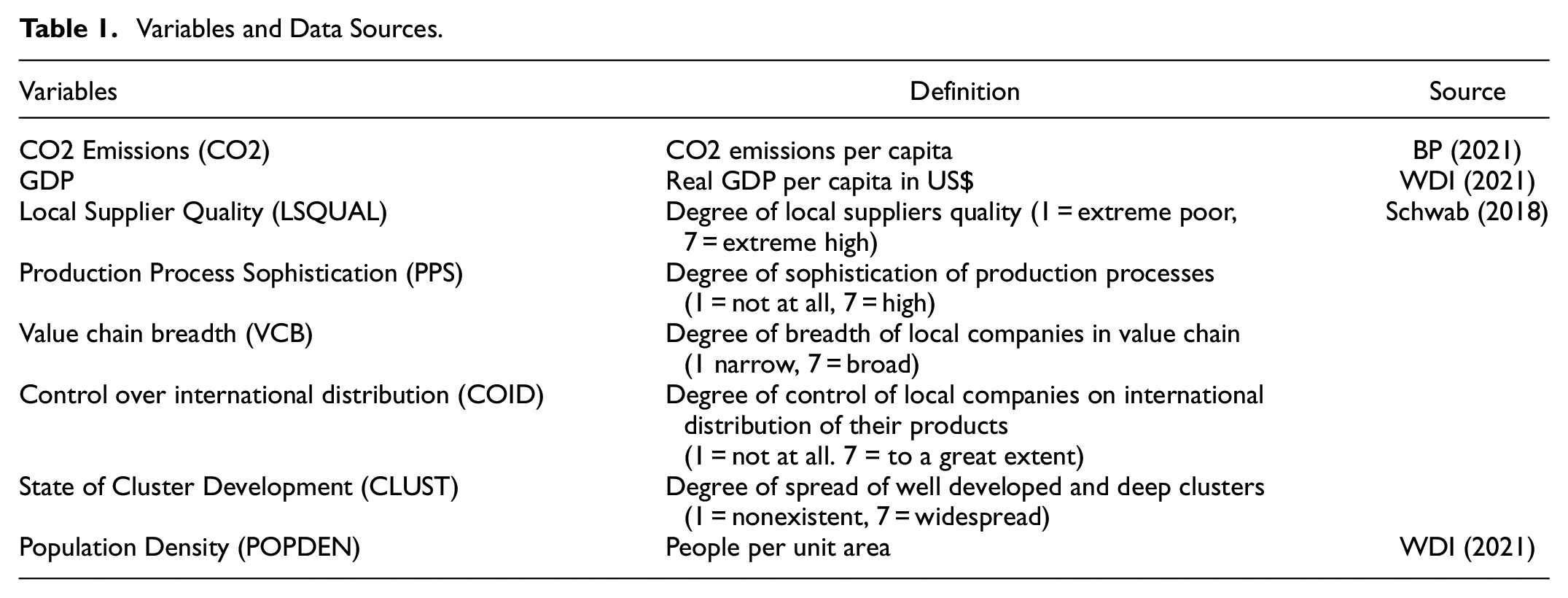
Table 1 provides the definitions for the variables utilized by this study. Here, the CO2 emissions are the dependent variable extracted from British Petroleum (BP, 2021) because of the availability of recent data. The GDP and GDP2 will be used as the base to estimate the EKC model. The control variable includes population density. These variables are extracted from World Development Indicators (WDI, 2021). While 5 dimensions of supply chain quality, namely local supplier quality (LSQUAL), production process sophistication (PPS), value chain breadth (VCB), control over international distribution (COID) and state of cluster development (CLUST). The data is extracted from the World Economic Forum (WEF) named Global Competitiveness Index (Schwab, 2018). WEF records the survey data between 1 and 7 scale and provides average country-level data. The data is selected for 135 countries between 2008 and 2018.
Variables and Data Sources.
Estimation Specification and Equation
Following is the estimation equation with the quadratic specification of GDP and moderation using indicators of supply chain quality. This estimation equation is designed to firstly estimate the EKC relationship between CO2 emissions and production activity (GDP). The coefficients
Since the selected data of 135 countries between 2008 and 2018 vary in terms of time and country, this study has used panel data specification. This uses the intercept, which varies across cross sections and time to control unobserved data heterogeneity. Within the panel data models, this study has used the Panel Feasible Generalized Least Squares (FGLS) model, including the cross section specific standard errors to control for any remaining heterogeneity in the estimates. This model is more robust and efficient as compared to conventional Fixed and Random effect models (Arshed et al., 2022; Hameed et al., 2021).

Results and Discussions
Here Table 2 provides the descriptives of the variables used in the study. Here it is seen that CO2 and POPDEN have a mean value smaller than the standard deviation, which shows that the variable is under dispersed. While other variables are over dispersed in the sample. Further, the skewness and kurtosis values indicate that none of the variables are normally distributed statistically. Since the sample size is above 30, it can be assumed that the variables are asymptotically normally distributed.
Descriptive statistics of variables.

Further, this study has conducted a visual association between CO2 and GDP by adding contrasts of different types of supply chain quality, the Figures 2 to 6 depict the contrasts. Here we can see that generally, higher GDP is positively associated with CO2 emissions, but the higher contrast values of supply chain quality tend to stay below the linear approximation of CO2-GDP association, this means that the countries which tend to have a higher quality of supply chain usually are less polluting.
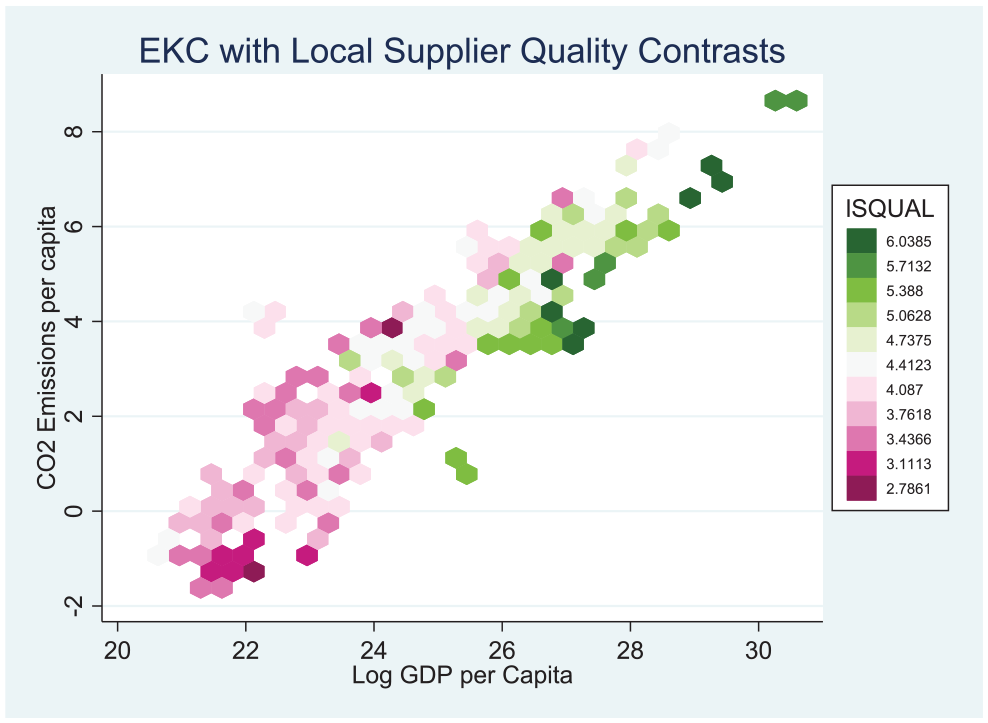
EKC with ISQUAL.

EKC with PPS.

EKC with VCB.

EKC with COID.
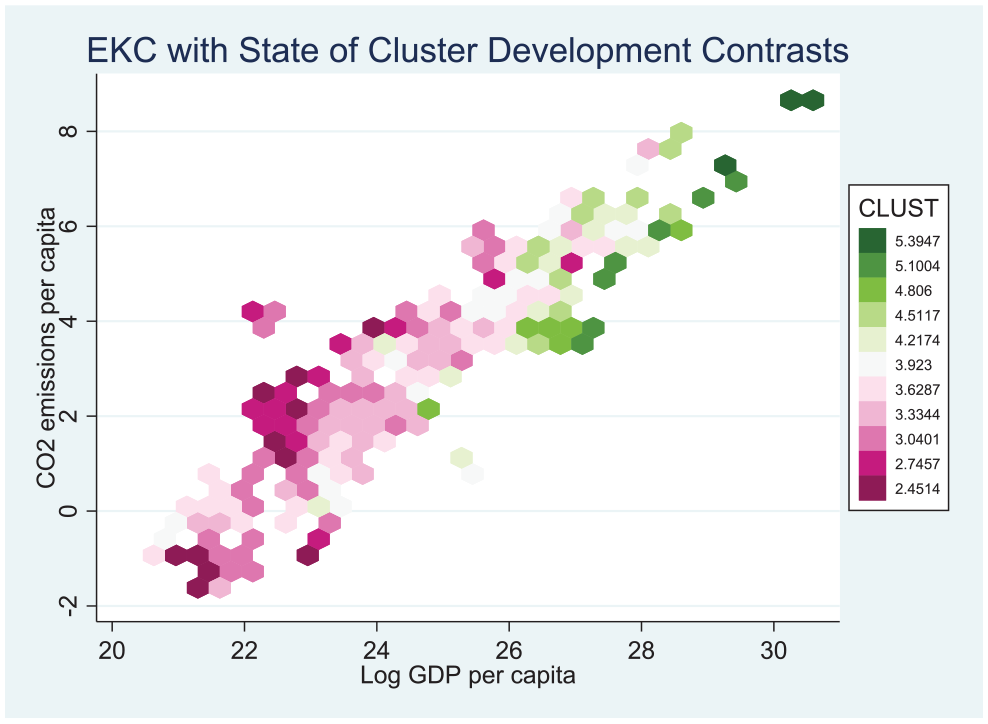
EKC with CLUST.
In order to assess the moderating role of supply chain management, this study has estimation equation number 1. Table 3 provides the regression estimates using the Panel FGLS model. Based on 1,371 observations from 135 countries, the Wald test confirms that the overall model fits. The positive value of the intercept is prompting toward the net effect of environment degrading forces that led to CO2 emissions.
Regression Estimates.

where we can see that the coefficient of LGDP is negative while the LGDP2 is positive; this means that an increase in economic activity tends to follow U shaped pattern in affecting the CO2 emissions, which is confirmed by the studies (Arshed et al., 2022; Wang et al., 2021). In an inspection of the direct effect of supply chain indicators, it is noted that LSQUAL, PPS and VCB have a positive effect on CO2 emissions while COID and CLUST have a negative effect. Hence, the supply chain management indicators have mixed direct effects on environmental quality. Further, in terms of the moderating effect on the EKC relationship, it can be seen that LSQUAL, PPS, and VCB reduce the marginal effect of LGDP on CO2 while COID and CLUST increase the marginal effect of LGDP on CO2. Lastly, POPDEN has a positive effect and the time dummies show that there is a gradual decrease in CO2 emissions over time, showing the efforts of the world to improve the environmental quality.
Following the quadratic specification in the regression estimations, Figures 7 to 11 plot the moderating effect of supply chain quality on the EKC. For the case of local supplier quality, Figure 7 shows that at low GDP, low local supplier quality reduces pollution, while at higher GDP, higher local supplier quality reduces pollution. Figure 8 shows that higher production process sophistication tends to increase the pollutive effect of LGDP. This means that these two indicators are not very helpful in reducing the CO2 emissions at higher GDP.

EKC with LSQUAL moderation.
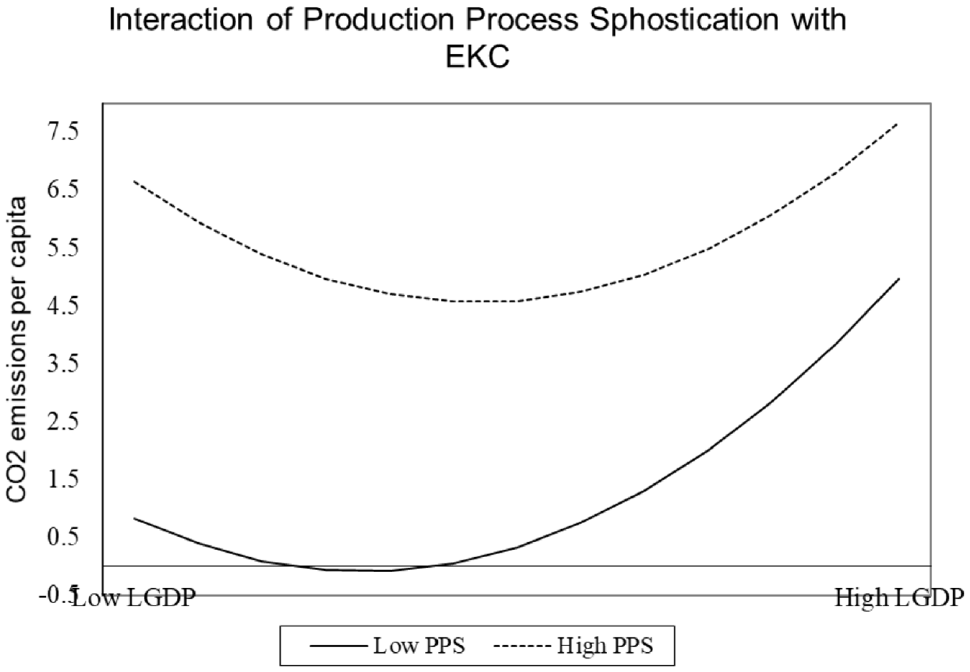
EKC with PPS moderation.

EKC with VCB moderation.

EKC with COID moderation.

EKC with CLUST moderation.
Figure 9 shows the effect of value chain breadth. Here we can see that the higher value chain changes the U shaped pattern of EKC to negative sloped. This shows that value chain can significantly reduce CO2 emissions at higher economic activities. Figure 10 shows the effect of control over international distribution. Here it can be noted that higher control tends to increase the pollutive effect of LGDP at high LGDP values. Lastly, Figure 11 shows the effect of state of cluster development. Here we can see that at low levels of GDP, higher cluster development helps in reducing pollution. While at higher GDP, cluster development does not create any difference.
In order to assess the effect of current level of supply chain competitiveness on the environment in each country, the estimated CO2 emissions are calculated using the average value of supply chain competitiveness and independent variables. Figure 12 plots the difference between the estimated CO2 emissions and actual CO2 emissions for each country. Here, the light blue shaded countries represent the case where supply chain competitiveness plays a role in reducing the current level of CO2 emissions. This graph is plotted on the data generated using the envelop theorem.

Spatial plotting of effect of supply chain competitiveness.
Conclusion and Policy Implication
Since years, literature has been discussing the relationship between supply chain management practices and environmental quality. This paper focused on the quantitative relationship of supply chain management using different dimensions with CO2 emissions. In a region, the production ecosystem goal is to focus on environmentally friendly products by following competitive supply chain activities. This helps in positioning products and services to local and international markets. In order to achieve a sustainable competitive advantage, economic activities necessarily interact with the quality of supply chain processes to reflect resilience in controlling CO2 emissions. For instance, China has now focused on improving quality control processes along with increased economic activities. As production processes increase and organizations produce more sophisticated products, environmental pollution also increases. However, the countries that have developed their infrastructure and technologies can control pollution by developing more supply chain practices, and in this way, the less developing countries suffer more from pollution.
This study fosters the organizations and policymakers to develop such policies and additional means to reduce the CO2 emissions and pollution that is harmful to the environment and develop a supply chain of renewable energy utilization to produce such goods that are less polluted to the environment as suggested by (Janjua, 2021). This research study gives insights into the emission optimized supply chain structure on the country as well as the global level to make the environment of higher quality and develop the economy.
This study proposes supply chain management as a potential tool to achieve cleaner production passage for businesses. This business-oriented strategy helps the business expand and stay cleaner and more sustainable. While ranking the supply chain management indicators in terms of their ability to diminish the carbon emission impact of increasing GDP, value chain breadth is considered as the best option, while the potential of cluster development reduces with the increase in GDP. It denotes that the companies with a broader value chain tend to control their vision better to adopt supply chain management practices.
The results of this study provide guidelines to the managers about the effective management of the upstream and downstream supply chain networks and provide awareness about the synergies that arise by combining the SCQM effects that will result in the quality performance among all the supply chain networks. To meet the requirements of the global competition and develop an organizational environment for the long-term, managers should not solely depend on the internal quality capabilities, but they should practice the supply chain activities to manage the quality and include all the other partners, including suppliers. It is the responsibility of the managers to convince their staff and employees about the benefits of supply chain perspectives and to build a relationship with other members of supply chain networks and external customers.
Policymakers should focus on developing the local supplier quality, value chain breadth, and clusters to assist sellers in aligning the production growth and environmental sustainability goals together. The regions like North America, Africa, and Asia Pacific can adapt to the successful supply chain practices in the USA, Australia, and other parts of Europe to reduce CO2 emissions.
Footnotes
Acknowledgements
The authors acknowledge Mr Osama Aziz and Dr Nadia Hanif who particpated in sharing their experience in developing the theoretical framework of the study.
Author’s Contributions
All authors have equally contributed to developing this research manuscript.
Availability of data and material
The data are publically available, and their sources are mentioned in section 4.1. in Table 1.
Declaration of Conflicting Interests
The author(s) declared no potential conflicts of interest with respect to the research, authorship, and/or publication of this article.
Funding
The author(s) received no financial support for the research, authorship, and/or publication of this article.
Ethical Approval
Not required as the data is publically available.
Consent to Publish
The authors give their consent to publish the manuscript.
Consent to Participation
Not Applicable as no experiments are conducted on humans.
