




Abstract
The joint green R&D of suppliers and manufacturers and the green marketing of manufacturers directly affect the degree of green products. Based on this, this paper establishes a coordination decision-making model of green innovation on the basis of cost-sharing contracts to stimulate supply chain partnerships, and studies the green R&D efforts and green marketing investment decisions of the secondary supply chain composed of a single supplier and a single manufacturer under different leadership scenarios, as well as the relationship between the green R&D decisions of the supply chain and the green marketing decisions of the manufacturer. The influence of green innovation capability on enterprise profit, product greenness and marketing investment is analyzed by numerical simulation. The results show that if an enterprise increases the unit cost coefficient of green innovation, it will reduce the green input of all members of the supply chain; When consumers’ green preference is low, manufacturers will tend to increase investment in green marketing; Cost-sharing contracts can promote the overall green degree of products. The research conclusion can provide reference value for green supply chain management decision-making.
Introduction
With the development of society, environmental and resource issues promote the growth of consumer demand for green products. The green R&D of enterprises can be divided into two parts: green supply and green manufacturing R&D, which play an important role in promoting the growth of green products (Jian et al., 2019; Lu & Xu, 2018; Yenipazarli & Vakharia, 2017). With the continuous penetration of green concept in the supply market, production market and consumer market, consumers gradually turn from the original simple price comparison mode to pay attention to product quality.
Many researchers have carried out in-depth research on the game strategy of green supply chain under consumers’ green preference. At present, some scholars have introduced the concept of product green degree to analyze the game decision-making between upstream and downstream members of green supply chain. For example, Ghosh and Shah (2012, p. 568) established a game model, believing that manufacturers and retailers have always been in the game process, and profit maximization is the goal of the game process between manufacturers and retailers, while the price and green degree in the game process directly affect the market demand. C. T. Zhang and Liu (2013, p. 3369) established a green chain game model, which takes into account the influence relationship between manufacturers, retailers and consumers, and obtains the optimal results of the decision-making model among the three by establishing multi-objective optimization. Tian and Zhu (2016, p. 526) constructed a game model of green supply chain management considering the influence factors of government subsidies. The model described the three stages of supply chain management, and on this basis, focused on the impact of government subsidies on the supply chain. Shi et al. (2016, p. 1937) studied the characteristics of consumer preferences in the green supply chain, analyzed the impact of consumer preferences on the pricing decision of green products through game models, and showed that when consumers’ preferences for products increase, the price of green products will increase, but when the price increases to a certain level, the consumer preferences will decrease. Guan et al. (2019, p. 480) studied the relationship between consumer preferences and green operation of the supply chain, and established a game model between consumer preferences and the supply chain. F. Wang et al. (2011, p. 262) studied the impact relationship between funding concerns and supply chain green product design. J. Gao et al. (2015, p. 3033) analyzed the relationship between carbon emissions and the cost of green products in the supply chain. Jin and Zhu (2018, p. 494) analyzed the balance between economic objectives and green products in the supply chain to achieve the optimization of supply chain costs and carbon emissions.
Regarding the coordination of green supply chains, the existing literature focuses on cost sharing and revenue sharing contracts, and focuses on green supply or manufacturing. Bai and Tang (2017, p. 818) believe that green marketing practice improves market demand and further affects green supply and green manufacturing decisions of supply chain members. Zhu et al. (2018, p. 654), Qu et al. (2016, p. 62), and Pu and Gong (2016, p. 86) studied the decision-making of green product supply chains and found that sharing the cost of green innovation can encourage suppliers and manufacturers to increase green investment and enable system members Achieve Pareto improvement. A few scholars study the coordination of green marketing costs and believe that it can promote green innovation of enterprises. Hong and Guo (2019, p. 155) found that when manufacturers and retailers share green marketing costs, it may harm the interests of retailers, but it will encourage manufacturers to carry out green manufacturing. Peng and Luo (2011, p. 41) pointed out that the green innovation of suppliers has played an important role in the manufacturing of downstream enterprises. Liu et al. (2017, p. 182) believe that green manufacturing helps suppliers find environmentally friendly raw materials and improve environmental performance.
Manufacturers are responsible for green production and retailers are responsible for green marketing; or they only consider green R & D in the upstream and downstream of the supply chain without considering green marketing. However, in the supply chain of automobile and food, the green degree of products is determined by the joint green R & D of suppliers and manufacturers and the green marketing of manufacturers. Therefore, it is necessary to incorporate the green R & D Decision of the supply chain and the green marketing decision of the manufacturer into the green supply chain. However, the above literature on green marketing cost coordination focuses on the downstream of the supply chain, and ignores the impact on suppliers, that is, it does not consider the complex impact of green marketing in the entire supply chain green innovation system. In view of this, based on the supply chain game model, this paper studies the green R & D efforts and marketing investment decisions of suppliers and manufacturers under different leader scenarios, and encourages supply chain partners through cost sharing contract to establish a coordinated decision model of green innovation. On this basis, numerical analysis is used to describe the optimal decision-making of R & D efforts and marketing investment of green supply chain, The research conclusion can provide decision-making reference for relevant enterprises to implement green supply chain management.
The main contributions of this paper are as follows:
Based on the concept of compound green degree product supply chain, the research is carried out from the perspectives of green R & D and green marketing in the supply chain. At present, the research on green supply chain is mainly carried out from the perspective of manufacturers and retailers.
Three interesting conclusions are found: first of all, the increase of unit cost coefficient of green innovation of an enterprise will not only reduce its green investment, but also reduce the green investment of the member enterprises of the supply chain, which will further reduce the environmental protection attribute of the product; Secondly, when the supplier is the leader, if there is external pressure to urge the supplier to increase green investment, other manufacturers will balance the R & D and marketing investment according to the investment coefficient of green R & D and green marketing. However, when consumers’ green preference is low, even if the unit investment cost of green R & D is less than that of green marketing, manufacturers will increase green marketing investment to increase profits; Thirdly, the contract can improve the total green degree of products and increase the profits of enterprises. However, when the marginal profit of upstream and downstream enterprises meets a certain range, the contract will lead to the manufacturer to reduce R & D efforts and increase marketing investment. Therefore, from the perspective of managers, in order to achieve the optimal performance of supply chain members, choosing the appropriate cost sharing contract can improve the economic benefits and environmental performance of enterprises.
The green innovation studied in this paper includes green supply R & D, green manufacturing R & D and green marketing, as well as the green investment activities of its implementers, and the research results can provide a constructive reference for the green research and development of product supply chain from the perspective of management.
Problem Description and Basic Assumptions
Problem Description
The specific process in this paper is shown in Figure 1, and the contents are as follows:
When the level of green R & D efforts and green marketing investment affect the market demand at the same time, the decision-making process of green innovation of suppliers and manufacturers under different supply chain leaders’ perspectives is studied.
When the manufacturer or supplier is the leader of the supply chain, study the supply chain coordination process of the manufacturer (supplier) to encourage the supplier (manufacturer) to carry out green innovation under different incentive contract forms, and compared the green innovation ability of enterprises under different conditions, that is, the influence of the unit cost of product green innovation on corporate profits, product greenness and marketing level.

Compound greenness product supply transfer process.
In Figure 1, gs+gm is product final greenness; ρ s , ρ m are the marginal profits of the supplier and the manufacturer, respectively; ks, km, v are the unit investment cost coefficients of green supply, green manufacturing and green marketing respectively. The higher the coefficient, the greater the difficulty of innovation, and the company will reduce green investment; D represents product demand.
Basic Assumptions
Model hypothesis 1: Based on references (Chakraborty et al., 2019; Zhu et al., 2018), the consumer demand function
Model hypothesis 2: Based on the research of Ghosh and Shah (2015, p. 319), an increasing convex function is used to represent the investment cost of green practice. Among them: the green supply investment cost of the supplier is
Decentralized Supply Chain
In this section, the supplier determines the green degree of product supply, and the manufacturer determines the green degree of product manufacturing and the final marketing investment. As channel leadership has an important impact on the performance of supply chain, there are two different scenarios in reality: supplier (DS) and manufacturer (DM) as supply chain leaders.
The profit functions of suppliers and manufacturers are as follows:


Stackelberg Model Leaded by Supplier (DS Scenario)
In many industries, the supplier is the leader of the supply chain. For example, in the food supply chain, the core leadership of the supplier owner leads the food manufacturers to carry out green manufacturing and marketing (Li et al., 2019; X. Gao and Wang, 2019; X. Zhang et al., 2021). The game order of DS scenario is that the supplier decides gs first, then the manufacturer decides gm and η, and then solves the problem according to the reverse order method.
Let





It can be seen from Inference 1(a) that when ks is small, it is easier for the supplier to improve the greenness of the product in the supply stage, and the manufacturer is more willing to increase its own innovation investment after understanding the supplier’s innovation information and conduct marketing in the market, increase investment in green marketing, in order to expect higher profits.
It can be seen from Inference 1(b) that when the km is smaller, the manufacturer will increase the greenness of the manufacturing stage, and the reduction in cost will increase the demand for order quantity. This will make manufacturers pay more attention to upstream suppliers, that is, increase the sensitivity of the order quantity to the greenness of the supplied products, thereby increasing the marginal profit brought by upstream green investment, and making upstream companies increase their green supply input.
From 1(c), it can be seen that when v is small, it indicates that the manufacturer’s marketing investment level has a strong influence on demand, which will lead the manufacturer to increase market investment. Suppliers believe that the risk of market uncertainty for green products is reduced, and they are more willing to invest more in green innovation costs, and the greenness of their products has begun to increase.
Generally, the unit cost of green innovation only affects the green degree decision of the enterprise. However, the inference 1 proves that the increase of the unit cost of green innovation will reduce the green investment of the other enterprise, resulting in the further decline of the compound green degree. Therefore, no matter what kind of leadership, the development of compound greenness products with the most environmental protection attributes needs the joint green efforts of supply chain members.
In addition, we also consider a special scenario, that is, when the leader supplier increases the green supply efforts, we need to study the green R & D and green marketing decisions of the follower manufacturers.
As mentioned above, government policies and consumer preferences will increase the demand for high greenness products. At this time, suppliers with greater channel leadership will first increase the


(b.0) when
(b.1) when
(b.2) when
When the supplier’s green R & D efforts increase, inference 2 (a) shows that manufacturers will also increase green manufacturing efforts and increase marketing investment. It is easy to deduce the conclusion from the demand function
Inference 2 (b) shows that manufacturers are more willing to increase green marketing investment when the formula (b.0) is satisfied; In the case of formula (b.1), manufacturers are more willing to improve green R & D efforts; Formula (b.2) is a special case, that is, when the green cost coefficient km of the manufacturer is smaller, if the supplier improves the green R & D efforts, the manufacturer is willing to increase the green marketing investment of the product.
Therefore, when the supplier improves the gs, the manufacturer who is the follower will balance the R & D and marketing investment according to the km and V, that is, when the km is small, the manufacturers are more willing to carry out green manufacturing, and vice versa for green marketing. However, when
Stackelberg Model Leaded by Manufacturer (DM Scenario)
In the supply chain of electronics and automobile manufacturing, manufacturers often act as supply chain leaders and encourage suppliers to carry out green innovation. Different scholars have different ideas about the decision-making order of marketing. J. Gao et al. (2015, p. 187) studied the Stackelberg model of retailers taking the lead in making marketing efforts, and analyzed the impact of product green effect and sales effort effect on enterprise decision-making; Y. Y. Wang et al. (2013, p. 422) studied the secondary supply chain decision dominated by retailers, and found that under the same price strategy, retailers’ postponing marketing decisions would benefit all supply chain members. The game order of DM scenario is shown in Figure 2.

Game order of DM scenario.
First, the manufacturer decides the gm value; secondly, the supplier decides the greenness gs value; finally, the manufacturer decides the marketing effort η value according to the total greenness of the product, and solves it according to the reverse order method.
if


The DM scenario also satisfies inference 1, and the proof is omitted.
Supply Chain Green Innovation Incentive Contract
The Contract Decision of Supplier Encouraging Manufacturer's Green Innovation
Based on the DS scenario, this section assumes that external pressure, such as the government has requirements on the greenness of products (Hong & Guo, 2019; Martin & Simintiras, 2013), at this time, suppliers hope that downstream manufacturers can improve the greenness of products. Therefore, an incentive contract for cost sharing is proposed, and it is assumed that the contract is made by the supplier. Because of the difference in cost sharing, it is divided into incentive contracts for manufacturing cost sharing and marketing cost sharing.
The decision-making sequence of suppliers to encourage manufacturers to carry out green innovation is shown in Figure 3.

The decision order of suppliers to encourage manufacturers to carry out green innovation.
Firstly, the supplier decides the green degree gs value and the cost sharing proportion; secondly, the manufacturer decides the gm value and marketing effort η value, which is solved by the reverse order method.
Incentive Contract for Supplier to Share Manufacturing Cost (DS-CP Scenario)
When the supplier shares the manufacturing cost incentive contract, the profit function is


Among them, ϕ in equations represents Green R & D cost factor. In DS-CP scenario, if




Incentive Contract for Supplier to Share Marketing Cost (DS-CM Scenario)
When suppliers share the incentive contract of marketing cost, their profit function is


In DS-CM scenario, if



Comparative Analysis
Inference 3
(a) Compare the greenness, marketing investment level and profit of each enterprise in different stages under DS-CP and DS scenarios.
(b) Compare the greenness, marketing investment level and profit of each enterprise in different stages under DS-CM and DS scenarios.
Inference 3 shows that suppliers can encourage downstream manufacturers to improve the greenness of products in the manufacturing stage through cost sharing contract, so as to improve the total greenness of products and encourage manufacturers to increase their marketing efforts. However, at this time, as the leader of the supply chain, the supplier formulates the contract on the premise of maximizing its own profit. Therefore, the supplier will not pay too much attention to the greenness of the product supply stage, and try to reduce its own R & D cost payment.
The Contract Decision of Manufacturer Encouraging Supplier's Green Innovation
Based on the DM scenario, this section proposes a cost sharing incentive contract. The manufacturer hopes to improve the green degree of products by sharing the cost of green supply from upstream suppliers, and assumes that the contract is made by the manufacturer.
Incentive Contract for Manufacturer to Share Supply Cost (DM-CP Scenario)
In this section, manufacturers encourage suppliers to carry out green innovation, and the decision-making order is shown in Figure 4.

Decision order of manufacturers to encourage suppliers to carry out green innovation.
First, the manufacturer decides the greenness gm value and the cost sharing ratio; secondly, the supply decision gs value; finally, the manufacturer decides the marketing effort η value according to the total greenness of the product, and solves it according to the reverse order method
At this time, their profit functions are


In DM-CP scenario, if


Comparative Analysis
Compare the DM-CP and DM scenarios, the greenness of the product in the supply and manufacturing stage, the manufacturer’s marketing investment level, and the profitability of each company.
Inference 4
(a) If ρ
m
<ρ
s
and
(b)
Inference 4 shows that manufacturers can encourage upstream suppliers to improve the greenness of products in the supply stage through cost sharing contract, and they are willing to increase marketing investment when they understand the green innovation practice of suppliers. However, since the manufacturer formulates the contract on the premise of maximizing its own profit, it does not pay attention to the greenness of the product manufacturing stage. As the inference 4 (a) proves, when the marginal profit of the manufacturer is less than the supplier and the unit cost of green marketing is large, the contract will lead the manufacturer to reduce the cost payment of green manufacturing to improve its profit.
Numerical Analysis
In order to further analyze the model and explore the correctness of the conclusion, the optimal decision-making of R & D efforts and marketing investment of green supply chain is described by numerical simulation. The enterprise economic level and product greenness of decentralized scenario (DS and DM) and cost sharing contract scenario (DS-CP, DS-CM and DM-CP) are compared. The parameters in the model are assigned as follows (Yu et al., 2019):

Comparison of Supplier Incentive Scenarios for Manufacturers
This section focuses on the simulation of the impact of green innovation unit cost coefficient on product greenness and enterprise economy under DS scenario, DS-CP scenario and DS-CM scenario, and
As shown in Figure 5, the gs and gm under the cost sharing contract are always higher than those in the decentralized scenario, which means that the cost sharing contract can promote the green practice of the supply chain and improve the greenness of the products. Moreover, the optimal greenness change chart reveals the results. Figure 5 also shows that suppliers’ sharing of manufacturing costs can more encourage manufacturers to improve the greenness of products in the manufacturing stage. However, different cost sharing contracts have no difference for suppliers. When the suppliers share the manufacturer’s cost, they will not pay too much attention to the green degree of the product supply stage.
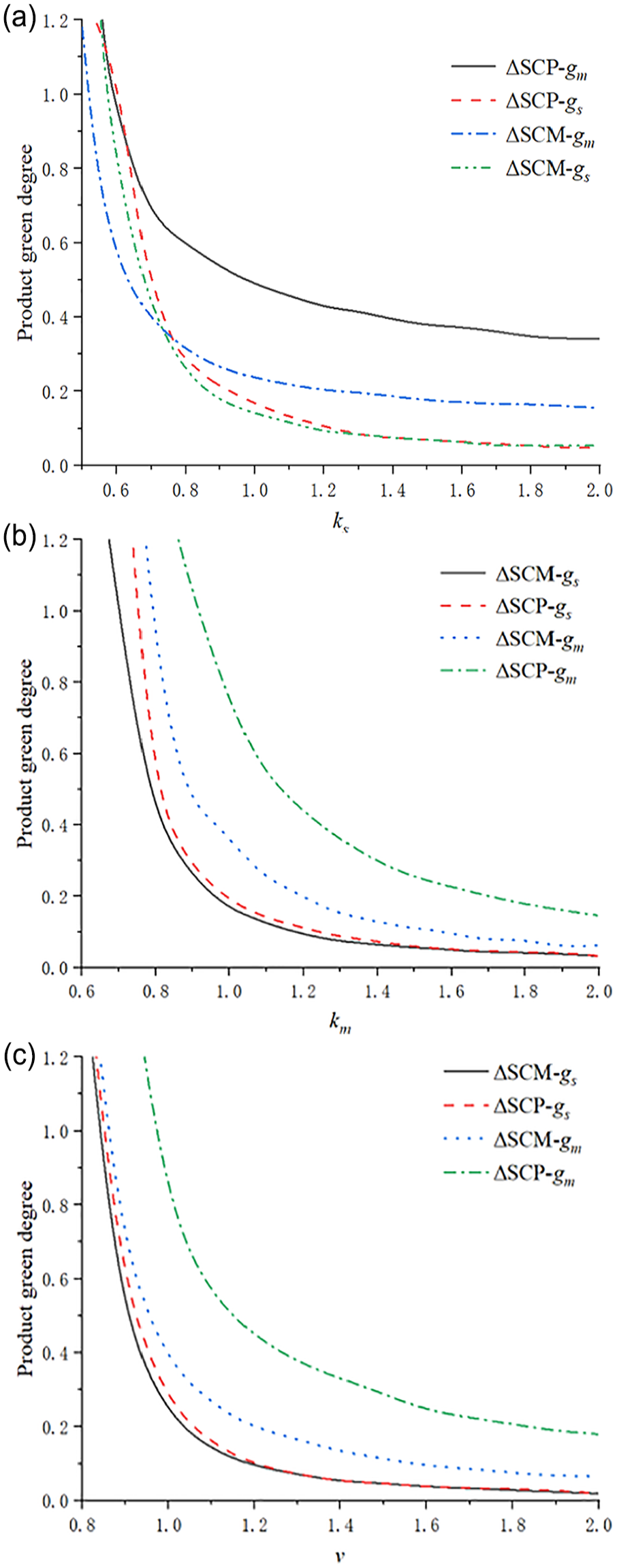
The comparison of greenness under the scenario of decentralized scenario and cost sharing contract (supplier LED): (a) relationship between ks and product green degree, (b) relationship between km and product green degree, and (c) relationship between v and Product green degree.
As shown in Figure 6, under the cost sharing contract, πs and πm are always higher than those in the decentralized scenario, that is, the cost sharing contract can not only improve the green degree of the product, but also increase the profit of the enterprise. And the enterprise profit change chart reveals the results, the supplier sharing cost can make the manufacturer increase more profits than the supplier, but there is no difference between the different cost sharing contracts for the supplier.

Comparison of enterprise economy under decentralized scenario and cost sharing contract scenario (supplier LED): (a) relationship between ks and profit, (b) relationship between km and profit, and (c) relationship between v and profit.
Comparison of Manufacturers’ Incentives to Suppliers
This section focuses on the simulation of the impact of green innovation unit cost coefficient on product greenness and enterprise economy under DM and DM-CP scenarios.
Figure 7 shows that the gs and gm under the cost sharing contract are always higher than those in the decentralized scenario, that is, the cost sharing contract can promote the green practice of the supply chain and improve the green degree of the products. However, when the marginal profit of supplier and manufacturer is different, the optimal decision of manufacturer is different, as shown in Figure 8.

Comparison of product greenness and marketing investment under decentralized and cost sharing contract scenarios (manufacturer LED): (a) relationship between ks and parameter variation, (b) relationship between km and parameter variation, (c) relationship between v and parameter variation.

Manufacturer’s optimal decision in DM-CP scenario.
The three areas in Figure 8 are as follows: Zone 1 indicates that the manufacturer will increase the green degree of the product in the manufacturing stage; Zone 2 indicates that the manufacturer will reduce the green manufacturing investment; and Zone 3 indicates that the supplier does not accept the contract. As inference 4 says, contracts encourage upstream suppliers to improve the greenness of products in the supply phase, and then improve the total green degree of products. When manufacturers see the total green degree information of products, they are willing to increase green marketing investment. However, in order to maximize their own profits, manufacturers will not pay too much attention to the greenness of products in the manufacturing stage, but will reduce the green manufacturing investment.
Figure 9 shows that under the cost sharing contract, πs and πm are always higher than those in the decentralized scenario, that is, the cost sharing contract can not only improve the green degree of products, but also increase the profits of enterprises. And the enterprise profit change chart reveals the results. Figure 9b and c shows that with the increase of km or v, the profit of the manufacturer is greater than that of the supplier.

Comparison of enterprise economy under decentralized scenario and cost sharing contract scenario (manufacturer lead): (a) relationship between ks and profit, (b) relationship between km and profit, (c) relationship between v and profit.
Conclusion
Based on the supply chain game model, this paper studies the green R & D efforts and marketing investment decisions of suppliers and manufacturers under different leadership scenarios. In addition, this paper studies the production decision-making model of the upstream and downstream enterprises in the supply chain to encourage each other to carry out green innovation by using the cost sharing contract, and analyzes the influence of the green innovation ability of the enterprise on the enterprise profit, product green degree and marketing investment. Through the analysis of the two scenarios under the decentralized scenario, the conclusions are as follows:
For managers, in the process of developing compound green degree products with the most environmental protection attributes, they need to pay attention to the collaborative green R & D of upstream and downstream enterprises to reduce the green practice cost of both sides, because the unit cost coefficient of green innovation of an enterprise will affect the total green degree of products.
When the external pressure makes the leader supplier improve gs, the follower manufacturer will balance the two green inputs according to km and v. However, when the consumer’s sensitivity to green products in the market satisfies
Cost sharing contract can improve the total greenness of products, but under different scenarios, the impact on enterprise economy and product greenness is different. When the supplier is the leader, the green manufacturing cost sharing can encourage the manufacturer to improve the greenness of the product in the manufacturing stage, and improve the manufacturer’s profit. However, there is no difference between different cost sharing contracts for suppliers; When the manufacturer is the leader, the contract will not promote all members of the supply chain to increase green R & D efforts. When
Footnotes
Acknowledgements
The authors would like to thank the editor and three anonymous reviewers for their constructive comments, which enabled us to describe the research more clearly.
Declaration of Conflicting Interests
The author(s) declared no potential conflicts of interest with respect to the research, authorship, and/or publication of this article.
Funding
The author(s) received no financial support for the research, authorship, and/or publication of this article.
