




Abstract
This paper studies the effect of international talent inflow on technological innovation and the influence of the Chinese cultural environment on their relationship. Based on provincial-level data from 2000 to 2012, we construct a static panel data model to explore the effects of international talents on technological innovation and the moderating role of Guanxi culture and social trust in the above relationship. We find that international talent inflow positively impacts technological innovation. Guanxi culture significantly negatively impacts technological innovation and negatively moderates the relationship between international talent inflow and technological innovation. Social trust significantly positively impacts technological innovation and positively moderates the relationship between international talent inflow and technological innovation. The interaction between social trust and Guanxi culture has a significant positive effect on technological innovation. The study shows that different cultural environments have an essential impact on developing international talent’s innovation ability. This paper provides evidence for the need to improve China’s cultural environment and provides important implications for the formulation of talent policies. Based on this, we suggest improving the talent introduction system, optimizing the relationship culture, and building a good social trust system to promote regional innovation.
Plain language summary
In this paper, we found that international talent inflow positively impacts on technological innovation. Guanxi culture significantly negatively impacts on technological innovation and negatively moderating the relationship between international talent inflow and technological innovation. Social trust significantly positively impacts on technological innovation and positively moderates the relationship between international talent inflows and technological innovation. The interaction between social trust and Guanxi culture has a significant positive effect on technological innovation. This study makes several contributions to the literature. First, it enriches the research on the influence of informal institutions in the field of international talents and reveals the boundary conditions for the role of international talents. Second, it deepens the research on the influence of culture with Chinese characteristics and enriches the empirical research on Guanxi culture in management. Lastly, it expands the antecedents of technological innovation. There are some limitations to this study. First, in addition to the negative side of the Guanxi culture, there is also a positive side. This study only uses the time invested by entrepreneurs and corporate entertainment expenses to explore its effect. Therefore, future research can analyze both sides of Guanxi culture. Second, Guanxi culture is just one of China’s core cultures. Other cultures such as favor and face are also cross-cultural adaptation issues that international talents must face. It is necessary to discuss them. Third, limited to data availability, the social trust data only covers 7 years. Therefore, more relevant alternative indicators can be sought to verify the results in the future.
Keywords
Technological innovation is the driving force for the economic development of a country or region. Compared with natural resource endowments, technological innovation has become more prominent with globalization and the knowledge-based economy (Freixanet et al., 2020). Since technological innovation refers to the beginning, evolution, and development process of technological products (More, 1985), it is more dependent on the human initiative. Therefore, talent represents the core productivity in this area in some ways, especially in the era of the knowledge-based economy. As a result, the global war for talent has become increasingly fierce, and the cross-border movement of talent has become a norm (Harvey, 2013). According to the World Migration Report 2018, the number of migrants worldwide is approximately 244 million, accounting for about 3.3% of the world’s population, and 72% of migrants are in the 20 to 64 age group, becoming one of the driving forces for economic development and technological progress in countries and regions affected by talent inflow (International Organization for Migration, 2017). The cross-border flow of human capital includes three stages: talent outflow, talent inflow, and talent circulation. China has entered the talent inflow phase. Especially after implementing several effective measurements, such as the “Thousand Talents Plan,” the work permit system for foreigners, and the talent visa system, a large number of international talents have flowed into China to work. In 2015, the number of overseas experts working in mainland China reached 623,500, showing an increase of 39.8% compared with 2008. In 2016, 432,500 Chinese people who had an overseas educational background returned to China; the return rate reached 79.43%, which is much higher than the 38.54% in 2008 (C. Li & Niu, 2018). Since international talents have comparative advantages in technical knowledge, social networks, education, and overseas experience, they can promote China’s economic growth and technological progress through the effects of human capital, networking, and knowledge spillover (P. Li & Xu, 2011). However, because customs, behavioral norms, and values vary across different countries, foreigners are prone to facing problems such as cultural shock and mental illness, that is, the problem of cross-cultural adaptation (F. J. Sun, 2012). As for returnees, they mostly face the risk of “reverse cultural shocks” and showing “adversity to the soil and water” in one’s social life, career, and lifestyle (Yu & Chang, 2017). Guanxi, one’s network, and one’s face constitute the key characteristics in the Chinese social structure (Y. J. Jin, 2013). Among these, Guanxi reflects the rules of Chinese interpersonal communication and is deeply embedded in Chinese society, economy, and life—which form Guanxi culture. On the one hand, this culture regards interpersonal relationships as the guarantees for credibility, conducive to emotional communication and the establishment of mutual trust relationships, and also benefits the resource acquisition and the resolution of conflict and friction. However, on the other hand, increasingly complex interpersonal relationships may trigger corruption and rent-seeking behavior. In addition, the business transactions generated by a interpersonal relationship causes the economic agents involved to pay high interpersonal costs, that is, the “liability” of human relationships, which are not conducive to the development of economic agents (X. C. Li et al., 2016). Therefore, Guanxi culture has become an important factor affecting the cross-cultural adaptation of international talents, which will have an impact on the work and innovation performance of international talents.
Scholars have discussed the impact of returnees and international immigration on technological innovation from the perspective of human capital, social networks, and knowledge spillovers at the macro-level (Burns & Mohapatra, 2008; P. Li & Xu, 2011; S. Y. Wu et al., 2016). Furthermore, some studies have focused on personnel knowledge transfer and task performance affected by cultural differences (Chang et al., 2012; Harrison & Shaffer, 2005; Zhu & Hu, 2015). Meanwhile, the relationship between culture and technological innovation is valued by scholars (Svarc et al., 2019). Some scholars believe that low power distance, masculinity, low uncertainty avoidance, and long-term orientation are conducive to improving research efficiency, innovation investment, national innovation efficiency, and technological innovation (Contiua et al., 2012; Efrat, 2014; Kaasa & Vadi, 2010; Lim & Park, 2013; Taylor & Wilson, 2012). The stronger the individualism, the more conducive to national innovation (Desmarchelier & Fang, 2016). However, some scholars believe that uncertainty avoidance is not conducive to innovation (Waarts & Van Everdingen, 2005) and that even individualism has no effect (Engelen et al., 2014). Patriotism and democracy are conducive to national innovation (Kaasa & Vadi, 2010; Steers et al., 2008), but familism and localism are detrimental (Taylor & Wilson, 2012). Furthermore, institutional collectivism negatively affects regional innovation, while the opposite is true for performance orientation and gender equality (Song et al., 2019). Political stability and education mitigate the adverse effects of collectivism and uncertainty avoidance on firm innovation (Nam et al., 2014). External resources and education investment can diminish the adverse impact of cultural diversity (dialect) on innovation (Hu et al., 2022). However, the following problems still exist: First, there remains a lack of a discussion on the relationship between environmental factors such as systems, culture, and capital and international talents in macro studies. Particularly, the impact of cultural differences and institutional differences in China has especially been ignored, and studies in this area are mostly based on qualitative analysis. Second, micro-level studies have mostly been based on the individual and organizational levels, ignoring the mutual influence and joint role of interpersonal interaction groups, and rarely concerning issues in technological innovation.
Facing the dual influence of Guanxi culture, whether or not the influential talents can effectively exert their technological knowledge capabilities and benefit from regional technological innovation remains to be explored. Therefore, this study focuses on the following questions: First, how does Guanxi culture affect the relationship between international talents and technological innovation; and second, from the perspective of social capital, does social trust benefit technological innovation and weaken the impact of Guanxi culture?
This study makes several contributions to the literature. First, it enriches the research on the influence of informal institutions in the field of international talents and reveals the boundary conditions for the role of international talents. Second, it deepens the research on the influence of culture with Chinese characteristics and enriches the empirical research on Guanxi culture in management. Lastly, it expands the antecedents of technological innovation.
Theoretical Analysis and Research Assumptions
International Talent Inflow and Technological Innovation
International talents are talents who have the knowledge, skills, and abilities required for foreign-related work and can contribute to economic globalization (Ding, 2010). Generally, they have international work experience, internationalization consciousness, and relatively strong internationalization capabilities. International talents mainly include foreign experts, students studying abroad, professionals and technicians dispatched abroad, and professionals and technicians employed by foreign enterprises (C. Wu, 2000). In this study, international talent inflows are the talents who have entered China to work, including overseas experts and returnees. They have great made contributions to China’s economic development and technological progress. International talent inflows have impacted China’s technological innovation in the following ways: first, the human capital effect. With internationalization consciousness and relatively high-degree professional knowledge, international talents can promote the innovation input and output of enterprises (Zhang & Wu, 2016) and can produce knowledge spillover effects, technology transfer effects, and diffusion effects (Fan, 2015; Le, 2008; H. Yang & Chen, 2013), which are beneficial to the improvement of regional technology. Second, network effects. International talents have a dual network covering their home country and host country. They can use a dual network to obtain technical resources and customer resources, promote business and technology communication between the home country and host country, and attract foreign investment and trade, which is conducive to improving the performance of technological innovation and amplifying technological spillover effects (Kerr, 2013). Finally, competition effects. The inflow of international talents will occupy employment opportunities in related fields and generate a “position crowding in effect,” thereby motivating domestic individuals to improve their technical level through reeducation or training, which is conducive to the improvement of local innovation levels, and thus enhance local independent innovation capabilities and technology absorption abilities (Z. Sun & Liu, 2014). Moreover, the inflow of international talents can also contribute to technology diffusion through benchmarking effects, employee mobility effects, and industrial agglomeration effects. Based on the above analysis, we make the following hypothesis:
H1: International talent inflows have a positive impact on technological innovation.
Guanxi Culture and Technological Innovation
Guanxi culture is the identification, construction, and maintenance of interpersonal relationship networks by individuals or organizations within a region. It is a cultural value system that restricts interpersonal behaviors (Liu et al., 2018). As an informal system, Guanxi culture is relatively common and important in developing China’s economy, and “reciprocity” and “building connections” have become common phenomena in business activities. The impact of Guanxi culture is mainly reflected in two aspects. On the one hand, as social capital, it can make up for the shortcomings of formal systems, which is conducive to resource acquisition, reduces market transaction risks, and promotes economic development (Peng & Luo, 2000). On the other hand, Guanxi culture has become an inhibitor of corporate innovation activities. Because innovation requires large quantities of funds, human resources, and time investment, relatively speaking, building connections is more effective, which induces the rent-seeking behavior of organizations or individuals and improves the short-term performance of enterprises. At the same time, in areas where Guanxi culture is prevalent, little protection is given to intellectual property. The innovation activities of enterprises are easy to be imitated or copied, which destroys the market competition system and reduces the willingness of enterprises to invest in innovation activities. In particular, private enterprises are more enthusiastic about building connections and black box operations, and the inhibition of Guanxi culture on their innovation and development is more significant. The “curse of political resources” effect exists in China’s business activities, mainly due to the pursuit of political connections by enterprises, which is not conducive to the development of corporate innovation activities and the improvement of innovation efficiency, and this adverse effect continues for some time (Yuan et al., 2015). Because Guanxi culture is compulsory and inductive, it will not only force companies in the same region to follow the same rules but also induce them to adopt the same means to obtain resources, so that foreign enterprises such as returnee entrepreneurs and local entrepreneurs can reach a formal–informal balance (Lin et al., 2015), which leads to a vicious circle and further inhibits technological innovation.
The Chinese divide associates into different groups with different interactive levels based on Confucianism. With family relationships as the core, they form a three-level cultural relationship of kinship, acquaintance, and strangers, generating several concentric circles (Fei, 2007). Groups outside of one’s kinship are difficult to break through the conservative psychological defense (Hwang, 1987). As Guanxi culture has penetrated all aspects of Chinese life, it has become a socially accepted value and code of conduct, greatly affecting international talents. Hence, talents need to invest time and energy in relationship cultivation before building trust to facilitate business development and cooperation (A. Jin, 2006). At the same time, Guanxi culture is one of the norms of Chinese social relations. It has legitimacy and universality, is widely recognized by the Chinese, and has a strong binding force, forcing international talents to build an interpersonal network and obtain information and resources (Ye et al., 2016). This may conflict with the values and thinking modes formed by international talents, leading to cross-cultural adaptation issues, which easily weakens the willingness and motivation of international talents to learn and communicate, which is not conducive to the absorption of diverse knowledge, creation of investment, and cross-cultural collaboration (Morris et al., 2008). At the same time, talents from conservative cultures are less likely to adopt foreign ideas. They cannot cooperate effectively with talents from inclusive cultures, which may hinder innovation exchanges and learning innovative of knowledge, and intensify with increasing cultural distance (Chua et al., 2014). When the host country possess few cultural differences from the home country, although the existing knowledge structure and behavioral practices will be challenged, international talents will be more readily accepted by locals and will quickly generate identity, which will help reduce the difficulty of cross-cultural adaptation (Tung, 2016). At the same time, it would be easy to access new things different from their own country. These novel changes are conducive to developing creativity (Godart et al., 2014). In contrast, if talents do not involve themselves in the host country’s culture, it would not be conducive to technological innovation. Based on the above analysis, we make the following hypothesis:
H2a: Guanxi culture negatively impacts technological innovation.
H2b: Guanxi culture negatively moderates the relationship between international talent inflows and technological innovation.
Social Trust and Technological Innovation
Social trust is defined as the subjective probability of one party evaluating how another party or group will act (Gambetta, 1988), reflecting the positive expectations of social members on the intentions or behaviors of others (Knack & Keefer, 1997). Different from special trust based on family, relatives, and friends in the Chinese Guanxi culture, social trust reflects the trust of strangers, which is general trust (Delhey et al., 2011). It belongs to people’s spontaneous interaction activities, and it is the glue in forming and developing social networks. Based on social capital, it shows that social trust can promote the exchange of resources and cooperation among individuals or groups to achieve common goals (Adler & Kwon, 2002), which has a direct impact on business cooperation, technological progress, and economic prosperity, and can improve social efficiency (Putnam, 1905). For technological innovation, social trust can promote information dissemination and exchange, conducive to the transfer of knowledge and technology and the acquisition of information and resources, which also positively impacts the improvement of regional innovation capabilities. In addition, the higher the degree of social trust, the more it is conducive to reducing the cost of social transactions and increases the possibility of future cooperation so that more transactions and cooperation are reached (Granovetter, 1973). At the same time, social trust is conducive to dispelling people’s concerns about ideological exchanges, thereby helping to create a good atmosphere for innovation, enhancing the frequency of knowledge exchange, and stimulating the collision of innovative thinking. With the increase of social trust, the level of national innovation has also been improved (X. Li, 2013). In addition, in weakly connected social networks, social trust is conducive to accelerating the acceptance rate of innovative activities. Existing research shows that social trust can significantly promote technological innovation (Akçomak & ter Weel, 2009).
If the level of social trust is low, Guanxi culture will work, which will undermine formal legal contracts, and this additional “transaction cost” hinders economic flexibility and growth. Comparatively speaking, the social trust of the United Kingdom and the United States mainly originates from the system and norms, while the social trust of China and Italy is built on relationships, such as kinship, geo-association, and reciprocity (Fukuyama, 1995); hence, the Chinese tend to build up connections to gain special trusts. Unlike western companies’ materialistic views, Chinese corporate values are more people-oriented, which makes them more likely to adopt interpersonal relationship strategies. The lower the social trust, the stronger this tendency, and the more emphasis is placed on the development of short-term rather than long-term performance. On the contrary, the higher the social trust, the weaker the Chinese company pursues relationship establishment, and the company will be more inclined to increase the brand value (W. Yang & Yang, 2016). Owing to uneven social and economic development in China, the higher the level of regional marketization, the more perfect the formal system. Further, the government intervenes less in corporations, which weakens Guanxi culture and the motivation of corporations for adopting interpersonal relationship strategies to obtain resources (Ye et al., 2016). Therefore, when international talents enter different regions of China, they may face different social trust situations. The higher the social trust, the weaker the Guanxi culture is, which is more conducive to international talents exchanging and cooperating in innovative activities and improving collaboration efficiency. On the contrary, the lower the degree of social trust, the stronger the Guanxi culture faced by international talents, the more time and energy it takes to manage interpersonal relationships and gain trust to achieve the acquisition of resources and cooperation opportunities, which is not conducive to technological innovation. Based on the above analysis, this study makes the following hypothesis:
H3a: Social trust positively impacts technological innovation.
H3b: Social trust positively moderates the relationship between international talent inflows and technological innovation.
Methodology
Variable Selection
Explained Variable
Input and output indicators are standard measures of technological innovation. Patents are output indicators, and their market value is relatively large. They cover almost all fields and are a homogeneous measure of innovation in all regions. Compared with utility patents and appearance patents, invention patents have the highest originality, and their acceptance has not been restricted by the reviewing institution. Indeed, many scholars have adopted the use of invention patents to measure technological innovation (Acs et al., 2002; Guan & Gao, 2009; Luo et al., 2017). Therefore, this study selects the number of accepted invention patents as the proxy indicator of technological innovation.
Explanatory Variables
International Talents Inflow
Compared with overseas returnees and overseas students in China, foreign experts working in mainland China are divided into overseas economic, technical, management experts, and overseas education, culture, and health experts. Generally, these foreign experts work in domestic enterprises, institutions, and foreign-invested enterprises. Their positions include investors, general managers, plant managers, and department managers, among others. Their purpose mainly includes business cooperation and working experience. The data is easy to obtain. Therefore, this study selects overseas experts from mainland China to measure international talent inflow (C. Li & Niu, 2018).
Guanxi Culture
As for Guanxi culture, the existing management research has mainly adopted the time invested by the entrepreneur and the cost paid by the enterprise in connection with Guanxi activities to reflect the importance a company attaches to Guanxi. Ye et al. (2016) borrowed from this, and according to the theory of entrepreneurs’ attention, they believe that since entrepreneurs allocate more time to Guanxi activities, this means that Guanxi is important in their business process. The entertaining cost of the entrepreneur to build and maintain a relationship is adopted as the revised indicator. Based on data from six national private enterprises surveys from 2000 to 2010, Ye et al. (2016) used these two indicators to construct a regional Guanxi index. They used indicators such as official corruption and the variation of marketization development to test its reliability and validity. At the same time, X. C. Li et al. (2016) and Liu et al. (2018) used this Guanxi index for reference or verification and further proved its theoretical and practical significance. Because international talents come to China for business cooperation or work opportunity, they are bound to be affected by Guanxi culture. Therefore, this study selects the Guanxi culture index to measure the relationship culture (Ye et al., 2016).
Social Trust
Extant literature has adopted proxy indicators to measure social trust. Zhang and Ke (2002) used inter-firm trust, world values, China’s comprehensive social survey, and the number of accepted labor dispute cases to represent social trust. However, several problems with this approach exists, such as a relatively short time lag, missing data, the difficulty of obtaining the relevant information, and uncertain validity. Most indicators are not targeted by enterprises or business leaders. The Chinese Entrepreneurs Survey System commissioned Wang et al. (2012) to conduct surveys on state-owned and non-state-owned enterprises using Chinese enterprise managers’ follow-up questionnaires, including the measurement of “the integrity of the social environment that fits local enterprises’ development.” This can more accurately reflect the social trust of various regions and has been verified by scholars (Yan & Jing, 2016); at the same time, the survey is consistent with the inflow of international talents into China for corporate work and business cooperation. Therefore, this study adopts the trust data of Wang et al. (2012).
Control Variables
Technological innovation is not only affected by the inflow of international talents, relationship culture, and social trust but is also closely related to regional absorptive capacity and social capacity. When a region’s degree of opening up to the outside world is higher, foreign direct investment will be more fully utilized. In addition, financial development will reach a higher level, the industrial structure will be more reasonable, and the economic environment will be more stable, which will attract a larger number of talents, who will benefit from learning and imitation (Almeida & Kogut, 1999). According to the relevant studies, we select the degree of opening up, foreign direct investment, financial development level, and industrial structure as our control variables. The degree of regional opening-up is based on the total imports of each province of China (converted according to each year’s RMB exchange rate) divided by the gross domestic product (GDP) ratio. Foreign direct investment (FDI) is represented by the actually used amount of FDI (conversed according to each year’s RMB exchange rate) divided by the GDP ratio. The industrial structure is measured by the secondary industry added value divided by the GDP ratio, and the financial development level is based on financial structure deposit and loan balance divided by the GDP ratio (C. Li & Niu, 2018).
The definitions of the main variables used in this study are provided in Table 1.
The Definitions of Variables.

Model Construction
Griliches (1979) first proposed the knowledge production function. Based on this, Jaffe (1989) considered that innovation output was a function of research and development (R&D) capital investment and R&D personnel investment, and thus formed the classic Griliches–Jaffe knowledge production function. Based on this, this study regards technological innovation as a function of international talent, Guanxi culture, social trust, and financial development. The static panel data model is constructed as follows:


Here,
Data Sources
The data used in this study is from 30 provinces and municipalities, covering a period of 6 years between 2000 and 2012 (Tibet, Hong Kong, Macao, and Taiwan were not included owing to lack of data). Data on technological innovation was sourced from the China Statistical Yearbook of Science and Technology, that on international talent inflows comes from the Compilation of Statistical Survey of Foreign Experts Working in China, and that on Guanxi culture comes from the research results of Ye et al. (2016). Social trust data were obtained from the four-year survey of Wang et al. (2012). Data on opening degree, FDI, financial development level, and industrial structure was from the China Statistical Yearbook. The statistical description of each variable and correlation between each variable is shown in Table 2.
Descriptive Statistics and Correlations.
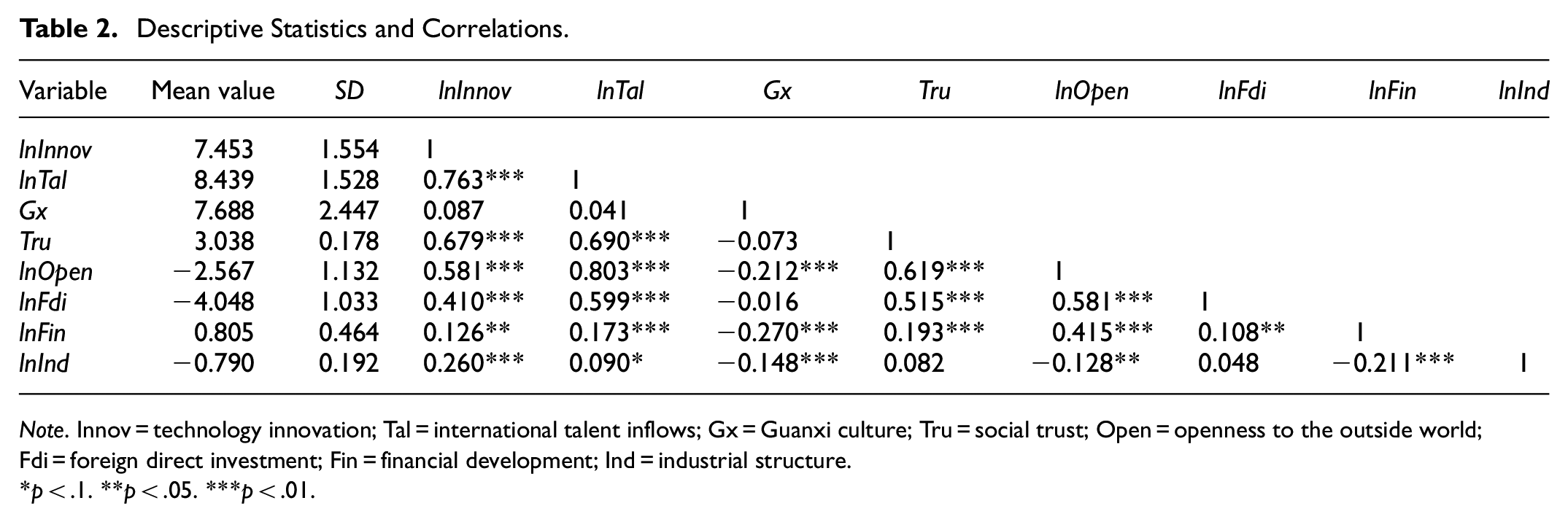
Note. Innov = technology innovation; Tal = international talent inflows; Gx = Guanxi culture; Tru = social trust; Open = openness to the outside world; Fdi = foreign direct investment; Fin = financial development; Ind = industrial structure.
p < .1. **p < .05. ***p < .01.
Data Analysis
Hypothesis Test
The data used in this paper are small T (time) and large N (sample size), which belong to short panel data, and the model error terms are independent and identically distributed. To avoid the impact of multicollinearity on the regression results, the VIF values of each regression model need to be examined and analyzed using Stata14.0 software. The results show that the VIF values of all explanatory variables are lower than 10, indicating no serious multicollinearity problem. Moreover, we first used a fixed effect model, random effect model, and Hausman test to test for selection, as shown in Tables 3 and 4, both of which exhibited significance at the 1% level. Therefore, a fixed-effect model should be selected. Moreover, a Wald test was performed, and it was found that the Wald statistics of each model were significant at the 1% level, indicating the existence of heteroscedasticity. Therefore, we chose clustered robust standard errors for correction, and the results are shown in Appendix 1.
Moderating Effect of Guanxi Culture and Social Trust on International Talent Inflow and Technological Innovation.
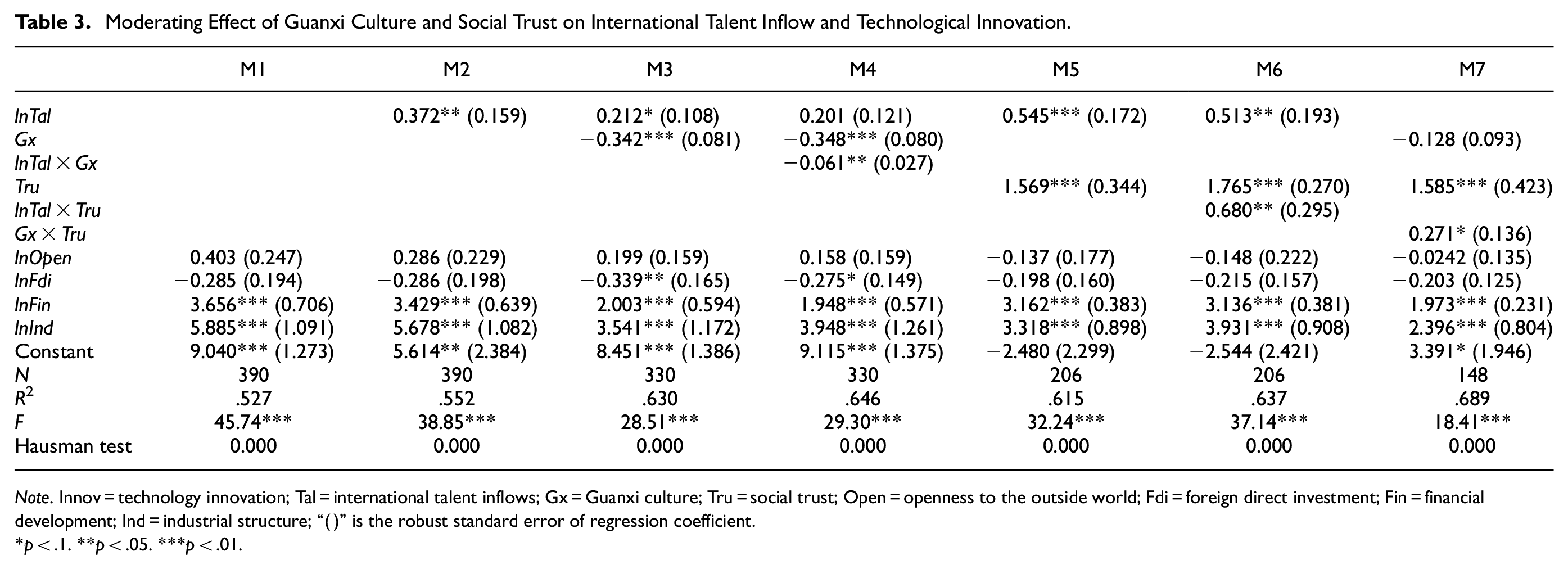
Note. Innov = technology innovation; Tal = international talent inflows; Gx = Guanxi culture; Tru = social trust; Open = openness to the outside world; Fdi = foreign direct investment; Fin = financial development; Ind = industrial structure; “( )” is the robust standard error of regression coefficient.
p < .1. **p < .05. ***p < .01.
Robustness Regression.

Note. Innov = technology innovation; Tal = international talent inflows; Gx = Guanxi culture; Tru = social trust; Open = openness to the outside world; Fdi = foreign direct investment; Fin = financial development; Ind = industrial structure; “( )” is the robust standard error of regression coefficient.
p < .1. **p < .05. ***p < .01.
To verify the moderating effect, we centralized international talent inflow, Guanxi culture, and social trust, and put their interaction terms into the equation for regression. First, we verified the role of a single moderator, as shown in Table 3. Model 1 is a benchmark model that only contains control variables. Model 2 is our main effect model. The results show that international talent inflow has a significant positive impact on technological innovation (β = 0.372, p < .05). The test results are robust in Models 3, 5, and 6, and H1 is supported. Models 3 and 5 add two moderating variables. The results show that Guanxi culture has a significant negative impact on technological innovation (β = −0.342, p < .01), which is greater than the positive impact of international talent inflows on technological innovation (β = 0.212, p < .1); social trust has a significant positive impact on technological innovation (β = 1.569, p < .01), and is greater than the positive impact of international talent inflows on technological innovation (β = 0.545, p < .01). The verification results remain robust in Models 4 and 6, and H2a and H3a are supported. Models 4 and 6 add corresponding interaction terms. The results show that the regression coefficients of the interaction terms of international talent inflows and Guanxi culture are significantly negative (β = −0.061, p < .05), and the derivative of technological innovation with respect to international talent inflow is 0.201(insignificant) −0.061Gx, which indicates that the effect of international talent inflow depends on the level of Guanxi culture. Under different value ranges of Guanxi culture [3.026, 15.884], the derivative may be completely positive or negative after a certain threshold. Similarly, the derivative of technological innovation with respect to Guanxi culture is −0.348−0.061lnTal, which is negative in different value ranges. Therefore, it shows that Guanxi culture significantly negatively moderates the relationship between international talent inflow and technology innovation, and H2b is supported. The regression coefficient of the interaction term between international talent inflows and social trust is significantly positive (β = 0.680, p < .05), and the derivative of technological innovation with respect to international talent inflow is 0.513 + 0.680 Tru, which indicates that the effect of international talent inflow depends on the level of social trust, and the derivative is positive in the value range of social trust [2.58, 3.56]. Similarly, the derivative of technological innovation with respect to social trust is 1.765 + 0.680lnTal, which is positive in different value ranges. Therefore, it shows that the social trust significantly moderates the relationship between international talent inflow and technological innovation, and H3b is supported. At the same time, compared with Guanxi culture and its interaction with international talent inflows in Models 3 and 4, the impact of social trust and its interaction with international talent inflows in Models 5 and 6 has a more significant impact on technological innovation. We verified this, as in Model 7 we found that the impact of Guanxi culture on technological innovation was reduced and no longer significant, and the interaction between Guanxi culture and social trust had a positive impact on technological innovation (β = 0.271, p < .1), and the derivative of technological innovation with respect to Guanxi culture is −0.128 (insignificant) + 0.271Tru, which indicates that the effect of Guanxi culture depends on the level of social trust, and the derivative is positive in the value range of social trust [2.58, 3.56]. Similarly, the derivative of technological innovation with respect to social trust is 1.585 + 0.271GX, which is positive in the value range of Guanxi culture [3.026, 15.884]. It can see that social trust can weaken the negative influence of Guanxi culture on technological innovation, and even this negative influence disappears when the degree of social trust is high. Fukuyama (1995) and W. Yang and Yang (2016) made similar observations: the higher the degree of social trust, the lower the dependence of economic subjects on the interpersonal relationship. For example, no longer worrying about being deceived and used in economic transactions, more time will be invested in researching and developing new products instead of wasting excessive resources on the supervision of suppliers and business partners.
Robustness Test
Since we use two moderators—Guanxi culture and social trust, to further verify the moderating effects of the two variables, we reference X. C. Li et al. (2016) and add all moderating variables to the model, as shown in Table 4. Based on Model 2, Model 8 adds all moderating variables. The results are consistent with Models 3 and 5, indicating that the impact of Guanxi culture and social trust on technological innovation is still significant. The effect of the two is far greater than the effect of international talent inflow on technological innovation. Based on Model 8, corresponding interaction variables are added to Models 9, 10, and 11. The results show the moderating role of Guanxi culture (β = −0.063, p < .1) and social trust (β = 0.783, p < .01) and are consistent with the results of Models 4 and 6. Figures 1 and 2 show the moderating role of Guanxi culture and social trust. Figure 1 shows that in the presence of Guanxi culture, the inflow of international talents is not conducive to improving technological innovation, mainly due to the negative effect of Guanxi culture being far greater than the positive effect of international talent inflow. In addition, the positive effect of the interaction between Guanxi culture and social trust on technological innovation is still significant (β = 0.269, p < .1).

Moderating effect of social trust.

Moderating effect of Guanxi culture.
Model 12 is a full model. The moderating effect of social trust and the interaction between Guanxi culture and social trust are still significant, while the moderating effect of Guanxi culture is no longer significant. At the same time, the effect of interactions among international talent inflow, Guanxi culture, and social trust, such as Model 13, were examined, and the results show that the derivative of technological innovation with respect to Guanxi culture is −0.157 + 0.284Tru + (0.082Tru−0.062) lnTal(insignificant), which shows that the effect of Guanxi culture depends on the level of social trust. Under different value ranges of social trust [2.58, 3.56], the derivative is positive. Similarly, the derivative of technological innovation with respect to social trust is 1.896 + 0.284GX + (0.082GX + 0.757) lnTal, which is positive in different value ranges of Guanxi culture [3.026, 15.884]. Therefore, Model 13 once again confirms that the interaction between Guanxi culture and social trust has a positive impact on technological innovation. Meanwhile, the interactions between the three had a positive impact on technological innovation, but not significantly. Combining the results of Models 7, 11, and 12, we find that high social trust has a more significant positive impact on technological innovation, and it is conducive to weakening the effect of Guanxi culture on technological innovation and strengthening the impact of international talent inflow on technological innovation.
Discussion and Conclusion
Discussion
The cross-border flow of human capital is conducive to promoting global economic development and technological progress. With the development of global integration, talent circulation is gradually emerging. The improvement of China’s overall national strength and the implementation of overseas talent introduction policies have attracted and benefited a large number of foreign talents and returnees, which has beneficially promoted China’s economic development and technological innovation. However, the inflow of international talents into China is facing the problem of cross-cultural adaptation, especially the “Guanxi issue” in Chinese culture. It is of profound research significance to explore how Guanxi culture restrains the exertion of the innovative effects of international talents and how to break through this restriction. Therefore, this study builds a static panel data model based on 2000 to 2012 Chinese provincial-level relevant data to explore the impact of international talent inflows, Guanxi culture, and social trust on technological innovation. We found that, first, international talent inflow has a positive impact on technological innovation, consistent with the conclusion of previous studies. For example, international migration positively impacts R&D spillovers (Le, 2008) and patenting activity (Luo et al., 2017).
Second, Guanxi culture has a negative impact on technological innovation and negatively moderates the relationship between international talent inflow and technological innovation. That is, the stronger the Guanxi culture, the weaker the spread of knowledge and technology, thereby reducing cooperation efficiency (Chua et al., 2014; Hu et al., 2022), which easily weakens the willingness and motivation of international talents to learn and communicate, and is not conducive to the absorption of diverse knowledge, creative input, and cross-cultural collaboration (Morris et al., 2008). It is not conducive to developing corporate innovation activities and improving innovation efficiency (Yuan et al., 2015).
Third, social trust has a positive impact on technological innovation, which is consistent with the study of Akçomak and ter Weel (2009). However, we found that social trust positively moderates the relationship between international talent inflows and technological innovation. Meanwhile, the interaction between Guanxi culture and social trust positively impacts technological innovation, and it is robust. This shows that social trust is conducive to the transfer of knowledge and technology and the acquisition of information and resources (Akçomak & ter Weel, 2009), and weakens the dependence on relationships (W. Yang & Yang, 2016), which is more conducive for international talents to participate in the exchange and cooperation of innovation activities and improve collaboration efficiency (X. Li, 2013).
Policy Recommendation
Based on this, this study puts forward the following suggestions: First, due to the positive role of international talents in technological innovation, on the one hand, it is necessary to continue to implement the policies of attracting talents, improving the work permit system and talent visa system for foreigners coming to China, and relaxing the restrictions on foreigners’ permanent residence application, so as to encourage foreign talents to come to China and overseas students to returning to China, and promote the flow of international talents within different regions of China and form the circulation of talents. Second, after introducing international talents, how to retain the talents and exert their technological innovation effect is strongly affected by the Guanxi culture, besides the hard conditions such as salary and benefits. Serious problems exist, such as cultural shock and mental illness of international talents, especially in the face of complex Guanxi culture, which is more difficult to involve. Although the Guanxi culture can promote interpersonal trust to a certain extent and is conducive to resource acquisition. But in China, it is more about small groups formed based on blood, relatives, friends, and hometown association, which is easy to be exclusive. Besides, it is inconsistent with the idea of international talents, especially from the west, which mainly follows the spirit of individualism and contract. Itis not conducive to technological innovation. Because international talents in China mainly face the adaptation in work, and the negative impact of Guanxi culture is greater than the positive impact of international talent inflows. Therefore, we must pay attention to the negative effects of the Guanxi culture, correctly guide the industry climate and business rules, regulate the government-business relationship, and create a good business environment. Third, high social trust has a greater positive impact on technological innovation, and it is far greater than the impact of international talent inflow. At the same time, it is conducive to weakening the effect of Guanxi culture on technological innovation and strengthening the positive impact of international talent inflow. Therefore, we must attach importance to constructing of a social trust system. However, China currently has a certain level of trust crisis. In addition to the government’s credibility that needs to be improved, incidents of fraud at the economic and social levels occur frequently. Especially in the context of the Internet, online trust crises are more likely to occur. Therefore, it is necessary to increase the penalty of dishonesty, severely crack down the financial fraud, online extortion, etc., and increase the trustworthiness bonus, reward trustworthy enterprises and individuals, and guide the social atmosphere to improve the level of social trust.
Limitations and Future Directions
There are some limitations to this study. First, in addition to the negative side of the Guanxi culture, there is also a positive side. This study only uses the time invested by entrepreneurs and corporate entertainment expenses to explore its effect. Therefore, future research can analyze both sides of Guanxi culture. Second, Guanxi culture is just one of China’s core cultures. Other cultures such as favor and face are also cross-cultural adaptation issues that international talents must face. It is necessary to discuss them. Third, limited to data availability, the social trust data in this study only covers 7 years. Therefore, more relevant alternative indicators can be sought to verify the results in the future.
Footnotes
Appendix 1
Fixed, Random Effect Models and the Hausman Test.

| M1 (FEM) | M1 (REM) | M2 (FEM) | M2 (REM) | M3 (FEM) | M3 (REM) | M4 (FEM) | M4 (REM) | M5 (FEM) | M5 (REM) | M6 (FEM) | M6 (REM) | M7 (FEM) | M7 (REM) | |
|---|---|---|---|---|---|---|---|---|---|---|---|---|---|---|
| lnTal | 0.372*** (0.0834) | 0.568*** (0.0750) | 0.212*** (0.0670) | 0.431*** (0.0703) | 0.201*** (0.0658) | 0.388*** (0.0699) | 0.545*** (0.133) | 0.927*** (0.0960) | 0.513*** (0.129) | 0.918*** (0.0969) | ||||
| Gx | −0.342*** (0.0383) | −0.116*** (0.0344) | −0.348*** (0.0376) | −0.158*** (0.0355) | −0.128** (0.0493) | 0.0347 (0.0489) | ||||||||
| lnTal × Gx | −0.0613*** (0.0170) | −0.0637*** (0.0184) | ||||||||||||
| Tru | 1.569*** (0.318) | 1.882*** (0.346) | 1.765*** (0.316) | 1.926*** (0.350) | 1.585*** (0.285) | 2.394*** (0.353) | ||||||||
| lnTal × Tru | 0.680*** (0.212) | 0.184 (0.221) | ||||||||||||
| Gx × Tru | 0.271*** (0.0927) | 0.160 (0.117) | ||||||||||||
| lnOpen | 0.403*** (0.125) | 0.596*** (0.108) | 0.286** (0.125) | 0.291*** (0.108) | 0.199* (0.111) | 0.343*** (0.103) | 0.158 (0.109) | 0.307*** (0.102) | −0.137 (0.143) | −0.405*** (0.124) | −0.148 (0.139) | −0.410*** (0.125) | −0.0242 (0.129) | 0.219* (0.118) |
| lnFdi | −0.285*** (0.0893) | −0.184** (0.0870) | −0.286*** (0.0871) | −0.202** (0.0808) | −0.339*** (0.0796) | −0.151* (0.0792) | −0.275*** (0.0800) | −0.111 (0.0791) | −0.198* (0.108) | −0.203** (0.0955) | −0.215** (0.106) | −0.206** (0.0960) | −0.203** (0.0939) | −0.0527 (0.105) |
| lnFin | 3.656*** (0.339) | 1.979*** (0.278) | 3.429*** (0.334) | 0.963*** (0.216) | 2.003*** (0.289) | 0.527** (0.216) | 1.948*** (0.284) | 0.483** (0.216) | 3.162*** (0.350) | 1.028*** (0.220) | 3.136*** (0.341) | 1.038*** (0.224) | 1.973*** (0.248) | 1.420*** (0.243) |
| lnInd | 5.885*** (0.407) | 5.219*** (0.397) | 5.678*** (0.399) | 4.184*** (0.362) | 3.541*** (0.444) | 3.356*** (0.400) | 3.948*** (0.449) | 3.444*** (0.396) | 3.318*** (0.620) | 1.821*** (0.500) | 3.931*** (0.633) | 1.940*** (0.510) | 2.396*** (0.554) | 1.754*** (0.579) |
| Constant | 9.040*** (0.568) | 10.77*** (0.549) | 5.614*** (0.947) | 5.121*** (0.988) | 8.451*** (0.803) | 7.015*** (0.913) | 9.115*** (0.809) | 7.890*** (0.926) | −2.480 (1.517) | −6.793*** (1.460) | −2.544 * (1.477) | −6.828*** (1.467) | 3.391** (1.306) | 0.918 (1.499) |
| N | 390 | 390 | 390 | 390 | 330 | 330 | 330 | 330 | 206 | 206 | 206 | 206 | 148 | 148 |
| R 2 | .527 | .552 | .630 | .646 | .615 | .637 | .689 | |||||||
| F | 99.08*** | 87.46*** | 83.42*** | 76.26*** | 45.23*** | 42.36*** | 35.20*** | |||||||
| Wald χ2 | 299.1*** | 343.2*** | 302.0*** | 326.2*** | 282.3*** | 279.9*** | 136.6*** | |||||||
| Hausman test | 0.0000 | 0.0000 | 0.0000 | 0.0000 | 0.0000 | 0.0000 | 0.0000 |
Note. Innov = technology innovation; Tal = international talent inflows; Gx = Guanxi culture; Tru = social trust; Open = openness to the outside world; Fdi = foreign direct investment; Fin = financial development; Ind = industrial structure; “( )” is the robust standard error of regression coefficient.
p < .1. **p < .05. ***p < .01.
Author Contributions
CL: Conceptualization, methodology and writing—original draft preparation. CW and LW: data collection and analysis, revising, final approval. RZ: writing—review and editing. XN: editing and supervision.
Declaration of Conflicting Interests
The author(s) declared no potential conflicts of interest with respect to the research, authorship, and/or publication of this article.
Funding
The author(s) disclosed receipt of the following financial support for the research, authorship, and/or publication of this article: This work was supported by the National Natural Science Foundation of China (Grant No. 71772041), Shaoxing University (Grant No. 2020SK003), Youth Elite Program in Philosophy and Social Sciences of Shaoxing University (Project No. 202420), and Zhejiang Federation of Humanities and Social Sciences (Grant No. 2022N76).

Data Availability Statement
The data used in this study are available from the corresponding author on reasonable request.