




Abstract
Export technical complexity is an effective indicator to measure the upgrading of a country’s trade structure and high-quality development of trade. This study examines the impact of artificial intelligence on the export technical complexity upgrading of Chinese manufacturing enterprises at the enterprise and industry levels. It analyses matched data from the China Customs and Chinese Industrial Enterprises databases from 2000 to 2015. The results show that artificial intelligence promotes the upgrading of export technical complexity in Chinese manufacturing enterprises. The impact of artificial intelligence on upgrading export technical complexity is dynamic, showing an “inverted U-shape.” Heterogeneity test results indicate that artificial intelligence has a greater effect on export technical complexity upgrading if it features high-tech complexity, or the enterprises are local or in the eastern region of China. The mechanism results indicate that artificial intelligence significantly promotes labor productivity and innovation to upgrade China’s manufacturing enterprises’ export technical complexity. Finally, industry-level analysis shows that the application intensity of artificial intelligence substantially affects the average export technical complexity upgrades of Chinese manufacturing enterprises through spillover effects and resource reallocation effects. These findings promote upgrading export technical complexity at the enterprise and industry levels.
Keywords
Introduction
New technologies, production methods, and products represented by Big Data, artificial intelligence, and industrial robots are emerging in large quantities, becoming an essential driving force for a new scientific and technological revolution and industrial change. Artificial intelligence, as a high-level automation technology, highlights integration with other industries with a primary focus on promoting intelligent manufacturing development, the most significant feature of robot participation in production activities. According to the International Federation of Robotics (IFR), since 2003, China’s industrial robot installations have developed rapidly, with an average annual growth rate over 20% (Figure 1), and have ranked first worldwide for several years. From the global industrial robot stock perspective, by 2019, China’s industrial robot stock reached nearly 800,000 units (Figure 2), accounting for approximately 30% of all global industrial robots. In 2016, China surpassed Japan for the first time as the country with the largest stock of industrial robots worldwide.
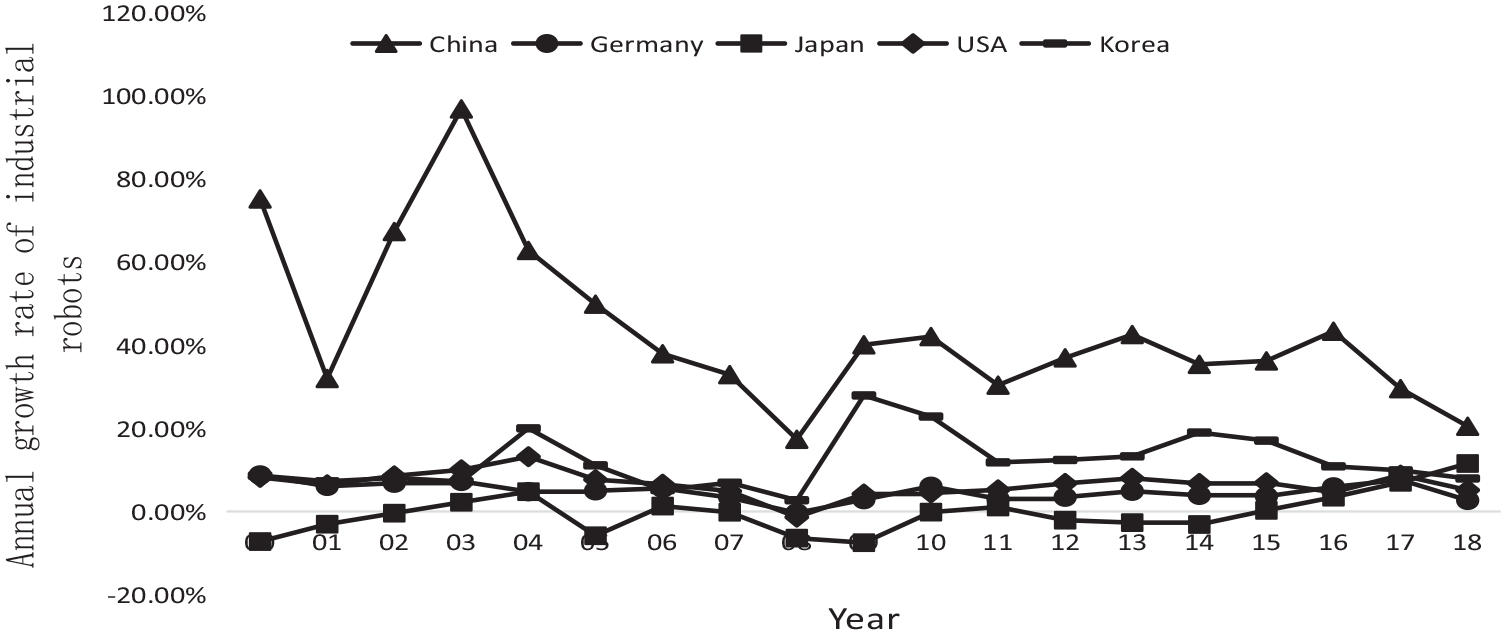
Annual growth rate of industrial robots of major countries, 2000 to 2018.
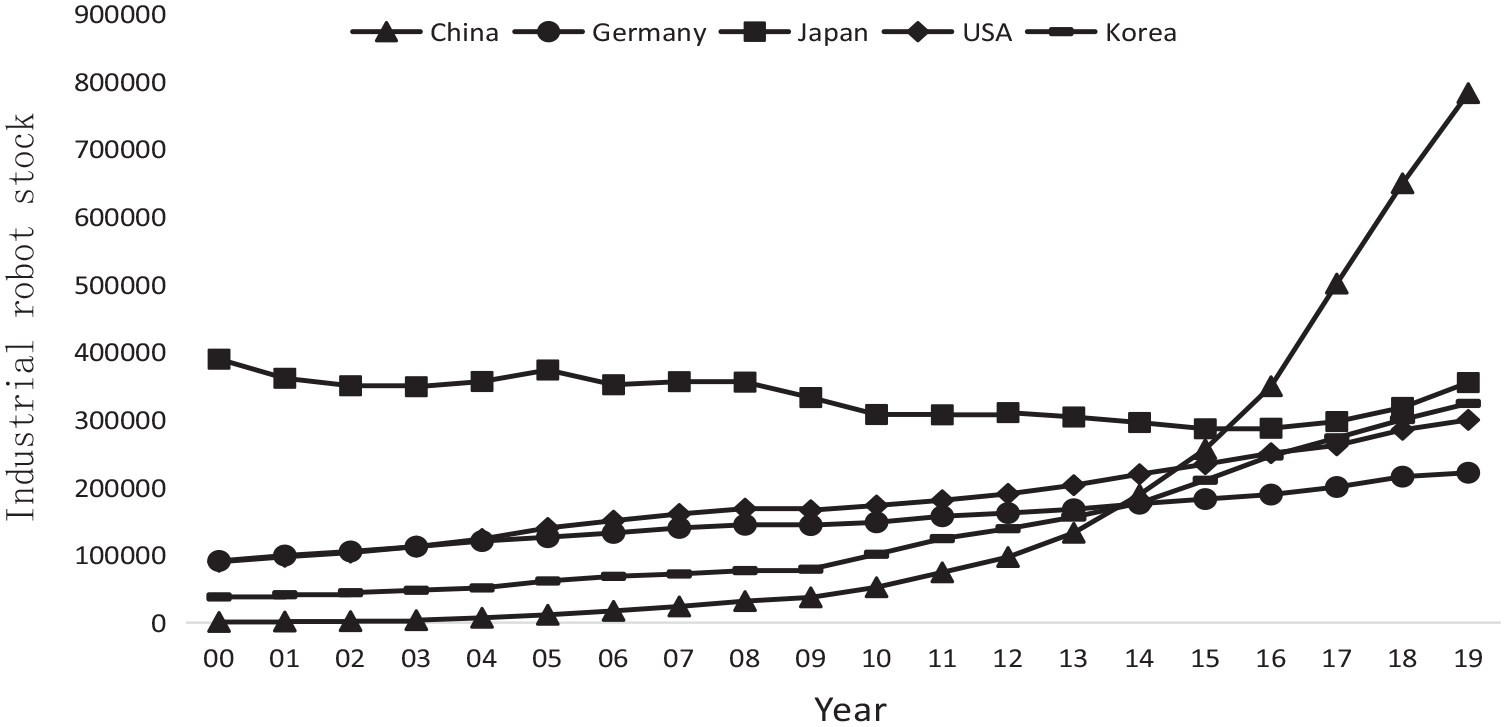
Stock of industrial robots in major countries, 2000 to 2019.
Artificial intelligence is the critical key link and essential foundation for connecting intelligent manufacturing and industrial applications; thus, the rapid development of artificial intelligence in China will likely profoundly impact the country’s current and future intelligent manufacturing and industrial applications. China’s manufacturing industry has for some time been in the low-cost link of processing and assembly in the global value chain, and there is a risk of being “locked” and “solidified” by the low end of production (D. Li & Zhu, 2019; Song et al., 2022), the level of industrial development is low, and the technical content of products is not high either. The external environment is becoming more complex and uncertain, especially in the face of the triple pressure of domestic and foreign demand contraction, contraction of supply shock, and weakening of market expectations. Accelerating trade and product structure upgrades, improving the technical level of China’s manufacturing industry and export technical complexity, and realizing the transformation of Made in China to “Created in China” may prompt the driving industrial force to promote economic growth and high-quality development in the new era. Therefore, this study examines the impact and action mechanism of artificial intelligence on the export technical complexity in China to provide a policy reference for Chinese manufacturing enterprises to upgrade their technical complexity.
Literature Review
Impact of Artificial Intelligence
Since their inception, artificial intelligence has widely attracted attention from economists, while extant literature regarding the impact of artificial intelligence on the economic field mainly focus on topics such as economic growth (L. Wang et al., 2021), the labor market (Acemoglu & Restrepo, 2020; DeCanio, 2016; Kromann et al., 2011), income distribution (Lankisch et al., 2019), and energy performance (G. Huang et al., 2022; E. Z. Wang et al., 2022; Yin and Zeng, 2023). For example, L. Wang et al. (2021) developed a theoretical framework and explored the effects of artificial intelligence on capital, wages, and economic growth, and found that an increase in artificial intelligence capital results in lower capital prices, a higher wage, and increased productivity. Acemoglu and Restrepo (2020) studied the effects of industrial robots on US labor market. They illustrated theoretically and empirically that robots may reduce employment and wages. Yin and Zeng (2023) examined the impact of industrial intelligence on energy intensity in China, and showed that industrial intelligence reduced energy intensity.
With the in-depth development of artificial intelligence, some scholars have begun to focus on the impact of artificial intelligence on international indivision of labor and trade (Alguacil et al., 2022; Artuc et al., 2018; Destefano et al., 2019; Faber, 2020; Goldfarb & Trefler, 2018; Krenz et al., 2021; Stapleton & Webb, 2020). For example, Artuc et al. (2018) studied the impact of industrial robots on north–south trade from theoretical and empirical aspects on the basis of Ricardo’s two-stage production and trade model, and the results showed that industrial robots promoted import and export growth between developed and developing countries by reshaping comparative advantages. In contrast, Berg et al. (2016), Rodrik (2018), Krenz et al. (2021), Destefano et al. (2019), and Faber (2020) believe that the application of industrial robots has eroded the developing countries’ labor cost advantages, affected the international division of labor, promoted the return of manufacturing to developed countries, reduced their employment opportunities, and caused declines in offshoring and trade shares, ultimately aggravating inequality. However, at the enterprise-level, researchers such as Stapleton and Webb (2020) have also found that the application of industrial robots can actually scale up production, increase productivity, and help increase imports from developing countries and the number of subsidiaries.
Part of the related literature about robots and trade has highlighted on the effects of robots on export performance (Alguacil et al., 2022; Zhang et al., 2023). For example, Alguacil et al. (2022) analyzed robot adoption and export performance in Spain at the firm level and pointed that firms adopting robots have experienced a sharp increase in their export probability, export sales, and share of exports in total output. Zhang et al. (2023) further discussed Chinese industrial firms’ export behavior to state that robot adoption made it easier to win export competition and increase market share just for large-scale firms, while small and medium-sized enterprises (SMEs) did not seem to enjoy any benefits from adoption.
Determinants and Effects of Export Technical Complexity
Meanwhile, extensive research has also been conducted on export technical complexity, positing that the export technical complexity reflected the characteristics of productive knowledge and technology distribution contained in a country’s export products; therefore, it is an effective indicator to measure the upgrading of a country’s trade structure (Hausmann et al., 2007) and high-quality development of trade. After this indicator was first proposed by Hausman et al. (2007), studies in this direction began to proliferate. To date, this research has mainly focused on the determinants and effects of export technical complexity. The relevant literature has also posited that macro-level determinants, such as regional human capital enhancement and government supportive policies (Z. Wang & Wei, 2007), trade liberalization (Nguyen, 2016), FDI (Xu & Lu, 2009), cultural diversity (Fan et al., 2018), improved financial services (Qi & Xiang, 2020), scientific research investment (C. Q. Li & Lu, 2017), factor structure improvement (Yu & Hu, 2015), agricultural technology (Bai, 2020), population aging (Wu et al., 2022), and cleaner production standards (Ju et al., 2022) can facilitate upgrades to a country or region’s export technical complexity. However, lower technological levels, excessive export prices, and corruption will hinder efforts to upgrade export technical complexity (Cabral and Veiga, 2010; Hallak and Schott, 2011; Willem & Pai, 2015). In terms of micro-level determinants, institutional similarities and corporate heterogeneity (Demir & Hu, 2021), labor productivity, capital stock and infrastructure (S. Huang et al., 2014), product density (Ding & Li, 2018), and digital capabilities (Banga, 2022) have demonstrated significant effects on export technical complexity. In addition, the studies on the effects of export technical complexity showed that the upgrading of export technical complexity not only helped to promote the upgrading of export product quality and productivity improvement (Mishra et al., 2011; Zhu & Fu, 2013), which can also significantly promote economic growth (Jarreau & Poncet, 2012).
Artificial Intelligence and Export Product Quality
Closer to the topic of the present research is the impact of artificial intelligence on export product quality. For example, DeStefano and Timmis (2021) primarily discussed the impact of artificial intelligence application, such as industrial robots, on the export quality of developed and underdeveloped countries. In addition, Hong et al. (2022) focused on the impact of industrial robots on upgrading Chinese enterprises’ export products, and examined the impact of industrial robots on export product quality upgrades from the perspective of enterprise cost changes and structural effects of labor allocation. They found that there was a U-shaped relationship between the use of industrial robots and export products’ quality upgrading, most enterprises have not yet realized the quality upgrading of export products. Lin et al. (2022) used the PSM-DID method to examine the impact of industrial robots at the enterprise level on the quality upgrading of Chinese export trade and found that the impact caused by the application of industrial robots on the export product quality is dynamic, which increases initially and then decreases.
Research Gaps
Some research gaps exist in the literature. First, the existing studies on industrial robots and artificial intelligence have focused on economic growth, labor market, energy performance, and international division of labor, leaving its trade performance impact largely ignored. Compared with the few research on the trade scale and quality effects, this research mainly focuses on the impact of artificial intelligence on export structure, addressing the gap in existing research on the impact of trade performance. Second, the previous literature on the determinants and effects of export technical complexity has ignored the link between emerging artificial intelligence technologies and export technical complexity. Finally, few studies have explored the impact of artificial intelligence at the enterprise and industry levels.
Based on the above, the present study contributes to the literature in several ways. First, to the best of our knowledge, our study is the first to investigate the impact and action mechanism of artificial intelligence on manufacturing enterprises’ export technical complexity. To this end, we use the latest matched data from the China Customs and Chinese Industrial Enterprises databases from 2000 to 2015 to identify the impact of artificial intelligence. Artificial intelligence technologies, such as industrial robots, are widely used and popular in developing countries, for example, in China, according to data from the IFR, the number of industrial robots has rapidly increased since 2003. Their average annual growth rate has exceeded 20% for nearly 20 consecutive years, ranking first globally. By 2019, the stock of industrial robots in China accounted for almost 30% of the global stock, reaching nearly 800,000 units, surpassing Japan for the first time in 2016, and becoming the country with the largest stock of industrial robots worldwide. However, previous studies have mainly concentrated on developed countries. The present study focuses on China, providing new empirical evidence on emerging developing countries. Second, unlike most previous research, this study empirically addresses the enterprise and industry levels and examines the impact of artificial intelligence on export technical complexity at the industry level through spillover and resource reallocation effects. Finally, this study used the propensity score matching (PSM) and difference-in-difference (DID) methods for baseline estimation and the instrumental variable method for robustness testing. After controlling for endogenous problems, such as two-way causality and missing variables, the impact of artificial intelligence on Chinese manufacturing enterprises’ export technical complexity is more accurately identified.
The remainder of this paper is organized as follows. Section “Theoretical Mechanisms” provides a theoretical analysis of the impact mechanism of artificial intelligence on export technical complexity. Section “Materials and Methods” describes the research design. Section “Results” presents the results of empirical analysis, while Sections “Enterprise-Level Further Discussion” and “Industry-Level Further Discussion” provide the enterprise-level analysis and industry-level expansion analysis, respectively. Finally, Section “Conclusions and Implications” offers the conclusion and policy implications.
Theoretical Mechanisms
Based on a review of relevant literature, this study mainly analyses the mechanism of artificial intelligence affecting the export technical complexity upgrading of Chinese manufacturing enterprises from the perspective of labor productivity and innovation.
Labor Productivity
Artificial intelligence can promote labor productivity by deepening capital and improving human capital. Regarding capital deepening, in the Abel-Blanchard model (Madsen, 2010), technological advances increase the expected return on capital stock, which leads to capital deepening. As typical representatives of technological advancement, artificial intelligence has dual roles in both technological progress and capital deepening. Technological progress and capital deepening are mutually integrated and inseparable; thus, capital investment increases when technological advances lead to new production equipment. According to neoclassical growth theory, capital deepening changes in the same direction as labor productivity, and since every capital good embodies the latest technology at the moment of its construction (Phelps, 1962), robotic automated production and artificial intelligence promote upgraded labor productivity (Graetz & Michaels, 2015). Therefore, with a large investment in new equipment, enterprises achieve technological developments at an accelerated speed, thereby improving labor productivity.
In terms of human capital improvement, the advancement of artificial intelligence increases the related demand for highly skilled labor, creating higher requirements for the labor force’s skills. Hémous and Olsen (2022) have found that artificial intelligence can reduce the demand for low-skilled labor while increasing labor productivity and thereby increasing the demand for highly skilled labor, their results indicate complementary and substitution effects between artificial intelligence and labor. In addition, the integration and development of artificial intelligence in different industries lead to new formats and models, which, in turn, promote the transformation and upgrading of industrial structure. Such transformations and upgrades to the industrial structure not only promote the flow of human capital but also advance higher requirements for human capital, inevitably increasing the demand for highly skilled labor (Michaels et al., 2014), thereby directly promoting improvements in human capital. Moreover, export technical complexity reflects a country’s export products’ technical content and production efficiency (Rodrik, 2006). Thus, we propose hypothesis 1 (H1).
H1. Artificial intelligence can promote export technical complexity through improved labor productivity.
Enterprise Innovation
The enterprise innovation effect generated by artificial intelligence may help Chinese manufacturing enterprises upgrade their export technical complexity. First, the penetration and transformation of artificial intelligence have greatly improved enterprises’ information-sharing and processing capabilities, allowing enterprises to break through the restrictions of industry and geography on “cognitive distance,” and significantly enhance the efficiency of enterprise information searches. These improvements may reduce uncertainty in the innovation process, promote new knowledge discovery, and contribute to improved innovation ability. Second, the productivity effect of artificial intelligence may reduce production and operation costs (Javaid et al., 2021), which saves enterprise funds. Therefore, an enterprise may invest more capital in complex and high-end technology research and development (R&D), alleviating the financing constraints in the R&D process and improving the enterprise’s level innovation. Third, artificial intelligence induces an innovative effect of “learning by doing.”Arrow (1962) has found that investment in fixed assets in the production field can generate knowledge and experience through “learning by doing,” which leads to improved production efficiency. As a physical form of innovative results relative to general fixed asset investment, industrial robots are easier to apply, imitate, and learn in practice due to their science and technology characteristics, integration, and intelligence. The resulting technological progress and labor productivity promotion are generally significant. Moreover, enterprise innovation is an essential factor that affects export technical complexity (Zhu and Fu, 2013). Hence, we propose Hypothesis 2 (H2).
H2. Artificial intelligence may help enterprises upgrade their export technical complexity through the effect of enterprise innovation.
Materials and Methods
Data
Considering the IFR data is only industry-level data, and this study investigates the impact of artificial intelligence on the export technical complexity at the enterprise level, hence, we use the imported robots data from China Customs database to characterize artificial intelligence, however, the latest data from China Customs Database and Chinese Industrial Enterprises Database are up to 2015, therefore, this study uses the above databases from 2000 to 2015 based on data availability. For the Chinese Industrial Enterprises Database (2000–2015), we refer to Cai and Liu (2009) data processing method by excluding the following: (a) samples missing variables such as employees, total assets, fixed assets, sales, and industrial output value; (b) samples with fewer than eight employees; (c) samples where the total assets were less than the current assets or the total fixed assets were greater than the total assets; (d) samples with paid-in capital less than or equal to 0; and (e) samples with enterprise age is less than 0 years or greater than 100 years.
Using the China Customs Database (2000–2015), we could calculate the export technical complexity of Chinese manufacturing enterprises. We processed the data according to the following steps: (a) exclude the samples with missing information such as enterprise names, export location names, and product names; (b) exclude the samples with a single trade size of less than $50 or a quantity unit of less than 1; (c) add monthly data to annual data; (d) exclude the samples of trading intermediary firms; (e) only keep the samples with the largest number of counting units under the same product code; (f) add Harmonized System (HS) 8-digit level data to HS 6-digit level data; (g) convert the product data into HS07 level data; (h) exclude the non-manufacturing samples; (i) exclude the primary and resource products; and (j) exclude the homogeneous product samples.
Finally, we initially matched the robot import data and export data of export technical complexity by enterprise name code. Then, we matched the data from both databases by enterprise name, and matched the remaining data by each enterprise’s postal code and the last seven digits of the telephone number. We obtained 307,622 observations, which included 86,366 enterprises, of which 20,688 were robot import enterprises, and 65,678 were non-imported robot enterprises.
Baseline Model
To alleviate the endogenous problems caused by selective bias and missing variables, we initially matched the treatment group to a similar control group using the PSM method proposed by Heckman et al. (1997), and then adopted the multi-period DID method for estimation. Regarding the specific PSM method, first, we divided the samples into two groups: robot importing enterprises (treatment group) and robot non-importing enterprises (control group). Second, to meet the principle of conditional independence, we selected the variables that affected the export technical complexity of enterprises and whether to import robots as covariates for matching. The final covariates included the following: whether it was a general trading enterprise, the total factor productivity of enterprise, and the enterprise size. The higher-order terms of some variables were used as matching variables. Then, we selected the caliper K neighbor method for matching, a matching ratio of 1:5, and a caliper choice of 0.05. Finally, after matching, we obtained 257,044 observations, 85,628 observations in the treatment group, and 171,416 observations in the control group. Among them, the number of enterprises in the treatment group was 20,548, and the number in the control group was 57,922.
Although the PSM method can control for observable differences in firm characteristics between treatment and control groups, the unobservable differences between groups and missing variables may lead to estimation biases. Therefore, referring to Angrist and Pischke (2014), we also used multi-period DID to build a measurement model to investigate how artificial intelligence affects the export technical complexity upgrading of Chinese manufacturing enterprises. We use robot import as a proxy variable for artificial intelligence. The econometric model used for multi-period DID is as follows:

where
Variables
Export Technical Complexity
In view of this study’s aim to examine the impact of artificial intelligence on the export technical complexity upgrading of Chinese manufacturing enterprises, comparing export technical complexity across borders was unnecessary. Therefore, referring to the calculation methods of Xu and Lu (2009), we measured Chinese manufacturing enterprises’ export technical complexity using two steps. First, we measured the technical complexity of the Chinese product level, using the following equation:

where
Second, we summed the export technical complexity at the product level obtained in the first step at the enterprise level. The specific equation is as follows:

where
Considering economic development levels vary greatly among provinces in China, the difference in the quality of the same export product between different provinces will lead to differences in the export technical complexity of the product between the provinces. Therefore, following Xu (2010), we first added product quality adjustments to calculate the export technical complexity at the product level in the first step. The specific practice was initially to calculate the export quality of each province at the product level, according to the China Customs Database. Second, we multipled


In Equation (4),

Artificial Intelligence
Artificial intelligence is the core explanatory variable for this study. Since industrial robots participation in production activities is one of the most significant features of artificial intelligence application, we take industrial robots application to represent artificial intelligence. According to data provided by the International Federation of Robotics, by 2015, over 70% of domestic industrial robots relied on imports, indicating that the import of industrial robots reflects industrial robots application to a certain extent. Moreover, various countries only provide industrial robot stock data at the industry level, and domestic industrial robots use data at the enterprise level has been temporarily unavailable. Therefore, following Acemoglu and Restrepo (2020), we used the import data of industrial robots as a proxy variable for artificial intelligence.
Industrial robots are mainly divided into seven categories: IC factory special automatic handling robots (HS848640), multi-functional robots (HS847950), laser welding robots (HS851580), handling robots (HS842890), spraying robots (HS842489), arc welding robots (HS851531), and resistance welding robots (HS851521). The first three are high-tech complexity industrial robots, and the last four are medium- and low-tech complexity industrial robots. In the sample period, if an enterprise imported any type of industrial robot in year
Control Variables
Referring to previous literature on the influencing factors of export technical complexity, we selected eight variables as control variables at the enterprise level and industry levels. First, enterprise size (
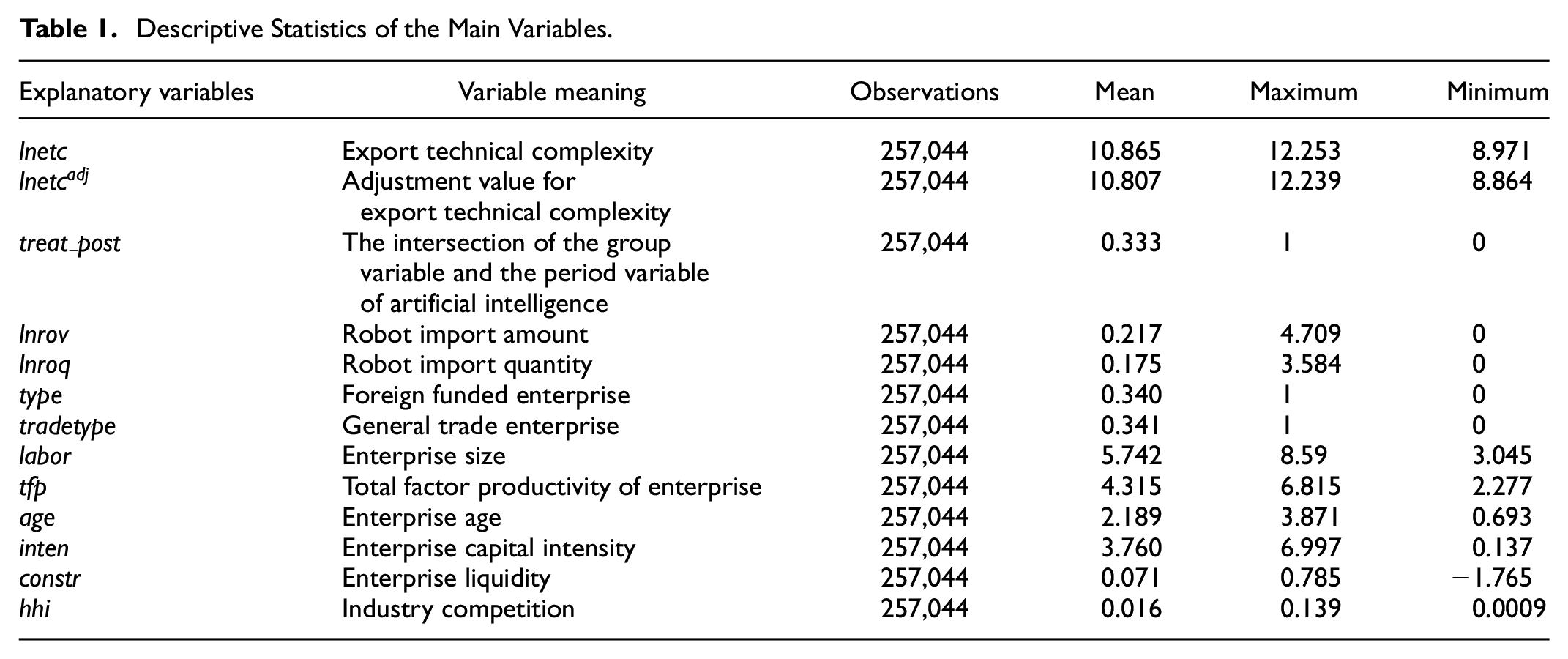
Descriptive Statistics of the Main Variables.
Results
Matching Balance Test Results
Matching Balance Test Results.

Note. To save space, Table 2 only lists the matching balance test results for univariate variables, and the higher-order term test results for other covariates are conclusive.
Baseline Results
In Table 3, the results are reported in Columns (1) to (2) based on the whole sample
Baseline Results.

Note. Robust standard errors are in parentheses. We controlled for firm and year fixed effects, which is the same as in the following tables. In addition, it is worth noting that 28,398 observations on the estimation of
, **, and *** indicate significance at the 10%, 5%, and 1% levels, respectively.
The results showed that the impact of artificial intelligence was significantly positive at the 1% level, regardless of whether the estimation was based on
Parallel Trend Test Results
A prerequisite for the validity of the regression results of

where

Parallel trend test results.
In Figure 3, the horizontal axis represents the year before and year after industrial robots were imported, and the vertical axis represents the estimated coefficient of each year. It shows that the estimated coefficient of each year before the current industrial robot import period is within the 95% confidence interval, which is not significantly different with zero. This indicates that, before industrial robots were imported, there were no significant differences in the change trends for export technical complexity between the treatment and control groups. Thus, the parallel trend hypothesis was supported. When n was 0, …, 5, the estimated coefficient of each year displayed a trend of increasing first and then decreasing, showing an “inverted U-shape,” which was significantly positive at the 5% level. Thus, this showed, to a certain extent, that the impact of industrial robot importing on the export technical complexity is dynamic, which is specifically manifested as a continuous promotion effect. The estimated coefficient reached the maximum (0.0254) in the second period after industrial robots were imported, and then gradually decreased, but the decline was smaller, resulting in the estimated coefficient of the fifth year after industrial robots were imported still being large (0.0165). This may be related to the long service life of imported industrial robots and the lag impact of robot importing on intermediary variables, such as labor productivity. This result is consistent with the study of Zhang et al. (2023) and Lin et al. (2022) on the dynamic effect of industrial robot applications on export performance and the quality upgrade of export products.
Robustness Tests
Other Endogenous Issues
Although the estimation based on
Robustness Test Results.

Replacing Explanatory Variables
Borrowing from Acemoglu and Restrepo (2022) and Aaronson and Phelan (2019), we used the import amount and import volume of industrial robots as proxy variables for artificial intelligence, and examined their impact on export technical complexity after logarithmic processing. Columns (3) and (4) of Table 4 show the estimation results. The estimated coefficients of the two alternative explanatory variables remained significantly positive at the 1% level; thus, the overall results were consistent.
Replacing the Explained Variable
Variations in the quality of the same export product between provinces may lead to differences in the export technical complexity of the same export product in different provinces. Thus, borrowing from the correction method of Xu (2010) for export product quality, we re-measured the export technical complexity of the enterprises, then obtained its adjustment value for robustness testing, adopting Equation (1). The results are shown in Column (5) of Table 4. The estimated coefficient was 0.011, which did not change substantially, indicating that the results of benchmark regression were still valid after changing the measurement method for export technical complexity.
Enterprise-Level Further Discussion
Heterogeneity Test
Technical Complexity of Imported Robots
Based on the technical complexity, we divided the industrial robots into the categories of high-tech complexity and medium- and low-tech complexity. The types of industrial robots imported may have had a heterogeneous impact on the technical spillover effect, substitution of low-skilled labor, and improvement of labor productivity, and then may have had differential impacts on the export technical complexity of an enterprise. Accordingly, we further examined the heterogeneity effects of high-tech complexity industrial robots and medium- and low-tech complexity industrial robots on an enterprise’s export technical complexity. As the results in Columns (1) and (2) of Table 5 show, it is clear that the import of industrial robots under both classifications had a significant role in promoting the improvement of export technical complexity. Further, importing high-tech complexity robots have had a greater role in promoting an enterprise’s export technical complexity. This is likely because imported high-tech complexity robots can more obviously replace low-skilled labor or promote technological innovation, thereby greatly improving an enterprise’s export technical complexity. Moreover, high-tech complexity industrial robots are more conducive to generating technological spillover effects, thereby promoting the improvement of an enterprise’s export technical complexity.
Heterogeneity Test Results.

Enterprise Ownership
Owing to the difference in technical level and resource allocation efficiency of foreign-funded enterprises and local enterprises, there will also be differences in the impact of industrial robots import on the export technical complexity of different ownership enterprises. Therefore, we classified the sample into foreign-funded and local enterprises, then examined the heterogeneity impacts. As shown by the results in Columns (3) and (4) of Table 5, the importing of industrial robots by local enterprises had a significant role in promoting the improvement of export technical complexity; however, there was no significant impact on export technical complexity for foreign-funded enterprises. To explain the reason for these results, it could be because the productivity level of foreign-funded enterprises is higher compared with that of local enterprises, the spillover effects brought by industrial robot imports may be greater; however, compared with foreign-funded enterprises, local enterprises are in inferior positions in terms of technical level, human capital, and productivity. Therefore, local enterprises are more likely to obtain technology spillover through foreign enterprises, which, in turn, can promote the export technical complexity to a greater extent.
Region
According to the statistics on the import of industrial robots at the province level in the China Customs Database, we explored the possibility that there could have been more industrial imported robots in Shanghai, Jiangsu, Guangdong, and Beijing, which are mainly distributed in the eastern region of China. Moreover, compared with the central and western regions, the eastern region has a higher level of economic development, higher institutional quality, and a greater highly skilled labor force, thus, the import of industrial robots may have had a greater role in promoting export technical complexity. Accordingly, we divided the samples into eastern, central, and western samples for grouped regression, the results of which are shown in Columns (5)-(7) of Table 5. We found that the import of industrial robots by enterprises in the eastern region had a significant role in promoting export technical complexity improvement; however, it had no significant impact on the export technical complexity of enterprises in the central and western regions, in line with Dong et al. (2022). Regarding the possible reason for this finding, the number of enterprises that imported industrial robots in the central region during the sample period accounted for less than 4% of the total number of imported industrial robot enterprises, and even fewer enterprises imported industrial robots in the western region, accounting for only approximately 2%. Moreover, the average import quantity of industrial robots in the central and western regions is only about one-twentieth of the average import quantity of eastern enterprises. Thus, it is difficult to form a scale effect in the central and western regions. In addition, the technical spillover effect after the import of industrial robots depends on the absorption capacity of local enterprises. Thus, the low level of economic development, backward system construction, and lack of highly skilled labor in the central and western regions will inhibit their technology spillover effects, which, in turn, will restrict the improvement of enterprises’ export technical complexity.
Mechanism Test
The basic conclusion of this study is that artificial intelligence can significantly improve an enterprise’s export technical complexity. Here, based on the above theoretical analysis, we present a constructed model of mediation effects to further verify how artificial intelligence can promote improved export technical complexity among manufacturing enterprises. The mediation effect models are as follows:


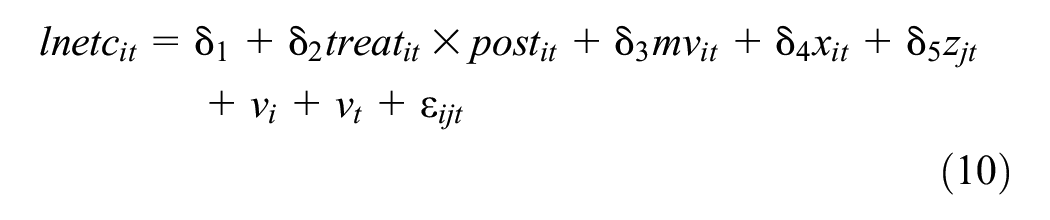
where
Table 6 shows the results of the mechanism test. Column (1) and (4) present the estimation results from using Equation (8). Columns (2) and (5) show the results of the estimation adopting Equation (9), which estimated the effects of artificial intelligence on mediation variables, including labor productivity and innovation output. Columns (3) and (6) show the estimated results of Equation (10). In Column (3), the estimated coefficient of the artificial intelligence variable is significantly smaller than what is shown in Column (1), indicating that labor productivity is the mediating channel through which artificial intelligence promotes improvement in an enterprise’s export technical complexity (Damioli et al., 2021; Graetz & Michaels, 2015; W. M. Zhang et al., 2023). This result supports H1.
Mechanism Test Results.

The results in Column (5) show that artificial intelligence significantly increases innovation output, in line with L. Wang et al. (2023), and has a further significant impact on export technical complexity, as shown in Column (6). Moreover, the estimated coefficient of artificial intelligence in Column (6) is smaller than what is shown in Column (4); therefore, it indicates that artificial intelligence improves export technical complexity through innovation to support H2. The reason may be as follows. Artificial intelligence have greatly improved the efficiency of enterprise information searches, which can contribute to improved innovation ability. Artificial intelligence can also reduce production and operation costs (Javaid et al., 2021), which make an enterprise have more capital to invest in more complex and high-end technology R&D. In addition, artificial intelligence will also have the innovative effect of “learning by doing,” which leads to improved production efficiency. Furthermore, enterprise innovation is an important factor that affects export technical complexity (Zhu and Fu, 2013).
Industry-Level Further Discussion
The above analyses examined the impact of artificial intelligence in promoting export technology complexity at the enterprise level. In view of the potential spillover effect of technological progress, we further explored the impact of artificial intelligence on export technical complexity at the industry level. We verified the impact of artificial intelligence on export technical complexity at the industry level from two perspectives. First, we examined the impact of artificial intelligence intensity on the export technical complexity of other non-imported enterprises at the regional-industry level, that is, we examined the spillover effect of artificial intelligence on other enterprises. Second, we examined the impact of artificial intelligence intensity on overall export technical complexity at the regional-industry level. On this basis, we further analyzed the resource reallocation effect. The econometric model built under the first way is shown in Equation (11):

where
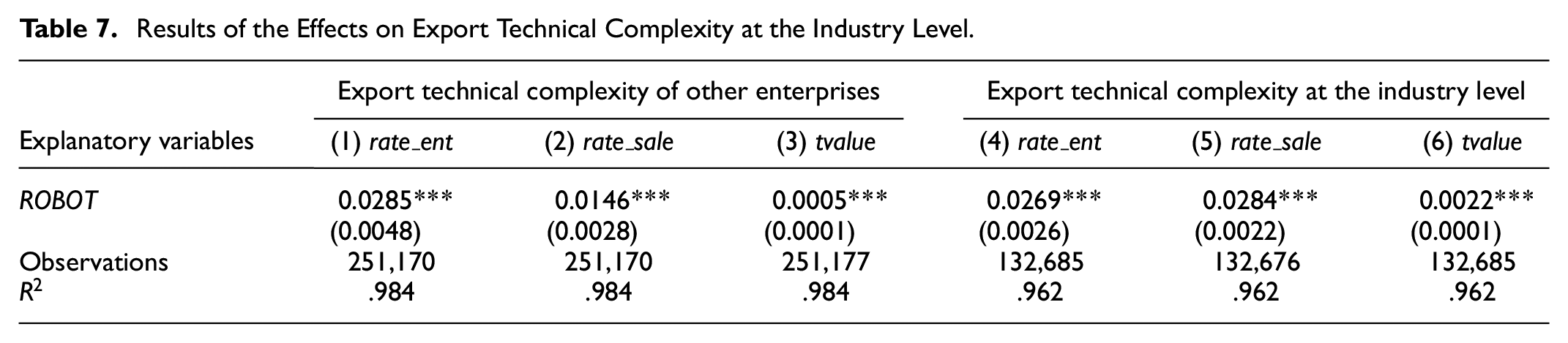
The control variables at the enterprise and industry levels were consistent with Equation (1), while controlling for the fixed effects of enterprise, year, and regional-industry level, and clustering at the enterprise level. The results of the regression are reported in Columns (1) to (3) of Table 7. The application intensity of artificial intelligence as measured by three different variables played a significant role in promoting the improvement of the export technical complexity of other enterprises at the regional-industry level. This indicates that artificial intelligence has created spillover effects on the export technical complexity of other enterprises at the regional-industry level, possibly because when more enterprises apply artificial intelligence, the improvement of their labor productivity will increase the intensity of industry competition, thus forcing other enterprises to improve their labor productivity, which, in turn, promotes export technical complexity.
Results of the Effects on Export Technical Complexity at the Industry Level.
The specific approach of the second idea is as follows. First, we measured the overall export technical complexity at the regional-industry level. Second, we examined the impact of the application intensity of artificial intelligence on overall export technical complexity at the regional-industry level, of which the application intensity was consistent with the Equation (11). The equation for the overall export technical complexity at the regional-industry level is shown in Equation (12):

where

where

where
Table 8 shows the estimated results of artificial intelligence on the effect of simple average export technical complexity and export technical complexity covariance terms at the region-industry level. Columns (1) to (3) present the results of the effects of the application intensity of artificial intelligence using different agent variables on the average export technical complexity at the regional-industry level. We explored the significant role of the application of artificial intelligence in promoting the improvement of the average export technical complexity of the region-industry. Columns (4) to (6) show the results of the effects of the application intensity of artificial intelligence on the covariance term of export technical complexity characterizing the resource reallocation effect.
Results of the Effects on Items at the Industry Level.

We also found that the estimated coefficient of the application intensity of artificial intelligence was significantly positive, indicating that the application of artificial intelligence significantly promoted the improvement of the export technical complexity covariance term. This indicates that the redistributive effect of the export share is an important channel for applying artificial intelligence to improve overall export technology complexity at the regional-industry level. A possible reason for this is that the application of artificial intelligence will lead to a shift in export share from enterprises with lower export technical complexity to enterprises with higher export technical complexity. Comparing the estimated coefficients of the average export technical complexity and export technical complexity covariance term under the corresponding artificial intelligence application intensity agent variable in Table 8, it can be seen that the sum of the estimated coefficients of the two is equal to the estimated coefficient of the overall export technical complexity at the regional-industry level (e.g., 0.0238 + 0.003 = 0.0268 ≈ 0.0269), which again verifies that the redistributive effect of export share promotes the effects of artificial intelligence on the improvement of export technical complexity at the regional-industry level.
Conclusions and Implications
Conclusions and Policy Implications
Based on matched data of the China Customs and Chinese Industrial Enterprises Databases from 2000 to 2015, this study examined the impact of artificial intelligence on upgrading the export technical complexity of Chinese manufacturing enterprises at the enterprise and industry levels. First, the results show that artificial intelligence significantly promotes upgrading export technical complexity among Chinese manufacturing enterprises. Second, the impact of artificial intelligence on upgrading export technical complexity is dynamic, showing an “inverted U-shape.” Third, artificial intelligence has a greater effect on export technical complexity upgrading if artificial intelligence features high-tech complexity or enterprises are local or in the eastern region. Fourth, artificial intelligence significantly promotes labor productivity and innovation to upgrade the technical complexity of exporting Chinese manufacturing enterprises. Finally, the application intensity of artificial intelligence significantly impacts the average export technical complexity upgrading of Chinese manufacturing enterprises through spillover and resource reallocation effects.
Based on the above conclusions, this study provides some policy recommendations. First, the Chinese government should encourage enterprises to import industrial robots for transformation and upgrading, especially high-tech complexity robots, to promote the upgrading of export technical complexity. Second, the government should actively support local enterprises that make use of artificial intelligence to encourage upgrading export technical complexity through fiscal and tax preferential and rent reduction policies. Third, the education department must actively promote the construction of professional disciplines, such as robot technology and application, and strengthen the cultivation of high-end talent in related emerging technologies in China. However, it is also necessary to strengthen coordination and cooperation with policies to promote industrial and trade structure upgrading and encourage universities and enterprises to jointly cultivate highly skilled talent, urgently needed in emerging technology fields, to strengthen vocational skills training for employees and continuously improve worker quality. Fourth, enterprises should increase domestic R&D investment in artificial intelligence to achieve independent domestic supply. Finally, the government should address the balance between different regions when promoting the development of artificial intelligence, especially improving supporting measures for the application of artificial intelligence in the central and western regions.
Limitations and Future Research
Due to the data availability, this study used the China Customs Database and Chinese Industrial Enterprises Database from 2000 to 2015. Therefore, future studies can investigate the impact of the new generation of artificial intelligence on upgrading export technical complexity in recent years and compare the heterogeneous impacts with traditional artificial intelligence. In addition, we only focused on the effect of imported artificial intelligence on upgrading export technical complexity. Future studies should compare the heterogeneous impacts between imported artificial intelligence and local artificial intelligence.
Footnotes
Declaration of Conflicting Interests
The author(s) declared no potential conflicts of interest with respect to the research, authorship, and/or publication of this article.
Funding
The author(s) disclosed receipt of the following financial support for the research, authorship, and/or publication of this article: This study was supported by Natural Science Foundation of Hunan Province (Grant No. 2023JJ30218), Zhuzhou Social Science Research Project (Grant No. ZZSK2024135), and Key Scientific Research Project of Hunan Provincial Department of Education (Grant No. 22A0407, 23A0431).

Data Availability Statement
Data sharing not applicable to this article as no datasets were generated or analyzed during the current study.