




Abstract
This study provided an integrated model for an advanced understanding of an audience’s elaboration routes, communication effects, and the reciprocal spillover effects between NPO and endorsers using rational and emotional advertising appeals for smoking cessation with a celebrity endorser. Questionnaires with two advertising appeals (rational and emotional) were randomly distributed to adult participants, and 468 valid responses (243 rational and 225 emotional) were analyzed using linear structural equation modeling. The results revealed that although advertising attitudes toward smoking cessation did not directly affect idea acceptance, they mediated the changes in the elaboration route of the audience they mediated the changes in the audience’s elaboration route. Further, evoking the audiences’ responsible thinking was critical for smoking cessation and social marketing. This advertising appeal could change the elaboration path effects of the audience. Nevertheless, it has no significant influence on communication effects. Moreover, the reciprocal spillover effects existed for endorsers and NPOs, with endorsers having more spillover effects than NPOs. The rational appeal had better spillover effects than the emotional appeal for NPO. However, its effect on endorsers was insignificant. The findings show that regardless of whether it is rational or emotional appeals, the audience’s central and peripheral elaboration of coexists and interaction effects influence idea acceptance, and the reciprocal spillover effects existed for endorsers in the advertisement of NPOs.
Plain language summary
This study provides an integrated model to understand how different smoking cessation advertisements endorsed by celebrities from nonprofit organizations (NPOs) influence audience elaboration paths and spillover effects. The research results highlight that whether it is a rational appeal or an emotional appeal, the audience’s central elaboration and peripheral elaboration coexist and interact, and the type of advertising used can change part of the audience’s elaboration route. The audience’s attitude towards smoking cessation advertisements will not directly affect their acceptance of the concept of smoking cessation. Rather, it indirectly affects concept acceptance by influencing the central and peripheral routes of the audience. The spillover effect is a two-way spillover between the nonprofit organization and the endorser, rather than a one-way spillover from the endorser to the nonprofit organization.
Keywords
Introduction
Previous research focusing on advertising endorsers are conducted from four perspectives: (1) exploring the effect of celebrity endorsers in advertising on sales or purchase intention (Ikawati et al., 2021; Mathur et al., 1997; Misra & Beatty, 1990); (2) discussing the perceptions and attitudes of consumers toward endorsers in advertising, as well as brand attitude (Chan et al., 2021; Ikawati et al., 2021; Kamins et al., 1989; Mowen & Brown, 1981; Mowen et al., 1979; Mustapha et al., 2021; Onian, 1991; Singh & Banerjee, 2018; Tripp et al., 1994); (3) understanding the factors for the selection of endorsers, including their characteristics that suit the products, such as their credibility, trustworthiness, and popularity, when endorsing multiple products (Erdogan et al., 2001; Gräve et al., 2021; Kahle & Homer, 1985; Karasiewicz & Kowalczuk, 2014; McCracken, 1989; Miciak & Shanklin, 1994; Schimmelpfennig, 2019); (4) exploring how the characteristics (e.g., credibility, trustworthiness, and identification) of celebrity and influencer endorsements affect advertising effects (e.g., brand attitude, attitudes toward the advertisement and product, and purchase intention) on social media or network sites (e.g., FB or Instagram) (Loureiro & Sarmento, 2019; Shan et al., 2020; Zeren & Gökdağlı, 2020). Additionally, they discuss how the parasocial identification or prosocial behavior of the endorsers affects advertising effects on social media (Loureiro & Sarmento, 2019; Shan et al., 2020).
Most studies on advertising endorsement explore the characteristics of endorsers that produce better advertising effects or discuss suitable strategies for product types. However, only a few studies have provided insights into the mental elaboration process of the audience and the reciprocal spillover effect of corporate brands on endorsers, which are influenced by different types of advertising appeals with endorsers. Further, few studies have investigated the various effects of nonprofit organizations (NPO) or social marketing endorsements.
In the advertising appeals of the endorsers of NPOs, Aaker (1991) points out that rational appeals convey relevant information, are likely to attract the attention of consumers, and have significant persuasion effects because consumers are rational and systematic decision-makers. Rational appeals help solve the problems of consumers, producing a positive product attitude (Shimp, 1981). Some studies have found that emotional appeals lead consumers to respond positively to a product (Goldberg & Gorn, 1987; Page et al., 1990). Moreover, emotional appeals help consumers easily recall a product (Choi & Thorson, 1983). Wang (2008) uses an advertising appeal experiment to test gender differences in responses to public services. The results show that females have a better attitude toward helping with sad emotional appeal adverts than with rational appeal adverts. The effectiveness of a sad emotional appeal is mediated by the evoked empathy. Smoking cessation is a major concern in social marketing. One widely used emotional strategy is the appeal to fear, which tests the effects of message communication variables, such as message frames (Yang, 2018a, 2018b), threat levels (Dickinson & Holmes, 2008), and involvement (Jung & Villegas 2011), on smoking behaviors. The results show that threat messages are not a good appeal strategy for users. Yang et al. (2011) explore the influence of advertising message appeals with endorsers on quitting drugs, including advertising attitudes and communication effects. The results show that for the advertisement to have high communication effects, emotional appeals can be used when the endorser has a high reputation, whereas rational appeals can be used when the endorser has a low reputation. This finding indicates that endorsers with different reputations employ different appeal strategies to achieve high spillover effects. The above results reveal only the direct and inconsistent advertising effects; however, the study does not discuss the mental elaboration process of an audience and how it is affected by different types of advertising appeals with an endorser, particularly on social or public service issues.
In the mental elaboration process of an audience, the elaboration likelihood model (ELM) proposed by Petty and Cacioppo (1981, 1986) has dominated persuasion research (Carpenter, 2020; Durmaz et al., 2016). It assumes that there are two distinct methods of persuasion: central and peripheral routes. The central route involves a relatively high level of cognitive elaboration and a logically driven message argument. This happens when the receiver thoughtfully examines the message and considers its arguments before deciding what to do. The peripheral route, which requires a relatively low level of cognitive elaboration, occurs when the receiver relies on association with characteristics such as brand, celebrity endorsement, and positive emotions (Carpenter, 2020; Shahin et al., 2021). However, previous studies have reported inconsistent results. The effects of multichannel processing, dual paths, and their interaction on persuasion and attitude change do not entirely depend on the ELM (Bitner & Obermiller, 1985; Carpenter, 2020; Coulter & Punj, 2004; Kitchen et al., 2014; Petty et al., 1997).
In this regard, scholars have suggested that, in addition to cognitive elaboration, individuals exhibit emotional elaboration, which reflects the emotions related to information and increases persuasion effects independently (Batra & Ray, 1986; Carpenter, 2020; Cyr et al., 2018; Rosselli et al., 1993; L. Wang & Lee, 2019). For instance, the persuasion effect of threat appeals is an emotional response caused by protection motivation; thus, a cognitive response does not increase its effectiveness (Charry & Demoulin, 2012). Moreover, the most expected result of emotional elaboration is the feeling of happiness (DeRosia, 2007). Nevertheless, it is unclear whether the central (or cognitive) and peripheral (or emotional) elaborations of an audience have individual, dual, or interaction effects. The advertising appeals of endorsers are required to understand how to affect the elaboration of an audience and how reciprocal spillover affects the relationship between the NPO and the endorser.
Therefore, this study focuses on three research problems. First, it explores whether the endorsement advertising of NPOs produces a reciprocal spillover effect between the NPOs and endorsers. Second, we analyze how communication is affected by the central (or cognitive) and peripheral (or emotional) routes of the elaboration of an audience and if and how they produce dual and interaction effects. Finally, based on these, the social marketing integrated communication model of NPOs is established to discuss the elaboration process of an audience using advertising (rational and emotional) appeals with an endorser.
Literature Review
Spillover Effects of Endorsers
Spillover effects strongly influence changes in beliefs about an entity, such as endorsers, because of the mental inference of another associated entity or the transfer of traits between associated entities (Raufeisen et al., 2019). Erdogan et al. (2001) integrate four theoretical models related to the selection of endorsers: the (1) source credibility model, (2) source attractiveness model, (3) product match-up hypothesis, and (4) meaning transfer model. The source credibility and attractiveness models are based on social psychology, emphasizing that the characteristics of advertising endorsers, such as professionalism, trustworthiness, familiarity, likability, and similarity, can change consumers’ attitudes toward the brand. However, these sources of trust do not necessarily have significant effects. Friedman and Friedman (1979) observe that trustworthiness is a major factor, whereas Ohanian (1991) reveals that trustworthiness is not significantly related to purchase intentions. McCracken (1989) observes that these models cannot explain the entire endorsement process because they excessively emphasize endorsers’ persuasion effect and ignore product relevance.
Meanwhile, the product match-up hypothesis, which focuses on the match-up between products and endorsers, is introduced to solve this problem. Advertising effects depend on the consistency between the image of endorsers and the brands or products they endorse. Some empirical studies reveal that advertisements with high consistency between the image of the endorser and the brand gain more consumer trust than those with low consistency (Kahle & Homer, 1985; Kamins, 1990; Misra & Beatty, 1990). Finally, McCracken (1989) describes and divides the transfer model into three stages: (1) the meaning of cultural factors moves to an endorser; (2) the meaning moves from the endorser to the product or brand; (3) the meaning is transferred from the product to consumers. Karasiewicz and Kowalczuk (2014) consistently find that celebrity endorsers’ physical attractiveness and social status positively impact product categories associated with these characteristics.
Based on relevant research, the selection of endorsers has received significant attention because endorsers’ public images or features affect their connections with the brand. Athlete endorsers may have an advertising influence on athlete brands (Kunkel et al., 2019). However, its spillover effects have not been investigated. The relationship between consumers and their perceptions of the endorser and brand is mutually beneficial or detrimental, or if one side benefits while the other suffers.
Balachander and Ghose (2003) have researched the advertising spillover effect between parent brands and their sub-brands based on the information economy and associative network theory. Their study defines the spillover effect as the advertising effect of product A (B) on the effectiveness of product B (A) for customers. Yang et al. (2012) conducted preliminary empirical research on the spillover effect between endorsers and the car brands they endorse. They explore the spillover effect of advertising endorsers, which they defined as the interaction effect between the perceptions of consumers of the images or features of endorsers and their perception of the brand or product they endorse, as modified from the definition proposed by Balachander and Ghose (2003). This study adopts the definition proposed by Yang et al. (2012), which also reflects a reciprocal spillover effect on the image or attitude of the brand for the endorsers and NPOs.
Cognitive and Affect Transfer
The affect transfer hypothesis holds that advertising attitudes unidirectionally influence brand attitudes (Gardner, 1985; Moore & Hutchinson, 1985; Park & Young, 1984). However, advertising attitude does not significantly affect brand attitude when cognitive involvement is high (Park & Young, 1984). This is consistent with the hypothesis of the independent influence proposed by Gorn (1982), which states that advertising and brand attitudes have no relationship and exert a separate impact on purchase intentions. Therefore, the influence of advertising attitude on brand attitude can be explained by the peripheral route of the ELM proposed by Petty and Cacioppo (1981).
The dual mediation hypothesis (DMH) adds a cognitive structure or response to the communication effect (Lutz & Swasy, 1977). The influence of advertising attitudes on brand cognition is produced by general clues of persuasion (Cyr et al., 2018; Fishbein & Ajzen, 1975), which become the central route of the ELM. Thus, the DMH integrates the influences of the peripheral and central routes (Mackenzie et al., 1986; Shahin et al., 2021).
Mackenzie et al. (1986) conducted an empirical study on toothpaste advertisements. They evaluate four hypothesis models under unidirectional and bidirectional appeal conditions.
The results show that the DMH is the most appropriate model. This implies that a unidirectional or bidirectional appeal enables the audience to think simultaneously via a dual route (i.e., central and peripheral), as illustrated in Figure 1.

Dual meditation hypothesis model.
Reciprocal Spillover Effects
Lafferty et al. (2002) conducted an empirical study on the celebrity endorsements of sneakers. In their research, high- or low-credibility endorsers and enterprises are matched to examine the impact of corporate brand and endorsement credibility on advertising attitudes, brand attitudes, and purchase intentions. Singh and Banerjee (2018) examined four major two-wheeler brands endorsed by celebrities and used a questionnaire to survey 380 participants. The results reveal that celebrity credibility significantly influences consumers’ attitudes toward the advertisement, brand, and purchase intention. Mustapha et al. (2021) used 273 valid copies of a questionnaire to examine the impact of celebrities’ credibility on consumers’ perception and attitude toward Globacom telecommunication products. The results reveal that celebrity endorsements affect the consumers’ perception and product attitude. In social media, celebrity endorsements positively affect the brand of Instagram (Schouten et al., 2020; Zeren & Gökdagli, 2020). A dual credibility model (DCM) is developed and shown in Figure 2.

Dual credibility model.
Lafferty et al. (2002) observe that DMH and DCM can be combined into a dual integration model, as shown in Figure 3. The inconsistency between the two models lies in whether corporate credibility or brand cognition influences the advertising attitude in a unidirectional or bidirectional manner. They believe that brand cognition can be divided into pre-event and post-event cognition. The credibility of endorsers and enterprises (pre-event cognition) combines with a specific type of appeal to form brand attitude, influencing the brand attitude (post-event cognition and image) and purchase intentions after the audience deliberates on the advertisement. Corporate credibility comprises pre-event cognition, whereas brand attitude comprises post-event cognition.

Dual integration model.
Celebrity endorsements enhance the image of corporate brands (Chan et al., 2021; Hussain et al., 2020; Ikawati et al., 2021). This effect is similar to the spillover effect of endorsers on corporate brands. This study proposes a communication model for the advertising endorsers of NPOs based on this dual integration model, along with the reciprocal spillover effect, as shown in Figure 4.
H1: The credibility of endorsers positively affects the attitude of the audience.
H2: The credibility of NPOs positively affects the attitude of the audience.
H3: The advertising attitude positively influences the idea acceptance of the audience.
H4: The credibility of NPOs positively affects the audience’s attitude toward NPOs.
H5: The attitude of NPOs positively influences the idea acceptance of the audience.
H6a: The advertising attitude positively impacts the audience’s attitude toward NPOs.
H6b: The advertising attitude positively impacts the audience’s attitude toward endorsers.

Peripheral route of the integrated communication model of NPO’s advertising endorser.
Responsible Thinking and Idea Cognition of Central Routes
An organization may have different products, and a particular NPO may have different idea appeals, which can be differentiated into corporate (here referring to NPO) brands, products (here referring to idea appeals), and endorsers. Hassan et al. (2007) emphasize in their social advertising research on anti-tobacco that responsible thinking is a crucial mediator of behavioral changes. They define a cognitive elaboration in which individuals need reflection on the demerits of their behavior before they can self-correct. This complies with social marketing communication. Message comprehension or idea cognition is an essential variable for social persuasion. When the audience believes that the European Union makes social advertisement, responsible thinking becomes a complete mediator of behavioral changes; therefore, message comprehension leads to responsible thinking and arouses behavioral changes (Hassan et al., 2007). In the current conceptual model, idea cognition and understanding are integrated and labeled as idea cognition. It is defined as rational elaboration, which is the degree of comprehension of advertising messages in social marketing communication. Swiss universities use knowledge exchange and transfer by involving stakeholders to promote responsible thinking and sustainability behavior (Ágnes, 2021). Therefore, the communication effect of the cognitive (or central) routes in social advertising can be inferred based on the DMH and persuasion model, as shown in Figure 5. Based on these results, the following hypotheses are proposed.
H7a: Advertising attitude has a mediating effect on idea cognition.
H7b: Advertising attitude has a mediating effect on responsible thinking.
H8: Idea cognition affects responsible thinking.
H9: Responsible thinking impacts idea acceptance.
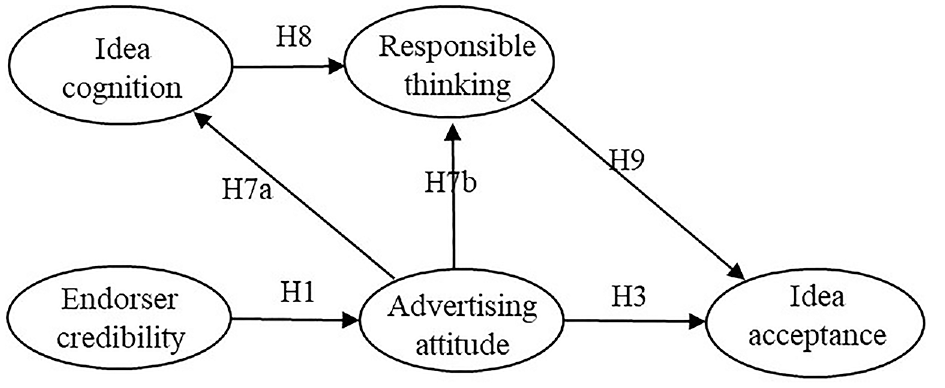
Central route of the integrated communication model of NPO’s advertising endorser.
Dual and Interaction Effects of Elaboration Using Message Appeals
Kotler (1991) classified message appeals into rational and emotional appeals. Rational appeals focus on the audience’s self-interest and emphasize the benefits of a product or service. Conversely, emotional appeals stimulate people’s willingness to purchase by arousing positive or negative emotions. Positive emotional appeals include humor, love, joy, and sexual excitement, whereas negative ones have fear, guilt, and shame. Keller and Lauren (1996) study the message appeals of anti-smoking advertisements. They observe that fear appeals affect the communication of their advertisements; however, excessively low or high levels of fear messages do not affect the communication. Although these studies reveal the appeal strategy and communication effects, they do not provide insights into the audiences’ elaboration process. Some studies have shown that emotional appeals are more persuasive than informational appeals (Rhee & Jung, 2019); nonetheless, this is inconsistent with the marketing of NPOs. Hence, instead of the persuasion effects, this study emphasizes the elaboration route of the audience.
Reichert et al. (2001) examine 13 social marketing topics testing matched pairs of appeals (sexual/non-sexual) and reveal that sexual appeals can affect cognitive processing. Sexual appeals receive more attention than non-sexual appeals; further, they are likable and increase interest in the topic. The results suggest that peripheral persuasion can be used when receivers expect to counterargue or resist the messages. Steenburg (2015) integrates the ELM and the theory of planned behavior to understand donor intentions. An empirical method is used to collect 235 responses and perform normative message manipulations. The results show that the audience’s donations increase when they are involved with the advert; however, these messages have the opposite effect when they are not involved with the advert. Hence, peripheral cues are more persuasive than rational arguments for an audience with low involvement with the adverts (Amichai-Hamburger et al., 2003). Therefore, the emotional changes of the consumers, whether positive or negative, are linked to behavioral intentions and changes (Morris et al., 2002). The cognitive route is as important as the emotional route in the information-processing model for eliciting behavioral change. The cognitive route involves information processing, with emotional influences at its core. Thus, emotions generated by the content process lead to increased changes in attitude (Carpenter, 2020; Morris et al., 2005). According to the ELM, regardless of the situation, the central and the peripheral routes may exist simultaneously (Carpenter, 2020; Coulter and Punj, 2004). The difference lies in whether the cognitive or emotional route is prominent (Arnould et al., 2002; Morris et al., 2002), and both cognitive and emotional routes affect the depth of information processing (Morris et al., 2005; Tam & Ho, 2005). Kim et al. (2020) collected data from 230 college students to examine if emotional and rational advertising copies affect sustainable marketing. The results reveal that both advertising appeals significantly influence value–satisfaction–trust–word-of-mouth context.
Moreover, the experimental between-subjects study conducted by Kunkel et al. (2019) shows that informational appeals have higher spillover effects than emotional appeals on the perception of the athlete endorser. This supports that the attitude of respondents toward the advertisement affects the perceptions of the athlete endorser.
However, this study proposes the integrated communication model of the advertising endorsers of NPOs based on the DCM, ELM, and spillover effects, as shown in Figure 6. The model supports the same argument: regardless of whether it is rational or emotional appeals, the audience’s elaboration of central and peripheral routes coexists, and the dual and interaction effects influence idea acceptance in the advertisement of NPOs. Hence, the following hypotheses are proposed.
H10a: Rational appeals strengthen the central-route elaboration, whereas emotional appeals strengthen the peripheral-route elaboration.
H10b and H10c: The audience’s elaboration of the central and peripheral routes has dual and interaction effects on idea acceptance for rational and emotional appeals.
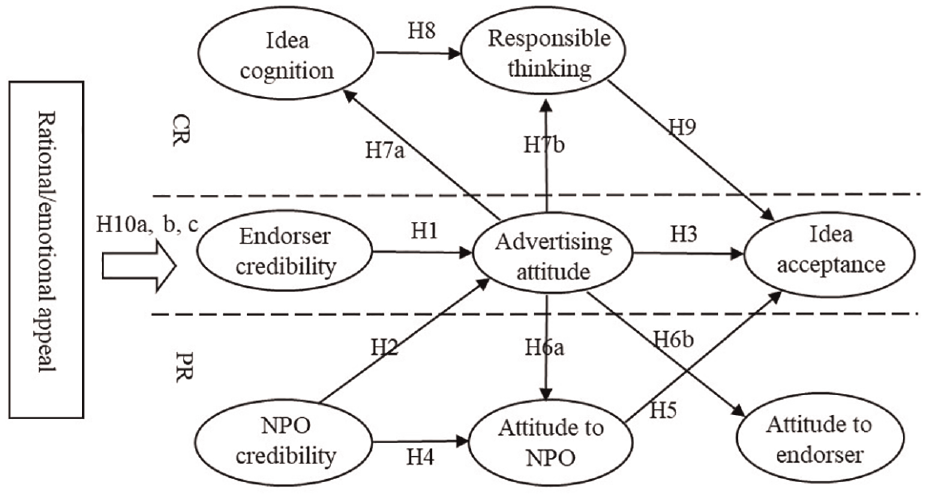
Integrated communication model of NPO’s advertising endorser.
Methods
Research Design and Measurement
The proposed integrated communication model for the social marketing of NPOs and the research framework are shown in Figure 6. A quasi-experimental design created rational and emotional appeals for smoking cessation advertisements. The John Tung Foundation (2014) website contains a rational appeal stating that smoking may cause other severe illnesses to stimulate the cognition of the audience. The emotional appeals state that smoking cessation results in a good life. These advertisements were designed by the John Tung Foundation and endorsed by the Taiwanese B-list entertainer Amber An (see Table 1). A stratified sampling method was used to distribute 600 questionnaires in the waiting areas of railway stations in Taiwan. Personal interviews with a gift (facial mask) were also conducted.
Advertisement Contents: Rational and Emotional Appeals.

The research description, anonymous measurement, and implementation steps were explained in detail on the first page of the questionnaire. The respondents were asked to complete the questionnaire in that order. Further, the first page included items to measure the credibility of the endorser and the NPO; the semantic differences were measured on a 7-point scale based on three items for each aspect—“attractive/unattractive,”“trustworthy/untrustworthy,” and “professional/unprofessional” (Newell & Goldsmith, 2001; Ohanian, 1990). The second page comprised a smoking cessation advertisement. One group received a questionnaire with a rational appeal, and another received an emotional appeal. The respondents were required to thoroughly read the smoking cessation advertisement before responding to the two items that measured whether they were manipulated by the rational or emotional appeal (Yang et al., 2011).
The third page comprised items related to advertising, NPO, and the attitudes of the endorsers. It included nine questions adopted from the studies by Coulter and Punj (1999) and Yang (2018a). The items were scored using a 7-point semantic differences scale based on three questions for each aspect: “unimpressive/impressive,”“boring/interesting,” and “dislike/like.” Finally, the scales for idea cognition and responsible thinking were revised based on those developed by Hassan et al. (2007). After watching the advertisements, the respondents were asked to respond to the following statements: (1) “It is possible to quit smoking/be anti-smoking”; (2) “Smoking is absurd”; (3) “Smoking harms your health and that of the people around you”; (4) “You are made to think about quitting/being anti-smoking”; (5) “It makes you think about whether or not to smoke in front of non-smokers”; (6) “It makes you think about the value of quitting smoking”; (7) “It makes you feel that smoking is not good.” Furthermore, to measure idea acceptance, this study modified the questions developed by Yang (2018a) and presented the following statements to the respondents: (1) “After watching the advertisement, I am more supportive of smoking cessation”; (2) “I am more willing to continue my support for smoking cessation”; (3) “I am more willing to publicize the harm of smoking to relatives and friends”; (4) “I am more willing to participate in the activities of persuading others to quit smoking.” The items were measured using a 7-point Likert scale.
Participants
A total of 468 valid questionnaires were collected: 216 (46.2%) respondents were from Northern Taiwan, 118 (25.2%) from Central Taiwan, 112 (23.9%) from Southern Taiwan, and 23 (4.7%) from Eastern Taiwan. The recovery ratio for each region was consistent with that of the population in each region of Taiwan (the chi-squared test showed no significant difference). In terms of sex, 212 (45.3%) respondents were men, whereas 256 (54.7%) were women. Regarding age, 9.4% of the respondents were between 18 and 19 years, 28.4% were between 20 and 29 years, 40% were between 30 and 39 years, 15% were between 40 and 49 years, and 7.3% were over 50 years. In terms of educational attainment, 80 (17.1%) attended senior high school or below, 328 (70.1%) attended junior college, and 60 (12.8%) attended graduate school. Of the 468 questionnaires, 243 (51.9%) were rational appeals and 225 (48.1%) were emotional appeals.
Results and Discussion
Reliability and Validity
Two types of advertisements were provided for appeal manipulation, one with rational appeal and another with emotional appeal. A t-test showed that the perceptions of the rational and emotional appeals were significantly different, indicating that the advertising appeal manipulations were successful (see Table 2). According to the internal reliability analysis, all the constructs of Cronbach’s α were greater than .73 (see Table 3) for all the items in the questionnaire; therefore, it had good reliability and internal validity.
Manipulation Checks of Advertising Appeals.
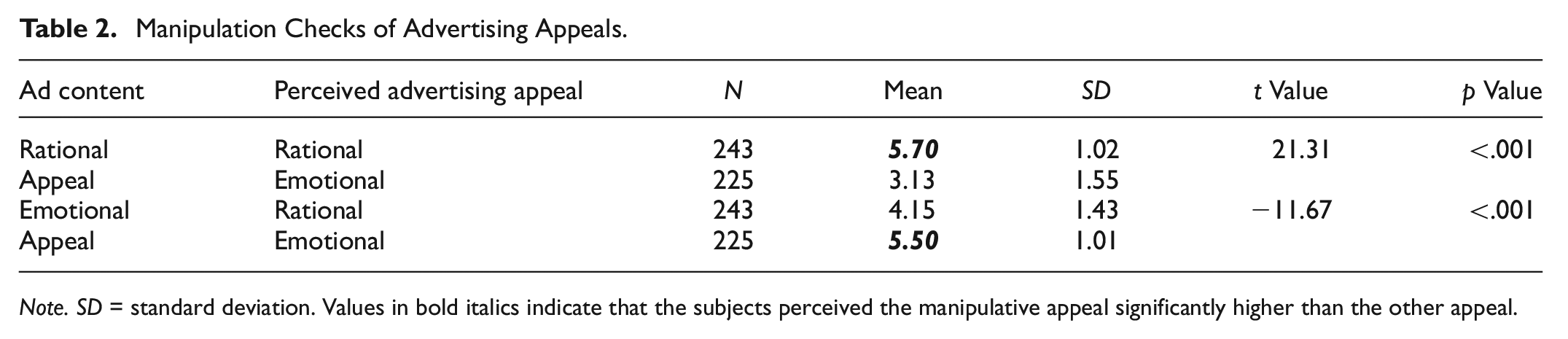
Note. SD = standard deviation. Values in bold italics indicate that the subjects perceived the manipulative appeal significantly higher than the other appeal.
Cronbach’s α for the Variable Construct.

Data Analysis
Three linear structure models with analysis of moment structure (AMOS) software were used to analyze the social marketing integrated communication model of the NPOs and compare the effects of advertising appeals. The data gathered from the 243 questionnaires about rational appeals, 225 questionnaires about emotional appeals, and the remaining items in all 468 questionnaires were analyzed. The hypotheses of the path effects of these three models were tested, and the results are presented in Table 4.
Direct Effects of Latent Variables and the Goodness of Fit for SEM.

p < .05. **p < .01. ****p < .001. Values in bold italics indicate that different appeals significantly affect the audience’s elaboration routes or these influences.
The results of these three models showed that the goodness of fit was acceptable and similar. This outcome could be explained by the advertising appeal having no significant effect on the communication model.
A goodness-of-fit test was used to compare the differences in the path effect between the two advertising appeals, and the covariance difference was more than 50% between the rational and emotional appeals. There were four different path effects obtained: (1) advertising attitudes → responsible thinking (χ2 = 2.86, p < .1, rational/emotional = 1.51); (2) advertising attitudes → NPO attitude (χ2 = 4.59, p < .05 rational/emotional = 1.69); (3) advertising attitude → idea cognition (χ2 = 21.42, p < .001, emotional/rational = 3.75), and (4) NPO attitude → idea acceptance (χ2 = 18.42, p < .001, emotional/rational = 1.78).
Research Results
The AMOS linear structural analysis revealed that all hypotheses were supported except for H3 and H10.
Message Elaboration Is Necessary to Persuade the Audience Into Smoking Cessation
Based on SEM analysis for all responses. In the central routes, the results showed that the credibility of endorsers and NPOs influenced idea cognition (path effect is 0.26) and responsible thinking (0.35) through advertising attitudes. Moreover, idea cognition directly affected responsible thinking (0.85) and significantly and indirectly affected the acceptance (0.72) of smoking cessation via responsible thinking. These results were consistent with those reported by Hassan et al. (2007). Therefore, hypotheses H7a, H7b, H8, and H9 were supported. The results were the same as those of Cyr et al. (2018), who proposed the determined effects of argument quality as a central route to influencing attitude changes in the ELM.
In terms of complex social behaviors, the acceptance of smoking cessation and taking relevant actions necessitated the evaluation of idea cognition and responsible thinking. Moreover, according to Ágnes’s (2021) research results, exchanging knowledge about smoking cessation and involving family or friends raises responsible thinking and behavior.
Reciprocal Spillover Effects for the Endorsers and NPOs
In the peripheral routes, the credibility of the endorsers (0.48) significantly impacted advertising attitudes more than that of the NPOs (0.18). This is consistent with the DCM and DHM results. Moreover, the credibility of the NPO influenced their attitude (0.62) and indirectly affected the acceptance of smoking cessation via the attitude toward the NPO (0.06). The same results as those of Thomas and Johnson (2016) revealed that the credibility of a celebrity positively affected attitudes toward advertisements, message comprehension, and change intention. Hence, an endorser with high credibility positively affects advertising attitudes, communication, and spillover effects. H1, H2, H4, and H5 were supported.
A reciprocal spillover effect was observed for smoking cessation endorsed by a celebrity for NPOs. The advertising attitude had a more significant impact on the attitude of endorsers (0.91) than that of NPOs (0.37). The audience’s attitude toward the endorser, NPO, and smoking cessation appeal of the advertisement generated a reciprocal spillover effect. These results were similar to those Yang et al. (2012) and Kunkel et al. (2019) reported. Therefore, an excellent public service advertisement or social marketing endorsement can effectively improve the audience’s evaluation of the endorser. Moreover, NPOs can benefit from this in terms of their image. Hence, H6a and H6b were supported. These results revealed that B-list entertainers or celebrities are suitable advertising endorsers for NPOs. According to the classical conditioning theory, an endorser can continue to link with good deeds repeatedly, which is suitable for establishing the public service image of the endorser.
Advertising Attitude Is a Crucial Mediator to Change the Elaboration Routes
The influence of advertising attitude on idea acceptance was not significant. Thus, H3 was not supported. This result was different from that of DCM but the same as that of DHM. Advertising attitudes toward products with low involvement directly affect the purchase intentions of consumers, whereas products with high involvement are mediators (Yeh & Chen, 1999). The preference for social advertising can directly affect social behavior with low behavioral costs and low involvement, such as donating invoices or agreeing to policy issues. Nevertheless, the concept of smoking cessation was highly complicated for the audience, and advertising attitude toward smoking cessation was an indirect variable for idea acceptance. Shimp (1981) found that consumer attitudes toward advertising were essential mediators of the formation and transformation of brand attitudes (Mitchell & Olson, 1981).
Notably, the influence of advertising attitudes on idea acceptance could be explained through the peripheral and central routes. The results of the linear structural models highlighted the importance of advertising attitude, which was a pivotal mediator in changing the audience’s elaboration routes and transferring spillover effects within all appeals. This result was the same as that of Carpenter (2020), who proposed a classic example of using toothpaste or bacon advertising endorsements. The endorsers showed bright smiles, which indicated that the advertisement was an effective peripheral cue. This smiling endorser may draw the audience’s attention and cause them to consider the advertisement more carefully and elaborate on the central routes. Therefore, designing good endorsement advertisements could attract the attention of the audience, make the advert likable, and increase interest in the advertising topic. Thus, the consumer would be considerably involved with the advertising messages and flow in central routes, as shown in the study by Reichert et al. (2001).
Dual and Interaction Effects of the Elaboration Routes by Advertising Appeal
The emotional appeals enhanced (1) advertising attitudes toward responsible thinking (central route) and (2) advertising attitudes toward NPO attitude (peripheral route), and the rational appeal enhanced (1) advertising attitudes toward idea cognition (central route) and (2) NPO attitude toward idea acceptance (peripheral route). Each appeal significantly enhanced one central route and one peripheral route. Therefore, H10a was not supported.
The emotional appeals improved the influence of advertising attitudes on idea cognition (the central route). This revealed that the audience elaborated on the advertisement with an emotional appeal to enhance their willingness to understand the smoking cessation messages, indirectly triggering their responsible thinking. However, the advertisement with a rational appeal enabled the audience to skip idea cognition, suggesting that the related advertisements directly led the audience to responsible thinking and resulted in idea acceptance. This result was similar to that reported by Hassan et al. (2007). The audience (consumer) who likes the advertisement with more smoking cessation messages would likely elaborate on the messages and engage in responsible thinking.
For peripheral routes, it was found that rational appeal improved the spillover effect of the advertising attitude of the audience on the NPO attitude more than emotional appeal (peripheral route). However, the emotional appeal enhanced the attitude of the NPO to influence idea acceptance. This indicates that rational appeals directly affect communication, whereas emotional appeals allow the audience to think more and exert an indirect effect. Although rational appeals (.95) had a more substantial spillover influence on the advertising attitude of the audience toward endorsers than emotional appeal (.85), it did not have significant spillover effects on endorsers. This finding is inconsistent with the results of Kunkel et al. (2019).
These results showed that rational appeals in social marketing did not significantly strengthen the central route elaboration of the audience. Further, emotional appeals did not significantly strengthen the peripheral-route elaboration either. This indicates that rational appeals directly affect communication, whereas emotional appeals allow the audience to think more and exert an indirect effect. Furthermore, these studies revealed that the rational and emotional elaborations of the audience were blended into social marketing communication.
Figure 7 shows that regardless of the rational or emotional appeals in advertising when the audience reads NPO endorsements, the elaborations via the central (cognition) and peripheral (emotional) routes co-exist. The audience can deliberate through these two routes, thereby influencing the persuasion effect. Therefore, these two elaboration routes had dual and interactive effects on idea acceptance. Therefore, H10b and H10c were supported.

Verification of the NPO’s social marketing integrated communication model.
Conclusion and Suggestion
This study verified the social marketing integrated communication model of NPOs and showed that advertising attitudes toward smoking cessation did not directly affect idea acceptance. For an audience to accept the idea of smoking cessation, they must elaborate on smoking cessation messages in the central and peripheral routes. However, advertising attitude was found to have a significant mediating influence on changing the audience’s elaboration route and transferring the spillover effects.
The elaboration in the central routes had a better communication effect on idea acceptance than that of peripheral routes. Invoking the responsible thinking of the audience is essential for smoking cessation and social marketing. However, a rational appeal in social marketing does not evoke the central route of the elaboration of the audience more than an emotional appeal.
Advertising appeal can change the elaboration path effects of the audience but has no significant influence on communication. An emotional appeal allows the audience to think more and understand the idea better, as well as increases the effect of the NPOs’ attitude on idea acceptance. Conversely, a rational appeal is direct and substantial, leading the audience to responsible thinking and enhancing the spillover effects on NPOs. However, the audience’s elaboration of the central and peripheral routes has dual and interaction effects on idea communication, regardless of whether the advertising communication of the NPOs is under rational or emotional appeals.
For celebrity endorsements in the social marketing of NPOs, selecting an endorser with good credibility is considerably important because it can improve communication effects and result in spillover effects for NPOs. The reciprocal spillover effects apply to both the endorsers and NPOs. Endorsers have more spillover effects than NPOs. Future studies might extend and test the social marketing integrated communication model with other social marketing issues, such as safe driving or anti-abortion.
Advertising attitude is a crucial successful mechanism for the social marketing of NPOs. It can create reciprocal spillover effects for both endorsers and NPOs, and it can also evoke the interaction between the central and peripheral routes of the audience’s elaboration on social issues. Therefore, it is a win–win strategy to pay attention to designing good microfilms that advertise social marketing. Enhancing the images of the NPOs and endorsers (or donated corporates) increases the advertising attitude of the audience, resulting in positive social marketing effects.
For future research, three topics are worth discussing in depth: (1) How can we fit the advertisements of NPOs (or corporates) and endorsers to create the best reciprocal spillover effects? (2) How can the interaction between the central (cognitive) and peripheral (emotional) routes of the elaboration of the audience be invoked? (3) Verify the social marketing integrated communication model of the NPOs using other social issues.
This study examines advertising appeals through text manipulation. However, the messages must be refined into rational and emotional appeals for clarity. Furthermore, although this study controlled for internal consistency, reliability, and internal validity, the convergence and discriminative validity in the integrated model were not good enough, and extraneous variables might affect the results. Therefore, caution should be exercised when using advertising messages, questionnaire items, and models. Moreover, this study focused only on smoking cessation; thus, the results and conclusions should be applied cautiously to other issues.
Footnotes
Declaration of Conflicting Interests
The author declared no potential conflicts of interest with respect to the research, authorship, and/or publication of this article.
Funding
The author disclosed receipt of the following financial support for the research, authorship, and/or publication of this article: The author would like to thank the Ministry of Science and Technology of Taiwan for financial support (NSC 102-2410-H-214-003-SS2), and Shu-Wan Yang for their assistance in data collection of the project.

Data Availability Statement
Data sharing is not applicable to this article as no datasets were generated or analyzed during the current study.