




Abstract
Our study is the first to analyze the influence of CEO power and ownership structures on earning manipulation. This study also clarifies whether different ownership structures discourage powerful CEOs from manipulating earnings in family businesses. The sample data is a balanced panel with 985 observations of 116 family businesses in Vietnam from 2005 to 2020. We primarily employ the dynamic system Generalized Method of Moments with cross-sectional fixed effect to overcome endogeneity and heterogeneity issues. Our findings indicate the negative relationship between CEO power and earning manipulation. Higher state or institutional ownership restrains powerful CEOs from manipulating earnings in family businesses. However, Powerful CEOs in family businesses with higher participation of blockholders increase the earning manipulation. Our robustness results show that CEOs from 50 to 70 years old reduce earning manipulation the most in family businesses. Our findings support agency theory, stewardship theory, resource dependency theory, monitoring and accountability theory, legal framework theory, reputation theory, monitoring theory, Maslow’s need hierarchy, and prior literature. Our study contributes practical policy and management implications to sustainably reduce earning manipulation in family businesses.
Introduction
Real earnings management (REM) has become a contemporary topic because corporate decisions about business operations maximize earnings. Prencipe and Bar-Yosef (2011) show that a family business is a typical model that empowers agency problems. Tabassum et al. (2015) argue that 80% of managers are motivated to manipulate earnings to boost earnings at the end of the financial year. Duru et al. (2016) argue that state and institutional ownership improve corporate efficiency through adequate supervision, which helps maintain financial statements’ reliability and reduces the incentive to manipulate earnings. Therefore, the role of ownership structures is relevant, especially in transition economies, because these markets have been transforming from a centralized economy to a market economy.
We conduct this study in Vietnam because of the following reasons. According to the General Statistics Office of Vietnam (GSO) and the Vietnam Chamber of Commerce and Industry (VCCI), 70% of family firms are out of the total companies in Vietnam. Family-owned businesses gain approximately 65% of the Ho Chi Minh Stock Exchange (HOSE) market capitalization. In addition, the 100 biggest asset-sized family firms contribute to 25% GDP in Vietnam. These features show that family companies have a large proportion in Vietnam and significantly contribute to the economy. However, there are several non-transparency activities that family-owned companies implemented to make illegal self-interest and cause damage to the economy. According to Tax Bureau in Vietnam, the number of companies relating to earnings manipulation, especially tax fraud activities, increased from 31,000 in 2013 to more than 100,000 in 2019. These companies carry out, generally, tax fraud activities by making cash sales or declaring the price in the invoice lower than the actual selling price. These activities aim to cause a loss in the income statement and pay lower taxes. Luu Thu (2023) also mentions that earnings management is only concerned with short-term profits, with no product quality or company structure improvement. Thus, earning manipulations distort financial reporting and negatively affect the firm performance. Therefore, the large amount of such non-transparency activities directly causes a massive loss of revenue for the national budget. Besides, Nguyen and Thi Duong (2022) argue that the Vietnamese government also attaches great importance to the improvement of legal frameworks because there are many problems related to the lack of transparency, the poor legal environment and especially herding behavior for the common benefit leading to earnings manipulation occurs in Vietnam. Therefore, it is worth testing how CEO overpower and ownership structures affect the earning manipulation in Vietnam, a transition country in Asia.
To close the literature gap, we employ the Random Effects Models (REM) and dynamic system Generalized Method of Moments (GMM) methods to analyze a sample of 116 listed family businesses in the Vietnam stock exchange market from 2005 to 2020. Our findings show that powerful CEOs reduce real earning manipulation by 0.04% when the CEO power index increases by one score. When CEOs have more experience, they have more power, so their goal is to improve the firm’s performance rather than manipulate earnings (Bouaziz et al., 2020). Moreover, this study reports that different ownership structures have mixed impacts on the real earning manipulations in family businesses. Our findings support agency theory and stewardship theory.
Secondly, this study tests whether different ownership structures have mixed roles in preventing CEOs from earning manipulations in the family business. The results suggest that family companies with higher institutional or state ownership restrain powerful CEO from manipulating earnings, implying higher monitoring efficiency. However, powerful CEOs manipulate earnings easily in family businesses with higher block ownership. In family businesses, blockholders are close relatives of the board of directors, so blockholders impose fewer monitoring mechanisms on the management team. Therefore, powerful CEOs have more incentive to manipulate earnings in family businesses with higher block ownership (Lin et al., 2014).
We also follow Sitthipongpanich and Polsiri (2015) to test whether our findings are robust across the CEO age subsamples. The robustness test confirms that powerful CEOs discourage earning manipulation in family businesses. In addition, CEOs from 50 to 70 years old reduce the earning manipulation by up to 44% more than other CEOs ages. This finding suggests that experienced CEOs prioritize developing firm performance sustainably rather than distorting earnings to secure their managing positions in family businesses. Our findings support Maslow’s need hierarchy.
This study is unique because of the following reasons. Our study closely relates to Bouaziz et al. (2020) and Altarawneh et al. (2020) because they examine the nexus between CEO power and earning manipulation. This study also relates to Duru et al. (2016) because they found that the interaction variable between CEOs and the board of directors positively affects firm performance. Ownership structures play a competitive advantage and provide more effective supervision to reduce agency costs between powerful CEOs and shareholders. Therefore, this study is unique because it analyzes the interaction between CEOs and ownership structures to explore whether ownership structures moderate the relationship between CEO power and earning manipulation. Finally, this study is unique because it performs a robustness test to check whether primary findings are robust across CEOs’ age subsamples.
The rest of this study is structured as follows. Section “Literature Review” provides the literature review. Section “Data and Methodology” describes the research methodology, including data, model formulation, and estimation. The empirical results are discussed in Section “Empirical Results and Discussion.” Section “Conclusion” is a conclusion.
Literature Review
Relevant Theory
Maslow’s Need Hierarchy Theory
Maslow’s hierarchy of needs theory is one of the most influential theories in motivation psychology and personality science. This theory creates five classes representing five basic levels of human personality: physiological needs, safety, love and belonging, self-esteem, and self-actualization of the species. Maslow’s “Big Five” model is both a theory of human needs and a model of personality development (Montag et al., 2020). This theory suggests that as young people mature, they experience the need for safety and love. Hence, they are more motivated by the need to be respected and recognized by others and the desire to express themselves. Montag et al. (2020) suggest that during adolescence, people often have high growth needs beyond the first physiological and safety needs to move closer to self-actualization. In addition, Hall and Nougaim (1968) suggest that young people require security, recognition, and self-affirmation. However, as younger managers do not have any outstanding recognition in the organization, they have an increased tendency to manipulate earnings to create impressive achievements.
In addition, as people become older, they focus on social connections, health, and financial insecurity. The soft landing hypothesis proposes that in family companies, the older CEOs want to make an impressive business performance before they retire. Thus, CEOs use several techniques to manipulate earnings to avoid adverse fluctuations related to the financial results, attract investors, and consolidate their position. Saona et al. (2020) mention that earnings manipulation occurs when CEOs inflate financial statements to make it easier to report results to misleading information.
CEO Overpower and Earning Manipulation
Prior studies examine the influence of CEO power on earnings manipulation in Vietnam. For example, Luu Thu (2023) argues that the high Income in the study in Vietnam is partly due to earnings manipulation. Khuong et al. (2023) showed that the higher the level of CSR participation, the better the CSR performance, which reduces the risk of earnings manipulation and improves the overall financial performance. Khuong et al. (2022) report that older firms are likelier to manipulate earnings. Besides, Khuong et al. (2022) suggest that the participation of state ownership helps to reduce the possibility of earnings manipulation in older firms.
Agency theory suggests that the interests of the shareholders must be protected by the Board of Directors, who are responsible for monitoring the management actions. In a family business, the CEO may also be a family member with a dominant position, making it difficult for the board to hold them accountable. Saona et al. (2020) suggest that CEO duality has wielded too much power, thus facilitating the reduction of supervisory effectiveness on the board of directors. Therefore, Saona et al. (2020) mentioned that CEO duality motivates earning manipulation. Our sample summary statistics report that the average value of CEO duality is over one-third of total observations, so using CEO duality to test whether powerful CEO helps increase earnings manipulation in our research is an obvious possibility. CEO duality significantly affects earnings management in emerging markets. Specifically, firms with CEO duality are more likely to engage in earnings management practices than firms without CEO duality. Peecher et al. (2013) also report that powerful CEOs manipulate earning reports to increase their salaries and compensation, significantly affecting the firm value.
Similarly, social identity theory suggests that individuals identify with certain social groups and derive their self-worth and identity from these groups. Powerful CEOs are influencers with upper social identities, so they have a desire to manipulate earnings to endure their social status and management power (Tajfel & Turner, 2004)
On the other hand, Stewardship theory suggests that CEOs are motivated by a sense of responsibility to improve business performance rather than just maximizing their wealth. Chi et al. (2015) argue that CEOs from family companies will be more altruistic, not for personal gain but for the stakeholders’ benefit. Bouaziz et al. (2020) suggest that when CEOs become more powerful, they prioritize developing the business performance to consolidate their positions rather than manipulate earnings. Suddaby and Jaskiewicz (2020) argue that family firms often struggle between maintaining their identity across generations and innovating to adapt to current and future requirements. Family businesses often value maintaining a continuous identity across generations and respecting the values and beliefs of the founder, so the possibility of earnings manipulation is very low.
Resource dependency theory suggests powerful CEOs are less likely to manipulate earnings because they can access capital markets or regulatory approval. If these external resources are jeopardized by earnings manipulation, the CEO may face severe consequences. Prencipe and Bar-Yosef (2011) mentioned that powerful CEOs have experience in managing pressure and crisis management, so they produce good-quality reports and reduce the risk of manipulation. Consequently, CEOs with a high power level may be more likely to avoid earnings manipulation to maintain access to external resources. (Pfeffer & Salancik, 2003).
We propose the following hypothesis as prior theories and studies document mixed findings between CEO powers and earning manipulation.
Hypothesis 1: Powerful CEO decrease earning manipulation in family businesses.
State Ownership and Earning Manipulation
Guo and Ma (2015) document the positive impact between state ownership and earning manipulation. Businesses accept earnings manipulation if the government prioritizes economic goals and actively supports local businesses. However, Lassoued et al. (2017) report a negative relationship between state ownership and REM, implying that higher state ownership discourages earning manipulation. Government interventions tend to be conservative in investment decisions, so CEOs have less incentive to distort the income statement. Wang and Yung (2011) found that businesses can leverage their connections to gain government incentives so they do not need to distort earnings to access external financing.
Agency theory suggests that state-appointed managers may be more likely to manipulate earnings to develop their political objectives. Chi et al. (2015) argue that companies with higher state ownership have lower report quality, and these companies are likely to manipulate earnings. Moreover, political capture theory explains that the positive relationship between state ownership and earnings manipulation can be attributed to political capture. According to this theory, state-owned enterprises (SOEs) may manipulate earnings to serve the interests of government officials or political elites who exercise control over the state-owned enterprises (Fan & Wong, 2002). Similarly, the rent-seeking theory suggests that state-owned enterprises may manipulate earnings to seek economic rents or privileges from the government. (Wei et al., 2005)
In contrast, stewardship theory suggests that state-appointed managers may act as responsible stewards of the business, prioritizing the company’s long-term success over short-term gains. Our sample data has 21.6% of family enterprises with government ownership. Although it is not a compulsory requirement to have state ownership in a family business, state ownership exists due to the transitional process from a centralized economy toward a private economy. Monitoring and accountability theory suggests that state ownership may reduce the likelihood of earnings manipulation because state-owned enterprises (SOEs) are subject to more excellent monitoring and accountability by government regulators. This theory suggests that the government’s oversight of SOEs reduces the agency problem between managers and shareholders, resulting in lower earnings manipulation. (La Porta et al., 2000). Finally, legal framework theory suggests that state ownership may reduce earnings manipulation due to a solid legal framework in countries where state-owned enterprises operate. This theory suggests that the legal system in such countries provides vital protection for minority shareholders, making it more difficult for managers to manipulate earnings without facing legal consequences (Claessens & Yurtoglu, 2013).
We propose the following hypothesis as prior theories and studies report mixed findings between State ownership and earning manipulation.
Hypothesis 2: State ownership negatively affects earning manipulation in family businesses.
Institutional Ownership and Earnings Manipulation
Agency theory suggests institutional ownership can reduce the likelihood of earnings manipulation in family businesses. Institutional owners have significant ownership in the company, so they are more likely to monitor management actions to protect their interests. Lemma et al. (2018) indicate a negative relationship between institutional investors and earning management. The supervision of institutional shareholders restrained CEOs from distorting earnings. Institutional ownership can also provide greater access to resources, which can help to prevent earnings manipulation. Alves (2012) argues that institutional investors may discover better earnings management than non-institutional investors because institutional investors can intervene promptly and prevent CEOs from having the incentive to manage earnings. Similarly, reputation theory suggests that institutional investors may be concerned about the reputational risk of investing in companies that manipulate earnings. Reputation theory suggests institutional investors may use their influence to encourage companies to engage in more transparent financial reporting and discourage earnings manipulation. (Bertrand and Mullainathan, 2001).
On the other hand, Stewardship theory suggests institutional ownership may not necessarily reduce earnings manipulation in family businesses. Lin et al. (2014) found a positive relationship between institutional investors and earning management. Alves (2012) argues that institutional investors will not try to monitor well and interfere in the CEO’s decisions because it will adversely affect their relationship with the company. Therefore, institutional owners may not be as effective in detecting or preventing earnings manipulation as family owners.
Hypothesis 3: Institutions increase earning manipulation in family businesses.
Blockholders and Earning Manipulation
Agency theory suggests that blockholders can monitor and influence management decisions, including decisions related to earnings manipulation. Blockholders with a significant ownership stake in a company may be motivated to maximize their financial gains. They may pressure managers to manipulate earnings to achieve this goal. Habbash (2013) finds the positive impact of block ownership on earnings management. Blockholders can put pressure on managers to report good financial performance, and they also interfere with poor management. Jiang et al. (2020) discovered that poor monitoring mechanism from blockholders makes it easier to manipulate earnings. Suddaby and Jaskiewicz (2020) argue that family firms often need help maintaining their identity across generations and innovating to adapt to current and future growths. Therefore, they may manipulate earnings to ensure the company’s survival and growth, even sacrificing short-term profits.
However, Stewardship theory suggests that blockholders may have a long-term perspective and a sense of responsibility toward the company they own, which may discourage them from engaging in short-term manipulative practices such as earnings manipulation. Dou et al. (2018) find a negative relationship between block holders and earnings management. Due to the close association between managers and large shareholders, CEOs are more likely to provide for shareholders’ best interests, resulting in less need for managers to manipulate earnings.
Similarly, the monitoring theory suggests that blockholders may be more effective at monitoring and disciplining management than dispersed shareholders. As a result, blockholders may be better able to detect earnings manipulation. Alves (2012) believes that large block-holders help tighten corporate governance to prevent earnings management activities. Finally, reputation theory suggests that blockholders with a long-term investment horizon and good reputation may be less likely to manipulate earnings. Engaging in manipulative practices can damage their reputation and affect their future investment opportunities. (Klein et al., 2005)
Hypothesis 4: Blockholders increase earnings manipulation in family businesses.
The Moderating Role of Ownership Structures on CEO Power
According to agency theory, the emergence of effective ownership structures closely monitors CEOs and effectively protects shareholders’ interests. The concentration of ownership in the hands of family members can provide more control over decision-making and limit the power of the CEO. Efficient ownership structures reduce operational risks and provide helpful strategic advice so CEOs minimize the incentive to manipulate earnings (Wijethilake & Ekanayake, 2020). Duru et al. (2016) indicate that ownership structures help CEOs reduce harmful risks to a better direction for the quality of company operations and improve monitoring efficiency. A powerful CEO will help improve oversight, help give advice and create a competitive advantage over competitors. However, Debnath et al. (2021) argue that institutional owners can associate with managers such as CEOs for their benefit and use their power to discount and reduce costs, thereby increasing earning distortion.
The stewardship theory argues that family ownership structures are often seen as a positive factor because they reduce agency behavior and promote the family’s interests. In this view, family members are more likely to act in the long-term interest of the business and avoid unethical behavior, including earnings manipulation. Saona et al. (2020) mention that the role of the board of directors is to reduce earnings management risks and improve the credibility of its financial statements. Therefore, the effective ownership structure in family businesses can moderate CEO power and the potential for earnings manipulation.
Hypothesis 5: The interaction terms between CEO power and ownership structures statistically impact earning manipulation in family businesses.
Data and Methodology
Data
We collected 116 family businesses in Vietnam listed on HOSE and HNX from 2005 to 2020 because the Vietnamese stock market started in 2000 with only two listed firms. Altarawneh et al. (2020) conducted a study with hundreds of businesses in Vietnam. They suggested that when the CEOs have the proper powers and functions, the CEO will better manage the earning management scale. Therefore, we collect data from 2005 to ensure a sufficient sample size for regression analysis with minimized biases. Besides, we collect information about CEOs from the annual reports that have been made public every year. We exclude the finance companies because Duong et al. (2022) suggest that financial intermediaries rely heavily on financial leverage. We follow Duong et al. (2022) to winsorize all variables at the 5% and 95% levels to mitigate extreme value issues. We also follow Duong et al. (2022) to remove observations that do not have enough data to calculate relevant variables to remove observations with insufficient data to calculate relevant variables. Our final sample is a balanced panel with 985 annual observations of 116 family businesses from 2005 to 2020.
Variable Definitions
Earning Manipulation
Our research follows Tabassum et al. (2015) to estimate the earning manipulation focused on sales manipulation. Tabassum et al. (2015) method is more suitable for our study than Roychowdhury’s (2006) for the following reasons. First, Tabassum et al. (2015) specifically examine sales manipulation, which is the type of earnings manipulation we are interested in studying. In contrast, Roychowdhury (2006) focuses on manipulating production costs and discretionary expenditures, which are not directly related to sales manipulation. Second, Tabassum et al. (2015) employed a methodology specifically designed to identify sales manipulation, including comparing sales growth to industry benchmarks and examining the timing of sales transactions. Tabassum et al. (2015) provide insights into the motivations and consequences of this type of manipulation, which may be relevant to our research on CEO overpowers and real earnings manipulation in family businesses. The formula of REM is calculated by:

In the study by Tabassum et al. (2015), earning manipulation is computed using the Jones model, a commonly used method for measuring accrual-based earnings management. The Jones model compares the level of accruals reported in a firm’s financial statements to the level of accruals that would be expected based on the firm’s historical performance and industry averages. The difference between the actual and expected accruals is known as “discretionary accruals,” which represents the amount of earnings management that has been conducted. Operating Cash Flows (CFOs) are actual cash flows and sales publicly listed on annual reports. In addition, the higher value of residual indicates more earnings manipulation. This leads to an increase in sales on annual reports but a decrease in the actual CFO. The abnormal lower operating cash flow is REM. REM is calculated from the result of the residual multiplied by (−1).
CEO Overpower
We follow Duong et al. (2023) to estimate the CEO overpower index by applying the principal component analysis (PCA). PCA helps to convert linear variables with high frequency to aggregate into a general representative index for the research goal. In addition, PCA also eliminates the correlation of independent components. Specifically, we apply PCA to estimate the CEO overpower index from the following proxies. The first proxy is CEO ownership because CEO ownership represents the authority of the CEO, and it significantly influences REM. The second proxy is CEO duality because Bouaziz et al. (2020) suggest that companies with duality CEOs show higher earnings management. Besides, if there is a separation between these two positions, it will help limit the incentive to entice board members. The final proxy is CEO age because older CEOs reduce REM (Bouaziz et al., 2020).
Appendix A shows table (a) describes the maximum eigenvalues of the three components: 1.4565, 0.9541, and 0.5894, respectively. In addition, table (a) reports the proportion of three factors explained 48.55%, 31.80%, and 19.65% of the overall variations, respectively. Besides, Appendix A also presents the eigenvectors loadings of PC 1, PC 2, and PC 3, representing CEO age, duality, and ownership in table (b). As can be seen in table (b), PC 1 contains significant and positive values. However, PC 2 and PC 3 are small and negative. Therefore, PC 1 explains more data variation, so we collect PC 1 to generate CEO overpower.
Ownership Structures
We followed Guo and Ma (2015), Lassoued et al. (2017), and Habbash (2013) to measure ownership structures, including state ownership, institutional ownership, and blockholder. We collect data manually according to the percentage of ownership stated in the company’s financial statements. State ownership is a percentage of government shares; institutional ownership is the ownership ratio of domestic or foreign enterprises and organizations. Furthermore, blockholder ownership represents the proportion of shareholders owning more than 5% of the outstanding shares.
ROA
Following Strobl (2013) and M. D. Tran and Dang (2021), we also control for the return on asset (ROA), which is measured by Income before irregularities are divided by the carrying amount of total assets at the beginning of the fiscal year. ROA refers to the company management’s ability to earn money. Strobl (2013) increased profits from earnings manipulation will attract a positive response from investors, enhancing stock price and business value. M. D. Tran and Dang (2021) argue that return on assets with earnings management confirms that profitable firms will arrange several methods to manipulate earnings. Managers balance profit margins between accounting periods to ensure long-term sustainable profit trends.
Firm Age
We follow Davila et al. (2015) and Guo and Ma (2015) to calculate the firm’s age as the difference between the current year and the establishment year of each firm. New businesses can change their financial statements over time and improve their reputation and image in the market. Based on research showing a negative relationship, Davila et al. (2015) provided that established firms have a lower tendency to manage earnings manipulation than startups. Guo and Ma (2015) report a positive relationship between firm age and earnings manipulation.
Leverage
We follow Tulcanaza-Prieto et al. (2020) and M. D. Tran and Dang (2021) as measured by the ratio of total liabilities to total assets. Tulcanaza-Prieto et al. (2020) suggest that changes in advantage and degree of advantage have different effects on financial reporting manipulation and conclude that increased advantage is associated with a reduction in cumulative reporting manipulation. Furthermore, the results suggest a beneficial effect of debt because increasing debt reduces CEO spending and thereby reduces manipulation of the income statement. On the contrary, M. D. Tran and Dang (2021) found a positive relationship between financial leverage (LEV) and earnings management. The higher leverage ratio motivates firms to engage in earnings management. The higher the debt ratio, the higher the debt status, and the higher the risk of default. Therefore, managers often control revenue by inflating profits to secure borrowing contracts and create a suitable trust for creditors.
Firm Size
We follow Bouaziz et al. (2020) and Tabassum et al. (2015) to compute firm size as the logarithm of total assets. M. D. Tran and Dang (2021) argue that firm size negatively correlates with earnings distortion. The larger the companies have a qualified accounting team and have better control over earnings management. Bouaziz et al. (2020) also argued that firm size negatively affects earnings manipulation because large-scale enterprises have more efficient internal control systems and competent internal auditors. In addition, the internal control system in large companies is more transparent and efficient than smaller firms, which reduces earnings manipulation.
Model Construction
We follow Bouaziz et al. (2020) to examine the relationship between CEO power and earning manipulation in the regression model (1) as follows:

Kim and Sohn (2013) mentioned that state ownership does not efficiently reduce earning manipulation. Lin et al. (2014) suggest that it is essential for businesses to investigate the relationship between institutional ownership and earnings manipulation. Therefore, higher institutional ownership imposes efficient monitoring mechanisms on financial reports and reduces earning manipulation. In family businesses, blockholders are close relatives of the management team and board of directors, so blockholders ultimately empower the CEO’s powers. Thus, we construct model 2 to estimate the impacts of different ownership structures on earning manipulation.

In the regression model (3), (4), and (5), we put the interaction variables such as CEO × STATE ownership, CEO × INST, and CEO × BLOCK into the model to test the moderating roles of different ownership structures on the earning manipulation tendency of powerful CEOs in family businesses.


Our control variables are ROA (M. D. Tran & Dang, 2021), LEV (M. D. Tran & Dang, 2021), LNFIRMAGE (Davila et al., 2015), and LOG_ASSET (Bouaziz et al., 2020). All variable definitions are reported in Appendix B.
Estimation Methodology
Firstly, we implement the Hausman Test and the Breusch–Pagan test and Redundant Fixed Effects test to choose the most suitable estimation method among the Pooled Ordinary Least Square (OLS), Fixed Effects Model (FEM), and Random Effects Model (REM). However, Duong et al. (2022) argue that OLS, FEM, and REM are ineffective because of violating the heteroskedasticity assumptions. We then conduct the Wald test to check for heteroskedasticity issues. Therefore, we follow O. K. T. Tran et al. (2022) and Duong et al. (2023) to employ the dynamic system Generalized Method of Moments (GMM) with cross-sectional fixed effects to overcome the endogeneity and unobserved heterogeneity. We conduct Arellano-Bond tests to determine whether the model has a first- and second-order autocorrelation. We also check the J-statistics to ensure that the instruments are valid. Finally, we perform a robustness test to confirm the persistence of our main findings across subsamples by CEO age.
Empirical Results and Discussion
Descriptive Statistics
Table 1 provides descriptive statistics for all variables. The earning manipulation and institutional ownership in Vietnam have average values of 0.009 and 0.9%. The average state ownership in Vietnamese family businesses is 1.6%. The average value CEO power index in Vietnam is 1.5 and higher than in Thailand. In addition, our results differ in earning management and the state ownership variables compared with the study of M. D. Tran and Dang (2021). The difference is that we focus on family companies only, while M. D. Tran and Dang (2021) examine non-financial listed firms in Vietnam. The average value of leverage ratio, ROA, Lnfirmage, and log_asset are 0.498, 5.770, 2.939, and 13.834, respectively.
Descriptive Statistics.

Note. This table presents the descriptive statistics. Our report studied 116 listed companies from 2005 to 2020. All variable definitions are displayed in Appendix B.
Pearson Correlation Matrix
The correlations between the independent variables are moderate because all the correlation coefficients are less than 0.5. To ensure that our sample does not have a multicollinearity issue, we compute the variance inflation factor (VIF). Table 2 reports that the VIF of all variables is less than five, so there is no multicollinearity issue in this study (O. K. T. Tran et al., 2022, Duong et al., 2023).
The Pearson Correlation Matrix.

Note. This table presents the Pearson correlation between independent variables. Our data includes 116 listed family businesses from 2005 to 2020. All variable definitions are displayed in Appendix B. The symbols ***, **, and * denote the significant levels at 1 %, 5 %, and 10 %. p-Values are in parentheses.
Regression Results
The Hausman and Breusch Pagan tests indicate that the REM is the most suitable estimation method among OLS, FEM, and REM. Table 3 suggests that CEO power negatively impacts earning manipulation because Prencipe and Bar-Yosef (2011) mentioned that creating a self-image or gaining benefits is easy to find in businesses for powerful CEOs. It explains that powerful CEOs often promote adequate business pressure to produce quality financial reports and reduce the risk of manipulation. Ownership structures negatively affect real earning manipulation because Duru et al. (2016) argue that CEOs combined with ownership structure help improve corporate efficiency through close supervision, which helps to maintain the reliability of financial statements and reduce the incentive to manipulate earnings. However, the relationship between all variables is insignificant.
Regression Results from Random Effect Models.

Note. This table reports the Random Effects Model (REM) results. Our sample has 116 listed family companies in Vietnam from 2005 to 2020. All variable definitions are displayed in Appendix B. p-Values are in parentheses.
However, the Wald test results indicate that REM estimations are ineffective because of violating the heteroskedasticity assumptions. Therefore, follow Duong et al. (2023) and O. K. T. Tran et al. (2022) to estimate our findings using dynamic system GMM to mitigate the endogeneity and heteroskedasticity problems.
Estimation Results from the Generalized Method of Moments
The regulatory environment in a socialist-oriented market economy may differ from that of a purely market-driven economy. In addition, the ambiguity between a market economy and a socialist-oriented market economy can impact the transparency and accountability mechanisms in place. The state may impose stricter regulations and oversight on SOEs to ensure accountability and prevent excessive profit-seeking behavior. The state may emphasize the importance of transparency and accountability in SOEs to maintain public trust. These regulations and a more robust monitoring and control environment can act as a deterrent against earnings manipulation, reducing the adverse effects between CEO power and manipulation for firms. This can also limit the extent of earnings manipulation by aligning the government interest with the overall societal or political objectives, reducing the negative relationship between state ownership and earnings manipulation. Institutional investors often have longer-term investment horizons and may prioritize financial performance and transparency. Their presence and active ownership can enhance corporate governance practices and reduce the likelihood of earnings manipulation within SOEs. Besides, blockholders may have their motivations and objectives, which can influence their stance on earnings manipulation. Some blockholders may prioritize short-term gains and engage in earnings manipulation. In contrast, others may prioritize long-term sustainability and transparency.
Table 4 shows the result of regression by using the GMM method. Our findings suggest that the CEO’s power negatively impacts real earnings manipulation. If the CEO power index increases by one score, REM decreases by 0.04% without considering the impact of ownership structures. After controlling ownership variables, one score increase in the CEO power index reduces the earnings manipulations by 0.1%. Our results are consistent with Bouaziz et al. (2020) because they report that powerful CEOs prioritize constructing long-term financial performance, so they have less tendency to distort earnings. In addition, stewardship theory, on the other hand, suggests that CEOs are motivated by a sense of responsibility to protect and grow the business rather than just maximizing their wealth. Our findings support hypothesis 1, the stewardship theory and resource dependency theory.
Regression Results from the GMM Estimations.

Note. This table summarizes the regression results using the GMM method. Our report studied 116 family businesses in Vietnam between 2005 and 2020. All variable definitions are displayed in Appendix B. p-Values are in parentheses.
The symbols *, **, and *** indicate statistical significance at 1%, 5%, and 10%, respectively.
Table 4 reports that higher state ownership helps reduce real earnings manipulation in family businesses. Specifically, the earnings manipulation is reduced by 0.73% if state ownership increases by 1%. Lassoued et al. (2017) explain that government interventions tend to be conservative in investment decisions and less subject to manipulation in the income statement. Wang and Yung (2011) found that institutions can leverage their political connections to gain government incentives and support, so they do not need to distort earnings to access external financings. Stewardship theory suggests that state-appointed managers act as responsible stewards of the business, prioritizing long-term success over short-term gains. Our findings support hypothesis 2, stewardship theory, monitoring and accountability theory, and legal framework theory.
Table 4 suggests an insignificantly negative impact of institutional ownership and earning manipulation after controlling for CEO power in the family businesses. Specifically, a percentage increase the institutional ownership increase earning manipulation to 0.083%. Lin et al. (2014) found a positive relationship between institutional investors and the earning management of managers because of more significant expertise but lower cost of management oversight compared to individual investments. Therefore, institutional investors monitor managers and increase earnings manipulation to maximize private interests. Stewardship theory suggests that institutional ownership may not necessarily reduce earnings manipulation in family businesses. Alves (2012) argues that institutional investors will not try to monitor well and interfere in the CEO’s decisions because it will adversely affect their relationship with the company. Therefore, our findings support hypothesis 3, stewardship and reputation theories.
Table 4 reports that blockholders help reduce real earnings manipulation the most in Table 4. When blockholder ownership increases by 1%, the real earning manipulation decreases by 1.27%. Dou et al. (2018) suggest that CEOs are more likely to provide for shareholders’ best interests with the close association between managers and large shareholders, resulting in less necessity for managers to manipulate earnings. Agency theory suggests that conflicts of interest arise between shareholders and management and among shareholders themselves. Blockholders, who hold significant stock ownership, can influence decision-making and reduce agency costs. Alves (2012) believes that large block-holders will contribute to tighter governance in earnings management activities, improving the reliability of financial statements. Our findings support hypothesis 4 and are consistent with the monitoring and reputation theories.
Table 4 indicates that different ownership structures have mixed effects on preventing powerful CEOs from manipulating earnings in family businesses. A percentage increase in state ownership prevents powerful CEOs from manipulating earnings by 0.041%. Similarly, a percentage increase in institutional ownership discourages powerful CEOs from distorting earnings by 0.022%. These findings suggest that institutional and state ownership have moderating roles against the earning manipulation tendency of CEOs in family businesses. Institutional and state ownership support CEOs in strategic decisions, so CEOs have less incentive to manipulate earnings (Wijethilake & Ekanayake, 2020). Duru et al. (2016) explain that institutional ownership improves monitoring efficiency, so it is difficult for CEOs to manipulate earnings. Agency theory suggests that the concentration of ownership in the hands of family members can provide more control over decision-making and limit the power of the CEO. Stewardship theory suggests that family ownership structures are often seen as a positive factor because they reduce agency behavior and promote the family’s interests. In this view, family members are more likely to act in the long-term interest of the business and avoid unethical behavior, including earnings manipulation and improve the credibility of financial statements. Therefore, the ownership structure in family businesses can moderate the relationship between CEO power and earnings manipulation. Our findings support hypothesis 5 and are consistent with agency and stewardship theories.
Table 4 reports a positive relationship between profitability and real earnings manipulation in family businesses. Specifically, a percentage increase in ROA causes a 0.02% rise in real earning manipulation. Strobl (2013) explained that inflated profits from earnings manipulation generate a positive response from investors, enhancing stock price and business value. M. D. Tran and Dang (2021) argue that profitable firms will arrange several methods to manipulate earnings to maintain long-term sustainable growth.
Table 4 reports that real earning manipulation is reduced in larger family businesses. M. D. Tran and Dang (2021) and Bouaziz et al. (2020) argued that large-scale enterprises have more efficient internal control systems and competent internal auditors. In addition, the internal control system in larger companies is more complex than smaller peers, reducing earnings management.
Table 4 reports higher financial leverage ratio increases real earnings manipulation in family businesses. M. D. Tran and Dang (2021) suggest that higher leverage implies higher distress risks. Therefore, managers often control revenue by distorting earnings to secure loan contracts and create a suitable trust for creditors. Duong et al. (2022) indicate that financial distress risk causes financial constraints, so CEOs in distressed firms tend to manipulate earnings to access external financing capital.
Finally, Table 4 reports that older family businesses have less tendency to manipulate earnings. Our findings support Davila et al. (2015) because they indicate that long-term established firms are less motivated to distort earnings than startups. However, this result is inconsistent with Guo and Ma (2015).
CEO Power and Earning Manipulation Across Ages
Sitthipongpanich and Polsiri (2015) argue that younger CEOs have higher business misconduct due to limited management experience. Besides, they find that the age diversity of CEOs improves the family business’s value. In this section, we follow Sitthipongpanich and Polsiri (2015) to test whether powerful CEOs reduce earning manipulations when their ages are higher.
Table 5 reports the robust impacts of CEO power on earning manipulation across CEO age subsamples. Remarkably, CEOs from 50 to 70 years old are in the most integrity period when the CEO’s power can reduce the motivation to manipulate by 30% to 44%. According to Maslow’s need hierarchy, the older group cares more about achievement and self-esteem (Hall & Nougaim, 1968). Therefore, CEOs use their power to consolidate their social status rather than involving in business misconduct such as earning manipulation.
Robustness Test Results by GMM Estimations.

Note. This table reports the earning manipulation of a family business with a CEO over 30 to 70 years old using the GMM method. Our report studied 116 family businesses in Vietnam between 2005 and 2020. All variable definitions are displayed in Appendix B. p-Values are in parentheses.
The symbols *, **, and *** indicate statistical significance at 1%, 5%, and 10%, respectively.
Our test results show that CEOs over 30 are more motivated to manipulate earnings than those younger than 30. Hall and Nougaim (1968) suggest that young people demand social recognition and self-affirmation in the organization, which motivates them to manipulate earnings to create an impression for themselves. When CEOs are over 70s, they focus on social status, health, and financial insecurity. As a result, this result supports the window dressing and soft landing hypothesis. In family companies, especially popular with older members, the older CEOs want to make outstanding contributions to financial performance before retiring. Thus, CEOs use several techniques to manipulate earnings to inflate firm performance, attract investors, and assert their management position. Saona et al. (2020) mention that earnings manipulation occurs when managers like CEOs inflate statements to make it easier to report results to mislead information to stakeholders.
Conclusion
This study examines the impacts of CEO powers and ownership structures on earning manipulation in Vietnam, a transitional market in Asia. Given the differences between emerging and developed markets regarding their institutions and governance, it is worth exploring whether different ownership structures moderate the relationship between CEO power and earning manipulation in family businesses.
Our sample is a balanced panel sample of 116 listed companies from 2005 to 2020. We employ the REM and GMM estimations to analyze data and discuss our findings. Our findings show that powerful CEOs negatively reduce real earning manipulation. In addition, our findings determine the moderating roles of institutional and state ownership in preventing powerful CEOs from manipulating earnings in family businesses. However, more blockholders allow powerful CEOs to manipulate earnings in family businesses easily. Finally, our robustness test documents that CEOs aged 50 to less than 70 tend to manipulate earnings less than other CEO age subsamples. Our findings support agency theory, stewardship theory, resource dependency theory, monitoring and accountability theory, legal framework theory, reputation theory, monitoring theory, and Maslow’s need hierarchy. Our findings are consistent with Lassoued et al. (2017), Wang and Yung (2011), Lemma et al. (2018), Wijethilake and Ekanayake (2020), and Duru et al. (2016)
Our study is relevant for managers and shareholders of family businesses because it provides practical corporate governance suggestions for reducing earning management. Firstly, the board of directors in family businesses should prefer to appoint outside CEOs to prevent the cooperation between blockholders and powerful CEOs in manipulating earnings. Family businesses should be mindful of the potential conflicts of interest that can arise when block-holders associated with powerful CEOs are highly involved in the company.
Secondly, we recommend that family businesses encourage the participation of state and institutional ownership to monitor corporate actions effectively and closely. Our findings suggest that policymakers supervise the cross-ownership and management between subsidiaries of the family business to ensure transparent operations. It highlights the importance of having robust institutional and regulatory frameworks in place to ensure that companies operate ethically and in the best interests of their stakeholders. This recommendation is essential in family businesses with a concentration of power and a need for external oversight.
Finally, by holding a significant stake in the company, institutional and state owners have the power to monitor and discipline powerful CEOs who may be tempted to manipulate earnings for their benefit. This suggestion can prevent unethical behavior and promote long-term value creation for all stakeholders.
Our study has data limitations because it only reflects the context in Vietnam. In addition, Vietnam is a frontier market, so our findings need to reflect the contexts in emerging and developed markets. Therefore, we suggest that future studies examine this topic across countries to generate in-depth insights.
Footnotes
Appendix
Variables Description.
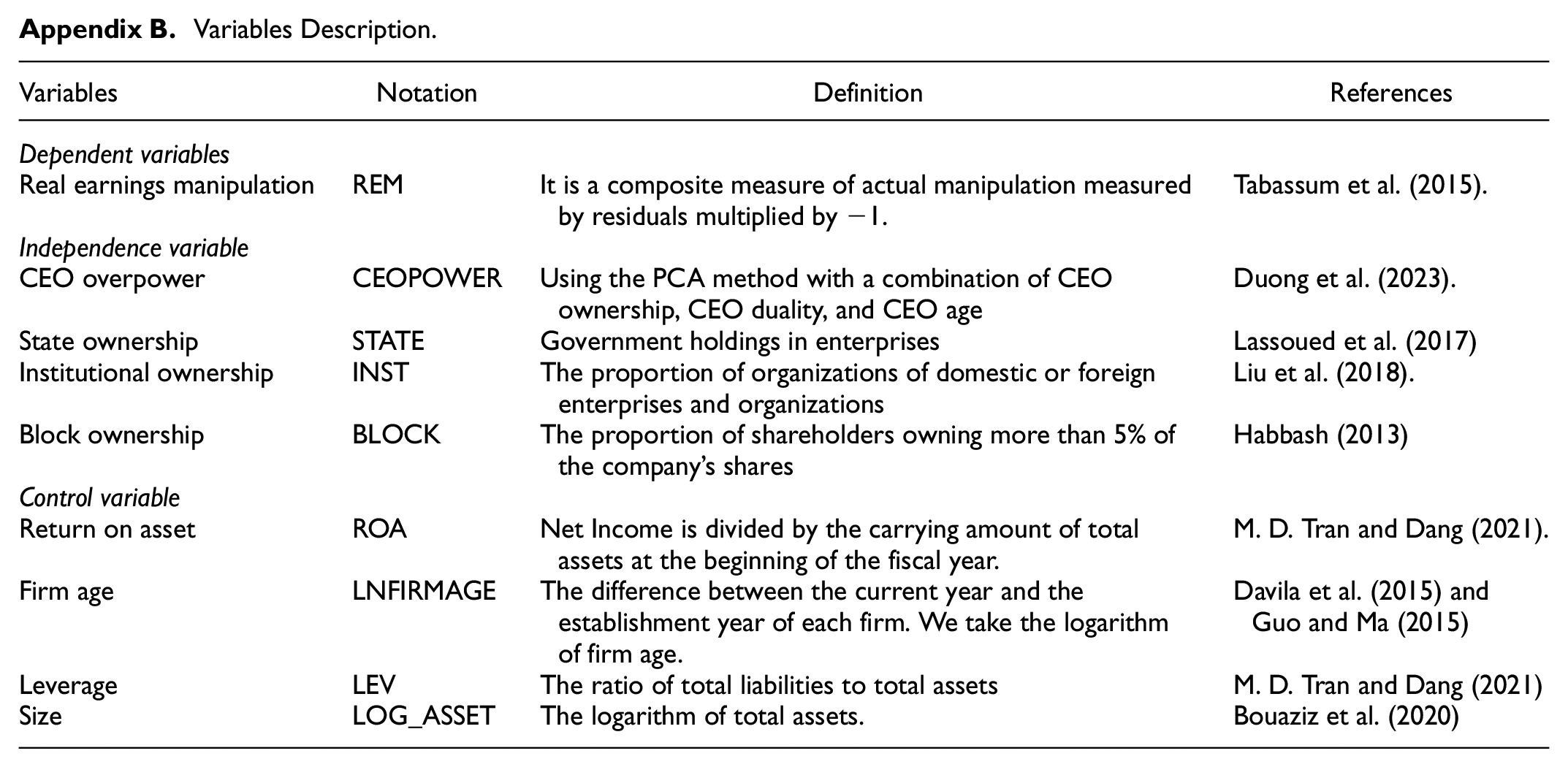
| Variables | Notation | Definition | References |
|---|---|---|---|
| Dependent variables | |||
| Real earnings manipulation | REM | It is a composite measure of actual manipulation measured by residuals multiplied by −1. | Tabassum et al. (2015). |
| Independence variable | |||
| CEO overpower | CEOPOWER | Using the PCA method with a combination of CEO ownership, CEO duality, and CEO age | Duong et al. (2023). |
| State ownership | STATE | Government holdings in enterprises | Lassoued et al. (2017) |
| Institutional ownership | INST | The proportion of organizations of domestic or foreign enterprises and organizations | Liu et al. (2018). |
| Block ownership | BLOCK | The proportion of shareholders owning more than 5% of the company’s shares | Habbash (2013) |
| Control variable | |||
| Return on asset | ROA | Net Income is divided by the carrying amount of total assets at the beginning of the fiscal year. | M. D. Tran and Dang (2021). |
| Firm age | LNFIRMAGE | The difference between the current year and the establishment year of each firm. We take the logarithm of firm age. | Davila et al. (2015) and Guo and Ma (2015) |
| Leverage | LEV | The ratio of total liabilities to total assets | M. D. Tran and Dang (2021) |
| Size | LOG_ASSET | The logarithm of total assets. | Bouaziz et al. (2020) |
Acknowledgements
We also thank anonymous reviewers for their constructive feedback, which helps us revise our manuscript. This work was supported by Ton Duc Thang University, Van Lang University, and Ho Chi Minh City Open University.
Author Contribution Statement
Khoa Dang Duong (
Declaration of Conflicting Interests
The author(s) declared no potential conflicts of interest with respect to the research, authorship, and/or publication of this article.
Funding
The author(s) received no financial support for the research, authorship, and/or publication of this article.
Ethical Approval
This study does not involve animals or humans.

Data Availability Statement
Data sharing not applicable to this article as no datasets were generated or analyzed during the current study.