



Abstract
Knowledge, Attitudes, and Practices (KAP) studies offer valuable insights into the socio-cultural, psychological, and behavioral determinants of nutrition. This study aims to assess nutrition KAP during pregnancy and lactation in selected areas of Adilabad and Kumaram Bheem Asifabad districts, Telangana, India. A cross-sectional KAP survey was conducted on 536 individuals from February to March 2020, employing tablet-based data collection for pregnant women, lactating mothers, young mothers, and frontline staff. Departing from the standard equal-weight approach, we assigned different weights to responses based on existing literature and stakeholder consultation, acknowledging the varying significance of each response. This novel approach aims to mitigate the risk of overestimating or underestimating factors, thereby designing more effective policy interventions tailored to societal complexities. The results reveal that regarding the three micronutrients (Iron, vitamin A, and Iodine), the knowledge levels of pregnant women, lactating mothers, and young mothers were low, that is, less than 50% when compared with the functionaries/frontline staff. Pregnant women scored low on attitudes regarding micronutrients compared to lactating mothers, young mothers, and functionaries/frontline staff. Attitudes translate into practices; however, the data revealed that pregnant women, lactating mothers, and young mothers were not adopting appropriate dietary and nutrition practices except for the micronutrient iodine. The inadequate knowledge of all categories of respondents indicates a gap in nutrition literacy and education. The results point to the urgent need for policy action for nutrition education interventions among the vulnerable population.
Introduction
Malnutrition remains a pressing global challenge. The scant progress that has been made toward eradicating it has been slow and unequal. Significant barriers hold back millions of people from healthy diets and lives today. Globally, one in nine people is hungry or undernourished and one in three overweight or obese. A new analysis shows that global and national patterns hide inequalities within countries and communities, with vulnerable groups most affected (Mannar et al., 2020). In some of the poorest countries, underweight prevalence is up to 10 times higher than the wealthiest countries. Poor diets resulting in malnutrition are more because of lack of access, affordability of a healthy diet and lack of nutrition awareness rather than personal choice. Therefore, investing in nutrition, especially in the most affected communities, is recommended (Mannar et al., 2020; Weerasekara et al., 2020).
The significance of nutrition and agriculture in the context of the Sustainable Development Goals arises from a heightened acknowledgment of the far-reaching implications of malnutrition and an escalating commitment to both identify and amplify evidence-based strategies aimed at tackling this urgent issue. The inception of the Scaling Up Nutrition (SUN) movement in 2009 marked the commencement of a united initiative involving governments, civil societies, and other entities, all aimed at prioritizing and addressing nutritional concerns. Pregnant and lactating mothers are particularly at risk, especially in developing nations as there is an increased need for nutrients. Therefore, knowledge of required nutrients and their consumption is essential during that period (Gopalan et al., 1989). The diets of pregnant and lactating women in India often lack adequate levels of various essential nutrients. It was also observed that the nutrient and dietary intake of pregnant women and lactating mothers is deficient compared to the Recommended Dietary Allowances (RDA, 2009). Another concern is the absence of evidence on the nutritional outcomes of indigenous communities across the country. However, the National Nutrition Monitoring Bureau (NNMB) report on the indigenous population provides information on select nutrition indicators for only nine states of India (Laxmaiah et al., 2014).
Programs that aim to increase nutritional knowledge have positive results on nutritional status (Bamji et al., 2021; Buckner, Carter, Ahankari, et al., 2021; Buckner, Carter, Crocombe, et al., 2021; Chaluvaraj & Satyanarayana, 2018; Kamalaja et al., 2018; Kshirsagar & Mohite, 2019; S. Maiti et al., 2011; Murty et al., 2016; Singh et al., 2019). Surveys on Knowledge, Attitudes, and Practices (KAP) expose misconceptions or misunderstandings that could hinder the implementation of desired activities and serve as potential obstacles to promoting behavior change. The KAP survey is instrumental in health and nutrition-related research (Canavan et al., 2016; Devadas, 2002; Edith & Priya, 2016; A. Maiti et al., 2015; Ramadasmurthy et al., 1992; Sangra & Nowreen, 2019). The information generated in the KAP survey helps assess the targeted communities’ knowledge, attitude and practices for particular health-related aspects or deficiencies; the data can be utilized for designing and developing effective interventions (T. P. Kaur et al., 2021; Moitra et al., 2021; Mutalik & Raje, 2017). Except for the KAP tool developed by the Food and Agricultural Organization (FAO) (Marías & Glasauer, 2014), there is very little evidence available on validated and commonly used tools used in nutrition interventions to measure nutrition knowledge among different age groups and genders in developing countries. Recent studies (Huong et al., 2023; Ishak et al., 2022; Islam et al., 2023; Straughan & Xu, 2022; Wang et al., 2023) have initiated the use of KAP tools while undertaking the interventions.
In low-income countries, lactating mothers are typically considered nutritionally vulnerable as they face nutritional stress because of the lactation process. The increased risks of high maternal mortality are often due to frequent pregnancies followed by lactation. In India, there is a significant challenge of diseases that often evolve from nutritional deficiencies (Gopalan, 2013). In this context, understanding nutrition among pregnant, lactating, and young mothers (with children under five years old) is crucial for keeping both their own and their children’s nutrition in good condition. This knowledge also safeguards their nutritional requirements, laying a solid groundwork for a healthy society and a prosperous future (NNMB, 2009, 2012). Pregnant women and lactating mothers need to be made more aware of their own dietary needs and that of their children, especially about micronutrients and other healthcare practices, and this will go a long way in reducing the severity of malnutrition (Gavaravarapu et al., 2017; Radhakrishna & Ravi, 2004). Evidence-based knowledge/awareness levels on nutrition and dietary practices are crucial in improving nutritional outcomes. Therefore, a standard evidence base is also essential for solving malnutrition because it provides the much-needed empirical basis for most public policy analyses. However, the standard measurement of KAP methodology considered assigning same scores or weights to the responses to the question asked can overestimate or underestimate the response which may affect the overall policy decisions.
Accordingly, the primary aim of this study is the two fold, the firstly to assign weights to the responses based on the literature, and the secondly to use the KAP scores to understand nutrition awareness in indigenous communities, especially among the vulnerable population comprising pregnant women, lactating mothers, and young mothers and compare it with the FAO standards for providing evidence-based decision making.
Continuing from this brief introduction, the subsequent section delineates the study’s methodology, followed by a subsequent section presenting the results and engaging in discussion. The final section encapsulates the conclusions drawn.
Material and Methods
Sample
Data was collected from indigenous households in Mohindagudipeta, Rambaiguda, Chinnereddypalli, and Rajaguda villages of Tiryani Mandal in Kumaram Bheem-Asifabad district and Chanduri, Kamaipet, Kommuguda, and Mathadiguda villages of Utnoor mandal in Adilabad district of Telangana, India (Figure 1).

Location of the sample selected for study in India.
A purposeful sample included 282 individuals from three different groups of the indigenous communities including pregnant women, lactating mothers (mothers with children below one year of age), and young mothers (mothers with children below five years of age). The other purposeful sample of 254 individuals included functionaries/frontline staff [school teachers, Anganwadi and Accredited Social Health Activist(ASHA) staff]. The total sample comprised 536 individuals.
Questionnaire/Survey Instrument
KAP survey instrument was administered seeking information at the household level and at the individual level to understand their knowledge, attitude and practices to general nutrition and especially to iron, iodine, and vitamin A deficiency, using digital tools. The survey was conducted in a face-to-face interview style, which took about 20 to 25 min to complete by the trained field staff with the participants. The present study includes the KAP data on awareness of three micronutrients (iron, iodine, and vitamin A) deficiencies amongst the vulnerable population (pregnant women, lactating mothers, and young mothers) of the indigenous community as well as functionaries/frontline staff (school teachers, Anganwadi and ASHA staff) responsible directly or indirectly for the nutritional welfare of the vulnerable population.
Methods
Data Collection
The KAP survey is a quantitative approach involving predetermined questions presented in standardized questionnaires. This method offers a means to gather both quantitative and qualitative information.
It’s important to note that a KAP survey primarily captures opinions and declarations, recording statements made by individuals. Although it provides insights into what was expressed, there can be significant disparities between words and actions (Contento, 2015). The survey instrument for the present study was an adapted version of a previously validated questionnaire of FAO (Marías & Glasauer, 2014). The current study focuses on individual-level modules, which comprise the three micronutrient deficiencies-iron, vitamin A, and iodine.
Assigning Weights to KAP Scores and Analysis
Standard KAP analysis considers equal weightage for every response to each question, but this equal weightage overestimates the score. Therefore, we have used different weights for different responses based on the existing literature and stakeholder consultation supporting the weightage for general nutrition awareness for pregnant women and lactating mothers and nutrition KAP, including pregnant women, lactating mothers, young mothers and frontline staff (Supplemental Appendix Tables A1 and A2).
The analysis of these questions on specific micronutrients was done based on the scalar-scoring method, but different weights were used for the scoring depending on the significance of the responses. In the KAP analysis, we had two types of question-answer formats (Table 1). Type I (question) was if the responses to the KAP question were direct (Yes or No) and the scoring was Yes = 1 and No = 0. Type II (question) was if the responses to the KAP question were multiple, then the weightage distribution among the options was per literature and the relevant stakeholder consultation. To generate the score for the responses, the distributed weights were added (score) for various options selected by the respondent. Here, the sum of the total weightage of the scores. After assigning the score for each question, we added this score to get the KAP score for each individual.
Example of Comparison of the Standard Scoring Versus the Author’s Scoring.

Source. Author’s calculations.
For Type I both standard scoring and our scoring are the same. In Type II questions, the scoring departed from the standard procedure, instead basing the assignment of weights on the significance of options as suggested in existing literature and stakeholder consultation. 1 This approach enhances internal consistency reliability by ensuring scoring consistency across respondents and aligning with the study’s objectives. Furthermore, the consultative process with stakeholders suggests a likely promotion of inter-rater reliability, as it cultivates agreement among scorers regarding the importance of response options. While not directly assessed, the reliance on literature and stakeholder input implies stability in the scoring approach over time, supporting the likelihood of consistent results upon repeated administrations of the questionnaire and contributing to the study’s overall reliability. Moreover, the consultative process with stakeholders not only strengthened content validity but also promoted the construct validity of the scoring methodology by ensuring that the assigned weights accurately reflected the perceived importance of response options. In case, the respondent chose the first two options, the individual score would be 0.66 as per the standard method of assignment of weights. However, if the weightage was based on of scoring method, it was 0.50 (details in the supplementary appendix material: Scoring and weightage of responses). In the existing methods where, equal weight is assigned to all options, there exists a risk of either overestimating or underestimating certain factors, potentially leading to ineffective policy interventions. By assigning weights to different options, we attribute importance to each, thereby reflecting their varying significance and influencing behavior accordingly. This approach aids in designing more effective policy interventions that accurately address the complexities of societal issues.
In addition, the KAP responses were compared against the threshold levels and classified according to the FAO guidelines (Table 2) to prioritize the nutrition education intervention strategy.
Suggested Threshold Levels Indicating the Need for Nutrition-Education Intervention.

Source. Adapted from FAO (Marías & Glasauer, 2014).
These threshold levels indicate whether an intervention is required or not in a particular community and therefore is very crucial to be included in the pre-intervention studies especially focusing on enhancing the knowledge of communities.
Results and Discussion
During February to March 2020, a cross-sectional KAP baseline survey was executed across chosen areas, involving 536 participants. The survey was exclusively carried out among pregnant women, young mothers, lactating mothers, as well as frontline personnel such as School teachers, Anganwadi, and ASHA staff. The primary objective was to assess the extent of nutrition awareness within the specified sample group.
Understanding the Nutrition Knowledge, Attitudes, and Practices of Pregnant Women, Lactating Mothers, and Frontline Staff
Knowledge levels of mothers have an important role in maintaining maternal and child nutritional status. Adequate knowledge regarding various aspects of nutrition and dietary intake during pregnancy and lactation is essential for women as they influence the nutritional outcomes of their newborn babies. However, our data analysis revealed that the nutrition knowledge among pregnant and lactating mothers was deficient, registering at less than 50% across all participants, as shown in Table 3. Pregnant women achieved the lowest scores in terms of knowledge and attitudes, while young mothers demonstrated the lowest scores in terms of implementing healthy dietary practices, in contrast to frontline staff.
KAP Scores (Percentage) on the Nutrition of the Selected Sample.

These results line with the findings from the existing literature like the study by Sachdev et al. (2020) which highlights that 49% of tribal women lack knowledge about nutrition in Maharashtra, India. Many women in this group are unaware of malnutrition’s impact on child development and lack the perseverance to address related issues. Similarly, Priyadarshini’s (2023) study on nutrition in indigenous adolescent girls found that 41.2% had average knowledge and 58.8% had poor nutritional knowledge.
Awareness of Deficiencies of Micronutrients
Knowledge about micronutrients exerts a strong influence on enhancing nutritional status, as it can encourage positive dietary attitudes and behaviors, ultimately leading to improved overall nutrition and well-being. The respondents were asked whether they were aware of nutrients and their deficiencies to understand their level of awareness. Especially the focus was on the awareness of the three most essential micronutrients, that is, iron, vitamin A and iodine (Table 4). These micronutrients are critical for both women and children they affect physical and mental development. Our study revealed that among the respondents, the least aware were young mothers (8.43%), pregnant women (8.57%) and lactating mothers (14.49%) and the highest awareness was among the functionaries/frontline staff (schoolteachers, Anganwadi and ASHA staff) in comparison to the vulnerable group. These low scores indicate a need for more awareness about the significant micronutrients that can eradicate several deficiency disorders. In various studies, similar findings emerge regarding knowledge and practices related to nutrition and child health. Shettigar et al. (2013) found that 54% of mothers had poor knowledge of under-five nutritional issues, with only 8% demonstrating good understanding. Similarly, Vakilna et al. (2018) noted inadequate awareness among Anganwadi workers in Gujarat regarding growth monitoring, preschool education, and nutrition and health counseling. However, Mahanta et al. (2015) examined frontline workers in Assam, reporting that 72% had good overall KAP status, particularly in maternal and child health components. Overall, the sample is much more aware of anemia or iron-deficiency anemia compared to the other two deficiencies.
Awareness of the Micronutrient Deficiencies (in Percentage) Among the Target Groups.

Source. Author’s calculations.
KAP Scores of Micronutrient Awareness Among the Vulnerable Group and the Functionaries
Apart from the basic question on awareness of the three deficiencies (Table 4), the respondents were subjected to several detailed questions on the KAP of the three micronutrients—Iron, Vitamin A, and Iodine, and their respective KAP scores have been detailed in Table 5.
KAP Scores of the Selected Micronutrients.

Source. Author’s calculations.
Note. The values are given in percentages.
Iron Deficiency
The impact of iron deficiency negatively affects the immune system and increases susceptibility to infections across all age ranges. Consequently, cognitive performance at all life stages can be compromised due to iron deficiency. The primary outcomes of insufficient iron levels encompass anemia, diminished cognitive and physical capabilities, and elevated rates of maternal and child mortality (Dary & Hurrell, 2006).
The knowledge level of iron deficiency anemia among the sample was 41% to 54%, while attitudes and practices were much higher across all the groups. This observation reveals that the knowledge levels are and low even though the strategies to combat iron-deficiency anemia have been in operation for over two decades, and there has been no perceptible biological impact of anemia due to iron deficiency (Vijayaraghavan, 1995; Vijayaraghavan et al., 1990). In the study by M. Kaur and Singh (2001) on rural women of Punjab, India, it was revealed that 73.3% and 46.6% of women in the control group did not know the causes, signs, and symptoms of anemia respectively, thereby indicating low knowledge levels. The attitudes and practices scores were found to be higher than the knowledge scores. The ongoing national iron supplementation program which has been in operation for a long time also did not increase the practice scores beyond 60% to 70%. Based on the results, training on the significance of iron through health and nutrition education improves knowledge levels and practices thereby enhancing the consumption of iron rich/fortified foods or iron supplements.
Vitamin A Deficiency
Vitamin A deficiency commonly develops in environments marked by ecological, social, and economic constraints. Crucial factors that contribute to this deficiency include a diet lacking in vitamin A sources (such as dairy products, eggs, fruits, and vegetables), inadequate nutritional status, and a heightened prevalence of infections, particularly diseases like measles and diarrhea (Dary & Hurrell, 2006).
In this study, KAP scores of vitamin A, the knowledge scores were lowest among the pregnant women and ranged between 21% and 66% across the sample (Table 5). Interestingly, the attitudes and practices scores were much higher compared to the knowledge scores (Konapur et al., 2019). The practice scores (65%–75%) were lower despite the ongoing national vitamin–A supplementation program in the communities. This result reiterates the need for customized training on awareness sessions for enhancing the knowledge levels on Vitamin-A that can lead to better consumption of vitamin-A.
Iodine Deficiency
Iodine deficiency poses a significant public health challenge on a global scale, especially affecting young children and pregnant women. In certain contexts, it can pose a substantial risk to a country’s social and economic progress. The most severe consequence of iodine deficiency is mental retardation, making it a prominent contributor to preventable cognitive impairment worldwide. There were initiatives to control iodine deficiency in India (Pandav & Kochupillai, 1982). It was observed that the vulnerable population did not have any knowledge or attitude toward iodine but were practicing the consumption of iodized salt as it is being provided by the functionaries/frontline staff for consumption (Datta et al., 2018; Mohapatra et al., 2001; Vasudevan et al., 2019). The practice scores were highest among the sample for iodine (as iodized salt packets were provided to the target group through the Public Distribution System) when compared to vitamin A and iron.
It was also observed that the KAP scores for all three micronutrients were higher among the functionaries/frontline staff than the vulnerable group. This might be attributed to the initial education on nutrition provided to the functionaries as a part of their job roles and responsibilities.
Comparison of KAP Scores with the FAO Threshold Levels
The KAP survey is important to evaluate the status of communities on micronutrient awareness before implementing any interventions. This will enable the policymakers to better understand the differences and not advocate one policy for all. In addition, the KAP survey can also act as a baseline, and thereby the improvements can be measured, and mid-course corrections can be taken to enhance nutrition awareness for bringing about sustainable nutrition for all.
As can be observed from Table 6, knowledge scores for iron, vitamin A, and iodine were low, and thereby there is an urgent need for nutrition education intervention across all the groups (Dudala et al., 2021). For the attitude scores, the need for intervention for all the micronutrients was higher among pregnant women, lactating mothers, and young mothers compared to the functionaries such as schoolteachers, Anganwadi, and ASHA staff. As per the classification indicated in Table 2 and the results from Table 6, the need for intervention category “should be considered” was higher for micronutrients iron and vitamin-A followed by the “urgent need” category of intervention across all the groups. In the case of iodine, there is no need for any intervention as iodine consumption is practiced due to the provision of free/or subsidized iodized salt by the government to vulnerable groups.
Percentage of People Under Various Policy-Related Intervention Categories.
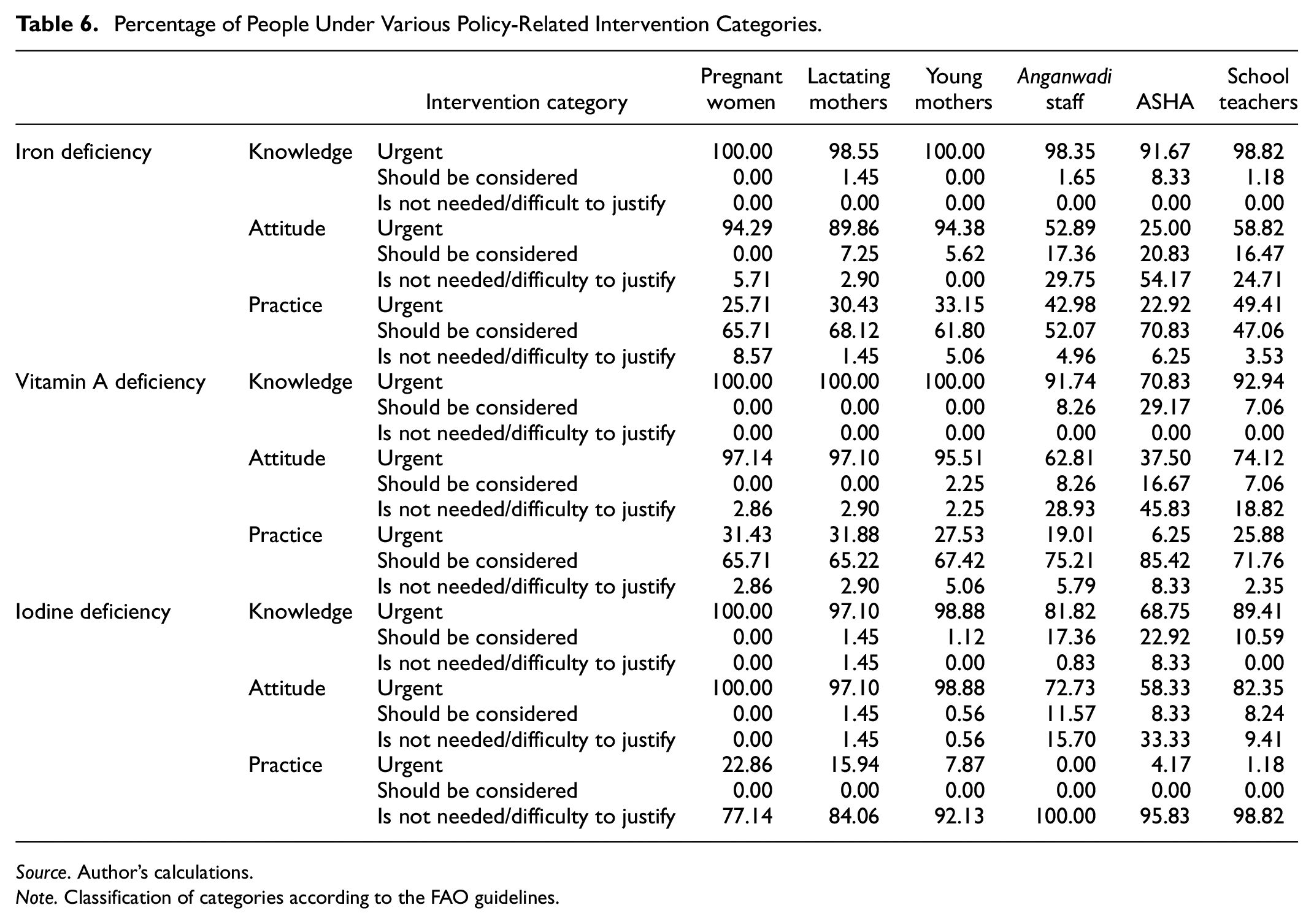
Source. Author’s calculations.
Note. Classification of categories according to the FAO guidelines.
Nutrition education programs endeavor to improve participants’ dietary intake during pregnancy and the lactation period by advocating for a diet balanced in all nutrients. The available evidence indicates that providing nutrition education during pregnancy has a notable influence on the understanding and dietary behaviors of expectant mothers. This, in turn, contributes to enhancing maternal well-being and birth outcomes (Mulliner et al., 1995; Popa et al., 2013; Whitworth & Dowswell, 2009). Also, nutrition education is important for the functionaries as they are the focal points in delivering nutrition products to the communities at the grassroots level.
Our research holds significant implications across various domains, offering valuable insights for practice, research, prevention, and policy.
Our study adds to the evolving literature on KAP methodology calculation. Unlike the standard approach that assigns equal weight to each response, our research incorporates different weights based on existing literature and stakeholder consultation. This departure from equal weighting mitigates the risk of overestimating or underestimating certain factors, which can lead to ineffective policy interventions. By assigning weights to responses, we acknowledge their varying significance, thereby influencing behavior accordingly. This novel approach enhances the design of policy interventions, ensuring they accurately address societal complexities and challenges.
Our study highlights the crucial role of nutrition awareness in promoting healthy and sustainable diets, particularly among vulnerable populations. Implementing targeted educational campaigns and community-based initiatives can empower individuals to make informed choices, positively impacting public health outcomes. Additionally, our findings offer valuable insights for policymakers, who can use them to develop tailored interventions addressing the unique challenges faced by vulnerable communities. This includes the implementation of targeted programs, subsidies, and educational initiatives aimed at fostering sustainable dietary practices and improving overall nutrition outcomes.
One of the principal strengths of our research is its focus on practical implications, offering concrete strategies to bolster nutrition awareness and promote sustainable diets. By specifically targeting vulnerable populations, we address their unique needs and tailor interventions, accordingly, ensuring effectiveness within our study area. Additionally, our incorporation of local context enhances the relevance and applicability of our findings to similar settings, benefiting public health practitioners, policymakers, and researchers alike. Methodological rigor, including robust data collection and analysis procedures, underpins the reliability of our results. Our multidisciplinary approach, drawing insights from nutrition, public health, and social sciences, enriches the comprehensiveness of our study, providing a holistic understanding of the factors shaping dietary practices among vulnerable populations.
However, it is essential to acknowledge the limitations inherent in our research. The regional specificity of our study area may limit the generalizability of findings to other geographical locations, necessitating caution in applying our results to diverse contexts. Additionally, the cross-sectional nature of our study design provides a snapshot of attitudes and practices, but longitudinal research would be needed to establish causation and observe changes over time.
Furthermore, the reliance on self-reported data introduces the possibility of response bias, as participants may provide socially desirable answers or may not accurately recall their dietary practices. Despite efforts to ensure inclusivity, the vulnerability of certain populations may still pose challenges in obtaining a fully representative sample.
Conclusions
The study reveals that the knowledge levels regarding the three micronutrients (Iron, Vitamin A, and Iodine) of pregnant, lactating mothers and young mothers were inadequate, that is, less than 50% compared to the functionaries/frontline staff. Pregnant women exhibited lesser positive attitudes toward micronutrients when compared to lactating mothers, young mothers, and frontline staff. While attitudes usually translate into behaviors, the data revealed that, apart from the micronutrient Iodine, none of the respondent categories were adopting suitable dietary and nutritional practices. The insufficient knowledge across all respondent groups underscores a significant gap in nutrition literacy and education. This assessment brings about the immediate or urgent need for interventions based on nutrition education and behavior change communication. Hence, it is essential to strategize and collaborate on designing innovative methods that involve both planning and creation. These approaches aim to enhance nutrition knowledge through impactful messaging, fostering transformative changes in behaviors related to healthy diets and dietary practices. By adopting a comprehensive community approach, health and nutrition awareness can be enhanced, simultaneously empowering households, particularly women, to make well-informed food decisions that contribute to the well-being of their families. Expanding upon the existing extension system comprised of roles such as school teachers, Anganwadi, and ASHA staff, this approach capitalizes on established structures and reliable community members who possess an understanding of social norms and cultural practices. Incorporating robust evaluation processes could also offer insights for comparable initiatives and contribute to the available evidence. Mobilizing communities to enhance diversity in their diets and increasing micronutrient intake is a serious requirement, necessitating a holistic and integrated approach. The lack of a strong evidence base for KAP should not act as a deterrent to future research; rather, it should inspire a proactive effort to explore and test effective solutions to enhance awareness of diets and micronutrients among communities. The present KAP study identified an urgent need for nutrition education intervention, especially on three essential micronutrients among the vulnerable groups and the functionaries or frontline staff.
Supplemental Material
sj-docx-1-sgo-10.1177_21582440241266695 – Supplemental material for Knowledge, Attitudes, and Practices of Vulnerable Populations for Achieving Sustainable Dietary Practices in India
Supplemental material, sj-docx-1-sgo-10.1177_21582440241266695 for Knowledge, Attitudes, and Practices of Vulnerable Populations for Achieving Sustainable Dietary Practices in India by Padmaja Ravula, Kavitha Kasala and Abhishek Das in SAGE Open
Footnotes
Acknowledgements
The authors would like to acknowledge the support of the field enumerators in collecting the data and also highly appreciate the participation of communities: men and women inhabiting the tribal villages in Utnoor and Tiryani, Telangana, India.
Declaration of Conflicting Interests
The author(s) declared no potential conflicts of interest with respect to the research, authorship, and/or publication of this article.
Funding
The author(s) disclosed receipt of the following financial support for the research, authorship, and/or publication of this article: This research was funded by TIGR2ESS: Transforming India’s Green Revolution by Research and Empowerment for Sustainable Food Supplies. TIGR2ESS is funded by the UK Research and Innovation (UKRI) Global Challenges Research Fund (GCRF) and the Grant Number is BB/P027970/1.
Disclosure
The abstract of this paper was presented at the 6th NNEdPro International Summit on Medical Nutrition Education and Research in the year 2020, as a poster presentation entitled “7 Assessment of nutrition related knowledge, attitudes and practices of pregnant and lactating mothers in the tribal areas of Telangana, India” with interim findings. The poster’s abstract was published in “Poster Abstracts.”BMJ Nutrition, Prevention & Health, 5(Suppl. 1) (2022), A7.  .
.
Institutional Review Board Statement
The study was conducted according to the guidelines of the Declaration of Helsinki and approved by the Internal Research Ethics Committee of the International Crops Research Institute for the Semi-Arid Tropics IEC-ICRISAT/20200602/04 and the date of approval is 06/02/2020.
Informed Consent
All participants in the study provided written informed consent before their involvement.
Data Availability Statement
Data utilized in this study is available upon request.
Supplemental Material
Supplemental material for this article is available online.
Notes
References
Supplementary Material
Please find the following supplemental material available below.
For Open Access articles published under a Creative Commons License, all supplemental material carries the same license as the article it is associated with.
For non-Open Access articles published, all supplemental material carries a non-exclusive license, and permission requests for re-use of supplemental material or any part of supplemental material shall be sent directly to the copyright owner as specified in the copyright notice associated with the article.
