




Abstract
Print media plays a crucial role in information distribution and thus enjoys the mileage of being one of the strongest medium of public information. Media plays an important role in our society as its purpose is not only to inform the public about current and past events, but it also determines what we think and worry about. With more in-depth coverage and investigation, this written form of communication creates a longer influence on the minds of the reader. Theory predicts that information provided by print media reflects the media’s incentives to provide news to different types of groups in society, and affects these groups’ influence in policy making. The article analyses the role played by the print media in creating awareness among the Indian public regarding the paramount sanitation issues. The study will use data produced by the different newspapers pertaining to such issues. It is a well established fact that a good percentage of people in India still have no adequate means of disposing their waste. Poorly controlled waste also means daily exposure to an unpleasant environment. Despite the presence of grand public sanitation schemes, waste management remains to be one of the major problems faced by the people. Content analysis is proved to be instrumental in analyzing the content of the major Indian English dailies. This study used content analysis to unveil how much importance newspapers have been giving to sanitation problems and hygiene-related issues. The findings reveal that newspapers have given an utmost importance to the sanitation policies in India.
Introduction
Mass communication technically refers to the process of transferring or transmitting a message to a large anonymous, heterogeneous audience. The invincible power wielded by the mass media to influence and shape opinions has been widely researched and established. The media is a tool which contributes to the declaration, announcement, and spread of the opinions of various groups in the society by reflecting the opinion within itself and those belonging to the external environments, thus, provides an interaction between the rulers and ruled ones (Girgin, 2001). Media endow with knowledge and news related to basic events necessary for coherent jurisdictions of people. At the same time, it also acts as a forum through securing the admittance to various categories of information which people swap over (O’Neill, 1988).
Media (television, radio, print media, Internet, etc.) plays a significant role in spreading information and raising awareness on sanitation issues. They can help trigger a positive change in public opinion and behavior on a matter of concern. This can lead to public pressure on the local policy actors, so the media can indirectly influence decision makers as well (Peters, n.d.). Media assumes an ever greater role in spreading sensitization about sanitation issues, in the world, in general, and India, in particular. It is incumbent upon the media to shape public debate on sanitation, making the citizens aware and holding the governments accountable.
In the words of Jae So (Water and Sanitation Program, n.d.), the manager of “Water and Sanitation Program” by the World Bank Group’s Water Global Practice,
The news media plays a pivotal role not only to raise awareness and support for the water and sanitation sector, but also in giving a stronger voice to every day citizens and in monitoring commitments made by political leaders. When journalists understand the real challenges behind delivering water and sanitation services to the poor, they help facilitate public dialogue and citizen engagement that focuses on relevant solutions.
With the Indian policy makers taking renewed interest in this area, and the launch of the country’s largest ever drive to improve sanitation, aiming to end open defecation in 5 years, an analysis of the present status of media coverage of sanitation issues becomes important.
The present study focuses on newspaper coverage considering that they continue to be a momentous medium for the transmission of information and determining public opinion. Moreover, newspaper readership trends are particularly significant in the Indian context, because while registering a decline in the West, print circulation continues to increase in Asia. “Circulation is like the sun. It continues to rise in the East and decline in the West” said Christoph Riess, CEO of World Association of Newspapers and News Publishers (WAN-IFRA; Kilman, 2011), while presenting the annual survey at the World Newspaper Congress and World Editors Forum in Vienna, Austria.
Background of the Study
Inadequate discharge of un-treated domestic/municipal wastewater has resulted in contamination of 75% of all surface water across India. More than 37% of the total human excreta generated in urban India is un-safely disposed. The failure to effectively contain and manage human excreta is associated with a wide range of health problems and a large disease burden. As per the “WHO/UNICEF joint monitoring report (2012),” India accounts for 90% of the 692 million people in South Asia who practice open defecation, and has 97 million people without access to improved sources of drinking water, second only to China. Research also reveals that diarrhea kills 25 lakh globally and 6 lakhs in India alone. The figures indicate that there is a serious problem associated with the sanitation issues despite ample policies in action.
Sanitation: Policies and Problems
Sanitation is defined as safe management of human excreta, including its safe confinement treatment, disposal, and associated hygiene-related practices. With an estimated 40% of the global population lacking access to safe sanitation and 15% still defecating in the open, sanitation remains a major public health concern. Although this policy pertains to management of human excreta and associated public health and environmental impacts, it is recognized that integral solutions need to take account of other elements of environmental sanitation, that is, solid waste management, generation of industrial and other specialized/hazardous wastes, drainage, and also the management of drinking water supply.
According to Census 2001, 12.04 million (7.87%) urban households defecate in open as they do not have access to latrines. However, 5.48 million (8.13%) urban households use community latrines and 13.4 million households (19.49%) use shared latrines. A total of 12.47 million (18.5%) households do not have access to a drainage network. In all, 26.83 million (39.8%) households are connected to open drains. The status in respect of the urban poor is even worse. The percentage of notified and non-notified slums without latrines is 17% and 51%, respectively. Ministry of Urban Development, Government of India (n.d.).
The Indian sanitation policy is focused on decentralized solutions instead of a centralized treatment. Under Indian Constitution, sanitation and water supply is a state responsibility. Currently, central government makes policies related to water supply and sanitation. States plan, design, and execute water supply schemes accordingly through their different departments like PHE (public health engineering). This is a well established fact that as such there is no autonomous regulatory agency for the water supply and sanitation sector in India at the state or national level (Anderson & Gugerty, 2010). Both rural and urban sanitation policies are developed independently and are managed by different government departments.
In India, many policies like Integrated Low Cost Sanitation Scheme (ILCS), Mega City Scheme, Integrated Development of Small and Medium Towns (IDSMT), Swachh Bharat Abhiyan (Clean India Campaign), National Urban Sanitation Policy, Accelerated Rural Drinking Water Supply Program (ARWSP), and so on are operational. Despite this, the problems of sanitation have been looming large. There may be numerous other reasons behind the “failure” of sanitation policies. Among them, poor awareness among the people remains to be a burning issue. It is a general belief that sanitation has been accorded low priority and there is poor awareness about its inherent linkages with public health.
A group of journalists writing on water, sanitation, and hygiene (WASH) from South Asia established a regional body called WASH Media-South Asia in 2011. The group consists of both print and broadcasting media personnel from Bangladesh, India, Nepal, Pakistan, and Sri Lanka. The regional network helped to share their stories and coordinate their actions as the members were already actively writing on WASH issues. Such initiatives by media professionals must be followed and encouraged. Media has the power to reach millions of homes at a time; thus, it may play an important role in attaining the desired goals. Media through its powerful message can create awareness regarding different schemes and policies among the citizens. It must give a due consideration to the issues related to water supply, hygiene, and sanitation policies. With an affirmative media presentation, the limitations of such public policies may be vanquished.
Objective
Keeping in consideration the area under study, following objective has been framed for the study:
The study aims to trace out the total coverage and prominence given to the stories related to sanitation by selected Indian English dailies.
Purpose and Significance of the Study
The study aims to analyze the role of print media in highlighting the sanitation policies and issues. With the help of this, we could analyze the importance given by one of the most effective forms of media to such paramount issues. The study would help us to get an idea about the coverage given to these topics. The research may further help us to conclude whether print media is playing a significant role in covering sanitation issues and policies or there is a need of any improvement in the media campaigns. There are dozens of schemes aimed to improve the general quality of life. The goal of such schemes can only be achieved with an affirmative media presentation. The article will help to unearth the real situation about the media’s presentation. The article will provide the path for the full-fledged research on the topic.
Literature Review
Kaliski (2015) concluded through her study that reforms in sanitation are not supposed to be limited to simply construction of toilets, or supply of educational components or welfare programs to create demand. She suggested that there is a need to focus more on proper data collection and monitoring.
A report titled “The Final Frontier” (2014) published in The Economist newspaper states that the problem of open defecation in India cannot be resolved for decades yet, through the mere availability of government-built latrines. The report further highlights that the media, along with the schools, needs to play a crucial role in spreading awareness about the health and economic benefits of using toilets and maintaining hygiene.
A report published by the United Nations University (2010, April 14) quoting UN experts concludes that though India can be called a country wealthy enough considering the fact that around half of its population owns mobile phones, yet about the same number of people do not have access to the basic necessity and dignity of a toilet.
Chennaiaha et al. (2013) in their study found that largely, the water available in the area of study was not fit for drinking purposes. The study also revealed that a lot of emphasis has been laid on setting up and upgrading laboratories at the state and district levels, and on water monitoring through field testing kits. However, there still exist obstructions like lack of awareness, surveillance, monitoring and testing, mitigation measures, non-availability of alternate water sources, and poor hygiene practices. It is imperative to undertake and promote sanitary assessment and community-based water quality monitoring and surveillance at the grassroots level, so as to locate the problem areas and adopt remedial measures thereof.
UNICEF, Food and Agriculture Organization, and South Asia Consortium for Interdisciplinary Water Resources Studies’ (2013) article titled “Water in India: Situation and Prospects” states that according to Indian water policy, resource allocation is to be done by considering the domestic requirements of water first. In practice, however, this is rarely followed provided that many parts of urban and rural India continue to be “un-served” by formal water supply systems.
WASH Media-South Asia (2012) stated that more than 1 billion people in South Asia do not have access to improved sanitation facilities, while around 700 million practice open defecation. The report further remarks that in 2006, as per the figures given by The World Bank, the consequences of inadequate sanitation cost India approximately $53.8 billion, which amounts to 6.4% of its GDP.
Water and Sanitation Program’s (2011) report concluded that inadequate sanitation causes the poor in India to endure considerable adverse bearings on their lives, health, and limited financial resources.
Asian Development Bank’s (2009) report “Water for all” series 18 titled India’s Sanitation for All: How to Make It Happen came out with six recommendations to help key stakeholders overcome the major obstacles in providing universal sanitation coverage in India. The recommendations included scaling up of sanitation programs customized to the needs of the poor, targeting the investments to those who need it the most; exploration of cost-effective methods; application of proper planning and sequencing; adoption of community-based solutions wherever possible; and forging of innovative partnerships to boost investments.
Method
To achieve the objects of this study, following methodology was applied and an attempt was made to analyze the sample in a qualitative and quantitative manner. Content analysis is proved to be instrumental in checking the coverage in terms of variables of frequency and prominence given to the topics under study.
Measures of the Study
As study focuses on newspaper coverage given to the sanitation policies in India, news stories were analyzed using specific units like prominence, total news coverage, and placement, to carry out a qualitative as well as quantitative analysis. Each news story that appeared in a particular newspaper issue is considered as a unit of analysis. The stories were identified on the basis of the presence of certain predetermined keywords related to the topic of the study in the headlines, subheads, and the lead. The types of articles chosen for the study include features, news briefings, and editorials. Letters to the editor, advertorials, and other advertisements were not included in the study.
Sample
As it was not humanly possible to consider all the main English newspapers, a sample of two newspapers—The Hindu and The Times of India—were used. On the basis of their readership and widespread appeal, the aforementioned newspapers were selected for the study. The newspaper editions present in the Maulana Azad Library, Aligarh Muslim University, Aligrah, India, were studied.
The Hindu
The Hindu is an Indian English-language daily newspaper founded in Madras on September 20, 1878, as a weekly by four law students. The Hindu was one of the many newspapers of the period established to protest against the discriminatory policies of the British government in India. It is considered as one Indian newspaper that has international standards to its credit. According to the Audit Bureau of Circulations (ABC), it has a circulation of 1.46 million copies. According to the 2011 Indian Readership Survey (IRS; Department of Communication & Journalism, University of Pune, n.d.), The Hindu is the third most widely read English newspaper in India with a readership of 2.0 million people.
The Times of India
The Times of India is an Indian English-language daily newspaper owned and published by Bennett, Coleman & Co. Ltd. According to ABC, it is largest selling English-language daily in India. According to the 2012 IRS (Department of Communication & Journalism, University of Pune, n.d.), The Times of India is the most widely read English newspaper in India with a readership of 7.643 million.
Time Period
Through purposive sampling technique, a sample of The Hindu and The Times of India newspapers from October 1st to October 31st, 2014, was selected for the study. This time was given preference on the basis of re-launch of Nirmal Bharat Abhiyan campaign as Swachh Bharat Abhiyan. Analyzing newspapers during this time would help to get an idea about the role played by the media in highlighting public schemes at large. Out of 62, a total of 60 issues were content analyzed. The issues of 2nd and 23rd of October, 2014, of The Hindu were not available.
Result and Data Interpretation
Total Coverage
The tables below have documented the coverage that has been provided by The Hindu and The Times of India. The data were reviewed to find out the number of stories that have been published during the mentioned time period. The first and foremost difference in the content analysis was there were only 29 stories published in 31 issues of The Times of India newspaper and 40 stories published in 29 issues of The Hindu. Stories include news stories, editorials, and columns. Letters to the editor and advertisements were not included in the study.
Placement
Stories are also categorized on the basis of news value. Stories possessing high news value are given more importance and are placed on important pages (front page). Placement of the stories is another aspect to grab attention of the readers toward particular write up. Placements of these stories in the newspapers (The Times of India and The Hindu) clearly highlight the approach of the newspapers toward the issue.

Page-wise coverage distribution by The Hindu.
Table 1 shows total number of stories related to sanitation policies and issues published by The Hindu during this month.
Total Coverage by The Hindu.
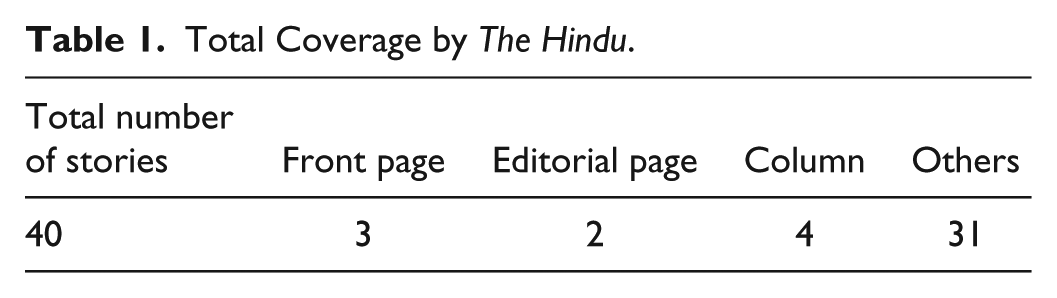
Table 2 shows total number of stories related to sanitation policies and issues published by The Times of India in one month.
Total Coverage by The Times of India.

Table 3 shows total number of stories related to sanitation policies and issues published by both The Hindu and The Times of India in one month.
Comparing The Hindu With The Times of India.

The graph above highlights the difference in coverage provided by the two dailies in the course of time under study.
Conclusion
The content analysis reveals that the number of stories related to sanitation policies and issues published by The Hindu is higher than that of the stories published by The Times of India. The Hindu has published 40 stories in 29 issues whereas The Times of India has published 29 stories in 31 issues related to sanitation policies and issues. The sifting of the newspapers further revealed that the majority of the stories were related to Swachh Bharat Abhiyan. The stories published mostly were reactions to the Swachh Bharat Abhiyan of different prominent personalities like Sachin Tendulkar, Aamir Khan, Shashi Tharoor, and other political figures. Except few stories related to toilet issues, other sanitation issues have not been given a due consideration by these newspapers during the time mentioned. With the findings of the study, it can be asserted that both the newspapers have extensively covered the event of Swachh Bharat Abhiyan and have tried to aware people about this campaign. Furthermore, the coverage given to the event clearly highlights the approach of the newspapers toward the issue. But, newspapers have not provided much space to other burning topics of the same issue during the course of time under study.

Page-wise coverage by The Times of India.

Comparison of coverage provided by The Hindu and The Times of India.
Furthermore, the comparative analysis of the two newspapers shows that there is a large gap in the number of stories published by both the national newspapers. Although The Times of India has published four stories on the front page as against The Hindu’s three, the word count of majority of these stories published by The Times of India is very small. Both The Times of India and The Hindu have dedicated two editorials, each to this sanitation scheme.
The findings reveal that out of the total coverage, The Hindu has provided 7.5% space to the stories on the front page as against The Times of India’s 14%. The coverage provided to the editorials by The Hindu is 5% as against The Times of India’s 7%. Both the newspapers score equal percentage (10%) when it comes to number of columns. In total, coverage provided by the The Hindu to news stories published on other pages (except Front, Edit, and Column page) is 77.5% as against 69% by The Times of India. With the findings of the study, it may be well established that print media has been playing an important role in covering the sanitation schemes and issues.
Limitations and Implications of the Study
The study was limited to only two newspapers. It was not possible for the researcher to include all the issues of the newspaper.
There are concerns regarding the external validity of the research.
The study may be used as a source by the policy makers in media to redefine their editorial policies.
The study may be further explored to get a bigger picture of the issue.
Footnotes
Declaration of Conflicting Interests
The author declared no potential conflicts of interest with respect to the research, authorship, and/or publication of this article.
Funding
The author received no financial support for the research and/or authorship of this article.