




Abstract
Studies show that awe can predict prosocial behaviors. However, the effects of awe on green consumption or its underlying mechanisms remain unclear. Awe promotes the small self that can promote connectedness to nature (CNS). Emotion regulation strategies can modify the effects of emotions on behavior. Therefore, this study investigated the moderating effects of emotion regulation strategies (emotion reappraisal and suppression) and the multi-step mediating effects of the small self and CNS on awe’s impact on consumers’ green purchasing intentions. Through four experiments, the study showed that (a) awe positively impacts consumers’ green purchasing intentions; (b) the small self and CNS play a multi-step mediating role in awe’s positive effect on green purchasing intention; (c) emotion reappraisal moderates awe’s favorable influence on green purchase intentions; and (d) apart from positive awe, negative and unnatural awe also influence green purchasing intention positively. This research has practical implications for companies’ green marketing strategies.
Plain language summary
Human production and consumption destroy the natural environment. The continued destruction of the natural environment will eventually threaten the survival of human beings. In order to reverse the trend of ecological deterioration, we must change our consumption patterns. Many companies have introduced green products in the market. However, because green products are of poorer quality or more expensive compared to ordinary products, they are not always popular in the market. Green consumption is clearly a moral behavior, so priming moral emotions can promote green consumption. Awe is a typical moral emotion. Awe occurs when we are confronted with a magnificent landscape in nature or a natural disaster. This paper verifies that priming awe can promote green consumption through questionnaires and experiments. On this basis, we found the psychological mechanism of awe promoting green consumption. The awe that arises when people are confronted with a huge natural landscape or a natural disaster makes them realize their insignificance and enhances their connection with nature. This ultimately leads to an increased willingness to consume green. In order to avoid embarrassment, we consciously regulate our emotional responses in our daily lives in order to experience more authentic emotions or to make socially acceptable emotional responses. Emotional regulation strategies include reappraisal and suppression strategies. In this paper, we propose and verify that emotion reappraisal strategies can reinforce the positive effects of awe on green purchasing intentions. The findings of this paper have strong implications for our better use of awe to promote green consumption.
Introduction
Green products refer to products that can reduce the development of natural resources, use fewer toxic substances, discharge less pollutants, and have lower waste levels during the production process (Amatulli et al., 2019). Because green products are typically more expensive than conventional products or perform poorly, buyers frequently sense a conflict between self-interest and public interest when purchasing them (Chuang et al., 2016). Therefore, the realization of green consumption has attracted considerable research attention.
Emotions have a greater influence on purchasing decisions than price or consumer taste do (Jiang et al., 2014). People’s expectations of emotional experiences, such as pleasure or pain, among others, affect their decision expectations; the inner emotions experienced during decision-making affect their judgment, and emotions evoked from one’s experiences or memories influence consumer decisions (Ibanez et al., 2017). Furthermore, emotions play an important role in the formation of consumers’ pro-environmental behavior. There are three types of environmentally friendly emotions that are considered moral: connectedness to nature (CNS) and ecological fear (Kao & Du, 2020). Using moral emotion in green marketing is expected to promote consumers’ green purchase intention.
Awe occurs when people perceive great stimuli (natural wonders, panoramic views, and beautiful art) that defy their accustomed frame of reference; awe can significantly reduce the individual’s self-concern and increase their prosocial behaviors (Piff et al., 2015). The experience of awe can potentially enhance an individual’s “small self.” Individuals exhibiting a heightened degree of trait awe tend to exhibit a decreased likelihood of self-identifying as “unique” or “special.” Instead, they place greater emphasis on their membership within a broader category (Shiota et al., 2007), which can undoubtedly increase the connection between individuals and society (Van Cappellen & Saroglou, 2012). Existing studies have shown a close relationship between awe and individual prosocial behaviors. Awe predicted greater generosity, moral decision-making, and prosocial helping behavior among individuals (Piff et al., 2015; Rudd et al., 2012). However, existing research has primarily concentrated on prosocial behaviors associated with temporal contributions, thereby warranting further investigation into the impact of awe on prosocial behaviors linked to monetary donations, such as socially responsible consumption (Ye et al., 2018).
Does awe predict green purchasing intentions? What are the mediating mechanisms and boundary conditions for the influence of awe on green purchasing intentions? Do trait and state awe have the same effects on green purchasing intentions? Can awe predict green purchasing intentions under different conditions? Addressing to the aforementioned questions may potentially support research on the correlation between awe and prosocial consumer behavior. CNS can promote pro-environmental behavior (L. Martin et al., 2020), and these two variables are highly correlated (Mackay & Schmitt, 2019). The small self that is induced by awe reduces self-awareness and enhances the prosocial values of individuals (Piff et al., 2015). Emotions that promote social connectedness can also stimulate the CNS (Moreton et al., 2019). Reducing self-awareness can enhance people’s CNS (Frantz et al., 2005). Therefore, the small self and CNS play a multi-step mediation role in the influence of awe on consumers’ green purchasing intentions.
When people feel the need to change their emotional response to their experiences, they tend to engage in emotional regulation, including dampening, intensifying, or maintaining their emotions (Balaji et al., 2017). For instance, individuals may adopt emotional reappraisal strategies, including situation selection, situation modification, attention deployment, and cognitive change, which can increase or weaken negative emotional experiences and their influence (Gross, 1998). Alternatively, they may adopt an emotion suppression strategy that focuses on the outcome, mainly restraining emotional response and modifying their behavior (Gross, 1998). Emotional reappraisal strategies would augment the favorable impact of awe on consumers’ intentions to purchase green products, whereas emotional suppression would diminishes the positive impact of awe on consumers’ intentions to purchase green products. Therefore, emotion-regulation strategies moderate the effect of awe by positively affecting consumers’ green purchase intentions. Nevertheless, the mediating effect of the small self and CNS and the moderating effect of emotion regulation strategies are theoretical and need to be tested empirically. Therefore, this study verifies the positive effects of awe on green purchasing intention, the multi-step mediating role of the small self and CNS, and the moderating role of emotion regulation strategies by conducting four experiments.
Literature Review
Role of Awe
Awe stems from an individual’s perception of vastness and the need to accommodate it. Vastness reflects physical magnitude, including loud sounds, shifting ground, and huge symbolic signs, or social factors such as fame, reputation, and prestige (Keltner & Haidt, 2003). The need for accommodation is based on the urge to challenge or deny existing cognitive structures, when people are unable to comprehend the magnitude or vastness of something, which compels individuals to change their cognitive structures to comprehend what is in front of them (Keltner & Haidt, 2003).
Awe has many positive effects; it promotes green consumption (Wang et al., 2019), makes individuals more spiritual (Saroglou et al., 2008), induces a sense of oneness with the world (Shiota et al., 2007), increases their perception of time availability (Rudd et al., 2012), shifts their preference from material goods to experiences, and increases their life satisfaction (Rudd et al., 2012). Furthermore, it increases their proclivity to perceive occurrences as the result of intentional and purposeful agents (Valdesolo & Graham, 2014), makes them more generous and prosocial (Piff et al., 2015), increases their perception of freezing (Joye & Dewitte, 2016), decreases aggression (Yang et al., 2016), reduces territoriality (Wang, Geng, & Rodríguez Casallas, 2022), enhances sharing intention (Wang, Zhang, Chen, et al., 2022), and promotes pro-environmental behaviors (Qi et al., 2018; Sun et al., 2020).
Experiencing moral and self-transcendent emotions enables individuals to shift their attention from themselves to others’ needs and concerns, thus promoting cooperation, group stability, prosocial behaviors (Keltner & Haidt, 2003; Stellar et al., 2017), and pro-environmental behaviors (Ibanez et al., 2017). In contrast to moral emotions, such as compassion, gratitude, admiration, moral elevation, and love, awe is unique in that it emphasizes the idea of superiority outside oneself, which leads to self-diminishing rather than self-focused and self-enhancing behaviors (Shiota et al., 2007). Green consumption is associated with moral issues (Wu & Yang, 2018) and reflects an individual’s concern for the welfare of others and the welfare of nature (Griskevicius, Shiota, & Nowlis, 2010). Awe reflects people’s self-transcendence values, thus promoting green consumption (Yan et al., 2023). Therefore, awe can promote consumers’ green purchasing intention.
Small Self
Awe affects individual behavior by making individuals have a sense of the small self. The small self refers to the sense of smallness, including diminished self-awareness, diminished self-conscious emotions, and the insignificance of self-related goals (Piff et al., 2015), felt by the self in the face of an awe-inspiring experience (Weger & Wagemann, 2021). Existing research indicates that a small self mediates the influence of awe on prosocial behaviors and aggression reduction (Piff et al., 2015; Yang et al., 2016). Green consumption can be interpreted as proactive altruistic behavior, because green products cost more than traditional products and deliver a message that they are beneficial to the environment (Griskevicius, Tybur, & Van den Bergh, 2010). Thus, the experience of awe favorably impacts the purchase behavior of consumers toward eco-friendly products based on the notion of the small self.
CNS can be understood as “the degree to which a person feels that he or she is part of nature” (Wesley Schultz, 2001). It is an individual’s experience and emotional connection with nature (Mayer & Frantz, 2004). CNS differs from people’s general feelings about nature as it encompasses an individual’s appreciation and understanding of the interconnectedness between human beings and all other living things on Earth. CNS also differs from environmentalism because it involves not only a love of the pleasurable aspects of nature but also an appreciation for creatures that are repulsive to humans (such as spiders and snakes; Nisbet et al., 2009).
CNS can have many positive effects on individuals, including making people happier (L. Martin et al., 2020) and promoting pro-environmental behaviors such as green purchasing (Dong et al., 2020) and recycling (Dong et al., 2020; L. Martin et al., 2020).
Both awe and having a small self (Liu et al., 2023; Wang, Zhang, Chen, et al., 2022) can enable consumers to experience moral elevation (Keltner & Haidt, 2003), which can promote CNS (Moreton et al., 2019). CNS can promote pro-environmental behaviors (L. Martin et al., 2020), and the connection between CNS and pro-environmental behavior is very close (Mackay & Schmitt, 2019). This is because stronger (weaker) CNS are associated with stronger (weaker) biosphere values that promote sustainable consumption behaviors (C. Martin & Czellar, 2017). Therefore, the small self can enhance CNS, thereby promoting green consumption.
Emotion Regulation Strategies
Emotional regulation involves the management of the onset, persistence, and alteration of emotional experiences by individuals through a set of involuntary or voluntary mechanisms (Webb et al., 2012). For instance, suppressing laughter when witnessing another person’s misfortune, attempting to contextualize disturbing sequences in a film, remaining calm when provoked, and displaying enthusiasm for business opportunities are some examples of coping mechanisms (Webb et al., 2012). Emotion regulation is such a common everyday psychological phenomenon that people pay attention to it only when they feel dysregulated (Gross, 1998).
Emotion regulation includes reappraisal and suppression strategies. A situation encountered by an individual does not generate emotion in itself; rather, emotion arises from the individual’s assessment of the situation. Therefore, a reappraisal strategy involves an individual adjusting their emotions by changing their assessment of the situation (Gross, 1999). Suppression of an individual’s self-expression of emotions can weaken the impact of the emotional experience (Gross & Levenson, 1997). The reappraisal strategy occurs at the early stage of an individual’s response to a situation and intervenes before the emotion is fully generated. Therefore, the reappraisal strategy can enable individuals to show their true emotions (Balaji et al., 2017). In contrast, the suppression strategy is a “surface acting” in which individuals can show more emotion than they experience or suppress real emotion and show acceptable expressions (Grandey, 2000). Therefore, a reappraisal strategy can help individuals perceive the situation and increase their positive emotions and effects. Suppression strategies can reduce negative emotions or change external behavior, but they cannot affect emotional states. Existing studies have found that reappraisal strategies can strengthen positive emotions and their influence while weakening negative emotions and their influence (Balaji et al., 2017; Li et al., 2021). Conversely, suppression strategies can weaken the influence of emotions on behavior (Balaji et al., 2017; Li et al., 2021).
Thus, we propose the following research hypotheses.
H1: Awe increases consumers’ green purchasing intentions positively.
H2: The small self mediates the positive effect of awe on consumers’ green purchasing intentions.
H3: The CNS mediates the positive influence of an individual’s small self on their inclination toward green purchasing behavior.
H4: The positive impact of awe on the intention to purchase green products is mediated by the small self and CNS through a series of intermediary steps.
H5: Emotion regulation strategies moderate the positive influence of awe on consumers’ green purchasing intentions.
H5-1: Reappraisal strategies strengthen the positive influence of awe on consumers’ green purchasing intentions.
H5-2: Suppression strategies weaken the positive effect of awe on consumers’ green purchasing intentions.
Conceptual Model
Figure 1 illustrates the study’s conceptual model. This study aims to explore how awe affects green consumption. Second, it seeks to explore whether small self and connectedness to nature play a multi-step mediating role in the positive effect of awe on green purchasing intention. Finally, it proposes and verifies the role of emotion regulation strategies in the positive effects of awe on green purchasing intentions.

Conceptual framework.
Study 1
The primary objective of Study 1 was to verify the positive effect of trait awe on green purchasing intention. Compassion, gratitude, and awe are typically self-transcendent emotions that promote mutual aid, cooperation, and group coordination. In Study 1, compassion and gratitude were used as control variables to verify the effect of awe on green consumption.
Methods
Participants and Procedures
The participants were recruited through the Credamo website. The Credamo platform is one of the most authoritative survey websites in China. It is the Chinese version of M-Turk. A total of 161 questionnaires that met the criteria for validity were obtained over a 2 week period. The sample included 82 women. Of the participants, 61.5% were aged 21 to 30 years old, 31.7% were aged 31 to 40 years, and 6.8% were aged 41 to 50 years. In the experiment, we first measured the participants’ trait self-transcendence. We then measured the consumers’ green purchasing intentions. Finally, we gathered data on the participants’ gender, age, education, and income.
Measures
Study 1 used the following measures.
Compassion
The compassion scale was based on the research results of Shiota et al. (2006) and includes five items (Cronbach’s α = .840). An example item from the subscale is “It is important to take care of people who are vulnerable.”
Awe
The awe scale drew on Shiota et al. ’s (2006) results and includes six items (Cronbach’s α = 0.777). An example item from the subscale is “I often feel awe.”
Gratitude
The gratitude scale was derived from McCullough et al. (2002) and comprises six items. An example item from the subscale is “I have so much in life to be thankful for.”
Green Purchasing Intention
Referring to van der Werff et al.’s (2013) study, this experiment adopted a product selection task to evaluate the participants’ green purchasing intentions. In the product-selection task, participants chose eight products, including milk, jeans, and laptops. Each product had two options: unsustainably produced and sustainably produced (van der Werff et al., 2013). The sustainable production option was 10% more expensive than the unsustainable option. For example, unsustainably produced jeans cost 500 yuan, whereas sustainably produced jeans cost 550 yuan. In this study, the number of sustainable products selected by the participants was used as the index of green purchasing intention.
Results and Discussion
The indices of compassion, gratitude, and awe were calculated using the mean values, and the number of green products chosen by the participants was taken as the index of green purchasing intention. The study employed regression analysis to investigate the relationship between green purchasing intention and awe while controlling for demographic variables such as gender, age, education, income, and other relevant factors. The analysis included compassion and gratitude as control variables. The findings presented in Table 1 indicate that that the experience of awe has a positive and significant effect on the intention to engage in green purchasing (β = .217, t = 1.996, p < .05). This suggests that trait awe can better predict consumers’ green purchasing intentions than trait compassion and gratitude can. Thus, H1 was supported.
Analysis of the Influence of Trait Awe on Green Purchasing Intention.

Note. CV = control variable; IV = independent variable; N = 161
p < .05.**p < .01.***p < .001.
Study 1 verified the effect of trait awe on consumers’ green purchasing intentions. The effects of trait awe remained significant, especially after controlling for the demographic variables, compassion, and gratitude. This shows that compared with other self-transcendent emotions, awe plays a prominent role in promoting consumers’ green purchasing intentions. However, it is doubtful whether a study that measures trait awe would have the same effect as state awe. Moreover, there is a need for further exploration and validation of the mechanism through which awe impacts people’s green purchasing intentions.
Study 2
Field experiments may be a better way of verifying causal effects. However, researchers may find it difficult to exert effective control during field experiments (Viglia et al., 2021). Therefore, laboratory experiments are effective research methods. Valdesolo and Graham (2014) and Piff et al. (2015) have used experimental methods in their studies to verify the effects of awe. To examine the e mechanism behind an effect (i.e., theoretical application), convenient samples, such as students, are often used to investigate many questions.
Methods
In contrast to cross-sectional surveys, experimental methods are one way to assess cause–effect relationships.
Participants and Procedures
Study 2 used recall and writing tasks to prime state awe among consumers (Piff et al., 2015). Questionnaires were administered to the participants through the Credamo website. A total of 86 valid questionnaires were collected over a 2 week period. The participants were divided into the control group (46) and the awe group (40). The sample consisted of 40 women (46.5%). Fifty participants (58.1%) were aged 21 to 30 years and 32 (37.2%) participants were aged 31 to 40 years, and four (4.7%) participants were aged 41 to 50 years. The participants were randomly assigned to one of the two experimental groups during the investigation.
Participants in the awe group were instructed to recollect a recent natural scene that evoked a sense of awe in them. The participants were then asked to express their thoughts and emotions regarding their experiences in at least five sentences. The experimental protocol required the control group to retrieve a recent task from memory, such as cycling, studying, or any other activity that occurred during the day. To verify the success of the experimental manipulation of the emotion of awe, the participants were asked to fill the degree to which they experienced related emotions, including “anger, awe, disgust, fear, pride, sadness, and happiness” (Piff et al., 2015). Next, they completed small self-and CNS scales. We measured consumers’ green purchasing intentions through a product-selection experiment. Finally, the participants filled in demographic information such as gender, education, age, and income.
Measures
The Small Self
The small self scale was modified from Piff et al.’s (2015) study; it included four items (Cronbach’s α = .706). An example item from the subscale is “I feel small or insignificant.”
CNS
The CNS scale was based on Mayer et al.’s (2009) findings and included 13 items (Cronbach’s α = .843). An example item from the subscale is “Right now I’m feeling a sense of oneness with the natural world around me.”
Green Purchasing Intention
For the product-selection experiment, an experimental fictional company called LoveTravel was introduced, which produces two business backpacks: S and E. The performance and design of Backpack S are better than those of Backpack E; however, Backpack E is made of recycled materials, and the production process is less polluting. After reading the experimental stimulus material, the consumers answered the manipulation test question “Which of the two backpacks are: (a) more durable; (b) more environmentally friendly?” (1 = definitely backpack S; 7 = Definitely Backpack E) and regarding their product-selection decision, “If you had a choice between two backpacks, which would you be more likely to choose between the Super Strength Backpack S or the Eco-Life Backpack E?”:1 = definitely Backpack S; 7-definitely Backpack E (Wu & Yang, 2018).
Results and Discussion
First, the manipulation experiments were performed. The study found that individuals who were subjected to the awe condition exhibited notably higher levels of awe than those who were subjected to the control condition (Mcontrol = 3.17, SD = 1.894; Mawe = 6.08, SD = 1.023; F [1, 84] = 75.78; p < .001). Thus, this study successfully primed state awe. As shown in Table 2, participants in the awe condition experienced higher levels of pride and happiness and lower levels of anger, disgust, fear, and sadness. Furthermore, the participants perceived Backpack S as more durable than they did Backpack E, with a scale mean (M = 1.99) that was significantly smaller than the midpoint (M = 4.0, t [85] = −12.511, p < .001). Meanwhile, the participants perceived Backpack E to be more environmentally friendly, with a scale mean (M = 6.77) that was significantly larger than the midpoint (M = 4.0, t [85] = 56.807, p < .001).
Mean Values of the Emotional Experience of Subjects in Study 2, 3, and 4.
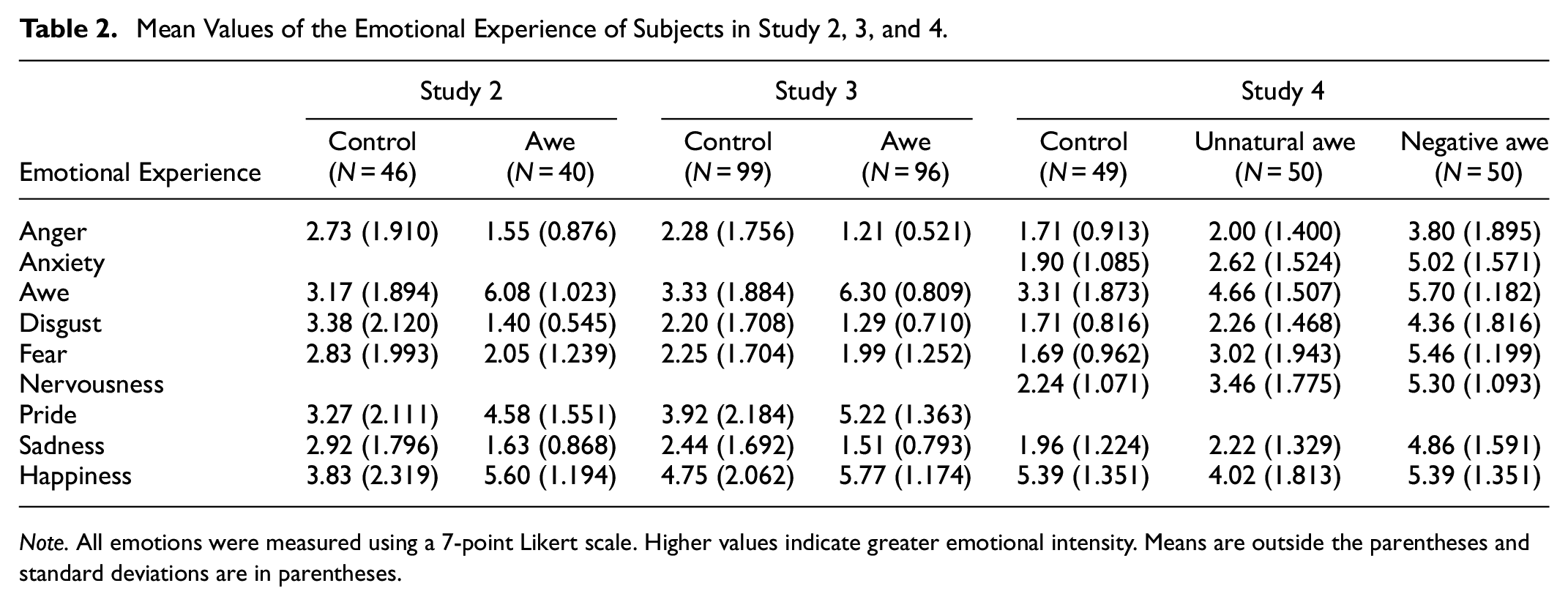
Note. All emotions were measured using a 7-point Likert scale. Higher values indicate greater emotional intensity. Means are outside the parentheses and standard deviations are in parentheses.
Second, the main effects were verified. A one-way analysis of variance (Analysis of Variance, ANOVA) indicated that consumers in the awe condition were more inclined to purchase green than those in the control condition (Mcontrol = 5.46, SD = 1.675, Mawe = 6.13, SD = 0.966, F [1, 84] = 4.955, p < .05). Thus, H1 was supported.
Finally, the PROCESS plug-in was used to validate the multi-step mediating role of the small self and CNS. Model 6 was chosen with a sample size of 5,000, a confidence interval of 95%, and demographic variables as control variables. The analysis results showed that the mediating path of “awe → the small self
Study 2 aimed to elucidate the process through which awe influences green purchasing intentions; that is, the multi-step mediating role played by the small self and CNS. Although this study identified the mechanisms through which awe promotes green consumption, is necessary to explore the boundary conditions by which awe positively influences consumers’ green purchasing intentions.
Study 3
Study 3 aimed to validate the role of emotion regulation mechanisms in moderating the positive influence of awe on customers’ green purchasing intentions.
Methods
Participants and Procedures
Study 3 used the same recall and writing methods as Study 2 to prime the participants’ experiences of awe, and the same questions were used to test the manipulation. After administering questionnaires on the Credamo website, 195 valid questionnaires were obtained. The experimental design involved a control group comprising 99 participants and an awe group comprising 96 participants. Among the subjects, 123 (62.4%) were female. This study included a cohort of 108 individuals (54.8%) aged 21 to 30 years, accounting, 69 individuals (35%) aged 31 to 40 years, and 11 individuals (5.6%) aged 41 to 50 years.
We then assessed the emotion regulation strategies employed by the participants, namely reappraisal and suppression.
Measures
Emotion Regulation Strategy
The scales for both the strategies were obtained from Balaji et al. (2017). The reappraisal strategy scale included six measures (Cronbach’s α = .747) and the suppression strategy scale included four items (Cronbach’s α = .852).
Green Purchasing Intention
A virtual consumption scenario was used to assess participants’ green purchasing intentions. We told the participants to imagine a budget of $3,000 to purchase an air conditioner. Air Conditioner A uses a fluorine-free refrigerant and is therefore $600 more expensive than Air Conditioner B. The participants’ propensity to choose Air-conditioner A formed their green purchasing intention index (Wu, 2014).
Results and Discussion
First, the manipulation tests were performed. Participants in the awe group experienced higher levels of awe than those in the control group did (Mcontrol = 3.33, SD = 1.884, Mawe = 6.30, SD = 0.809, F [1, 193] = 202.087, p < .001). Thus, this study successfully manipulated their state awe. Table 2 shows that participants who were exposed to the awe condition reported elevated levels of positive emotions such as pride and happiness and reduced levels of negative emotions such as anger, disgust, and sadness. Second, the main effects were verified. A one-way ANOVA showed higher levels of green purchasing intention in the awe condition (Mcontrol = 2.52, SD = 1.722, Mawe = 1.99, SD = 1.138, F [1, 193] = 6.280, p < .05).
Finally, the moderating effect of emotion regulation strategies was verified. The variable “awe” was transformed into a binary dummy variable, where 0 represented the control group and 1 represented the group that experienced awe. The reappraisal and suppression strategies were mean-centralized, and interaction terms for awe and reappraisal strategies and awe and suppression strategies were constructed. Green purchasing intention was taken as the dependent variable; awe, reappraisal strategy, and their interaction terms as the independent variables; and gender, educational background, age, and income as the control variables.
Regression analysis showed that reappraisal strategies enhanced the effect of awe on green purchasing intention (β = −.260, t = −2.999, p < .01). Table 3 presents the results of the moderating effect analysis. Green purchasing intention was considered the dependent variable; awe, suppression strategies, and their interaction terms the independent variables; and gender, educational background, age, and income the control variables. The regression analysis showed that the suppression strategy had no moderating effect on the positive effect of awe on green purchasing intention (β = −.090, t = −0.993, p = .322). Thus, H5-1 was supported but H5-2 was not supported, possibly because according to existing studies, the suppression strategies are usually targeted at negative emotions, whereas awe is a positive emotions; therefore, suppression strategies may not have played a significant role.
Analysis of the Moderating Effect of Reappraisal Strategies.

Note. CV = Control Variable; IV = Independent Variable. All results in the table were calculated using Spss21.0 software; N = 195.
p < .05. **p < .01. ***p < .001.
Study 3 verified the moderating effects of emotion regulation strategies. Specifically, consumers’ adoption of reappraisal strategies reinforced the positive effects of awe, whereas the suppression strategies did not exert a moderating effect.
Study 4
Most experiences of awe are directed toward a positive state, but one-fifth of awe-inspiring involve fear (Stellar et al., 2017). Whether based on respect or fear, awe can promote prosocial behaviors (Zhao et al., 2021). However, whether negative awe, dominated by fear, promotes green consumption remains to be verified. The “complexity of time, quantity, and detail” can also bring about the perception of vastness and thus lead to awe (Balaji et al., 2017), so the influence of unnatural awe is also worth examining.
Study 4 aimed to verify the favorable impact of negative and unconventional awe on the intention to purchase green products.
Methods
Participants and Procedures
In Study 4, video materials were used to prime negative and unnatural awe. In the experiment, participants were randomly divided into three groups. Participants in the negative-awe group watched videos of natural disasters to prime their negative awe. Subjects in the unnatural awe group watched slow-motion videos shot at 5,000 frames per second to induce unnatural awe experiences. The control group watched a workshop assembly-line video (Piff et al., 2015). Each video was approximately 2 min and 30 s long. Participants then rated their level of experience using the following emotions: anger, anxiety, awe, disgust, fear, nervousness, sadness, and happiness (1 = not at all, 7 = a lot). Thereafter, the participants were asked to imagine themselves purchasing detergents. In the experiment, we provided subjects with a choice between two detergents. Powerful detergent S has a strong detergency and is easy to use. Herbal detergent E does not contain hazardous substances and comes in environmentally friendly packaging. Both detergents had the same prices, and the participants’ preferences for the two products formed their green purchase intention index (Wu, 2014). Finally, the participants provided demographic data such as gender, education, age, and income.
In total, 149 valid questionnaires were collected from the Credamo website. Among them, 62 (41.3%) were female. In Study 4, 75 people (50%) were 21 to 30 years old; 63 (42%) were aged 31 to 40 years, and 7 (4.7%) were aged 41 to 50 years. There were 49, 50, and 50 participants in the control, negative-awe, and unnatural-awe groups, respectively.
Results and Discussion
First, manipulation experiments were performed. Individuals subjected to the negative-awe condition reported experiencing notably elevated levels of awe compared to those in the control condition (Mcontrol = 3.31, SD = 1.873, Mnegative awe = 5.70, SD = 1.182, F [1, 97] = 58.067, p < .001). Individuals subjected to the unnatural-awe condition reported notably higher levels of awe than those in the control condition did (Mcontrol = 3.31, SD = 1.873, Munnatural awe = 4.66, SD = 1.507, F [1, 97] = 15.735, p < .001). This finding suggests that the attempt to manipulate the experience of awe was effective. As shown in Table 2, participants in the control, negative-awe, and unnatural-awe groups experienced varying degrees of anger, anxiety, disgust, fear, nervousness, sadness, and happiness.
This study confirmed the favorable impact of negative and unnatural awe on consumers’ green purchasing intentions. The results of the one-way ANOVA indicated that participants exposed to the negative awe condition demonstrated a greater propensity to select green products than those in the control condition did (Mcontrol = 5.02, SD = 2.116, Mnegative awe = 6.04, SD = 1.456, F [1, 97] = 7.825, p < .01). The group of individuals who were subjected to the manipulated state of awe demonstrated a greater propensity to purchase green products than the group of individuals who were not exposed to the manipulated state (Mcontrol = 5.02, SD = 2.116, Munnatural awe = 5.78, SD = 1.502, F [1, 97] = 4.254, p < .05).
Studies 1 and 2, Study 4 further verifies that negative, unnatural, and positive awe can promote green consumption, verifying that awe is a stable predictor of green consumption.
Discussions and Implications
Conclusions
Study 1 verifies the positive impact of trait awe on green consumption. Existing research shows that gratitude and compassion can promote green consumption (Lu & Schuldt, 2016; Tam, 2022). However, the existing research lacks studies comparing awe, compassion, and gratitude using the same model. Study 1 placed trait awe, gratitude, and compassion on the same research model. These findings suggest that trait awe is a better predictor of green consumption than trait gratitude or compassion.
Existing research has identified the positive effects of awe on prosocial behaviors and the mediating role of the small self (Piff et al., 2015). Study 2 induced state awe among participants through an experiment. The study findings confirm the positive effect of state awe on green purchasing intentions. Specifically, Study 2 showed the multi-step mediating role of the small self and CNS in awe’s positive impact on green purchase intentions. Our study supports the existing research findings while expanding our understanding of how awe positively influences green consumption.
Few studies have explored the boundary conditions under which awe affects green consumption. Considering the universality of emotion regulation strategies, we believe that it is necessary to explore their role in awe’s positive influence on green consumption. Accordingly, Study 3 validated the positive effects of awe enhanced by reappraisal strategies as part of emotion regulation strategies, thus contributing to this research area.
Awe can be classified as positive, negative, or unnatural. Piff et al. (2015) comprehensively discussed the positive effects of the three types of awe on prosocial behaviors. However, existing research does not clarify whether all three types of awe can positively affect green consumption. Study 4 verified that the aforementioned types of awe actively promote green purchasing intentions. These findings deepen our understanding of the positive effects of awe.
Existing research has focused on the effect of awe on prosocial behaviors. This study extends this perspective to the field of green consumption. This study concluded that awe can promote green consumption, which is consistent with the findings of existing research. However, unlike previous studies, this study proposed and validated the multi-step mediating role of the small self and CNS, as well as the moderating role of emotion regulation strategies.
Table 4 presents the outcomes of hypothesis validation.
Results of Hypothesis Testing.

Practical Implications
First, companies can activate people’s awe through green marketing. The study concluded that companies could not only use grand natural landscapes in their green advertising but also elements such as natural disasters to evoke awe among the consumers. However, when using natural disasters as an appeal, companies must avoid consumers’ negative associations with brands. The study’s findings suggest that complexity can trigger awe. Therefore, these elements can also be applied to green advertising to achieve the purpose of green marketing.
Second, CNS and green consumption have a close relationship, indicating that the use of natural landscapes and other elements in green advertising will greatly enhance the effect of green marketing. In addition to green advertising, many other factors can increase consumers’ CNS. Enterprises can use natural landscapes in product packaging, marketing channels, and promotions. Finally, enterprises should consciously encourage consumers’ emotional regulation in green advertising. Companies can enhance the positive effect of awe on green consumption through communication strategies that enable consumers to re-evaluate natural beauty or other awe-inducing situations. For example, encouraging consumers to consider the power and dominance of nature can reinforce the consumer experience of awe and its positive effects on green consumption.
Limitations and Future Research Directions
The study only focused on the positive effects triggered by the manipulation of awe emotions without developing green marketing strategies with practical value. Thus, future studies should further develop marketing strategies based on the positive effects of awe and verify their practical value. The study used an experimental method involving a questionnaire, and future research should include field experiments, especially those involving green products developed by actual companies, to verify the validity of the findings.
Supplemental Material
sj-docx-1-sgo-10.1177_21582440241266071 – Supplemental material for Study on the Impact of Awe on Consumers’ Green Purchasing Intention
Supplemental material, sj-docx-1-sgo-10.1177_21582440241266071 for Study on the Impact of Awe on Consumers’ Green Purchasing Intention by Dalin Li and Bonian Deba Julie in SAGE Open
Footnotes
Author Contribution
Dalin Li: data search and curation; funding acquisition; project administration; writing original draft; review & editing draft of the paper; the final draft approval. Bonian Deba Julie: review & editing draft of the paper; the final draft approval.
Declaration of Conflicting Interests
The author(s) declared no potential conflicts of interest with respect to the research, authorship, and/or publication of this article.
Funding
The author(s) disclosed receipt of the following financial support for the research, authorship, and/or publication of this article: This research was funded by Social Science Foundation of the Education Department of Henan Province (Grant No.2023-ZZJH-019), Soft Science Research Program of Henan Province in 2024 (Grant No.242400410039) and Social Science Foundation of Henan Polytechnic University (Grant No. SKB2022-07).
Ethical Approval
We used data available from published papers and dissertations by searching the databases (CNKI, EBSCO, and Google Scholar), 1997–2021. Thus, ethical approval is not applicable to this study.

Data Availability Statement
Data sharing not applicable to this article as no datasets were generated or analyzed during the current study.
Supplemental Material
Supplemental material for this article is available online.
References
Supplementary Material
Please find the following supplemental material available below.
For Open Access articles published under a Creative Commons License, all supplemental material carries the same license as the article it is associated with.
For non-Open Access articles published, all supplemental material carries a non-exclusive license, and permission requests for re-use of supplemental material or any part of supplemental material shall be sent directly to the copyright owner as specified in the copyright notice associated with the article.
