




Abstract
Current research evaluates the mediating role of attitude toward the green brand and the moderating effect of green trust for the relationship of green brand positioning and green customer value with green purchase intention. Data was collected from the 464 University students with the help of snowball sampling technique. Results describe that green brand positioning and green customer value has noteworthy impact on green purchase intention. Results also illustrate that green brand positioning and green customer value has significant impact on attitude toward green brand. Moreover, attitude toward green brand act as partial mediator for the relationship of green brand positioning and green customer value with green purchase intention. Furthermore, green trust act as moderator for the relationship of green brand positioning and green customer value with green purchase intention. This is cross-sectional research as data is collected at single time point and this kind of research decrease the confidence about cause and effect assumptions. This research only focuses the employees at individual level. Some other potential predictors are not included in this research due to time and cost constraint. It is better to do longitudinal researches on these variables for generalization purpose. In future researches results may be compare at group as well as at network level.
Keywords
Introduction
Since Earth Summit 1992 and Brundtland Commission 1987 (Lubin & Esty, 2010), sustainability development has been considered one of the critical agendas discussed worldwide (Ruiz-Real et al., 2018). In recent years, more recognition is gained by sustainability because of its inferences of sustainable goals (Luo et al., 2018). Goals like DG6: Sanitation and Pure Water, SDG 3: Promoting Well-Being, and Better Health, and SDG15: Life on Land SDG12: Responsible Production and Consumption are directly linked to a green environment (Rockström & Sukhdev, 2016). During the last three decades, environmental issues have been raised at the top of the agenda of different governments. People worldwide are more worried than they have ever been about ecological challenges. Natural resource protection has become a priority of businesses and consumers alike, resulting in a shift to the green production and consumption habits of both companies and consumers (Sreen et al., 2018). The environmental issues are getting more attention from the customers, and in response, different companies are trying to develop specific activities for attaining sustainable goals (Raska & Shaw, 2012; Verma et al., 2019). The green environment has emerged as one of the sensitive issues for consumers, which results in various green products. According to Baiquni and Ishak (2019), the particular concern from consumers about the environment has emerged as increased demand for different environment-friendly products. Consumers purchase environment-friendly products regularly (Alamsyah et al., 2020). According to Chen and Chang (2012) and Suki (2016), consumers show positive behavior toward environment-friendly brands. Due to environmental pollution and global warming, various corporations have begun to manufacture environment-friendly green products, and environmental concerns have become a primary concern for organizations (Sugandini et al., 2018). Likewise, green consumer behavior has emerged as a new trend for researchers and marketers (Jaiswal & Kant, 2018; Lai & Cheng, 2016).
Increased attention to sustainability challenges, environmental concerns, and amplified customers’ awareness regarding ecological pollution act as the primary source for green consumption of the products for any society (Barbarossa & De Pelsmacker, 2016; Johnstone & Tan, 2015; Patel et al., 2017). Incorporating sustainability, conservation, green consumption, and behavior issues are needed to explore in developing countries (J. Ali et al., 2010; Mainardes et al., 2017). In most countries, the population residing in urban regions increased substantially (Kautish & Soni, 2012). By 2050, the urban population of the entire world will reach up to 66% (Nations, 2014). Currently, the urban population of the Asia continent is approximately 52% (Afzal et al., 2018). The urbanization of Pakistan is breakneck among the South Asian countries, and in 1951 its urban population was about 17%; in 2010, its value was about 37%, and in the next 10 to 15 years, almost 50% population will live in urban areas (Hussain, 2014). According to Nations (2018), since 1950, the number of people living in cities worldwide have more than doubled, rising from 746 million to more than 4 billion in 2017. As the population grows more densely populated, incomes rise, health risks increase, and people’s habits shift, the country faces new consumption-related concerns, such as packaged food and water. Organic food is becoming increasingly popular as a response to these concerns (Rana & Paul, 2017). Green awareness, increased health awareness, growth in educated social groups, increased consumer disposable earnings, and higher food costs have all contributed to the significant growth in the organic market (BusinessWorld, 2018; Lee, 2009). Current research focuses on educated people in urban areas as the target population. The study identified university students as respondents because they have a greater understanding and awareness of sustainability and green products and can better answer questions.
Green purchase intentions (GPI) benefit the organizations to establish a positive brand image, goodwill, and good public image (Sreen et al., 2018). GPI is widely spread among consumers who are very careful about purchasing environment-friendly commodities that are not environmentally hazardous (Kautish & Sharma, 2019; Lai & Cheng, 2016). Examining the relationship between green purchase intentions and attitudes toward brand is helpful for environment-friendly marketing activities (Carrete et al., 2012; Pebrianti & Aulia, 2021; Thøgersen et al., 2015). Attitude describes the judgment of specific kinds of environmental-friendly behaviors or products like organic food or choice of green products. Ha and Janda (2012) examined that a particular attitude toward the green product enhances positively the level of green purchase intentions (Verma et al., 2019). Recently, researchers have found a relation between attitude toward a green brand with GPI (Dickinger & Kleijnen, 2008; Han et al., 2017; Jaiswal & Kant, 2018; Kautish et al., 2019; Khare, 2014; Nath et al., 2017; Ru et al., 2018; Singh & Gupta, 2013; Uddin & Khan, 2016; Wang et al., 2016) and positive customer attitudes toward green products have a substantial influence on GPI; hence, customers whose attitude toward the green development is at a high level will be in a position to purchase more and more green products (Sun & Wang, 2019).
Green brand positioning (GBP) signifies the organization’s image as environment friendly and in public. Wang et al. (2016) also, describe that GBP help organizations fulfill the customer’s needs about the particular brand. Due effective use of GBP, organizations get a competitive advantage over their rival organizations by incorporating environmentally friendly practices (Huang et al., 2014). According to Huang et al. (2014), Wahyuningtias and Artanti (2020), and Wati and Ekawati (2016) GBP has a big influence on ATGB. GBP Similarly, has a positive impact on GPI (Aulina & Yuliati, 2017; Baiquni & Ishak, 2019; Himawan, 2019; Situmorang et al., 2021; Suki, 2016; Tristiani et al., 2019; Wati & Ekawati, 2016). It is also beneficial for organizations to examine the effect of green customer value (GCV) on GPI. According to Chen and Chang (2012), “GCV refers to consumers’ overall appraisal of what they give for and receives from a product or service, based on their environmental desires, sustainability expectations, and green needs.” GCV is used as a significant customer judgment and a critical factor of GPI (Mahesh, 2013). Positive GCV will result in a more enhanced level of GPI (Tan & Goh, 2018). According to Suki (2016), GCV is considered a crucial determinant of customer buying behavior. It plays an essential role for customers and the business market (Woo & Kim, 2019).
According to Chaowanapong et al. (2018), organizations in developing countries are much behind in producing environmentally friendly products due to the feeble application of laws about environmental protection, less financial resources, and little cooperation in sharing the knowledge about different industries. It is reported that (Dupont Green Living Survey, 2014) awareness of Indian customers about green products is 63% which is significantly lower than developed countries such as Canada at 78% and the USA at 73%. There is little evidence regarding the general public’s understanding of environmental concerns (Malik et al., 2019). Environmental protection awareness and the availability of environmentally friendly products are shallow in many developing countries compared to Asian countries such as Malaysia and Singapore (Ramayah et al., 2010). Pakistan, like India, is a neighboring country; hence the two countries are similar.
Green product awareness is also relatively low in comparison to advanced countries. It has been reported that there is less demand for green products in Pakistan, according to Azeem et al. (2017), stakeholders and customers. As a developing country, Pakistan is now coping with environmental deterioration, which is one of the difficulties it is dealing with Malik et al. (2019). The lack of awareness in society is also contributing to environmental damage. According to Dagher et al. (2015), ecological awareness is spreading widely in Western countries. A study by Jones et al. (2014) reported that, the green goods were expected to reach US$3.5 trillion by 2017. However, in some impoverished countries, this movement is still in its infancy, as some regions are unaware of green products (Malik et al., 2019). Majeed et al. (2022) claim that buyers in Pakistan who are not environmentally conscious do not frequently buy green products. They are unaware of the benefits of green products. Another concern for Pakistani clients is the high cost of green products, and their lack of income may be the main reason for fewer green product purchases (Awan & Wamiq, 2016; Soomro et al., 2020), and green products cost 20% to 30% more than traditional products in Pakistan (Bhutto et al., 2019).
This research incorporates the theory to describe the model is Attitude-Behavior-Context theory. ABC theory explains that consumers’ behaviors had a noteworthy influence on consumer green purchasing intentions (Guagnano et al., 1995). Attitude-Behavior-Context (ABC) theory assumes that consumers take steps repeatedly due to their expectations about particular actions (Feldmann & Hamm, 2015). Hence, this theory gives us the precise framework for investigating how the manners of human beings result in specific behaviors (Goh & Balaji, 2016).The attitude-Behavior-Context (ABC) theory was demonstrated by Guagnano et al. (1995). They explained that although customers may communicate environmental attitudes and values, attitudes and values, but these were not adequate to give details about ecological behaviors. It is vital to predict these behaviors and attitudes, facilitating or explaining actions (Guagnano et al., 1995; Zepeda & Deal, 2009). Customers worry about personal health, which is a potent stimulus for buying organic food (Dimitri & Greene, 2002; Willer & Yussefi, 2005); however, past research evaluated the green purchase for environmental change, ecological concerns, and societal issues for various viewpoints but only researchers incorporated theoretical perceptions of this theory to describe the comprehensive model. Based on the ABC theory (Liao et al., 2020), green customer values and green attitudes toward brands could explain green purchase intention. Current research also broadens the concept based on studies (Huang et al., 2014; Mostafa, 2007; Situmorang et al., 2021; Suki, 2016; You-Kyung, 2020) which stated that green brand positioning also explains the phenomenon of green purchase intention. This research also broadens the concept of ABC theory by considering the green trust as the moderator of green purchase intentions. The current research addresses these questions. The first question is: how does GBP affect GPI? Second, is there a linkage between GBP, GCV, and GPI? Third, how does GT moderate GBP, GPI, and GCV?
As shown above, customers in developing countries are less aware of the relevance of green products than consumers in developed countries. Similarly, low-income consumers in countries like Pakistan have trouble affording similar products. GPI and other variables such as GCV, GBP, ATGB, and GT in a single model are included in this study’s framework. There have been a few recent studies on the mediating role of consumer attitudes toward green brands in determining whether or not likely to make green purchase intention. This study adds to the body of knowledge by recommending ATGB as mediating variable for the relationship between GBP and GCV with GPI. This study adds to the literature by examining green trust as moderating variable between green customer value and green brand positioning. Using the Attitude-Behavior-Context (ABC) theory, current research proposes a correlation among GPI, GCV, ATGB, GBP, and GT.
Literature Review
Green Brand Positioning (GBP)
Brand positioning is one of the significant factors to attain the competitive market advantage (Clancy & Trout, 2002). According to Keller et al. (2011), brand positioning is the organizational effort and strategy to attain a particular place in the customer’s mind, such as to design the brand image as the consumer desires, and that becomes the primary reason behind purchasing the specific brand not even once but again and again. Similarly, to attain green brand positioning and competitive advantage, a deep focus is needed on environment-related issues and attributes. Green brand positioning is based on the following three parts; green, dynamic, and functional positioning. Hartmann et al. (2005) said that functional positioning reflects the brand’s functions and a process to convey environment-friendly consent to consumers. The green positioning of a corporation is an important part of its entire green brand positioning plan (Coddington & Florian, 1993; Hartmann et al., 2005). Situmorang et al. (2021) created an emotional and functional framework for the company’s green brand positioning. Aaker and Joachimsthaler (2000), Hooley et al. (1998), Kotler et al. (2018), Pebrianti and Aulia (2021), and Wahyuningtias and Artanti (2020) these researchers described that the art of brand positioning is to create a product so that it occupies a specific place in front of a customer and have an edge in the competitive market. It is the art and ability of a company to produce such an image with a high value among its targeted segment and become the companies’ advantage over its competitors. Situmorang et al. (2021) suggested that the advantage is based on its uniqueness and particular difference with competitive products and brands. In many researches green brand positing is treated as uni-dimensional variable (Aulina & Yuliati, 2017; Baiquni & Ishak, 2019; Himawan, 2019; Tristiani et al., 2019). In recent years, this variable is still considered as a single construct instead of a multidimensional construct (Borah et al., 2021; Pebrianti & Aulia, 2021; Situmorang et al., 2021). The current study uses the green brand positioning as a uni-dimensional construct based on these facts.
Attitude Toward Green Brand (ATGB)
According to Lee (2008) the concept of attitude toward green brands (ATGP) has emerged through evaluation and rational-based judgment by consumers about the green brand. Rios et al. (2006) says that organizations have tried to offer environment-based friendly products to consumers, which also help them to decide and purchase among different brand competitors. Huang et al. (2014), Indriani et al. (2019), and Swenson and Wells (1997) described that there is a direct link among consumers of environmental concern and their intention toward the green brand, particularly in a situation when consumers understand the efforts being made by companies related to green brand positioning. Attitude toward green products result in enhancing the level of environment friendly products (Indriani et al., 2019). Enhancing the level of ATGP does not support the organizations to advance the level of GPI but can support one country to develop sustainable future of any other country (Sreen et al., 2018). The capability of the organizations to produce and deliver highly environment-friendly products may become the reason for consumer attitudes toward the brands and enhance purchase preferences (Situmorang et al., 2021). As per Kardoyo et al. (2020), companies consider the environmental factor for product design and focus on the behavior to consume environment-friendly products. Consumer’s positive attitude toward green brands enhances the level of purchases. Still, if companies do not produce adequate green brands, the trust level will be reduced, and there will be the lower purchase interest from consumers.
Green Customer Value (GCV)
The particular green consumers are always interested in purchasing only environment-friendly products. Consumers that are environment-conscious and value reusability place, a high value on environment-friendly items and companies (Lee, 2009; Mostafa, 2007). The customer’s decision to purchase the product is based on the product’s perceived value, which reflects the particular purchase intention of consumers (M. Li & Cai, 2012; Sharma & Klein, 2020). The consumer’s view of the product and its worth is known as a perceived value (Ashton et al., 2010; Song et al., 2019). As per Chen and Chang (2012), the overall evaluation of a consumer’s real outcome or output from any product or service is known as green perceived value. It is now regarded as the most recent factor for environment-conscious shoppers (Koller et al., 2011). Green purchase intention is a necessary component of customers’ real green purchasing behavior. It shows that consumers only purchase the product when they feel necessary, valuable, and attractive for them (Al-Gasawneh & Al-Adamat, 2020).
Green Purchase Intention (GPI)
According to Aulina and Yuliati (2017), the desire of a customer to buy green brands to suit their needs is referred to as GPI. Amoako et al. (2020) and Situmorang et al. (2021), stated that having a positive attitude toward green products will increase the likelihood of making a green purchase intention. Change in GPI occur in different cultures, on individual and gender base (Sreen et al., 2018). Consumers with concerns about the environment may indulge themselves in becoming part of the solution, and even changing consumption patterns (Rehman & Dost, 2013). When a customer identifies the green attributes in any brand and afterward purchases that brand, they can be categorized as the green consumer (Hamzah & Tanwir, 2021; Oliver & Lee, 2010) and also elaborated as responsible consumers as they utilize their power of purchase to contribute to the environment and even specific changes (Moisander, 2007). According to Dahai et al. (2022) and Huang et al. (2014), customers who have a positive opinion of green products may be more interested in green purchasing intentions. Conscious consumers are more likely to buy environment-friendly commodities. As per Suki (2016), to grow and achieve the desired targets, companies must work on green brand positioning. Different studies have explored that green positioning particularly forces the consumer to increase green purchase intention (Huang et al., 2014; Mostafa, 2007; Situmorang et al., 2021; Suki, 2016). A variety of predictors influence green purchase intention. Current study considers GCV, GATB, GBP, and GT as the predictors of GPI on the basis of previous researches. For example, GCV and GATB has positive influence on GPI (Liao et al., 2020), GBP is positively related with GPI (Aulina & Yuliati, 2017) and GCV is positively associated with GPI (Liao et al., 2020).
Green Trust (GT)
Trust in the environmental performance of foreign goods is characterized as a belief or expectation that is founded on the credibility, compassion, and capability of the person or organization that holds the belief or expectation (You-Kyung, 2020). Flavián et al. (2005) discovered that trust could reduce a consumer’s perceived risk while simultaneously increasing the chance of purchasing at the time of a transaction’s execution. According to Yu-Shan (2010), if you have faith in a product’s sustainable development because of its reliability, friendliness, and competence, you may put your confidence in it because you have faith in it.
Even though indirect cues (e.g., advertising) might influence consumer expectations, the most critical factor in brand trust is the actual consumer experience with the company (Chuah et al., 2020; Delgado-Ballester & Munuera-Alemán, 2005). Trust reduces the likelihood that an exchange partner will act opportunistic, enhances the value of transactions, and raises the probability that a purchase will be made (Chen & Chang, 2012; Ganesan, 1994; Kang & Hur, 2012). Consumers’ green trust in a company’s environmental performance indicates that the company is credible, reliable, and adheres to industry standards. According to the authors, green trust involves being reliable, dependable, satisfying consumers’ expectations, trustworthy, and having products’ potential to ensure the environment’s safety, among other qualities (Yu-Shan & Chang, 2013). Increasingly, the concept of green marketing as a component of ethical marketing is gaining popularity in wealthy countries and making its way into underdeveloped countries. The shift in consumer behavior indicates the success of green marketing initiatives to promote environmental-friendly items (Imaningsih, 2019).
Conscious consumers are more likely to buy environment-friendly commodities. As per Suki (2016), to grow and achieve the desired targets, companies must work on green brand positioning. Different studies have explored that GBP mainly forces consumers to increase GPI (Huang et al., 2014; Mostafa, 2007; Situmorang et al., 2021; Suki, 2016). In light of this, current research assumes the following hypothesis.
Perceived value is the consumer’s perception of the product and its value (Ashton et al., 2010; Song et al., 2019). As per Chen and Chang (2012), green perceived value is the all-around estimation of a consumer’s actual result or output from any product or service. It is now regarded as the most recent factor for environmentally conscious shoppers (Koller et al., 2011). Green purchase intention is a necessary component of customers’ real green purchasing behavior. It shows that consumers only purchase the product when they feel necessary, valuable, and attractive (Al-Gasawneh & Al-Adamat, 2020). Various researchers have determined that the single essential determinant in purchase behavior is customer perceived green value (Ahmad & Zhang, 2020; Suki & Suki, 2019). On the basis of this fact, current research suggests the following hypothesis.
The study was carried out to better understand the impact of green brand positioning, particularly on brand attitudes, and it discovered that this direct impact is positive (Hartmann et al., 2005). Consumers’ concern for the environment is positively linked with attitude toward brand (Huang et al., 2014), mainly when consumers believed that organizational efforts are aligned with green brand positioning (Becker-Olsen et al., 2006). Aulina and Yuliati (2017), also discovered that GBP had a positive impact on consumer ATGB. The current study provides following hypothesis based on the above facts.
According to Swait and Sweeney (2000), customer perceived value might have an impact on customer attitude. Based on this fact, current research proposes the following hypothesis.
Tsen et al. (2006) mentioned that it is more important to grasp the aspects that play a crucial role in gauging consumers’ intentions who are prepared to spend extra money on eco-sustainable products. Chekima et al. (2016) identified that consumer attitudes regarding the environment reflect the evaluation of the environment by customers, as measured by their preferences and perceptions to act on. Additionally, environmental issues on environmental attitude are the most crucial determinant that directly links with green purchase intention (Fauzan & Azhar, 2019; Michaelidou & Hassan, 2010). Similarly, Huang et al. (2014) ATGB improve GPI, as mentioned. For instance, Amoako et al. (2020) revealed a direct and positive association between GPI and ATGB. Based on ABC theory (Liao et al., 2020), green customer values and green attitude toward brand explained green purchase intention. Thus, research presents the following hypothesis.
There is adequate evidence to demonstrate that there is a causal association among value orientation, green attitudes, and green product purchase intentions toward green products (Cheung & To, 2019; McCarty & Shrum, 1994; Situmorang et al., 2021; Suki, 2016). However, there are studies that show how integration of value with climate change toward green products can help people buy green products (Boon & Quoquab, 2015; Khan & Mohsin, 2017; Parker et al., 2014; Paswan et al., 2017). Additionally, some researchers conduct study on GBP, GPI, and ATGB. Aulina and Yuliati (2017) and Situmorang et al. (2021) discovered a direct association among these variables, that is, the influence of GBP on ATGB and ATGB on GPI. However, no previous research has revealed a mediating role of ATGB on the relationship between GBP and GPI, to the best of the researchers’ knowledge. Previous research examines that GBP has a positive impact on GPI, GBP has a positive impact on ATGB, and ATGB has a positive impact on GPI in the above discussion for a direct relationship. Furthermore, attitude toward the green product is seen as an important component. In several studies, this variable is regarded as a mediator (Chu, 2018; Kautish et al., 2019; Najmi et al., 2012; Sheeraz et al., 2016). Based on these findings, the current study used attitude toward green products as a mediator. Due to the above facts, current research proposes the following hypotheses of mediation.
Green trust is a moderator between GBP and GPI and likewise between GCV and GPI
In general, the notion that the other party’s actions are reliable is referred to as trust, actions, or promises are trustworthy, as well as the assumption that they will keep their commitments in an exchange relationship (Leonidou et al., 2015). Integrity, kindness, and competence were the three beliefs that constitute trust (Blau, 1986; Schurr & Ozanne, 1985). Trust had a direct impact on consumer green purchase intentions (Rousseau et al., 1998). Trust had been characterized as an emotional condition in which a person is willing to tolerate vulnerability in exchange for a favorable anticipation of another party’s behavior or intention. Trust was a directly main driver of consumers’ GPI. Green trust was introduced for the first time in the context of green consumption by Yu-Shan (2010), as a belief in and anticipation of eco-friendly products, as well as the emergence of a tendency to rely on such products due to their environment-friendly and energy-saving properties.
Trust has been shown in various studies to control the relationship between buyers and sellers, attracting customers who have a stronger sense of fidelity to the brand (Nguyen et al., 2013; Nuttavuthisit & Thøgersen, 2017; Ong & Zien Yusoff, 2015). After conducting an empirical investigation with Taiwanese consumers, Yu-Shan and Chang (2013) green perceived value was found to have a constructive impact on consumer green trust. Specifically, trust is a powerful predictor of future purchase intentions among customers (Garbarino & Johnson, 1999), and consumers’ levels of green trust impact their proclivity to purchase green commodities. In light of previous research on green trust, this study examines customers’ movement from environmental concerns to purchase intention from a broader viewpoint.
According to Gil and Jacob (2018) and Peattie (2001) consumers’ level of green trust relied on the customer’s repurchase intentions and green product purchase intentions (Lam et al., 2016). You-Kyung (2020) revealed that trust can help customers reduce their perceived risk and consumers those have a low risk perception are more likely to buy green commodities. During the transaction execution phase, trust helped consumers enhance their likelihood of making a purchase. Yang and Zhao (2019) found that customers’ green trust can strengthen their attachment to a green brand, which in turn increases their desire to purchase eco-friendly commodities in the future. In addition, it was found that customers’ green trust could enhance their intentions to purchase green products (Yang & Zhao, 2019). Finally, when it comes to product selection, environmentally conscious consumers will prefer green products that have the most negligible influence on the surroundings. Consumers’ belief in environment-friendly products has an impact on their purchasing decisions. In the long run, both environmentally conscious consumers and those who have a strong belief in the environmental benefits of green products are more likely to purchase (G. Li et al., 2021) previously, as a mediator between green environmental values and green purchase intentions, this variable was used.
On the basis of the preceding information, current study proposed the following moderating hypothesis (Figure 1).
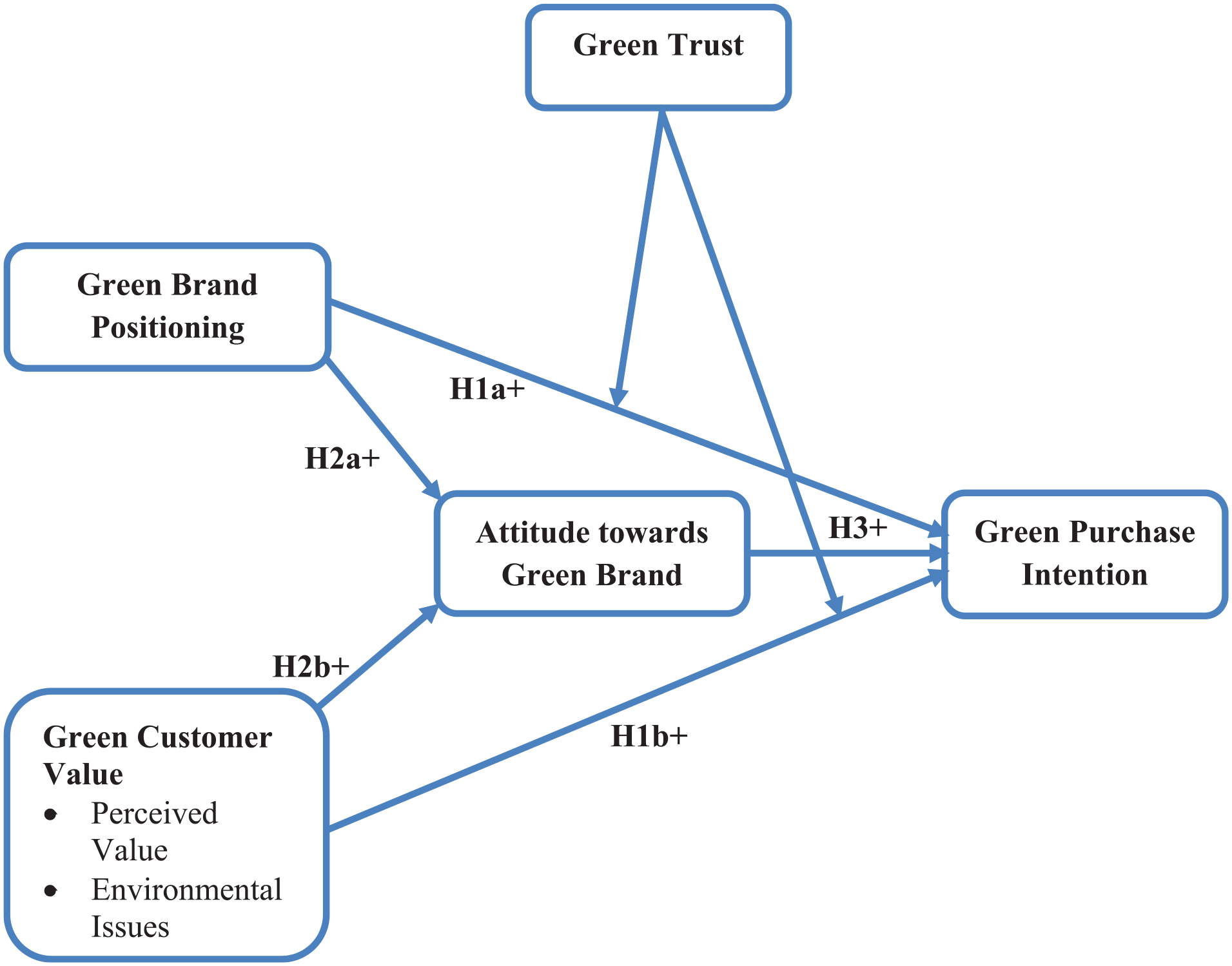
Hypothesized research model.
Target Population and Sampling Method
The current study used the structured self-administered questionnaire for data collection from respondents of Lahore, Pakistan, using the snowball sampling technique. Respondents of Lahore are the target population as it is the second-largest city in Pakistan, and almost students all around the country are getting their education in different Universities in this city.
The current study considers the young students who are doing their graduation in the universities of Lahore. Lahore is an important urban area of Pakistan. Young students who are doing their graduations are considered as a target population because young educated people have good awareness about green products, and they purchase green products more than as compared to other customers (Prakash & Pathak, 2017; Taufique & Vaithianathan, 2018; Verma & Chandra, 2018; Yadav & Pathak, 2017).
For data collection, a structured questionnaire was utilized. A total of 750 questionnaires were distributed with the help of snowball sampling (during January–March 2020). Snowball sampling is employed for data collection because it is a quick technique to find response. This technique is performed in two steps. In the first step, a technique of probability sampling is used for the selection of the initial sample; in the second step, a remaining sample is selected with the help of already selected respondents. In various researches about green products, researchers applied non-probability sampling techniques to young graduates (Kautish et al., 2019; Kautish & Sharma, 2019; Khare, 2014; Nuttavuthisit & Thøgersen, 2017). For performing the sampling procedure, 59 questionnaires were distributed to the respondents with the help of a simple random sampling method among the students of six universities in Lahore, Pakistan. Three were public sector universities, and three were private sector universities. A total of 11 respondents were not interested in buying green products; that’s how we selected 46 respondents in the initial step. Based on the opinion of these 46 respondents, the current study distributed 704 remaining questionnaires.
While 464 complete questionnaires were returned back and used. A response rate of the questionnaires is about 62%. Based on demographic analysis, 62.93% (N = 292) were male respondents, whereas 37.07% (N = 172) respondents were female, 33.62% (N = 156) respondents were enrolled in master level degree, whereas 66.38% (N = 308) respondents were enrolled in bachelor level degree.
Scale and Measurements
Green customer value comprises two sub-variables named environmental image and perceived value. Five statements estimated the environmental image (Yu-Shan, 2010), a sample item is “The brand is successful about environmental performance.” The reliability of this scale is estimated at .744 (Yu-Shan, 2010). Perceived value was estimated by five statements (Dodds et al., 1991); the sample item is “I consider this product to be a good buy.” The reliability of this scale is estimated at .94 (Yu-Shan, 2010). Green brand positioning was estimated by five statements (Suki, 2016); the sample item is “I believe in the products I use.” The reliability of this scale is estimated at .830 (Situmorang et al., 2021). Attitude toward green brand was assessed by five statements (Hartmann et al., 2005) sample item is “This product is in accordance with the wants and needs of environmentally friendly products.” The reliability of this scale is estimated at .779 (Situmorang et al., 2021). Green purchase intention was estimated by five statements (Taylor & Todd, 1995); the sample item is “I have a Favorable attitude toward purchasing a green version of a product.” The reliability of this scale is estimated at .75 (A. Ali et al., 2011). Likewise, green trust was evaluated by five statements (Yu-Shan, 2010). The sample item is “This brand keeps promises and commitments for environmental protection.” The reliability of this scale is estimated at .768 (Yu-Shan, 2010).
Table 1 indicates that all the mean values and standard deviation values of all the variables. Whereas current research examines the correlation values as follows. GBP and GCV are positively correlated (r = .48, p = .01). GBP and ATGB are favorably associated (r = .49**, p < .01). ATGB and GCV are positively correlated (r = .54**, p < .01). GBP is correlated positively to GPI (r = .58**, p < .01). Likewise, analysis shows that GPI is correlated positively to GCV (r = 0.62**, p < .01). Hence, GPI and ATGB are positively correlated according to given analysis (r = .61**, p < .01).
Correlation Analysis, Mean Value, and SD.

Note. GPI = green purchase intention; GBP = green brand positioning; GCV = green customer value; GT = green trust; ATGB = attitude toward green brand.
**p < .01.
Anderson and Gerbing (1988), suggested the structural equation modeling-SEM approach to carry data analysis in two stages. First of all, the CFA test was applied for testing the factor loading values (Anderson & Gerbing, 1988). Currently used the parameter of Williams et al. (2009) about model fitness values (i.e., CFI ≥ 0.90, GFI ≥ 0.90, SRMR ≤ 0.08, RMSEA ≤ 0.08, and χ2/df ≤ 3.0) and utilized the Hair (2009) standards for loading (≥0.50). Table 2 indicates that all the variables’ items have a value >0.50. Factor loading provided assurance about the inclusion of a particular statement in the final analysis. We used only those statements whose value was >0.5 and exclude those statements whose value was <0.5. This research observed the model fitness values as CFI = 0.94, GFI = 0.92, SRMR = 0.085, RMSEA = 0.081, and χ2/df = 3.14. All the values fall in the range.
Factor Loading and Reliability Analysis.

Direct relationship of GBP and GCV with GPI and ATGB
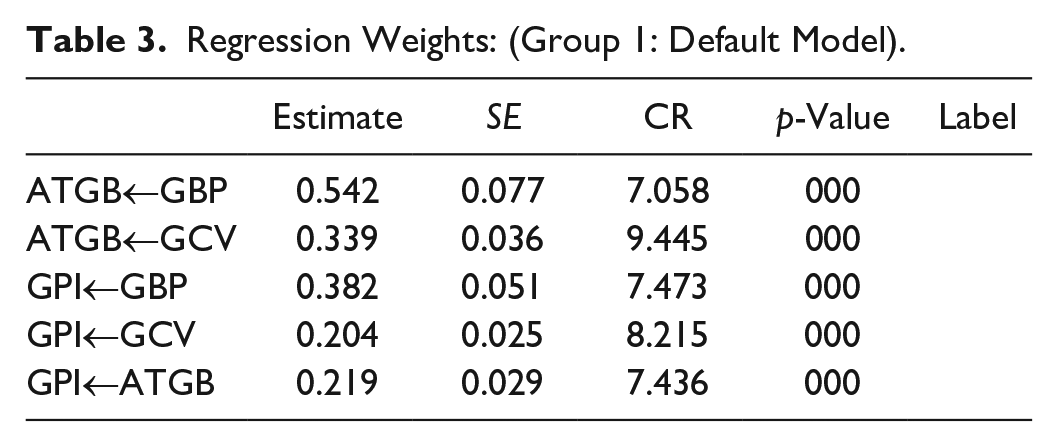
This study used the AMOS for performing the SEM analysis for the basis of following reasons. Data was normally distributed, and constructs were reflective. Moreover, a large number of studies about green products used the AMOS for performing the SEM, and respondents were young graduates (Kautish et al., 2019; Kautish & Sharma, 2019; Majeed et al., 2022). Table 3 and Figure 2 indicate the results of
Regression Weights: (Group 1: Default Model).

Estimated research model.
Table 3 and Figure 2 also indicate the results of
ATGB as a mediating factor in the relationship between GCV and GBP and GPI
By examining direct and indirect relationships, the mediating effect of ATGB for the relationship of GBP with GPI was evaluated. In a direct relationship, the path is significant between GPI and GBP (p = .000 and β = .38). This research found the indirect relationship by multiplying two paths (GBP on GPI with GBP on ATGB; p = .000 and β = .20) and noticed significant results. Both direct and indirect relations were significant; therefore, ATGB acting as a mediating role for the relationship of GBP with GPI. Hence hypothesis No
The direct and indirect relationship was used to evaluate the mediating effect of ATGB in the relationship of GCV with GPI. In a direct relationship to GPI and GCV path is significant (p = .007 β = .20). This research found the indirect relationship by multiplying two paths (GCV on GPI with GCV on ATGB; p = .000 and β = .08) and noticed significant results. Both direct and indirect relations were significant; therefore, ATGB plays a mediating role in the relationship of GCV with GPI. Hence hypothesis No
Green Products Purchase Intention as Dependent Variable for both Relationships.

Note. GBP = green brand positioning; GCV = green customer value; GT = green trust; GPPI = green product purchase intention
Green trust is playing moderating role between green customer value with green product purchase intention and green brand positioning
For checking the moderation effect, current research used (Hayes, 2017) model no 15 to examine the role of green trust as a moderator in the relationship between GBP and GCV with GPI. The hierarchical regression analysis is used in this study. Green trust and GBP regressed on GPI in the first step. The study noted noteworthy of GBP (β = .41, p = .000 < .01) on GPI. And also examined the insignificant influence of Green Trust (β = .04, p = .67 < .10) on GPI. In step 2, an interactional word GBP X GT was calculated to check the impact and examined the significant influence (β = .37**, p = .000 < .01) on GPI. The value of β is reduced from .41 to .37; thus, moderation exists.
This research also examined the moderating role of green trust for the relationship of Green Customer Value with Green Customer Purchase Intention. The current study used the hierarchical regression analysis. In the first step, green trust and Green Customer Value regressed on Green Customer Purchase Intention. This study noted the noteworthy of Green Customer Value (β = .23**, p = .000 < .01) on Green Purchase Intention. And also examined the insignificant influence of Green Trust (β = .03, p = .78 < .10) on Green Purchase Intention. In step 2, an interactional word GCV X GT was calculated to check influence on GPI and examined the considerable influence (β = .19**, p = .000 < .01) on GPI. The value of β is reduced from .23 to .19; thus, moderation exists. These results indicate that hypotheses H5a and H5b are supported.
Discussion and Conclusion
Modern organizations are focusing more and more on environmental issues. These organizations actively participate in environmental safety activities, assign capital, make effective policies, and incorporate environmentally friendly actions (Islam et al., 2020). As per study of Raska and Shaw (2012), the environment is getting higher intention from the customers, and in response, different companies are trying to develop and manage certain activities for sustainability. The environment has emerged as one of the sensitive concerns for consumers, particularly in personal care and beauty-related products. Green consumer behavior has emerged as a new model for researchers and marketers (Jaiswal & Kant, 2018; Lai & Cheng, 2016). Due to this reason, organizations are now focusing on the manufacturing of eco-friendly products which are not harmful to the eco-system and can be recycled easily even with minor toxicity type materials (Calkins, 2008). According to Aaker and McLoughlin (2010) and Kotler et al. (2018), there is insufficient research material to understand the impact of environmentally friendly brands and their positioning. Due to these reasons, current research focused on green variables like GCV, ATGB, GBP, and GPI. The results of the relationship between GBP and GCV with GPI revealed that both strongly influenced GPI. These findings corroborate prior findings (Huang et al., 2014; Mostafa, 2007; Suki, 2016).
Furthermore, recent study investigates the influence of GBP and GCV on ATGB. According to the findings, both had a considerable impact on ATGB. The first finding (
Implications and Limitations
Theoretical Implications
On the basis of the Attitude-Behavior-Context (ABC) theory, this study adds to the body of literature by considering all variables in a single model and evaluating the mediating effect of ATGB for the relationship between GCV and GBP with GPI. On the basis of the Attitude-Behavior-Context (ABC) theory, this study adds to the corpus of knowledge by analyzing the role of green trust in the relationship between GBP and GCV with GPI.
Managerial Implications
A logical, systematic approach is also necessary to better understand the threats and risks and supporters that may weaken or strengthen the pro-environmental behavioral patterns for attitude toward green brands; additionally, the interrelationship with green intentions. Behavioral patterns influence green purchasing intention (Kautish et al., 2019). Green brand positioning and green customer value are good predictors of green purchase intention. So, marketing managers must formulate good policies for maintaining current policies regarding GBP and GCV. For promoting the intention of the green brand, managers must launch an effective advertising campaign for promoting the intention of green purchase. GBP and GCV are also good predictors of ATGB. As ATGB acts as a partial mediator for the relationship of GBP and GCV with GPI, marketing managers must maintain the current policies regarding GBP for formulating their customers about the ATGB. Additionally, managers also use the campaign for promoting the ATGB. Moreover, In the Pakistani cultural context, little research incorporates the green brand; hence, this research acts as a policy guideline for the companies who engage in green production.
Limitation and Future Research
This is cross-sectional research as data were collected at a single time point, and this kind of research decreases the confidence about cause-and-effect assumptions. So, it is better to do longitudinal studies on these variables to solve this problem. This research only focuses on the employees at the individual level. In future investigations, results may be compared at the group as well as at the network level.
Some other potential predictors are not included in this research due to time and cost constraints. In the future, some other potential variables like green equity, green product, and green marketing will include for generalization. This research only focuses on the respondents of one city in Pakistan. In future research, this kind of research will also be conducted by including multiple cities and multiple nations.
Footnotes
Declaration of Conflicting Interests
The author(s) declared no potential conflicts of interest with respect to the research, authorship, and/or publication of this article.
Funding
The author(s) disclosed receipt of the following financial support for the research, authorship, and/or publication of this article: This paper was supported by Natural Science Foundation of China (No. 71262029).
