




Abstract
As the issue of greenwashing becomes more important, previous studies have not fully explained the various pathways and complex effects of greenwashing on consumer behaviors. To overcome these limitations, we present a model based on the theory of reasoned action for the relationship between consumers’ awareness of greenwashing and green purchase intention and the mediating effect of green trust and green word-of-mouth intention in this relationship. The results of analyzing the data of 306 respondents in the online survey in the third quarter of 2023 using structural equation modeling (SPSS 26.0, Amos 23.0) are as follows: The path of greenwashing awareness to green purchase intention through green trust and green word-of-mouth intention was significant. Specifically, greenwashing awareness had a negative effect on green trust and green word-of-mouth intention, which in turn had a negative effect on green purchase intention. In addition, green trust and green word-of-mouth intention had a positive effect on green purchase intention. The findings suggest that companies should adopt third-party certifications, improve supply chain transparency, and invest in sustainability initiatives. The responses also indicate a need to implement a standardized eco-labeling system and establish and utilize a stricter enforcement mechanism to curb greenwashing. Despite these implications, this study has a limitation in that the sample is restricted to Korean adults with experience in purchasing eco-friendly cosmetics. Follow-up studies on diverse products and consumer groups should be conducted to strengthen the generalizability of the findings.
Keywords
Introduction
From the dawn of the Industrial Revolution, the Earth has been growing warmer rapidly. The average temperature of the Earth’s surface has increased by approximately 1.1° Celsius since 1850 (Lindsey & Dahlman, 2020). Most notably, the last 40 years have been warmer than ever since the mid-19th century and global warming has caused significant changes worldwide. The cause of this warming is reckless human action. Therefore, the most effective way to alleviate the current environmental problems (e.g., water pollution, biodiversity loss, and desertification) is to change human behavior (Steg & Vlek, 2009). Accordingly, in modern society, there is an increasing awareness of the need for environmental protection and sustainable consumption as well as growing consumer interest in and demand for green products. Between 2009 and 2010, the number of eco-friendly products in the market increased by approximately 73% (TerraChoice, 2010). Since the Biden administration rejoined the Paris Agreement in 2015 and agreed to a goal of net-zero emissions by 2050, corporate responsibility for the environment has emerged as a global trend (South et al., 2021). Supporting this trend, the 2017 UN Sustainable Development Goals included the goal of ensuring “sustainable consumption and production patterns.” This growing environmental concern and pressure to engage in environmentally responsible behavior has led many companies to place environmental management at the top of their agendas (King & Lenox, 2002). Consequently, companies are modifying their business models to accommodate environmentalism (Ottman, 2011). Many strive to build an eco-friendly image by introducing public efforts and achievements related to environmental management. Using environmental management to promote sustainable growth, companies are adopting eco-friendly marketing strategies that appeal to consumers interested in the environment (Nguyen et al., 2021), thereby securing a competitive advantage.
At present, eco-friendly products are associated with prestige, stylishness, and luxury (Ahmad & Zhang, 2020). These changes in consumer preferences provide companies with strong incentives to develop eco-friendly strategies for their products and services. However, not all green marketing claims accurately reflect environmental behaviors. While some companies have truly reduced their environmental impact, others have exaggerated their environmental efforts or hidden their anti-environmental actions (Garfield, 1991). Some companies take advantage of consumers’ heightened awareness of the environment and their good-natured motivations by pretending to be eco-friendly. This phenomenon is known as greenwashing, a practice that not only confuses consumers and makes it difficult for them to choose sustainable products and services but also negatively impacts businesses actually engaging in green practices while trying to remain competitive. Consumers support companies that display genuine social and environmental responsibility, and a lack of sincerity through greenwashing can damage a company’s reputation and trustworthiness (Balluchi et al., 2020).
Owing to greenwashing issues related to green products, the cosmetics market is one of the fields receiving the most attention. Cosmetics often contain chemical ingredients that do not decompose naturally and can have harmful effects on the environment (Utami et al., 2022). Cosmetic containers are frequently made of materials that are difficult to recycle such as plastic and glass. Additionally, cosmetics products require unique packaging methods and materials to maintain stability (Amberg & Fogarassy, 2019). Developing and producing eco-friendly cosmetics requires additional costs and time due to regulations and certification procedures. Consequently, some cosmetics companies may use greenwashing methods to deceive consumers and gain unfair profits. One study found that up to 40% of companies’ eco-friendly claims could be misleading, highlighting the significant risk of greenwashing in the beauty industry (Nemes et al., 2022). You can also find many ambiguous terms used in making green claims on cosmetic packaging, such as “eco” and “eco-friendly,”“plant-based,” and “naturally responsible,” as well as phrases like “gentle on the environment,”“bio-based,”“conscious,” and “responsible.” (Styles, 2023). The cosmetics industry has the highest use of plastic packaging materials. However, there are limitations to recycling plastic cosmetic containers owing to factors such as the use of a composite material structure to prevent the contents from deteriorating, various additives, and residual contents (Dube & Dube, 2023). According to the Leybourne (2025), a non-profit organization, 95% of plastic cosmetic packaging waste is not recycled or discarded. Accordingly, companies in the cosmetics industry have focused on developing eco-friendly containers to reduce the use of plastic and replace plastic materials. For example, cosmetic companies have developed paper tubes to replace plastic containers (Sharma et al., 2023). Some plastic tubes used for cream-type cosmetics, such as sunscreen, have been replaced with paper tubes, and some companies are actively promoting eco-friendly resource management. However, as most commercially available paper tubes have a light plastic coating added to ensure water resistance, questions regarding greenwashing may be raised. Indeed, consumers notice the consistency between cosmetic companies’ environmental claims and their actual efforts.
This study analyzed the impact of greenwashing awareness in the cosmetic industry on consumers’ green purchase intention using the theory of reasoned action (TRA). TRA is a theory that predicts actual behavior through behavioral intention, and mainly explains that attitude and subjective norm affect behavioral intention. Based on this TRA theory, this study analyzed the impact of greenwashing perception on green purchase intention through green trust and green word-of-mouth intention. Previous studies mainly focused on a single psychological factor or negative aspect to analyze the impact of greenwashing on consumer behavior. For example, many studies have emphasized the negative impact of greenwashing on consumer trust and purchase intention (Ogiemwonyi, 2024; Sun & Shi, 2022). However, this study analyzed the complex path of greenwashing perception on green purchase intention through green trust and green word-of-mouth intention based on the TRA theory in a multidimensional manner. This allows for a more comprehensive understanding of the impact of greenwashing on consumer behavior. Furthermore, while most previous studies on greenwashing have analyzed why greenwashing occurs and what practices and results it brings from a business perspective (Ferrero-Ferrero et al., 2021), research on specific industries and product sectors is scarce. Therefore, to address this gap in the literature, we analyzed greenwashing issues in the cosmetics industry, where greenwashing is highly likely to occur and consumers’ reactions to such issues can be sensitive. Specifically, we collected and analyzed survey data on consumers in the South Korean beauty market, which is growing as a global leader in the beauty and cosmetics market. The research results are expected to provide important insights into the green product market and consumer behavior and to help consumers make more sustainable consumption choices by identifying the relationship between greenwashing awareness and green purchase intention.
The structure of this paper is as follows. Chapter 2 provides an overview of related research and theories, and explains the relationship between greenwashing awareness based on TRA and consumers’ green purchasing intention. Chapter 3 sets the research hypothesis and presents the theoretical basis for analyzing consumer behavior. Chapter 4 explains the research methodology, and Chapter 5 explains the hypothesis verification results based on the research results. Finally, Chapter 6 draws the conclusion of the research and explains the implications and limitations of this research.
Literature Review and Theoretical Background
Theory of Reasoned Action
According to behavioral theory, human behavior can be determined by behavioral intention, which is influenced by various psychological variables. In particular, the TRA (Ajzen, 1980; Ajzen & Fishbein, 1975) is useful for predicting pro-environmental behavior. According to the TRA, behavioral intentions are influenced by attitudes and subjective norms. Attitudes reflect an individual’s evaluation (positive or negative) of performing a specific behavior, whereas subjective norms refer to an individual’s judgment of how meaningful people around them perceive their behavior. Meanwhile, the theory of planned behavior (TPB; Ajzen, 1991), which was derived from the TRA, additionally includes the element of perceived behavioral control, a concept derived from self-efficacy. Perceived behavioral control is a subjective evaluation of how well one can actually perform and control a target behavior and is related to the resources and self-efficacy abilities required for the behavior. In other words, according to the TRA, an individual’s attitude, subjective norms, and perceived behavioral control influence behavioral intentions, which are ultimately expressed in behavior.
Previous studies have applied the TRA and TPB frameworks to predict environmentally friendly behaviors (Kaiser & Gutscher, 2003; Meinhold & Malkus, 2005; Tonglet et al., 2004). Kaiser and Gutscher (2003) used the TPB to examine the effects of consumers’ attitudes, subjective norms, and perceived behavioral control on their intention to engage in environmentally friendly behaviors such as environmentally friendly energy use, procurement, waste management, and management. The research results were consistent with the TPB and verified that all three variables were important predictors of behavioral intentions. However, some studies found non-significant effects of perceived behavioral control (Hinds & Sparks, 2008; S. Kim et al., 2013). A meta-analysis of the psychosocial determinants of environmental protection behavior found that the effect of attitudes was stronger than that of subjective norms and perceived behavioral control (Bamberg & Möser, 2007). These results suggest that a TRA-based framework is useful for understanding environmentally friendly behaviors.
Following the TRA, this study is applied in the following ways. First, in terms of attitudes, it analyzes the effect of greenwashing awareness on consumer attitudes toward environmentally friendly products. Positive attitudes are related to high green trust, which can positively affect green purchase intention. High levels of green trust reduce the uncertainty and risk felt by consumers, thereby promoting eco-friendly behaviors such as purchasing green products. Additionally, green trust strengthens the relationship between consumers and brands, influences consumers’ rational cognitive systems, and plays a crucial role in their judgment and decision-making processes regarding green products. Second, in terms of subjective norms, this study investigates how consumers perceive the expectations and social pressures of those around them. It identifies consumer intentions to purchase environmentally friendly products through the effect of greenwashing awareness on subjective norms. This multidimensional approach can help us understand the effect of greenwashing on consumer behavior more accurately and provide practical assistance in establishing sustainable marketing strategies for companies.
Greenwashing
Large increases in consumer markets and socially responsible investments in green products have led to an increase in green marketing (Delmas & Burbano, 2011). Although companies have participated in eco-friendly campaigns for decades, some have been suspected of engaging in marketing to hide their anti-environmental behavior (Cherry & Sneirson, 2012; Laufer, 2003). Representative examples are BP’s “Beyond Petroleum” campaign, which succeeded in the company emerging as a major competitor in the industry by promoting eco-friendly management such as reducing carbon emissions through increased efficiency and focusing on investment in renewable energy, and Chevron’s “We Agree” campaign, which promised to fulfill various types of social responsibilities (Cherry & Sneirson, 2012). These companies have become the subject of controversy as they engage in anti-environmental and anti-social activities.
Greenwashing is a compound word for green and crime concealment and was first used to criticize the 1980 Chevron case (Cherry & Sneirson, 2012). In the following decades, the definition of greenwashing was clarified. For example Lyon and Montgomery(2015) define greenwashing as various types of communication activities that deceive consumers into believing in a company’s environmental practices or performance. Table 1 shows the seven types of greenwashing related to product labels or promotions announced by Terra Choice, a Canadian eco-friendly consulting company.
Seven Types of Greenwashing.

Summarizing the definitions and types reviewed above, greenwashing is the act of an organization packaging its environmentally friendly activities to pursue profits and attract green consumers who lack practical actions to fulfill their environmental promises without making any real efforts to protect the environment. This can be seen as the act of exaggerating or concealing a company’s activities while pretending to be considerate of the environment.
Greenwashing in the cosmetics industry often manifests as vague or misleading claims about product ingredients, packaging, or the overall environmental impact. Common tactics include using terms such as “all-natural” or “chemical-free” without clear definitions, highlighting eco-friendly packaging while ignoring harmful formulations, and emphasizing a single green attribute while neglecting other environmental impacts. For instance, L’Oréal has faced accusations over its “Green Sciences” approach, which critics argue overstates the natural origins of its ingredients (Slater, 2023). Similarly, Lush has been criticized for marketing “naked” packaging while using synthetic preservatives in its products (Wakefield-Rann, 2017).
Approximately 42% of “green” claims made by major beauty brands were found to be misleading or unsubstantiated, with the most common types of greenwashing being vague claims and hidden trade-offs (Nemes et al., 2022). This highlights the need for more transparent and standardized sustainability claims in the industry. Regulatory bodies are increasingly scrutinizing green claims. For example, the European Union has proposed new rules under the Green Claims Directive that require companies to substantiate environmental claims with scientific evidence and third-party verification (Nemes et al., 2022).
Researchers have proposed frameworks for transparent sustainability claims to address greenwashing issues. Martins and Marto (2023) developed a multicriteria decision model to assess the true environmental performance of cosmetic products across their life cycles to provide consumers with more comprehensive information. This holistic approach can help combat greenwashing by ensuring that sustainability claims are supported by concrete action and transparent reporting.
Green Trust
Trust refers to an individual’s belief that another party will behave as expected (Ganesan, 1994; Rousseau et al., 1998) and can act as an intention to accept risk based on positive expectations about others’ behavior or intentions (Hart & Saunders, 1997; Luhmann, 1979). According to the social exchange theory, trust is built slowly over time and contributes to increased commitment (Grayson & Ambler, 1999; Singh & Sirdeshmukh, 2000). Green trust refers to the extent to which consumers believe in and accept a company’s environmental claims and efforts and acts as a key factor in forming long-term relationships between consumers and companies. This reduces consumer uncertainty and perceived risk, thereby increasing consumers’ intention to purchase environmentally friendly products. Y.-S. Chen (2010) defines green trust as a concept that represents environmental trust in a brand or organization based on beliefs or expectations about the reliability, goodwill, and environmental performance of a product or service. Green trust helps reduce consumers’ uncertainty about eco-friendly products, which can aid in shaping positive consumer attitudes toward eco-friendly products from the TRA perspective and lead to actual eco-friendly product purchase behavior.
Green Word-of-Mouth Intention
The definitions of word-of-mouth (WOM) differ slightly depending on the researcher; however, there is something in common in terms of the flow of information from one mouth to another. In other words, WOM refers to verbal communication between consumers and other parties such as channels, product or service producers, experts, friends, and relatives (Chaniotakis & Lymperopoulos, 2009). Unlike general corporate advertising, conveying information through WOM significantly impacts consumer purchase intention because information is conveyed through acquaintances (Mangold et al., 1999). Research on WOM in marketing began in 1960 (Arndt, 1967; Dichter, 1966). Since then, WOM as a type of consumer behavior has been regarded as a highly persuasive and effective means of communication in marketing (Grewal et al., 2003). The importance of information provided through WOM is emphasized because it is more reliable than information obtained through other channels (C. Y. Kim & Cha, 2023). Word-of-mouth has been shown to be twice as effective as radio advertising, four times more effective than personal selling, and seven times more effective than newspaper and magazine advertising (Katz & Lazarsfeld, 1964).
Green WOM, a concept that extends WOM to the environmental field, can be defined as customers informing their acquaintances of the characteristics of environmentally friendly products, along with the positive environmental message of the product or brand (Y.-S. Chen et al., 2014). Green WOM contributes to the formation and reinforcement of social norms regarding environmentally friendly behavior (Lavuri, 2022). This explains the role of subjective norms in the TRA. For example, when friends or family members recommend a particular eco-friendly product, both consumers’ trust in that product and their purchase intention increase. This strengthens subjective norms, leading to more people choosing eco-friendly products. Green WOM is considered a more reliable source of information than formal advertisements. This makes consumers trust the information obtained through WOM, thereby reinforcing subjective norms. Additionally, repeated green WOM helps consumers internalize environmentally friendly behaviors as social norms. Over time, they form social expectations regarding individual behavior, and these expectations act as subjective norms promoting sustainable consumption behavior.
Hypotheses Development
Greenwashing Awareness and Green Trust
Previous studies have argued that trust involves three beliefs: sincerity, benevolence, and competence (Blau, 1964; Gefen et al., 2003; Schurr & Ozanne, 1985). Green trust is a concept that represents trust in a brand or organization regarding the environment and is formed based on beliefs or expectations arising from the reliability of the product or service, benevolence, and environmental performance (Y.-S. Chen, 2010). However, companies often engage in greenwashing, which involves exaggerating or manipulating a product’s environmental features and values to prevent customers from trusting their products (Kalafatis et al., 1999). The perception of greenwashing can damage consumer attitudes toward environmental performance (Parguel et al., 2011). If a company attempts to deceive consumers through greenwashing, consumers will be reluctant to form a long-term trusting relationship with it (Cherry & Sneirson, 2010; Ramus & Montiel, 2005). Therefore, we propose the following hypothesis regarding the relationship between greenwashing awareness and green trust:
Hypothesis 1: Greenwashing awareness negatively affects green trust.
Greenwashing Awareness and Green Word-of-Mouth Intention
Green WOM, a concept that extends WOM to the environmental field, occurs when customers inform their acquaintances about the characteristics of environmentally friendly products, coupled with a positive environmental message of the product or brand (Y.-S. Chen et al., 2014). A company’s eco-friendly activities and performance can create a positive image of the firm and its products, thereby strengthening consumers’ green WOM intentions, which positively influence the purchasing behavior of other consumers. By contrast, when a company deceives consumers through greenwashing, victims may spread WOM information about illegal activities and take action to warn or even deter others from purchasing the product. Accordingly, we put forward the following hypothesis regarding the relationship between greenwashing awareness and green WOM intention:
Hypothesis 2: Greenwashing awareness negatively affects green WOM intention.
Greenwashing and Green Purchase Intention
Green purchase intention refers to the likelihood that consumers will purchase a specific product based on their environmental perspective and indicates the degree to which they are prepared to purchase a product from a company with a reputation for being environmentally friendly (Newton et al., 2015). If companies use greenwashing to appear environmentally friendly and healthy, consumers may be more willing to purchase their products based on misinformation. Greenwashing involves making false statements about environmentally friendly aspects so as to take responsibility for non-environmentally friendly materials (Topal et al., 2020). Customers who are committed to specific green products are likely to exceed their purchasing goals. Greenwashing awareness negatively impacts green purchase intention by eroding consumer trust and increasing skepticism toward green claims (K. Chen & Deng, 2016; Leonidou et al., 2013). When consumers become aware that a company engages in greenwashing, they feel deceived and lose confidence in its environmental claims. Such erosion of trust can lead to reluctance to purchase from the company as consumers may question the authenticity of the product’s environmental benefits. Empirical studies have shown that consumer skepticism toward green advertising can hinder consumers’ intentions to buy green products (de Sio et al., 2022). Additionally, the confusion and decision paralysis caused by greenwashing can overwhelm consumers, leading them to avoid making sustainable choices altogether. Furthermore, greenwashing can harm legitimate eco-friendly brands by making consumers skeptical of all green marketing claims, thus reducing their overall motivation to make sustainable purchases (Sajid et al., 2024). Therefore, greenwashing awareness directly undermines green purchase intention by fostering distrust and confusion, ultimately discouraging consumers from engaging in environmentally friendly purchasing behaviors (K. Chen & Deng, 2016; Leonidou et al., 2013; Topal et al., 2020). Therefore, we postulate the following regarding the relationship between greenwashing awareness and green purchase intention.
Hypothesis 3: Greenwashing awareness negatively affects green purchase intention.
Green Trust and Green WOM Intention
Trust can produce positive or negative WOM effects. Thus, companies who attempt to deceive consumers using greenwashing may damage customers’ trust and make them reluctant to form long-term trusting relationships with them (Cherry & Sneirson, 2010; Ramus & Montiel, 2005). Brand distrust causes consumers to invest additional efforts to search for the truth in order to judge a brand’s truthfulness. This additional increase in effort may cause negative reactions among consumers (Xia et al., 2010). By contrast, an increase in trust can lead to a favorable attitude (Macintosh & Lockshin, 1997) because it increases the perceived quality of the brand and the possibility of including it in a list of trustworthy candidates (Erdem & Swait, 2004). In this study, purchase intentions were established based on consumer responses. Therefore, we hypothesize the following regarding the relationship between green trust and green WOM intention:
Hypothesis 4: Green trust positively affects green WOM intention.
Green Trust and Green Purchase Intention
Green trust refers to consumers’ confidence in a product or brand’s environmental claims and practices. This trust is crucial for influencing green purchase intention because it reduces the perceived risk associated with green products. Studies have shown that when consumers believe a product is genuinely eco-friendly, they are more likely to purchase it. Wasaya et al. (2021) highlighted that green trust significantly impacts green purchase intentions with a positive correlation coefficient. This finding is consistent with the commitment-trust theory of Morgan and Hunt (1994), who posit that trust is a fundamental element in building long-term customer relationships and can significantly impact purchase intentions.
Further supporting this hypothesis, Cheung et al. (2015) found that green trust, along with green brand image and satisfaction, significantly contributed to green brand equity, which, in turn, enhanced consumers’ green purchase intention. This study emphasizes that consumers who perceive a brand as trustworthy in their environmental claims are more likely to develop a long-term association with the brand and exhibit increased purchase intention for its sustainable products and services. Moreover, Khan et al. (2023) indicated that green perceived quality and green trust are critical predictors of green purchase intention. This study suggests that when consumers perceive high-quality green products and trust a brand’s environmental claims, their intention to purchase these products grows. This underscores the importance of building and maintaining green trust to foster sustainable consumer behavior. Accordingly, this study proposes the following hypothesis:
Hypothesis 5: Green trust positively affects green purchase intention.
Green WOM Intention and Green Purchase Intention
Green WOM refers to informal communication between consumers regarding the environmental benefits of a product. Prior research has emphasized that green WOM can reduce perceived risks and enhance the perceived value of green products, thereby increasing green purchase intention. According to Wang et al. (2018), verbal evaluations and comments on product features are essential to assess the quality of green products and services, thereby reducing consumer uncertainty. This finding is supported by Chang and Chang (2017), who demonstrated that WOM communication via social networks and reference groups considerably impacts the organic food market, indicating the broader influence of green WOM on purchasing behaviors. Additionally, Guerreiro and Pacheco (2021) discovered that consumers are more inclined to trust and buy eco-friendly products when they have high green trust. This trust is often built through positive WOM, which acts as a credible source of information for potential buyers. Accordingly, we propose the following:
Hypothesis 6: Green WOM intention positively affects green purchase intention.
This study assumes that greenwashing awareness, trust, and green WOM intention are closely related to purchase intention. In addition, the causal relationship between greenwashing awareness and green purchase intention is expected to be partially mediated by green trust and green WOM intention.
According to previous studies, the reason for the discrepancy between attitudes toward green products and actual purchasing behavior is that consumers incur costs and take time to obtain environment-related information, as well as the price, quality, and purchasing habits of the product before making their final purchase decision (Leire & Thidell, 2005). Therefore, obtaining environment-related information and trusting a product or brand are expected to create a negative or positive WOM effect, which can ultimately affect consumers’ purchases of green products.
In this study, the antecedent factor of the research framework is greenwashing awareness, the final outcome variable is green purchase intention, and green trust and WOM intention are the partial mediating variables. Figure 1 illustrates the research framework.

Research model.
Research Method
Research Participants
The unit of analysis in this study was the consumer. To test the hypotheses and verify the research model, we conducted a survey targeting adults who had purchased eco-friendly cosmetics in South Korea. A total of 306 individuals responded to the survey conducted between June 28 and September 20, 2023. Among the collected questionnaires, 302 were used for analysis after excluding four that were judged to have a response bias. Table 2 presents the respondents’ demographic characteristics.
Respondents’ Demographic Characteristics (n = 302).

The demographic characteristics of the study participants were as follows: more males (61.9%) than females (38.1%); age distribution: 20s (39.4%), 30s (24.8%), 40s (15.6%), 50s (16.2%), and 60s or older (4%). Most participants had university degrees (71.2%), were married (67.2%), and lived in metropolitan areas (72.5%). Monthly income varied, with the largest group earning over than 4 million to 5 million KRW (30.1%).
Questionnaire Items and Pilot Test
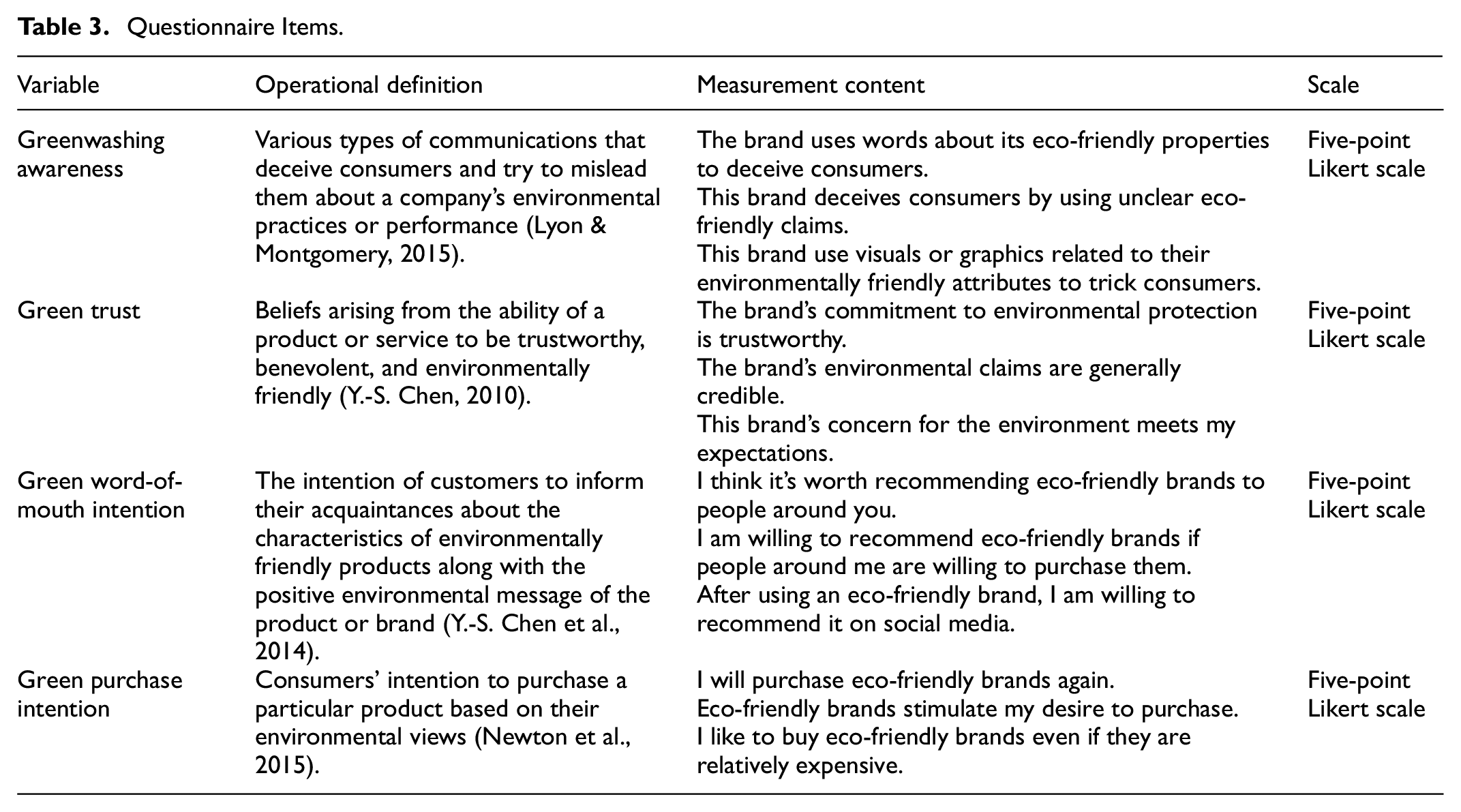
Table 3 presents the operational definitions and measurement of the variables used to verify the research model and test the hypotheses. To measure greenwashing, we used the questions from Y.-S. Chen and Chang (2013). Green trust was measured using the questions from Y.-S. Chen (2010), and green WOM intention was measured using the questions used by Berger and Schwartz (2011) and Lee (2013). The questions used by D. K. Kim et al. (2011) and Morwitz (2014) were adopted to measure green purchase intention. Before data collection, a pilot test was conducted to verify the validity of the measurement instruments. A pilot test was conducted with 20 Korean adults, who were deemed as representative of the target research population. The collected data were analyzed to assess whether the survey questions were clear and easily understood by the respondents. Based on the results of the pilot test, it was determined that no modifications to the survey questions were necessary. Therefore, the primary survey was conducted using the same scale.
Questionnaire Items.
Data Analysis
SPSS 26.0 and AMOS 23.0 were used to test the hypotheses, and the statistical methods were as follows. First, a frequency analysis was conducted to confirm participants’ demographic characteristics. Second, an exploratory factor analysis was conducted to verify the validity of the measurement tool, and Cronbach’s alpha coefficients were derived to evaluate the reliability of the measurement items. Third, descriptive statistics and Spearman’s correlation analyses were conducted to identify the levels of the major variables and confirm the approximate relationships between them. Fourth, to verify convergent and discriminant validity, factor loadings, average variance extracted (AVE), and construct reliability (CR) were calculated through confirmatory factor analysis, and structural equation modeling was used to verify the research hypotheses. Bootstrapping (2,000 times) was performed to verify the mediating effect.
Results
Validity and Reliability of the Measurement Tool
Exploratory factor analysis was conducted to explore the factor structure inherent in the measurement tool. Principal component analysis was applied as the factor extraction method and varimax rotation, a type of orthogonal rotation, was used as the factor rotation method. The minimum factor loading was set at .4 (Ford et al., 1986), and the item internal fit coefficient was calculated to verify the reliability of each variable derived through factor analysis. If the item’s internal fit coefficient was .6 or higher, it was considered acceptable (Nunnally, 1978).
Table 4 shows the results of the exploratory factor analysis. The Kaiser-Meyer-Olkin (KMO) measure, which determines the adequacy of the amount of data, was .865, which was above the minimum standard of .6, and Bartlett’s sphericity test statistic, which determines whether it is a unit matrix, was found to be significant at the 5% level. Therefore, the collected data were suitable for exploratory factor analysis.
Validity and Reliability of the Measurement Tool.

Note 1) Eigenvalue: Used to explain the variance of data; a large eigenvalue indicates that the corresponding principal component explains a large amount of data variation. 2) Average variance extracted (AVE): An indicator used in structural equation models (SEM) that indicates the ratio of the variance of observed variables explained by latent variables. Generally, an AVE value of 0.5 or higher is considered acceptable. 3) Cronbach’s α (Cronbach’s Alpha): Cronbach’s α is an indicator that evaluates the reliability of a questionnaire or test and measures internal consistency. The Cronbach’s α value ranges from 0 to 1, and the closer it is to 1, the higher the reliability. Generally, a value of 0.7 or higher is considered to be highly reliable.
Descriptive Statistics and Correlation Analyses
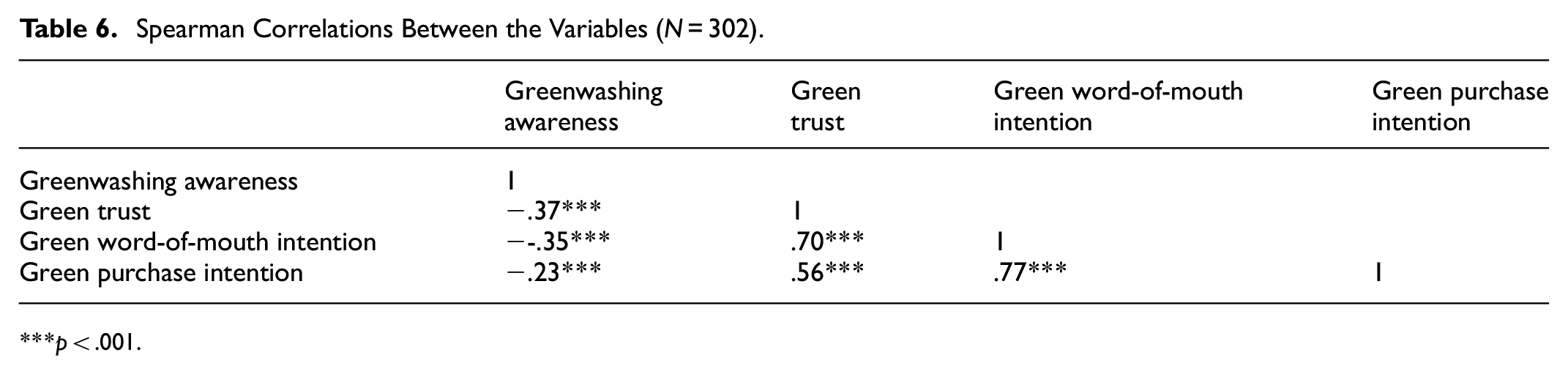
Descriptive statistics and correlation analyses were conducted to verify the hypotheses. Table 5 presents the results of the descriptive statistics analysis, and Table 6 presents the results of the correlation analysis. To verify the general tendency and normality assumption of the main variables in this study, the means and standard deviations of greenwashing, green trust, green WOM intention, and purchase intention were calculated, and the skewness and kurtosis values were examined. The skewness range of the variables was −0.09 to 0.25, and the kurtosis range was −0.34 to 0.05. Since skewness was less than three and kurtosis was less than seven, all variables met the normal distribution assumption (Kline, 2023).
Descriptive Statistics of the Variables (N = 302).

Spearman Correlations Between the Variables (N = 302).
p < .001.
To check the correlation between variables, Spearman product-moment correlation analysis was performed, and the results showed that greenwashing was negatively correlated with green trust (r = −.37, p < .001), green WOM intention (r = −.35, p < .001), and purchase intention (r = −.23, p < .001), green trust was positively correlated with green WOM intention (r = .70, p < .001) and purchase intention (r = .56, p < .001), and green WOM intention was positively correlated with purchase intention (r = .77, p < .001). Since the correlations between all variables were less than .85, it was determined that the possibility of multicollinearity problems was low (Kline, 2023).
Measurement Model Verification
For structural equation modeling analysis, the structural model is generally analyzed after verifying the measurement model. The measurement model analysis confirms that the measurement variable measured the latent variable appropriately, and convergent and discriminant validities are verified. If this analysis is valid, the structural model analysis stage can be performed.
To determine the suitability of the confirmatory factor analysis and structural equation model, the chi-square test statistics, Tucker–Lewis index (TLI), comparative fit index (CFI), root mean square residual (RMR), and root mean square error of approximation (RMSEA) were calculated. The acceptance criteria for goodness of fit are interpreted as an acceptable model when TLI and CFI are .9 or higher, RMR is .08 or lower, and RMSEA is less than .10 (Bentler, 1990; Browne & Cudeck, 1993).
The result of conducting confirmatory factor analysis revealed that the fit of the model fell slightly short of the minimum standards. Therefore, the fit was improved by applying the modification index method, and confirmatory factor analysis was repeated. In other words, the fit index was increased by allowing for covariance between the error variances of the measurement variables, and the analysis was repeated. As shown in Table 7, the fit indices of the modified model were good (TLI = .936, CFI = .961, RMR = .045, and RMSEA = .098), confirming that the model was acceptable.
Goodness-of-Fit Indices of the Measurement Model.

p < .001.
The standardized regression coefficients, AVE and CR, were calculated to verify the convergent and discriminant validities of the measurement model. If the standardized regression coefficients and AVEs are above .5 and the CR is above .7, the convergent validity is interpreted as appropriate (Anderson & Gerbing, 1988). As shown in Table 8, the standardized regression coefficients were .71 to .97, the mean AVEs were .68 to .79, and CR was .86 to .93, confirming convergent validity.
Standardized Regression Coefficients, AVEs, and CR.

The discriminant validity was confirmed. Discriminant validity is secured if the square root of the AVE is higher than the absolute value of the correlation coefficients between the latent variables (Fornell & Larcker, 1981). Table 9 presents the correlation coefficients of the latent variables and square root of the AVE. The square root of AVE was generally higher than the correlation coefficient of the corresponding row and column, partially confirming discriminant validity.
Correlation Coefficients Between the Latent Variables and Square Root of the AVE.

Note. The values in parentheses are the square root of the AVE.
Hypothesis Testing
Structural equation modeling analysis was conducted to verify the model in which green trust and green WOM intention mediated the relationship between greenwashing and green purchase intention. The goodness-of-fit indices of the model were TLI = .936, CFI = .961, RMR = .045, and RMSEA = .098, indicating that the model was acceptable.
Table 10 and Figure 2 present the path coefficients of the research model. Greenwashing awareness was found to negatively affect green trust (β = −.42, p < .001), green WOM intention (β = −.23, p < .001), and green purchase intention (β = −.24, p < .001). Green trust was found to have a positive effect on green WOM intention (β = .72, p < .001) and green purchase intention (β = .46, p < .001). Green WOM intention was found to have a positive effect on green purchase intention (β = .80, p < .001). In other words, higher greenwashing and lower green trust, green WOM intention, and green purchase intention were confirmed. In addition, the higher the green trust, the higher the green WOM intention and purchase intention. Moreover, the higher the green WOM intention, the higher the green purchase intention. Therefore, all of the hypotheses proposed in this study were supported.
Path Coefficients of the Research Model.

p < .001.
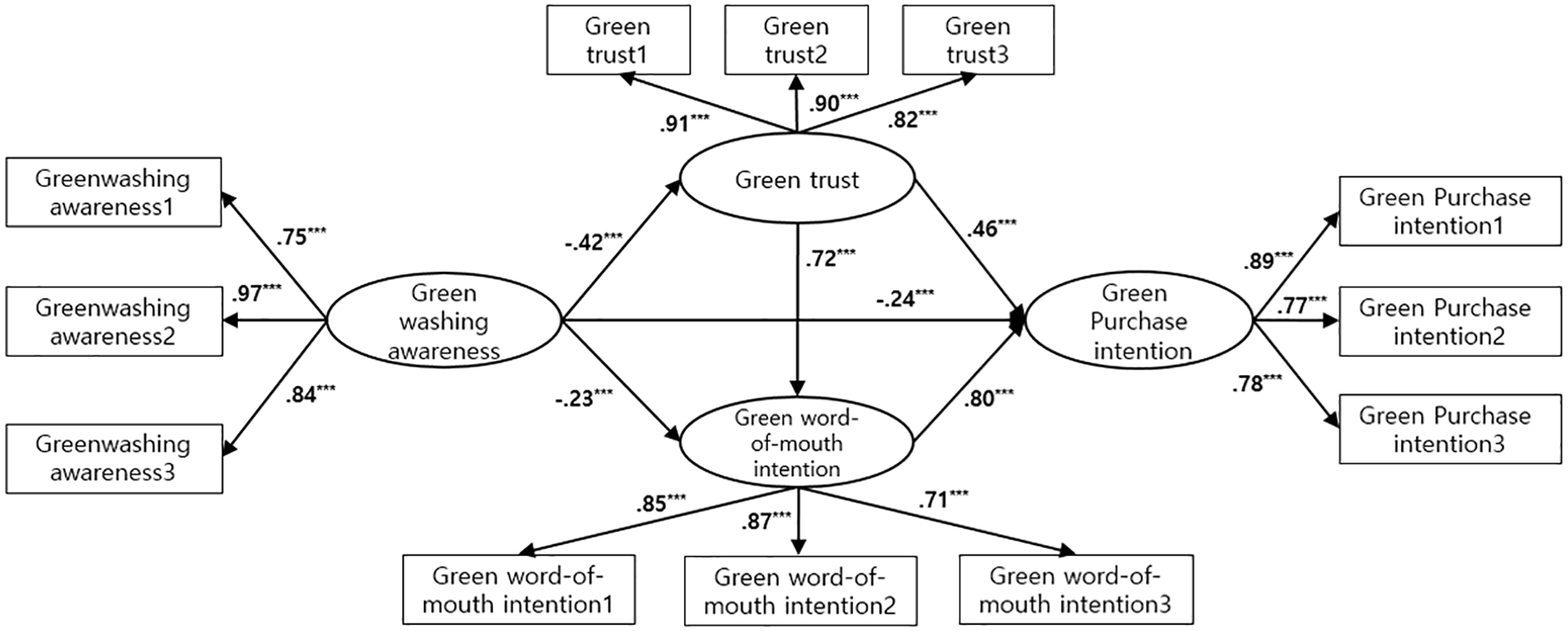
Path coefficients (standardized regression coefficients).
Bootstrapping (2,000 times) was performed to estimate the mediating effect. Table 11 summarizes the results. Three indirect paths were found to be significant: from greenwashing awareness to green purchase intention via green trust (β = .19, p < .001), from greenwashing awareness to green purchase intention via green WOM intention (β = .24, p < .001), and from greenwashing awareness to green purchase intention via green trust and green WOM intention sequentially (β = .18, p < .001).
Verification of the Mediation Effect.

p < .01.***p < .001.
Conclusion
Key Findings
The key findings of this study are as follows: First, increased greenwashing awareness negatively affected green trust, WOM intention, and purchase intention. Second, higher levels of green trust positively influenced both green WOM intention and purchase intention. Third, positive green WOM intention significantly enhanced green purchase intention. Finally, green trust and green WOM intention partially mediated the relationship between greenwashing awareness and green purchase intention. These findings highlight the complex psychological processes that drive consumers’ eco-friendly behaviors and underscore the importance of authentic environmental practices in building consumer trust and promoting sustainable consumption.
Discussion
First, the finding that greenwashing perception negatively affects green trust and purchase intention is consistent with those of previous studies. Y.-S. Chen and Chang (2013) also reported that greenwashing reduces consumers’ green trust and inhibits their green purchase intention. This suggests that consumers’ skeptical attitudes toward a company’s environmental claims may negatively impact the overall green product market.
Second, the finding that green trust has a positive effect on green WOM intention and purchase intention is consistent with the findings of previous studies (Cheung et al., 2015; Guerreiro & Pacheco, 2021; Khan et al., 2023; Wang et al., 2018; Wasaya et al., 2021). This implies that when consumers trust a company’s environmental claims, they are more likely to purchase and recommend it to others. Moreover, it shows that consumers tend to trust the opinions of people around them more than official advertisements when obtaining information about green products.
Third, the finding that green trust and green WOM intention partially mediate the relationship between greenwashing perception and green purchase intention is new and has not been sufficiently addressed in previous studies. This shows that the impact of greenwashing on consumer behavior is not simply direct but operates in a complex manner through the intermediate processes of trust and WOM. These results support the multidimensional impact of greenwashing proposed by Topal et al. (2020) and suggest that corporate environmental communication strategies should move beyond simply emphasizing environmental performance to build consumer trust and induce positive WOM.
Implications
Theoretical Contributions
This study is academically significant in that it provides an important theoretical foundation for understanding consumers’ environmentally friendly behavior by analyzing the impact of greenwashing awareness on their green purchase intention based on the TRA. In particular, it complements the limitations of previous studies that analyzed the path and impact of greenwashing on consumer behavior by verifying and presenting various pathways through which greenwashing perception affects green purchase intention through green trust and WOM intention. In addition, targeting the cosmetics industry, this study provides a specific understanding of a specific industry and product sector by analyzing consumer behavior in an industry where greenwashing problems are particularly serious. This study also provides basic data that can be extended to other industries and product sectors in future studies.
Practical Contributions
This study has important practical implications for both companies and policymakers.
First, companies must adopt strategies to build consumer trust and prevent greenwashing. Companies should actively adopt third-party certifications to increase consumers’ trust in environmental claims made by companies and reduce the risk of greenwashing. Additionally, companies should improve their supply chain transparency as this allows consumers to clearly understand the environmental impacts of the production process, which plays a crucial role in building trust. Finally, companies should invest in sustainable initiatives. Beyond creating an eco-friendly image, investing in environmental protection activities can help build consumer trust and encourage positive WOM.
With regard to policymakers, the following recommendations are made. First, a standardized eco-labeling system should be introduced to help consumers easily understand the environmental impact of products, curb greenwashing, and enable them to make better choices. Secondly, stricter enforcement mechanisms should be implemented to prevent greenwashing. This encourages companies to provide accurate and transparent information while making environmental claims. For example, South Korea can refer to the European Union’s eco-labeling guidelines to introduce more transparent and stringent guidelines and strengthen efforts to prevent greenwashing.
Limitations
Despite these implications, this study has several limitations that must be overcome through follow-up studies. First, the sample was limited to South Korean adults with experience in purchasing eco-friendly cosmetics. This may be relevant to a specific research context, but it has limitations in that the results may not be generalizable to a broader population or to consumers in other cultural or geographical environments. Second, the TRA model was adopted to analyze the impact of consumer behavior on environmental behavior. A research model was established and analyzed using green purchase intention as the final outcome variable. However, other factors, such as price, brand image, and economy, can also significantly influence consumer purchase decisions. Therefore, follow-up research should be conducted to control for the effects of a wider variety of internal and external variables that could affect consumer purchase decisions and obtain comprehensive and reliable research results. Third, consumer behavior can change over time. Therefore, follow-up research that tracks how the environmentally friendly characteristics of products or services influence consumer behavior in the long term is required.
Footnotes

Ethical Considerations
There is no an ethics statement (including the committee approval number) for animal and human studies.
Funding
The author(s) received no financial support for the research, authorship, and/or publication of this article.
Declaration of Conflicting Interests
The author(s) declared no potential conflicts of interest with respect to the research, authorship, and/or publication of this article.
Data Availability Statement
Data sharing not applicable to this article as no datasets were generated or analyzed during the current study.