




Abstract
Larger comparative studies into Europeans’ attitudes toward English are scarce particularly those researching southern-eastern European countries. Thus, the present study explores attitudes toward English among 1,179 respondents in Bosnia and Herzegovina, contrasting two emerging attitudinal clusters. Moreover, the study also compares Bosnians’ attitudes with the attitudes of two other national groups, that is, German and Dutch, from Edwards and Fuchs study. The findings show that younger and better educated Bosnian respondents with higher English proficiency are more favorably inclined toward English, whereas older, less educated Bosnian respondents with lower English proficiency are not as well-disposed toward English and express concerns over its consistent presence. Compared to German and Dutch respondents, Bosnians are less confident about the status of their L1, more deeply engrossed in English and like and prefer using it significantly more than two other national groups. They are exonormatively oriented and aim toward native-like pronunciation.
Plain language summary
The current study explores attitudes toward English in Bosnia and Herzegovina by contrasting two attitudinal groups, that is, English-positive and English-negative groups. Moreover, the study also compares Bosnians’ attitudes with the attitudes of two other national groups, that is, German and Dutch, from Edwards and Fuchs (2018) study. The findings indicate that younger and better educated Bosnian respondents with higher English proficiency are better-disposed toward English, whereas older, less educated Bosnian respondents with lower English proficiency are less favorably inclined toward English and express concerns over its consistent presence. In comparison to German and Dutch respondents, Bosnians are less confident about the status of their L1 and like and prefer using it significantly more than two other national groups. They are exonormatively oriented and aim toward native-like pronunciation. The study’s importance lies in its potential to uncover some hidden language ideologies, reveal a range of English-related identities present in the Bosnian context and establish a link between English-related and national identity.
Keywords
Introduction
English has been deeply ingrained in Europe ever since the 1950s and it has strengthened its presence in various domains and assumed multiple functions, from an instrumental function as a link language through a symbolic function as a marker of status and prestige to an integrative function of identity construction (Berns et al., 2007). Such multifunctionality and its inviolable presence have not always been perceived favorably and attitudes toward this language have been split. Predominantly positive attitudes tend to persist among younger Europeans who consider English indispensable for their global orientation, whereas less favorable attitudes prevail among older Europeans who express concerns about its compelling presence and its impact on the integrity of their native language (Berns et al., 2007; de Bot & Evers, 2007; Edwards, 2016; Edwards & Fuchs, 2018). However, both attitudinal groups see English as a useful and attractive accessory to their L1 and not a threat and they do not seem to echo the opposing voices of policy makers and the media heard in some European countries (Edwards & Fuchs, 2018; Erling, 2004; Flaitz, 1993; Leppänen et al., 2011; Oakes, 2001; Walsh, 2015).
Addressing the “spokesman” issue underlying the question as to who can represent the views of the whole group, Edwards and Fuchs (2018) extensively researched attitudes to English in the Netherlands and Germany. They identified two attitudinal groups per country, an English-positive group and an English-negative group, and concluded that prominent voices widespread in the media and politics against the overwhelming impact of English do not reflect the voices of ordinary people. The present study extends Edwards and Fuchs (2018) research to Bosnia and Herzegovina (B&H) and explores language attitudes among English language (EL) speakers in B&H, comparing them simultaneously with language attitudes persisting in the Netherlands and Germany.
Language Attitudes, Language Ideologies and Identity Construction
Language attitudes, defined as evaluative orientations toward language (Garrett, 2010, p. 20), have been extensively researched (Garrett et al., 2003) and have been established as one of the most essential concepts in social psychology and sociolinguistics (Garrett et al., 2003; McKenzie, 2010). Although more frequently analyzed within social psychology using the tripartite model of attitude structure, namely cognition, affect and behavior (Dragojevic et al., 2021; Fazio & Olson, 2003; Garrett, 2010), language attitudes have also been identified as a central area of research in sociolinguistics and one of the key dimensions in formulating the sociolinguistic theory. They can contribute to directing language planning and framing foreign language policy as well as to determining the extent of language spread and language maintenance (McKenzie, 2010, pp. 37–38). Their importance is particularly recognized in studying the sociolinguistic situation of some understudied countries, as is the case with B&H in the present study.
Research into language attitudes in multilingual settings is inseparable from research into language ideologies and identity (Pavlenko & Blackledge, 2004) and the relationships among these three concepts are even more complex in postmodern societies (Jenkins, 2007). Language ideologies represent an important concept for comprehending the politics of language in multilingual contexts and any exploration of language variation and change (Garrett et al., 2003; McKenzie, 2010). They are understood as “morally and politically loaded representations of the nature, structure, and use of languages in a social world” (Woolard, 2020, p. 1) and are believed to influence, create or reinforce language attitudes (Garrett, 2010).
Identity also plays an important role in the construction of language attitudes (Jenkins, 2007) and the two are found to be closely related in sociolinguistic research (Dailey-O’Cain & Liebscher, 2011). Identity can be broadly defined as “the social positioning of self and other” (Bucholtz & Hall, 2005, p. 586) and it is viewed as an “emergent product” (Bucholtz & Hall, 2005, p. 588) rather than a pre-existing category (Jenkins, 2007). In the approach to identity taken here, identity is not fixed, it is constructed and varies within established contexts. It is not a unique category but multiple identities co-exist and their distribution depends upon their salience (Omoniyi, 2006). According to some research, language attitudes adapt to newly constructed identities (Tong et al., 1999) and every formulation of a new language attitude incorporates the formulation of an individual’s identity (Dailey-O’Cain & Liebscher, 2011).
The process of globalization has led to an unprecedented spread of EL, its linguistic features as well as widely-held and encoded language ideologies related to it (Lin, 2014), and has also caused a change in a range of available “English-related” identities (Pavlenko & Blackledge, 2004) because “national - and individual - identities are often constructed in relation to English as the language of world economy” (Pavlenko & Norton, 2007, p. 594). These English-related language ideologies and the ideologies embedded in the context in question as well as newly constructed and negotiated English-related identities are also believed to shape attitudes toward English in this sociocultural context.
Previous Research Into Attitudes Towards English
Due to its “global inevitability” (Osterhammel & Petersson, 2012, p. 107), English has been at the center of language attitude research (Garrett, 2010) and attitudes toward English as well as attitudes toward its varieties have been systematically explored in different sociocultural contexts (J.-M. Dewaele, 2005; J. Dewaele & Díaz, 2018; Edwards & Fuchs, 2018; Erling, 2004; Gnutzmann et al., 2015). The findings emerging from the data largely converge and point to a greater preference for native rather than non-native varieties and predominantly favorable attitudes toward English in general. Thus, in Denmark and Finland, English is considered a key to internationalization and attracts positive and pragmatic, but also fairly relaxed attitudes (Leppänen et al., 2011; Preisler, 2003). The Finns from Leppänen et al.’s (2011) study believe that English skills are necessary for full participation in the Finnish society, but they also express confidence in the stability and vitality of their L1s. English has high prestige among Danes as well, but, according to Preisler (2003), it enters the Danish society largely through Anglo-American youth subcultures, which he refers to as the English-from-below ideology.
Young people in France also have rather positive attitudes toward English and do not resonate firmly embedded language ideologies expressed by the creators of official language planning measures (Walsh, 2015). The discrepancy between people’s and policy makers’ attitudes also exists in Germany (Erling, 2004) and the Netherlands (Edwards & Fuchs, 2018). German university students value English highly and use it daily, but still deem their L1 very important as their national language (Erling, 2004; Gnutzmann et al., 2015), and dismiss the idea that English determines their identity. The Dutch explicitly and implicitly position English as “a purely utilitarian tool for international communication” (Edwards, 2018, p. 163), but also use it as an additional means of identity expression, the youth in particular (Edwards, 2016, 2018), and generally do not seem to be concerned over the rise of English and its threat to their L1 (van Oostendorp, 2012).
Still, despite the fact that attitudes to English are predominantly positive around Europe, different clusters were observed in many attitudinal studies. In Denmark, Preisler (2003) makes a distinction between the “English-haves,” a larger group, and the “English-have-nots,” a smaller group of respondents with little or no EL knowledge. Despite their lack of proficiency, the English “have-nots,” as well as the English “haves,” are rather positive about English. More recently, an additional group of highly proficient, young pro-English and English-oriented respondents surfaced in Finland and the Netherlands (Edwards, 2016; Leppänen et al., 2011). Thus, Leppänen et al. (2011) introduced three distinct groups of respondents, older less proficient Finns who use English rarely and to whom English means very little (the “have-nots,” 6%), the major group of respondents (78%) or the “haves,” who have moderate attitudes toward English and the youth population and young educated adults in favor of English who have high proficiency and use English daily (the “have-it-alls,” 16%). Along the same lines, Edwards (2016, pp. 101–104) identified three groups of Dutch speakers, the largest instrumental group of highly proficient English-positive respondents (around 70%) and two marginal groups, the anti-English group who resent having to use English, and the anglophile group of respondents who use English in every possible situation and rate it as more important than their L1. Edwards and Fuchs (2018) built upon Edwards (2016) research and conducted a cross-country study with the Dutch and German data. They determined two attitudinal groups per country, a more positive group consisting of younger, urban, better educated and more proficient respondents and a predominantly negative group encompassing older, less urban, less highly educated and less proficient respondents.
The Current Study
The current study aims to determine typical clusters of attitudes to English shared by Bosnian respondents and probe further into intra-country differences. It simultaneously compares the Bosnian data with the Dutch and German data collected by Edwards and Fuchs earlier (Edwards & Fuchs, 2018, 2019) to come to specific conclusions regarding the inter-country differences. No new German and Dutch data sets were collected, but the old data sets were, with the permission of the authors of these studies, reanalyzed for the purposes of the current study so that the Bosnian data could be systematically compared to the German and Dutch data and broader inter-country differences highlighted. The study is particularly compelling because it compares three countries designated as belonging to three different zones in Europe established based on the status of English, widespread competence and its use (Mollin, 2019). Thus, the Netherlands belongs to the countries with the highest proficiency and widespread everyday usage (over 70%), Germany to the countries with high proficiency and more than 50% of population able to converse in English, while B&H is grouped with Eastern European countries where English competence is not so widespread especially among older people and the position of English is frequently threatened by other foreign languages, but English is very common among the youth who are eager to be like their European peers in terms of their EL competence (Mollin, 2019, pp. 36–41).
English is recognized as an expanding circle variety (Kachru, 1992) in B&H and attitudes toward English still tend to be exonormative or native-oriented (Brdarević-Čeljo & Dubravac, 2022). It is the first foreign language children come in contact with in the pre-school period and it is firmly established as an obligatory subject and the most studied foreign language in primary and secondary education (Dubravac & Brdarević-Čeljo, 2024). B&H children spend 11 to 13 years studying English formally through school before the onset of university-level education, with the annual instruction time being roughly 70 and 105 hr in primary and secondary education respectively. English is also frequently used as a means of instruction in newly opened bilingual schools and universities in the last few decades (Dubravac & Brdarević-Čeljo, 2024). It is highly prevalent in science and Bosnian scholars recognize the importance of publishing in English to disseminate their results more widely (Dubravac & Brdarević-Čeljo, 2024).
Besides the domain of education, the internet, TV, and print media also present sources of everyday exposure to English. In B&H, English TV programs are subtitled, a practice considered an important aspect facilitating informal EL acquisition and ensuring a direct, daily contact with English (Verspoor et al., 2011). Print media, the internet and social networks are also valuable sources of direct contact with English. The Bosnian youth are common English-language users on social networks (Dubravac & Skopljak, 2020) and they frequently alternate between their L1 and English easily and creatively. English borrowings are largely present in the print media (Dubravac, 2016) and the linguistic landscape of B&H is also shaped by English and it is the most frequent foreign language especially on unofficial signage and in advertising and business domains (Tankosić & Litzenberg, 2021).
Thus, in this sociocultural context, English is ideologically constructed as a global language and an indispensable means for global communication (Ajšić, 2016) and the most commonly assumed English-related identity is the identity of citizens of the world (Pavlenko & Norton, 2007) or global citizens (Darvin & Norton, 2015), as observed in some previous studies (Dubravac & Skopljak, 2020). The English language is conceptualized as an international “high” variety employed in the domains of prestige, such as higher education, business, media, foreign affairs (Ajšić, 2016, pp. 192–196) and high proficiency in English is equated with individual and collective accomplishment and progress, while low or a lack of proficiency is linked to “failure and backwardness” (Ajšić, 2016, p. 197). The ideology of monolingualism, embedded in the standard language ideology, seems to prevail in this sociocultural context (Ajšić, 2016) and monolingual interaction in either standard English variety or standard L1 variety is preferred, which is visible through the discourse of binary linguistic identities frequently present in the Bosnian media (Ajšić, 2016, p. 192). Despite its widespreadness, this ideology of monolingualism is not adopted by all generations and in all domains in this sociocultural context. Thus, experienced young multilinguals do tend to use English intranationally and mix it with their L1 particularly in peer interactions, not only for conveying a message but also for identity construction and expression (Dubravac & Skopljak, 2020).
The pervasiveness of English is not looked upon disapprovingly in B&H and no policy makers, language experts or any organizations seem to adopt a critical stance on the strong presence of English. The ideology of endangerment attested in other European countries seems to be absent in this sociocultural context (Ajšić, 2016) and English is not seen as a threat. In the introduction to the edited volume on the status of English in B&H, Buckingham (2016) also touched upon this relatively relaxed stance on the general adoption of English and said that few studies problematize the general adoption of English, which is “may surprise readers accustomed to a more critical stance on geopolitical issues related to the positioning of the English language” (p. 4). Such a relaxed stance is sometimes assigned to a rather intricate linguistic situation in this area, where three fairly similar official languages exist side by side and are selected as natives along the ethnic dimension (Greenberg, 2004). Thus, speakers of these official languages tend to be more cautious of the impact of the neighboring official language than of the impact of the geographically distant but powerful English language (Katnić-Bakaršić, 2009, p. 79), which facilitates its rapid spread.
A comparison of the sociolinguistic situation in B&H, on the one hand, and Germany and the Netherlands, on the other hand, shows marked variation in terms of the presence of English, EL proficiency and frequency of its usage as well as in-country language policies. Such variation is also noticeable in intra-country comparisons and different groups of English users exist in B&H. These differences are expected to be directly reflected in attitudes toward English, an additional profile dimension worth further exploration in a systematic comparative study. In the present study, we set out to determine the number of attitudinal groups in B&H, probe into within-country and cross-country attitudinal differences and ultimately develop individual sociodemographic profiles of two clustered groups. Thus, based on the adopted approach, the following research questions will be explored further:
How many attitudinal groups can be formed in B&H?
How do Bosnian attitudinal groups differ in terms of their use of English, the status of English and exonormative orientation?
How do Bosnian respondents differ from German and Dutch respondents in terms of their attitudes toward the use of English, status of English and exonormative orientation?
What is the sociodemographic profile of both Bosnian attitudinal groups in terms of age, gender, proficiency, level of education, and language used in higher education and how do these groups differ in this respect from German and Dutch attitudinal groups?
Methodology
Respondents
The sample for the current study comprised 1,179 respondents from B&H. Additionally, 1992 respondents from Germany and 1997 respondents from the Netherlands were also included in the current study for the purpose of conducting a cross-country comparative study and coming to specific conclusions regarding inter-country differences. The data related to German and Dutch respondents were not collected by the author of the current study, but were given access to by Edwards (2016) and Edwards and Fuchs (2018), and were reanalyzed for the purpose of the current study.
The Bosnian respondents’ age ranged from 15 to 93, with the mean value of 31.5 (M = 31.5, SD = 10.2) and more women filled in the questionnaire than men (BH F = 75.2%). Over 90% of Bosnian respondents reported having at least “reasonable” EL proficiency (BH N = 92.1%) and more than 50% reported being fluent in English (BH N = 51.3%). Over 50% of Bosnian respondents were highly-educated, 54% of them studied in their national language, while 16.7% of them studied entirely in English. The demographic data indicate that Bosnian respondents were young, predominantly female and mainly highly-educated, which might have impacted the study’s results.
When compared to the respondents from Germany and the Netherlands, Bosnian respondents were on average younger than German and Dutch respondents (GRM M = 40.7, SD = 16.1; and NL M = 44.07, SD = 16.8) and the Bosnian data set had the largest proportion of women when compared to the German and Dutch data sets (GRM F = 52.9%; NL F = 56.4%). More Bosnian and Dutch respondents (N =98.1%) reported having at least reasonable EL proficiency than German respondents (N = 81%), while Bosnian respondents reported being less fluent than German and Dutch respondents (GRM N = 58.1%; NL N = 70.3%), Dutch respondents being the most fluent of all. Bosnian respondents were less highly-educated than German or Dutch respondents, and more respondents from Bosnia studied at a university where English is employed as a means of education than from two other countries (BH F = 16.7%; GRM F = 7%; NL F = 12.4%) (see Table 1).
Socio-demographic Variables.

Instrument
The research instrument was originally developed and employed in Edwards (2016) for collecting the Dutch data, and was later reused in Edwards and Fuchs (2018, 2019) for collecting the German data for the purpose of German-Dutch comparative analysis. The same research instrument was translated into Bosnian, adapted to fit the Bosnian context and used to retrieve the Bosnian data. The questionnaire was distributed online in B&H using the Google form and it was available for the period of 9 months in 2019. Bosnian respondents were recruited by snowball sampling, a chain-referral method (Edwards, 2016) and the questionnaire was disseminated through the author’s personal contacts who agreed to send it to their contacts in turn, and through some public social network groups as well. The Bosnian data collected for the purpose of the current study were analyzed for intra-country differences and then complemented by the German and Dutch data and compared with these data sets in the present three-way cross-country comparative study.
The questionnaire consisted of two parts. The first part collected the demographic data, namely gender, age, nationality, education level, the information about the respondents’ first language, their self-reported EL proficiency level and language of instruction in higher education. The second part collected responses to attitudinal statements on a four-point Likert scale ranging from strongly disagree to strongly agree, as well as to statements measuring code-switching frequency on a four-point scale ranging from never to often. The statements were meaningfully classified into three groups similarly as in Edwards and Fuchs (2018), the first one concerning the use of English and code-switching frequency, the second one concerning the status of English and the third one related to the respondents’ attitudes toward exonormativity. The first set of statements included statements expressing appreciation of or resentment at using English, preferences toward using English and the respondents’ personal behaviors and feelings evoked when using English, such as “I like using English,”“I prefer using Bosnian in most situations, whenever possible,” and others. The first set of statements also incorporated the statement about the code-switching frequency in which the respondents were asked to mark to what extent they use English words when speaking Bosnian with different interlocuters. The second set measured the respondents’ perceptions of the status of English especially in relation to their native language, and it contained statements such as “English is very important to me personally,”“For Bosnians, Bosnian is more important than English” and some others. The third set of statements encompassed items measuring the respondents’ attitudes toward exonormativity, such as “When I speak English to the outsiders, they should not be able to recognize where I’m from” and “As long as my English is good, I don’t mind if it has a bit of Bosnian flavor.” In the original questionnaire, the third set also contained a statement measuring the respondents’ attitudes toward their local varieties of English, namely “Gerlish/Dunglish is bad English” and the equivalent statement was also inserted in the Bosnian questionnaire as “Boslish, the Bosnian variety of English, is bad English.” However, due to low reliability of the third set (see the reliability scores reported below), this statement was eventually removed from the analysis. Edwards and Fuchs (2018) also pointed out some inconsistencies in the findings related to this statement and they attributed these to the phrasing of the statement in the German questionnaire.
We examined the Cronbach’s alpha coefficient to check the internal consistency of the overall questionnaire as well as of each group of statements. The coefficient for the overall scale was α = .82 (24 statements), which indicates high reliability (Ekolu & Quainoo, 2019; Taber, 2018). The individual scales’ coefficient ranged from moderate/acceptable for the use of English α = .80 (13 statements) and the status of English α = .59 (9 statements) to low for the third scale measuring exonormative orientation α = .46 (2 statements) (Ekolu & Quainoo, 2019). In the original questionnaire, the third scale contained an additional statement on attitudes toward local varieties. When Cronbach’s alpha was measured for this three-item scale, the coefficient was very low. Thus, we removed this item from the final analysis and the coefficient measured for the two remaining scales was α = .46, which can be considered acceptable (Taber, 2018) particularly due to the fact that it consisted of only two items and short scales lead to a small Cronbach’s alpha coefficient (Pallant, 2007). Still, following the recommendations provided in Pallant (2007), we measured the mean inter-item correlation for these two items and the correlation coefficient was .29, which is considered optimal according to Briggs and Cheek (1986).
To investigate the instrument’s validity, the expert judgment approach was employed. Thus, three Bosnian experts in sociolinguistics were consulted and they offered some useful suggestions regarding the exact phrasing of the statements in the Bosnian questionnaire, particularly the statement on attitudes toward the local English variety.
Procedure
The analysis was conducted using the statistical program SPSS Statistics version 25, by applying descriptive statistics, two-step clustering analysis, ANOVA and a Chi-square Test. The first step in the procedure was to subdivide the respondents into homogeneous groups based on their response scores for attitudinal variables using the two-step cluster procedure with the maximum number of iterations being 10. The purpose behind adopting the clustering procedure was to identify groups of people with similar attitudes toward English. Due to the fact that the optimal number of clusters for both German and Dutch groups proved to be two (Edwards & Fuchs, 2018), we specified the wanted number of clusters for the Bosnian group to be two so that direct and broad cross-country comparisons could be drawn. In the first step of the procedure, we assigned cases to “preclusters,” and in the second step we clustered the ’preclusters’ by applying the hierarchical clustering algorithm. In the end, two clusters were also identified for B&H.
To examine each group’s attitudes, one-way analysis of variance (ANOVA) was applied followed by Tukey’s test, a post hoc test used for the comparison of the groups’ means measured on each attitudinal variable. Initially, we compared Bosnian respondents’ attitudes. Since the clustering analysis grouped respondents with similar attitudes, we expected to find significant differences there. We also compared cross-country positive groups and cross-country negative groups to explore to what extent positive and negative Bosnian respondents are similar or different from the respondents from two other countries.
The previously specified group sets were also compared based on their sociodemographic characteristics (age, gender, proficiency, level of education, and language used in higher education). ANOVA and Tukey’s post hoc tests were employed to compare the means on the continuous variables age and proficiency, while the Chi-square test was applied to compare the distribution on the categorical variables, gender, education level, and higher education language.
Results
Attitudinal Groups
Two attitudinal groups were identified for B&H applying the clustering procedure, namely BH1 and BH2, and two attitudinal groups were also reaffirmed for the reanalyzed German and Dutch data, namely GRM1 and GRM2 (for Germany), and NL1 and NL2 (for the Netherlands). The first groups (BH1, GRM1 and NL1) were generally well-disposed toward English and had rather positive attitudes toward it (M > 2.5), whereas the second groups (BH2, GRM2 and NL2) were not so favorably inclined toward English and tended to share more negative attitudes toward it (M < 2.5). The value of 2.5 was used as a midway cut-off point on the 4-point scale, which is aligned with the original questionnaire from Edwards and Fuchs (2018).
Inter-Country and Cross-Country Differences in Terms of Attitudinal Variables
Use of English
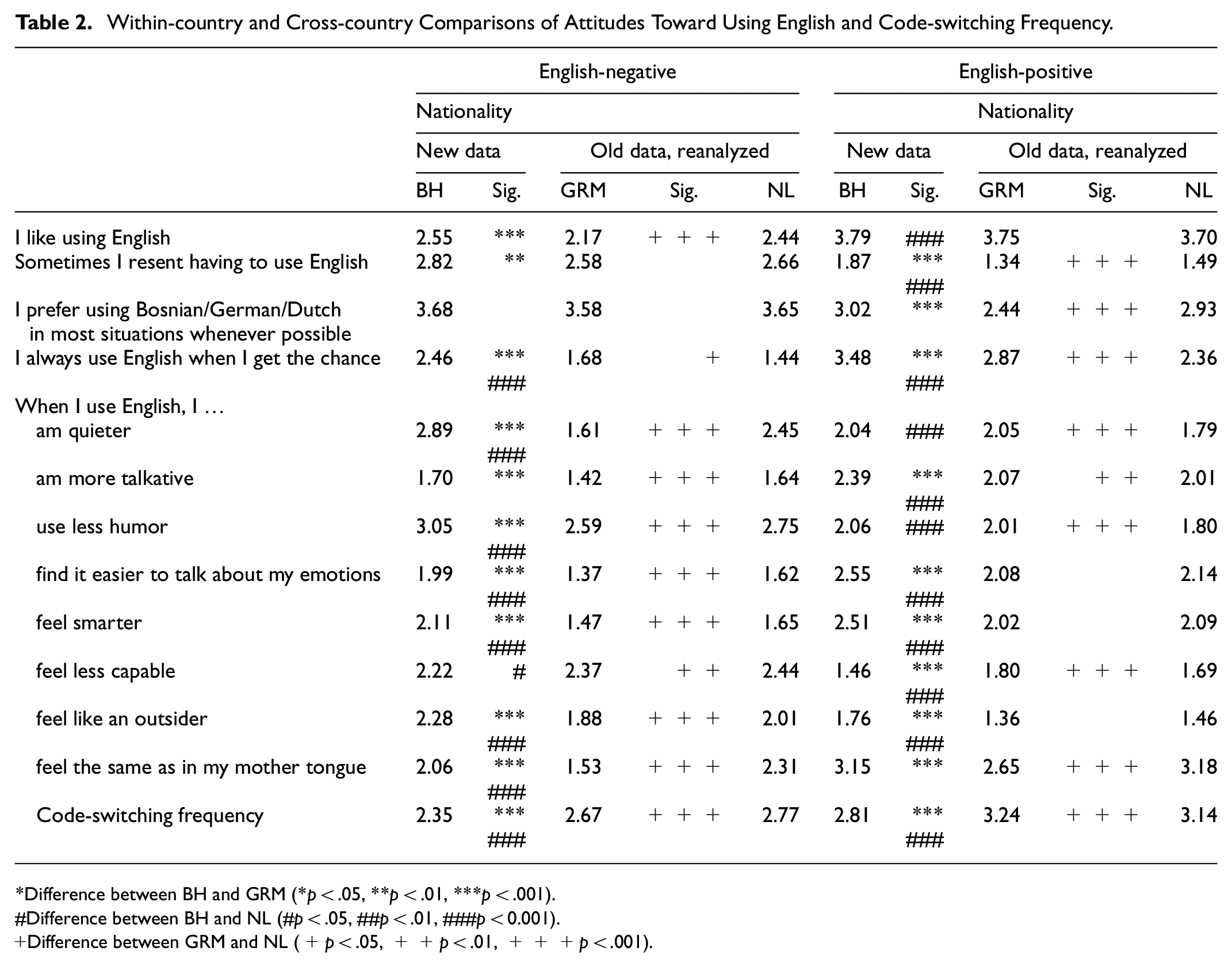
The positive Bosnian group demonstrated a particularly strong liking for using English (M = 3.79) and they stated they liked using it most, significantly more than the positive Dutch group (M = 3.70, p < .001) and insignificantly more than the positive German group (M = 3.75). They did not resent having to use English (M = 1.87), but they least strongly disagreed with the statement when compared to positive German (M = 1.34) and Dutch groups respectively (M = 1.49). Positive respondents from all three countries also preferred using their local languages whenever possible, but reported always using English when they got a chance. Still, Bosnian respondents expressed the strongest preference for the usage of their local language in most situations (M = 3.02), and they as well as Dutch respondents preferred using it whenever possible significantly more frequently than German respondents, who even tended to mildly disagree with that statement (M = 2.44). The preference for local language over English among positive Bosnian respondents could be assigned to their linguistic insecurity triggered by their moderate levels of EL proficiency. Bosnians experience anxiety when they need to use English (cf. Ahmetović et al., 2020, p. 276) because they are unsure as to whether their usage conforms to the norm, which is a reflection of a dominant ideology of monolingualism based on standard language prestige and a discourse of measurable language proficiency (Ajšić, 2016) deeply rooted in this sociocultural context. The ideology of monolingualism also resurfaced through the respondents’ reported code-switching frequency. The positive Bosnian group (M = 2.81) stated that they tended to code-switch significantly less frequently than the Dutch positive group (M = 3.14) and the German positive group (M = 3.24), which might suggest that Bosnians view code-switching as a sign of a lack of competence rather than as a sign of linguistic creativity to a larger extent than the respondents from two other groups. Such a low tendency to code-switch among Bosnian respondents was also observed in some previous studies conducted in this sociocultural context (Brdarević-Čeljo et al., 2021), where Bosnian respondents’ code-switching frequency was low to moderate. This unwillingness to code-switch to a large extent might be attributed to Bosnians’ positioning of English as the language of the different other and the spreading of the discourse of “binary linguistic identities” as well as the discourse of “discrete linguistic codes and associated monolingual ethnocultural identities,” as observed in Ajšić (2016, p. 189).
On the other hand, Bosnian respondents stated that they most frequently used English when they got a chance (M = 3.48), significantly more than the positive German (M = 2.87) or Dutch group (M = 2.36) who even slightly disagreed with the statement. Such a frequent use of English by the positive Bosnian group might indicate that Bosnians tend to exploit every real-life situation to express themselves in English so that they can practice their language skills and acquire greater English fluency (cf. Ahmetović et al., 2020). Such an alleged frequent use of English in the Bosnian context reveals a prevalent ideology of the indispensability of English for global communication (Ajšić, 2016) and the conceptualization of high English proficiency as a pre-requisite for individual and societal progress. The awareness of the indispensability of English among Bosnian respondents resulted in their development of the identity of citizens of the world (Pavlenko & Norton, 2007), the identity option frequently assumed in the context of non-postcolonial countries.
Rather interestingly, positive Bosnian respondents also confirmed that they did not feel differently when using English and their L1. Thus, they strongly agreed that when they used English, they felt the same as when using their mother tongue (M = 3.15), they did not use less humor (M = 2.06), they were not quieter (M = 2.04) and they did not feel like outsiders (M = 1.76) or less capable (M = 1.46). They also claimed not to be more talkative when using English (M = 2.39), though the mean value for this response was close to the midway cut-off point, which might be a result of their previously expressed willingness to practice English at every available opportunity. The cross-country data comparison revealed similarities among the countries’ positive respondents who all seemed to maintain their identity when using English, though the positive Bosnian and Dutch groups identified with English and use it as an identity marker to a larger extent than the positive German group. Still, only positive Bosnian respondents mildly agreed that they felt smarter (M = 2.51) or found it easier to talk about their emotions (M = 2.55) when using English and they confirmed this statement to a significantly larger extent than positive German or Dutch respondents, who disagreed with the statements. The difference might be attributed to the fact that Bosnian society is largely monolingual and English proficiency is much less widespread than in the other two European countries (Mollin, 2019). Thus, English is valued as a symbol of individual and social prestige, English users are generally seen as more competent than its nonusers who are frequently thought of being backward and not very competitive in the job market. On the other hand, Bosnians’ ability to verbalize their emotions better in English than in Bosnian might indicate that English is slowly becoming an important factor in the construction of their identity, which is particularly common among the youth (Dubravac & Skopljak, 2020).
The negative groups liked using English significantly less than the positive groups. Still, the negative Bosnian group felt somewhat positive about using English and they expressed mild agreement (M = 2.55). Their mean value did not significantly differ from the mean value of the negative Dutch group (M = 2.44), but both groups, the negative Bosnian and the negative Dutch group, felt significantly more positive about using English than the negative German group. On the other hand, the negative Bosnian group (M = 2.46) reported using English significantly more frequently than the negative German (M = 1.68) or Dutch group (M = 1.44), and, rather interestingly, even more frequently than the positive Dutch group (M = 2.36). Slightly positive attachment to English among negative Bosnian respondents reaffirms the existence of strong ideologies of indispensability of English and the necessity of English proficiency in this context. Such findings might also suggest that English has assumed a firmer instrumental function in B&H than in two other countries. However, positive attachment to English among negative Bosnian respondents might also be related to the fact that the Bosnian sample was overall younger than the German or Dutch samples and younger people are generally better-disposed toward English than the older population.
Negative Bosnian respondents also expressed slight resentment at having to use English (M = 2.82) and strong preference for their local language in most situations (M = 3.68). The results for the negative German and Dutch groups were similar and both groups also sometimes resented having to use English (M < 2.66) and preferred using their local languages whenever possible (M < 3.65), agreeing with the statements slightly less readily than Bosnian respondents. The resentment at having to use English and preference for local language among negative Bosnian respondents could also be explained by their lower EL proficiency which triggers linguistic insecurity and speaking anxiety and sometimes even leads to self-deprecation. Due to the prevailing standard language ideology and the presence of the discourse of measurable language proficiency (Ajšić, 2016) with constant reference to EL proficiency as either high or low and to low proficiency as non-success, negative Bosnian respondents feel more comfortable using their mother tongue and do not feel comfortable using English in some situations, particularly in the domains of prestige.
Moreover, when expressing themselves in English, the negative Bosnian group did not feel the same as when they used their mother tongue (M = 2.06, <2.5). When using English, they did not confirm feeling smarter (M = 2.11, <2.5) or less capable (M =2.22, <2.5) or like outsiders (M = 2.28, <2.5), they were not more talkative (M = 1.70), they were less humorous (M = 3.05) and they did not find it easier to talk about their emotions (M = 1.99). Among the three negative groups, only the negative Bosnian group confirmed being quieter when using English (M = 2.89), which was aligned with their responses to some other questions and revealed their linguistic insecurity and a lack of confidence surrounding their language use. The negative Bosnian group also reported the lowest code-switching frequency (M = 2.35), which showed that both Bosnian groups code-switched significantly less frequently than both German and Dutch groups. This might indicate that Bosnian respondents, irrespective of their attitudes, assume binary linguistic identities and value both languages but seek to keep them apart in everyday usage to a larger extent than German and Dutch respondents. The Bosnian groups’ strongest preference for their L1 and the highest frequency of using English whenever there is a chance and at the same time the lowest self-reported code-switching frequency reaffirm the previous claim that Bosnians’ use of English is more linked to instrumental factors, such as education, employment and promotion, rather than to other integrative factors. Such a use is more common among EFL than ESL learners (Edwards, 2016) and these findings further confirm a solid EFL status of English in B&H. The results seem to indicate that English is used for integrative purposes slightly more frequently in the Netherland and Germany than in B&H, which has led some authors to raise the question of its potential transitioning from an EFL to ESL status in these two countries (cf. Edwards, 2016; Hilgendorf, 2005, 2007; Mollin, 2019).
Within country differences in terms of Bosnians’ attitudes toward the use of English and code-switching frequency were statistically significant for every statement, which indicates that the respondents have more in common with the respondents from two other countries with whom they share similar attitudes than with the respondents from a different attitudinal group from their own country. Overall, positive perceptions of English in general and English competence, a lack of resentment at having to use English, and identification with English are much more present among positive respondents across all national groups than among negative respondents. Positive Bosnian respondents also reported code-switching significantly more frequently than negative Bosnian respondents whose code-switching frequency range was even below the split point. Such moderate code-switching frequency could be explained by the fact that negative Bosnian respondents are on average older than positive Bosnian respondents. They are more conscious of their ethnolinguistic identity and assume binary linguistic identities more firmly and thus tend to avoid mixing the two languages and keep their L1 separate from English (Brdarević-Čeljo et al., 2021). Negative respondents are also less proficient in English, which might impact their lower code-switching frequency since code-switching entails creative language usage common for more proficient language speakers (see Table 2).
Within-country and Cross-country Comparisons of Attitudes Toward Using English and Code-switching Frequency.
Difference between BH and GRM (*p < .05, **p < .01, ***p < .001).
Difference between BH and NL (#p < .05, ##p < .01, ###p < 0.001).
Difference between GRM and NL (+p < .05, ++p < .01, +++p < .001).
Status of English
The positive Bosnian group considered English highly important (M = 3.76), but did not believe that English enjoyed a higher status in B&H than Bosnian (M = 2.00). They did believe that speaking both Bosnian and English was an advantage (M = 3.87), but considered Bosnian more important for Bosnians than English (M = 3.01). They did not think that English skills were overrated (M = 1.91) or that English was a threat to their L1 (M = 1.62) and they strongly believed that English offered advantages in seeking good job opportunities (M = 3.82), but also agreed that it would be hard to get a job in B&H without the knowledge of Bosnian (M = 3.24). Rather interestingly, most positive Bosnian group’s responses significantly differed from the other two positive groups’ responses. Thus, positive Bosnian respondents attached English more importance and agreed significantly more strongly that English offered advantages in seeking good job opportunities (p < .001) than both German (M = 3.64) or Dutch (M = 3.61) respondents, and were also most certain that it would not be hard to get a job in B&H even without knowing Bosnian. Positive Bosnian respondents also felt significantly less certain about the status of their L1 than both positive German (M = 3.23) or Dutch respondents (M = 3.30). As for the impact of English on their L1, the positive groups only mildly agreed that English enriched their mother tongues (M > 2.51) with the positive Bosnian group being significantly less sure about that than two other national groups.
When these results are observed in their entirety, positive Bosnian respondents emerge as more confident in the status of English and less confident in the status of their own L1, which is aligned with the sociocultural nature of the context in question. Such a high regard for English among Bosnian respondents is a reflection of the prevalent ideology of the indispensability of English and the necessity of EL competence for individual and societal progress. B&H is a small country with high unemployment rate and constant ethnic tensions and many of its residents are internationally oriented and see English as a pass which will ensure high-paid employment and better living conditions. In addition to this, a rather intricate linguistic situation in this area related to the positioning of three official languages contributes to the firm positioning of English and high regard for that language.
Even negative Bosnian respondents found English very important personally (M = 2.84), and, similarly to positive respondents, they emphasized the importance of English (M = 2.84) significantly more strongly than the other negative groups, which demonstrates that, irrespective of their attitudes, Bosnians deem English very important. Negative Bosnian respondents also strongly agreed that speaking both languages was an advantage (M = 3.63), but still found their L1 more important than English (M = 3.00) and disagreed that English has a higher status than their L1 in their countries (M = 2.02). The responses to these two questions were insignificantly different and almost identical in both attitudinal groups in B&H, which further confirms that both positive and negative Bosnian respondents are least confident about the status of their L1 of all the respondents. This was further substantiated by the fact that negative Bosnian respondents least strongly agreed that finding a job without knowing Bosnian was hard (M = 2.99), significantly less strongly than negative German (M = 3.65) and negative Dutch (M = 3.53) respondents, and confirmed that English offered advantages in seeking good job opportunities significantly more strongly than two other groups. Of all the respondents, negative Bosnian respondents most strongly disagreed that English skills were overrated (M = 2.29) or that English was a threat to their mother tongue (M = 2.11). Thus, differently from positive groups, negative groups did not believe that English enriched their mother tongues, and negative Bosnian respondents were most confident about that, which is in line with an earlier claim that Bosnians try to keep the two languages apart.
Though positive and negative Bosnian groups differed significantly in their responses to most of the statements concerning the general status of English, the responses to two statements about the importance of Bosnian and the status of English in B&H proved insignificant, as specified earlier. Still, the overall results concerning the status of English further accentuated the existing dissimilarity between two groups within one country and the respondents’ closer similarity to the respondents from other countries than to their compatriots (see Table 3).
Attitudes Toward the Status of English.

Difference between BH and GRM (*p < .05, **p < .01, ***p < .001).
Difference between BH and NL (#p < .05,## p < .01, ###p < 0.001).
Difference between GRM and NL (+p < .05, ++p < .01, +++p < .001).
The ideology of endangerment was rejected by both positive and negative respondents from all three countries as none of the respondents considered English a threat to their L1. Despite the presence of the ideology of endangerment in the media and political establishment in Germany and the Netherlands, German and Dutch respondents do not think their L1s are threatened by English and they value them highly and realize and assert their importance for their national identity. This is aligned with some previous studies which also pointed to the discrepancy between people’s and policy makers’ voices (Erling, 2004; Flaitz, 1993; Leppänen et al., 2011). The ideology of endangerment was not attested in the Bosnian context either among the current study respondents or among politicians, policy makers or in the media as observed earlier (Ajšić, 2016; Buckingham, 2016) and the respondents even showed deeper appreciation of English and less appreciation and recognition of the importance of their L1 than the respondents from two other countries. Ajšić (2016, p. 197) even puts forward an interesting claim about the reversed ideology of endangerment in the Bosnian context saying that English rather than Bosnian “is endangered by low standards and whose low standards are a danger to societal progress.”
Exonormative Orientation
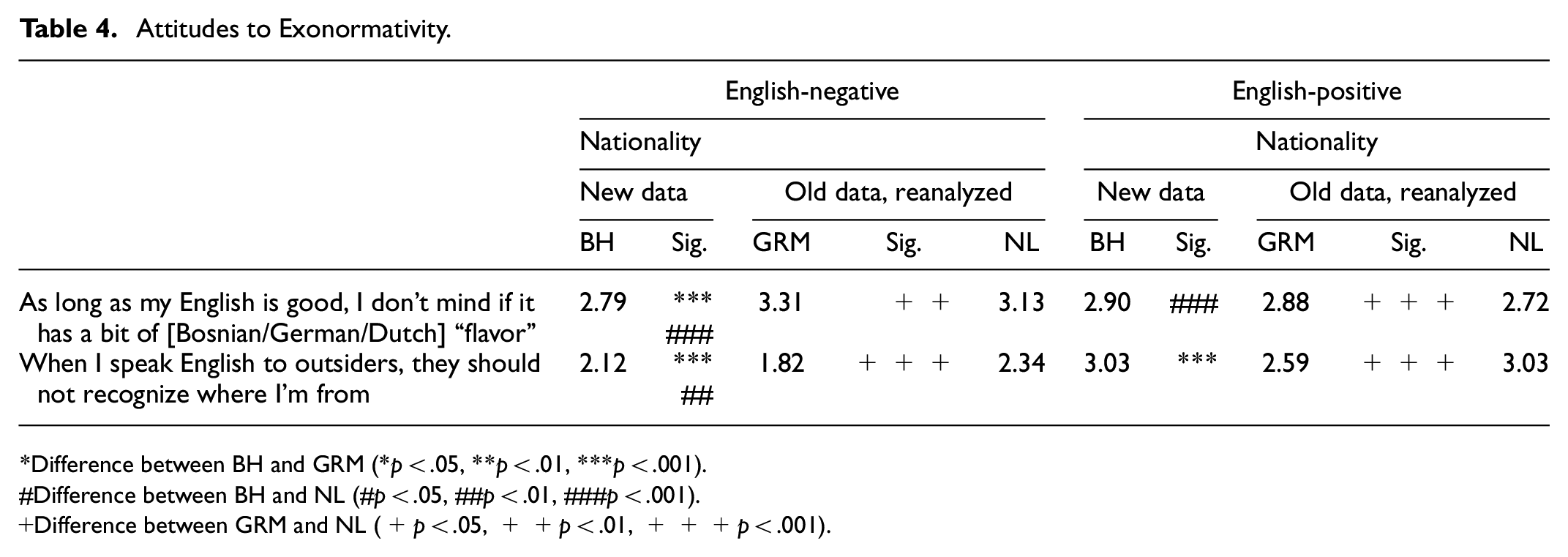
Positive Bosnian respondents expressed stronger exonormative attitudes than negative Bosnian respondents, as they tended to agree (M = 3.03) that outsiders should not be able to recognize where they come from based on their English, whereas negative respondents tended to disagree with that statement (M = 2.12). Still, the positive and negative Bosnian groups responded similarly to the other question from the set and the groups’ levels of acceptance of the local flavor in their English speech (positive group M = 2.90, negative group M = 2.79) did not differ significantly. In terms of their native-speaker orientation, the positive Bosnian group’s responses were similar to the positive Dutch group’s responses as both groups agreed to the same extent that their English should not reveal their place of origin (M = 3.03) and both groups affirmed their exonormative orientation significantly more strongly than the positive German group (M = 2.59). All negative groups tended to disagree with that statement, Bosnian (M = 2.12) and Dutch (M = 2.34) respondents significantly less so than German respondents (M = 1.82). The positive groups’ acceptance rate of a bit of local flavor in their English was similar, which was reversed for the negative groups, among which Bosnian respondents (M = 2.79) tended to agree with the local flavor less strongly than the corresponding German (M = 3.31) or Dutch group (M = 3.13).
Though positive Bosnian respondents shared some exonormative attitudes with positive Dutch respondents and believed that their English should not reveal their place of origin significantly more firmly than positive German respondents, they also tended to be more accepting of a local flavor in their English “as long as their English is good.” They were even very similar to negative Bosnian respondents in those two aspects. These apparently contrary findings seem to reaffirm the previous claim that the use of English among Bosnians, irrespective of their attitudes, might be more closely linked to instrumental rather than integrative factors. Thus, Bosnians might be primarily focused on improving their language competences so that they can improve their educational, professional and other prospects and it seems that, as long as they speak good English, they can allow for “a bit of local flavor.” However, native-like expression is still the aim of positive Bosnian respondents, which might be a result of a strong prevalence of standard language ideology in EL education in B&H (Dubravac, Brdarević-Čeljo & Bećirović, 2018; Dubravac, Brdarević-Čeljo & Begagić, 2018), where the importance of the representation of native varieties, British and American in particular, is frequently emphasized (Brdarević-Čeljo & Dubravac, 2022, p. 109) (see Table 4).
Attitudes to Exonormativity.
Difference between BH and GRM (*p < .05, **p < .01, ***p < .001).
Difference between BH and NL (#p < .05, ##p < .01, ###p < .001).
Difference between GRM and NL (+p < .05, ++p < .01, +++p < .001).
Sociodemographic Variables
Gender and Age
Overall age-related differences between Bosnian, German and Dutch respondents were significant (F(2) = 213.87, p < .001). Bosnian respondents were the youngest (M = 30.87) and the age difference between two attitudinal groups was the smallest. Within country age-related differences were significant and negative Bosnian respondents were significantly older than positive Bosnian respondents (F(1) = 57.32, p < .001). Significant differences also existed among three English-positive groups (F(2) = 132.02, p < .001) and three English-negative groups from different countries (F(2) = 61.42, with p < .001 for Bosnian-German and Bosnian-Dutch comparisons and p < .05 for Dutch-German comparisons). This indicates that, irrespective of the sociocultural context they come from, younger respondents are generally more favorably disposed toward English than older respondents (see Table 5), which has also been confirmed in some other studies (Edwards, 2016; Edwards & Fuchs, 2018; Walsh, 2015).
Respondents’ Mean Age Per Group.

The difference in the proportion of women and men in two attitudinal Bosnian groups was insignificant, but women were more represented than men in both groups. The Bosnian data were comparable to the Dutch data, which also showed insignificant gender differences between two attitudinal groups. On the other hand, the difference in gender distribution was significant only among German respondents (χ2 = 61.14, df = 2, p < .001) and female and male respondents were distributed differently within two attitudinal German groups, women being significantly more present within the positive group and men within the negative group (Table 6). Such findings concur well with some previous findings reported in different EFL contexts which showed that gender-related differences in attitudes toward English among Flemish high school students (J.-M. Dewaele, 2005), Galician language learners (J. Dewaele & Díaz, 2018) and members of French speech community (Walsh, 2015) were insignificant. Such findings, along with the current study findings, seem to show that language attitudes do not seem to be gendered, but depend on some other sociodemographic factors.
Gender Distribution Per Group.

The between-country differences in gender distribution in English-negative (χ2 = 86.87, df = 4, p < .001) and English-positive groups (χ2 = 57.41, df = 4, p < .001) were significant. Thus, men were significantly less represented in the negative Bosnian group than in the negative Dutch or German group. Women, on the other hand, were significantly more present in the negative Bosnian group than in the negative Dutch or German group. When the distribution of gender in positive between-country groups was explored, it could be noticed that there were significantly more women and fewer men in the Bosnian group than in the positive Dutch or German group.
Education Level, EL Proficiency and Higher-Education Language
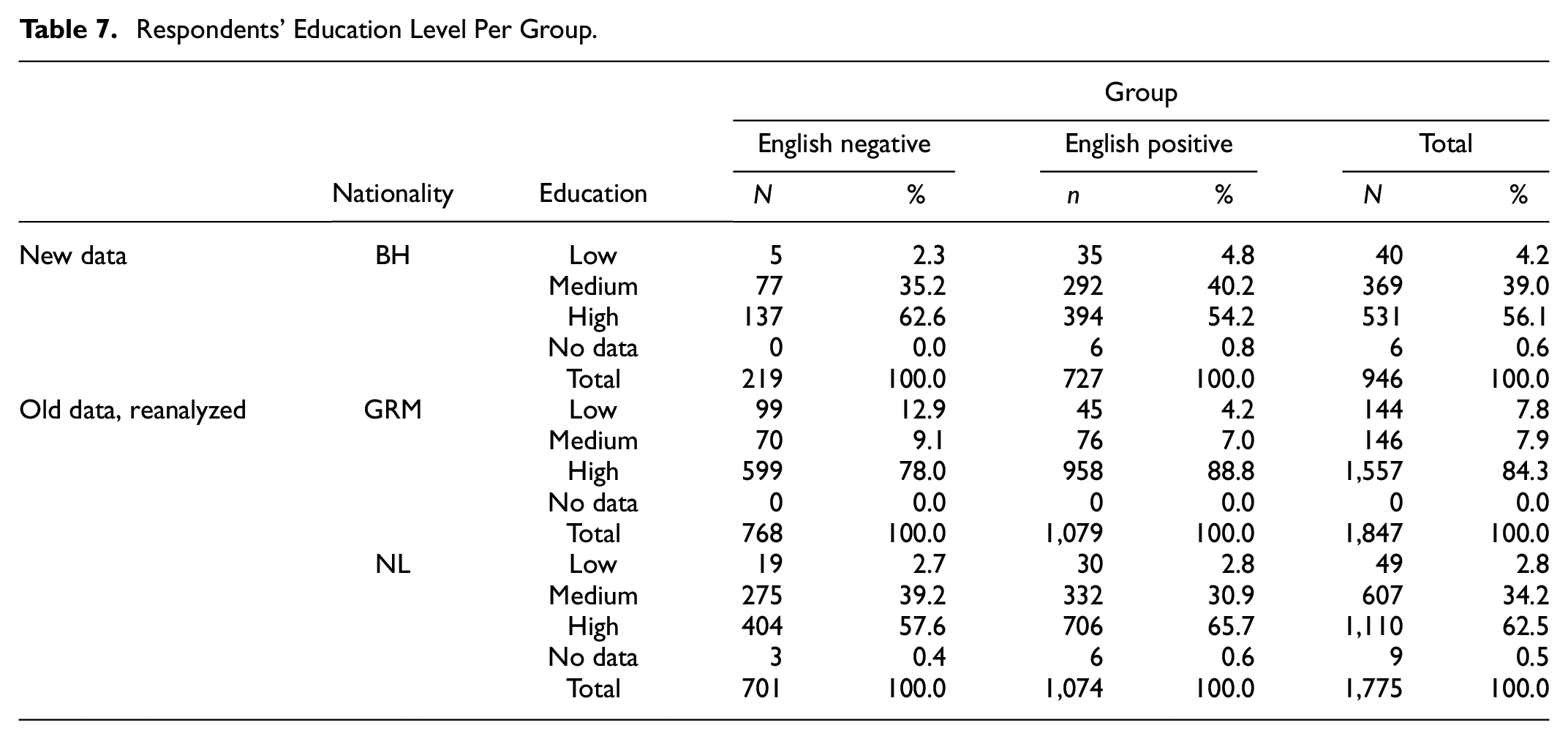
The proportion of highly educated respondents was significantly larger within the positive groups than within the negative groups in all three countries. Between-country differences were also significant both for negative (χ2 = 231.76, df = 6, p < .001) and positive groups (χ2 = 320.50, df = 6, p < .001). The proportion of respondents with low and high education levels within the negative Bosnian group was similar to the proportion within the negative Dutch group but significantly lower than within the negative German group. The proportion of respondents with a medium level of education was significantly larger within negative Bosnian and Dutch groups than within the negative German group. On the other hand, three positive groups did not differ in the proportion of respondents with low education level (Table 7). These findings do not concur with Walsh’s (2015) and Edwards (2016) findings which measured no correlation between attitudes to English and education level.
Respondents’ Education Level Per Group.
As for EL proficiency, positive Bosnian respondents reported significantly higher proficiency degrees than negative Bosnian respondents (F(1) = 365.86, p < .001). The positive groups’ mean values on the self-reported proficiency scale were at the far end of “reasonable” in Bosnia as well as in Germany and “fluent” in the Netherlands, whereas the negative groups’ mean values were within the lower end of “reasonable.” When between-country differences were compared, pair-wise comparisons among positive groups (F(2) = 77.09, p < .001) and negative groups (F(2) = 93.81, p < .001 for BH-NL and GRM-NL and p < .05 for BH-GRM comparisons) were significant. Still, both Bosnian groups reported the lowest proficiency rates, which reflects actual English proficiency rates as measured by the Education First English Proficiency Index. This index places the Netherlands into the “very high” proficiency band ranking first among 35 European countries (Education First, 2016, 2021), Germany into the “high” proficiency band, whereas B&H is a country belonging to the “moderate” proficiency band and is placed 26th (Education First, 2016) (Table 8). Proficiency level appears to be a significant contributor to language attitudes. Thus, in Edwards (2016), self-rated fluent English speakers from the Netherlands were significantly overrepresented in the anglophile group. Likewise, J. Dewaele and Díaz (2018) as well as Edwards and Fuchs (2018) showed that participants with more positive attitudes toward English would rate their proficiency higher.
Respondents’ Self-reported EL Proficiency.

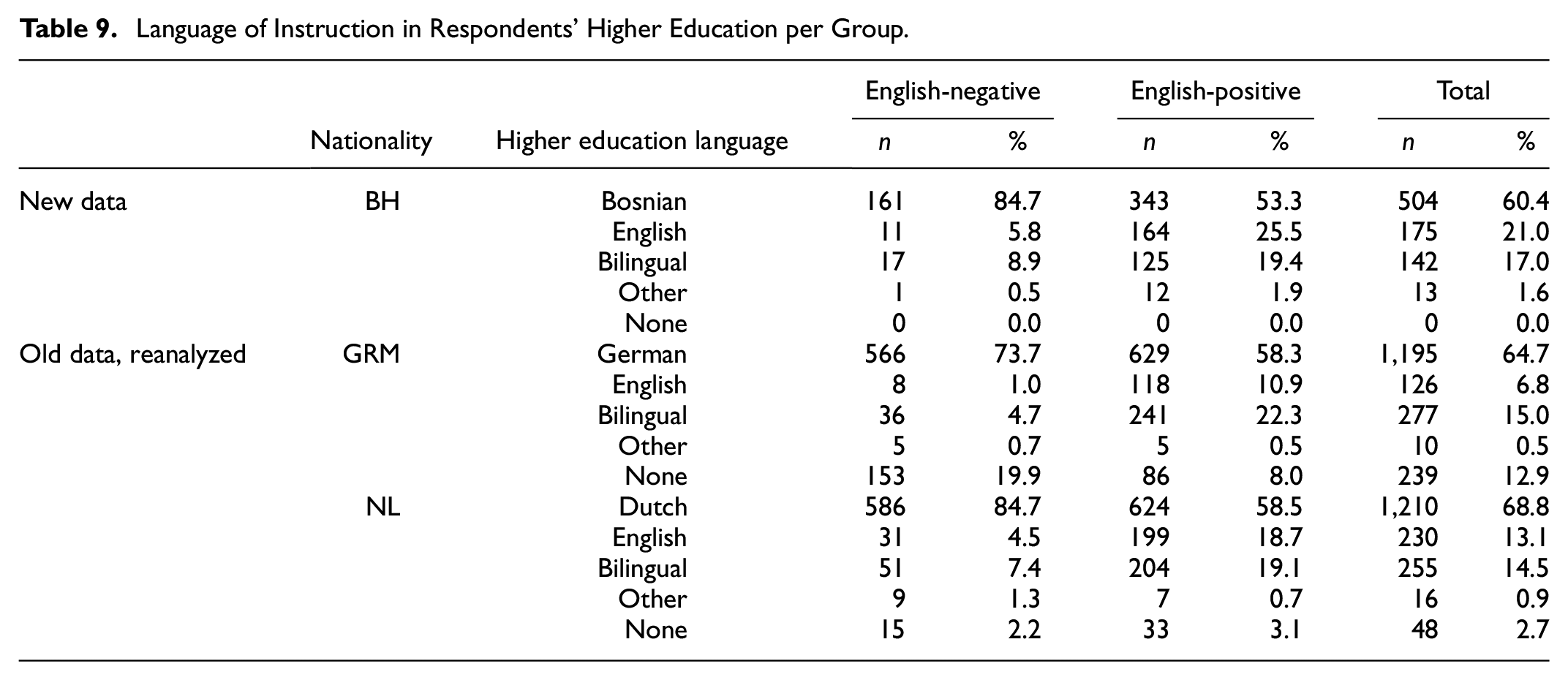
When the language of instruction was analyzed, it could be noticed that the differences between the positive and negative group within B&H were significant (χ2 = 62.24, p < .001). The negative Bosnian group had a larger proportion of respondents whose higher education language was their L1, while the positive group was associated with higher education solely in English or bilingually in English and L1 (Table 9). Between-country differences were also significant both for negative (χ2 = 168.96, df = 8, p < .001) and positive groups (χ2 = 132.46, df = 8, p < .001). There was a significantly larger proportion of negative respondents in B&H or in the Netherlands studying solely in their L1 or in English than in Germany. On the other side, B&H had significantly more positive respondents with English-medium higher education than two other countries, which might be explained by the fact that a large number of students from private universities agreed to participate in the research.
Language of Instruction in Respondents’ Higher Education per Group.
Concluding Remarks
Aiming to expand language attitude research to a rather understudied southern-eastern European country, that is, Bosnia and Herzegovina, the present study examined Bosnians’ attitudes toward English and compared them to the attitudes existing in two socio-culturally and linguistically different contexts, namely Germany and the Netherlands. With these three countries belonging to discrete European zones of English use and competence (Mollin, 2019), we assumed that cross-country attitudinal differences would be more pronounced. Though such differences do emerge, they do not seem to be so profound.
Substantial intra-country differences were observed for B&H along the attitudinal dimension. Thus, positive Bosnian respondents particularly liked using English and did not resent having to use it frequently. They considered English highly important and did not find its skills overrated. Still, they found speaking both languages advantageous especially in terms of their employment and accorded Bosnian a high status disagreeing along that English had a higher status than Bosnian in B&H. They reported code-switching moderately frequently and revealed that they did not feel differently when using English and Bosnian. The positive group were predominantly female and significantly younger and more proficient in English than the negative group. They had a larger proportion of highly educated respondents and they were more exposed to English through multilingual or bilingual programs at the university level. On the other hand, the negative Bosnian group did not dislike using English, which differentiated them from the German or Dutch negative group, and they even expressed mild liking. They sometimes resented having to use English and avoided using it because they preferred using Bosnian. They also considered English personally very important and advantageous in many aspects, especially in employment, but less so than the positive Bosnian group. Though they agreed that speaking both languages is beneficial, they found Bosnian more important than English and did not attach English a higher status. They reported code-switching significantly less frequently than positive Bosnian respondents and did not seem to maintain the same identity when using English. They were significantly less exonormatively oriented than positive Bosnian respondents and generally accepted local flavor in their English but less so than two other national groups. Negative Bosnian respondents were on average older, less educated, less proficient in English and they were not as much exposed to English through their education as positive respondents.
The sociodemographic profiles of positive and negative Bosnian respondents match the profiles of positive and negative groups developed in Edwards and Fuchs (2018) and the inclusion of the Bosnian data set seems to further confirm the existence of two socio-demographically different attitudinal groups in different European English zones as well as a closer similarity of English-positives or English-negatives from different countries than of English-positives and English-negatives from the same country.
Still, Bosnian respondents differed from German and Dutch respondents in some important aspects. Thus, Bosnians seemed to be most likely to use English, preferred using it whenever they could significantly more than two other nationalities and they also acknowledged the importance of English through a set of responses. Such a prominence of English in B&H might be a result of continued international presence in this sociocultural context through the Office of the High Representative and many international organizations, but it might also stem from the country’s strong global orientation and the dominant ideology of indispensability of English and necessity of its proficiency for individual and societal progress. Assuming the identity of global citizens, Bosnians aim to improve their language competences as they believe that proficiency in English can enhance their employment prospects and grant them access to international markets.
Bosnians are also less confident about the status of their L1 than the Dutch or Germans. Such findings indicate that the link between language and national identity is not as strong in B&H as it is in the Netherlands and Germany. A complex ethnic and linguistic composition of B&H as well as historical and social circumstances have strengthened the link between language and ethnic identity (Footitt & Kelly, 2012; Greenberg, 2004), which has completely overshadowed the link between language and national identity and facilitated the firm positioning of a foreign language, EL in particular. This, in turn, might explain a complete lack of ideology of endangerment both in public domains and in people’s attitudes.
Bosnians also tend to code-switch less frequently than the Dutch and Germans, which reveals a greater prominence of the ideology of monolingualism in B&H. Assuming binary linguistic identities, Bosnians observe English as the distinct other and they tend to keep the two languages apart. Along with the Dutch, positive Bosnians seem to express rather exonormatively oriented attitudes and aim toward native-like pronunciation, whereas Germans are much less exonormative. This reveals the prevalence of the underlying standard language ideology based on the notion of “nativeness” in the Netherlands and B&H, where the dominant ideological construct is a native standard language (Train, 2007).
Still, despite pronounced similarities existing across the national dimension, positive and negative Bosnian respondents are also similar in some respects. Both groups liked using English and had the lowest confidence in the status of their L1, significantly lower than other positive and negative groups from both countries, and they also shared the same attitudes toward local flavor in their English. This further confirmed the privileged status of English in this sociocultural context and the willingness of all Bosnians to improve their EL proficiency due to its indispensability for individual and societal success (Ajšić, 2016). EL is viewed as a useful instrument for social prestige and better employment possibilities and it frequently competes with the L1s in this respect. Bosnians, irrespective of the nature of their attitudes, seem to be less attached to their L1s than the Dutch or Germans. This might be assigned to a weakened link between language and national identity in that sociocultural context, which seems to be overshadowed by the ethnic dimension of identity and the concomitant linguistic complexity. Bosnian respondents’ moderate negative attitudes might also be a result of an absence of the ideology of endangerment or any public opposition to the influx of English in B&H and the non-existence of individual voices emphasizing a need to control it.
Overall, the findings confirm the earlier distinction between more proficient English-haves and less proficient English-have-nots (Preisler, 2003) or English-positives and English-negatives (Edwards & Fuchs, 2018) and also substantiate the claim about the pre-eminence of the split along the attitudinal rather than nationality dimension (Edwards & Fuchs, 2018, p. 664) proving that the respondents from the corresponding attitudinal groups share similar attitudes irrespective of their nationality. With the English-positives being comparatively younger, the question arises as to whether at some point in the future attitudinal differences will become blurred and a clear split along the attitudinal dimension infeasible and whether a rise of young, educated, internationally oriented multilinguals and anglophiles across Europe will eventually lead to homogeneity in attitudes toward this foreign language.
This research has some potential limitations. Firstly, no qualitative data were analyzed and a qualitative exploration might provide a better insight into language attitudes as well as underlying language ideologies and adopted language-related identities. Secondly, the study’s sample is not so diverse in terms of gender and the representation of gender is not equal across different attitudinal but also national groups, particularly English-positive and English-negative Bosnian groups. The sample is also not so diverse in terms of age and education level, as there is a larger proportion of younger and more highly educated respondents, particularly in B&H. Some further studies need to include more elderly respondents to closely observe age-related differences.
Practical Implications
In-depth research into attitudes toward English carries some practical implications for language planning and language policies. Such research is particularly important for the sociocultural context of B&H, where no official policies on the status and role of English have been developed. Thus, the current findings might serve as a basis for framing language policies regulating the status and role of English particularly in relation to official languages and language policies for multilingualism. In addition to this, the findings might also increase the understanding of the relation between language and identity and how identity shapes and is shaped by language attitudes and they might also prompt policymakers to work toward strengthening the relationship between language and national identity and weakening the impact of ethnic identity on language attitudes in this sociocultural context.
Footnotes
Acknowledgements
The author is deeply grateful to Alison Edwards and Robert Fuchs for their permission to include the German and Dutch data into the current study.
Funding
The author received no financial support for the research, authorship, and/or publication of this article.
Declaration of Conflicting Interests
The author declared no potential conflicts of interest with respect to the research, authorship, and/or publication of this article.
Ethics Statement
All procedures performed in studies involving human participants were in accordance with the required ethical standards.

Data Availability Statement
Data sharing not applicable to this article as no datasets were generated or analyzed during the current study.