




Abstract
This study investigated how socioeconomic status (SES) is associated with academic achievement and English proficiency in an English-medium instruction (EMI) program at a state university in Indonesia. It also examined the mediating effect of English proficiency and moderating effect of parents’ education on the relationship between SES and academic achievement. Data for 234 EMI students were obtained from the academic office of the university. Based on mediation analysis, SES significantly predicted students’ academic achievement and English proficiency. However, it stopped being a significant predictor when mediated through English proficiency. The moderation analysis shows that the degree of increase in EMI students’ grade point average was affected by the level of parents’ education when associated with family income. The article also presents the implications of the findings in enhancing university EMI programs and suggestions for future research.
Keywords
Introduction
There has been an increase in the practice of offering English-medium instruction (EMI) at higher education institutions (HEIs) in non-English speaking countries in Europe (Maiworm & Wächter, 2014), Japan (Aizawa et al., 2020), Taiwan (Fenton-Smith et al., 2017; Macaro et al., 2018), Indonesia (Simbolon, 2018), and Korea (Byun et al., 2011). EMI is mostly driven by higher education “internationalization,” job market competition (Knight, 2013), and the use of English as a lingua franca (ELF; Crystal, 2003). This is a major shift from English language teaching focusing on English as a second or foreign language (ESL/EFL) to using English in contextualized and meaningful situations (Shohamy, 2012). EMI is defined as “the use of the English language to teach academic subjects (other than English itself) in countries or jurisdictions where the first language of the majority of the population is not English” (Macaro et al., 2018, p. 37). EMI is aimed at utilizing students’ second language (SL) or foreign language (FL) to achieve content mastery and improve their English concurrently, which Macaro et al. (2018) called a “win-win solution.” Students’ achievement has been a critical issue in most EMI studies due to the use of English for classroom interaction, which could affect students’ content understanding (Aizawa et al., 2020). Most research have addressed content mastery by examining students’ grade point average (GPA) as the focus of their learning (Pecorari & Malmström, 2018) and improvement in English proficiency (Wanphet & Tantawy, 2018). However, the findings on the effectiveness of EMI are context-bound and remain inconclusive (Macaro et al., 2018). Several factors are associated with students’ academic attainment in EMI practices, including a combination of socioeconomic, cultural, societal, and political factors (Baker, 2001; Wilkinshaw et al., 2017; Lin & Man, 2009).
Socioeconomic status (SES) plays an important role in shaping students’ educational culture as it provides them with intellectual, social, and emotional support (Leithwood et al., 2004; Tomul & Polat, 2013). SES also determines the availability of financial support (Engle et al., 2006), the levels of psychological (Cedeño et al., 2016), and motivational (Merritt & Buboltz, 2015) conditions, and social interactions (Hackman & Farah, 2009). SES background is a credible measure for determining students’ academic success (Harwell & LeBeau, 2010; Patten, 2019). Some studies have shown that SES influences students’ academic achievement (Cheung & Andersen, 2003; Tucker-Drob & Harden, 2012). In addition, English proficiency has been a major debate in EMI programs regarding whether it should be a prerequisite threshold for entrance (Aizawa et al., 2020; Curle et al., 2020) or a learning output (Joe & Lee, 2013). However, considering EMI as a content delivery approach, the English proficiency of both students and lecturers should not be negated when formulating EMI policies (Aizawa & Rose, 2019; Hu et al., 2014; Rose et al., 2020). Both are assured to possess an adequate level of English (Galloway et al., 2017) for maximum content delivery and understanding (Airey et al., 2017; Doiz et al., 2011; Galloway et al., 2017) as well as facilitating classroom interactions (Floris, 2014). Otherwise, EMI may result in more loss than gain (Hamid et al., 2013). It is therefore worth researching to examine the interaction of SES and English proficiency in relationship with the academic achievement of EMI students.
This study was conducted at a faculty of economics and business at a state university in Indonesia. The university has been offering EMI programs as a strategy for internationalization, similar to those that other reputable universities deploy to strengthen their internationalization programs (Dewi, 2017; Simbolon, 2018). The Indonesian Ministry of Research, Technology, and Higher Education has already sought to raise five reputable state Indonesian universities into the top 500 of the QS world university ranking through the world-class university initiative (Dewi, 2017; Kemristekdikti, 2019). Some universities have strengthened their EMI programs through collaborations with international institutions through embedded overseas programs such as double degrees, credit transfers, and short courses (Simbolon, 2018).
Few studies have focused specifically on using both SES variables and English proficiency as predictors of students’ academic achievement in the EMI context. In addition, previous studies have mostly focused on self-reported data, such as data obtained through questionnaires (Peng & Xie, 2021). This study, therefore, offers a different approach by employing empirical institutional data, namely students’ SES, English proficiency test results (TOEFL score), and academic achievement (overall GPA) in an EMI program to reveal the extent to which the two factors interact in predicting students’ academic achievement through mediation and moderation analyses. Thus, it seeks to enrich the theoretical basis and offers empirical findings to address the research gap to justify the complexity of EMI (Baker, 2001; Dafouz & Smit, 2020; Wilkinshaw et al., 2017), especially in its intersection with SES and English proficiency of the students. Practically, the findings of this study are expected to help policymakers evaluate and improve their EMI policies. Specifically, this study aims to examine the relationship between SES, English proficiency, and academic achievement, and the mediating effect of TOEFL score and the moderating effect of parents’ education on the association between family income and the GPA of EMI students in the Indonesian HEI context.
Literature Review
SES and Its Association With Academic Achievement
SES describes a family’s accessibility to social and economic resources (Altschul, 2012). SES encompasses the family income, parents’ education, the family model, the location of residence, the language used at home, parents’ ethnicity, and previous level of education, as well as acquired behaviors and talents (Finnie et al., 2005; McMillan & Western, 2000; Organisation for Economic Co-Operation and Development, 2004). For this study, the association between SES and academic achievement can be explained using the parent-investment model (Mayer, 1997), which emphasizes familial decisions in allocating the number of available resources for different family needs. This model illuminates that as a family’s socioeconomic resources increase, their investment-financial, human, and social capital resources in connection with their children’s education increase as well, leading to improvement in their children’s academic outcome. The trend toward transforming education into massification has led family income to play a crucial role in the students’ academic access and attainment (Chan & Lin, 2015). This study, therefore, employed family income as financial investment and parents’ education as human and social investment to predict EMI students’ academic achievement. This approach was taken based on empirical findings that the parent-investment model is closely related to students’ cognitive development (Gershoff et al., 2007; Guo & Harris, 2000; Linver et al., 2002; Sirin, 2005).
Family income, as a measure of SES, can influence students’ academic achievement. Students whose family income is high gain more access to different means to improve their academic achievements (Engle et al., 2006), such as access to a larger pool of resources, better study facilities, extra lessons outside of school, and more club or community outings that can develop their educational perspectives. However, those from lower SES backgrounds do not have as much access to resources, are less literate, and engage in minimal enjoyable activities with their parents, who have low expectations for their academic achievement (Hackman & Farah, 2009). Due to their financial limitations, they are more likely to experience stress, that is difficulty in fulfilling and managing basic needs, such as food, health, school, and transport, leading to a mindset that hinders cognitive functions and affects their academic achievement adversely (Cedeño et al., 2016; Shah et al., 2012). Diverse findings were found regarding the relationship between SES and academic achievement. The economic condition of a family affects the educational attainment of a student (Cheung & Andersen, 2003; Patten, 2019; Sirin, 2005; Tucker-Drob & Harden, 2012). SES, however, was not related to the academic achievement of Taiwanese college students (Hsieh, 2019). Those SES studies, however, focused on academic achievement in regular or mainstream classes using the first language. Hence, the value of our study lies in that fact that we examined family income as the SES measure in relation to EMI students’ academic achievement.
Looking at the relationship between SES and English proficiency, theories about second language acquisition have shown that SES has a big impact on the English learning outcomes (Ellis, 1994; Gardner, 2006). This is also in line with the aforementioned parent-investment model, as the students in the EFL contexts, such as in Indonesia, need familial support to access to English language education (Lamb & Coleman, 2008). This is due to the cost the students must afford in order to get into English courses (Lamb & Coleman), cram schools (Liu, 2020), or even EMI programs (Lorenzo et al., 2021), which could incur more expenditure than regular tuition. Some studies have shown that SES is significantly related to English proficiency; students with higher SES outperformed those with low SES in a Spanish bilingual school (Lorenzo et al., 2021) and also in German EMI and non-EMI schools (Trebits et al., 2021) and in the Philippines (Serquina & Batang, 2018).
English Proficiency and Academic Achievement in EMI Programs
English is positioned as a foreign language in Indonesia. It is taught as a compulsory subject starting from junior high school to university, though with limited course credits (Zein et al., 2020). Students’ English proficiency receives strong enthusiasm in Indonesian educational institutions. However, access to English language education is much influenced by the SES of the students (Lamb & Coleman, 2008). At universities, TOEFL has been a popular means to measure university graduates’ English proficiency and is used as a graduation requirement (Renandya et al., 2018). In addition, English has been taught as a compulsory subject in the form of English for specific purposes (Mauludin, 2021). EMI has also been supported by the Ministry of Education and Higher Education at Indonesian universities (Lamb et al., 2021).
English proficiency is mostly measured using standardized tests such as the TOEFL, the International English Language Testing System (IELTS), the Test of English for International Communication, the Cambridge Proficiency English Test, and other general English tests developed and used in various countries. Meanwhile, academic achievement can be measured using semester achievement scores, such as midterm and final exam scores, or the cumulative GPA (Rose et al., 2020). Previous studies have shown how English proficiency is related to academic achievement of university students. Light et al. (1987) found that the TOEFL score of international students at a university in the United States significantly correlated with their academic achievement, especially among humanities, fine arts, and social science students. Johnson (1988) and Graham (1987) found that students’ TOEFL scores significantly predicted their academic performance.
In the EMI contexts, English proficiency measured by standardized tests like TOEFL and IELTS had a significant relationship with students’ academic outcomes among EMI students in Japan (Rose et al., 2020) and in Australia (Oliver et al., 2012). English proficiency also predicted the academic achievement among medical students in China (Peng & Xie, 2021) and the international students in a business school in Australia (Dooey & Oliver, 2002). In addition, Joe and Lee (2013) found that students’ English proficiency level affected their content understanding in an EMI class at a Korean university. Thus, students require a certain level of proficiency to succeed in an EMI program (Aizawa & Rose, 2019; Chang, 2010; Kim, 2017). However, Curle et al. (2020) found that general English proficiency did not significantly predict students’ academic outcomes in a partial EMI program at a university in Turkey. Further EMI studies therefore should use academic English proficiency, such as TOEFL score, to measure the relationship between English proficiency and academic achievement (Curle et al., 2020), as EMI is situated in an academic setting which thus requires an academic English performance measure, that is by using TOEFL, rather than general English (Oliver et al., 2012).
Regarding the mediating role of English proficiency, our study applied the ROAD-MAPPING framework by Dafouz and Smit (2020) to deal with the complexity of EMI practices; EMI is not just affected by a single linear factor but by possibly complex variables. The framework covers Roles of English, Academic Discipline, language Management, Practice and Processes, and Internationalization and Glocalization, which are directed toward discourse practices such as classroom instructions or interactions regarding their disciplinary subjects. As our mediation analysis examined how the relationship between SES and academic achievement was mediated by English proficiency, we focused on the Roles of English, with its dual pedagogical roles, to aid teaching through and learning and to increase students’ English proficiency.
The Role of Parents’ Education
In addition to family income, this study employed parents’ education as a moderating factor for the association between family income and EMI students’ achievement. The underlying theory for this analysis is the theory of class distinction proposed by Bourdieu (1986), which states that parents’ education background has a strong influence on students’ academic success, as the provision of more cultural and social capital by educated parents will support their children during their education. The parent’s education moderating role in an EMI context can also be seen through the lens of the ROAD-MAPPING framework which emphasizes the important role of the Agents, as “the different social players (whether conceptualized as individuals or as collectives, concretely or abstractly) that are engaged in EMEMUS” (Dafouz & Smit, 2020, p. 60). Related to our study, agents can be students (Baker & Tsou, 2021), with their parents and diverse educational backgrounds as social players, who take different important roles in the EMI program department by understanding the value of taking an English- medium instruction program.
Previous studies have highlighted the importance of parents’ education for their children’s academic achievement. Engle et al. (2006) determined high or low SES based on parents’ education level, indicating that those with college degrees were in the high SES group and those without were in the low SES group. Those from high education family backgrounds are more prepared to meet the expectations of higher education as they model their parents and have greater academic confidence (Merritt & Buboltz, 2015). Another form of support provided by educated parents includes increasing their children’s motivation (Steinmayr et al., 2012) and academic inspiration to raise their academic achievement (Zhan & Sherraden, 2003). Highly educated parents encourage their children to get into better schools (Goldthorpe, 2007). Their expectations for their children’s success are also related to their academic achievement and life satisfaction, as they consider education and foreign languages to be important for the future (Crede et al., 2015; Fan & Chen, 1999; Micholas, 1985; Rahman et al., 2004). However, students from less-educated families may not be encouraged to seek a college degree (Billson & Terry, 1982) and may tend to misinterpret postsecondary education as unnecessary for their future (Vargas, 2004). This is in line with Tomul and Polat’s (2013) finding that parents of unsuccessful students tend to have a lower level of education than those of successful students. However, there is a lack of studies that address the role of parents’ education in EMI students’ achievement along with the family income. Using these two variables would give a more complete picture to explain students’ academic achievement (Cabrera et al., 2018; Gobena, 2018). This study thus seeks to reveal how parents’ education moderates the relationship between parents’ income and students’ academic achievement in an EMI university setting.
Based on the above-mentioned literature review, the research questions for this study were formulated as follows:
To what extent is SES related to academic achievement and English proficiency of the students in an EMI program at a state university in Indonesia?
Are there any mediating effects of English proficiency and moderating effects of parents’ education on the relationship between SES and academic achievement of the students in an EMI program at a state university in Indonesia?
Accordingly, the following hypotheses were formulated:
Hypothesis 1: SES is positively associated with EMI students’ academic achievement.
Hypothesis 2: SES is positively associated with EMI students’ English proficiency.
Hypothesis 3: English proficiency combined with SES significantly predicts students’ academic achievement.
Hypothesis 4: English proficiency has a mediating effect on academic achievement in an EMI program when it is associated with SES.
Hypothesis 5: Parents’ education level moderates the association between family income and the academic achievement of EMI students.
The hypotheses are modeled in Figure 1.

Research model.
Methods
Data Source and Collection
Our study aimed to examine the relationship between SES, English proficiency, and academic achievement and to examine the mediating effect of TOEFL score and the moderating effect of parents’ education on the relationship between family income and the GPA of EMI students. This study relied on empirical data that captured EMI students’ SES, namely family income and parents’ education level, English proficiency (TOEFL) scores, and cumulative GPA. Data of students from a faculty of economics and business at a state university in Indonesia were analyzed. A formal letter was sent to the university institutional review board requesting permission to conduct the study. After approval was granted by the university, the data for 255 graduates from a 9-year enrollment period (2008–2016) of undergraduate EMI students at the faculty were obtained from the University Office of Academic Affairs. To ensure students’ confidentiality, students’ personal information was removed or deidentified in this study. For reliability, the obtained data were checked for accuracy, completeness, and consistency, resulting in the final complete data of 234 subjects (Table 1). These data were analyzed with the listwise technique using SPSS 24 software to address missing values.
Summary of the Subjects.

Measurement and Analyses
SES was evaluated using after-tax monthly family income in Indonesian Rupiah (IDR), as family income is the most commonly and easily used measure (Gobena, 2018; Sirin, 2005), and parents’ education level (Engle et al., 2006). Family income combined both parents’ incomes. Parents’ education was quantified based on their level of education (Tomul & Polat, 2013), namely elementary school (coded as 6); junior high school (as 9); senior high school (as 12); diploma 3 (3-year vocational program; as 15); bachelor’s degree or 4-year undergraduate (as 16); master’s degree (as 18); and doctorate (as 22) in accordance with Indonesia’s education system. English proficiency was measured using the TOEFL score (310–677; Graham, 1987; Johnson, 1988), and academic achievement was determined based on the overall GPA (2–4; Fan & Chen, 1999; Oliver et al., 2012).
The data were screened before statistical analyses in order to check the normality of the distribution of the data. First, Kolmogorov–Smirnov and Shapiro–Wilk tests were conducted, and both resulted in p = .000, which indicates a non-normal distribution for the family income variable. Therefore, log transformation was applied to achieve a normal data distribution (Kolmogorov–Smirnov, p = .075; Shapiro–Wilk, p = .275; Osbourne & Waters, 2002). This was required to conduct mediation and moderation analyses. Parents’ education, TOEFL score, and GPA were normally distributed. Then, to ensure the reliability of the analysis results, as mediation and moderation analyses are regression analyses, assumptions proposed by Osbourne and Waters (2002) were met, namely normal distribution (Kolmogorov–Smirnov with p = .200), linearity shown by P-P Plots showing points falling in the line (Figure 2), multicollinearity using the variance inflation factor (<10), and homoscedasticity (Cook’s distance of min. .000, max .086). No multicollinearity was present, as shown by there being no strong correlations between the predictor variables (<.9). The model fit and analysis of variance were also checked as both were significant (p < .001), showing a good model fit acceptable for further analysis.

Normal P-P plot of the regression standardized residual.
Regression analyses were conducted using Process 3.5 by Hayes in SPSS 24 to examine the correlations among SES, English proficiency, and academic achievement, as well as mediation and moderation analyses followed by bootstrapping to test whether the mediation and moderation effects were significant. The mediation analysis using parents’ income as the SES measure and the TOEFL score to predict overall academic achievement seeks to argue the critical role of English proficiency in EMI contexts. Baron and Kenny’s (1986) conditions were applied for mediation analysis, namely (a) the independent variable (IV) has a causal relationship with the dependent variable (DV), (b) the IV has a causal relationship with the mediator variable (MV), (c) the MV significantly affects DV, and (d) when MV significantly mediates the IV–DV relationship, with the effect of IV on DV controlling for MV should be zero. To test a significant mediation, the Sobel test was used to provide “an approximate significance test for the indirect effect of the independent variable on the dependent variable via the mediator” (Baron & Kenny, 1986). Finally, to check whether the mediation was complete or partial, Preacher and Hayes’s (2004) assumptions were applied.
Meanwhile, moderation by parents’ education level argues about the differences between high and low education levels of EMI students’ parents. The combined moderation and mediation analyses followed the piecemeal approach in which both were analyzed separately and the results interpreted jointly (Edwards & Lambert, 2007).
Results
Descriptive Findings
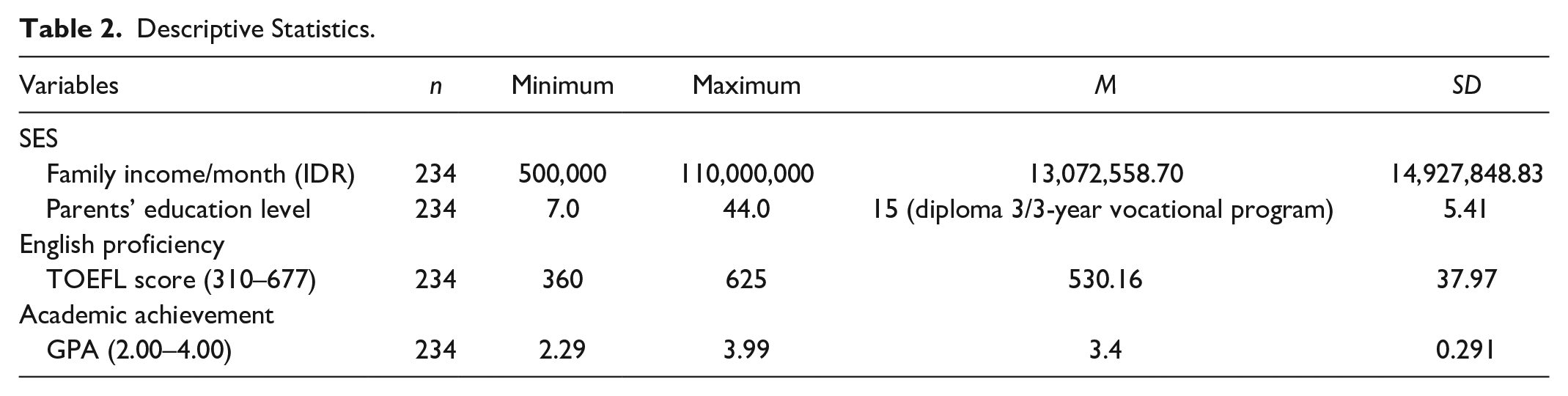
The descriptive findings (Table 2) show that the average family income of the students was IDR 13,072,559 per month, and the average parents’ education level was at a college level of diploma 3 (3-year vocational program). In addition, the mean of the students’ TOEFL score was 530, indicating a higher intermediate level based on the Education Testing Service. Finally, the average overall GPA of the students was 3.37 (max. 4.00), indicating a satisfactory graduate predicate according to Indonesian higher education assessment standards.
Descriptive Statistics.
Correlation Among SES, English Proficiency, and Academic Achievement
Table 3 shows the results of the Pearson correlation analysis. A significant positive correlation (r = .215, p < .05) was found between students’ family income and GPA, meaning that the higher the students’ SES, the higher their achievement. There was also a significant positive correlation between family income and the TOEFL score (r = .157, p < .05), which means that the higher the students’ SES, the higher their English proficiency. Finally, there was a significant positive correlation between the TOEFL score and GPA (r = .293, p < .01), which means that the higher the students’ English proficiency, the higher their GPA. Referring to Baron and Kenny’s (1986) principles, a mediation analysis could then proceed. Parents’ education had a significant correlation with family income, but not with the TOEFL score and GPA. Thus, parents’ education was not used for further mediation analysis as it had no significant relationship with GPA.
Pearson Correlation Analysis of SES, TOEFL, and GPA.

Correlation is significant at the .05 level (two-tailed).
Correlation is significant at the .01 level (two-tailed).
Mediating Effects of English Proficiency
Further, a mediation analysis was carried out using Process 3.5 by Hayes (2017) in SPSS 24 by testing the IV (family income), the MV (TOEFL score), and the DV (GPA). The model summary shows a good fit (r = .315, p < .001). Meeting the first assumption (path c), it was found that family income significantly predicted GPA (b = 0.117, p = .02). This means that for every 10% increase in family income, students’ GPA increased by about 0.0117. Meeting the second assumption (path a), family income was found to predict the TOEFL score (b = 14.358, p = .02). This means that for every 10% increase in family income, the TOEFL score increased by about 1.44. Finally, after testing the third assumption (path b) and fourth assumption (path c′) by examining the regression analyses of the relationship between family income and GPA as well as the TOEFL score and GPA, it was shown that in path b, GPA was significantly predicted by the TOEFL score (b = 0.002, p < .001). This shows that for every 1-point increase in the TOEFL score, GPA increased by about .002. Further, the mediation analyses showed that after combining family income and the TOEFL score to predict GPA, family income did not significantly predict GPA (b = 0.87, p = .07). The final mediation model, presented in Figure 2, shows that English proficiency completely mediated the association between SES and academic achievement. The bootstrap confidence interval with 5,000 samples confirmed the significant mediation effect by the indirect effect of family income on GPA through the TOEFL score (Table 4) with no 0 in the interval between the lower level 95% confidence interval (CI) and upper level 95% CI.
Bootstrap Results for the Indirect Effect.
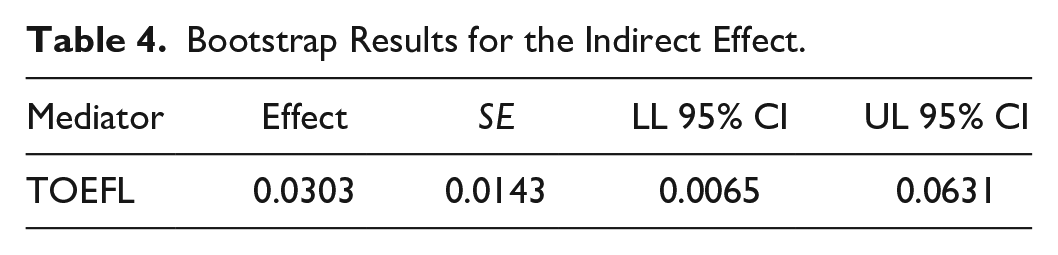
The Sobel test also presented significant results (p = .023) that confirmed the complete mediation (Figure 3). This shows that SES did not significantly predict academic achievement after it was combined with English proficiency as the single mediator among EMI students. The finding is consistent with Preacher and Hayes (2004) about complete mediation.

Complete mediation results.
Moderating Effect of Parents’ Education
The moderation analysis was conducted using Process 3.5 by Hayes (2017) in SPSS 24. It was found that parents’ education had a moderating effect on the association between family income and GPA. This model showed a good fit (r = .340, p ≤ .001). The effect of parents’ education on GPA was not significant (b = 0.0014, p = .70), but after centering, the relationship between family income and education in GPA was significant (b = .0136, p = .04). This shows that the relationship between family income and GPA was moderated by parents’ level of education (Table 5). The association between family income and GPA was plotted when the education level was one standard deviation (SD) below and above the mean score, as shown in Figures 3 and 4.
The Moderating Effect of Parents’ Education.

Note. LL = lower level; CI = confident interval; UL = upper level.
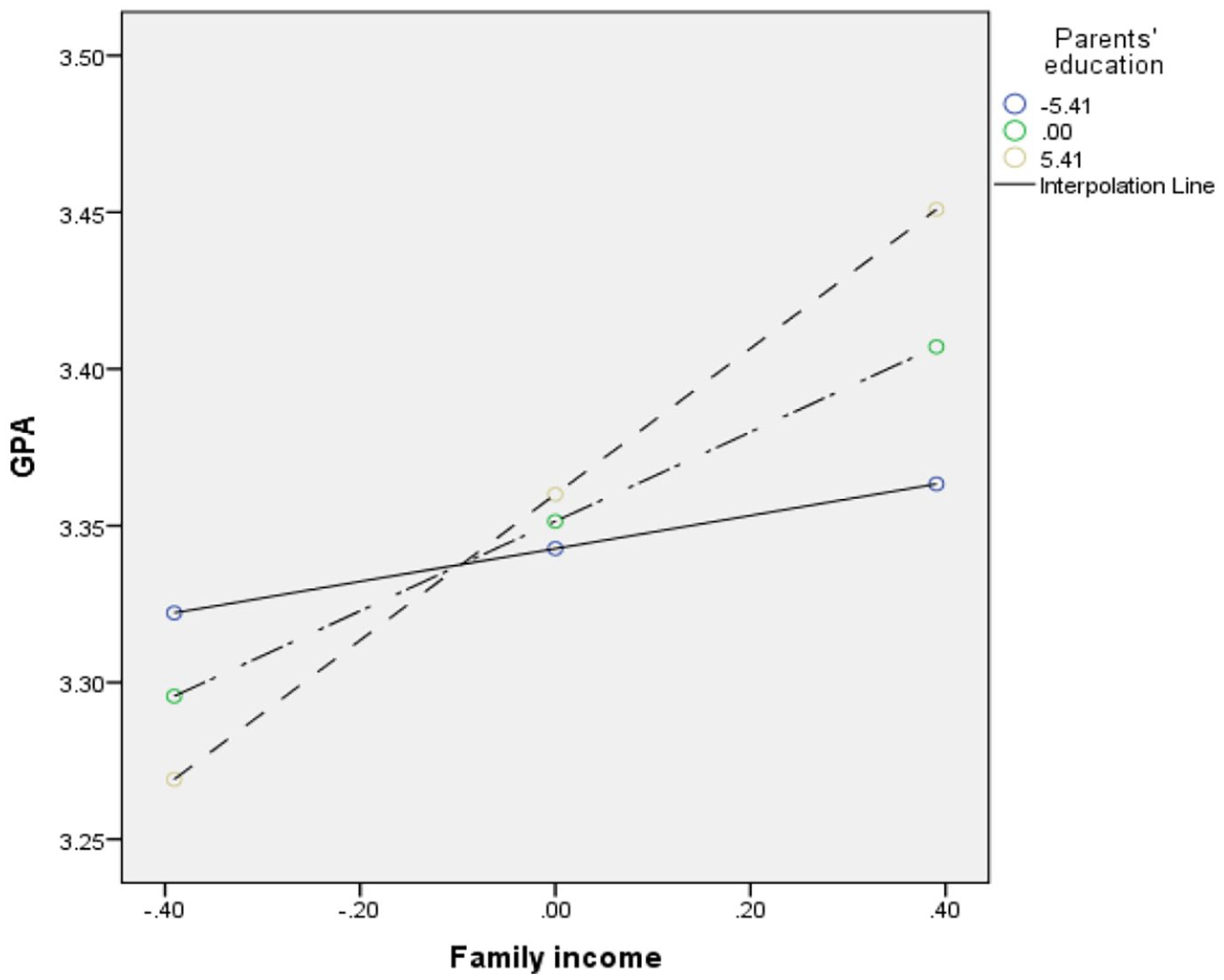
Moderating effect of parents’ education on the association between family income and GPA.
We used the bootstrap method to analyze the conditional indirect effects of parents’ education level on the association between family income and GPA. The indirect effects at three levels of education (1 SD above the mean, at the mean, and 1 SD below the mean) were examined using 95% CIs. As shown in Table 6, a significant increase in the slope was found among students whose parents’ education level was above the mean, implying that students whose parents’ education level was above the mean tended to have a higher GPA as their incomes increased. For students whose parents’ education level was around the mean, there was a significantly increasing slope, implying that such students had a higher GPA as their incomes increased. However, for students whose parents’ education level was below the mean, there was no significant increase in the slope, indicating that their GPA remained stable even when their family incomes increased.
Conditional Effects of the Focal Predictor at Different Moderator Values.

Discussion and Conclusions
This study examined the mediating effect of English proficiency and the moderating effect of parents’ education on the overall GPA of EMI students. The empirical findings are that family income significantly predicted academic achievement as indicated by the overall GPA, and the relationship was completely mediated by the TOEFL score. The study also found that parents’ education moderated the association between family income and the GPA of EMI students. The findings of the study show the complexity of an EMI practice by placing the role of English as central in EMI students’ academic achievement, especially as English is used as a pedagogical function, that is in teaching and learning settings (Dafouz & Smit, 2020). This elaborates the application of parent-investment model by Mayer (1997) that in an EMI context, more attention should be allocated to enhancing students’ English proficiency to sustain their EMI learning. Thus, academic achievement can be influenced by multifaceted factors in an EMI practice that is different from that of mainstream classes (Dafouz & Smit, 2020; Wilkinshaw et al., 2017).
Referring to Baron and Kenny’s (1986) mediation model, family income was a significant predictor of GPA. Thus, Hypothesis 1 was supported, implying that family income determines the degree of success of EMI students. This confirms previous research that has shown that SES, indicated by family income, significantly predicts students’ academic achievement (Cedeño et al., 2016; Cheung & Andersen, 2003; Tucker-Drob & Harden, 2012). Family income determines access to social and economic resources for students (Sirin, 2005), and their academic achievement, which depends on the ease of access to available resources (Fan & Chen, 1999; Tomul & Polat, 2013). In the context of this study, students who could take an overseas program, such as student exchange and double-degree programs with partner universities abroad, required familial financial support that was provided. This finding, however, contradicts Hsieh’s (2019) finding that SES did not affect university students’ academic success in Taiwan. This difference may have been because of (a) different institutional types under study, wherein the current study focused on a specific EMI program and Hsieh (2019) focused on a general university program with a larger number of samples using national data and (b) the difference in the degree of access to university between Taiwan and Indonesia, with Taiwanese students having greater access as a result of the massification of education (Chan & Lin, 2015) compared with the Indonesian university elite context.
Second, family income positively predicted EMI students’ TOEFL scores. Hypothesis 2 was then accepted. The positive coefficient showed that when family income increased by 10%, the TOEFL score increased by 1.44 points. The finding justifies that in an EMI context, parent-investment model by Mayer (1997) is relevant to show that educational attainment must be supported by financial investment so that the students’ English skills can be enhanced. This confirms the findings of Rose et al. (2020), Dooey and Oliver (2002), and Joe and Lee (2013). It implies that the higher the students’ family income, the higher their English proficiency will be, as they can access more English learning programs either inside or outside campus to help improve their English proficiency. This finding is supported by Lamb and Coleman’s (2008) finding that students’ SES significantly determined their access to better English learning in Indonesia. In addition, families believe that higher English proficiency will lead to better future prospects for their children (Rahman et al., 2004), also confirming that in today’s global competition, parents’ support for their children improving their English ability is critical for academic and future needs, and in Indonesia, this is no exception.
Our third finding shows that the TOEFL score significantly predicted the GPA. Hypothesis 3 was thus supported. This highlights the importance of English proficiency in an EMI class for students’ academic achievement. Specifically, the higher the TOEFL score, the better the GPA. This confirms Oliver et al. (2012), who found that measuring English proficiency using academic proficiency score (TOEFL) predicted EMI students’ academic achievement. Thus, English proficiency is essential for a successful EMI program (Aizawa & Rose, 2019; Chang, 2010; Dooey & Oliver, 2002). This finding, however, contradicts a previous study, which found that English proficiency did not significantly predict academic success among Turkish partial EMI students (Curle et al., 2020). This difference may be the result of different contexts and models, as our study focused on a full EMI program and the TOEFL score as opposed to partial EMI and a general English proficiency score. In addition, the TOEFL score—as used in this study—is more appropriate here as the test score has been widely used, assuring the foreign students can follow a course delivered in English, such as when studying in English-speaking countries and has been used widely for measuring academic achievement in EMI contexts (Oliver et al., 2012).
This study’s novel contribution is the confirmation of complete mediation, in which when family income and the TOEFL score were combined, family income did not significantly affect academic achievement, implying that the TOEFL score had a full mediating effect on the relationship between family income and the GPA. Hypothesis 4 thus was supported. This shows that EMI students cannot secure better academic achievement without developing their English proficiency, even though they are from a high SES, which confirms the multifaced factors in EMI students’ academic achievement due to the roles of English (Dafouz & Smit, 2020). This finding responds to criticism of EMI programs that favor students from high-income families (Hamid et al., 2013), meaning that English proficiency is the more important factor for EMI students when it comes to academic achievement. This is reasonable as classroom interactions are conducted in English, so possessing adequate English proficiency for EMI students is very valuable as they will be able to read, write, listen, and speak in English about their disciplinary subjects. This finding, therefore, shows the instrumental and vital role of English in an EMI program. Students’ English proficiency should be promoted in a couple of ways, such as by enhancing English for specific purposes to enhance their disciplinary terminologies and help their content understanding (Rose et al., 2020). Further, English for academic purposes could be promoted by providing language instruction for academic study (Schmidt-Unterberger, 2018).
Finally, the current study found that parents’ education level played a moderating role in the association between family income and the academic achievement of EMI students. Hypothesis 5 of this study was then supported. The moderation findings showed that the GPA of students with average or highly educated parents—that is, holding at least a diploma 3 (3-year bachelor’s) degree or upward (≥D3 degree)—tended to increase as their parents’ income increased. However, the GPA of students whose parents had low levels of education—below a 3-year bachelor’s degree—did not increase when family income increased. This finding was also in line with that of Crede et al. (2015), showing that parents’ education level served as a moderator for academic achievement, with life satisfaction as the predictor variable. Students with highly educated parents are more motivated to be academically successful. More importantly, highly educated parents emphasize the importance of preparing for the future and develop their children’s confidence in academic attainment (Merritt & Buboltz, 2015), and develop better perspectives on academic orientation (Engle et al., 2006). Therefore, parents’ educational background plays a very critical role in a student’s academic success, as higher educated parents tend to provide students with more academic- and future-oriented motivation (Crede et al., 2015; Micholas, 1985; Steinmayr et al., 2012), academic inspiration (Zhan & Sherraden, 2003), and encouragement (Goldthorpe, 2007). This echoes the theory of class distinction by Bourdieu (1986). Overall, family income and parents’ education, as combined variables of SES, can more comprehensively explain the degree of academic success of EMI students. Lastly, as the population of this study consists of students from three different majors: accounting, management, and economic finance and banking, the findings could represent an EMI practice in the economics and business field.
Limitations and Implications
To the best of our knowledge, this study is the first to examine the mediation effect of English proficiency and the moderating effect of parents’ education level on the association between family income and the GPA of EMI students, strengthened by empirical data from a 9-year enrollment period instead of self-perceived and self-reported data. However, it still has some limitations. This study was conducted at only one faculty in one university in Indonesia. Future research should use larger samples and examine different disciplines such as the humanities, science, and engineering to verify these results. Future studies should also look at other variables, such as the quality of education received and other SES variables such as the home environment; student support, either in linguistic aspects such as English for specific or academic purposes or pedagogical aspects such as teaching and learning strategies; and learner differences regarding attitude and motivation, to arrive at more comprehensive findings.
Our results have some significant implications for EMI programs. In formulating EMI policies, to help students secure better academic attainment, more attention should be given to assure adequate English proficiency of students in at least two stages: during the program selection process, by having clear language criteria, and during the study process, by providing English language support to cope with the high demands of EMI programs, such as enhancing one’s English for academic purposes, strengthening academic skills, and maximizing information and communication technology for learning, as today’s generation are more digitally literate. Further, due to the high pressure of EMI programs, EMI students should be encouraged and supported to be more autonomous by providing activities such as achievement motivation training, promoting autonomous or metacognitive learning, and enabling better access to learning resources such as through self-access centers to help students achieve better. Finally, as the role of the family is pivotal in EMI students’ academic achievement, there must be an effective collaboration between universities and parents as stakeholders to enhance EMI students’ academic achievement in disciplinary subjects and English.
Footnotes
Acknowledgements
We thank Prof. Dr. Aulani’am drh., DES. (University of Brawijaya, Indonesia) for granting the permission for the research and Abdul Ghofar, DBA., AK., CFA, (Faculty of Economics and Business, University of Brawijaya, Indonesia) for providing the access to the data.
Declaration of Conflicting Interests
The author(s) declared no potential conflicts of interest with respect to the research, authorship, and/or publication of this article.
Funding
The author(s) received no financial support for the research, authorship, and/or publication of this article.
