




Abstract
This study is the first to explore language attitudes of the endangered Faifi language in SA. Understanding these attitudes is crucial for future language revitalization efforts. Employing a conceptual framework from LA research, data were collected via an online Arabic questionnaire with a sample of 258 participants. This paper aims to explore the indigenous people’s language attitudes, frequency of language use, and the influence of social backgrounds. Data were analyzed using factor analysis and multiple regression. Three key findings emerged: Firstly, a two-dimensional model encompassing status and dynamism dimensions was identified, offering new insights into LAs. Notably, the trait “educated” was associated with dynamism rather than the typical association with the status dimension, which can be attributed to educational factors related to the Faifi language’s lack of formal instruction in schools. Secondly, the reported use of the Faifi language by its speakers indicated a positive trend. Lastly, age was found to be the only significant sociodemographic variable, with older participants exhibiting more positive attitudes compared to younger participants. In summary, this research contributes fresh perspectives on the dimensions of language attitudes, particularly by highlighting the deviation of the trait “educated” from its customary position within the status dimension. Additionally, the study emphasizes the salience of age as a factor. The paper recommends macro and micro language policies; macro language policy should consider integrating the language into the educational system, while micro language policy should originate from the indigenous community itself, initiating initiatives to further support language use among young speakers.
Plain language summary
This study is the first of its kind to explore what people think about the endangered Faifi language in Saudi Arabia. Previous research focused on how the language is spoken, but not much attention has been given to people’s opinions about it. Understanding these opinions is important for efforts to revive the language in the future. To gather data, an online survey was conducted in Arabic with 258 participants. This research finds out what indigenous people think about the language, how often they use it, and how their social backgrounds influence their views. The data was using some statistical techniques and three main findings were revealed. First, the research reveals that people’s opinions about the language can be described in two ways: how important they think it is and how much they think it can change and adapt. This provides new insights into language attitudes. Surprisingly, being “educated” was associated with how much the language can change, rather than how important it is. This might be because the Faifi language isn’t taught in schools, which affects people’s views. Second, the research finds that people who speak the Faifi language reported using it more often, which is a positive sign. Lastly, age was emerged as the only significant factor that influenced people’s opinions. Older participants had more positive attitudes compared to younger participants. In summary, this research gives us new perspectives on language attitudes, especially by showing how the trait “educated” can be different from what we usually expect. It also emphasizes the importance of age. Based on the findings, I recommend both macro and micro language policies. Macro policies should focus on including the language in schools for indigenous people, while micro policies should come from the community itself, taking actions to support the language, especially among young speakers.
Introduction
In many parts of the world, minority language speakers can be found within larger multicultural and multilingual contexts. In most cases, their language is prone to endangerment for many reasons. For instance, previous colonialism has significantly influenced the preservation of certain languages, such as the Maori language in New Zealand and Aboriginal languages in Australia. Both countries, once colonized by Britain, experienced a gradual replacement of indigenous languages with English (Weatherall, 2013). Other reasons could relate to imperialism, as observed with the Tibetan minority languages in China and the Hawaiian language in Hawaii (Roche, 2019). Furthermore, the prestige of a dominant language and its speakers may have a negative effect on the indigenous people, causing them to gradually abandon their language in favor of the dominant language, as is the case with the Mi’kmaq and Mohawk languages in Canada. Therefore, indigenous people throughout the world encounter substantial challenges in preserving their languages.
Arabic is the predominant language in Saudi Arabia (SA), and Islam is the official religion of the country. On the surface, it appears that SA has a unified cultural and linguistic heritage; however, this is not the case. The country is culturally diverse, and although Arabic is its primary language, there are two other endangered languages: Mehri and Faifi. These two endangered languages are neither official nor supported by any institution. Thus, given that Arabic is the official language of the country, research investigating effective measures to preserve endangered languages in the context of SA is timely. This study focuses specifically on language attitudes (LAs) toward the Faifi language.
The Faifi language, one of the two endangered languages in SA, is exclusively spoken and lacks a formal orthographic system. Its speakers primarily reside in the Faifa mountain area, spanning approximately 600 km in southwestern SA, with Yemen directly to the south. The overall estimated population of Faifi speakers is approximately 50,000 (Alfaife, 2018). A portion of the Faifi population has migrated from their hometown to other parts of SA in search of employment and higher education (E. Alfaifi, 2020). This mobility could potentially contribute to the language’s endangerment. According to UNESCO’s classifications of endangered languages, the Faifi language meets several proposed classifications and factors. First, the intergenerational transmission of the language is alarming, as newer generations are beginning to lose this indigenous language (Alfaife, 2018). Second, it lacks representation in both the media and the educational system (Alfaife, 2018; E. Alfaifi, 2020). The ratio of speakers to the entire Saudi population is yet another alarming factor contributing to its endangerment. Given the alarming rate of language and cultural erosion, a more in-depth investigation of the Faifi speakers’ attitudes toward preserving their language and culture is warranted.
The affiliation of the Faifi language and its relationship to Arabic have been widely debated by both Western and Saudi researchers. However, there is consensus that both Faifi and Arabic are Semitic languages. Alfaife (2018) traced the origins of the Faifi language back to the Sabaic language group, a branch of Old South Arabic languages spoken in southwestern Arabia, the same region where the Faifi language is currently spoken. Other researchers have traced it back to Himyaritic, which was spoken in ancient Yemen (Alaslani, 2017; M. H. Alfaifi, 2014) and is also a branch of Old South Arabic. Some have argued that Faifi has a strong affiliation with Arabic and is a branch of modern Arabic dialects (A. A. M. Alfaifi & Behnstedt, 2010; A. Alfaifi & Davis, 2021; E. Alfaifi, 2020). Although linguists are still debating the affiliation of the language, they have concluded that Faifi and Arabic are not mutually intelligible (M. H. Alfaifi, 2014; Ingham, 2006; Watson, 2011). Thus, such a dichotomous linguistic situation has negatively affected the Faifi language, as it is not understood by the majority in the country. The subsequent paragraph will explore the macro factors contributing to the increasing endangerment of the Faifi language and how these might impact LAs.
When reviewing the linguistic and social situation of the Faifi language, four macro factors appear to be the most significant threats to its survival. First, Arabic, the language of Islam’s holy book, has dominated the Arabian Peninsula since the spread of Islam. It is the language used for formal and religious occasions (e.g., Holes, 2006; Watson, 2011), leading to the marginalization of older Arabic languages such as Faifi. Second, after the discovery of oil in SA, urbanization had significant effects even among Saudi speakers within the country as the gap between urban and rural dialects widened. This development complicated the situation for endangered languages such as Faifi, which now exist in an increasingly urbanized society. Third, the Faifi language does not have an orthographic system; thus, it is not taught within the education system to indigenous people (Alfaife, 2018; E. Alfaifi, 2020). To the best of my knowledge, no official efforts have been recorded to teach the language. Lastly, the language is not even represented in the media (Alfaife, 2018; E. Alfaifi, 2020), which undoubtedly increases the lack of awareness about the language and its speakers among Saudis.
Understanding the LAs of indigenous speakers is crucial at this stage, as these attitudes serve as the backdrop for any initiatives aimed at reversing language shift and for language revitalization and maintenance projects (Batibo, 2005; Fishman, 1991). LAs are an interpretation of a person’s psychological inclination to speak, adopt, or learn a language (Garrett, 2010). Thus, attitudes are the dynamics of the desire to speak or not speak the language.
In the case of the Faifi language, few studies have investigated its linguistic situation. These limited studies range from providing a detailed description of the language’s syntax and morphology (see A. H. J. Alfaifi, 2016) to documenting a detailed grammar of the language (see Alaslani, 2017; Alfaife, 2018; A. Alfaifi & Davis, 2021) and investigating a sketch of its vocabulary and grammar (see A. A. M. Alfaifi & Behnstedt, 2010). Thus, to my knowledge, no previous research has explored the social psychology of this endangered language and its implications for the revitalization process.
Considering the paucity of research on the LAs of the Faifi language, this paper intends to explore the perspectives of the core community toward this endangered language. Additionally, it will reveal how the indigenous people of Faifa perceive the frequency of their language use. Finally, it will examine the effects of social backgrounds on their attitudes and perceived language use.
Based on the findings of the current study, this paper primarily aims to contribute to the discussion of LA research by generating knowledge that could inform measures to bolster educational support for endangered languages. The second objective of the present study is to determine how the reported use of the Faifi language and the homogeneity of findings from the demographic variables could serve as predictive factors for the maintenance and revitalization of the language.
However, the study faces two limitations. The first limitation is the inability to investigate the attitudes of non-Faifi individuals toward the Faifi language. This constraint arises from the fact that Saudis do not generally recognize the name of the language. Moreover, the language is not represented in the media or the educational system. It was therefore deemed necessary to exclude attitudes from the broader community to maintain the integrity of the research findings. The second limitation is the relatively small size of the advisory panel. Despite the intent to engage a larger group, only five participants agreed to serve on the panel responsible for evaluating the questionnaire items.
Literature Review
Theoretical Perspective on Language Attitudes
Theoretically speaking, attitudes can be investigated through three paradigms: psychological, behaviorist, and the combined paradigm (Dragojevic et al., 2018; Garrett, 2010; Liang, 2015). The psychological paradigm considers attitudes as a psychological construct evoked by stimulation from the external world (Garrett, 2010). The behaviorist paradigm considers attitudes as an entity that can be observed through the discursive practices of an individual (Liang, 2015). The combined paradigm integrates both psychological and behaviorist paradigms (Dragojevic et al., 2018). Thus, the combined paradigm regards attitudes as a social phenomenon formulated by both resources (i.e., psychological) and consequences (i.e., behaviorist).
In the current research, attitudes will be investigated from the perspective of the psychological paradigm. Accordingly, this paradigm views attitudes as naturally intangible; therefore, researchers have attempted to analyze their abstract nature and construction (Garrett, 2010; Garrett et al., 2003; Kristiansen et al., 2005).
Previous research investigating the psychological paradigm of attitude objects has largely contributed to LA theory. Studies within this paradigm have revealed that people’s attitudes can be categorized into attitudinal dimensions, primarily solidarity (i.e., social attractiveness), status (i.e., prestige), and dynamism (i.e., vitality). The solidarity dimension encompasses perceptions of a language or a dialect and its speakers in terms of beauty, kindness, friendliness, likability, pleasantness, goodness, and honesty (Carrie, 2017; Yin & Li, 2021; Zahn & Hopper, 1985). The status dimension includes viewing a language or a dialect and its speakers in terms of the social power of the language interpreted through literacy, education, intelligence, fluency in the language, competence, economic status (including wealth and class), and cultural identity and heritage (including tradition and uniqueness; Yin & Li, 2021; Zahn & Hopper, 1985). The dynamism (i.e., vitality) dimension includes viewing a language or a dialect and its speakers in terms of the active use of the language, enthusiasm, strength, confidence, and energy (Yin & Li, 2021; Zahn & Hopper, 1985).
Language Attitude Research in Practice
Previous research on LAs toward endangered and minority groups’ languages has found similar attitudinal dimensions. For example, Yin and Li (2021) found that the dimensions of solidarity, status, and vitality emerged as separate entities in their study of LAs toward the endangered Sibe language in China. Kircher and Fox (2019) revealed that the solidarity and status dimensions were not perceived as separate evaluative dimensions when investigating LAs toward Multicultural London English. Instead, they found these dimensions operating as unidimensional rather than bi-dimensional. Items typically associated with the solidarity dimension (i.e., friendly, likable, sociable) loaded more heavily on the status dimension than the solidarity dimension. Thus, the first research question of the current study will reveal the evaluative dimensions behind LAs toward another, yet unexplored, endangered language to confirm whether the previous evaluative dimensions hold true and thus reveal whether these evaluative dimensions indicate positive or negative stereotypes and prejudices of the Faifi language.
The relationship between attitudes and behaviors has consistently been a topic of interest in LA research (Garrett, 2010). Uncovering this relationship can be achieved by combining a perceptual approach to LAs with an observational approach to language use (see Kristiansen, 1997; La Piere, 1934) or by comparing findings from two different studies, one focusing on language use and the other on perceptual use. Since the current study’s approach is purely perceptual, a question has been included that aims to elicit perceived language use among the Faifi. This will enable a comparison between the positivity or negativity of revealed LAs (from the first research question) and perceived language use (from the second research question), thus providing more robust findings. Moreover, the perceived language use among the Faifi will serve as a foundation for any future observational studies on the language use of this group.
Previous LA research has demonstrated that the attitudes of ethnic people are significantly influenced by demographic variables such as age, social class, education, gender, and mother tongue (see Kircher & Fox, 2019; Nesteruk, 2010; Zhang, 2017). It is important to note that the age demographic variable is frequently recorded as significant in most LA studies of ethnic languages. Positive attitudes tend to decrease among younger generations and vice versa. In a recent study, Yin and Li (2021) investigated LAs toward the Sibe language, an endangered language in China. They found that age was a salient factor in the dynamism (i.e., vitality) dimension. Specifically, their findings revealed that younger generations experienced anxiety toward learning the Sibe language; thus, their negative attitudes toward the learnability of the language affected the vitality dimension.
However, this age pattern is not fixed and can diverge from the abovementioned trend or demonstrate more complexity. For example, Sallabank (2013) investigated LAs toward the Guernesiais language spoken in Guernsey in the Channel Islands, United Kingdom. Her study included both indigenous and non-indigenous LAs toward the Guernesiais language. The pattern revealed by the study was rather complex, as the age group under 12 showed a positive LA, the 13 to 16 age group showed a negative LA, and the 17 to 25 age group showed an increasingly positive attitude. Another study by Puah and Ting (2015) revealed that younger generations of speakers of the Foochow and Hokkien ethnic languages rated their language more positively than the older generations. Given that demographic variables, in general, and the age factor, in particular, have been shown to be predictors of LAs toward ethnic languages, the third research question of the present study seeks to determine the extent to which demographic variables may influence the results.
Methodology
Procedures
The survey was disseminated through online channels, specifically via email and the WhatsApp application, with data collection taking place in September 2021. The research centered on the entire Faifi population, residing both within and outside the Faifa region. Convenience sampling was utilized as the sampling technique, in which participants were recruited based on their accessibility and presence on online platforms.
Participants
The participant sample consisted of 258 Faifi speakers. The sample comprised 67.8% males and 32.2% females. Their ages ranged from 18 to 64, distributed as follows: 18 to 24 (9.3%), 25 to 34 (31.4%), 35 to 44 (34.5%), 45 to 54 (16.3%), and 55 to 64 (8.5%). In terms of education, 43.4% had attained secondary education, 46.5% had an undergraduate degree, and 10.1% had postgraduate education. Approximately 58.9% of the participants were born in the Faifa region, and 41.1% were born outside the Faifa region (see Table 1). Over the last 10 years, 27.5% of the participants had lived within the Faifa region, while 72.5% had lived outside the region.
Demographics of Participants.

Research Design
In this study, the author employed a conceptual approach, which falls under direct methods in LA research. This approach represents the language name conceptually to the participants. The conceptual approach has been widely used in the literature and is considered “arguably a powerful and ‘clean’ method” since it delivers a clear picture of deeply-rooted stereotypical presuppositions (Bishop et al., 2005, p. 131) Relatedly, the aim of the present study is to reveal a broader picture of stereotypes toward a minority group’s language in SA. These broader attitudes can be obtained through the descriptive and explanatory approach used in the study, which is best achieved through the conceptual representations of dialects and languages (Kristiansen et al., 2005).
Instrument
Attitudes toward Faifi language were obtained mainly through a questionnaire instrument that included a 7-point scale with semantic differential response options. A semantic differential scale was used in the study as a tool for evaluating the traits in the questionnaire. It is an effective tool for eliciting spontaneous attitudes, as it does not allow participants much time to deliberate on their responses—a factor that might induce biases toward the traits (Garrett, 2010; Henerson et al., 1987).
Items in the questionnaire for this study were partly derived from two prior factor analytic studies conducted by (Alhazmi, 2018, 2023). These studies focused on attitudes toward dialects in SA and identified dimensions that were consistent with previous research findings. However, one might question the applicability of a questionnaire designed for Saudi-spoken dialects to the Faifi language, given that Faifi is a distinct language spoken in SA. In order to address this concern, a panel of five Faifi participants was recruited to evaluate the questionnaire items, identify any items they deemed irrelevant, and suggest additional items specific to the Faifi language. The panel consisted of five females, ranging in age from 20 to 45, all of whom resided outside the Faifa region. They were recruited through a network of personal connections. Among them, two were homemakers; one was a university student; another was a physics teacher at a public school; and the final participant was a PhD student specializing in information technology.
The panel unanimously approved the questionnaire items and proposed the inclusion of three items that they deemed significant for this study (items 10–12). A reliability test was conducted to check the internal consistency of all items in the questionnaire. The scale revealed good internal consistency, with a Cronbach’s alpha coefficient of .88. According to Pallant (2013), this is an acceptable value, indicating good reliability. The items of the attitude questionnaire are listed below:
Using the Faifi language makes a speaker sound traditional.
Using the Faifi language makes a speaker sound correct.
Using the Faifi language makes a speaker sound confident.
Using the Faifi language makes a speaker sound prestigious.
Using the Faifi language makes a speaker sound beautiful.
The Faifi language is similar to Modern Standard Arabic (MSA).
Using the Faifi language makes a speaker sound open-minded.
Using the Faifi language makes a speaker sound moral.
Using the Faifi language makes a speaker sound modern.
The Faifi language is easy to learn.
Using the Faifi language makes a speaker sound educated.
The Faifi language has a valuable cultural identity.
The questionnaire composed of four sections. The first section introduced the study and its objectives. After reading the information sheet and providing their consent, the questionnaire directed participants to a preliminary question before proceeding to the second part. The preliminary question asked the participants to confirm whether they were of Faifi origin, with the options being “Yes” or “No.” The raw data were subsequently filtered based on this question to align with the study’s aim, excluding any participants not of Faifi origin. However, it is worth noting that all the collected data came from participants who identified as being of Faifi origin based on their responses to the aforementioned question.
The second section asked participants to rate the evaluative traits listed above using a semantic differential scale ranging from 1 to 7. Each trait was labeled with two opposing descriptors: least and most. The third section asked participants to rate their language use using four scales: always, sometimes, rarely, and never. The fourth section of the questionnaire gathered demographic information from the participants.
Model of Analysis
The data obtained from the first research question were subjected to factor analysis. During this research phase, it was essential to unravel the attitudinal dimension, a task best accomplished via factor analysis. The factor analysis model applied was principal axis factoring, deemed effective for unveiling the underlying dimensions of LAs (Conway & Huffcutt, 2003). The influence of demographic factors on the data for the first research question was analyzed through multiple regression. The data obtained from the second research question were scrutinized using descriptive statistics and box plots to visually represent the frequency of language use among the Faifi population. The impact of demographic variables on the second research question was evaluated using Chi-Square tests.
Results
This section presents three primary findings: firstly, an examination of the multidimensionality of attitudes; secondly, an exploration of the influence of demographic variables on the various attitudinal dimensions; and thirdly, an analysis of self-reported language use by indigenous individuals and the impact of their social background on their perception of language usage.
Factor Analysis Results: Attitudinal Dimensions
First, the suitability of the data for factor analysis was verified using the Kaiser–Meyer–Olkin test and Bartlett’s test. The recommended value for the Kaiser–Meyer–Olkin test is 0.6 or above, and the present study recorded a value of 0.905. Bartlett’s test also produced a significant value (p < .001). Second, the 12 components were subjected to principal axis factoring analysis using SPSS version 23. This analysis revealed two factors. The first factor accounted for 46.89% of the variance, and the second factor for 10.46%. The two-factor solution was further validated by the scree plot test, confirming the presence of two factors (see Figure 1).

Scree plot test.
As illustrated in Figure 1, a sharp break is observed after the second factor. According to Pallant (2013), the sharp break denotes a sharp decrease in the variance shared by the factors. Thus, the first two factors are the most representative of the results.
Following factor extraction, the factor solution was rotated to achieve a simple structure. There are two common rotation methods, with the choice between them dependent on the correlation between the factors. The guiding principle for this selection is as follows: If the correlation between the two factors is less than .3, orthogonal rotation is recommended. However, if the correlation is greater than .3, oblique rotation (specifically, direct oblimin) is suggested. In this analysis, the correlation between the two factors was .513, as shown in Table 2, making oblique rotation the chosen method. The final rotated solution can be found in Table 3.
Factor Correlation Matrix.

Rotated Factor Matrix.

The analysis of Table 3 shows that eight items converged to form Factor 1, while four items composed Factor 2. Upon further examination of these two factors, it appears that Factor 1 shares many characteristics with the previously identified status dimension, while Factor 2 aligns with some aspects of the dynamism dimension. Therefore, the author will refer to Factor 1 as “Status” and Factor 2 as “Dynamism.”
Multiple Regression Results: Demographic Effects
The mean score for overall attitudes toward Status was notably high at 5.80, indicating positive attitudes. For Dynamism, the mean score was a moderate 3.80. The regression findings for the status dimension did not reveal any significant effects (see Table 4). The regression finding for the dynamism dimension showed that age had a significant effect on the results (see Table 5). Further scrutiny of the differences in mean scores among age groups using a posthoc Tukey test revealed that the older age group (45–54) held more positive attitudes toward the Faifi language than the younger age group (25–34), see Table 6.
Multiple Regression: Coefficients for Attitudes—Status Dimension.

Multiple Regression: Coefficients for Attitudes—Dynamism Dimension.

Post hoc Test Results on the Age Demographic Variable.

The Results of Language Use Frequency
This section presents findings related to the second research question. The data revealed the following: 24% of participants reported always speaking their language when away from their home region, 48% sometimes used their language under the same conditions, 20.5% rarely used their language when away from home, and only 7.4% reported never using their language outside its geographical area (see Tables 7 and 8 and Figure 2). These findings indicate that the language is more often used outside its geographical area, as the combined percentage of respondents who reported always or sometimes speaking the language (72.1%) exceeds that of those who reported rarely or never using it (27.9%).
The Reported Use of the Faifi Language by Faifi Participants.
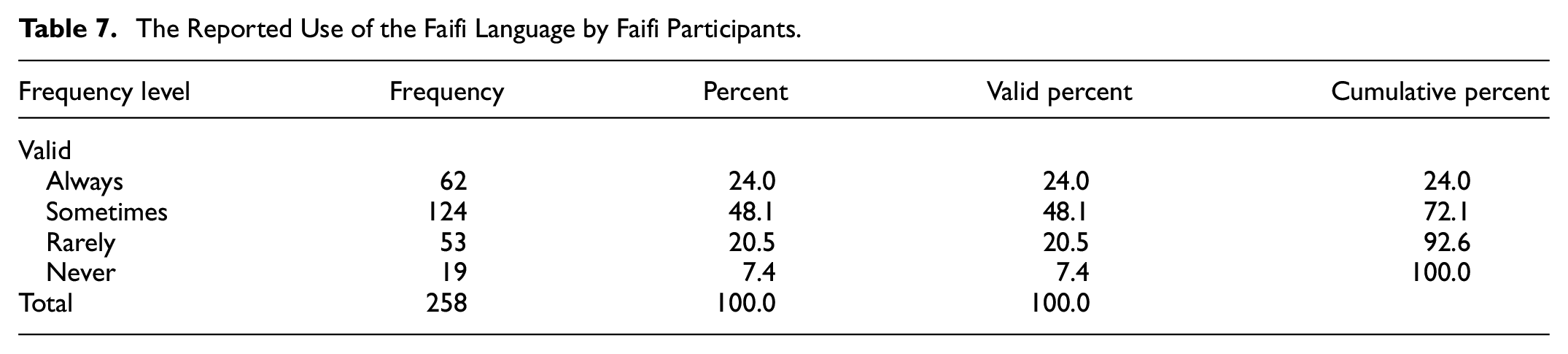
Descriptive Statistics.

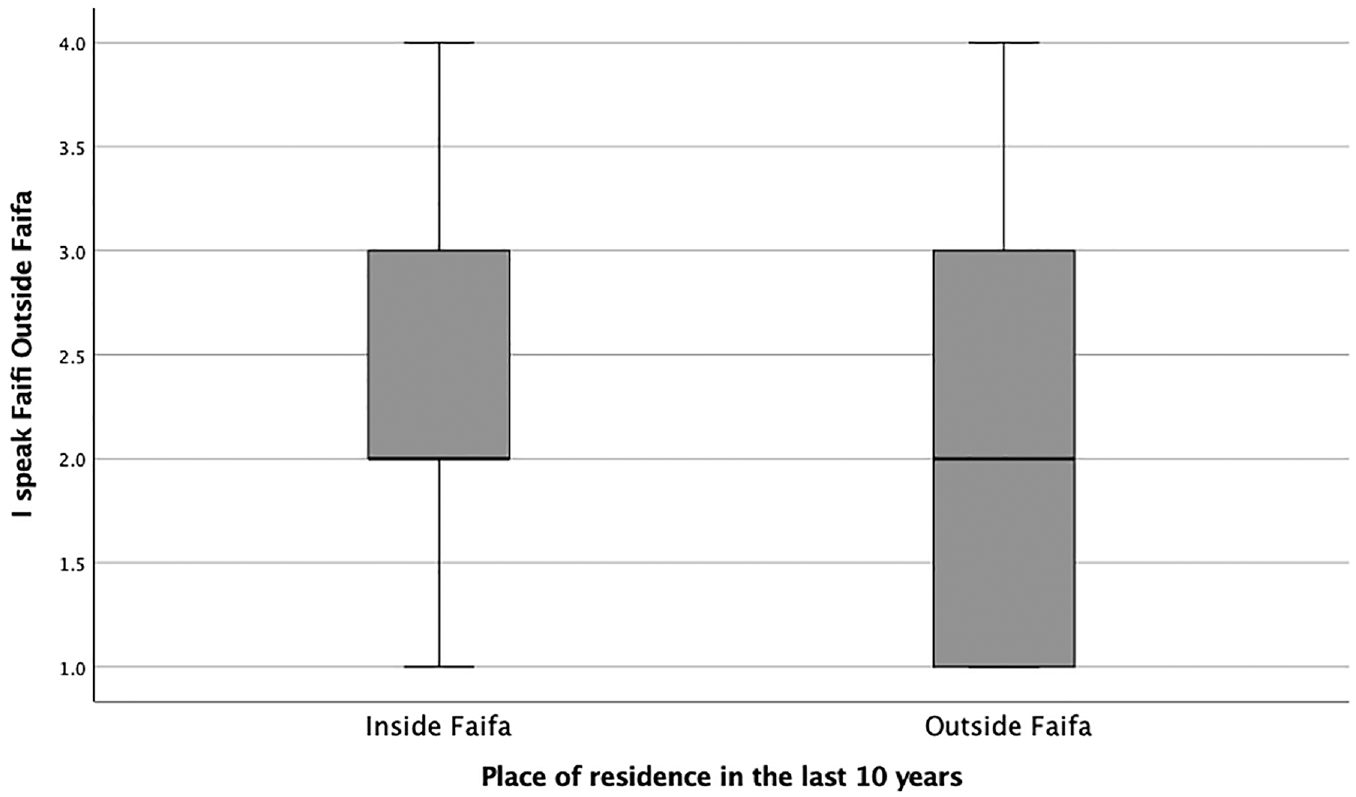
The frequency of speaking the language in relation to place of residence.
It is noteworthy that 187 of the participants resided outside Faifa, while 71 lived inside Faifa during the last 10 years. At this point in the analysis, it is worthwhile to examine the data further with a focus on the distribution of the results between the two groups—those living inside and those living outside of Faifa. Thus, the author separated the two groups and displayed the findings for each separately using a box plot. This representation reveals the variance in distribution between the two groups (see Figure 2).
As can be seen from Figure 2, the distribution of results for those who lived outside Faifa is more skewed than for those who lived inside Faifa. Thus, 50% of the cases from the sample who lived inside Faifa fall within the interquartile range from 2 to 3, with a median of 2, and 50% of the cases from the sample who lived outside Faifa fall within the interquartile range from 1 to 3, with a median of 2. Overall, the pattern indicates that most participants who lived outside Faifa selected “1” (always) on the scale.
A Chi-Square test for independence revealed no significant association between sociodemographic variables and the frequency of speaking the language outside its geographical place. The non-significant results for each demographic are as follows: place of birth (p = .14, Cramer’s V = .14), length of residence (p = .22, Cramer’s V = .12), age (p = .34, Cramer’s V = .13), gender (p = .25, Cramer’s V = .12), and level of education (p = .81, Cramer’s V = .07).
Discussion
The first finding is related to the factor components. Two factors have been revealed in the findings: Status and Dynamism. Unexpectedly, the characteristic “educated” has been revealed as a characteristic in the dynamism dimension instead of its default inclusion within the status dimension. In previous studies, the distinction between status and solidarity dimensions has been widely demonstrated across various global regions (see El-Dash & Busnardo, 2001; Genesee & Holobow, 1989). In recent years, the dynamism dimension has emerged as a third attitudinal dimension (see Kristiansen, 2001; Yin & Li, 2021). However, no earlier study reported the widely observed “educated” characteristic moving from the status dimension to the dynamism dimension. This unexpected finding can be interpreted by two factors: first, understanding the language planning and policy in SA. The language has never been taught in schools and does not possess an orthographic system. Therefore, the “educated” characteristic was not manifested in the status dimension. Second, the Faifi population might perceive education as a vital source contributing to the dynamism of the language rather than a prestigious indication for the language speakers.
Numerous past studies did not discover the exact components of each of the attitudinal dimensions. For example, Kircher and Fox (2019) found that attitudes are unidimensional by nature. Their research indicates that the observed outcome could be attributed to the multiethnolect nature of the variety under investigation. In particular, the author hypothesizes that attitudes may initially be one-dimensional and that the separate dimensions of status and solidarity only manifest once widely accepted social stereotypes about a specific variety have been firmly established. According to this proposal, the lack of prevalent and agreed-upon social stereotypes associated with multiethnolects, such as Multicultural London English, could explain the lack of a distinction between status and solidarity in the present study. Furthermore, Puah and Ting (2015) found that one of the solidarity traits, “easy-going,” was grouped within the status dimension. Ultimately, attitudinal dimensions are not universal (Garret, 2010) and can be driven by the social and cultural factors where attitudinal studies take place. Thus, LA methods play a crucial role in uncovering how language ideology is affected by various social factors, including language policy and planning, in the present study.
The second finding pertains to the effects of demographics in the study. Results suggest homogeneity and positivity in attitudes. The inner circle attitudes indicate a generally positive attitude toward the Faifi language, especially in the status dimension. This finding is further supported by the multiple regression findings concerning demographic impacts. None of the demographic variables was found to negatively influence the results except for age. Although five age groups were included, the difference emerged only between the 25–34 and 45–54 age groups, with the latter exhibiting more positive attitudes. This result can be interpreted by considering the recent social, cultural, and economic developments in SA. The country is adhering to an ambitious vision initiated by Crown Prince Mohammed bin Salman in 2016, aiming to foster a vibrant society, a thriving economy, and an ambitious nation (Saudi Vision 2030, n.d.). Despite the relatively recent inception of this vision, its impacts are materializing rapidly. The author hypothesizes that the younger Faifi demographic may feel that their language is lagging behind the country’s rapid development, especially given its absence from the educational system and Saudi media, thus resulting in less positive attitudes. Numerous previous studies have unveiled a similar trend where younger individuals exhibit less positive attitudes toward their ethnic language (Huteson, 2003; Yin & Li, 2021).
The third finding indicates that Faifi speakers’ reported language use leans in a positive direction, as most participants (72.1%) reported that they always or sometimes use their language outside its geographical place. The author postulates that their positive language ideology, revealed in the first research question, acts as a predictor of their language use. However, findings from this question cannot be generalized, as the question remains perceptual and does not observe their actual language use. On the positive side, these findings can serve as a basis for further observational studies of language use to verify whether their attitudes accurately reflect their behavior. It is crucial to acknowledge that despite the endangered status of the Faifi language and its limited recognition among Saudi citizens, Faifis are able to maintain the use of their language within their familial and Faifi communities residing outside of Fifa. This is primarily attributed to the migration of numerous Faifis from Faifa to other regions of SA, driven by motivations such as employment prospects, higher education pursuits, and various societal factors.
Overall, the author contends that although the Faifi language is linguistically endangered, its speakers maintain positive attitudes toward it, which is reflected in their reported language use. The reasons and intensities for using their language, as well as the places where they use it, fall beyond the scope of this study; hence, the author recommends future studies explore these questions to gain a better understanding of the Faifi language ideology.
Implications for Language Planning
Negative social stereotypes and their implications for structuring societies have been extensively discussed in LA studies (see Garrett, 2010; Kircher & Fox, 2019). Subsequently, negative stereotypes can significantly impact social equality within societies. In the current study, the characteristic “educated” has moved away from its traditional inclusion in the status dimension. In essence, education is not perceived as an indicator of the status of Faifi speakers, as their language is not integrated into the educational system. The author hypothesizes that should the language be taught in schools, the evaluative profiles of Faifi speakers would likely include “educated” under the status dimension. This finding has serious implications for language planners in SA.
The author posits that for the language to be maintained and revitalized, both macro and micro language planning policies need to be implemented. Recent research indicates that state-initiated language planning alone has been unsuccessful in revitalizing endangered languages. Instead, other sociolinguistic variables, such as the roles of families and communities, have been identified as significant factors in the revitalization of endangered languages (Tollefson et al., 2018; Yin & Li, 2021). Therefore, the author proposes that the integration of micro language policy, which needs to be initiated at the family and community level, along with the macro language policy, is inevitable at this stage. Macro language policy should consider integrating the language into the educational system for its indigenous people. In contrast, micro language policy should originate from the indigenous people themselves, initiating initiatives and actions to further support language use, especially among young speakers.
In light of the literature reviewed and the findings obtained from the present study, both macro and micro language policies should consider four main points.
Key considerations for macro and micro language policies emerge from the recent urbanization and development processes in the country. These processes have implications for the maintenance of ethnic languages, with urbanization identified as a salient factor in dialect leveling and disappearance (Al-Rojaie, 2013; Xu, 2015). Recently, Al-Rojaie (2020) conducted a perceptual study on the spread of a koine language in SA, finding a significant dominance of a koine language in the country that replaces many regional dialects. If this is the case for regional dialects in the country, then the situation could be even more complex for the Faifi language. Thus, the issue of maintaining endangered languages in SA must be prioritized. Language planners need to initiate an educational scheme that can face challenges arising from urbanization. The author suggests that language planners design an educational scheme that promotes additive bilingualism, which supports and encourages the linguistic and cultural maintenance of endangered languages (Giles et al., 1976). Linguistically, it encourages learners to master their ethnic language alongside the dominant or official language in the country. Furthermore, additive bilingualism calls for the wider society to value and respect the indigenous people’s language and culture. Thus, I argue that if language planners in the country consider the additive bilingualism of the Faifi language, the language can be maintained and revitalized.
Furthermore, the micro language policy needs to target younger speakers, as one finding from this study indicates that the younger age group (25–34) had fewer positive views than the 35 to 44 age group. Initiatives and cultural activities need to originate from the indigenous people and engage this specific age group. Sociolinguist researchers in the Faifi community are encouraged to conduct preliminary and pilot studies to find out what engages this particular age group (25–34) and what types of social and cultural activities they would prefer. The recommendations derived from these studies should then be put into practice.
This study is subject to two limitations. The first limitation is related to the study sample. The inclusion of outer circle attitudes toward the Faifi language was not possible, as the language is not known to most Saudis. The language is neither represented in the media nor taught in schools. Therefore, LAs from the outer circle would not be reliable or valid. Thus, the author recommends that language planners in SA introduce the notion of language diversity and highlight its value as a source for national nourishment in the future. Furthermore, the Saudi media should consider featuring the language, its speakers, and its culture. If these suggestions are implemented, future attitudinal research could include the wider society, yielding more generalizable findings that could inform language planning policy in the country.
The second limitation pertains to the selection of judges responsible for evaluating the questionnaire items utilized in the study. Extensive efforts were exerted to assemble a diverse panel of judges consisting of both male and female participants. Regrettably, only five female judges responded affirmatively and agreed to partake in the study in an online discussion via the Webex platform and provide feedback on the questionnaire items. Given the relatively small size of the Faifi community in comparison to the overall population of SA, finding suitable participants posed challenges. Even when potential Faifi participants were contacted, their willingness to serve as judges on the panel was not guaranteed. Secondly, endeavors were made to recruit judges possessing linguistic expertise in order to obtain a comprehensive and insightful feedback on the questionnaire items. However, these attempts proved unsuccessful, resulting in the inclusion of solely five non-linguist female judges as the available evaluators.
Conclusion
The present investigation yields three key findings of notable significance. Firstly, it contributes to the realm of LAs by offering fresh perspectives on the dimension of status within LA research. Specifically, the findings underscore that the “educated” attribute loses its import as an indicator of status when a language lacks recognition or educational provision. This underscores the criticality of prioritizing educational endeavors to safeguard the languages spoken by minority groups. Secondly, this study provides preliminary insights into the reported language usage among the Faifi community, indicating that despite the language’s endangered status, it continues to be employed within the Faifi community, even when members are residing away from their homeland. This finding holds the potential to establish a foundation for future investigations delving into the actual language usage patterns of Faifi speakers. Thirdly, the research reveals that age can serve as a significant predictor of LAs toward endangered languages, as older participants exhibited more favorable attitudes compared to their younger counterparts. Consequently, based on the triad of findings, this paper advocates for the implementation of both macro and micro language policies aimed at preserving and revitalizing the Faifi language. Macro language policy should encompass the integration of the language into the educational system for the indigenous population. What follows, the paper proposes the incorporation of additive bilingualism into the educational system in SA. This can be done through various methods, such as offering language classes or immersion programs in schools, allowing students to learn both the endangered language and the dominant language. By adopting this approach, students can become proficient in both languages and also contribute to the preservation of the endangered language. To enhance the learning and appreciation of the endangered language, additional resources like books, multimedia, and cultural activities can be made available. Micro language policy should emanate from within the indigenous community itself, initiating initiatives and actions to provide further support for language usage, particularly among young speakers.
Footnotes
Declaration of Conflicting Interests
The author declared no potential conflicts of interest with respect to the research, authorship, and/or publication of this article.
Funding
The author received no financial support for the research, authorship, and/or publication of this article.
Ethical Approval
Approval was obtained from the ethics committee of King Abdulaziz University. The procedures used in this study adhere to the tenets of the Declaration of Helsinki.
Informed Consent
Informed consent was obtained from all participants prior to the study. Participants were provided with an information sheet before they started filling out the questionnaire. They had the right to withdraw at any point.
