



Abstract
Admist intensifying academic and shifting regulatory landscape of China’s “Double Reduction” policy, this study investigates the language attitudes and investment behaviors of urban middle-class families in Changsha, a major city in monolingual central China. Through a purposive sample of 350 parents of primary school students, the findings reveal broadly positive attitudes toward English, with use value rated highest and demonstrating strong consensus, while exchange value showed the greatest dispersion. Family investment in English education is characterized by substantial material expenditure and high levels of parental intellectual, non-intellectual, and social interaction, reflecting a composite strategy of capital conversion. Path analysis indicates that while exchange value exerts the most direct influence on annual family expenditure, use value and symbolic value indirectly shape investment through social interaction. The study further identifies a “manager mother” model, wherein maternal educational background significantly predicts the intensity of family involvement. These micro-level strategies are nested within macro-level structures, demonstrating how family agency both responds to and potentially reinforces educational stratification and policy shifts. The research contributes to FLP literature by applying an investment perspective in a monolingual context, addressing a geographical bias toward coastal metropolises, and providing quantitative evidence of the complex interplay between parental beliefs and strategic resources mobilization.
Plain Language Summary
Researchers studied how middle-class families in Changsha, China, invest resources in their children’s English education amid growing competition. They surveyed 350 parents from two urban primary schools. Parents strongly value English, especially its practical use (e.g., daily communication), which had the highest agreement. Views on career/school value (e.g., future opportunities) varied most. Families invest heavily through both money (classes, materials) and active involvement, particularly parent-child English interaction. The mother’s education level significantly impacts all investment decisions, reflecting a "maternal manager" model. Only belief in English’s career/school value directly increases annual spending. Practical value and status value indirectly boost spending by motivating more parent-child interaction. Overall, practical value most strongly shapes family participation. The study connects these patterns to family, community, and societal influences.
Keywords
Introduction
In contemporary China, the fervent pursuit of English proficiency has become a hallmark of urban middle-class parenting, reflecting broader anxieties about academic success and social mobility in a globalizing world. This phenomenon is particularly intriguing against the backdrop of a national policy environment that, since the 2021 “Double Reduction” policy, has actively discouraged excessive extracurricular academic training (Xinhua News Agency, 2021). The persistence of substantial family investment in English education amidst such policy shifts underscores a critical disconnect between state mandates and familial aspirations, pointing to the need for a deeper understanding of the private language planning occurring within Chinese households.
Research on Family Language Policy (FLP) has productively examined such home-based language management, yet its focus has remained largely on multilingual contexts, such as immigrant and transnational families (Duff, 2019; Lanza & Gomes, 2020). Within China, existing studies have predominantly explored highly internationalized metropolises like Beijing and Shanghai (e.g., Li et al., 2022; Zheng & Mei, 2021), leaving a significant gap in our understanding of families in central and western regions. These families navigate a distinct reality: they operate in a predominantly monolingual Mandarin environment with limited daily exposure to English, yet they are driven by similar, if not greater, aspirations for their children to acquire this global linguistic capital. This context—a monolingual society with a powerful drive for foreign language bilingualism—remains critically underexplored.
To investigate this underexplored terrain, our study adopts the lens of “investment,” a concept pioneered by Peirce (1995) and further developed by Darvin and Norton (2015), which frames language learning not merely as a skill acquisition but as a social practice intertwined with identity and capital. This perspective is particularly apt for illuminating the socio-economic rationales underlying middle-class family strategies, as it directly links language learning to aspirations for future returns. Central to this investment are parental beliefs about the value of English. We consciously focus on measurable language attitudes—parents’ evaluative judgments about English—rather than the broader, more abstract concept of language ideology. This operational choice allows us to systematically investigate how specific parental perceptions of English’s utility, symbolic status, and economic value directly shape tangible investment behaviors, from financial expenditures to time and social resource allocation.
Accordingly, this study turns its attention to Changsha, a major city in central China representative of this under-researched context. By examining the language attitudes and investment practices of middle-class families in Changsha, we seek to unveil the mechanisms through which global English is pursued at the family level in a monolingual heartland. This research aims to make a threefold contribution: (a) theoretical, by applying and testing the investment perspective within a monolingual FLP context; (b) geographical, by shifting the focus from first-tier coastal cities to a representative central Chinese urban center; and (c) methodological, by employing a quantitative approach to identify broader patterns. This research not only addresses a significant geographical and contextual gap in FLP literature but also offers critical insights into the complex interplay of global linguistic markets, national education policies, and localized family struggles for competitive advantage.
Literature Review
The Development and Current Status of Family Language Policy (FLP)
Family Language Policy (FLP) is defined as both explicit/overt and implicit/covert planning regarding language use and literacy practices within the family domain (Curdt-Christiansen, 2009, 2018; King et al., 2008; Spolsky, 2012). It encompasses the roles of parents in language education, language distribution within the household, and how language planning is implemented. FLP research has evolved from the fields of language socialization and language planning to include a more diverse array of topics such as family language investment and language capital, making it an interdisciplinary area of study spanning linguistics, sociology, and education.
Early FLP research centered on “contact zone” (Pratt, 1991), on decisions regarding the choice of native and foreign languages, particularly in immigrant and multilingual families, where parents often face challenges in balancing heritage language maintenance with the dominant society’s language (King et al., 2008; King & Fogle, 2013). Chen and Cao’s (2025) systematic review revealed a dominant research focus on parents as the primary decision-makers shaping FLPs. For instance, Bohnacker’s (2022) study showed that Turkish parents believed that proficiency in Turkish language would facilitate their children’s acquisition of other languages. Wan and Gao (2021) found that parents strategically chose an international school where their children were exposed to multiple languages while maintaining their connection to Chinese culture by participating in Chinese language related activities.
As globalization and cross-cultural communication have increased, FLP has evolved into a more multifaceted research field, considering how parents make language decisions based on the social functions and value of languages (Curdt-Christiansen, 2009; Mirvahedi, 2021; Mirvahedi & Cavallaro, 2020). Curdt-Christiansen and Wang (2018) have discussed how parents make choices in response to the sociocultural and economic opportunities offered by different languages, highlighting the role of language in shaping social capital. Shen et al. (2020) find a noticeable decline in the use of the Miao language across different generations in China and discuss the meso, macro factors behind such a change. This shift marks an important expansion of FLP into non-Western contexts, enriching the field with diverse sociocultural perspectives.
In addition to explicit language policies, FLP research increasingly considers implicit language management—particularly in the context of globalization—where parents may aim to equip their children with linguistic skills that can enhance their social mobility. For instance, Palviainen and Bergroth (2018) conducted a study on multilingual families in Finland, using discourse analysis to explore parents’ views on “mother tongue” and their questioning of bilingual identities. With English’s status as a lingua franca, English education has become a key focus for many families, given its central role in educational and professional success. Research shows that the attitudes parents hold toward English and other foreign languages significantly influence their language planning decisions (Curdt-Christiansen & Wang, 2018). In China, the demand for English as a key driver of upward social mobility has intensified (Butler, 2014; Shen et al., 2020). Seo (2023) also find family capital such as parents’ English language proficiency, ability to support and sustain English language practice at home support parents’ efforts to provide a rich linguistic environment for their children in Korea. These studies demonstrate that parental language attitudes not only determine the direction of family language policies but also influence the distribution of educational resources and the extent to which language investment occurs. This growing attention to the socio-economic dimensions of language choices paves the way for the “investment” perspective, which provides a cohesive theoretical framework to analyze the resource allocation and future-oriented strategizing that characterize contemporary FLP, particularly in contexts of globalization.
Family Language Investment: Theoretical Perspectives and Practical Forms
Family language investment is rooted in theories of capital from sociology and economics, notably Bourdieu’s (1984) theory of cultural capital and Peirce’s (1995) theory of second language learning investment. From this perspective, family education investment involves more than just financial resources; it encompasses a range of non-material forms of investment such as time, emotional support, and social capital (Liu & Xie, 2015). Parents make these investments with the expectation that by providing their children with greater language learning opportunities, they will help enhance their children’s social competitiveness and upward mobility (Piller, 2001; Piller & Gerber, 2018). For families, investing in language education—particularly in a global language like English—can increase their children’s social capital, enhancing their ability to compete in a globalized world (Liu, 2014a, 2014b).
Research adopting an investment lens in FLP is expanding. Studies have examined how parental investment in early bilingual education shapes children’s cultural identity (Li & Liu, 2016; Zhu & Li, 2016), and how English learning in South Korean families reflects globalized aspirations for social mobility (Cho, 2015; Seo, 2019). Parental school choice, especially regarding bilingual or immersion programs, is also seen as investment driven by aspirations for social mobility (Ryan, 2020; Wan & Gao, 2021). These studies highlight the underlying language ideologies and the symbolic value of multilingualism as capital.
Encouraged by shared aspiration, families ability in investing language education differs. Scholars conceptualize the family as a site where various capitals—material, cultural, emotional—interact under socio-political constrains (Curdt-Christiansen & Morgia, 2018). Li (2007) argued that family language environments are shaped by these capital forms, which influence language practices and access to resources. Consequently, children’s language abilities are the result of the combined effects of various forms of capital and language experiences. Research by Zheng and Mei (2021) shows that investment patterns differ by social class, with upper-middle class families more capable in translating their language planning into language practices.
Research Gaps and Research Questions
While significant progress has been made in the study of FLP and family language investment, there remain several research gaps. First, a geographical and contextual imbalance persists. A statistical review by Lanza and Gomes (2020) confirmed a continued skew toward European and North American contexts, with immigrant and multilingual families receiving more attention. Moreover, much of the existing literature conducted in China has focused on first-tier cities (e.g., Li et al., 2022; Zheng & Mei, 2021), with limited attention paid to families in relatively monolingual environments. This study addresses this gap by focusing on monolingual Chinese households in central China, a context where English operates purely as a foreign language.
Additionally, the relationship between socio-economic status (SES) and family language policy warrants further exploration (Butler & Le, 2018; Gu et al., 2025). SES shapes language ideologies, which in turn influence family language management and practices (King et al., 2008; Curdt-Christiansen et al., 2023). While previous studies indicate that SES plays a crucial role in determining language investment (Zheng & Mei, 2021), how parental language attitudes influence investment decisions when SES is controlled remains unclear. This study seeks to clarify this mechanism by measuring and controlling for key SES indicators in its data collection of the attitude-investment relationship.
To effectively address these gaps, this study employs a quantitative survey methodology. This approach is specifically chosen because our research objectives are concerned with identifying and establishing the prevalence and relationships between constructs—namely, language attitudes and investment behaviors—within a defined demographic group. A quantitative design allows for the systematic collection of data from a larger sample, enabling us to map the general landscape of parental attitudes, document the scope and forms of financial and non-financial investments, and use statistical modeling to test the strength and pathways of the relationships between these variables. While qualitative methods are invaluable for exploring depth and nuance, the current study is strategically designed to first establish these broader patterns and correlations, thereby providing a foundational dataset and identifying key levers for future in-depth qualitative inquiry.
Based on above discussions, we have chosen middle-class families from a central city in China as our research subjects. Using a questionnaire survey, we aim to answer the following questions:
RQ1. What are Chinese middle-class parents’ reported attitudes toward English?
RQ2. What is the current status of their investment in children’s English education?
RQ3. To what extent, and how, is family language investment shaped by parental language attitudes?
Theoretical Framework
This study is grounded in an integrated theoretical framework that combines Family Language Policy (FLP) and Coleman’s (1988) theory of family capital to examine how parental language attitudes shape family investment in English education. FLP research focuses on the dynamic interplay between language beliefs, language management, and language practices (Curdt-Christiansen, 2009; Spolsky, 2003). Within this framework, language beliefs—conceptualized here as parental language attitudes—serve as the ideological foundation that guides family language planning and practices. To further explain how these attitudes translate into concrete educational investments, we draw on Coleman’s (1988) theory of family capital, which posits that families mobilize material, human, and social capital to support children’s development. Integrating these two perspectives allows us to analyze not only what families do to support English learning, but also why they do it, and with what resources.
In this study, language beliefs refer to parents’ views on foreign language proficiency and language learning (primarily English), shaped by the historical, economic, political, and social roles of language in society. We examine parental language beliefs through the lens of language attitudes, defined as parents’ evaluations of the value of English proficiency and English learning, including individual perceptions and expressions of the economic, political, cultural, and social values (Blommaert, 2006; Curdt-Christiansen, 2014; Kroskrity, 2010). Referring to previous studies (Ma, 2021; Shen, 2017), we focus on the cognitive dimension of language attitudes within a broader socio-cultural context.
The measurement indicators for language attitudes are categorized into three types: exchange value, use value, and symbolic value. Exchange value, viewing language learning as a means of exchange to achieve an external goal, such as advancing in education or employment (Shen, 2017). Use value is related to the needs of the learner’s real-life experience and personal development, emphasizing intrinsic and practical benefits such as communication, personal development, and cultural enrichment. Symbolic value refers to the associations that a language may evoke related to certain qualities (Cameron, 2012), such as French being associated with romance, German with technology and rigor, and English often being linked with internationalization and globalization.
Family investment in English education is conceptualized as an inter-generational transmission and transformation of family capital aimed at promoting children’s English proficiency. In the Chinese context, this primarily refers to parental investment in English as the dominant foreign language. Based on Coleman’s family capital theory, family investment is analyzed through three dimensions: material investment (rooted in physical capital, referring to financial and time expenditures), parental involvement (based on human capital and within-family social capital, including intellectual participation such as tutoring children in English, and non-intellectual participation, such as parental companionship during children’s English learning), and social interaction (based on between-family social capital and family network resources, referring to parents’ interactions with schools, communities, and other family members, as well as the information and resources within the family social network, such as communication with teachers or other parents about children’s English learning).
To synthesize the above components, Figure 1 presents the integrated theoretical framework of this study. It illustrates how the three dimensions of parental language attitudes (exchange, use, and symbolic value) within the FLP paradigm influence the three forms of family language investment, which are operationalized through the mobilization of Coleman’s family capitals. This framework allows us to trace how parental attitudes are enacted through the strategic conversion of family resources to support children’s English learning.

Theoretical framework integrating family language policy and family capital theory.
Research Context of the Current Study
This study was conducted in Changsha, the capital of Hunan Province in central China. As a major urban center with a population of 10.42 million, Changsha recorded a GDP of 1526 billion yuan (around 214 billion USD) in 2024. It represents a typical developed inland city, characterized by a lower cost of living and less exposure to English compared to coastal metropolises, yet it is experiencing growing middle-class aspirations for educational investment. Notably, the city’s per capita disposable income was 69,658 yuan in 2024, providing a benchmark for the sample’s socioeconomic status.
The research was situated within a specific policy environment. Despite national initiatives such as the “Double Reduction” Policy in 2021, which strictly regulated off-campus tutoring, investment in English remains prevalent among urban families. This context makes the exploration of family investment in a city like Changsha, where everyday English use is limited, particularly critical for understanding the broader dynamics of English education in China.
Research Methods
Participants
This study employed a purposive sampling strategy to recruit urban middle-class parents from two public schools in Changsha. The schools, S Primary School and Y Primary School, were selected because their admission policies, which require urban household registration and property ownership within the designated school district, naturally enroll families from the target socioeconomic background. The two schools were chosen to capture some diversity within the urban middle class, with S school drawing more from professional and enterprise backgrounds, and Y school being affiliated with a university, thus including academic families. Housing prices within their school districts (20,000 yuan/m2 for Y school and 34,000 yuan/m2 for S school) are substantially higher than the city’s average (9,629 yuan/m2), reflecting a significant level of family investment in education and aligning with the middle-class profile targeted in this study.
While the initial school access was facilitated through the researchers’ professional networks, the selection of the schools themselves was criterion-based, fulfilling the requirements of purposive sampling. The primary caregiver responsible for the child’s English learning was requested to complete the survey. A total of 368 questionnaires were distributed, with 350 valid responses obtained, yielding a 95.11% effective response rate.
Instruments and Data Collection
The survey instrument, titled Survey on parental language attitudes and family investment in English learning, was developed based on the theoretical framework and prior literature (e.g., Ma, 2021). It comprised three sections: demographic information, language attitudes, and family investment scale. The language attitudes scale measured three dimensions—symbolic, exchange, and use value—using 15 items (five items per dimension). Sample items include: “English ability is a symbol of international identity” (symbolic value) and “Learning English helps get into better schools” (exchange value). The family investment scale assessed material investment (e.g., annual expenditure, types of tutoring), parental involvement (e.g., “I often teach my child English words”), and social interaction (e.g., “I often communicate with my child’s English teachers) through 14 items. Most items employed a five-point Likert scale (1 = strongly disagree, 5 = strongly agree).
A pilot study was conducted in January 2024 to refine the instrument. Within the two purposively selected schools, two classes were randomly selected for this pilot phase. This approach allowed for an unbiased test of the questionnaire’s clarity and reliability before full-scale deployment. The formal investigation was administered online via Wenjuanxing in March 2024. Teachers distributed the questionnaire to parents, requesting that the primary caregiver responsible for the child’s English learning complete it.
Data Analysis
The researcher downloaded the valid responses in Excel format for preprocessing and conducted data analysis using SPSSAU (Statistical Product and Service Software Automatically). The analytical strategy was structured to address the three research questions sequentially:
To investigate RQ1 (parents’ language attitudes) and RQ2 (current investment status), descriptive statistics (means, standard deviations, frequency distributions) were applied.
To answer RQ3 (the relationship between attitudes and investment), Pearson correlation analysis was first conducted to examine possible relationships. Subsequently, path analysis was employed to explore the direct and indirect influence strength of different variables.
The following section details the results of these analyses.
Results
Reliability and Validity of the Instrument
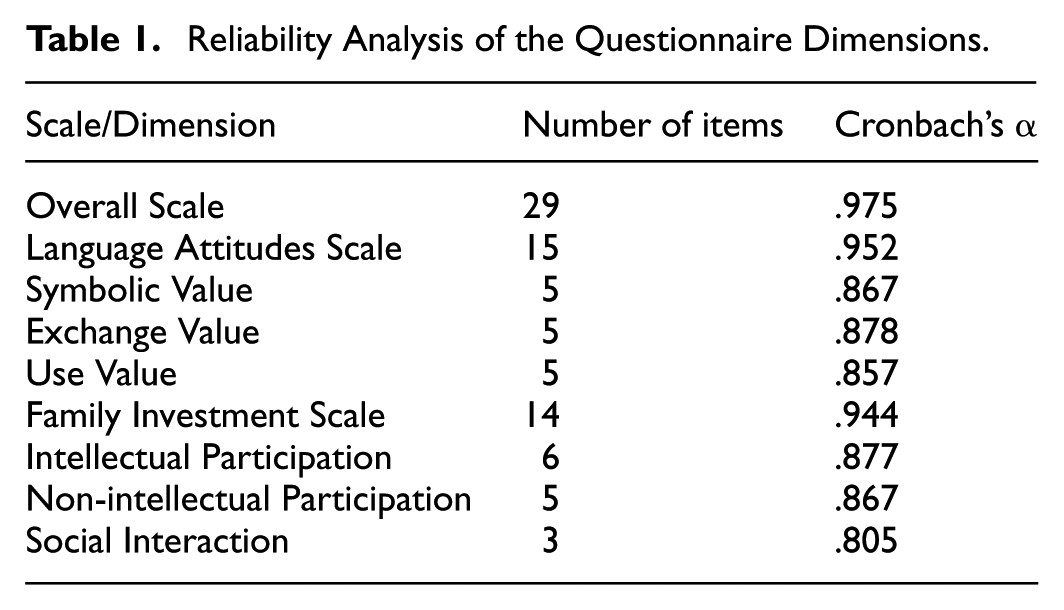
Prior to analysis, reliability and validity tests were conducted on the scale to assess the instrument. As presented in Table 1, the Cronbach’s α coefficients for the overall scale and all sub-dimensions ranged from .805 to .975, indicating excellent internal consistency reliability. Subsequently, an Exploratory Factor Analysis (EFA) was performed to assess the structural validity. The results (see Table 2) show a KMO value of .955 and a significant Barlett’s test of sphericity (χ2 = 2325.48, p < .001), demonstrating that the data were highly suitable for factor analysis. The model accounted for 73.13% of the total variance, confirming that the instrument possesses a sound and robust factor structure.
Reliability Analysis of the Questionnaire Dimensions.
Results of Exploratory Factor Analysis for Structural Validity.

Demographic Information of Participants
Among the surveyed samples, parents of children in Grade 3 and 4 accounted for the highest response rate (44.86%), likely due to the Chinese government’s policy mandating the formal introduction of English instruction from Grade 3. The majority of respondents responsible for their child’s English learning were mothers (72%), consistent with previous research on family language policy (Armstrong, 2013; King & Fogle, 2006; Nakamura, 2016). Most respondents were aged 30 to 40 (58%).
In terms of occupation, 79.99% of fathers and 71.71% of mothers were professionals employed in government agencies, public institutions, private companies, or were business owners, positions typically associated with the middle class. Educationally, 75.14% of fathers and 71.43% of mothers held an associate degree or higher, reflecting a well-educated parental demographic.
Regarding household annual income, 83.14% of families reported annual earnings between 100,000 and 500,000 yuan (about 14,0043–70,217 USD), 15.43% earned less than 100,000 yuan, and 1.43% reported an income exceeding 500,000 yuan. Considering the 2024 per capita disposable income in urban Changsha was 69,658 yuan (about 9,784 USD), most surveyed households were above the average income level, indicating that the sample predominantly represents the urban middle-income group.
Current Status of Parents’ Language Beliefs
As shown in Table 3, the mean scores of all three dimensions of parental language attitudes exceed 3, indicating generally positive view toward the value of English proficiency.
Descriptive Data on Parents' Language Attitudes.

Parents rated the use value of English proficiency the highest (MS = 3.696), with the lowest standard deviation, suggesting strong consensus. Notably, the two highest-rated items (Item 12 and 13), related to communication and cognitive development, fall under this dimension. This contrasts with previous research, where academic and career-related benefits (exchange value) were prioritized (Ma, 2021), suggesting that urban middle-class parents in this study place greater importance on the intrinsic value of English proficiency, such as the cognitive development and communication skill. Interestingly, the exchange value dimension exhibited the highest variability, indicating divergent opinions on the role of English in academic and career prospects. This may be influenced by recent national policies discouraging excessive extracurricular English tutoring.
Current Status of Family Language Investment
We first investigated the amount of time parents spend each week on their children’s English learning. Only 26.29% of parents reported spending less than 1 hr per week, while 40.29% reported dedicating over 3 hr weekly supporting their children’s English learning.
Regarding annual expenditures on children’s English learning, 46.86% of parents reported spending between 8,000 and 15,000 yuan per year (see Figure 2), reflecting a substantial commitment to English education. Additionally, 12.73% spent over 15,000 yuan annually, indicating a subgroup prioritizing premium resources such as international schools and overseas study tours. In contrast, only 10.28% of parents reported spending less than 3,000 yuan per year. Both the time and financial investments observed suggest that middle-class families in our study place a high value on their children’s English education.

Parental annual expenditure on children's English education.
Beyond annual expenditure, specific forms of material investment were also examined to better understand parental preferences in supporting children’s English education.
As shown in Table 4, 92.13% of parents hired English tutors, making it the most common form of investment, surpassing enrollment in English extracurricular courses (79.78%). This trend reflects a shift toward private, individualized support, especially in the context of the “Double Reduction” policy, which has limited formal tutoring channels and prompted wealthier families to seek more discreet alternatives, which potentially further exacerbating educational inequalities driven by family socio-economic (Fu et al., 2024).
Response Rates and Popularity Rates of Different Forms of Investment.

Note. Chi-square goodness-of-fit test: χ2 = 94.035, p = .000. Three parents indicated no investment in their children’s English education, hence the number of respondents were 347.
Other common investment types with popularity rates near 90%, include the purchase of English learning products (91.01%), participation in paid English exams (88.76%), and purchase of extracurricular English materials (88.76%). These patterns underscore the enduring dominance of traditional language learning approaches, including private tutoring, extracurricular exercises, learning products, and English exams. Notably, 49.44% of respondents reported participation in paid overseas study tours or camps, highlighting a growing trend among urban middle-class families to access high-end educational experiences, reinforcing their commitment to elite educational paths.
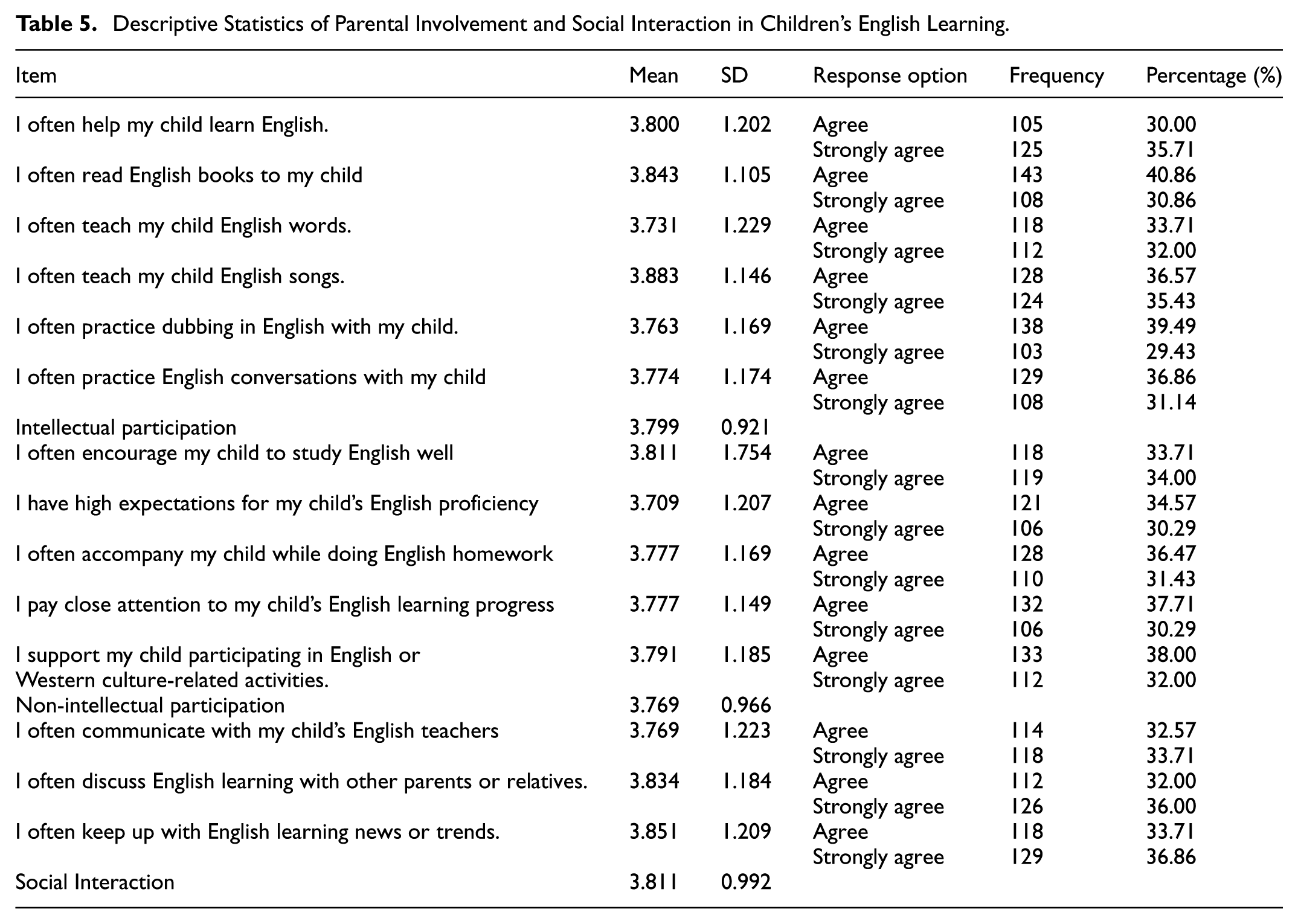
In terms of parental involvement and social interaction, the mean scores for all items exceeded 3.7, with over 60% of parents selecting “agree” or “strongly agree” for each item (see Table 5). This indicates that families not only invest materially but also actively cultivate conducive learning environments and utilize social networks to access resources and track peer progress, strategies aligned with class reproduction through linguistic capital accumulation.
Descriptive Statistics of Parental Involvement and Social Interaction in Children's English Learning.
To explore the determinants of family language investment, the Pearson correlation analyses were conducted among demographic variables, parental language attitudes, and investment practices. Results revealed that both annual household income (r = 0.501, p < .01) and the overall score of parental language attitudes (r = 0.552, p < .01) were positively correlated with annual spending on children’s English learning. However, these variables were not significantly associated with specific forms of investment, nor with parents’ occupations or educational backgrounds. Weekly time devoted to children’s English learning also showed no significant correlation with any demographic variables. Interestingly, mothers’ highest educational attainment was positively correlated with all items measuring parental involvement and inter-family social interaction, with the sole exception of the statement “I often read English books to my child.” This finding once again highlights the central role mothers play in family investment in English education.
The Relationship Between Language Attitudes and Family Language Investment
To further explore the relationship between parental language attitudes and family language investment, parental attitudes were categorized into three dimensions: exchange value, use value, and symbolic value. Similarly, family language investment was divided into four components: material investment, intellectual participation, non-intellectual participation, and social interaction. A path analysis was conducted, and a preliminary model was proposed based on our theoretical framework. We propose that parents’ evaluation of English influences family investment in language, including parental involvement and social interactions, which ultimately manifests in the annual expenditure on their children’s English education.
We then assessed the path significance of the model. The path from symbolic value (p = .141), use value (p = .393), intellectual participation (p = .812), and non-intellectual participation (p = .336) to annual expenditure on English education were not significant and were therefore removed. After re-estimating the model, all fit indices met the required standards (see Table 6). The final model and path coefficients are presented in Figure 3.
Fit Indices for the Final Path Analysis Model.


Path model of parental attitudes toward English and family investment in children's English education.
As shown in Figure 3, parental language attitudes have multiple significant paths influencing family language investment. Symbolic and use value do not directly affect annual expenditure on language education but exert indirect effects through social interaction. Notably, the direct path from exchange value to annual expenditure is the strongest among all, with a coefficient of .466 (p < .01). This suggests that, despite varied views among middle-class families on whether English proficiency improves educational and career prospects, exchange value remains the most direct driver of material investment. Overall, parents’ perception of use value has the broadest influence, significantly influencing intellectual participation (β = .357, p < .01), non-intellectual participation (β = .387, p < .01), and social interaction (β = .324, p < .01). In total, parental language attitudes account for 84.1% of the variance in intellectual participation, 76.5% in non-intellectual participation, and 78.5% in inter-family social interaction.
Discussion
This study reveals that middle-class family investment in English education in central China is far from a simple consumer behavior; it is a strategic practice deeply embedded in the interconversion of material, human, and social capital. Shaped by the new educational ecology of the “Double Reduction” policy and persistent competitive pressures, family decision-making exhibits complex logics. This discussion will analyze the composite capital structure of family investment, illustrate the differentiated driving mechanisms of parental language attitudes, examine the central role of mothers in policy implementation, and ultimately situate these micro-level behaviors within the broader context of macro-level policy and social stratification to reveal their profound implications.
Beyond Material Input: Family Language Investment as a Composite Capital Conversation Strategy
The findings reveal that middle-class language investment constitutes a synergistic system, grounded in material capital and activated through human and social capital, with the fundamental aim of strategic intergenerational advantage transmission. Survey data paint a picture of multidimensional engagement: approximately 60% of families spend over ¥8,000 annually on English, over 40% of parents devote more than 3 hr per week to intellectual participation, and the social interaction dimension received the highest mean score (M = 3.811). This pattern indicates that in a monolingual environment lacking natural context, families are systematically converting capital to construct an artificial, “immersive” English-learning ecology.
This finding powerfully validates and refines Coleman’s (1988) theory of family capital. Material investments (e.g., purchasing courses, learning products) form the necessary physical foundation, but their efficacy is highly dependent on within-family social capital (parent-child interaction) and between-family social capital (parent-school, parent-parent networks). The highest score for social interaction in our data precisely illustrates that parents are adept at leveraging social networks to access scarce information and resources, thereby maximizing the return on material investment. We believe that the significant correlation between mothers’ educational background and most family involvement items underscores that maternal human capital is the key engine activating the entire investment system. They are not merely contributors of time but are “managers” who apply their own knowledge and skills to optimize the learning process. Therefore, this study posits that middle-class Family Language Policy in China is essentially a model of capital conversion. Material capital enables educational procurement, human capital (especially the mother’s) enhances the quality of involvement, and social capital ensures channels and efficiency in resource acquisition. This process extends far beyond enhancing language proficiency; it deeply participates in social class reproduction (Bourdieu, 1984; Bengtson et al., 2002; Lareau, 2011)—it is through this sophisticated mechanism of capital conversion that families aim to secure a favorable position for their children in future social resource allocation (Swartz, 2008), which constitutes a core perspective for interpreting these investment behaviors.
Coordinated Instrumentalism: The Differentiated Drive of Language Attitudes on Investment
Parental perceptions of English value exhibit a characteristic of “coordinated instrumentalism”: they most widely acknowledge its intrinsic utility in principle, but their most substantial financial expenditures are most directly driven by its exchange value. Descriptive statistics show that use value received the highest mean score (M = 3.696) and the lowest standard deviation, indicating the strongest consensus. In contrast, exchange value exhibited the greatest internal divergence. Path analysis further uncovered a crucial mechanism: exchange value was the only dimension exerting a direct and strongest effect (β = .466) on annual material expenditure, whereas use value and symbolic value primarily influenced investment indirectly through their impact on social interaction.
This finding highlights the differentiated roles that various value dimensions play at different decision-making levels. The high recognition of use value reflects the middle class’s intrinsic pursuit of global competence and holistic child development (Pan, 2015; Shen, 2017), which constitutes the underlying motivation for their sustained family involvement and non-financial inputs. However, when it comes to significant financial outlay decisions, rational calculation of educational returns and career prospects—that is, exchange value—becomes the overriding dominant factor. It is noteworthy that the high divergence within the exchange value dimension may precisely reflect the uncertainty among the parent cohort regarding the future weight of English within the education system, against the backdrop of the “Double Reduction” policy and domestic education reforms. This uncertainty does not diminish the centrality of exchange value; on the contrary, it may prompt families to more meticulously calculate the expected return on their financial investments. Thus, the findings of this study deepen the connotation of linguistic instrumentalism (Gerhards, 2012), suggesting that in the Chinese context, FLP is governed by a dual logic: widespread recognition of intrinsic utility sustains everyday language management practices, while shrewd calculation of external returns directly leverages large-scale material investment.
“Manager Mothers” and Intensive Parenting: The Execution Engine of Foreign Language Policy
The effective implementation of FLP relies heavily on the central role of mothers and a high-investment, high-management model of intensive parenting. Our data indicate that mothers are the primary persons responsible for children’s English learning (72% of respondents), and their educational level is positively correlated with 13 out of 14 items measuring family involvement and social interaction. This role extends far beyond traditional “companionship,” evolving into that of strategic planners of educational resources, coordinators of information networks, and supervisors of learning progress.
This finding aligns closely with the phenomena of “manager mothers” (Park, 2007) or the “brokerization of motherhood” (Yang, 2018) described in prior literature, but our research further reveals its new adaptations within China’s post-“Double Reduction” educational ecology. As formal after-school tutoring has been strictly curtailed, mothers’ managerial function in organizing personalized learning within the family has been intensively reinforced. This high-investment, high-control, high-expectation participation model is a classic manifestation of the “intensive parenting” described by Doepke and Zilibotti (2019). The data from this study, particularly the strong association between maternal education level and refined forms of participation, provide empirical support for the presence of this model among middle-class families in Changsha in the realm of English education. Mothers, leveraging their cultural capital, transform the home into a highly organized “learning center” to bridge the gap between public educational provision and elite educational aspirations.
Nested Decision-making: FLP in Interaction with Macro Policy and Social Structure
Micro-level family decisions are not made in a vacuum but are deeply nested within and continuously interact with meso- and macro-level policies and social structures. The findings of this study must be interpreted within the specific context of China’s educational policies and social stratification.
First, the “Double Reduction” policy, as the most direct macro-level intervention, leaves discernible traces in our data. For instance, the prevalence of hiring Chinese English tutors (92.13%) even surpassed enrollment in English training classes (79.78%), likely reflecting a family strategy of shifting toward more discreet, personalized tutoring channels in response to policy restrictions. This trend suggests that a policy aimed at reducing burdens may, in practice, unintentionally exacerbate educational inequalities driven by family socioeconomic status (Fu et al., 2024). Resource-affluent families can maintain or even strengthen their competitive edge through private means, while resource-constrained families rely more on public educational services. Consequently, a key implication for policymakers is that efforts to “reduce the burden” must be accompanied by reinforced quality and equity within the public education system, alongside compensatory support for disadvantaged families, to prevent the widening of educational disparities.
Second, our findings resonate strongly with research on educational stratification in China (Wu, 2020). The perception of English as a crucial tool for gaining a competitive edge directly drives material investment. This reflects families’ path dependence on education for upward mobility within an increasingly solidified educational screening system. As Wu (2020) pointed out, policies in the early stages of China’s reform and opening-up that favored key schools shaped a persisting “pyramidal” school structure. The sample schools in this study, with their catchment zone housing prices substantially above the city average, inherently embody this stratification. This study provides solid micro-level evidence for this macro-level assertion: families’ investments in school district housing and premium English resources (such as paid overseas study tours, reported by nearly half the families) are precisely aimed at securing a superior position within this stratified structure. The peer group effect (Winkler, 1975) operates not only on students but also on parents, prompting them to continuously adjust their investment strategies to maintain relative advantage. Therefore, family language policy is both a product of adapting to macro-structures and a force that, in turn, reinforces them.
In summary, this study draws a complex picture of FLP among middle-class families in an inland Chinese city. It is a strategic process, led by mothers and executed through the conversion of composite capital. Within this process, parental valuation of English demonstrates a characteristic of coordinated instrumentalism, encompassing both aspirations for global competence and shrewd utilitarian calculation. All these micro-level behaviors are profoundly intertwined with macro-level forces such as the “Double Reduction” policy and educational stratification. Understanding this interplay is crucial for formulating more insightful educational policies and conducting deeper research on family language.
Conclusion
This study, situated in the monolingual heartland of central China, demonstrates that the pursuit of English proficiency among urban middle-class families is a strategic endeavor characterized by the synergistic conversion of material, human, and social capital. Guided by a framework of “coordinated instrumentalism,” parents navigate their investments by balancing a broad consensus on the intrinsic, use value of English for personal development with a more calculated, and sometimes divergent, assessment of its direct exchange value for academic and professional advancement. The path analysis confirms that while the latter most directly commands financial expenditure, the former sustains the daily, non-material investments of family involvement.
The execution of this family language policy is spearheaded by a “manager mother” model, wherein mothers, leveraging their own human capital, act as strategic planners and network coordinators within an intensive parenting paradigm. Crucially, these micro-level family strategies are not formed in isolation but are deeply embedded within macro-level structures. Our findings highlight a dynamic interplay between family agency and societal forces, showing how parental decisions both respond to and potentially reinforce the unintended consequences of national policies like “Double Reduction,” ultimately exacerbating the pervasive reality of educational stratification in China.
Accordingly, this study makes a threefold contribution to the field of FLP. First, it theoretically advances the “investment” perspective by applying and validating it within a predominantly monolingual FLP context, revealing the complex, coordinated logic of parental attitudes. Second, it addresses a geographical bias in the literature by shifting the focus from first-tier, highly internationalized coastal metropolises to a major central Chinese city, thereby broadening our understanding of the global spread of English. Third, methodologically, it employs a quantitative approach to establish prevalent patterns and relationships within a defined demographic, providing a robust foundational dataset for future inquiry.
While this study offers these insights, it is imperative to acknowledge its limitations. The first limitation lies in its sample, which was drawn from two high-achieving public schools in affluent districts. While this provides a valuable and focused lens on urban middle-class families and their strategies, it necessarily constrains the generalizability of the findings to the broader Chinese middle class. Future studies could productively explore whether and how these patterns manifest across a broader socioeconomic spectrum, including families from different school types and income brackets, to map the full continuum of family language policy in China. Furthermore, the quantitative design of this study effectively maps the what and how much of attitudes and investment. A critical next step is to employ qualitative or mixed-methods approaches to investigate the lived experiences and decision-making processes that underpin these statistical relationships, uncovering the emotional and discursive dimensions behind the numbers. Finally, recognizing the internal diversity within the middle class, subsequent research could investigate the role of potential moderating variables, such as parental English proficiency, child gender and aptitude, or family migration history, which may significantly influence the strength and nature of the relationship between language attitudes and investment behaviors.
As no individual exists in isolation, neither does any family function as a closed system; it is always situated within and shaped by various levels and spheres of interaction. It is hoped that this study not only shed light on the lived experiences of middle-class families in Changsha, but also contributes to understanding broader dynamics shaping foreign language education in an increasingly interconnected world.
Footnotes

Ethical Considerations
This study was reviewed and approved by the Ethics Committee of Hunan First Normal University, with the approval number (2024) Lunli01003. The questionnaire was administrated online with clear descriptions about the purpose of data collection. All respondents were recruited on a volunteer basis and well-understood that the use of their responses is for research purpose only. All participants was provided with the information sheet, and all participants provided informed consent to participate in the study before data collection. Moreover, all participants’ details are fully anonymize.
Funding
The authors disclosed receipt of the following financial support for the research, authorship, and/or publication of this article: The first author Huang Wang received funding from the Youth Project of Philosophy and Social Science Fund of Hunan Province, under the Grant number of 23YBQ124.
Declaration of Conflicting Interests
The authors declared no potential conflicts of interest with respect to the research, authorship, and/or publication of this article.
Data Availability Statement
Data associated with this study has not been deposited into any publicly available repositories. The datasets generated during and/or analyzed during the current study are available from the corresponding author on reasonable request.