




Abstract
Previous studies have discussed the impact of social context on language maintenance and shift of Chinese fangyan in metropolises, but not enough in rural areas. To explore the language maintenance and shift of the Hakka fangyan among Mid-mountain Hakka (MMH), a sub-branch of the Hakka people who live in Hakka-Chaoshan adjoining areas, this study examined the language proficiency, use, attitudes, and group identity of 200 residents in Jiexi County using quantitative and qualitative data. Through an analysis of survey- and interview-based self-reported data, our results revealed that although MMH seemed able to maintain the Hakka fangyan at a good level overall, there was still a sharp intergenerational decline in fangyan proficiency, use, attitudes, and awareness of Hakka identity and culture. Furthermore, there may have been a shift from the predominance of Hakka-Chaoshan bilinguals to the predominance of Hakka-Putonghua bilinguals across generations. We also constructed a model of the factors influencing language maintenance and shift of MMH. This study helps enhance our understanding of the role of group identity in language maintenance and shift, and has important implications for the practice of fangyan protection in rural areas of China.
Introduction
Fei (2005) remarked that the roots of Chinese culture are in the countryside, and indeed, the vast rural areas of China are rich in linguistic and cultural resources. However, two national policies, namely the urbanization of China and the promotion of Putonghua, have profoundly changed the linguistic landscape of rural areas.
Particularly, owing to the rapid industrialization and urbanization in China, the country’s rural language and culture have faced unprecedented dilemmas: first, there has been a decline in the number of villages/farmers. Specifically, the rural population decreased from 841.77 million in 1997 to 576.61 million in 2017, resulting in a phenomenon named “rural hollowing.” Specifically, “hollow villages” is a term used to refer to communities in which depopulation and housing modernization have led to the abandonment of a significant number of properties (Huang, 2019; Long et al., 2012). Second, because many of the farmers who migrate to urban areas become obsessed with the urban culture and eventually lose their original cultural identity, the country has experienced a widespread cultural decline.
We must also consider two other problems that may be related to this cultural decline: first, the mechanization of agriculture has changed how farmers deal with efforts at mutual assistance in production; second, the large number of farmers migrating to cities in search of work led to a great reduction in the interactions between the left-behind and the out-migrant groups, alienating interpersonal relationships in the countryside and making it lose its status as an acquaintance society (Lv, 2019).
Chinese has seven major fangyan (regional variety; the meaning of fangyan is defined and discussed below under subsection “The conceptual distinctions regarding the terms language, dialect, and fangyan”) groups, namely: Mandarin, Cantonese, Hakka, Min, Gan, Wu, and Xiang. In 1949, the Chinese government began the promotion of Putonghua as the official national language to endorse national literacy and unity. This policy provides job opportunities for rural inhabitants, but it also deprives many of their language rights. In relation to this, research shows that the use of many Chinese fangyan has retreated to the family domain, with many of them disappearing (Shen & Gao, 2019).
The Hakka people, which literally means “guest people,” are believed to have originated in north-central China (Leo, 2015). Currently, they mainly reside in Southeast China, Taiwan, and Southeast Asia, and more than half of those located in mainland China reside in Guangdong Province, mostly in its mountainous areas. The Hakka people are well known for their endeavors to maintain the Hakka fangyan, and their fierce spirit has been recorded in an old Hakka saying, “We would sell our ancestors’ farmland rather than abandon their fangyan” (Li & Gan, 2018). Despite the Hakka people’s fierce linguistic pride, against the backdrop of the recent rapid urbanization and efforts to promote Putonghua, the preservation of their fangyan has faced significant challenges. For instance, the ability to use Hakka vocabulary among Hakka youth has showed a downward trend (Qiu & Yan, 2022). Accordingly, this study focused on a sample of Mid-mountain Hakka (MMH), specifically the Jiexi County Hakka (JCH) people, living in five specific towns in Jiexi County where Hakka and Chaoshan (a sub-branch of Min) people adjoin.
Adopting the framework of family language policy and planning (FLPP) (Spolsky, 2004, 2009), this paper examines the language proficiency, use, attitudes, and group identity of the JCH people using quantitative and qualitative data. The focus is on the tension between language maintenance and language shift, and we attempted to answer the following questions:
What are the generational differences in language proficiency, use, attitudes, and group identity among the JCH people?
What factors contribute to such differences?
We start with a review of literature on some key terms (e.g., language, dialect, fangyan, ethnicity, ethnic identity, and Hakka identity), the MMH, and language maintenance and shift in China. This is followed by the methods, including participants, materials (questionnaire), data collection and analysis, after which the results of quantitative and qualitative analyses will be presented. Finally, the findings and implications will be presented.
Literature Review
This section first describes the language/fangyan distinction and its impact on language maintenance and shift within historical and current contexts. We then discuss the concept of ethnicity, ethnic identity, and Hakka identity. Following that, we introduce the reality of the MMH in the Hakka-Chaoshan adjoining areas. Finally, the research on language maintenance and shift in China will be presented.
The Conceptual Distinctions Regarding the Terms Language, Dialect, and fangyan
There are 56 officially recognized ethnic groups in mainland China. The dominant Han group, comprising 91.5% of the total population, speaks Chinese (Hanyu), forming the Sinitic branch of the Sino-Tibetan languages family. Furthermore, Chinese is not a linguistically monolithic entity, but consists of nearly 2,000 regionally spoken language varieties (Curdt-Christiansen & Gao, 2021). Linguists in China defined these distinct varieties as the heirs or offspring of the common language, which was termed Putonghua (Yuan, 2001, p. 7).
Various academicians have long been describing the varieties of Chinese using the English word “dialect;” still, the use of this word has also been criticized by some scholars, who argue that this translation is highly misleading (Mair, 1991; Norman, 2003). In the West, some linguists consider mutual intelligibility as the main criterion for determining whether varieties are separate languages or dialects of a single language (Mair, 1991). Considering only this aspect, Bloomfield (1933, p. 44) remarked that we should define the spoken varieties of Chinese as languages, not dialects. In the view of these cited researchers, Chinese is not a single language, but a family of languages comprising various, mutually unintelligible languages. Notwithstanding, other linguists argue that historical, cultural, and political factors must also be considered in determining a variety as either a “language” or a “dialect.” Despite these scholarly discussions, the reality for most Chinese people is that these spoken Chinese varieties are constituents of a single language, mostly because they share a common writing form, culture, and history (Baxter, 1992, p. 7).
According to Stalin’s model of language policy, a natsia (translated into English as nation, ethnicity, or race; and translated into Chinese by relevant authorities as minzu) should have its own common language, which should be based on the dialect of an area which is politically, economically, and culturally well-developed. Following this definition, the Chinese government put forward Putonghua, based on the Beijing fangyan, as the common language of the Han group (Tam, 2016). Further, the concept of “One-Language, One-Nation” is one of the major attributes of the modern nation-state (DeFrancis, 1984, p. 56). Considering this Soviet perspective on language and the characteristics of modern nation-states, defining the regional Chinese varieties as different languages—just because they are mutually unintelligible—would be both historically inaccurate and politically unacceptable because this would imply that speakers of these varieties belong to different minzu (Baxter, 1992, p. 8).
Hence, in order to avoid confusion with the different connotations of the word “dialect” in the West, some scholars devoted to studying Chinese proposed the use of some words to describe its variants, including “topolect” (Mair, 1991; Spolsky, 2014), “regionalect” (DeFrancis, 1984), and “fangyan” (Curdt-Christiansen & Gao, 2021). Within the context of FLPP, Curdt-Christiansen and Gao (2021) and Yang and Curdt-Christiansen (2021) discussed the language maintenance and shift of fangyan users. Drawing on these last cited studies (Curdt-Christiansen & Gao, 2021; Yang & Curdt-Christiansen, 2021), this paper uses the term fangyan to refer to Chinese varieties, including the Hakka fangyan and the Chaoshan fangyan, the latter of which belongs to the Min fangyan.
The Impact of the Language/fangyan Hierarchy on Language Maintenance and Shift
Tam (2020) argues that two divergent narratives were at the core of the construction of Chinese nationalism and national identity: one viewed fangyan as subordinates and variants of the national language; the other celebrated fangyan as the embodiment of the country’s historical and contemporary authenticity. However, language, be it standard or not, has long been an essential part of the Chinese national identity (Tam, 2020, p. 5). Similarly, Joniak-Lüthi (2015) found that two tensions existed and were negotiated on a daily basis among academicians and the ordinary Han minzu people: first, the tension related to the attachments that people have to the regions from which they originated and to their perceptions of regional cultures; second, the tension related to the necessity to progressively construct a sense of national unity. On the one hand, Chinese citizens consider the “ancestors,” “history,” “tradition,” and “spirit” as the Han“essence,” which is shared by all Han people. On the other hand, they stress that the Han minzu are culturally heterogeneous and fragmented by boundaries of “regional cultures” and “regional languages” (Joniak-Lüthi, 2015, pp. 121–122).
A typical example of an attempt to reconcile regional fragmentation with the cultural and historical continuity of the unitary Han minzu is its three cultures or branches in Guangdong: the Guangfu, Hakka, and Chaoshan. The cultures of these three groups all originated in the Han culture, but have their own local characteristics (Huang, 1998). Each of these three groups speak their own distinct fangyan and have their own, relatively concentrated settlements. The Cantonese-speaking Guangfu people can be found in nine cities across the plains of the Pearl River Delta. The Hakka-speaking people are mainly distributed across the northern and eastern mountainous regions. The Chaoshan-speaking people are mainly found in the eastern plains (Xiong & Zhang, 2012).
The concept behind the language policies in China throughout the twentieth century was that “a unified country should consist of one ethnicity speaking a single national language.” Thus, the state regime has spared no effort to promote Putonghua. Generally, Putonghua is seen as a tool for acquiring knowledge, while fangyan is regarded as an obstacle or problem in learning Putonghua (Tam, 2020). In recent decades, with the acceleration of urbanization in China, some economic and social factors (e.g., massive internal rural-urban migration and intermarriage of couples with different fangyan) have greatly enhanced the communicative and instrumental values of Putonghua. Furthermore, Curdt-Christiansen and Gao (2021) describes that mastering Putonghua means getting better job opportunities and living conditions. Against this social backdrop, it was inevitable for the shift from fangyan to Putonghua to eventually take place. The national and provincial policies in China are another factor further accelerating this shift, which is sometimes operationalized by force. Unfortunately, cultural histories, linguistic traditions, and identities are also lost in this process (Duff, 2021).
Ethnicity, Ethnic Identity, and Hakka Identity
Since the research questions of this study involve the Hakka identity, we see the need for discussing the constructs of ethnicity and ethnic identity. As aforementioned, the concept of minzu is equivalent to the English terms of “nation” and “ethnicity.” In the literature, sub-ethnic identity is a term often used to describe different fangyan groups in China, mostly because they are regarded to not form a separate ethnic group (Erbaugh, 1992; Moser, 1985). Patterson (1980) defined ethnicity based on three aspects: belief (the element of consciousness), group (the group with which one identifies based on this criterion), and ideology (a commitment to the idea of ethnicity itself). Both the Hakka and Chaoshan people belong to the Han Chinese subgroup since they do not satisfy Patterson’s definition for the term “ethnicity.” Moreover, these two groups are not included in the 56 nationalities officially recognized by China (Mullaney, 2010). Although the Hakka people believe that they have social characteristics and cultural markers that set them apart from other fangyan groups, they also do not want to be separated from the “Chinese family” (Leo, 2015, p. 117). The Hakka people consider themselves more Chinese than other Han people and the preservers of ancient northern Han culture (Erbaugh, 1992).
In addition to self-identity, ethnic identity is also related to how other groups view a specific group. In the past, when the Hakka people united against the Cantonese or Chaoshan groups, they deliberately chose some shared markers to promote unity (Leo, 2015, p. 118). Research also highlights different forms of interaction between the Hakka and Chaoshan groups, including in business and trade, mixed marriage, competition for land, and spiritual belief (Bei et al., 2005; Zhou, 2005). For example, Zhou (2005) reported a case of a Hakka-Chaoshan mixed village, named Xibei, in Fengshun County. In Xibei, the Chaoshan people have only one surname, while the Hakka people have five surnames and are the dominant fangyan group. These different Hakka surnames reflect different ancestral origins. Despite these ancestral differences, to confront and suppress the spirit and beliefs of the Chaoshan people, the Hakka people in the village unified by worshipping the same gods through joint celebrations.
These Hakka-Chaoshan interactions/competitions have obviously led to various consequences: they strengthened the Hakka’s group identity; they often promoted integration and mutual identity transformation, which is manifested in the similar language characteristics, religious beliefs, architecture, and food culture of these two groups. Regarding mutual identity transformation, research shows that most language shifts among these two groups were from Hakka to Chaoshan, not the other way around. The Chaoshan people tended to historically have superior economic conditions compared with the Hakka, making the first more likely to develop a strong group. Therefore, many Hakka people have started to identify themselves as Chaoshan people over the past 300 years, with at least 120,000 people having underwent this process in more than 20 towns, accounting for 9% of the MMH population (1.4 million) (Bei et al., 2005).
The MMH in the Hakka-Chaoshan Adjoining Areas
The Hakka people residing in Guangdong are mainly distributed across its northern and eastern regions. Meizhou City is known as their cultural and linguistic capital (Xie & Huang, 2007). Meanwhile, the eastern part of Guangdong is also the main location for the Chaoshan-speaking people (e.g., the Teochew, Swatow, and Jieyang), all which are sub-branches of the Southern Min fangyan (Lin & Li, 2010). Hence, the Hakka and the Chaoshan people border one another in the counties of Raoping, Fengshun, Jiexi, Luhe, Jiedong, Puning, Huilai, and Chao’an (hereinafter, the Hakka-Chaoshan adjoining areas). The Hakka people’s ancestors migrated to these areas during the middle and late Ming Dynasty. By 2005, approximately 1.4 million Hakka people were living in these adjoining areas, and because they tend to live halfway between the mountains and plains, they are also called MMH (Bei et al., 2005).
Among the aforementioned eight counties, Jiexi, which belongs to Jieyang City, has the largest Hakka population. Jieyang City has a population of 6 million, among which 83.7% are Chaoshan and 14.4% are Hakka speakers (Cai et al., 2013); that is, despite Jiexi having the largest Hakka population in Jieyang City, the fact remains that they are still a minority group in the region. Hepo Town is the administrative seat of the government in Jiexi, which has a population of 980,000—57% of which speak the Hakka fangyan. Residents speaking this fangyan are distributed across 10 geographically connected townships, while the other 43% of the population speak the Chaoshan fangyan and are distributed across seven townships (Lin, 2020). The Chaoshan people in Jiexi are mainly distributed across villages/towns along the Rongjiang Plain in the east (Figure 1).
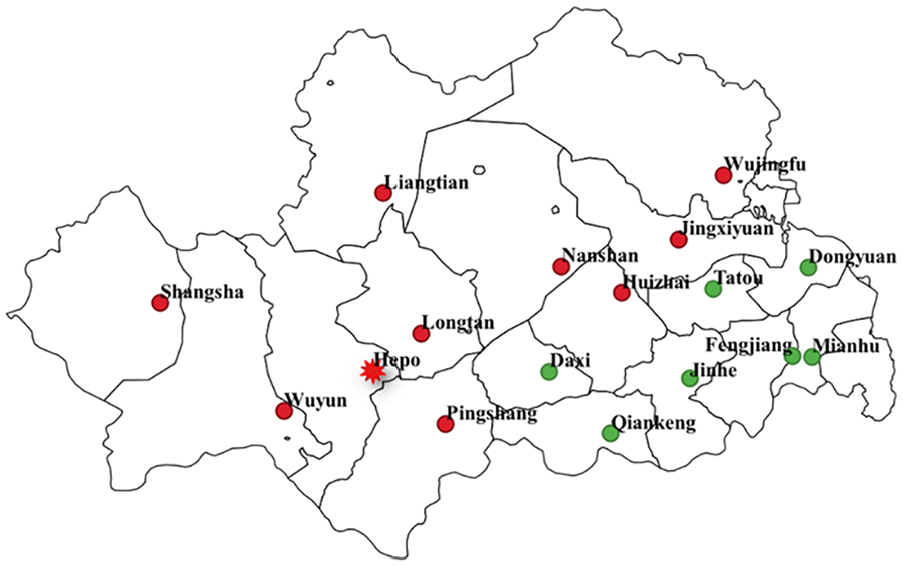
Distribution of the 17 towns in Jiexi County. The red and green dots represent Hakka and Chaoshan towns, respectively.
Language Maintenance and Shift in China
The recent rapid urbanization and promotion of Putonghua in China have raised concerns about the loss of Chinese fangyan (Shen & Gao, 2019). Importantly, these studies have analyzed language planning for urban families and provide a background for the subject of protection/maintenance of fangyan. Cao (2001) conducted one of the earliest studies on the endangerment of some fangyan in China, calling on to society to take various measures to protect the Chinese fangyan. According to a survey by Shanghai Social Academy, more than 40% of the students in Shanghai could not speak the Shanghai fangyan well, leading to the launch of a campaign to save it. By surveying 10 stakeholders in this campaign (e.g., language officials, language experts, delegates of local political advisory bodies, members of pressure groups, and parents), Shen (2016) found that all the participants believed that the decline of the fangyan was a threat to the language and to the local population’s identity. In a study that applied questionnaires to 771 and interviewed 10 parents in Guangzhou, Li et al. (2019) found that although most parents had a positive attitude toward a mastery of Cantonese, their efforts to use and manage this at home were very limited. Hence, the prospects for the maintenance of Cantonese are not very promising.
Moreover, Zou (2020) surveyed three migrant Hakka-speaking families in Guangzhou, finding that parents lack the motivation to retain the Hakka fangyan because they pay more attention to Putonghua and English. This study also showed that, although both grandparents and parents insisted on their Hakka identity, they did not make any efforts to use the Hakka fangyan at home. These respondents believed that the Hakka identity was determined by blood relationships, not language. Furthermore, Yang and Curdt-Christiansen (2021) indicated that, among rural migrant workers, the language-identity association plays a key role in the intergenerational shift from fangyan to Putonghua, and that the latter is regarded as symbolizing new rural residents.
In summary, the maintenance and shift of Chinese fangyan happen within profound social, political, and economic contexts. In addition, although people are eager to maintain their loyalty/identity with their native fangyan, they also face socioeconomic and language-related pressures (Curdt-Christiansen & Gao, 2021), such as that from the official national language (i.e., Putonghua) in China.
Methodology
Participants
Using convenience sampling, we surveyed 200 people, mainly from the five Hakka towns that are the closest to Chaoshan towns in Jiexi. People who are too old and too young could have found it difficult to fill out the questionnaire, so we limited the age of respondents to 11 to 70 years old. In the 1980s, Putonghua began to be vigorously promoted on campuses nationwide. The Law of the National Commonly Used Language and Script of the People’s Republic of China was passed in 2000. Thus, the ages of 40 and 20 were believed to be the dividing lines between Putonghua and fangyan in terms of proficiency and usage (Qiu & Yan, 2022; Yu, 2010). Our sample was divided into three age groups: 41–70 (M = 47, SD = 3.4), 21–40 (M = 28, SD = 1.6), and 11–20 years (M = 17, SD = 2.8). Among them, there were 43.5% male and 56.5% female participants. Most of them were in college (35.5%) and middle school (32%) at the time of data collection. They engaged in a variety of occupations, with most being students (37.5%) and farmers (20.5%). Table 1 lists the age, gender, education, and occupation of the survey respondents.
Participants’ Demographic Information.

The numbers are described as frequency/percentage.
Employed in governmental institutions, schools, hospitals, etc.
Materials
Our questionnaire (Appendix) was adapted from several sources. The items in language proficiency and use were adapted from Li et al. (2019) and Yu (2010); those on language attitudes and Hakka identity and culture were constructed based on two studies (Huan & Lim, 2021; Leo, 2015). The final 32-item questionnaire comprises five parts. First, questions on demographic information (five items), including hometown, age, gender, education, and occupation. Second, questions on language proficiency (three items), including first language, spoken language, and language proficiency. Third, questions on language use in the family and public domains (eight items), including four interlocutors in the family domain (i.e., with grandparents, parents, siblings, and children) and four settings in the public domain (i.e., in the wet market and shops, hospitals and banks, and local governments, and when talking with friends). Fourth, questions on language attitudes toward the Hakka fangyan based on four parameters (eight items; two items for each): affective, instrumental, identity-building, and preserving values. Fifth, questions on awareness of Hakka identity and culture (eight items), including group pride, identity maintenance, identity presentation, and knowledge of Hakka history, food, religious beliefs, architecture, and art.
The questions on first language, spoken language, and language use had four options: Hakka, Chaoshan, Putonghua, and a mixture of Hakka and Putonghua. The language proficiency questions asked participants to report their proficiency in Hakka, Chaoshan, and Putonghua on a five-point scale (no–excellent; ranging from 1 to 5). Items regarding attitudes toward the Hakka fangyan and those on awareness of the Hakka identity and culture were rated on a five-point Likert scale, ranging from 1 to 5 (strongly disagree–strongly agree). If the five-point scale is converted into a 100-point scale, the former’s 3.5 points is roughly equivalent to the latter’s 62.5 points. Therefore, a score below 3.5 will be considered a low score in this study. All items were self-reported.
Quantitative Data Collection and Analysis
The survey was conducted from January to March 2021. We surveyed 130 people through on-site home visits and 70 through the WEN JUAN XING tool (https://www.wjx.cn/), a professional online survey platform. Both methods shared the same questionnaire. During the home visits, the investigator collected the responses of each participant after explaining the research purpose and obtaining informed consent. The online questionnaire was distributed only to students. The second author of this paper is from Jingxiyuan; thus, for sample recruitment in this town, we used snowball sampling (comprising 41.5% of our sample). We also investigated neighboring towns such as Wujingfu (comprising 13% of our sample), Nanshan (12%), Huizhai (13%), Pingshang (10.5%), and other towns (10%). All participants were required to have been born and grown up in the Hakka towns.
The questionnaire data were analyzed using SPSS, version 21.0. We used the Cronbach’s alpha reliability coefficient to analyze the internal consistency of the questionnaire, showing a total value of .85. For the respondents’ first language, spoken language, and language use, we calculated percentages. For language proficiency, attitudes, and identity, we calculated average scores (full score = 5). After conducting Kolmogorov-Smirnov tests, we observed that the data for language proficiency, attitudes, and identity were not normally distributed. Thus, we conducted Kruskal-Wallis tests to examine age differences based on these variables, instead of one-way ANOVAs (Jiang & Dewaele, 2019).
Qualitative Data Collection and Analysis
We conducted individual semi-structured interviews using open-ended questions, where eight participants responded to questions about their attitudes toward the maintenance and transmission of the Hakka fangyan, and their beliefs regarding the Hakka and the Chaoshan peoples. Table 2 presents basic information of the interviewees selected using purposeful sampling (Patton, 2014). To ensure that we collected representative information, we analyzed whether participants could yield relevant or even key data on topics such as the Hakka fangyan and culture, the Chaoshan fangyan and culture, school education, Putonghua promotion, among others.
Demographic Information of Interviewees.

We analyzed the following variables when selecting interviewees to ensure heterogeneity: gender, age, occupation, education, and hometown. Since many married women come from other places and speak other fangyan, we deliberately chose 5 male and 3 female participants. The inclusion criteria were: born locally, speak the Hakka fangyan as the first language, and willing to participate in this research. All interviewees gave their informed consent before they participated in the study.
The interviews were conducted in the Hakka fangyan and Putonghua, each lasting approximately 30 minutes. Interviews were audiotaped for transcription and posterior analyses. The analytical procedure of interview data proposed by Li et al. (2019) was adopted in this study, which was guided by the research questions and the framework of FLPP (Spolsky, 2004, 2009). The first author first read all the interview transcripts in order to become familiar with the content, and then coded them based on the group identity and three components of FLPP (language ideologies/practices/management). Finally, we compared the transcripts of each respondent to summarize their responses to the research questions of this study.
Results
First Language and Language Proficiency
In total, 65% of respondents used Hakka as the first language, 27% used a mixture of Hakka and Putonghua, and 8% used Putonghua. Among those aged 11 to 20 years, 54.2% used Hakka as their first language, 13.9% used Putonghua, and 31.9% used both Putonghua and Hakka. Therefore, although the use of Hakka as a first language showed higher ratios than that of Putonghua and a mixture of Hakka and Putonghua, there seems to be a declining trend for the use of Hakka (88.9% among those aged 41–70 years; 54.2% among those aged 11–20 years) and an increasing trend for the use of Putonghua as a first language across generations (Table 3).
First Language Distribution by Language and Age Group.

The numbers here are presented as percentage (%).
As illustrated in Table 4, most respondents spoke Hakka (84%) and Putonghua (83.5%). Among those aged 11 to 20 years, although only 54.2% used Hakka as their first language, 70.4% of them were able to speak it; hence, the Hakka fangyan seems to have been properly passed on to the younger generation. We also observed that the number of JCH people who can speak Hakka and Chaoshan seemed to be declining across generations, while it was increasing for those who can speak Putonghua. Thus, while the number of Hakka-Chaoshan bilinguals has greatly reduced, it has greatly increased for Hakka-Putonghua bilinguals. Additionally, 12.5% of the participants reported being able to speak other fangyan. According to the interview data, these fangyan mainly referred to Cantonese, which may be because Guangzhou is the political and economic center of Guangdong, giving the Guangzhou Cantonese great prestige and attracting people from other parts of the province to learn and use it.
Frequency of Spoken Languages by Language and Age Group.

The numbers here are presented as percentage (%).
In total, the mean proficiency in Putonghua (4.44) was higher than that in the Hakka fangyan (4.07), and the lowest was for the Chaoshan fangyan (2.07). Statistical analyses showed significant age differences for language proficiency, and post-hoc tests showed significant differences for proficiency in Hakka by age. Specifically, proficiency in Putonghua among those aged 41 to 70 years was lower than that of those aged 21 to 40 years. Meanwhile, proficiency in Chaoshan among those aged 41 to 70 years was higher than that in the other age groups (Table 5).
Means and Standard Deviations for Language Proficiency by Language and Age Group.

In the Kruskal-Wallis Test, the numbers 1, 2, 3 denote the 41 to 70, 21 to 40, 11 to 20 age groups, respectively.
p < .05. **p < .01. ***p < .001.
Language Use in the Family and Public Domains
Because all participants were born in local Hakka towns, no one reported using Chaoshan fangyan to talk to their family members at home. As indicated in Table 6, results showed that the overall proportion of people who spoke Hakka with grandparents and parents was over 80%, while it was much lower with siblings (62%). Moreover, the overall proportions of JCH people who only spoke in Putonghua with siblings and children were 5.5% and 11.2%, respectively, making Hakka the dominant fangyan in the JCH family domain. The overall proportions of JCH people who spoke a mixture of Hakka and Putonghua with siblings and children were 32.5% and 31.8%, respectively. Hence, there is an obvious generational trend: as age decreases, the use of a mixture of Hakka and Putonghua gradually increases (Table 6).
Language Use in the Family Domain by Language and Age Group.

Only parents describe the language that was used to talk with their children; thus, the data for those aged 11 to 20 years are in blank.
The numbers here are presented as percentage (%).
Unlike in the family domain, less than 10% of JCH people used Chaoshan in public places. When with their Hakka friends, the proportions of those aged 41 to 70 years and 11 to 20 years who spoke in Hakka were 84.4% and 45.8%, respectively, while these proportions for Putonghua were 0% and 18.1%, respectively. Thus, in peer interaction, the use of Hakka showed a sharp decline across generations. Regarding language formality, people tended to be less formal in the wet market/shops, more formal in hospitals/banks, and even more so in government settings. Overall, the use of Hakka decreased successively across domains as the formality of the domain increased, with the greatest use being in the wet market (64.1%). Regarding generational differences, the use of Hakka decreased dramatically across generations, while the proportions of the use of Putonghua and of a mixture of Hakka and Putonghua gradually increased (Table 7).
Language Use in Public Domains by Language and Age Group.

Local governments include villagers’ committees and town governments.
The numbers are presented as percentage (%).
Attitudes Toward the Hakka fangyan
Regarding attitudes toward the Hakka fangyan, the highest mean appeared in the item “Preserving the Hakka fangyan is important” (4.39), while the lowest was in “The Hakka fangyan has social influence” (3.87). Respondents’ ratings for the identity-building value subscale were relatively high: “The Hakka fangyan is a symbol of Hakka identity” (4.33) and “The Hakka fangyan provides an emotional bond among the Hakka people” (4.31). Nonetheless, we observed contradictory results: although there were high scores for “Preserving the Hakka fangyan is important” (4.39), the scores for “Descendants of the Hakka people must acquire the Hakka fangyan” were relatively low (3.98).
Regarding age differences, only one item (“The Hakka fangyan has social influence”) showed no significant differences. In the other seven items, youngsters showed attitudes that were not as optimistic as those of older adults, who tended to have more positive/affective views toward their first language. Post-hoc tests showed that there were significant differences across all age groups for the following items: “The Hakka fangyan is a symbol of Hakka identity,” and “The Hakka fangyan provides an emotional bond among the Hakka people.” Moreover, those aged 41 to 70 years and 21 to 40 years had higher scores for the item “The Hakka fangyan sounds nice” than those aged 11 to 20 years; and those aged 41 to 70 years had higher scores for the items “The Hakka fangyan is useful,” “Preserving the Hakka fangyan is important,” and “Descendants of the Hakka people must acquire the Hakka fangyan” than the other groups. Finally, those aged 41 to 70 years tended to perceive Hakka as more “endearing” than those aged 11 to 20 years (Table 8).
Means and Standard Deviations for Attitudes to Hakka fangyan by Item and Age Group.
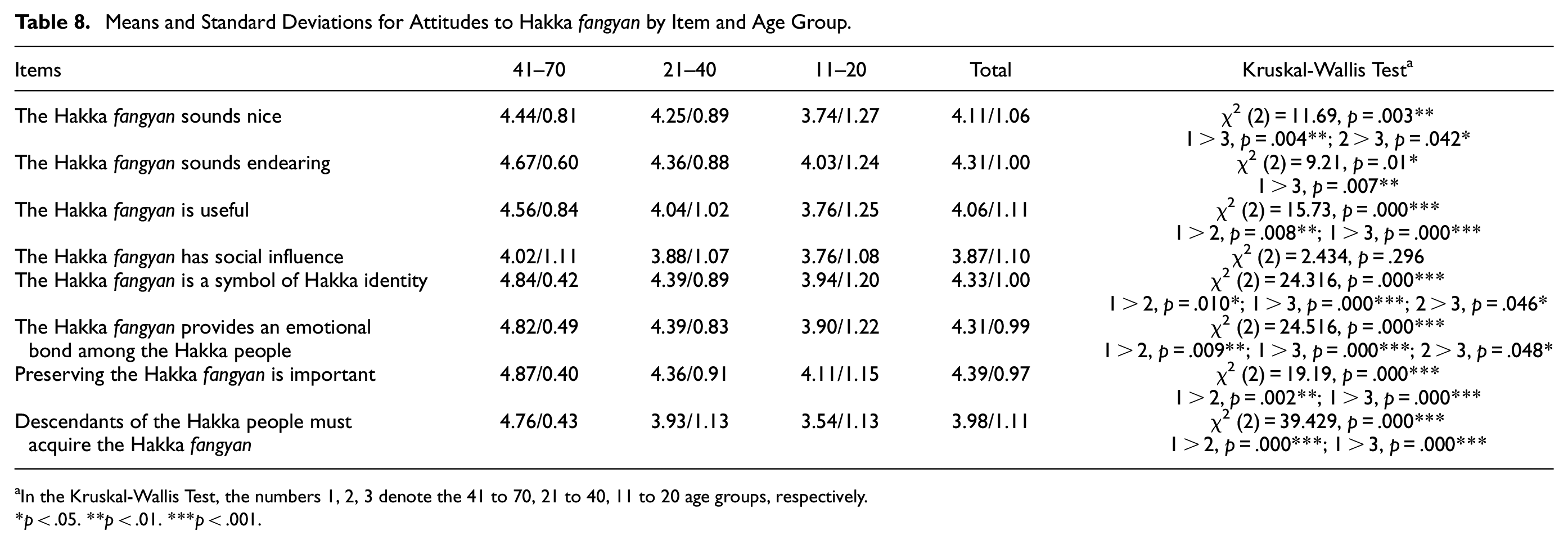
In the Kruskal-Wallis Test, the numbers 1, 2, 3 denote the 41 to 70, 21 to 40, 11 to 20 age groups, respectively.
p < .05. **p < .01. ***p < .001.
Awareness of Hakka Identity and Culture
Most of the scores for items on the awareness of Hakka identity and culture were lower than those for language attitudes. The highest total score appeared for the item “I am proud of being a Hakka” (4.09), while the lowest appeared for “I am knowledgeable about Hakka arts” (3.56). Regarding age differences, there were significant differences in six items except for the two items just mentioned. Post-hoc tests showed that the scores in those aged 41 to 70 years were higher than those of the other groups for five items: “I will sustain my Hakka identity,” “I am happy to introduce myself as a Hakka when I meet a stranger,” and the three items on having knowledge about Hakka food, religious beliefs, and architecture. Moreover, knowledge about ancestors’ origins showed a decreasing trend across generations (Table 9).
Means and Standard Deviations for Awareness of Hakka Identity and Culture by Item and Age Group.

In the Kruskal-Wallis Test, the numbers 1, 2, 3 denote the 41 to 70, 21 to 40, 11 to 20 age groups, respectively.
p < .05. ** p < .01. *** p < .001.
Factors Contributing to Intergenerational Differences
Putonghua is the only language used as the medium of instruction in schools, having an important effect on the language development of youngsters. Moreover, Putonghua has not only become one of the languages used in the family but is also the first language of 8% of the participants (Table 3). For example, owing to caretakers’ influences while she was a child, Li Xiu learned Hakka and Putonghua simultaneously:
I was brought up by my grandmother and aunt when I was young. Grandma spoke in Hakka. My aunt was in her 20s, so she often taught me to speak Putonghua, like reading Tang poetry. So, I remember that I learned both Hakka and Putonghua concomitantly when I was young. After going to kindergarten, I spoke more in Putonghua. Accordingly, I spoke less and less Hakka when I stayed at home. (Li Xiu, female, 17, student; Excerpt 1)
Moreover, Putonghua’s promotion efforts have gained new traction by access to new media platforms. On this topic, a participant remarked:
My 5-year-old daughter likes speaking Putonghua, but her Putonghua was not taught by us; she learned it by watching short videos on Tiktok. Before the age of four, we taught her Hakka, but she learned to speak Putonghua through the Internet. Now, she only talks in Putonghua at home. (Tang Chun, male, 35, worker; Excerpt 2)
Based on the interviews, it seems that youngsters’ proficiency in the Hakka fangyan has dropped so severely that they cannot speak in Hakka fluently/correctly. Accordingly, they tend to shift to Putonghua, in which they are more proficient. Regarding youngsters’ language use when talking with their peers, the following extract provides a possible explanation:
My Hakka is not fluent enough, so I use Putonghua to talk with good friends and classmates, which makes conversation smooth, convenient, and comfortable. If I use the Hakka fangyan, I will have to rack my brain because I do not know how to say many words and expressions in Hakka, making conversation very uncomfortable and embarrassing. (Luo Gang, male, 16, student; Excerpt 3)
As shown in Table 9, except for the item “I am proud of being a Hakka,” those aged 11 to 20 years scored relatively low (around 3.5 points or even lower) in all other items on the awareness about Hakka identity and culture. Hence, youngsters’ awareness seemed to be lower than that of older adults in our sample. As mentioned earlier, urban and popular cultures have become the dominant ones in China, leading to a decline in rural culture. On the topic of Hakka fangyan and culture, a participant said:
As for the Hakka nursery rhymes, I can sing the first few sentences of “Moonlight Song,” but I cannot remember it in full. Currently, only the elderly like listening to Hakka’s mountain songs, and it seems that there are very few people who can sing them. I think it sounds too unpleasant; I do not like it. I prefer pop music. (Wang Fang, female, 22, student; Excerpt 4)
Other reasons for the current results regarding the lack of awareness of Hakka identity and culture may be the influence of administrative divisions and the Chaoshan culture. Although many JCH youngsters seemed to maintain a linguistic differentiation between “we” and “they” for the Hakka and Chaoshan people, respectively, they also often seemed to get confused about their identity; this is exemplified in the following excerpt:
When I went to high school in Rongcheng, downtown of Jieyang, whenever Chaoshan people talked about food and customs, I would remember that their foods and customs were similar to those in my hometown. At that time, I felt weird about this, and began asking myself, “Am I a Chaoshan?” However, I gradually discovered that as a Hakka, I was different from the Chaoshan people. Because most of my classmates were Chaoshan, I never felt integrated into their group for three years, and felt like I was an “outsider.” (Cai Fu, male, 26, clerk; Excerpt 5)
The JCH families in our sample seemed to adopt a laissez-faire attitude toward language management; both JCH parents and children showed high evaluations about the importance of preserving the Hakka fangyan and culture, but seemed reluctant to make efforts to prevent its decline. This is exemplified in the following excerpt:
When my son went to school, he learned to use Putonghua for daily communication. He also acquired further bits of knowledge through Putonghua and learned to talk in Putonghua in public. Therefore, it mainly depends on what the children like. We cannot do anything about this. (Ma Mei, female, 40, homemaker; Excerpt 6)
Regarding the future of the Hakka fangyan, some respondents might not have realized that youngsters are the hope of the perpetuation of the Hakka fangyan; if the number of youngsters speaking the Hakka fangyan and their attitudes and skills continue to decrease, this will inevitably lead to a crisis in the transmission of the Hakka fangyan. A participant commented:
It is not difficult for a Hakka to acquire the Hakka fangyan if it is taught since one’s childhood. Moreover, if the Hakka people live together, it is impossible for them to shift to speaking Putonghua. As long as one identifies as a Hakka, one can speak the Hakka fangyan, so it is impossible for the Hakka fangyan to disappear. (Zhou Feng, male, 43, farmer; Excerpt 7)
Many older JCH adults perceived that they could not speak Putonghua fluently, so their only option was to learn the Chaoshan fangyan, which is very useful in the region for conducting business with the neighboring Chaoshan people. Meanwhile, JCH youngsters had more language choices and mostly chose Putonghua, which they had already learned in school. Therefore, JCH youngsters may be less motivated to learn the Chaoshan fangyan. For example, when asked about how to learn the Chaoshan fangyan, Zhou Long replied:
When I was young, I went to Tatou to do business, so I naturally learned the Chaoshan fangyan. I went there to sell tofu and firewood. [At that time] If I did not speak the Chaoshan fangyan, the goods couldn’t be sold out. The times are different now. The youngsters learn Putonghua when they go to school, an opportunity not available for those older and who cannot speak Putonghua well. (Zhou Long, male, 66, farmer; Excerpt 8)
Discussion
Finding 1
Our results showed what seems to be a sharp intergenerational decline in language proficiency, use, attitudes, and awareness of Hakka identity and culture. This decline seemed to be owed mostly to urbanization, the promotion of Putonghua, and JCH people’s limited efforts in language management. The current result of the intergenerational decline in language use is consistent with previous studies on the Hakka fangyan (Qiu & Yan, 2022; Zou, 2020), Guangzhou Cantonese (Li et al., 2019), Shanghai fangyan (Shen, 2016), and Suzhou fangyan (Yu, 2010). As mentioned earlier, the vast rural areas in China seem to have fallen into a crisis of cultural decline owing to the fast urbanization in recent years. Although the national promotion of Putonghua is very effective, the measures for its promotion seem to be too strict. Research even shows group incidents related to such strict measures, such as the “Protecting Cantonese Movement” in Guangzhou (Gao, 2012). In another study, a schoolteacher reportedly rewarded students for speaking in Putonghua with their family members (Yu, 2009). In our research, although some JCH parents described that they sometimes criticized their children for not/inaccurately speaking in Hakka, they also did not deliberately demand them to speak this fangyan. This finds consistency in the literature (Caldas, 2012; Li et al., 2019; Zou, 2020).
Finding 2
The JCH people in our sample seemed to maintain the Hakka fangyan at a good level, regardless of age differences, showing relatively high scores for some key indicators. For example, 65% of the respondents described having acquired the Hakka fangyan as their first language; 84% described being able to speak in Hakka; the average proficiency in Hakka was of 4.01 points (out of 5); and 80% reported using Hakka when talking with grandparents and parents. We attributed three reasons to such strong language/group identity. First, the JCH people are highly concentrated and live contiguously. Specifically, they live in 10 very condensed and adjoining towns, and the people living in the counties to the north, west, and south of Jiexi predominantly speak the Hakka fangyan. Second, the population distribution of the Hakka and Chaoshan people in Jiexi is favorable to the former; there are slightly more Hakka people (57%) than Chaoshan people (43%) (Lin, 2020). Third, the administrative center of Jiexi is Hepo Town, which is dominated by the Hakka culture. These reasons are in line with the factors affecting language vitality as proposed in Giles et al. (1977)’s study.
Concomitantly, JCH youngsters were troubled by the unique identity of MMH owing to administrative divisions, as well as the cultural and economic influences of the Chaoshan people. The administrative division has a significant influence on the allocation of administrative/financial resources and public goods to support regional development (Tian et al., 2020). Thus, youngsters in our sample reported concerns about their unique identity by describing them as “Hakka people in a Chaoshan region.” Despite having differential fangyan, these two groups indeed share various cultural characteristics, with the Chaoshan culture (strong culture) being a great influencer of the Hakka culture (weak culture). More powerful groups tend to exert influence on disadvantaged groups intentionally or unintentionally through political and economic arrangements (García, 2012). Similar examples occur not only between the official language (Putonghua) and fangyan (Shen & Gao, 2019) but also between different fangyan (Duff, 2021).
Finding 3
Results also showed that the number of Hakka-Chaoshan bilinguals and the use of the Chaoshan fangyan have declined sharply. Moreover, a shift seems to have occurred across generations: from the prevalence of Hakka-Chaoshan bilinguals to that of Hakka-Putonghua bilinguals. Hence, the Chaoshan fangyan, once prestigious for the MMH, is gradually being replaced by the official national language. Geographically speaking, most Hakka people have historically lived in mountainous areas, while most Chaoshan people have lived in plains and closer to the sea, making the latter’s areas more suitable for economic trade. That is, older JCH adults were forced to learn the Chaoshan fangyan when they were young in order to conduct business. In addition, the Hakka and Chaoshan people intermarried throughout history. These characteristics have allowed most older JCH adults speak both Hakka and Chaoshan. However, the modern Chinese government has endeavored to build schools and shops in every town/village, and the advancement of urbanization has led JCH youngsters to start making a living in the big cities of the Pearl River Delta. These seem to have greatly reduced the interactions, language shifts, and intermarriages between the Hakka and Chaoshan peoples, all of which seem to occur much less in JCH youngsters compared with older generations.
A Model of Language Maintenance and Shift in JCH
Based on the above findings and interview data, we adopt Chua and Baldauf’s (2011) framework to examine the multi-level and -actor, complex relationships of language policy and planning (LPP) in China. Nonetheless, the model adapted in this paper is not limited to LPP, because it also includes national development planning (e.g., urbanization promoted by the central government). China’s LPP has a strong tradition of being centralized, and the actors involved in LPP activities are governments at all levels (Spolsky, 2014). As Figure 2 shows, LPP comprises four inter-related stages in a continuum: supra macro-planning, macro-planning, micro-planning, and infra micro-planning (Chua & Baldauf, 2011). Each stage involves different actors who exercise their agency in implementing the top-down policy or bottom-up initiatives. Nine representative actors can be identified based on the political and language contexts of China. Although these stages indicate a linear model—going from a large powerful body (e.g., the country) to families and individuals with limited influence on society—LPP can start at any stage (Eisenchlas & Schalley, 2022, p. 708).

The stages and levels of policy planning (based on Chua & Baldauf, 2011, p. 940, with levels adapted to the Chinese context) and their impacts on language maintenance and shift in JCH.
Macro-level planning generally refers to national-level planning. For example, since the founding of the People’s Republic of China, the Chinese government has issued various documents to promote urbanization. As a result, China’s urbanization rate jumped from 17.9% in 1978 to 58.5% in 2017 (Huang, 2019). The large-scale migration of the rural population because of urbanization has led to large populational losses in rural areas. Then, when people speaking different fangyan flock to the same city, it is inevitable for them to seek to communicate in the country’s national language. Together with urbanization policies, the State Language Commission (SLC), an LPP agency affiliated to the Ministry of Education, has been engaged in the promotion of Putonghua for decades. This promotion is aimed at emphasizing national unity through language unity. Coupled with the recent acceleration of urbanization, Putonghua has been endowed with new economic value and started being regarded as an important language resource for upward mobility by rural migrant workers (Curdt-Christiansen & Gao, 2021).
The language commissions affiliated to provincial education departments in each province are specifically responsible for overseeing the promotion of Putonghua. For example, the Language Commission of Guangdong Province promulgates specific measures according to the requirements of the SLC documents. It also guides the promotion of the national language at the municipal- (e.g., Jieyang City) and county-level (e.g., Jiexi County) governments. As the body responsible for policy implementation, the Jiexi County government is responsible for promoting Putonghua in schools and public places across the county. Further, the two powerful, top-down, supra macro-planning policies had a decisive impact on the decline of the Hakka fangyan and culture. The urbanization process of China not only changed the demographic patterns of Jiexi, resulting in the “hollowing out” of the countryside (Huang, 2019; Long et al., 2012), but also weakened the local cultural values and group identity of the Hakka people. Specifically, this supra macro-planning led the local Hakka people to begin to become obsessed with urban culture and gradually abandon the Hakka culture, which brought them happiness and warmth (Lv, 2019). Accordingly, the Hakka identity began to become blurred and diluted. The promotion of Putonghua changed the FLPP of Hakka families and individuals, who started to believe that Putonghua was more influential and useful. Further, after they learned Putonghua, they started using it at school, in public spaces, and finally even at home.
Jiexi County is also administratively governed by the Jieyang City. Considering the demographic reality and the strong position of the Chaoshan culture in Jieyang, the economic development and culture of the Hakka community in Jiexi can be considered to be at a disadvantage. In other words, the positioning of the Chaoshan culture in Jieyang has impacted the group identity of the JCH people. Overall, macro factors such as urbanization, the promotion of Putonghua, and the influence of the Chaoshan culture have led to the language shift of JCH families and individuals from Hakka to Putonghua. Nonetheless, there are favorable micro-level factors that help to maintain the Hakka fangyan among JCH; these include the location of the Jiexi County government seat, which is dominated by the Hakka people, the Hakka population being larger than the Chaoshan population in Jiexi, and the fact that the Hakka people in this area live in 10 contiguous townships.
As we point out in the literature review, the Chinese fangyan are subordinate to the national language. Despite the regional cultural value and people’s emotional attachment to fangyan, their development was not supported from national language policies. As indicated in Figure 2, there are complex and inter-related factors that create tension regarding the language maintenance and shift of the Hakka fangyan. Judging from the findings of this study, we believe that the balance will be tilted toward the language shift. Previous studies have revealed that LPP in contemporary society has shifted from macro-level, top-down planning to micro-level and bottom-up planning (Eisenchlas & Schalley, 2022, p. 708). Unfortunately, JCH families and individuals, who are the main people who will inherit the Hakka fangyan, are not only faced with the government’s strong Putonghua promotion policy but also lack awareness about the need to protect fangyan and engage in FLPP. There are not, to the best of the authors’ knowledge, any reported bottom-up initiative pertaining to fangyan inheritance. Furthermore, the hope regarding language inheritance is the young people in the Hakka communities. Notwithstanding, this paper found that compared with the other two groups, those aged 11 to 20 years experienced a severer intergenerational decline regarding fangyan use, attitudes, and group identity. Therefore, it can be predicted that when these young people become parents, their practices and attitudes related to the Hakka fangyan may further deteriorate.
Implications
This study makes several contributions to the literature. First, this is the first study on language maintenance and shift in the rural areas of mainland China. Second, it not only enriches the literature but also our understanding of the role of group identity in language maintenance and shift. Southern China is a lineage society with strong group consciousness (Freedman, 1966). Previous studies indicated that the decline in the use of the Hakka fangyan and knowledge of Hakka customs contributed to the weakening of the Hakka identity (Constable, 1996). Therefore, we believe that there is an urgent need to revive the awareness of JCH youngsters about their group identity. Third, this study has important implications for China’s rural revitalization. The rural areas generally have some of the biggest concentrations of intangible cultural heritage artifacts in China, and language has often been regarded as an important carrier of some forms of intangible cultural heritage (e.g., local drama). Hence, the effective protection of fangyan and intangible cultural heritage in rural areas may help form a positive interaction between fangyan protection and local economic development (Wang, 2021).
Conclusions and Limitations
In the past, efforts to promote Hakka awareness and identity served to help avoid people from identifying themselves with the Chaoshan people. Now, such efforts should be aimed at ensuring the survival of the Hakka culture. Historically, the Hakka have competed with the Chaoshan for resources, but these contexts have changed. Against the background of China’s rapid urbanization and the promotion of Putonghua, the risk of language shifts among these groups seems to have been reduced, but this may have also weakened JCH youngsters’ Hakka identity. Coupled with the influence of urban, popular, and Western cultures (Xia & Lei, 2021), youngsters seem to have lost interest in the Hakka fangyan and culture, which may increase the risk of a shift from the Hakka fangyan to Putonghua. Although the Hakka fangyan might not be as endangered as some of the less spoken fangyan in mainland China (Cao, 2001), our results still underpin a worrying situation. Specifically, if the relevant parties (e.g., policymakers, local governments, scholars, and parents) do nothing regarding fangyan protection, the Hakka fangyan of the MMH may soon be at risk of endangerment.
However, this study has its limitations. First, our data comes from a mixture of on-site and online surveys, which may affect data consistency. Second, this study only focused on JCH people, so we did not investigate the Hakka people who live in other Hakka-Chaoshan adjoining areas. Hence, a comparative study on language maintenance and shift in different types of settlement for this fangyan group is warranted. In addition, this article only compared data by age among the sociodemographic factors. Future research should examine other sociodemographic variables, including gender, educational background, occupation, and annual income.
Footnotes
Appendix
Acknowledgements
We would like to thank all the respondents who very generously gave their time to participate in this study and the anonymous reviewers for their insightful suggestions and constructive comments.
Declaration of Conflicting Interests
The author(s) declared no potential conflicts of interest with respect to the research, authorship, and/or publication of this article.
Funding
The author(s) disclosed receipt of the following financial support for the research, authorship, and/or publication of this article: This work was funded by the National Social Science Fund of China (16ZDA205) and Innovation and Strong College Project of the Education Department of Guangdong Province (2018WTSCX025).
