




Abstract
The use of deadly force in the Republic of Serbia is regulated by the Law on Police and the Rulebook on Police Powers. Empirical research on the use of deadly force or on refraining from the use of deadly force has never been undertaken in Serbia. Therefore, the research presented in this paper is the first on this important topic. It focuses on the use of firearms, abstinence from the use of firearms, and training in the use of firearms. In order to assess the competence of members of the Police Directorate of the Ministry of Interior of the Republic of Serbia in the use of firearms (FA), a structured questionnaire developed by using close-ended, multiple-choice questions, and 5-point Likert scale questions (1 for strongly disagree to 5 for strongly agree) was used in the study. The research was conducted from September to October 2022. The research showed that the use of deadly force by members of the police in Serbia is rare, and that it generally does not differ largely from other European countries.
Plain Language Summary
Research on police use of deadly force represents one of the most important issues in policing that is being thoroughly researched around the world. However, in Serbia, empirical research on the use of deadly force or on refraining from the use of deadly force has never been done in Serbia. Therefore, the empirical research presented in this paper is the first on this important topic. In order to assess the competence of members of the Police Directorate of the Ministry of Interior of the Republic of Serbia in the use of firearms (FA), a structured questionnaire developed by using closeended, multiple-choice questions, and 5-point Likert scale questions (1 for strongly disagree to 5 for strongly agree) was used in the study. Within the first part of the questionnaire, there were questions concerning demographic and socio-economic characteristics of the respondents, the second part of the questionnaire contained questions related to the use of FA by the respondents themselves, while the third part contained questions related to evaluation of the competence of police officers for the use of FA. The survey was anonymous. Only police officers who agreed participated in the research, and it was conducted entirely on a voluntary basis. The data for the research was collected from 306 police officers of the Ministry of Interior of the Republic of Serbia. Police officers from all parts of the Republic of Serbia took part in this research. The research sample was appropriate. However, the quality of the research would probably have been higher if the researchers could have reached more respondents who used deadly force.
Introduction
In all countries, the police represent the most visible part of the state government, which works to ensure the population’s well-being. Politicians, the media, and the public have debated and argued about the function of the police and the nature of policing for decades. Miller defines the role of the police in terms of (a) the collective end of protecting the legally enshrined and justifiably enforceable moral rights of citizens from violation by fellow citizens; and (b) the use of coercive, including lethal, force in pursuing this end (S. Miller, 2016, p. 108). The police are the only branch of government that can use coercive physical force on citizens (Bittner, 1991; Hinds, 1979, p. 7; L. Miller, 2020, p. 8; Scharf & Binder, 1983; Walker & Fridell, 1993). Therefore, the use of force is inevitably a part of the police service (Becker & Stephens, 1994, p. 1; Bittner, 1975) and a national issue (Baker, 2007, p. 379; Kuhns & Knutsson, 2010, p. 3). Regardless of what kind of police we are dealing with, we encounter the use of force or deadly force (Jones, 2022). It is supposed that the police use necessary force (Belur, 2010, p. 1; Skolnick & Fyfe, 1993, p. 84), while deadly force represents a rare but important example of another use of force (L. Miller, 2020, p. 5).
A long time ago, Fyfe (1978) described deadly force as a physical force capable of or likely to kill but which does not always kill (p. 32). Palmiotto (2001) describes deadly force as a force capable of causing serious bodily injury or death, while generally, the police have the authority to use deadly force to save their lives or the lives of others (p. 27). Alternatively, deadly force represents any action that may result in serious bodily injury or death from the use of empty-hand techniques, batons, or firearms (Buttle, 2010, p. 40). However, almost any means the police deploy can result in death or serious physical harm (Punch, 2011, p. 85; Ronkowski, 1979, p. 709).
Intentional use of deadly force is subject to a higher threshold and is only permitted in cases where it is necessary to protect life (Casey-Maslen & Connolly, 2017, p. 99; Krajewski et al., 2023, p. 1). As Brodeur (1981) and later Kane (2007, p. 8) emphasize, citizens who kill would be generally held responsible for homicide (self defence in citizens terms), whereas police officers who kill often engage in the legitimate police practice of “deadly force” (Brodeur, 1981; Kane, 2007). Therefore, this could be seen as the biggest difference between law enforcement officers and citizens (Palmiotto, 2017a, p. 44). Of course, certainly such problems are solved through the criminal justice system of a certain country (Turanjanin, 2021; Ćorović et al., 2022). Miller connects the moral justification of the police’s use of deadly force with social contract theory (S. Miller, 2016, p. 110): this justification can exist in cases of self-defense and defense of others (see also Knutsson, 2010, p. 107; S. Miller, 2016, p. 113; Palmiotto, 2017b, p. 85). At the Council of Europe field, the police’s use of deadly force was a subject of the European Court of Human Rights (Giuliani and Gaggio v. Italy, 2011; Banović and Turanjanin, 2018). Training police officers in the use of deadly force is therefore important for reducing injuries and deaths and improving citizens’ perceptions of the police’s use of force.
As shown in Figure 3 from Oramas Mora et al. (2023), Serbia has not yet examined the police’s use of deadly force. Upon request, we received information from the Ministry of the Internal Affairs on the consequences of police use of force for the period 2014-2023. In this period, 17 people lost their lives (11 in the period 2014–2018, and 6 in the period 2018–2023), while 48 people suffered serious physical injuries.
The research in this paper is the first on the police’s use of deadly force in Serbia and the Western Balkans. All previous research in Serbia is based on official statistics that do not give a true picture of the situation on the ground. Statistics show how many firearms were used and their consequences. It does not show situations in which there was use of FA that was not reported, or situations in which the conditions for using FA were met and police officers did not use FA, as well as other data. This research helps to get a more realistic picture of the use of FA by the police officers, finds weak points and create a new training program based on them, which will be adapted to those who need it most. This paper aims to provide a view into the police’s use of deadly force in Serbia, their perception of the use of deadly force and firearms, and their training to use firearms. All previous research in Serbia is based on official statistics that do not give a true picture of the situation on the ground. Statistics show how many firearms were used and their consequences. It does not show situations in which there was use of firearms that was not reported, or situations in which the conditions for using firearms were met, and police officers did not use it, as well as other data. The research can help to get a more realistic picture of the use of firearms by the police officers in the Republic of Serbia, find weak points and create a new training program based on them, which will be adapted to those who need it most.
The goal of the research is to get a picture of the use of deadly force by the police, the reasons for it, reporting and reasons for not reporting, as well as refraining from using this type of force. Also, the aim of the research is to obtain information about the views of respondents regarding the ability to use firearms, which is the first research of this type in Serbia. This paper is divided into three parts. The first part reviews the relevant comparative research and literature. The second part elaborates on the relevant legal provisions regulating the use of deadly force and provides statistical data on the use of deadly force in Serbia. The third part explains the methodology, presents the results, and discusses them.
Literature Review
Police Use of Force and Reporting
In the last 70 years, many articles have been written on the police’s use of deadly force from different perspectives. Oramas Mora et al. (2023) divided the research into three waves (1960–1990, 1991–2010, and 2011–2020). In the third wave, authors found 181 articles on the police’s use of deadly force. We have now identified a fourth wave that starts in 2021.
The literature mainly focuses on the decision to use force, deadly force (J. Lee, 2016; Terrill & Mastrofski, 2002) or restrain (Pinizzotto et al., 2012). Hanink et al. (2023) tried to establish a connection between the lethality of police shootings and their proximity to trauma centers; they found little could be done to reduce the fatality rate of police shootings. Research has shown that in the United States, approximately 1,000 people are killed by police every year (Sullivan et al., 2019; Wetherell & Miethe, 2022). Terrill and Somers investigated firearm danger from the perspective of police officers and found that the police discerned various levels of firearm danger (Terrill & Somers, 2022). Porter (2023) examined lethal force decisions by the police in Australia by exploring the proximity of coefficients between police behavior and subject behavior. The literature specifically examines the willingness of police officers to report the use of deadly force, with the percentage of respondents who would not do so varying from state to state (Kutnjak Ivković & Haberfeld, 2015, 2019).
Restraint
Researchers have observed that the police often hesitate to use deadly force even when permitted by constitutional, statutory, or policy provisions (Morrison, 2010, p. 135). Pinizzotto et al. (2012) found that officers reported exercising restraint in 93% of situations where they could have legally fired their weapon but did not. Another study identified officers who did not respond with deadly force as soon as possible; instead, they waited for an indication of the suspect’s intention (Doerner, 1991, p. 8). Pickering and Klinger divided non-shooters into two distinct groups, where one group consisted of officers who had made conscious choices to refrain from shooting after contemplated pulling the triggers of their service weapons, and in the second group were the officers who never contemplated shooting (Pickering & Klinger, 2023). In this study, the main reasons for holding the fire were facts that other officers were in their line of fire, the subject was out of the fight, lack of a clean view of the subject, belief that other officers on-scene had a better shot and expecting other officers on-scene to shoot (Pickering & Klinger, 2023).
Racism
In some states, the police use of deadly force has a racism element (Correll et al., 2002; R. Lawrence, 2000, p. 42; Shane & Swenson, 2019, p. 5). Another, although a smaller study, identified that the suspect race was not a statically significant factor in terms of how officers viewed danger (Terrill & Somers, 2022). In the newest research conducted by Fridell and Marier (2023), adults from a nationally representative sample were asked to rate the appropriateness of a police officer’s use of force as illustrated in a fictitious story. Prince and Sun (2023) assessed the influences of race and ethnicity on the presence of the resistant behavior during deadly police contact with people with mental illness, whose finding suggested directions for policymakers, police administrators and researches to improve the police encounters with citizens experiencing mental illness.
Training on Police Use of Force
The literature on training on police use of (deadly) force is also very rich. For a very long time, use-of-force training has been a crucial part of police training programs (Arnspiger & Bowers, 1996, p. 6; Bennell et al., 2007, p. 35). The goal of police force training is to enable officers to prevent and handle physical encounters in the field that should guarantee that the officer is capable of resolving any impending conflict situation, even if such a circumstance has never been practiced (Staller & Zaiser, 2015, p. 2). Police officers should receive training that will enable them to do their jobs in a safe and efficient manner (Arnspiger & Bowers, 1996, p. 6). Wolfe et al. (2020) in their study investigated in-person and online social interaction training to reduce police use of force. They found that there is no evidence about the effectiveness of an online version of social interaction training for police and it will be critical for police agencies to conduct independent evaluations (Wolfe et al., 2020, p. 143).
Police officers would have been more likely to use excessive force if the department do not provide use-of-force training. Gallo et al. (2008) found that the police department may be liable for not giving its officers enough use-of-force training or for not giving its officers adequate use-of-force training (p. 485). According to the findings of H. Lee et al. (2010), the training reduces unnecessary use of force, so police officers with more training will be expected to rely on less deadly force (H. Lee et al., 2010, pp. 695–696). Rajakaruna et al. (2017) recognized the whole spectrum of competencies necessary to successfully handle potentially dangerous circumstances in which the use of force may be necessary and thought about how training may improve these competencies. However, although specific training can reduce the number of cases in which officers use more force than is necessary, empirical evidence is limited (Klinger, 2012, p. 120). Lim and Lee found that less education can be replaced by increased training (Lim & Lee, 2015, p. 457). Stickle’s (2016) study showed that college-educated police are less likely to fire their weapons (p. 12). Kutnjak Ivković and Haberfeld in their researches considers that one of the most severe lapses in police integrity is the inappropriate use of deadly force (Kutnjak Ivković &Haberfeld, 2015; see also Datzer et al., 2023, p. 270).
Bennell et al. (2021) in their research on de-escalation and use of force training assume that the presumption that better training will completely prevent unnecessary injuries and deaths that occur during police-public encounters would be naive, especially if these are caused by legitimate errors made by police officers who must make extremely difficult decisions in extremely difficult situations because the police officers will not behave differently from the other people under the pressure (p. 394). Broomé (2011) studied the psychological aspects of police cadets acting under pressure in simulated scenarios and his study shows that the experiences still fall short of simulating the psychological impacts of real-life police shootings. Petrowski (2002, p. 30) concludes that the use-of-force training regarding immediate self-defense differs from the use of force to affect a seizure when an officer does not face an imminent threat, but in both cases, the focus must be on removing hesitation.
Another study identified training explicitly designed to reduce police officer use of force in their interactions with citizens (Andersen & Gustafsberg, 2016). This assessment shows the significance of physiological aspects in police decision-making and behavior inside crisis occurrences, although having potential biases due to the small sample size (Engel et al., 2020, p. 738). Van Droogenbroeck et al. (2023) in their study demonstrated that the peace education has the potential to reduce ethnic prejudice.
Police Use of Force in Serbia
Empirical research on the use of lethal force or on refraining from the use of deadly force has never been undertaken in Serbia. However, some studies have focused on the use of force by the police, the results of which indicate that the most common example is handcuffing (Leštanin & NIkač, 2023, p. 250; Nikač, 2019). Certain studies emphasize the importance of police training (Kešetović, 2013) as well as the fact that the accuracy in shooting the subjects is not at a sufficient level, primarily due to the lack of ammunition for training (Nikač & Simić, 2012; Vučković et al., 2001). Rhodes et al. (2008) found that police violence is a primary concern of sex workers in Serbia. Other research is predominantly theoretical, emphasizing the interpretation of legal provisions (Nikač & Leštanin, 2017) or harmonizing the legislation of the Republic of Serbia with the standards of the European Union (Radović & Braković, 2015).
Normative Frame
In Serbia, the Law on Police (LOP) and the Rulebook on Police Force (RPF) regulate the means of coercion (Vasiljević, 2011). According to the LOP, a police officer shall use coercive means only if the task cannot be carried out in another way, restrained and proportionate to the danger threatening the goods and values protected by the law (Nikač & Leštanin, 2016). The police officer shall use the mildest means of coercion that can achieve a legitimate goal in proportion to the reason for its use and in a way that carries out the official task without unnecessary harm. Before using coercion, the police officer shall warn the person against whom he intends to use the means (Škrtić, 2007, p. 70), if possible, and shall not call into question the execution of the official action. When using coercive means, police officers are obliged to protect human lives, cause as little injury and material damage as possible, and ensure help is provided to an injured or endangered person as soon as possible (Škrtić, 2007, p. 74) and that his relatives are informed as soon as possible (Article 105 LOP).
According to the RPF, a police officer must always be ready to repel a possible attack by another person or prevent the possible self-harm or escape of the person against whom police power is applied (Article 3 RPF). The means of coercion allowed by the LOP and the RPF include a sprayer with an irritating effect, electromagnetic means, the official baton, means of tying, special vehicles, a police dog, a police horse, means of forcibly stopping a vehicle, means of obstructing the passage of people, devices for ejecting jets of water, chemical means, special types of weapons and means, and firearms (Nikač & Leštanin, 2017).
When the means of coercion are used within the limits of the powers established by law, the responsibility of the police officer who used them is excluded. It is an interesting legal solution that when criminal proceedings are conducted against a police officer due to the use of means of coercion or undertaking other measures and actions in the performance of police duties, the Ministry of Police shall provide him with free legal and other necessary assistance during the proceedings. The Ministry shall also provide free legal assistance to a citizen who has assisted a police officer, if criminal proceedings have been initiated against him due to an action taken in connection with providing assistance. At the same time, the Ministry is obliged to provide all necessary medical, psychosocial and other necessary assistance to the police officer and the citizen who assisted the police officer who used coercive means (Article 109 LOP).
In Serbia, the use of deadly force comes down to the use of firearms (Kesić & Bikarević, 2018, p. 249). There are no instances of police officers killing suspects with batons or such in Serbia. The LOP and the RPF regulate the use of firearms in great detail. The use of a firearm is considered shooting toward another person with a (official) firearm (Article 94 RPF). Drawing a firearm, positioning a firearm for use, and firing a warning shot into the air are not considered firearm use.
When performing police duties, a police officer may use a firearm only if he cannot achieve a legal goal in the performance of the task by using other means of coercion and when it is absolutely necessary to repel a simultaneous illegal attack from himself or another person that threatens his or another person’s life. Essentially, this is about fulfilling the conditions under which the action of a police officer will not constitute a criminal offense (Stojanović, 2019, p. 152). An unlawful attack that endangers the life of a police officer or the life of another person is considered an attack with a firearm, imitation firearm, or a dangerous weapon or another object (i.e., an attack in some other way) that can endanger the life of a police officer or the life of another person. Even drawing or attempting to draw a firearm is considered an attack with a firearm against a police officer. Drawing a firearm is considered a movement with a firearm to bring it or put it in a position for use; an attempt to draw is considered a movement made toward a firearm. The use of firearms is not permitted when it endangers the lives of other persons unless the use of firearms is the only means of accomplishing tasks. At the same time, the use of firearms is not allowed against minors, except in cases where it is the only way to defend against an immediate attack or danger (Article 124 RPF; Nikač & Leštanin, 2017).
After performing one of the aforementioned actions, the police officer makes an official note explaining the reasons for his performance. When the circumstances indicate the existence of conditions for the use of firearms, the police officer prepares the firearm for use by placing a bullet in the barrel before issuing a warning in the manner prescribed by law. Before using a firearm, the police officer places himself in the safest position under the given circumstances, enables the safe use of the firearm, and directs the weapon toward the person he intends to use it against. While the firearm is ready for use, the police officer must not point it at other persons, and after the conditions for use have ceased, he shall freeze and put away the firearm. Before using a firearm, the police officer shall issue the order “Stop, police, I will shoot!” to the person against whom he will use the firearm (see also Škrtić, 2007, p. 119). The Croatian legislation contains the same stipulation (Article 156 of the Rulebook on the manner of behavior of police officers). According to the RPF, if a person does not comply with the issued order, the police officer shall warn the person with a shot in the air if this does not endanger other people’s safety. A police officer shall use a firearm without issuing an order and a warning shot if this would call into question the defense against an attack or the elimination of a danger that endangers his life or the lives of other persons (Article 94 RPF).
When the police, while performing police tasks determined by law, come to know that the person against whom police powers should be applied will endanger the life of a police officer or another person, they shall draw up a plan of action before applying police powers. The plan determines the leader of the plan, the required number of police officers, their weapons, protective equipment, tasks, tactics of action, security measures for the use of firearms and, depending on the assessment, other elements. A police officer participating in the implementation of the plan must be familiar with the assessment of expected armed resistance, the situational plan, the schedule and tasks of other police officers, as well as with his own task. The police officer can then use the firearm only upon the order of the plan manager unless the use of the firearm is necessary to repel a simultaneous illegal attack when the weapon can be used even before the order is issued (Article 95 RPF).
When performing police duties, when at a certain time or in a certain area there is an increased risk for the safety of police officers and people, a police officer may carry a firearm ready for use (bullet in the barrel, locked) even before the conditions for the use of firearms arise. Then the police officer is obliged to act with due care and adhere to safety measures for handling firearms (Article 96 RPF). When the conditions for using a firearm against a person fleeing toward a group of people are met, but the use of a weapon may endanger the life of someone from the group, a police officer shall not use a firearm, unless the use of a firearm is the only means of repelling an attack that endangers life. When a person against whom a firearm can be used is fleeing toward a state border, a police officer may use a firearm, taking care not to violate the inviolability of the state border, unless the use of a firearm is the only means of repelling a life-threatening attack (Article 97 RPF).
Informing and reporting on the use and procedure of assessing the justification and regularity of the use of means of coercion and the measures taken after the procedure has been carried out is provided through urgent information, daily reporting and periodic information in the manner prescribed by the Rulebook and the Instruction on information and reporting (see also Škrtić, 2007, p. 160). The police officer shall immediately orally report any use of coercive means to the duty service or the immediate superior, and no later than 24 hr after the use of coercive means, submit a written report on the use of coercive means or a report on the use of restraints. When coercive means are used by order, each police officer who used coercive means shall submit a report, and the police officer who ordered the use of coercive means shall make an official note about it. The report on the use of means of coercion contains: data on the time, place of use, type of means of coercion, legal basis for use, data on the person or persons against whom the means of coercion were used, description of the event, consequences of use, data on witnesses to the event, data on reporting on use, rank/title, first and last name, the personal identification number and signature of the police officer submitting the report.
In the description of the event, the police officer reports on the type of police work and activity he performed; the manner of application of police powers; the manner, actions and means used by the person when resisting, attempting or carrying out an attack or escape; the way of warning the person that coercive means shall be used or the reasons if the person was not warned; actions of the person after the warning; when the use of means of coercion was started, what actions were taken by the police officer and in what way; actions of persons during the use of means of coercion; when the use of means of coercion was stopped and how further control over the person was achieved and about other circumstances and facts of importance for the assessment of the justification and regularity of the use of means of coercion. When a police officer is unable to submit a report on the use of force means on the circumstances of use, an official note with available data shall be made by the police officer who was present at the place of use or the immediate superior of the police officer who used the coercive means (Article 102 RPF).
Upon receipt of notification that a police officer has used coercive means, the head of the duty shift shall organize the taking of the necessary measures and actions (providing medical and other assistance, securing the scene, notifying the competent prosecutor, conducting an investigation, notifying a relative, etc.) and shall immediately inform the immediate superior about the circumstances of use and the actions taken. The immediate supervisor shall immediately organize the implementation of urgent measures and actions that have not been taken, and the delay of which would make it difficult to carry out the procedure for assessing the justification and regularity of the use of coercive means and other necessary measures and actions (collecting information from eyewitnesses and other persons, obtaining opinions or findings of doctors for injured persons etc.; Article 103 RPF). After that, one or more police officers shall be appointed to assess the justification of the use of means of coercion, and the justification and regularity of the use of firearms, the use of other means of coercion that resulted in serious bodily injury or the death of a person, or the use of means of coercion against three or more persons or group of persons shall be evaluated by the committee.
The Current Study: Using Firearms: Experiences of Serbian Police Officers
Methods
In order to assess the competence of members of the Police Directorate of the Ministry of Interior of the Republic of Serbia in the use of firearms (FA), a structured questionnaire developed by using close-ended, multiple-choice questions, and 5-point Likert scale questions (1 for strongly disagree to 5 for strongly agree) was used in the study. The Likert scale (1–5) was applied in this research because we have used a modified survey questionnaire based on similar research that examined the use of firearms and the perception of police officers about it (Culhane et al., 2016; Engel et al., 2021; Thompson et al., 2006; Vasović, 2021; author). A good Likert item should state the opinion, attitude, belief, or other construct under study in clear terms. The response options (1-5) provide the opportunity for gradations (DeVellis, 2003).
Within the first part of the questionnaire, there were questions concerning demographic and socio-economic characteristics of the respondents, the second part of the questionnaire contained questions related to the use of FA by the respondents themselves, while the third part contained questions related to evaluation of the competence of police officers for the use of FA. A psychometric test of the scale used in the research was performed. It demonstrated satisfactory internal consistency. Cronbach alpha coefficient is .76, which is an acceptable value for its use (DeVellis, 2003). In order to determine the instrument’s quality and provide information about the readability of the scale (DeVellis, 2003) a pre-test was conducted with a sample of eight police officers. No revisions to the scale were required as a result of this process.
The survey was anonymous. Only police officers who agreed participated in the research, and it was conducted entirely on a voluntary basis. The data for the research were collected from 306 police officers (M = 83.7%, F = 16.3%). Police officers from all parts of the Republic of Serbia took part in this research. Authors personally surveyed the police officers. The authors visited police stations throughout Serbia and distributed survey questionnaires in sealed envelopes. The respondents would return the questionnaires to the envelopes and hand them over to the researchers. The envelopes were opened only after the entire survey had been conducted. A total of 400 questionnaires were distributed. A total of 306 completed surveys were returned to the researchers (response rate 76.5%). There were no survey questionnaires that could not be used due to the lack of certain data. The Ministry of Internal Affairs of the Republic of Serbia (MUP) has a total of 41,157 employees (gender representation in the Police Directorate is 79% against 21%, in favor of men (Subošić & Vranešević, 2021)), and that number includes employees in administrative jobs, firefighters and other employees who do not have the right to carry and use firearms and according to an estimate, there are about 30,000 police officers who have the right to use deadly force. Therefore, about 1% of the total number of police officers who can exercise police powers filled out the survey questionnaires. The research was conducted from September to October 2022.
In this study, the demographic characteristics of respondents were calculated using descriptive statistics. T-test of independent samples was used to examine the relationship between the assessment of the competence of police officers for the use of FA and dichotomous independent variables. A one-factor analysis of variance (ANOVA) was used to examine the relationship between the evaluation of the competence of police officers for the use of FA and continuous variables. All tests were two-tailed, with a significance level of p < .05. In addition, the parametric technique Pearson's coefficient of linear correlation was applied, which was used to investigate the relationships between the variables. Statistical analysis was performed using SPSS Statistic 26.0 (Figure 1).

Research design.
The work was based on the Theory of Human Resource Management (HRM; Matejić & Ćurčić, 2023). According to the aforementioned theory, human capital is the main driving force of every organization, including police organizations. They are the ones who can make a difference, and in the police organization it is the police officers who can improve the work and the image of the organization by respecting the civil liberties and human rights of citizens, especially when using means of coercion (firearms), but also effectively protecting their lives, while protecting the human resources of their own organization. Every employee has an important role, regardless of their position in the hierarchy, and the ultimate goal is better results for the entire organization. Adequate education and continuous training are prerequisites for obtaining quality personnel.
Socio-economic and Demographic Characteristics
The most represented respondents were between 36 and 45 years of age (48.7%). As for education, the majority of respondents had completed high school (36.6%), followed by college (35.3%). Only 18 respondents (5.9%) did not complete any form of police education. When it comes to work experience in the police, the most experienced respondents are the most represented, with over 20 years of work experience (29.7%). Patrol officers make up the largest number of respondents (55.9%). Of the total number of respondents, 17.6% are in management/command positions (Table 1).
Basic Socio-economic and Demographic Information of Respondents (n = 306).

Results
The obtained results indicate that 90.5% of respondents have never used FA (Figure 2). A total of 29 respondents had 40 uses of FA, of which only one was made by a female respondent. 79.31% of them used it for the reason of repelling attacks on themselves (Figure 3). A number of respondents (4.6%) used FA, but did not officially report it to the authorities (Table 2). The most frequently cited reason for this is the extensive and complicated procedure. Only three respondents were disciplinary or criminally liable for illegal or improper use of FA. Although the legal requirements for the use of firearms were met, 17.4% of respondents stated that they did not use firearms, and the most common reasons for this were that in the particular case the use of a firearm was not necessary and because of extensive and complicated documentation. In seven cases, the persons against whom the FA was used suffered minor or serious injuries, and in three cases, the person died. 16.3% of the respondents did not complete the special training for the use of FA during their employment in the Serbian police (Table 2).
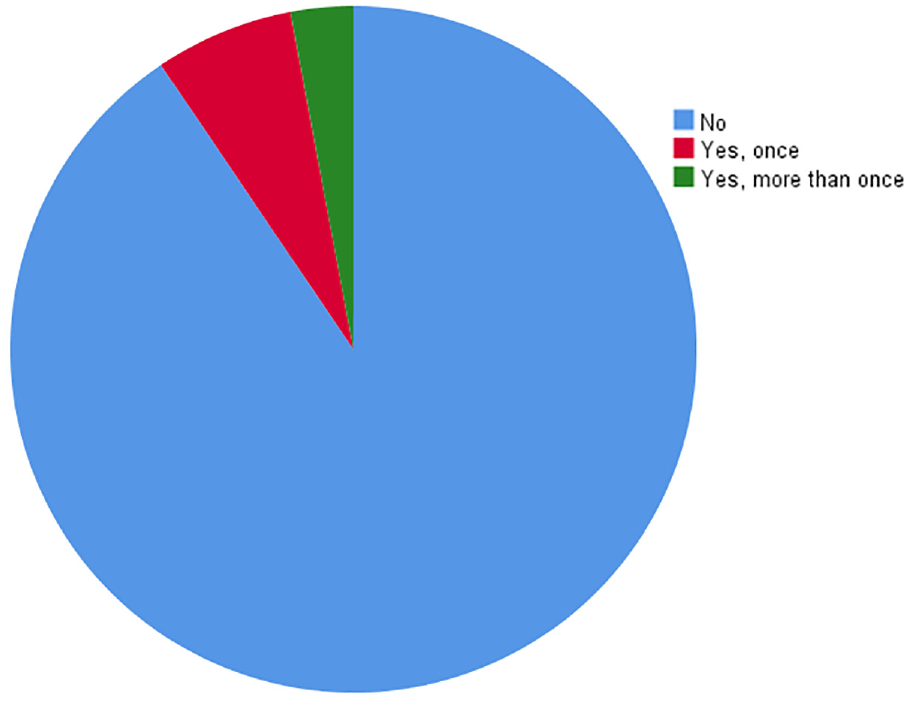
Have you ever used your firearm?

What was the reason for using firearm?
Descriptive Results on the Use of Firearms (FA) by Respondents (n = 306).
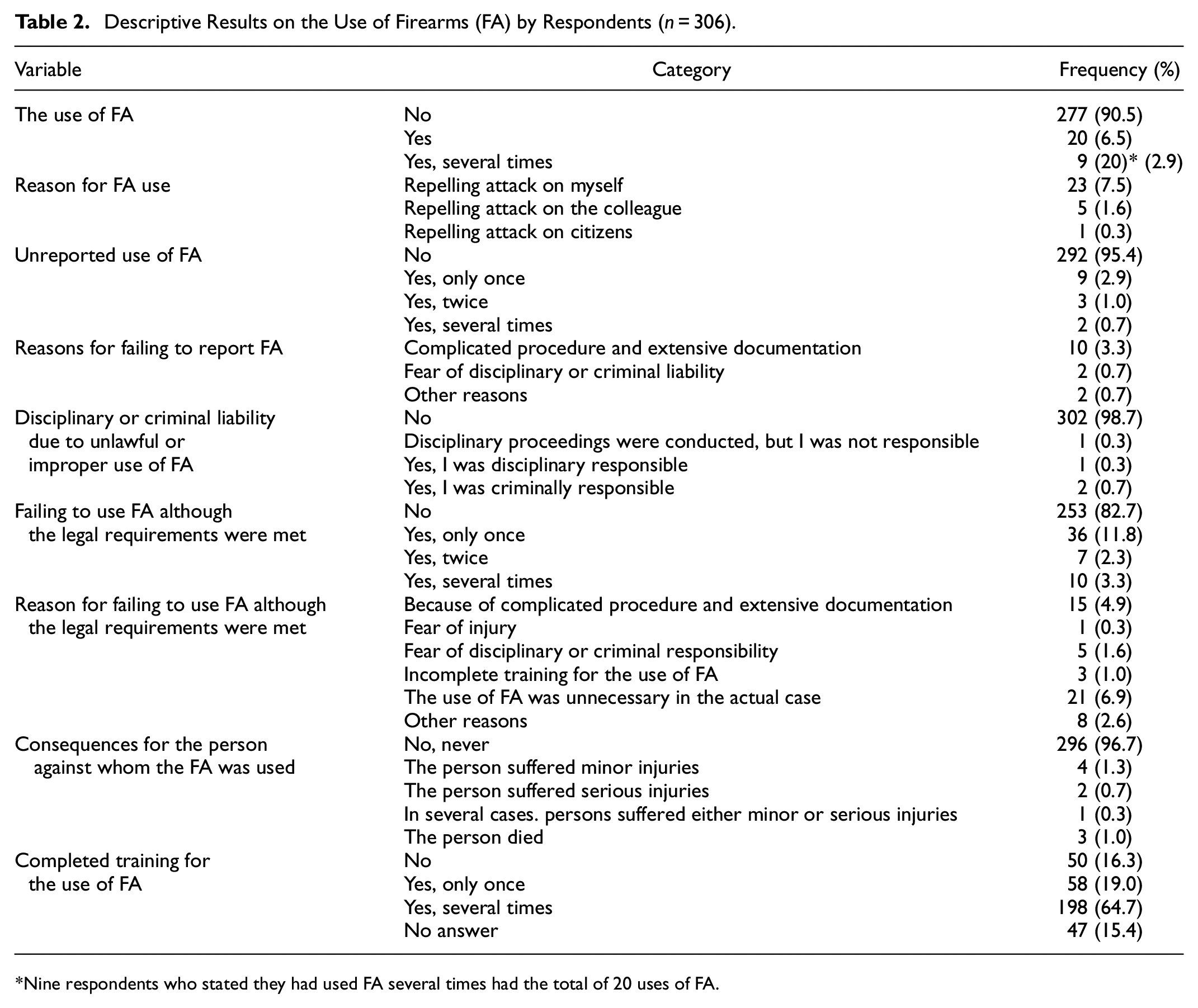
Nine respondents who stated they had used FA several times had the total of 20 uses of FA.
Almost half of respondents (47%) believe that police officers of the Ministry of Interior are not well trained to use FA (X = 2.83), and a similar percentage of respondents (44.8%) believe that police officers in their unit are not well trained to use it (X = 2.89). When it comes to personal ability to use FA, 54.6% of respondents believe that they are well trained to use FA (X = 3.34). Regarding the training for the use of FA during police training, 53.6% of respondents believe that a lot of attention is paid to theoretical content (X = 3.33), while in contrast to such high percentages, 51.9% of them believe that not enough attention is paid to practical content (X = 2.67). 53.9% of respondents (X = 2.51) believe that the Serbian police do not pay enough attention to training for the use of FA. When it comes to written forms for use of FA, as many as 61.1% of respondents believe that they are complicated to fill out (X = 2.32), while even more respondents (65%) believe that it takes a lot of time to fill them out (X = 2.22). Only 32.7% of respondents oppose the assessment that police officers should be given greater discretionary powers to use FA (X = 3.27) (Table 3).
Results of Descriptive Analysis of Perception of Police Officers on Use of Firearms (n = 306).

T-test of independent samples was used to examine the relationship between the assessment of the competence of police officers for the use of FA (Table 3) and dichotomous independent variables (gender and level of work performance). A statistically significant correlation was established between gender, on the one hand, and the assessment that members of the police in Serbia are generally well trained to use FA on the other hand (male—M = 2.89, SD=1.30; female—M = 2.50, SD=1.15; t[304] = 2.00, p = .046), that the respondents are personally well trained to use FA (male—M = 3.42, SD = 1.39; female—M = 2, 90, SD = 1.31; t[304]=2.45, p = .015) and the assessment that the Serbian police devotes a lot to training for the use of FA (male—M = 2.58, SD = 1.30; female—M = 2.14, SD = 1.14, t[304] = 2.22, p = 0.027). The second statistical significance was the correlation between the level of work performance and the assessment that police officers should be given more discretionary right to use FA (executor—M = 3.36, SD = 1.41; manager—M = 2.87, SD = 1.45; t[304] = 2.28, p = 0.023).
One-factor analysis of variance (ANOVA) was used to examine the relationship between the assessment of police officers’ ability to use FA (Table 3) and continuous variables (age, degree of education, police education, the police unit and years of service in the police). The correlation between age and variables (f–h), level of education and variable f, type of police education and variables (a–b; d, f), belonging to a police unit and variable b, and finally the years of service and variables (f, h, i) was determined.
The obtained results show that respondents aged 46 to 55 (X = 3.02) emphasize largely that the Serbian police pays enough attention to training for the use of FA, compared to respondents aged 26 to 35 (X = 2.38) and 36 to 45 (X = 2.38). The most experienced respondents (46 to 55 years old) more positively assess that the reports for the use of FA are easy to fill out (X = 2.73) and that it does not take much time to fill them out (X = 2.57), compared to the youngest colleagues (18–25 years old; X = 1.68; X = 1.63). When it comes to the level of education, respondents with completed high school (X = 2.79) point out to a greater extent that the Serbian police pays enough attention to FA training, compared to colleagues with completed master studies (X = 2.13). The most correlations were found in the type of police education. Respondents who have completed the basic police training believe to a greater extent (X = 3.18; X = 3.28; X = 3.60) that the members of the Serbian police are generally well trained in the use of FA, that their colleagues from the unit are well trained and that during police education a lot of attention is devoted to theoretical training for firearm training, compared to respondents who graduated from High School of Internal Affairs (X = 2.53; X = 2.52; X = 2.95). Respondents who have completed the basic police training (X = 2.96) believe to a greater extent that in the Serbian police, sufficient attention is paid to training for the use of FA, compared to respondents who have completed High School of Internal Affairs (X = 2.17), Advanced School of Internal Affairs (X = 1.85), the Police Academy (X = 2.35) and the University of Criminal Investigation and Police Studies (X = 2.23).
In relation to belonging to a certain police unit, the respondents employed in special police units (Gendarmerie and the like; X = 3.77) believe to a greater extent that their colleagues from the unit are well trained for the use of FA, compared to employees in the crime prevention police unit (X = 2.65) and patrol officers (X = 2.82). When it comes to the length of service in the police, employees with more than 20 years of service (X = 2.79; X = 2.44) believe to a greater extent that the Serbian police pays a lot of attention to training for the use of FA and that filling out the report on the use of FA does not take much time compared to employees with 11 to 15 years of service (X = 2.15; X = 1,85). On the other hand, employees with 6 to 10 years of service (X = 4.00) believe to a greater extent that police officers should be given greater discretionary powers to use FA, than employees with 11 to 15 years of service (X = 2.93).
Additional analyzes were performed that examined the relationships between the variables used in the study. Table 4 shows established correlations between the variables for which significance was determined.
Pearson’s Linear Correlation Coefficients Between Variables Related to Firearm Use.

Correlation is significant at the .05 (two-tailed).
Correlation is significant at the .01 (two-tailed).
Discussion
Although it may appear to the public at first glance, on the basis of the presented data, that police officers in Serbia often use FA, as is the case with police forces around the world (Italiano et al., 2021; Oramas Mora et al., 2023), at this point, the whole situation must be viewed more comprehensively. For example, in a survey conducted in Belgium (Noppe & Verhage, 2017), which investigated the use of coercive means, 7.7% (9.4% in Serbia) of police officers declared that they had used FA once. However, the crime rates in these two states must also be taken into account. In Serbia, it is 6.22, while in Belgium it is much lower, 4.34 (Global Organized Crime Index 2021, 2021). Considering these data, one can conclude that in relation to the crime rate, that is, the dangers faced by police officers in Serbia, they neither often nor needlessly use FA if compared to their colleagues in Belgium.
Out of 29 respondents who declared that they had used FA in 40 situations, in seven situations people were injured, and in three situations the person died. This means that in 75% of the use of FA, the police officers missed the target, in 17.5% of the situations people were injured, and in 7.5% of the situations, the person died. If we compare these with data from Philadelphia between 1987 and 1992, the use of FA resulted in 14% of deaths, 35% of cases ended in personal injury, and in 51% the officers missed their target (White, 2006). In New York police departments in 2017, the total number of uses of FA resulted in 29.4% of deaths, and in 58.8% there were injuries (Lorei & Balaneskovic, 2022). We can observe that Serbian police officers had lower results compared to their colleagues from previous surveys.
When it comes to gender, there are certain differences. Out of the total number of uses of FA, the females used FA only once, which represents 2.5% of all FA uses. In Dallas (USA) in the period 2002 to 2016, the females used FA in 3.55% of situations (Kim et al., 2021). The male population has a more positive view than the female population, that members of the police in Serbia are generally well trained in the use of FA, that the respondents are personally well trained in the use of FA and that the Serbian police devotes a lot of time to training in the use of FA. The reason for this may be that only one of the female respondents used FA and she is the only one who knows everything that each use entails in detail, the stress, consequences, way of handling, assessment of use, etc.
Table 2 served researchers, as well as future research, as an indicator that there are differences that exist in official statistics, from the situation on the ground. There are situations where weapons are used without such use being reported, and on the contrary, there are situations where the conditions for use have been met without firearms being used. Table 3 shows the attitudes of police officers regarding the use of firearms, the evaluation of their training, as well as suggestions for measures to improve training. Such information does not exist in official statistics, and such information can help to improve the training of police officers.
The use of FA training during police education is of key importance to the safety of a police officer at the beginning of the career and provides a foundation for later in-service training (Morrison, 2006). Regarding the training for the use of FA in the police of the Ministry of Interior of the Republic of Serbia, the respondents believed that it is not given enough attention. When it comes to training during police education, respondents were asked to assess this segment of training. The majority assessed that the most important shortcoming of police education was that there was not enough practical training for FA training, and that the theoretical segment was satisfactory. However, on the other hand, quite a few police officers declared that they used firearms without reporting it to their authorities and that they did not use it even though all the legal requirements were met. One of the most common reasons they gave for both situations was that they did it because of a complicated procedure and extensive documentation. Comparatively, the percentage of police officers who would not report the use of deadly force varies from state to state (Kutnjak Ivković & Haberfeld, 2015). A large number of respondents specifically stated that the accompanying documentation was not simple and that filling it out took a lot of time. When the question of practical training was raised, the respondents only thought of the handling of firearms and not the segment of filling out accompanying documentation after use. In addition, all research conducted so far (Oramas Mora et al., 2023) related to the use of FA has focused on the handling of firearms, and in no segment does it consider the stated problem that can be created by “extensive and complicated documentation.” Answers to questions whether that problem exists in other countries or whether it is not interesting to scientific circles can be found in future research. We can conclude from the above that in the police education, there is theoretical training for the use of firearms, which includes knowledge of legal acts, but that a problem arises when it needs to be practically applied to a specific case. In addition to the legal use of firearms, it is very important to fill out the documentation correctly, because it can serve as evidence in possible criminal, misdemeanor or disciplinary proceedings and save police officers from possible punishment, and the research showed that there were such cases as well.
Members of special units (Gendarmerie) assessed their unit as very well equipped for the use of FA, with a higher rating compared to how other members assessed their units. Patrol officers are expected to respond to and process a wide variety of calls for service every day, some of which may involve suspects with firearms. On the other hand, special unit officers rarely respond to daily calls for service, but are often engaged in situations where these officers interact with armed suspects. The survey carried out in Sweden found that most of the use of FA (80%) happened within a few minutes and those who were the first on the scene had to react. Most often, these were patrol officers. Thus, the chances to apply preventive measures or wait for elite reinforcements were not options (Petersson et al., 2017). This research also proved that patrol officers have the highest number of FA use, while members of special units (Gendarmerie) had only four uses of FA, and members of Special Antiterrorist Unit had none. In essence, it is a reasonable assumption that encountering the firearms threat is more unpredictable while in a patrol duty and more predictable within a special forces function (Terrill & Somers, 2022). Because of the above, training for the use of FA is more intensive for special units than for other units, and because of this their members are better trained in the use of FA.
One of the dilemmas was whether police officers should be given broader powers to use FA. The executors believed that it should be done, while the managers believed it to a lesser extent. Managers have a broader view of the problem. They are thoroughly familiar with all FA uses, with all police officers in the unit they lead, they have to evaluate whether each use is legal and proper or not, and finally what consequences shall each use entail, whether it be the death of a person or police officers, injuries, criminal or disciplinary prosecution. They simply have responsibility for all police officers, and police officers are only responsible for their own actions.
Limitations
The research sample was appropriate, but it remains to be seen whether it was fully representative. Researchers are aware that in any research it is more representative to use sampling based on probability theory, however in practice it is very difficult to apply sampling based on probability, which was also the case in this research. The Ministry of Interior of the Republic of Serbia was a limiting factor in obtaining data. This research would be a starting point for future research, which would use probability-based sample types if possible. According to the numbers, this sample was representative, but perhaps better-quality data could have been obtained. Namely, only 9.4% of respondents used firearm weapon once or more. The quality of the research would probably have been higher if the researchers could have reached more respondents who used deadly force. Then they would get "first-hand" more quality information about its usage itself. However, in order to get to those respondents, it was necessary to review the reports on the use of deadly force, through which the names of police officers who used it could be obtained. This was not possible because such reports are an official secret. Only when we have the specific names of the police officers who used deadly force, a more detailed investigation could be carried out, for example by conducting interviews with such police officers.
Also, data that would indicate whether police officers are adequately trained to use fire weapons, which the researchers did not find, is the number of bullets they used in each individual case. The research showed that police officers hit the target in only 25% of situations and that they are weaker than their European colleagues in this indicator. However, even for those few situations, the question arises as to how accurate they were, that is, how many bullets did they use to hit the target? Those numbers would help determine how police officers are ready to use fire weapon, not only because of the shooting technique but also as one of the indicators of whether they have overcome the stress that occurs in those situations. Such data does not exist in the statistical reports of the police in Serbia, but, again, the only way to get to them was to look at individual reports on the use of fire weapon, which researchers are not able to access because they are an official secret.
Conclusion
The research showed that the use of FA by members of the police in Serbia is rare, and that it generally does not differ largely from other European countries. This is precisely why another problem arises, which is that few police officers have had the opportunity to use FA, and that they have no experience in this matter. The question is how to prepare them for such rare situations.
The obtained results indicate that 90.5% of respondents have never used FA. Te most of them who has used the FA, used it for the reason of repelling attacks on themselves. A number of respondents used FA, but did not officially report it to the authorities. The most frequently cited reason for this is the extensive and complicated procedure. The percentage of non-reporting of the use of firearms generally varies around the world, and compared to the sample of police officers who have used firearms at all, we believe that it is not low. Data on the use of firearms in this sample, compared to other studies, indicate that the fatal outcome of the use of firearms by members of the police is lower. At the same time, the percentage of non-use of firearms even though all the legal requirements have been met is also lower compared to other surveys (Morrison, 2010, Pinizzotto et al., 2012). Unlike some comparative studies (Correll et al., 2002; R. Lawrence, 2000; Shane & Swenson, 2019), this study did not identify the problem of the use of deadly force with elements of racism.
Almost half of respondents believe that police officers of the Ministry of Interior are not well trained to use FA. However, the existence of training apparently reduces unnecessary use of force, so police officers with more training will be expected to rely on less deadly force, which is in accordance with other researches (H. Lee et al., 2010, pp. 695–696). As for the practical training for the use of FA, it should be intensified, because it has been shown that the percentage of hitting the target is lower compared to colleagues in other countries. It should be intensified primarily among patrol officers, because the research has shown that they encounter this problem significantly more often than members of special units do. However, that training should not be like before, when officers simply shoot at a target from a certain distance. Training should be designed to better prepare police officers for extremely high psychological stress, through various situational shootings, with the use of simmunition (Non-Lethal Training Ammunition), with armed markers, and in this way bring them to real situations as closely as possible.
The originality of the paper is that it is the first research of this scope conducted on the territory of Serbia and the Western Balkans. Unlike other studies, which considered the use of FA exclusively with a focus on practical training and use of FA, this study, in addition to the above, also considered the problem of filling out the accompanying forms. Although the majority of respondents believe, a lot of attention is paid to theoretical training during police education, it turned out that extensive and complicated documentation is a big problem in specific situations. However, the results indicate that there is also a lack of practical training, not so much in handling firearms, but in practical examples of filling out forms, with concrete situations and examples. That is why it is necessary for future police officers to go through a special segment during firearm training that includes filling out forms, with specific situations and examples, and not to memorize the articles of the law as before. Moreover, after each use of FA, it is necessary to analyze each use, especially with the accompanying documentation, in joint meetings with all police officers.
For certain future research, it remains to investigate what failed to be completed in this one, and above all to investigate more closely the situations in which the FA was used, from what distance the FA was used, how many bullets were fired, etc., in order to adapt training for the use of FA to such situations.
Footnotes
Acknowledgements
We would like to thank all the participants who expressed their desire to participate in the research.
Declaration of Conflicting Interests
The author(s) declared no potential conflicts of interest with respect to the research, authorship, and/or publication of this article.
Funding
The author(s) disclosed receipt of the following financial support for the research, authorship, and/or publication of this article: The part of the research is helped through the project Management of New Security Risks - Research and Simulation Development—NEWSIMR&D.
Ethical Approval
An ethical statement is not applicable.

Data Availability Statement
The dataset is available from the corresponding author upon reasonable request.