




Abstract
Selection of photographs is part of the complex process of creating the multimodal textual elements that news editors use to represent and interpret social reality. This article, guided by Aristotle’s golden mean and Halliday’s theoretical notion of metafunctions, used critical visual analysis to examine the nature of photographs that news editors of Nigerian newspapers selected and used to frame news stories about acts of terrorism by the Boko Haram sect. The pattern established through the visual analysis shows that, although the stories of terror act by the Boko Haram sect present deviant and negative social realities, news editors of the selected newspapers exercised ethical restraint by choosing images with nuanced configurations that are less likely to amplify moral panic or intensify horrid feelings. Using euphemistic photographs to tell stories about terror acts is a demonstration of ethical responsibility that has great implications for public peace especially in an African country like Nigeria with security concerns.
Keywords
Introduction
Editorial decision making in the newsroom is a complex task. Apart from gatekeeping competing news items, the editor decides the appropriate news (textual) elements to tell the story in a manner that communicates the intended messages. The aggregate of these multimodal textual elements helps to describe, explain, and interpret social reality. These elements significantly determine how the audience perceive the communicated messages in relation to the real world (Norris, 1995; Vreese, 2005; Watson, 2007). Out of the elements that go into the text, the visual component is the most pervasive (Kellner, 2002), powerful, sensitive, and complex (Chik & Vásquez, 2016; Christensen, 2016). No doubt, pictures appeal to both the sight and the emotion, and stay longer in the reader’s memory than the verbal texts (Bendito, 2005). When a news story is framed with picture(s), message deconstruction becomes easier, and the audience is more likely to be attracted to such a story than to stories presented without photos. This might explain why editors always prune down competing pictures (Griffin, 2004) and frame their news stories with the best images. When pictures are abused or misused in news stories, the consequence is likely to be more damaging than when verbal texts are abused.
The sensitive nature of visual elements in message construction has attracted attention of various scholars (e.g., Alo & Ogungbe, 2013; Anderson, 2014; Bendito, 2005; Berger & Naaman, 2011; Chik & Vásquez, 2016; Christensen, 2016; Fahmy, Kelly, & Kim, 2007; Hum et al., 2011; Kellner, 2002; Moriarty & Shaw, 1995; Neumann & Fahmy, 2012; Rovisco, 2017; Veneti, 2017). However, a critical analysis of how editors of newspapers use photos to frame stories about acts of terrorism, especially in Nigeria—an African nation facing the scourge of terrorism by the Boko Haram sect, among other security challenges—deserves scholarly attention. The central question addressed in this study, therefore, is what is the nature of photographs Nigerian news editors use to tell stories about acts of terror by the Boko Haram sect? Specifically, we carried out a critical visual analysis (CVA) of news photos of Boko Haram’s terror acts to verify how these photos were used (i.e., in terms of selection and presentation), and then discussed their likely ethical implications. Aristotle’s golden mean and Halliday’s theoretical notion of metafunctions guided this study.
Analysis of a thematically homogeneous group of news images on acts of terror by the Boko Haram sect would provide a framework for theorization as to the nature of photographs used by editors of Nigerian newspapers in framing stories such as those about terror acts. This, it is believed, would add an African perspective to the global discourse on how ethical restraint is applied when editors use images to tell news stories about terrorism.
Boko Haram: A Brief Background
Founded in 2002 by the late Mohammed Yusuf, Boko Haram, in Hausa translation, literally means “Western education is forbidden.” The adopted Arabic name of the sect is Jama’atu Ahlis Sunna Lidda’awati Wal-Jihad, the English translation of that is “People Committed to Propagation of the Prophet’s Teachings and Jihad” (Nwabueze & Ekwughe, 2014, p. 76). Mohammed Yusuf was a devout disciple of Sheikh Jaafar Mahmud Adam, a renowned Islamic scholar. Yusuf’s encounter with a radical ideology built on the Afghan Taliban led to his radicalization and eventual formation of Boko Haram—“a group which declared a total boycott of democracy, government and Western education” (Ibrahim & Mukhtar, 2017, p. 144). The emergence of Abubakar Shekau, a former deputy to Mohammed Yusuf, as the leader of Boko Haram militarized the group, which became extremely violent (“Boko Haram,” 2016). Consequently, in 2013, the U.S. Department of State designated the sect a foreign terrorist organization (Sergie & Johnson, 2015). According to Global Terrorism Index 2015, Boko Haram has escalated terror threats in Nigeria with the country witnessing the largest increase in terrorist deaths ever recorded by any country. The sect overtook ISIL (also known as the Islamic State) to become the most deadly terrorist group in the world. Fatalities attributed to Boko Haram increased by 317% in 2014 to 7,512, while ISIL was responsible for 6,073 terrorist deaths. In March 2015, Boko Haram pledged its allegiance to ISIL as the Islamic State’s West Africa Province (ISWAP). The sect concentrates its attacks in the northeastern part, and occasionally in the central part of Nigeria, including Abuja, the Federal Capital Territory (Institute for Economics & Peace, 2015). As Akinbi (2015) explains, the northeastern part of Nigeria, where the group’s activities are rife, has become “the most dangerous region to live in the country” (p. 32).
Literature Review
News Reporting, Photographs, and Textual Deconstruction
Pictures play significant roles in news presentation and meaning construction by editors on one hand and textual deconstruction by the audience on the other hand, especially in multimodal news media such as the television (Piazza & Haarman, 2015), the print media generally, and the new media. Bersak (2006) explains that news images have the power to significantly shape our culture, and they can symbolize social realities in such a manner that would remain in the collective memory of a generation.
Empirical studies have proven that the way pictures are used to frame news stories would determine largely how the audience interpret the stories and relate their messages to the real world. For instance, as reported by Fahmy et al. (2007), numerous studies on visual framing have analyzed how the news media covered conflicts or terrorist attacks, and revealed that image framing by the media greatly influenced public perception of conflicts. Fahmy et al. further reported Moriarty and Shaw’s (1995) analysis of visual themes in three U.S. news magazines that covered the first Gulf War, which established that the science-fiction-like images presented by the media prevented the public from appreciating the actual cost of the war. Griffin (2004) contends that the release of images of Abu Ghraib demonstrated the extent to which visuals affect public perception of social reality as presented by the mass media. Weber and Barker-Ruchti (2012), in their analysis of professional sports photographs of female figures in the 1970s Gymnastics, presented the assumption that “images hold strategic power and create particular objects of knowledge” (p. 24). The authors said that “sports photographs constructed and established gender and body standards through their visual construction of gendered and de-gendered gymnastics performances” (p. 22). Similarly, Piazza and Haarman (2015) explain that the nature of images used in television news items determines how viewers activate their cognitive process to interpret such news stories.
The foregoing pieces of evidence from the literature show that photographs play massive roles in textual construction and deconstruction. The leading function of picture in news reporting is to communicate meaning (Oyero & Amodu, 2012). In Veneti’s (2017) opinion, journalists’ use of picture is a combination of artistic predilections and a journalistic tool of “bearing witness” (p. 293). Veneti’s position suggests that photographs in news reporting are used not only to capture the event being reported but also to present the news with nuanced texts that make the news pleasurable to consume. In essence, how a picture is used to frame news stories determines reader’s interpretation of the encoded message and the nature of feelings and attitude the message evokes in the audience. Therefore, while news editors are selecting pictures, they are expected to always exercise care: They must effectively deploy “the tools of the trade such as framing, camera angle, cropping and the selection of images” (Berger & Naaman, 2011, p. 274). When these tools are used effectively, they increase image objectivity and news credibility, and ultimately underscore the ethical responsibility of the photojournalist or the news editor.
Issue of Ethics and Images in News Reporting
Describing news photos as tools of memory, Zelizer (1998) explains that news images must be seen and treated as markers of both truth-value and symbolism, and must always be analyzed both for their referential qualities and their diverse features that enhance meaningful referentiality. Zelizer’s explanation gives credence to the fact that the issue of ethics must always be considered by news editors whenever they select images to construct social meaning. The question of ethical responsibility in the use of images in news reporting is a critical issue for the news editor (Andén-Papadopoulos, 2013; Bednarek & Caple, 2012; Bersak, 2006; Chouliaraki, 2006, 2008; Chouliaraki & Blaagaard, 2013; Cromey, 2010; Hill & Hi, 2005; Lester, 1991; MacKenzie, Burke, Carvalho, & Eades, 2006; Wilkins & Coleman, 2005; Zelizer, 1998). Photos in newspaper stories are not immune to technological embellishment and manipulation (Cromey, 2010) because they can be cropped, toned, or framed by the editors to suit the context of the news stories or to achieve some editorial objectives (Berger & Naaman, 2011). Ethically, news editors must be morally responsible by telling their news stories with images that depict the social reality reported in the news.
While using images to tell their stories, news editors should follow some ethical guides. As identified by Lester (1991), these guides are captured in six ethical constructs—categorical imperative (i.e., what goes for one should go for everyone; no discrimination by the editor while using a photograph), utilitarianism (i.e., critical assessment of different images to maximize ones that are good for the greatest number of news audience), hedonism (i.e., using the image that feels good), the golden mean (i.e., finding middle ground between the extremes), the veil of ignorance (i.e., considering how the editor would feel if he were the subject of the moral action), and the golden rule (i.e., the editor treating his news subjects as he would treat himself). The golden mean construct is central to this study as it describes the nature of photographs that editors of Nigerian newspapers select and use to present stories about terror acts in manners that may demonstrate ethical restraint.
Euphemism in the Context of News Reporting
Euphemism is a literary device used for presenting and hiding a rather harsh, distasteful, and offensive concept or situation. Lirola (2014) describes euphemism as the semantic or formal process by which the most explicit or obscene overtones of taboo is suppressed. It is one of the different linguistic and social means of achieving “social legitimization . . . and reinforcing values and social codes” (p. 410). News writers use it to escape the trap of libel or ethical excessiveness by avoiding the use of directly offensive words or images.
The application and interpretation of euphemism depend largely on the social context of the user and the target audience (Literary Devices, 2014). It is used when there is the need to replace certain words, images, or concepts, which may prove offensive, and graphic, upsetting or uncomfortable for a particular set of audience in a particular context, especially when the issue being reported concerns sensitive topics such as crimes, violence, sexuality, death, politics, and religion (Halmari, 2011; Lucas & Fyke, 2014; Matusitz, 2016; Ryabova, 2013). It is a strong weapon for editors to present human interest stories. Ryabova (2013) explains that euphemization is a process that news editors employ to create “ideological framing in media communication” (p. 42), and it permeates languages and cultures. Ryabova also identifies some functions of euphemism in media framing. For instance, euphemism can be used to (a) modify exact names or concepts with shocking inferences; (b) name things or phenomena that are potentially offensive, indecent, and antisocial; and (c) mild or mask the real nature of things. Although, the third function, as listed above, suggests that euphemism can be used to veil the truth (Matusitz, 2016; Ryabova, 2013), from the deontological point of view (Day, 2006), the moral agents—news editors and journalists in this context—are expected “to uphold moral duties including positive duties to do good and negative duties to avoid harm” (Lucas & Fyke, 2014, p. 553). This suggests that using euphemization to achieve balance, avoid moral panic (Kidder, 1995), and mitigate terrifying inferences in the news stories is ethical.
Scholars have conducted a number of studies on the use of euphemistic images by news editors. For example, Veneti (2017) conducted a study to investigate photojournalistic approach to protest imagery. The study shows that the editors selected euphemistic images to report the protests. Therefore, the author submits that the use of hybridized strategies that permit more nuanced depictions of social realities enables news editors to create powerful and audacious images of protests. Also, a study by Moriarty and Shaw (1995) on visual themes in the coverage of the Persian Gulf War by three U.S. news magazines established that editors of the news magazines underplayed the human costs of the war. News editors achieved this by de-emphasizing images of incidents that projected the wounded and the dead Americans, and scenes of blood spilled during the war. The authors argue that selection of euphemistic images by the editors was to minimize the negative impact of the war and create the impression that Americans, in particular, were not affected by the war. Similarly, Berger and Naaman (2011) conducted an analysis of the visual representation of Israeli women soldiers. Findings of the study show, among others, that all the newspaper images of Israeli women soldiers “share a tendency to minimize the destructive potential of combat roles” (p. 282) suggesting a deliberate attempt by the editors to maintain the peculiar traditional notion of femininity in the Israeli cultural context. Despite the fact that there are studies on the use of euphemistic images by editors to tell news stories, scholars are yet to pay attention to how editors of Nigerian news media use images euphemistically to presents stories about the Boko Haram sect, which the U.S. Department of State in 2013 designated a foreign terrorist organization (Sergie & Johnson, 2015). This current study fills this gap by adding the African perspective to the global conversations on the use of euphemistic images to present stories about terrorism.
Theoretical Framework
This study is anchored on two theories—Aristotle’s golden mean and Halliday’s theoretical notion of metafunctions. The two theoretical models are discussed below.
Aristotle’s Golden Mean
Aristotle (384-322 BC), a biologist and Greek philosopher propounded the golden mean theory, a brand of The Virtue Theories because it emphasizes that when the moral agent (journalist or editor) takes decisions, priority should be given to character (virtue) rather than extreme obedience to rules (sense of duty). Aristotle shares Plato’s view of virtue in moderation and that “acts performed out of sense of duty did not necessarily reflect a virtuous character” (Day, 2006, p. 64). Moderation, therefore, is the core of the golden mean theory where moral virtue lies between two extremes. A moral agent is a virtuous person when he avoids the extremes anytime he is in a web of moral dilemma. In essence, moral agents must find the intermediate between an excess and a deficiency, between strength and weakness. Aristotle further argues that courage is the mean between recklessness and cowardice, whereas proper pride is the midpoint between empty vanity and excessive modesty (Folarin, 1998; Foreman, 2010; Josephson, 2002; Kidder, 1995; Ojebode & Ojebuyi, 2014). According to Day (2006), “The Golden Mean provides a moderate solution in those cases where there are identifiable extreme positions, neither of which is likely to produce satisfactory results” (p. 64). Of course, Aristotle’s golden mean provides a midpoint for the journalist to choose, for instance, when he is in the dilemma of applying either the teleological value (Foreman, 2010; Kidder, 1995; Okunna, 1995) or the deontological ethical principle (Day, 2006; Josephson, 2002; Wilkins & Coleman, 2005).
This theory is relevant to this study because the core objective of the study is to establish, through visual analysis, how editors of Nigerian newspapers exhibit ethical restraint while using photos to frame news stories about acts of terror by Boko Haram. When editors are faced with ethical challenges of giving the public an accurate account of the realities (Moriarty & Shaw, 1995) and being mindful of news impact on both the news subject and the audience, applying the golden mean principle becomes expediently imperative.
Halliday’s Metafunctions
The systemic functional linguistics has provided clear and linguistic paradigms (Blomaert, 2005; Toolan, 1997), and inspired social semiotic studies by various scholars (e.g., Adami, 2013; Bednarek, 2013; Bednarek & Caple, 2012; Caple, 2009; Economou, 2006, 2012; Halliday, 1978; Kress, 2010; Kress & Van Leeuwen, 2006; Macken-Horarik, 2004; Marefat & Marzban, 2014; Van Leeuwen, 2005; Wang, 2014) to deconstruct the relations between public text (i.e., discourse including language and images) and social meaning. Michael Halliday, for example, through his metafunctions of language as related to the social-semiotic and systemic-functional linguistics, has significantly influenced the development of critical discourse analysis (Ademilokun & Taiwo, 2013; Alo & Ogungbe, 2013; Blomaert & Bulcaen, 2000; Fairclough, 2001, 2005; Jørgensen & Phillips, 2004; van Dijk, 2001; Weiss & Wodak, 2003). These three metafunctions of language, as identified by Halliday, are the ideational, the interpersonal, and the textual functions (Adami, 2013; Bilal, 2012; Haratyan, 2011). The three functions explain how a discourse works in terms of what it represents and does, the relations or identity it projects, and how the textual configuration of the discourse shapes its representation and relation or identity with the audience.
Kress and Van Leeuwen, (2006) have applied Halliday’s notion of metafunctions to the study of image and all semiotic genres (Bilal, 2012). They say that “in order to function as a full system of communication, the visual, like all semiotic modes, has to serve several representational and communicational requirements” (p. 42). In this study, we harmonized the descriptions of Halliday’s metafunctions by Kress and Van Leeuwen (2006), Caple (2009), Bednarek and Caple (2012), and Bednarek (2013) as a social semiotic approach to the multimodal analysis of images.
In this current study, the ideation function of the photo news selected by Nigerian news editors concerns what the news photographs represent and connote in relation to the social reality (i.e., terror acts by Boko Haram) they are used to project, while the interpersonal function corresponds to the relations or identities projected by the news photos about the Boko Haram news and the mass audience in terms of the feelings or reaction the photographs can evoke in the mass audience. The textual function relates to how the textual structure of the news photos shapes the ideational and the interpersonal meanings. The Aristotle’s golden mean and Halliday’s metafunctions are relevant to this study. One, Aristotle’s golden mean provides the ethical framework for explaining the rationale for moral decisions taken by news editors to select and use certain images to frame their news stories. Two, Halliday’s metafunction framework provides the basis for interpretation of the relationship between the news photographs and the represented social reality in terms of verbal–visual message encoding, construal, and deconstruction.
Method
Method and Data
The study employed the CVA method to examine how editors of the select newspapers used photographs in framing their news stories about terror act of the Boko Haram sect in Nigeria. This method is employed when the objective is to explain the semiotic implications of visual–verbal messages (Martin, 2001). Data for this study were news images from the online sites of five Nigerian national newspapers—The Punch, The Sun, The Vanguard, the Premium Times, and Sahara Reporters. The newspapers and the news images analyzed were selected through purposive sampling technique. The criteria considered in selecting the newspapers are (a) active online presence and (b) national coverage and readership. The selected newspapers have national coverage and are among the top 10 most read and active online Nigerian news media (Answers Africa, 2017; “NaijaQuest.com,” 2018). The selection spread through May 2014 to February 2016. These periods were considered because (a) May 2014 marked the time when Boko Haram started attracting more global attention after they had kidnapped more than 200 school girls in Chibok, Borno State, on April 14, 2014; and (b) February 2016 marks the time when the Nigerian Army intensified action against the sect. To get the specific news photos that were analyzed, three key words (Boko Haram, Islamist insurgents in Nigeria, and terror attacks in Nigeria) were used as the search indexes on the website of each of the selected newspapers. During each search, every news story that came up under the submitted key words was considered relevant for the study. However, only stories that fulfilled all the following criteria were finally purposively selected for analysis: (a) The stories must be about terror attacks carried out by the Boko Haram sect in Nigeria within the selection period—May 2014 to February 2016; (b) the story must involve fatalities or report graphic incidents; and (c) the story must be framed with picture(s).
Data Analysis
Each of the images was analyzed using critical multimodal analysis—a social semiotic approach that adapts Michael Halliday’s metafunctions as a subset of critical discourse analysis (see Bilal, 2012; Haratyan, 2011) to deconstruct news images (Bednarek, 2013; Bednarek & Caple, 2012; Caple, 2009; Kress, 2010; Kress & Van Leeuwen, 2006; Van Leeuwen, 2005). The images were analyzed to realize (a) the ideational, (b) the interpersonal, and (c) the textual meanings.
Under the ideational/representational meaning, we looked for the human and nonhuman characters in the images, the process that the participants engaged in (i.e., showing movement or no movement, showing gaze, lip movement, nods, etc.), and the context (circumstance) of the process depicted in the image. To realize the interpersonal meaning, we used five constructs as simplified by Bednarek (2013): (a) contact—whether the image participants directly looked at the viewers to engage them, or not; (b) affect—the nature of response (positive or negative) that the image participant was likely to evoke from the viewers; (c) involvement—the camera angles which could be frontal (i.e., that engaged the viewers), or oblique (i.e., that excluded the viewers); (d) social distance—the types of shot used (i.e., very close/close, medium, or short shots), and (e) power—the vertical angles used to present the image characters (i.e., eye level, low angle, and high angle). We analyzed the images for textual meaning by considering salience (i.e., the character that attracted the viewers’ attention first in the image), and how elements in the image are distributed to achieve balance in terms of which element was singled out and focused on, or which two elements of equal size were arranged evenly.
The theme of visual euphemism and ethical restraint guided the sorting and analysis of the photographs in the news stories, as identifying the nature of the photographs used by Nigerian news editors to minimize graphic effect of stories about terror acts in Nigeria was the objective of the study. Four main identifiers (i.e., source, date, presumed location, and headline) were used to characterize the selected photographs to provide some background information that guided data presentation and analysis. The data, analyses, and discussion of the findings are presented in the following sections.
Results
Pictures in Samples 1 to 11 were analyzed to answer the research question on the theme of Visual Euphemism and Ethical Restraint. This theme guided us in analyzing the pictures to highlight how the news editors, in their gatekeeping decisions, handled the photographs that were used to frame stories about terror acts by the Boko Haram sect. The analyses established how the selected pictures perform the three Halliday’s metafunctions (Halliday, 1978; Haratyan, 2011) that were adapted for visual analysis by scholars such as Kress and Van Leeuwen (2006), Caple (2009), Bednarek and Caple (2012), and Bednarek (2013). All the stories selected have explicitly offensive themes capable of abusing the sensibility of the audience, evoking tense emotion, and heightening public fears. However, the pictures that the news editors used to tell the stories have textual function that neither reveals most of the graphic scenes nor contains personalization in terms of the wounded or dead victims (ideational function). Also, the analyzed images could induce less horrid imageries of the potential negative effect of the stories (interpersonal function).
Sample 1
Source. The Punch.
Date: December 15, 2015.
Presumed location: One of three northeastern villages—Warwara, Bura-Shika, and Mangari villages—near Buratai, the hometown of Nigeria’s Chief of Army Staff, Tukur Yusuf Buratai.
Headline: Boko Haram Attacks Three Borno Villages, Kills 30.

Analysis
The image in Sample 1 was used to frame a news story about fatal attacks on three villages by the Boko Haram Islamists in the restive northeastern Nigeria where 30 people were slaughtered and 20 others seriously wounded. At the ideational/representational level, a critical analysis of the image shows that the elements in the image are trees, thatched huts, rising flames, and balls of thick smoke but no human characters. At the interpersonal level of analysis, the picture shot is long with frontal and eye-level camera angles. The picture is rendered slightly opaque, cropped to conceal other elements that could be offensive in the image. In terms of textual composition, the portion of the scene that is directly affected by the flame is not foregrounded. The scene with fresh green trees and thatched huts are near the camera lens while the affected spots are obscure. These visual properties of the image have some semiotic implications: (a) As the picture was taken in a long shot and there are no human participants in the image, it implies that there is no social interaction (contact) between the audience and the visual elements of the image and (b) absence of social contact then suggests that the image cannot evoke in audience a negative emotional response (affect) that the message of the story suggests. The headline reads Boko Haram Attacks Three Borno Villages, Kills 30, but the image shows no such human fatalities. Obscuring the graphic portion of the photograph in a story such as this fulfils Aristotle’s golden mean that espouses moderation and restraint (Day, 2006).
Sample 2
Source. Sahara Reporters.
Date: September 20, 2015.
Presumed location: Gomari and Ajilari areas of Maiduguri, the Borno State.
Headline: Boko Haram Fighters Attack Maiduguri.

Analysis
The picture illustrated the story about bomb attacks by Boko Haram members in the Gomari and Ajilari areas of Maiduguri, the Borno State capital. The human characters in Sample 2 are two soldiers squatting in combat positions. Other elements are broken fences and huts in a village scene, half of which are on flame. Extreme long shot, frontal and slightly high camera angles are used to capture the participants. Faces of the human characters, the salient elements in the photo, are rendered unidentifiable. The real scene of the attack is distant with no visible images of dead or wounded victims in the image. The picture shows that with the two soldiers as the human participants maintaining combat positions, there is a social contact between the image participants and the audience. The social distance (contact) between the image participants and the interactive participants (i.e., news audience; Kress & Van Leeuwen, 2006) is such that could evoke a positive emotion (affect) in the audience, whereas the story that the image is used to tell suggests Boko Haram attacks. This image in Sample 2 with combat-ready soldiers as the salient elements creates in the minds of the reading audience a sense of security rather that of panic as suggested in the story. Also, the frontal and eye-level camera angles (Bednarek & Caple, 2012; Kress & Van Leeuwen, 2006) used to shoot the picture suggest a positive and equal social relation between the image participants and the audience.
Sample 3
Source. The Punch.
Date: January 31, 2016.
Presumed location: Dalori village near Maiduguri, Borno State.
Headline: Boko Haram kills 65 in Borno village attack.
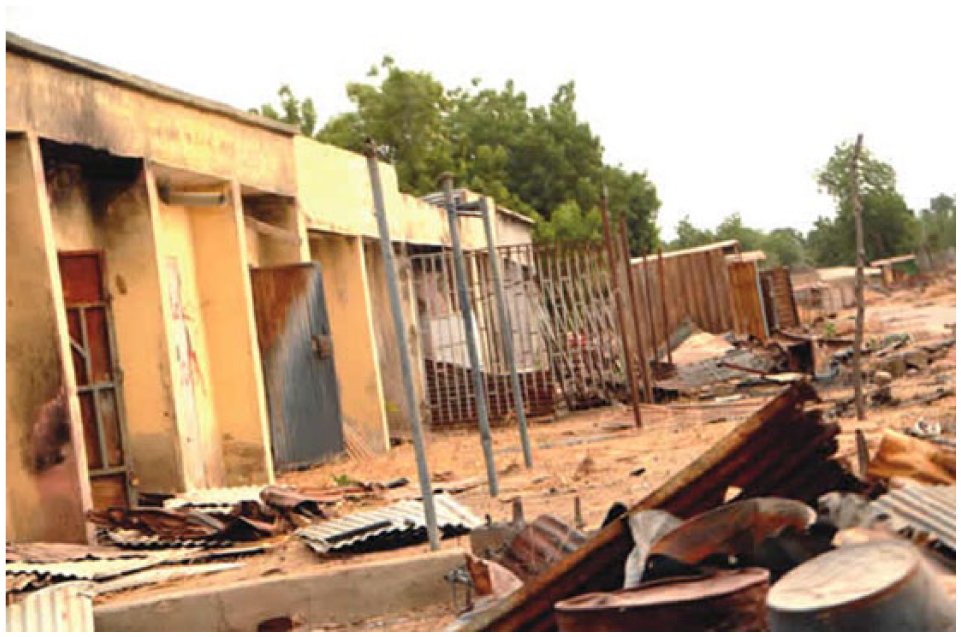
Analysis
The picture in Sample 3 authenticated the report of a night attack by the Boko Haram sect where no fewer than 65 persons were reportedly killed in Dalori, a village bordering Maiduguri, the capital of Borno State. Ruins of buildings and other domestic objects are the salient elements in Sample 3 above. A long shot is combined with frontal and eye-level camera angles to present the elements in the photo. There are no dead or apparently wounded victims in the picture. Like the image in Sample 1, there is no human participant in the image in Sample 3. Therefore, there is no social interaction (contact) between the interactive participants and the image. This further suggests that the image cannot evoke in audience a negative emotional response (affect) suggested in the story with the headline: Boko Haram kills 65 in Borno village attack.
Sample 4
Source. Premium Times.
Date: July 11, 2015.
Presumed location: Ngamdu town between Damaturu and Maiduguri.
Headline: Boko Haram militants seize Damaturu-Maiduguri road.

Analysis
The picture in Sample 4 was used to authenticate the report of attacks by the Boko Haram militants, who killed no fewer than 10 persons in Ngamdu town, Borno State. The characters represented in the image are a crowd that resembles onlookers or sympathizers at the scene of an attack. The onlookers are clustered behind some pale smokes from the charred debris on the scene. In front of the crowd are relics of carnage as the salient elements. There are no dead or visibly wounded casualties in the photo. A long shot is combined with oblique, eye-level camera angles to present the elements in the image. The long shot conceals the expression of panic or anger on the faces of the participants. In addition, the use of long shot in the image in Sample 4 creates some social distance between the represented reality and the viewers whom Kress and Van Leeuwen (2006) describe as interactive participants. This type of social distance (as exemplified in the image with a long shot in Sample 4) lessens the interaction between the viewers and the image, and mitigates the emotional trauma that a close shot of such a graphic scene would have created.
Sample 5
Source. The Sun.
Date: September 21, 2015.
Presumed location: City of Maiduguri, Borno State.
Headline: Suspected Boko Haram suicide bomber kills 54 in north-eastern Nigeria.

Analysis
The picture corroborated the report of attacks by suspected Boko Haram members on a mosque and football fans watching a televised match where at least 54 people were killed and 90 wounded when several bombs exploded in the city of Maiduguri in Borno State. The characters in Sample 5 are human beings that look like groups of sympathizers—some of them close to the camera lens looking at a locally fabricated wheelbarrow and a heap of slippers while another groups are standing at a far distance. There are no dead or visibly injured victims at the scene. Long shots, oblique, slightly high and long camera angles were used to capture the participants. The salient objects that first attract the viewers’ attention are the wheelbarrow and the slippers. With the use of long shots, oblique, slightly high and long camera angles, the image participants are obscure in such a way that the news audience could not easily discern the emotional frames on the faces of the human elements in the picture. This effect mitigates the extent of negative emotional reaction the story could, ordinarily, generate.
Sample 6
Source. The Sun.
Date: September 30, 2015.
Presumed location: Malari village in Konduga Local Government Area, Borno State.
Headline: Boko Haram kills 20 in midnight attack.

Analysis
The picture confirmed the report of attacks by the Boko Haram sect where no fewer than 20 people were killed, and many others injured in a midnight attack by the Boko Haram insurgents in Malari and other communities in Konduga Local Government Council of Borno State. The salient human characters and elements in Sample 6 are three fully armed Nigerian soldiers parading a sandy street where some persons, mostly children and women, are standing in small groups. Faces of the human characters are unidentifiable. There are no visible images of dead or wounded victims in the image. A long shot, and frontal, eye-level camera angles are combined to present the elements in the image. The image in Sample 6 above shares some similarities with the image in Sample 2: In both images, there are combat-ready soldiers as the salient elements. The scene that suggests ruins or human casualties as reported in the story here are hidden behind the soldiers. The texture of this image could create in the minds of the reading audience a feeling of safety and a sense of confidence in the Nigerian military to provide security for the citizens, whereas the story, typically, could suggest vulnerability and human tragedies. Also, the frontal and eye-level camera angles used to shoot the picture indicate an equal social relation or cooperation between the image participants (the soldiers) and the audience (the citizens).
Sample 7
Source. The Vanguard.
Date: September 26, 2015.
Presumed location: Madagali Local Government Area of Adamawa State.
Headline: Many dead, 50 houses razed as Boko Haram invades Adamawa communities.

Analysis
The picture in Sample 7 was used to frame a report of attacks by suspected members of the Boko Haram sect when they invaded three communities of Sabon Gari, Kafin Hausa, and Bakin Dutse of Madagali Local Government Area of Adamawa State and reportedly killed many people after setting houses ablaze. The characters in the image are a scattered crowd, mostly young men, at the scene of an attack. Some of the people including a man in a military uniform are leaving while others are standing looking at the relics of a carnage covered in smokes that render the spots opaque. The salient elements are the smoky spots. There are no dead or visibly wounded casualties in the image. A long shot is combined with an oblique, eye-level camera angle to present the elements in the image. The participants maintain no direct engagement with the viewers. With the long shot and oblique camera angle, the kind of contact between the image participants (especially the human participants) and the news audience is such that could mitigate negative emotional response. The image participants are placed far and obliquely, with most of the human characters backing the camera. The semantic implication of these effects is that faces of the angry and panic-stricken human characters are concealed from the scrutiny of the interactive participants.
Sample 8
Source. Sahara Reporters.
Date: February 14, 2016.
Presumed location: Dadikowas village, Gombe State.
Headline: Boko Haram Militants Attack Gombe.

Analysis
The picture in Sample 8 framed the report of shooting and explosions as the Nigeria troops engaged the Boko Haram insurgents who attacked Dadikowas village some 4 km away from Gombe, the state capital. The participants in the picture are residents; thick, dark clouds rising from a distant background; commercial tricycles moving on the street; trees; and other buildings in the neighborhood. There is no direct engagement between the participants and the viewers. Long shot, oblique, slightly high and long camera angles are used to capture the participants. The thick smokes are the salient elements to first attract the viewers’ attention. The back and the side views of the human characters are visible from the images. This image in Sample 8 shares similarities with the image in Sample 7: In the two images, the image participants are placed so far and obliquely. With these long shot and oblique camera angle, the social distance between the image participants and the news audience is capable of creating a kind of contact that mitigates negative emotions that could be evoked by the horrid incidents reported in the stories.
Sample 9
Source. The Vanguard.
Date: November 30, 2014.
Presumed location: Kano Central Mosque, Kano State.
Headline: Kano Blasts: “We saw hell in the house of God.”

Analysis
The picture in Sample 9 framed a report of a suicide bomb attack carried out by suspected members of the Boko Haram sect on the Central Mosque, Kano, during a Friday prayer where the death toll was more than 200. The participants represented in the image are cars, thick clouds rising from the back of a tower from a distant background, and some people standing in small groups. There is no direct engagement between the human participants and the viewers. The participants are captured with a long shot, oblique and slightly high camera angles. The thick smokes and the cars are the salient elements to first attract the viewers’ attention. No dead or visibly injured persons are presented in the image.
Sample 10
Source. The Punch.
Date: February 1, 2016.
Presumed location: Dalori village, Maiduguri, in Borno State.
Headline: Boko Haram burns children, kills 86 in Borno attacks.

Analysis
The picture in Sample 10 above was used to frame a story about a night raid by the Boko Haram members, who overran Dalori, a village 4 km outside Maiduguri, where they allegedly burnt some children to death and killed another 80 residents of the community. In Sample 10, the characters are human beings standing on a charred terrain, a mud house, the carcass of a burnt cow, other burnt objects, and smoky surroundings. To present the image, a long shot is combined with oblique and high camera angles. The burnt cow and the charred spot are the elements that first attract the viewers’ attention. There are no dead or visibly injured human characters in the image. In terms of intermodal relationship, the image in Sample 10 does not explicitly project the extent of fatalities reported in the headline of the story: Boko Haram burns children, kills 86 in Borno attacks. Aristotle’s golden mean principle is also applied here. The editor chose a picture that simultaneously suggests carnage but conceals the raw scenes of human tragedies that the story conveys.
Sample 11
Source. Sahara Reporters.
Date: September 1, 2014.
Presumed location: Bama, Borno State.
Headline: Boko Haram Takes Over Bama.
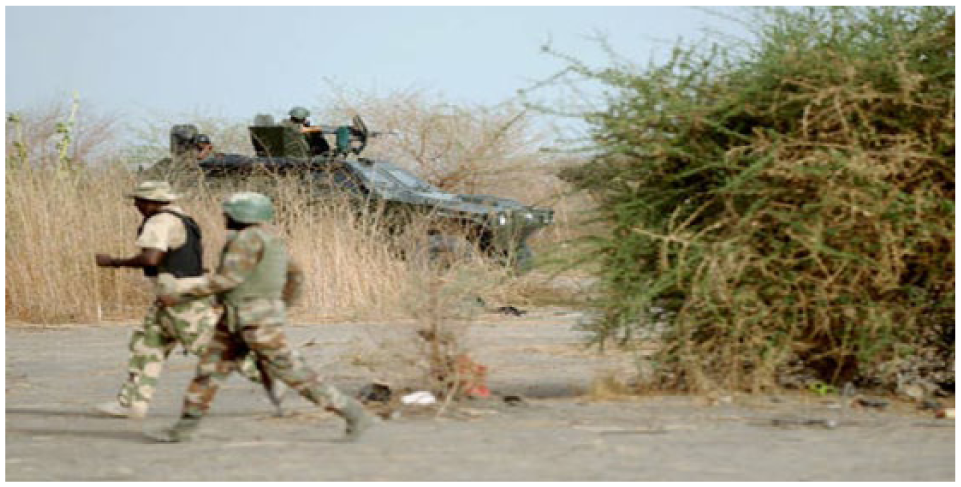
Analysis
The picture in Sample 11 framed a story about Boko Haram’s invasion of Bama community in Borno State. The report says Boko Haram overran the community killing and injuring many soldiers and residents before hoisting their flag in the town. The characters in the image are some Nigerian soldiers who appear to be on duty fighting the Boko Haram terrorists. Two of the soldiers are advancing on their feet while others are on a military armored tank. The setting looks like typical Boko Haram hideouts in the northern desert. Extreme long shot, oblique and slightly high camera angles are used to capture the participants. The human characters, who are the salient elements in the photo, do not have a direct engagement with the audience. There are no dead or wounded victims in the image. By choosing a photograph that presents combat-ready Nigerian soldiers, instead of a community overrun by the Boko Haram fighters, as reported in the story, the editor has suggested that the Nigerian military is capable and alert. The image has also played down the likely negative emotional response from the audience. The contact between the interactive participants (news audience) and the image participants (soldiers represented in the image) is such that could restore a sense of safety and confidence in the citizens.
Discussion
As evident in the results, editors of the selected Nigerian news media regulated their use of images to report acts of terror by the Boko Haram sect. For example, the images in Samples 1 to 11, in their textual configuration (i.e., textual function), are without personalization; they subdue direct interaction between the viewers and the images, and conceal most of the graphic portions of the scenes of the incidents reported. These textual structures of the images affect the ideational and interpersonal functions of the news photos. In terms of ideational function, the images illustrate scenes of terror acts reported. For interpersonal function, the images do not convey the same level of raw, graphic messages that the stories textually captured. The interaction between the images and the viewers may not produce the same degree of negative responses as the stories in text would do.
The images in Samples 1 to 11 show no wounded or dead human casualties, whereas the textual accounts of the stories they represented confirm deaths, injuries, or destructions resulting from attacks by the Boko Haram members. Specifically in Sample 9, the editor was euphemistic by cropping the image such that the full scene, which probably has images of burnt children, as reported in the story, is not revealed. Instead, the editor used a picture of nonhuman characters (carcass of a burnt cow and other charred objects) as the salient elements in the image. The inference from the samples is that in presenting the stories of Boko Haram attacks, the news editors demonstrated professionalism and ethical restraint by not using sensational, offensive, and graphic images to frame the panic-invoking stories. Different photos with visible images of death casualties could present the stories in a more scaring manner. A citizen-eyewitness image, for example, taken and used by a citizen journalist with no professional training or experiences could be extremely graphic with obvious elements of subjectivity and affectivity (Andén-Papadopoulos, 2013; Pantti, 2013) because the citizen journalist, without considering the ethical implications of the graphic image, might want to show some overzealousness and prove that he really witnessed the incident.
The use of long shots in the pattern of the images in the samples is euphemistic. Photo journalists may choose to use long or extreme long shots for some reasons: one, to cover much of the landscape in a scene; two, to suppress the severity of a potentially offensive or graphic scene; and three, to express an impersonal social relationship between the image characters and the viewers (Bednarek, 2013; Bednarek & Caple, 2012). The pictures selected by the news editors to tell the stories of terror acts achieve these objectives. They cover much of the scenes of the attacks including nonhuman characters, or in some cases, living rather than dead human beings, as the salient elements of the photos. This shows the textual function of the images. The use of long shots conceals the graphic scenes of the terror attacks (ideational function), and this could reduce negative emotional responses from the viewers (interpersonal function). Also, the selection of images with oblique angles (e.g., Samples 4, 5, 7, 8, 9, 10, and 11) to frame the stories suppresses the graphic incidents reported in the respective stories. Like long shots, oblique angles are less revealing. When news editors are considering images to be used for framing stories, ethical moderation (Day, 2006; Foreman, 2010; Josephson, 2002) is better by using less offensive images as recommended by Berger and Naaman (2011). This is achievable by choosing a picture with a medium or long shot, which captures the scene but with an oblique angle that suppresses the gravity of the offensive sight (Bednarek & Caple, 2012). The stories framed with the pictures were accounts of fatal attacks by the Boko Haram sect in the northeast Nigeria, where emotions and fears were heightened among the residents because of frequent similar occurrences of terror acts. By using the types of pictures in Samples 1 to 11 to frame the stories, the editors have played down the grimness of the incidents and respected the sensibility of the readers (Lester, 1991). This is euphemistic. Different news images with close shots and highly revealing camera angles—exposing the grim fatalities and graphic images of the victims in the stories—would have increased the negativity of the stories and aggravated the prevalent sense of horror and insecurity in the region and across the country. The editors’ decisions to conceal the severity of the incidents are justified by the tenet of Aristotle’s golden mean, which prescribes that when the moral agent is taking decisions, character (virtue) should be placed above extreme obedience to rules (Day, 2006) by striking the balance between presentation of facts and respecting the audience’s sensibility (Moriarty & Shaw, 1995).
The findings in this study are similar to a study by Berger and Naaman (2011), where analysis of visual representation of Israeli women soldiers shows that all newspaper images of Israeli women soldiers “share a tendency to minimize the destructive potential of combat roles” (p. 282). The scholars argue that the choice of these less combative images of the Israeli women soldiers by newspapers could be a deliberate attempt by the editors to maintain the peculiar traditional notion of femininity in the Israeli cultural setting. Similarly, in a study by Moriarty and Shaw (1995) on visual themes in the coverage of the Persian Gulf War by three U.S. news magazines, it is established that editors of the news magazines underplayed the human costs of the war by underreporting scenes that depict the wounded and dead, while the representation of blood spilled during the war was almost not reported. Besides, there were no images of apparently dead Americans. This approach, according to the authors, was to suppress the negative impact of the war and create the impression that few were wounded or killed during the war, and Americans, in particular, were untouched by the crises. Furthermore, Veneti (2017), after investigating photojournalistic approach to protest imagery, submits that it is “through the employment of hybridized strategies—where the artistic form allows for more nuanced depictions—that powerful and audacious images of protests can be created” (p. 293). These findings are examples of how news editors apply euphemism to smother negative effect of naturally offensive stories. The findings further prove that euphemism is time- and context-specific, used to achieve ethical balance, and avoid moral panic and social taboos (Day, 2006; Folarin, 1998; Josephson, 2002; Kidder, 1995; Literary Devices, 2014).
The findings in this study suggest that while exercising their gatekeeping roles (Donohew, 2001; Paul & Elder, 2006; Shoemaker, Eichholz, Kim, & Wrigley, 2001), news editors could select and render images that help in achieving certain editorial objectives. One of these objectives is to avoid moral panic. As Rothe and Muzzatti (2004) explain, the use of negative and scary news frames than the represented social reality always exaggerate and distort the social reality especially if it is about deviant or criminal activity. Following Halliday’s proposition that textual configuration of photographs determines the representation of social reality and audience’s reaction to the visual texts, the visual analysis in this study provides the platform for understanding how news media could render the multimodal texts as elements of news discourse in manners that could influence audience’s attitudes and emotions (Alo & Ogungbe, 2013; Blomaert & Bulcaen, 2000; Fairclough, 2001, 2005; Jørgensen & Phillips, 2004; Veneti, 2017; Wang, 2014; Weiss & Wodak, 2003). As Lirola (2014) asserts, multimodal texts can transmit facts in a specific way appropriate to the editor’s objectives, such as selling the newspaper or causing certain social behavior.
The adaptation of Aristotle’s golden mean and Halliday’s metafunctions in driving this study has helped us to achieve two purposes: One, Aristotle’s golden mean has provided the theoretical framework for explaining how moral obligations of news editors to be ethically responsible while taking editorial decisions could play some roles in the fulfillment of certain editorial objectives; two, the Halliday’s metafunctions have established the possible meanings or effect that configuration of news photographs can create as they are used by news editors to tell their stories.
Conclusion
From the findings, we have been able to answer the core research question posed in this study. As a summary, the findings have shown that, like news editors in Europe and America, editors of the selected Nigerian newspapers have used the visual element to achieve some objectives while constructing news stories. One is to tell stories that have harsh, scary, or offensive contents in a less hurting manner. As shown in Samples 1 to 11, the news editors exercised some ethical restraints as proposed by Aristotle’s golden mean (Day, 2006; Foreman, 2010; Josephson, 2002; Lester, 1991) through visual euphemism (Lirola, 2014). They demonstrated this by underplaying the human costs (Moriarty & Shaw, 1995) of Boko Haram activities thereby creating the impression through images, that the terror acts caused more damage to properties but had lesser human casualties.
News editors should respect the dignity of both the mass audience and the human subjects of their news stories. They should not feed the mass audience with content injurious to their senses and emotion. If newspaper content is offensive, the message can insult and hurt the audience’s sensibility. Editors must never fail to handle photographs properly while presenting their stories; they must be wary of how they use citizen-shot images, which in most cases do not conform to the professional standards of facts, neutrality, and detachment (Andén-Papadopoulos, 2013; Pantti, 2013). Editors, in their attempt to expose the truth, should endeavor to exercise ethical restraint (Day, 2006; Foreman, 2010; Lester, 1991) by maintaining a balance between the extremes of virtue and absolute obedience to the rules.
Data Sharing Statement
The data (photographs) we used for analysis in the study are in electronic format. They are available on the online platforms of the selected Nigerian newspapers:
Footnotes
Acknowledgements
We sincerely acknowledge colleagues and experts who helped us to read the article and made critical corrections and suggestions that added to the overall depth and quality of this article before it was submitted. They also provided lists of relevant references that we eventually consulted to significantly strengthen the literature and theoretical framework sections.
Declaration of Conflicting Interests
The author(s) declared no potential conflicts of interest with respect to the research, authorship, and/or publication of this article.
Funding
The author(s) received no financial support for the research, authorship, and/or publication of this article.
