




Abstract
Although women’s educational achievement and human capital have increased, the wage gap persists both in Germany and Turkey. Also, there are many differences in terms of labor market policies for both countries. This study will discuss the current situation within the framework of various wage gap theories and estimate the relationship between an extensive range of human capital, and economic and social characteristics of gender differences in wages for Germany and Turkey. We employ the stochastic frontier approach methodology to calculate a frontier of wages using German Socio-Economic Panel (SOEP) and the Turkish Statistical Institute’s (TUIK) Household Research data and Labor Force Research data. The findings of the study strongly suggest that the current frameworks are inadequate, and more comprehensive measures need to be adopted to promote gender equality in the labor market. Policymakers should focus on creating more inclusive and supportive work environments by improving education, offering greater workplace flexibility, ensuring wage transparency, and providing robust legal protections for women. By addressing these systemic issues, both countries can make strides toward reducing the gender wage gap and promoting a more equitable workforce.
Introduction
The gender wage gap is commonly measured by comparing the ratio of women’s wages to men’s wages, with women typically earning lower wages than men. The gender wage gap is a multifaceted subject that has been thoroughly examined in various nations and circumstances. The distribution of men and women throughout different sectors, jobs, and career stages has a significant influence on the disparity in wages between genders. Conventional theories for the gender wage gap, which attribute it to disparities in human capital such as education, job experience, and productivity, have proven to be insufficient in accounting for the extent of the female wage gap in recent years. Furthermore, disparities in wages across genders can be attributed to variations in occupations and sectors. Additionally, it encompasses psychological characteristics and non-cognitive abilities, which contribute to a relatively modest to moderate portion of the disparity (Blau & Kahn, 2017). Discrimination in work distribution, disparities in productivity, and features specific to the company can all contribute to the gender wage gap. The institutional context in which individuals work, including rules and regulations that encourage equitable chances, can also influence it (Triventi, 2013).
In light of the historical decrease in the disparity between wages based on gender, it is crucial to analyze the factors that have contributed to the continued existence of a substantial gender wage gap in some nations, despite major advancements in women’s educational and professional ambitions. In this study, the gender wage gap will be discussed in the context of a comparison between Germany and Turkey. In these countries, women’s wages are relatively lower than men’s wages. (7% lower for Germany and 18% lower for Turkey according to World Bank 2023 statistics). Although women’s educational achievement and human capital have increased, the wage gap persists. The idea that efforts should be made to understand the obstacles behind this persistence motivates this study.
Since there is considerable variation of labor market policies adopted across these countries, this research can comparatively provide strong perceptions for eliminating the wage gap by suggesting a broad range of socioeconomic policies. A comparative study can offer valuable insights into the potential elimination of this gap by examining the varying policies implemented in different countries. Given policy differences across countries, research that has been conducted offers strong perceptions of the need to eliminate this gap. Therefore, these countries were chosen as the subject of the research.
The selection of Germany and Turkey for this comparative analysis is grounded in their contrasting yet instructive socio-economic and institutional landscapes. Germany exemplifies a sophisticated, social-market economy with strong labor rights, rules governing wage transparency, and a high rate of female labor force participation. As a developing country, Turkey, on the other hand, has a lower rate of female labor force participation, a higher percentage of informal work, and a less robust enforcement of labor laws pertaining to gender equality. They are compelling for comparison both philosophically and empirically because of this disparity. Although female education and human capital have improved in both countries in recent decades, substantial salary discrepancies still exist. We can learn more about how different institutional frameworks, cultural norms, and labor market regulations influence gender-based wage results by comparing these two situations. This comparative approach not only highlights structural inefficiencies and common challenges but also enhances the relevance of policy recommendations by evaluating which mechanisms succeed or fail in different developmental contexts
After an introduction, the second section of the study mentions about methodology. The third section comprises the empirical results. Following the results, the next section includes a discussion of the findings. Finally, the last section presents policy implications.
Literature Review
Human Capital Theory (Becker, 1964) posits that wage disparities stem primarily from differences in human capital, such as education, skills, experience, and productivity. According to this theory, women tend to invest less in human capital than men because they are more likely to take career breaks (e.g., for childcare) and may work fewer hours or choose part-time roles. Consequently, their overall human capital accumulation (measured by job experience and training) is often lower, which contributes to their lower earnings. Although differences in human capital account for a portion of the wage gap, studies show that even when men and women possess similar levels of education and experience, significant wage gaps persist. This indicates that human capital theory alone is insufficient to fully explain the gender wage gap.
The Universal Male Wage Advantage Theory (Bergmann, 1974) suggests that men enjoy a wage premium simply due to their gender. This theory implies that employers may hold unconscious biases or socialized expectations that result in higher pay for men. Historically, men have been perceived as the primary earners, reinforcing societal norms that contribute to their wage advantage.
Devaluation Theory (England, 1992) proposes that work traditionally associated with women is undervalued and, therefore, underpaid compared to male-dominated roles. Occupations that are predominantly filled by women, such as teaching, nursing, and administrative work, are systematically paid less than male-dominated jobs, even when they require similar levels of education, training, or responsibility. Society tends to devalue “women’s work,” leading to lower wages in female-dominated sectors. However, this theory focuses largely on occupational segregation and does not fully address wage differences within the same roles or industries where men and women work alongside each other.
Discrimination Theory (Becker, 1957) contends that gender discrimination in the labor market results in wage disparities between men and women. This discrimination can also manifest in hiring, promotion, and training opportunities, with men being favored for higher-paying or leadership positions.
Negotiation Theory (Babcock & Laschever, 2003) suggests that women are less likely to negotiate assertively for higher wages, which can lead to lower initial salary offers and fewer raises. Cultural and social norms may discourage women from negotiating or lead to their efforts being perceived less favorably compared to men’s.
The Motherhood Penalty Theory (Waldfogel, 1997) posits that motherhood often results in career interruptions, reduced working hours, and a shift towards more flexible, lower-paying jobs. This leads to mothers earning less than childless women and men, as they experience a “wage penalty” due to taking time off or reducing their hours to care for children. This can limit wage growth and promotion opportunities, thereby widening the gender wage gap.
Social Role Theory (Eagly & Wood, 1999) asserts that societal expectations and gender roles shape the types of jobs men and women pursue and how they are compensated. Gender norms often suggest that men should be assertive, ambitious, and focused on career advancement, while women are expected to be nurturing and more suited for caregiving roles. These expectations influence career choices and wage outcomes, with women often opting for roles associated with caregiving (which tend to be lower-paying), while men gravitate towards leadership and financially lucrative roles.
Compensating Differentials Theory (Smith, 1776) argues that wage differences can be attributed to preferences for job characteristics such as flexibility, work-life balance, and job security. Women may prioritize non-wage benefits, like flexible hours or job stability, which could come at the cost of higher wages. As a result, they may accept lower-paying jobs that offer greater flexibility, contributing to the gender wage gap.
Each of these theories provides valuable insights into the gender wage gap, yet no single theory can completely account for the disparity. A combination of factors, including human capital, discrimination, societal norms, and workplace structures, contribute to the complex and enduring wage gap between men and women. Understanding this diverse range of theories is crucial for crafting comprehensive policies that tackle the root causes of wage inequality. This study not only seeks to examine the validity of the Universal Male Wage Advantage Theory and the Discrimination Theory in selected countries, but also delves into other theories, such as Human Capital Theory, Social Role Theory, and the Motherhood Penalty Theory, using variables that reflect the socioeconomic and personal characteristics included in the empirical analysis.
The gender wage gap is a widely researched and published topic in the literature, and in this section, publications on the countries covered by this study, the variables it uses, and its method will be discussed. Studies using the stochastic frontier method, studies on Turkey, studies on Germany, and briefly studies on other countries are included in this section, respectively.
The formulated working hypotheses will be analyzed whether:
H1: There is a wage difference between women and men only because of their gender
H2: Some social, economic, and personal features are effective in wage determining
Bishop et al. (2007) examine Taiwan’s male–female earnings gaps over three decades (1978–2003) to evaluate women’s labor market integration. It uses labor market efficiency model. While earnings between men and women converge during this period, the model reveals rising efficiency for both genders, with women experiencing a faster increase. They conclude that this relative gain in female efficiency reflects a decline in discrimination against women. Díaz and Sánchez (2011) studied the impact of marital status on salaries and its role in the gender wage gap from 1995 to 2001. They found that much of the wage disparity for married women in Germany, Italy, Spain, and the UK cannot be explained by differences in education, skills, or job-related characteristics. Their study, using the stochastic frontier approach, provides evidence of wage discrimination against women. It highlights that the gender wage gap is largely unrelated to human capital factors, despite limitations in the education data. The paper contributes to the gender discrimination debate with its innovative stochastic frontier approach. Garcia-Prieto and Gómez-Costilla (2017) analyze the gender wage gap, focusing on the portion due to discrimination and its relationship with education. Using the stochastic frontier approach and Spanish data, they split the gap into job search inefficiencies and discrimination. They find significant discrimination at all education levels, particularly among lower-educated workers, with highly educated women facing less. The study estimates potential wages and measures discrimination through the gender potential wage gap, independent of other wage factors. Perez-Villadoniga and Rodriguez-Alvarez (2017) examine the gender wage gap by focusing on base wages determined by collective bargaining for occupational categories. Using data from the 2010 Spanish Structure of Earnings Survey, the authors estimate a wage frontier to compare observed wages to potential wages based on human capital and firm characteristics. They find that while men nearly reach their potential base wage, women fall short, earning 93% on average. The analysis reveals occupational segregation, with women concentrated in lower-ranking jobs, supporting the “sticky floors” phenomenon. Their study uniquely highlights gender discrimination in wage components linked more to job characteristics than to individual attributes. Ognjenović (2023) examines the gender wage gap in the Republic of Serbia, a topic that has been understudied. Using panel data from a survey on income and living conditions, it explores whether the COVID-19 pandemic has impacted the wage gap. Employing the stochastic frontier model, the study identifies significant wage differences between men and women, as well as varying labor market efficiency, measured by the gap between realized and potential wages.
Özkan and Özkan (2010) tried to develop a valid and reliable scale for discrimination in the remuneration of female workers by determining the factors that are effective in determining the wages of female workers in Turkey. They concluded that a discriminatory criterion such as gender factor is effective in determining the wages of female workers. They also listed the important factors in determining the wages of female workers as the job the female worker is doing, her ability, and her level of education. They found that the discrimination that female employees are exposed to in remuneration is also due to the problems of not being able to become qualified permanent workers in the labor markets. Ozcatal (2011) examined the effects of patriarchy and gender relations on women’s employment by including 298 female workers in the study in Tokat province of Turkey. Research findings have revealed that women work out of economic necessity rather than making a free choice. It was also determined that they made their working decisions based on their gender-based responsibilities. Another finding of the study revealed that women are disadvantaged compared to men in benefiting from educational opportunities starting from childhood. Akça and Ela (2012) researched population growth, which determines the supply side of the workforce, and the decreases in fertility, which is one of the main factors affecting this increase, as important determinants of the near-term and future unemployment rate. Turkish Statistical Institute TÜIK (2012) examined the Household Labor Force Statistics and touched upon the importance of the effects of women’s labor force participation rate, income level, and especially education level, which are socioeconomic factors determining fertility, on unemployment through fertility and population growth for Turkey. Zeren and Savrul (2017) examined the relationship between the female employment rate and economic growth, unemployment, and urbanization rate in Turkey with the cointegration approach. In their findings, they said that economic growth, unemployment rate, and urbanization should be considered as important factors affecting the female employment rate. Caglayan-Akay and Komuryakan (2023) analyzed the gender wage difference among couples and parenthood’s influence across the unconditional salary distribution in the Turkish labor force. Unconditional quantile regression and decomposition are used to analyze 1,198 working-married couples with and without children from the 2018 Turkish Household Budget Statistics survey. The findings provide light on three labor force issues: the gender wage gap between spouses, the impact of motherhood on wages, and their variance across the wage distribution. Couples have a gender wage difference, which is greater for lower-paid workers. Akarsu et al. (2023) examined Turkey’s inequality, including regional, wage, and gender discrepancies in the labor market. Their analysis shows a growing income disparity between capital owners or the working rich and workers, especially after 2015. Since the 2018 currency crisis, the wage gap between male and female white-collar workers has grown, while the difference between blue-collar workers has decreased. Duman (2023) evaluated gender pay discrepancies in permanent, temporary, and informal employment. Bargaining has significant gender inequities, especially for temporary and informal jobs. Thus, women in similar jobs should face higher wage penalties. Low-paid women had a stronger adverse relationship between salaries and non-permanent contracts. The study adjusts for selection bias and uses unconditional quantile regression and counterfactual decomposition analysis. Private sector employees are covered by 2005 to 2019 Turkish labor force surveys. The findings showed that temporary and informal employment has a disproportionate impact on women’s earnings and may contribute to the gender pay gap in Turkey, particularly for low-wage groups.
Selezneva and Van Kerm (2016) found that gender discrimination in wages in Germany is much higher when adjusted for the inequality parameter. Grönlund and Magnusson (2016) investigated the underlying factors contributing to the gender pay disparity in Germany, Sweden, and the United Kingdom (UK), while also comparing the circumstances of highly skilled and low-skilled workers. Their research revealed that the disparity in wages between genders among highly qualified workers in Sweden is more than in the UK, but not greater than in Germany. According to Fehr et al. (2016), an analysis of data from Germany over the past 40 years revealed that macroeconomic changes have a significantly less impact on the labor supply of single women compared to married women. The explanation given for this is that closing the gender wage gap leads to a decrease in specialization and an increase in women’s capacity to engage in risk-sharing within the family. Caliendo et al. (2017), in their study examining the factors determining wages in Germany, found that the gender-based wage difference was not significant. In their study on the impact of the relationship between human capital and obesity on wages, which they examined with Germany’s 2002 to 2012 data, Bozoyan and Wolbring (2018) concluded that the wages of female employees (especially as the level of obesity increases) are lower. According to Busch’s (2020) research, the level of discrimination against women in occupations that are usually dominated by males appears to have decreased. However, the average incomes of women in these traditionally masculine occupations have significantly increased in Germany over the previous several decades. Finger et al. (2020) examined the correlation between students’ receptiveness to income return data and gender disparities in their choice of majors, which might potentially contribute to the enduring female pay disparity. The study revealed that disclosing economic information specifically impacts the selection of college majors among male students who have plans to attend college. Collischon (2019) conducted an analysis of the disparity in wages between genders by examining data from 2010 across various salary levels. The results revealed a consistent rise in gender pay disparities across all analyses, indicating the presence of a significant barrier to advancement for women in Germany, even after accounting for a wide range of observable factors. Women’s salaries consistently exhibit a lower value compared to men’s pay throughout all of his individual research conducted on West Germany, East Germany, and the public sector. By examining data between 1992 and 2005 in Germany, Busch (2020) found that the wages of women working in the sector called men’s work increased compared to women in other sectors and approached male workers. Briel et al. (2022) examined gender disparities in anticipated first earnings and the distribution of wage expectations among prospective university students in Germany. They collected data on participants’ perceptions about their own incomes and the salaries of typical students in the same profession. Quantile regressions, both unconditional and conditional, reveal that females have wage expectations that are 5% to 15% lower. Schmitt and Auspurg (2022) investigated the degree to which the progress in reducing the disparity between men and women in hourly salaries in West Germany has been hindered by the rise in non-standard working hours. The researchers conducted a detailed analysis of German Socio-Economic Panel data from 1985 to 2014, using descriptive trend analyses and Juhn-Murphy-Pierce decompositions. Their aim was to determine the impact of part-time and marginal work, as well as overtime work, on the changes in the gender pay gap in West Germany. Leibing et al. (2023) conducted an analysis of the gender disparity in anticipated full-time income, revealing a discrepancy of more than 15%. This finding was based on a distinctive survey of German high school graduates. They analyze the initial disparity between genders and discover that variations in coefficients account for divergent predictions. Specifically, prioritizing family time as a professional motivation and being the first in one’s family to attend college result in significant reductions in women’s wages. For higher-expected careers, this is especially true. The expected returns to education are linked to women’s college enrollment, which may perpetuate earnings gaps. Bonaccolto-Töpfer et al. (2023) examined West German gender pay gap developments from 1984 to 2020 using German Socio-Economic Panel data. They provide both an aggregate and comprehensive pay breakdown, allowing us to directly test for gender and time-related changes. They employed linear unconditional quantile regressions in addition to regular ordinary least squares to account for gap and component changes at the mean and across the distribution.
This paper can be accepted as a complement to the earlier empirical papers. However, it diverges from the current literature in several aspects; simultaneous estimations of the relation among very broad range of economic and social characteristics of gender differences of wages, which was analyzed by the stochastic frontier approach (SFA) model. Applying SFA to wage differences brings a different perspective and understanding to the subject. There are usually successive quantile regression analyses as empirical models of wage differences since SFA has been generally used for firm production and cost efficiencies. Previous studies in the literature have not adequately used variables such as human capital, family, and other personal characteristics in their models to explain wage differences. Additionally, selecting the gender variable (woman dummy variable) as the only variable in the inefficiency model of SFA allows us to isolate the gender effect in the wage gap from other socioeconomic factors used in the model. Furthermore, this study presents a comparative analysis of developing and developed countries by examining the concept for both Turkey and Germany.
Research Materials and Methods
This research examines the presence of a wage disparity resulting from gender status in Germany and Turkey. Our goal is to increase the comparability between men and women. To do this, we choose a subset of persons who have demonstrated a significant dedication to the labor market. Specifically, this refers to women who maintain consistent employment throughout the analyzed time, regardless of their marital status or whether they have children.
We employ a wage frontier and an inefficiency model to examine the factors that contribute to wage deviations from their expected value. Wage discrimination refers to the challenges faced by women in converting their human capital assets into market-based remuneration. We employ a set of explanatory variables such that wage inefficiency captures only the discrimination of woman. Including many variables in the study may result in concealing the main point. In this study, the labor policies in the countries selected for examination and the variables most related to these policies were included and the socioeconomic factors that led to the gender wage gap were tried to be revealed. In addition, it was possible to directly compare a developing and a developed country with very different labor policies. For these reasons, this study has produced many results that will lead to the evaluation of labor policies, unlike the previous literature. Variables are summarized in Table 1.
Description of Variables.
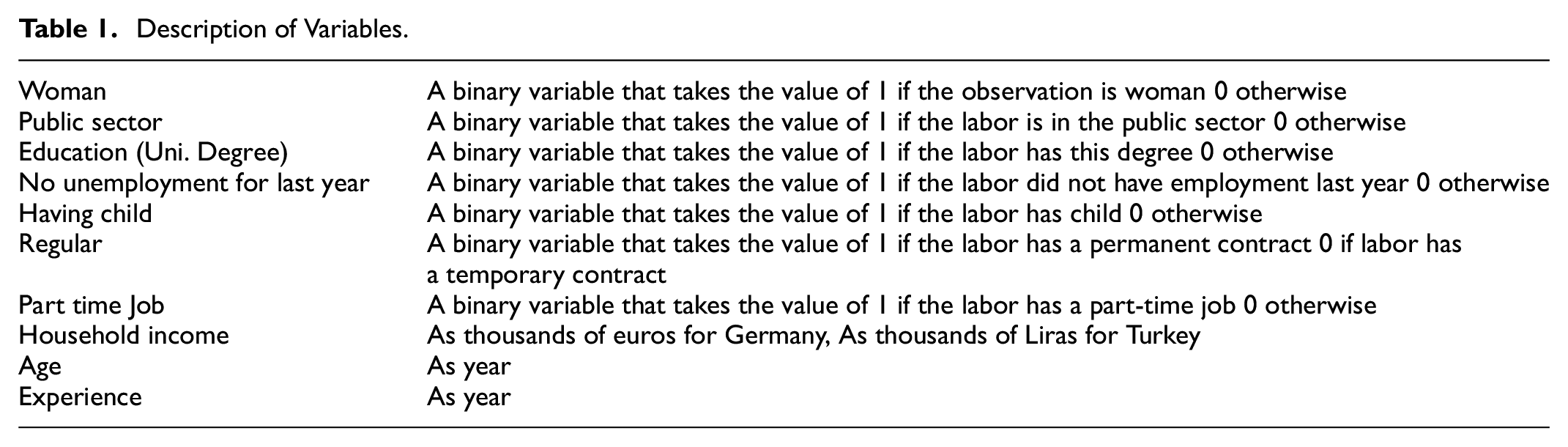
Data are obtained from the German Socio-Economic Panel (SOEP) conducted by Deutsches Institut für Wirtschaftsforschung and the Turkish Statistical Institute’s (TUIK) Household Research data and Labor Force Research data. We have used the longitudinal data for the period of 2011 to 2021 since TUIK data are limited back to 2011 although SOEP data backs to 1984. TUIK collects detailed and up-to-date information on the labor force status of the population, those in employment and those unemployed through the Household Labor Force Survey. The individuals included in the household surveys are selected using sampling techniques from the Address Based Population Registration System to represent all segments of society, and data is collected from 600,000 people. The German Socio-Economic Panel (SOEP) is a longitudinal survey of approximately 15,000 private households in the Federal Republic of Germany from 1984 to 2021 and the eastern German region from 1990 to 2021 (release 2023). Variables include household composition, employment, occupation, earnings, health, and satisfaction indicators. Sample size for Germany is 16,536 and 12,344 for Turkey. Also, some statistics are obtained from international organizations such as Eurostat. Descriptive statistics about data are presented in Table 2. We restrict the age profile of the sample to the retirement ages for countries even though many people continue to work after retirement in Turkey compared to Germany due to insufficient income and economic conditions. Since the retirement age is higher in Germany than in Turkey, German workers are older and more experienced on average. Both the full-time job rate and the unemployment rate are higher in Turkey than in Germany. University degree is lower in Turkey since there is a lower rate of school enrollment for girls. Indeed, some of the population give up continuing education to enter into the labor force because of insufficient family income. Although birth rates are risen to record levels in Germany for the recent years, it is still higher in Turkey. Public sector employment is higher in Germany with almost all of them having tenure contracts. However, more than one-third of the workers have temporary contracts and they are at high risk of losing their job.
Descriptive Statistics.

We employ the stochastic frontier methodology to calculate a frontier of earnings, incorporating an asymmetrical error element that represents wage inefficiency into the conventional earnings equation. We claim that the potential or potential wage may deviate from the actual wage, indicating that workers may not be able to convert their entire human capital into wages fully. The disparity in wages is referred to as wage inefficiency, which is incorporated into the study by introducing a unidirectional error component to the conventional earnings function, resulting in a frontier. We are concurrently estimating the factors that contribute to this wage inefficiency.
The stochastic frontier approach is a strategy that incorporates a one-sided error component to account for the potential inefficiency of an economic unit in pursuing an economic goal. The frontier technique is commonly utilized for analyzing inefficiencies in the output of enterprises. Applying this approach to the examination of wage disparities enables us to reveal the disparities between the potential and actual wages that an individual may attain, based on their investment in human capital. The earnings frontier represents the maximum possible revenue that may be achieved based on a specific amount of human capital. When a worker’s earnings are lower than their potential wage, the discrepancy in wages signifies inefficiency in converting human capital characteristics into earnings. We may examine the elements that account for these disparities between the potential and actual wage. Discrimination may be a contributing factor to the disparities in wages. Discrimination has a direct impact on the status of each person concerning the limit: individuals will obtain lesser rewards in the job market than they deserve, based on their human capital and work-related attributes. The stochastic frontier methodology enhances the accuracy of estimating the wage gap and discrimination when compared to other approaches. The stochastic frontier technique in estimating an earnings equation draws a connection between an individual’s maximum achievable income and their human capital, as well as other personal attributes, based on the theories. This approach focuses on the maximum wage rather than the average wage. Furthermore, it enables the assessment of the disparity in individual wages (the difference from the optimal level) and facilitates the examination of the factors that may account for the predicted wage inefficiency.
The Aigner et al. (1977) model is:

Where X denotes the set of inputs; β denotes the set of parameters, vit is a two-sided term representing the random error, assumed to be independent and identically distributed N(0, σ v 2); uit is a non-negative random variable indicating the inefficiency that:

The random variable θ it is distributed according to a truncated normal distribution with a mean of zero and a variance of σ2. The truncation point is Zitδ.
After calculating the random intercept for each observation, we proceed to estimate the efficiency score. The efficiency of unit i in year t may be calculated as the ratio of observed output to the maximum or potential output possible for a unit (assuming no inefficiency) is (Battese & Coelli (1995):

Where

The likelihood function is formulated in relation to variance parameters. Defining

The symbol
The earnings frontier describes the highest potential income associated with a given stock of human capital. We adopt a standard logarithmic earnings equation:

Where W is the potential or theoretical wage and X the set of human capital variables.
The translog specification is expressed as;
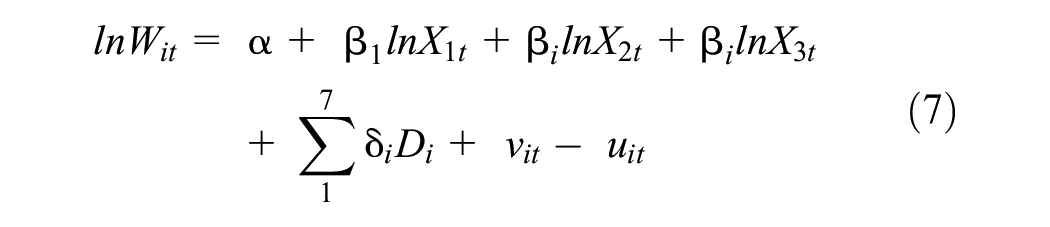
where W is the wage level, X1 is the household income, X2 is the age, X3 is the experience, Di are the categorical variables such as woman, public sector, education, no unemployment for the last year, having child, regular and part-time job.
The observed wage (W) may be reduced due to measurement errors or inefficiency in the conversion of human capital into earnings, referred to as “wage inefficiency.” When examining gender wage disparities, we take into account discrimination as a potential factor that might account for these variations in income.
By introducing a dummy variable that represents a certain set of workers into the pay equation, we acknowledge the possibility of discrimination. If this binary variable is statistically significant with a negative coefficient, we cannot exclude the possibility of discrimination.

Where Dit represents the set of gender dummy variables.
To determine the optimal specification for the production function (Cobb-Douglas or Translog) based on the provided data set, we performed hypothesis tests on the parameters of the stochastic frontier production model. These tests utilized the generalized Likelihood Ratio (LR) statistic, which is defined as:

Results
The findings of our study indicate that there exist disparities between potential and actual wages that cannot be attributed to variations in human capital investment. Furthermore, while examining the elements that may account for these disparities, we discovered a notable influence of workers’ gender in each of the nations under investigation. The data indicate that women are significantly below their potential wages compared to males with equivalent levels of human capital.
To determine the estimation of models between Log-Linear and Cobb Douglass forms, Kodde and Palm (1986) version of Likelihood Ratio test was applied. A likelihood ratio test of 48,14 was obtained with 10 restrictions, and we have selected the log-linear form according to a critical value of 17,670 for %5 level. Gamma, (γ=σu2(σu2+σv2)), which shows the ratio of the deviation from frontier caused by inefficiency, is found to be over 90% and significant in the model. This result, together with log-likelihood, suggests high goodness of fit for the model. After estimating the relationship between the wage gap and socioeconomic variables according to the above-mentioned model, the results for each country are as follows in Table 3.
Estimation Results for Germany and Turkey.

,**, and *** Represents 10%, 5%, and 1% level of significance for the variables.
Upon examining the wage equation, it becomes evident that being a female result in a decrease in wages in both nations. Due to lower promotion rates, women experience a narrower range of wages compared to males. Women earn 14% less in Germany and 22% less in Turkey than men even though they have the same level of human capital and personal characteristics as men.
Having a child and more education increases wages although they are not statistically much significant in both countries. There may be two different explanations for this. Women with lower levels of education experience limited career prospects, leading to a higher likelihood of having more children and exiting the workforce. Conversely, women with higher levels of education often postpone having children until they get a stable and well-compensated position. Workers with non-labor income have the advantage of negotiating for higher wages closer to their maximum potential since having a larger family income offers them more bargaining power and the ability to choose better employment opportunities and higher wages.
Work in the public sector increases wages. This can be the result of more flexible opportunities for temporary leave after the child. That creates stability and higher years of experience. The wage of the workers increases with their age in both countries but it is higher in Germany. This situation can be explained by the fact that only 5% of workers work for minimum wage in Germany but the majority of workers in Turkey (37%) work for minimum wage and their salaries do not increase, as they get older.
Having a full-time job (against a part-time job) increases the potential earning in both countries. Even though they are not significant, both being tenure, being older, and having more experience increase the wages in both countries but higher in Germany than in Turkey. In fact, the coefficient of being regular is significant and high for Turkey. This situation can be explained as the rights of temporary contract workers in Turkey are not legally secured sufficiently and employers abuse this and exploit workers in terms of wages.
The estimated frontier is the upper limit of the wage that an individual may achieve based on their investment in human capital (potential wage). Wage inefficiency quantifies the disparity between an individual’s potential wage and their actual wage by measuring the distance to the frontier. We have hypothesized that wage inefficiency is influenced by gender; hence, we have used a dummy variable to represent gender. The inefficiency model shows that the coefficients of the women factors are positive and statistically significant in explaining wage inefficiency in the nations under examination. A positive indication indicates an augmentation in the gap between the stochastic frontier, suggesting a greater disparity between the potential and actual wage for women. Considering the results obtained in this study, it can be argued that policymakers should conduct comprehensive and effective studies on the wage discrimination that women face in the labor market. Among these, while there may be policies to encourage women’s employment, arrangements should also be made to contribute to women’s education so that women’s wage levels can increase as a more qualified workforce. In addition, the representation rate of women in workers’ unions should be increased, and women’s awareness of wage inequality should be increased, and they should be supported on legal grounds in their struggles with employers on this issue.
Labor force participation rates of women in these countries give some clues about the policy responses. In Germany, the labor force participation rate of men is 66% and women is 56% whereas the labor force participation rate of men is 71% and women is 35%. Since Germany fulfills the conditions of being a social state much more, women can participate in the workforce more safely and benefit from the advantages and rights. However, in Turkey, women participate less in the workforce because both the working conditions and the social rights of workers are not adequately provided. This may cause some women, who are actually very talented and hardworking, to become housewives instead of working, or if they give birth to a child while working, they may not return to business life and stay at home to take care of the children. It can be concluded that companies tend to pay women less and give them fewer raises due to their motherhood situation. As a solution to this, policies can be developed regarding assistance with childcare. For example, increasing the number and quality of nurseries, and supporting grandmothers looking after their grandchildren. Germany has adopted more extensive measures to tackle the gender wage gap, such as wage transparency, generous parental leave policies, flexible work conditions, and robust social protections. These initiatives have contributed to increased female participation in the workforce and a somewhat reduced gender wage gap, though challenges still exist. On the other hand, Turkey continues to struggle with the gender wage gap due to limited wage transparency, insufficient parental leave, inadequate childcare support, and cultural obstacles. Although laws exist to prevent gender discrimination, poor enforcement and weak social support systems, combined with lower female labor force participation, hinder progress toward gender wage equality in Turkey.
Turkey’s female labor force participation is significantly lower than Germany’s. Cultural and social norms, coupled with inadequate childcare and flexible work options, often deter women from entering or remaining in the workforce. Economic factors and informal employment further lower women’s participation in the labor market. Flexible working arrangements are less prevalent in Turkey. While some companies offer part-time or flexible hours, these opportunities are not widespread, and many women find themselves in insecure, informal jobs without benefits. The absence of such flexibility makes balancing work and family responsibilities difficult, reducing women’s overall engagement in the workforce.
Germany’s unemployment benefits are generous and applied equally to both men and women, helping mitigate the financial impacts of career breaks. In contrast, Turkey’s social protection system is less comprehensive. Although benefits like maternity pay and health insurance exist, they are not as extensive, and women in informal employment are often excluded from these protections. Turkey’s unemployment benefits are less generous, and there is minimal support for women re-entering the workforce after taking career breaks.
Germany also leads in gender equality initiatives, such as mandatory gender quotas for women in senior management roles in large corporations. Labor unions in Germany actively advocate for equal pay and improved working conditions for women, contributing to greater awareness and action against wage inequality. In Turkey, however, labor unions are less powerful in promoting gender wage equality, and unionization rates are lower overall, limiting the effectiveness of collective bargaining to enhance women’s wage conditions.
Both Turkey and Germany have made efforts to improve access to education for women, but wage gap findings indicate that education alone is insufficient. In Germany, women benefit from broader access to higher education and vocational training, with social policies encouraging lifelong learning. In contrast, Turkey faces challenges with female school enrollment and dropout rates due to socioeconomic factors, particularly in rural regions. Although education levels are relatively high for women in Germany, the persistence of the gender wage gap indicates the need for policies targeting advanced career training and leadership programs. In Turkey, efforts should focus on increasing female participation in education and expanding access to vocational training, especially for women in rural areas. Additionally, initiatives could include awareness campaigns to shift cultural attitudes regarding women’s roles in the workforce and financial incentives for employers to provide equal training opportunities for women.
Germany surpasses Turkey in family-friendly policies. German women enjoy generous maternity leave (up to 14 weeks) and parental leave (up to 14 months), which can be shared with fathers. Furthermore, Germany offers substantial financial support through family benefits and childcare subsidies. The Kita system provides subsidized daycare, making it easier for mothers, in particular, to remain in or return to the workforce. By comparison, Turkey provides relatively shorter maternity leave (16 weeks: 8 weeks before birth and 8 weeks after) for mothers, fathers receive only 5 days of paternity leave, and access to affordable, high-quality childcare is limited. The lack of accessible childcare forces many women to take extended leave or withdraw from the workforce, further widening the gender wage gap. Turkey could benefit from aligning its maternity leave policies with international standards and improving access to affordable, high-quality childcare services.
Germany has already implemented wage transparency policies, requiring companies with over 200 employees to report gender-based wage statistics. While this has helped reduce the wage gap to some extent, the problem has not been entirely eliminated. Turkey does not have similar wage transparency measures, and salary data is often opaque, which perpetuates wage disparities. Introducing mandatory wage reporting based on gender for all companies, regardless of size, would be an essential step forward. Wage transparency would push companies to justify their pay structures, encouraging fairer compensation practices.
Germany also has stronger legal frameworks that support women in addressing wage discrimination through the courts or labor unions. Its anti-discrimination laws are robust, prohibiting gender-based discrimination in wages and other employment conditions, and the country adheres to EU directives on equal pay for equal work. Although Turkey has general anti-discrimination laws, weak enforcement and a lack of awareness among women about their legal rights limit their effectiveness. Germany could enhance its labor unions’ focus on advocating for gender pay equity in collective bargaining agreements. In Turkey, the lower female labor force participation and unionization rates, along with cultural norms and insufficient childcare and flexible work options, continue to discourage women from joining or staying in the workforce. Strengthening Turkey’s legal frameworks to ensure wage discrimination claims are taken seriously could be beneficial, possibly through offering free legal services to women who experience discrimination.
Family policies’ influence on long-term income trajectories is one significant institutional variation that demands more consideration. Policies like the Mütterrente (mother’s pension), which recognizes and values the time spent raising children in terms of pension benefits, are essential compensatory measures in Germany. By minimizing the lifetime earnings penalty that mothers experience as a result of taking professional pauses, these policies help to lessen gender-based differences in old age income. Long-term pay and pension disparities are made worse in Turkey, where there are no such strong systems in place to compensate for such career disruptions. It is important to recognize how such family policies work as delayed income supplements that impact gendered labor market decisions, even though the pay discrepancies evaluated in this study reflect active labor market involvement. These institutional approaches emphasize the significance of compensating for gendered life-course patterns that contribute to women’s long-term economic insecurity in addition to tackling wage inequalities during working years. Future models that incorporate these metrics could improve our comprehension of the wider socioeconomic effects of family policy regimes on gender wage disparities.
Conclusion
This paper aims to analyze the hypothesis of the wage gap for Turkey and Germany. It is searched whether the wage differentials of men and women can be attributed to the other variables or not. In other words, whether there is a wage differential between men and women only because of their genders. The stochastic frontier approach model has been used to determine this relation and results differed according to the characteristics of the countries. The results in reference to the hypothesis of this study indicate that women are significantly below their potential wages compared to males with equivalent levels of human capital. In addition, personal characteristics and human capital endowments are effective in determining wage levels.
The findings of our study indicate that there exist disparities between potential and actual wages that cannot be attributed to variations in human capital investment. Furthermore, while examining the elements that may account for these disparities, we discovered a notable influence of workers’ gender in each of the nations under investigation. The data indicate that women are significantly below their potential wages compared to males with equivalent levels of human capital. The findings of our study provide clear indications of gender-based discrimination against women. Since women tend to take more breaks in their careers and have longer periods away from work, they are perceived as a less productive group and therefore receive fewer training and promotion opportunities within the company.
Even with our greatest efforts to guarantee appropriate data and methods, certain possible restrictions may still exist. Our study may have limitations because we may have selected different factors that affect salary levels. Given that the data’s availability constrained the selection of control variables, the issue might be due to omitted-variable bias. A larger number of nations may be included in these kinds of investigations in the future. Furthermore, additional research can incorporate the use of longer time series and other statistical techniques.
The gender wage gap remains a significant challenge in both Germany and Turkey despite existing policies. The findings of the study strongly suggest that the current frameworks are inadequate, and more comprehensive measures need to be adopted to promote gender equality in the labor market. Policymakers should focus on creating more inclusive and supportive work environments by improving education, offering greater workplace flexibility, ensuring wage transparency, and providing robust legal protections for women. By addressing these systemic issues, both countries can make strides toward reducing the gender wage gap and promoting a more equitable workforce.
Footnotes

Funding
The author(s) received no financial support for the research, authorship, and/or publication of this article.
Declaration of Conflicting Interests
The author(s) declared no potential conflicts of interest with respect to the research, authorship, and/or publication of this article.
Data Availability Statement
The datasets used during the current study are available from the corresponding author on reasonable request.