




Abstract
Praise reward is a marketing strategy widely adopted by e-commerce sellers at present. However, improper praise and reward will reduce the reference value of consumers’ online comments, and even damage the good online shopping environment. Aiming at the problem of e-commerce platform, this paper constructs an evolutionary game model with merchants, consumers and e-commerce platform as the main body. Matlab software is used to simulate and depict the dynamic evolution process of merchants and consumers’ behavior decisions under the setting of reward and punishment mechanisms. The results show that the initial selection probability, the cost of favorable reward strategy and the reward and punishment of e-commerce platform can change the evolution tendency and stability of the strategy when the parameters change around the stable point; Increasing the strategic cost of merchants and consumers and optimizing the reward and punishment mechanism of e-commerce platform for merchants and consumers can effectively improve improper consumer praise behavior. The conclusion of this paper can provide decision support for the government to formulate appropriate policies, guide and promote the healthy and orderly development of e-commerce market.
Introduction
With the arrival of the digital economy, China’s online shopping market has shown explosive growth. According to the data of the 52nd Statistical Report on the Development Status of the Internet in China by China Internet Network Information Center (CNNIC), as of June 2023, the scale of online shopping users in China reached 884 million, accounting for 82% of the total number of Internet users, and the online retail sales amounted to 7.16 trillion yuan, a year-on-year growth of 13.1% (China Internet Network Information Center [CNNIC], 2023). China’s e-commerce is booming. The boom in the e-commerce market is not only seen in China, with market researcher eMarketer estimating that global e-commerce retail sales will exceed $6 trillion by 2023 (Lebow, 2021).
As online shopping is not limited by time, space and geography, consumers around the world can purchase products or services from e-commerce platforms (e.g., Amazon, eBay, Walmart, and Taobao) at any time and in any country. However, due to the virtual nature of e-commerce platforms, consumers are unable to experience the look and feel of the products they intend to buy compared to offline shopping. This leads to a greater degree of uncertainty about the appearance and texture of products, which affects consumers’ purchasing decisions (Senecal & Nantel, 2004). Therefore, in the e-commerce environment, consumers are more inclined to refer to online user reviews to identify product performance, match consumption needs and communicate product or service details to reduce shopping risks and uncertainties and help them make correct consumption decisions. Many existing studies suggest that the important influence of online reviews on e-commerce platforms on consumers’ purchasing decisions is due to the fact that consumers perceive information from online reviews provided by other buyers who have already made a purchase as an indicator or signal of the quality of a product or service (Forman et al., 2008; Shi et al., 2016). For example, data from Jupiter Research suggests that more than 75% of consumers learn about online reviews from other consumers who have purchased the product before making an online purchase, and more than 90% of large companies believe that user reviews and testimonials play an important role in influencing consumers’ purchase intentions (Yin, 2012). In the film industry, a film’s online review score across film and television platforms is considered to be a signal of the quality of the on-demand release, significantly influencing the film’s subsequent performance at the box office after its release (Fan et al., 2021). In the restaurant industry, each additional star in a restaurant’s online review rating on takeaway e-commerce platforms increases revenue by an additional 5% to 9% (Luca & Zervas, 2016). The above surveys and studies show that with the rapid development of global e-commerce, online review information on e-commerce platforms has become an important reference for consumers’ online shopping decisions and also has a very important impact on the economic benefits of e-commerce platform merchants.
Evolutionary game theory represents a significant analytical instrument for the examination of regulatory strategies. The fundamental premise of conventional game theory is the supposition that the subjects are wholly rational and possess the capacity to make fully informed decisions. Nevertheless, this is an exceptionally challenging objective to attain when dealing with actual participants in the real world. The concept of evolutionary games offers a novel perspective on the classical analysis of games. In contrast to the direct computation of game properties, evolutionary games employ alternative player population modeling strategies. These strategies employ a process analogous to natural selection to determine the evolutionary trajectory of the population. The theory of evolutionary games is capable of explaining the complexity required to represent groups with different strategies in multi-agent games (Hofbauer & Sigmund, 1998; Samuelson, 1997). The model provides a robust analytical framework for studying positive feedback behavioral mechanisms based on the regulation of e-commerce platforms. In the model, subjects engaging in specific behaviors are categorized as finite rationality (Simon, 2013).Firstly, the payment function is transformed into a fitness function under a selection and variation mechanism. Secondly, the replicated dynamic equations are computed using the evolutionary game payment matrix. Subsequently, the solutions are evaluated for their alignment with the stabilization strategy. This process enables participating subjects to enhance their finite rationality through continuous learning and timely adjustment of their strategies, thereby achieving individual (type or strategy) fitness (Mu et al., 2023; Ma et al., 2023). It is therefore necessary to introduce the concept of evolutionary games into the regulation of rewarding behaviors for positive online reviews on e-commerce platforms.
Here we can get the motivation of this paper:
The evolutionary game model is an effective tool for analyzing the multi-party regulation problem of rewarding behaviors for positive online reviews on e-commerce platforms.
The evolutionary game model can better examine the strategic choices of different participating subjects from a global perspective.
The contribution of this article is mainly reflected in the following aspects. First, as far as we know, we have not directly modeled the evolutionary game of the impact of similar incentive behavior on consumer evaluation by merchants under the supervision of e-commerce platforms. This paper is one of the few to explore the mechanisms underlying the impact of similar incentives on consumer evaluation. Secondly, although some scholars have set up game models to analyze the evolution of reward strategies between e-commerce platforms and consumers, the models only consider reward models, and this paper further considers the regulation and reward and their rewarding and punishing mechanisms of e-commerce platforms, expanding and supplementing relevant research. Third, this paper also adds the factor of the loss caused to merchants by consumers giving false reviews in product message discussion forums and other channels to the game model for in-depth analysis, which makes the research more realistic.
This paper is structured as follows: the initial section presents the introduction, which outlines the research question addressed in this paper. The second part comprises a review of the relevant literature, which describes the research direction and related theories. The third section presents the pertinent assumptions and constructs an evolutionary game model for e-commerce platforms. The fourth section comprises an analysis of evolutionary game behavior and the identification of equilibrium points. The fifth section of the paper presents a simulation of the proposed model, with a view to verifying the influence of different parameters on the behavioral strategy choice of liking rewards. The sixth part presents a summary of the conclusions of this paper and offers targeted suggestions for future research.
Literature Review
Online Review
Online Review, also known as online user review, is one of the most important forms of online word-of-mouth communication, which is a text-based evaluation of a product or service, and is the information submitted by consumers through the Internet to comment on a product or service (Hennig-Thurau et al., 2004). Current research on online reviews focuses on three aspects: first, online reviews and sales, mainly by exploring the influence mechanism between online reviews and sales, and then analyzing the impact on sales revenue (Dellarocas et al., 2007; Y. Liu et al., 2017); second, online reviews and brand loyalty, where positive online reviews help to increase customers’ brand loyalty (Alsaraireh et al., 2022; Bowman & Narayandas, 2001; Chakraborty & Bhat, 2018); whereas negative online reviews have a significant negative effect on consumer brand loyalty (Chakraborty, 2019; Ho-Dac et al., 2013); and thirdly, the impact of online reviews on consumer behavior, for example, Patil and Rane (2023) revealed the impact of online reviews on consumers’ decision to choose a restaurant through a qualitative study of customer reviews on Zomato platform and quantitative analysis of questionnaire data, which will help restaurants to understand the important role of online reviews on consumers’ purchasing behavior. Dellarocas (2003) questioned the authenticity and validity of online reviews and investigated the relationship between the content of reviews on consumers’ access to information about products and services. Rohmatulloh and Sari (2021) further explored the significant impact of online customer reviews on customer satisfaction and their evaluative behavior. Park et al. (2021) put the the impact of online reviews on consumer behavior and purchase intention to a merchant’s incentive scheme.
Based on the influence mechanism of online reviews on products and consumer behavior, a large number of merchants use online reviews to promote product sales, especially the marketing strategy of new products, and pay more and more attention to high-quality online reviews, which has gradually given rise to the positive feedback rewards as a representative of the online marketing methods. Reward for good reviews is an act in which a platform operator requests consumers to give good reviews to its goods or services, and at the same time promises to give consumers a certain form of material or cash compensation. Since positive feedback reward behavior occurs mostly in the reputation evaluation system of Chinese e-commerce platforms, and the reviews induced by this behavior are hidden and complex, some scholars have conducted research on positive feedback reward behavior on e-commerce platforms (Cao et al., 2011; Jin et al., 2021; Román et al., 2023; Ye et al., 2018; Zaman et al., 2023; Zeng et al., 2018; Zou, 2022).
Evolutionary Games
Evolutionary game theory combines the concepts of biology, evolution, nonlinear dynamics, and game theory, and has developed into a very active research field. The theory overcomes the limitations of classical game theory of complete rationality and static analysis, and proposes an important mechanism for evolutionary analysis of games, that is, evolutionary stable equilibrium (strategy), which is able to well analyze the changes in decision-making among different participating subjects, and is now widely used in the study of dynamic relationships in the fields of multi-subject cooperation, business and public management. A part of scholars use evolutionary games to study the online review behaviors of merchants and consumers on e-commerce platforms as well as the regulation of review information. Sun et al. (2021) established a two-party evolutionary game model to study how online reviews affect the decision-making of two competing online sellers. Hu et al. (2018) further introduced the prospect theory and the risk perception factor in the evolutionary game model to analyze the the impact of different parameters such as simulated returns and value perception on the strategic choices of the game parties under different stability conditions on the evolutionary outcome, and purposefully put forward an optimization mechanism for governing online reviews. Guo et al. (2021) constructed an evolutionary game model between merchants, e-commerce platforms, and consumers, and conducted a study on the regulatory mechanism for selling fake goods. e-commerce platform credit regulation mechanism. W. Liu et al. (2023) proposed a mathematical framework for review sentiment analysis based on evolutionary game theory, which created a new paradigm for the application of game theory models in various NLP sentiment analyses. Peng and Wu (2011) integrated the parameters of product quality, consumers’ psychological expectations, and rewards, and added a platform regulation and government punishment mechanism to study the They investigated the effects of two types of positive feedback rewards based on cash rewards and coupon rewards on consumers’ willingness to recommend. Therefore, the evolutionary game model can analyze the decision-making behavioral paths of each participant in the process of rewarding positive feedback.
Model Hypothesis and Construction
Model Hypothesis
The mechanism by which merchants’ implementation of positive feedback reward strategies under the regulation of e-commerce platforms influences consumers to conduct online reviews can be viewed as a game of whether merchants give positive feedback rewards and whether consumers give positive feedback. It mainly includes two important parties: e-commerce platforms, platform merchants, and consumers. Both merchants and consumers have different strategic choices in the game process, and the final results of the game will be different if both sides adopt different strategies. When the merchants give positive feedback rewards, some consumers who are greedy for small bargains as online reviewers, out of their respective interests, there will be false positive feedback and low-quality evaluation information, at the same time, the platform’s regulatory penalties will also affect the decision-making of the agency. As a result, an evolutionary game model can be constructed under the regulation of off e-commerce platforms with merchants and consumers as the main subjects, focusing on the strategic evolution process and stable equilibrium point of the two regarding the rewards for good reviews. Based on this realistic scenario, the following assumptions are made:
Based on the above assumptions, the parameters and their meanings shown below are sorted out, see Table 1 for details.
The Definitions of Parameters.

Model Construction
Based on the above hypotheses, the mixed-strategy game matrix of platform merchants and consumers under the regulation of e-commerce platforms is constructed in Table 2.
Payment Matrix of Merchants and Consumers.

Analysis of Model
Replicator Dynamic Equations for Merchants and Consumers
In order to study the strategic choice of business praise reward and consumer evaluation under the supervision of e-commerce platform, according to payment matrix Table 2 between enterprises and consumers, and drawing on the replication dynamic mechanism of evolutionary game theory, the following inferences are drawn:
The expected income

The expected income

According to the above expressions of

Similarly, the expected benefits that can be praised by consumers are:

The expected benefits of consumers’ negative comments are:

To sum up, the comprehensive expected income of consumers under the above two strategies is:

According to the replication dynamic formula of evolutionary game (Ji et al., 2015; J. M. Li & Jiang, 2023; G. Q. Li & Tao, 2018; Traulsen & Glynatsi, 2023) we can get the replicator dynamic equation of businesses and consumers:


According to Formula (7) and (8), we can build a set of replication dynamic equations about businesses and consumers to form a two-dimensional dynamic system W, as shown in Formula (9):

Therefore, under the supervision of e-commerce platform, the relationship between business praise strategy and consumer evaluation can be described by the power system W. Next, we will study the dynamic process of strategic choice of participating subject through W to explore the evolution path and law of participating subject.
Stability Analysis of Equilibrium Points of Evolutionary Game Systems
In order to facilitate the analysis, let
According to Friedman’s calculation of the group dynamics of a dynamic system composed of differential equations (Friedman, 1991), the stability analysis of its equilibrium points can be obtained by analyzing the local stability analysis of the Jacobian matrix of the differential dynamic system (An et al., 2021; Ma et al., 2023; Su et al., 2021). Thus, the Jacobian matrix of the system W can be calculated to get the Equation 10:
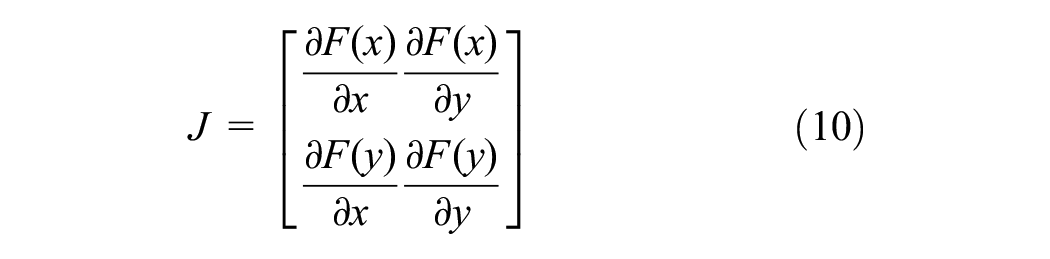
Among them:

For the differential dynamic system W, the change of initial values
In order to further study the evolution path of the reward strategy business praise and consumers under the supervision of e-commerce platforms the stability of equilibrium point of differential equations will be determined according to the stability criterion of the second order equations. If determinant (DetJ) and trace (TrJ) of Jacobian matrix at an equilibrium point meet the following conditions:
(1) Determinant DetJ > 0, that is
(2) TrJ < 0, that is,
Then it can be determined that the point is in a locally asymptotically stable state, which is the evolutionary equilibrium strategy of the system. Substitute the five balance points into formula (10), and calculate DetJ and TrJ at each point to obtain the determinant and trace of the Jacobian matrix at the system balance point as shown in Table 3.
Jacobian Matrix Expression Corresponding to Each Equilibrium Solution.

Set
(1) When
(2) When
(3) When
(4) When
Stability Analysis of System Strategy
In accordance with Proposition 4, it can be demonstrated that the e-commerce platform allows for a maximum of two evolutionary stable strategies, namely the merchant’s liking reward strategy and the consumer’s review strategy selection. These are (0,0) and (0,0) and (1,1), respectively. The evolutionary phase diagrams of the stable strategies of the system under different conditions are presented in Figure 1a and b.

Phase diagram of the evolutionary stable equilibrium strategy of the system: (a) evolutionary stability strategies (0,0) and (b) evolutionary stability strategies (0,0) and (1,1).
According to the phase diagram of system evolution shown in Figure 1a and b and the evolutionary game model between the above businesses and consumers, the following analysis results can be obtained:
Firstly, when
Secondly, when
Thirdly, when
Based on the situation in Figure 1a and b and the above analysis, it can be seen that the evolution of the system to the equilibrium state is affected by the payment matrix and the position of the initial point of the system. When the degree of consumers’ willingness to give favorable comments lies in the quadrilateral region

According to formula (11),


This shows that when the


This shows that when consumers pay more


This shows that


This shows that π,

This shows that
Experiment Simulation
In order to directly observe the impact of merchants’ positive rewards on consumer reviews, and more clearly show the evolutionary trajectory of the game between the subjects and the degree of influence of the parameters. This paper uses Matlab on the evolution stability strategy and experiment. The equilibrium is a suitable strategy choice when looking at the whole process of rewarding behavior for good reviews on the entire e-commerce platform, rather than the equilibrium of (1,1) as in Ma et al. (2023), which is the equilibrium for the regulation of Internet finance. Focusing on the sensitivity of the parameter A related to the hypothesis under the equilibrium point (0,0) strategy is analyzed. In this section, with reference to the data settings of relevant papers (Ma et al., 2023; Mu et al., 2023; Su et al., 2021) and combined with the statistics of relevant e-commerce platforms, the initial values of the parameters in the system when evolutionary stability cannot be achieved are assumed as follows: set the simulation period at 150. The default values are:
The Analysis of the Impact of Willingness to Reward Favorably on System Evolution
Under the supervision of the e-commerce platform and with other parameters unchanged, the influence of merchants’ initial willingness
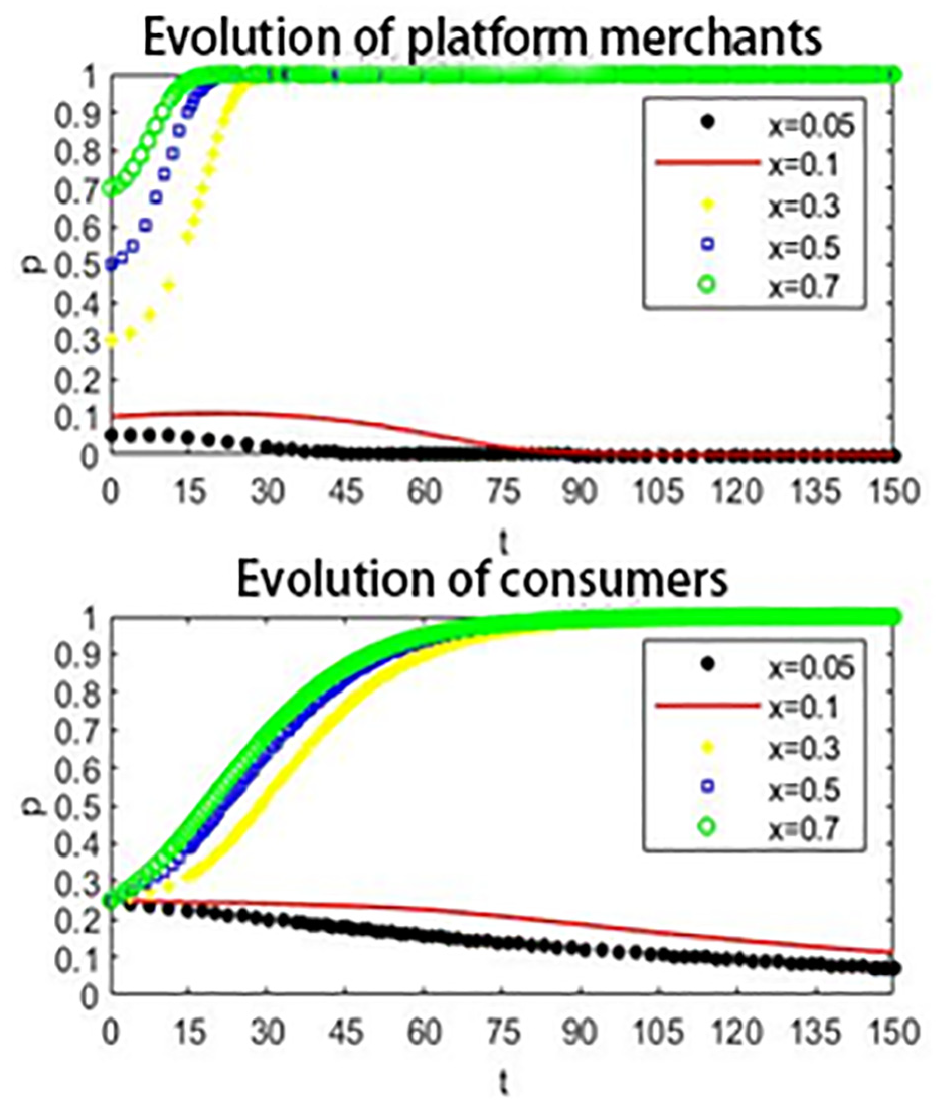
Impact of praise reward intention of e-commerce platform on system evolution.
As can be seen from Figure 2, when willing of the e-commerce platform to implement the praise reward referred by
The Analysis of the Impact of Regulatory Probabilities, Rewards and Penalties on System Evolution
Keeping other parameters of the system unchanged, we adjusted the probability π of successful discovery of merchants’ praise reward by e-commerce platform supervision respectively, and obtained the simulation results as shown in Figure 3 for changes in reward

Regulatory probability, reward, and punishment influence of evolution.
According to Figure 3, as the probability of merchants’ favorable reward behavior is gradually increased, the direction of system evolution is also changed, and the stable strategy of system evolution tends to the point (0,0), that is, the {no favorable reward, give bad review} strategy. At the same time, with the gradual increase of the amount of government reward and punishment, the proportion of merchants who choose to evolve to (0,0) in the market increases. This is consistent with the conclusion of Proposition 8. In addition, it can be seen from Figure 3 that the variable π has a relatively obvious threshold effect, that is, when
The Analysis of the Impact of Changes in Losses and Gains on the Evolution of the System
As can be seen from Figure 4, as the losses

The impact of changes in losses and returns on system evolution.
The Analysis of the Impact of Changes in Additional Merchant Revenue on the Evolution of the System
Figure 5 shows that the merchants praise through reward strategies for extra income

Simulation of the influence of merchant income change on system evolution.
Conclusions and Recommendations
Conclusions
In this paper, starting from the behavior of positive praise reward, we constructed the e-commerce platform merchants as well as consumers involved in the e-commerce platform positive praise reward subject game model, applied the evolutionary game method to analyze the dynamic change process of the two sides’ strategy selection of positive praise reward, and used MATLAB software to assign values to each parameter and carried out numerical simulation. The evolution path of the game system was further studied, and the evolution law of the positive praise reward on e-commerce platform was explored, revealing its evolution mechanism. The following conclusions are mainly obtained:
First, the impact of e-commerce platform merchants’ praise reward behavior on consumer evaluation has two stable equilibrium points, namely {praise reward, positive reviews} and {no praise reward, negative reviews}. For consumers, when the cost of giving good reviews is more than the income, consumers tend to give bad reviews; For businesses, when the benefits brought by their praise reward behavior are less than their investment and losses, they will eventually tend to adopt the strategy of non praise reward.
Secondly, the strategic choice of e-commerce platform merchants and consumers and the evolution of the whole system are closely related to the initial state of both parties and the relevant parameters of the game payment matrix. To be specific, when the degree of supervision of e-commerce platform over praise reward behavior exceeds a specific threshold, the proportion of consumers participating in praise reward will be reduced, otherwise the proportion will gradually increase; The investment cost of praise and reward for merchants, the loss caused by consumers’ bad comments on merchants, and the increase of rewards and punishments for e-commerce platform supervision have a restraining effect on consumers’ false praise; The increase of the praise reward given to consumers and the additional income from the praise reward will promote the praise of consumers.
In summary, increasing the strategy cost of merchants and consumers and optimizing the reward and punishment mechanism of e-commerce platforms for merchants and consumers can effectively improve the improper consumer praise behavior and further promote the improvement of the relevant credit evaluation system of e-commerce platforms. Firstly, an evolutionary game model with merchants, consumers and e-commerce platforms as the main body is constructed based on the evolutionary game theory; secondly, stability analysis is carried out by using the evolutionary equilibrium point; finally, the dynamic evolution process of merchants’ and consumers’ behavioral decision-making under the setting of rewards and punishments mechanism is simulated by using the MATLAB software and the evolution mechanism is analyzed specifically in light of the real situation. In future research, the proposed model can also be applied to other fields and environments of the strategy selection game.
Recommendations
Based on the above analysis conclusions and the characteristics of e-commerce platform, the following suggestions are put forward:
First, improve the strategic cost of praise awards and reduce the strategic benefits of praise awards. The first is to strengthen the publicity and education of integrity, create an atmosphere of public opinion conducive to the concept of integrity, increase the cost of dishonesty of stakeholders, make them pay a certain moral cost, economic cost and legal cost for dishonesty, guide e-commerce platform merchants to compete with peers by proper means, and improve the authenticity of consumer comments; Secondly, the government and the platform, as participants and regulators, should formulate specific reward and punishment measures, such as setting different levels of punishment measures for the amount of praise awards, etc., to guide businesses and consumers to face up to the negative impact of online reviews on e-commerce platforms, reduce consumers’ false good reviews, and at the same time support those honest businesses who dare to let consumers objectively evaluate, so as to achieve the goal of cracking down on bad businesses that rely on praise, reward and drainage, The purpose of purifying the shopping environment of e-commerce platform.
Secondly, in order for e-commerce platforms and consumers to lose more than a certain threshold when choosing to praise reward behavior, the government and e-commerce platforms should further strengthen the regulation of praise reward behavior. First of all, with the help of new generation information technology, such as big data, cloud computing and other technical means, through comprehensive analysis of evaluation time, evaluation language and other elements, data analysis is carried out to find out the distorted evaluation content and delete it; Secondly, it should be linked in many ways. For example, be sure to connect with regulators, hand over problem leads to regulators in a timely manner, and make regulators pay a legal price. Finally, we should perfect relevant laws and regulations, improve the operability of the regulations, and realize the precise punishment of the relevant enterprises.
Thirdly, for e-commerce platform, it is necessary to revise and upgrade the existing credit evaluation mechanism. E-commerce platforms can reduce the proportion of consumers participating in disinformation campaigns by providing such services as reporting and complaints to consumers and businesses, establish consumer protection mechanism for e-commerce platforms, reduce the misleading impact of disinformation campaigns on consumers and improve consumers’ purchasing experience. Thus purifies the online shopping commodity evaluation system, effectively protects the consumer’s right to know and to trade fairly, and creates a fair, healthy and healthy e-commerce ecology.
Limitations and Future Work
The game model established in this paper and the conclusions of the study can effectively explain the status quo of the rewarding behavior of good reviews on the e-commerce platform, and provide a theoretical basis and decision-making basis for the government to formulate policies to guide the benign development of the market. However, the paper does not consider more game subjects and so on within the model, while the collection of relevant data is also very conducive to further research. Therefore, this is a further research direction of this paper, and in the subsequent research, these factors can be included in the model to further study their impact on the evolution of the favorable reward game system.
