




Abstract
Artificial intelligence plays an important role in higher education, helping to manage centres and students’ educational pathways, and acting as a valuable tool for both professors and scholars. However, its use in education is still at an early stage of development. Despite the notable increase in the number of publications and the growing interest in this area, there is a need to understand the rapid evolution of this domain. Hence, to fill this gap in the literature, this article employs a bibliometric approach based on co-occurrence analysis to identify what existing research and to understand current trends and emerging topics in the field of AI and higher education. To conduct this study, VOSviewer and SciMat softwares were used to analyse 181 papers retrieved from Web of Sciences and Scopus databases. Findings reveal that the conceptual structure consist of the impacts of AI on academic performance, particularly in relation to the use of chatbots such as ChatGPT and its multiple uses. To encompass the focus on students’ engagement and the potential for AI to enhance their self-regulated learning and active learning. Furthermore, aspects such as the integration of machine learning and robotics in higher education and student feedback are also considered. The emerging themes were found to be highly related to engagement strategies for the implementation of these technologies. Additionally, this paper provides future research avenues according to the results obtained, which could support scholars for the development of future studies, highlighting the lack of papers focussed on management and business issues in the implementation of AI tools and the need for personalisation. The training required to use these tools properly and the impact on students’ academic performance to monitor success are among the most outstanding practical implications of this study.
Introduction
Artificial Intelligence (AI) is currently becoming one of the most influential emerging technologies. These technologies are increasingly prevalent in different fields and sectors and used by a variety of companies (Dwivedi et al., 2021). AI has gained popularity in recent years, particularly among younger generations who have discovered a simpler way to manage information. This has sparked the need to understand current and previous studies, as well as the global trends in the research of these new technologies (Essel et al., 2022). Regarding education, it has been observed that more and more students and lecturers are taking advantage of these new tools, including Generative Artificial Intelligence (GenAI), to create presentations and assignments. GenAI is a type of AI technology that can generate data, such as text, code, simulations, photos, 3D objects, and videos in response to a human-provided prompt, making them look intelligent (Peres et al., 2023). Tools such as the ChatGPT are valuable resources to generate text and natural language processing, and Dall-e for creating images.
Covid-19 pandemic demonstrated the need for tools and methodologies that would facilitate the coexistence of face-to-face and online education. This transition was imperative for institutions to continue providing education during this unprecedented period and to ensure the safety of students and staff. However, this shift presented a set of challenges and limitations that must be addressed for distance learning to be as effective as in-person instruction. Certain limitations were identified in higher education from the perspective of teaching staff. For instance, insufficient space at home, the lack of necessary tools and technical support (Mukhtar et al., 2020). Management challenges encountered throughout those months made it very challenging for them to complete essential tasks, such as evaluating students accurately and practising time management. These limitations have resulted in lower performance levels among university and higher education centre staff (Castillo-Olivares & Castillo-Olivares, 2021). Thus, the new social and technological context in which education in general and higher education in particular is developing requires changes to support the academic management of lecturers and students, as well as to support the management of educational institutions (Ratten, 2023). Following the pandemic, there has been a significant increase in articles, methodologies and the development of new technologies, including student tracking programmes, MOOCs (Massive Open Online Couses), and the initial implementations of AI have been introduced (D. T. Ng et al., 2023; D. T. K. Ng et al., 2023).
This bibliometric article seeks to investigate what has been previously done in the field of AI in higher education. There are previous bibliometric analyses about this research domain. Hinojo-Lucena et al. (2019) studied the impact that AI has on higher education, following a descriptive analysis of the scientific publications between years 2007 to 2017. Whilst Lutfiani et al. (2023) provides suggestions of AI for e-learning. Some bibliometric studies are focussed on a particular area, for instance, Hwang and Tu (2021) which targets Mathematics education to personalise and to improve student performance. With regard to e-learning, it is highlighted its use during the pandemic (2020–2021) and the appearance of AI as a research trend topic in the bibliometric analysis performed by Brika et al. (2022). In the same vein, D. T. Ng et al. (2023) and D. T. K. Ng et al. (2023) conducted a bibliometric analysis about the management of the online learning and the role of AI to gather information and to make more effective decisions during the Covid-19 pandemic. Talan (2021) examines AI in education conducting an analysis of the literature between 2001 and 2021 using WoS, emphasising on the co-authorship structure and co-word network. Thereby, considering the high number of papers published in recent years, it is necessary to update the scientific literature on the application of AI in higher education to identify emerging trends. In comparison with previous research, our paper makes a significant contribution to the advancement of research, as, to the authors’ knowledge, this is the first bibliometric study in addressing this topic from a holistic approach. The present paper seeks to continue evaluating the evolution of this field, with special focus on years 2022 to 2023 due to its strong progress during this period. Although some studies explaining consequences of the use of AI for education purposes have been published mainly in the last year, there is a lack of analyses oriented to provide a general vision of what has been done and needs to be done and identify opportunities of research and transfer of knowledge in this field. Moreover, this study provides valuable information for further research in the field suggesting future research avenues focussed on the gaps identified related to challenges of AI, its management and opportunities for higher education institutions. Hence, we postulate the following research questions:
(RQ1) Which journals and authors have published in this domain?
(RQ2) What are the emerging research trends related to AI and higher education?
(RQ3) How is the evolution of this research field?
(RQ4) What are the possibilities for future research on the application of AI in higher education?
This article is structured as follows. After the Introduction section, a literature review is presented regarding the application of AI in higher education. Therefore, the methodology process, data collection and bibliometric analysis, is displayed. Results based on the thematic structure (developed by co-occurrence analysis, VOSviewer, and SciMat) are presented and discussed. The following section is focussed on the gaps detected and the future research avenues according to the opportunities identified. Ultimately, conclusions within theoretical and practical implications as well as the main limitations of this study are provided.
Literature Review
During the 1950s, the initial concepts associated with AI emerged. In 1955, the term AI was coined by the computer scientists (McCarty et al., 2006; Salas-Pilco & Yang, 2022) AI is defined as ‘computing systems that are able to engage in human-like processes such as learning, adapting, synthesising, self-correction and use of data for complex processing tasks’ (Popenici & Kerr, 2017, p. 2). As stated in other sources, AI refers to the ability of machines to adjust to new and emerging situations, solve problems, answer questions, devise plans, and perform other functions that often require human-like intelligence (Suh & Ahn, 2022). In the field of education, AI has been evolving as described by Guan et al. (2020). The first AI appeared in 1987 as intelligent tutoring systems. These systems solve problems presented by the user in a human-like way by reasoning about their process and solution. In 2003, AI was summarised within the educational context as an intelligent tutoring system designed to organise system knowledge and information, improve user performance, and create progression within exercises while correcting the student’s session. In 2009, AI continued to be seen in the educational world as artificially intelligent tutors, providing real-time feedback using their analytical skills on students and their understanding of the problem posed. In 2020, AI is defined as computer systems capable of engaging in human-like processes such as adaptation, learning, synthesis, self-correction and the use of various data required for complex processing tasks. Encompassing many more learning situations, and also administrative tasks within the educational community. In recent years, along with the definition of generative AI, new approaches have emerged, including Generative Pre-trained Transformers (GPT). GPT is a type of generative AI model that uses deep learning techniques to generate natural language text (Chan, 2023).
AI and its application in higher education has been explored from a pedagogical approach, for instance, considering the role of educators to take advantage of it during years 2007 and 2018 (Zawacki-Richter et al., 2019), highlighting that beyond these aspects, further research is needed on ethical issues. AI plays a key part on online learning in terms of assessment and student performance as well as recommendations, participation, engagement and satisfaction (Ouyang et al., 2022). Regarding management theories linked to behaviours and technology acceptance, Theory of Planned Behaviour (TPB) points out that users’ behavioural intention is influenced by the attitude of the user (Ajzen, 1991). Whilst Technology Acceptance Model (TAM) argues that perceptions of usefulness and ease of use are key to the acceptance and loyalty of new technologies (Davis, 1989; Sciarelli et al., 2022). Venkatesh et al. (2003) highlights The Unified Theory of Acceptance and Use of Technology (UTAUT) model for interpreting users’ intentions to adapt to new technologies such as AI.
There is empirical evidence on the support and challenges of AI adoption, for example, in Indian higher education (Chatterjee & Bhattacharjee, 2020). However, it is since 2022 that AI has revolutionised higher education with OpenAI chatbots such as ChatGPT. Malinka et al. (2023) focuses on its application benefits as well as challenges in computer sciences. With regard to management educators, ChatGPT points to the importance of applying policy and incorporating OpenAI into learning practices and curriculum design (Ratten & Jones, 2023). The significant growth of AI research in education requires a reflection and analysis of the state of the art, considering which fields might represent hotspots (Dwivedi et al., 2021). It is necessary to know whether all possible applications and areas of knowledge are being covered. Hence, it should be considered and investigated from a multidisciplinary perspective. Therefore, gaps and future lines of research can be identified.
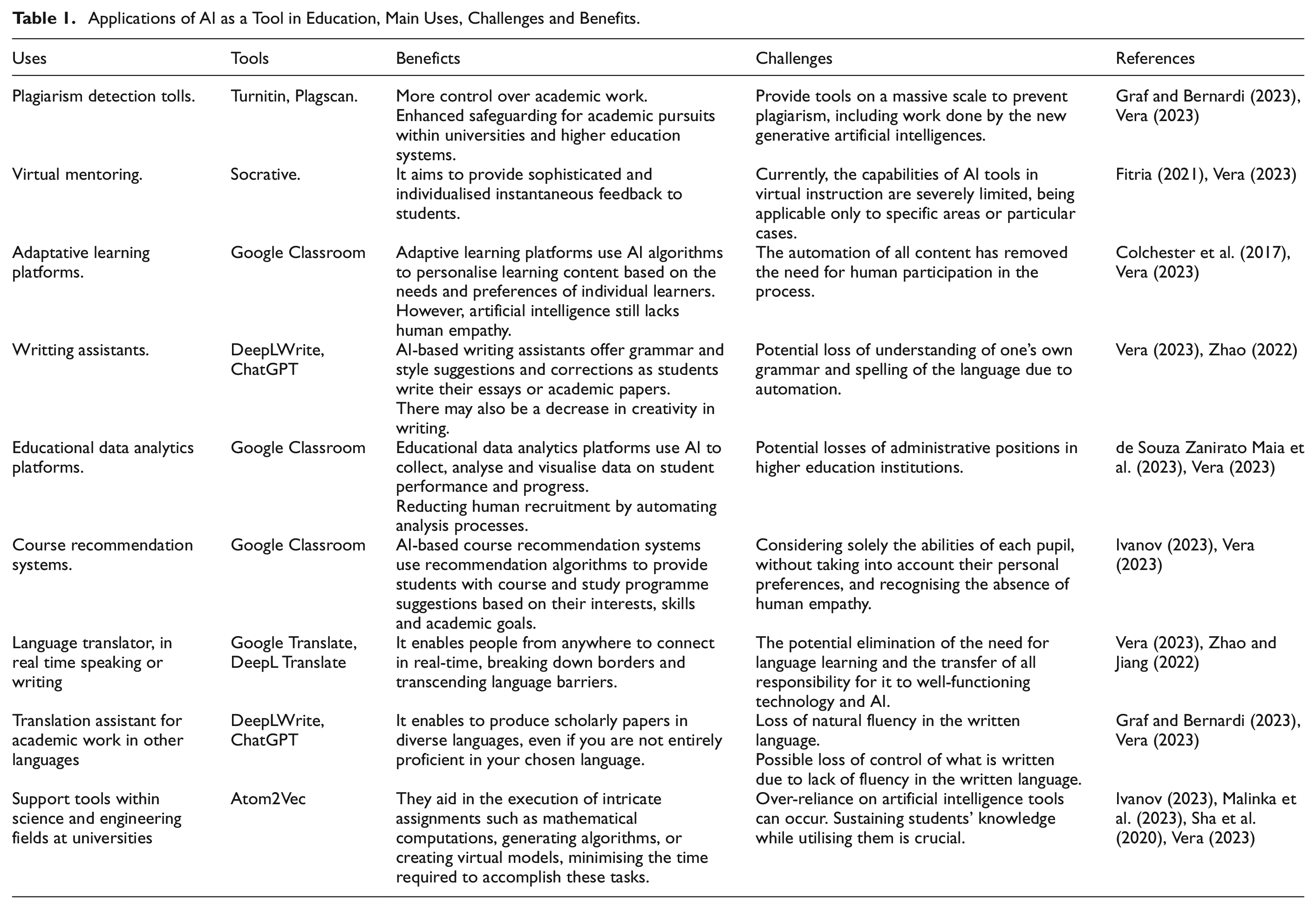
AI presents various opportunities, challenges and possibilities in the higher education and for the academic management sphere. At the administrative level, there are various valuable functionalities available, including the personalisation and automation of learning, the enhancement of the efficiency and effectiveness of the educational process, the availability of advanced learning resources, and the improvement of retention and completion rates of educational programmes (See Table 1) (Vera, 2023). Supporting to virtual mentoring, adaptative learning platforms, plagiarism detection tools (such as Turnitin and Plagscan), writing assistants (e.g., Grammarly and Deepl), educational data analytics platforms (e.g., Google Classroom) and course recommendation systems. However, it should not be overlooked that, in addition to its potential as a technology, it needs to be developed within a social and legal framework (Perc et al., 2019).
Applications of AI as a Tool in Education, Main Uses, Challenges and Benefits.
Methodology
To address the research questions (RQs) presented and the aim of this study, to gain insight into the conceptual/thematic structure of this research domain in light of the gaps identified in the existing literature, a bibliometric approach was employed. This section will first explain the methodology used for data collection and then proceed to present the results of the co-occurrence analysis conducted by VOSviewer and SciMat software.
Data Collection
This research was carried out using two databases, the Web of Science (WoS) and Scopus, which are widely used for bibliometric analysis due to their accessibility and availability of bibliographic data (Pranckutė, 2021). Considering previous research (D. T. Ng et al., 2023; D. T. K. Ng et al., 2023; Song & Wang, 2020), the search criteria includes the following terms: (‘Artificial Intelligence’ OR ‘AI’ OR ‘Machine Learning’ OR ‘ML’ OR ‘Deep Learning’ OR ‘Robotics’ OR ‘Neural Networks’ OR ‘Data Learning’ OR ‘Expert Systems’ OR ‘Intelligence Interfaces’) AND (‘Higher education’ OR ‘University’ OR ‘college’) sorted by Social Sciences Citation Index. The search included title, abstract, and author keywords. Only articles in English were considered, covering the period from 1989, when the first article was published by Stratil et al. (1989), up to September 2023. The initial search yielded 34,430 documents, which were then refined to only include articles published in educational journals, resulting in 268 documents. The same query in Scopus, using the same set of filters, resulted in a sample of 207 articles, of which 37 were not present in the WoS sample.
Firstly, the relevant papers were identified by two authors through a double-check process, considering only those articles where AI is not the main theme under study. Some of the papers discarded mention AI but not as a main theme. This reduced the sample to 153 from WoS and 28 from Scopus. Then 181 articles from both databases were considered, thereby discarding a total of 119 papers. Secondly, the two databases were combined using the BibExcel tool. Thirdly, a thesaurus is created to detect inconsistencies and duplicates, for example, neural-networks and neural network, to visualise the results using VOSviewer. In addition, a manual check was developed to eliminate inconsistencies for the analysis conducted by SciMat. Figure 1 illustrates the data collection process (inclusion and exclusion criteria).
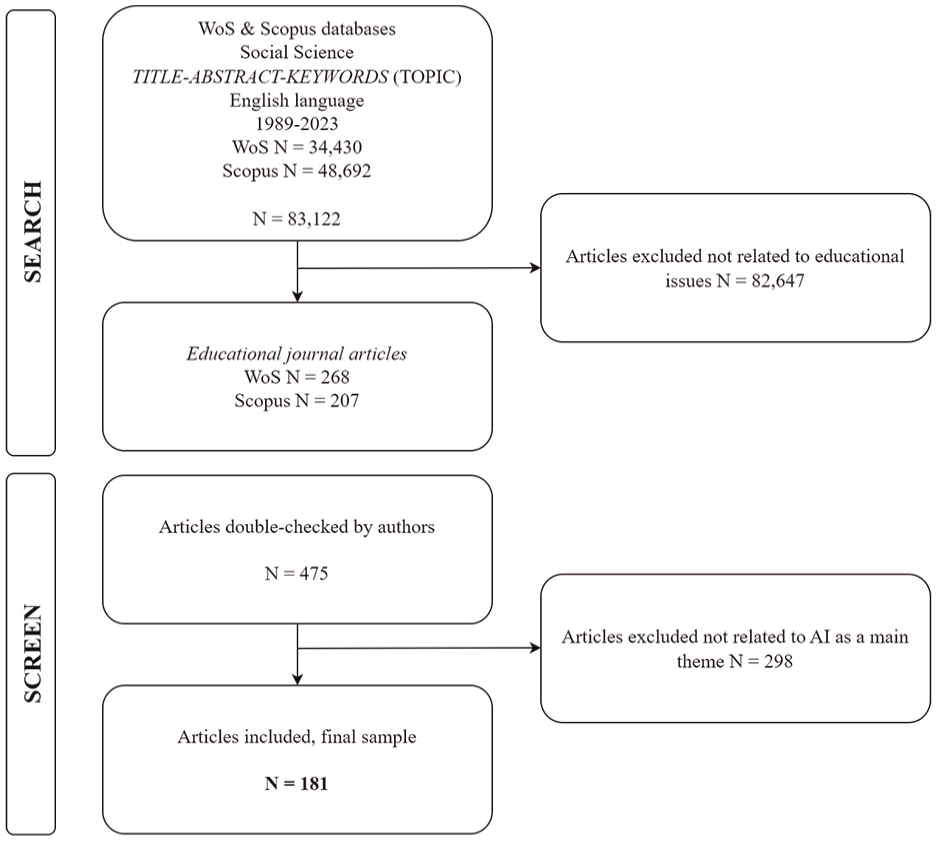
Inclusion and exclusion criteria.
Bibliometric Methods
The bibliometric technique assesses the development of a research field through bibliographic data, which offers scientific mapping and performance analysis (Cobo et al., 2011). A bibliometric analysis details the evolution and current state of a particular field through a review of scientific publications. A co-occurrence analysis traces the development of a domain by detecting the research trend topics and their conceptual structure (Zupic & Čater, 2014). The use of both databases enables the tracking of the evolution of AI applications in higher education due to the representative sample that WoS and Scopus integrate. In this study, we have applied the VOSviewer tool, developed by van Eck and Waltman (2010), and the SciMat software, developed by Cobo et al. (2011), to analyse scientific maps and identify motor, basic, isolated, and emerging themes. VOSviewer clusters were used to identify recent topics based on their inter- and intra-relationships, while SciMat evaluates an evolution map and a strategic diagram (with the four quadrants exposed).
Regarding to the workflow of scientific mapping, once the bibliographic sample is retrieved, firstly a preprocessing process must be applied to identify misspelled terms and errors, according to the unit of analysis, in this case keywords (Moral-Muñoz et al., 2019). With VOSviewer a manual thesaurus is generated to clean the sample merging concepts (e.g., AI and artificial intelligence) as well as to remove duplicates and inconsistencies. While with SciMat, the software employes a plural grouping method to facilitate the identification of analogous items during the de-duplication process (e.g., academic-performance and academic performance). Secondly, to obtain the bibliometric network, VOSviewer software uses the full counting network technique to obtain the total number of occurrences that a keyword appears in the retrieved sample. Therefore, the link strength between concepts were normalised (van Eck & Waltman, 2010), obtaining different clusters based on keywords linkage. To achieve this normalisation, VOSviewer employs similarity measures: the proximity index or association strength. The degree of similarity (s ij ) between two elements (i and j) is calculated using the total number of co-occurrences between i and j (c ij ), as well as the total number of occurrences of these keywords (w i and w j ), as seen in Equation 1 (van Eck & Waltman, 2010).
Associated strength used by VOSviewer software

For SciMat software the normalisation measure selected was the equivalence index (Callon et al., 1983) and the simple centres algorithm to create the scientific map and associated clusters and subnets (Cobo et al., 2011). The network analysis employed by SciMat is based on Callon’s density, which is used to quantify the internal cohesion of a network, and centrality, which is utilised to assess the extent of interaction between networks (see Equation 2, Chen et al., 2019). Here k represents a keyword that is pertinent to the topic under discussion. In contrast, h denotes a keyword that is relevant to other topics. For the density i and j are keywords that are associated with the thematic. Finally, w is the keyword count within the thematic (Chen et al., 2019). While the inclusion index is employed to ascertain the significance of a thematic nexus (see Equation 3).
Callon’s density and centrality used by SciMat software


Finally, the visualisation technique employed in each software was thematic networks built by a clustering algorithm to detect the conceptual areas. VOSviewer shows a temporal analysis while SciMat presents a longitudinal one.
Productivity Measures
Table 2 displays the most representative educational journals that have published articles related to AI and higher education. The most portraying source by number of publications of this sample is Education and Information Technologies with 53 papers published and 843 total number of citations. However, the most cited is International Journal of Educational Technology in Higher Education (23, 1,709). These journals are highly focussed on technology, engineering and computers education (79.55%), and, to a lesser extent, related to philosophy and psychology (Educational Philosophy and Theory, Educational Psychology, 1.65%). Appreciating the little attention that this topic received in business and management journals (e.g., The International Journal of Management Education), which is starting to change from 2023 onwards. Regarding the most prolific authors, researchers from Spain (University of Alicante and Universitat Oberta de Catalunya) form the top 4. These researchers present co-authorship between them (Santiago Puente and Fernando Torres, as well as David Bañeres and Ana-Elena Guerrero-Roldán). Also, authors from China are predominant (Xieling Chen, Haoran Xie, and Di Zou).
Most Representative Journals and Authors’ Institution and Countries.

N = number of documents; % = from the total sample of documents (N = 197); TC = total number of citations; Instit. = Institution.
Thematic Analysis
To understand the thematic organisation on a specific field, the co-occurrence technique is used. This analysis shows the connections between terms (Callon et al., 1983). This paper provides the thematic structure of the field of AI applications in higher education following the results of two software: VOSviewer and SciMat. Firstly, VOSviewer clusters the inter-connections between the most recent terms to detect emerging and research trend topics. Secondly, SciMat offers the evolution map, dividing up the sample by periods, based on the publication date, and a strategic diagram with subclusters that identify motor, basic, isolated and emerging themes.
Conceptual Structure by VOSviewer Software
VOSviewer software was developed by van Eck and Waltman (2010) to display and to visualise maps creating bibliometric analysis from network data of scientific literature, in this case from the WoS and Scopus databases. In conducting the analysis, a variety of occurrence thresholds have been employed for the purpose of observing the network structure. Ultimately, this study considers a minimum of 3 occurrences per keyword, which suppose that a concept must appear at least three times. From 919 keywords, 74 have surpassed the specified threshold, which resulted in six clusters coloured by red, green, blue, yellow, purple and light blue (Figure 2). These nodes are identified to visually distinguish relationships within and between nodes, based on the computer algorithm clusterisation (see Table 1 in Appendix). Therefore, the chromatic characteristics of an item are contingent upon its cluster affiliation, while the lines between items represent the existence of a link (Van Eck & Waltman, 2011). Figure 1 (Appendix) shows the overlay map of this co-occurrence analysis, which follows the blue and yellow scores based on the average year of publication (van Eck & Waltman, 2010). This map is used to detect the most recent keywords by cluster.

Co-occurrence analysis by VOSviewer.
Red Cluster – The Impact of AI on Higher Education Related to Academic Performance
In the red node, keywords focus on ‘academic performance’ linked to ‘online learning’, ‘deep learning’ and ‘education data mining’. The ‘impact’ of AI, the most recent keyword of the cluster, is involved with perception of students (blue node) using the new AI with chatbots (Essel et al., 2022), and the future perception about these technologies (Cox, 2021). Academic performance refers to the analysis of higher education students to identify potential learning difficulties or drop-out risks using technological methods. Within academia, it is crucial to demonstrate how tools impact on improving student performance and enabling educational institutions to select the most capable students. This highlights the significance of such tools beyond just serving to students (Fahd et al., 2022).
In terms of self-regulation and autonomy, gender differences suggest that men require more support than women to study (Xia et al., 2023). However, in the field of AI, 80% of the professors are men while only 15% of women study this area (Ferrante, 2021). Suggesting that this may have larger impacts within the male gender, where there is a greater appreciation for the use of technology related to AI.
Green Cluster – Using AI ChatGPT Tools for Gamification in the Higher Education
This cluster links ‘Artificial Intelligence’ as a core topic to various fields related to higher education, academic performance, and students, among others. For instance, regarding satisfaction, findings indicate that students experience greater satisfaction with AI when they are given instant feedback and correction, which results in increased comfort with their performance after utilising AI (Jin et al., 2023). However, as it can be seen within the cluster is that ChatGPT is becoming more popular, particularly by using it to English as a foreign language and relying on translators. Recent keywords suggest an interest in gamification and ChatGPT (Stojanov, 2023). The rapid adoption by the student is also due to ChatGPT’s simple and friendly user interface, which allows users to enter their queries. This way, the AI-based programme presents the best possible results from users (Bodani et al., 2023).
Chatbots such as ChatGPT, are being employed as teaching assistants in higher education, using natural language processing to make a significant impact (related to the red cluster) and its acceptation has been increased (Essel et al., 2022). The significance of ethics, creativity and critical thinking in higher education regarding the utilisation of AI tools is of utmost importance pedagogically. There is potential for misuse of such tools by both the teaching community and students, as well as in institutional management. This could result in the rejection of worthy candidates if the sole basis for students’ selection are the choices provided by AI (Ivanov, 2023).
Blue Cluster – Self-Regulated Learning Towards Students’ Engagement in Higher Education
The blue cluster relates to the acceptance of technology and its close relationship with ‘motivation’, ‘strategies’, and ‘student engagement’. AI integration into learning tools, for instance, by using the flipped classroom approach, has the potential to foster students’ interest in learning and engagement. This, in turn, leads to a boost in intrinsic motivation and improved academic performance, as well as increased engagement of students (Huang et al., 2023).
The ‘self-regulated learning’ is the most recent keyword. Highly connected to motivation and engagement (blue cluster). AI is being used to provide personalised learning environments for students. For instance, it may provide smart teaching programmes, response and advice tailored to individual circumstances. This enables teaching staff and management systems, such as digital classrooms, to efficiently and affordably allocate additional resources. Likewise, this release academic management’s time and resources in numerous higher education institutions (Xia et al., 2023). Hence, it is imperative to facilitate learners’ self-regulated learning in digital learning settings (presented on the red cluster). External support through AI has the potential to help learners in achieving successful self-regulated learning (Jin et al., 2023).
Yellow Cluster – Machine Learning Natural Language Processing in Higher Education
The yellow cluster highlights the application of ‘machine learning’ in ‘higher education’, with a strong connection to ‘natural language processing’. Machine learning can be applied in the monitoring of higher education to produce predictive models that can determine crucial factors including academic, learning, financial and perceptual outcomes (Iatrellis et al., 2021). This harnesses the power of AI to enhance the efficiency of managing higher education institutions (Çakıt & Dağdeviren, 2022).
The most recent keyword is ‘natural language processing’ (see connections in the Figure 3b). AI is increasingly employed to ease workloads, often interpreting human natural language either verbally or in writing to provide optimal results for given tasks. An example of such implementation can be found in the analysis of quality control processes within higher education and for the accurate evaluation of educational programmes (Zaki et al., 2023). This may expand opportunities for mobile learning, enabling international programmes and learning from any location around the world (Medrano et al., 2023). This intervention has the potential to promote student engagement by self-regulation, connected to the blue cluster (Ross et al., 2018).
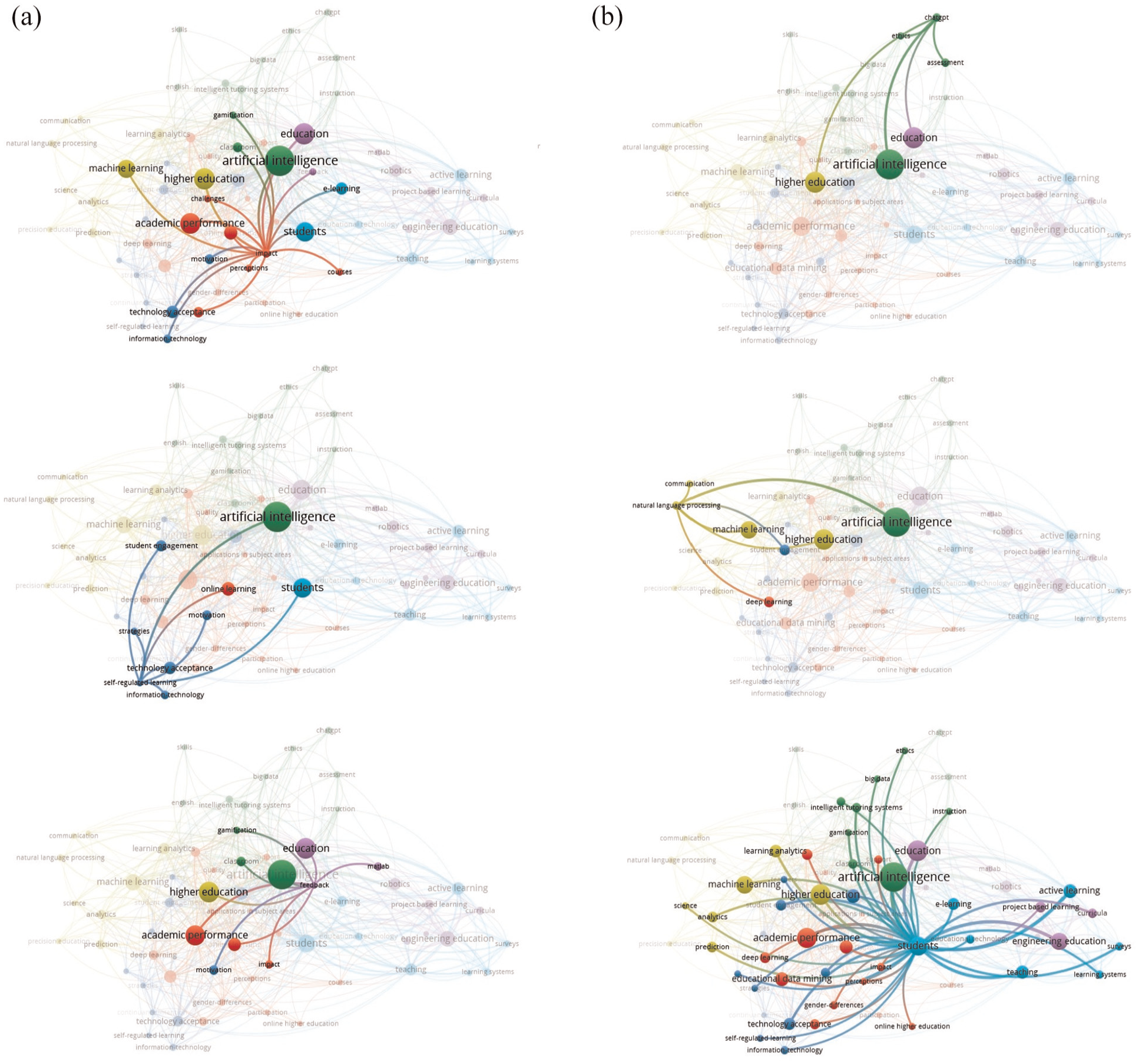
(a) Inter and intra clusters relationships by VOSviewer and (b) Inter and intra clusters relationships by VOSviewer.
Purple Cluster – Students Feedback in the Use of Robotics in Higher Education
This cluster concerns students’‘feedback’ on the use of ‘artificial intelligence’ in ‘higher education’ institutions with regards to their studies offered. This cluster is closely linked to other areas within the education community, as feedback patterns are applicable across various settings. The linkage with the core of the other analysed clusters, such as ‘artificial intelligence’, ‘higher education’ (yellow cluster), ‘academic performance’ (red cluster), ‘motivation’ (blue cluster), and ‘education’ is represented in Figure 3a.
This practice has been widely adopted in the education sector in the 2010 and 2020 decades, especially in the realm of robotics research employing MATLAB. Both universities and corporations utilise AI -equipped robots, such as Mitsubishi Motors (Hamilton, 2007). The most recent keyword refers to the feedback students received through AI in various university projects worldwide. For instance, in China, AI is utilised in foreign language courses (related to the green cluster), such as English (Yang et al., 2023).
Light Blue – Student Active Learning in Higher Education Enabled by AI
The light blue cluster is strongly linked to ‘students’ and the promotion of ‘active learnings’ through the help of ‘AI’. It is closely associated with students’ interest and motivation (connected to the blue cluster), as well as modern forms of learning such as e-learning.
E-learning is the most current keyword and, moreover, one of the most important within this cluster. It mainly refers to studies of the new form of distance learning, especially since the Covid-19 and post Covid-19 era. This education is modelled with artificial neural networks (red cluster) and how this is working for the student’s involvement and their motivation, presented in the blue cluster (Özbey & Kayri, 2022).
It is worth noting that higher education institutions conduct surveys to analyse this type of new teaching amongst their students. Thus, it is also important to consider the potential issues that might arise in this new educational paradigm utilising AI (Kong et al., 2023).
The Evolution of the Thematic Organisation by SciMat Software
SciMat software, developed by Cobo et al. (2011) is used to perform co-occurrence analysis. This analysis complements the conceptual structure conducted by VOSviewer software to understand the thematic organisation. Our analysis is divided up into two periods, according to the number of papers published: Period 1 (years 1984–2020) and Period 2 (years 2021 and 2023). This cut-edge coincides with the pandemic, considering the challenges addressed by higher education institutions.
SciMat follows a longitudinal analysis that provides an evolution map and strategic diagrams with subnets. The evolution map displays the development between concepts in the scientific literature. Bold lines show clusters that keywords share a major theme, and dashed lines show clusters that share themes that are distinct from the major theme (Cobo et al., 2011). The study employed a two-period analysis to examine changes over time and to illustrate the evolution of the field’s thematic structure. The first period from 1980 to 2020, while the second period extended from 2021 to 2023. The initial period was characterised by the establishment of terminology and preliminary trials in domains such as robotics and engineering. The second period encompassed investigations aimed at elucidating the implications of integrating these novel tools within the educational context (Karakose et al., 2024). As seen in Figure 4, some terms have greater significance and a stronger connection to related concepts across different periods (e.g., robotics with machine learning and artificial intelligence). Conversely, other nodes (e.g., acceptance) in the second period appear unrelated to period 1, as they are novel terms during the 2021 to 2023 timeframe. Similarly, some terms disappear in period 2, as they no longer have sufficient weight in the literature (e.g., ‘curriculum’). The trend shows that less attention is paid to how AI support with ‘curriculum’ design (Blagojevic & Micic, 2020) to give greater weight to other topics related to ‘performance’, how the use of these tools could benefit to obtain better qualifications (e.g., mathematics performance Hwang and Tu (2021). Connected to AI and its management is the use of ‘machine learning’ (presented in the yellow cluster VOSviewer) to develop predictive models and outcomes (e.g., Iatrellis et al., 2021). It is observed that the application of AI is not only focussed on engineering or science but is also beginning to be applied in the subject of English as a second language (green cluster VOSviewer). During the first period under study (1984–2020), the focus was more on robotics (purple cluster VOSviewer), with target on programming (algorithms), and currently this is more associated to truly AI (Guzman & Lewis, 2020). More emphasis on the key role of ‘lecturers’ (also presented in the blue cluster VOSviewer) at higher education is getting the attention of scholars (e.g., Hwang & Tu, 2021; Peres et al., 2023). Teaching strategies are focussed on improving the level of acceptance, regarding students’ perception to new tools such as ChatGPT (e.g., Essel et al., 2022) and how to enhance their engagement and motivation at class due to these applications (e.g., Huang et al., 2023) which is also presented in the blue cluster (VOSviewer).
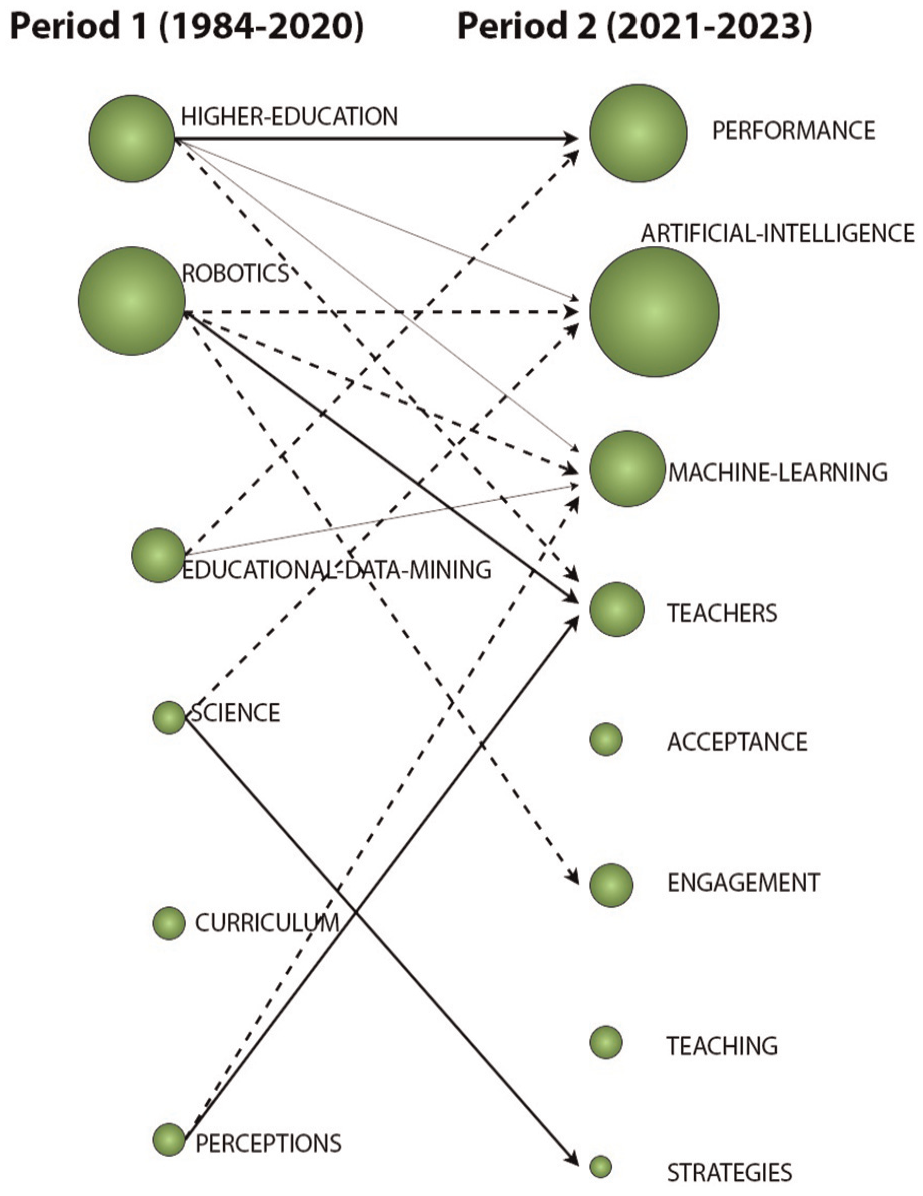
Evolution map and division of periods by SciMat.
The strategic diagrams pertain to the second period (2021–2023) in order to identify the most recent research topics. The diagram shows four quadrants based on centrality, measures a cluster’s connectedness to other clusters, and density, measures the internal strength of the bond.
The motor themes (top right quadrant) contain the concepts of ‘performance’ (red cluster VOSviewer) and ‘acceptance’ (blue cluster VOSviewer), considering how students acceptation play a pivotal role in the application of IT, AI and ‘machine learning’ (yellow cluster VOSviewer) related technologies and students’ success at class (e.g., Huang et al., 2023). Regarding the basic and transversal themes (lower right quadrant), here appears the term ‘teachers’ as they carry the full burden of implementing AI in the classroom (e.g., during Covid-19 pandemic in Saudi Arabia; Sayed Al Mnhrawi & Alreshidi, 2023). In the lower left quadrant are the keywords ‘engagement’ and ‘strategies’ that arises as emerging themes, presented in the blue cluster of VOSviewer. One strategy being implemented is to use AI to enhance the flipped classroom model (e.g., during the pandemic, Clark et al., 2021). AI can improve student motivation and engagement, personalise educational recommendations, and provide faster and more personalised feedback (Huang et al., 2023). As a more developed or isolated theme (top left quadrant) appears the concept ‘teaching’ (light blue cluster VOSviewer) since AI is starting to be taken more into account for other roles such as: studying the ratio of students who can succeed, analysing patterns and the motivation of students (e.g., Huang et al., 2023). Hence, currently AI is not just considered as a teaching tool.
Discussion and Avenues for Future Directions
The papers analysed showed the potential of AI in higher education in terms of student performance, motivation and engagement, as well as the importance of acceptance and feedback between the agents involved –institutions, professors and students–. This bibliometric analysis, compared to previous studies, provides an update on the evolution of this field of research, considering its significant growth.
Although the field of research is still in its early stages, there has been an evolution in the application of AI in higher education. However, it has yet to be fully consolidated, as noted in previous studies such as Hinojo-Lucena et al. (2019). It is therefore the aim of this article to present a thematic analysis of this field on what has been done in the literature. Quantitative bibliographic analysis programmes such as VOSviewer and SciMat are valuable tools for the management and analysis of large bibliometric datasets, offering insights that can inform research strategies and practical decisions (Moral-Muñoz et al., 2020). Nevertheless, the efficacy of these tools is contingent upon the quality of the data, the expertise of the user, and a meticulous interpretation of the results (Shaheen et al., 2023). It is essential to employ these tools with a comprehensive understanding of the subject matter in order to gain a thorough grasp of the research landscape.
Looking at the results, the most frequently keywords, ‘data mining’, ‘machine learning’ and ‘deep learning’ still appear as research hotspots (as in Talan, 2021). Furthermore, the scientific literature still focuses on ‘motivation’ and ‘user acceptance’, as pointed out by Brika et al. (2022). Previous analyses focussed on the Covid-19 (e.g., Brika et al., 2022), a term that is no longer present in our co-occurrence analysis, as the period of analysis includes the post-pandemic scenario (years 2022 and 2023). However, it is precisely since Covid-19 that AI-related technologies have been promoted (D. T. Ng et al., 2023; D. T. K. Ng et al., 2023), highlighted in the blue light cluster.
Considering how multidisciplinary this topic is, the findings reveal that the literature is still very focussed on AI applications from a technological approach, and mathematics, for example, Hwang and Tu (2021), and less focussed on ethical issues, which is partially presented in the green node of VOSviewer but not in the SciMat analysis. Regarding this, organisations have started to consider these ethical aspects (Stahl et al., 2022), however, the scientific production still fails to highlight it and give it the importance it deserves. This is reflected in the journals and research areas published on the subject, which, compared to previous work, continue to focus mainly on technology and engineering, for example, Education and Information Technologies and International Journal of Educational Technology in Higher Education. Therefore, there is a need to pay more attention to other aspects such as ethics, protection of creativity and promotion of critical thinking (Ivanov, 2023). According to previous descriptive analysis, authors from the University of Alicante (Spain) are still the most productive in this area (also noted in the article by Hinojo-Lucena et al., 2019).
The development of the applicability of AI in higher education is of great importance, as this trend has strong implications for institutions, managers, professors and students. More emphasis could be placed on areas beyond engineering and English as a second language, such as management and business degrees and subjects.
According to the results obtained from the co-occurrence analysis, considering the research trend and emerging topics, an agenda with future avenues of research in the field is suggested. Table 3 shows the future research avenues in the implementation of AI tools in higher education applied to management studies.
Future Avenues of Research in AI and Higher Education Focussed on Management Studies.

This research agenda identifies future directions for improving the use of ChatGPT in higher education. Understanding how this tool is used by students and professors, and how they are trained to use it (Vera, 2023). More emphasis on empirical research on the use of AI and chatbots is needed to determine how their application impacts on higher education (Ragheb et al., 2022). Their main challenges can be further addressed in the literature, from the red and green clusters. More attention to student feedback, acceptance (red and purple clusters, motor themes) could be measured. Focus on empirical evidence on how AI affects academic performance, motor theme, and how institutions and professors consider and measure this aspect. The blue cluster highlights research questions related to how AI improves student engagement strategies, also presented as an emerging theme in SciMat analysis, and how it affects student motivation, as well as the key role of self-regulated learning enhanced by AI. The blue cluster also identifies that academic institutions can benefit from AI to simplify and support administrative tasks, which requires further investigation. It would be interesting to identify which institutions and countries are leading the way in this respect. In addition, there is a lack of research on personalisation in the literature, thus comparisons between subjects and institutions could be developed. Concerning to the green, yellow, purple and light blue clusters, it is crucial to observe how AI can enable people to take courses without having a common language, and how this could support collaboration between students around the world. In terms of language learning, AI can adapt and personalise English courses, for instance. Empirical evidence of AI support for distance and mobile learning is needed (Zhao & Jiang, 2022). Finally, attention can be given to measuring how the use of robotics in business and management studies, such as tourism or hospitality degrees, can prepare tomorrow’s professionals.
Conclusions
The significance of AI in higher education is well developed. AI is poised to establish new benchmarks globally. AI massively expands the potential of education by assisting students and educators, academic and administrative management. It can even help in developing new management and education models with global possibilities. Naturally, it presents new and unique challenges that ought to be addressed in due course (Ivanov, 2023).
This analysis provides information about the most prolific authors in this field, highlighting those from Spanish and Chinese institutions (RQ1). Considering their co-authorship, noting that the articles are written by authors from the same institutions, therefore, a stronger internationalisation in terms of collaboration may be of interest. Regarding the most productive journals, engineering and computer-oriented sources stand out, which underscored the need for a greater presence and attention of AI application in the business and management education (RQ1). Based on the thematic analysis developed by VOSviewer and SciMat software emerging research trends in this field (RQ2) are focussed on the main impacts of AI application regarding for instance, the student performance improvement (red cluster), the use of ChatGPT and its advancements as a learning tool (green cluster, e.g., Essel et al., 2022), strategies of student’s engagement (emerging theme, SciMat analysis) and self-regulation (blue cluster) enabled by AI tools (e.g., Jin et al., 2023). Machine learning applications for predictions (motor theme SciMat, Iatrellis et al., 2021) and the use of mobile learning, yellow cluster (Medrano et al., 2023), the pivotal role of students feedback in the use of robotics at class (purple cluster; Edwards et al., 2016), and how active learning and e-learning systems are powered by AI in higher education, light blue cluster (e.g., Özbey & Kayri, 2022). Findings reveal how the analysis conducted by VOSviewer, which considers the whole period under study: 1984 to 2023, and SciMat, which divides the sample into two periods (period 1: 1984–2020 and period 2: 2021–2023), provides valuable insights to current literature. These results show that those most recent keywords examined by VOSviewer (e.g., self-regulated learning) coincides and reinforces the emerging themes developed by SciMat focus on ‘engagement’ and ‘strategies.’
The evolution map displayed by SciMat software (Figure 5) addressed RQ3 in terms of the evolution of the field and how the concepts have evolved. Finally, based on the analysis performed, future avenues of research have been suggested (Table 3), providing further research questions and opportunities to continue developing this field (RQ4). It focuses, for instance, on the need for empirical evidence on the use of chatbots and their relationship with academic performance, personalisation of management and business studies, taking classes in different languages without being a barrier, and simplifying management tasks, among others.

Strategic diagram (period 2: 2021–2023) by SciMat software.
Theoretical Implications
This article presents theoretical contributions to the scientific literature related to AI applications in higher education. Firstly, this bibliometric overview provides the state-of-the-art of this field to understand what has been researched and what remains to be developed. Although there have been previous bibliometric analyses in this field, to the best of the authors’ knowledge, this is the first bibliometric overview to provide a comprehensive examination of the utilisation of AI in higher education from a holistic approach. Secondly, the use of two databases (WoS and Scopus) as well as two complementary software (VOSviewer and SciMat) provide valuable insights to the field and make the paper more rigorous using two tools (Caputo & Kargina, 2022). Thirdly, the most prolific authors are recognised, which may be of consideration to contact them for future studies collaboration. Fourthly, in the same vein, the most productive and cited journals are detected, thus this can serve as a guide to researchers on where to publish in the area. However, a lack of studies focussing on management and business has been reported, which implies a gap for future work. Fifth, research trend topics and emerging themes are identified, highly related to acceptance, students feedback and engagement, self-regulated learning as well as chatbots as a learning tool. Sixth, it has been observed how the field has evolved (evolution map, SciMat). Seventh and lastly, a research agenda linked to the results of the thematic organisation (co-occurrence, clusterisation) has been developed. These proposals have been set out along with research questions to guide scholars for future avenues of research.
Practical Implications
This article provides practical contributions to governments, institutions, professors, managers, students and scholars (academic community), considering the novelty of this field of research and all its opportunities.
Government investment in AI through public-private partnerships can positively affect a country’s competitiveness, not only in education, to train the future professionals, but also in business, to get the best professionals. Since 2018, the European Commission (EC) has considered the use of AI in all levels of education for modernisation as a key point in the development of the EU. Therefore, the EC is focussing on educational policies in this regard (EU Artificial Intelligence Act, 2023; European Commission, 2018). Higher education institutions should put more emphasis on the application of AI and their main challenges such as the use of chatbots (e.g., ChatGPT, red, and green clusters) and how professors can address these new scenarios. More public-private collaboration and funds to face the future of education are required. Are institutions putting enough attention on how to detect the use of chatbots to perform tasks? Referring professors, do lecturers know how to identify its use? Is it being used correctly? Hence, training is needed on the many applications of AI that can be employed in the classroom. To teach students how to use it correctly. How the use of these technologies affect to students’ academic performance is of great importance for institutions, professors and managers to monitoring success or failure in the use of AI in the classroom. Additionally, students’ feedback could help institutions to improve future management and personalisation (Huang et al., 2023). Motivation and engagement, presented on the red and purple clusters- play a key role in the implementation of AI and what strategies may be followed by professors. Regarding managers, management issues could be simplified by AI tools. This will allow managers to focus on other tasks, such as customising study guides and curricula desing for each student (Ratten & Jones, 2023). It is worth noting that current language barriers will tend to disappear thanks to tools linked to AI. Allowing (online) attendance by students from anywhere in the world, whether or not they understand the language in which the class is taught (e.g., Navigli et al., 2022). Referring to scholars, they can detect opportunities for future work among the less developed topics. Additionally, more emphasis about empirical research and case studies to explore the evolving use of AI as a learning tool is required. There is much to know and learn about it. Papers on the implementation of AI-related tools are still very much focussed on areas of engineering (Hamilton, 2007) or language learning (e.g., English as a second language, Yang et al., 2023). Hence, more attention about management and business courses and the use of AI should be developed. The lack of focus on management and business-related courses has been highlighted. For instance, the use of robotics (autonomous service) in Tourism and Hospitality courses (Wakelin-Theron, 2021), or robotics for operations management in Business Administration and Management Degree, among others (e.g., Tang et al., 2020). Ultimately, research seems to ignore the ethical and legal aspects of its implementation, while focussing on its applications and results. Addressing these ‘forgotten’ aspects would imply incorporating new fields of knowledge such as philosophy or law.
Limitations and Future Lines of Research
This paper is not free of limitations. Firstly, the bibliometric analysis was conducted based on keywords co-occurrence, which not considers other aspects such as the references cited. Thus, in future research, a bibliographic coupling analysis could be performed to understand the intellectual structure of the literature about AI and higher education. Moreover, the most cited articles could be considered to identify the diffusion of these topics (Zupic & Čater, 2014). Secondly, other databases such as Google Scholar were not taken into account and this study may have missed interesting papers related to the field. Thirdly, this paper only considered articles written in English, therefore it would be interesting for further studies to include articles written in other languages, such as Spanish and Chinese, in line with the origin of the authors who publish most in this area. Fourthly and lastly, the limitations of bibliometric analysis are such that the information available may be biased. This may be exemplified by the overrepresentation of certain journals in databases (Matorevhu, 2024).
Future lines of research can focus on how the discipline will develop in the coming future, for instance, by repeating a bibliometric analysis to identify research trends and emerging themes over the next 2 to 5 years. Conducting questionnaires with students to get feedback (purple cluster) from them, as well as feedback from professors to better understand the current situation. What they would improve, what they need to know to use AI as a learning tool and what are the best engagement strategies (SciMat emerging themes). Also, questionnaires to institution managers to know their needs and to support them in the transition to the implementation of AI to assist in routine management tasks to simplify them. While paying more attention to personalising study guides and adapting curricula to students’ needs. To interpret the results of the questionnaires, a qualitative content analysis could be carried out using NVIVO or Atlas.ti software. In addition, case studies could be carried out to compare the application of AI worldwide and the different strategies pursued as successful cases in each institution.
Footnotes
Appendix
Clusterisation by VOSviewer Software.

| Cluster 1. (red) | ||||
|---|---|---|---|---|
| Keyword | Occurrences | Link | TLS | APY |
| Academic performance | 29 | 41 | 105 | 2021.38 |
| Educational data mining | 13 | 20 | 39 | 2020.15 |
| Online learning | 12 | 28 | 46 | 2021.58 |
| Technology | 8 | 26 | 34 | 2021.62 |
| Deep learning | 8 | 21 | 31 | 2021.38 |
| Artificial neural networks | 7 | 15 | 19 | 2016.86 |
| Impact | 4 | 18 | 22 | 2021.75 |
| Support | 4 | 17 | 19 | 2019.00 |
| Gender-differences | 4 | 16 | 21 | 2020.50 |
| Challenges | 3 | 14 | 18 | 2021.67 |
| Courses | 3 | 14 | 18 | 2019.33 |
| Perceptions | 3 | 13 | 15 | 2021.00 |
| Participation | 3 | 9 | 11 | 2021.67 |
| Quality | 3 | 10 | 10 | 2018.33 |
| Applications in subject areas | 3 | 9 | 9 | 2012.00 |
| Lego mindstorms | 3 | 9 | 9 | 2014.67 |
| Online higher education | 3 | 6 | 6 | 2021.33 |
| Cluster 2. (green) | ||||
| Keyword | Occurrences | Link | TLS | APY |
| Artificial intelligence | 67 | 56 | 223 | 2019.10 |
| Classroom | 6 | 22 | 29 | 2020.83 |
| Intelligent tutoring systems | 6 | 19 | 24 | 2014.33 |
| Pedagogy | 5 | 21 | 25 | 2021.60 |
| Assessment | 4 | 11 | 13 | 2018.00 |
| ChatGPT | 4 | 5 | 7 | 2023.00 |
| Gamification | 3 | 18 | 21 | 2023.00 |
| Big data | 3 | 11 | 14 | 2021.33 |
| Instruction | 3 | 11 | 13 | 2020.67 |
| Ethics | 3 | 10 | 13 | 2022.67 |
| English | 3 | 5 | 6 | 2023.00 |
| Skills | 3 | 5 | 6 | 2022.00 |
| Cluster 3. (blue) | ||||
| Keyword | Occurrences | Link | TLS | APY |
| Design | 14 | 34 | 52 | 2017.64 |
| Student engagement | 8 | 15 | 35 | 2021.38 |
| Motivation | 6 | 20 | 24 | 2022.83 |
| Information-technology | 4 | 14 | 19 | 2021.75 |
| Self-efficacy | 4 | 11 | 14 | 2022.50 |
| Technology acceptance | 3 | 21 | 38 | 2021.00 |
| Teachers | 3 | 15 | 18 | 2021.00 |
| Strategies | 3 | 13 | 14 | 2022.67 |
| Improving classroom teaching | 3 | 11 | 12 | 2022.67 |
| Continuance intention | 3 | 10 | 11 | 2022.33 |
| Self-regulated learning | 3 | 8 | 9 | 2023.00 |
| Cluster 4. (yellow) | ||||
| Keyword | Occurrences | Link | TLS | APY |
| Higher education | 31 | 45 | 102 | 2020.81 |
| Machine learning | 22 | 28 | 68 | 2020.59 |
| Learning analytics | 11 | 22 | 49 | 2020.82 |
| Analytics | 8 | 16 | 33 | 2021.62 |
| Prediction | 8 | 14 | 25 | 2020.12 |
| Natural language processing | 4 | 6 | 10 | 2022.75 |
| Science | 3 | 13 | 16 | 2021.67 |
| Communication | 3 | 9 | 11 | 2022.33 |
| Precision education | 3 | 8 | 10 | 2020.67 |
| Mobile learning | 3 | 7 | 8 | 2020.67 |
| Cluster 5. (purple) | ||||
| Keyword | Occurrences | Link | TLS | APY |
| Education | 32 | 43 | 110 | 2018.00 |
| Engineering education | 21 | 22 | 70 | 2014.33 |
| Robotics | 12 | 13 | 19 | 2008.67 |
| Project based learning | 8 | 14 | 28 | 2016.12 |
| Curricula | 6 | 11 | 29 | 2013.50 |
| Mobile robots | 4 | 7 | 8 | 2009.25 |
| Matlab | 4 | 5 | 7 | 2015.00 |
| Feedback | 3 | 10 | 11 | 2021.67 |
| Mechatronics | 3 | 7 | 9 | 2009.67 |
| Cluster 6. (light blue) | ||||
| Keyword | Occurrences | Link | TLS | APY |
| Students | 27 | 44 | 118 | 2019.33 |
| Active learning | 14 | 18 | 63 | 2016.79 |
| Teaching | 12 | 19 | 62 | 2015.83 |
| E-learning | 10 | 23 | 30 | 2018.30 |
| Educational technology | 5 | 15 | 21 | 2016.80 |
| Surveys | 4 | 10 | 23 | 2017.25 |
| Learning systems | 4 | 9 | 18 | 2016.75 |
| Computer aided instruction | 3 | 8 | 11 | 2009.33 |

Author Contributions
Conceptualisation: Juan-Manuel Aguado-García; Data curation Juan-Manuel Aguado-García and Sara Alonso-Muñoz; Formal analysis: Carmen De-Pablos-Heredero; Investigation: Juan-Manuel Aguado-García, and Carmen De-Pablos-Heredero; Methodology: Sara Alonso-Muñoz; Supervision and validation: Carmen De-Pablos-Heredero. Writing - original draft: Juan-Manuel Aguado-García and Sara Alonso-Muñoz; and Writing - review & editing: Carmen De-Pablos-Heredero.
Funding
The author(s) received financial support for the research, authorship, and/or publication of this article. This article has been financed with funds from OPENINNOVA High-Performance Research Group (URJC-V1404).
Declaration of Conflicting Interests
The author(s) declared no potential conflicts of interest with respect to the research, authorship, and/or publication of this article.
Data Availability Statement
Data sharing not applicable to this article as no datasets were generated or analysed during the current study.