




Abstract
Although Artificial Intelligence (AI) is notable in education, the studies on its specific application in university science education are still incipient. At the same time, the research demonstrates a critical need to systematize AI pillars to provide a coherent and clear structure to guide the development, implementation, and understanding of this technology in various fields, but very little progress has been made in the field of university science education. Therefore, the present study was aimed at exploring the essential pillars of AI for university science education. This scoping review followed the Arksey and O’Malley methodology, which unfolds five stages; based on established criteria 89 texts were finally selected and included in the study. Ten pillars were found: (1) AI Ethics, (2) AI Didactic Integration (AI-DI), (3) Machine Learning (ML), (4) Deep Learning (DL), (5) Active Learning (AL), (6) Intelligent Prediction (AI-IP), (7) Natural Language Processing (NLP), (8) Augmented reality and Virtual reality (AR/VR), (9) Artificial Neural Network (ANN), and (10) Intelligent Tutoring System (ITS). The study provides a comprehensive synthesis of current trends and advances in this field, highlighting good practices that provide empirical evidence, highlighting ethical, pedagogical, and technical challenges associated with the application of AI in science education, which can contribute to the formation of an aware and ethical educational community in the use of AI.
Introduction
Artificial intelligence (AI) integrates, in an interdisciplinary manner, areas such as computer science, mathematics, statistics, philosophy, neuroscience, linguistics, psychology, and engineering, among others, with a notable presence in educational processes. Although it is recognized that AI has a profound impact on education (Geng, 2019), further progress is still needed in the integration of AI specifically in the field of science education and research, in an educational environment shaped by digital transformation and technological innovation.
An interesting study argues that AI in science education can provide students with a better and more appropriate teaching pathway (Teng, 2021); recently Cooper (2023) Noted that generative AI can significantly improve science education, but it is critical that educators carefully analyze any generated resources and adjust them according to the specifics of their environment. As expressed by X. Zhang (2020) teachers must understand both the advantages and disadvantages offered by AI to provide a better education to students; and prepare them for an Industrial Revolution 4.0 context (Devi et al., 2020).
In this regard, Aldosari (2020) highlights the need to increase awareness of AI applications in education, especially to integrate them promptly into the curricula of various countries (Suh & Ahn, 2022). It is further recognized that the use of “Artificial intelligence, with its more intelligent, personalized, accurate and diversified characteristics, brings a new idea for the innovation of teaching management methods in colleges and universities” (Ge & Hu, 2020, p. 1).
AI can be a valuable resource for generating a cooperative learning environment (Ilić et al., 2021). However, although AI is a reality, the scientific production on its application in higher education has not been consolidated (Hinojo-Lucena et al., 2019), although there has been an evolution in AI research in education, focusing in recent years on the performance and influence of AI in educational processes (Moreno-Guerrero et al., 2020).
This shows the demand for digitization of the science and education system, but based on innovative digital technologies (Vodenko & Lyausheva, 2020). Consequently, combined with the current level of social development, universities should attach importance to the application of AI in scientific research management (Yongtao, 2019).
In this sense, methodological strategies should continue to incorporate new approaches to improve the scientific skills and attitudes towards science and research of university students (Setiawaty et al., 2018), This may include AI-based gamification methodological strategies as an innovative alternative for educational and research activities (Vinichenko et al., 2019), empowering collaborative learning teams (Guo & Barmaki, 2020), o Team-Based Learning (Thompson et al., 2007), and adaptive learning (M. Zhang & Zhang, 2020). But in the reality of education, the creation of an innovative technological system requires disruptive thinking (Luo et al., 2022), motivation of educational actors, and especially an ethical approach from a collaborative and ethical education in AI (Raji et al., 2021).
Although AI has demonstrated remarkable potential in a variety of fields, including education, its specific application within university science education remains relatively unexplored. Despite its ability to revolutionize teaching and learning processes, there is a notable gap in the literature regarding the comprehensive understanding of the role and effectiveness of AI within this specific educational context.
In this regard, while some research explores certain aspects of AI integration, such as machine learning or intelligent tutoring systems, there is a paucity of comprehensive frameworks or studies that systematically examine the essential building blocks necessary for the effective use of AI in university science education. Therefore, there is a critical need to systematize these key pillars essential for the integration of AI in science education, while also examining ethical, pedagogical, and technical challenges inherent in this process. Addressing this gap is crucial to advancing our understanding of how AI can be optimally leveraged to enhance teaching and learning experiences in science education at the university level.
Considering the above, the objective of this scoping review is to explore the essential pillars of AI for science education and research in higher education. Our main motivation is to offer a meaningful contribution to the scientific and educational community. First, by providing a comprehensive synthesis of current trends and developments in the use of AI in education, offering academics and practitioners a thorough understanding of the most relevant applications and providing a valuable conceptual framework for practical implementation.
To better understand the objective of the study, it is important to clarify what we mean by “pillar.” A pillar is a fundamental, solid, and structurally important element that supports or sustains a given construction or system. In the context of this study, a pillar represents an essential or fundamental component that provides support and stability to the integration of AI in university science education, summarizing key subject areas, concepts, tools, or types of AI that are fundamental to the effective development and implementation of AI in this specific context. Each pillar addresses a fundamental aspect that contributes to the understanding and successful application of AI in undergraduate science teaching and learning.
Previous studies have provided this perspective of integrating AI pillars, for example, one study proposes seven pillars that, in the authors’ opinion, represent the main distinguishing features of the future of AI: multidisciplinary, task decomposition, parallel analogy, symbolic grounding, similarity measurement, intention awareness, and reliability (Cambria et al., 2023), another paper entitled “AIR5: Five Pillars of Artificial Intelligence Research” demarcates 5Rs as the pillars of artificial life, for sustainable AI and computational intelligence; “rationalizability, resilience, reproducibility, realism, and responsibility” (Ong & Gupta, 2019, p. 411). In the field of medicine, studies highlight the pillars of machine learning in healthcare (Harris et al., 2022; Javaid et al., 2022); and also in the field of “computational spectroscopy,” highlights the importance of the pillars (Barone et al., 2021).
The above demonstrates that there is a critical and ongoing need to systematize the pillars of AI as it is crucial to provide a coherent and clear structure to guide the development, implementation, and understanding of this technology in various fields, however, very little progress has been made on the systematization of these pillars in the field of university science education, hence the uniqueness and importance of this study.
This review also aims to highlight good practices and case studies that illustrate the effectiveness of AI in improving teaching and research in higher education, providing empirical evidence that supports the usefulness of the identified pillars, which can be crucial for the adoption of educational technologies. Furthermore, by addressing potential ethical, pedagogical, and technical challenges associated with the implementation of AI in science education, the review provides a balanced perspective that guides practitioners in making informed decisions.
Research question: What are the fundamental pillars of Artificial Intelligence (AI) being applied or potentially applicable in university science education?
Methodology
We worked with one of the most widely used international scoping review methods (Arksey & O’Malley, 2005), which allows you to explore the literature (Kokorelias & Ashcroft, 2020), and describe the essential elements based on an examination of the breadth of knowledge related to the subject matter (McCutcheon et al., 2020).
Stage 1: Identifying the Research Question
What are the fundamental pillars of Artificial Intelligence (AI) being applied or potentially applicable in university science education?
Stage 2: Identifying Relevant Studies
To identify relevant studies, some databases such as Scopus, Web of Science, SCIELO, DOAJ, LATINDEX, and REDALYC were initially explored. Among these databases examined, the greatest representativeness of the studies of interest was found in Scopus; in the databases SCIELO, DOAJ, LATINDEX, REDALYC, a low number of publications were registered; even in Web of Science, when placing the search equation in the title field, then in the Keywords field and finally in the Abstract field, the results were few (141) compared to Scopus (832); this allowed us to decide to select Scopus for the study.
The search equation was constructed from three content blocks directly associated with the study, Artificial intelligence (block 1), Higher education (block 2), and Science Education (block 3) combining descriptors and Boolean operators in a strategic way to identify relevant studies; the blocks were linked with the Boolean operator “AND” and the search fields were considered: “TITLE-ABS-KEY” For the first two blocks dedicated to AI and higher education the equations provided by an important systematic review of research on AI applications in higher education was assumed (Zawacki-Richter et al., 2019).
Block 1. Artificial Intelligence
“Artificial intelligence” OR “machine intelligence” OR “intelligent support” OR “intelligent virtual reality” OR “chatbot*” OR “machine learning” OR “automated tutor” OR “personal tutor*” OR “intelligent agent*” OR “expert system” OR “neural network” OR “natural language processing”
Due to the rise of generative artificial intelligence, especially ChatGPT, it was intended to include in the artificial intelligence block the descriptors: “ChatGPT,”“Generative AI,” and “Generative Artificial Intelligence,” but only one document was included in the search (Kazemitabaar et al., 2023) and although it addresses an interesting perspective, it was not relevant to the objectives of the study.
Block 2. Higher Education
“Higher education” OR college* OR undergrad* OR graduate OR postgrad* OR “K-12” OR kindergarten* OR “corporate training*” OR “professional training*” OR “primary school*” OR “middle school*” OR “high school*” OR “elementary school*” OR “vocational education” OR “adult education”
Block 3. Science Education and Research
“elementary science education” OR “learning science” OR “mixed research” OR “qualitative research” OR “quantitative research” OR “research activity” OR “research competencies” OR “research culture” OR “research design” OR “research ethics” OR “research methods” OR “research personnel” OR “research skills” OR “research work” OR “research-based learning” OR “science education” OR “science instruction” OR “science process skills” OR “science teachers” OR “scientific inquiry” OR “scientific knowledge” OR “scientific literacy” OR “scientific research” OR “scientific researches” OR “scientific thinking” OR “teaching science” OR “undergraduate research”
In total, taking June 14, 2023, as the cut-off date, a total of 832 documents were obtained, we proceeded to filter considering only the “OPEN ACCESS” since the team needed to review internal issues of each study, obtaining a total of 276 documents; these were organized hierarchically considering the most cited “Cited by (highest)” and we proceeded to export them from Scopus in RIS format, to later import this file to the ZOTERO software.
Stage 3: Study Selection
For the selection of the studies, an EXCEL analysis matrix was designed in Google Drive, for the online collaborative work of all the researchers. Before this, a meeting was held to define which aspects to include in the general database, and the following criteria were included: (a) a number of the articles in the database (each article received a number according to its position in the export from Scopus, organized from the most cited), (b) bibliographic reference (in a second column were the references in APA 7 of each article), (c) number of citations (a third column collected the number of citations of each article), (d) abstract, (e) type of article, (f) objective, and (g) evidence of application or proposal of AI in science education (this was the main criterion for the selection of the studies; if the article analyzed did not show this aspect, it was left out of the selection; thus, only those that met this criterion were selected). The distribution of the articles among the different members of the team is shared below. The acronyms used refer to the initials of the authors who participated in the study (see Table 1).
Distribution and Selection of Articles by Specialists.
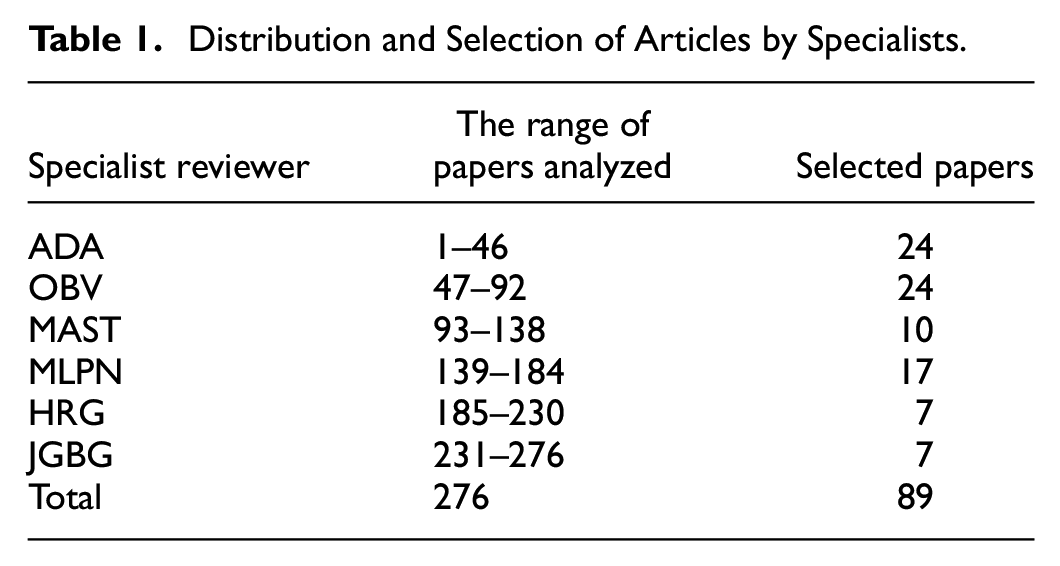
The main inclusion criterion was: (1) Evidence of AI applications, proposals, or discussions in university science education, (2) Full text “OPEN ACCESS,” and (3) Studies directly related to the university context.
The following fields were not limited, such as subject area, document type, publication stage, keyword, country/territory, source type, language, and year of publication, to capture the most representative content of interest. This moment was crucial and demanding, as abstracts cannot be assumed to be representative of the full paper and therefore the abstract alone may not capture the full scope of an article (Badger et al., 2000). The 276 full articles were reviewed, from which studies that were not directly related to the university context were excluded (mostly studies focused on primary and secondary school), and studies that did not address direct applications of AI in the field of interest were also excluded, leaving a total of 89 articles selected.
Following (Arksey & O’Malley, 2005) we distinguish between systematic literature reviews and scoping reviews. This study adheres to their definitions, clarifying that it is a scoping review, not a systematic review. Nonetheless, we employ the “PRISMA 2020 flow diagram” (Page et al., 2021) to enhance transparency in our selection and review process (see Figure 1).

PRISMA 2020 flow diagram for new systematic reviews, which included searches of databases, registers, and other sources.
Stage 4: Charting the Data
Considering what was stated by Pawson (2002) on the importance of making decisions about what information to record from studies, the team decided to establish an online screening matrix to extract the significant findings from each study, and through the method “descriptive-analytical,” to create a shared analytical model (Arksey & O’Malley, 2005).
Figure 2 shows graphically the workflow followed by the team at this stage, for the writing of the final synthesis of the 89 selected studies, a common analytical framework was used that considered: objective, methodology, results, and conclusions. The acronyms used refer to the initials of the authors who participated in the study, and show how, based on a common analytical framework, an integrated text was achieved; this reconciled text was included in the ATLAS—TI version 8 software for the categorization process.
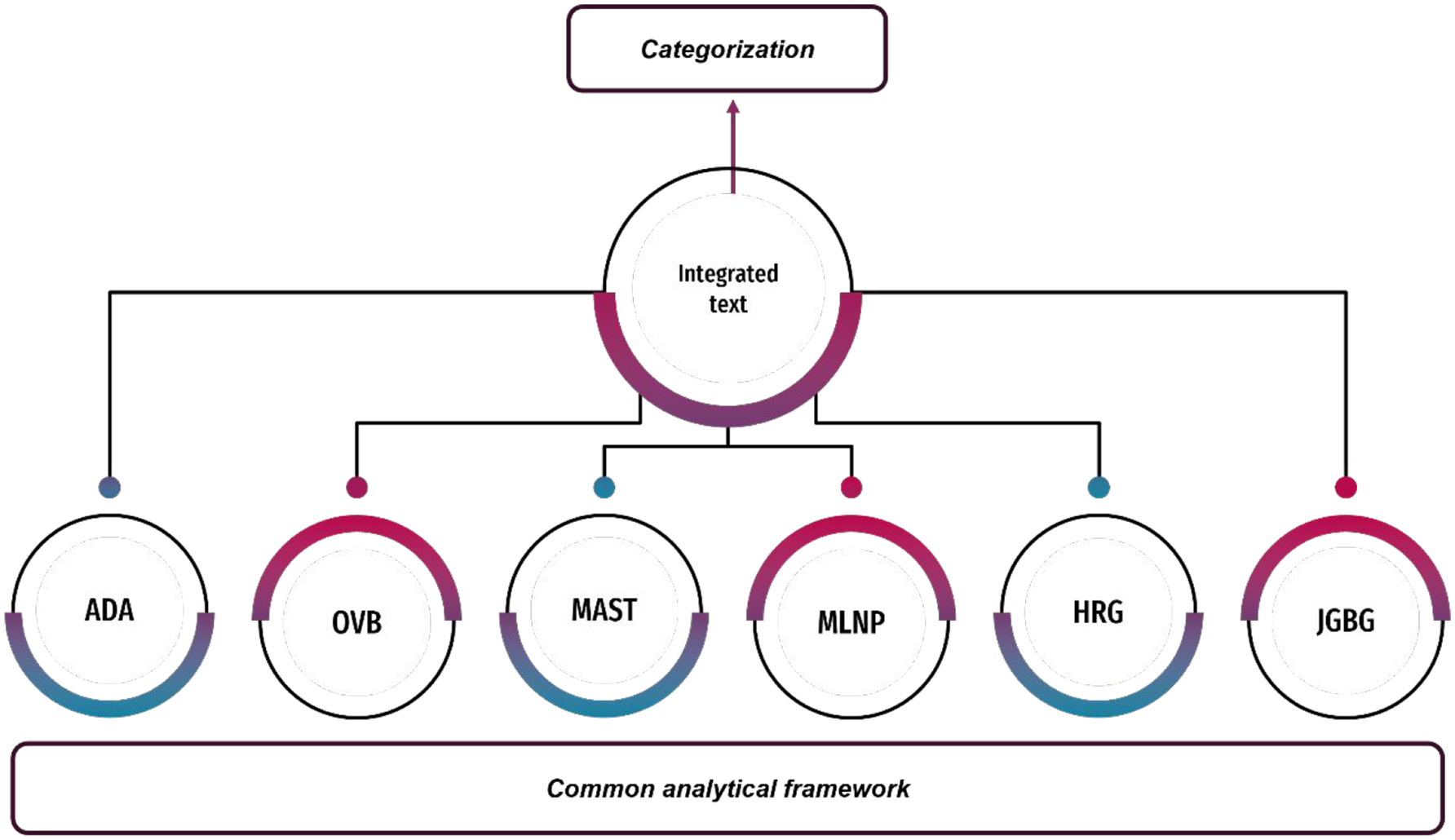
Workflow for integrated text creation and categorization.
Stage 5: Collating, Summarizing, and Reporting the Result
The integrated text achieved in the previous phase was entered into ATLAS.TI version 8, this software allowed grouping the multiple codes into emerging categories; in total 211 codes were obtained, which were grouped into 10 categories (see Figure 3), these emerging categories are the 10 pillars that we stated in the study.

The semantic network of emerging categories.
Results
The results of the study can be summarized in 10 essential pillars. Below we present the findings as captured by a table documenting the pillars and the number of studies for each pillar (Table 2).
Number of Studies for Each Pillar.

To ensure the traceability and replicability of the research, the studies selected by each pillar are shared (Table 3).
Specific References Are Associated with Each Pillar.

The analysis of the selected studies made it possible to identify the predominant challenges for each pillar (Table 4).
Ethical, Pedagogical, and Technical Challenges

Discussion
This part focused on the systematization of the scopes based on good practices and empirical evidence that support each of the pillars found, as well as the analysis and results of various studies; It is important to recognize that the pillars do not obey a single typology or level of AI, but are diverse elements made up of sub-disciplines, resources, tools, techniques or technological components to support AI in education, which can even be combined (for example, an Intelligent Tutoring System—ITS—can use advanced techniques such as natural language processing—NLP). From this point on, knowing the particularities and implications of each pillar is vital for an adequate implementation of AI in university science education.
AI Ethics
One of the most important points in the approach to artificial intelligence in science education and research is the ethical aspect. As stated by Siau and Wang (2020): AI ethics is the field concerned with the study of ethical issues in AI. AI ethics studies the ethical principles, rules, guidelines, policies, and regulations related to AI. Ethical AI is AI that performs and behaves ethically. For this, it is necessary to recognize and understand the potential ethical and moral problems that AI may cause to formulate the necessary ethical principles, rules, guidelines, policies, and regulations for AI (i.e., AI ethics). With proper AI ethics, AI that exhibits ethical behavior (i.e., ethical AI) can be built (p. 74).
Among the studies selected in the scoping review, research that recognizes the lack of an ethical approach to artificial intelligence (AI) and how computer science education contributes to this problem stands out. It is mentioned that AI ethics education tends to focus on computational approaches to the exclusion of other perspectives. This generates indifference between “computer science” and “social sciences,” perpetuating the myth of technologists as “ethical unicorns” and a shift towards collaborative and ethical AI education is proposed (Raji et al., 2021). Aldosari (2020) discusses the need to increase awareness of AI in education. Also, Salas-Rueda (2020) analyzes the importance of social networks in improving education and creating new learning opportunities in the digital age, however, this requires important ethical precisions.
For its part Lv and Shi (2020) propose improvements in university records management using artificial intelligence-based information systems, while in such a vital field educational research on artificial intelligence in surgery coins the term “digital surgery” and the ethical and data governance challenges in implementing AI technologies in the operating room, which may have important implications for medical education (Lam et al., 2021); it is important to examine the boundaries between research ethics and the ethical use of AI in health research, highlighting the impact on society and responsible innovation (Samuel et al., 2021). Ethics in artificial intelligence emerges as an essential component. Ethical training ensures that scientists-in-training understand the ethical implications of their research and technological developments. Addressing ethical issues related to AI becomes an imperative to cultivate responsible professionals who are aware of the social implications of their contributions.
Another of the selected studies aimed to investigate teachers’ conceptions of teaching artificial intelligence. Six categories of teachers’ conceptions were identified: (1) technological connection, (2) knowledge transmission, (3) stimulation of interest, (4) establishment of ethics, (5) cultivation of skills, and (6) intellectual development. The study highlights the deep concern about the ethical implications that this set of tools could have (Yau et al., 2023).
Based on the above, it is concluded that before any application of artificial intelligence, educational actors must understand the socio-educational sense and formative impact of the proposal, and must first manage the ethical, technological, and pedagogical challenges associated with the application of AI in university science education and proposes the development of TPACK (integration of technological, pedagogical, and disciplinary knowledge) within the framework of AI.
AI Didactic Integration (AI-DI)
This section recognizes the importance of integrating artificial intelligence topics into school curricula and how teachers can effectively design and implement curricula related to AI (Chiu & Chai, 2020). They are examining AI elements for the educational process (Salas-Rueda, Salas-Rueda, et al., 2020).
One of the areas where considerable progress has been made in the development of artificial intelligence in the university environment is in the teaching of English (Y. Liu and Ren, 2022). In this regard, a recent study emphasizes AI-based speech assessment systems (Zou et al., 2023), it also recognizes how an AI tool affects students’ engagement, attitude, and learning behavior in the context of academic writing in English (Nazari et al., 2021).
The use of genetic algorithms with artificial intelligence to manage teaching and learning in English courses is highlighted, so that they analyzed student performance data and showed that the integration of AI with the Internet improves student response to classes; a study that aimed to design a software and hardware integrated information system for teaching foreign languages to university students based on artificial intelligence is rescued (X. Zhang, 2020).
Similar to the above, a study found that compared to the traditional English writing model, with the “Pigai.org” application students are more willing to write, as it generates more enthusiasm and confidence (Z. Li & Yan, 2020), Other research found that English language learners can improve their reading skills by practicing with eyeball movement technology (B. Li et al., 2021).
In the field of mathematics, other authors demonstrate the impact of web application using data science and machine learning, enables the development of mathematical skills (Salas-Rueda, Gamboa-Rodríguez, et al., 2020), while also highlighting that the GeoGebra application facilitates not only the assimilation of knowledge and the strengthening of mathematical skills, but also the active role of the student. At the same time, students were motivated and satisfied with the incorporation of technology in their classes (Salas-Rueda & Salas-Rueda, 2019).
At the same time, educational trends and approaches related to science education in the medical field and that could involve the application of advanced technology, which is linked to the incorporation of artificial intelligence in higher education, are analyzed (Han et al., 2019). In this regard, the impact of the Big Data era on the development of mental health education for university students was analyzed. The results show that 66.2% of students and teachers are not satisfied with mental health education. It is concluded the importance of further strengthening the research theory of college students’ mental health consultation, to provide scientific guidance for mental health consultation (X. Zhang & Jia, 2021).
Cai and Tang (2022) analyze the correlation between higher education level and AI-driven public mental health of college students. For this purpose, they used the neural network-based correlation model. Emphasizes the importance of monitoring the mental health of students.
Another of the selected texts is related to the application of innovative teaching methods in computer science and engineering, including the introduction of artificial intelligence. It discusses how teaching using robots and wearable computing can be effective in attracting students’ interest and how wearable computing can be integrated into education (Ngai et al., 2010). At the same time, a previous study explicitly mentions the use of team-based projects and “RoboCup” challenges as a basis for classroom projects in university-level courses. In addition, research on the development of shared resources and assessment tools for these projects is discussed. Since the use of “RoboCup”-related classroom projects and their relationship to pedagogy, as well as the creation of shared resources, is mentioned, it can be stated that there is an application of artificial intelligence in science education (Sklar et al., 2004).
More recently, the application of data analysis techniques in the context of making binary decisions in scientific research and industrial applications is explicitly mentioned. It seeks to help students and researchers in data science to understand when it is more appropriate to use hypothesis testing or binary classification in binary decision-making problems in real data analysis (J. J. Li & Tong, 2020).
A novel study explicitly mentions the application of emerging technologies such as artificial intelligence (AI), the Internet of Things (IoT), and Edge Computing (Edge Computing) in education. The article focuses on how universities can prepare human resources for the industry of the future by providing knowledge about these technologies (Dec et al., 2022), another technology identified is blockchain, and a study shows how this technology can facilitate the acquisition of skills in open and inclusive learning processes, involving diverse people and cultures in higher education (Kuleto et al., 2022).
At the same time, was concluded that careful planning of digital learning environments is required, which involves deploying a competency model, and appropriately incorporating artificial intelligence to provide personalized feedback and support (Kubsch et al., 2022). At the same time, another study advanced the work of teaching music with AI. It was found that the model offers high potential so it contributes to a more effective and efficient performance of the instructor’s work (Yang, 2021).
In the graduate field of neuroscience, an artificial intelligence method called “Spikeling” was designed. From the classroom implementation, the method was perceived by students as engaging and effective in introducing basic concepts of neural coding. Thanks to this device, the students were able to successfully assemble a functional unit, despite having little or no previous experience in electronic circuit logic (Baden et al., 2018).
In other more specific contributions, McCardle (2002) highlights a model used to introduce artificial intelligence (AI) to undergraduate industrial design students, showing successful examples of interaction between research and education, while De Freitas et al. (2023) developed an application to systematizing more than 1.5 million Phyton programs from more than two thousand college students. While, the incorporation of chatbots in the field of higher education academic libraries has also been the subject of attention (Dube & Jacobs, 2023).
There is also empirical evidence of implementing an AI-generated avatar in the redesign of business ethics material in a graduate course. The students interviewed state that AI avatars were suitable, sometimes even preferred, for lecture delivery, with some enhancements that have a direct implication on science education and research (Vallis et al., 2023); another good practice can be glimpsed in the algorithm called “DenseNet” (P. Huang, 2023).
Another study uses machine learning techniques to obtain information about student performance patterns to design appropriate feedback (Bertolini et al., 2023). Finally, evidence is presented of a study that concludes the application of the web game DGE version 3.0. was an important factor in facilitating the teaching-learning process, promoting the active role of students in the distance mode, concluding that the WEB game by its design and colors, positively influenced the knowledge and assimilation in students, in addition to the development of skills in the field of e-learning (Salas-Rueda et al., 2022).
The didactic integration of artificial intelligence (AI) in university science education not only empowers students by providing them with advanced pedagogical tools but also challenges professors to adapt teaching methods. This approach requires educators to constantly update to take full advantage of AI capabilities, transforming educational dynamics and improving student engagement and understanding.
Machine Learning (ML)
ML is one of the relevant aspects in the development of AI. It has become the most popular technology in the fields of computer vision and natural language processing (Geng, 2019). The field of teaching-learning and research is strengthened with the studies of Nauman et al. (2021) who focus their empirical research on ensuring the correctness of machine learning decisions in higher education institutions. Other text mentions the application of ML in different fields. It also discusses the use of ML techniques in research and mentions the bibliometric analysis conducted to examine the overall structure of ML research (Oyewola & Dada, 2022).
The authors Abdul Hussein and Najeeb (2022) applied a questionnaire to 515 professors (samples) from various universities in Iraq. As a result, a model using a “Support Vector Machine (SVM) with a regression enhanced KNN method” is presented, which identifies factors that have a substantial influence on the model for the type of education, whether blended or traditional.
Machine learning has been widely deployed in science education. Specifically in STEM courses at the university level (Owens et al., 2017). In another study, the authors investigated the disagreements between human-originated scoring and artificial intelligence scoring to effectively score and provide feedback on constructed responses and Machine Learning or ML assessments in various STEM disciplines (Kaldaras & Haudek, 2022).
ML has also been used to rank scientific research abstracts (Goh et al., 2020). Another text deals with the application of machine learning methods in the natural sciences. Advantages and challenges in the incorporation of these techniques in scientific research are discussed. In addition, the importance of science education in overcoming obstacles and encouraging greater adoption of machine learning in these disciplines is mentioned. This underscores the importance of interaction between science and technology experts. In science education, this can emphasize the need for interdisciplinary and collaborative skills to address complex problems. Random Forest is specifically mentioned as an easy-to-implement and effective ML method. In science education, this could illustrate how complex techniques can be applied in practice in an accessible way (Thessen, 2016).
Another study explicitly mentions the recent advancement in the field of ML and how it is being applied in the integration of simulations and statistics and highlights the importance of cloud technologies, inexpensive streaming sensors, and data storage, as well as the challenges and opportunities associated with the integration of simulations, machine learning and statistics (Pan et al., 2022). On the other hand, the application of AI and ML in improving student engagement and motivation through gamification in the teaching and learning process is explicitly mentioned (Duggal et al., 2021).
Deep Learning (DL)
W. Li (2021) explicitly mentions the use of multimedia technology and the application of DL algorithms to improve music education at the university level in China. In addition, the creation of online multimedia educational materials to guide the application of multimedia technology in music education is mentioned.
Other authors report the use of DL techniques to provide recommendations and support for students learning and progression in programming modules in higher education (Azcona, Hsiao, Arora, et al., 2019), for this also is used a hybrid convolutional neural network model (Wan & Ye, 2022), while other findings show that the DL-based model of assessment and analysis of college student’s mental health is more efficient in the analysis of individual data, compared to the traditional method of psychological research (Zhou, 2022).
DL has a high potential to transform undergraduate science education by empowering the analysis of complex data and accurately modeling scientific systems. Its application accelerates the discovery of patterns and correlations, preparing students and teachers for contemporary challenges and fostering an analytical mindset essential in today’s science.
Active Learning (AL)
Studies are making inroads into the integration of AI in active methodologies (Tan & Huet, 2021). Manduca et al. (2017) examine how participation in the “Cutting Edge” program and the adoption of active learning approaches are related to improved teaching, while the study of Morrison et al. (2020) employs skin sensors to measure student engagement in different active learning strategies, highlighting the effectiveness of dialogue to enhance learning about climate change. For its part, Lino Alves and Duarte (2023) aimed to develop general competencies to reinforce specific or specialized competencies in engineering students through active learning.
Active learning, fostered by direct student interaction and participation, becomes crucial in science education. AI can facilitate personalized active learning strategies, adapting to individual needs and improving knowledge retention, thus transforming the traditional dynamics of the university classroom.
Intelligent Prediction (AI-IP)
The intelligent prediction resource can have a significant impact not only on proactively detecting students’ academic achievement through AI use (Cruz-Jesus et al., 2020) but also on AI integration in research on emotions and behaviors in science education (Ezquerra et al., 2022).
One of the texts explicitly mentions the application of artificial intelligence in the context of diagnostic accuracy studies. Although it does not directly address teaching in educational settings, it addresses the need to improve the transparency and quality of scientific reporting in the field of artificial intelligence applied to medicine, which may have implications for how this area is taught and learned about in academic contexts (Sounderajah et al., 2021).
It describes how various sources of student data, including static demographic information and dynamic behavioral records, can be collected at institutions of higher education. By combining these data, a complete digital footprint of students is created, allowing institutions to better understand their behavior and provide better support to guide them toward their academic potential in research learning. In addition, the article presents a proposal that uses historical student data to build predictive models. These systems can automatically identify students at risk of failing a task and provide personalized feedback (Azcona, Hsiao, & Smeaton, 2019a).
Another text explicitly mentions that AI uses models for the determination of the three-dimensional conformation of proteins. The text discusses how bioinformaticians use various models and artificial intelligence tools to predict the folded structure of proteins from their amino acid sequence (Guyeux et al., 2014).
Likewise, Nosakhare and Picard (2019) in the field of mental health, highlight a framework study to map complex health behavior data to meaningful representations of health behavior characteristics and discover latent patterns that better predict well-being. Supervised latent assignment modeling and variational inference are applied to identify these patterns in data collected from college students. In another study, three models AI based are developed to estimate the Internet addiction levels of college students (Peng et al., 2019).
Data science is used to create predictive models, focusing on the use of the APEPH (Hypothesis Testing) application in the educational process. This application enhances the teaching-learning process in statistics by providing meaningful content, effective web design, and data simulation (Salas-Rueda et al., 2019). Bolt et al. (2021) discuss interdisciplinary trends in methods of analysis and their integration in education. For their part, Latif et al. (2021) present an AI-IP to predict student performance using ML. Finally, other studies with important contributions in the field of intelligent prediction of student performance stand out (Baashar et al., 2022; Endovitskiy & Gaidar, 2021; Guabassi et al., 2021; Moonsamy et al., 2021), while another group of studies emphasize the advantages of AI for the prediction, detection and classification of learning-related sentiments (Alhazmi et al., 2023; Lasri et al., 2023).
A novel proposal is the “Predictcs” platform. Among the findings, the predictions worked quite well. In addition, many students freely opted to receive their notifications as feedback on their programming, which allowed them to access personalized suggestions and thus correct their programs. It is concluded that the more data you have, the better the performance of the platform (Azcona, Hsiao, & Smeaton, 2019b).
Intelligent Prediction’ in university science education plays a crucial role by employing advanced algorithms to predict outcomes in various research fields. This predictive capability not only optimizes experimental planning but also provides a deeper understanding of complex scientific phenomena. The integration of these techniques promotes the training of professionals capable of addressing scientific challenges with innovative predictive approaches.
Natural Language Processing (NLP)
The potential of using NLP to analyze small group learning conversations in real-world situations is explored, which can be applied to student groups under research-based learning. Although the application of artificial intelligence is not explicitly mentioned, the use of NLP is related to AI techniques that can improve educational research and understanding of interactions in learning environments (Sullivan & Keith, 2019).
Other studies propose innovative approaches to teaching complex computer science and data science topics. The first uses problem-based learning to teach NLP to undergraduate and graduate students by engaging them in summarizing large datasets of electronic events and theses. In the second study, the use of the Inverted Classroom in database classes demonstrates a positive influence on students’ knowledge assimilation and skill development. Both approaches enhance the teaching-learning experience and offer valuable alternatives for science education and research in these fields (L. Li et al., 2020; Salas, 2020).
NLP can continue to significantly revolutionize undergraduate science education by facilitating the extraction and understanding of complex information in scientific text. NLP algorithms make it possible to analyze large amounts of scientific literature efficiently, speeding up literature review and access to key knowledge. The integration of NLP in science education not only improves research but also develops comprehension and communication skills in students, preparing them for more effective collaboration in the information age.
Augmented Reality and Virtual Reality (AR/VR)
Empirical evidence is rescued describing the development of an AR application for learning human body anatomy, providing students with a more interactive and visual way to learn human body anatomy compared to traditional materials such as textbooks and mannequins, with direct involvement with research). This also has implications for science education by using advanced technological tools to enhance the way students learn and understand complex scientific concepts (Layona et al., 2018).
In the field of Virtual Reality Dziurka et al. (2022) are committed to the inclusion of these technologies in the educational process to improve the practical teaching of students, it is also recognized that neural network-supported virtual reality is entering the legal knowledge training industry (Cheng et al., 2021), which opens an interesting look at the various forms and disciplinary fields in which this technology can be used, and the advantages it can offer to science education and research.
AR/VR revolutionizes university science education by providing immersive environments for the exploration of complex concepts and virtual experiments. These technologies allow students to interact with scientific phenomena in a hands-on manner, enhancing understanding and experiential learning. The implementation of these initiatives in education facilitates the simulation of expensive or dangerous experiments, democratizing access to advanced laboratory experiences. By integrating these tools, science education becomes more accessible, engaging, and aligned with contemporary technological advances.
Artificial Neural Network (ANN)
The AI application in the form of Artificial Neural Networks (ANN) and their ability to learn, grow, and adapt to dynamic environments, allows the introduction of new solutions and approaches to challenging problems in the field of research (Taylor, 2006).
That is why Smirnov et al. (2023) have set out to develop an artificial neural network, creating intelligent applied technology to support and display the dynamic profiles of schoolchildren’s research activities and projects and act as a growth classifier of their scientific potential. Other authors have shown that the ANN application has a positive impact on the effectiveness of teaching courses (H. Liu et al., 2021; Ran, 2020; Zeng, 2022), also ANN was used to predict student performance (Ghnemat et al., 2022), and also for the evaluation of research competence in university students (Yin et al., 2022).
Also, a study examined the model for evaluating the innovation and entrepreneurship capacity of universities through the neural network and concluded that the neural network is a useful way to solve those comprehensive evaluations of a non-linear nature and the influences of human factors in such evaluations can be avoided (S. Li, 2022). Neural networks play a fundamental role in science education by enabling the modeling and analysis of complex data in diverse disciplines. These flexible structures improve the predictive ability and understanding of scientific phenomena, promoting significant advances in research.
Intelligent Tutoring System (ITS)
As noted in a study from the 1980s, “artificial intelligence (AI) is related to intelligent computer-assisted instruction and science education” (Good, 1987, p. 325). Hence, experiences propose explicable student agency analytics to support pedagogical planning in higher education (Saarela et al., 2021), recognizing the importance of developing an ITS for education (Schmohl et al., 2022).
In this regard, authors argue that the operation of a laboratory can no longer be carried out with manual management systems, but with the use of intelligent systems (F. Zhang et al., 2022). Another study proposes the creation of an algorithm or mechanism called improved backpropagation of gray wolf optimization (IGWO-BP) for the evaluation of promotion concerning experiential education. It was found that the algorithm (IGWO-BP), achieved higher scores and accuracy compared to other traditional algorithms (Ding, 2022).
Another study is salvaged to report on a Decision Support System (DSS) that was developed for research management at the University. The authors concluded that the conceptual model constructed was suitable as a basis for improving research management at higher-level institutions (Ehlers et al., 2009).
A new study aimed to understand and explain the support that technologies based on virtual trainers with artificial intelligence (FVIA) can give to self-directed learning and higher university studies, both with the mechanism of voice, and synthetic representations in 2D or 3D in contexts that present expanded realities. It is concluded that students are open to virtual training with artificial intelligence, which they consider positively (Martín-Ramallal et al., 2022). Other authors propose to organize project activities to create dialogue programs (training bots) to improve the foreign language training of future specialists (Bagramova et al., 2022). Another study provided an intelligent system for the use of the Scientific Research Information System (Benmoussa et al., 2018).
The investigation has found challenges associated with the use of Large language models (LLM) that can be used in Chatbots or other educational software (Waisberg et al., 2023), due to the accuracy and versatility of these LLMs in intelligent answers to domain-specific questions (D. Huang et al., 2024). ITS are crucial in undergraduate science education by personalizing instruction with instant feedback and tailored resources, fostering understanding and performance. By employing analytics for situated feedback, these systems optimize learning effectiveness and contribute to the development of more competent and adaptive professionals in a dynamic scientific environment.
Conclusions, Limitations, and Future Projections of the Study
The results of this research showed that there are 10 pillars directly related to the application of artificial intelligence in the teaching of research in higher education. This was accompanied by an assessment of the various fields associated with science education in which artificial intelligence has been applied, such as scientific research, mental health, natural sciences, diagnostic accuracy, academic writing, learning the anatomy of the human body, learning about climate change, practical teaching of nursing students, detection and classification of feelings related to learning, student competence, new changes in teaching, management, and dissemination of knowledge, development of mathematical skills, understanding of theoretical concepts, among others.
The present study allowed finding tools, techniques, or technological components to support AI in science education such as data science, use of robots (including training bots), wearable computing, embeddings, vectorization techniques, cloud technologies, transmission sensors, internet of things, edge computing, variational inference, blockchain technology, decision support system, big data, and Phyton programs.
Among the main limitations, it is stated that only OPEN ACCESS studies were considered, and although this guaranteed access to the full texts, there may be relevant information in the articles that are not in open access, it is also stated that the search was performed only in Scopus, and although it is one of the largest scientific databases worldwide, future studies can be complemented with other databases. The stage is open for future studies to conduct systematic reviews on this crucial topic, including meta-analyses to assess the quality of AI-based educational interventions and their impact on university science education.
As future trends it would be interesting to gather evidence of the application of AI by study investigators themselves for their research work, detecting AI resources or technologies used both to support research and to support the writing of scientific text may be an interesting area in the field of science education, considering the challenges involved. Future studies may further address emerging fields of AI application in education such as mental health and sentiment analysis.
As action points, it is worth mentioning that the implementation of artificial intelligence (AI) in university science education brings with it several ethical, pedagogical, and technical challenges; these must be addressed holistically. The ethics of AI is critical to ensure responsible and ethical use of the technology. Effective integration of AI into the educational process is crucial to enhance the learning experience for students. In addition, technical challenges include the development of advanced machine and deep learning algorithms, as well as the implementation of intelligent prediction and natural language processing systems. Overcoming these challenges requires a multidisciplinary approach that integrates sound ethical principles, innovative pedagogical practices, and technical advances in AI. This synthesis highlights the importance of addressing these challenges to promote a conscious and ethical use of AI in science education, which can lead to significant improvements in learning and teaching.
Footnotes
Acknowledgements
To Universidad San Ignacio de Loyola.
Authors’ Contributions
All authors contributed to the design, data collection, data analysis and writing of the article. All authors have read and agreed to the published version of the manuscript.
Declaration of Conflicting Interests
The author(s) declared no potential conflicts of interest with respect to the research, authorship, and/or publication of this article.
Funding
The author(s) received no financial support for the research, authorship, and/or publication of this article.

Data Availability Statement
The data used are available; please contact the corresponding author.