




Abstract
The main objective of this study is to understand the role of creative industries in the sustainability of low-density territories. Primary data were gathered from semi-structured interviews’ transcripts. The interviews were applied to five creative entrepreneurs and heads of companies belonging to the creative industries, and four heads of local institutions, namely a university, two municipalities and a business incubator. The data were processed using NVivo software. The results obtained show that creative industries can be a solution to the problems identified in low-density territories, since creative companies reduce the unemployment rate and increase the population, thus reversing the depopulation of these territories. Creative industries also value local resources and the development of the local economy, thus enabling the emergence of innovation. This research’s findings include evidence of creative industries’ significant impact on low-density regions. In addition, this study demonstrates information and evidence on the role of creativity and this sector of creative companies, as well as the influence shown by creative entrepreneurs in the development of the region. The main limitations of this study are related, on the one hand, to the subjectivity of qualitative studies, due to the fact that the results can be interpreted in several ways. On the other hand, because only one territory was studied.
Introduction
Low-density territories are especially characterized by several structural weaknesses, which end up affecting economic and social development (Daniel & Almeida, 2020), and these territories as a whole cover 75% of the Portuguese surface, but correspond to only 19% of the population.
Low-density territories have been facing serious problems, such as the increasing aging of the population, emigration, and urbanization, which lead these territories to end up with a reduced human capital. The problems of low qualification and the lack of talented young people also influence the lack of investment in innovation and entrepreneurial activities, leading to a decline in entrepreneurial opportunities in these territories (e.g., Fortunato & Alter, 2015; Korsgaard, Ferguson, & Gaddefors, 2015; Miguel & Herrero-Prieto, 2020; OECD, 2018). However, in recent years, some studies have pointed out entrepreneurship and creative industries as a solution to some of these problems (e.g., Innocenti & Lazzeretti, 2019; Landry, 2012; Roodhouse, 2011). According to Roberts and Townsend (2016), the emergence of new creative companies in some sectors of activity, such as agritourism, heritage, gastronomy, and local crafts, allows the creation of sustainable development in low-density environments.
Entrepreneurial and innovation-based initiatives (i.e., the creative industries) strengthen these territories’ socioeconomic development through both job and wealth creation and the improvement of regional resources, cultural heritage, and residents’ quality of life (Sá et al., 2019). These industries thus help low-density regions overcome their endemic inequalities (e.g., Korsgaard, Müller, & Tanvig, 2015; Sá et al., 2019).
According to Dengler et al. (2018), creative industries, by having professionals with creativity in their activities, end up being an asset to these low-density territories, as creativity, in addition to being a difficult factor to be replaced, has increasingly originated services/differentiating products in the market. Some studies (e.g., Boix et al., 2014, 2022; Daniel & Almeida, 2020; Tähtinen et al., 2016) also report that the creative industry has been gaining prominence as a technique for developing low-density media, due to the addition of value to the product and/or service, and consequently for having been helping to stimulate innovation in the territories.
The implementation of creative industries in these media makes people increasingly look for alternative lifestyles to those prevailing in big cities, prioritizing well-being associated with sport, healthy eating, environmental preservation and sustainability, and even the sense of community and local identity (Ferreira et al., 2018; Selada et al., 2010). In addition, the creative industries contribute to attracting and retaining talent, particularly from the creative class in the territory, especially in low-density territories (Lange et al., 2008).
However, some studies (e.g., Almeida & Daniel, 2021; Bendassolli et al., 2015; De Beukelaer, 2014) report that despite recognizing a positive relationship between the creative industry and development of low-density territories, there is still a great lack of studies in this area. In addition, there is a lack of empirical studies that identify the main obstacles of creative companies and how they can contribute to the sustainable development of a territory, especially of low-density (Caruso, 2018; Innocenti & Lazzeretti, 2019). For this, in order to fill the identified gaps, this study has as main objective to study the role of creative industries in the sustainability of low-density territories. Thus, it is intended that this study will answer the following research questions:
What are the main difficulties of creative companies?
What are the problems of low-density territories?
What is the contribution of the creative industries to the sustainability of low-density territories?
In order to respond to the objective under study, semi-structured interviews were conducted with five entrepreneurs with creative companies in low-density territories in the Douro region. In order to triangulate the information collected, four heads of local organizations were also interviewed, namely municipalities, universities, and business incubators. The information collected from the interviews was submitted to content analysis and data coding using NVivo software.
The next section provides a brief summary of the relevant theoretical background including the creative industries and their significant role in low-density areas’ sustainability. Section three presents the methodology applied, while section four covers the results and discussion. The last section comprises the main conclusions, the findings’ implications and this study’s limitations, as well as suggestions for further research.
Literature Review
Low-Density Territories
Low-density territories are mainly characterized by rural areas of low population density (De Beukelaer, 2014). Furthermore, they indicate an economic deficit and a low relational density that is, a reduced level of social interactions (García & Massuet, 2012). As a rule, these types of territories are due to the progressive rural exodus over the last few decades (Roberts & Townsend, 2016). The constant mass displacement of inhabitants from rural areas to large cities is due to numerous problems in these territories (De Beukelaer, 2014).
Bendassolli et al. (2015), found that multiple limitations restrict these rural areas’ development, including structural problems that contribute to depopulation, adverse dispersion patterns, growing socioeconomic and sociocultural deficits, and dwindling territorial capital (De-Miguel-Molina et al., 2012). On the other hand, the fact that these territories are disadvantaged, with an aging, poorly qualified and entrepreneurial population, ends up affecting social interactions and territorial dynamics (Selada et al., 2010). As a rule, these territories are uncompetitive and innovative, with a reduced capacity for job creation, thus causing a lack of coordination between companies and institutions (Wood & Taylor, 2004).
According to Almeida and Daniel (2022), the specificities that characterize these territories require the implementation of development strategies that consider the characteristics that mark several unfavorable aspects already mentioned (reduced quantitative magnitudes, e.g., population, scarcity of networks, small number of entities, and infrastructures to support entrepreneurs). It is therefore imperative to strengthen the materialization of collective actions in an integrated manner, considering that local and regional initiatives implemented in isolation, without an integrated model, result in the squandering of resources and the waste of synergies (Rangel-Preciado et al., 2021).
Of course, to improve the performance of these territories, a sustainable territorial vision is needed, which privileges the revitalization and development of these territories by exploring their potential and endogenous resources, as well as the creation of diversified productive activities, such as the creative industries (De-Miguel-Molina et al., 2012; Garcez et al., 2022).
The Creative Industries
In recent years there has been a lot of attention being directed toward innovation and creativity, both by entrepreneurs and researchers (Kohn & Wewel, 2018). Associated with these concepts are the creative industries, which despite appearing in the 90s, are only now gaining attention (Hussain et al., 2017). The term “creative industries” was coined to describe business sectors in which creativity has become an crucial component (Bendassolli et al., 2009). These industries engage in activities connected to, among others, cinema, theater, music, and plastic arts, which have contributed significantly to cultural, social, and economic progress worldwide (Chapain & Stryjakiewicz, 2017; Hesmondhalgh, 2008; Santoro et al., 2020). According to Pangsy-Kania and Sokół (2019, p. 3), creative industries “are entities whose basis for action is the use of tangible and intangible resources, in order to effectively use mental activities to join collective processes, the in order to achieve a high-level creative process at different levels of organization and management.”
However, there is still no general definition about the creative industries (Hussain et al., 2017), with different opinions and definitions from various authors (e.g., Amabile et al., 2008; De-Miguel-Molina et al., 2012; Knudsen et al., 2008; Kohn & Wewel, 2018; Stam et al., 2008). For example, Kohn and Wewel (2018) suggest that the creative industries comprise all companies focused on crafting, making, and delivering creative or cultural products and services. On the other hand, Amabile et al. (2008) and Hussain et al. (2017), report that the organizational environment of each organization can influence differently the frequency and level of creative behaviors in employees, the that allows any employee to come up with new and unique ideas. From another point of view, the creative industries create and promote more interactions with other companies in order to foster the innovative process (Knudsen et al., 2008). In addition, they create a greater number of jobs (Malik et al., 2022; Stam et al., 2008), greater entrepreneurship, well-being and development of territories (Cruz & Teixeira, 2021; De-Miguel-Molina et al., 2012).
The creative entrepreneur leads to greater stability, economic prospects, and competitiveness, that is, creativity has become a key success factor (Throsby, 2008). It is true that the entire creative industry increasingly creates development opportunities (Ford & Gioia, 2000; Gerlitz & Prause, 2021; Shin et al., 2012), as it has been one of the greatest determinants of economic development.
In this sense, the theory of creative classes came to demonstrate that creativity drives innovation, development and economic growth in cities (Darchen & Simon 2022; Florida, 2002). A fundamental assumption in this theory is that the creative class is considered responsible for several differences in growth in a number of industrialized countries around the world (Flórida, 2005). In this case, creative industries have created unusual innovative processes, valuing the entity and enabling innovative development (Pangsy-Kania & Sokół, 2019). Creative Class Theory is defined as those individuals who have occupations “whose function is to create significant new forms” (Florida, 2012, p. 38), individuals who are, in general, highly mobile. The theory predicts that the Creative Class will move into areas that simultaneously possess four attractive qualities, namely: talent, tolerance, technology, and territorial assets (the four Ts).
According to the theory of the creative class, creatives increasingly promote the exchange of ideas between apparently distant sectors and consequently provide growth and added value to the territory (Innocenti & Lazzeretti, 2019). The creative industries do not develop innovations in isolation as these companies have extensive relationships and interdependencies with nearby businesses in other sectors, which overall ensures more sustainable development (Innocenti & Lazzeretti, 2019). Creative class theory is focusing on sustainability in order to consider present and future needs, thus implementing various strategies (Almeida & Daniel, 2021). Examples of this are the reductions in the emission of polluting gases, greater energy efficiencies, improvements in water management, and even the level of mobility in cities (Almeida & Daniel, 2021; Florida, 2006).
Creative Industries in the Sustainability of Low-Density Territories
Low-density territories have disadvantaged characteristics, including low population density and great demographic aging (Moreira, 2001). According to Carvalho (2018), low-density areas have been affected over the years by several factors, especially by disqualification, impoverishment, aging, emigration, and depopulation. All these elements have been affecting the economic and social development of these territories, and have led to profound changes in the demographic, economic, and social structure (Daniel & Almeida, 2020).
As a result of these problems, some regions of low density are beginning to realize that creativity and innovation can bring solutions for the sustainability and development of the territory (Wood & Taylor, 2004). The attraction and retention of creative talents can emerge as a solution for these territories (Florida, 2002). Creativity is the only indicator that distinguishes the territories from each other and allows the enhancement of local resources, thus contributing to the fixation of people, who seek alternative lifestyles (Bindi et al., 2022; Fuchs et al., 2021).
According to Pick et al., (2015), the coming of the creative industry to low-density media offers opportunities to diversify skills among the population, as well as attracting new residents. In this sense, it can become a sustainable solution and a stimulus for economic growth, for revitalization, thus reversing the trends of depopulation and desertification of inland areas (Florida, 2002). According to Burns and Kirkpatrick (2008), the entrepreneurial spirit of the creative class induces business development and gradually drives the development of low-density territories (Bakhshi et al., 2008). The presence of creative activities in these territories, which tend to be more and more, attract a greater number of companies and creative projects, interacting with each other, thus sharing knowledge and new experiences between them (Duxbury & Campbell, 2011).
For Oyekunle (2017), the creative industries also have a great impact on the GDP and productivity of the regions, leading them to increasingly contribute to the sustainability and development of these territories. That is, they create highly qualified jobs (undergraduate and higher), which automatically generate local economic growth and a lever for innovation and differentiation (Oyekunle, 2017).
The more or less successful attempts at innovation in the creative industries, such as introducing or improving products, defining or redefining the positioning, defining or redefining the paradigm of an organization can, and should, involve emerging technologies. In the context creative industries, this may mean developing an app, investing in other storytelling strategies, such as gamification, augmented reality or memes, redefining the organization’s positioning (focusing on digital content, e.g.) or its business model (Kovacova et al., 2022; Nica et al., 2022).
Emerging technologies such as augmented reality, for example, can be extremely important to creative industries. Indeed, the use of these technologies could leverage these industries, allowing distance selling of their products as well as knowledge of these arts (Kliestik et al., 2022; Popescu et al., 2022).
Methodology
Case Study Selection
To explore the creative industries’ role in low-density regions in greater depth, this research applied qualitative methods, through case studies, based on semi-structured interviews. For Yin (2017), observes that case studies are a specific qualitative methodology that examines on-going phenomena in their natural context. This approach is especially useful when the boundaries between the phenomena and their surrounding setting tend to be unclear.
In qualitative research, small sample sizes are acceptable because the data must be, first and foremost, deep and rich and the results do not have to be generalized or replicated (Altinay & Hussain, 2005). According to Perren and Ram (2004), qualitative approaches such as case studies have become increasingly attractive to researchers who focus on entrepreneurship and small business given that these methods facilitate the collection of data that produce results that cannot be measured or quantified.
For the development of this case study, we chose to study the Douro region because it is a low-density territory and because a project to support creative industries financed by community funds (ERDF through Portugal 2020) took place in this region. The Douro Creative Hub project aimed to survey creative entrepreneurs in the Douro region and stimulate and promote the Creative Industries in this region. With this project it was possible to identify the existence of at least 906 creative entrepreneurs in the Douro region.
The interviews were applied to five creative entrepreneurs and heads of companies belonging to the creative industries. In order to triangulate the information collected, some heads of local institutions were also interviewed, namely, a university, two municipalities and a business incubator. The criteria used to select respondents were as follows: (i) criterion for convenience, for having selected entrepreneurs who were more receptive to participating in the study, due to the ease of access to information; (ii) entrepreneurs with different academic qualifications, ages, and sector of activity. In order to triangulate the information collected, four representatives of local institutions that have been contributing to the creative entrepreneurship of the region and who were involved in the Douro Creative Hub project were also interviewed.
The Case: Douro Region
Territory Characterization
The Douro region (Figure 1) comprises 19 Municipalities (level III of the Nomenclature of Territorial Units for Statistical Purposes, approved by the European Commission: NUT III), covering an area of 4,032 km2. It is located in the northeast of Portugal, in the Douro river basin, surrounded by mountains that give it particular mesological and climatic characteristics. This region is located in the interior, and is characterized by a low-density territory due mainly to the needs and specificities of the areas, which are more vulnerable and depopulated.

Douro region.
As can be seen in Figure 1, NUTS III Douro encompasses municipalities in four different districts, among which, in the separation of the River Douro, namely on the North bank, there are seven municipalities in the District of Vila Real and three in the District of Bragança. On the south bank of the river there are eight municipalities in the District of Viseu and one in the District of Guarda.
The Douro Region has a low demographic and relational density, that is, there are relatively few interactions between people and institutions, which leads to few partnerships between companies, weak local critical mass and public institutions with few territorial dynamics (Table 1).
Characterization of the Douro Region (NUTS III).

Average number of individuals per km2.
Source. Pordata data for the years 2010 and 2018.
With regard to Table 1, we can observe that this region has a resident population of 191,574 inhabitants (corresponds to 15.7% of Portugal, 2018 data), composed of 24.8% of elderly people (>65 years old), 64.2% of the working age population (15–64 years old), and 11% of young people (<15 years old). However, it should be noted that in terms of demography, the asymmetries are very large as the municipalities of Vila Real, Peso da Régua, and Lamego together represent almost half of the population, with the remaining 16 municipalities having an average of 6,500 inhabitants. Also according to Table 1, we can see that the number of unemployed decreased slightly compared between 2010 and 2018.
In 2011, this region represented only 4.6% of the total wealth generated in the North, reaching only 83% of the GDP per capita of the North Region, and it faces strong challenges of strengthening competitiveness and economic, social, and territorial cohesion. The predominant sector in the Douro is Agriculture, with vineyards, wine and landscape being the most valuable tripod in the region. They sustain and dynamize the viticulture, the economic activity, which is the basis of economic sustenance in the Douro region.
Characterization of the creative industry in the region
According to the Creative Douro Project, promoted by the University of Tras-os-Montes and Alto Douro, the creative industry has been very important in this region and, above all, has been recognized for socioeconomic development and for the creation of more qualified jobs, thus leading to greater innovation and competitiveness. In Table 2, it is possible to observe the evolution of some activities in the creative sector in the Douro Region, between 2010 and 2018.
Characterization of the Creative Industry in the Douro Region (NUTS III).

Source. Pordata data for the years 2010 and 2018.
According to Table 2, we can conclude that the creative sectors have grown slightly in this Douro region, comparing from 2010 to 2018. Artistic activities and live show sessions are the examples with the greatest growth felt in this Demarcated region.
Table 3 compares the Gross Value Added (GVA) of some creative sectors, between 2010 and 2018, in Portugal and NUTS III Douro. The objective was to understand the evolution of these sectors of activity, as well as their different weight and contribution to the economy.
Comparison of the GVA Size of Some Creative Sectors and the Evolution in the Douro Region (NUTS III) and Portugal.
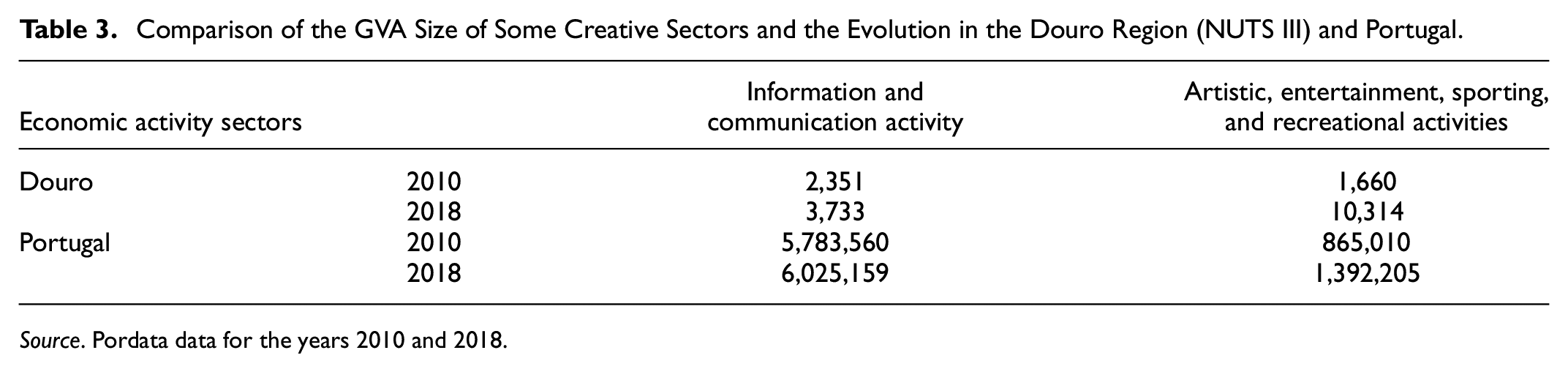
Source. Pordata data for the years 2010 and 2018.
Through Table 3, we can conclude that in some sectors of creative economic activity, from 2010 to 2018, there were significant increases in the GVA, and in turn, we can conclude that there was an increase in the contribution of these creative sectors to the economy. Figure 2 shows the creative areas by activity sector.

Distribution of creative areas by sector.
In this figure we can see that the creative sector that is most present in the Douro Region is Handicraft, with 13.3% of the total creatives. According to the results, we can also conclude that Architecture, with 12.8%, followed by Design and Music, with 12.5%, and Photography, with 9.9%, are then the main creative sectors with the highest incidence in this Region, with some variations from county to county.
The sectors called Others represent the Jewelry (1%), Gastronomy (1%), Radio (1.60%), Dance (1%), Fashion (1%), Publishing (3.3%), Software sectors (3.6%), Advertising (3.60%), Multimedia (4.90%), Theater and Circus (5.6%), Video (6%).
As for the distribution of the creative sector by Municipalities (Figure 3), we conclude that Vila Real has 39% of creatives, followed by the municipality of Lamego, with 15%, being the two municipalities with the highest number of creative industries. These two councils together have, according to the results, more than half of the creative agents in the region, and they are the two largest councils in the Region.

Distribution by municipalities.
The “others” (Figure 3) are the other municipalities in the Douro, including Peso da Régua, Sernancelhe, Armamar, Santa Marta de Penaguião, Moimenta da Beira, Torre de Moncorvo, Mesão Frio, São João da Pesqueira, Tabuaço, Penedono, Carrazeda de Ansiães, Vila Nova de Foz Côa, Alijo, Sabrosa, Murça, Sword Ash ash, and Tarouca, each presenting a percentage ranging from 5% to 1%.
Data Collection and Treatment
According to Benbasat et al. (1987) and Tuli (2011), data collection serves to obtain a set of information that addresses the topic under study and captures its contextual complexity. In this sense, primary data was obtained through individual and semi-structured interviews, conducted by a script with the questions for the study. The interviews allowed a more complete and spontaneous collection of answers through the interaction between the interviewer and the interviewee, thus avoiding problems related to the interpretation of the questions (Creswell, 2013).
The interview guide used in this study was divided into two parts. The first part includes questions to characterize the interviewees and the institutions they represented. In the second part, open-ended questions were asked about the creative industries, their obstacles, and the main difficulties of companies in this sector. In addition, the interview guide contained questions about the role of the creative industries in the sustainability of low-density territories, more specifically in the Douro region. The interviews were conducted from November 2020 to February 2021. They each lasted for an average of 20 min. Table 4 contains a brief profile of the participants.
Characterization of the Interviewees.

All the interview transcripts’ contents were systematically analyzed. NVivo 11.0 software was used to organize the data by source and codes in order to identify useful segments of information. The results were generated in the form of node trees, which label and separate into branches the relevant data in each interviewee’s responses. Word cloud analysis was carried out when answers had overly diffuse content or lacked the necessary components to form clear patterns, thereby overcoming any difficulties encountered while coding the content.
Results
Differences Between Creative and Non-Creative Companies
Creative industries have creative and innovative professionals, as they create activities and products with greater value and differentiators, compared to other non-creative industries (Daniel & Almeida, 2020; Dengler et al., 2018). According to Mikić (2020), creative industries have a greater social and economic contribution than non-creative ones, due to the rapid growth they have been showing. Almeida and Daniel (2021) state that creative companies increasingly promote the growth and development of territories, focusing on improvement and sustainability, thus implementing various improvement strategies.
In this context and according to the interviewees, the creative industries add greater value and implement changes in terms of development and growth of both the territories and the local economy, thus distinguishing themselves from other non-creative companies, as mentioned by some of the interviewed:
Interviewee CE5: “A creative company can reinvent itself, constantly evolve and create strategies to differentiate itself from other non-creative companies. […]” Interviewee CE4: “[…] The ease of continually adjusting to new times, new needs and at the moment we are in, if a company doesn’t reinvent itself, it doesn’t survive. […]” Interviewee LI2: “What distinguishes a creative company from a non-creative one is precisely the existence of this concept, creativity, complemented by innovation. […] Creativity in a creative company adds value to it, due to the ability to leverage products/services, implementing solutions that follow the paradigm shifts and needs of customers, while in non-creative companies the way of thinking is always the same, which does not leave the your comfort zone, there’s no stimulus to think differently.”
Main Obstacles in the Process of Creating a Creative Company
According to Madrid-Guijarro et al. (2009), a major obstacle in the creation process is immediately faced with the financial issue, due to the financing of the initial creative activity, namely in terms of taxes, bureaucracies with the initiation process, and due to areas related to management, because the lack of knowledge leads to huge costs in this area. On the other hand, creative companies face a scarcity of resources due to the qualification and costs of their activity, and they are more susceptible to labor (Vrgovic et al., 2012). They also present as an obstacle some economic risks, due to the creative activity being very expensive and risky (Madrid-Guijarro et al., 2009). Companies that will start an activity in the area of creativity may need some support, namely at a bureaucratic level and stability and initial funding (Mahn & Poblete, 2023).
Regarding the obstacles in the creation of the creative companies under study, Figure 4 presents some of the problems identified by the interviewees.

Main obstacles in creating a creative company.
According to the interviewees, the main obstacles in creating a creative company (Figure 4) are the lack of funding, the existing bureaucracy, the lack of qualified labor and the lack of management knowledge, as mentioned by some of the creative entrepreneurs interviewed:
Interviewee CE1: “Logistics, bureaucracies, paperwork, something is always missing, […].” Interviewee CE4: “The main obstacle in the process of creating my company was finding qualified labor.”
However, the interviewees, representatives of local institutions, report that the main obstacle is the lack of knowledge in management. As a rule, creative entrepreneurs are trained in areas quite different from management (e.g., multimedia, theater, communication, computing, among others) which enable them to be creative and to develop the business, but which limits them to the process of creation or management of a company.
Interviewee LI3: “[…] If the entrepreneur does not have knowledge, the only difficulty he will feel will be at the bureaucratic level, for example, having to immediately have expenses for opening the company, related, for example, to the accountant, which we have to hire if we do not have knowledge, and still without having an income, we started right away with mandatory monthly expenses.” Interviewee LI1: “The financial issue - Financing of the activity that allows you to create and that makes it possible to pay a monthly salary until the business starts operating and profitable.”
Main Difficulties/Needs of Creative Companies
Creative companies immediately present financial difficulties, making it difficult to reach the foreign market right away (Xie et al., 2010). According to Yulisettiarini et al. (2019), companies have management problems, due to the limited knowledge they have in terms of management, which consequently creates difficulties in product management, both in terms of the price to be defined and the quantity of production. Consequently, there are still difficulties related to sales and consequently in communication with customers (Zeleny, 2012).
Regarding the main difficulties of the creative companies under study, Figure 5 presents some of the problems identified by the interviewees.

Main difficulties of creative companies.
According to the interviewees, the main difficulties of a creative company (Figure 5) are mainly due to the lack of management knowledge. With the little knowledge that most have in the area of management, it is difficult to combat the initial costs of the project, and consequently the stipulation of the ideal price for the sale of the products they create, and the consequent increase in them. This factor also leads to inappropriateness regarding the size of stock they end up producing, as they end up not knowing how to manage the stock in relation to the sales they present. As these industries end up having creativity at their base, it is difficult for them to immediately position themselves in the market, and even manage to reach the foreign market, as they are new and unknown products in the market. Hence the difficulty in communicating with people who do not know such creativity, as mentioned by some of the interviewees:
Interviewee CE1: “[…] It’s a job very linked to sustainability, and sometimes it’s difficult to get to the client […]. Fortunately, we have achieved this through word of mouth because people are increasingly sustainable.” Interviewee CE3: “[…] i would say that the main difficulty is to raise the average price, that for us, who do not have a product, we are a service company, in this case design, so at the moment the biggest difficulty I would say is actually raising the price of services. We don’t have a lack of customers, we always have work. […] we feel there is some difficulty for people to realise the value that the work should have, sometimes people’s lack of sensitivity to realise that the work will require more time for research, development, and the price will have to rise.” Interviewee LI3: “I think that there is a main problem with the initial expenses, they may sometimes have difficulties in also being publicised in society and showing their business to society.” Interviewee LI1: “Issue of financing, market access and dissemination. Dimension to produce, scalability and the ability to access points of sale.”
Creative Industries in Low-Density Territories
Main Problems of Low-Density Territories (Douro Region)
Low-density territories have disadvantaged characteristics, including low population density and great demographic aging (Almeida & Daniel, 2021). According to Duxbury et al. (2011), low density areas have been affected over the years by several factors, especially by disqualification, impoverishment, aging, emigration, and depopulation. With regard to the main problems in the Douro region (low density territories), Figure 6 illustrates some of the problems identified by the interviewees.

Main problems in the Douro region (low-density territory).
According to Figure 6, low-density territories increasingly present high rates of aging population, and consequently low levels of young population, mainly due to the reduced number of specialized companies, and difficulties in accessing information, which creates consequently lack of employment for the population. As a result of the small local market and the territories being less and less industrialized, young people end up leaving the low-density territories and these end up having huge population losses, as mentioned by the interviewees:
Entrevistado EC1: “[…] On the coast, companies need more support to grow and move to other markets, while inland, companies need more support in business structuring, sales channels and/or logistics issues.” Entrevistado EC3: “The aging population, the lack of opportunities, for example, often a small regional cuisine in the interior of the country that wants to sell their products to a big city on the coast has serious transport difficulties. Lack of support from specialised companies in the territory.” Entrevistado IL1: “The depopulation of the territory makes the local market increasingly small and uninteresting for companies to operate […]. For example, in the Douro region it is very common for wine-producing farms to create their sales shops and their headquarters in the city of Porto.” Entrevistado IL2: “One of the main problems can be access to information. As a rule, specialized companies are located in large urban centers […] Sometimes entrepreneurs find it difficult to get information due to lack of knowledge […].”
The Contribution of Creative Industries to the Sustainability of the Douro Region
One of the solutions for low-density territories is to re-attract young people and, consequently, creative talents (Florida, 2002). Creativity is one of the main factors that lead to innovation, which distinguishes territories from each other and allows the valorization of local resources, thus contributing to the fixation of people, who seek alternative lifestyles (Selada et al., 2010).
According to Pick et al (2015), the coming of the creative industry to low-density media offers opportunities to diversify skills among the population, as well as attracting new residents. In this sense, it can become a sustainable solution and a stimulus for economic growth, for revitalization, thus reversing the trends of depopulation and desertification of inland areas (Florida, 2002). With regard to the contribution of creative industries to the sustainability of low-density territories, Figure 7 presents some of the solutions identified by the interviewees.

The contribution of creative industries to the sustainability of low-density territories.
According to Figure 7, creative industries can contribute to the sustainability of low-density territories (such as the Douro region) in various ways, namely, through the creation of employment and, consequently, the settlement of the population in the territory. In addition, the creative industries promote innovation, solutions for environmental balance and value endogenous products, recovering the region’s traditions. Consequently, the promotion of the local economy and the GDP increases, as mentioned by the interviewees:
Interviewee CE1: “Our company is concerned with developing environmentally friendly products that value the endogenous resources of our region […]. For example, we developed a soap based on donkey milk and aromatic plants from the region.” Interviewee CE2: “[…] give them a new look. Allow artisans who made a living from it to do it again. That we are not all doctors, that there are more jobs. I think so. Allow endogenous resources, local.” Interviewee LI2: “Any company that exists in the territory contributes to its development and economic sustainability. In the case of creative industries, this reality remains, since many of them use products from the region to elaborate their creations and innovative products (see the example of handicraft), contributing to the local economy, not only at an economic level. as well as in the guarantee of jobs and the consequent settlement of the population, since this is one of the major problems identified in low-density territories.” Interviewee LI1: “It contributes a lot. It has an impact on the national GDP, on productivity, in terms of hiring and business. During the crisis period, 2011, the creative sector was the only one that increased hiring. It’s the one where people have more training. The creative activity that adds value, that is, looks at the territories’ resources and add value. […] It is the only thing that can distinguish territories from each other, as it is not knowledge that moves, and contributes to the fixation of people.”
Discussion
The results showed that the low-lying territories present several challenges, such as the loss of population, aging, the lack of specialized companies, the high unemployment rate, among others, which is in line with the results obtained in several studies. (e.g., Marques et al., 2021; Matos Silva et al., 2022). These challenges tend to slow down any local development, so, when creatives arrive, they stimulate the surrounding region’s economy (Pick et al, 2015).
On the other hand, the results show that in the Douro region the creative industries have contributed to innovation, job creation, appreciation of endogenous products, population settlement, promotion of the local economy, and the recovery of ancient traditions. The results contribute to the theory of the creative class, which argues that creativity stimulates sustainable urban development (Betlej & Kačerauskas, 2021; d’Orville, 2019), through the promotion of innovation and creative occupations that are less intensive in resources (Felton et al., 2010). Furthermore, it can help cities to be successful in the global competition, reinforcing their position as places of reproduction of the “urban environment,” to attract and retain a certain group of people who make up the “Creative Class,” conceived as the source the latter of economic growth (Florida, 2012). In this sense, and based on the results of this study, we can say that the creative industries can be a solution for the development of low-density territories, as is the case of the Douro region.
It is consensual among the interviewees that the creative industries have played an important role, mainly in valuing the region’s endogenous resources, often with solutions for environmental and sustainable balance. According to Selada et al., (2010), people are increasingly looking for alternative lifestyles to those prevailing in large cities, prioritizing well-being associated with healthy eating, sports, environmental preservation and sustainable community, and local identification.
As a rule, creative industries face certain obstacles when they are created (Xie et al., 2010). A good example of this is financing, in which the creative industries have large initial investments with bureaucracies, mainly due to not having great knowledge in the area of management.
However, these industries, by overcoming their obstacles and difficulties, bring a great contribution to these low-density territories, since creativity is an indicator that distinguishes the territories from each other and allows solutions to be provided for the environmental balance (Seleda & Tomáz, 2010). The creative industries thus have a key role in these regions’ growth and contribute over time to more people settling there due to the greater availability of jobs and companies. These industries can ensure low-density regions’ businesses are more fully prepared to deal with external markets and encourage greater innovation.
Conclusion
With the aim of this study to understand the role of the creative industry in the sustainability of low-density urban territories, interviews were conducted with entrepreneurs from creative industries and incubators in the Douro Region. The results indicate that the creative industries are vitally important to these areas because creatives foster increased local development even when opportunities are restricted and resources are scarce, thus in line with what is advocated by the theory of creative classes. The emergence of creative companies automatically creates a greater number of jobs, combating the desertification of these media and the unemployment rate, which in the medium and long term will result in the settlement of people in the territories and the increase in the population’s purchasing power, thus contributing to a solution for the local economy.
The results also suggest that it is possible to recover or reinvent the territories’ traditions, that is, old creative works that until then were in disuse, making endogenous products appreciate, thus allowing to create opportunities and create value through innovation.
Despite being consensual that the creative industries can contribute to the development of low-density territories, the interviewees mention that creative companies have several difficulties, namely, financially, lack of management knowledge, difficulties in defining the price of the product /service, sales, communication with customers or business scalability. As a rule, creative entrepreneurs focus too much on product/service design and end up giving less attention/importance to other issues.
This study brings two important theoretical contributions to the existing literature. Firstly, it shows how the creative industries can contribute to the sustainability of a low-density territory. Our findings show that the creative industries, in addition to creating new jobs and retaining young people in the region, can also reinvent traditional products and enhance the region’s endogenous resources with environmental concerns. Second, this study contributes to the development of the theory of creative classes with some empirical results.
Regarding the practical implications, this study shows that public policies to encourage creative industries are important, in order to create aid in initial financing and introduce national and regional actions that involve and create opportunities for both the creation of companies and the creation of jobs. In addition, this study contributes to highlighting the importance of creative industries in low-density territories, providing more information and evidence on the role of creativity and this sector of creative companies, as well as on the influence of creative entrepreneurs on the region’s development.
This study was not without limitations. In this domain, it is highlighted the fact that the results can be interpreted in several ways, that is, the first limitation is related to subjectivity, despite having taken every precaution to reduce this limitation, qualitative studies always present some subjectivity in the analysis of results and in the coding and categorization system of interviews. Another limitation is related to the fact that a small territory was studied, applied to a single country, since the ideal would be to apply this study to the whole of Portugal and to other countries in order to validate the results obtained.
With regard to further investigations, it would be important to compare the various low-density territories throughout the country, in order to find more complete and ideal results. Another limitation is the fact that only one territory was studied, applied to a single country, since the ideal would be to apply this study to the entire Portuguese territory and to other countries to validate the results obtained.
Footnotes
Declaration of Conflicting Interests
The author(s) declared no potential conflicts of interest with respect to the research, authorship, and/or publication of this article.
Funding
The author(s) disclosed receipt of the following financial support for the research, authorship, and/or publication of this article: This work is supported by national funds, through the FCT—Portuguese Foundation for Science and Tec04011/04011/2020.

Data Availability Statement
The first author will supply the relevant data in response to reasonable requests.