




Abstract
The role that higher education plays in the promotion of sustainable development outstands in the declarations on Education for Sustainable Development (ESD), besides being a research priority in higher education. However, few studies exist that evaluate sustainable lifestyles among university students. The aim of this study was to analyze the mission and vision, processes and actions undertaken to promote sustainability in higher education institutions, and to compare the pro-sustainability orientation (PSO) reported by 360 students coursing first or last semesters at college. The study was intended to evaluate the influence that four higher education institutions in Sonora, Mexico, have on students’ PSO. Results of the study indicate that a coherent PSO factor emerges from the interrelations among pro-environmental dispositional and behavioral variables reported by students. However, university programs and actions do not produce statistically significant differences between freshmen and senior students. Possible reasons explaining the lack of positive influence of those universities on students’ PSO are discussed.
Keywords
Introduction
Following the 1992 Earth Summit Declaration, the concept of Education for Sustainable Development (ESD) inspired diverse educational practices and policies (Wals, 2009; Wright & Pullen, 2007). A number of universities incorporated the goal to educate with a global vision for the present and the future into their traditional functions; such a vision is implicit in sustainability (Cortese, 2003, Gough & Scott, 2007).
After a literature review of relevant experiences at universities, Karatzoglou (2012) identified prevailing methodological approaches and two areas of interest: theoretical articles and successful case studies related to sustainability. In the case of theoretical papers, the author noticed shortcomings in the use of rigorous conceptual frameworks and criticized the descriptive nature of case studies that can be inspiring for future actions. According to him, those approaches do not contribute to the development of theory. Previous to that, Corcoran, Walker, and Wals (2004) and Fien (2002) reached a similar conclusion (see also Barth & Rieckmann, 2016; and Kyburz-Graber, 2016, for recent reviews on this topic).
This study offers a vision that has been proven in common population, denominated pro-sustainability orientation (PSO), as a contribution to the lack of evaluation in ESD.
Other authors suggest the pertinence of the “Social Learning” concept (Sterling & Thomas, 2006); a condition that Hansmann (2010) established as a prerequisite for sustainability learning. One additional concept is “Eco-pedagogy Call,” suggested by practitioners in the field of environmental education at all educational levels (Antunez & Moacir, 2005; Gutiérrez & Prado, 2004). In addition, Competencies for Sustainable Development are identified and, according to a number of authors, those should be operationalized and promoted in higher education contexts (De Haan, 2010; Juárez-Nájera, 2016; Rieckmann, 2012; Wiek et al., 2016). Similarly, the notion of Competence for Sustainability (CS) is proposed from the perspective of conservation psychology. Corral-Verdugo (2010) and Fraijo, Tapia, and Corral-Verdugo (2014) defined CS as the set of effective and deliberate actions aimed at the protection of the natural and sociocultural resources needed to guarantee the present and future well-being of humanity. In turn, Wals and Schwarzin (2012) conceptualized such competence as skills and qualities of people, their organizations and communities, which are used to address the challenges of sustainability. It would be useful to recognize that “competency” is used indistinctly to refer either to (a) a pro-sustainable strategy used by a person in his or her overall life or (b) knowledge and skills that education programs provide to graduates to successfully act in the labor market. Clearly, education as sustainability (EAS) should go beyond the provision of competencies for professional activities, so that EAS is the kind of competency that should be developed in higher education (Wiek, Withycombe, & Redman, 2011).
In a related vein, Barth, Godemann, Rieckmann, and Stoltenberg (2007) argued that education and learning are key pieces for achieving sustainable development (SD). In this regard, participative methods are most effective for change in values among university members (Ferrer-Balas et al., 2010), also for the instigation of social norms that influence the adoption of sustainable lifestyles (Corral-Verdugo, Tapia-Fonllem, Fraijo-Sing, Mireles, & Márquez Ulloa, 2008), and the promotion of universal values, anticipation of future consequences, responsibility, and even intelligence (Juárez-Nájera, Dieleman, & Turpin-Marion, 2006).
However, according to some scholars, in spite of those proposals and theoretical advances, the role of higher education in the search for sustainability is an enigma (Fonseca, Macdonald, Dandy, & Valenti, 2011). Wright and Pullen (2007) noticed that published papers on sustainability and higher education are dominated by studies of education for sustainability, ecological of physical operations, university policy, and case studies. The curriculum design that includes sustainability issues constitutes one of the preferred practices of universities (Barth & Rieckmann, 2012; Cusick, 2008; Desha, Hargroves, & Smith, 2009; Doniec, 2006; Kagawa, 2007; Lozano, Lukman, Lozano, Huisingh, & Lambrechts, 2011; McMillin & Dyball, 2009).
Disarticulated efforts are centered on environmental-physical aspects (i.e., conservationism) and eco-efficiency, while others consider the inclusion of sustainability topics into the curriculum and in research projects (Shephard, 2016). The social aspects of sustainability (equity, cooperation, altruism, justice, etc.) are practically neglected in those efforts, and the integration of research, teaching, and practice of pro-sustainability aspects is absent. Given this scenario, it is necessary to define indicators of sustainability in the higher education context, specify assessment and interventional tools, and determine links among sustainability teaching, research, and practice to grasp the effectiveness of higher education contributions to sustainability (Clugston & Calder, 1999; Fonseca et al., 2011; Shriberg, 2004). The research field on sustainability in higher education is relatively new and emergent (Wright, 2010). A definition of sustainable university is necessary to guide such effort.
Considering the above discussed, the present study aims to
Identify the discourse and programs of action regarding ESD at Universities in a Mexican region.
Specify and test a model of PSO in university students.
Compare levels of PSO between freshman and senior students.
The study intends to contribute the discussion of the role played by universities in the development of more sustainable-oriented societies. Having that aim in mind, we propose that an important component of that role is achieving a modification in students’ orientation toward sustainability. A pro-sustainably oriented student would exhibit predispositions and behaviors resulting in the conservation of the sociophysical environment. Accordingly, a pro-sustainably oriented university will increase the levels of predispositions and behaviors resulting in the conservation of the sociophysical environment.
Theoretical–Methodological Approaches for Intervention
Sterling (2001) identified three main educational approaches to sustainability: Education about sustainability, which emphasizes on learning that is content/knowledge based. This approach assumes that the meaning of sustainability is already identified within the dominant paradigm, and that it can be taught as a separate subject. Education for sustainability is the second approach; its focus is on learning for change and includes content but goes further to incorporate values and capability bias. Educators in this approach assume that they know what values, knowledge and skills are needed to promote sustainability. The green movement of schools is mainly located here, according to Sterling. The third approach, education as sustainability, is based on a holistic and dynamic view of people–environment interactions. It focuses on process and quality of learning, which is characterized as creative, reflective, and participative. SD or “sustainable living” is conceived as a learning process. This approach is the most difficult to achieve at universities, because it has a conflict with existing structures, values and methodologies. Our approach is more closed related to the EAS view. This is the sort of education that should be expected from higher education institutions.
In this sense, there have been efforts from the novel field of conservation psychology (also known as psychology of sustainability) on theoretical approaches that enable the identification of constructs that refer to the PSO of general population (Corral-Verdugo et al., 2008) and university students (Tapia-Fonllem, Corral-Verdugo, & Fraijo-Sing, 2017). The emerging models are shaped by diverse psychological dimensions such as pro-environmental deliberation (PED), appreciation of nature (AON), affinity towards diversity (ATD), pro-ecological behavior (PEB), equity, frugality, and altruism, among others. This field contributes with methods and models that asses the way a sustainable lifestyle might influence human well-being without deteriorating the environment. Under this approach, sustainable behaviors (SBs) are conceived as actions contributing to the quality of life of present and future generations without sacrificing the biosphere’s resources (Tapia-Fonllem et al., 2017). Furthermore, the way conservation psychology addresses environment—behavior issues is by studying pro-social and PEBs, because environmental problems affect both physical and social aspects. Therefore, most of the conservation psychology approaches include the holistic and dynamic view of people–environment interactions that Sterling (2001) saw as defining features of EAS. Yet, a number of conservation psychology researchers still focus only on the study and promotion of PEB, which is conceived as a set of human activities that intend the protection of natural resources and the reduction of environmental degradation (Hess, Suárez, & Martínez-Torvisco, 1997). According to Corral-Verdugo and Pinheiro (2004), the social environment and, therefore, the human needs are not considered in a specific way as potential impacts of PEB. The interaction of social and bio-physical dimensions of sustainability, and the holistic and dynamic nature of people–environment interactions are absent in this limited vision.
To define PSO, it is necessary to demarcate the terms “orientation” and “sustainability.” The Oxford Dictionary (2015) defined orientation as the relative position or direction of something. Tapia-Fonllem et al. (2017) defined sustainability as a concept that can be understood in two ways: as the possibility of continuity or, in its ecological meaning, as the maintenance of the ecological base of Humankind within a time structure, indicating concern for the present and future. This way, PSO can be considered a favorable position regarding the conservation of resources to ensure their continuity. Corral-Verdugo et al. (2008) established that the factors shaping PSO are personal and they include predispositions to act (PED) and emotions (AON, ATD). PED is indicated by a person’s intention to protect the environment; AON manifests as a pleasure for the contact with plants, animals, and nature in general, while ATD implies liking differences in the constitution of the sociophysical environment. In Corral-Verdugo et al. model, PSO positively affects the practice of SBs: actions aimed at protecting the natural and social resources required for humankind’s survival. Figure 1 is a representation of the system of relations wherein PSO emerges. In this system, AON, PED, and ATD constitute the PSO factor, which, in turn, influences the practice of SBs. SB integrates the practice of pro-ecological, frugal, altruistic, and equitable behavior (EB). In this sense, a pro-sustainably oriented person not only exhibits behavioral predispositions toward sustainability but also engages in pro-social and pro-environmental activities.

The hypothetical model of the pro-sustainability orientation.
In Figure 1, AON1 to AO3 represent specific indicators of AON (for instance, pleasure for contact with plants, liking contact with animals, pleasure for contact with non-built environments); PED1 to PED3 indicate particular instances of PED (for instance, willingness to pay for protecting ecosystems, intention to recycle, intention to assist people in need). ATD1 to ATD3 are indicators of ATD (for instance, liking diversity of gardens’ plants, liking the existence of diverse political orientations, preferring landscapes with diversity of animals); FB1 to FB3 indicate frugal behaviors (reuse of clothing, decreasing waste of products; decreasing unnecessary consumption of food). In turn, PEB1 to PEB3 are pro-ecological practices (ecosystems conservation, avoidance of pollution, water conservation); and EB1 to EB3 indicate EBs (treating equally the poor and the rich, sharing house chores with family members, fairly distributing resources). Finally, AB1 to AB3 represent altruistic behaviors (assisting people in need, donating blood, contributing to the Red Cross).
Thus, the psychological aspects of sustainability consider the profile of a pro-sustainably oriented individual, who possesses pro-environmental predispositions and engages in altruistic, frugal, equitable, and PEBs. PSO is inferred from variables previously studied in general and university populations (Corral-Verdugo et al., 2009; Corral-Verdugo et al., 2008; Tapia-Fonllem, Corral-Verdugo, Fraijo-Sing, & Durón-Ramos, 2013). In addition, our contributions have recently been the subject of reflection and study in the understanding of the relation of psychological rules of behavior and indicator of sustainability in higher education students in Peru (García et al., 2015) and South Korea (Choi, 2016).
The present study suggests an assessment methodology of PSO levels in university students, measuring behavioral and attitudinal indicators related to SB and the possibility of comparing between two groups: students taking course in their first or last semesters, as a criterion to determine the role that universities play in students’ integral formation, with the direct or indirect implication with SD. The study is aimed at assessing the PSO of university students from four public higher education institutions in Sonora, Mexico. To identify a possible effect of curricular and programmatic actions on PSO, we proceeded to evaluate significant statistical differences in PSO between the two abovementioned groups. The different components of PSO will be described up next.
The following collection of scales that forms the PSO and SB have been tested from the ideas Corral-Verdugo and Pinheiro (2004) did and that can be identified in various studies over a decade; below, the variables that have finally offered the greatest explanatory power and sustained its validity are presented. Tapia-Fonllem et al. (2017) found a historical review of the evolution of these constructs.
SB
SB is considered a set of actions aimed at protecting the sociophysical resources of our planet (Corral-Verdugo, Frías-Armenta, & García-Cadena, 2010). This kind of behavior is future-oriented, as it considers the needs of future generations in addition to meeting present needs (Bonnes & Bonaiuto, 2002). SB includes pro-ecological, altruistic, frugal, and equitable actions (Tapia-Fonllem et al., 2013). Some researchers argue that SB is effective (i.e., problem solving) and deliberate (i.e., oriented toward the conservation of resources). It demands an active protection of natural and human resources that have the same importance as the conservation of natural ecosystems (Bonnes & Bonaiuto, 2002).
PEBs
The effective and purposeful actions that result in the conservation of natural resources are known as PEBs (Corral-Verdugo, Frías-Armenta, & García-Cadena, 2010). To assess this kind of behavior, Kaiser (1998) proposed the General Environmental Behavior (GEB) scale, which includes the self-report of actions such as ecosystem conservation, water conservation, recycling, reading about environmental topics, pro-ecological design of buildings, among many others (see also Baasell-Tillis & Tucker-Carver, 1998; Suárez, 2008).
FBs
FB can be described as actions opposing consumerism (Jackson, 2008), and they may implicate a sustainable lifestyle characterized by the reduction of unnecessary consumption, which results in lessening the human impact on the availability of natural resources (De Young, 1996; Iwata, 2002). Among the results of instruments developed to asses this kind of behaviors, a correlation between FBs and PEB and its determinants is noticed (Corral-Verdugo et al., 2008; De Young, 1996; Iwata, 2002; Jackson, 2008).
ABs
Altruism is considered a predisposition to increase someone else’s benefits with little or no interest in gains for oneself; also as a state of motivation to maximizing others’ well-being (Batson, 1991). Actions such as providing money, time, and assistance to people in need are considered instances of AB. The Norm Activation Model is a theoretical approach that outstands a relationship between SBs and altruism (Gärling, Fujii, Gärling, & Jakobsson, 2003; Joireman, Lasane, Bennett, Richards, & Solaimani, 2001).
EBs
EB denotes treating other persons in a fair way, avoiding bias and discrimination. It also considers a just distribution and allocation of resources and the empowerment of people, so that existing differences in income, educational opportunities, and access to services tend to disappear. A psychological measure for this behavior was produced in the study by Corral-Verdugo, García-Cadena, Castro, Viramontes, and Limones (2010), which revealed a significant relationship between sustainable lifestyles and equitable actions.
Correlates of SB
Some factors associated with SB antecede its occurrence, while others are consequences of this behavior. Correlates such as demographic (age, gender, education, etc.) and psychological variables (deliberation, ATD, AON, etc.) related to the effort of pro-environmental behavior have been studied as antecedent factors of SB (Bamberg, 2002; Corral-Verdugo et al., 2009; Kals, Schumacher, & Montada, 1999).
PED
Deliberation has been studied as a willingness to sacrifice oneself in favor of the environment (Iwata, 2002), act in a pro-environmental way (Bamberg, 2002), and pay for the conservation of the integrity of the environment (Nixon, Saphores, Ogunseitan, & Shapiro, 2009), which help achieve sustainability ideals. Deliberation is considered a crucial component of SB (Corral-Verdugo, García-Cadena, et al., 2010).
ATD
ATD is defined as an inclination to prefer and like variations in the sociocultural and bio-physical scenarios of human life. Individuals display preference for environments with diversity and complexity. Some of the diversities that people face are physical such as weather, sociocultural (religion, ethnicity, etc.), and biological (plants and animals). ATD predicts SB according to some studies, which also show a link between biological diversity and preference toward sociodiversity (Corral-Verdugo et al., 2009).
AON
AON is an emotional dimension indicating being pleased by contact with plants, animals, and the non-built environment. This factor reflects pleasurable emotions such as joy, serenity, well-being, and positive mood due to exposure to environments containing natural characteristics or that are entirely or almost entirely natural (Kals, 1996). It has been documented that being exposed to nature produces restorative effects on physical health, improves attention on the performance of cognitive tasks, and induces emotional well-being. It can also generate a state of emotional affinity which in turn leads to concern for the environment (Kals et al., 1999).
Method
Participants
This research was conducted in two phases. The first was a brief review of offerings of universities relevant to sustainability issues. This review considered a description of strategic goals, mission, institutional visions, and extracurricular programs promoting ESD of four public universities at the State of Sonora, Mexico.
The second phase of the research consisted of the evaluation of PSO in students, which involved a quantitative analysis, having as participants 360 students of those four institutions: University of Sonora (UNISON), Technological Institute of Agua Prieta (TIAP), Technological Institute of Hermosillo (TIH), and Technological Institute of Nogales (TIN). These universities were chosen because they are among the most important higher education institutions in the Sonora state, due to their characteristics of tuition coverage, diversity of their educational offerings regarding sustainability (Table 1), and geographic location.
Offers From Leading Universities Regarding Sustainability Issues in the State of Sonora.

Institutional missions and visions committed to sustainability.
Subjects within the curriculum promoting Education for Sustainable Development.
Research Instruments were administered to 90 students per institution who were coursing in that moment, specifically the first (freshmen) or the last semesters (seniors) of their careers; 55.7% were men and 44.3% were women, oscillating between 18 and 42 years with a mean age of 21.51 years, and belonging to psychology programs 22.6%, industrial engineering 19.6%, administration 17.8%, public accountant 11.1%, electrical engineering 9.3%, informatics 5.9%, mechatronics 5.6%, civil engineering 4.8%, mining engineering 1.5%, and the careers of marketing, finance, and social work with less than .5%. Only 90 students per university were selected because in some schools, this was the number of students enrolled in a class (and a particular career). Therefore, this was the number to match in the rest of the higher education institutions.
Instruments
The used instrument to assess PEB was Kaiser’s (1998) General Ecological Behavior Scale. We utilized 16 items of this instrument, which includes the report of actions such as reuse, recycling, energy and water conservation, and so on. These are assessed in a 0 (never) to 3 (always) scale. Frugality was self-reported considering 10 actions such as buying the strictly necessary, the reuse of clothing, taking meals at home, and so on, which were reported using a 5-point Likert-type options of response (0 = totally agree to 4 = totally disagree); this instrument was designed by Corral-Verdugo et al. (2008), producing indication of validity and reliability. We also utilized a scale assessing altruistic actions, consisting in the self-report of 10 behaviors aimed at assisting or helping others, such as visiting sick people, economically helping the poor, supporting the Red Cross, and so on. Corral-Verdugo et al. (2008) reported the use of this scale, providing indications of validity and reliability; the scale uses a 4-point response–option format (0 = never to 3 = always engage in such an action). Equity was measured with a scale also developed by Corral-Verdugo et al. (2008), which included seven items indicating behaviors such as providing equal educational opportunities for girls and boys, and treating the rich and the poor as equals, and so on, using response options from 0 (totally disagree) to 4 (totally agree). Six items from a scale of intention to act (PED) developed by Corral-Verdugo et al. (2008) were also included. They assessed respondent’s willingness to engage in behaviors such as recycling, participating as volunteer in conservationist actions, and the intention to be involved in water conservation behaviors. Participants responded to these items by considering a four-option scale ranging from 0 (never) to 3 (always). A .80 alpha was previously reported from administering this instrument. ATD was measured through 14 items taken from Corral-Verdugo et al. (2009). The ATD scale encompassed items indicating preference for physical (weather, landscape) and biological (plants, animals) diversity, as well as human (ethnic, gender), and social (religious, social class, political) diversity. Responses ranged from 0 = does not apply to me, 1 = it almost does not apply to me, 2 = it partially applies to me, to 3 = it totally applies to me. The scale of Appreciation of Nature assesses positive emotions resulting from contact with nature. It is scored with response options ranging from 0 = nothing applies to me to 3 = applies completely to me. Corral-Verdugo et al. (2009) reported an alpha of .62 for this instrument, as well as evidence of concurrent validity. The items of all scales are presented in Tables 3 through 9.
Procedure
On a first stage, a qualitative analysis was conducted to review the curriculum of the different universities in Sonora emphasizing the importance of the promotion of ESD in their educational programs. During the quantitative phase, the instrument was administered at the participants’ classroom. They were debriefed by telling them the purpose and aims of the study and their informed consent to participate was obtained. None of them refused to cooperate with the study. The administration of the scales took about 15 min. Results were analyzed using univariate statistics (means, standard deviations, and frequencies). The internal consistency of the scales was also analyzed for calculating their Cronbach’s alphas. The t tests were used to determine whether the groups were significantly different from each other. A structural model of PSO was specified and tested using the Structural Equations (EQS) software (Bentler, 2006). The specified model was the one depicted in Figure 1. The purpose of testing this model was to empirically demonstrate the presence of a coherent PSO factor subjacent to the behavioral propensities and pro-sustainable practices of the studied participants.
Results
Review of Offerings of Universities Relevant to Sustainability Issues
TIAP
The Technological Institute of Agua Prieta assumes in its mission a commitment with society and the environment, not explicitly mentioned as SD. As for its vision, the TIAP stipulates sustainability as a goal to achieve. However, this institution does not detail any process and/or extracurricular action that allow the fulfillment of this vision. TIAP offers six engineering careers and two degrees, within which SD is compulsorily taught, varying its curricular occurrence between the II and VII semesters. No elective subjects related to the sustainability topic are offered.
TIH
Within its mission, this university is committed to sustainability, and as part of its vision, refers only to its interest for society. In addition, the Institute pays special attention to ecological conservation, praising as one of its core values that govern its academic community.
The academic offering presented by TIH includes eight engineering programs and two degrees. SD is incorporated as an obligatory subject in the 10 educational programs. This institution does not offer optional subjects that correspond to sustainable education.
TIN
Neither SD mission nor vision is considered in its discourse. This institution proposes to train students committed with both society and the environment, yet it does not conduct extracurricular programs seeking that purpose. Three degrees and six engineering programs are taught, which incorporate SD as compulsory subject. As in the above described two cases, no electives in the field of sustainability are offered.
UNISON
Both mission and vision of the University of Sonora keep in mind the concept of sustainability; also it has an Institutional Program for SD which regulates extracurricular activities and inter-institutional operations. It also obtained an environmental certification (ISO 14001: 2004).
The University of Sonora offers a total of 44 different degrees and engineering programs; 11 of them demand their students to course a compulsory subject related to environmental aspects as part of their academic training. There are optional subjects within 16 training programs, chosen by students, which involve education toward SD: Urban and Environment Management, Environmental Psychology, Environmental Law, Environmental Management, Sustainable Development, Ecology, Environmental Education, Natural Resource Management, and responsible utilization of water. However, no obligatory or optional subjects involving training on sustainability are incorporated in 25 educational programs (56% of the educational offering).
This review seems to indicate, that, in the best case, these higher education institutions are aimed at providing education for sustainability. This approach is incorporated in the universities’ curricula in terms of content, values, and capabilities, oriented to educate students as environmentally responsible individuals. Yet the extent of this approach’s influence on students’ PSO results imprecise from this review. Moreover, the review documents do not provide information regarding specific content and pedagogy related to education for sustainability programs in these institutions.
Evaluation of PSO in Students
Table 2 exhibits the correlation matrix of the measured variables and their internal consistencies. The Cronbach’s alpha values in all used scales resulted appropriate, indicating an acceptable reliability of the instruments. Overall, the correlations go from moderate to low, but statistically significant.
Univariate Statistics and Interrelations Among Variables of Pro-Sustainability Orientation.

Note. n = 360; PEB = pro-ecological behavior; FB = frugal behavior; AB = altruistic behavior; EB = equitable behavior; PED = pro-environmental deliberation; ATD = affinity towards diversity; AON = appreciation of nature.
p < .05. **p < .001.
Tables 3 through 9 exhibit the univariate statistics of the used scales. Each table presents the general means and standard deviations by item and university.
Univariate Statistics of the Pro-Ecological Behavior Scale.

Note. n = 360. TIN = Technological Institute of Nogales; TIAP = Technological Institute of Agua Prieta; TIH = Technological Institute of Hermosillo; UNISON = University of Sonora.
Univariate Statistics of the Frugality Scale.

Note. n = 360. TIN = Technological Institute of Nogales; TIAP = Technological Institute of Agua Prieta; TIH = Technological Institute of Hermosillo; UNISON = University of Sonora.
Univariate Statistics of the Altruism Scale.

Note. n = 360. TIN = Technological Institute of Nogales; TIAP = Technological Institute of Agua Prieta; TIH = Technological Institute of Hermosillo; UNISON = University of Sonora.
Univariate Statistics of the Equity Scale.

Note. n = 360. TIN = Technological Institute of Nogales; TIAP = Technological Institute of Agua Prieta; TIH = Technological Institute of Hermosillo; UNISON = University of Sonora.
Univariate Statistics of Pro-Environmental Deliberation.
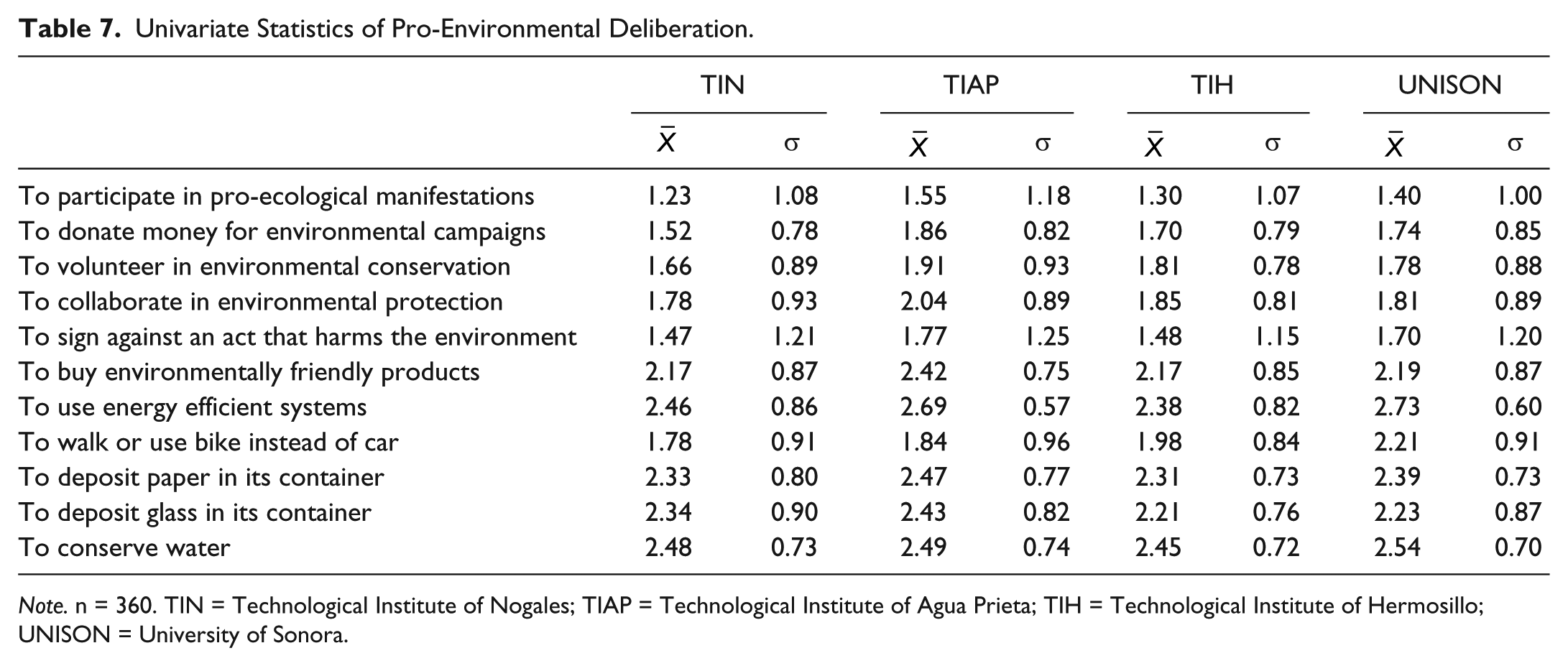
Note. n = 360. TIN = Technological Institute of Nogales; TIAP = Technological Institute of Agua Prieta; TIH = Technological Institute of Hermosillo; UNISON = University of Sonora.
Univariate Statistics of Affinity Towards Diversity.

Note. n = 360. TIN = Technological Institute of Nogales; TIAP = Technological Institute of Agua Prieta; TIH = Technological Institute of Hermosillo; UNISON = University of Sonora.
Univariate Statistics of Appreciation of Nature.

Note. n = 360. TIN = Technological Institute of Nogales; TIAP = Technological Institute of Agua Prieta; TIH = Technological Institute of Hermosillo; UNISON = University of Sonora.
In synthesis, the means of the scales reflect moderate values in PEBs (1.79, rank: 0-3), Frugal Behaviors (2.51, rank 0-4), Altruistic Behaviors (1.83, rank 0-3), Equitable Behaviors (3.21, rank 0-4), Pro-Environmental Deliberation (2.04, rank 0-3), and Affinity towards Diversity (1.94, rank 0-3). The highest values were produced on Appreciation of Nature (2.42, rank 0-3).
Figure 2 exhibits the results of the tested structural equation model. Three parcels (represented as squares in this figure) were used as indicators for each first-order factor (i.e., AON, PED, ATD, PEB, FB, AB, EB, which are represented as ovals). Those parcels, in turn, were computed from the responses to the items in the research instrument. High and significant (p < .05) factor loadings between each first-order factor and their corresponding parcels resulted, indicating construct validity. PSO was a higher order factor computed from high and significant interrelations among the first-order factors of AON, PED, and ATD). Similarly, the higher order factor of SB was constructed from the interrelations among the pro-ecological, frugal, altruistic, and EB factors. The estimation of the relationship between PSO and SB revealed a significant (p < .05) influence of the former on the latter (structural coefficient = .77). The practical goodness-of-fit indicators Bentler Non-Normed Fit Index (BNNFI) and comparative fit index (CFI; > .90) and the root mean square error approximation (RMSEA) value (.05) support the adequacy of the hypothetical model. PSO explains 59% of variance in SB.

Results of the pro-sustainability orientation model.
Table 10 presents the values obtained from the t student tests in comparing the four variables that integrate the SB construct. The comparison contrasted the freshmen and senior student groups regarding pro-ecological, frugal, equitable, and ABs. Students about to finish their university training at all universities produced higher means than freshmen. Yet this difference is not statistically significant. One exception is the EB variable, which produced a significant difference favorable to students at the University of Sonora, but, unexpectedly, higher among freshmen.
Results of t Tests Comparing Student Groups on Levels of Sustainable Behaviors.

Note. TIN = Technological Institute of Nogales; TIAP = Technological Institute of Agua Prieta; UNISON = University of Sonora; TIH = Technological Institute of Hermosillo.
Table 11 shows the results from the tests comparing the levels of PSO dispositional factors, by group/university. Again, no statistically significant differences were obtained between the students coursing their first year in university and those about to finish, except for, once again, the freshmen in the University of Sonora who stood out with higher means than those soon to graduate in the affinity towards diversity and appreciation of nature variables.
Results of t Tests Comparing Student Groups on Levels of Correlates of Sustainable Behaviors.

Note. TIN = Technological Institute of Nogales; TIAP = Technological Institute of Agua Prieta; UNISON = University of Sonora; TIH = Technological Institute of Hermosillo.
Conclusion
This article discussed the need of evaluating the impact that higher education has on the pro-environmental orientation of students, which in this case was assessed with seven scales addressing psychological dimensions of sustainability: PEB, FB, AB, EB, PED, ATD, and AON.
A battery of scales was administered to groups of students with the aim of identifying a PSO factor. PSO was specified in a structural model as a latent variable emerging from interrelations among a series of dispositional variables that the relevant literature identify as indicators of this orientation: AON, PED, and ATD. The model also included a SB factor, indicated by pro-ecological, frugal, altruistic, and EBs. The testing of this model revealed that these two higher order coherently emerged from their indicators. PSO highly and significantly influenced SB. This finding can also be interpreted as SB being part of PSO (i.e., SB, altogether with AON, PED, and ATD are indicators of a more general PSO). The model produced goodness of fit, which indicates that the data support the pertinence of PSO as a coherent construct. The elements constituting PSO were subsequently used as measure to contrast between freshmen and senior students. A significant difference in PSO was expected, in favor of those students about finishing their studies, evidencing a positive influence of universities’ programs and activities in favor of sustainability.
Results from our study indicated that at the four Mexican universities studied, it was possible to identify some efforts aimed at implementing ESD programs. Such programs attend the international claim of linking universities with SD. Those efforts include SD as an obligatory subject on three out of the four studied universities, a pro-sustainable vision within all those universities and the presence of general and specific SD courses within the curriculum.
The assessment of the elements of PSO in freshmen students and those about to finish their training at the four analyzed universities revealed that, even though the seniors’ means were higher than those of freshmen in the dimension of PEB, frugality, and altruism, the differences were not statistically significant. Something similar occurred in regard to AON, PED, and ATD. This seems to indicate that the universities’ academic actions have not been enough to cause an impact on the orientation toward sustainability that their students possess. This is reflected in the comparison of means between groups and universities when, overall, freshman and seniors maintained results showing no significant statistical differences.
In spite of the fact that there were no statistically significant differences between groups, contrast to the variables of the PSO and SB constructs, it indicates the levels that reach the students are not the result of actions of education pro-sustainability that make universities; this evidence is not sufficient to determine an inefficiency in the ESD programs, in any case it suggests that every action or institutional policy for sustainability must correspond to their own goals and objectives, liable to evaluation.
In contrast to the results of Lozano and Young (2012), who evaluated the study plan of the University of Leeds that approaches and incorporates SD in their curriculum, and reported no impact of the implemented programs and policies. Future research has to be conducted to explain the reasons behind the ineffectiveness of current measures aimed at developing a sustainable orientation in university students; the difference is that these authors defined evaluation indicators congruent to ESD design strategies of their own University. Our PSO tool does not have a scope on the particularities of higher education.
In terms of exposure to ESD materials and experiences, there seems to be differences for the students at their different universities and in their different programs. In spite of these differences (especially in the case of SD as an obligatory subject), we aggregated results from the assessment of PSO levels within a single model of PSO, regardless of university of origin. Although such aggregation provides data variability, we are aware that the existing differences between universities could have influenced the models’ results and comparisons between freshmen and those about to finish their education. This aspect is a limitation that has to be considered in future evaluations of PSO at universities.
One additional aspect to consider in future studies is the inclusion of appropriate theoretical approaches (Karatzoglou, 2012), which can be used to evaluate the impact of universities on the sustainable lifestyles of their students. In this article, we propose the use of PSO, a construct identifying a general disposition to engage and maintain environmentally protective practices. Such orientation considers not only the need of protecting the physical milieu but also the need of conserving the social environment, which corresponds with the notion of SD commonly accepted (World Commission on Environment & Development, 1987). Yet, more theoretical approaches of this type are needed to evaluate the influence of higher education on pro-sustainable attitudes and behaviors. Examples of those approaches include the idea of developing students’ competencies for sustainability (Rieckmann, 2012); the approach that combines knowledge, values, and attitudes to promote SB (Kaiser, Wölfing, & Fuhrer, 1999); the Reasonable Person model, which includes the circumstances that help bring out the best in people through model building, meaningful action and effectiveness (Kaplan, 2000); among many others.
One limitation of our study is that it only considered the self-report of pro-sustainable predispositions and behaviors, when what is sought is to observe the actual behavior of the students, not only their attitudes. Although self-reports can be used as indicators of behaviors, doubts arise regarding their validity in the assessment of actual behavior. Therefore, future studies have to consider the use of more valid indicators of pro-sustainable actions. Examples of those indicators include direct observations of students’ SB at campus, traces of students’ behavior (i.e., observation of products of pro-environmental behaviors such as recycled or reused objects), problem solution tasks (i.e., assessment of pro-environmental competency), indicators of environmental critical thinking (i.e., evaluating differences in opinions and facts regarding environmental issues), among many others (see Corral-Verdugo, 1997; Corral-Verdugo, Frías, & Corral, 1996; Gifford, 2016).
One more limitation is the sample size of the study. Although 360 cases constitute an adequate number for statistical analyses, more participants are required to guarantee representativeness of results. Also, the research (pre–post comparison) design may contain some flaws that impose limits on our conclusions, for example, the influence of a number of intervening factors on PSO that were not controlled.
Our findings revealed that PSO manifested as a coherent psychological disposition among the participants in this study. Yet, no difference in levels of PSO was found between freshmen and advanced students. Because moderate values in PSO were produced in the assessment of students, this suggests that such orientation is obtained out of the campus (family, friends, church, etc.). This also suggests the need of incorporating certain aspects in the curriculum that address the elements shaping PSO. For instance, pro-ecological, frugal, equitable, and altruistic behaviors could be incorporated not only as conceptual terms to discuss but also as practices embedded within courses. Field trips, the expression of commitment to protect the environment, experiences with socio and biological diversity, and so on may be also used to promote PSO, as the pertinent literature suggest (Corral-Verdugo, 2010).
In any case, something more than expressing a concern for the environment within the university discourse has to be done. The impact of higher education institutions on their students’ sustainable lifestyles should go beyond the transmission of such concern. This study shows some of the opportunity areas to be addressed by those institutions in the construction of more pro-sustainably oriented universities.
This article contributes to the existing literature on ESD in at least three ways: (a) Incorporating the idea of PSO to the development of theory in the ESD field of study; this aspect responds to the need of postulating rigorous conceptual frameworks that assist in the evaluation of ESD programs (Fien, 2002; Karatzoglou, 2012; Kyburz-Graber, 2016); (b) specifying and empirically testing a model of PSO: a set of predispositions and behaviors to develop at universities, as Corral-Verdugo et al. (Corral-Verdugo et al., 2009; Corral-Verdugo et al., 2008) had suggested; and (c) incorporating the assessment of the social dimensions (not only the bio-physical dimension) of sustainability in evaluating pro-environmental behavioral outcomes of ESD, this aspect considers the constructive criticism and proposals by a number scholars in this field (Corral-Verdugo & Pinheiro, 2004; Wright & Pullen, 2007, for instance). Other potential contributions may be mentioned: one of them is the possibility of testing of our model’s constructs (SB, deliberation, ATD, etc.) within conceptual frameworks already tested in ESD studies, such as the one involving the concept of competencies for SD (De Haan, 2010; Juárez-Nájera, 2016; Rieckmann, 2012; Wiek et al., 2016). A competency for sustainability includes not only knowledge and skills to be used in solving environmental problems but also propensities to act pro-environmentally, and, of course, the practice of SBs (Fraijo et al., 2014), as our model does.
One final comment regarding our quantitative approach toward studying PSO at universities is necessary: Although this approach may provide information about some specifics of behavior and educational experiences, it is important to acknowledge that other valuable schools of thinking exist that take a broader qualitative approach to seek understanding of what people do, and specifically what educational experiences help to achieve the outcomes society is looking for. In this specific case, our approach seeks to contribute to the development of theory and indicators for evaluating the impact of higher education on sustainability.
Footnotes
Declaration of Conflicting Interests
The author(s) declared no potential conflicts of interest with respect to the research, authorship, and/or publication of this article.
Funding
The author(s) received no financial support for the research and/or authorship of this article.