




Abstract
In view that Culture and Creative Industries (CCI) are multi-sector, emergent, and complex, this paper couples the theoretical perspective of Margaret Archer’s Morphogenetic Approach with Adam Kahane’s Tansformative Scenario Planning (TSP) as its strategic framework to discover, articulate, and connect cross-sector (community-based organizations, industry, government, and education) CCI efforts. This study has sought to understand how and in what ways the actions found in the creative sector can be leveraged to enhance participation and ameliorate the outputs of socio-economic efforts across the full spectrum of the greater Seattle region. Thus, though this example it contributes to the creation of vital places of public welfare, where public frameworks and policies nurture accessibility and participate in connected culture and creative ecology.
Plain Language Summary
The primary aim of this paper is to co-create the generative narratives necessary to develop adequate regional capacity to connect financial and social capital through different societal sectors to establish inclusive and creative career pathways into Culture and Creative Industries by considering the case of the city of Seattle. Through a participatory process, the paper posits the meaningful facets and mechanisms to encourage the creative sectors to stimulate local economies and nurture community-based social responsibility. This information needs to be assimilated on different scales – on individual, communal and regional levels – to raise awareness among the public, across the business, cultural, educational, and political communities. To achieve the primary aim of the paper the following objectives are considered: • Identify the key cross-sector stakeholders who constitute CCI in Seattle; • Reveal the generative mechanisms and the capacities that are required to expand the creative economies while reducing the disparities in the CCIs; • Articulate the necessary generative narratives needed to develop adequate regional capacity to connect financial and social capital through different societal sectors to establish inclusive and creative career pathways into Culture and Creative Industries in the City of Seattle; • Strengthen theoretical grounding of the Transformative Scenario Planning (TSP) approach by framing the notion of reflexivity as a means to couple the Morphogenetic approach and TSP.
Introduction and Background
The year 2021 was designated “International Year of Creative Economy and Sustainable Development” by the United Nations. The resolution, which was unanimously adopted by the United Nations General Assembly (UNGA) on 19 December 2019, included 81 countries as co-sponsors (UNCTADOnline, 2021). The resolution acknowledges the role of the creative economy in generating full and productive employment as well as decent work, encouraging the formalization and growth of micro-, small-, and medium-sized businesses, stimulating innovation, empowering people, promoting social inclusion, and reducing poverty (UNCTADOnline, 2021). In introducing the resolution, Isabelle Durant, UNCTAD Deputy Secretary (UNCTADOnline, 2021) shared these remarks on creative industries: Creative Industries leave many developing countries and economies in transition an opportunity to diversity production and exports to develop a competitive advantage and attract investments. In 2021 we will be collaborating with member states and other stakeholders in this regard. We are all actors and protagonist in the creative economy and that’s why I invite to commit yourself and join us in this celebration.
Though these remarks were meant to be bold and deliver an optimistic outlook, it is important to critically examine how; in what circumstances; and for whom the attributes of the resolution serve and deal with fundamental global and structural inequalities. A problem with these remarks is that they do not adequately describe a pathway through previous approaches on how to create a transformational social development approach or if transformation can happen at all. Without a critical examination, the Deputy Secretary General’s remarks are guileless in that they avoid much of the distress that has been present in the social sciences on the possibility for making the world a better place. Therefore, the approach of this work stands in distinction to those who argue that society is inherently conflict-ridden and the only pathway for transformation is class revolution (Boettke, 1994; Turner & Hulme, 1997), to those who argue for modernization built on growth theory (Martinussen, 1997) and to those who fall into a post-modern cynical claim that there is no pathway for transformation (Deleuze & Guattari, 1983).
This paper is situated within the discipline of development studies and offers an alternative to both overly optimistic and cynical approaches to the possibilities of innovative societal development (Asheim et al., 2019; Gills & Hosseini, 2022). Throughout the 20th Century and into the 21st Century, theories of development on one side focused on top-down planned approaches while, on the other side, focused on a hands-off approach. In a society where tremendous economic inequality and environmental deterioration exists, describing development in this way has proven to be inadequate. Since 2000, theorists situated in development studies have been increasingly looking to sustainable development (Dietz & O’Neill, 2013; Euler, 2018; Fioramonti, 2017; Hosseini, 2021; Raworth, 2018; Strong & Hemphill, 2006) and human agency development theory (Grillitsch et al., 2022; Marsh, 2014; Sen, 2004; Sferrazzo & Ruffini, 2021) to posit development that meets the needs of the present without compromising the ability of future generations to meet their own needs. When it comes to the function of the Creative and Cultural Industries (CCIs) in terms of societal development, this way of thinking is similarly inadequate. Thus, this paper takes up a coupling approach and connects the theories and perspectives of Archer’s (1995) morphogenetic approach and Kahane’s (2012) Transformative Scenario Planning (TSP). These approaches are woven together as the paper seeks to describe and reimagine an emerging development narrative shifting away from top-down and hands-off approaches toward a cross-sector, co-created, and staged development approach, particularly focused on the impact that Culture and Creative Industries (CCIs) can play on societal development. Those who participate in CCIs, namely, creatives and artists have much to share in how these shifts are understood, reimagined, and implemented.
This paper argues that Archer’s theoretically inclined Morphogenetic approach may become an effective strategic planning approach by integrating Kahane’s (2012) process of Transformative Scenario Planning and with Nobel Laureate economist Robert Shiller’s notion of Narrative Economics. Through a coupling of the theoretical Morphogentic approach with a focus on the articulation of generative mechanisms and the pragmatic Transformation Scenario Planning approach this paper develops the concept of generative narratives. Shiller (2019, p. 12) posits, “When economists want to understand the most significant economic events in history, they rarely focus on the important narratives that accompanied those events. And, while all disciplines increasingly pay attention to narratives, economics and finance are still playing catch-up, despite occasional calls for a broader approach to empirical economics.”Snowden (1999, p. 23) writes, “Story provides a means by which current values can be elicited from the ecology in question. At its most fundamental Story provides a simple agent through which we can communicate complex meaning. Story is one of the means by which we enable self-organisation in the face of increasing uncertainty.”
The Morphogenetic approach is strongly related to the idea of generative mechanisms (Archer, 1995, 2017). The Morphogenetic approach focuses on how structure and agency interact to explain social development and seeks to understand the mechanisms and dynamics behind social development and stability by investigating the generative mechanisms that operate in various situations and analyzing their consequences on social structures. It offers a method for examining the interaction between agency and structure, emphasizing the mutual influence and co-construction of people and social institutions.
The generative mechanisms that underlie the creation and replication of social structures are viewed as the fundamental processes in the Morphogenetic approach. These processes affect people’s attitudes, convictions, behaviors, and actions as well as their interactions and relationships with one another on both an individual and a group level.
As the dominant economic narratives of the 20th Century shifted from Keynesianism to neoliberalism (Harvey, 2005; Jameson & Miyoshi, 1998; Mignolo, 2011; Saul, 2006) a question now arises as to what narrative comes next. There has been considerable debate over moving away from the prevalent way of determining the strength of socio-economic vitality such as Gross Domestic Product (GDP) as the standard measure (Palley, 2005). With its mechanisms of increased privatization, deregulation of the economy, reduced taxation for large business interests and the increasing financialization of the economy, Harvey (2005, p. 19) argues that neoliberalization “has not been very effective in revitalizing global capital accumulation. We can, therefore, interpret neoliberalization either as a utopian project to realize a theoretical design for the reorganization of international capitalism or as a political project to re-establish the conditions for capital accumulation and to restore the power of economic elites.”
As a result, this paper calls for a needed shift beyond narratives such as “Invisible Hand” (Smith, 1776, p. 350) and “Trickle Down” (Arndt, 1983, pp. 1–10) to a shift that exposes how impact measures such as Gross Domestic Product (GDP) emerge as means to an end, rather than the end itself. This shift would mean moving away from a conflation of goals and actions and distinguishing between what counts as a positive and what counts as a negative impact and start to measure economic performance along those lines. There is also a need for a shift in understanding development processes and a move away from what has been called the “Law of the Hammer.”Maslow (1966, p. 15) explains, “I suppose it is tempting, if the only tool you have is a hammer, to treat everything as if it were a nail.” Narratives are shared between stakeholders to create various options for mutual benefit, and they are also used to negotiate understanding and to create accounts of happening (Shiller, 2019). Consequently, through this process, narratives form practical patterns. Moreover, this process has a connection to a vibrant economic system where the choices are available for all the stakeholders, negotiations take place, interactions form patterns, and trends are established for overall progress.
Aim and Purpose
The primary aim of this paper is to co-create the generative narratives necessary to develop adequate regional capacity to connect financial and social capital through different societal sectors to establish inclusive and creative career pathways into Culture and Creative Industries by considering the case of the city of Seattle. Through a participatory process, the paper posits the meaningful facets and mechanisms to encourage the creative sectors to stimulate local economies and nurture community-based social responsibility. This information needs to be assimilated on different scales—on individual, communal, and regional levels—to raise awareness among the public, across the business, cultural, educational, and political communities. To achieve the primary aim of the paper the following objectives are considered:
Identify the key cross-sector stakeholders who constitute CCI in Seattle;
Reveal the generative mechanisms and the capacities that are required to expand the creative economies while reducing the disparities in the CCIs;
Articulate the necessary generative narratives needed to develop adequate regional capacity to connect financial and social capital through different societal sectors to establish inclusive and creative career pathways into Culture and Creative Industries in the City of Seattle;
Strengthen theoretical grounding of the Transformative Scenario Planning (TSP) approach by framing the notion of reflexivity as a means to couple the Morphogenetic approach and TSP.
Scale and Scope
Culture and Creative Industries (CCIs) have an enormous potential to impact society’s socio-economic development (Comunian, 2011; Deng, 2013; Fahmi & Koster, 2017; Fazlagić & Skikiewicz, 2019; Stupples, 2014). Phillips (2004, p. 112) identified the need for the arts in communities as “arts can play a crucial and valuable role in their local community economic development efforts.” In the past decade, numerous cities and regions throughout the world have been quantifying the size, profile, and impact of their creative industries; to such an extent that some of these regions have even transformed their creative sectors into their primary source of economic growth (National Endowment for the Arts, 2020; Otis Report on the Creative Economy, 2019).
The participants in the Culture and Creative Industries (CCIs) setting, as well as their interaction and interconnection with the CCIs context, were the focus of this paper. The City of Seattle in the state of Washington was chosen as the location for this research owing to the commitments of the city’s cross-sector stakeholders to understand implications of the recent growth of the Culture and Creative Industries (CCIs). The social, economic, and political conditions of the city can thus be considered as a significant element in the shaping of CCIs in Seattle. This paper seeks to understand how and in what ways the innovations found in the creative sector could be leveraged to enhance participation in the move toward becoming a “sustainable city” and ameliorate the outputs of socio-economic efforts across the full spectrum of the greater Seattle region. To achieve the aim of this paper, the CCI narrative must be shifted from a focus on the measurement of economic growth as the primary goal of developmental efforts to a focus on understanding the generative mechanisms (Archer, 2017). These generative mechanisms include the powers, liabilities, dispositions, facets, and resources that produce dynamic social processes, which act to shape and describe social regularities. They are an account of the makeup, actions, and interrelationships of those responsible processes that make CCIs an important contributor to the quality of life and well-being of a community. Narrative shifting is an approach based on emergence that delves into the experiences of participants in development efforts. Aligning with King (2005, p. 2) who posited that the “truth about stories is, that’s all we are.” As a result, co-creating narratives entails societal obligations that include critically challenging past circumstances, constructing a present, and imagining a collectively desired future state of society.
According to Peck (2012), many cities across the world have embraced the idea of intentionally planned creative placemaking, or the use of arts and culture opportunities to improve urban liveability and cityscapes. Various facets shaping CCIs regarding “place” have been studied by scholars (Anthopoulos, 2019; Florida, 2004; Landry, 2012; Scott, 2014), however, differences “in time” have been often neglected. Global attention has been drawn to creative city concepts and interventions because of the focus on site as a crucial anchor for creativity (Goldberg-Miller & Heimlich, 2017). Though developers, arts mediators and creatives have flocked to culturally-driven metropolitan regions as a result of the deliberate employment of place-based municipal alternatives such as adaptive reuse of city-owned buildings, rezoning, tax incentives, and other tools as Pretorius (2020) suggests, along with understanding the mechanisms, structures, and participants, an understanding the role of timing and stages needs to be part of a robust development process.
Owing to the multi-sector, emergent, and complex nature of Culture and Creative Industries (CCIs) in the City of Seattle, this paper examined the strategies to enhance the potential of CCIs as a means for social transformation and development and the factors that shaped the CCIs. While CCIs’ success in the City of Seattle has created confidence in terms of economic growth (which needs to be shifted as the primary goal of developmental efforts), it has been, so far, in too few hands (Creative Vitality Index, 2017). As the data collected in this paper pointed out, it is now not even in the hands of the participants themselves, as too few have access to the required competencies necessary to participate in CCIs. The very mechanisms that would have those already reinventing these systems have been pulled out, which creates the difficulty of collaborating across multi-disciplinary agencies where authority, legitimacy, and promotion are all concentrated in mono-disciplinary silos (Pratt, 2017). Strengthening the intersections of Seattle’s government efforts, public education, private industry, philanthropy as well as arts and culture institutions to nurture creatives in the economy will need to transcend the limitations of existing siloed structures.
As mentioned in the introduction, the remarks made by Isabelle Durant (Deputy Secretary General for UNCTAD) regarding the United Nations resolution that 2021 has been designated “International Year of Creative Economy and Sustainable Development” are problematic. As a result, this paper did not want to fall under that same criticism levied against Durant’s remarks that “we are all actors and protagonists in the creative economy” (UNCTADOnline, 2021). The remarks did, however, set the necessary stage and a climate for this paper, as it argues that it is possible to intervene and transform society to become more inclusive. To do so, a co-created and staged-development approach is necessary to gain a critical situational understanding of the roles that actors and protagonists play in developing generative narratives shaping circumstances toward desired and emergent states of being. Creating generative narratives is a collaborative process in which participants contribute situational elements in which potential futures draw on various aspects of the past to co-create narratives in the present. Generative narratives broaden the scope of the “why?” question to include human intention, imagination, and agency. This paper seeks to demonstrate how in accessing Culture and Creative Industries (CCIs), participants may reframe social reality in such a way that collaboration is possible instead of using it as a means to accentuate conflicting interests. The antithesis of the argument is that development remains top-down and disconnected across sectors whereby there are inadequate resources and processes that do not take into account localized and co-created criteria of success, recognizing there needs to be sufficient time given for staged capacity building.
Although, terms such as “Creative Cities” (Bianchini & Landry, 1995), “Smart Cities” (Anthopoulos, 2019), and “Healthy Cities” (Jacobs, 1961) have emerged in recent decades as descriptive narratives in response to a lack of CCI vitality found in many cities, they have not gone far enough in answering the questions of “why,”“for whom,”“in what contexts,” and “when.” This paper intends to provide answers to these questions through a Transformative Scenario Planning (Kahane, 2012) process to identify, articulate, and connect cross-sector understandings by leveraging creative work and contributing to making a more vibrant CCI in the City of Seattle.
Transformative Scenario Planning and Morphogenetic Approach
Transformative Scenario Planning (TSP) is a practice for better decision-making that considers four issues (Kahane, 2012): (1) dealing with assumptions by developing detailed and careful contextual understandings; (2) recognizing uncertainties by mapping causal relationships of important (current and imminent) variables; (3) broadening perspectives by combining a variety of ideas from disciplines and (4) resolving dilemmas and conflicts by considering a wide range of options. Building a strong container within which participants may foster strong collaboration to transform their understandings, relationships, intents, and behaviors is an important part of TSP. Chris Corrigan (Bushe & Marshak, 2015) offers, “An effective container creates the conditions for people within groups to shift their attention from themselves to the collective whole. A container that holds a social field well increases a group’s ability to do emergent work and make discoveries that flow from collective intelligence. Broadly speaking, good containers for generative dialogue are those in which people are fully present, they participate fully, the process creates opportunities for them to make contributions, and the work is co-creative.” Emergent processes (Brown, 2017; Merz, 2002; Snowden, 2020), activity boundaries, and participant capacity restrictions all define a meaningful container in seeking understanding in a given situation (Lindstedt, 2015; Taylor, 2007). Situations where cause and effect are obvious and where best practices apply are labeled as “simple” according to Snowden (2020). He goes to describe “complicated” situations (e.g., building a bridge or accounting) as when cause and effect are knowable, predictable, and when expertise and best-practices apply. “Complex” situations (e.g., culture change or poverty reduction) occur when cause and effect can be understood only partially and only retrospectively and emergent practices apply. According to Snowden (2020), complexity work is rooted in disintermediated sense-making (discerning patterns not solving problems) and distributed cognition (finding patterns together). While there are many examples of TSP projects, the Reos Partner Impact Study (2018, p. 14) lists 43 TSP projects across domains such as Social and Economic Inclusion, Energy and Climate, Education, Health and Peace as well as Democracy and Governance, there have been a few academic studies detailing the process. In his paper, Transformative Scenario Planning: Unpacking Theory and Practice, Roy (2019, p. 16) claims, “Transformative Scenario Planning is an underdeveloped approach, which is rarely applied in academic research. This is the first reported study to outline the methodology of TSP in order for it to be applied in academic research.” Agreeing with Roy’s (2019) claim, this paper delved deeper into the ontological and epistemological foundations forming its theoretical approach.
Scenario planning has been utilized as an approach for exploring complexity, future change, and stimulating a reflective process that can lead to better decision-making (Kahane, 2012). Pereira et al. (2019) posit that current economic models and scenario processes, as well as their contributions to human well-being, are insufficient to represent the complexity and context-specific character of the issues confronting these sectors. To reimagine a more inclusive and just future, it is suggested that it is beneficial to encourage more inclusive and creative participatory procedures that recognize the necessity of comprehending cross-sector connections and relationships. Scenario planning grows more common when life grows more chaotic and uncertain (Roy, 2019). Scenario planning methods that are adaptive and participative have been used in a variety of scenarios for formulating strategy and policy.
To situate the theoretical underpinnings of TSP, this paper utilized Archer’s (1995) morphogenetic approach rooted in the meta-theory of critical realism as a contextualized systemic transformation process to elaborate on the social context and generative mechanisms shaping Culture and Creative Industries (CCIs) in Seattle. Critical realism is a philosophical approach to social science that is based on critical thinking. It opposes aspects of empiricism and positivism by viewing science as being concerned with discovering causal processes (Bhaskar, 1975). The nature of causation, agency, structure, and relationships, as well as the implicit or explicit ontologies in use, are all of interest to critical realism. In terms of ontology, critical realism is critical of naïve realism. It accepts the presence of a structured, shifting truth that is independent of the mind (Archer, 1982). It recognizes that information is a collective product that is not independent of those who create it. Critical realists are interested in determining the ontological character of social reality, namely, the realities that produce the facets and events that are observed and investigated (Archer, 1995).
Morphogenesis, a Greek term, implies a change in form or shape. A stratified model of social agency highlights how the causal potential of humans must be understood in relation to and in what respect they are acting. Social structures are granted the objective influence on interaction by shaping the action contexts. By classifying these levels in sociological explanation, Archer (1995) maintains that the interplay of causal influences between the structure, culture, and agency can be revealed. Owing to the emphasis on the link between structure, culture, and agency, the morphogenetic approach is regarded as a dynamic approach. According to a Morphogenetic approach of social reality, the future cannot be predicted or foreseen since it is a continuously emergent outcome resulting from the interactions of people in constantly changing situations. Structure logically predates the action(s) that transform it, and structural elaboration logically postdates those events that can be described, according to the morphogenetic argument.
The Morphogenetic approach places emphasis on the idea that people have the power to create and alter social systems through their interactions and behavior (Archer, 1995). In the same way, people are affected and limited by the social structures that are already in place. The generative processes offer a theoretical framework for comprehending how people’s behaviors and dispositions affect how social institutions are reproduced, changed, or transformed over time. The approach seeks to understand the mechanisms and dynamics behind social development and stability by investigating the generative mechanisms that operate in various situations and analyzing their consequences on social structures (Archer, 2017). It offers a method for examining the interaction between agency and structure, emphasizing the mutual influence and co-construction of people and social institutions.
The generative mechanisms idea is crucial to the Morphogenetic approach because it offers the analytical tools needed to comprehend the processes that lead to the creation, replication, and transformation of social structures (Archer, 1995). While acknowledging the impact of current structures on people’s behaviors and results, it emphasizes the significance of individual agency and social relationships in influencing social change. A person’s dispositions, such as their beliefs, values, and emotions, which direct their actions and relationships, are frequently the foundation of generative mechanisms. These processes, which function both individually and collectively, are in charge of creating social patterns, institutions, and structures. They contribute to the explanation of social stability, change, and the formation of new social forms. Social institutions may function as creative forces (Archer, 2017). Social institutions are formalized networks of relationships, positions, and norms that control specific facets of social life. They offer the frameworks and structures that influence how people behave and interact in society. Contrarily, social services are initiatives or programs created to address certain social needs and advance well-being.
Understanding the connection between participants and their settings is a goal shared by Archer’s Morphogenetic approach and TSP (Kahane, 2012). While Archer’s approach is a theoretical framework for comprehending the interaction between structure and agency, TSP is a methodology for supporting group action in complex, dynamic, and uncertain environments.
The Morphogenetic approach and TSP both emphasize the significance of reflexivity in figuring out how agents and their surroundings interact. Since TSP requires participants to reflect on their assumptions, values, and beliefs and analyze how these elements affect their thinking and behaviors, reflexivity is a crucial part of the scenario design process. Participants in this process are given the chance to question their own prejudices and take into account various viewpoints, which can result in more inclusive and sensible decision-making.
This paper makes the case that the internal dialogue that occurs during the Morphogenetic process is the first step in a process of facilitated change and can be followed by a second step, such as the convening of stakeholders to co-create narratives about issues of shared interest after they have benefited from reflexivity and gained a new and deeper understanding of themselves in their contexts, as is done in the TSP. According to Archer (2007), reflexivity mediates the connection between structure, culture, and agency. All normal persons engage in reflexivity, which is an internal dialogue in which they consider how they relate to their (social) environments and the other way around. When people actively react to the initial sociocultural circumstances that conflict with their own modus vivendi, social morphogenesis begins. They are able to engage in behaviors and activities that help to change the initial socio-cultural settings through their reflexive deliberations. In order to form the social actors working for social change, Archer identifies the mode of meta-reflexivity (Archer, 2007).
When people can build on a social context and choose to act responsibly, progressive social change can be reinforced, according to sociologists Golob and Makarovic. In that sense, accountability refers to people’s concerns and actions in relation to accomplishing shared objectives that promote long-term stability and societal well-being. This viewpoint is consistent with morphogenetic theories on society, which claim that social actors can change social contexts to suit their requirements by taking their intents and potential future problems into account through reflective internal dialogue (Golob & Makarovic, 2022).
Archer’s approach is analytical, and she does not present her work as a strategic tool, although it has been strategized by scholars and practitioners (Pretorius, 2020). Though Archer (1995) is wary of practice-based theories, Mutch (2017, p. 5) argues for the need to consider routines in organizational contexts as a means of “engaging with practices in the specifically organizational context.” Routine focus is “congruent with elements of strategy as practice, with its focus on how agents encounter strategizing in particular spaces utilizing particular artefacts” (Mutch, 2017, p. 5). The Morphogenetic approach is used in this context as more than just a theory of change; coupled with TSP it is may also become a tactical tool for progressive individuals and organizations to bring about progressive societal change. It entails a desirable future compared to a perceived less-than-ideal present. The pathway that progress takes over time from an unpleasant present to a desired future is uneven and emergent.
Approach
In the case of CCI in Seattle, a Transformational Scenario Planning (TSP) process was employed in this work with various stakeholders and representatives from arts and culture organizations, industry, government, and education sectors. TSP, according to Kahane (2012), is a model for learning about current and contextual situations in which a strategy is formed by drafting a small number of stories (scenarios) with respect to how the future might potentially unfold. The purpose of the scenario planning process is to improve the quality of strategic thinking, challenge mental models, increase understanding and trust and create a shared space for the learning process. The aim is to bring a diverse group of people together to form relationships rooted in their mutual understandings of a particular situation and provide an opportunity to clarify intentions and develop possible pathways and actions.
To move toward naming and framing the generative narratives shaping Seattle’s CCI, this paper engaged in a series of cross-sector TSP sessions with people participating from various CCI sectors (arts and culture organizations, industry, government, and education) in order to better understand the constraints they have experienced; articulate the capabilities and competencies necessary to sustain participation; and then to frame generative narratives leading to a desired state of inclusive well-being. To ensure research rigor the participant questions were produce and reformulated in consultation with key CCI stakeholders. This helped to avoid ambiguity and improve clarity. The research objectives were explained to all the participants, and they were provided with instructions, where needed.
Figure 1 depicts the steps that make up a Transformative Scenario Planning session.

Transformational Scenario Planning steps.
As depicted in Figure 1, the steps constituting this paper’s Transformative Scenario Planning (TSP) sessions include:
Convening cross-sectional focus sessions
Conducting dialogues with participants to build up a shared understanding of the situation
Articulating and map findings into generative attributes and mechanisms
Constructing scenarios through co-creation process with participants
Presenting scenarios as generative narratives to inform cross-sectorial development
TSP Step 1 and 2: Working with the Seattle Office of Arts and Culture and Seattle Office of Economic Development, a list of potential stakeholders was identified, including members of various arts and culture organizations, industry professionals, and representatives of education sectors to identify and define the variable and subgroups (strata) to ensure appropriate representation. Each group consisted of eight participants.
In order to establish diversity in group representation, member checks and persistent observations (Dye et al., 2000) were utilized in this paper. Member checks were utilized during the Transformation Scenario Planning sessions in order to form shared understanding with and among cross-sector participants. Participants reviewed the data collected and co-created interpretations of that data. This also led to the phenomenon of persistent observation with those participating. Figure 2 depicts the CCI stakeholder groupings and questions.

CCI stakeholder groupings and participant questions.
TSP Step 3: Based on an analysis of findings obtained from the particular sessions (I, II, III) an initial list of themes was generated. Subsequently, the collected data from the sessions were coded and analyzed with the use of Atlas TI. The various coding steps included: conducting a keyword search; identifying and mapping the emergent concepts; and then creating clusters of themes with regards to the participant questions. Figure 3 depicts the various steps of the stakeholder groupings and coding.
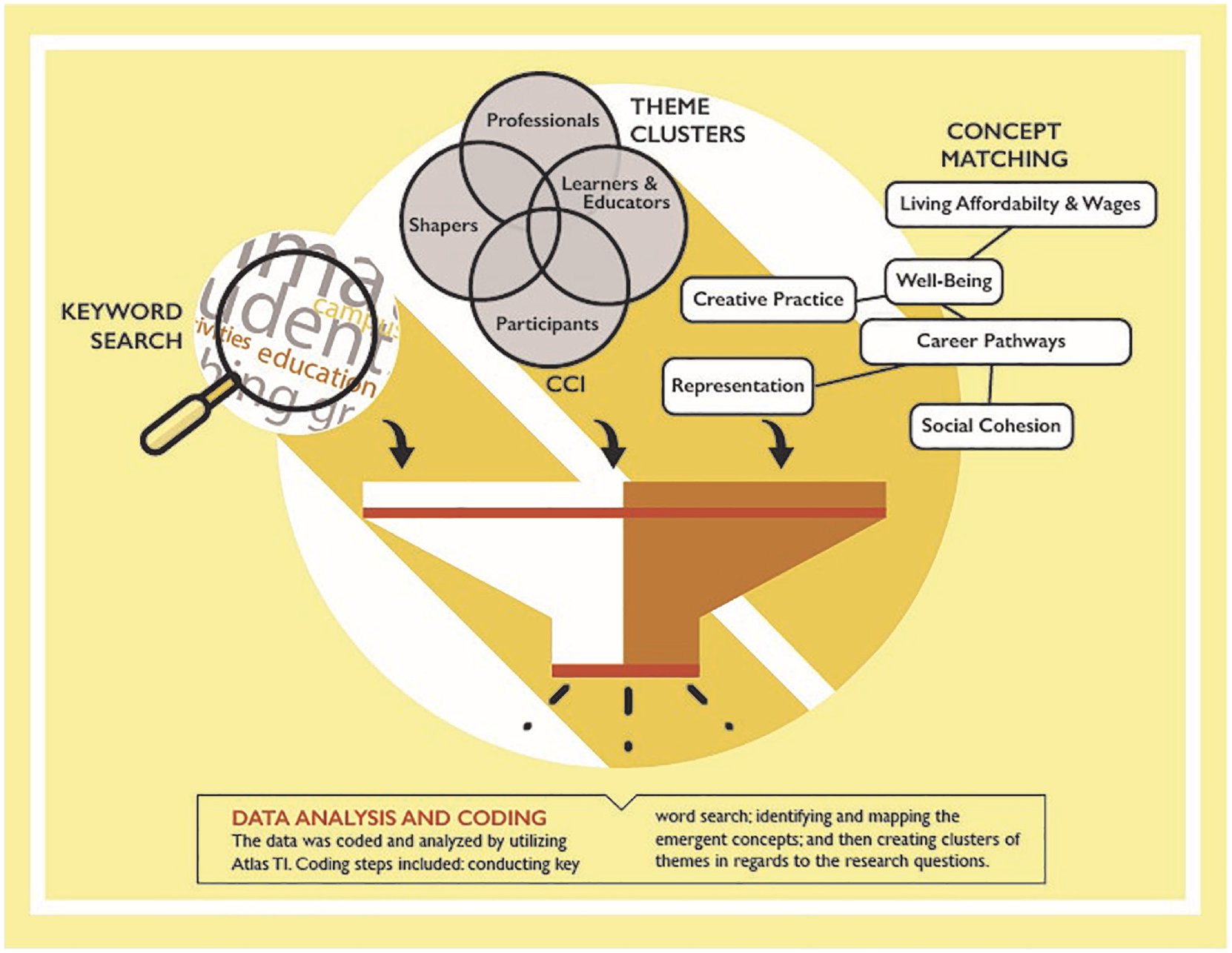
Stakeholder groupings, key word search coding, and content mapping.
The following main themes emerged from the data analysis: well-being and social cohesion; living affordability and wages; creative practice, representation; and career pathways.
TSP Step 4: TSP cross-sector participants came together to work with the complex, situations that they wished to change but which they could not change on their own or directly. As a result, the approach allowed for participants to get unstuck and move forward by working together and being creative. For example, to enable the participants to move toward naming and framing the generative narratives shaping Seattle’s CCIs. This engagement enabled the participants to better understand the constraints they had experienced, articulate the capabilities and competencies necessary to sustain participation and then to frame generative narratives leading to a desired state of inclusive well-being. In this context, Pretorius (2018) discusses the important role of growth for development as a means but not as an end, namely: Appropriate economic and socio-economic growth is not simply growth of wealth that leads to further inequalities but rather growth that is so differentiated that it leads to increasing inclusion, increased quality of life across an increasingly broader base and leading to inclusive well-being.
The TSP process included five steps, namely, Step 1: convening cross-sectional focus sessions; Step 2: conducting dialogue and story-share; Step 3: articulating and mapping findings into co-created CCI sector specific attributes and narratives; Step 4: constructing transformative scenarios through a co-creative narrative process and Step 5: presenting scenarios as generative narratives to inform CCI cross-sector development. The main themes that emerged from the TSP sessions included well-being and social cohesion, living affordability and wages, creative practice, representation, and career pathways.
TSP Step 5: An inductive approach was utilized during each of the particular cross-sector stakeholder focus group sessions. Kahane (2012, p. 57) defines the inductive method as “a form of the intuitive logics which draws on a team’s collective intuition about what could happen.” The inductive approach included working with each group to generate discussions and findings, which were then written up as collective narratives. A deductive approach was then utilized when bringing the stakeholder groups together to generate the transformative scenarios and generative narratives for Step 5. The scenarios were constructed through a collective co-creation process and presented as generative narratives. These four scenarios were plotted along the chosen uncertainties (axis) of capacity (funding, competencies, policy, and social cohesion), and the axis of a connected CCI approach, which included various facets that constituted the particular quadrant as co-developed by the CCI stakeholder groups (see Figure 4). The four scenarios were labeled metaphorically with the corresponding implications for generative narratives.

CCI generative narratives/transformative scenarios.
The goal of TSP was to develop the emergent scenarios of various possibilities facing CCI participants in the City of Seattle. In addition, TSP was expected to generate more effective actions, such that cross-sector relationships, system understanding, and system-aware intentions may be developed, leading to the system-transformative action movement toward desired states of inclusive well-being. Therefore, collectively articulating the key possibilities (scenarios) was a crucial step in moving toward an actionable strategy. Kahane (2012) frames scenarios as a story about what “might,” not “will” or “should” happen. Scenarios are an internally-consistent hypothesis about the future, which is relevant, challenging, and plausible when considering the case of CCI in Seattle.
Finding and Recommendations
From the four-scenarios presented above the following findings and recommendations are offered for the case study as generative narratives shaping further development. These generative narratives are intended to shape decisions such that creative cities like Seattle may emerge as places of simultaneous renewal where people can access the necessary generators (capacities and resources) to live connected lives. These narratives also furnish the necessary climate where the businesses and organizations constituting the CCIs can acquire the conceptual understandings of the organizational growth and mind-shifts toward well-being through relational networking and meaningful socialization.
Scenario 1: Sink Hole
In this scenario, imagine a CCI that is heavily siloed and underfunded. This leads to a narrative represented by a sink hole, which is framed by fragile and extractive mechanisms. Due to a lack of capacity in terms of competencies, funding, policy, and social cohesion the dominant attributes of city are described as having a lack of quality, unfair access to development, privatization of creative and cultural action and where the cross-sector participants are grounded in socially toxic and bankrupt silos.
Scenario 2: Conveyor Belt
In this scenario, imagine a disconnected CCI that receives adequate funding. This leads to a narrative of being on an endless conveyor belt, where consumption becomes a dominant driver. Even though there is access to adequate capacity due to a disconnection across CCI sectors the dominant attributes of city are described as being optimized for soles, fearful of change, offering a lack of agency and where CCI efforts are disconnected and culturally co-opted.
Scenario 3: Traffic Jam
In this scenario, imagine a connected CCI with a scarcity of funding. This leads to a narrative of being stuck in a traffic jam in which the only way of making quick progress is to purchase a fast pass to access an exclusive privatized toll lane. Even though CCI efforts are connected across sectors due to a lack of adequate capacity in terms of competencies, funding, policy, and social cohesion the dominant attributes of city are described as one-off efforts, fragmented, rooted in an extraction economy where one has limited access to unless one has funds to pay the necessary toll.
Scenario 4: Creative Ecosystem
In this scenario, imagine a CCI comprised with an adequate capacity (funding, competencies, policy, and social cohesion) that is connected across various sectors. This leads to a narrative rooted in a creative ecosystem consisting of various sustainable, regenerative, and participatory processes, where the well-being of people matters. The dominant attributes of city are described as being inclusive, accessible, fair, participatory, engaged, and sustainable.
The practical application of the theories of Margaret Archer’s Morphogenetic Approach (2017) and Adam Kahane’s Transformative Scenario Planning (2012) through an analysis of the focus sessions consisted of the following stakeholders representing CCI cross-sectors in Seattle:
i. CCI Shapers—City of Seattle Office of Arts & Culture and Office of Economic Development.
ii. CCI Participants—CCI Community-based Organizations.
iii. CCI Professionals—Seattle Interactive Design Advisors.
iv. CCI Educators & Learners—Institutions of Higher Education (IHE) and Schools.
This work provided an opportunity to reveal and appreciate the mechanisms that are shaping the CCI in Seattle, including: well-being and social cohesion; living affordability and wages; creative practice, representation; and career pathways.
CCI employers require a talented, responsive and creative workforce. The creation of explicit pathways through career connected learning opportunities could help uplift the talent pipeline, where historically there has not been inclusive access and equipped learners have not been taught to be agile and to adapt to the dynamic needs of the workforce. In their chapter, Education in the Learning Economy, Bengt-Ake Lundvall, Palle Rasmussen, and Edward Lorenz (Araya & Peters, 2010, p. 174) write, “One of the most fundamental characteristics of the learning economy is the high rate of change in the market place. One way to narrow the gap is to strengthen the practice-oriented elements in the formal education and training system and of course to develop new forms of cooperation between knowledge institutions and the work of organisations in the private and public sectors.”
Capacity building, therefore, is a key mechanism in shaping CCI participation. The capability approach (Sen, 2004) posits that well-being should be interpreted in terms of people’s capabilities and functionings. Capabilities are the true freedoms that people have to do and be their best selves. In this view, true freedom implies having access to the resources needed to do or be whatever one desires. That is, it is not just the formal freedom to do or be something, but also the substantial possibility of doing so. Sen’s capabilities align well with the TSP process to integrate a diverse group of people across various sectors in order to form relationships rooted in a shared understanding of the CCI situation in Seattle and the opportunity to clarify intentions so as to create opportunities for capacity building that shape the development of an engaged career-connected learning pathway.
The findings of this work point to the development of a cross-sector Creative Exchange Learning Lab (CELL) a space that builds the capacity for places of learning and CCIs to extend their career readiness capabilities and increase engagement through learning content, critical analysis, acquiring competencies, building networks, generating demonstrable examples of work and CCI specific coaching and mentoring. Participants would be tasked with developing their own learning journey and along-side CCI mentors and would receive guided feedback for reflection as to their progress. CELL aligns with the notion of generative learning (Wittrock, 1990) a reflexivity (Archer, 2007) where reflection and feedback deeply shape perceptions and ideas and whereby participants generate their learning and create emergent and contextual solutions to relevant and meaningful issues. The process is one of simultaneous renewal (Goodlad, 1994) whereby individual and institutional renewal are expected to occur. CELL would be designed to serve as a catalyst for pathways to participate in the CCI in Seattle, ensuring that the CCIs are rooted in excellence, access, and equity; and an articulation of the necessary facets for a CELL.
CELL would be intended to be a public-private collaborative effort of programmed co-working space, community media access, and the public research lab that is designed to expand and adapt to perform the following activities:
Revive and invest in the critical role of creativity, arts, and culture in the public space and problem-solving abilities of the stakeholders.
Prototype the educational models for a globally-connected, intergenerational, interdisciplinary, public/private, applied initiative for solving the urgently-pressing challenges facing society.
Connect the existing community reforms and experimentation efforts and create an open-source knowledge base in both the real and virtual worlds.
Similarly, the crucial pathways to make the CCIs a significant economic driver include:
Making the already existing business financing and support mechanisms more accessible to the creative businesses;
Developing the new economic development policies and funding sources to grow CCI sectors;
Creating novel and improved networking and professional development opportunities, and a better promotion of Seattle’s creative businesses and destinations;
Improving the continuum of education through a continued professional development process in preparing the creative workers and entrepreneurs;
Advocating for the policies and programs to grow the creative economy.
Culture and Creative Industries (CCI) are increasingly understood as having an important role in community and economic development (Kostis, 2021; Potts & Cunningham, 2008; Stupples, 2014). This study argues for a co-created, cross-sectorial, and staged-development approach. Thomas (2015, p. 86) warns of constraints of such an approach, “Participatory approaches to planning, for example, can too easily become opportunities for gaining consent for an already fully formed idea, rather than learning from the perspectives of residents and other stakeholders. Strong foundational work to mitigate displacement may be overwhelmed by market forces down the road.” Yet, the design of CELL would put forth an innovative model whose intentional co-creative practices are designed to bring cross-sector understandings of community and CCI into meaningful interaction. CELL would provide a rich setting for investigating a broader sense of community allowing stakeholders to understand how actions shape these experiences.
Conclusion
In order to develop societal shifts that matter, TPS scenarios need to be analytically grounded and morphed into generative narratives. The power of coupling TSP with a morphogenetic approach is that developing generative narratives rests in the idea that narratives about the actors in the system in which one participates, as well as the decisions that are made and the impact of those decisions, are articulated and envisioned. By coupling Archer’s (1995) morphogenetic approach andKahane’s (2012) Transformative Scenario Planning this study when considering the case of CCI is Seattle makes the move to couple the analytic and the strategic. To achieve this objective in the context of developing pathways into CCI, the focus on quantifying economic growth as the primary goal of developmental activities must be shifted to an understanding of the key generative mechanisms (Archer, 2017); the powers, liabilities, dispositions, and resources that form dynamic social processes. Social regularities are shaped and described by generative mechanisms. They are a description of the components, activities, and interrelationships of the processes that make CCIs a substantial contribution to a community’s quality of life and well-being and thus from the basis of generative narratives.
The notion of reflexivity (Archer, 2007) emphasizes the interaction between people and the social processes and institutions that influence their behavior. It emphasizes that people are active agents who interact with and affect their environments rather than passive recipients of outside forces. The Morphogenetic approach similarly emphasizes the significance of reflexivity in figuring out how actors shape and are shaped by their surroundings. The methodology contends that agents are capable of self-reflection and behavior modification in response to shifting social systems. Agents can contribute to the continuing evolution of social structures and systems by partaking in this reflexivity process.
Reflexivity thus creates a connection between people (agents) and the surroundings that have an impact on their development-related thoughts and behavior. It emphasizes the dynamic and collaborative nature of this interaction and the agency of people in influencing their surroundings (Archer, 2007). Both TSP and the Morphogenetic approach empower individuals to have an active role in understanding and modifying their settings through the promotion of reflexivity, resulting in outcomes that are more inclusive and sustainable for development. TSP (Kahane, 2012) is a strategy that brings together stakeholders with various, frequently opposing points of view to talk about urgent issues and create narratives that show several possible futures that can result from choosing various courses of action. By doing this, the parties concerned have a greater understanding of their current situation and how certain dynamics may be facilitating or impeding the development of a better or alternate future. In other words, agents are urged to reflect on and discuss their environments.
TSP is a methodological approach (Kahane, 2012) that seeks to imagine and bring about transformative change in complex systems, as opposed to generative mechanisms, which concentrate on the fundamental mechanisms that give rise to social phenomena. The underlying processes or mechanisms that originate and mold social activities and structures are known as generative mechanisms. They contribute to the explanation of social stability, change, and the formation of new social forms. Understanding and identifying the generative mechanisms behind social events might help us get new perspectives on how they develop and change through time. TSP, on the other hand, is a method utilized in the planning and decision-making stages of strategic initiatives. It entails the creation of believable scenarios that investigate various futures and their ramifications (Kahane, 2012). By including transformative and participative elements, TSP goes beyond conventional scenario planning. It involves a wide range of stakeholders and motivates them to question presumptions, consider alternative options, and collaborate to bring about transformational change. The shared interest in comprehending and influencing social change is what connects generative processes and TSP. In contrast to TSP, which offers a practical methodology for visualizing and actively participating in transformative change processes, generative mechanisms offer a theoretical framework for comprehending the fundamental processes that produce and influence social phenomena.
In this regard, generative mechanisms can offer perceptions into the fundamental forces and dynamics of change that must be addressed and shaped by the transformative scenarios created by TSP. Understanding generative mechanisms (Archer, 2007) can aid in locating intervention leverage points and direct the creation of tactics that support transformative change. TSP offers a useful method for visualizing and enacting transformative change, whereas generative mechanisms give a theoretical perspective through which to view social change. Combining these viewpoints can enhance our comprehension of intricate social processes and aid initiatives to bring about desired and beneficial changes.
It is expected that these scenarios will generate many practicable ideas toward visioning a desirable future and channeling the energy available in CCIs toward action. The creative ecosystem narrative presents a scenario as a cluster of individual parts that interact with each other, and, over time, desired system-wide patterns appear. Aligning with the morphogenetic approach, it builds a generative narrative in which reality is both continuous-pattern and agent-based simultaneously. These scenarios are intended to illustrate choices that could be actionable for the members of society, policymakers, industry professionals, community groups, and politicians. It is admitted that none of these scenarios may likely predict the future with complete accuracy, because the social systems are multi-factorial, and changes in these complex systems usually arrive in unpredictable ways. These participatory scenario processes, in contrast to prediction-based processes, aim to contribute to co-learning. Pereira et al. (2019, p. 3) argue that multiple perspectives are needed to understand the “multiple facets of an issue, learning together and from one another, enhancing relationships, and thus opening new collaborations and possibilities for future collective action.” Therefore, these scenarios can be described as plausible fictions, namely, generative narratives, which are meant to stimulate thought, imagination, conversation, and action. However, independent scenario planning is insufficient, as a staged capacity-building approach is required. While employing participatory approaches to co-develop new scenarios is beneficial, it is not adequate in and of itself for developing or improving systems thinking and social learning to promote transformative paths for more equitable and sustainable futures.
The City of Seattle may continue to move toward a place that fosters, nurtures, and sustains itself as a thriving center for CCI and center its values of equity and social justice in the ways that build capacity through the development of integrated career-connected learning pathway based on:
Engaging participants and listening to what is being articulated and needed by people and contexts that are relevant; and bringing together constellations of key actors to co-create common intentions.
Understanding the situation including the individual and collective reality, with regards to the issue at hand, at both an emotional and empirical level.
Developing intentional spaces for reflection on the transformational process. Prior to delving into the specifics and practicalities, it is critical to consolidate the conclusions drawn from extensive observation and reflection.
Co-creating actions and prototypes that are honed and linked to concrete next steps and continuing, long-term action plans.
Co-developing a broader creative ecosystem and holding the space for participants to interact across sectors by seeing and acting from a holistic perspective moving toward inclusive well-being.
Howkins (2010), in his book, Creative Ecologies: Where Thinking Is a Proper Job, shares ideas regarding fundamental principles of creativity and the process of sustainable creation. According to Howkins (2010, p. 11), a creative ecology can be defined as “a niche where diverse individuals express themselves in a systemic and adaptive way, using ideas to produce new ideas; and where others support this endeavour even if they don’t understand it.”Howkins (2010) declares that it is time to apply eco-creativity to all natural resources and begin treating them differently, not mechanically consuming, but creatively sustaining. Creativity may be nurtured in any organization, and often leads to innovations that address changing and complex human requirements. Approaches that can engage and elicit more imaginative processes have a transformational ability, and these are often neglected. At both the individual and communal levels, imagination comprises both cognitive and emotional processes. People can use their imagination to rise above their current situation. In other words, encouraging imagination and engaging emotions in participatory and other creative processes can help people make sense of their experiences, which can lead to changed motivation. It is necessary to examine sustainability, equitable development and well-being as emergent qualities of debate processes and negotiation. This is because progressing toward a desired state of being will often require unique approaches of co-developing scenarios. As a result, there are chances to experiment with new approaches of envisioning the future. These more inventive initiatives have the potential to go beyond the business-as-usual tactics that have so far failed to bring about the transformations required for a more sustainable and equitable access to CCIs.
The aim of this paper was to create a developmentally-focused approach and pathway that framed and situated generative narratives as a possibility of simultaneous renewal where participants gain access to the capacities necessary to become career-connected learners and where the businesses and organizations that constitute the Culture and Creative Industries (CCIs) acquire the conceptual understandings of the necessary organizational growth mind-shifts. This emergent pathway is developmentally staged such that all participants may engage in steps toward inclusive well-being which is depicted in the Creative Ecosystem scenario and includes facets such as: being inclusive, accessible, fair, accountable, participatory, engaged, sustainable, and where quality matters (see Figure 4). The following objectives were attained in order to fulfill the paper’s aim:
Identified the key cross-sector stakeholders who constitute CCI in Seattle including CCI Shapers, CCI Participants, CCI Professionals, and CCI Educators and Leaners (see Figure 2);
Revealed the generative mechanisms and the capacities that are required to expand the creative economies while reducing the disparities in the CCIs including: well-being and social cohesion; living affordability and wages; creative practice, representation; and career pathways (see Figure 3);
Articulated the necessary generative narratives needed to develop adequate regional capacity to connect financial and social capital through different societal sectors to establish inclusive and creative career pathways into Culture and Creative Industries in the City of Seattle including four scenarios: Sink Hole, Conveyor Belt, Traffic Jam, and Creative Ecosystem (see Figure 4);
Strengthen theoretical grounding of the Transformative Scenario Planning (TSP) approach by framing the notion of reflexivity as a means to couple the Morphogenetic approach and TSP.
Shifting demographics, economic challenges, and disruptive technologies are forcing the traditional institutions and the existing power structures to rethink their values. The rise of Cultural and Creative Industries (CCIs) compels all to evaluate differently what capacities current and future generations must acquire to navigate these transformations. Young professionals must excel in imagination, strategic thinking, teamwork as well as simple grit and resilience during this upheaval. Additionally, organizations must shift to a mindset of growth in terms of learning and well-being, if they are to become agile enough to strive toward simultaneously pursuing social responsiveness and maintaining organizational integrity as well as alignment of mission goals, operational strategies, and processes for measuring impacts. It is vital to acknowledge that investing in creative professional development and recognizing their position in the economy is now more important than ever. Pratt (2017) warns of the need not to characterize a resilient stance in terms of a neoliberal instrumentalist position. The neo-liberal approach’s resilience concept is to network and unlock resources from elsewhere to do more with less.
Moving forward, it is expected that this paper will essentially contribute to the creation of vital places of public welfare, where the public frameworks and policies nurture accessibility and participate in a connected culture and creative ecology. Creative action is always situated in a society with a cultural matrix of one spirit or another, where crosscurrents of historical retreat and development are constantly impinging upon what people do, who they are, and who they are becoming.
Footnotes
Declaration of Conflicting Interests
The author(s) declared no potential conflicts of interest with respect to the research, authorship, and/or publication of this article.
Funding
The author(s) received no financial support for the research, authorship, and/or publication of this article.
Ethical Approval
The ethic clearance number from Nelson Mandela Bay University is H-18-BES-DTS-034 and informed consent was given by all participants.

Data Availability Statement
Data sharing not applicable to this article as no datasets were generated or analyzed during the current study.