



Abstract
This paper sought to identify distinct classes of women who endorse wife-beating and the determinants of such justification to broaden current knowledge of the correlates of intimate partner violence in Zimbabwe. We drew on survey data from the 2015 Zimbabwe Demographic and Health Survey (ZDHS) and restricted our analytical sample to 2,966 currently partnered women. To classify women’s responses into patterns of tolerant attitudes, we used latent class analysis, an unsupervised classification method that helps identify heterogeneity in a population using observable variables. The data supported a three-class solution characterized by the following probabilities: class 1, high tolerance (6%); class 2, moderate tolerance (26%); and class 3, low tolerance (66%). The results from the regression analysis suggest that older age, reading a newspaper frequently, and having more than primary education were negatively associated with membership in the moderate and high tolerance classes. Women who made joint decisions or had no say in their healthcare issues were more likely to belong to the moderate and high tolerance classes. In other words, tolerant attitudes toward wife-beating were negatively associated with personal empowerment. Therefore, interventions that increase personal empowerment in the form of education and access to media might be needed to redress the endemic acceptance of wife-beating in Zimbabwe. At the same time, gender role transformative interventions are required to challenge patriarchal thinking, which denies women decision-making autonomy and perpetuates attitudes that encourage marital violence.
Plain language summary
This paper focuses on a well-known but under-researched correlate of intimate partner violence in Zimbabwe: attitudes toward wife beating. We argue that such attitudes reflect dominant social norms and that understanding them can help shed light on the intergenerational cycles of violence. To better understand these attitudes, we use a classification approach which allows us to identify subgroups that are qualitatively different from each other based on their tolerance of wife beating. Using this classification, we also sought to understand the factors associated with Zimbabwean women’s acceptance of violence. Our findings revealed three distinct classes, which we defined as high, moderate and low tolerance. In terms of associations, we found that personal empowerment factors such as age, education and media access were significantly associated with women’s tolerance of violence. Therefore, interventions that address such attitudes are needed to break the cycle of violence in Zimbabwe.
Background
Marital violence (also known as intimate partner violence, IPV), which can manifest as physical, sexual, psychological or financial abuse, is a subject of great concern among public health scholars. Although this type of violence affects women across all socio-demographic backgrounds, the situation is much worse in sub-Saharan countries, where the average prevalence of 37% exceeds the global average of 30% (WHO, 2013, 2018). In the case of Zimbabwe, between 45 and 48% of women have experienced some form of marital violence in general (Bengesai & Khan, 2021; Wekwete et al., 2014). Emotional violence, which includes behaviors meant to control, isolate or frighten the victim, is estimated to be around 30%, physical violence at 35%, while sexual violence is estimated to be around 10.5% (Bengesai & Khan, 2021; Iman’ishimwe Mukamana et al., 2020). These rates increased between 2005 and 2015, suggesting that marital violence in Zimbabwe has not abated (Iman’ishimwe Mukamana et al., 2020).
The adverse effects of marital violence are well-documented (Bullinger et al., 2021; Sullivan et al., 2018) and include mental health problems such as depression, low self-esteem and reduced self-concept (Ikonomopoulos et al., 2017); physical injuries (Campbell, 2002), as well as reproductive and gynecological problems such as sexually transmitted infections and HIV and AIDS (McClintock & Dulak, 2021). Given such a high prevalence and the resulting consequences, prevention has become the central focus of public health discourse—leading to a proliferation of research that seeks to understand the correlates of marital violence. Consequently, several socio-cultural, structural, relationship, and environmental factors have been identified (Abramsky et al., 2011; Iman’ishimwe Mukamana et al., 2020). Recent work has also focused on attitudes toward wife beating, framing these as perhaps the most prominent determinant of marital violence (Behrman & Frye, 2021; Sandberg et al., 2020). This is because, in many communities, women are often subjected to inequitable gender attitudes, which restrict their independence, educational and economic opportunities, and roles within the family (Basu et al., 2017). However, perhaps the most troubling aspect for researchers has been the widespread social and cultural acceptance of marital violence in many communities, especially in low- and middle-income countries (Okenwa-Emegwa et al., 2016; Rani et al., 2004; Uthman et al., 2011), although wife-beating occurs everywhere in the world (Heise & Kotsadam, 2015). Using data from multiple countries, Tran et al. (2016) found that the proportion of women who justified wife-beating ranged from 2.0% in Argentina to 90.2% in Afghanistan. When disaggregated by region, Africa and Asia had the highest percentage of women who endorsed these attitudes under certain circumstances, with seven African countries, including Zimbabwe, having a greater proportion. Regarding country-specific studies, Hindin’s (2003) study, which used the 1999 Demographic and Health Survey, found that approximately 50% of Zimbabwean women accepted marital violence. Recent studies have also shown that the acceptance of wife beating persists, with findings revealing that as of 2015, up to 30% of Zimbabwean women were still justifying this behavior (Behrman & Frye, 2021; Bengesai & Khan, 2021). At the same time, evidence suggests a positive association between such attitudes and the actual experience of violence (Saud et al., 2021).
Despite this recognition that attitudes toward IPV are endemic, not many studies from Zimbabwe have exclusively examined the factors associated with such norms. The study by Hindin (2003) was the only one we found that specifically focused on this topic. While there are cross-national studies which included data from Zimbabwe (Behrman & Frye, 2021; Rani et al., 2004), these do not measure country-specific correlates of attitudes. Furthermore, of those Zimbabwean studies that have used attitudes toward wife-beating as a proxy for women’s status, the tendency has been to use simple measures, treating attitudes as essentially monolithic. The common practice, especially in research using Demographic and Health Surveys, has been to use simple binary (Hindin, 2003; Iman’ishimwe Mukamana et al., 2020; Wekwete et al., 2014) or composite additive indicators (Bengesai & Khan, 2021) derived from the five hypotheticals regarding the acceptability of wife-beating. While these approaches have shed light on the effect of such attitudes on IPV experience, they mask any heterogeneity that may be essential in understanding the underlying causes of marital violence (Rani et al., 2004; Sandberg et al., 2020).
This study aims to (i) classify women’s attitudes toward wife-beating and (ii) examine the association between these attitudes and their socio-cultural and demographic characteristics. Drawing on the IPV literature, we hypothesize that these attitudes play a crucial role in the occurrence of marital violence. Furthermore, these attitudes are believed to influence how women respond to IPV. Therefore, studying the association between the endorsement of marital violence and its enactment is crucial, as the former can justify abusive behavior by the husbands while discouraging victims from seeking help leaving the abusive marriage.
Conceptualizing Attitudes Toward Wife Beating
Many factors shape women’s attitudes toward violence, and the research and theoretical perspectives suggest that most of these are steeped in socio-cultural structures and norms of gender (Hindin, 2003; Okenwa-Emegwa et al., 2016; Rani et al., 2004; Sandberg et al., 2020). For instance, in their widely cited thesis on subcultures of violence, Wolfgang and Ferracuti (1967) posit that violence thrives in a context where a set of values support its expression, thus providing normative support for violent behavior (Lawson, 2012). According to Latzer (2018), these subcultures might be ethnic or religious groups in society, and to empirically determine whether such a culture exists, we must examine the “relevant cultural values with as much specificity as possible and explain precisely how these values encourage violent behaviours” (Latzer, 2018, p. 44). In the case of Zimbabwe, there is a great deal of commentary around sub-groups that are deemed to condone violence (Bengesai & Derera, 2021; Christiansen, 2009). Several scholars have commented that the country generally suffers from a culture of violence, which is best manifested among the people of the Shona culture (Chitakure, 2016; Christiansen, 2009). Of particular concern are the marriage customs in this ethnic group, which promote the overt use of violence. To illustrate, in the Shona culture, great value is placed on the family unit (including extended family). In this context, the wife’s role is primarily responsible for caring for the family’s well-being. Therefore, failure to perform this role is considered a serious transgression that can be punished through beating, scolding and even divorce (Chitakure, 2016). Moreover, a man who fails to discipline his wife for transgressing these norms is looked down upon by society and labelled as a weakling who, according to critics, might have been given a love potion (kudyiswa) (Mangena, 2021). Thus, among the traditional Shona people, wife-beating is seen as a husband’s right, which is tacitly and explicitly sanctioned by society.
Another sub-culture that is often linked to violence is religion, which is a major influence in the lives of most Zimbabweans. Data from the Zimbabwe National Statistical Agency (2022) suggest that 90% of the country belong to some religious grouping, with 40% affiliated with the Apostolic Faith, 45% to different Christian groupings such as Protestant, Roman Catholic, and Pentecostal, and about 5% African traditional religion. Approximately 2% belong to the Islamic, Jewish and Hindu religions, while the remaining 8% do not identify with any religion. Less than 1% belong to the Islamic religion, while the remaining 15% do not identify with any religion. Among these different religious groups, the Apostolic Faith has received much attention in Zimbabwe due to its well-known vices such as child marriage, polygamy, and women’s subjugation (Bengesai et al., 2021). In addition to these vices, the church also endorses restrictive practices against women on many issues, including access to education, reproductive health services, and household decision-making (Hallfors et al., 2016). These practices render women in these churches voiceless and powerless while directly or indirectly forcing them to accept male dominance, including violence. Studies have also linked Christian religions to marital violence, arguing that biblical texts are often manipulated to justify abusive tendencies (Chadambuka, 2022). Although not much has been written about the association between Islamic religions and IPV in Zimbabwe, studies from elsewhere have shown a high acceptance of marital violence and the subjugation of women (Doku & Asante, 2015), with selective texts being used to justify violence.
While the sub-culture of violence theory has been widely used to explain why some communities are more violent than others, other scholars have argued that violent behaviors and tolerance represent a learnt pattern that begins in childhood (Copp et al., 2019; Cui et al., 2013). These scholars argue that there exists a continuity in IPV victimization and perpetration because individuals who are exposed to violence early in life “may internalise behavioural scripts for violence and, by extension, adopt attitudes that justify IPV” (Copp et al., 2019, p. 1359). Indeed, many studies have confirmed this thinking – and showed that women who witnessed interparental violence in childhood were likely to have tolerant attitudes toward IPV and were also at a higher risk of being victims in later life (Kanwal Aslam et al., 2015; Koenig et al., 2003; Uthman et al., 2011).
Still, other scholars contend that marital violence and its antecedents are better understood by examining intrahousehold relationships and resources available in the family (Huis et al., 2020; Tenkorang, 2018). Regarding intrahousehold relationships, participatory household decision-making has been one of the most studied factors, with scholars arguing that the balance of power in decision-making can trigger IPV (Goode, 1971). Women who can make decisions on matters that affect their well-being or their families are seen as highly empowered, while this capacity to make decisions is also shaped by the resources a woman has at her disposal (Kabeer, 1999). Scholars who align with this thinking argue that women with fewer or no resources are likely to acquiesce to abuse due to marital dependency (Hansen et al., 2020; Tenkorang, 2018). Therefore, empowering women can potentially change the dependency, reduce male dominance and eventually augment women’s decision-making autonomy in domestic matters, including whether violence is justifiable (Kabeer, 1999). At the same time, another school of thought has established that rather than being protective, female empowerment can be a factor in violence (Shamu et al., 2018; Vyas & Watts, 2008), especially if the women can leverage those resources to making decisions that benefit them in a relationship. This is particularly the case in patriarchal communities like Zimbabwe, where decision-making is the privilege of men (Chitakure, 2016); therefore, women’s autonomous decision-making might be inconsistent with gender and societal norms. In such cases where household hierarchy is undermined, perpetrators of violence may use force, sanctions or violence to maintain the status quo (Seidu et al., 2021).
Understanding and analyzing attitudes toward violence and the associated factors is critical because the link between marital violence and tolerance of it is very close. This kind of analysis requires a conceptual model that considers the interplay of factors operating at different levels. With this in mind, our study draws on these different theories to test their applicability in influencing attitudes toward marital violence. In particular, we look at the influence of personal resources and decision-making autonomy and argue that women with limited social and economic power in relationships often find it difficult to protect themselves against patriarchal dominance. Hence, such women are more likely to acquiesce to marital violence. We also draw on the sub-culture of violence theory and argue that beliefs about and enactment of violence vary spatially and demographically. We further contend that the existence of a subculture of violence can also be established by analyzing data on values regarding marital violence. Again, we also consider whether beliefs about marital violence result from social conditioning.
Methods
Measuring attitudes that justify marital violence requires reliable and valid measures, and many scales have been developed informed by different theoretical perspectives on the nature of gender-role attitudes. The most common scale used is drawn from the Demographic and Health Surveys, conducted in LMICs (Sandberg et al., 2020). One advantage of the DHS surveys is that they use uniform data collection instruments across countries, improving the scales’ validity and reliability.
Despite their widespread use, some investigators have raised questions regarding whether the DHS questions are reflective of respondents’ personal beliefs regarding the justification of marital violence or, rather, their perceptions of the social norms operational in their communities (Asadullah et al., 2021; Perrin et al., 2019). These scholars have advised using cognitive interviews or list experiments, which have the potential to reduce respondents’ hesitance in answering sensitive questions. List experiments include asking several questions that randomly include or exclude sensitive questions (Asadullah et al., 2021). However, while such methods are better than the traditional survey, they do not eliminate misreporting completely (Lépine et al., 2020). Hence, in the absence of other data sources, survey data remains a valuable source that can be used to understand gender role attitudes, albeit within the context of these limitations.
The Data
The study uses the 2015 Zimbabwe Demographic and Health Survey (ZDHS), which was conducted by the Zimbabwean Ministry of Health and Zimbabwe Statistics in collaboration with the US Agency for International Development. The ZDHS is a nationally representative survey which employs a stratified two-stage cluster sampling method, selecting women based on urban or rural residence. These surveys are also widely used in population health research, including domestic violence. The datasets are publicly available, although one needs approval from the DHS program to use them for research. This approval ensures that data usage adheres to ethical guidelines.
For this analysis, we used data from the women’s file, focusing on currently partnered women only. We then extracted 3,499 records of women who met this criterion. Since some of our variables of interest were only asked of women sampled for the domestic violence module, we then excluded 533 cases that did not have this information, leaving us with a sample of 2,966 women who had complete information to explore variables of interest related to intimate partner violence.
Outcome Variables
In the DHS, respondents were asked five hypothetical questions concerning the endorsement of wife-beating under different hypothetical scenarios. These included:
If she goes out without telling him;
If she neglects the children;
If she argues with him;
If she refuses to have sex with him; and
If she burns the food.
Women’s responses to these questions were either No = 0, Yes = 1 or “do not know.” We recoded the unknown responses, which constituted less than 3% of the sample, as missing.
Control Variables
We also included the following control variables:
Witnessing parental violence was derived from the question which asked whether the respondent had witnessed her father beating her mother during childhood and was recoded as (0 = No; 1 = Yes = 2).
Educational level was defined as (0 = primary or lower, 1 = some secondary and 3 = complete secondary and higher). This categorization was informed by the Zimbabwean basic education system, which follows a 7-4-2 structure consisting of 7 years of primary education, 4 years of lower secondary and 2 years of upper secondary (Bengesai et al., 2021). Completing the 4-year secondary education level is the primary yardstick for determining academic achievement leading to upper secondary education or vocational training.
Media access is vital in educating women on issues related to gender-based violence, especially in low- and medium-income counties (Forsyth & Ward, 2022). Hence, we also included this variable in our model and recoded it as follows: 0 = no access, 1 = less than once a week, and 2 = almost daily.
Women’s decision autonomy was derived from the question which asked about who had the decision-making responsibility on (i) household purchases, (ii) visiting relatives, (iii) visiting healthcare institutions, and (iv) husband’s earnings. For each of these questions, the women’s responses were (i) wife alone, (ii) husband alone, (iii) joint decision, (iv) other. The responses to these questions were then recoded to take the value of 0 if the woman was not involved in any decision making, 1, if the woman indicated making sole decisions and 2, if the woman made decisions jointly with her husband/partner.
We also included several socio-demographic variables (age, place and province of residence, religion) which have been associated with gender attitudes. We reclassified age into a three categorical variable (1 = 15–24; 2 = 25–34, and 3 = 35+). Other variables which we used include: religion (1 = Christian, 2 = other and 3 = Apostolic); residence (1 = Urban; 2 = Rural), and wealth quintile; (1 = poor, 2 = middle class, 3 = rich).
Zimbabwe has 10 provinces, of which two are major cities with provincial status (Government of Zimbabwe, 2020). The Mashonaland province, home to most of the Shona Zezuru people, is divided into three provinces, while Matabeleland, predominantly Ndebele-speaking, is divided into two provinces. For this analysis—the three Mashonaland provinces were combined into one category (Mashonaland = 1) while the two Matabeleland were grouped into Matabeleland = 2. Manicaland = 3 is home to the Manyika people. The Midlands province is at the country’s epicenter, bordered by Masvingo, Mashonaland, and Matabeleland. Harare is the administrative and largest city of Zimbabwe, followed by Bulawayo.
Analysis
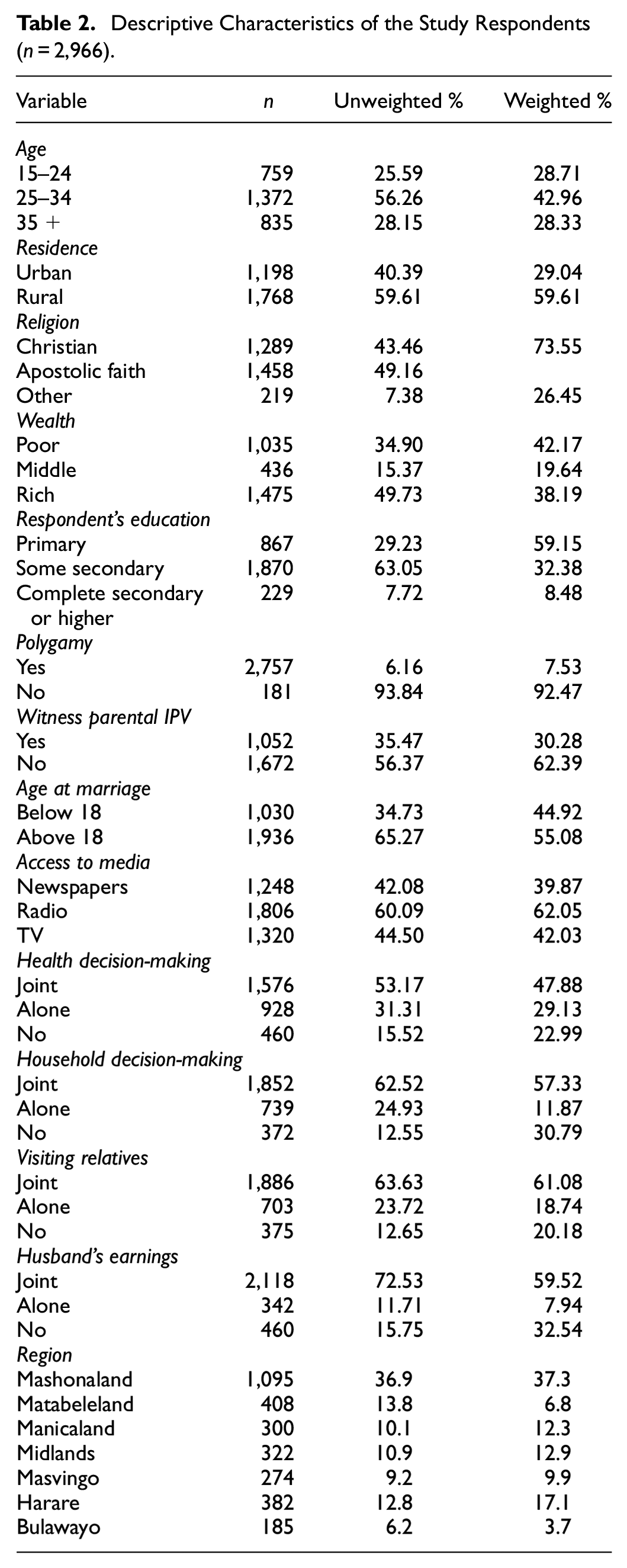
To understand variability in attitudes toward wife-beating (Figure 2, Table 1), we used latent class analysis (LCA), an unsupervised classification method that helps identify heterogeneity in a population using observable variables. LCA analyses individual behavior patterns and groups those with common attributes into classes with the highest probability of belonging. This results in subgroups more similar to each other being assigned to a class. Using responses to the five questions on wife-beating acceptability, we estimated models for two, three and four classes using maximum likelihood estimation. We also applied survey weights to ensure the representativeness of the sample. After identifying the classes, we conducted multinomial logistic regression to understand the factors associated with our outcome variable. We also provide the descriptive statistics of the sample in Table 2. There were up to 3% missing values on one variable, which according to Schafer (1999), is inconsequential. Hence, listwise deletion was used, whereby cases with missing values were excluded.
Model Statistics.

The classes with the lowest AIC, BIC and Adj.BIC are highlighted in bold; Class 3 entropy is also highlighted as it higher than class 4 entropy.
Descriptive Characteristics of the Study Respondents (n = 2,966).
Results
Distribution of Outcome Variable
Figure 1 shows the percentage of women who justify wife-beating in each hypothetical scenario.

Distribution of attitudes justifying wife-beating (2015 ZDHS; n = 2,966).
Approximately 21.2% of the women believed that wife-beating was justifiable if the woman goes out without informing the husband, 20% if the woman neglects children, 16% if she argues with her husband, and 13.8% if she refused sex. Only 6.8% of the women felt that violence was acceptable if the woman burnt food.
Latent Classes
In conducting LCA, the first step was to determine the optimal number of classes across different statistical fit indices (Table 1; Weller et al., 2020). Nylund et al. (2007) argue that the Bayesian information criterion (BIC) may be the most reliable, given that it rewards parsimony in models. Thus, it can be used to compare competing LCA solutions. Others advise using the adjusted BIC, especially when small sample sizes are involved (Yang, 2006). Nonetheless, the guiding principle in choosing class solutions is that the lower the statistic, the better the model.
Using the fit statistics in Table 1, a three-class model seemed to be the ideal class based on the BIC and the adjusted BIC. In addition, the entropy, which measures the extent to which the latent classes are distinguishable, revealed superior precision for the three-class model (0.90) as opposed to the four-class model (0.88). Although the two-class model had the higher entropy, the BIC and adjusted BIC test statistics suggested that a three-class solution was the most parsimonious model.
Figure 2 presents the three latent classes. For women in class 1, the probability of endorsing wife-beating across different scenarios was high ≥ 80%, except for burning food (58%). This was followed by women in class two, where the probability ranged from 10% for burning food to 51% for going out without informing the husband. Women in class three had the lowest acceptance (<1%) across all scenarios. The probability of belonging to class 1 was 0.08, class 2, 0.26 and class 3, 0.66.

Latent class probabilities of women’s acceptability of physical violence (2015 ZDHS).
Table 3 presents the adjusted relative risk ratios for the moderate and high tolerance classes compared to the low tolerance classes.
Results of the Multinomial Regression Results: Relative Risk Ratios.

Note. RRR = relative risk ratios; CI = confidence interval.
p < .10. **p < .05. ***p < .005.
In the moderate tolerance class, age, education and reading a newspaper at least once a week were negatively associated with endorsing attitudes supporting wife-beating. Women aged 25 years and above had a lower propensity of endorsing attitudes supporting wife-beating relative to those aged 15 to 24 (RRR = 0.45–0.75). Women with some secondary education or more (RRR = 0.24–0.81) or who read a newspaper at least once a week (RRR = 0.76) also had a reduced probability of supporting wife-beating. Compared to women from Mashonaland, women from all the other provinces were less likely to endorse wife-beating (RRR = 0.44–0.74), with Bulawayo and Harare, the largest cities and economic hubs of the country, having women with the least tolerance. One of our key arguments is that religion significantly influences the acceptance of marital violence. Nonetheless, our results show that while women from the Christian religion were less likely to endorse marital violence, and those from the religion group categorized as “other” were more likely to be tolerant relative to the Apostolic Faith, the effect was not statistically significant. We also did not find any statistically significant association between wealth and work status—variables we had selected to represent the resources women had at their disposal or our decision-making proxies as well as place of residence. Thus, it can be concluded that in the moderate tolerance class, attitudes toward wife beating were associated with personal empowerment variables (such as age, education and access to media) rather than economic and household empowerment or female autonomy for women in this class.
As in the moderate endorsement class, older women (above 25 years) had a reduced probability of supporting wife-beating in the high tolerance class (RRR = 0.30–0.68). Women with some secondary education or more (RRR = 0.03–0.69) or who read a newspaper at least once a week were negatively associated with attitudes endorsing wife-beating. Women from Manicaland and Harare were less likely to endorse wife beating relative to those from the Mashonaland provinces (RRR = 0.13–0.31). Regarding factors positively associated with the endorsement of wife-beating, we found that women who witnessed interparental IPV were up to two times more likely to support wife-beating, while those who enjoyed joint healthcare decision-making autonomy (RRR = 1.67) or none (RRR = 1.96) were more likely to support IPV in the high tolerance class. Like in the moderate class, we did not find statistically significant associations between wealth and work status, religion, place of residence, and most of our decision-making proxies and endorsement of wife beating.
Supplementary Analysis for the Region
It is important to note that Shona people are also found in Masvingo and Manicaland provinces. Hence, to fully establish the existence of a subculture of violence, we conducted supplementary analysis where we focused on (i) the maShona provinces alone (Mashonaland, Manicaland and Masvingo) and (ii) where we combined these three regions and compared them against the rest of the country (Mashonaland, Manicaland and Masvingo vs. other). This subsequent analysis revealed that compared to Mashonaland, women from Manicaland and Masvingo were 70% and 31% less likely to justify wife-beating, respectively. Compared with the entire country, women from the other provinces were 20% less likely to endorse wife-beating relative to those from Mashonaland, although these results were not statistically significant.
Discussion
Attitudes toward marital violence are perhaps among the most prominent factors associated with IPV. Many studies have focused on this aspect, often using such attitudes as a proxy for women’s empowerment. However, despite the importance of understanding these attitudes, few studies from Zimbabwe have explored the factors associated with such attitudes. Moreover, most prior research on the topic has used simple classifications (Sandberg et al., 2020). The aims of this study were twofold. First, we sought to establish whether there are distinct classes of women who justify marital violence. Second, we also wanted to examine the prevalence of attitudes toward wife-beating and the associated factors. Our assumptions of factors associated with such justification were drawn from subcultures of violence and resource theories; hence our controls were carefully chosen in line with these theories.
Regarding the classification of women’s attitudes toward wife-beating, the results from our study point to variability in the acceptability of wife-beating and support a three-class solution characterized by the following probabilities: class 1, high tolerance (6%); class 2, moderate tolerance (26%); and class 3, low tolerance (66%). Although not many studies have examined patterns of IPV justification in Zimbabwe, and hence direct comparisons cannot be made, our findings mirror the evidence from one Senegalese study (Sandberg et al., 2020) and highlight the potential of LCA in understanding the heterogeneity of IPV experiences among vulnerable women.
In terms of the prevalence of attitudes that justify wife-beating, our findings from the descriptive analysis indicated that close to 30% of Zimbabwean women endorse wife-beating under certain circumstances, while the most acceptable reason for wife-beating is when a woman goes out without informing the husband or when she neglects children. Although this is an improvement on the 1999 and 2010–2011 ZDHS studies, which found that between 40% and 50% of Zimbabwean women believed that wife-beating was justified (Hindin, 2003; Wekwete et al., 2014), these results suggest that this problem is still prevalent in Zimbabwe and a cause for concern. If a third of married women believe that violence is endemic, it is not surprising that the country still experiences such high rates of IPV (Bengesai & Khan, 2021).
The fact that violence was justified when a woman went out without her husband’s permission also indicates the prevalence of coercive control among Zimbabwean men (Bengesai & Derera, 2021). Restricting freedom of movement is a form of control that can place women at a greater risk of IPV. When mobility is controlled, abused women are cut off from their kin and non-kin social networks (Tenkorang, 2018), preventing them from getting the support they need to deal with violence. In Zimbabwe, especially in rural areas and among Shona people, women are positioned within the family lifecycle of marriage and motherhood (Liamputtong & Benza, 2019). While boys are brought up to take on the family headship from an early age, the female child is expected to get married, have children and perform household chores while the husband goes to work (Chitakure, 2016). Hence, neglecting children is equivalent to neglecting a woman’s primary role in the family. Therefore, it is not surprising that there was a greater endorsement of wife-beating when the woman neglected her children.
In terms of the factors associated with the justification of marital violence, the results suggest that endorsement of wife-beating reduces with age, education status and access to newspapers in all classes, although the associations differed in the strength of the relative risk ratios, with the high tolerance class reporting the highest estimates. In particular, women older than 24 years were more likely to disagree with wife-beating. Similar findings have also been reported in other countries such as Mali (Seidu et al., 2021), Ghana (Doku & Asante, 2015), and Malawi (Bazargan-Hejazi et al., 2013). This association between age and endorsement of IPV could be due to several factors. First, if we consider the perspective that attitudes are bred in the family, it is possible that younger women who are new to marriage unions might not have formed their own attitudes at the time of marriage. Hence, their acceptance could be influenced by their family of origin. If they marry into a family where this is acceptable, they might find it challenging to resist such norms (Bazargan-Hejazi et al., 2013). Conversely, older women may have developed self-confidence, unlike their younger counterparts, which empowers them to resist marital violence (Seidu et al., 2021). Regardless of the reasons for the high level of acceptance of marital violence by younger women, the findings from this study and prior studies (Doku & Asante, 2015; Seidu et al., 2021) that have reached similar conclusions indicate the need for interventions targeting young women, with older women serving as role models.
The inverse association between education and endorsement of marital violence was not unexpected, given that the former is the key means of acquiring knowledge; hence, it can enhance one’s decision-making capacity (Wencheko & Tadesse, 2017; Zegeye et al., 2021). Therefore, this inverse relationship suggests that in a country like Zimbabwe, empowering women educationally can help significantly to ensure gender equality, reduce the risk of IPV, and, ultimately, its adverse effects (Sardinha & Nájera Catalán, 2018).
Although access to all forms of media was found to be negatively associated with acceptive attitudes, only reading the newspaper was statistically significant. Nonetheless, previous research has found that access to media can increase women’s awareness of gender equality and human rights and thus alter their attitudes and behavior (Gurmu & Endale, 2017). In the case of our findings, we contend that women who can read newspapers are more likely to be literate and/or educated; hence, the negative association might have mirrored the effect of education on attitudes.
Overall, the finding that educationally empowered and literate women are less likely to endorse IPV is important for stakeholders, as they suggest that improving women’s education and literacy levels can potentially change harmful social norms (Nasrawin, 2017; Rani et al., 2004). Thus, while indeed, beliefs toward marital violence can be learnt through observation, education can act as a buffer and empower women to directly or indirectly challenge patriarchal norms (Okenwa-Emegwa et al., 2016)
Although we did not find any statistically significant effect for the place of residence (urban vs. rural), our results indicate that women from Harare and Bulawayo, which are the two largest cities in Zimbabwe, had the least probability of being in both the moderate and high tolerance classes. This is likely because these cities are the most developed in the country; hence, cultural ties are less strong in these areas as they are comprised of people from diverse ethnic groups (Gurmu & Endale, 2017). The results also show that, relative to women from the Mashonaland provinces, women from all the other provinces were less likely to support wife-beating in both the moderate and high tolerance classes. This is unsurprising, given that patriarchy is deeply entrenched among the Shona people (Chitakure, 2016). Thus, these findings also confirm the sub-culture of violence within this ethnic group compared to the others (Wolfgang & Ferracuti, 1967). Moreover, the differences in the acceptability of marital violence among the three Shona tribes (Zezuru, Karanga, and Manyika) are evidence that the “subculture of violence is in a way a subculture of a subculture” (Latzer, 2018, p. 44). Hence, not everyone within a subculture might subscribe to a culture of violence.
Factors that were positively associated with the endorsement of IPV include joint or lack of decision-making autonomy on healthcare matters in the high tolerance class and witnessing parental IPV in both classes. Ebrahim and Atteraya (2018), who operationalized female autonomy as a composite variable of the number of decisions a woman was involved in, found that women with a higher level of autonomy were less accepting of marital violence. Similar results were also reported by Seidu et al. (2021) and Hindin (2003). However, Oyediran (2016) found that married women with a say in household decision-making were more likely to endorse wife beating. Although direct comparisons cannot be made, given the different operationalizations—these divergent findings can be explained within the context of the patriarchal nature of marriage in African communities. Given that the man is the head of the family and the value placed upon marriage—it is possible that women, regardless of decision-making power, may have been socialized to strongly commit to marriages regardless of circumstances (Oyediran, 2016).
Witnessing parental violence was only significantly associated with the high tolerance class. Several studies, mainly from developed countries, have established a link between witnessing parental violence and exposure to violence in adulthood (Cui et al., 2013; Madruga et al., 2017). Drawing on social learning theorists such as Bandura (1977), these studies suggest that women exposed to intimate partner violence (IPV) during childhood are more inclined to perceive such violence as normal and consequently display higher tolerance toward it. This suggests that acceptive attitudes are vertically transmitted and exist in a vicious cycle of marital violence (Cui et al., 2013). Therefore, addressing social norms around violence might be the most effective approach to breaking these cycles of violence. Evidence from South Africa (Gibbs et al., 2018); and India (Santhya et al., 2010, 2019) has shown that gender-transformative programs such as the Stepping Stones and the Creating Futures intervention (Gibbs et al., 2018) have had considerable success in altering attitudes in these countries. The existing programs in Zimbabwe mainly focus on victims and could be strengthened by including gender role transformation and increasing female empowerment to create critical reflection on gender norms and promote non-violent gender attitudes (Gibbs et al., 2018).
Some limitations must be considered when interpreting these findings. First, the data used in this study were drawn from a cross-sectional research survey. Hence, they provide only a “snapshot” of the respondents’ lived experiences at a particular time. Secondly, as with any survey, it is difficult to distinguish between respondents who genuinely believe marital violence is wrong and those who report it due to social desirability bias (Behrman & Frye, 2021).
These limitations notwithstanding, the findings from this study reveal justification of wife-beating reveal that it is still prevalent in Zimbabwe, despite international and country-based calls to eliminate marital violence. Further, the findings provide empirical evidence that although beliefs about marital violence are learnt through observation, empowerment and education may potentially challenge social norms. Therefore, it is crucial to implement interventions and policies that encourage both men and women to adopt non-violent and gender-equitable attitudes. This is particularly important when one considers that attitudes are perpetuated by commonly held norms that create social standards for appropriate behaviors in society. Therefore, addressing this root cause of marital violence requires changing deeply ingrained beliefs that promote harmful masculinity norms.
To reduce the tolerance of violence, there might also be a need to empower women to negotiate power and influence decision-making within the household. Indeed, several studies have shown that enhancing female autonomy can reduce the risk of IPV (Tenkorang, 2018). Moreover, these interventions should also focus on communities rather than individuals since some communities are more prone to violence than others. It is worth noting that women who exercise agency in their personal lives are less inclined to be tolerant of marital violence.
We also recommend enhancing media literacy. Given that reading newspapers was found to be negatively associated with tolerant attitudes, promoting media literacy might shape a better-informed perspective on gender equality and the unacceptability of violence under any circumstances.
Footnotes
Acknowledgements
The authors wish to thank the DHS program for providing access and allowing the use of the data used in this study. The authors would like to thank the Zimbabwe Demographic and Health Survey
Declaration of Conflicting Interests
The author(s) declared no potential conflicts of interest with respect to the research, authorship, and/or publication of this article.
Funding
The author(s) received no financial support for the research, authorship, and/or publication of this article.
Ethical Approval
This study uses secondary data which is already in the public domain. However, permission to use this data was granted by the Demographic and Health Survey Program.
