




Abstract
When victims of intimate partner violence (IPV) victims seek help from informal supporters (e.g., family, friends, etc.), they are often revictimized and blamed. The Supportive Attitudes Toward Victim Scale (SAVS) was developed to examine others’ intentions to help IPV victims. A factor analysis was conducted and four subscales of the SAVS were developed. A fictional scenario depicting a female IPV victim disclosing about being being abused by her male partner was adminsitered online to a sample of 184 college students. The study included two conditions (i.e., victim’s decision to stay with her abuser and victim’s decision to leave her abuser) to which participants were randomly assigned. Particpants completed several questionannires including the SAVS. The relationships between benevolent sexism (BS), hostile sexism (HS), right-wing authoritarianism (RWA), and intentions to help IPV victims were examined. Additionally, how victim blame varied by gender and scenario was also measured. BS, HS, and RWA were predictive of different SAVS subscales, and the victim was blamed more by males and in the scenario where the victim decided to stay with her abuser. Implications for IPV intervention research and programs are discussed.
Keywords
Male perpetrated violence against women remains as a pressing issue around the world (Devries et al., 2013). Intimate partner violence (IPV) represents one of the main forms of violence against women and the physical form of this abuse includes any physical violence (e.g., hitting, punching, pushing, choking, slapping, etc.) inflicted by one partner onto another in a romantic relationship (Black et al., 2011). While estimates vary, a multi-country report from the World Health Organization (WHO; 2012) conveyed that between 13% and 61% of ever-partnered women reported having experienced physical violence by a partner and 4% and 49% of ever-partnered women reported having experienced severe physical violence by a partner. In the United States, about one in four women will be physically abused by an intimate partner in their lifetimes (Black et al., 2011). These estimates are generally lower than what is thought to actually occur because of issues of reporting (e.g., victim blaming, fear of perpetrator retaliation), and inconsistency in measurement (Breiding, Black, & Ryan, 2008). Therefore, violence against women around the world is more prevalent than the estimates described here, and remains unacceptably high (Bostock, Plumpton, & Pratt, 2009).
Victims of IPV often face long-standing and detrimental consequences (Kimerling et al., 2009) including severe physical injuries, mental health problems, and being unable to maintain gainful employment due to sustained physical abuse and health problems (Garcia-Moreno & Watts, 2011). Due to the myriad of debilitating repercussions that IPV victims endure, most remain with their abuser for several years (Yamawaki, Ochoa-Shipp, Pulsipher, Harlos, & Swindler, 2012). The injuries that IPV victims suffer, and other negative consequences they endure are not isolated events, but rather, are a constant state for many years. When a victim tries to leave her abusive partner, she often faces many obstacles (e.g., lack of financial resources, victim blaming, being unaware of shelters and other services, etc.) and threats of death (Panchanadeswaran & McCloskey, 2007). The largest threat of murder for women around the world is from a current or former intimate partner (Stöckl et al., 2013), with murder by an intimate partner accounting for approximately 50% of homicides of women in the United States alone (Díez et al., 2017).
Society is also adversely affected by IPV. Medical care costs are increased (Robinson & Spilsbury, 2008) because female IPV victims make twice the amount of hospital visits than non-victims (Alhabib, Nur, & Jones, 2010). In addition, victims’ inability to consistently hold a stable job adversely affects employers as a large proportion of their workforce is compromised (Garcia-Moreno & Watts, 2011). A recent report from the McKinsey Global Institute (Hunt et al., 2016) revealed that the United States loses US$4.9 billion annually due to increased medical costs, loss in productivity, and loss in earnings results for female IPV victims. Addressing IPV through research and other prevention methods is not only critical for victims, but for society as well.
Secondary Victimization and Its Effect on the Victim
While shelters and formal support (e.g., IPV shelter staff, police, medical staff, etc.) are important and necessary links for victims to escape from their abusive relationships, it is often informal supporters (e.g., family, friends, neighbors, etc.) to whom victims turn to first for help (Chabot, Tracy, Manning, & Poisson, 2009). Previous research indicates that the responses from informal supporters predict the likelihood of victims seeking help from formal support systems (e.g., the police, legal advocates, etc.; Sylaska & Edwards, 2014). However, there are many instances in which informal supporters inadvertently blame the victim for the abuse she endures (Trotter & Allen, 2009). This occurs when informal supporters tell the victim she is at fault for the abuse, minimize the abuse, and excuse the actions of the perpetrator (Edwards, Dardis, & Gidycz, 2012). In some instances, family members and other informal supporters give an ultimatum to the victim and will only offer help if they follow their demands for them to leave immediately, which victims report as very unhelpful (Moe, 2007). When a victim faces these types of negative responses and is blamed, this is called secondary victimization (Ullman, 2010). After experiencing secondary victimization, a victim is much less likely to seek out further help and support, is much more likely to remain in an abusive relationship (Policastro & Payne, 2013) and face threats of violent reprisals from their abusers or death as a consequence (Kim & Gray, 2008). Therefore, supportive responses from informal supporters are of the utmost importance as the strongest predictors of a victim leaving her abusive relationship are support from others and the knowledge of available resources (Chang et al., 2010). It is critical, then, to investigate and understand which factors contribute to negative and unsupportive attitudes toward victims of IPV in the effort to reduce the incidence of secondary victimization.
Ambivalent Sexism and Negative Attitudes Toward IPV Victims
One consistent predictor of negative responses to and victim blaming of IPV victims is ambivalent sexism (Durán, Moya, Megías, & Viki, 2010). Conceptualized first by Glick and Fiske (1996), ambivalent sexism applies specifically to sexism against women and includes two dimensions—hostile sexism (HS) and benevolent sexism (BS). HS entails explicitly negative and adversarial views of women such as women seeking “special favors” or trying to “control” men (Christopher & Mull, 2006). BS, however, refers to seemingly positive but still sexist views of women such as women being “pure” and “helpless” creatures that “need” protection from men (Durán et al., 2010; Glick & Fiske, 1996). Both poles of ambivalent sexism have been found to predict greater victim blaming of IPV victims (Flood & Pease, 2009).
Valor-Segura, Expósito, and Moya (2011) investigated the relationship between ambivalent sexism, victim blaming, and perpetrator exoneration in a fictional IPV scenario. They found that participants who scored higher on HS blamed the victim and exonerated the perpetrated more. The authors argued that this finding is consistent with previous research that shows that people with more traditional gender role attitudes tend to endorse violence against women more than people with egalitarian gender role attitudes. Other research conveys that BS is also related to attitudes that legitimize violence against women, and blame the victim (Koepke, Eyssel, & Bohner, 2014). Therefore, both HS and BS are predictive of negative and unsupportive attitudes toward IPV victims.
Gender and Negative Attitudes Toward IPV Victims
Gender is another predictive factor of negative attitudes toward IPV victims (Alfredsson, Ask, & Borgstede, 2016). Although there are mixed results, previous research indicates that men are more likely to blame victims of dating violence, rape, and IPV more than women (Nabors, Dietz, & Jasinski, 2006). Some researchers argue that this gender difference is due to adherence to traditional gender roles, which men tend to endorse more than women (Flood & Pease, 2006). While the underlying reason requires further investigation, gender remains as a consistent predictive factor of negative attitudes toward IPV victims (Reidy, Shirk, Sloan, & Zeichner, 2009; Yamawaki, Ostenson, & Brown, 2009).
Right-Wing Authoritarianism (RWA) and Negative Attitudes Toward IPV Victims
RWA is another factor that is related to negative attitudes toward female victims of violence (Gerger, Kley, Bohner, & Siebler, 2007). RWA is a personality factor that includes three components as defined by Altemeyer (1996), including submissiveness to authority figures, endorsing conventional thought, and a tendency to aggress in ways that are acceptable to authority figures. Strict adherence to traditional views such as gender roles and upholding conventional values are related to negative attitudes toward and victim blaming of IPV victims (Valor-Segura et al., 2011). RWA is predictive of punitive attitudes toward female victims of violence (Hockett, Saucier, Hoffman, Smith, & Craig, 2009) and is, therefore, worth considering as a predictive factor of victim blaming and less supportive attitudes toward IPV victims.
The Victim’s Decision and Negative Attitudes Toward IPV Victims
Another factor that has not been explored much in previous research, but that influences others’ perceptions of IPV victims, is the victim’s decision to stay with or leave her abuser (Yamawaki et al., 2012). There are many obstacles and threats to safety that prevent victims from successfully leaving their abusers (Kim & Gray, 2008) and, consequently, about 50% of victims who attempt to leave their abusers eventually return to them (Roberts, Wolfer, & Mele, 2008). The majority of previous research on outside observers’ attitudes toward IPV victims did not examine how the victim’s decision to stay or leave her abuser influences victim blaming and other attitudes toward the victim. As Yamawaki et al. (2012) argued, examining how observers judge a victim who decides to leave or stay with her abuser is an important factor to consider as this better reflects the reality that many victims face. This is a newer consideration in IPV violence research, and warrants more attention.
The Current Study
As discussed previously, when an IPV victim faces blame and other negative types of reactions (i.e., secondary victimization) from her informal supporters (family, friends, etc.), these deter victims from seeking aid from formal resources (e.g., shelters, police, etc.). Some consistent predictors of negative attitudes toward IPV victims and victim blaming include hostile sexism (HS), benevolent sexism (BS), gender, and the victim’s decision to stay or leave her abuser. While much of the IPV literature has focused on what accounts for secondary victimization, exploring and understanding what contributes to positive and supportive attitudes toward victims is rarely investigated, and is of great importance. Consequently, the current study sought to explore which factors are predictive of positive and supportive attitudes toward IPV victims who disclose.
In summary, the current study explored factors that predict an informal supporter’s intentions to help a female IPV victim in a heterosexual relationship and factors related to victim blaming. Specifically, the effects of RWA, BS, and HS on intentions to help an IPV victim were investigated. In addition, differences in victim blaming by gender and the victim’s decision to leave or stay with her abuser were also examined by including two conditions in a hypothetical scenario with a female victim of IPV: a leave condition and a stay condition. In the leave condition, the victim decides to leave her abuser and in the stay condition, the female victim decides to stay with her abuser. Our hypotheses included the following:
Hypotheses
Methods
Participants
The participants in this study were undergraduate students who were recruited from introductory psychology classes in a large, private university in the Western part of the United States. There were 184 total participants made up of 108 women and 76 men. The majority of the students in this study identified as White/Caucasian (85%), while 5.3% identified as Hispanic/Latino, 1.6% identified as Asian, 4.8% identified as Mixed Race, and the remaining 2.7% identified as Other or did not specify their race/ethnicity. The average age of the participants was 20.59, with a range of 17 to 52 years, and 88.2% were single, 10.8% were married, and 1% were divorced. The participants were informed that the purpose of this study was to examine how individuals view the interactions between intimate partners. Before conducting this study, the investigators sought Institutional Review Board approval from their university and the experimenters treated all participants in accordance with the ethical guidelines of the American Psychological Association (Keller & Lee, 2003). Confidentiality and anonymity were maintained for all participants. Participants were compensated by receiving extra credit in their introductory psychology courses.
Materials and Measures
Scenarios
A fictional scenario was developed and used in this study. The scenario describes a victim who discloses about her abuse to a friend. The following is the scenario that was presented to participants:
Imagine that you have a close friend named Lucy and you have been friends for several years. One day, when you and Lucy are spending time together, she confides in you that her husband, Jacob, lost control of his anger during a recent disagreement. Jacob became so angry that he beat Lucy. This is not the first time that Lucy has confided in you about Jacob’s anger and violent behavior; in fact, Lucy has discussed with you a similar situation several times in the past.
To manipulate the impact of the victim’s decision to stay with or leave her abuser, participants who were assigned to the stay scenario read the following instructions: “Imagine that after she has told you everything about what happened with Jacob that Lucy has now informed you that she has decided to remain with Jacob.” Likewise, participants who were assigned to the leave scenario read the following instructions: “Imagine that after she has told you everything about what happened with Jacob that Lucy has now informed you that she has decided to leave Jacob.”
Supportive Attitudes Toward Victim Scale (SAVS)
The SAVS was developed for the purpose of this study to assess the degree to which an individual held supportive attitudes toward the hypothetical victim. We used Internet searches in popular media, examined scientific studies (Chabot et al., 2009; Kaukinen, Meyer, & Akers, 2013; Overstreet & Quinn, 2013; Plichta, 2007; Postmus, Severson, Berry, & Yoo, 2009; Sylaska & Edwards, 2014; West & Wandrei, 2002; Yam, 2000), and consulted with mental health professionals, and found 15 items that are inappropriate responses for support toward IPV victims. Participants rated all 15 items on a 7-point Likert-type scale to convey the likelihood of stating such responses. The items on the SAVS ranged from 1 (strongly disagree) to 7 (strongly agree). Higher scores reflected a greater intention to support the victim while lower scores conveyed less intended support for the victim.
A principal component analysis with a varimax rotation was conducted on the 15 items with the present data and a four-factor solution (based on eigenvalues >1) was yielded. Items were assigned to a factor if they loaded uniquely on one factor at .50 or higher. The first factor involved five items and was termed the Insisting Victim to Leave subscale (accounting for 24.30% of the variance), and the items in this subscale were (a) “I will insist that Lucy leaves Jacob (reverse scored)”; (b) “If Lucy stays with Jacob, I will despise her decision (reverse scored)”; (c) “Lucy does not have any choice but to leave Jacob (reverse scored)”; (d) “I will only provide support if Lucy leaves Jacob (reverse scored)”; and (e) “I will tell Lucy to leave Jacob right away (reverse scored).” This subscale is purported to assess the degree to which respondents endorse insistence of the victim leaving her abuser. The second factor included three items and was labeled as the Imposing Judgment subscale (accounting for 19.46% of the variance). The items for this subscale were (f) “I will ask Lucy why she does not make changes in her life (reverse scored)”; (g) “I will ask Lucy why she does not care about the effect this is having on her family and friends (reverse scored)”; and (h) “I will tell Lucy that she would experience PTSD and depression in the future if she does not leave Jacob (reverse scored).” This subscale is supposed to evaluate the degree to which participants endorse impositions of their judgment on the victim. The third factor included three items and was named the Traditional Value for Intimate Relationships subscale (accounting for 9.61% of the variance), and the included items were (i) “If she doesn’t want this to happen again, she shouldn’t make Jacob angry (reverse scored)”; (j) “If Lucy leaves Jacob, she will break the sacred marriage covenant (reverse scored)”; and (k) “This is a couple’s quarrel and no one else should be involved (reverse scored).” This subscale aims to evaluate the degree to which participants endorse adherence to traditional values for a male–female intimate relationship. Finally, the fourth factor consisted of two items and was called the Insisting to Work Out Relationship subscale (accounting for 6.84% of the variance), which contained (l) “I will insist that Lucy and Jacob together should receive couple’s counseling (reverse scored)”; and (m) “Lucy should stay with Jacob because things will get better (reverse scored).” This subscale is supposed to assess the degree to which respondents endorse the idea that the victim should stay with her abuser. The internal consistencies, a measured by Conbach’s alpha analysis, for the Insisting Victim to Leave subscale, Imposing Judgment subscale, Traditional Value for Intimate Relationships subscale, and Work Out Relationship subscale of the current study were .76, .75, .69, and .60, respectively.
Victim Blame Attribution (VBA) scale
Another dependent measure in this study was the degree to which participants placed blame on the IPV victim for being hit by her partner. This was measured by the VBA scale, which was developed by Yamawaki et al. (2009). This measure was modified for this study by changing the names to Lucy and Jacob for the victim and abuser, respectively. The VBA scale is a 5-item scale designed to measure the degree to which participants blame a victim of IPV for the violence she endures. It includes the following items: (1) “Lucy had some fault in this incident,” (2) “Lucy deserved to be hit,” (3) “Lucy unconsciously wants to be in an abusive relationship,” (4) “Lucy has some responsibility for creating the situation,” and (5) “Lucy should be blamed for being in the situation.” Participants rated these items on a Likert-type scale that ranged from 1 (strongly disagree) to 7 (strongly agree). Higher scores on this measure indicated greater victim blaming. The internal reliability for the VBA scale used in this study was Cronbach’s α = .83.
Right-wing authoritarianism (RWA) scale
The RWA scale was developed by Altemeyer (1981) to measure conservative ideology. RWA is defined as including three dimensions: submissiveness to authority figures, endorsing conventional thought, and a tendency to aggress in ways that are acceptable to authority figures (Altemeyer, 1996; Benjamin, 2006). For the purposes of this study, the political orientation of the RWA scale that is sometimes focused on was not of interest, but rather, the negative attitudes toward members of groups whose behavior is unacceptable to authority figures was of interest. An abbreviated version of the RWA scale that consists of 22 items rated on a 7-point Likert-type scale was (Altemeyer, 1996). The scale ranges from 1 (strongly disagree) to 7 (strongly agree). An example of the items on this scale is, “Women should have to promise to obey their husbands when they get married.” Higher scores reflected a greater endorsement of conservative ideology while lower scores conveyed less endorsement of conservative ideas. The reliability of the RWA scale used in this study was Cronbach’s α = .87.
Ambivalent Sexism Inventory
Developed by Glick and Fiske (1996), the Ambivalent Sexism Inventory (ASI) is a 22-item measure with two subscales—benevolent sexism (BS) and hostile sexism (HS). BS represents an endorsement of views of women in which women are “pure,” “submissive,” and require “protection” provided by men. HS, however, represents the other subtype of ambivalent sexism in which negative stereotypes of women who defy traditional gender-prescribed behavior are endorsed. These include ideas like “women are merely seductresses,” “women are trying to control men,” and “women do not deserve the same opportunities as men.” An example of items on the HS subscale is, “When women lose to men in fair competitions they typically complain about being discriminated against”; an example of items on the BS subscale is, “Women should be cherished and protected by men.” Participants responded to the items by using a 7-point Likert-type scale. Higher scores represented greater endorsement of ambivalent sexism. The reported reliability for the BS and the HS subscales in this study were Cronbach’s α = .84 and α = .87, respectively.
Procedure
Participants were recruited in their psychology courses and completed this study through an online university system known as SONA. An equal number of participants were randomly assigned to each of the study’s conditions (i.e., victim’s decision to leave or stay). The questionnaires and scenario were administered electronically via a Qualtrics web-based survey (Qualtrics.com), and only participants who gave their consent were able to proceed in completing the study. This study was divided into two parts. In the first part of the study, all participants completed the RWA scale, the ASIy, and a demographic survey that gathered the participants’ age, gender, marital status, and race and/or ethnicity. After completing the first part of the study, participants were informed that they would receive an email link to complete a second study after two days that would allow them to earn more credit if they chose to participate.
In the second part of the study, all participants initially read an identical fictional scenario (see Methods section) regardless of which condition they were randomly assigned to. The fictional scenario included all of the information regarding Lucy and Jacob’s IPV incident and Lucy’s disclosure; however, at this point in the study, the scenario did not include Lucy’s decision to stay with or to leave Jacob. After reading the fictional scenario, all participants answered questions from the SAVS. Participants assigned to the condition in which the victim decides to remain with her abuser were then informed of Lucy’s decision to remain with Jacob. Likewise, participants assigned to the condition where the victim decides to leave her abuser were then informed of Lucy’s decision to leave Jacob. Participants then answered questions from the VBA scale.
Analytic Strategy
To test the hypotheses for the current study, statistical analyses were conducted using SPSS version 24. These included a series of simultaneous multiple regression analyses to test for the predictive relationship between RWA, BS, and HS, gender, and the outcome variables: supportive attitudes toward the victim and VBA. In addition, a 2 (gender) × 2 (scenario) multiple analysis of variance (MANOVA) on SAVS and VBA was performed to test for main effects of gender and scenario on supportive attitudes toward the victim and victim blame and for potential interaction effect between the independent variables and the outcome variables. Table 1 provides descriptive statistics for and zero-order correlations between the variables used in the study.
Descriptive Statistics for and Zero-Order Correlations Between Variables Used in the Study.
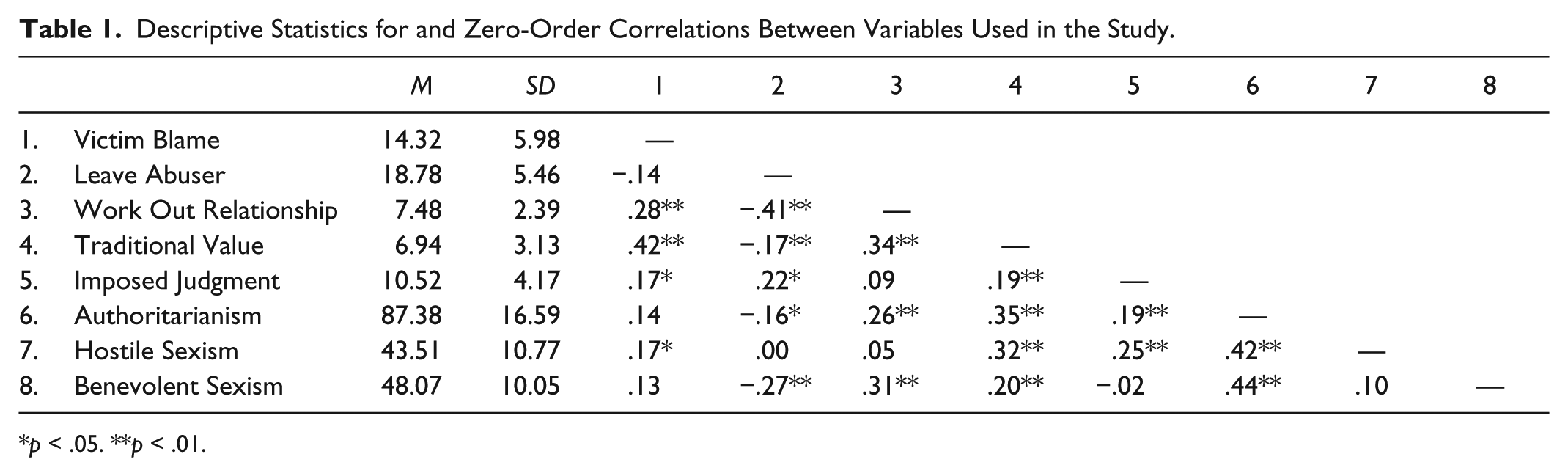
p < .05. **p < .01.
Results
Predictive Roles of RWA, BS, and HS on Victim Blame and Intentions to Support the Victim
To test the predictive roles of RWA, BS, HS, and gender on victim blaming and intentions to support the victim, a series of simultaneous multiple regression analyses were conducted.
Multiple regression analysis for victim blame
The overall regression model was significant F(4, 166) = 4.68, p < .05, R2 = .10; indicating that the predictors taken together accounted for a significant amount of the variance in victim blame despite only accounting for about 10% of the variance. When examined separately, however, gender was the only significant predictor that accounted for unique variance of victim blame, ß = −.29, t(166) = −3.57, p < .001 (see Table 2).
Multiple Regression Analyses of Predictive Relationship Between HS, BS, RWA, Gender, and Victim Blame.

Note. HS = hostile sexism; BS = benevolent sexism; RWA = right-wing authoritarianism.
p < .001.
Multiple regression analyses for supportive attitudes toward the victim (SAVS)
The overall regression model was significant F(4, 163) = 420, p < .05, R2 = .09; indicating that the predictors taken together accounted for a significant amount of the variance in SAVS despite only accounting for approximately 9% of the variance. When examined separately, both RWA (ß =.07 t[163] = −2.11, p < .05) and HS (ß = .13 t[163] = 2.24, p < .05) were significant predictors that accounted for unique variance of SAVS.
In addition to examining the predictive role of HS, BS, and RWA on supportive attitudes toward the victim as a whole, the relationship between these predictors and the subscales of the SAVS scale were also examined. Gender was not included in these analyses as it was only a significant predictor of victim blame and not for SAVS previously. As for the Insisting Victim to Leave subscale, the results of the regression analysis indicated that BS was the only significant predictor, ß = −.23, t(168) = −2.78, p < .01, and explained a significant proportion of variance in the leaving subscale scores, F(3, 171) = 4.39, p < .01, R2 = .07, R2 adj = .06. That is, participants with higher BS scores tended to insist that the victim needed to leave her abuser or they did not intend to provide any support. On the Work Out Relationship subscale, the results of the multiple regression analysis showed that RWA and BS were significant predictors, ß = .21, t(170) = 2.43, p < .05; ß = .22; t(170) = 2.79, p < .01, respectively, and explained a significant proportion of variance in the leaving subscale scores, F(3, 170) = 8.21, p < .001, R2 = .13, R2 adj = .11. That means participants with higher BS and RWA scores were inclined to insist that the victim work out her relationship with her abuser by going through couple’s counseling and/or that she stay because everything will be better. As for the Traditional Value for Intimate Relationships subscale, the results revealed that both RWA and BS were significant predictors, ß = .20, t(173) = 2.27, p < .05; ß = .23; t(173) = 2.89, p < .01, respectively, and explained a significant proportion of variance in this subscale’s scores, F(3, 173) = 8.47, p < .001, R2 = .13, R2 adj = .11. Namely, respondents with higher BS and RWA scores were prone to insist that the wife should not make her husband angry, leaving her husband means breaking the marriage covenant, and no one should be involved in a couple’s quarrel. On the Imposing Judgment subscale, the results exhibited that RWA and HS were significant predictors, ß = .25, t(173) = 2.89, p < .01; ß = .19; t(173) = 2.41, p < .05, respectively, and explained a significant proportion of variance in this subscale’s scores, F(3, 173) = 8.09, p < .001, R2 = .12, R2 adj = .11. Specifically, participants with high RWA and HS scores tended to impose their judgment on the victim by asking why she was not willing to change her life, telling her to think about the potential of becoming mentally ill, and asking her to think about friends and family who will be affected by her abusive relationship. See Table 3 for a summary of the multiple regression analyses for SAVS.
Multiple Regression Analyses of Predictive Relationship Between HS, BS, RWA, Gender, and SAVS.

Note. HS = hostile sexism; BS = benevolent sexism; RWA = right-wing authoritarianism; SAVS = Supportive Attitudes Toward Victim Scale.
p < .05.
Effects of Scenario and Gender on Supportive Attitudes Toward the Victim and VBA
To test the effects of scenario and participants’ gender, a 2 (stay or leave condition) × 2 (male and female) MANOVA was performed on supportive attitudes toward the victim and victim blaming. When both the dependent variables were considered together, this analysis showed a significant difference between men and women, Wilks’s Λ =.96, F (2, 169) = 3.25, p < .05, and
Discussion
The focus of the current study was to examine informal supporters’ intentions to help an IPV victim who discloses. RWA and the two valences of ambivalent sexism—BS and HS—were explored in relation to a measure created for the purposes of this study, the SAVS. In addition, the effects of an IPV victim’s decision to remain with or leave her abuser and the participant’s gender on victim blaming were explored in the current study.
RWA, BS, HS, and Intentions to Support the Victim
RWA, BS, and HS related to the subscales of the SAVS in different ways. Both RWA and BS were significant predictors of the Traditional Value for Intimate Relationships subscale. Participants who scored higher on RWA and BS were more likely to endorse the items on the Traditional Value for Intimate Relationships subscale, which included items that reflect traditional values for male–female intimate relationships. Such endorsement of traditional values (e.g., leaving the abuser is “breaking the sacred marriage covenant”) would act as a deterrent to IPV victims from seeking to escape from their abusive relationships since this implies that leaving such a relationship is unsacred or wrong. Both RWA and BS are related to more traditional views on relationships, endorsement of traditional gender roles, and punishment for those who break traditional gender roles (Durán et al., 2010), which is seen as breaking away from an established authority (Benjamin, 2006). Therefore, this finding makes sense given previous findings.
In addition, both RWA and BS were significant predictors of the Insisting to Work Out Relationship subscale, which means that participants who scored higher on both the RWA and BS measures were more likely to endorse responses which encouraged the victim to work out her relationship with her abuser without any outside help. These types of responses are common misconceptions of solutions to IPV and are detrimental to the victim (Policastro & Payne, 2013). As mentioned previously, both BS and RWA are predictive of endorsing traditional views of relationships, gender roles, and punitive attitudes toward dissenting from traditional gender roles (Benjamin, 2006; Durán et al., 2010). As such, it is understandable that those who scored higher on BS and RWA would be more likely to give suggestions to an IPV victim to “work out” her relationship and that no one else should be involved as these are commonly held traditional beliefs (Capezza & Arriaga, 2008).
For the Imposing Judgment subscale, both RWA and HS were significant predictors. Participants who scored higher on RWA and HS, then, were more likely to endorse suggestions that actually were judgmental in nature toward the victim (e.g., “I will ask Lucy why doesn’t she make changes in her life”). As mentioned previously, HS entails adversarial views of women as seeking special favors and trying to control men and represents a different pole of the ambivalent sexism spectrum than BS (Glick & Fiske, 1996). The findings in this study are consistent with previous research that show that BS and HS predict different forms of sexism and/or violence against women with HS predicting violent proclivities against women and BS predicting greater victim blame for female victims of violence (Durán et al., 2010). In the current study, BS was related to participants insisting that the victim leave her abuser which although is still unhelpful to IPV victims is a seemingly less harsh intention/statement compared to the items on the Imposing Judgment subscale that were endorsed by participants who scored higher on HS.
It is possible that those who scored higher on HS already have negative views toward women, and since the victim was female, this may have related to the endorsement of judgmental responses toward the victim. The relationship between RWA and more judgmental responses may be reflective of an authoritarian quality wherein the observer higher in RWA believes himself or herself to be best suited to decide what to do for the victim; which, results in more judgmental responses and suggestions.
The final subscale that was developed from the original SAVS was the Insisting to Leave subscale, which was related to BS. Participants who scored higher on BS were more likely to endorse the responses from the Insisting to Leave subscale. As discussed previously, BS is related to views of gender and gender roles that are more traditional (Glick & Fiske, 1996). With a more traditional understanding of gender and gender roles, women are often seen as “pure” until they break or betray their prescribed role in some way. When this occurs, women receive harsh criticism and judgment because they have violated their own “purity” (Capezza & Arriaga, 2008). Indeed, previous research shows that BS is a consistent predictor of victim blaming and negative attitudes toward IPV victims (Durán et al., 2010). It is possible that those who endorse BS more may explain the cause of the abuse for IPV victims as stemming from a flaw in or wrong-doing of the victim, rather than focusing on the abuser. As a result, it is necessary to insist for the victim to leave since it is her “fault.”
The Victim’s Decision and Victim Blaming
Another area of focus in the current study was the effect of the victim’s decision to stay with her partner on VBA. As hypothesized and consistent with previous research (Policastro & Payne, 2013), the victim’s decision to stay with her partner was a significant predictor of increased victim blame. Participants assigned to the condition in which the victim decided to remain with her abuser blamed the victim significantly more than participants in the condition in which the victim decided to leave her abuser. When a victim remains with her abuser, outside observers assume that she accepts the abuse she is enduring and, therefore, is more deserving of blame than a victim who decides to leave her abuser (Kim & Gray, 2008). Examining the victim’s intentions to leave or remain with her abuser is an important area of focus as the majority of IPV victims face numerous obstacles that constrain them from being able to leave successfully (Panchanadeswaran & McCloskey, 2007). Some of the common barriers include financial dependence, the presence of children, and lack of access to or knowledge about appropriate resources (Kim & Gray, 2008; Overstreet & Quinn, 2013). In addition to these obstacles, female IPV victims risk losing their lives, with 70% of all femicides globally committed by a male intimate partner (Zeoli & Webster, 2010). As a result, it is extremely arduous and dangerous for victims to leave their abusers. Despite this, outside observers who are uninformed about IPV often misjudge the reasons why the victim remains with her abuser (Sprague et al., 2013). Consequently, victims who remain with their abusers may face greater secondary victimization from their informal supporters (Yamawaki et al., 2012). This in turn would deter victims from receiving proper aid that is necessary for them to escape their abusive relationships (Ullman, 2010). Therefore, understanding how the victim’s decision to stay or leave plays a role in outside observers’ perceptions of IPV victims is crucial as it contributes to the likelihood of victims seeking out and gaining access to vital resources.
Gender and Victim Blaming
In addition to exploring how the victim’s decision to stay with or leave her abuser affected victim blaming, gender differences in victim blaming were also explored. In line with the study’s prediction and previous research (Flood & Pease, 2009), male participants significantly blamed the victim more than female participants. Females may blame IPV victims less because females can better empathize with the female victim in the situation and, therefore, place less blame compared to males (Beeble, Post, Bybee, & Sullivan, 2008). This difference, while replicated in other studies, is not always consistent (Valor-Segura et al., 2011). Some researchers postulate that the inconsistent findings may be because the gender difference is reflective of the endorsement of traditional gender roles (Flood & Pease, 2009), with men more often endorsing more traditional gender roles than women (Alfredsson et al., 2016) rather than gender alone. In the current study, a significant gender difference was found in victim blaming. This difference could be attributable to the participants’ gender alone or to higher endorsement of traditional gender roles among male participants. Future studies should explore this in more depth to better determine the reasons for this effect of gender differences on victim blaming.
Limitations
The current study has several limitations. One limitation is the use of a convenience sample of college students in the current project and the real-world generalizability of the current findings. However, according to Miller’s (2011) review of recent surveys of U.S. college students, 13% to 42% of students in these samples indicated perpetrating physical violence against and/or being victimized by a partner in a dating relationship. The findings from this study are, therefore, important for this population. However, future studies should focus on responses from informal supporters in applied or real-world settings (e.g., neighbors, family members, members of religious communities, etc.) as informal supporters’ responses are critical in IPV victims seeking and receiving proper aid (Chang et al., 2010).
The SAVS has potential weaknesses and findings related to it should be taken with caution. The measure may be more of a reflection of what observers think is appropriate to do to help rather than capturing their intention to help and support the victim. In addition, the reliabilities for each of the subscales were within the range of acceptable reliability in the social sciences (α = .60–.80; Cooksey, 2014). Consequently, the findings in this study related to the SAVS measure should be interpreted cautiously. It is recommended that a different scale be developed with greater reliability for future research involving outside observers’ intentions to help and support the victim.
Finally, the current study also focused only on a married female victim in a heterosexual relationship. Future research should investigate how the findings from this study compare for different types of relationships, like homosexual couples, as IPV occurs in same-sex couples as well (Ard & Makadon, 2011). Including same-sex and other types of couples from the lesbian, gay, bisexual, and trans (LGBT) community would provide insights into how potential intersections of homophobia and prejudice toward IPV victims relate since prejudice persists against these community members today (Hooghe, Claes, Harell, Quintelier, & Dejaeghere, 2010).
Implications and Future Directions
The current project has several implications for informal supporters and IPV victims. The first implication is related to the SAVS created for this study. The items on the SAVS represent what one should not do when an IPV victim discloses and, as a result, these items may reflect what people often think they should do in this situation (e.g., “I will tell Lucy to leave Jacob”; “I will only help Lucy if she leaves Jacob”). Therefore, it should be noted that this measure does not necessarily convey informal supporters’ intentions to help or not. Instead, the SAVS may capture what they think they should do in this situation. As such, it is important to note the findings from this study should be interpreted cautiously.
In addition, the subscales of the SAVS may convey that there are different types of aid and support for IPV victims. The subscales of the SAVS should be explored in future studies to determine whether the findings here can be replicated and to explore different areas related to intentions to help a victim. Another take away from the SAVS and its subscales is that proper aid, suggestions, and support for a victim are not simple or straightforward. Rather, these are more nuanced than outside observers may think. It is important, then, for community education efforts to explain how different types of responses and suggestions can affect the victim. The current study also contributes to understanding which types of attitudes (e.g., HS, BS, and RWA) are less helpful than others for IPV victims who disclose. This is an important step forward since IPV victims often report that informal responders (to who they often first disclose to) can be very unhelpful (Sylaska & Edwards, 2014). Finally, the current study also contributed to previous research that shows a gender difference in victim blaming, with males placing more blame on victims than females do.
Footnotes
Author’s Note
Christina Riley is now affiliated to Fulbright Scholar, Psychology Ambedkar University Delhi, Kashmere Gate Delhi.
Declaration of Conflicting Interests
The author(s) declared no potential conflicts of interest with respect to the research, authorship, and/or publication of this article.
Funding
The author(s) received no financial support for the research, authorship, and/or publication of this article.
