




Abstract
Social commerce, as a new business model, is becoming increasingly critical. Even though a large amount of literature examines the determinants of consumer purchase intentions, the evidence needs to be more balanced. Therefore, this quantitative meta-analysis aims to compare and confirm the research results on social commerce from 2010 to 2022 to reconcile the conflicting results. The results indicate that emotional support, relationship quality, and perceived value positively and strongly correlate with purchase intention. In contrast, technical factors (such as Information quality, System quality, and Service quality) exhibited a small influence. Also, we found that culture moderated the relationships between consumer purchase intentions and their causes, except for information support and interactivity. The moderator analysis suggests technical and motivational factors are more important in Eastern than Western culture. For Social factors, the effect size of Western culture is bigger on the relationships of social support, information support, and Emotional support. This study gives insight into the integration factors that affect the breadth and depth of customers’ buying plans, as well as future directions for research that will help management make decisions.
Introduction
Social media technologies contributed to business activities and created a new genre of electronic commerce (e-commerce) called social commerce (SC) (Nisar & Prabhakar, 2017). The success of the new SC platform and the development of mobile payment technology also assist in promoting the transformation of traditional e-commerce into the SC (T. Islam et al., 2021). For example, Taobao and Jingdong (JD) established Weitao and Jingxi (Wechat + JD) as SC platforms in 2013 and 2019 to gain more market shares. Since 2010, SC has become a global phenomenon; From a transactional perspective, the extant studies on consumers’ purchase intention (CPI) in the SC environment attract many scholars’ attention. It is thus particularly important to identify the antecedents and moderators of CPI.
The general factors affecting CPI in the SC environment are integrated into three categories: social, technical, and motivational factors (Busalim et al., 2019, 2021; Han et al., 2018; Nadeem et al., 2020; J. Wang et al., 2022). Social factors include social support (J. Lin et al., 2018), information support (Jiang et al., 2019), emotional support (L. Chen et al., 2021), social interaction (Li, 2019), social presence (Lu et al., 2016), and so on. Apart from those mentioned above, technical factors, such as relationship quality (Liang et al., 2012), interactivity (Kang et al., 2021), information quality (Fu et al., 2020), system quality (H. H. Cheng & Huang, 2013), and service quality (C. L. Hsu et al., 2018), have been concerned by some scholars. Among the motivational factors that were identified by previous studies, the perceived hedonic motivation (Pöyry et al., 2013), the practical motivation (Hu et al., 2016), and the perceived value (Gan & Wang, 2017) significantly contribute to the decision to purchase in the academic field on SC.
However, the research literature on the factors affecting CPI in the SC has inconsistent findings, which goes against the sustainable development of SC. For example, some quantitative studies suggest strong effects of social support (Hossain et al., 2020), social interaction (Hu et al., 2016), and information quality (Dabbous & Barakat, 2020) on CPI in SC. Others hold the opposite view that influence is weak (Liang et al., 2012; Manthiou et al., 2014; Xu et al., 2020; Yusuf et al., 2018). Regarding conflicting results reported by many studies, factors affecting CPI in the SC platform are still an open question. Second, many studies differ in methodological approaches. Inconsistent or inconclusive results may come from differences in the measures, such as culture or other factors. The uneven development in conceptualization and practice is growing in the evolution of SC due to several challenges (Akram et al., 2021; J. D. Zhao et al., 2019). The cultural difference implies that social commerce has different foci on the utilitarian, economic, or recreational side in different stages and levels of development worldwide (C. Wang & Zhang, 2012). Most previous empirical research obtained data from a single country. Investigating and evaluating the culture valve between countries, particularly Eastern and Western countries, is worthwhile. The relevant studies need to treat the importance of cultural diversity seriously. Therefore, this means that resolving these contradictions and offering a reliable and conclusive finding is indispensable and needed, enabling individuals to better understand the relationships between CPI and its determinants.
Several studies have explored the many elements influencing CPI in the SC platform. Still, existing studies have failed to statistically synthesize the literature stream to ensure the linkages between them. Meta-analysis is a comprehensive quantitative analysis based on plenty of individual studies, which can provide more reliable evidence of the relationship between factors and CPI. Meta-analysis has been prevalent across several disciplines due to a broader overview of evidence and a more robust estimate. The application of Meta-analysis in the field of information systems (Jeyaraj & Dwivedi, 2020), business (Cerasoli et al., 2018), management (S. H. Lee et al., 2019), and health (J. Wang et al., 2019; Y. Zhao et al., 2018) domain has gained considerable traction. Compared with other research methods, the meta-analysis method has an advantage in sample size, measurement error, and sampling error, which is beneficial for estimating the relationship between dependent and independent variables. Therefore, this study used the meta-analysis method to investigate a clearer and more succinct disclosure of the effect of the antecedents and the moderating role of culture on CPI to achieve consistency in research outcomes in SC contexts.
The structure of the study is organized as follows: Section “Literature review” is a literature review of SC, determinants of CPI in SC, and the moderating effect of culture. In the next section, we present the methodology, involving a literature search strategy, selection criteria for sample data and quality assessment, data collection and coding, and effect size calculations. In Sections “Results” and “Discussion,” the results are discussed. Finally, we conclude this paper with implications, limitations, and future directions in Section “Implications, limitations, and future directions.”
Literature Review
Social Commerce
The term SC combines e-commerce, social media, Web 2.0, and social activities, involving elements of marketing, computer science, sociology, and psychology (Y. J. Wu et al., 2015). Examples of SC features are online forums, ratings, communities, reviews, and recommendations (Shanmugam et al., 2016). Compared with e-commerce, SC on people, management, technology, and information dimensions embodies more experience features of interaction, socialization, and collaboration. The diversity of social media-based functionality in SC makes it easy to interact between members of virtual communities (Friedrich et al., 2019b). It supports online selling and buying of services and products. The subcategory of SC mainly involves Facebook commerce (f-commerce), Google commerce (g-commerce), Twitter commerce (t-commerce), and embedding commerce into social media. The second type is e-commerce platforms that leverage social media to develop SC, such as Alibaba, Amazon, and Groupon (Z. Huang & Benyoucef, 2013, 2015). Many theoretical and empirical studies on SC have been explored, such as user behavior, overview, and business model (Han et al., 2018; Yeon et al., 2019). Among these themes, the dominant hot topic is from the perspective of consumers’ behavior intention, explaining the effect of antecedents, such as social, technical, and motivational factors, on it (Busalim et al., 2019).
Overview of the theoretical perspectives used in social commerce
The existing empirical studies on CPI in the SC environment are mainly based on the IS success model, social theories, motivation theory, and culture-related theoretical perspectives (Busalim et al., 2019, 2021; Mou & Benyoucef, 2021; K. Z. K. Zhang & Benyoucef, 2016). In addition to the abovementioned theories, trust theory, consumer decision process theory, elaboration likelihood model, and uses and gratifications theory are employed to a lesser extent. First, the IS Success model introduced in the study of SC is to test how SC platforms’ information, system, and service quality lead to CPI. In the context of SC, information quality, system quality, and service quality can increase the intent to shop (W. T. Wang et al., 2016). Second, the inherently social nature of SC implies that the important effect of the social aspect has dragged tremendous attention to SC by providing insights from social-related theories, including social support theory, social presence theory, social exchange theory, social influence theory, social capital theory, and social network theory. Third, the motivation theory emphasizes what motivates individuals to shop. Online shopping values strongly determine a customer’s motivation (Busalim et al., 2019), such as hedonic, hedonic, social, or others. At last, culture-related issues in SC are gaining the attention of scholars. The difference in cultural attributes, such as individualism/collectivism, uncertainty avoidance, masculinity/femininity, power distance, and long-/short- term orientation, significantly affect CPI (Kwahk & Kim, 2017).
Determinants of Consumer Purchase Intentions in Social Commerce
Social Factors
The socialization characteristic of the SC environment distinguishes it further from e-commerce. Social factors reflect the multilevel structure of social relations. Based on the systematic literature review, the studies explored that social factors influencing CPI in SC mainly involve social support, social interaction, social presence, and relationship quality (Akram et al., 2021; Busalim et al., 2021; X. Hu et al., 2019; G. Q. I. Huang et al., 2020; Leong et al., 2020; J. Lin et al., 2018). Based on social support theory, social support is considered a social facet of people’s perception under the context of formal support groups and informal helping relationships and their experiences or sense of being cared for, responded to, and supported (Leong et al., 2020). From a consumer socialization perspective, user support, support of user-generated content, and platform support in SC drive intentions to purchase behavior, particularly among non-family members (Bai et al., 2015). In addition, social support is multidimensional and explained in the upcoming variables involving information and emotional support. By obtaining information and emotional support in an SNS, the care receivers develop trust and friendship among members, which affects their SC intention (J. Chen & Shen, 2015; Li, 2019).
The definition of social interactions is derived from social interaction theory. Social interactions refer to interactions through networking, collaboration, and information sharing (Meilatinova, 2021). SC’s social media design features (e.g., forums and communities, reviews, or recommendations) enhance consumers’ interactions. The social interactions on social media between consumers can contribute to knowledge/information sharing (Ghahtarani et al., 2020), trust development (Leung et al., 2020), and value co-creation (Onofrei et al., 2022). As demonstrated in previous literature, many scholars have investigated the relationship between social interaction and CPI in SC. For example, some studies support this claim: social interaction, such as WOM communication or observing other consumers’ purchases, affects consumers’ intention to purchase (S. Chen et al., 2021; Y. Wang & Yu, 2017). Social presence grounded in social presence theory is regarded as “the salience of the other in a mediated communication and the consequent salience of their interpersonal interactions” (Gray, 1977). The quality of social presence lies in the ability of a communication medium to transmit social cues (Lu et al., 2016). The social design features in different design principles, such as personal profile, topic focus, community support, and messenger tools with sellers, positively impact trust, which, in turn, stimulates a series of purchase intentions in the context of SC (Lu et al., 2016). Higher levels of social presence on social media, members, or sellers have a more positive significant impact on consumers’ purchase behavior (Jiang et al., 2019).
The relationship quality derived from relationship marketing theory can be defined as relationship closeness or strength between the service provider and its customers to improve customer loyalty by satisfying the customers’ primary demands (M. N. Hajli, 2014; C. L. Hsu et al., 2018). The relationship quality in SC measured through commitment and trust receives considerable attention from marketers and academics. Observations demonstrate that relationship quality between users and social networking service providers strongly predicts consumers’ purchase behavior (Hossain et al., 2020; Riaz et al., 2021; Wibowo et al., 2021).
Technical Factors
The technical features and tools, such as social media, online communities, and other Web 2.0 applications, distinguish SC from traditional e-commerce (Akram et al., 2018). Consumers utilize social technologies for interactions, content generation, and information sharing (Curty & Zhang, 2011). Technical factors in SC refer to the technical quality of a system, mainly containing interactivity, information quality, service quality, and information quality. Interactivity is proposed to measure the extent to which interpersonal interactions occur in computer-mediated communication environments between users, regardless of distance or time (Kang et al., 2021). There are two kinds of interactivity, human–information interaction for controlling information and human interaction without any significant cost (Pai & Yeh, 2014). The three characteristics, two-way communication, timely, and mutual control, embody the intensity and richness of the interactivity (C. Liu et al., 2020). The more interactivity between consumers and SC platforms, the better and more informed decisions are made (Lin et al., 2019). Most findings demonstrated that interactivity positively correlates with consumers’ purchase behavior (E. Huang, 2012; C. Liu et al., 2020).
Information quality is one of the noble indicators of information system quality, defined as the latest, most accurate, and complete information provided (J. R. Fu et al., 2020; S. Kim & Park, 2013). Hence, previous studies widely apply information completeness, information accuracy, and information currency to explain the information quality (Gao et al., 2021; Molinillo et al., 2021). High-quality product information indicates sufficient and helpful information for product evaluations and accurate purchase decisions (X. Lin et al., 2019). In the context of SC, high-quality information tends to impact CPI positively (Gao et al., 2021). The information quality in SC corresponds to consumers’ purchase behavior. Service quality is determined by the extent to which consumers’ overall evaluation of the quality of online service delivery (Liang et al., 2012), including outcome, interaction, and environment quality (Hossain & Kim, 2020). Of the three dimensions of information system quality, service quality is evaluated from a customer-oriented perspective rather than a technically oriented one (C. L. Hsu et al., 2017). Many analytical results demonstrate that service quality offered by SC is one of the most important antecedents of consumers’ purchase behavior (Y. Ma, 2021a; W. T. Wang et al., 2016). Satisfaction drives consumers’ online purchase intention when they perceive higher service quality in the context of SC (C. L. Hsu et al., 2018).
System quality is regarded as another aspect of information system quality. From a technically oriented perspective, system quality refers to individuals’ perception of the extent to which SC possesses the desired system features (Liang et al., 2012). Most previous studies mainly emphasize the customer’s perceived degree of the website system’s overall performance by using system features of system quality. System features representing system quality involve reliability, usefulness, flexibility, availability, and so on (W. T. Wang et al., 2016). The research results indicated that the relationship between system quality and consumers in SC is significantly positive (Y. K. Lee et al., 2016; Liang et al., 2012).
Motivational Factors
The overall motivational factors are constructed by multiple variables, explicitly referring to utilitarian motivation, hedonic motivation, and perceived value. Perceived value is an essential motivational factor in recent research (X. Liu et al., 2021; Peng et al., 2019), normally considering the effect of both utilitarian and hedonic motivation factors on CPI (Xia & Chae, 2021). Motivation factors based on motivation theory can be divided into utilitarian motivation factors and hedonic motivation factors (Fang & Zhang, 2019). In addition, a few studies divided the conceptual framework of perceived value into two dimensions, namely perceived social value and perceived utilitarian value (Hu et al., 2016). In contrast, others discussed the perceived value in terms of hedonic, utilitarian, and social value (Akram et al., 2021). A conceptual framework of perceived value containing four dimensions also exists, involving price value, social value, emotional value, and quality value (Busalim et al., 2021; Peng et al., 2019). To summarize, “perceived value is regarded as the individuals’ general evaluation of the quality and performance of a product or service based on the perception of what is received and what is given,” which is different from utilitarian value and hedonic value (Zeithaml, 1988). The relevant studies support the idea that motivational factors influencing CPI in SC Websites are divided into three categories; hedonic motivation, utilitarian motivation, and perceived value (Busalim et al., 2019, 2021).
The motivation theory is one of the most adopted theories to understand consumer behavior in SC, ranking second among the statistics of theoretical foundations in SC research (K. Z. K. Zhang & Benyoucef, 2016). The concept of utilitarian motivation is that the utility derives from the functional and instrumental benefits (Gan & Wang, 2017). Based on the definition put forward in previous research, utilitarian motivation is a carrier of economic, rational, practical, or extrinsic benefits (Martínez-López et al., 2014). Consumers in SC with utilitarian motivation are more concerned with the overall assessment of functional benefits and sacrifices towards the task or goal (Martín-Consuegra et al., 2019), collecting information out of necessity rather than recreation (Shang et al., 2017). Customer participation in topics is higher than individuals with a high degree of hedonic motivation (Leong et al., 2018). Studies have proven that utilitarian motivation results in the generation of CPI.
Hedonic motivation can be defined as an overall judgment of consumers’ pleasurable experience from feelings or affective states during purchasing (H. H. Lee et al., 2019). In terms of the difference between the hedonic/utilitarian dichotomy, hedonic motivation emphasizes the importance of the cognitive and affective interests of the individual, such as perceived enjoyment, fun, pleasure, and entertainment (M. H. Chen & Tsai, 2020). Consumers with hedonic motivations can build and nurture strong relationships with other members, which makes SC interesting and exciting (X. Wang et al., 2021). Positive emotional feelings generated from hedonic motivations strengthen online engagement, leading to a stronger intention to purchase in the SC (Dabbous & Barakat, 2020; W. Wu et al., 2018). Perceived value is another critical motivational factor in assessing customers’ universal mental responses to individual experiences, products, or services (Chakraborty, 2019). The perceived value in a customer-oriented business environment plays an important role in transactions. Past studies show that the perceived value of products or services is strongly and significantly associated with CPI in the context of SC (J. Guo et al., 2021; J. U. Islam et al., 2017; Nisar & Prabhakar, 2017; Y. Zhao & Bacao, 2021). SC sites’ Information and service quality contribute to customer perceived value, influencing CPI.
The Moderating Effect of Culture
From the perspective of a value-oriented view, culture is defined as the value cultivated and formed by the environment individuals belong (Nakayama & Wan, 2019). Six cultural dimensions are often mentioned: high/low power distance, collectivism /individualism, feminine/masculine, high/low uncertainty avoidance, long-term orientation, and indulgence/restrains (Herrando et al., 2019; H. Zhang et al., 2012). Culture has been identified as an essential moderator in the relationship between CPI and its antecedents in the context of SC (Nakayama & Wan, 2019; Xu-Priour et al., 2014). Some studies have tested the moderator effect of culture on the relationship between trust and social shopping intention (Faqih, 2016; Hossain et al., 2020). Regarding the antecedents of CPI, the moderating effect of culture is mainly examined from the regional culture dimension, such as the comparison between USA and Korea (Hossain et al., 2020), East Asia, and Latin America (Ng, 2013) and proved that its varying effect (L. Chen et al., 2021).
In sum, this study investigated the influence factors of CPI in SC from technical, social, and motivational viewpoints and examined culture’s moderating role in these relationships. A research model is as follows (see Figure 1):

Research model of CPI with its antecedents.
Materials and Methods
Literature Search Strategy
The literature search must match the Preferred Reporting Items for Systematic Reviews and Meta-Analyses (PRISMA) statement for systematic reviews and meta-analyses. Several electronic databases were searched in January 2022, and the time frame was started in 2010, including Web of Science, Ebsco, SpringerLink, Emerald, Science Direct, Taylor & Francis, and Wiley. The search terms were a combination of “social commerce,”“social media,”“s-commerce,”“social networking site,”“Facebook,”“Twitter,”“Instagram,”“WeChat,”“Whatsapp,”“Live streaming,”“Snapchat,”“blogs,”“LinkedIn,”“Youtube” along with “purchase,”“buy” and “shop.” Group buying is one of the types of SC, so the keyword “group buy” is used as a keyword in the progress of the literature search. In addition, 13 determinant terms, such as “social support,” and “social interactions,” are used as a supplementary search strategy for comprehensive data.
Selection Criteria for Sample Data and Quality Assessment
Studies were included under the selection criteria as follows: (1) The studies had to be written in English and published through peer review; (2) The studies had to be quantitative studies with explicit or convertible correlation values and clear sample size; (3) The studies had to include at least one of the following factors: social factors such as social support, informational support, emotional support, social interaction, social presence, interactivity, information quality, service quality, system quality (technical factors); utilitarian motivation, hedonic motivation and perceived value (motivational factors); (4) If multiple articles use a same data set, we only choose one article with a higher impact factor among them as a sample source. 119 studies are incorporated in the meta-analyses as presented in Figure 2, of which four articles published in 2022 have been included in this study.

Flow chart of studies selection.
Data Collection and Coding
Before conducting the analysis, two students independently coded the collected articles like the following features: publication information (including author information, publication source, year published, impact factor—2020), effect size (such as Pearson correlation coefficient, path coefficient, SEM including the correlations among exogenous variables), and sample size of each study. Many studies report the correlation coefficient; therefore, we pay more attention to the correlation coefficient than other statistics. It happens that when a variable covers multidimensional terms in a study, the final effect value is the mean value. In addition, culture was introduced to explain the differences between countries. Studies are classified into two categories, Eastern culture and Western culture, which is the most suitable method in the early stage of researching culture’s moderating effects (L. Zhang et al., 2012). For each study, we code the culture by matching the location of the selected studies’ data collection with various cultural dimensions.
If the sample data involves two cultures and cannot be distinguished, the sample must be deleted when performing the culture-mediated variable analysis. The description of the selected studies is displayed in Table 1.
Selected Studies for Meta-analysis.

Meta-Analysis and Effect Size Calculations
Stata software is widely used for meta-analysis to test publication bias and homogeneity by computing effect size (T. Ma & Atkin, 2017). The first step for meta-analysis is to examine publication bias to judge whether the conclusion is reliable. Publication bias is measured by the ratio between Fail-safe N and 5K + 10, which is positive with the result’s stability. Fail-safe N can be calculated by using a formula as follows:

where Nfs.05 represents the fail-safe coefficient, Zi is the Z-value of study i, N is the total sample size of articles included in the meta-analysis.
Then Q tests and I2 statistics, two different quantitative statistics, are used to measure the presence or absence of heterogeneity and reflect the percent of the variance in effect sizes separately. The random effect model is more theoretically appropriate for pooling effect sizes in our sample when Q-estimates were statistically significant at p < .01, and each I2-value was above 90% (Hamari & Keronen, 2017). Q-estimates and I2-value can be calculated by using a formula as follows:


The effect size is the value that determines the strength and direction of the influencing factors on CPI. The effect size in this study is reported with the Pearson correlation coefficient, path coefficient, and SEM, including the correlations among exogenous variables and t statistic. Weighted average correlation coefficients are calculated according to Schmidt and Hunter’s meta-analysis approach. The effect size can be calculated by using the formula as follows:


where ri is the correlation coefficient of factors on CPI; wi is the sample size of study i.
Results
Description of the Studies
There are 119 independent studies for the meta-analysis of factors affecting CPI in the SC environment. They were mostly conducted in various countries such as China, Jordan, Korea, France, Germany, Iran, Indonesia, USA, UK, Malaysia, Pakistan, Nigeria, Spain, Lebanon, and Nigerian between 2010 and 2022. The sample sizes for meta-analysis in this study ranged from 116 to 1219.
Meta-Analysis
Publication Bias Analysis
To defend against the problem of publication bias in the samples, the ratio of Fail-safe N/(5k + 10) should be considered to check for possible or potential risks of the analyzed relationships. The Fail-safe N/(5k + 10) ratio over 2.0 indicates that the study is reliable and robust. Table 2 presents the analysis result of reporting bias. All the Fail-safe N/(5k + 10) ratios reach the standard, suggesting no publication bias.
Analysis Result of Reporting Bias.

Heterogeneity Tests
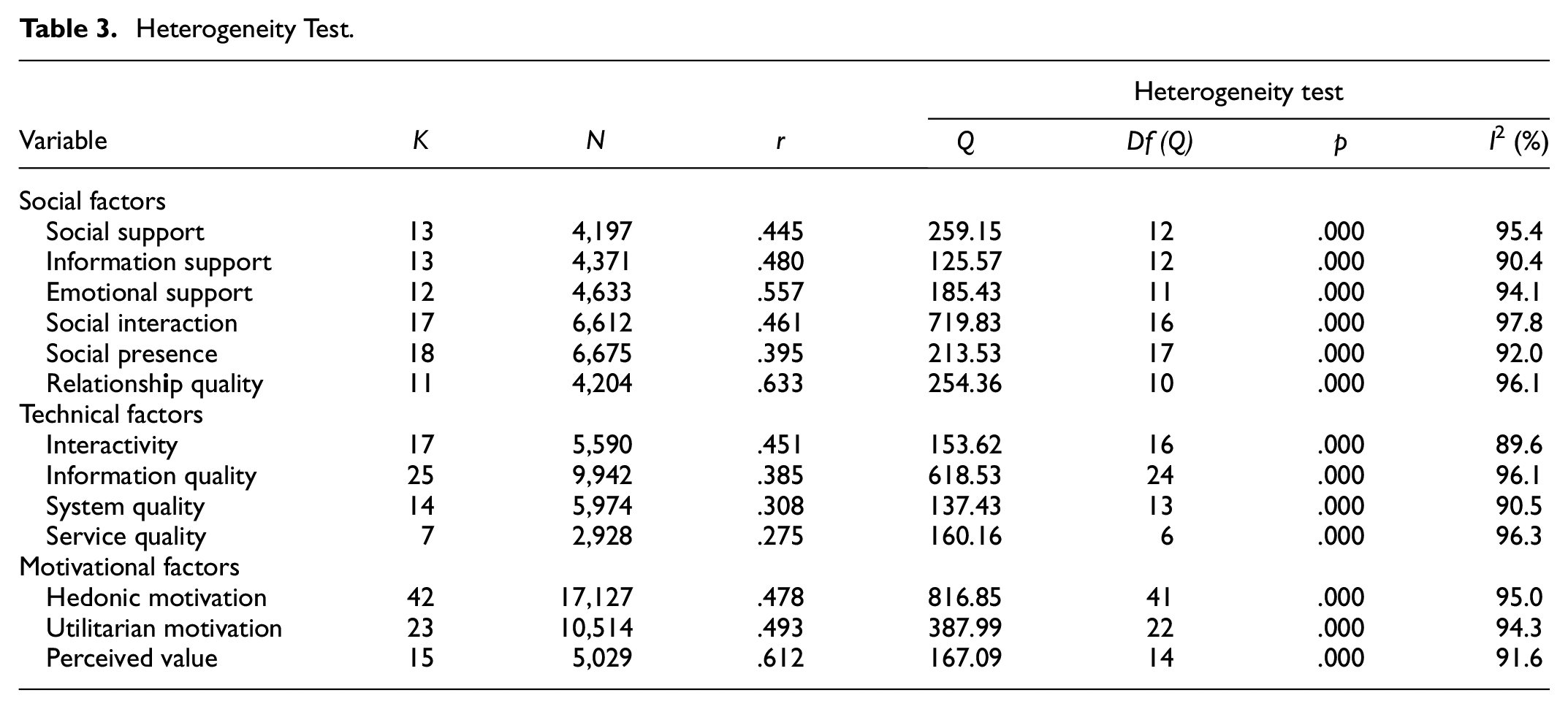
This meta-analysis demonstrates the heterogeneity test results of each variable across studies in social support (Q(12) = 259.15, p = .000; I2 = 95.4%), information support (Q(12) = 125.57, p = .000; I2 = 90.4%), emotional support (Q(11) = 185.43, p = .000; I2 = 94.1%), social interaction (Q(16) = 719.83, p = .000; I2 = 97.8%), social presence (Q(17) = 213.53, p = .000; I2 = 92.0%), relationship quality (Q(10) = 254.36, p = .000; I2 = 96.1%), interactivity (Q(16) = 153.62, p = .000; I2 = 89.6%), information quality (Q(24) = 618.53, p = .000; I2 = 96.1%), system quality (Q(13) = 137.43, p = .000; I2 = 90.5%), service quality (Q(6) = 160.16, p = .000; I2 = 96.3%), hedonic motivation (Q(41) = 816.85, p = .000; I2 = 95.0%), utilitarian motivation (Q(22) = 387.99, p = .000; I2 = 94.3%), perceived value (Q(14) = 167.09, p = .000; I2 = 91.6%. The Q value supports heterogeneity across studies under the main effect (p < .01) and I2 statistic (more than 80%), which indicate there may be some important moderators between CPI and its antecedents. The results are in Table 3.
Heterogeneity Test.
Meta-Analytic Results
A meta-analysis study was designed to generalize the relationship between and the effects of the factors on CPI. Meta-analysis results, the revised effect sizes (r), and confidence interval (CI) are summarized for social, technical, and motivational factors, as shown in Table 4. The strength of factors influencing CPI in the SC environment can be classified into three categories: small (between 0.10 and 0.30), medium(between 0.30 and 0.50), and large(between 0.50 and 1.00) thresholds (Sarkar et al., 2020).
Results of Effect Sizes Between CPI and its Antecedents.

Social Factors
The average effect size of the thirty studies that explore the association between relationsh

Forest-plot for the effect of social factors on CPI.
Technical Factors
Among the studies examining the technical factors of CPI nexus, interactivity is found to be more significantly and positively associated with CPI compared with other technical factors. According to Cohen’s d coefficients (Cohen, 1988), the effect sizes for information quality(r = 0.385, 95% CI = 0.284 to 0.486) and system quality (r = 0.308, 95% CI = 0.224 to 0.393) are large, while service quality (r = 0.275, 95% CI = 0.083 to 0.466) has the medium association with CPI (see Figure 4).
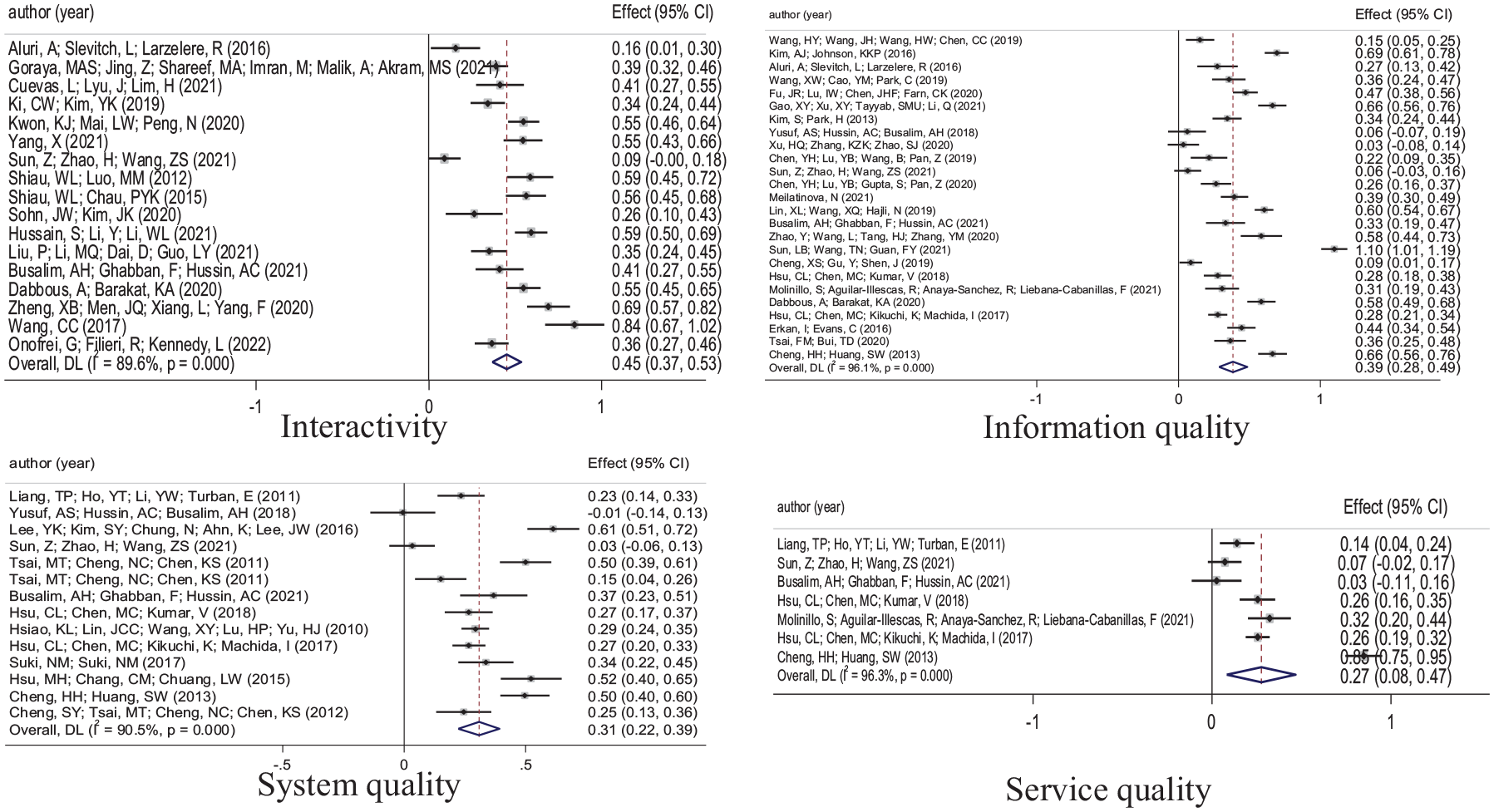
Forest-plot for the effect of technical factors on CPI.
Motivational Factors
Correlations for hedonic motivation (r = 0.478, 95% CI = 0.140 to 0.545), utilitarian motivation (r = 0.493, 95% CI = 0.411 to 0.574), perceived value (r = 0.612, 95% CI = 0.515 to 0.710) are categorized as a large association in their strength (see Figure 5).

Forest-plot for the effect of motivational factors on CPI.
Moderator Analysis Results
In terms of homogeneity estimates (Q-test), the results of moderator analysis of the culture in this research are summarized in Table 5. The coefficients for the relationships between relationship quality, system quality, service quality, and CPI in the SC environment were not calculated for moderating roles due to subgroups covering insufficient effect sizes (the number of observations is at least three from precious work).
Moderator Analysis.

In the context of SC, culture acts as a moderator in investigating the correlations between social factors and CPI (L. Chen et al., 2021; Sheikh et al., 2017; Xu-Priour et al., 2014). The analysis showed that the effects of social presence and social interaction on CPI were positive and stronger in Eastern counties than in Western counties. However, it is easier for consumers to make purchase intentions with the help of social support and emotional support in Western culture than in Eastern culture. Specifically, in terms of information support, consumers in Eastern counties are not likely to seek advice to help them solve problems and make purchase decisions due to insignificant effects. However, that relationship is significant in the east culture. As for technical factors, the meta-analysis results suggest that culture was a significant moderator of the relationship between information quality and CPI. Culture moderates the link between interactivity and CPI in Western cultures; the association is insignificant in Eastern cultures. Concerning motivational factors, the results of the moderator effects of culture on the relationships between hedonic motivation, utilitarian motivation, perceived value, and CPI are significantly larger in the Eastern culture.
Discussion
This is the first study, as far as we know, to systematically evaluate and quantify the magnitude of factors on CPI in the SC environment to obtain general conclusions based on the mixed findings.
Regarding social factors, the findings predicted a significant and large-sized positive effect between relationship quality and CPI in SC. Unlike the traditional e-commerce model, SC builds more positive and closer customer relationships through experience and knowledge about shared products. These relationships, such as trust and familiarity, make consumers reduce uncertainty about information misuse (Li, 2019). Therefore, it could be speculated that the sustainable development of SC is how to build and maintain long-term close connections. Similarly, a significant and strong relationship is found between emotional support and CPI. Emotional support reflects the extent to one’s perception of being cared for by their peers in SC communities, such as benevolence, kindness, understanding, and empathy (Yang, 2021a), which contribute to forming a good relationship with members in SC. As another dimension of social support, information support had a smaller impact on purchase intention than emotional support. A plausible reason to explain this small effect is that information quality is a fundamental design principle in e-commerce while SC applications build on Web 2.0 technologies, emphasizing interaction among users. Therefore, this finding demonstrates that social interaction and social presence between consumers have a significant positive effect on purchase intention. However, consumers’ flow experience decreases when they interact with unfamiliar members due to the absence of enjoyment under this circumstance (Al-adwan & Kokash, 2019).
Concerning technical factors, the effect of interactivity is stronger than any other factors. The website interactivity theory highlights platform interactivity as a first-order formative construct (S. Hussain et al., 2021) with a strong power on website traffic improvement, flow experience, and customer engagement (Clement Addo et al., 2021), which is beneficial to strengthening CPI in SC. Interactive features of SC platforms, such as forums and communities, referrals and recommendations, and ratings and reviews, contribute to acquiring detailed product information, control access, keep hold of consumers’ attention and help fulfill the task at hand through actual human-human interactions and real-time conversations (Hussain et al., 2021). The interactive nature of conversations is not only found to be an important predictor of enhancing the perceived quality of information, system, and service (Cuevas et al., 2020) but also cultivates relationships with other users based on two-way communication. The interactive attribute of the platform hence is a more important technical factor. Analyzing service quality, we also find interesting results that it is with the smallest significant effect. Service quality management accounts for the small effect size of service quality in SC (Shin et al., 2020). The SC and e-service quality are evaluated from customer- and seller-oriented perspectives. The e-service quality dimensions in an electronic commerce environment do not completely increase the customers’ perceptions, experiences, and satisfaction in the context of SC (Jami Pour et al., 2021).
As for motivational factors, perceived value has a larger effect on CPI in SC than utilitarian and hedonic motivation. One possible explanation for this result is that perceived value is the overall and multi-dimensional consumers’ judgment and evaluation of a product or service in the SC (Busalim et al., 2021), including utilitarian, hedonic, and social value. The social value among them, such as cultivating a good relationship with members or getting support from others, contribute to CPI in SC, corresponding with previous research (Y. Chen et al., 2020; X. Wang et al., 2021). Therefore, the effect size is relatively larger with three constructs of consumer-perceived values in this condition. Utilitarian and hedonic motivation have a significant and positive medium effect on CPI in SC, and the former is slightly larger. Consumers’ core motivations and expectations of purchasing in SC are economies, efficiency, and time-saving, while perceived enjoyment is an extra (Xia & Chae, 2021). Most customers look for useful information from online reviews to make decisions in the SC (T. Islam et al., 2021). Customers’ perceived utilitarian value matters more in SC because they pay more attention to products (Y. Guo et al., 2022). In addition, this result is consistent with the previous study that as consumers get more experienced, the effect of utilitarian value becomes more significant in SC (W. Wu et al., 2018).
Considering the important level of cultural backgrounds, the moderating role of culture on CPI and its antecedents, information support, and interactivity fail to show significance. One possible explanation for this finding is that SC combines information, technology, business, and user interaction (C. Wang & Zhang, 2012). Even if the user-generated content evolved from text-based to audio-, video-, and multimedia-based and differences in culture exist between regions, information exchange in interactive environments is the consumer’s basic requirement in the context of SC (Herrando et al., 2019). The interactivity is the feature of the medium (W. Zhao et al., 2019). A mediating interaction in SC, such as human–to–system interactivity, human–to–document interactivity, and human–to–human interactivity, is without space or temporal constraints and exerts a positive influence on purchase intention regardless of culture (Hussain et al., 2021; J. Lin et al., 2019).
The effect of social support and its subset, emotional support, is stronger in Western countries, whereas social presence and social interaction have a larger effect in a collectivist culture. In individualistic cultures such as the USA, consumers tend to add value to their social community collaboration for autonomy, variety, and security (Sheikh et al., 2017). Consumers in Western countries emphasize trust or commitment in the context of SC due to a higher level of information technology and control over feelings (Hossain et al., 2020). Collectivist consumers tend to regard themselves as a member of a society or an organization, focusing more on familiarity, interdependence, and sociability (Xu-Priour et al., 2014). Individuals participate more in online social interaction and make decisions based on the group members’ opinions, which indicates that social presence and social interaction among them are stronger in collectivistic cultures (L. Chen et al., 2021). It is interesting to find that the effect of the information quality in Western and Eastern countries has a marginally significant difference, indicating that information quality is an important indicator of CPI in SC. The moderating effect of culture was more significant and stronger in the relationships between all motivational factors and CPI in the context of Eastern countries. Based on consumer motivation theories, consumers pay more attention to their needs and motives driving human behavior (Xiao, 2018). The individualistic culture is characterized by a relatively low level of communal identification with social media. In contrast, in a collectivist culture, consumers value opinions from personal contacts and rely more heavily on social media as primary sources to satisfy their need for informative and entertaining content (W. H. S. Tsai & Men, 2017).
Implications, Limitations, and Future Directions
Implications
In summary, the results of this meta-analysis include three main dimensions, social dimension, technical dimension, and motivational dimension, which involve 13 antecedents, 119 empirical studies, and a total of 227 effect sizes. This result solves the controversies about the relationship between CPI and its antecedents and draws more reliable conclusions than an individual study. While these factors are proposed in previous studies, these effects’ magnitudes and consistency need to be clarified further. It would be more helpful to provide directions for future research.
Second, little attention has been paid to the role of cross-culture. The current study identifies and verifies cultural differences, which is beneficial to comprehend the cultural nature of CPI in SC. Many factors affect CPI in SC from the perspectives of culture-related theories (K. Z. K. Zhang & Benyoucef, 2016). The moderating role of culture influences CPI in terms of their outer actions and inner thoughts. Although our meta-analysis shows that hedonic and utilitarian values are medium values of 0.478 and 0.493, the latter is stronger. This finding corresponds with previous research that as consumers become more experienced, the effect of hedonic value becomes less significant in SC (W. Wu et al., 2018). The core of SC is to improve utilitarian value through hedonic value.
The current meta-analysis documented several factors we should pay more attention to relationship quality, perceived value, and emotional support for CPI in SC. These significant and strong determinants are distributed among social factors and motivational factors measured with multiple dimensions, which indicate that satisfying socializing needs and understanding customer motivation should be applied and refined for the sustainable development of SC. First, the relationship quality is the most significantly and positively associated with CPI, as noted in the meta-analysis result.
Considering the competition between SC platforms, administrators and Internet engineers should generate more competitive advantages in improving the relationship quality. In terms of relationship quality, it is measured by some multidimensional constructs, mainly including trust, commitment, and satisfaction. Therefore, better relationship quality needs improvement from these indicators, making SC valuable for customers, marketers, and managers. For example, SC platforms can strengthen consumers’ trust through the improvement of website popularity, privacy protection measures, and validation of the authenticity of information. Good trust management is beneficial to develop the relationship commitment between parties, which in turn has a positive effect on satisfaction. On the other hand, the configuration of SC needs to be enriched. The Enterprises can adopt two social commerce strategies, namely, E-commerce websites that leverage social media features and social network websites that provide e-commerce functionalities, which contribute to form their relationship quality with customers. Second, the perceived value determined by the multidimensional perception of SC is the second greatest factor influencing CPI. Therefore, SC platforms should take measures to provide more convenience, lower costs, and a broader product offering. In addition, a delightful consumption experience is also needed to increase consumers’ perception of the value of SC. Third, our analysis reveals a strong relationship between emotional support and CPI. From the perspective of emotional support, methods for SC platforms to generate emotional support among consumers include optimizing the interaction interface of SC, providing channels or groups for emotional exchanges with others, and discussing problems or hot topics with each other. At last, based on one of the main results of this study, culture moderates the relationship between CPI and its antecedents, which is crucial for understanding CPI in SC. To maintain the sustainable development of SC, cross-cultural differences in CPI should be considered. This result implies that managers in the background of Eastern collective culture can use new technologies, such as Chatbots and VR shopping, to enhance social presence and interaction. Practitioners in Western countries should build better online communities to provide emotional and informational assistance, which is helpful to enhancing consumers’ perception of social support.
Limitations and Future Research
There are several limitations to our studies. The current meta-analysis only explains the moderator effect of culture on the relationship between CPI and its antecedents. Therefore, another important area for future research is to address other potential moderators, such as SC types and gender, by obtaining more relevant research. In addition, the perceived value can be categorized into multiple dimensions, such as three dimensions (functional, emotional, and social) and six dimensions (emotional, social, quality, health, epistemic, and educational). Only hedonic and utilitarian values were included in this study. Therefore, more factors can be examined as an important dimension of customer perceived value in the future.
Footnotes
Declaration of Conflicting Interests
The author(s) declared no potential conflicts of interest with respect to the research, authorship, and/or publication of this article.
Funding
The author(s) disclosed receipt of the following financial support for the research, authorship, and/or publication of this article: This study was supported by the Humanities and Social Sciences Research Proiect of the Ministry of Education of China, Grant/Award Number: 22YJC630131. This study was carried out in accordance with the recommendations of the Ethical Principles of Psychologists and Code of Conduct of the American Psychological Association (APA).

Data Availability Statement
Data sharing not applicable to this article as no datasets were generated or analyzed during the current study.