




Abstract
This study examined the factors determining social commerce purchase and recommendation intentions within the context of swift guanxi. The data analysis was conducted with Smart PLS 3.0 using the structural equation modeling technique. The results have illustrated that perceived usefulness and perceived ease of use were significant in determining both the recommendation and social commerce purchase intentions. In addition, eWOM was also a significant predictor of both social commerce purchase and recommendation intentions. Interestingly the results showed that trust in social network sites was not significant in influencing social commerce purchase and recommendation intentions. Also, mutual understanding and relationship harmony were found to predict the social commerce purchase and recommendation intentions. The implications of these and other results findings of the study are discussed.
Keywords
Introduction
The social aspect of e-commerce is termed as a social commerce. Social commerce adds e-commerce functionalities to social media which enables consumers to purchase goods and services from their connected location (Lin et al., 2019). Social commerce is considered the application of Web 2.0 features like content generational tools for the enhancement of consumers’ interaction and engagement in e-commerce and it is broadly based on the relationship built through online commercial undertakings (Liang et al., 2011; Stephen & Toubia, 2010). It can also be referred to as a new revolution of e-commerce where the delivery of e-commerce activities and transactions takes place through the social media platform (Huang & Benyoucef, 2013; Liang & Turban, 2011; C. Wang & Zhang, 2012). It is a subset of e-commerce that applies social media technologies to undertake e-commerce transactions and it has attributes such as social technology, community interactions, and commercial activities (Liang et al., 2011; Yadav et al., 2013). Social commerce provides consumers and companies immense opportunities to harness the benefits that social media offers to exchange information and transact businesses with each other (Lin et al., 2019; Shin, 2013). Social commerce provides unique features that enable a more social and interactive environment that permits information sharing, networking, and collaborating thereby enhancing communication and interaction between users (Busalim & Hussin, 2016; C.-Y. Li & Ku, 2018). Due to the social media information-sharing capabilities, consumers are empowered to undertake prudence purchase decisions based on the rich knowledge and experiences about products and services that are shared online (Lin et al., 2019). Businesses and online vendors can also be empowered to take advantage of the social media platform to get vital information generated by consumers to improve products and service delivery and also build a good relationship with consumers (Lin et al., 2019).
The consumer engagements in social commerce purchase and recommendation intentions are very crucial to the development and increment in purchase volumes in social commerce. A social commerce survey about US online shoppers showed that about 83% of consumers tend to share shopping information with friends and 67% indicated that they may purchase more based on recommendations from friends online (Marsden, 2009). Additionally, the number of digital shoppers in the USA in 2016 reached 209.6 million people where it was specified that virtual shoppers had browsed products, compared prices, or purchased merchandise at least once (Daniela, 2021). These numbers are projected to reach 230.5 million people in 2021 which positions the USA as one of the major e-commerce countries (Daniela, 2021). When it comes to the Chinese market, the number of online shoppers as of December 2020 was about 782.41 million people who have undergone a purchase online (Yihan, 2021a). The digital purchase penetration rate in China’s e-commerce system is about 57% which makes China the world’s second-largest e-commerce market after the USA (Yihan, 2021a). Trickling down to social commerce, China in recent years (5 years) has seen consistent growth in its social commerce space with the number of social commerce users reaching 713 million in 2019 while the market size is projected to go beyond two trillion yuan (Yihan, 2021b). In 2019, the social commerce industry was estimated to have created about 48 million jobs in China (Yihan, 2021b). The projected Social commerce industry annual growth in China is 66% as of 2020 (Yihan, 2021b).
The consumers’ purchase behavior in social commerce may be influenced by recommendations because shopping information shared by friends and colleagues is considered by consumers as credible and reliable (X. Hu et al., 2016). An important characteristic of social commerce is the inter-personal relationship generated during interactions on social commerce sites which can influence consumer purchase decisions. As indicated by Zhang et al. (2016), the manner of inter-personal relationships in social commerce is a greater contributor to consumer purchase decisions. These inter-personal relationships in social commerce create relational exchanges between parties to engage in economic and impersonal interaction in networking based on trust, commitment, and satisfaction in social commerce (M. N. Hajli, 2014; Hsu et al., 2017; Shanmugam et al., 2016). This inter-personal and relational exchange among the populace in China is termed Guanxi. Guanxi is a close and pervasive interpersonal relationship that is prominent in China and reports indicate that WeChat is used actively to build guanxi (Lin et al., 2019; Lovett et al., 1999). Guanxi is considered a Chinese system of engaging in business based on personal relationships and it is representative of the way business is done (Lovett et al., 1999). Guanxi in social commerce is known as swift guanxi and it plays an important role when it comes to social commerce in China (Lin et al., 2019; Wu, 2021).
This study seeks to understand the determinants of social commerce purchase and recommendation intentions within the context of swift guanxi among Chinese college students. College students are considered as the most vibrant group in terms of the use of social networking sites due to their technology-education orientated and information seeking as well as multi-tasking nature. The use of social networks for college students creates a lasting environment where according to Razi et al. (2017) they feel bonded in terms of closeness and emotionally. Thus they anticipate some form of social and moral support from social network colleagues. These social relationships that are created among college students as a result of the interaction on social networking sites influence their decisions to undertake a purchase on social commerce activities (Al-Adwan & Kokash, 2019). The second important element aside from purchasing decisions is the powerful nature of referrals or recommendations that social networking sites provide. As indicated by Trusov et al. (2010), the referral or recommendation communication shared on social media platforms exerts greater influence due to the power of persuasion and credibility that it generates among users (Hossain & Kim, 2018).
Thus, this study explores the swift guanxi dimensions such as mutual understanding, reciprocal favors, and relationship harmony along with the core determinants in the Technology Acceptance Model (TAM) such as perceived usefulness and perceived ease of use on the consumers’ social commerce purchase and recommendation intentions. Whilst these dimensions of swift guanxi (mutual understanding, reciprocal favors, and relationship harmony) have been validated to significantly influence consumer social commerce purchase intentions among Chinese people (Lin et al., 2019). The study of Lin et al. (2019) however failed to consider how these three characteristics of swift guanxi such as mutual understanding, reciprocal favors, and relationship harmony can influence the decision of social commerce consumers to recommend products and services to other people. Another study that experimented on the phenomena of swift guanxi showed that the factor of guanxi is instrumental in driving the repurchase intentions of social commerce users (J. Lin et al., 2017). This study (J. Lin et al., 2017) again failed to demonstrate how swift guanxi can lead to consumer recommendation behavior but rather did indicate that recommendations along with feedback and interactivity are antecedent of swift guanxi. Also, the study of Cheng et al. (2020) demonstrated that the antecedent of swift guanxi are familiarity, interpersonal similarity, interactivity, and personal interaction but did not demonstrate how swift guanxi elements can impact the consumer recommendation behavior in social commerce (Cheng et al., 2020). It thus follows that these studies (Cheng et al., 2020; J. Lin et al., 2017; Lin et al., 2019) along with other studies as far as the literature is concerned have failed to validate the direct impact of these three dimensions of swift guanxi on the recommendation behavior of consumers in social commerce. Consequently, this is the identified gap in the e-commerce and social commerce literature which this study fills by expanding the understanding of swift guanxi in the context of social commerce purchase and recommendations. To achieve the objectives of this study the following research questions will be explored: (1) what factors determine consumer social commerce and recommendation intentions within the context of swift guanxi? (2) What is the significant impact of these factors on consumer social commerce purchase and recommendation intentions within the context of swift guanxi? The elucidation of these questions will not only contribute to a better comprehensive appreciation and extension of the literature but also for social commerce developers, and practitioners. First, the result will determine the vital role that swift guanxi dimensions (mutual understanding, reciprocal favors, and relationship harmony) can have in shaping social commerce purchase and recommendation behavior. Secondly, highlight the role that perceived usefulness and ease of use can have in the design and development of social commerce systems toward the uptake of social commerce purchase and recommendation behaviors. Thirdly, dissection of the crucial role eWOM and trust can play in the context of consumer purchase and recommendations. These research outcomes will aid social commerce practitioners to develop marketing systems to drive higher social commerce activities/interactions to reach sustainable maximum purchase decisions and recommendations within the context of swift guanxi.
The rest of the paper is organized in the following order: The discussion of the research background and research model and hypotheses development, research methodology, presentation of data analysis, followed by a discussion of the results along with its implications for theory and practice, conclusion, and limitations of the study.
Research Background and Foundation
Technology Acceptance Model (TAM)
The Technology Acceptance Model (TAM) is amongst one of the Information System (IS) theories that are applied to understand how and why people adapt to and use new information technologies. The technology acceptance model was developed by Davis (1989) as an adaptation of the Theory of Reason Action (TRA) to explain the user adoption and acceptance of new information technology systems. This model was designed to offer a better explanation of the influencing factors of computer acceptance across many ranges of new technology users. TAM postulates that the perceived usefulness and perceived ease of use are the two key chief determinants of information technology acceptance behaviors. The perceived usefulness is explained as the individual users’ subjective possibility that the use of a new information system or technology will improve his or her job performance within the organizational settings (Davis, 1989; Davis et al., 1989). Contrary, perceived ease of use is defined as the individual user understanding that the use of a particular information technology system will be free of effort (Davis, 1989; Davis et al., 1989).
The TAM was later extended into the Extended Technology Acceptance Model (TAM 2) (Venkatesh & Davis, 2000). TAM2 sought to integrate additional constructs such as social influence, subjective norm, voluntariness, image, job relevance, output quality, result demonstrability, and perceived ease of use to enrich the understanding of the individual factors influencing the acceptance of any information system. Through the extended TAM2, it was demonstrated that subjective norm has a direct significant impact on the individual intentions to use as compared to the perceived usefulness and perceived ease of use (Davis et al., 1989; Venkatesh & Davis, 2000). TAM is said to be one of the widely used models in the areas of technology adoption research (Dwivedi et al., 2017). This wide usage and application could be attributed to its simplicity, ease to use, understanding, and testing across broad areas of research to explain the user adoption of new systems.
Related Work
Perceived Usefulness and Ease of Use
Perceived usefulness and ease of use of any form of technology are instrumental in driving the uptake of such technology. The usefulness of technology is the consumer tendency to hold a belief that technology will enable the execution of a better job outcome. That is the use of technology that will promote quicker work performance, make the job easier and more beneficial, and particularly increase productivity (Jegundo et al., 2020; Sinaga et al., 2021; Turk et al., 2019). On the other hand, perceived ease of use is the confidence of users that the application of any innovation/technology will be less challenging. It can ensure the development of technological systems that are: easy to learn, controllable, clear and understandable, flexible, easy to become skillful, and easy to use (Iriani & Andjarwati, 2020; Prayogo & Sugianto, 2021).
Electronic Word of Mouth
Electronic word of mouth (eWOM) is considered a shift from traditional word of mouth communications as a result of the innovation introduction of web.20 technology. Traditional word of mouth communications is considered a face-to-face interaction or communication shared (offline) among know friends and acquaintances (Y. Hu & Kim, 2018; Sulthana & Vasantha, 2019). The increasing growth of social media has empowered users online to connect, create and share user-generated content (Bore et al., 2017; Verma & Yadav, 2021). While the word of mouth communication does exist for a short period, e-WOM communication can last for a longer period due the how it is shared via computer-mobile technology systems (Verma & Yadav, 2021). E-WOM is considered as the quantum of consumer experience with a company’s products and services (positively or negatively) which is shared through the internet system. It can influence other consumers’ decisions to participate or engage in products or services from any company or institution. In other words, eWOM is instrumental in changing consumers’ attitudes and behavior toward products and services (Moran & Muzellec, 2017).
Trust
The factor of trust is mandatory for the elimination of risk perceptions and indispensable if business interactions are to be considered successful. Different characteristics can influence and form the basis for trust such as cultural background, personality type, religious belief, and past experiences (Rouibah et al., 2021). Trust in e-commerce can be categorized into forms such as trust in e-commerce systems/applications, trust in internet shopping processes, trust in vendors, trust between individuals, and firm trust in e-business (Lin et al., 2019; Papadopouou et al., 2001). Research has validated that social trust in the form of information-based trust and identification-based trust has a positive impact on social commerce behaviors (Sohaib, 2021).
Guanxi
Scholars have expanded and extended this social relationship factor (Guanxi) to understand how Chinese social commerce consumers can actively respond to the purchase decision on social commerce systems. A recent study that sought to understand Chinese consumer participation in social commerce through the lenses of social support and swift guanxi found that relationships do exist in social commerce interactions and it can be demonstrated by swift guanxi and trust (J. Lin et al., 2018). The study further revealed that swift relationships matter since they form the basis for consumer intentions on social commerce sites (J. Lin et al., 2018). In a related study, it was further demonstrated that social support and presence are driving forces for swift guanxi and trust which lead to consumer repurchase decisions and social sharing intentions (Fan et al., 2019). In another research, it was shown that the dimensions of guanxi exert a positive impact on sellers’ effectiveness and that guanxi can be used to determine the buyer’s perceived guanxi position toward the seller (Wu et al., 2022).
Recommendation and Social Commerce
The concept of recommendation in social commerce empowers consumers to locate and find products and services that meet their standards and expectations. Sometimes companies implement recommender systems as a business tool to understand product knowledge through either coded knowledge given by experts or knowledge mined based on the learned consumer attitude and behavior (Gutama et al., 2021; Mican et al., 2020). This recommender system can facilitate and guide consumers through the difficult task of choosing and locating services and products that they prefer (Mican et al., 2020; Selva Rani & Kumar, 2018). Recommendation systems do contribute to social commerce in three aspects: First, it enables the converting of browsers into buyers where the system can aid the consumer to locate the product they want. Secondly, increase cross-sell by the suggestion of extra or additional products for the consumer to buy, and thirdly, it enables companies to build loyalty through the creation of a value-added relationship between the site and consumers (Abumalloh et al., 2020; Selva Rani & Kumar, 2018).
Research Model and Hypothesis Formation
The study investigates the research model depicted in Figure 1. It aims to explore how the swift guanxi dimensions (mutual understanding, reciprocal favors, and relationship harmony) can predict both the social commerce purchase and recommendations intentions. Additionally, it considers how the key factors of the Technology acceptance model (TAM) such as perceived usefulness and ease of use can influence the consumer social commerce purchase and recommendation intentions. Lastly, it hypothesizes how electronic word of mouth (eWOM) communication and trust can both determine social commerce and recommendation decision among consumers respectively.

Research model.
Perceived Usefulness (PU)
The perceived usefulness of information systems has the potential to influence users’ adoption behavior. As defined by Davis (1989), perceived usefulness is the degree to which the user is convinced that the use of any information technology will provide an enhancement in his or her performance. System usefulness is an important criterion for users to come to a definite conclusion of the benefits that will be accrued to them in the course of adopting a technology. Based on the user’s convictions and apprehension of the performance of an information system, it can influence their decision to recommend the acceptance of such technology and the intention to use it as well. Hence, it thus follows that if users think that social commerce site is useful to them they will then have the intention to use it and recommend it as well. Studies have established a significant relationship between perceived usefulness and social commerce purchase intentions (Al-Dwairi, 2017; Biucky & Harandi, 2017; Choi, 2019). In this study, we also postulate a positive relationship between perceived usefulness and intention to recommend social commerce. Accordingly, H1 and H2 were proposed.
Perceived Ease of Use (PEOU)
Perceived ease of use is considered as the user believes that using new technology will be free from effort (Davis, 1989). PEOU that accompanies social commerce design has the potential to also influence the extent to which users use such social commerce sites and recommend its adoption to others as well. Scholars have provided strong evidence of the direct positive impact of PEOU on social commerce purchase intentions (Al-Dwairi, 2017; Biucky & Harandi, 2017; Choi, 2019). In addition, we posit a direct positive link between perceived ease of use of social commerce interface and intention to recommend social commerce. Consequently, H3 and H4 were proposed.
Electronic Word of Mouth (eWOM)
Word of mouth communication that occurs online through comments shared or made by consumers be it potential, actual, or former consumers through the medium of the internet is known as electronic word of mouth (eWOM) (Lamberton & Stephen, 2016; J.-J. Wang et al., 2018). EWOM often takes place through written communication and it is considered to be more asynchronous than traditional WOM because it can break during the communication process (Siqueira et al., 2019). EWOM play an important role in consumers’ attitudes and behaviors due to the uncertainty that consumers experience when it comes to deciding the quality of a service or product and thus will resort to the word of mouth advice from other consumers because of its resonating nature (Berger, 2014; Mudambi & Schuff, 2010; Siqueira et al., 2019).
The social media platform is the major way by which consumers try to find out more information to discuss, share and voice their experiences/challenges in terms of products and services (Siqueira et al., 2019). These experiences that are shared through eWOM empower consumers to take a keen interest in a product or service and information shared has the potential to reach a large audience and groups with distance challenges (Siqueira et al., 2019). The comments and views shared through eWOM on social media can be considered as an endorsement or recommendation to others and may affect the purchase intentions of would-be consumers (Siqueira et al., 2019; X. Wang et al., 2012). EWOM communications share through social media networks become known as social word-of-mouth (sWOM) (Siqueira et al., 2019). Consumer experience shared on social networks can influence the decision of the user to recommend the adoption of social commerce and social commerce purchase intentions. Consumer attitude toward social commerce was confirmed to influence electronic word of mouth intentions (eWOM) (Um, 2019). Studies have shown the direct significant impact of eWOM on the intention to use (Abubakar et al., 2017; Tien et al., 2019; Zainal et al., 2017) but no study to the best of our knowledge has explored the relationship between eWOM and intention to recommend social commerce. Consequently, H5 and H6 were proposed.
Trust in Social Network (TSN)
Trust is a critical component of interaction that takes place on social media. Trust is recognized as a major component in social relationships and also a measure of confidence that an entity will act expectedly despite being able to monitor or control the environment in which it occurs (Aghdam et al., 2020; Sherchan et al., 2013). Trust is assumed or established within social networking when two parties have a history of trustworthy interactions or communications (Sharma et al., 2019). Trust has been a vital ingredient in today’s world due to the existence of challenges of different types of users such as honest, dishonest, or people with malicious intentions that may interact with each other anonymously (Aghdam et al., 2020). These dishonest or malicious persons can join and perform unauthorized or malicious actions through the spreading of untruth information while persons may trust them unknowingly (Aghdam et al., 2020). Trusting dishonest people and users can create a negative effect which will result in less trust and interaction on social networks (Aghdam et al., 2020). Thus, based on the nature of the trust of consumers on the social network sites they can decide to engage in the adoption and recommendation of social commerce sites. Previous studies have demonstrated that trust in a social network is a significant determinant of the intention to engage in social commerce (Sharma et al., 2019). Accordingly, H7 and H8 were proposed.
Swift Guanxi
Swift guanxi originates from China from the word guanxi (meaning relationship). Guanxi is a form of informal relationship strategy practiced by everyone in China. Also, it is based on the belief that social interaction is dependent on building strong relationships (Fu et al., 2006). Guanxi is considered a closely connected network that depends on obligatory reciprocity, trust, harmonious relationship, and face preservation (Davison et al., 2018). The factors consisting of guanxi are affection, face/reputation, harmony, reciprocity, and trust (Davison et al., 2018; Voelpel & Han, 2005; Young et al., 2012). It is further defined as a particularized and personalized relationship based on the reciprocal enhancement of favors between two individuals (C. C. Chen et al., 2004; Lee et al., 2001).
Swift guanxi is a theory proposed based on the traditional concept of guanxi within the context of social commerce (Ou et al., 2014). Swift guanxi is defined as an online consumer’s understanding of a swiftly formed interaction and international personal relationship with a seller which is made up of three important dimensions such as mutual understanding, reciprocal favors, and relationship harmony (Ou et al., 2014). The first dimension of swift guanxi known as mutual understanding has to do with members’ appreciation of each other’s needs within the social commerce environment while the second dimension, reciprocal favors has to do with members’ perceived positive benefits arising from the interactions in the social commerce platform. To sum up, the third concept of swift guanxi is called relationship harmony which is considered as a mutual respect and conflict avoidance among social commerce groups or members. Swift guanxi enables consumers to build relationships rapidly through the online environment which has the potential to influence their decision-making processes (Lin et al., 2019; Ou et al., 2014).
Mutual Understanding
Mutual understanding is a major component of the three dimensions of swift guanxi (Lin et al., 2019). Mutual understanding depicts both consumers and sellers appreciating and valuing each other’s demand and thus agreeing on what to buy and sell particularly when it comes to the details of the transactions involved (Lin et al., 2019). It allows parties to a transaction to understand and follow the implicit rules of a guanxi-based relationship or engagement such as business culture, exchanging favors, and the business engagement and interactions (Lee et al., 2001; Y. H. Wong & Chan, 1999). Mutual understanding according to Lin et al. (2019) has the potential to positively influence consumers’ social commerce purchase intention. In the absence of mutual agreement and understanding of price, delivery, quality, and other requirements it will be hard for consumers to make a purchase decision (S. G. Li et al., 2021). Depending on the nature of the mutual understanding reached between consumers and sellers, it can have a positive effect on their decision to engage in social commerce purchase and recommendation. The direct positive impact of mutual understanding on purchase intention in social commerce has been demonstrated (Lin et al., 2019). Hence H9 and H10 were proposed.
Reciprocal Favors
Another major dimension of swift guanxi is reciprocal favors. This is demonstrated through the providing of discounted prices or small gifts to buyers or releasing positive ratings and reviews for sellers, as a means to fulfill reciprocal obligations (Lin et al., 2019). Reciprocity is considered the basic ingredient for the social exchange to happen and forms relationships on which future interactions or transactions may be based (Akoorie et al., 2013; Leung et al., 2005; Luk et al., 1999). In cases where a producer or seller provides some form of favors to consumers, it drives reciprocal favors which bring about the willingness to transact/engage with the producer or seller (M. Wong, 2007). Based on this assumption, it is postulated that reciprocal favors can positively affect the decision of users to engage in social commerce purchase intentions and recommendation intentions. Consequently, H11 and H12 were proposed.
Relationship Harmony
Relationship harmony is another important characteristic of swift guanxi (Lin et al., 2019). Within the context of a harmonious relationship, parties engage and respect each other and endeavor to avoid conflict (Lin et al., 2019). Establishing a harmonious relationship eliminates or reduces costs or risks associated with consumers’ decision to engage in social commerce and drives businesses success (Hoare & Butcher, 2008; Lin et al., 2019). A relationship that is based on respect and consumers will be more inclined to make purchase products or services from producers or sellers who show respect (Ou et al., 2014). Establishing strong relationship harmony between consumers and sellers can positively drive consumers to harbor the intention to engage in social commerce and recommend it as well. Studies have shown the direct positive effect of relationship harmony on the intention to participate in social commerce purchases (Lin et al., 2019). According, H13, and H14 were proposed.
Social Commerce Purchase Intentions
The development of social media has changed the nature of the interaction between consumers and producers/sellers. Social media serves as a social network offering better and cheaper avenues for information gathering to make purchase decisions before and after the product and services are procured (Biucky & Harandi, 2017; Bugshan & Attar, 2020; Ghahtarani et al., 2020). Social media has transformed from a strategy to attract more customers to a strategy to attract more consumers to purchase through social media which is known as social commerce. Social commerce is the purchasing and sharing of product information via social media. The nature of the interactions which occur on social media could increase shared experiences and may help in identifying products and gathering and sharing product information that will impact positively the intention to engage in social commerce (Bugshan & Attar, 2020; N. Hajli, 2015; D. Kim, 2013; Mathur, 2015). Previous studies have shown a positive relationship between intention to use and the intention to recommend (Oliveira et al., 2016; Verkijika, 2020). Thus, it follows that consumers that harbor the intention to engage in social commerce purchase may also have the intention to recommend its adoption to others. Accordingly, H15 was proposed.
Research Methodology
The questionnaire approach was used to collect data for this study from college students. The college students were chosen as the sample for this study because students are most vibrant in the usage of social media and commerce and thus may have a high tendency to engage in social commerce purchases. Convenient and random sampling techniques were adopted to gather the required data for this study. The questionnaire items used were adopted from previous studies but were modified to reflect the context and scope of this study. There were adapted as follows: Perceived usefulness and perceived ease of use (Biucky & Harandi, 2017; Davis, 1989; Um, 2019), electronic word of mouth communications (e-WOM) (Erkan & Evans, 2016; S. Kim & Park, 2013), trust in social network sites (Chang et al., 2017; N. Hajli et al., 2017; Hong & Cha, 2013), mutual understanding, reciprocal favors and relationship harmony (Lin et al., 2019; Ou et al., 2014), intention to recommend (Hosany & Prayag, 2013; Hosany & Witham, 2010; Prayag et al., 2017) and purchase intention (Erkan & Evans, 2016; Hong & Cha, 2013; Lin et al., 2019). The designed questionnaires items used are attached as Appendix A.
The sample size was determined by the use of indicators such as a confidence interval level of 95%, a margin of error of 5%, and an estimated student population size of 33,000. Per the use of these indicators the calculated minimum required sample size is 380 (Qualtrics, 2020). Based on this validation of the sample size, the researcher decided to administer (manually) the questionnaires to the targeted population size of 33,000 students randomly with the expectation that at least the minimum required sample of 380 will be obtained. The sample (421) obtained was more than the minimum required sample and thus we decided to proceed with it. Also, we dedicated to proceed with the sample size of 421, taking into consideration that the PLS-SEM which was used for this study works efficiently with small sample sizes when the models under investigation are complex (Kaufmann & Gaeckler, 2015; Ringle et al., 2012; Willaby et al., 2015).
The items in the questionnaire were measured on a five-point scale which ranges from 1 = Strongly Disagree (SD) to 5 = Strongly Agree (SA). Out of the 500 total questionnaires distributed to students during class sections and off class periods, study rooms, dormitory/hostels, 484 responses were recovered. A thorough check was conducted on the recovered questionnaires for incomplete information and it was discovered that 63 (13%) of the returned questionnaires were not completed. The deficient questionnaires were discarded and hence not were captured for the data analysis. Consequently, the total valid responses of 421 (86.9%) were captured and used for the data analysis. The captured data were analyzed with SPSS and Smart PLS 3.0 by undertaking the structural equation modeling technique. The Smart PLS was chosen as the best evaluation tool because it has been used in several studies to validate various proposed research models (Lallmahomed et al., 2017; Oliveira et al., 2016). Also, its unique characteristics permit the estimation of complex models with many variables and indicators particularly in the context of achieving better prediction analysis (Hair Jr et al., 2014; Ramayah et al., 2018).
Common Method Bias (CMB)
The use of a single survey data source for both independent and dependent variables from the same instrument can potentially generate a bias as a result of first, the adoption of a single method of data collection and secondly, response bias by respondents (Eichhorn, 2014). These forms of errors or bias are technically known as Common Method Variance (CMV) or Common Method Bias (CMB) (Eichhorn, 2014). The Harman Singe Factor (HSF) was used to determine the common method variance in the study. Common method bias is considered to be present when the common latent factor explains more than 50% of the variance (Eichhorn, 2014). The analysis revealed that the factors explain 37.6% of the variance which is less than the 50% recommended. Hence, it is an indication that there is no common method variance/bias challenge in our data.
Results and Data Analysis
Demographic Statistics
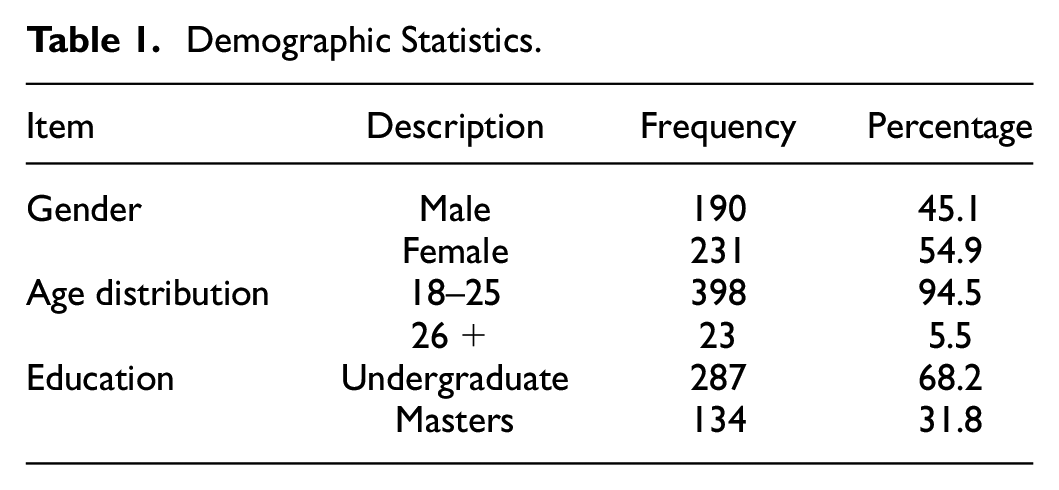
The demographic statistics of the respondents who participated in the survey are shown in Table 1. The majority of the respondents were female (54.9%) and most of them were at the age ranges of 18 to 25 years (94.5%). The greater parts of the respondents were undergraduate students (68.2%).
Demographic Statistics.
Measurement Model
The results of the measurement model are shown in Table 2. Quality criteria such as Cronbach’s alpha, average variance extracted, composite reliability, and factor loading were used to test and determine the reliability and validity of the proposed model. The acceptable reliability indicator for factor loadings is that items should load above .70 (Hair et al., 2010) and this was achieved as per the figures shown in Table 2. The reliability indicator for Cronbach’s alpha is recommended not to be less than .70 (Hair et al., 2010; Henseler et al., 2009) while for the composite reliability, the acceptable indicator reliability is a value above .80 (Henseler et al., 2009). In addition, the average variance extracted is recommended not to have values less than .50 (Hair et al., 2010). Hence the acceptable and recommended values for each of the reliability indicators such as composite reliability, average variance extracted and Cronbach’s alpha were all met. Also, the discriminate validity of the constructs was undertaken using the Fornell-Larcker criterion as shown in Table 3. The discriminant validity criterion states that a construct is considered to have discriminant validity if the square root of the AVE is larger or greater than the paired inter-correlations between the latent constructs (Fornell & Larcker, 1981). As displayed in Table 3, it can be observed that all the diagonal variables (square root of the AVE) are higher than the equivalent off-diagonal values (paired correlations). In conclusion, the Fornell-Larcker principle has been satisfied and thus confirms the discriminant validity of the scales of measurement used in our study.
Measurement Model.

Discriminant Validity.

Note. The bold diagonal in Fornell-Larcker show the square root of the AVE. PU = Perceived usefulness; PEOU = Perceived Ease of Use; EWOM = Electronic Word of Mouth; TSNS = Trust in Social Networking Sites; MU = Mutual Understanding; RF = Reciprocal Favors; RH = Relationship Harmony; RI = Recommendation Intentions; SCPI = Social Commerce Purchase Intentions.
Goodness-of-Fit Indices
The model fit indices of the measurement model are indicated in Table 4. The goodness of fit (GoF) indices is considered as the second level validation of the measurement model (Henseler & Sarstedt, 2013; Shi et al., 2019). It is a means to properly validate a PLS path model and measure the predictive performance of the measurement models (Esposito et al., 2008; Tenenhaus et al., 2004). The recommended (cut-off for good fit) goodness-of-fit indices indicators and values are as follows: x2/df (p-value > .05), GFI ≥ 0.95, AGFI ≥ 0.90, NFI/TLI ≥0.95, NNFI ≥ 0.95, CFI ≥ 0.90, RMSEA < 0.08 and SRMR < 0.08 (Brown, 2015; L. Hu & Bentler, 1999; McDonald & Ho, 2002; Parry, 2020). As indicated in Table 4, all the recommended values for goodness-of-fit to exit have been met and thus a confirmation of the good model fit of our data.
Goodness of Fit Indices.

Note. x 2/df = ratio of chi-square to degrees of freedom; RMSEA = root mean square error of approximation; CFI = comparative fit index; GFI = goodness of fit index; AGFI = adjusted goodness of fit index; IFI = incremental fit index; TLI = Tucker–Lewis index; NFI = normalized fit index.
Structural Model
The results of the structural model (hypothesis) tested are shown in Table 5. The results indicate that perceived usefulness was significant predictor of both the recommendation intention (β = .589, p < .01) and social commerce purchase intention (β = .324, p < .01). Hence H1 and H2 were supported. Also, perceived ease of use was found to significantly predict both the recommendation intention (β = .103, p < .05) and social commerce purchase intention (β = .374, p < .01). Therefore H3 and H4 were also supported. Electronic word-of-mouth communication was determined to positively predict both the recommendation intention (β = .126, p < .001) and social commerce purchase intention (β = .162, p < .05). Consequently, H5 and H6 were statistically supported. It further revealed that trust in social network sites (TSNS) was not significant predictor of both the recommendation intentions (β = .026, p > .05) and social commerce purchase intentions (β = .05, p > .05). H7 and H8 were therefore not supported. However, it was found that mutual understanding was significant determinant of both the recommendation intentions (β = .420, p < .01) and social commerce purchase intentions (β = .225, p < .01). H9 and H10 were therefore supported. In addition, whilst reciprocal favor was not significant in predicting recommendation intentions (β = .040, p > .05), however, it was found to significantly determine the social commerce purchase intentions (β = .103, p < .05). Hence, H11 was not supported while H12 was supported. Again, relationship harmony was found to significantly predict both the recommendation intention (β = .201, p < .01) and social commerce purchase intention (β = .185, p < .01). Therefore H13 and H14 were supported. Lastly, the social commerce purchase intention was significant determinant of user recommendation intention (β = .436, p < .01). H15 was therefore supported. The graphically depicted structural model (validated research model) is shown in Figure 2.
Research hypothesis tested.

Note. Estimation of partial least squares. PU = Perceived usefulness; PEOU = Perceived ease of use; EWOM = Electronic Word-of-Mouth; TSNS = Trust in Social Networking Sites; MU = Mutual Understanding; RF = Reciprocal Favors; RH = Relationship Harmony; RI = Recommendation Intentions; SCPI = Social Commerce Purchase Intentions.
p < .01. **p < .05. *p < .001.

Validated research model.
Discussion
This study explored the factors influencing the social commerce purchase and recommendation intentions among college students. A research model was developed based on a thorough literature review and was later validated through a structural equation modeling (SEM) technique using Smart PLS 3.0. The results have shown mixed findings with the majority of the proposed hypotheses being statistically supported, thus broadening our understanding of the determinants of social commerce purchase and recommendation intentions. First, the impact of perceived usefulness on recommendation and social commerce intentions was supported. These demonstrate that users of social commerce will recommend the adoption of commerce and engage in social commerce purchasing only if there are associated benefits when interacting on social media/commerce networks. Some of these associated benefits that social commerce offers are reduced costs, easy access to diverse products, expanded markets, decreased costs, increased choice, and time savings (Biucky & Harandi, 2017). Our findings support previous studies that established that perceived usefulness is a significant determinant of social commerce purchase (Al-Dwairi, 2017; Biucky & Harandi, 2017; Choi, 2019; Park et al., 2004; Shaharudin et al., 2012; Tcheuffa et al., 2020).
Secondly, it was also found that perceived ease of use was significant in influencing the social commerce purchase and recommendation intentions. This further illustrates how the ease of use attached to the development of new technology systems can have on the adoption of such items. This happens, when users who interact with a social commerce platform can easily navigate and engage with the system with reduced technical difficulties, they will be induced to engage in social commerce and recommendation its adoption to others as well. Thus, it is further elaborated by (Biucky & Harandi, 2017) who indicated that when social networks ensure a simplification process leading to the purchasing of products and services, it will be accompanied by increased use and adoption of social commerce. The findings also corroborate past research that demonstrated that perceived ease of use has a direct significant effect on the intention to engage in social commerce purchase (Biucky & Harandi, 2017; Iqbal & El-Gohary, 2014; Rashid et al., 2017; Tcheuffa et al., 2020; Um, 2019).
In addition, our study has shown that electronic word of mouth (e-WOM) was a significant predictor of both the consumer decision to engage in social commerce purchase and recommendation intentions. It means that the sharing and exchanging of consumers’ information and experience through the social media arena has great potential in helping other consumers to make a decision when it comes to engaging in social commerce purchase and recommendation intentions. The word-of-mouth communications shared electronically enable users to get advice and immediate help from their online friends in social networking sites as such feel more connected and develop a stronger interpersonal relationship with their friends. When consumers don’t have prior personal experience with a seller in social commerce, the word of mouth communication emanating from their fellows contains vital positive information about the seller’s product quality, service quality and thus enables the consumer to make purchasing decisions (J. Chen et al., 2009; Jiang et al., 2008; Y. Wang & Yu, 2017). Ultimately, e-word of mouth generates personal and individual advice, guidance, and important information to assist consumers to solve problems, generate new ideas as well as make good purchasing decisions (Y. Wang & Yu, 2017). Thus, positive word of mouth on social media sites encourages sellers to get more support from consumers and increase engagement/transactions (Lin et al., 2019). Our findings support past studies that also showed that e-WOM has a direct impact on social commerce purchase (Al Mana & Mirza, 2013; Danniswara et al., 2020; J.-J. Wang et al., 2018).
Furthermore, the analysis showed that trust in social network sites does not determine both the consumer social commerce purchase and recommendation intentions. This was contrary to our expectations since many past studies have demonstrated that trust plays a key role in the decision of consumers to engage in online platforms such as social commerce. The non-significant impact of trust in social network sites may be attributed to some reasons: first, it could be due to the over familiarization of users in the use of social media and social commerce to the extent that the issue of trust does not arise. This over familiarization could be based on the many years consumers have engaged and used social media platforms and social commerce. Secondly, perhaps over the years, government and private sector IT companies or social media developers have over the years enhanced the security features of social networks sites, and thus many consumers may not have encountered any abuse that may lead to the lack of trust phenomenon in the social networking sites/commerce. It must be stated that our findings are a sharp departure and do support the results of other studies that showed that trust has a positive significant impact on social commerce purchase intentions (Al-Dwairi, 2017; Sharma et al., 2019; Tcheuffa et al., 2020).
Also, mutual understanding within the swift guanxi context was found to be a positive determinant of both the consumer social commerce purchase and recommendation intentions. These findings illustrate the extent to which positive mutual understating established through recognition and important/value attachment between sellers and consumers can have on the decision of consumers to engage in social commerce purchase and recommendation intentions. This mutual understanding between producers and consumers could be in the form of agreement on price, delivery, quality, nature of services, etc. which in its absence, it will be difficult for consumers to make good purchasing decisions (Lin et al., 2019; Luk et al., 1999). This is emphasized by Lin et al. (2019) that the element of mutual understanding is the first and inextricable stage of online transactions/interactions. Our finding on the positive impact of mutual understanding on the social commerce purchase intentions is supported by previous studies that empirically established that mutual understanding is positively associated with purchase intentions in social commerce (Lin et al., 2019). In addition, the mutual understanding generated through recognition and respect from both the sellers and buyers can lead consumers to recommend social commerce adoption. Per the literature, there is no study to the best of our knowledge that has experimented and validated this relationship.
Once again, our study revealed that while reciprocal favor was a positive determinant of social commerce purchase intention, it was however not significant in influencing the intention to recommend social commerce purchase. Reciprocal favors which are an important dimension in swift guanxi are considered as favorable gestures particularly from producers/sellers toward consumers to induce a returned purchase or increased repeated transactions. Thus, the results demonstrate the importance the gestures from sellers such as offering discounted prices and gifts to buyers, providing positive ratings and reviews for sellers, and seasonal promotions can have on the reciprocal induced favors of consumers to engage in purchasing in social commerce decisions and recommend same. As postulated by Lin et al. (2019), providing discounts, positive ratings, or comments through a designed feedback system is a crucial ingredient for establishing transactions. The positive significant impact of reciprocal favors on social commerce purchase intentions is in line with the previous study that validated that reciprocal favor is positively associated with the consumer purchase intentions in social commerce (Lin et al., 2019). On the other hand, the non-significant impact of reciprocal favors on the recommendation intentions could be adduced to the fact that consumers may not value or attach importance to the favors that the seller may offer and hence may not affect their intention to recommend adoption of social commerce to others. Also, this is the first time per the literature that reciprocal favors have been empirically validated in any study particularly in social commerce literature.
The study also established that relationship harmony which is a major dimension in swift guanxi was a significant predictor of both social commerce purchase and recommendation intentions. This means a harmonious relationship between parties (seller and buyer) on social commerce sites which results in respect for each to avoid conflict and disagreement, has the potential to influence the consumer decision to engage in social commerce purchase and recommendation intentions. Interaction and transaction processes in social commerce based on the harmonious relationship will contribute to reducing contracting costs associated with potential opportunism, and hence consumer buying is easy to complete or accomplish (Lin et al., 2019). A previous study has also confirmed that a harmonious relationship has a direct positive significant impact on the intention to purchase in social commerce (Lin et al., 2019). However, the positive impact of the harmonious relationship on the recommendation adoption of social commerce could not be compared to any previous literature or study since this seems to be the first attempt to validate such a hypothesized relationship.
Lastly, the study demonstrated that social commerce purchase intention has a significant impact on the recommendation intention of social commerce. This finding means and broadens our understanding that consumers who have the intention to engage in social commerce purchases, also have a high desire to recommend its adoption to their social network/commerce users/friends. Support similar studies that validated the significant impact of intention to use on recommendation adoption under the context of mobile payment (Oliveira et al., 2016; Verkijika, 2020).
Theoretical Implications
This study contributes to the swift guanxi and social commerce literature by exploring the antecedents of social commerce purchase and recommendation intentions. It demonstrates how interpersonal and immediate forms of interaction between buyers and sellers in social commerce can influence purchasing and recommendations in social commerce. As indicated by Lin et al. (2019), this aspect of social commerce has attracted little attention in social commerce literature. The major theoretical contribution (unique) of this study is the validated impact of mutual understanding, reciprocal favors, and relationship harmony on the purchase intentions in social commerce on the intention to recommend social commerce. Additionally, the validated model shows that perceived usefulness, perceived ease of use, EWOM, trust in SNS, mutual understanding, reciprocal favors, and relationship harmony jointly accounted for 73.3% and 85.7% of the variance determining the intention to recommend social commerce and social commerce intentions respectively. These findings extend the Technology Acceptance Model’s core constructs such as perceived usefulness and perceived ease use within the context of social commerce and recommendation intentions. Also, the study expands the applicability of the TAM model through the integration of eWOM, trust in SNS, and swift guanxi dimensions to explain social commerce and recommendation behaviors of consumers.
Practical Implications
First, the validated impact of mutual understanding on social commerce purchase and recommendation intentions implies that maintaining good mutual understanding in terms of price, quantity, service quality, and information quality can influence social commerce users to engage in social commerce purchase and recommendation. Social commerce merchants and vendors must put in place some mechanism to promote guanxi-related interaction to appreciate the concerns and needs of buyers. It is only when there is some formidable mutual comprehension between social commerce vendors and consumers that the consumer will be influenced to purchase and recommend such products and services to people within their cycle of friends and acquaintances. Also, social commerce merchants must at best reduce anything that will result in conflict, ambiguity, and misunderstanding with the consumer at all times. Since this will harm consumers’ purchase and recommendation intentions in social commerce (of vendor’s products and services). That is social commerce merchants must eliminate or reduce any form of disagreements with consumers concerning the quality of products and services, information shared, quantity, shipment, mode of delivery, and expected time of delivery. Mutual understanding thus becomes the foremost foundation for the completion of any social commerce transaction between sellers and buyers.
Secondly, the positive impact of reciprocal favors on the intention to engage in social commerce purchase does illustrate how the provision of favors such as a discount on goods and services, marketing promotions, seasonal reduction (festive special offers) in prices of goods and services can influence consumers to engage in social commerce purchase intentions. These favors put an obligation on consumers to provide reciprocal favors by engaging in the purchasing of goods and services on social commerce platforms. Social commerce vendors should take advantage of festive seasons such as Christmas, Chinese New Year, Valentine’s Day, etc. to provide special discounts and promotions to consumers. Consumers will respond positively or negatively to these favors reciprocally depending on the nature and quantum of discounts and promotions offered by merchants. Merchants must formulate and implement favors that are strategically executed to induce a return favor from consumers (purchase decisions). They can also use reciprocal favors as a tool to overcome stiff competition from other social commerce vendors (competitors).
Thirdly, the significant impact of relationship harmony on the consumer intentions to engage in social commerce purchase and recommendation is a testament that social commerce practitioners should at best reduce and eliminate conflicts by maintaining a harmonious relationship with consumers on social commerce sites. The reduced conflicts will encourage consumers to purchase and recommend social commerce. Additionally, social commerce vendors must appreciate that a harmonious relationship is critical to the success of any business especially in the virtual business space. Vendors can develop a good communication strategy when it comes to information sharing and dissemination to consumers. It can be used as a tool to deepen the harmonious interaction between vendors and consumers which can make both of them feel good about the nature of the social commerce relationship created. Maintaining a strong relationship harmony with consumers (vendor-buyer tailored communication) on social commerce sites can dispel any form of misgivings and misconceptions about each other (vendor and consumer) and thus create strong ties which can drive consumers to purchase and recommend vendors’ products and services. Furthermore, vendors should sustain mutual respect and do away with acts that may affect the consumer perception of disadvantages in commerce due to the intangible nature of the virtual space, social and temporal vendor-buyer separation. Relationship harmony can be sustained and protected when vendors try their best to address/solve challenges encountered by consumers on social commerce systems. The timely response to consumer difficulties (e.g., replacement of damaged goods during the delivery process) that will help satisfy the consumer expectations for example, through after-sales support can be a basis to develop and keep a harmonious relationship with the consumer and thus will ultimately result in consumer purchase and recommendations.
Fourthly, social commerce purchase intentions showed a direct impact on the recommendation adoption of social commerce. This also implies that social commerce practitioners must put in measures to encourage and drive purchase intentions among consumers since this will influence their recommendation intentions of social commerce purchase. This recommendation from consumers to other consumers has the potential to increase the diffusion of social commerce adoption and purchasing of products and services. It further implies that consumer experiences in social commerce should leave a positive impression that will last with them for a long time. Thus factors that will encourage purchase decisions should be promoted such as timely delivery, product quality, service quality, cost dimensions, etc. These parameters will leave long-lasting purchase experiences in social commerce and therefore the consumers will, in turn, be attracted to share and recommend such services and products to other counterparts/people. These consumer recommendations can be used as a marketing strategy for vendors to disseminate information about products and services to a wider segment of users on social commerce systems and thus will save vendors time and huge money that will have been spent on marketing campaigns.
Fifthly, the positive impact of perceived usefulness and perceived ease of use on the social commerce purchase and recommendation intentions imply that practitioners and developers of social commerce should design social commerce sites to have attributes of usefulness and ease of use to enhance the consumer interaction on social commerce sites. These attributes of ease of use and usefulness will encourage consumers to engage in social commerce purchase and recommendation intentions. Social commence systems that are designed with technical features such as easy navigation, browsing, upload and download of information, system quality, integrated feedback systems, and cross-platform integration will give consumers personalized shopping exposure and experience. Especially for first-time social commerce users who may not have the adequate skills and knowledge to operate transactions on social commerce sites. Additionally designing easy and usable social commerce features such as rating and review tools, share, recommend, and like buttons, live chat tools, tag buttons, social wish lists, social login buttons, activity feeds, etc. will improve consumer perspectives toward the perceived ease of use of social commerce systems. Also, social commerce’s usefulness can be promoted to consumers when vendors deliver products and services promptly, provide discounts, swiftly handling of complaints and dissatisfaction, and replacement of damaged goods.
Lastly, the significant impact of electronic word of mouth on both the intention to engage in social commerce purchase and recommendation does demonstrate the power of social commerce word of mouth communication shared by consumers can have on the purchase and recommendation intentions of consumers. It thus implies that practitioners of social commerce must ensure that their services generate positive word of mouth from consumers since these shared experiences if negative can negatively affect the decision of users to engage in the social commerce purchase and recommendation intentions. Social commerce vendors should leverage the positive reviews shared by consumers on social commerce systems via eWOM to advance their marketing strategy. Since the comments, reviews shared, and visual representations by consumers portray and present products and services to many other potential and current consumers. Merchants could also use this strategy to gain and sustain market share and competitive advantage within the social commerce environment. Vendors should develop viable strategies that will ensure the provision of consistent messages and campaigns and cooperate with several consumer groups through multiple social media systems, technologies, and purchasing environments. Ultimately these strategies should create and maintain a unique social commerce society from other merchants and actively get their consumers involved in the creation of positive competitive and persuasive eWOM.
Conclusion
This study has provided empirical evidence to widen our understanding of the antecedents of social commerce and recommendation intentions within the confines of swift guanxi. The findings have demonstrated how the development of swift guanxi between sellers and buyers on social commerce sites can influence the success of social commerce in terms of social commerce purchases and recommendations. The results have revealed that swift guanxi dimensions such as relationship harmony and mutual understanding have a significant impact on the intention to engage in social commerce purchase and recommendation intentions. Also, reciprocal favors were found to determine social commerce intentions but do not influence the intention to recommend social commerce adoption. Trust in social commerce sites was not positive in determining both social commerce purchase and recommendation intentions. Furthermore, perceived usefulness, ease of use, and electronic word of mouth were found to be significant in influencing the social commerce purchase and recommendation intentions. Social commerce purchase intention was a predictor of the intention to recommend social commerce adoption.
Limitation and Future Research
First, the model tested in this study could be experimented with in other settings and the results may not conform to our study due to context and cultural differences when it comes to swift guanxi. Secondly, the sample size may not be representative hence the result findings should not be over-generalized. The model tested explained 73.3% of the variance in social commerce purchase intentions and 85.7% of the variance in social commerce recommendations. This means that other constructs have not been factored in the model to fully understand the purchase and recommendation intentions in social commerce. Future studies will, therefore, seek to add constructs from social commerce affordances such as interactivity and stickiness into the model. In addition, the popular methods of data collection known as eye-tracking (eye-tracking is a technology that collects data by tracking the flow of a person’s gaze) will be employed since it can provide a direct measure of processing effort and instant data source in actual or real-time settings. With these innovative eye-tracking systems, interactivity dimensions and index explores the visual process and draw upon the time spent on social commerce sites. These interactivity characteristics: personalization, synchronization, controllability, adaptability, and receptivity can contribute to social commerce exposition under the auspices of Swift Guanxi.
Footnotes
Appendix
Research Items Used.

| Perceived Usefulness (PU) | PU1: Using social commerce will enhance my effectiveness | (Biucky & Harandi, 2017; Davis, 1989; Um, 2019) |
| PU2: using social commerce will improve my performance | ||
| PU3: Using social commerce will enable me to accomplish tasks quickly | ||
| PU4: Using social commerce will make things easier for me | ||
| Perceived Ease of Use (PEOU) | PEOU1: I will find social commerce easy to use | (Biucky & Harandi, 2017; Davis, 1989; Um, 2019) |
| PEOU2: my interaction on social commerce will be clear and understandable | ||
| PEOU3: learning to use social commerce would be easy for me | ||
| PEOU4: It will be easy for me to become skilled at using social commerce | ||
| Electronic Word of Mouth (EWOM) | eWOM1: I will share my shopping experience with others on the social commerce app | (Erkan & Evans, 2016; S. Kim & Park, 2013) |
| eWOM2: I will share positive things about social commerce apps with my friends | ||
| eWOM3: I will recommend social commerce to my friends and colleagues | ||
| eWOM4: Friends shopping experiences can influence my use of social commerce | ||
| Trust in Social Network Sites (SNSs) | TSNS1: I trust in the social network sites | (Chang et al., 2017; N. Hajli et al., 2017; Hong & Cha, 2013) |
| TSNS2I: I feel social network sites are secured | ||
| TSNS3I: I feel that my personal and transaction information will be protected | ||
| TSNS4I: Think social network site is reliable | ||
| Mutual Understanding (MU) | MU1: Sellers on Wechat and I do understand each other’s need | (Lin et al., 2019; Ou et al., 2014) |
| MU2: Sellers on Wecaht and I can make ourselves heard | ||
| MU3: Sellers on Wechat and I do show interest in each other’s opinions | ||
| MU4: Sellers on Wechat and I can understand each other’s point of view | ||
| Reciprocal Favor (RF) | RF1: If I buy from Wechat sellers, they would provide a discount for me | (Lin et al., 2019; Ou et al., 2014) |
| RF2: Sellers on Wechat and I provide positive comments to each other | ||
| RF3: Sellers on Wechat and I prove we are friends by doing favors for each other | ||
| Relation Harmony (RH) | RH1: Sellers on Wechat and I maintain a good relationship | (Lin et al., 2019; Ou et al., 2014) |
| RH2: Sellers on Wechat and I avoid conflict | ||
| RH3: Sellers on Wechat and I respect each other | ||
| Social Commerce Purchase Intentions (SCPI) | SCPI1: I intend to purchase my products and services on Wechat | (Erkan & Evans, 2016; Hong & Cha, 2013; Lin et al., 2019) |
| SCPI2: I will use social commerce more frequently | ||
| SCPI3: If I need any particular product and services I will get from WeChat | ||
| SCPI4: I will continue to use social commerce | ||
| Recommendation Intentions (RI) | RI1: I will recommend the use of social commerce to my friends | (Hosany & Prayag, 2013; Hosany & Witham, 2010; Prayag et al., 2017) |
| RI2: I will always recommend the use of social commerce to my family and close partners | ||
| RI3: Recommendation will be based on my personal experiences of using social commerce |
Declaration of Conflicting Interests
The author(s) declared no potential conflicts of interest with respect to the research, authorship, and/or publication of this article.
Funding
The author(s) received no financial support for the research, authorship, and/or publication of this article.
