




Abstract
E-commerce and social media integration are becoming increasingly popular throughout the world, particularly with the emergence of Web 2.0 technology. In a social commerce (SC) environment, trust also plays a vital role in consumers’ purchase intentions. This research aims to achieve consistent findings regarding the concise effect of trust on consumers’ purchase intention and the moderating effect of SC constructs in social commerce platforms. A meta-analysis, including 20 effect sizes from 19 studies, investigated the association between trust and consumers’ purchase intention. The outcomes demonstrate that trust positively influences consumers’ purchase intentions. Meanwhile, moderation analysis points out that trust in sellers has a larger significant effect than other trust objects. Meanwhile, consumers in forums and communities can gain more trust, affecting their purchase intentions. In terms of website types, trust has a similar influence on purchase intention.
Introduction
In the past 10 years, research on social commerce has grown exponentially, which reflects the widespread adoption of social commerce tactics and methods (Doha et al., 2019). From traditional marketplaces to e-commerce platforms to social commerce (SC), the widespread usage of social media and Web 2.0 apps has contributed to a better business phenomenon (Yahia et al., 2018). SC has recently expanded to real-time operations. This development changes the role of customers and reacts to them in real-time by putting them in a unique position to influence other customers buying decisions (Sohn & Kim, 2020). Users on SC sites spend more time and interaction, sharing online shopping experiences, product-related information, seeking advice through rating and review tools, and so on (Liu & Li, 2019; Zhang & Li, 2019). SC has the greatest influence on the deformation of persons or organizations because of the substantial economic benefits that the implementation of Web 2.0 technology delivers to increase communication and cooperation (Zhang et al., 2022). In order to maintain the development of SC, many scholars have researched the influence of SC factors on users’ purchase intention, especially in terms of trust (Cheng et al., 2019; Farivar et al., 2017; Hajli, Sims, et al., 2017; Kim & Park, 2013; Liu et al., 2019; Lu et al., 2016). Due to society’s perceived complexity, vulnerability, and risk, individuals encounter many difficulties and challenges in online transactions. Therefore, trust is considered a prerequisite and predictive factor for business success (Zhao et al., 2019). In the face of this situation, investigating and explaining the link between trust and purchase intention has become the focus of many SC research and has attracted great attention from scholars and practitioners.
However, although the previous research on the influence of trust on purchase intention has made significant progress, the results are inconsistent. This may be due to different theoretical foundations, limited sample size, inevitable measurement errors, and different methods used. For example, several studies have found that trust significantly and strongly affected consumers’ intention to purchase (Chen & Shen, 2015; Hajli, 2015; Li, 2019; Zhao et al., 2019), while a few other studies demonstrate the opposite view and suggest a converse connection between trust and purchase intention in the field of SC (Chen et al., 2019; Lal, 2017; Wang & Herrando, 2019). In addition, further research is required to examine and explore the potential moderating factors of the relationship between trust and purchase intention, such as trust object, SC constructs, and website type, discovered by the coding of differences between researches. Different approaches, such as the hierarchical linear model (HLM; Hung et al., 2021) or structural equation model (Irshad et al., 2020), are used to examine the relationship between trust and purchase intention experimentally.
Until now, research has yet to uncover evidence that the moderate effect of SC constructs and website type for the association between trust and purchase intention. There is a paucity of research on trust objects as potential moderators. For example, the trust object was segregated into SC platform and SC member to examine the moderating effect whereas the trust object in existing studies involves members (Chen et al., 2019; Chen & Shen, 2015; Fu et al., 2018, 2019; Zhou, 2019), sellers (Kwahk & Kim, 2017; Lu et al., 2016; Zhao et al., 2019), website (Lal, 2017; Ng, 2013; Wang & Herrando, 2019; Yeon et al., 2019), and self-trust disposition (Cheng et al., 2019; Escobar-Rodríguez et al., 2017; Lu et al., 2016), which indicated that many unknown aspects remain regarding the moderate effect of the trust object on individual behavior in SC. Prior scholars have debated the significant moderating effect of social media platform types, namely social networking sites and virtual communities (Wang et al., 2016). However, the question of moderating impact of website types that provide e-commerce functionalities (Gibreel et al., 2018; Huang & Benyoucef, 2015) is not unsettled. Hence, beginning where the meta-analysis study left off by (Wang et al., 2016), the moderating effect of website types on the relationship between trust and purchase intention is a question worthy of understanding to fill the gap in this research.
As the SC discipline is going to be matured, meta-analysis has become a powerful mechanism that can synthesize previous findings, reconcile inconsistent findings, and resolve relationships. Therefore, the purpose of this meta-analysis is to provide the closest overall estimation of unidentified common facts based on how to perceive errors. It is also important to fill in the existing gaps through a meta-analysis of the present literature, establishing an inclusive understanding of this topic. Therefore, to address these issues and generalize knowledge for future research, this study conducts a meta-analysis of statistically combining all the existing similar studies on the topic (Wang et al., 2019; Yang et al., 2018). Moreover, the previous meta-analysis explored and understood the influence of trust on consumer purchase intentions on social media platforms, but ignored another type of SC, namely, e-commerce websites that use social media features, such as emerge in the Alibaba, Gmarket, and Amazon websites (Gibreel et al., 2018). Our meta-analysis comprehensively studies two types of SC and summarizes the reported results of the recent literature on this topic. As mentioned above, we treat trust objects, SC constructs, and website types as moderators for subgroup analysis. The research goals are as follows:
(1) Calculate an overall effect size for the association between trust and consumers’ purchase intention.
(2) Examine trust objects, SC constructs, and categorization of SC websites as moderator conditions affecting the association between trust and consumers’ purchase intention.
Therefore, the valuable contribution of this study lies in two important ways. First, this study offers further insight into the relationship between trust and purchase intention based on a meta-analysis and the results will enrich the academic finding and the diversity of research methods in the related field. Second, our meta-analysis provides a better understanding of moderator effects on the relationship between trust and purchase intention, which is beneficial to illustrate the inconsistent relationship between them.
Theoretical Background of the Study
Trust is defined as a party’s (trustor) confidence in another party (trustee or a trusted third party) (Yeon et al., 2019). Based on a literature review of the distribution of outcome measures by theory model, the trust theory is a major theory applied in some studies and tends to explain individuals’ behavior intention compared with other theories (Han et al., 2018). The multidimensional feature of trust in SC is explained based on trust transfer theory, involving trust in sellers (Kwahk & Kim, 2017), trust toward members (Fu et al., 2019), and trust toward websites (Chen & Shen, 2015). By the following statements, trust is reasonable to be selected for this study and it plays an important role to stimulate purchase intention in SC.
First, is the function of trust. In a complex technical and social environment, trust can reduce uncertainty or risk about the system, user-generated content, product, sellers, or third-party organizations due to spatial and temporal distance between consumers and sellers (Friedrich et al., 2019b). Consumers usually ask trusted person advice rather than strangers. In addition, trust in the online environment can save operational costs, such as time of browsing, comparison and screening, and extra expenses (Liu & Guo, 2017). Last but not least, trust can contribute to better information sharing which in turn affects purchase intention.
Second, extant literature has investigated various factors affecting purchase intention in the context of SC, such as social factors (social presence, social support, and relationship quality), technical factors (information quality, service quality, and system quality), and motivational factors (utilitarian motivation and hedonic motivation; Busalim et al., 2019). These factors have been proved to contribute to customers’ trust formation and development, which in turn lead to customers’ perceptions and purchase intention in SC (Zhang et al., 2022). Most of these factors fail to influence purchase intention directly but are mediated by trust (Chen et al., 2020; Kim & Park, 2013; Rahman et al., 2020; Sharma et al., 2019).
Third, SC’s relatively unique social media features determine the most critical antecedent of purchase intention. Unlike e-commerce websites which emphasize commercial activities utilizing Web 1.0 technologies, social interactivity built on various types of Web 2.0 technologies in SC exists during any phase of the purchasing process which facilitates the social interaction of consumers, increasing trust and intention to buy (Lin et al., 2017). Creating trust is essential and important for social interactivity to keep a successful and long-term relationship in SC (Lal, 2017). The social interactivity in an environment of mutual trust makes strangers turn into friends, then customers (Osatuyi & Turel, 2019). Consumers can observe salesperson’s behavior and evaluate their trustworthiness by social media (Zhang & Li, 2019). Therefore, trust is treated as a vital factor selected for this study.
Furthermore, SC has strengthened online commerce with the spread of Web 2.0 technology, and customers are directly participating in the purchase process through information sharing and distribution. In other words, SC generates information-driven consumers who develop their content, rate, and evaluate services and items and write online evaluations (Shanmugam et al., 2016). SC structures are defined as structures derived from online business through online forums, ratings, communities, reviews, and recommendations (Hajli, 2015). These constructs are an important component of successful SC transactions. Consumers are more inclined to participate in online purchases or interactions when these SC constructs exist (Riaz et al., 2021). When individuals communicate on a dynamic platform, such as an online community, social support arises. This is visible when individuals provide emotional and informational support to their peers (Shanmugam et al., 2016). The concept of social support is derived from the Social Support Theory, which examines the impact of behaviors, emotions, and personal views on social relationships (Crocker & Canevello, 2008; Lakey & Cohen, 2015). Social Support Theory is multifaceted and applies to a wide range of situations particularly in the SC environment. Therefore, researches has discovered that Social Support Theory is regarded as a constructive feature of SC (Ali et al., 2020; Bai et al., 2015; Maier et al., 2015). It assists users in improving social bonds among SNS members and encourages them to join and exchange product information in SC or virtual communities or groups. Because of the hazards and uncertainties inherent in the online environment, people choose to join online community platforms only when they feel comfortable (Bansal & Chen, 2011). Individuals are more likely to build high levels of trust when social support systems are in place, owing to the beneficial effect of others in the network (Lee, 2016). Because trust is built via knowledge transmission, Social Support Theory assists individuals in obtaining the information they want about SC constructs before executing an activity (Crocker & Canevello, 2008; Hajli et al., 2015). Therefore, in the context of this study, we integrated Social Support Theory with Trust Transfer Theory to prove that the presence of social interaction promotes customer trust in the SC platform.
Literature Review
Trust and Purchase Intention in SC
In Internet-based consumer behavior, trust is crucial, because, in virtual networks, understanding cannot be increased through face-to-face interaction. Trust can enhance consumers’ intentions to shop online and promote more shopping behaviors (Zhao et al., 2019). In context to SC, trust is generally defined as a belief state that submits to the vulnerability created by the actions of another party without monitoring or exercising control over the other party (Al-adwan & Kokash, 2019). The prior studies about SC introduce trust as a core variable in their research models to analyze consumers’ behavior (Cheng et al., 2019; Hajli, Sims, et al., 2017; Sharma et al., 2019; Yeon et al., 2019). Many scholars mainly concentrate on the effect of trust on consumers’ purchase intention. Zhao et al. investigate the relationship between trust in sellers and consumers’ continuous purchase intentions in C2C SC (Zhao et al., 2019). It is also identified that trust in SC enhances an individual’s purchase intentions from e-vendors (Hajli, Sims, et al., 2017). Moreover, trust toward members is positively associated with purchase intention (Farivar et al., 2017). In terms of prior literature, trust is a multidimensional concept with different components: trust disposition, trust in the seller, trust toward members, and trust toward the site. Besides, trust transfer theory broadly applies in the research of individual behavior in SC, and recent studies demonstrated a close relationship between trustors, trustees, and a trusted third party (Chen & Shen, 2015; Zhao et al., 2019). Therefore, trust disposition, trust in sellers, trust toward members, and trust toward site go through the process of trust transfer as earlier studies discussed (Farivar et al., 2017). Trust is regarded as a critical factor in determining SC’s success (Nadeem et al., 2020). However, we do not know whom we can trust in SC due to complex and contradictory results in previous studies. To address this issue and develop a better understanding of this relationship, we should pay more attention to explaining it and generalize knowledge that future research can be built upon.
The Moderating Effect of Trust Object in SC
Trust object in the SC environment is divided into trustor, trustee, and trusted third party under the trust transfer theory (Zhao et al., 2019). Consumers themselves on the SC site are regarded as the trustor, the trusted third party implies to other members on the SC site; and the SC site can be treated as the trustee (Cheng et al., 2019). Several researchers claimed that consumers’ trust in online shopping mainly comes from online sellers, online shopping media, and other related factors (Lee & Turban, 2001; Shankar et al., 2002). Based on the above comprehensive analysis of trust objects, this paper demonstrated that SC trust covers four aspects: trust disposition, trust in the seller, trust toward members, and trust toward the site.
Trust disposition reflects an individual’s propensity to trust or distrust, and it is associated with individual traits shaped through their experiences, cultural environment, or education level (Escobar-Rodríguez et al., 2017; Sarkar et al., 2020). The importance of trust disposition is particularly emphasized under the less familiar condition (Cheng et al., 2019). As many scholars argued that consumers with a higher disposition to trust, the more possible they take action to accept the advice other people suggested (Escobar-Rodríguez et al., 2017; Pentina et al., 2013). The relationship between an individual disposition to trust and consumers’ purchase intention is proved to be significantly positive in SC as mentioned in the studies by Cheng et al. (2019) and Escobar-Rodríguez et al. (2017).
Trust in sellers indicates that consumers tend to make decisions depending on sellers’ words, actions, and hints (Zhao et al., 2019). One potential explanation for the strong positive effects of trust in sellers on consumers’ purchasing behavior may be that emotional and informational support from sellers enhances their trust level in the SC context (Kwahk & Kim, 2017). Consumers satisfy with sellers and perceive the high quality of sellers through trust in sellers (Hsu et al., 2014). Other findings revealed that trust drives customer engagement in sellers due to utilitarian and hedonic values (Wongkitrungrueng & Assarut, 2020).
Trust toward members is defined as “individuals’ willingness to be vulnerable to other parties’ actions and opinions” (Liu et al., 2019). Consumers have a stronger basis for purchase decisions through affiliation and trust transfer (Farivar et al., 2017). The feeling of familiarity and closeness from members is positively associated with consumers’ trust because customers tend to tolerate friends’ mistakes and foster a sense of belonging (Li, 2019). Reviews posted by the other users enhance the information credibility and information value and reduce perceived risks (Lee et al., 2016). Prior literature indicates that consumers prefer to receive experienced consumers’ views or suggestions to make purchase decisions because of uncertainty in transactions and unscrupulous behavior of online suppliers (Chen et al., 2019; Chen & Shen, 2015; Sohn & Kim, 2020).
Trust toward the site captures an individual’s perception of the website as positive expectations of quality or service (Lal, 2017). Positive expectations of quality or service represent that consumer can acquire reliable, correct, timely information, and a wonderful function experience, which in turn is beneficial to affect consumer purchase decisions. As mentioned above, the relationship between trust toward members and purchase intention is significantly positive, and many studies indicated that there is the same effort of trust toward site on consumers’ purchase intention based on trust transfer theory (Chen & Shen, 2015; Farivar et al., 2017; Zhou, 2019).
The Moderating Effect of SC Constructs
SC constructs are mainly composed of “ratings and reviews,” “online forums and communities,” and “recommendations and referrals,” which represent different features of SC sites. Individuals are empowered to actively participate in expressing, evaluating, sharing their preferences, and exchanging other valuable feedback on products and services. However, the effect of SC constructs on consumers’ behavior exists some differences. Ratings and reviews are regarded as the most important dimension of SC to produce a series of consumer behavioral outcomes compared with forums and communities, referrals, and recommendations (Ahmad & Laroche, 2017; Ali et al., 2020). As mentioned earlier, the key characteristics of reviews, such as volume, valence, or quality, have strong explanatory power in consumers’ purchase decision process and promote a higher level of trust (Hajli, 2015). While the effect of the ratings and reviews on the individuals’ trust in SC has often been questioned compared with other SC technologies, such as forums and communities or recommendations.
Many scholars augured that the level of uncertainty (and backlash) relative to ratings or reviews can be lowered by the introduction of related users or friends in their social network (Sharma et al., 2019). Learning from forums and communities significantly influences affective appraisal than the information produced from ratings and reviews (Chen et al., 2017). Meantime, the above-mentioned SCCs, namely ratings and reviews, online forums and communities, recommendations and referrals, have a significant difference in the level of information relevance, information richness, and consumers’ purpose (Hajli & Sims, 2015; Li, 2019; Sheikh et al., 2019), which indicate trust degree to SCCs should be evaluated in SC environment. It can be observed that the word-of-mouth effect is much more significant in the online environment as compared to the offline environment (Xu et al., 2021). Because online word-of-mouth data is derived from strangers, buyers cannot realize whether the information is released for non-commercial purposes (Yeon et al., 2019). Therefore, SC constructs can be considered powerful moderators of the effect of trust on consumers’ purchase intention in SC. The research of SCCs in the SC environment is necessary for creating opportunities and value among vendors, consumers, and platforms.
The Moderating Effect of Website Type
SC is a combination of e-commerce and Web 2.0, divided into e-commerce websites that leverage social media features and social network websites that provide e-commerce functionalities (Huang & Benyoucef, 2013). E-commerce websites that leverage social media features and social network websites that provide e-commerce functionalities differ on several parameters. The former mainly concentrates on shopping activities, individual connection, and interaction with customers, while the latter is more toward social activity, community, and interaction among customers (Herrando et al., 2019). Compared to the product-oriented environment of e-commerce websites that leverage social media features, and social network websites that provide e-commerce functionalities emphasize development models depending on customer-centered and sustainability-oriented (Akram et al., 2018).
Social network websites that offer e-commerce functionalities capture all four core elements of SC, including individual, community, conversation, and commerce, while e-commerce websites that leverage social media features only considers the inner layer (individual) and the outer layer (commerce) as they explained (Hajli, Sims, et al., 2017; Huang & Benyoucef, 2013). The research model based on survey data of e-commerce websites determined that the correlation coefficient between trust and purchase intention was .434, Taobao (Kwahk & Kim, 2017). On the contrary, trust is significantly associated with purchase intention according to the data collected from the SNS respondents who used Facebook, Twitter, Instagram (Yeon et al., 2019). Therefore, different website types cause inconsistent results across studies in the context of e-commerce websites or social network websites, hindering our generalized understanding of the effect of trust on consumers’ behavior.
Figure 1 shows this study’s research framework, and Table 1 defines each variable.

Research framework.
Variables Involved in Meta-Analytic.

Research Methods
Literature Search
This study mainly searches literature from the “web of science” core collection which includes the Social Sciences Citation Index (SSCI) and Sciences Citation Index (SCI). We conduct a supplemental search with the following databases: “Google Scholar,” “Ebsco,” “Elsevier,” “Emerald,” “Springer,” and “Taylor & Francis.” Search keywords were introduced in the combination of the SC, “social media,” “s-commerce,” “social networking site,” “Facebook,” “word-of-mouth,” “social interaction,” “review,” “recommendations,” and trust.
Inclusion and Exclusion Criteria
The full text of all the shortlisted articles was limited by following rigorous inclusion and exclusion criteria: (1) Eligible studies were required to have the association of trust and individual purchase intention or any construct that could be justified as measuring the same concept, such as “shopping” or “buy” in the context of SC. (2) The sample size of the study should be provided in its empirical evaluation. (3) The manuscripts must be written in English, not in other languages. (4) The studies are empirical and quantitative studies with complete correlation values or other statistics that could be converted to “r.” (5) The eligible studies must indicate consumers’ trust objects (customers themselves, sellers, members, or website). At last, a total of 19 articles that met all criteria were selected in this meta-analysis, as shown in Figure 2.
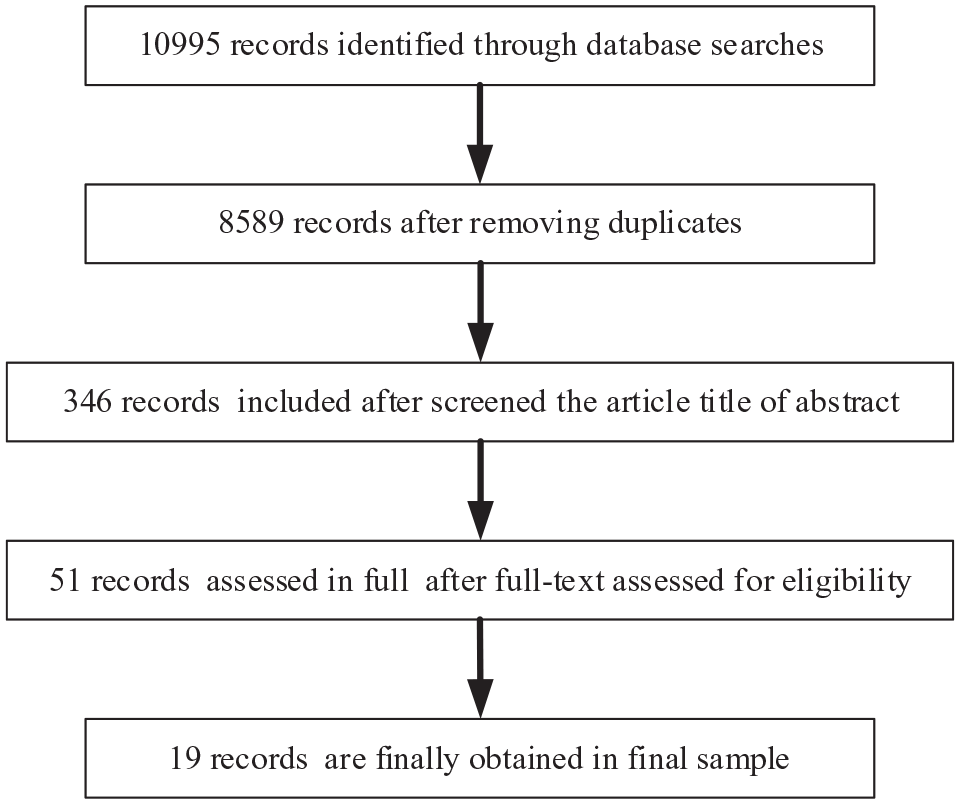
Flow diagram of data collection progress.
Coding
All the identified studies were recorded in terms of the following description items and effect value statistical items (see Table 2): author, publication year, publication source, sample size, correlation coefficient (t-value or F-value), trust object, and these coding data are cross-checked by two research assistants independently to avoid coding errors. When these occurrences happen, we must pay more attention to the statistical items of effect value. First, the Pearson correlation coefficient is the most important statistic among t-value, F-ratios, χ2 value, Cohen’s d, or β coefficient. Second, if the same data set is applied in multiple studies, the one with more comprehensive information is worth considering and selecting by comparing their statistical data. At last, if the variable is measured by more than one dimension, the effect size is the average of all dimensions.
Summary of Coding Information of Identified Studies.

Computation of Effect Sizes
The statistical software for meta-analysis was performed with the Stata 15 for the data synthesis and analysis. The random effect model is adopted in this meta-analysis in terms of the difference in the study design and study regions. The following basic steps were performed in our meta-analysis.
First, in the guidance of Hunter and Schmidt, calculate Fisher’s Z value as effect size (Raudenbush et al., 1991). Using the following equation:



Where,
ri = the correlation coefficient reported in independent study
ni = the sample size for the effect value of the ith study
rz = the final overall effect size.
z+ = the weighted mean effect
The heterogeneity test is to judge whether real differences among the selected samples exist using Q-statistics and I2-value. When significant heterogeneity emerged at p < .01 and each I2-value is equal to or larger than 80%, the random-effects model should be employed for conducting this meta-analysis. The related equation of Q-statistics and I2-value is as follows:

Where,
wi = the weight value of the ith study

The 95% confidence intervals of the effect size estimate are calculated using the standard deviation obtained from the sampling error variance. The equation of 95% confidence intervals is as follows:

Publication Bias Analysis
To avoid inter-study variability and inflation of biased mean estimates, this study applied Fail-safe N (Nfs) to examine the issue of publication bias rigorously to ensure the authenticity of the experimental results. When The ratio of Fail-safe N/critical value of each pair-wise relationship is over 1 or larger, this demonstrates that there is a more reliable result in the aspect of publication bias. The equation for Fail-safe N (Nfs) and critical value is as follows:


Where,
N = the total number of studies included in the meta-analysis
z = the converted z-statistic
k = the number of studies in the meta-analysis
To evaluate the likelihood of publication bias in this meta-analysis, we check the coefficient of Nfs/(5k + 10). The ratio of the moderate variable is generally over 8 as reported in Table 3, which reflects the fact that there is no potential threat owing to publication bias.
Summary of Publication Bias Analysis.

Results and Discussion
Description Analysis
The data set included 20 independent effect sizes toward the effect of trust on consumer purchase intention from 8,235 participants (see Table 4). The maximum effect value between trust object and consumer purchase intention is 0.67, while the minimum value is 0.162 for trust toward members
Result of Description Analysis.

Main Effect Analysis of Trust
As shown in Table 5 and Figure 3, the meta-analysis investigates the association between trust and consumers’ purchase intention in SC across empirical studies. The ratio of Nfs and Critical value is 157.97, indicating that the effect size is robust. Q value over the number of effect sizes and I2 values greater than 50% indicates that the level of heterogeneity between trust and purchase intention is high, and the random effect model should be used. The correlations between trust and purchase intention are significant for 95% confidence intervals, excluding zero. The mean effect size of trust is 0.55, suggesting a large effect on purchase intention.
The Overall Effect-Size Analysis of Trust.


Meta-analysis of the relationship between trust and purchase intention.
Moderator Analysis
Based on the heterogeneity test of effect sizes between trust and consumer purchase intention, we further explore and explain the moderation effects. Moderator analysis involving trust object, SC constructs, and website type (see Table 6).
Moderator Analysis.
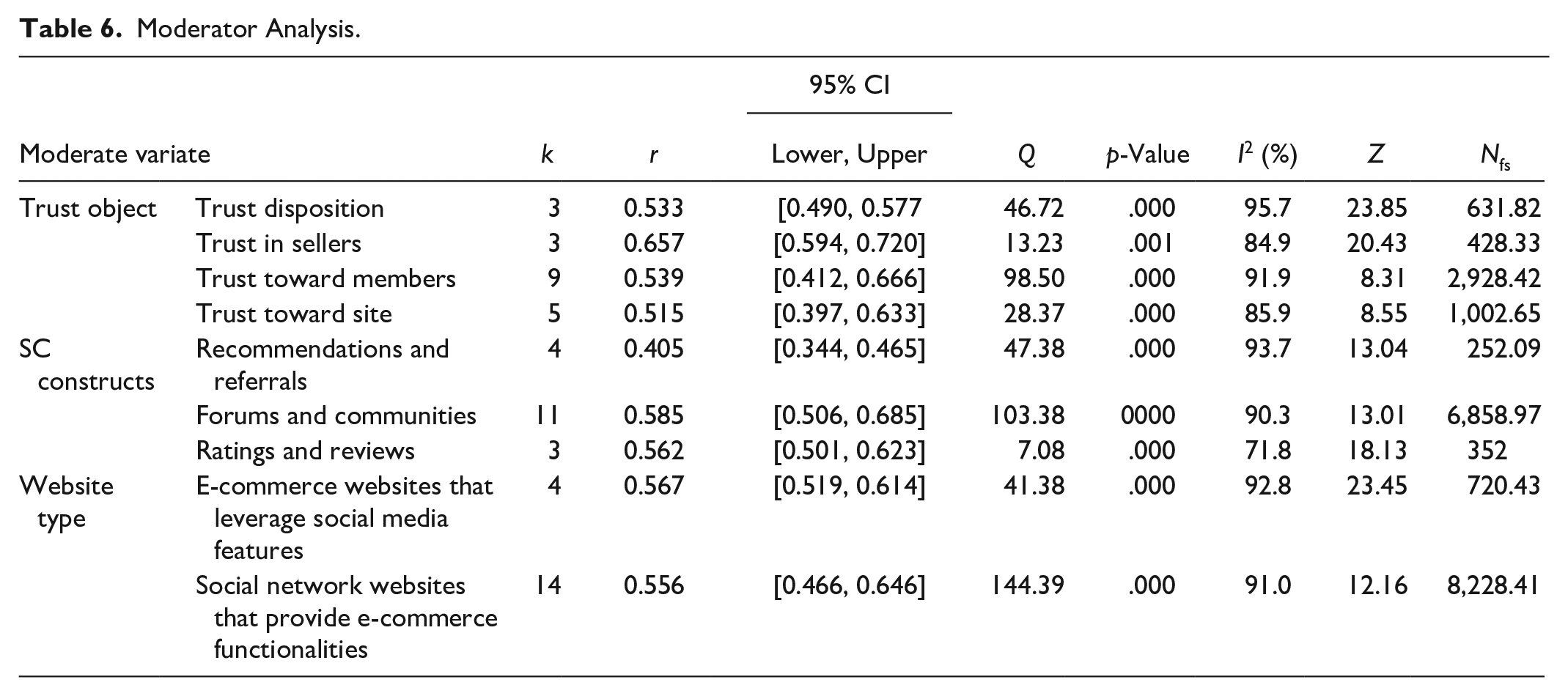
Trust object as a moderator. From the perspective of trust object, the authors divide the trust object into trust disposition, trust in sellers, trust toward members, and trust toward the site, and the results show that the positive relationship of trust with purchase intention irrespective of the trust object with the relationship being stronger to trust in sellers.
SC constructs as a moderator. We found that the effect value between trust and purchase intention is medium in the context of “recommendations and referrals,” while the pooled effect size for studies in the context of “forums and communities” and “ratings and reviews” is near .6, indicating a strong and significant positive correlation on purchase intention.
Website types as a moderator. The results of effect value and 95% confidence interval show a strong positive and significant relationship in both e-commerce websites that leverage social media features and social network websites that provide e-commerce functionalities. The effect value between the two website types is near.
Discussion
Despite the continued interest of scholars in a variety of topics toward the effect of trust on consumers’ purchase intention, the relationship between them remains a highly diverse and fragmented topic of study. This study sheds light on the relationship between trust and consumers’ purchase intention with the method of meta-analysis to achieve general conclusions and better understand the relationships.
The meta-analysis results have shown that trust has an overall big, significant, and heterogeneous effect on consumers’ purchase intention. The customers worry about monetary loss, product satisfaction, privacy issues, etc. in SC, highlighting the importance of trust (Farivar et al., 2017). Linking this result with previous literature, trust can directly positively influence consumers’ behavior in SC by sharing their perceptions, experiences, and evaluations of product/service and asking other individuals’ suggestions and recommendations (Zhang et al., 2014). Based on the trust transfer theory, social presence theory, and uncertainty reduction theory, the development of trust and its influence on individual behavior can also be proved by many scholars (Chen & Shen, 2015; Cheng et al., 2019; Fu et al., 2018; Zhao et al., 2019). The trust relationship in SC is a complex and multi-dimensional construct, including the buy-seller relationship reflected by the construct of trust in sellers and the buyer-institution relationship reflected by the construct of trust in the marketplace (Lu et al., 2016). Besides, the reviews, recommendations, ratings from other credible members in SC can also be seen as a way of establishing trust (Fu et al., 2018). That implies that three trustees are existing in SC in a view of a buyer perspective, namely seller, member, and website. Building and developing consumer trust during the purchase decision-making process requires different cues from different objects (Liu et al., 2019), which is consistent with some previous studies (Lal, 2017; Lu et al., 2016).
There is a high degree of heterogeneity existing in the relationship between trust and consumers’ purchase intention, which we should pay more attention to. There are some points we find through the moderator analysis. First, we regard the trust object as a moderator. According to trust transfer theory, different trust objects and their effect on purchase intention are not insistent (Zhou, 2019). Interestingly, trust in sellers is a better determinant of consumers’ purchase intention than the other trust objects. As indicated in prior literature, trust in sellers is built on the seller’s provision to the consumer of information (Zhao et al., 2019). Perhaps a plausible explanation is that individual behavior is more likely to be affected by relevant information from the group but not by group norms in a combined context of social media and e-commerce, which leads consumers to tend to trust in sellers (Kwahk & Kim, 2017). The normative social influence is defined to comply with the expectations of others, while informational social influence refers to the extent to which individuals accept the information provided by other members in SC to make purchase decisions (Friedrich et al., 2019a). This explanation falls in line with the results of our meta-analytical review(Liu et al., 2019; Zhou, 2019). Meanwhile, it also validates why the influence of trust in sellers on consumers’ purchase intention is bigger than that of trust toward members (Li, 2013).
Second, the presented results showed that in the context of forums and communities and ratings and reviews, the relationship between trust and purchase intention is stronger than that from recommendations and referrals. There are massive active consumers in forums and communities or review and rating websites (Lu et al., 2016). They can easily establish their profiles, post product information and shopping experience, reply to the comment they received, show interest in other members’ posts to build their online social networks, which make available to facilitate trust improvement and the likelihood of purchase (Leong et el., 2018). The communication channels embedded in forums and communities provide individuals with the possibility to take part in group discussions, share commercial-related information, and trigger intense interactions among participants, which can enhance the feeling of social presence, confidence, and willingness to purchase (Hajli, Sims, et al., 2017; Hajli, Wang, et al., 2017). The relevant functions of the forums and communities include ratings, reviews, recommendations, and referrals (Li, 2019). The extensive use of social technologies in forums and communities is more beneficial for potential consumers to exchange information share experiences and develop their social identity. The social and collaborative activities in forums and communities influence consumers’ trustworthiness perception (Rahman et al., 2020). In contrast, our meta-analytic results show that recommendations and referrals are proved to have a weaker effect on purchase intention. The relationship between them in the context of recommendations and referrals may be mediated by the perceived usefulness of the recommendation (Chen et al., 2019). Consumers will evaluate the usefulness of recommendation articles, weakening the effect of trust on purchase. That is why the effect of trust on individual purchase intention in the circumstance of forums and communities and ratings and reviews is larger than other SC constructs, recommendations, and referrals.
Finally, the moderating role of website types is significant in the relationships between trust and consumers’ purchase intention, and its effect on e-commerce websites that leverage social media features stronger than social network websites that provide e-commerce functionalities. Explanations for this phenomenon are that e-commerce-based SC websites are closely related to make purchases, which emphasizes advertising and attracting customers to online-stores to make purchases, whereas the technological features identified on media-based SC websites is associated with information sharing, which focuses on visit social networks mainly to socialize (Cutshall et al., 2020). When e-commerce is integrated with social media, brand interaction and social interaction of e-commerce websites can be improved, leading to increased trust and intention to buy.
Conclusion and Implications
Conclusions
This study explores the association between trust and consumers’ purchase intention while considering two types of SC websites, namely e-commerce websites that leverage social media features and social network websites that provide e-commerce functionalities. Compared with an existing meta-analysis that only focuses on commercial activities on social media, such as e-commerce and F-commerce (Kang & Johnson, 2015; Leong et al., 2018; Wang et al., 2016), we have conducted a more detailed study on the definition and types of SC, which makes the sample source of this meta-analysis more comprehensive. Further, based on the results of moderator analyses on the relationship between trust objects, SC platforms should pay more attention to offering more group information to assist consumers to make purchase decisions. At last, the function of social interaction in SC platforms also should be reinforced based on the moderator analysis of SC constructs.
Theoretical Implications
The results from this meta-analysis shed fresh light on applying trust theory to SC.
First, many scholars conduct an extensive qualitative, and quantitative review of the literature about SC, such as research themes, underlying theories, differences between SC and e-commerce (Han et al., 2018), consumer behavior (Zhang & Benyoucef, 2016), factors influencing customer engagement in SC platform (Busalim et al., 2019), intellectual structure, development, and evolution of SC (Cui et al., 2018). However, the contradictory outcomes that emerge in many empirical studies toward the effect of trust on consumers’ purchase intention had still existed. Our meta-analysis has identified and analyzed the association between trust and consumers’ purchase intention in SC. The results suggest that trust is significantly related to the consumers’ purchase intention without regard to inconsistent data treatments and the difference of results as posited by prior research.
Second, we find that trust objects moderate the relationship between trust and consumers’ purchase intention. Different dimensions of trust in SC are proposed in this study. The SC is characterized by a framework that includes four important dimensions (people, management, technology, and information), adding new objects that can formulate consumer trust (Lin et al., 2019). Based on the analysis of the distinct differences between e-commerce websites and social commerce websites (Li & Ku, 2018), the new object refers to people, management, and technology. In terms of the people-based aspect of SC, the individuals, members, communities, and societies are the fundamental drivers and reasons for social connections, technological advancement, and information sharing (Wang & Zhang, 2012). On the management dimension, the business goal of SC emphasizes the role of social activities, with a secondary focus on maximizing shopping efficiency (Chen et al., 2017).
Regarding SC websites tools and technological features, Web 2.0 technologies in SC are used to empower members to share their experience and information and develop trust (Huang & Benyoucef, 2013). Therefore, we examined trust objects in four refined dimensions in SC: trust disposition, trust in the seller, trust toward members, and trust toward the site. The trust we perceived is inconsistent with different trust objects. It is beneficial to deepen and broaden the understanding of research about trust from the multiple-dimensional nature of SC instead of a single-dimensional viewpoint. The moderator analysis of the multidimensional concept, trust object, contributes to academic research about trust transfer theory in SC.
Third, social commerce constructs are regarded as a moderator in this study and we have distinguished social commerce constructs between ratings and reviews, online forums and communities, recommendations, and referrals, to make the comparison. The results of our study provide supportive evidence and explanations that online forums and communities moderate the effect of trust on purchase intention. The online forums and communities are not traditional e-commerce constructs, embedding more social manifestation and are inherently social-oriented (Goraya et al., 2021). The familiarity with a website or SNSs consumers’ perceived is likely to increase in forums and communities or read others’ reviews and ratings, increasing users’ trust in the transaction (Hajli, 2015).
Practical and Social Implications
Previous studies consider various forms of trust and their impact on the stable and sustainable growth of the SC platform. A practical implication of this study is to highlight the importance the seller trust in SC. The development of seller trust is built on the information support and emotional support in the consumers’ shopping decision process. The SC community managers and businesspeople should maintain and cultivate trust between sellers and consumers by providing advice, guidance, or information.
Besides, SC constructs are multidimensional constructs consisting of three key dimensions including online forums and communities, ratings and reviews, recommendations, and referrals. The significant differences among these three social commerce constructs can be used to explain their influence on the relationship between trust and purchase intention. In terms of the information richness, information relevance, and customers’ browsing purposes, forums and communities, as well as ratings and reviews, have a more competitive advantage on building trust before making purchases (Chen et al., 2017). In the SC setting, online forums, and communities, ratings, and reviews have a larger effect on the relationship between trust and purchase intention than recommendations and referrals. They may be a better SC platform compared with recommendations and referrals (Sharma et al., 2019). The reason for the weak effect of recommendations and referrals can be explained by the absence of social support (Riaz et al., 2021). Managers and sellers should allocate economic and human resources and effort to build online forums and communities and maintain relationships among members, which are the main drivers of change from e-commerce to SC (Chen et al., 2017). Much more important information consumers acquired is helpful to determine their trust perceptions
The social implications of this study contribute to the sustainable development of SC. More actionable advice for organizations could ensue as the reasons behind website types in social commerce are explained. The social implication of the present study is that traditional e-commerce websites must integrate social media into e-commerce platforms. Our findings suggest that effect size in the context of e-commerce websites that leverage social media features is stronger. Because of the success of delivering e-commerce activities, services, and transactions in social media applications, traditional e-commerce also needs to use social media as a tool-supported strategy to attract and retain consumers to shop together with higher social and collaborative interaction. The live-stream (Wongkitrungrueng & Assarut, 2020), product recommendation (Hsu et al., 2018), and ratings and reviews (Li, 2019) are good ways to stimulate continuous interaction between consumers, but also help build trust and promote purchasing (Lu & Chen, 2021).
Limitations and Future Directions
There are also several limitations to research on trust and consumers’ purchase decisions. First, other moderators, such as type of SC, culture, demographic characteristics, in future research can be further investigated. The type of SC can also divide into the model of C2C, B2C, and B2B. The effect on consumers’ trust on purchase intention in the context of C2C, B2C, or B2B social commerce needs to be further discussed in detail. However, we cannot explore the moderator effect of variables due to the limitation of samples. A moderator analysis involving culture and demographic characteristics is beneficial to identify the role they may play in shaping the relationship between trust and purchase behavior. Individuals’ behavior exists a significant difference between cultures (Herrando et al., 2019) which contributes to explaining social commerce users’ behavior. Some demographic characteristics, such as age, gender, should be considered in future research as moderators.
Second, we do not assess mediators in our analysis. In the future, we should focus on the study of trust transfer mechanisms in the context of SC, investigating the association between trust objects, such as trust in sellers, trust toward members, and trust toward the site. The mediated effect of trust objects on purchase intention in SC is further examined which is valuable and useful for researchers to understand the trust formation process in SC.
Third, we cannot take qualitative studies into our study, which may affect the results. How to cover both types of studies in the meta-analysis is worth considering for future research and practice.
Footnotes
Declaration of Conflicting Interests
The author(s) declared no potential conflicts of interest with respect to the research, authorship, and/or publication of this article.
Funding
The author(s) disclosed receipt of the following financial support for the research, authorship, and/or publication of this article: This research work was supported by the General Project of Humanities and Social Science Research in Colleges and Universities in Henan Province, Grant Number: 2022-ZZJH-420, Key Funded Project of Educational Reform Research and Practice of Zhengzhou University of Light Industry, Grant Number: Zhengzhou University of Light Industry Educational Reform [2021] No. 1, 033 and Key Program of Teaching Reform in Higher Education of Heilongjiang Province, Grant Number SJGZ20200148.
