



Abstract
The crisis caused by COVID-19 has forced many vendors to consider alternative marketing strategies, such as live streaming on social commerce platforms. Social commerce live streaming involves using live streamers to endorse and sell products on their own social media accounts. Statistics show that this format can serve as a survival tool for vendors in exceptional circumstances. However, it is also a valuable opportunity to bring innovation and engagement to traditional e-commerce vendors. Based on a sample of 621 Chinese consumers, this empirical research proposes that features of live streamers (expertise, attractiveness, and humor) play an essential role in social commerce intention. At the same time, virtual friendship, emotional engagement, and platform attachment are antecedents of online purchasing intentions. It also contends that social presence interaction has a moderating effect on live s-commerce and that these elements together constitute a comprehensive model of live s-commerce. Our findings reveal that virtual friendship, platform attachment, and emotional engagement with live streamers are crucial for increasing buying intentions, and they confirm the mediation effect of social commerce intention and the moderating effect of social presence interaction. The practical and theoretical implications are pointed out to assist brands, managers, retailers, and e-marketplaces in developing effective marketing plans.
Plain Language Summary
In this manuscript, we show that live streamers impact purchasing intention. This research provides a more comprehensive understanding of broadcasters’ effect on purchasing intention through virtual friendship, emotional engagement, and platform attachment. The study’s framing contributes significantly to marketing literature and represents an effort to depart from previous findings on live streamers and their effect on purchasing behavior. Moreover, our research fills a knowledge gap by demonstrating how live streamers affect consumers in numerous ways (e.g., emotional and friendly appeal toward products). Simultaneously, the moderator role of social presence interaction plays a significant role in building a vibrant and friendly environment and urges users to purchase online. The mediation role of social commerce intention strengthens the relationship between live streamers and consumers. By doing so, we can make strong and significant recommendations for organizations and practitioners on using social media and s-commerce efficiently, with actions that can generate more engagement and, in turn, higher purchase intention.
Keywords
Introduction
Digital transformation (Krishen et al., 2021; Lal et al., 2020) and changing viewer media habits have driven immense growth in live broadcasting platforms such as XiaoHongShu, Momo, WeChat live, Dui Yuan, and TikTok (Cao et al., 2021). In 2020, there were roughly 617 million Chinese live-streaming subscribers, incorporating around 62.4% of the overall pool of online shoppers (Statista, 2021). In 2021, there were 850 million active consumers of social commerce, and its market size was projected to exceed 2.5 trillion yuan. The social commerce industry is expected to generate about 77 million new employment across China in 2020, which is expected to continue upwards (Ma, 2022). The COVID-19 pandemic has changed shopping dynamics, especially for online businesses (Alam et al., 2022; Wongkitrungrueng & Assarut, 2020). Many policies to limit the transmission of the virus have restricted individuals’ mobility (Lal et al., 2020). Due to COVID-19 limitations, online purchasing has progressed beyond comments and pictures to real-time video broadcasting (Y. Lu et al., 2023). Thus, a new form of social commerce known as live-streaming purchasing has evolved (Y. Sun et al., 2020). Sellers are increasingly turning to live-streaming platforms to market their goods with the help of influencers who interact with consumers using live streaming. Live-streaming purchasing offers significant improvements over conventional e-commerce in terms of product representations, operational expenses, shopping environments, and selling strategies. Platforms such as Taobao Live (Y. Li et al., 2021), WeChat live, TanTan Live, and TikTok offer live purchasing capabilities to their users. In 2020, the number of Chinese customers using these social commerce services surpassed 713 million. This market was worth more than 2 trillion yuan and created over 48 million new jobs (Statista, 2020). Unlike other forms of social media, live-streaming features and facilities are synchronized, meaning that specific activities take place in real-time and with reciprocal communication (Dwivedi et al., 2023).
Live streamers perform with a publicly scrolling display interface for instant interaction, creating a unique online buying experience (C.-C. Chen & Lin, 2018). Live-streaming permits demonstrations of products and services, and it allows the online community to engage with live streamers. During the streaming, streamers open a comments box so viewers can leave comments or queries (known as e-word of mouth) about the respective products and services. These online community members (followers or customers) are identified to the streaming site and are often incentivized through deals and discounts. As a result, these communication strategies help individuals make purchase decisions (J. Zhou et al., 2019). Live streamers are knowledgeable and attractive, but live streaming provides engagement and information transmission (Y. Lu et al., 2023). All these elements play a critical role in online purchasing intention (N. Chen & Yang, 2021). The online consumer believes that the streamers’ experience with and knowledge about the product or brand are significantly higher than their own. This creates a sense of comfort, augmenting the influencers’ endorsement to purchase (Farivar et al., 2021). One attraction of live-streaming is that the physical appeal of the streamers promotes consideration by online customers, and their approachability adds weight when they endorse products and brands (Balasubramanian, 2021; Nguyen, 2021). In fact, a streamer’s elaborative and friendly communication characteristics can fast-track the discussion of a product or brand, and this can increase web traffic, leading to better online customer engagement, for example, by using a streamer’s comments box.
Despite the increasing importance of live-streaming streamers, few studies have examined the streaming influence on purchasing intentions (Alam et al., 2022; Y. Li et al., 2021; Q. Sun & Xu, 2019; Todd & Melancon, 2018) and have looked into consumer social presence with live streamers in terms of virtual friendship (Wulf et al., 2020), emotional engagement (J. S. Lim et al., 2020), and platform attachment (Y. Li et al., 2021). For example, Wongkitrungrueng and Assarut (2020) investigated the influence of live streaming on trust and participation with social commerce merchants. They found that live broadcasts had a higher impact on customer involvement and trust. Still, there is a lack of research on how corporations can create an ideal social commerce environment for online users that incorporates live streamers. The pleasant engagement between viewers and streamers attracts and retains users (Hamilton et al., 2014) of the s-commerce platform, and it helps online customers buy goods (Al-Adwan et al., 2023).
Innovation and information availability are critical aspects of social commerce platforms (Y. Sun et al., 2020). In the current study, the features of live streamers stimulate the users’ intentions to connect with social commerce platforms, that will further increase the users’ friendship, engagement with broadcasters, and platform attachment, eventually leading to increased online purchase intentions. Empirical studies are scarce to fill this link gap between social commerce live streamers and online users. This study of live-streaming is also an empirical investigation of the aspects that influence social commerce adoption in an emerging economy such as China. To recognize the significant factors of s-commerce, the proposed model includes virtual friendship (Wulf et al., 2020), emotional engagement (J. S. Lim et al., 2020), and platform attachment (Y. Li et al., 2021) as drivers of online purchasing intention. At the same time, the social presence intentions of followers may moderate these intentions, given the significance of the social presence of interaction (B. Lu et al., 2016) and social commerce intentions (N. Hajli et al., 2017) between live streamers and followers. Thus, the objective of this study is to offer an empirical answer to these questions:
RQ1: How do live streamers reflect their characteristics and positively affect purchasing intention?
RQ2: What is the relationship of social commerce intention with virtual friendship, emotional engagement, and platform attachment under social presence interaction of live streaming?
We developed a model based on social presence theory and social cognitive theory to answer these queries and fulfill our study goals. Our empirical analysis examines the features of live streamers, such as expertise (Todd & Melancon, 2018), attractiveness (Todd & Melancon, 2018), and humor (Hou et al., 2019) and their association with consumer online buying intentions and deliberating the social presence and social cognitive theory. Compared to social commerce online shopping, traditional online purchasing may be seen as formal and inhospitable (S. Kim & Park, 2013) due to its unfocused, unknown, and computerized characteristics (Hassanein & Head, 2007). Pleasant buying experiences can be associated with significant accomplishments, including increased time spent with streamers, higher revenue, and enhanced unexpected purchases (Liao et al., 2023). Moreover, the social aspect of shopping was a significant factor in developing these pleasant experiences (Alam et al., 2022; Shen, 2012). The current study examines how live streamers’ friendliness and social interaction can be successfully integrated into the stream to influence viewers to purchase. Also, the current study empirically explores the significance of live streamer features on the determinants of online purchasing intention, such as virtual friendship, emotional engagement, and platform attachment, and how these factors influence the development of social commerce intention. The study also investigates how live streamers’ features in product recommendations influence their intention to engage in social commerce activities. This research examines the effects of features of live streamers on followers’ purchase intentions through proposed mediation and moderation effects.
Social commerce intentions are commonly recognized as critical aspects of a successful marketing approach on a social shopping platform (B. Lu et al., 2016). Moreover, virtual friendship (Wulf et al., 2020), emotional engagement (J. S. Lim et al., 2020), and platform attachment (Y. Li et al., 2021) significantly add empathy to discussions, and they provide information to the online community to urge online shopping. Furthermore, social presence interaction moderates the association between virtual friendship, emotional engagement, and platform attachment with online purchasing intentions. As a result, the existing framework links live streamers’ characteristics with the inclination to buy items from them. From the s-commerce viewpoint, social commerce intention appears to improve online purchase intention (B. Lu et al., 2016). In terms of s-commerce, China is one of the fastest expanding markets, and most Chinese live streamers perform an important role in social media platforms. To test the assumptions of this research, we gathered information from 621 Chinese social media platform users, fans, or followers, and we summarized it with partial least square structural equation modeling (PLS-SEM) (Table 1 and Figure 1).
Explanation of Study Variables.


Conceptual framework.
Theoretical Background
Social presence theory (proposed by Short et al., 1976) is used to understand user social commerce intentions and the social presence of interactions. According to Short (Gunawardena, 1995; Short et al., 1976), community members’ social presence on the platform brings fruitful results to society, and it enhances interaction with the live streamers. Compared to direct verbal engagement, social presence refers to the accessibility and exchange of nonverbal information in social interactions. According to the social presence theory, the accessibility of social presence is critical for efficient conversation and engagement between two individuals facilitated by the modern technologies of Web 2.0 (J. Kim et al., 2016).
In addition, Nadeem et al. (2020) demonstrated that social presence facilitates online connections, allowing for social commerce. The amount to which an online social atmosphere permits a client to build accurate, warm, close, and friendly contact with other individuals is described as social presence in social commerce (H. Zhang et al., 2014). In various situations, this connection is described as a psychological feeling of intimacy, warmth, and connection experienced while communicating and interacting with other individuals in a monitored atmosphere (Animesh et al., 2011). Live-streaming purchasing provides consumers with such an authentic visual pleasure to receive product details. Still, this allows streamers and audiences to connect and socialize with live streamers and other individuals on the network (Wongkitrungrueng & Assarut, 2020). These two unique characteristics contribute to helping other individuals exist on the platforms. Customers’ behavior is influenced by the such presence, causing individuals to keep or develop their relationships with live streamers, products and services, other streamers, and social commerce platforms.
Bandura and Walters (1977) proposed social learning theory that was the precursor of the social cognitive theory (SCT) proposed by Bandura (2003). SCT emphasizes that knowledge arises in a social context in individuals’ cognition, behavior, and atmosphere (Wood & Bandura, 1989). This idea focuses on social effects, and it proposes that individuals exercise responsibility for their surroundings in terms of self-efficacy. SCT expands self-efficacy development to include community effectiveness (Bandura, 2003). This theory suggests that people will engage on social platforms if their trust is acknowledged and vice versa. SCT is being used to study the use of the Internet (LaRose & Eastin, 2004) and social media (Khang et al., 2014). As a result, the SCT theory aims to see how social networking services enhance individual social presence and increase the engagement that can emerge, such as online purchasing intention.
Literature Review and Hypotheses Development
Social Commerce
Social commerce (s-commerce) denotes a new sort of online selling arising from customers’ contact on social media (N. Hajli et al., 2017). Consumers often inspire other consumers to make purchases and judgments through social interactions and engagements in social commerce (Busalim et al., 2019). The majority of earlier s-commerce research centered on its design elements (Huang & Benyoucef, 2015), incentives (Schaupp & Bélanger, 2019), distinctions from e-commerce (Bansal & Chen, 2011), or strategy, concepts, and developments (X. Lin et al., 2017). Some authors used behavior intention and s-commerce concepts to investigate the elements influencing purchase intentions (N. Hajli & Sims, 2015; Plaza-Lora & Villarejo-Ramos, 2017; Rahman et al., 2020; Yahia et al., 2018). Nevertheless, studies of live streamers are scarce. Yahia et al. (2018) explore the effects of s-vendors on trust and social commerce, drawing attention to how platforms are used. They also consider how s-vendors align their business strategies with the strategies of social media platforms to understand the mechanism of social commerce. Huang and Benyoucef (2013) and Sheikh et al. (2017) also reveal that social interaction during s-commerce appears to be a substantial topic for future researchers and its effects on online purchasing intention.
Yahia et al. (2018) also noted that social commerce had been acknowledged as one of the most successful avenues for digital development in Asia, providing a social communication feature. It is useful for discovering individuals with whom to exchange information or indulge in purchases from anywhere and at all moments through influencers and digital worlds (Ng, 2013). Zhu et al. (2016) noted that the social presence on such media altered the receivers’ interpretation of the information provided by streamers. This improved viewers’ attitudes about engaging in community interactions, and this is expected to boost engagement. This medium enables an individual to build deep personal attachments with everyone, akin to a face-to-face meeting, and this provides the positive effects of physical participation and dialog with others (D.-H. Shin, 2013). Accordingly, the current study focuses on users’ social commerce intention in the context of live streamers with the help of virtual friendship (Wulf et al., 2020), emotional engagement (J. S. Lim et al., 2020), and platform attachment (Y. Li et al., 2021). In social commerce, social media are used to inform target audiences about businesses and products. Consumers use the reviews, ratings, and comments given by others about products and services to make their buying decisions easier. As a result, customers who use social commerce sites develop purchasing preferences based on insights from other individuals (X. Yang, 2021). In this way, social commerce helps businesses enhance promotional effectiveness by engaging and participating with their target audiences (Hussain et al., 2021). As a results consumers can communicate with their peers and acquaintances in an online retail network. For instance, they can share their views about products they have bought and used.
Live Streamers
A live streamer is someone who broadcasts themselves playing video games or displaying or reviewing products and services, either as a hobby or a profession (China Economics Network, 2018). The term “live streamer” has become popular in the online environment of China. It refers to a well-known person, public figure, or online celebrity, famed on online platforms, who significantly influences the promotion of products and services (Xiaojun, 2020). Live streamers provide detailed features about those products and services, host discussions, and provide shopping advice. The use and endorsement of a product by celebrities frequently raises brand awareness and increases its fame among viewers. According to Sudha and Sheena (2017), influencer marketing identifies and educates potential consumers through live-streaming, and it virtually influences the purchase of products and services. Live streamers are primarily concerned with their target audience or media type, and their availability and public persona allow them to be practical tools for demonstrating products and services (Wu et al., 2023; X. Yang et al., 2023). Influencer marketing is a professionalized type of (the ever-dependable) word-of-mouth presentation in a particular social environment. Influencer marketing helps create a strong customer bond by reinforcing relationships between live streamers and an engaged audience (Alam et al., 2022).
Live streamers have become content providers with large numbers of followers on social media. They provide expertise and reflection about products and services by live-streaming, blogging, vlogging, and creating short videos on their live-streaming platforms (Alam et al., 2022; Zheng et al., 2023). Product managers motivate live streamers to support products and promote their uniqueness wholeheartedly. This involvement with e-commerce and s-commerce (the grouping of e-commerce with social media) includes an opportunity to demonstrate goods, hold special events, or reimburse the influencers (Archer & Harrigan, 2016). One of the prime challenges marketing managers face is to find the most suitable live streamer for a particular product or service (H.-C. Lin et al., 2018). A live streamer’s value is typically determined by the number of their subscribers on social media platforms—the higher the number, the greater the potential influence of the message. Live streamers are involved in several trends on social media platforms, such as fitness, well-being, health, fashion, lifestyle, groceries, and technology (Hudders et al., 2021). Live streamers on social commerce platforms display products they have used, offer suggestions to their followers, and promote their endorsed products with the audience. The images and videos provided by influencers are usually straightforward, and the content usually relates to the endorsed products of a particular brand (De Veirman et al., 2017; Sokolova & Perez, 2021).
Live streamers are widely considered the backbone of e-commerce and s-commerce (Xu et al., 2020). The prevalence of live streamers has risen among new and small online businesses. Online consumers often perceive live streamers’ content as more reliable and convincing (X. J. Lim et al., 2017). They share personal experiences with their online community members and associate with them directly, thus building genuine connections with viewers. Live streamers are friendly, realistic, responsive, and easygoing. This might involve s-commerce collaboration, which is defined as the impression of direct affiliation with live streamers that makes the audience more responsive to their views and behaviors (Abidin, 2016; De Veirman et al., 2017).
Features of Live Streamers (Expertise, Attractiveness, Engagement, & Humor)
Live streamers positively affect their viewers (customers) through their social identity in s-commerce (Tao et al., 2020). They share content and engage their followers by showcasing their expertise, attractiveness, engagement, and humor. Expertise represents the influencer’s experience with and knowledge about specific products and services. It is considered one of the most central aspects for increasing live streamers’ goodwill. Goodwill also depends on the attractiveness and engagement of the influencers, that can boost followers’ viewership. Therefore, if the live streamer has all these characteristics, it can positively affect their followers’ attitudes and behaviors, including their purchase intentions (Sokolova & Perez, 2021).
According to Haron et al. (2016), the quality and reliability of a live streamer’s information or content are essential, and they can significantly increase consumer purchases. They can also improve the worth of, and trust in, the live streamer. Casaló et al. (2020) stressed that the originality and uniqueness of social media are far more important than its quantity. Consequently, qualities like creativity, uniqueness, attractiveness, engagement, and humor appear to be essential aspects of a live streamer’s profile (Alam et al., 2022; Hou et al., 2019; Todd & Melancon, 2018). Marketing managers typically select a live streamer as a representative based on their expertise, attractiveness, engagement with online customers, and suitability for the brands’ products and services. One of the main criteria for followers and marketers is the influencer’s social identity or image, which increases virtual trustworthiness among customers (Jin et al., 2019). Thus, we can formulate the resulting hypothesis:
Social Commerce Intention
Blau (1964) initially proposed the social interaction theory, which aims to understand the foundations of an individual’s behavior when exchanging information. According to this viewpoint, individuals’ relationships with one another are centered on a personalized cost-benefit analysis. As previously stated, people desire more significant profit from their connections, which might not offer any direct advantages because others might engage with aspirations. Individuals might develop a social relationships to gain additional rewards, and in these interpersonal relationships, they can exchange knowledge (Razak et al., 2016). According to Kang and Johnson (2013), few elements of social networking platforms can encourage friendliness by showing global social interactions in a virtual realm. Online customers regard endorsed resources to be business-driven, and they appraise their real experience. Some marketers provide online reviews, but people think that this type of information is sponsored and they refuse it.
Online reviews written by colleagues increase social interaction and, as a result, improve customers’ opinions of social commerce sites. Customers’ feelings of social presence grow as they observe interpersonal interactions in an online context with increased frequency (Ning Shen & Khalifa, 2008). Virtual friendship is a vital aspect of social commerce (Bai et al., 2015). According to Pangle (2002), the best kind of friendship occurs when the individuals appreciate others for who they are, treasuring other’s identities also pleases them. However, if the strength of friendship is lacking, the primarily intrinsic tendency of friendship is poor; conversely, whenever a friendship is strong, the inherent bias of friendship also is strong. It is clear that if live streamers are friendly with customers, it will benefit the organization and directly impact the purchasing intention toward products or services (Liang & Turban, 2011; Ming et al., 2021). As a result, we propose the related hypothesis:
According to Bandura (2012), emotional engagement is critical in altering an individual’s attitude. Emotional engagement happens whenever a viewer is immersed in a swiftly dynamic conversation atmosphere. They feel emotionally linked to people and share those emotions in response to the live streamer or the community members (Y. Li & Peng, 2021). As a result, to feel emotionally engaged, the online individual must enter a state of emotional absorption in the live discussion while also being mindful of the existence of others (Haimson & Tang, 2017). As a result, we propose the related hypothesis:
Throughout social commerce, purchasing motivation relates to buyers’ desire to make purchases on an online platform. When customers openly communicate information about products and services in groups or on platforms, it is expected to operate as a trust mechanism that can significantly affect consumers’ purchasing intentions (B. Lu et al., 2016; Mikalef et al., 2017).
Virtual Friendship
Friendship is defined as “a deliberate interaction involving two people over a period meant to promote social objectives” (Duck et al., 1988, p. 395). Friends’ collaborative or social element allows them to engage in similar objectives, so we can say friendship is a multi-dimensional phenomenon (Ahn & Rodkin, 2014). Most live streamers share their thoughts, feelings, mutual interactions, and emotional support to encourage online purchasing intentions. Generally, friendship entails emotional connections among individuals that elicit favorable feelings, compassion, and affection with online users/peers/followers (Rawlins, 2017). Therefore, they can quickly develop trust in live streamers and trust the products and services they promote. In addition, in live-streaming, most individuals enter and break friendships based on their preferences. However, live streamers try to provide a pleasant environment to enjoy and construct a social commerce platform that can enhance their credibility (Y. Sun et al., 2019). The fundamental and distinguishing feature of virtual friendship by a live streamer is that they appreciate and care for their followers. Most followers exchange information about products and services on the social commerce platform, and they expect significant knowledge about the products and services from their live streamers, which directly changes purchasing intention. In the digitalized environment, websites, emails, newsgroups, chatrooms, and instant messaging are tools for engaging in virtual friendships (D. K.-S. Chan & Cheng, 2004; Deng et al., 2022). Nevertheless, because of advancements in technology, live streaming emerged as a suitable tool for virtual friendship (G. Chan, 2016; Liu & Yang, 2016; Sheng & Kairam, 2020), and it significantly affects online purchase intentions. Social commerce intends to establish close friendships between live streamers and online users to persuade them to purchase online. Therefore, we formulate the following hypothesis:
Emotional Engagement
Emotional engagement is a psychological attitude wherein users believe they are emotionally attached to the live streamers. The fast-paced live discussions with online users who engage with each other’s comments and questions for the streamers create an emotional connection. Emotional engagement encompasses emotional association with live streamers (Guo, 2018; Hilvert-Bruce et al., 2018; J. S. Lim et al., 2020), and emotional expressiveness (Wai Lai & Liu, 2020), resulting in purchasing intentions. When online user is in a fast-paced live chat, they might feel the phenomena of involvement or a “psychological feeling of engagement” (D. Shin, 2019, p. 1214), which encourages them to participate actively in the live-streaming surge in online purchasing. Emotional engagement is achieved by emotional gestures that use emoticons designed to elicit rapid emotions within the audience. Live streamers also employ various ways to stretch the idea that they answer their viewers’ queries and requests (e.g., having chatbots reply to inquiries). The emotional closeness that the customer gets when viewing and reacting to other customers’ responses is among the most critical customer experiences when watching live streaming. However, some note that customers feel linked to the live streamers and others engaged in real-time conversations (D.-H. Shin, 2016). According to D.-H. Shin (2016), individuals have a notable emotional engagement with live streamers, and that engagement is inclined to increase the purchasing intention on a social commerce platform. The emotional engagement has been identified as a prominent element of live-streaming, allowing viewers of a stage concert to feel emotionally linked and elicit their emotions along with others in the online community (Y. Lin et al., 2021; Wai Lai & Liu, 2020). For example, clients with a strong insight into self-branding are more likely to encourage others to include the products and services. Customers form a mutual connection as their emotional attachment grows by exchanging their abilities (Starr et al., 2020). As an outcome, buyers with a significant emotional attachment to live streamers are highly inclined to buy from them. As a result, our hypothesis is that:
Platform Attachment
According to M. J. Kim et al. (2016), the psychological relationship between online users and the platform is referred to as platform attachment. Platform attachment is a central aspect in preserving a platform’s relationship with its online community members (Spagnoletti et al., 2015). Consumers’ emotional attachment to a platform, for example, might have a beneficial impact on their platform stickiness. Platform attachment primarily influences consumers’ loyalty toward social commerce portals (Y. Li et al., 2021). The involvement and retention rates of online users can be increased considerably when they are connected with their live streamer (Luo et al., 2022; Ren et al., 2012), resulting in platform attachment. Many options, such as real-time interactivity, are available on live-streaming shopping sites to assist consumers in their decision-making. People are becoming accustomed to using these platforms for browsing and shopping (Y. Sun, 2020). As a result, consumers’ closeness to live shopping applications may motivate them to use the platform regularly and dynamically, increasing their purchasing intentions. Therefore, our study hypothesizes that:
Online Purchasing Intention
Technological advances and the rise of the internet have resulted in various online organizations and trades that encourage researchers to expand their explorations of online purchasing intentions in e-commerce (Alam et al., 2022; X. Zhang & Wang, 2021). In e-commerce, customers anticipate, explore, and carefully select before making a purchase. Live streamers can have an outstanding impression on consumers’ buying intentions through their commendations and assessments (Meilatinova, 2021). Consequently, live streamers might have the most significant impact on customer decision-making at all phases of the buying process: pre-buying, buying, and post-buying (Gao et al., 2023; Meskaran et al., 2013). According to Ge and Gretzel (2018), organizations agree on live streamers’ utility in reaching out to, engaging with, and influencing consumers’ purchasing decisions through live-streaming. It is well documented that when a live streamer’s reliability and credibility are high, consumers’ purchase intentions also are higher (Singh & Banerjee, 2018). Once an online customer is satisfied with a live streamer, they will tend to purchase the advertised product.
Moderation of Social Presence Interaction (SPI)
The effectiveness of a communication method in imparting social indicators is defined by social presence theory, which explains social presence interaction (SPI) (Jiang et al., 2019; T. Zhou, 2020). SPI is considered an intrinsic property of an interactive form of media and a communicative engagement for maintaining social relations in the online environment (Short et al., 1976). SPI is also linked to friendship and interpersonal affinity in a psychological aspect. SPI is frequently quantified in this context as felt warmth, which conveys a sense of human interaction, friendliness, and empathy (Jiang et al., 2019; W. Zhang et al., 2021). Most research on e-commerce has used a one-dimensional model of SPI, concentrating on a website’s capacity to communicate a feeling of interpersonal warmth and friendliness. In this study, we measure SPI as a moderator of the feeling between users’ and live streamers’ affections toward each other. For example, SPI creates a feeling of warmth and ease between live streamers and followers, and Live streamers can stimulate real interactions with followers or for the imagination of followers interacting. In contrast, in direct interaction, social presence relates to the accessibility of social cues in digital interaction. According to social presence theory, physical presence growth is necessary for successful interactions amongst two people, facilitated by emerging technologies (Caspi & Blau, 2008).
It has been shown that social presence facilitates online interactions, allowing online consumers toward social commerce platforms (Nadeem et al., 2020) and interacting with the online community. The online social atmosphere enables the online community to create social, emotional, and friendly engagement with others, and this is described as SPI in social commerce (Ko, 2018). In various situations, this connection is described as a psychological feeling of intimacy, warmth, and oneness experienced while communicating and interacting with individuals in a facilitated context (Animesh et al., 2011). The potential of a technologically enabled object (e.g., an internet site) to interconnect a form of emotional pleasantness and companionship has received much attention. As a result, these hypotheses have been developed:
Mediation of Social Commerce Intentions (SCI)
Social networking sites provide a platform for users to interact with one another while actively trading and exchanging information. Therefore, relationships can be formed through frequent engagement among individuals (Al-Adwan & Kokash, 2019; Huang & Benyoucef, 2013). Social networking platforms permit online community members to join social webs and establish eloquent networks with each other. According to Animesh et al. (2011), sociability contributes to more social contacts and sentiments of compassion, affiliation, and love. These emotions contribute to intimate interaction, which aids in the formation of relationships with streamers. Online community members provide social interaction to others by allowing them to form strong interactions with each other’s. Internet companies may employ marketing efforts to evoke sentiments like closeness and compassion (Septianto & Tjiptono, 2019). Social commerce intentions facilitate collaborative decision-making by enabling individuals to seek input and advice from virtual friends. Involving their virtual friends in decision-making fosters a sense of belonging and co-creation, enhancing their virtual friendships with streamers. While participating in social commerce activities with streamers can create shared emotional experiences. Discussions, recommendations, and even shared excitement or disappointment related to products can deepen emotional connections and bonding within the social network and streamers. In earlier days, vendors seldom participate in social commerce platforms with consumers due to a lack of awareness of the power of social media. These connections, however, are made feasible by online chat technologies. They can be used as an efficient sales, communication, and customer service-marketing medium. In online platform studies, SCI is close communication with individual consumers on social media platforms (T. Wang et al., 2016). Followers’ activities in social commerce reveal the depth of their emotional attachment to the live streamers (Hsu & Hu, 2023). The basis for explaining why a follower maintains a pleasant, engaged, and attachment interaction with live streamers is posited by the evidence that supports the association among live streamers’ features and social commerce intentions, emotional engagement, and platform attachment. Therefore, our hypotheses are:
Research Methodology
Survey Method, Data Collection, and Sample Profile
This research is based on a cross-sectional, self-administered survey. Live-streaming platforms of XiaoHongShu, Momo, WeChat, Dui Yuan, and TikTok were targeted to assess the purchase intentions of live-streaming viewers. Data were gathered through an online questionnaire. The questionnaire was developed in Chinese and uploaded on “Wen Juan Xing,” an online tool for generating and distributing surveys and collecting the responses. The survey was circulated through various live-streaming outlets (XiaoHongShu, Momo, WeChat, Dui Yuan, and TikTok) using snowball and simple random sampling methods. The online link to the questionnaire was reposted every week from 1 March to 31 May 2021. Our research sample size is 654, well above the threshold value proposed by Majchrzak et al. (2005). The sample comprised 45% males and 55% females, all of whom were of Chinese nationality. Concerning age, 14% of the participants were below 20, 38% were between 21 and 30, 28% were between 31 and 40, 15% were between 41 and 50, and 5% were above 50. The majority (46%) reported spending less than 1 hr per day on live streaming, 22% between 1 and 3 hr per day, 17% between 3 and 5 hr, and 15% over 5 hr per day. Concerning education, 60% held undergraduate or graduate qualifications, 19% held postgraduate qualifications, and 21% held a doctorate. Approximately less than one third (28%) of the participants earned a monthly income of less than 2,500 RMB, 21% earned between 2,501 and 5,000 RMB, 24% between 5,001 and 7,500 RMB, 19% between 7,501 and 10,000 RMB, and 8% earned over 10,000 RMB per month.
Measures
All the items used to measure this study’s constructs were adapted from previous research. Features of live streamers were measured on three dimensions: expertise, attractiveness (Todd & Melancon, 2018), and humor (Hou et al., 2019). Social commerce intentions (N. Hajli et al., 2017), virtual friendship (Wulf et al., 2020), emotional engagement (J. S. Lim et al., 2020), platform attachment (Y. Li et al., 2021), the social presence of interaction (B. Lu et al., 2016), and online purchase intention (Shaouf et al., 2016) were adapted from previous research and shown in Table 2 with constructs and their items.
Constructs Reliabilities and Validities.

Note. IC = items code; FL = factor loadings; α = Cronbach alpha; CR = composite reliability; AVE = average variance extracted; VIF = variance inflation factor.
Items are dropped due to factor loading less than 0.60.
Analysis
Partial least squares structural equation modeling (PLS-SEM) was performed using the SmartPLS 4 statistical package (Christian et al., 2022). Before performing the statistical procedure, we sorted the data to ensure its quality and then tested it for the normalization of the dependent construct. The current study utilized a two-step methodology (Measurement and structural model) approach and described the research outcomes (Hair et al., 2019).
Results
Common Method Bias
Common method bias (CMB) might occur because the predictor variables in this study are represented by a similar responding method (Podsakoff et al., 2003). Many researchers (Kock et al., 2021; Rodríguez-Ardura & Meseguer-Artola, 2020; Schwarz et al., 2017) have proposed various precautions to regulate CMB, such as participant anonymity, trying to dodge ambiguous research questions, and offering detailed guidance in surveys to reduce bias and glitch. In contrast to these measures, we used a modern approach and evaluated CMB by analyzing collinear constructs and associated items (Rodríguez-Ardura & Meseguer-Artola, 2020). First, we measured the associated items’ variance inflation factor (VIF). We found the VIF values to be less than 3.3, implying that the CMB was not a problem for evaluating the structural model (Table 2). The inter-construct correlation, as proposed by Bagozzi, is another way to test the CMB (Bagozzi et al., 1991). In this analysis, the inter-construct correlation should be below .90. Table 3 shows the statistics of inter-construct correlation, where all the numbers are below .90. Hence, CMB was not an issue for testing the structural model.
Discriminant Validity (HTMT Criterion).
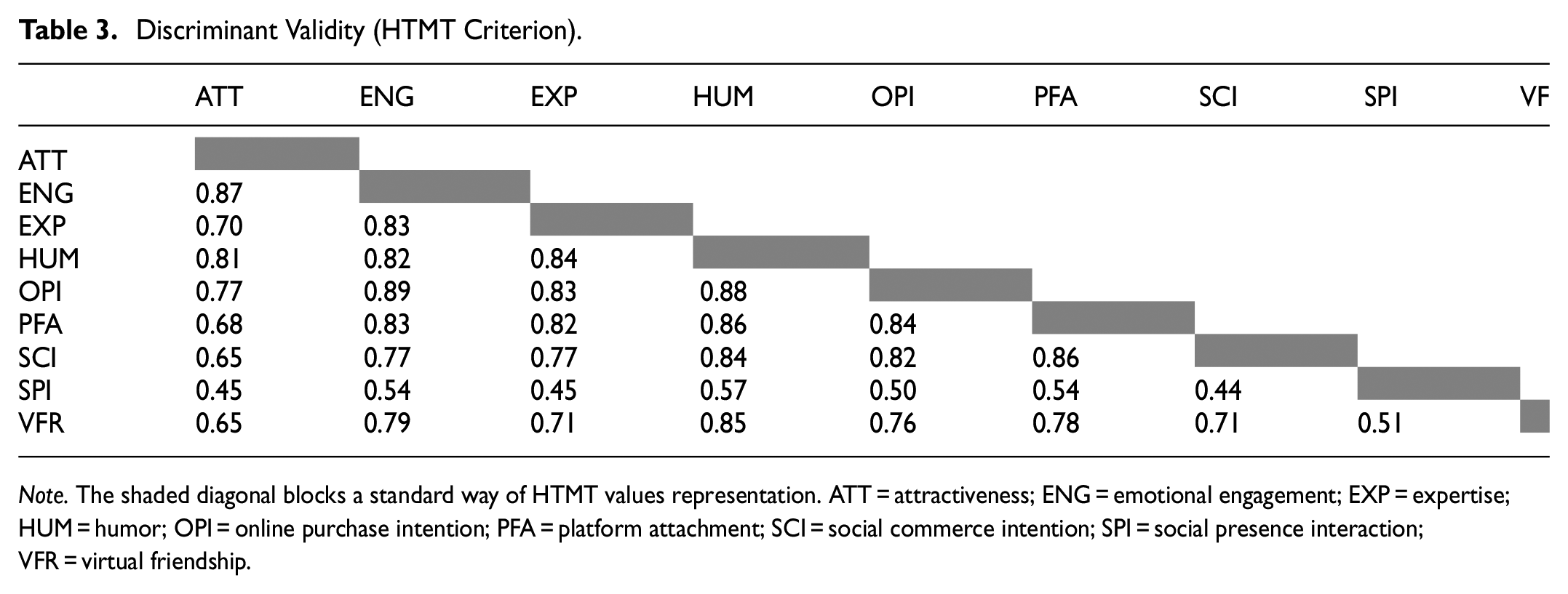
Note. The shaded diagonal blocks a standard way of HTMT values representation. ATT = attractiveness; ENG = emotional engagement; EXP = expertise; HUM = humor; OPI = online purchase intention; PFA = platform attachment; SCI = social commerce intention; SPI = social presence interaction; VFR = virtual friendship.
Measurement Model
The primary measures of internal consistency are Cronbach’s alpha and composite reliability. According to Hair et al. (2016), values between .60 and .70 are acceptable for Cronbach’s alpha. In Table 2, the values for Cronbach’s alpha are between .78 and .92. Composite reliability (CR) is called construct reliability (Henseler et al., 2009). CR’s minimum acceptable value is 0.60 (Fornell & Larcker, 1981). Table 2 shows that the internal consistency of the measurement scale ranges from 0.85 to 0.93. All the variance inflation factor (VIF) values are less than 3.3, suggesting common method bias is not an issue for testing the structural model (Hair et al., 2011), as shown in Table 2.
Discriminant validity is the extent to which one variable is empirically different from the other variables in a framework (Hair et al., 2019). As shown in Table 3, Hetrotrait-Monotrait ratio of correlations (HTMT) values are used to assess it. Henseler et al. (2015) have suggested that this criterion does not work well when the item loadings are incredibly high. Hence, HTMT ratios have been proposed (Voorhees et al., 2016) with a threshold value of 0.90 for structural models (Henseler et al., 2015) (Table 3).
Expertise, attractiveness, and humor were three lower-order constructs (dimensions) that the research proposed as making up the features of live streamers as a higher-order construct. It is a reflective-formative model because all aspects are formatively connected to live streamers’ features. The disjoint method presents and verifies all the statistical parameters (such as VIF values, outer weights, and outer loadings) (Becker et al., 2023) (Table 4).
Higher-Order Construct Validity Parameters.

Note. Inner VIF values less than 3.3.
R2, f2, and PLS predict are used to measure the explanatory power of the hypothesized model. R2 values of 0.75, 0.50, and 0.25 indicate that it is good, average, and weak, respectively (Hair et al., 2011). R2 values for social commerce intentions, virtual friendship, emotional engagement, platform attachment, and online purchase intentions are 0.62, 0.42, 0.51, 0.62, and 0.79, respectively. This shows the model’s high explanatory power (good and average). The effect size (f2) is somewhat redundant with the size of the path coefficients (Geisser, 1974; Stone, 1974). The threshold values for the effects of f2 are 0.02 for small, 0.15 for medium, and 0.35 for large (Cohen, 2013), as shown in Table 5. The obtained f2 values represent a medium to big effect size. According to the studies, a model with a certain degree of explanatory power can generate a range of predictive power (Shmueli et al., 2019; Umrani et al., 2020). As a result, the study needs to use the PLS prediction approach, a method that includes out-of-sample prediction (Sarstedt et al., 2023). The Smart PLS 4 demonstrates the proposed framework’s predictive (Shmueli et al., 2019). From the results, most of the RMSE item values derived from the PLS model are less than those derived from the LM model, validating the moderate predictive power of the present framework (Christian et al., 2022; Shmueli et al., 2019).
Coefficient of Determination (R2), Effect Size (f2), PLS Predictive Analytics (Q2), and Model Fit.

Note. RMSE = root-mean-square error; SRMR = standardized root mean squared residual; NFI = Normed Fit Index; GOF = Goodness of Fit.
The standardized root mean square residual (SRMR) and normed fit index (NFI) values see-through of model fit demonstration. The SRMR value is 0.08 (less than the threshold of 0.1), representing a good model fit (Henseler et al., 2014). The NFI value is 0.71, which is good. The closer an NFI value is to 1, the better the model’s fit (Lohmöller, 1990). This study also calculated the goodness of fit (GOF), as recommended by Tenenhaus et al. (2005), to evaluate the efficiency of the proposed solution. It is calculated as:

The GOF has been proven, based on the computed value is 0.62 (Table 5); it is increasingly significant and above the predefined threshold value of 0.36. (Wetzels et al., 2009) (Table 5).
Path Analyses, Mediation, and Moderation Results
The final part of the structural model presents the statistical significance and relevance of the path coefficients (Hair et al., 2019). Table 6 and Figure 2 show that the features of live streamers positively and significantly affect social commerce intentions (β = .79, p < .001), supporting hypothesis H1. Social commerce intentions positively affect virtual friendship, emotional engagement, and platform attachment (β = .65, p < .001; β = .71, p < .001; β = .79, p < .001). These results support hypotheses H2a, H2b, and H2c, respectively. We expect a positive relationship between virtual friendship and online purchasing intention, but the results depict an insignificant relationship (β = .06, p > .05), so hypothesis H5 is not supported. The emotional engagement and platform attachment positively affect online purchase intentions (β = .38, p < .001; β = .53, p < .001). These results support hypotheses H4 and H5 (Table 7).
Path Coefficient Results (Direct Relationship).

p < .05. **p < .01. ***p < .001

Results of path coefficients.
Path Coefficient Results (Moderation Role of SPI).
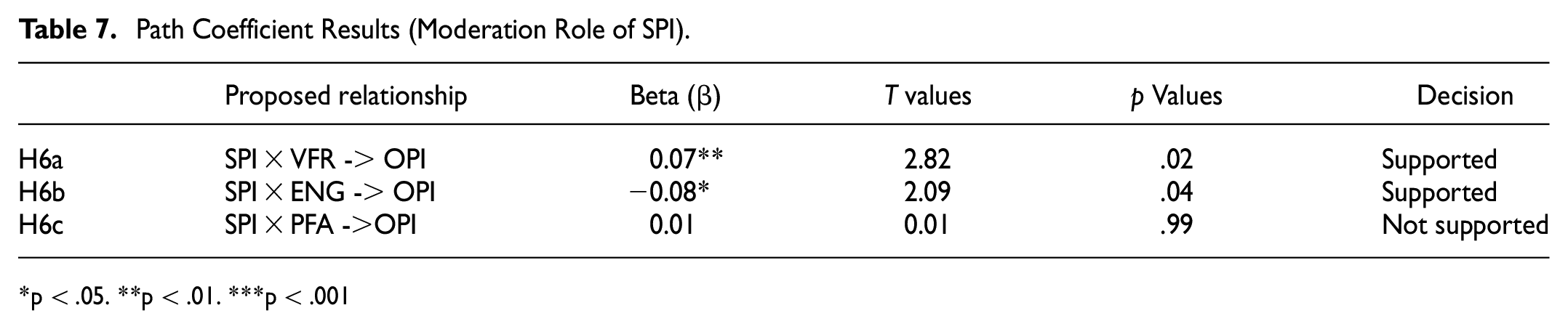
p < .05. **p < .01. ***p < .001
This study tests the moderating effects of social presence interaction between virtual friendship and online purchasing intention (β = .07, p < .05), emotional engagement and online purchasing intention (β = −.08, p < .01), platform attachment and online purchase intentions (β = .01, p > .05). These results support hypotheses H6a and H6b but do not support hypothesis H6c (Table 8).
Path Coefficient Results (Mediation Role of SCI).

Note. FLS = features of live streamers; SCI = social commerce intention; VFR = virtual friendship; ENG = emotional engagement; PFA = platform attachment; OPI = online purchase intention; SPI = social presence interaction.
p < .05. **p < .01. ***p < .001 .
This study tests the mediating effects of the social commerce intention between features of live streamers and virtual friendship, emotional engagement, and platform attachment. The features of live streamers significantly impact virtual friendship, emotional engagement, and platform attachment (β = .57, p < .001; β = .89, p < .001; β = .49, p < .001), supported the direct affirmation. On the other hand, the mediation effect of social commerce intention between features of live streamers and virtual friendship, emotional engagement, and platform attachment (β = .51 p < .001; β = .56, p < .001; β = .62, p < .001), thus supporting hypotheses H11, H12, and H13. Based on the researcher’s investigation, if the direct and positive effects are positive, then partial mediation exists (Zhao et al., 2010). From the results, it is recommended that partial mediation exist (Table 8 and Figure 2).
Discussion
This research offers a deep understanding of live streamers’ effect on purchasing intentions through social commerce intentions, virtual friendship, emotional engagement, and platform attachment. The study’s framing provides significant contributions to the literature on marketing, and it represents an effort to depart from previous findings on live streamers and their effect on purchasing behavior. Moreover, our research fills a knowledge gap by demonstrating how live streamers affect consumers in emotional and other forms of attraction to products (Casaló et al., 2020). Also, the moderating role of social presence of interaction plays a significant role in building friendship, engagement, and attachment, and the mediating role of social commerce intentions strengthens the relationship between features of live streamers and consumers in terms of engagement and attachment to both the service or product and the streamer. Our results provide a clear understating of the role of live streamers on social commerce platforms. They appeal to their customers to recommend and share their channels with others to increase their credibility and visibility (Alam et al., 2022; Tao et al., 2020). A live streamer’s value is determined by their number of followers, which is a central consideration for marketers when selecting whom to promote their campaign. In addition, the framework has proved all the relationships of the proposed conceptual model. Followers’ social presence intentions push their engagement in the shape of virtual friendship, emotional engagement, and platform attachment, and they help to confirm online purchase intentions. In accumulation, the study proved the mediating relationships with features of live streamers and followers’ virtual friendship, emotional engagement, and platform attachment. This shows that the live streamer’s personal features influence followers, and they intend to use social commerce to increase and enhance engagement and take the relationship between the live streamer and the follower to the next level.
The first study question was “How do live streamers demonstrate their characteristics and affect their followers’ proclivity to acquire recommended goods?” To answer it, we observed that the features of live streamers influence social audience participation. The positive association of live streamer features in the online community and social commerce intentions were then proposed and tested. The data supported the assumption that this relationship is beneficial, and according to Busalim and Hussin (2016), including social commerce intentions in enterprise leads to higher s-commerce revenues. Chawla and Kumar (2022) reveal that most online shoppers suspect e-commerce platforms because of fraudulent sales.
In contrast, s-commerce platforms give them assurances of interaction and a welcoming environment (Soleimani, 2022). As a result, hiring Chinese s-commerce live streamers might be an effective technique for conveying messages (Guan, 2021; Y. Yang & Ha, 2021), improving shopping hits, enhancing consumer engagement and platform attachment, and even increasing purchases. Influencers can help businesses develop personal relationships with potential clients and provide information in the native language of targeted users (Nosi et al., 2022).
We discovered that the characteristics of live streamers and their interaction with social commerce intention on virtual friendship, emotional involvement, platform attachment, and online purchasing intentions are critical aspects of s-commerce, and they have a strong impact on internet-based viewers. Study question two asked about the interrelationship between social commerce intention, virtual friendship, emotional engagement, and platform attachment in live broadcasting social presence interaction. To respond to it, we assumed (based on theory and previous research) that variables may have certain kinds of relationships, which we transform into hypotheses. The data supported the idea that these relationships are valuable. Based on earlier studies, the online world has emerged as a primary forum for social contact (S. S. Wang et al., 2010). The internet and its wireless connectivity make it easier to maintain social bonds (Katz & Rice, 2002), develop interactions (McKenna et al., 2002), build virtual communities (Khamis et al., 2017), and establish virtual friendships (Amichai-Hamburger et al., 2013). According to Hu et al. (2016), social creation and friendship forecasting are significant themes in social media that could offer valuable methods for s-commerce businesses.
Theoretical Implications
The current study emerges and advances the academic knowledge and enhancements of the theories used. First, although live-streaming is increasingly more connected with social commerce, limited research on the influence of live-streaming features on social commerce has been undertaken. There is little research that has explored the potential of social presence theory in online social commerce environments (N. Hajli et al., 2017; B. Lu et al., 2016). The features of live streamers affect social commerce intention, which can validate the use of social presence theory to examine social commerce platforms. Although previous studies have found that social commerce can be used as a trust-building mechanism to influence consumer behavior and intention to buy (N. Hajli & Sims, 2015; B. Lu et al., 2016), our study proposes the mediating role of social commerce intention, and it explains the relationship between live streamers’ features and virtual friendship, emotional engagement, and platform attachment. These factors are also important for enhancing social commerce platforms and strengthening online purchase intention.
Second, the distinguishing characteristics of live streamers, the highest order construct with three dimensions, and online purchase intention are investigated in the current research using an innovative theoretical structure that includes moderators (social presence interaction) and mediators (social commerce intention). The theoretical perspective also shows that followers’ affiliation with a live streamer may be helping them and have an emotional impact, which may lead to a desire to buy. This theoretical foundation supports our predictions, which contend that live streamers’ characteristics and their followers’ social commerce intention toward online purchasing intention are significantly associated. According to the social presence theory, people prefer associations and communities (similar to live streamers and followers’ bonds) that make it easy for them to feel connected, and people can demonstrate their social presence through purchase behaviors (Akram et al., 2021; Alam et al., 2022; Tuncer, 2021).
Third, social presence can change online users’ purchasing intention (Ye et al., 2019), validating the social cognitive theory. The online user’s sensation in terms of virtual friendship, engagement, and attachment brings a fruitful discussion to validate the social cognitive theory and increase buying intention on social commerce platforms. The features of live streamers attract online users to reach a massive fan following and feel their sensation as friends, family, and well-wishers (Choi & Sung, 2018). In addition, live streamers’ sensation with online users provides moral support, a sense of closeness, and intimacy (Yu et al., 2018). The research validates the importance of social presence theory and social cognitive theory in s-commerce. Overall, social presence theory provides insights into how the perception of presence and social interaction in live-streaming contexts can impact psychological immersion, social influence, social connection, media richness, and social comparison processes. Understanding these theoretical implications can help platform designers, content creators, and researchers optimize live-streaming experiences and foster meaningful social interactions. Finally, the conceptual model in the study is a unique contribution to academic knowledge.
Managerial Implications
Our results may be very interesting to marketing consultants and executives responsible for designing tactical plans and implementing tools to expand their live streamers’ marketing capabilities. There is an exciting suggestion that live streamers can significantly influence all phases of the purchasing process (Q. Sun & Xu, 2019) as long as they develop engagement and attachment in their content, products and services, and platforms. For example, in the current scenario, some online consumers make transactions with unfamiliar individuals that are involved in fraudulent activities (Bhattacharjee & Goel, 2005) and misplaced consumer trust and intention about online shopping. To overcome this issue, this study suggested that the social presence factor can build engagement and attachment to the streamers and the platform and the intention to purchase online. Our research model mitigates these problems using virtual friendship toward live streamers. For example, virtual friendship with live streamers provides a pleasant and comfortable environment to online users so that it can progress revenue. In addition, platform attachment enhances loyalty to the platform, so online users have less incentive to change the platform. In recent years, live broadcasting has attained outstanding progress (Jodén & Strandell, 2022; M. Wang & Li, 2020). Emotional engagement is closely associated with platforms and broadcasters to foster a dynamic connection with viewers, and it can cultivate a product’s (previously negative) image through emotional engagement (Cheung & Lee, 2009; M. Wang & Li, 2020; H. Zhang et al., 2015). Live streamers’ product-related information are seen as more reliable than promotion through mass media, celebrities, or official announcements (Sohaib, 2021). The digitization of the s-commerce setting generates favorable interactions with e-retailers and online goods through the mediating effect of social commerce intention and virtual friendship (Wulf et al., 2020), emotional engagement (J. S. Lim et al., 2020), and platform attachment (Y. Li et al., 2021) as drivers of online purchasing intention. Although several e-retailers have recognized the value of broadcasters, there is little scientific evidence to back up their use. Our research shows that live streams have a beneficial impact on customers’ online purchase intentions through virtual friendship (Wulf et al., 2020), emotional engagement (J. S. Lim et al., 2020), and platform attachment (Y. Li et al., 2021) as drivers of online purchasing intention. As a result, e-retailers should be enthusiastic about using live streamers to gain an economic benefit in the s-commerce platform with the help of the conceptual framework in this study.
Second, e-retailers may attempt to meet customers’ social presence and interaction through video streaming, creating a friendly environment and involving attractive emotions. Both play important roles in online purchase selections. E-retailers can use social presence to expand the chances for dialog and in-depth involvement, such as broadcasting promotional details, providing vouchers, and creating interactive experiences. More significantly, they can influence customer loyalty by utilizing the live streamer’s content. As a result, marketing managers and broadcasters keep a virtuous reputation in a live video that can help generate greater viewership and a safe environment for online users (M. Zhang et al., 2020). The virtuous reputation of content and live streamers is proposed to adopt a healthier atmosphere and safeguard that everyone follows the rules (Andy Chalk, 2019). Corporations should consider the perceived trustworthiness of a source. Our research empirically proves that virtual friendship and emotional engagement with live streamers can increase consumers’ desire to purchase products, thereby boosting sales revenues even after evaluating substitutes. Trustworthy live streamers affect purchasing decisions (Hudders et al., 2021); customers may change their existing purchasing plans because of the trusted recommendations of live streamers they like. For example, online businesses focusing on social networking services should provide their consumers with a high-quality environment that can influence purchasing behavior through virtual friendship and emotional engagement (H. Zhang et al., 2019). This implies that social commerce managers should create a pleasant environment and hire friendly live streamers. For example, the research might motivate young entrepreneurs in China to operate their businesses using social media platforms, and many young entrepreneurs are already using these platforms for business.
Conclusion
An s-commerce strategy is a fundamental approach for establishing vital relationships to ensure customer continuity and fidelity to certain live broadcasters. As an outcome, internet users would be inspired by live streamers’ features, which enhance social commerce intentions, and facilitate the creation of online friendship, platform attachment, and emotional engagement with live streamers. Live broadcasters aim to provide a pleasant s-commerce environment for viewers (Y. Sun et al., 2019). The close contact between s-commerce live streamers and users will increase the reputation of endorsed items and encourage buyer purchasing intentions. Finally, we found that social intentions are inextricably linked to users’ behavior on social commerce platforms. Altogether, this research shows that a social commerce strategy is highly inclined to engage individuals and affect their buying intention (Alam et al., 2022; M. Hajli, 2013; Sohaib, 2021; Tao et al., 2020).
Limitations and Future Work
This study has some potential limitations that should be noted. First, we collected data only through snowball sampling from northeastern China (around Dalian), so they have a limited geographical scope. The model produced in this work can be used in diverse regions and countries to explain online purchase behaviors on social networking websites through live streamers. For instance, the model could be used in other countries such as India, Pakistan, Nepal, Bangladesh, Sri Lanka, Thailand, Japan, and South Korea, where most people have many shopping platforms and digitalized populations (Ahmed et al., 2017). This may enhance our understanding of social commerce interaction. Second, the proposed model did not include second mediation due to moderation effects and factors like information seeking and the intention to continue following to live streamers. Future research should investigate the influence of these factors on online purchasing intention and e-loyalty context (Al-Adwan & Al-Horani, 2019). Third, future research could use an experimental randomized trial with foreign nationals living in China to explore the impact of translated Chinese live streamers’ content on online purchasing intention (Yu et al., 2018). China is a second home for many foreign nationals, especially students (N. Li et al., 2013). Therefore, other exciting research pathways could explore additional constructs, such as repurchasing intentions and the e-loyalty of a platform to establish long-term relationships with viewers and customers through influencers. Moreover, given the design of this study, we can repeat the current framework with different kinds of influencers, such as political, scientific, and sustainable influencers (Acharoui et al., 2020; Jauffret & Kastberg, 2019; Yesiloglu & Was, 2020), to examine their impact on consumer decisions in various sectors.
Footnotes
Acknowledgements
The authors thank the associate editor and the reviewers for their constructive feedback and helpful comments. Special thanks to research participants for their help in collecting the data.
Declaration of Conflicting Interests
The author(s) declared no potential conflicts of interest with respect to the research, authorship, and/or publication of this article.
Funding
The author(s) disclosed receipt of the following financial support for the research, authorship, and/or publication of this article: The authors thank the Spanish Ministry of Science and Innovation (PID2020-113469GB-I00), the Junta de Castilla y León, and the European Regional Development Fund (Grant CLU-2019-03) for the financial support to the Research Unit of Excellence “Economic Management for Sustainability” (GECOS) and the National Natural Science Foundation of China () (Grant No. : 72072026).
Ethical Approval
Our institution does not require ethics approval for reporting individual cases or case series. However, an online self-assessment called Self-Assessment for Governance and Ethics (SAGE) by authors was performed (corresponding author). The self-assessment guided that the study did not involve animals as participants. For survey research, self-assessment did not raise any issue that may impact human participants. All study constructs were sourced from secondary research and adopted to suit the purpose of the study. Participating in this research raised no concern for animal or human harm.
Informed Consent
Written informed consent was obtained from all participants in this study before commencing the survey.

Data Availability Statement
The data that support the findings of this study are available from the corresponding author upon reasonable request.
References
 https://baijiahao.baidu.com/s?id=1666539188917063228&wfr=spider&for=pc