




Abstract
Small and Medium Manufacturing Enterprises have emerged to play a crucial part in the context of industrialization and globalization, despite fierce competition and rapid change. However, in the extant studies, what drives Southeast Asia enterprises to reconfigure themselves and how well they cope with external challenges remains to be determined. Therefore, this research investigates structural reconfiguration as dynamic capabilities and conducts an empirical study for small and medium manufacturing firms in Southeast Asia. The World Bank Enterprise Survey, conducted between 2014 and 2016, collected information from 1,184 manufacturing firms used in the research on structural reconfiguration. The hierarchical regression model helps to create prediction equations to test structural reconfiguration as the mediators of organizational efficiency and business environment on firm performance. The findings demonstrate how structural reconfiguration is influenced by organizational efficiency and business obstacles. Furthermore, labor efficiency and competitive obstacles provide the most significant moderating effect on structural reconfiguration through dissolution. Finally, structural recombination has the potential to improve firm performance through direct and indirect impacts.
Plain language summary
1. This research discusses the challenges that small and medium manufacturing enterprises in Southeast Asia face in the context of globalization and industrialization. To survive in such a complex environment, these businesses must have resilience, managerial abilities, and structural flexibility. The study highlights the importance of reconfiguring organizational structures as dynamic capabilities to maintain evolutionary fitness, explore new opportunities, and achieve innovation efficiency. 2. The paper aims to contribute to the literature on dynamic capabilities by investigating the direct and indirect roles of organizational efficiency and business environmental obstacles in motivating various forms of structural reconfiguration. 3. The research analyzed 1,184 SMMEs-SEA from diverse industries between 2014 and 2016 using a cross-sectional approach to understand how business environment obstacles influenced structural reconfiguration. 4. The study found that reconfiguring organizational structure through recombination is associated with a positive outcome and can help businesses adapt to high environmental obstacles and develop an appropriate strategy to sustain competitive advantage.
Keywords
Introduction
The economic (costs, resources, productivity, product complexity), social (demanding consumers, moving markets, altering organizational cultures), and environmental (energy efficiency, waste, and climatic changes) are all becoming more dynamic in the context of globalization and industrialization, offering increasing difficulties to businesses (Felsberger et al., 2022). Southeast Asia’s small and medium manufacturing enterprises (SMMEs-SEA)—the backbone of the national economy—must have resilience, managerial abilities, and structural flexibility to quickly solve these difficulties to survive in such a complex environment. For this reason, SMMEs-SEA must use their current dynamic capabilities to implement novel approaches to running their businesses and revise their foundational structures. Structural reconfiguration as dynamic capabilities is essential for a firm to maintain evolutionary fitness, escape disadvantageous path dependencies, explore new opportunities, and achieve innovation efficiency (Karim & Kaul, 2015). In addition, reconfiguring organizational structures can help companies avoid or delay profit decline and extend growth cycles by removing unattractive organizational structures in high-priority trajectories (Karim, 2006, 2012; Karim & Kaul, 2015). Thus, this study highlights the need to adjust corporate strategy, with the issue of reconfiguring the organizational structure acting as the primary point of analysis and debate.
Recent research has highlighted the relevance of structural reconfiguration for determining the future of inclusive and sustainable manufacturing. Albert (2018) uncovered the role of political influence in driving reconfiguration decisions through a post hoc analysis of the 18 largest European universal banks during 2000–2013. Performance feedback and the transition from exploitative to exploratory reconfiguration were investigated by Dothan and Lavie (2016) using data from 248 electronics manufacturers between 1993 and 2001. They argue that performance falls relative to its aspiration, and the company will be motivated to invest in reconfiguration. Also, Karim and Williams (2012) emphasized the role of personal knowledge in the “structural composition,” which involves the unit’s structural origin and reconfiguration history. These studies have contributed to reconfiguring literature about how factors affect the changing corporate structure to adapt to the external environment. However, recent research ignores each type of structural reconfiguration, creating a wide gap between the “post-reconfiguration performance” and the “aspiration performance.”Karim and Kaul (2015) demonstrated that an uncertain and ambiguous organizational reconfiguring strategy creates conflict and complexity about incompatible organizational goals and resource allocation. For such reasons, this paper first aims to contribute to the literature on dynamic capabilities (Dothan & Lavie, 2016; Karim & Capron, 2016) by investigating the direct and indirect roles of organizational efficiency and business environmental obstacles in motivating various forms of structural reconfiguration. The second purpose is to identify and investigate the moderating effects of various business contexts on organizational efficiency and structural reconfiguration.
This research analyzed 1,184 SMMEs-SEA from diverse industries between 2014 and 2016 using a cross-sectional approach to corroborate and build upon our arguments. Firms actively reconfigure their organizational structure in three ways (structural addition, dissolution, and recombination), making this research extremely intriguing. We may examine the alignment between organizational efficiency, business environment and structural change due to the wide variety of absolute levels and performance shifts across organizations. As a result, the World Bank Enterprise Survey (WBES) provides an appropriate framework for investigating our arguments. This research provided three substantial contributions to the field of dynamic capacities. Firstly, we provide a clearer picture of how the organization’s efficiency (sales and labour) plays a role in choosing three reconfiguration approaches. Secondly, we use direct and moderate analysis, which may be seen as various schemes of influence in reaching the intended results, to understand how business environment obstacles (financing and land, educated labour, competitive intensity, tax rates, business licenses and permissions, and political instability) influenced structural reconfiguration. Besides, our research discovers that the business environment changes affect the choice of reconfiguring organizational structure via empirical testing. Finally, we use statistical methods to test the hypothesis that good performance may be achieved after a structural reconfiguration. The structural reconfiguration aims to help businesses adapt to high environmental obstacles and develop an appropriate strategy to sustain competitive advantage. Besides, our research demonstrates that reconfiguring organizational structure through recombination is associated with a positive outcome instead of an adverse outcome in Girod and Whittington (2017) study. Also, the lack of consideration of financial performance after reconfiguration in Karim (2006) is supplemented by this study.
Literature and Hypotheses
Dynamic Capabilities
In a changing environment, dynamic capabilities allow a firm’ sustainable growth through proactive or reactive adaptation (Eisenhardt & Martin 2000; Teece et al., 1997), in which corporate reconfiguration is required to maintain evolutionary fitness (Teece, 2007). Dynamic capability is described initially as “a firm’s ability to integrate, build, and reconfigure internal and external competencies to address rapidly changing environments” (Teece et al., 1997). Eisenhardt and Martin (2000) argued that dynamic capabilities could be categorized into three levels: (1) dynamic capabilities that assimilate resources (strategic decision-making routines and product development routines); (2) dynamic capabilities which focus on the reconfiguration of internal resources (management cooperation routines, resource placement/adaptation, vital resource abundance routines for adjustment to the market, and copying process); (3) dynamic capabilities which acquire and discharge resources (internal knowledge- creation routines, alliance and acquisition routines, and methods for releasing/removal of resources). Cepeda and Vera (2007) stressed that “Dynamic capabilities involve a transformation process of the firm’s knowledge resources and routines, and the output of dynamic capabilities is a new configuration of resources and operational routines.”
Dynamic capabilities emphasize keeping organizational configuration and adapting to external environments necessary to maintain evolutionary fitness and profitable growth (Bojesson & Fundin, 2021; Khan et al., 2021). Remarkably, reconfiguration of a firm by changing organizational structure is proposed to deal with external obstacles (Karim, 2006; Pitelis & Wagner, 2019). Chan and Reiner (2019) analyzed primary data from semi-structured interviews with industry stakeholders and experts across major biofuel-producing countries. Their finding showed that new entrants and incumbents rush to acquire new resources and capabilities, classified as critical in the industry’s value chain. Girod and Whittington (2017) investigated the firm’s dynamic capabilities connected to environmental dynamism and the relationship between reconfigurations within existing structures and performance. Their statistical analysis of large U.S. corporations between 1985 and 2004 found that significant reconfiguration in their business structures was associated with adverse performance outcomes. Thus, the view of dynamic capabilities implies that sustainable firms constantly undergo a renewal process in developing new or maintaining old capabilities and structures.
Structural Reconfiguration
Structural reconfiguration is required for a corporation to preserve evolutionary fitness, avoid unfavorable route dependencies, explore new prospects, and attain innovation efficiency (Karim & Kaul, 2015; Vo Thai et al., 2022). Further, by removing unattractive organizational structures in high-priority trajectories, a business may delay or avoid a decline in profitability and extend its growth cycles via structural reconfiguration (Karim, 2006, 2012; Karim & Kaul, 2015). Therefore, the primary objective of this study is to understand more about reconfiguration and related ideas. To further grasp our issue, we refer to Girod and Whittington (2017), Karim and Capron (2016), and Karim (2006) definition of structural reconfiguration, which covers “the addition of units to the firm (structural addition), the dissolution of units from the firm (structural dissolution), and the recombination of units inside the firm (structural recombination) such that the organization still possesses resources and activities.” In Figure 1, we see the potential outcomes of organizational structural changes.
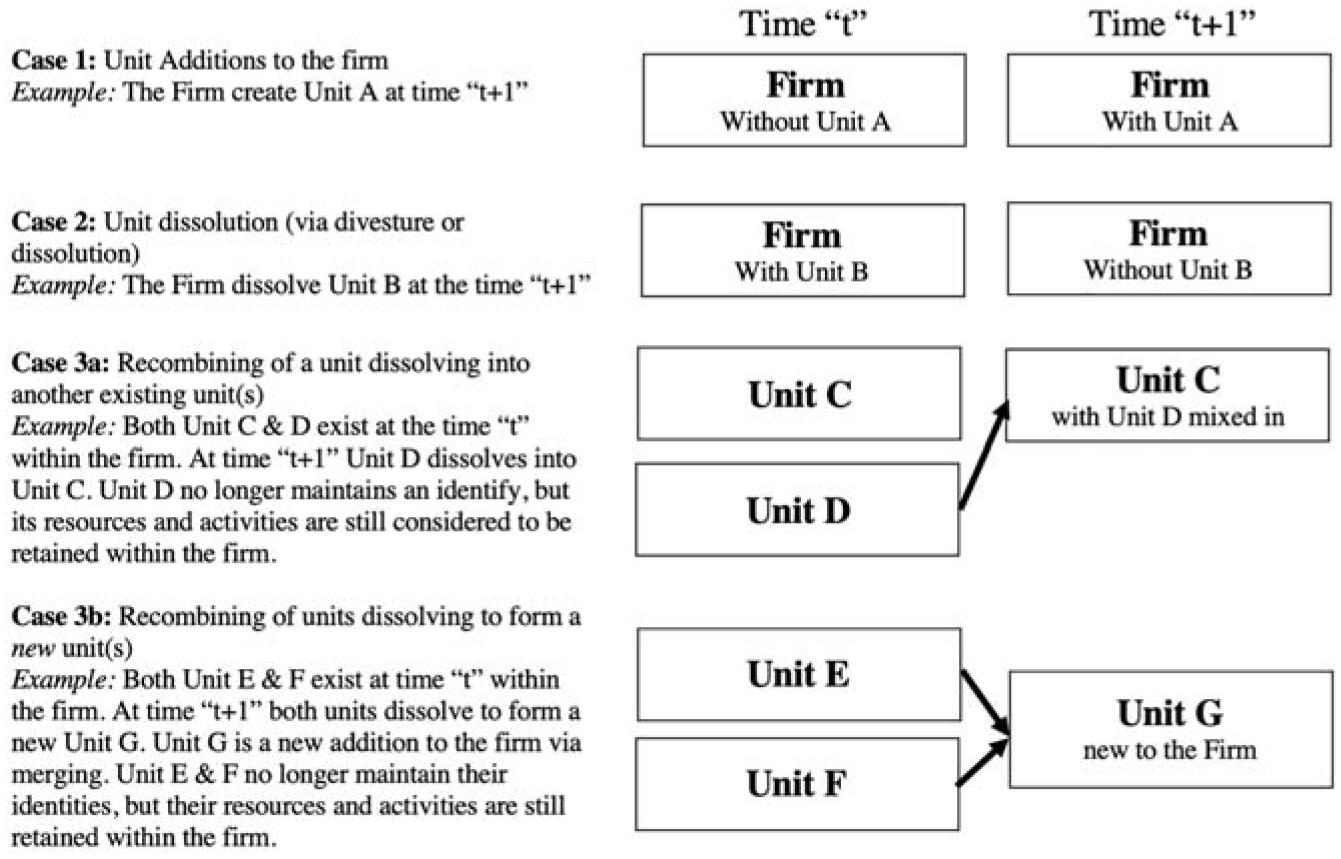
Three types of structural reconfiguration.
Úbeda-García et al. (2020) emphasized that firms need to develop the capabilities to manipulate the business units where these resources reside to succeed in new value-creating strategies. Accordingly, Albert (2018) and Karim (2006) examined structural recombination—the splitting and merging of modules. Structural recombination may lead to novel architectural opportunities that enable greater innovation and long-term performance. They revealed modularity-informed predictions in which visibility and information hiding affect structural recombination decisions. Furthermore, they demonstrated that new forms of organization could sustain firm survival by observing the efficiency and durability of various structural reconfigurations.
Also, recent studies demonstrated the significant impact of structural reconfiguration on innovation and long-term performance, such as Vo Thai et al. (2022), Wogwu and Hamilton (2018), and Albert (2018). Besides, Girod and Whittington (2017) contributed to the debate on the connection between dynamic capabilities and environmental dynamism by examining a set of large U.S. groups to determine the relationship between structural reconfiguration and performance. On the other hand, Karim et al. (2016) research revealed that the firms defer reconfiguring organizational structure in an unstable and turbulent environment, waiting for better conditions to pursue a successful strategic change. Therefore, our research will contribute to the renewal and development of dynamism capabilities by examining the role of organizational efficiency and the business environment in driving structural reconfiguration
Hypothesis Development
The Impact of Business Environment on Structural Reconfiguration
The dynamic capabilities approach emphasizes that continuous reconfiguration helps companies adjust their organizational structure and goals quickly to adapt to high-speed environments (Albert, 2018; Jantunen et al., 2018; Peng et al., 2022; Teece et al., 1997). Girod and Whittington (2017) and Carroll and Karim (2009) recently argued that reconfiguring organizational structure is appropriate for businesses to readjust development direction and react quickly to new opportunities in environmental dynamism. Besides, Ambroise et al. (2018) demonstrated that selecting and combining the right environment-strategy-structure configuration attributes is crucial to improving corporate performance. The three specific servitization strategies (added services, activities reconfiguration, and business model reconfiguration) are suggested for the service offering’s impact on business performance. North and Varvakis (2016) and Zollo et al. (2016) provided a foundation for our hypothesis. They proved that firms functioning in an ever-shifting business environment might effectively exploit opportunities, stay ahead of the competition, and improve operational efficiency by using their current reconfiguration capabilities. From these arguments, our research hypothesizes that business environmental factors (such as the accessibility to financing and land, inadequately educated workforce, competitive intensity, tax rates, business licensing and permits, and political instability) significantly impact reconfiguring organizational structure.
Organizational Efficiency on Structural Reconfiguration
The influence of organization efficiency in sales and labour on structural reconfiguration is highlighted in the second hypothesis. Kotiloglu et al. (2021) showed that enterprises that suffer from the process of under-performing would tend to look for strategic change to improve their performance. In contrast, achieving effective growth in the past will not motivate enterprises to seek organizational change (Kotiloglu et al., 2021; Vidal & Mitchell, 2015). On the other hand, a firm will be exposed to unforeseen risks associated with disruption as it pursues structural reconfiguration (Carroll & Karim, 2009, 2011; Gaba & Joseph, 2013). An abundance of research has looked at the link between organizational efficiency and reconfiguration, and it has been shown that businesses with poorer organizational efficiency are more likely to undergo unit dissolving or recombining (Dothan & Lavie, 2016; Lee et al., 2023). While highly effective businesses may utilize reconfiguration to rearrange inefficient organizational structures in anticipation of declining industry life cycles (Vidal & Mitchell, 2015; Xia & Li, 2013), they often reinvest in prospects for rapid expansion (Kaul, 2012). This study’s fundamental argument concerns whether or not sales and labour efficiency drive finding and choosing activities to reconfigure organizational structure. We hypothesize that
The Moderate Effect of Business Environment on the relationship between Organizational Efficiency and Structural Reconfiguration
The impact of organizational efficiency on structural reconfiguration under the changing business environment is reflected in our argument. According to Belling et al. (2022), the organization’s inefficiency in the past was not enough to motivate the organization to make a structural reconfiguration. Therefore, a strategic change approach is considered only when inefficient performance moderated by an event precipitated by environmental factors causes the structural reconfiguration to rapid adaptation. Additionally, Chakrabarti et al. (2011) analyzed 1,256 Southeast Asian firms to investigate the relationship between external markets’ influence and their strength in reconfiguration development. They found that divestment reconfiguration becomes necessary and feasible for inefficient businesses with environmental dynamism. Otherwise, the enterprise with better efficiency will prioritize “growth reconfiguration” by adding and recombining organizational structure. In agreement with these arguments, this research objective emphasizes that underperforming firms operate in a high-velocity environment, which causes them to limit market share, weak negotiating positions, and pressure to access financial resources. On the other hand, reconfiguring organizational structure executes their operations more efficiently, increases their development resources, and restores their competitive advantage (Fainshmidt et al., 2019; Khanagha et al., 2018). We thus postulate that structural reconfiguration selection is the glue between organizational efficiency controlled by the business environment.
The Impact of Structural Reconfiguration on Firm Profitability
Reconfiguring the structure of ineffective and unattractive units within the company aims to expand the business life cycle and put the enterprise on a high-priority trajectory for growth (Brown & Eisenhardt, 1997; Jantunen et al., 2018; Karim & Kaul, 2015; Vo Thai et al., 2022). Many recent studies have focused on the relationship between structural reconfiguration and post-reconfiguration outcomes. Albert (2018) analyzed a longitudinal sample of 222 divisions in 18 of the largest European universal banks and found that structural reconfiguration creates new architectural opportunities, allowing firms to implement innovation effectively and maintain continuing performance. Besides, Vo Thai et al. (2022) proved that dissolving and recombining an ineffective business unit affect profitability and strengthen competitiveness by focusing on new opportunities. In the study on the impact of dynamic capabilities participation on the international performance of early internationalizing firms, Jie et al. (2023) highlighted structural reconfiguration in response to environmental developments, enhancing firms’ international performance. Our study supported Jantunen et al. (2018) and Girod and Whittington (2017) that the reconfiguration capabilities by changing organizational structures to adapt to market and technology change allow firms to sustain profitable growth. Furthermore, our study extends structural reconfiguration into three activities separately (including adding, dissolving, and recombining organizational structure) to explore how these activities impact the fundamentals for achieving value-maximizing performance. Thus, we hypothesized that
The Mediating Effect of Structural Reconfiguration on the Relationship Between Business Environment and Firm Profitability
The business environment serves as a model for motivating managers to implement dynamic capabilities as structural reconfiguration. Additionally, reconfiguring internal structures may improve the organization’s profitability appropriately (Drnevich & Kriauciunas, 2011; Schilke, 2014). Ambroise et al. (2018) and Kohtamäki and Helo (2015), determining the appropriate environment-strategy-structure configuration is critical to increasing firm performance, that is A confluence of strategy, structure, and environmental features that are internally coherent, supportive, and mutually reinforcing. Besides, Girod and Whittington (2017) highlighted the advantages of reconfiguration in business environments, noting that its more continuous nature enables prompt repairs to organizational misalignments and rapid adaptation to new opportunities. Moreover, adjustments to the structure can be made rapidly by insertions and deletions, and inefficient rearrangements may be undone with little effort. According to these research findings, reconfiguration such as structural addition, dissolution, and recombination may mediate between business environmental obstacles and profitability.
The Mediating Effect of Structural Reconfiguration on the Relationship Between Organization Efficiency and Firm Profitability
As previously hypothesized, the efficiency of an organization is a direct aspect in inspiring various corporate activities, including repositioning within its strategic group (Kotiloglu et al., 2021), modifying a firm’s market dominance (Cheng et al., 2022), and reconfiguring through divestitures (Vidal & Mitchell, 2015). Besides, several studies attempt to determine how structural reconfiguration affects the connection between organization efficiency and firm profitability. When organizational efficiency falls below a certain threshold, risk-seeking pushes the organization to overcome inertial pressures and undertake reconfiguration in a quest for more remarkable performance (Feldman & Sakhartov, 2022; Joseph et al., 2016; Úbeda-García et al., 2020). Conversely, managers’ risk aversion and inertia dampen the firm’s propensity to invest in structural reconfiguration when organizational efficiency exceeds expectations. Eggers and Suh (2019) and Dothan and Lavie (2016) argued that responding to inefficient operations by investing in a reconfiguration may raise profitability via higher productivity and realizing economies of scale and scope. This research was conducted to support their argument concerning the mediating function of structural reconfiguration driven by efficiency gains inside the organization (sales and labour). Then, a change in the organizational structure may improve firm profitability by expanding activities (doing more), contracting activities (doing less), or encouraging innovation (doing something new). Thus, we hypothesize that:
The conceptual model may identify structural reconfiguration (addition, dissolution, or recombination) under specific business settings and organizational efficiency to ensure firm performance when a match is established (Figure 2).

Conceptual model.
Method
Data Source
The World Bank has been conducting Enterprise Survey, which gathers information from firms in emerging markets on their experiences and perceptions of the surrounding environment, since the 2000s. WBES employs nationwide sample frames that are both up-to-date and comprehensive, and it makes an effort to eliminate outliers from these frames before collecting data. Besides, WBES enables long-term survey administration and trustworthy response identification from firms in a wide range of emerging countries. As a result, WBES data will provides valuable insight into the influence of both internal and external factors on organizational structure reconfiguration. Furthermore, examining WBES data assists in identifying strategies for developing market SMMEs to boost profitability, raise global competitiveness, and expand into new markets, especially in light of the COVID-19 pandemic.
There are eight different Southeast Asian nations represented in WBES, with each contributing data in the form of answers to standardized and country-specific survey questions. For this study, we compiled a dataset on SEA since it had accurate information on all factors involved. Included are both low- and middle-income countries, such as Indonesia, Thailand, Vietnam, Malaysia, the Philippines, Laos, Cambodia, and Timor-Leste (WBES does not have statistics for Myanmar, Brunei Darussalam, and Singapore). Data collection for WBES came via in-person interviews with firms in the manufacturing sector; only officially registered firms were eligible to participate in the survey. WBES gathers information on many different aspects of organizational operations, including the characteristics of business owners, the challenges they face, how their organizations are structured, and the profits they generate. There are two significant benefits to using this dataset. First, the data collection is beneficial since it concentrates on SMMEs, the backbone of economic growth in developing countries. Second, the WBES stands out as the only one to include structural reconfiguration activities and other firm characteristics regarding size, age, geography, and industry coverage.
WBES investigated 1,184 establishments of SEA-SMMEs in eight countries between November 2014 and April 2016. The final sample is in Supplemental Appendix A. Figure 3 shows the percentage of SMMEs experiencing structural reconfiguration in this survey. It indicates that SMMEs in Thailand hold the highest percentage of experiencing reconfiguration activities, in which structural addition, dissolution, and recombination surpass 90%.
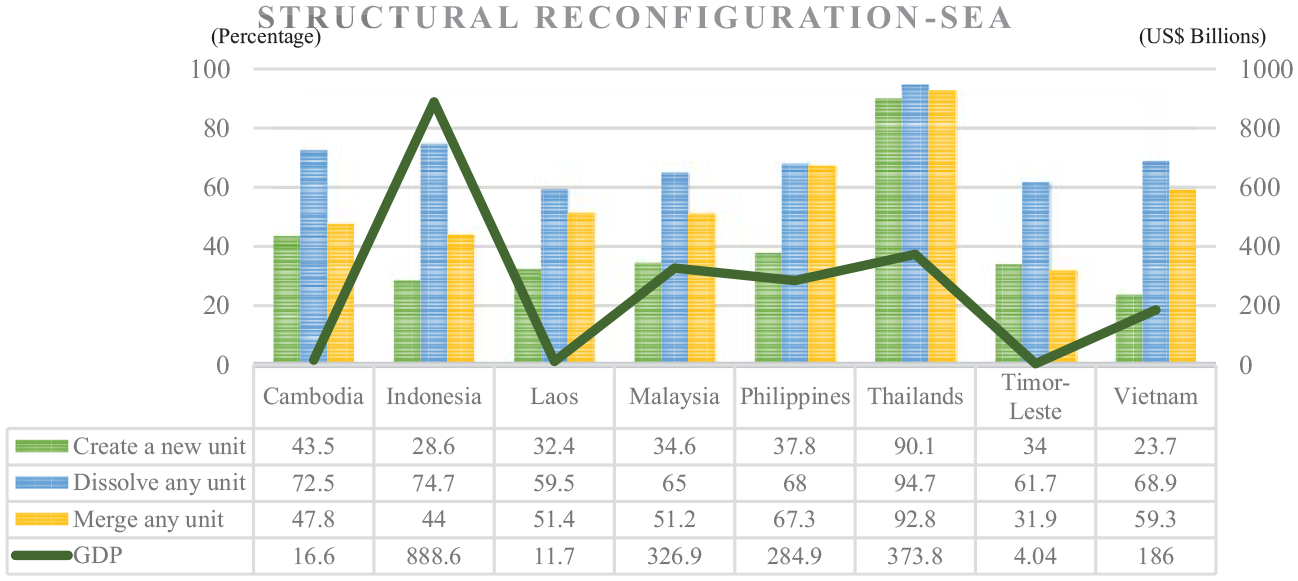
The percentage of structural reconfiguration and GDP.
Measures
This research examines the influence of internal and external factors on a firm’s structural reconfiguration. In some cases, managers of well-performing units may have chosen to create a new unit or department, while in other cases, firms may be dissolving or recombining underperforming units. The firm’s age, size, ownership structure, main market, and top manager experience are also considered control variables. Supplemental Appendix A shows the measurement design of structural reconfiguration.
Dependent Variables
Asset Turnover Ratio (ATR) and Gross Profitability Ratio (GPR) to know the condition status of the business after restructuring the configuration. ATR is a financial ratio that measures the efficiency of a company’s use of its assets in generating sales revenue or sales income to the company. Also, ATR is considered an Activity Ratio, a group of financial ratios that measure how efficiently a company uses assets (Henry et al., 2012). Asset Turnover Ratio = Net Sales / Total Assets. Additionally, The Gross Profits to Assets ratio is another profitability measure. A high Gross Profitability Ratio shows that a company has sustainable competitive advantages. Gross Profitability Ratio = Gross profits / Total Assets. The WBES is the source for all the numbers used here.
In the WBES, structural reconfiguration is categorized. Based on the question, “Did the establishment make any changes in its organizational structure in any of the following ways?”. The response consists of three structural reconfiguration approaches: (1) structural addition (RECONF_1), (2) structural dissolution (RECONF_2), and (3) structural recombination (RECONF_3). RECONF_1 is a dummy variable that equals 1 (one) if the firm added a new unit or department during 3 years, and otherwise 0 (zero). If the enterprise has dissolved any units or departments in the last 3 years, RECONF_2 will be set to 1 (one); otherwise, it will be set to 0. (zero). Lastly, RECONF 3 is a dichotomous variable assigned to 1 (one) if the enterprise is reconfigured by recombining divisions and 0 (zero) otherwise (Supplemental Appendix A).
Independent Variables
The research employs a variety of variables relating to organizational efficiency and environmental obstacles to evaluate Hypotheses 1–3. Organizational efficiency is measured by labour efficiency (LABOR), as collected in WBES: “What were total annual sales for this establishment? / How many permanent, full-time individuals worked in this establishment?”. The WBES were collected to measure the accessibility to finance (FINC) and land (LAND), inadequately educated workforce (WRFC), competitive intensity (COMP), tax rates (TAX), business licensing and permits (LICENS), and political instability (POLIT) 2 years prior to the firm’s structural reconfiguration. The relevance of the business environment is described using a 5-point Likert scale (no obstacles – very severe obstacles). See Supplemental Appendix A for the detail.
Control Variables
The following factors are considered to be control variables: firm size, firm age, firm ownership structure, the senior managers’ expertise, and market structure. WBES defines an enterprise as “small” if it has fewer than 20 workers and as “medium” if it has between 21 and 99 workers. By asking, “In what year did this establishment begin operation?” the study may determine the stage of development in which the enterprise is currently, allowing us to provide more relevant feedback. Another question used to determine top-level management expertise is, “How many years of experience working in this sector does the Top Manager have?”
Methods
Logical regression analysis was used to test hypotheses 1, 2, and 3 since the dependent variables are fixed in three groups: (a) structural addition, (b) structural dissolution, and (c) structural recombination. Furthermore, each of these groups is dichotomous, meaning that “No” equals “0” and “Yes” equals “1.” Each variable in the equation is assigned a non-standardized coefficient (β) from positive to negative infinity, distributed as a z score, using logistic regression analysis. The signs of these coefficients (+, 0, −) may be interpreted in the same way as the signs obtained by OLS regression (+ indicates a greater value, − indicates a smaller value). The coefficients show how each independent variable affects the probability of an occurrence. A positive coefficient indicates that an increase in the independent variable increases the probability of structural reconfiguration. A negative coefficient suggests the opposite.
For this model, we employ maximum-likelihood estimation, a helpful method for quantifying the parameters and asymptotic values in a large-sample investigation. We use the −2 log-likelihood, Chi-square (Model
Besides, hypotheses 4 to 6 relate to the mediating factor and the dependent variable, ART, and GPR, using hierarchical linear regression to test. Baron and Kenny (1986) and Bergh et al. (2008) mentioned three-step for testing mediated variables, firstly analyzing the connection of independent variables with structural reconfiguration approaches. The next step considers whether or not a direct effect between the independent variables and the firm profitability. After this step, evaluate the independent and mediated variables that simultaneously impact firm performance.
Results
Table 1 presents the mean, standard deviation, and correlations for the 1,184 SEA-SMMEs collected in 2015 by WBES. Please refer to Supplemental Appendix B for the definition of SMMEs in each SEA country in this study. The table indicated that more than 200 businesses conducted structural reconfiguration in 2015 through (a)
Mean, Deviation, and Correlation.
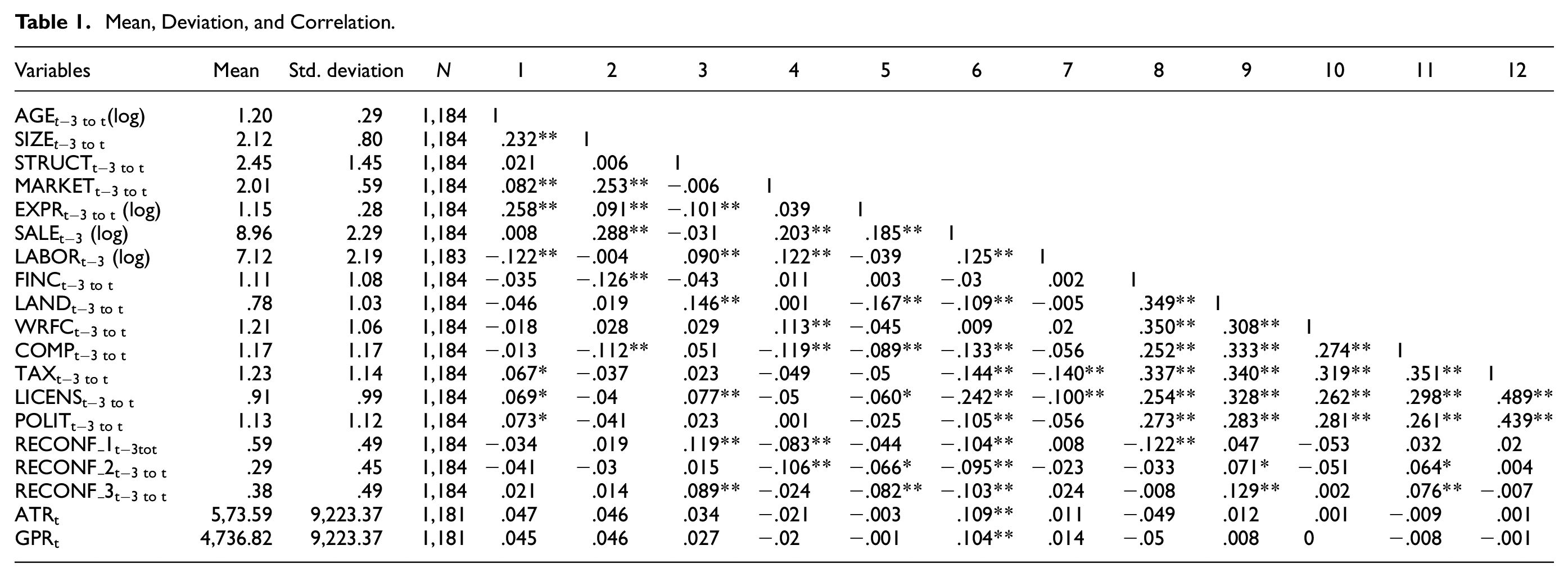

Correlation is significant at the 0.01 level (two-tailed).
Correlation is significant at the 0.05 level (two-tailed).
The hierarchical logistic regression analysis results are shown in Table 2 for the three dependent variables,
Results of the Hierarchical Logistic Regression Analysis (DV = RECONF_1 and RECONF_2).

Note. The number in the column is an unstandardized regression coefficient and the standard error of the coefficient. Bold value indicates a statistically significant difference with a p < .1.
p < .10. *p < .05. **p < .01. ***p < .001; N = 1,184.
Lastly, the business environment and organizational efficiency would interact significantly on structural reconfiguration. The results of Model 4, Model 8, and Model 12 in Table 3 give an overview of the third hypothesis (H3). The results show that the interaction term of
Results of the Hierarchical Logistic Regression Analysis (DV = RECONF_3).
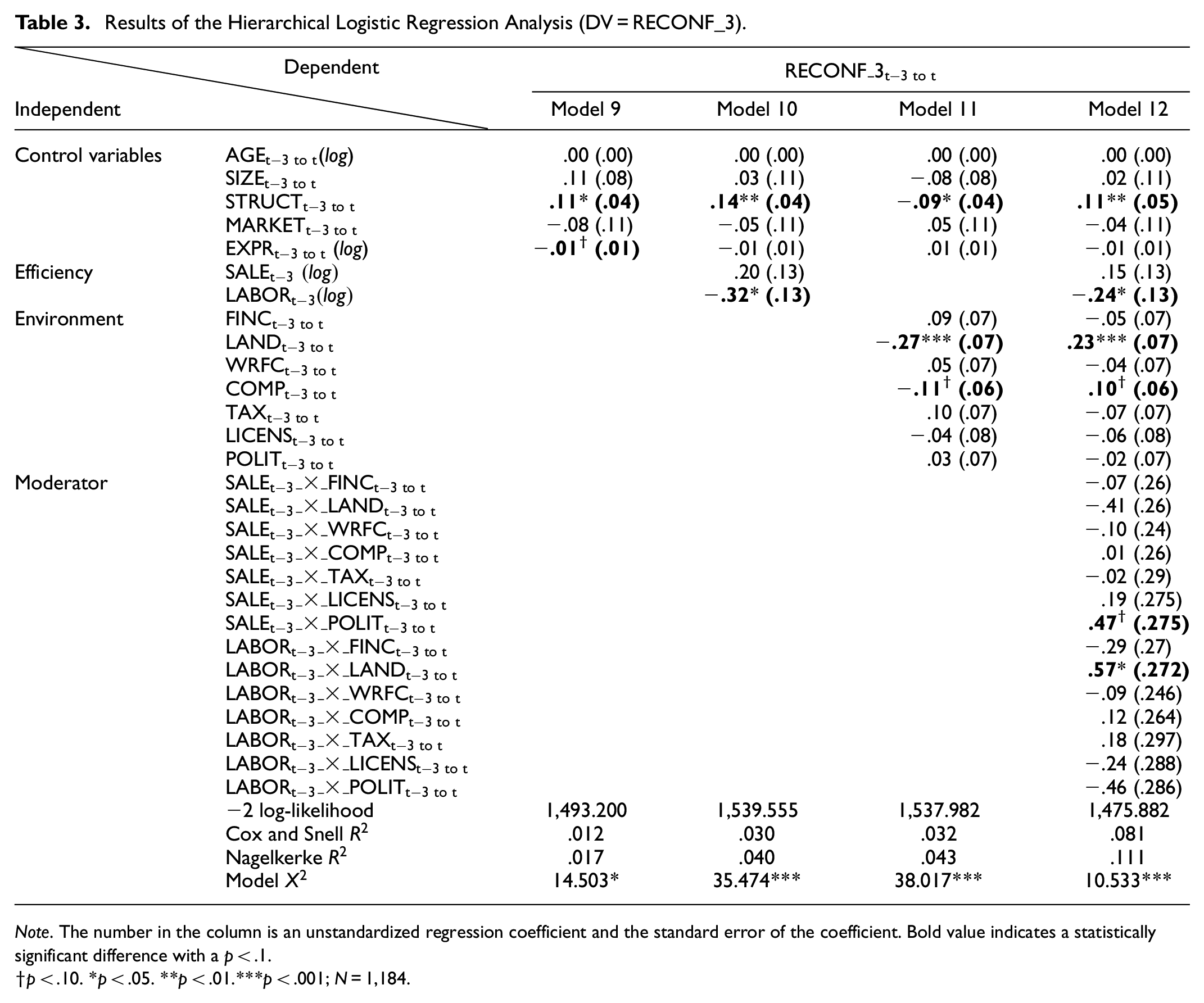
Note. The number in the column is an unstandardized regression coefficient and the standard error of the coefficient. Bold value indicates a statistically significant difference with a p < .1.
p < .10. *p < .05. **p < .01.***p < .001; N = 1,184.

Land obstacle dampens the negative relationship between labor efficiency and structural reconfiguration-merge unit.
The results of the hierarchical linear regression analysis, which is connected by mediated variables and serves as a crucial test for assessing the three final hypotheses, are shown in Table 4. The two variables for evaluating the firm’s profitability (
Results of the Hierarchical Linear Regression Analysis (DV = ATR and GPR).

Note. The number in the column is a standardized regression coefficient. Bold value indicates a statistically significant difference with a p < .1.
p < .10. *p < .05. **p < .01. ***p < .001. N = 1,184.
Supplemental Appendix C presents the estimation results of the structural reconfiguration using Breusch-Pagan and Koenker test statistics. The results of robustness checks are generally the same as our main results regarding the direction of impact (coefficient sign).
Discussion
Finding
This study’s motivation is to understand better the use of structural reconfiguration in an unstable business environment. The results from the four hypotheses supported this research question, “How do organizational efficiency and business environment affect the choice of structural reconfiguration to maintain a competitive advantage?” and provided an in-depth guide for choosing the suitable reorganization. We demonstrated Southeast Asian enterprises’ drivers in rearranging the organizational structure, which depends on prior organizational efficiency and the external business environment. Firstly, Table 2 shows us that the higher the sale efficiency, the more likely the SEAs enterprises utilize structural addition; otherwise, the lower the labour efficiency, they consider strategic change through structural recombination. Our research supported Dothan and Lavie (2016) and Vidal and Mitchell (2015) concerning manipulating reconfiguration capabilities to deal with performance feedback. The direct relationship between external environmental obstacles and structural reconfiguration is also explored in Tables 2 and 3. We have found that FINC, LAND, WRFC, COMP, and LICENS are particular business environmental obstacles in reconfiguration activities. Furthermore, our results explore the role of reconfiguring organizational structure as addition, dissolution and recombination in an unstable environment. Our results aim to support SEAs enterprise with a clear strategic direction, innovative culture, and flexible structure.
Theoretical Implication
A positive contribution to elucidating structural reconfiguration under each specific condition has provided a more comprehensive view of learning using the dynamic capability theory. This paper highlights the organizational efficiency that led to reconfiguring and mentions how environmental factors influence structural changes. Our study contributes to the debate about dynamic capabilities’ appropriateness in different environments (Girod & Whittington, 2017; Vo-Thai et al., 2021). Furthermore, we extend Karim and Capron (2016) research by testing how a specific business environment affects reconfiguration capacity in dynamic theory. Besides, the research uses reconfiguration capabilities to help Southeast Asian businesses seize opportunities for innovation, minimize environmental obstacles, optimize profits, and choose appropriate strategies. In short, this result contributes two critical aspects to dynamism (1) expanding the diversity reconfiguration activities in seizing new opportunities and supporting business growth strategy, and (2) advancing previous research on performance gaps by proposing for which appropriate structural reconfiguration responds to the changing environment, adding a foundation for sustainable development.
Managerial Implication
Managers of inefficient operations face significant pressure to recover profitable growth from external stakeholders such as analysts, potential shareholders, and partners. Due to organizational inefficiencies, access to financial capital and strong suppliers is impaired, resulting in an increased risk of acquiring another company (Zuckerman, 2000). Risk-taking managers utilize structural reconfiguration to improve operational performance quickly. By building research direction, detailing structural reconfiguration, and analyzing secondary data from eight SEAs countries, our empirical research explained the “how” questions to assist strategic managers or executives in choosing the correct reconfiguration activities. Our hypotheses about structural reconfiguration’s direct and moderated effects are supported. Accordingly, Hernández-Linares et al. (2021) indicated that a configuration change would not improve profitability and recommended against it. However, our results suggest that structural recombination associated with better post-reconfiguration performance provides a novel direction for managers to implement a strategic change to gain profitable growth. Mergenthaler Linotype (Tripsas, 1997), IBM (O’Reilly III et al., 2009), and NCR (Rosenbloom, 2017) are just a few examples of companies that have exploited their flexibility to reconfigure in the face of environmental disruption with positive results.
Limitations and Suggestions for Future Research
Some limitations of the study are also addressed in this paper. First, the WBES does not cover each reconfiguring cost. Therefore, we are limited in discovering how much cost a business needs to invest in reconfiguring activities to overcome the past inefficiency of business performance. Second, several constraints in causal inference will be encountered while studying structural reconfiguration utilizing the cross-sectional design. Future research should employ longitudinal designs to assess the need for structural reconfiguration. Furthermore, future studies on strategies may consider structural reconfiguration a critical aspect in gaining a competitive advantage, especially when investigating the link between market focus and structural flexibility. Teece (2007) also mentioned the role of market perception in reconfiguring the company’s assets. Studying market impacts on a company’s ability to adapt to change will enrich our understanding of dynamic capability and market direction. Future research will also give regulators and lawmakers a new perspective on reconfigurability in different industries.
Conclusion
In conclusion, our research contributes significantly to dynamic capabilities by drawing together internal and external factors influencing the decision to reconfigure organizational structure and firm performance. We have studied the apparent differences between the three types of reconfiguring organizational structure as addition, dissolution, or recombination of a group within the firm mentioned by Karim (2006), empirically based on WBES. From the paper’s overall perspective, we recognize that SEAs enterprises are increasingly developing and possessing the ability to change their structures to suit the domestic environmental obstacle rapidly. Based on the hierarchical logistic regression method results, we know that various internal and external factors govern the driving force for each type of reconfiguration. Moreover, the paper’s usefulness in understanding how a complex structure can effectively learn, adapt, and survive for a long time is a significant contribution. Thus, we hope this research discussion will advance our understanding of structural reconfiguration concepts.
Supplemental Material
sj-docx-1-sgo-10.1177_21582440241257393 – Supplemental material for Structural Reconfiguration of Firms toward Industrialization in Southeast Asia
Supplemental material, sj-docx-1-sgo-10.1177_21582440241257393 for Structural Reconfiguration of Firms toward Industrialization in Southeast Asia by Huy-Cuong Vo Thai and Shihmin Lo in SAGE Open
Footnotes
Declaration of Conflicting Interests
The author(s) declared no potential conflicts of interest with respect to the research, authorship, and/or publication of this article.
Funding
The author(s) disclosed receipt of the following financial support for the research, authorship, and/or publication of this article: This research is funded by the University of Finance-Marketing.

Data Availability Statement
The data that support the findings of this study are available from the corresponding author, Huy-Cuong Vo-Thai (
Supplemental Material
Supplemental material for this article is available online.
References
Supplementary Material
Please find the following supplemental material available below.
For Open Access articles published under a Creative Commons License, all supplemental material carries the same license as the article it is associated with.
For non-Open Access articles published, all supplemental material carries a non-exclusive license, and permission requests for re-use of supplemental material or any part of supplemental material shall be sent directly to the copyright owner as specified in the copyright notice associated with the article.
