



Abstract
The purpose of this study is to examine the direct and moderating effects of internal endowment and external dynamism on capability reconfiguration, which in turn has a positive impact on a firm’s post-reconfiguration performance. A researcher-designed survey questionnaire was developed based on multiple works and subsequently administered with a final sample of 266 Vietnamese small and medium enterprises engaged in manufacturing industries. As a result, we find that internal endowment and external dynamism positively impact a firm’s capability reconfiguration and post-reconfiguration performance consequently. This empirical research provides four major contributions that supplement the extant literature. First, the internal endowment sponsored by resource abundance and absorptive capacity enables both a firm’s capability evolution and capability substitution. Second, the external dynamism in terms of market turbulence, technology turbulence, and competitive intensity directly affects the enterprise’s capability reconfiguration and positively moderates the relationship between internal endowment and capability reconfiguration. Third, this study demonstrates that the firm’s engagement on capability reconfiguration once in line with external and internal factors can help maintain its post-reconfiguration performance. Finally, the primary data collected in Vietnam offers a firsthand investigation of the catching-up economy to be compared with the research findings available in developed countries.
Keywords
Introduction
The lapse of three decades since Doi moi—the socioeconomic reforms toward a market economy initiated in 1986—saw Vietnam grown from one of the lowest income countries to a thriving middle-income economy (Leaders, 2016). The country had likewise forged international commitments with its affiliation to the Comprehensive and Progressive Agreement for Trans-Pacific Partnership (CPTPP) in 2020. Other linkages include the EU–Vietnam Free Trade Agreement (EVFTA) and the EU–Vietnam Investment Protection Agreement (EVIPA) in 2019. These agreements further made the Vietnamese market more lucrative and foreign direct investments more rewarding for multinational corporations (World Bank, 2020). However, small and medium enterprises (SMEs), which often lack modern technologies and market acumen, face fiercer competition with major players under this economic leap. Technological turbulence, market volatilities, and competitive tensions urge Vietnamese SMEs to reconfigure their capabilities to survive and grow (Diez, 2016; United Nations Industrial Development Organization [UNIDO], 2015). How capability reconfiguration, enabled by internal endowments in coping with external dynamism, can shape Vietnam enterprises’ performance deserves immediate and scholarly attention.
A few extant studies have highlighted this issue of how firms reconfigure their resources and capabilities to maintain and create new competitive advantages. When an incumbent’s existing competencies are no longer sufficient to achieve its desired outcomes or even to be destroyed, the corporate reconfiguration of capabilities turns out to be inevitable (Eggers & Park, 2018; Tushman & Anderson, 1986). Responding to rapid environmental changes, incumbent firms may counter their unfavorable inertia by appropriately developing and deploying dynamic capabilities (Helfat & Peteraf, 2009; Teece, 2007). In particular, Karim and Capron (2016) and Girod and Whittington (2017) considered reorganization as a critical dynamic capability, which includes the more pervasive restructuring and the more limited reconfiguring, to enable firms to adapt and innovate at an architectural or at a modular level (Albert, 2018).
On the contrary, Lavie (2006) examined the complex interplay of environmental and internal factors that shape the incumbent’s choice of capability reconfiguration mechanisms to close the capability gaps. Capability evolution (CE) focuses on incrementally modifying a single capability’s constituting routines without altering its original purpose of the function. In contrast, capability substitution (CS) involves replacing existing capabilities or the overall capability portfolio with a new one that demands new knowledge and undertakes fundamentally different functions (Konlechner, 2017; Lavie, 2006). By empirically investigating the British software industry, Hawass (2010) concluded that interfirm collaboration and internal learning across units and levels are critical determinants of reconfiguration capability.
This study attempts to develop and empirically test a configurational model that depicts the relationship of external dynamism, internal endowments, the corporate involvement in CE and substitution, and the post-reconfiguration performance (PP). A survey questionnaire was designed by the researchers and validated by drawing on multiple works and then conducted with a final sample of 266 Vietnamese SMEs from manufacturing industries. Collected data had been subjected to analysis using structural equation modeling (SEM), which revealed a higher perceived external dynamism and more abundant internal endowments positively impact the enterprise’s engagement on capability reconfiguration and the PP.
The research makes four critical contributions to the perspectives of dynamic capabilities and capability reconfiguration: First, this study provides an unobstructed view that the enterprise’s internal endowments of resource abundance (RA) and absorptive capacity (AC) enable both CE and substitution; second, this engagement provides an opportunity to empirically test and show that external dynamism driven by market turbulence (MT), technology turbulence (TT), and competitive intensity (CI) positively impacts the enterprise’s capability reconfiguration directly and moderates the relationship of internal endowments and capability reconfiguration, which is rarely examined in extant related empirical research; third, this research empirically establishes that the firm’s engagement on capability reconfiguration in line with external and internal factors can help maintain successful PP; and fourth, all data analyzed from researcher-designed and validated survey questionnaires were primarily collected in Vietnam, which offer a firsthand investigation on the catching-up economy and compared the research findings available from developed countries.
This article is organized as follows. In the next section, we review relevant dynamic capabilities literature and develop a hypothetical model underpinned by capability reconfiguration and delineated with its antecedents and consequences. Then, we proceed with an illustration of the survey item design and validation process and an overview of our data collection. Subsequently, empirical analyses are conducted by SEM and to test our hypotheses. Finally, we conclude with a discussion of results, potential contributions, and future directions.
Literature and Hypotheses
Dynamic Capabilities
The firm’s survival and successes are undergirded by its allocation of internal endowments and its adaptation to the external dynamism. Dynamic capabilities enable a firm to sense and seize opportunities or neutralize threats by reconfiguring its resource base to pursue superior sustainable performance (Teece, 2007; Teece et al., 1997). However, in the face of high-velocity uncertainties, frequently found in the era of ferment after discontinuities, routine evolutionary changes become no longer valid and ad hoc problem-solving instead turns out unavoidable for enterprises to adopt (Eisenhardt & Martin, 2000; Tushman & Anderson, 1986; Winter, 2003). In particular, when core competencies or specialized complementary assets are destroyed, an enterprise that does not reconfigure its capabilities and resources in a timely manner will sooner or later be driven out of the market (Eggers & Park, 2018; Lavie, 2006).
The enterprise’s efforts to close gaps in capability over time constitute a capability life cycle until dramatic changes intervene and trigger capability reorientation and reconfiguration (Helfat & Peteraf, 2003; Konlechner, 2017; Teece, 2017). Heterogeneity among enterprises’ internal endowment and environmental changes in different aspects leads to various actions and consequent performance outcomes. Capability reconfiguration aims to maintain evolutionary fitness or escape from unfavorable path dependencies (Girod & Whittington, 2017; Teece, 2007) as the core element of dynamic capability and often implemented by reorganizing. By empirically investigating the British software industry, Hawass (2010) concluded that interfirm collaboration and internal learning across units and levels are vital determinants of reconfiguration capability.
Chan and Reiner (2019) showed how new entrants and incumbents reconfigure firm boundaries for new capabilities, as dynamic capabilities in critical and noncritical forms, to attain or sustain competitive advantages in the global biofuel industry. Subramanian et al. (2011) analyzed a case-specific Nintendo and demonstrated the incumbents’ reconfiguring capabilities accommodate them to withstand fierce competition from those technologically superior participants. Girod and Whittington (2017) contributed to understanding dynamic capabilities with a connection to environmental dynamism by examining the relationship between structural reconfiguration and the performance of a set of large U.S. corporations. Lecerf and Omrani (2020) also pointed out that in the face of high uncertainties and constraints from frequent environmental changes, business enterprises need to restructure or reconfigure existing resources and capabilities to achieve and maintain high-performance outcomes.
Although incumbent enterprises are prone to core rigidities, especially in the face of competence-destroying discontinuities (Tushman & Anderson, 1986), developing and deploying dynamic capabilities and reconfiguring routines or portfolio of capabilities allows enterprises to proactively respond to potential threats (Aragón-Correa & Sharma, 2003).
Capability Reconfiguration
External dynamism on capability reconfiguration
The higher the turbulence or instability level in a dynamic environment, the faster enterprises with reconfiguration capabilities will correct organizational misalignments and react quickly to new opportunities (Girod & Whittington, 2017). Also, environmental turbulence unleashes new potential opportunities, where firms use the dynamic capability to reconfigure and reassign existing capabilities, which gives the enterprise new capabilities to pursue market trends (Lecerf & Omrani, 2020; North & Varvakis, 2016). In addition, Frank et al. (2017) and Schilke (2014) emphasized that the practical and highly successful dynamic capacity performance depends on the external fluctuating environment. Previous scholars have argued that enterprises operating in the same industry can successfully capture opportunities, competitive advantages, and operational efficiency depending on the use of their existing dynamic capability to cope with the external environment change (North & Varvakis, 2016; Zollo et al., 2016). In short, in an external dynamism where there is always a high threat from competitors and the opportunity to dominate the market quickly, we must always prepare the optimal strategy and solution to respond in each case. Our research considers how external environment dynamism characterized as MT, technological turbulence, and CI separately impact reconfiguration strategies.
Thus, the higher the degree of external dynamism the firm faces, the more possible the firm will be prompted to reconfigure its current organizational capabilities:
Internal endowment on capabilities reconfiguration
This study used RA and absorptive capabilities to represent internal endowment. Firm-specific RA and absorptive capabilities were a symbol of the process of investment, learning, and decision-making during the development period (Lockett et al., 2009; Madhani, 2010). Alonso (2019) emerged an implication on how resource barriers affect competitive advantage. They argued that all companies operating in the same industry who want to dominate the market must leverage resource differences. Furthermore, Barney et al. (2011) proposed “theories of unique synergies” that resource difference can produce synergy with extraordinary value. Simultaneously, combining flexible utilization of resources and learning capabilities can facilitate the deployment of necessary competencies in changing environments, contributing to renewing knowledge and skills bases (Miroshnychenko et al., 2021). The firm’s learning mechanisms or AC became factors for determining the appropriate time to execute the incumbent’s reconfiguration strategy (Uzuegbunam & Nambisan, 2018; Zollo & Winter, 2002). They argued that learning influences the development of the firm’s capacity through improving decision-making, refining existing knowledge to support reconfiguration mechanisms, and speeding up the possession of new knowledge (R&D). In short, enterprises with an excellent internal endowment may help an organization further develop its new reconfiguration capabilities or provide a competitive advantage through unique synergies with existing capacity:
External dynamism on internal endowment to capability reconfiguration
Eisenhardt and Martin (2000) stated that strategies to leverage bundled resources and capabilities in high-speed markets help businesses gain a long-term competitive advantage by creating a series of unpredictable organizational change actions. Dynamic capability is a series of organizational change actions, including reconfiguring, building, and integrating the organization’s resources and capabilities, targeting to respond to changing markets where they are currently operating (Helfat & Peteraf, 2015; Teece, 2007, 2017; Teece & Pisano, 1994). This article considered how internal endowment in an external dynamism directly affects capability reconfiguring strategies. First, the abundance of resources helps the enterprise implement reconfiguration strategies in response to the market’s volatility and regain the market sooner than its competitors (Helfat et al., 2009; Nemeh & Yami, 2019). In addition, the external dynamism creates a disruption, limiting the firm’s goal of keeping costs low. Therefore, utilizing the wealth of resources to implement a reshaping strategy help firms to remain efficient and maintain a competitive advantage (Fainshmidt et al., 2019). Second, as the market’s intense volatility, the enterprises with well-developed absorptive capabilities can identify trends and opportunities, creating a fundamental for executing a reconfiguration strategy flexibly (Zahra & George, 2002). According to Pavlou and El Sawy (2011), incumbent companies with strong absorption capacity should take advantage of volatile market opportunities to seek solutions to strengthen existing capacities and sustain product development. Conversely, the weaker a firm’s absorption capacity in external environment turbulence, the higher the risk that the organizational capabilities will become obsolete.
Hence, although the enterprise possesses substantial firm-specific resources and capabilities, the capacity reconfiguration strategy will be overshadowed when the external environment stabilizes. However, this strategy will become critical when the external environment is volatile and dynamic (Pavlou & El Sawy, 2011). We hypothesize that the choice of capability reconfiguration mechanism is the adhesive between the firm-specific resources and capabilities moderated with environmental turbulence:
Capability reconfiguration on firm performance
Konlechner (2017) and Lavie (2006) proposed two reconfiguration mechanisms, which measure the incumbents’ capacity to modify the existing competencies to respond to a changing environment (Girod & Whittington, 2017). First, the CE associates with renewing, redesigning, or recombining the existing organizational capabilities; such reactions aim to close gaps in capability (Konlechner, 2017). Next, Konlechner (2017) described the capability substitute reconfiguration as the ability to unleash existing capabilities and replace them with new capabilities. Two reconfiguration mechanisms toward evolution and substitution will be crucial elements in the reforming models (Konlechner, 2017; Lavie, 2006; Uzuegbunam & Nambisan, 2018). This study agrees with Uzuegbunam and Nambisan (2018) that the ties that enforce the reconfiguration mechanism must be covered in detail to respond to proactively specific environmental changes. Furthermore, based on measuring a performance outcome (i.e., competitive advantage), they consider the degree of reconfigurability success among different incumbents. We hypothesize that the decision to participate in reconfiguration capabilities helps the company provide the fundamentals for achieving value-maximizing capability configurations and improving PP:
The proposed theoretical model can be designed as follows, under certain conditions in terms of environmental dynamism (technological turbulence, MT, and CI) and internal endowment (RA and absorptive capability), to choose a reconfiguration mechanism (between CE and CS) and ensure the firm’s good performance when a fit is reached (Figure 1).
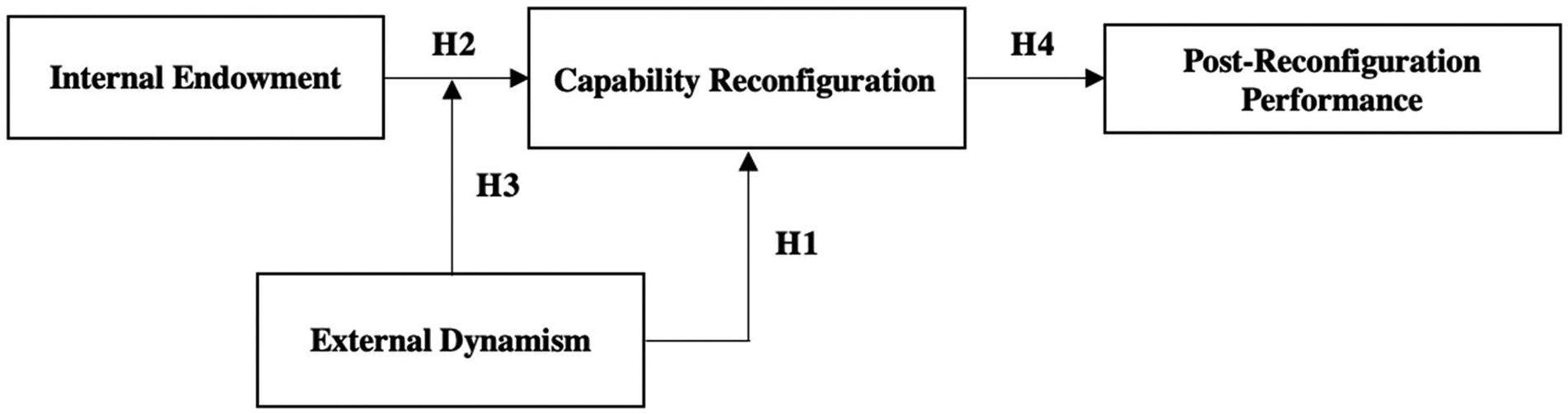
Hypothetical model.
Data and Methods
Sample
As a fast-growing developing country, Vietnam plays a critical role in the global supply chains from agricultural and food production, textiles and shoes, to mechanical and electronics manufacturing. In the process of globalization and catching-up, Vietnam stands out to be an appropriate empirical context where both environmental dynamism and corporate endowment make capability reconfiguration crucial to the firm’s survival and success. To ensure a diverse mix of industries and firms, data for this study come from a survey, explained below, of two groups of organizational informants from (a) the in-person survey of managers participating in Vietnamese industry exhibitions and (b) the e-mailed online survey addressed to manufacturing firms’ managers.
Accordingly, we first conducted the in-person survey in five popular exhibitions in Vietnam, MTA (Machine Tools Association) Vietnam 2019, Shoes and Leather Vietnam 2019, Vietnam PFA (Processing, Packaging and Preserving Food & Agricultural Products) 2019, Vietnam Medi-Pharm Expo 2019, and VietFood & Beverage—ProPack 2019. The attendants, either exhibitors or visitors, randomly approached are firsthand verified by their purposes to the exhibitions and their positions, allowing them to provide relevant knowledge on their firms’ capability reconfiguration. Ninety-four firms out of a total 150 contacted in-person are qualified and agreed to respond to the survey, for a response rate of 62.7%. After excluding three samples answering “No” in the required question as to the prerequisite for this study (“Has your company ever implemented capability reconfiguration in the face of environmental changes?”), a total of 91 samples constituting the first part of the data were identified.
Concurrently, we contacted the Investment and Trade Promotion Center (ITPC) for firms from various industries, which have been involved or interested in developing foreign trades and investments. After screening out unsuitable firm candidates for our survey by their industries (nonmanufacturing) and ages (founded within 2 years), we sent out 1,506 e-mails with a cover letter and the questionnaire. We received 253 responses achieving a return rate of 16.8%. After excluding 78 of them answering “No” in the required question (“Has your company ever implemented capability reconfiguration in the face of environmental changes?”), this data collection process yielded 175 usable responses.
As a result, this study reaches an aggregate of 266 samples from the two groups of target Vietnamese firm respondents by (a) the in-person survey for 91 samples and (b) the online survey for 175 samples. No significant difference in the responses between these two groups of informants (Box’s M test= 50.349, p =.080 > .05) was found for the eight variables later illustrated in the upcoming sections of measures and survey item design. Tables 1 and 2, to be revisited in the following sections, provide descriptive statistics for respondents’ demographic characteristics and responses acknowledging their represented enterprise’s perceived external dynamism, internal endowments, engagement on capability reconfiguration, and subsequent performance outcomes.
Demographic Characteristics of Respondents (n = 266).

Descriptive Statistics.

Measures
Each construct and associated variables used in this study are defined and operationalized first and then developed into survey items identified below by drawing on prior literature relevant to each construct and our discussion below in the following two subsections. This survey was primarily conducted in Vietnamese by the authors and translated into English with bilingual experts’ assistance. External dynamism is categorized into three dimensions: TT, MT, and CI, for which four, five, and four items are respectively designed to measure. Two critical aspects of an enterprise’s internal endowment are RA and AC, for which five and four items are respectively developed. The choices on capability reconfiguration that an enterprise has made to engage are distinguished into two types: CE and CS, for which four and three items are specified, respectively. Finally, three items are included to measure the PP of the enterprise. As a result, a 32-item questionnaire was developed (see the appendix for details).
A 7-point Likert-type scale (1 = totally disagree; 2 = disagree; 3 = more or less disagree; 4 = undecided; 5 = more or less agree; 6 = agree; and 7 = totally agree) was employed for all items in this study. The measurement scales have also been widely adopted in empirical studies in this area (Alegre et al., 2013; Nenonen et al., 2018). To help finalize the questionnaire before launching the survey, we conducted a pilot test with experts on face validity to ensure that respondents understood the items representing as many facets as possible of the given constructs. Suggestions and contributions were incorporated into the final draft of the survey questionnaire.
Dependent variables
PP
PP measures the effectiveness of firms’ attempts to reconfigure and obtain new capabilities. In line with Capron and Mitchell (2009) and Pratono et al. (2016), we asked respondents to assess “Our company’s performance in sales growth (PP-1); market share growth (PP-2); or profit growth (PP-3) is better than the industry average after 3 years of capability reconfiguration.”
Capability Reconfiguration—CE and CS
By drawing on Gatignon et al. (2002) and Lavie (2006), we define and measure two distinct aspects of capability reconfiguration. Four items are designed to measure CE by asking, “Capability reconfiguration in our firm was built mainly on prior technology (CE-1); existing experience base (CE-2); existing technological knowledge (CE-3); and simple adjustments to existing technology (CE-4).” On the contrary, three items are developed to measure CS by asking, “Capability reconfiguration in our firm required: fundamentally new concepts or principles (CS-1); new skills which our firm did not possess (CS-2); and adopting different methods and procedures (CS-3).”
Independent variables
External Dynamism—TT, MT, and CI
According to prior empirical research on external turbulence; Jaworski & Kohli, 1993; Pratono et al., 2016; Wu et al., 2017), TT, MT, and CI were developed and measured as follows.
First, four technological turbulence items were developed to tap the extent to which technology in industry was in a state of flux by asking, “The technology in our industry is changing rapidly (TT-1)”; “Technological changes bring about significant opportunities in our industry (TT-2)”; “It is challenging to forecast what the technology in our industry will be in the next 2 to 3 years (TT-3)”; and “A large number of new product ideas have been made possible through technological breakthroughs in our industry (TT-4).”
Second, five MT items were developed to assess the extent to which the composition and preferences of a firm’s customers tended to change over time by asking, “In our kind of business, the customer’s product preferences change quite a bit over time (MT-1)”; “Our customers tend to look for a new product all the time (MT-2)”; “We are witnessing demands for our products and service from customers who never bought them before (MT-3)”; “Our new customers tend to have product-related needs different from those of our existing customers (MT-4)”; and “We do not cater to as many of the same customers as that we used to in the past (MT-5).”
Third, the researchers developed and measured CI using four items to assess the degree of tension and pressure from competitive actions among rivals in the industry, including “Competition in our industry is cutthroat (CI-1)”; “There are always sales promotion wars in our industry (CI-2)”; “Anything that one competitor offers, others can match readily (CI-3)”; and “Price competition is a hallmark of our industry (CI-4).”
Internal Endowment—RA and AC
Through possession and utilization of a superior tangible and intangible resource base, and equipped with capabilities that assimilate, integrate, and apply external knowledge, firms are able to innovate, learn, and change. Accordingly, we used two sets of items to measure the internal endowment of a firm, with five items for RA and four items for AC. Five items as “Our company’s management capacity (RA-1); financial capital (RA-2); reputation (RA-3), specialized know-how (RA-4), or alliance experiences (RA-5) is above the industry average” were developed to measure RA (Amit & Schoemaker, 1993; Ployhart & Moliterno, 2011).
On the contrary, four items were developed to measure a firm’s absorptive capability (Distel, 2019; Wang & Byrd, 2017; Zahra & George, 2002) as a unique internal endowment by asking, “We have effective routines to identify, value, and access new information and knowledge (AC-1)”; “We have adequate routines to assimilate new information and knowledge (AC-2)”; “We are effective in transforming existing information into new knowledge (AC-3)”; and “We are effective in exploiting knowledge into new products (AC-4).”
Scale Analysis
We first show the data factorial structures for MT, TT, CI, RA, AC, CS, CE, and PP in presenting our experimental results rigorously. Next, we evaluate the validity of latent structures and model fit to ensure the theoretical model’s statistical applicability. Finally, the research hypotheses have been tested to confirm the causal relationships in the theoretical model.
Descriptive statistics
Table 1 presents the profiles of the responding companies and the demographics of the respondents. As the data indicate, the respondents were mostly senior managers or CEOs in Vietnamese firms, who oversee strategic management functions and understand the company. These individuals are considered accurate and reliable information (Narayanan et al., 2011). Besides, Table 2 reports the descriptive statistics of eight factors with 32 items. Descriptions of all items are shown with mean, standard deviation (SD), minimum, and maximum.
Exploratory factor analysis (EFA)
Based on the EFA, factor loadings for all items ranged from 0.409 (AC-1) to 0.899 (AC-4; see Table 3). Seven items displayed have lower than 0.4 factor loadings (AC-3: We are effective in transforming existing information into new knowledge, RA-2: The company’s financial capital, MT-2: Our customers tend to look for a new product all the time, MT-3: We are witnessing demand for our products and service from customers who never bought them before, TT-4: A large number of new product ideas have been made possible through technological breakthroughs in our industry, and CE-1: Our firm’s reconfiguration built heavily on prior technology), which were not considered for further analysis to ensure the quality of the measures (Costello & Osborne, 2005). Although one item of CE (CE-4: Simple adjustments to existing technology), two items of AC (i.e., AC-1: We have effective routines to identify, value, and import new information and knowledge, AC-2: We have adequate routines to assimilate new information and knowledge), three items of CI (i.e., CI-1: Competition in our industry is cutthroat, CI-2: There are many “promotion wars” in our industry, CI-3: Anything that one competitor can offer, others can match readily), and one item of MT (typically MT-1: In our kind of business, customer’s product preferences change quite a bit over time) fell below the minimum of 0.5 as a common cutoff point (Anderson & Gerbing, 1988), they still satisfied the criteria of 0.4 set by other work such as Hair et al. (2010).
Factor Loading and Cronbach’s Alpha.

Note. TT = technology turbulence; MT = market turbulence; CI = competitive intensity; RA = resource abundance; AC = absorptive capacity; CE = capability evolution; CS = capability substitution.
Table 3 shows the eight factors, their factor loading values, and corresponding Cronbach’s alpha with all values above 0.6. TT contains three parameters, TT-1, TT-2, and TT-3, with EFA loading values between 0.666 and 0.546. The second factor MT includes MT-1, MT-4, and MT-5, with the factor loading from 0.453 to 0.690. CI-1, CI-2, CI-3, and CI-4 belong to CI, giving the smallest value of Cronbach’s alpha, from .450 to .529. As for internal endowment, RA consists of RA-1, RA-3, and RA-4, with their factor loading of 0.500 to 0.662. AC consists of AC-1, AC-2, and AC-4, with factor loading values as 0.409, 0.452, and 0.899. Next on capability reconfiguration, CE contains CE-2, CE-3, and CE-4 with 0.705, 0.611, and 0.459, respectively. CS includes CS-1, CS-2, and CS-3, ranging from 0.511 to 0.671. Finally, PP-1, PP-2, and PP3 have EFA loading values of 0.511 to 0.676. The eight factors’ eigenvalues are above 1.033, and the cumulative explained variance is 58.646%. A Kaiser–Meyer–Olkin (KMO) statistic of 0.740 confirmed the items’ suitability because KMO values greater than 0.60 can be considered adequate for applying factor analysis (Hair et al., 2010).
Validity analysis
As noted by Ylinen and Gullkvist (2014), convergent validity can be evaluated by examining composite reliability (CR) and average variance extracted (AVE), where CR indicates the consistency of the constructs and AVE measures the amount of variance attributed to the construct relative to the amount due to measurement error (Ambad & Wahab, 2016). CR is calculated for every construct and then compared with the cutoff value of 0.6 (Bagozzi & Yi, 1988). In this study, CR values for AC, RA, MT, TT, CI, CE, CS, and PP were .630, .613, .620, .643, .600, .623, .647, and .619, respectively, as shown in Table 4, confirming convergent validity. On the contrary, AVE is traditionally expected to surpass the minimum threshold of 0.5. However, according to Fornell and Larcker (1981), even if AVE is less than 0.5, if CR is higher than .6, the convergent validity of the construct is still adequate. Therefore, when AVE was considered together with CR, this survey’s convergent validity was established. Table 4 summarizes the standardized regression weight, CR, and AVE of the model.
Standardized Regression Weight, CR, and AVE.

Note. CR = composite reliability; AVE = average variance extracted; TT = technology turbulence; MT = market turbulence; CI = competitive intensity; RA = resource abundance; AC = absorptive capacity; CE = capability evolution; CS = capability substitution; PP = postreconfiguration performance.
SEM
Our analysis follows a two-step procedure. First, the data analyses were performed using IBM SPSS analysis (release 26.0) and IBM SPSS Amos (version 24.0). SPSS software was adopted to explain social demographics, characteristics of participants, EFA, reliability, mean, and standard deviation. On the contrary, Amos was used to examine this study’s central hypotheses by using SEM. SEM is a statistical approach that simultaneously estimates the multiple regression equations in a single framework. Some recent research papers in similar areas with SEM are Mikalef et al. (2020) and Bini et al. (2020).
SEM, a multivariable technique, is used in this study to explore the role of capability reconfiguration along with its determinants and consequence for Vietnamese SMEs. Once the underlying assumptions about SEM are met, the analysis of model fit indices and coefficient parameters are used to test the relationship between the eight latent structures (TT, MT, CI, RA, AC, CE, CS, and PP). The model fit indices are displayed in Table 5. The constant loading estimates from the measurement model show the stability of the parameters between the items being measured, which further supports the validity of our measurement model (Hair et al., 2010).
Model Fits.

Note. CMIN = minimum discrepancy; df = degrees of freedom; SRMR = standardized root mean square residuals; GFI = goodness of fit index; IFI = index of fit; TLI = Tucker–Lewis index; CFI = comparative fit index; RMSEA = root mean square error of approximation.
Results
Table 6 shows the values of estimates and the critical ratio (C.R.) values for all parameters included in the analyzed model. For almost all of them, the C.R. exceeded the value of ±1.96, suggesting that those model parameters were statistically significant at the .05 level (Byrne, 2001). The results support Hypotheses 1 and 2, which conjecture that the stronger the external dynamism and the internal endowment, the higher the tendency for firms to reconfigure their capabilities.
Standardized Regression Weights.

Note. C.R. = critical ratio; TT = technology turbulence; MT = market turbulence; CI = competitive intensity; CS = capability substitution; RA = resource abundance; AC = absorptive capacity; CE = capability evolution.
p < .1. *p < .05. **p < .01. ***p < .001.
To the details of H1, TT prompts the firm’s capability reconfiguration through CS, TT → CS: coefficient estimates (r) = .131, C.R. (t) is 2.563, and p = .010, a little more than CE (TT → CE: r = .108, t = 2.111, and p = .035). On the contrast, MT and CI exert the firm to reconfigure by CE more than CS (MT → CE: r = .156, t = 2.386, and p = .017; CI → CE: r = .238, t = 3.806, and p < .001).
In terms of RA and AC, the hypothesized impact of internal endowment on the firm’s capability reconfiguration (H2) is also found positive for choice of the reconfiguration mechanism, CS, or evolution. To investigate further on the effects made to, our results show that the CS is more often adopted than CE when the firm demonstrates a higher endowment of resources and knowledge (RA → CS: r = .243, t = 3.649, and p < .001; AC → CS: r = .237, t = 4.089, and p < .001).
Mediation
Results in Table 6 also confirm the validity of Hypothesis 4 concerning the positive effects of mediation variables following the choice of capability reconfiguration to PP. In a rapidly changing environment, firms need to continuously retune or renew their competence bases by reconfiguring their existing capabilities to better attain or sustain their competitive advantages. Along with that the more the firm’s involvement on capability reconfiguration, the higher the chances to better perform than competitors after reconfiguration, CS was found to bring out the firm’s better performance than CE does (CS → PP: r = .259, t = 3.973, and p < .001; CE → PP: r = .206, t = 3.167, and p < .01).
Moderation
Based on Baron and Kenny’s (1986) guidelines for choosing an appropriate analytic procedure foresting for moderation, we used subgroup analysis to test for moderator effects. Table 6 shows that the firm’s capability reconfiguration enabled by its internal endowment was partially moderated by the environmental dynamism. As conjectured in Hypothesis 3, CI significantly strengthened the positive impact of the firm’s internal endowment (in terms of RA and AC both) made to its reconfiguration on CE (CI_x_RA → CE: r = .085, t = 2.104, and p < .05; CI_x_AC → CE: r = .071, t = 2.008, and p < .05). TT also exerts positive moderation effect onto the relationship between RA and CS (TT_x_RA → CS: r = .084, t = 2.207, and p < .05).
However, TT negatively moderates the relationship between the firm’s AC and its engagement on CS (TT_x_AC → CS: r = −.090, t = −2.489, and p < .05). TT also weakens the positive impact of the firm’s internal endowment (in terms of RA and AC both) made to its reconfiguration by CE (TT_x_RA → CE: r = −.078, t = 2.042, and p < .05; TT_x_AC → CE: r = −.082, t = −2.254, and p < .05). In addition, MT exerts negative moderation influence on the relationship between AC and CE (MT_x_AC → CE: r = −.115, t = −3.410, and p < .001). Finally, the rest of the interaction terms testing moderation effects of the model does not show any statistical significance based on the present data.
Discussion and Conclusions
Findings
As a catching-up economy playing a critical role in the world’s supply chains, Vietnam has been witnessing the country, industry, and corporate transformations over recent decades (Leaders, 2016; World Bank, 2020). How Vietnamese firms, especially SMEs, cope with environmental changes and reconfigure their capabilities to survive and grow further, which deserve the country and similar economies’ attention, remain largely unexamined through theoretical lenses along with empirical tests (Diez, 2016; UNIDO, 2015). Our study hence intends to fill this gap by bringing in dynamic capabilities and capability reconfiguration perspectives, designing a reliable and validated 32-item questionnaire (see the appendix), and conducting a two-step survey and statistical analyses from a final sample of 266 Vietnamese firms’ executives. The major share of the composition of survey firms is 5- to 10-year-old young (54.7%) and less-than-200 employees SMEs (86.8%; Table 2).
In this study, according to Table 6, the enterprise’s internal endowment of RA and AC is found to serve as a concrete foundation, which enables and boosts its capability reconfiguration (H2). Furthermore, CS of the firm receives a higher drive from internal endowment than CE does. In the meantime, an acute sense of environmental dynamism would encourage or urge the enterprise to reconfigure its capabilities (H1). MT and CI exert higher influence on CE than CS, whereas TT motivates CS more than CE. Once having been engaged in capability reconfiguration, the Vietnamese enterprise’s PP would be improved (H4), within which CS brings about more positive impact than CE to the firm’s performance. Mixed results are found in testing moderation effects made by external dynamism onto the relationship of internal endowment and PP. H3 is partially supported along with some interesting findings to be discussed next.
Theoretical Contribution
The empirical research of Karim and Capron (2016) emphasized the role of structural reconfiguration through adding, redeploying, recombining, and divesting business units. Using structural reconfiguration can help embrace open innovation, minimize agency issues, incentive alignment, and manage strategic fit. Nevertheless, capability reconfiguration, another aspect of the reconfiguration related to altering organizational existing capabilities (Konlechner, 2017; Lavie, 2006), has not been considered. Using 266 Vietnamese enterprises to analyze two reconfiguration mechanisms, we perceived the impact factors to enterprise changing decision-making and further link how the environmental turbulence affects the organizational reaction. This result contributes four critical aspects to dynamism: First, internal endowment driven by resources abundant and absorptive capability allows the enterprises accelerating capacity evolution and substitution; second, external dynamism driven by MT, TT, and CI positively impacts the enterprise’s capability reconfiguration directly and moderates the relationship of internal endowments capability reconfiguration, which is rarely examined in extant related empirical research; third, when enterprises possess internal endowment well in an external environment, they will prioritize using capability reconfiguration to maintain profitability, and fourth, the firm’s engagement on capability reconfiguration in line with external and internal factors can help maintain successful PP.
First, this study resonates with recent developments in conceptualizing dynamic capabilities for dealing with complex external environments, thanks to capability reconfiguration mechanisms (Girod & Whittington, 2017; Konlechner, 2017; Lavie, 2006). We have mainly defined inconsistencies effectively during MT, technological turbulence, and CI, leading to multiple strategic directions regarding capability reconfiguration, providing organizational capability flexibility (Girod & Whittington, 2017; North & Varvakis, 2016). Besides, this article reinforces the concept of CE, which, concerning renewing, redesigning, or recombining the existing organizational capabilities (Konlechner, 2017), should be considered through challenges from the CI and technological turbulence. In particular, our research reveals that managers prioritize considering CE to deal with CI due to catching up on competitive advantage quickly and cutting back on reconfiguration costs significantly than CS.
Second, by uncovering the mechanisms through which internal endowment influences responses to capability reconfiguration, we extended to previous research on a case-based analysis of absorptive capability and resource allocation toward CE and substitution (Miroshnychenko et al., 2021; Nemeh & Yami, 2019; Uzuegbunam & Nambisan, 2018). This result reinforces Uzuegbunam and Nambisan’s (2018) and Zollo and Winter’s (2002) perspective about absorptive capability concerning assessing, assimilating, transforming, and exploiting new knowledge plays a vital role in unleashing or replacing existing capabilities. The results indicated that Vietnam SMEs with absorptive capabilities focus on investing in substitution rather than evolution capabilities because of creating new and adaptable capabilities to replace outdated and inflexible capabilities, reinforcing a clear strategic direction to attain sustainable competitive advantage in business changes. Concerning resource allocation, this study is one of the few studies analyzing firm resources’ impact on figuring a suitable capability reconfiguration mechanism out. Our finding supports the argument of Nemeh and Yami (2019), Sirmon et al. (2007, 2010), and Lavie (2006) regarding the significant influence of resource allocation on capability reconfiguration, especially in substitution mechanism.
Third, our finding indicated that the direct influence from the internal endowment to capability reconfiguration in Vietnamese SMEs is more complex when faced with the external environment (Helfat & Peteraf, 2015; Teece, 2007, 2017). Specifically, our results showed Vietnamese SMEs prefer to use CE in internal endowment moderate with external dynamism. As shown in Figure 2, Vietnamese SMEs possess a substantial internal endowment regarding resource allocation and absorptive capability in CI, which significantly strengthens the choice of CE. However, when the outside environment faces low-tech turbulence, the relationship between internal endowment and CE displayed significantly negative. Moreover, considering the reconfiguration mechanism through substitution, the results show that Vietnamese enterprises choose this mechanism when significant fluctuations occur from external technology. Thus, this contribution helps to expand into the argument of Nemeh and Yami (2019), Sirmon et al. (2007, 2010), and Lavie (2006) on resource orchestration and capability reconfiguration under environmental change.

Hypotheses testing by SEM.
Fourth, by discovering the organizational reaction to capability reconfiguration from the influence of the external environment and internal endowment, our research complements previous research (Girod & Whittington, 2017; Uzuegbunam & Nambisan, 2018) related to PP in the aspect of sales, market share, and profit growth. The results presented in Table 6 and Figure 2 support our argument with Henderson (1993, 2006) about whether deploying capability reconfiguration brings good performance for enterprises in Vietnam. Also, we further focus on an in-depth analysis of two separate capability reconfiguration mechanisms in line with evolution and substitution. Konlechner (2017) and Lavie (2006) pointed out CS toward releasing or replacing core rigidities with an entirely new configuration capability of enterprise, which satisfies a new goal or function. Notwithstanding, implementing CS will face high costs related to monitoring/scanning, evaluation, termination, unlearning, and acquisition costs to help businesses realize the right time to have a value-maximizing capability configuration (Lavie, 2006). However, as a result of this study, we show that the high-cost investment in CS will bring higher PP in Vietnamese SMEs than evolution. In addition, Vietnamese SMEs must be noted that competitive advantages will gradually disappear at a later stage when enterprises implement CS due to acquisition options scarce and costly (Lavie, 2006).
Managerial Implication
In the face of increasing environmental dynamism, by rapid technological changes, varying customer preferences, and intensifying competition, there is an urgent need for firms to know how they would better transform themselves by matching appropriate reconfiguration of capabilities based on their resource base. The findings of this study in Table 6 and Figure 2 suggest that the stable sources of successful capability reconfiguration by either substitution or evolution are rooted in the firm’s RA and AC. There is no rush to reconfigure the firm’s existing capability portfolio until having built up advantageous resources along with effective organizational learning. Our findings also show that CS is comparably more adopted by Vietnam SMEs than CE and contribute to a better post-configuration performance.
On the contrary, utilizing or creating an emergence to change is always helpful for corporate reconfiguration. In addition, continuously sensing and monitoring external changes is required for a firm to successfully seize opportunities or neutralize threats. According to our findings again in Table 6 and Figure 2, TT drives more CS, whereas MT and CI bring about more CE of the firm. Managers are suggested to be well informed with the two distinct capability reconfiguration mechanism and corresponding effective antecedents respectively.
Although Henderson (1993, 2006) argues that adopting dual reconfiguration will not increase business performance and discourage each other, our results show that both reconfiguration mechanisms are associated with better PP. Being limited by resources, people, and time, CS and evolution are not substitute with each other all the time but complementary for some situations. For example, CI and internal endowment in combination would further drive CE. Our findings resonate with some previous real cases such as NCR (Rosenbloom, 2017), IBM (O’Reilly et al., 2009), and Mergenthaler Linotype (Tripsas, 1997), which have successfully reconfigured or reoriented their capability portfolio.
Limitation and Future Research
This study contributes to dynamic theory by relating absorptive capability and RA to the choice of reconfiguration mechanism to firm performance, thus identifying an essential antecedent of firms’ decisions to initiate reconfiguration. We also advance emerging research on capability reconfiguration by introducing the critical distinction between evolution and substitution reconfigurations and demonstrating their corresponding reaction patterns while accounting for their inherent trade-off. Finally, our study reveals how the interplay of internal factors and environmental conditions shapes a firm’s motivation to reconfigure capabilities.
The research is not without limitations. First, the study is solely based on primary sources’ data and lacks secondary data or manager interviews. Second, our research only focuses on one type of learning capability: absorptive capability and one type of resource base, namely, RA. Resource reconfiguration may involve more complex combinations of tangible, intangible, and human resources (Agarwal & Helfat, 2009). Although our simplification enables us to isolate the performance gap from synergies associated with various resources, future research should consider whether firm performance can affect potential synergies ascribed to different resource configurations.
There are some suggestions for subsequent studies. First, the collaboration with competitors, suppliers, and clients plays an essential role in strengthening the firm’s capability reconfiguration. It enables the firm to relink its existing technological system with new knowledge domains existing in the market. The study supports the knowledge brokering perspective (A. B. Hargadon, 2002; A. Hargadon & Sutton, 1997) by assuring the role of internal and external integration of knowledge in harnessing participants’ creativity and the exploration of innovative scenarios. Second, the focus on leadership is a crucial key strategy to motivate reconfiguration. Reconfiguring capabilities requires businesses to own a strategic leader capable of directing the future business pathway.
Footnotes
Appendix
Items design.

| Construct | Item | Description | Sources | |
|---|---|---|---|---|
| External dynamism | Technology turbulence (TT) | TT-1 | The technology in our industry is changing rapidly. | Jaworski and Kohli (1993); Andotra and Gupta (2016); Pratono et al. (2016); and Wu et al. (2017) |
| TT-2 | Technological changes bring about significant opportunities in our industry. | |||
| TT-3 | It is challenging to forecast what the technology in our industry will be in the next 2 to 3 years. | |||
| TT-4 | A large number of new product ideas have been made possible through technological breakthroughs in our industry. | |||
| Market turbulence (MT) | MT-1 | In our kind of business, the customer’s product preferences change quite a bit over time. | ||
| MT-2 | Our customers tend to look for new products all the time. | |||
| MT-3 | We are witnessing demands for our products and services from customers who never bought them before. | |||
| MT-4 | Our new customers tend to have product-related needs different from those of our existing customers. | |||
| MT-5 | We do not cater to as many of the same customers as we used to in the past. | |||
| Competitive intensity (CI) | CI-1 | Competition in our industry is cutthroat. | ||
| CI-2 | There are always sales promotion wars in our industry. | |||
| CI-3 | Anything that one competitor offers, others can match readily. | |||
| CI-4 | Price competition is a hallmark of our industry. | |||
| Internal endowment | Resource abundance (RA) | RA-1 | Our company’s management capacity is above the industry average. | Amit and Schoemaker (1993) and Ployhart and Moliterno (2011) |
| RA-2 | Our company’s financial capital is above the industry average. | |||
| RA-3 | Our company’s reputation is above the industry average. | |||
| RA-4 | Our company’s specialized know-how is above the industry average. | |||
| RA-5 | Our company’s cooperative alliance experience is above the industry average. | |||
| Absorptive capacity (AC) | AC-1 | We have effective routines to identify, value, and access new information and knowledge. | Zahra and George (2002); Wang and Byrd (2017) and Distel (2019) | |
| AC-2 | We have adequate routines to assimilate new information and knowledge. | |||
| AC-3 | We are effective in transforming existing information into new knowledge. | |||
| AC-4 | We are effective in exploiting knowledge into new products. | |||
| Capability reconfiguration | Capability evolution (CE) | CE-1 | Capability reconfiguration in our firm was built mainly on prior technology. | Gatignon et al. (2002) and Lavie (2006) |
| CE-2 | Capability reconfiguration in our firm was built mainly on an experience base. | |||
| CE-3 | Capability reconfiguration in our firm was built mainly on existing technological knowledge. | |||
| CE-4 | Capability reconfiguration in our firm was built mainly on simple adjustments to existing technology. | |||
| Capability substitution (CS) | CS-1 | Capability reconfiguration in our firm required fundamentally new concepts or principles. | ||
| CS-2 | Capability reconfiguration in our firm required new skills which our firm did not possess. | |||
| CS-3 | Capability reconfiguration in our firm required different methods and procedures. | |||
| Firm performance | Post-reconfiguration performance (PP) | PP-1 | Our company’s performance in sales growth is better than the industry average after 3 years of capability reconfiguration | Capron and Mitchell (2009) and Pratono et al. (2016) |
| PP-2 | Our company’s performance in market share growth is better than the industry average after 3 years of capability reconfiguration. | |||
| PP-3 | Our company’s performance in profit growth is better than the industry average after 3 years of capability reconfiguration. |
Acknowledgements
We are thankful to the Six Anonymous Reviewers for their valuable comments, which will help us clarify our results and statements as well as improve the quality of our manuscript to the benefit of a broader readership.
Author Contributions
All authors contributed equally to the manuscript; all authors had approved the final version.
Declaration of Conflicting Interests
The author(s) declared no potential conflicts of interest with respect to the research, authorship, and/or publication of this article.
Funding
The author(s) received no financial support for the research, authorship, and/or publication of this article.
