




Abstract
The empirical assessment of small and medium enterprises (SMEs) from different perspectives is an ever-green research agenda because of their enormous contributions to developed and developing economies. However, the size and resource limitations hinder the progress of SMEs. In this regard, business networks and connections have great potential to enable SMEs’ access to scarce and valuable resources. Entrepreneurial SMEs’ healthy relationships and connections with stakeholders can yield dynamism and innovativeness. Despite that, the understanding of these networks and connections over the innovation capability of entrepreneurial SMEs is limited and needs further empirical investigation. Thus, this study is among the preliminary ones which assay the impact of network capability on innovation capability in the entrepreneurial SMEs context. This study also investigates the above relationship through social capital. The study ground its assumptions based on dynamic capability theory and collected feedback via a questionnaire from 199 entrepreneurial SMEs operating in Pakistan. After ensuring the reliability and validity of collected feedback, the study employed the partial least square structural equation modeling technique to analyze it. Results of the study expand the understanding by unveiling that network capability has a substantial positive impact on innovation capability. This implies that by fortifying network capability, entrepreneurial SMEs substantially enhance their capabilities to innovate. Results also affirm that by building strong network capability, entrepreneurial SMEs boost their social capital, which subsequently has a positive and significant impact on innovation capability. Finally, by operationalizing the proposed model in the entrepreneurial SMEs context, this study made novel contributions to the literature of network capability, social capital, innovation capability, and entrepreneurship.
Introduction
The firms’ capacity to acquire and deploy knowledge is crucial for their success and competitiveness (Abbas et al., 2020; Le & Lei, 2019). That is why researchers and practitioners pay great attention to it and strive for effective and efficient knowledge management (Yang et al., 2018). In this regard, organizations’ relationships, business networks, and connections with stakeholders (other organizations, financial institutions, and government institutions) play a significant role in acquiring scarce knowledge and resources (Abbas, Raza, et al., 2019; Zhang et al., 2019). Large organizations have substantial financial and managerial resources to acquire and process knowledge. In contrast to this, small and medium enterprise (SME) has limited size and resources (Gupta & Bose, 2019; Zacca et al., 2015), which hinder the progress of SMEs. SMEs play a crucial role in the development of developed and developing economies (Cardoza et al., 2015). Y. Wang and Yao (2002) regarded SMEs as “the backbone of economic growth.” Accordingly, Hashim et al. (2018) identify them as the source of growth and economic lift. For instance, it contributes around 60% to China’s gross domestic product (GDP) (Daily, 2017). Along with the contributions to the countries’ economy in terms of GDP, tax return, and employment, these SMEs are also strategically vital for social development (Cardoza et al., 2015). Despite their vital role in the development of any economy, entrepreneurial SMEs are struggling for their survival. Prior research reports a 40% failure rate for startup SMEs (Hashim et al., 2018). Because of the unfavorable business environment and political instability, the failure rate in developing economies is much higher (Sherazi et al., 2013). Moreover, entrepreneurial SMEs struggle because of rapid technological development, continuously changing market environment, and shorter product life cycles (Zhang & Merchant, 2020). In these challenging and uncertain situations, it is crucial for entrepreneurial SMEs to acquire knowledge and resources to be more innovative and competitive than others. According to Trubek (2005), entrepreneurial SMEs need to develop strong links and connections with stakeholders to be competitive. Accordingly, these links and connections are crucial to create knowledge and exchange information to identify potential opportunities and threats and serve benefits (Ardito & Dangelico, 2018; Parker, 2018). Hence, in the context of entrepreneurial SMEs’ self-supporting strategies, we assume that building network capability and developing social capital have a great potential to make the entrepreneurial SMEs more innovative.
Business networks, relationships, and connections are multifarious in nature, enabling firms to work cooperatively to achieve common strategic goals (Helfat & Campo-Rembado, 2016). These strategic goals elevate SMEs’ capacities to be more dynamic and competitive (Battistella et al., 2017). Building these business networks, especially network capability, is crucial for entrepreneurial SMEs’ success because it enables them to identify opportunities in the external market (Ozgen & Baron, 2007). Prior research reports two prospects that influence SMEs’ opportunity identification processes. The first prospect focuses on firm internal knowledge and core competencies to indemnify opportunities (Dimov, 2010; Shane & Nicolaou, 2015), whereas the other prospect stresses on knowledge acquisition from external sources such as links with partner firms (R. Ma et al., 2011; Ozgen & Baron, 2007). Entrepreneurial SMEs enhance sensing and seizing the potential opportunities and mitigate the threats of the market by leveraging the network capability (Acosta et al., 2018), which may enhance their capacity to transform existing operational processes. Literature has linked the network capability with different prospects of the organization, such as firm performance (Cenamor et al., 2019; Zacca et al., 2015), knowledge management (Abbas et al., 2020), learning (Ucbasaran et al., 2009), sustainable performance (Anser et al., 2020), creativity (Gielnik et al., 2012), and cognitive processes (De Carolis et al., 2009). However, there is a gap in the literature regarding whether network capability boosts firms’ ability to transform their existing processes into a new one (innovation capability). Therefore, exploring this relationship is the main objective of the study.
Accordingly, in the context of entrepreneurial SMEs’ self-supporting strategies, another crucial prospect to acquire knowledge and resources is social capital. It is managers’ social connection with the management of other firms, government institutions, financial institutions, and political leaders (Zhang et al., 2019). It is developed through management ties and boundary-pushing actions (Sheng et al., 2011). Literature witnessed mainly two types of ties to develop social capital, that is, political and business ties (Krammer & Jimenez, 2020; C. Wang et al., 2020; Zhang et al., 2019). These are referred to as management social ties with other businesses, political leaders, and governmental institutions (Peng & Luo, 2000). These ties are critical drivers for firms’ access to scarce resources and valuable information about upcoming government policies (C. Shu et al., 2012), which subsequently help them adopt change proactively and stay competitive (Sojli & Tham, 2017). Accordingly, these ties provide financial benefits in terms of subsidies, loans, and other types of financing (J. Li et al., 2018). Prior researches extensively studied these ties as antecedents of different factors such as performance (Luk et al., 2008; Wu, 2011), innovation (Krammer & Jimenez, 2020; C. Wang et al., 2020), research and development intensity (D. Wang et al., 2018), internationalization (X. Ma et al., 2016), and absorptive capacity (Kotabe et al., 2017). However, the indirect role of social capital in terms of business and political ties is a scarcely understood phenomenon. More precisely, the indirect impact of social capital in the context of SMEs is an ignored area of research, which needs further empirical investigation.
The main objective of this assessment is to investigate the relationship between network capability and innovation capability in the context of entrepreneurial SMEs. Network capability is a higher order construct. The study measures it in terms of internal communication, coordination, relationship skill, and partner knowledge. In this stream, another core objective of the study is to find which one among them contributes more to build network capability in entrepreneurial SMEs. Finally, the study analyzes the relationship between network capability and innovation capability through social capital. The study achieved above objectives by answering the following questions: Does entrepreneurial SMEs’ network capability influence their capacity to innovate? Among first-order constructs of network capability, which one is more critical for entrepreneurial SMEs? Finally, does social capital mediate the association between network capability and innovation capability?
Moreover, this study fills the above-discussed gap in the literature and significantly expands it in three important ways; first, we advance the literature on entrepreneurship (Cenamor et al., 2019; Giotopoulos et al., 2017; Zacca et al., 2015) by hypothesizing that network capability has a positive influence on innovation capability. Entrepreneur via relationship skills can enhance their internal communication and coordination with other businesses. This enables them to acquire knowledge about partners, market demand, and potential opportunities, which boosts firms’ capabilities to transform existing processes. Thus, this study enriches the recent research on entrepreneurship (Cenamor et al., 2019; R. Shu et al., 2018; Yunis et al., 2018) by exploring the effect of network capability on innovation capability in the context of entrepreneurial SMEs. Second, we expand the understanding of network capability by finding an indirect relationship between network capability and innovation capability. Results show that network capability significantly influences social capital, which also has a substantial influence over the innovation capability of entrepreneurial SMEs. Third, we improve the literature on social capital (Krammer & Jimenez, 2020; Zhang et al., 2019) by finding that entrepreneurial SMEs can enhance their innovation capability via developing social capital. Entrepreneurial SMEs, through network capability, identify the need to develop specific social connections. These connections enable SMEs’ access to scarce resources and valuable knowledge, facilitating their efforts to adopt change. Results also support this assumption by finding that social capital partially mediates the association between network capability and innovation capability. The associations between the study’s endogenous and exogenous constructs are presented in Figure 1.
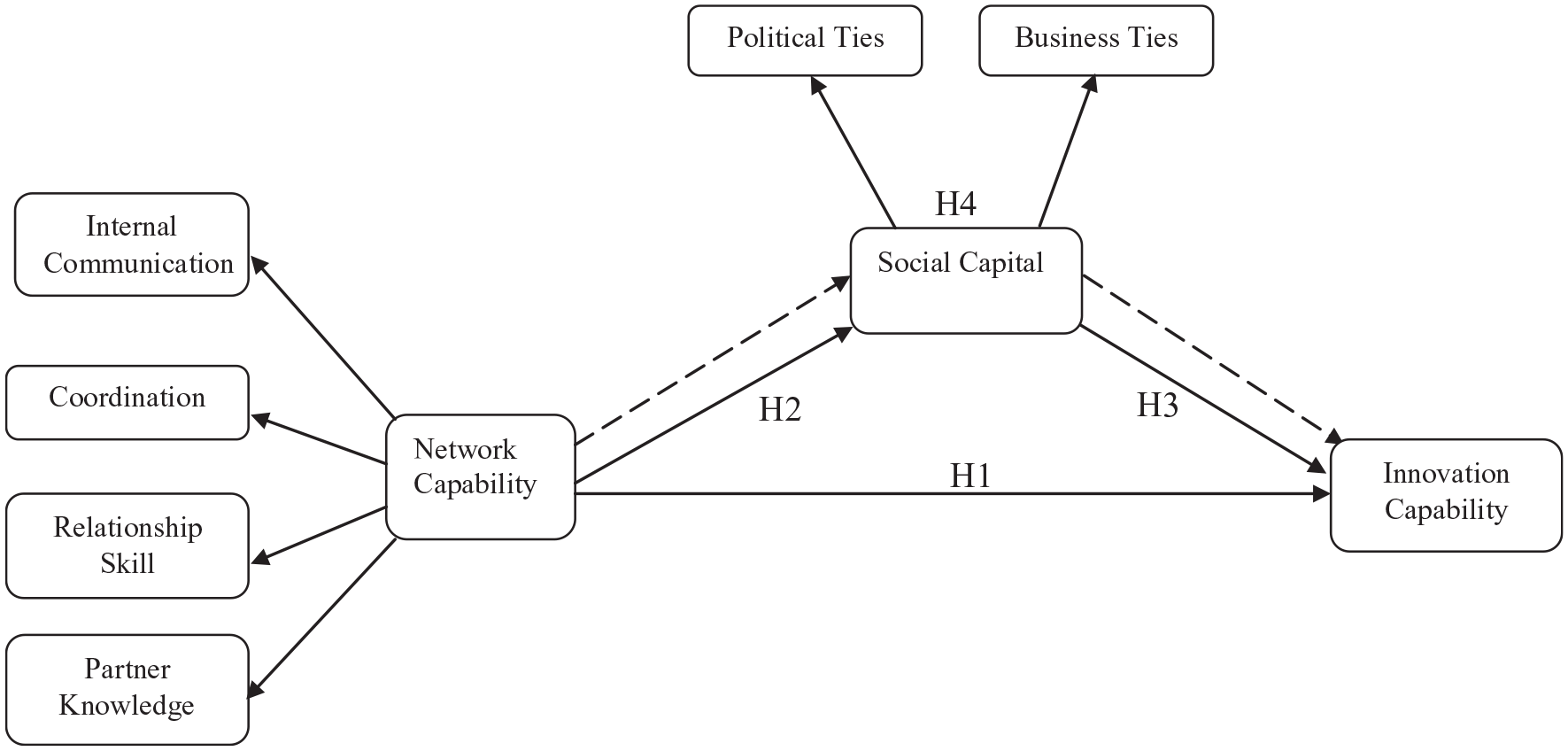
Conceptual framework.
Literature Review
Theoretical and Hypotheses Development
Strategic management theory (SMT) recently made enormous advancements because it influences efficiency, adaptability, and performance (Johnsen, 2015). Strategic management refers to the harmony between internal competencies and external market demand resulting from plans, plot, pattern, and perspective (Mintzberg et al., 2009). Bryson et al. (2010) conceptualize it as operationalizing strategic thinking, learning, and acting behaviors into adoptive sense-making structures. Moreover, SMT is a diverse and complex field (Ferreira et al., 2016), which comprises different frameworks such as strategy and structure, industrial organization, resource-base-view, strategic fit, stakeholder, contingency, and dynamic capability theory (DCT) introduced by Barney (1991), Chandler (1990), Chorn (1991), Porter (1980), and Teece et al. (1997). Researchers argue that there is no perfect approach that covers all the perspectives of strategic management. However, the current literature suggests that upcoming studies should focus on the integration approach to enhance performance (Ferreira et al., 2016). Within this stream of research, Eisenhardt and Martin (2000) and Teece et al. (1997) introduce the concept of dynamic capability view and define it as “uncovering the basic means of competitive advantages.”
Eisenhardt and Martin (2000) define dynamic capability as the strategic routine of an organization that allows the firm to achieve and transform resources as the market emerges. Hence, the dynamic capability view is essential to enhance firms’ capacity to be competitive and innovative. It also adapts and converts the firm’s resources, operational processes, and core competencies into enhanced economic performance (Ravichandran, 2018), especially in the context of entrepreneurial SMEs (Cenamor et al., 2019). With the limited resources and skills, it is a challenge for SMEs to transform their existing processes and achieve dynamism (Gupta & Bose, 2019; Karimi & Walter, 2016). According to R. Shu et al. (2018), no theory adequately explains the unique phenomenon of network capability development and challenges of entrepreneurship. We derive our model based on DCT. It focuses on sensing, seizing, and transforming to adopt change (Teece, 2014; Teece et al., 1997), which is a key to elevate firms’ capacity to transform and innovate (Innovation capability). Therefore, this study grounding its assumptions on DCT and affirms that entrepreneurs may need to establish network capability to get hands-on new resources and knowledge to enhance their innovation capability. The association between network capability and innovation capability is an under-researched area that requires further assessment. In this respect, we proposed a model presented in Figure 1.
Network Capability
A critical decision for a firm to make is what products to produce. Another critical decision that follows this decision is selecting a potential market for products (Pesämaa & Hair, 2007). The firms’ access to a potential market location is put forward by the network (Brekke, 2015). Hence, network capability is a development activity that allows firms to develop, manage, and harness opportunities via healthy connections and relationships (Vesalainen & Hakala, 2014). These networks, connections, and relationships correlated to the performance enhancement by helping firms mitigate the parochial barriers (Smallbone & Welter, 2012). Current literature uses different terms to describe it, such as “entrepreneurial business networks,” “business networks,” and “entrepreneur network capability” (Abbas, Raza, et al., 2019; R. Shu et al., 2018). This study will use the term “network capability” and investigate it in the context of entrepreneurial SMEs. It is regarded as a firm’s ability to induct, establish, and utilize internal and external organizational relationships (Zacca et al., 2015). The researcher argues that establishing network capability is beneficial for firms (Walter et al., 2006) and correlates it with enhanced firm performance (Abbas, Raza, et al., 2019; Cenamor et al., 2019). The network capability is crucial for firms, especially for entrepreneurial SMEs, as it provides substantial assistance in establishing new and current business processes. Network capability bolsters SMEs’ businesses at every stage to attain sustainable growth (Anser et al., 2020; Ferguson et al., 2016).
Classic researchers have extensively studied the network capability and stressed over different prospects of network capability such as integration of strategic and operational processes to achieve network success (Kale et al., 2002), collective learning (Foss, 1999), network partnership (Walter et al., 2006), and establishing new networks (Parida et al., 2016). In recent years, researchers have studied the network capability and found a positive and significant relationship with performance (Abbas, Raza, et al., 2019; Cenamor et al., 2019; Parida et al., 2016; Zacca et al., 2015). However, prior research overlooked the influence of network capability on firms’ ability to innovate (innovation capability). Thus, this study contributes to the literature by answering whether entrepreneurial SMEs’ network capability enhances their innovation capability?
Network Capability and Innovation Capability
Recently, networks and relationships are the subjects of interest among researchers and practitioners. These networks, connections, and relationships allow firms access to scarce opportunities, resources, and knowledge. Especially, networks are crucial in the context of SMEs to overcome the resource and size limitation (Acosta et al., 2018; Cenamor et al., 2019; Zacca et al., 2015). Network capability is referred to as “organization capacity to form and use the social relationship to get access to various resources” (Walter et al., 2006). It is a dynamic capability that aligns organizations’ internal competencies with the external market environment (Battistella et al., 2017). Prior research finds that network capability enables firms to identify opportunities, access resources, and enhance dynamism (Acosta et al., 2018; Knight & Liesch, 2016; Weerawardena et al., 2007). This is why building network capability is essential for entrepreneurial SMEs’ success and survival (Parida & Örtqvist, 2015). It facilitates entrepreneurial SMEs’ performance by enhancing knowledge management, cost control, innovativeness, reputation, and organization sensing (Abbas, Mahmood, et al., 2019; Lin & Lin, 2016).
Furthermore, network capability combines different relationship-related management capabilities, which may facilitate organizations’ innovation capability. Walter et al. (2006) introduced four dimensions of network capability: coordination, relationship skills, partner knowledge, and internal communication. These dimensions increase knowledge management between partners and enhance decision-making processes (Giotopoulos et al., 2017). Information management is crucial to the success of entrepreneurial SMEs because they usually suffer from information asymmetries (Abbas, Mahmood, et al., 2019. Moreover, the rapid flow of knowledge between internal and external stakeholders fosters opportunity identification along with innovation (R. Shu et al., 2018). This enables firms to transform their processes according to market needs and trends (Battistella et al., 2017). Similarly, obtaining information from different diverse sources stimulates existing innovation processes, which ensures the evolvability of firms (Wareham et al., 2014). Hence, based on the above discussion and at the back of the dynamic capability view, this study hypothesizes as the following:
The Mediating Role of Social Capital
Social capital refers to the social ties managers have established via personal relationships and connections (Sheng et al., 2011). Social capital is building ties and networks based on the give and take policy (D. Wang et al., 2018). Literature reports two dimensions of social capital: business ties and political ties. Business ties are regarded as management social ties with the management of other organizations, whereas management social ties with political leaders and government institutions are regarded as PT (Peng & Luo, 2000). The antecedent of these ties is an emerging research area. In this stream, we argue that network capability has great potential to foster social capital.
Network capability enhances firms sensing capability by helping them to identify the opportunities and knowledge available in the external market (Chetty & Holm, 2000). It also enables firms to access different resources such as financial, human, and information (Bell et al., 2003). Moreover, network capability serves the competitive advantage by enhancing the communication between internal and external stakeholders (Battistella et al., 2017). More precisely, it boosts the coordination, ties, skills, and knowledge management among groups with a common structure and interest. Furthermore, through network capability, firms identify the need to establish business and political ties, which enable them to achieve specific objectives. Thus, based on the above discussions, this study affirms that network capability has a great potential to influence social capital (Business and Political ties) and hypothesized the following:
Management social capital serves unprecedented benefits to the organization, especially entrepreneurial SME’s which face the challenges of limited resources and size. Through these ties, management practices boundary-spanning activities (Peng & Luo, 2000; Sheng et al., 2011) and gets access to valuable resources (Hemmert et al., 2016), which sever competitive advantage (Kemper et al., 2013). Furthermore, social capital expands firms’ access to financial and technical resources. In addition, it provides discounts, subsidies, and knowledge of upcoming government policies, which help firms to identify opportunities and minimize threats (H. Li & Zhang, 2007; J. J. Li & Zhou, 2010). Furthermore, management social capital is a key source of knowledge and resources, enhancing the firms’ ability to adopt the changes and transform existing processes. Therefore, based on the above discussion, this study hypothesized the following:
Method
Data Collection
The study inquires the association between network capability and innovation capability through social capital. To achieve the study’s objectives, a self-administered survey instrument questionnaire was used to collect the feedback from manufacturing SMEs operating in Pakistan. In this stream, a firm with no more than 35 employees is defined as an SME (Abbas, Raza, et al., 2019; Abbas et al., 2020; Khan et al., 2020). A number of researchers such as Abbas, Aman, et al. (2019), Iqbal et al. (2020), Kurtulmuş et al. (2020), and Shakeel et al. (2020) recommended and used the survey method to collect feedback from potential respondents. The study randomly selected a sample of 375 entrepreneurial SMEs located in Sialkot, Lahore, and Peshawar. The information about the sample was obtained from Small and Medium Enterprises Development Authority (SMEDA), local dictionaries, and personal links.
The questionnaire comprises two sections; Section 1 contains demographic-related questions, that is, gender, education level, respondents’ role, and firm size, whereas Section 2 consists of 22 latent construct–related questions. In total, network capability, social capital, and innovation capability comprise 12, six, and four questions, respectively. In this section, a 5-point Likert-type scale ranging from 1 (“strongly disagree”) to 5 (“strongly agrees”) was employed against all constructs’ item statements. Finally, the study ensured the latent constructs’ statements understanding as intended and content clarity via pilot study. In the pilot study, the questionnaire was shared with 15 respondents electronically (email and WhatsApp). Upon receiving their feedback via phone calls, slight adjustments were made in the final version of the questionnaire.
Measurement of Latent Variables
Network capability is a higher order construct of internal communication (IN-CO), coordination (COO), relationship skills (RE-SK), and partner knowledge (PA-KN), adapted from the study of (Cenamor et al., 2019). Each of the four subconstructs comprises three item statements. Accordingly, social capital has two subdimensions business ties (BT) and political ties (PT), adapted from the study of Zhang et al. (2019). Each sub-dimension has three item statements. Finally, we adapted innovation capability from the study of Zhang and Merchant (2020), which comprises four item statements.
To collect the feedback of 375 entrepreneurial SMEs, we sent one questionnaire to each firm either electronically or physically. A cover letter explaining the purpose of the study and voluntary participation was attached to both versions of the questionnaire. After three rounds of follow-ups via phone call, we received responses from 205 firms at the rate of 50.6%. Two hundred five firms’ responses surpassed Kline’s (2015) twenty-times rule and Barclay et al.’s (1995) ten-times rule for analysis in partial least square. Moreover, in a similar kind of study, Cenamor et al. (2019) used 129 firms’ responses for analysis. This implies that 205 responses from entrepreneurial SMEs are appropriate and will produce valid results.
In addition, to produce quality and valid results, we thoroughly screened the collected responses for potential errors. During this step, six extreme responses were found and removed from the analysis; this leaves us with 199 valid responses. The study’s further assessment starts with the demographic analysis presented in Table 1. Results depict that 63.6% and 36.2% of respondents were the owner and manager, respectively. Moreover, 75% of feedback was received from males, whereas females’ response rate was 24%. In addition, 43.2% of respondents were from the “master and above” group, followed by the “undergraduate” group with 35.2%, while 21.6% of respondents were college graduates. The reliability and validity assessment of the study is discussed below:
Respondents’ Demographic Attributes.

Common Method Bias
Conway and Lance (2010) criticized survey-based research for common method biases. However, the literature recommends different statistical tools to overcome any chances of common method biases (Chang et al., 2010). In this regard, we employed Herman’s test in the SPSS to assess the common method bias (Harman, 1976). The test results showed <50% of the total variance, implying that common method bias is not a concern of our study. The study also assesses the collinearity among constructs via variance inflation factor (VIF) (Hussain et al., 2021; Mubeen et al., 2020). The upper range VIF value of the study was 2.189, whereas the lower range value was 1.228. These values fall within the threshold of 3.0 (Hair et al., 2019), suggesting that collinearity is not a problem with this study. The detailed VIF values are presented in Table 2.
Measurement Model Assessment.

Note. The VIF values of indicators are less than the threshold of 3.00. FL = factor loadings; A = Cronbach’s alpha; CR = composite reliability; AVE = average variance extracted; HTMT = heterotrait–monotrait ratio; VIF = variance inflation factor.
Data Analysis Tools
Smart-PLS version 3.3.2 was used to analyze the data collected from 199 entrepreneurial SMEs. The study employed a partial least square structural equation model (PLS-SEM) technique to analyze the collected data. Literature supports the PLS-SEM technique because it is more suitable for higher order constructs (Sarstedt et al., 2016). Prior research supports the use of this tool for a model, which has direct and indirect associations between variables (Hsieh & Hsieh, 2015). Finally, PLS-SEM offers more latest statistical tools for reliability and validity analysis (Richter et al., 2016). The points mentioned above suggest that PLS-SEM is the right choice for our study. Moreover, for measurement model assessment and structural model assessment, this study follows the guidelines of (Hair et al., 2019), discussed below:
Measurement Model Assessment
Factor loadings, Cronbach’s alpha, composite reliability (CR), average variance extracted (AVE), and the Fornell–Larcker criterion were used to ensure the reliability and validity of the measurement model. Factor loadings of all constructs’ statements ranged from 0.641 to 0.903, which were above the given threshold of 0.6. Similarly, CR and Cronbach’s alpha values ranged from 0.817 to 0.864 and 0.704 to 0.764, respectively. These values also fall above the accepted threshold of 0.7 (Abbas, Mahmood, et al., 2019). Similarly, AVE values of latent variables were above the threshold of 0.5. The AVE values of this study ranged from 0.529 to 0.764. The thresholds for these statistical tools are recommended by Hair et al. (2016). The details of factor loadings, alpha, CR, and AVE are presented in Table 2, whereas a summary of measurement model assessment is given in Figure 2.

Measurement model assessment.
In addition, we ensured the discriminant validity of the data via the Fornell and Larcker (1981) criterion. Bold values in Table 3 are greater than the off-diagonal value, indicating that latent constructs are different from each other. The bold values are square roots of constructs’ AVEs, whereas off-diagonal values represent correlations among them. This shows that discriminant validity is not a problem with this study. The details of the Fornell and Larcker criterion are presented in Table 3. In summary, the results of the measurement model assessment depict that reliability and validity are not a problem in our study.
Fornell–Larcker Criterion (Discriminant Validity).

Note. Bold values at diagonal are the square root of average variance extracted (AVE) of the latent constructs. Off-diagonal values are correlations among contracts.
Structural Model Assessment
The Smart-PLS’s bootstrapping function was carried out at a subsample of 5,000 to assess the proposed model significance. The detailed results of the bootstrapping are presented in Table 4 and Figure 3. Here we assess the structural model for explanatory power (R2), path coefficient (β), p-values, and t-statistics.
Hypotheses Evaluation.

Note. NC = network capability; IC = innovation capability; SC = social capital.

Structural model assessment.
The results of the structural model assessment show that network capability has a positive and significant impact on innovation capability (β = .333; t = 3.934; p = .000). Thus results provide support to our assumption H1. Moreover, results depict that network capability has substantial positive influence over firms’ social capital (β = .666; t = 13.088; p = .000) and social capital has positive and significant influence over entrepreneurial SMEs’ innovation capability (β = .185; t = 2.025; p = .026), hence providing support to our assumptions H2 and H3. Furthermore, the dependent variable innovation capability explains a 22.7% variance in the independent variable of network capability and social capital. Meanwhile, social capital explains a 44.4% variance in its independent variable of network capability. These results show that the proposed model has enough exploratory power.
The indirect effect of social capital is analyzed between network capability and innovation capability. However, before an indirect assessment, the direct assessment was carried out as directed by Hair et al. (2016). Results of the indirect analysis show that social capital partially mediates the association between network capability and innovation capability (β = .123; t = 2.026; p = .026), thus providing evidence in favor of our H4.
Results and Discussion
Despite significant contributions to the economies, SMEs are facing challenges that hamper their progress. Around the world, governments are striving to facilitate SMEs in developing self-supporting strategies. In this regard, the governments introduce different policies, programs, subsidies, and loans to ensure the success of SMEs. For instance, in Pakistan government designates SMEDA to remove the factors that hinder the development of SMEs. SMEDA provides services such as feasibility studies, consulting, and seminars helping SMEs in mitigating the challenges. However, a handful of SMEs can take advantage of these services. Thus, the factors that enhance entrepreneurial SMEs’ capacity to establish self-supporting strategies lead them to strategic and operational efficiency, attracting researchers’ attention (Alraja et al., 2020; Braimah et al., 2021; Grimsdottir & Edvardsson, 2018). In this stream of research, researchers identify network capability as an essential factor that serves unprecedented benefits to entrepreneurial SMEs such as efficient knowledge management (Abbas et al., 2020), enhanced performances (Abbas, Raza, et al., 2019; Cenamor et al., 2019), and sustainable performance (Ben Amara & Chen, 2020). However, researchers ignored the role of network capability in enhancing SMEs’ capacity to transform processes. This empirical investigation sets three important objectives and proposed a networking model to fill the gaps in the literature.
Based on DCT, this study proposed a model to investigate the direct and indirect association between entrepreneurial SMEs’ network capability and innovation capability. These are critical research areas identified and explored by researchers like Abbas et al. (2020), Abbas, Raza, et al. (2019), Acosta et al. (2018), Parida et al. (2017), R. Shu et al. (2018), and Zacca et al. (2015). To empirically operationalize the study’s objectives, we used a questionnaire to collect feedback of 199 entrepreneurial SMEs’ operating in Sialkot, Lahore, and Peshawar of Pakistan. Research criticized that the data collected via questionnaires are subject to response biases and reliability and validity problems. In this regard, we took necessary steps such as data screening for potential errors, collinearity, content validity, convergent validity, and discriminant validity to ensure the reliability and validity of the data. The appropriateness of the proposed model was examined via R2 as recommended by Cohen (2013). The structural model assessment conducted in Smart-PLS at recommended bootstrapping of 5,000 shows that network capability has a positive and significant impact on innovation capability. Analyzing this association was the first objective of the study. We measure the network capability in terms of internal communication, coordination, relationship skills, and partner knowledge. The structural model assessment results presented in Figure 3 (β = .654; p = .000, β = .711; p = .000, β = .766; p = .000, and β = .627; p = .000, respectively) show that all dimensions contribute significantly to firms’ network capability. These results depict that coordination has a greater contribution to network capability followed by relationship skills, internal communication, and partner knowledge. These results enable us to achieve the second objective of the study. The third objective of the study was to analyze whether or not social capital mediates the relationship between network capability and innovation capability. Results unveil that network capability positively and significantly influences social capital, which has a positive and significant impact on innovation capability. This shows that social capital partially mediates the association between network capability and innovation capability. The theoretical and practical implications of the study are discussed in the following sections.
Theoretical Implications
The study advances the existing body of knowledge of entrepreneurship (Abbas, Raza, et al., 2019; Khan & Burki, 2020; Kurtulmuş et al., 2020; Shakeel et al., 2020), network capability (Anser et al., 2020; Cenamor et al., 2019), social capital (Krammer & Jimenez, 2020; Zhang et al., 2019), and innovation capability (Le & Lei, 2019; Zhang & Merchant, 2020). In this study, we empirically assessed the entrepreneurial SMEs’ network capability impact on innovation capability. To study any relationship, an appropriate theoretical foundation is critical. R. Shu et al. (2018) noted that there is no appropriate theory that covers the phenomenon of network development and entrepreneurship challenges. In this stream of research, we argue that DCT is a more suitable theory to study the association between network capability and innovation capability because it stresses on opportunity identification, threat mitigation, process transformation, and change adaptation (Eisenhardt & Martin, 2000; Teece et al., 1997). Therefore, we made a great theoretical contribution by grounding our assumptions based on DCT to study the associations between endogenous and exogenous variables. Apart from this, our study made three significant theoretical contributions discussed as under:
First, entrepreneurial SMEs face numerous challenges that hamper their development. In this context, developing business networks and connections is essential for entrepreneurial SMEs’ survival and success. Prior research identifies the importance of network capability by studying it from different perspectives. For instance, R. Shu et al. (2018) identify them as a source of opportunity identification. Similarly, Cenamor et al. (2019) linked them with enhanced firm performance (Abbas, Raza, et al., 2019; Anser et al., 2020; Cenamor et al., 2019). In this stream, Acosta et al. (2018) associate entrepreneur network capability with internationalization performance. However, prior researches overlook the role of network capability on firms’ capacity to transform. Thus, this study significantly expands the literature by examining the impact of network capability on innovation capability in the context of entrepreneurial SMEs. Second, this study extends the existing literature on entrepreneurship (Giotopoulos et al., 2017; Nasco et al., 2008) by showing that via business links and social connection, entrepreneurs can get access to scarce resources and knowledge, which subsequently improve their capacity to acquire and deploy resources to develop superior products. Third, the study affirms that SMEs’ social ties with other businesses and political leaders benefit them. Previous research found a significant impact of these ties on different organizational prospects. For example, Zhang et al. (2019) report a positive and direct association between social capital and innovation performance. Similar results were reported by Krammer and Jimenez (2020) and C. Wang et al. (2020). However, the antecedent that fosters social capital is an underdeveloped research phenomenon. More precisely, the literature ignored the indirect role of social capital between different constructs. Thus, this study significantly expands the understanding of social capital by finding that social capital partially mediates the association between network capability and innovation capability.
Managerial Implications
This study highlights the importance of network capability in terms of internal communication, coordination, partners’ knowledge, and relationship skills, which presents significant managerial contributions. The results of the study are crucial for the management of SMEs. SMEs’ management should pay a great deal of attention to internal communication and coordination with stakeholders. Similarly, their relationship developing skills and partners’ knowledge are crucial because they boost knowledge management and resources acquisition, enabling management to identify the opportunities available in the external environment. This also helps SMEs’ management to foresee and mitigate potential threats, ultimately enhancing the SMEs’ capacities to innovate. In this respect, management should establish network capability because it enhances the innovation capability of firms. Similarly, SMEs’ management should establish strong links and connections with other businesses and political leaders because it enables firms to access valuable knowledge and resources and advance information about government’s upcoming policies. These connections also help firms take advantage of different development programs, which the government introduces to facilitate SMEs’ development.
Research Limitation and Research Directions
Despite its contribution to the literature, our study has some limitations, which opens up the directions for upcoming research. We explored the impact of links and networking on SMEs’ innovation capability. Future studies can explore other variables that influence the network capability of entrepreneurial SMEs. Moreover, we conducted this research in the Pakistani context. Future research can explore this association in other contexts. Finally, we explored the limited English literature to build the study’s research model, objectives, and questions. Future research can study the literature in other languages to improve the generalization of the study.
Footnotes
Acknowledgements
The authors highly acknowledge the precious time and valuable feedback of the respondents. Without their help and support, this study would not have been possible. The authors would also like to acknowledge the efforts of service desk representatives of companies in collecting the data.
Declaration of Conflicting Interests
The author(s) declared no potential conflicts of interest with respect to the research, authorship, and/or publication of this article.
Funding
The author(s) disclosed receipt of the following financial support for the research, authorship, and/or publication of this article: The authors are grateful for the support provided by the National Natural Science Foundation of China (Grant Numbers 71472027 and 71774027) and Department of Education of Liaoning Province (LN2019J07 and LN2020Z04).
