




Abstract
Profound technological changes and high network levels have triggered competitive innovations and leadership style among firms. However, few studies have explored the leadership style needed to innovate within the duality of coopetition capabilities and in-learning. Therefore, the authors explore how leadership style affects innovation performance in the context of financial service firms. Using a PLS analytical approach and dynamic capability perspective (DCP), the authors find that coopetition capability positively mediates the relationship between leadership style and innovation performance. The finding also indicates that in-learning negatively moderates the relationship between coopetition capability and innovation performance.
Keywords
Introduction
Dynamism in business environments challenges executives’ ability to sense and respond to changing markets effectively. The lack of this ability has led to the demise of firms, such as NetBank, Lehman Brothers, Fannie Mae, and Freddie Mac (Liang, 2020). The job of executives is to improve their organizational effectiveness that roots in technological innovations and coopetition to retain their leadership (Shao et al., 2017). Leadership style allows managers to create a visionary strategy, then motivating their employees to adopt and implement influential predictors of innovation. Such that, firms can create an open condition to achieve better innovations (Xie et al., 2018), resulting in survival and growth opportunities (Sheehan et al., 2020).
Leadership style provides a crucial source to strengthen the functional relationship between leaders and followers, which becomes a necessary driver of employee creativity and organizational effectiveness (Kim, Baik et al., 2019). For example, a conceptual framework by Khan, Ismail et al. (2020) shows that leadership style acts as an initiator of organizational culture that leads to innovative outcomes. Donkor et al. (2021) further add that a leadership style-based model deals with competence, behavior, and approach of leaders that inspire their employees to improve performance contributing to organizational success. Accordingly, the relationship between leadership style and innovation performance remains important for the strategic role in increasing managerial effectiveness (Kim, Baik et al., 2019).
Coopetition capability is also important because it links to innovation opportunities. Previous findings indicated that a robust relationship exists between coopetition capability and innovation performance (Bengtsson et al., 2016; David et al., 2021). As widely evidenced, coopetition capability is a dual relationship (cooperate vs. compete) that becomes a critical matter for organizational innovations (David et al., 2021). It is acknowledged as a vital means of promoting competition and cooperation, as well as offering a strategy for pursuing market position (Hoffmann et al., 2018). In a complementary perspective, a strategic collaboration enables firms to create new markets and shared costs in relation to partnership credibility and extension of financial relationship (Fratantuono & Sarcone, 2017).
According to Bouncken et al. (2020), firms can access and enhance valuable knowledge to achieve internal learning through coopetition capability. In-learning offers knowledge-based opportunities to innovate and adapt to radical changes (Chen et al., 2021), which requires a strong alliance orientation with partners and competitors (Bouncken et al., 2020). In addition, learning from competitors brings new ideas while negative effect of in-learning might be also existed in a high level of competition, with little interest in coopetition (Karagouni, 2018). This culminates in managerial inefficiency and ineffectiveness, thus making in-learning a critical assessment to moderate coopetition capability and innovation performance (Bouncken & Fredrich, 2016; Karagouni, 2018).
Therefore, this article investigates how leadership style and coopetition capability engage to affect innovation performance. To explore these relationships, we include in-learning as a moderating variable and adopted a DCP to explain the conceptual framework. DCP enables firms to implement new strategies through available resource combinations and transformations in new and different ways (Badi et al., 2017). Organizational strategists also suggest that DCP provides firms the opportunity-recognizing and capitalizing capabilities that link to their innovation performance (Wu et al., 2016), especially in financial service sectors (Khalil & Belitski, 2020; YuSheng & Ibrahim, 2020).
We use a PLS technique to examine the proposed relationships for its applicability to management and business studies (Hair et al., 2021), using data from the financial service firms in Laos. As an emerging economy, Laos’s firms need a model to create effective leaders in improving their innovation performance while learning from developed economies (Chareunsy, 2018). Accordingly, our research contributes to the managerial practice and literature by proposing a leadership style-driven innovation model, in which we assessed the meditating role of coopetition capability under the boundary condition of in-learning that is applicable to a wide range of economies.
Theory and Hypotheses
This section discusses relevant literature and hypothesis development. A review of literature reveals that the context to assess leadership style was mostly in developed economies (Table 1). As shown in Table 1, existing studies extensively focus on main effects while ignoring possible boundary conditions. Palmatier (2016) argued that a research model only provides a sufficient contribution when it includes a theory-driven relationship. Therefore, the authors advance the conceptual model by adopting dynamic capability perspective to explain the norms of leadership style and innovation performance in the contexts of coopetition capability and in-learning.
Review of Relevant Studies.

Note. IV = independent variable; MV = mediating variable; DV = dependent variable.
Dynamic Capability Perspective
The literature suggests that dynamic capability perspective (DCP) assesses organizational resources to respond to the radical changes regarding strategic routines and resource configurations (Sarwar et al., 2021). As widely acknowledged, DCP sustains a competitive advantage by highlighting a firm’s ability to reconfigure and capitalize on tactical knowledge and resources. This helps translate the resources into superior value in a changing environment (Khan & Lew, 2018). Existing DCP literature also documents that gaining competitiveness requires an effective resource deployment and reallocation (Raza et al., 2021). On the one hand, DCP provides firms with specific capabilities to respond to the technological innovation and market trend, resulting in innovation confidence (Wu et al., 2016). On the other hand, it ensures efficient adjustment and alignment that conform to the innovation process to create value in a competitive environment (Wu et al., 2016). Accordingly, DCP offers firms the ability to analyze and predict competencies, strategic positions, and challenges for making effective strategic decisions (Schoemaker et al., 2018).
Based on DCP, organizational executives have a systematic approach to exploit, renew, and enhance core capabilities to sustain their organizational competitiveness (Sarwar et al., 2021). This aids leadership style to be an effective means of achieving superior performance (Raza et al., 2021). In addition, DCP creates an interactive condition to utilize networks and relationships, in which coopetition capability offers value creation and appropriation to pursue business objectives (Khan & Lew, 2018). Firms also need in-learning to obtain tactical knowledge for facilitating organizational innovative strategies (Bourke & Roper, 2017). Managerial scholars further suggest that DCP enables firms to identify and exploit profitable configurations of competencies and assets, regarding their product development and managerial orchestration processes (Schoemaker et al., 2018). Accordingly, we adopted DCP to explain the proposed relationships (see Figure 1).

Research model.
Leadership Style
In recent years, business academicians and practitioners have been observing leadership style from the leader’s knowledge and skill to facilitate the required outcomes (Khan, Ismail et al., 2020). Leadership style is considered a constant behavioral model and trait of the leader’s behavior (Kim, Baik et al., 2019). Among several leadership styles, this study explores participation and consideration leadership styles, which represent facilitative behaviors, such as levels of friendly, approachable, and open practices of leaders to enhance operational activities (Cortes & Herrmann, 2020). First, participation leadership style encourages an open exchange of ideas and critical feedback, as well as challenge acceptance regarding cross-functional interactions, and participative leaders share their decision-making processes with group members to reach goals (Strese et al., 2016b). Second, consideration leadership style supports an open discussion of disagreements and mutual bargaining among employees, as a means of managing competitive situations more effectively (Ponomariov et al., 2021). This enables coopetition among employees, as they are willing to solve conflicts since they do not fear reprisal to voice their thoughts (Usadolo, 2020). This usually affects how people perform their duties and responsibilities and how their learning can be used and built back into the organizational system to improve quality and performance (Strese et al., 2016a).
Coopetition Capability
Existing research focuses on evaluating the appropriate skill set that needs to manage coopetition and tensions (Bengtsson et al., 2016). For example, scholars indicated that information sharing needs both separation and integration strategies, as well as a combination of formal and informal control mechanisms (Ekinci et al., 2020). An extensive review of coopetition models suggests that firms should acquire an analytical and balancing process to manage paradoxes and tensions in coopetition relationships (Gnyawali et al., 2016). Coopetition capability pertains to the ability to initiate processes that help firms to attain and maintain a desired level of tension, irrespective of the strength of the paradox (Bengtsson et al., 2016).
Based on DCP, firms can re-configure internal and external competencies to address rapidly changing environments while the ratio between competition and cooperation depends on technological innovations (Wu et al., 2016). Thus, generating greater innovation in a coopetition relationship requires firms the capability to manage a balanced relationship from alliances (Bengtsson et al., 2016; Bouncken & Fredrich, 2016). Coopetition capability is a must-have competence of leaders as they could experience from cooperation and competition activities (Strese et al., 2016a). This leads to consistent knowledge integration from intra-and extra organizational domains (Bengtsson et al., 2016). Therefore, firms may need leaders who are capable of managing paradoxical tensions to promote coopetition in the contexts of cross-functional cooperation and extra-coopetition (Crick, 2021; Strese et al., 2016a).
In-learning
In-learning is a process of knowledge integration and usage from external sources to interpret and acquire innovations (Dussart et al., 2021). In-learning creates new knowledge through knowledge integration, making it an exchange relationship (Greco et al., 2019). Learning organization theory emphasizes the learning cultures that facilitate innovation and creativity to outperform the competition and achieve operational success (Shao et al., 2017). Business scholars argue that the goal of learning is to improve organizational performance and survival in turbulent environments (Bourke & Roper, 2017).
Organizational learning facilitates individual and collective learning empowerment, knowledge management, and technology unitization to adapt and leverage opportunities in a changing market (Bourke & Roper, 2017). Learning organizations have both productive and adaptive structures when compared to conventional organizations (Greco et al., 2019). The outcome is that their commitment to learning, openness to new ideas, ability to cope with complexity, continual adjustment to new situations and challenges, and self-renewal ability are highlighted to obtain a competitive advantage (Khan & Lew, 2018). However, in-learning underscores the creative and inventive pace of an organization as a result of ideological differences. This can culminate in low productivity and brand value (Wijaya & Suasih, 2020).
Hypotheses
Direct effects of leadership style
In the field of leadership, leadership style exerts a considerable impact on business operations and interactions in financial service firms (Chiu & Walls, 2019). Guided by DCP, a firm achieves innovations by exploiting its managerial and production skills (Schoemaker et al., 2018). Leadership style is one of the most important factors that affects employee creativity and organizational innovation (Kim, Baik et al., 2019). This requires leaders to support and encourage their employees that engage in creative processes (Schoemaker et al., 2018). The ability to identify and promote innovations of the leader is the key driver of an organizational success (Raza et al., 2021). In financial service firms, leadership style has been identified as a central element in obtaining sustainable competitive advantage for the firm (Schyns et al., 2020). Based on DCP, the leader’s role is to determine better solutions for service innovation because they have the ability and authority to introduce new ideas, set specific goals, and encourage innovative initiatives (Schoemaker et al., 2018). This implies that leaders can move the firm forward with innovation, creativity, collaborative ability, and strategy implementation (Raza et al., 2021). Therefore:
Mediating effect of coopetition capability
Coopetition pertains to a paradoxical relationship between two or more actors involved in cooperative and competitive interactions (Crick, 2021). Based on DCP, firms should sense and capitalize on specific internal and external competencies to respond to changing environments (Wu et al., 2016). This suggests firms to have a cross-functional cooperative ability and an extra-coopetition capability that enable them to overcome external tension (Yang, 2020). As a result, partnership is reflected by competitive and cooperative abilities while coopetition capability seems to be more essential in the presence of profound technological changes (Sanou et al., 2016). A key challenge of coopetition capability might be stemmed from the dynamic nature of the relationships with competing partners (Bouncken et al., 2020). This requires leaders to have sufficient knowledge and skills to perform duties and achieve results that are satisfactory to the organization (Obeng et al., 2021).
Coopetition capability can be viewed as a means of obtaining greater achievement and reciprocal advantage (Crick, 2021). In general, firms exchange information, tangible and intangible resources, skills, and knowledge to develop and commercialize new products through coopetition capability (Ovuakporie et al., 2021). Previous research suggested that considerate and participative leaders can facilitate coopetition as they focus on the relational bonds and functional interactions (Strese et al., 2016b). For example, considerate leaders build interpersonal relationships using exchange and trust to promote a positive workplace that increases cross-functional competition (Strese et al., 2016b). Usadolo (2020) also posited that participation leadership allows followers to involve in decision-making processes and encourage new ideas and collaboration across organizational units. Seepana et al. (2020) acknowledged that coopetition capability involves both cooperativity and competitivity in obtaining valuable technologies that lead to organizational innovations. For instance, coopetition enables Samsung and Sony to create new generation of the LCD technology to innovate and produce new TV products, making them big electronics giants (Lee et al., 2020). Given the discussion, we propose the coopetition capability’s mediating role as:
Moderating role of in-learning
In-learning works on the basis of exploiting external knowledge that transforms into internal operations, thereby improving an organization’s innovation (Karagouni, 2018). This allows managers to promote a dynamic workplace and increase employees’ productivity and performance in a better manner (Shao et al., 2017). Such that, organizational studies often consider in-learning to be an apparent driver of organizational performance (Bourke & Roper, 2017). However, Greco et al. (2019) indicated that in-learning is a trade-off between keeping existing skills or developing new beneficial skills regarding costs and limited resources of most organizations. Chai et al. (2019) also pointed that practicing in-learning in coopetition-driven innovation strategy is a double-edged sword because in-learning involves a single path that focuses on transforming external acquired knowledge into intra-organizational value.
In contrast, coopetition capability allows firms to pursue the interplay of cooperative and competitive forces which emphasizes the advantages from both intra-and extra-organizational knowledge in enhancing their innovation performance (Strese et al., 2016b). Lin et al. (2020) further indicated innovation performance is twofold that includes new ideas exchanging within an organization and its capitalizing capability of external knowledge and resource. According to DCP, firms should possess integrative capabilities to combine both external and internal knowledge and resources in achieving better innovation performance (Wu et al., 2016). While firms practicing coopetition and innovation need opportunity-recognizing and capitalizing capabilities, in-learning focuses on a single pathway to utilize external resources that might reflect coopetition (Karagouni, 2018). Given these discussions, we propose the role of in-learning as:
Method
Measures
First, we measured leadership style on the basis of Cortes and Herrmann (2020) and Usadolo (2020), who proposed that leadership style is a facilitative behavior, including consideration and participation behaviors. The measure of these two behaviors was furthered by Strese et al. (2016b), thus being employed in our study. Next, measures of cross-functional cooperative ability and extra-coopetition capability were used to form coopetition capability, in which we adopted from Strese et al. (2016a) and Bengtsson et al. (2016). Then, exploitative and exploratory innovations were adopted from Strese et al. (2016a) to measure innovation performance. Finally, we used the scales of Bouncken and Fredrich (2016) to measure in-learning.
Sample and Data Collection
We selected financial service firms as our sample framework because the open policy in this industry has given firms incentives with respect to the service diversifications (Sythongbay, 2021). This industry is a critical sector that has a considerable influence on the economic growth in Laos. The leadership process and coopetition activities reflect the competitive climate that encourages innovations to achieve a superior performance (Bekkevold, 2020). Therefore, we surveyed financial service firms in Laos to obtain valuable insights on businesses that actively develop and implement coopetition capability.
We used a questionnaire protocol for data collection and established its face validity by interviewing two professors of strategic leadership and two experts in innovation in November 2017, asking them to rate the research items. Then, we submitted the rated items to a second panelist of strategy and financial service management to recheck and confirm consistency with the proposed constructs. We used a back-translation by two language experts (English-Laos-English) and pretested the questionnaire in January 2018 to ensure the reliability and validity of the measured items. Responses were recorded on a 7-point Likert scale (1 = strongly disagree and 7 = strongly agree).
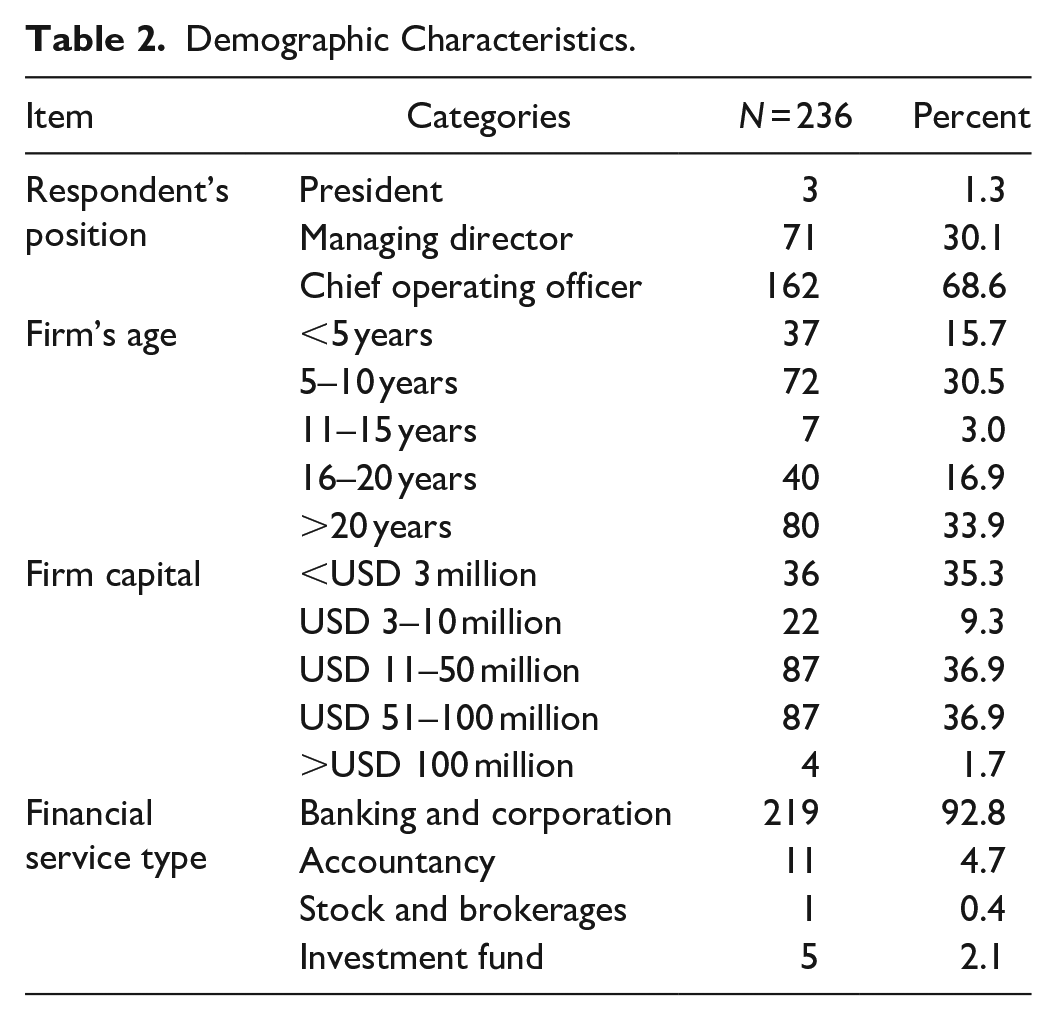
We hired a group of survey experts to collect the data from financial service firms from March to September 2018, drawn from the banks and financial institutions list that published by Bank of the Laos P.D.R. After 6 months, 236 valid questionnaires were returned. The key respondents were the top managerial positions (e.g., president, managing director, and chief operating officer) because they are experienced in the firms and were involved in the organizational strategy and operations. Thus, they were in the best position to discuss how leadership and competition engage in affecting innovations in the boundary condition of in-learning. We detailed the sample characteristics in Table 2.
Demographic Characteristics.
Analytical Approach
We assessed the research model by using a PLS technique because it is consistent in exploring the theoretical extension while testing the mediating and moderating effects (Hair et al., 2019). Significance levels of the proposed relationships were based on bias-corrected confidence interval because this allows us to examine and extract the research findings with insightful interpretation (Hair et al., 2021). The PLS technique is also useful for data presentation (Hair et al., 2021). In this study, path significance was assessed using bootstrap statistics with 5,000 resamples and 236 cases per sample.
Findings and Discussion
Reliability and Validity of Constructs
The PLS analysis was performed using the Smart PLS 3 software (Ringle et al., 2018), in which we assessed the measurement model through factor loadings, average variance extracted, composite reliability, Cronbach’s alpha, and Rho_A values (Dijkstra & Henseler, 2015). As shown in Table 3, these values were above .70, .50, .70, .70, and .70, respectively (Hair et al., 2021), verifying the reliability and convergent validity. We also examined whether the common method bias (CMB) matters in our research. Table 4 shows that the highest correlation value (r = 0.749) was lower than 0.90 (Lai & Hitchcock, 2017), suggesting that CMB was unlikely to be concerned. In addition, the VIF values appeared to be below the cutoff of 5 (Hair et al., 2021), removing the multicollinearity threat among the research constructs. We provided a descriptive statistics of construct items in Appendix 1. Finally, the square root of the AVE of each construct was higher than the correlation with other constructs (Hair et al., 2021), while the highest HTMT value was below the .90 benchmark (Ghasemy et al., 2020). Accordingly, the results confirm the discriminant validity in our study.
Reliability and Validity.

Discriminant Validity.
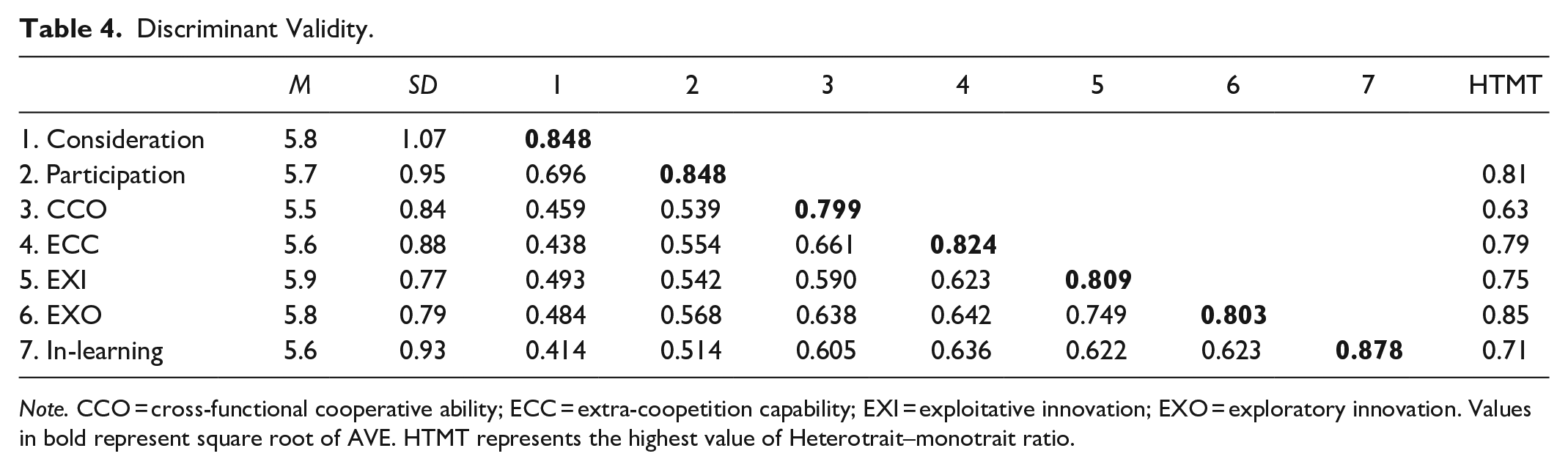
Note. CCO = cross-functional cooperative ability; ECC = extra-coopetition capability; EXI = exploitative innovation; EXO = exploratory innovation. Values in bold represent square root of AVE. HTMT represents the highest value of Heterotrait–monotrait ratio.
Path Results
We assessed the structural model using a set of R2, Q2 (Stone-Geisser, the predictive relevance), and f2 (effect size) (Ghasemy et al., 2020; Hair et al., 2017, 2019). First, as shown in Figure 2 shows, the model explains 36.3% of R2 in coopetition capability and 63.3% in innovation performance. Second, the Q2 values ranging from .19 to .32 (see Appendix 2) were larger than zero, indicating that the research constructs have predictive relevance for the PLS path model (Hair et al., 2017; Shmueli et al., 2019). Third, the f2 values ranged from .19 to .54, which allow to estimate the indirect effects (Hair et al., 2019). Given these results, we assessed further the proposed hypotheses.

Research model results.
H1, which proposed that leadership style has a positive effect on innovation performance, was supported (β = 0.186). H2, which indicated that coopetition capability positively mediates the relationship between leadership style and innovation performance, was also supported (β = 0.402). Furthermore, H3, which stated that in-learning negatively moderates the relationship between coopetition capability and innovation performance, was supported (β = –0.176). This suggested that in-learning could adversely affect coopetition capability because it is a double-edged sword with regard to knowledge sharing. The interaction effect increased R2 of coopetition capability by 2.80%, thus sustaining the moderating role of in-learning (see Table 5). We plotted this moderating effect in Figure 3. At low levels of in-learning (mean −1 SD), innovation performance increases rapidly when coopetition capability increases. However, at high levels of in-learning (mean +1 SD), innovation performance increases marginally as coopetition capability increases. Furthermore, the control variables (firm size and age) did not influence innovation performance (p > .05).
Hypothesis Testing Results.

Note. The threshold of f2 is .02.
p < .05. **p < .01.

Moderating role of in-learning.
Consistent with our expectation, leadership style and coopetition capability engage in influencing innovation performance. The results showed that coopetition capability plays a significant mediating role in the leadership style and innovation performance relationship under the boundary condition of in-learning. Relevant studies in the leadership style context extensively focused on dynamic capability process (Khan & Lew, 2018) and innovation atmosphere (Xie et al., 2018). While the findings of these studies indicated an important role of leadership in enhancing innovation, they had yet to indicate a valid mechanism of leadership and innovation-based model. The results of our study allow us to advance the leadership style and innovation-based model in financial service industry, in which we integrated the mediating role of coopetition capability and moderating effect of in-learning that based on the dynamic capability perspective.
Conclusion
The goal of this study was to examine the dimensions of leadership style, coopetition capability, and innovation performance among financial service firms in Laos. The key finding is that certain leadership style enables financial service firms to increase their innovation performance. Our findings show that leadership style positively affects coopetition capability that leads to better innovation performance under the moderating effect of in-learning. To our knowledge, practicing these proposed relationships allows firms to improve their coopetition ability that optimizes their organizational innovation outcomes. Thus, we provide several implications for practice, theory, and directions for the future study.
Theoretical Implication
Our first theoretical contribution lies in the research construct operationalization, in which we theoretically synthesized the leadership style by using consideration and participation dimensions (Strese et al., 2016b; Usadolo, 2020). In addition, we extended the coopetition capability by using cross-functional cooperative ability and extra-coopetition capability (Bengtsson et al., 2016; Strese et al., 2016a). Our study adds a supplementary understanding of leadership style and coopetition capability by defining their interplay in assessing an organizational innovation performance.
Second, our study confirms that coopetition capability positively mediates the leadership style and innovation performance relationship. This implies that leadership style is a facilitative behavior to enhance coopetition capability that leads to better innovation performance. This is consistent with the logic of Ponomariov et al. (2021) and Usadolo (2020), who argued that leadership style consisting consideration and participation helps create a sense of support and collaboration in problem-solving and tacit knowledge obtaining. This finding also adds to the study of Steele and Day (2020) by assessing the function of leadership by a survey-based design. Participatory and considerate leadership enhances coopetition capability, which determined by cross-functional cooperative ability and extra-coopetition capability would lead to innovation performance. Consistent with previous studies, such as Strese et al. (2016b) and Bengtsson et al. (2016), our findings suggest that coopetition capability is an important source of knowledge sharing in maximizing organizational outcomes (e.g., innovations), especially when it interplays with leadership style.
Third, our study finds that in-learning negatively moderates the relationship between coopetition capability and innovation performance, such that the effect of coopetition on innovation is weaker when in-learning is higher. This adds to the literature by identifying a boundary condition for the relationship between coopetition and innovation. Palmatier (2016) suggested that empirical models often include a direct assessment, in which a focal factor leads to an end-outcome while ignoring possible boundary conditions. This is less helpful for an organizational effectiveness. Drawing from DCP, we found a negative moderating role of in-learning in setting a contextual condition under which coopetition affects innovation. Our study adds a multidimensional view of in-learning that reflects coopetition and innovation (Donbesuur et al., 2021); however, this is also a double-edged sword in a coopetition-based strategy (Chai et al., 2019). Existing studies on leaderships and innovation often consider organizational learning necessary in optimizing relevant outcomes (e.g., sales) (Bourke & Roper, 2017; Shao et al., 2017). The current findings suggest that practicing coopetition capability in an organization depends on the level of in-learning, in which coopetition capability might be desirable if in-learning remains lower.
Managerial Implications
Our findings indicate that leadership style can be of organizational benefits with respect to facilitative behaviors and collaborations. So that, managers should consider practicing consideration and participation leadership to promote an open and constructive climate. The practice of consideration leadership lies in the concern and interest of the followers’ well-being by creating a friendly and approachable atmosphere, giving advance notice of changes, making a pleasant workplace, and treating employees equally. In addition, participation leadership focuses on an involvement mechanism, in which the leader allows employees to express their idea, voice their solutions, and take part in decision-making processes. A note to be given that leadership style showcases the supportive behaviors of managers that could increase an organizational effectiveness (Kim, Baik et al., 2019).
Our study also indicates the important role of coopetition capability in mediating the relationship between leadership style and innovation performance. Coopetition capability enables firms to involve in strong internal and external networks and enhance their partnership with cautions and ex post adjustments (Sanou et al., 2016). Managers can develop a cross-functional cooperative ability by identifying new and useful transferred market knowledge for their operating activities. In addition, as a core component of coopetition capability, extra-coopetition capability allows top managers to understand when to cooperate and compete with other firms. As a result, managers can develop alternative strategies for managing cooperation and competition, in which they should periodically renew the partnership scope.
The finding further indicates that in-learning negatively moderates the relationship between coopetition capability and innovation performance. This requires leaders to redefine competition in a more complex and multifaceted manner to collaborate in good faith and compete in enhancing their own strategic outcomes (Crick, 2021). In a dynamic environment, managers must reconfigure and capture resources to form new capabilities, thereby establishing a sustainable competitive position. The finding provides the importance of external resources but also depicts in-learning might reduce the effect of coopetition capability. Therefore, managers should reinforce their organizational resources to build coopetition capability in relation with flexibility and strategic implementation on exploitative innovations.
Limitations and Future Research Directions
We set the research context in Laos with relatively small sample size, in which the sociodemographic characteristics might differ from more advanced economies. Therefore, future research considers cross-validating the research model in a more developed market (e.g., U.S) with an expanded sample size would be more insightful. In addition, the research finding showcased a negative moderating effect of in-learning on the relationship between coopetition capability and innovation performance. Firms with high levels of innovations make full use of knowledge from other partners; however, if the measures of innovation performance include several objective indexes, such as number of new products, gross profit, or ROA would be more favorable.
In summary, the result also calls for a greater involvement in the leadership and subordinate relationship to achieve organizational goals. Thus, future research could consider replicating the conceptual model with alternative approach to this relationship. While we focused on the managerial perspective, responses from employees are also valuable in observing the research constructs. Therefore, future research considers collecting data from different position levels (e.g., employees and managers) would be more constructive.
Footnotes
Appendix
Predictive Power.

| Constructs | SSO | SSE | Q² (=1-SSE/SSO) |
|---|---|---|---|
| Consideration | 1,180 | 1,180 | |
| Participation | 708 | 708 | |
| In-learning | 708 | 708 | |
| Cross-functional cooperative ability | 1,416 | 1,154 | 0.19 |
| Extra-coopetition capability | 708 | 567 | 0.20 |
| Exploitative innovation | 1,180 | 807 | 0.32 |
| Exploratory innovation | 1,416 | 977 | 0.31 |
Declaration of Conflicting Interests
The author(s) declared no potential conflicts of interest with respect to the research, authorship, and/or publication of this article.
Funding
The author(s) received no financial support for the research, authorship, and/or publication of this article.
