




Abstract
This study intends to investigate how the extra-role behavior of distributors’ FFE strategic orientation affects daily necessity manufacturers’ NPD (New product development) performance. This study also probes the moderating effects of FFE external environment uncertainties and CEOs’ alertness on this relationship. Data for this study were collected from different categories of daily necessity manufacturing companies, such as daily hygiene firms, food and beverage firms and daily electronics firms. The collected data were analyzed by structural equation modeling. The results show that distributors’ customer orientation has a positive impact on daily necessity manufacturers’ NPD performance. Furthermore, the results also show that FFE market uncertainty and FFE economic policy uncertainty negatively moderate the relationship, while CEO alertness has a positive moderating effect. This study indicates that the extra-role behavior (behavior that beyond one’s normal business duty) of distributors should utilize daily necessity manufacturers’ FFE customer orientation to help build greater NPD performance. It also shows that CEOs’ alertness is vital for daily necessity manufacturers to defend against FFE external environment uncertainties. This study closes the gap between FFE strategic orientation and daily necessity manufacturers’ NPD performance. This study also explores extra-role behavior and CEOs’ role in daily necessity manufacturers’ FFE innovation.
Plain language summary
This study intends to investigate how the extra-role behavior of distributors’ FFE strategic orientation affects daily necessity manufacturers’ NPD (New product development) performance. This study also probes the moderating effects of FFE external environment uncertainties and CEOs’ alertness on this relationship.
Keywords
Introduction
In the post-COVID-19 era, international trade disputes, regional conflicts and high inflation rates have not only degraded the global manufacturing industry’s innovation abilities and international supply chains (Dean et al., 2021; Jin et al., 2022; Zimmerling & Chen, 2021) but also restrained the consumption capacity in the global market (Aharon & Qadan, 2022). Under this deglobalization trend, daily necessity manufacturing companies are urgently needed to strengthen and develop new business channels to stimulate product market growth and find new innovative solutions for delivering products to consumers satisfyingly in both domestic and international markets. Therefore, distributors play a central role in a daily necessity manufacturing firms (firms that produce products for everyday use)’ value chain to enhance the precedents because, distributors are the important connecting and strategic partners between daily necessity manufacturers and the terminal markets as they allocate daily necessities received from manufacturers to certain suitable terminal sales fields. Since almost all daily necessities are sold in super markets, department stores, grocery stores and convenient stores, distributors are the most important bridges that connect manufacturers and these terminal retail markets (Figure 1).

Distributors’ conventional role in the daily necessity manufacturers’ value chain.
However, based on the extra-role behavior of vertical stakeholders on a daily necessity manufacturer’s value chain (Autry et al., 2008; Wuyts, 2007), we propose that the functions of distributors on a daily necessity manufacturing firm’s value chain should not be limited to boundary spanners of logistic channels between manufacturers and the terminal retail markets in this research. Firms should also utilize distributors’ strategic orienting potential (customer orientation and technology orientation) in the initial product innovation phase of the fuzzy front-end (FFE) for the purpose of product commercial strategy formulation at the beginning of the NPD process (Kim & Wilemon, 2002a; Kim et al., 2011; Ling-Yee, 2010; Pan et al., 2021). FFE is the very first stage of a manufacturing company’s NPD procedure (Andriopoulos et al., 2018; Brentani & Reid, 2012; Sakellariou et al., 2017; Verworn, 2009; Zhang et al., 2019). The execution quality of FFE innovation will determine a new product’s commercial success when the product is on market for sale (Khurana & Rosenthal, 1998; Kim & Wilemon, 2002a; Koen et al., 2014; Zhang et al., 2019). Therefore, it is crucial to ensure that the appropriate initial product strategy is implemented at the FFE stage when the product concept is first being formed to place the optimal product prototype into the massive production line (Khurana & Rosenthal, 1998; Oliveira et al., 2022). Huang et al. (2023) investigated only the effects of consumers’ and suppliers’ FFE involvement on manufacturing firms’ NPD performance. However, as an important player in the daily necessity manufacturing firm’s vertical value chain, the distributor’s strategic contributions cannot be neglected. Compared to other high-tech or large product manufacturing companies, daily necessity manufacturers are relatively small, and they are usually more dependent on distributors to reinforce and seek channels for greater market shares and profits since the daily necessity manufacturing industry is generally competitive according to long tail theory (Anderson, 2006; Lee et al., 2011). On the other hand, distributors generally have broader knowledge about the current terminal retail market operating mechanism and consumers’ habits than the focal firms, and they will not only provide useful experiences from physical terminal retail markets but also give valuable strategic advice to daily necessity manufacturers about online retail platforms (Anderson, 2006; Elberse, 2008). Hence, we will examine how distributors’ FFE strategic orientations impact daily necessity manufacturers’ NPD performance in this study.
Moreover, as businesses are operating in a VUCA age, external environment uncertainties will have a tremendous impact on daily necessity firms’ FFE innovation and NPD performance. At the same time, the FFE stage is defined as an innovation phase that is filled with uncertainties by its essential characteristics (Cooper & Furst, 2023; Zhang et al., 2019). Previous research has also shown that external environmental uncertainties make it more difficult for firms to make relevant decisions at the FFE stage (Liu, 2007; Schoenherr & Wagner, 2016). Therefore, we will also explore how FFE external environment uncertainties influence the relationship between distributors’ strategic orientation in daily necessity products’ FFE innovation and daily necessity manufacturing firms’ NPD performance as a moderating factor. Furthermore, given that FFE innovation is surrounded by external environment uncertainties, daily necessity manufacturing firms must find ways to cope with uncertainties to guarantee that the FFE innovation process is smooth and successful. Both Kim and Wilemon (2002b) and Koen et al. (2014) indicated that responsible and effective leadership is the fundamental foundation for successfully executing FFE activities, thus decreasing FFE uncertainties. From this point of view, as daily necessity manufacturing firms’ CEOs’ alertness will have a positive impact on new product introduction and avoid risks at the same time (Srivastava et al., 2021; Tang et al., 2012), we will thus test the moderating effect of CEOs’ alertness between distributors’ strategic orientation in daily necessity products’ FFE innovation and daily necessity manufacturing firms’ NPD performance in this study from a micro view. Therefore, based on our analysis above, we raised two research questions in this study:
RQ 1. How do distributors’ extra-role behaviors of strategic orientation play a part in the daily necessity of manufacturers’ FFE innovation of NPD operations in this turbulent age?
RQ 2. Is there a difference between the relationship between distributors’ FFE customer orientation and daily necessity manufacturers’ NPD performance and the relationship between distributors’ FFE technology orientation and daily necessity manufacturers’ NPD performance?
RQ 3. What are the differences between FFE external environment uncertainty’s moderating effects and internal CEOs’ alertness moderating effect on the relationship between distributors’ strategic orientation in daily necessity manufacturers’ FFE innovation and daily necessity manufacturing firms’ NPD performance?
This study’s major contributions are threefold. First, we study for the first time the involvement of distributors’ strategic orientation within focal firms’ FFE innovation; second, we focus on measures of the daily necessity manufacturing industry’s NPD process that have not been thoroughly studied before; third, we test the moderating effects of both external and internal factors that we believe have significant influences on daily necessity manufacturers’ FFE innovation in the NPD process from both macro and micro perspectives.
This paper is formatted as follows. In the following section, we will analyze and discuss the previous academic literature regarding the relevant topics. In section “Hypothesis Development,” we propose our hypotheses based on logical reasoning. In sections “Methods and Results,” we conduct empirical research to test our theoretical model and hypotheses. Finally, we summarize our study by providing theoretical and practical implications and recommend future research options.
Literature Review and Theoretical Background
The Extra-Role Behaviors of Strategic Orientation from Distributors in Daily Necessity Manufacturers’ FFE Innovation of the NPD Process
FFE innovation is the earliest product strategy formulation phase of a manufacturing firm’s NPD process, which contains a set of different FFE activities (Khurana & Rosenthal, 1998; Kim & Wilemon, 2002a; Koen et al., 2014; Markham, 2013; Zhang et al., 2019). The FFE activities accumulated through FFE product strategies for shaping a very first product prototype will determine whether the product should be invested in a massive production line for subsequent product market commercialization (Christiansen & Gasparin, 2019; Cooper, 2021; Khurana & Rosenthal, 1998), hence deciding a firm’s NPD success, as NPD performance is related to the product’s market performance and scientific management performance (Cooper, 1994; Dolfsma et al., 2022). Nevertheless, some of the foregone studies have mainly concentrated on internal product strategy-focused FFE activities by omitting external strategic actions (Koen et al., 2014; Nobelius & Trygg, 2002). Kim and Wilemon (2002b), Zhang and Doll (2001) and Huang et al. (2023) have all emphasized the imperative effect of the external involvement of customers and suppliers during a focal firm’s FFE innovation in terms of successful and sustainable NPD performance. The role of distributors’ engagement in FFE innovation has yet to be defined. Distributors that serve the focal firm’s core strategic interests are also important stakeholders in a focal manufacturing firm’s vertical supply chain. Therefore, we believe that the external engagement of distributors’ strategic orientation is equally important as other external stakeholders’ FFE involvement in a manufacturing firm’s NPD process.
Zhang and Doll (2001) and Zhang et al. (2019) suggested that strategic orientation is one of the FFE mechanisms along with other internal and external FFE activities to establish NPD project targets and priorities that reduce uncertainties by using competitive intelligence. Strategic orientation formulates the holistic premises of direction, decisions and beliefs about FFE strategies (Adams et al., 2019; Hakala, 2011; Sandberg, 2020; Zhang et al., 2019). Therefore, all FFE activity executions should be followed by the integral frame of strategy orientation to purposefully innovate under the established long-term strategic goals for greater NPD performance. In our opinion, as distributors are intertwined with focal firms with a common goal for greater profits, utilizing distributors’ strategic orientation engagement in FFE innovation will enhance the focal firm’s strategic orientating abilities because distributors will provide information and solutions to manufacturer-distributor cooperation during the NPD process via shared values, communication, commitment and trust from distributors’ extra-role behaviors (Autry et al., 2008; Restuccia et al., 2016; Song & Zhao, 2004; Wuyts, 2007). Based upon the academic literature on channel members’ extra-role behaviors (Mandi et al., 2022; Zhou et al., 2020), distributors are usually willing to help focal manufacturers with new technology information, market knowledge and consumer behaviors in a voluntary way. Moreover, as distributors are the only vertical stakeholders that are closely associated with both focal manufacturers and terminal retail markets in practice (Figure 1), they can offer downstream strategic orientation about marketing strategies and information about advanced technologies to focal manufacturers’ upstream FFE strategies to make the NPD process more feasible according to the mutual understanding of firm governance, credibility, dedication and channel dependence from their extra-role behaviors (Kim et al., 2011; Ling-Yee, 2010; Sandberg, 2020). Thus, we believe distributors’ extra-role behaviors of strategic orientating capabilities will help focal manufacturing firms with FFE innovation in the NPD process in this study.
Customer orientation and technology orientation are the two main components that constitute a manufacturing firm’s strategic orientation for incipiently forging new products in FFE innovation of the NPD process (Jeong et al., 2006; Zhang et al., 2019). Customer orientation will help manufacturers transmit new products to customers with the aim of tightening close relationships with customers and creating values to satisfy customers’ essential demands (Narver & Slater, 1990), whereas manufacturers’ technology orientation hopes to turn technology investment into new product introduction advantages that fulfill market demands and values (Gatignon & Xuereb, 1997). Both the focal manufacturer’s customer orientation and technology orientation during FFE innovation are expected to build the right long-term strategies ahead for the downstream product marketing and commercialization phase. Therefore, it is vitally important to draw external stakeholders’ participation in the focal manufacturer’s FFE innovation for extra resources, voice of customers and market technological knowledge to drive a successful NPD launch (Cooper, 2019; Kim & Wilemon, 2002b; Zhang & Doll, 2001; Dolfsma et al.,2022). Chesborough et al. (2006) also added that it is important to create an open innovative organizational atmosphere to stimulate “purposeful inflows and outflows of knowledge to accelerate innovation internally while also expanding the markets for the external use of innovation.” Thus, the extra-role behaviors of strategic orientation from distributors during a focal firm’s FFE innovation will not only assist focal manufacturers with FFE innovation with strategic views on both customers and technologies but will also benefit other stakeholders on the vertical value chain by knowledge sharing and business ecosystem cocreation (Morash et al., 1996).
Anderson (2006) raised the point that the market shares of new products with relatively low-demand will rise to a point that is equally large or at least larger than mainstream brand products if the circulation channels are wide enough and the manufacturing costs are low enough according to the long tail theory. For daily necessity manufacturing companies, the basic manufacturing costs are usually lower than those of other large and technology-advanced manufacturers that require large factories and new technologies. Therefore, distributors will contribute more to those daily necessity manufacturing firms’ market share since they are the core controllers of business channels between focal firms and terminal retail markets, and daily necessity manufacturing firms typically rely on distributors to span more channels to retail terminal markets for market expansion (Figure 1). Especially, under COVID-19 lockdown policies and other VUCA situations, on the basis of different channel and terminal retailing knowledge about product usage, need for technological support, requests for modifications or customization, and information about competitor advances (Crawford & Benedetto, 2011; Mudambi & Aggarwal, 2003) from both domestic and international markets, distributors’ extra-role behaviors of strategic orientation at the daily necessity firms’ FFE innovation stage will have a heavier positive impact on a firm’s daily necessity NPD performance than the effects on other manufacturers. On the other hand, due to the international trend of business digitization transformation, distributors’ extra-role behaviors of strategic orientation can also aid manufacturers’ daily need for online product sales even though there are no distributing channels between focal firms and online stores. Distributors could offer useful knowledge about a product’s design and online display from their experiences with customer terminal retailing and consumption preferences. In summary, distributors’ contributions are narrowed not only by connecting and creating product channels between daily necessity manufacturers and terminal retail markets but also through substantial devotions of strategic orientation on daily necessity manufacturing firms’ FFE innovation of NPD in line with long tail theory from an extra-role behavior perspective.
FFE External Environment Uncertainties
Although different external resources, information and knowledge can have advantageous effects on FFE innovation in the NPD process (Huang et al., 2023; Kim & Wilemon, 2002a; Verworn, 2009; Zhang et al., 2019; Zhang & Doll, 2001), there are still external environmental uncertainties that could have negative influences on daily necessity manufacturers’ FFE strategic plans and NPD concentrations (Verworn, 2009; Zhang et al., 2019; Zhang & Doll, 2001), particularly in this current time when the global business world is facing difficulties that are affiliated with VUCA events. Both Lawrence and Lorsch (1976) and Wang and Xie (2016) suggested that external environment uncertainties should be described as a lack of clarity of external information that results in a firm’s inability to make relevant decisions and forecasts for future business actions. Eling et al. (2014) and Li and Pei (2022) further added that FFE external environment uncertainties have more dimensions in terms of a firm’s FFE activities and interactions with external stakeholders because these FFE activities and interactions can lead to uncertainties about external resources and a firm’s operation capabilities. Therefore, FFE external environment uncertainties are more dynamic as the business environment changes over time at a rapid speed. From a traditional point of view, FFE external environment uncertainties come from market and technology (Backman et al., 2007; Lynn & Akgün, 1998; Murphy & Kumar, 1997), which correspond with distributors’ FFE strategic customer orientation and technology orientation, as FFE strategic orientation is an important way to organize FFE activities to reduce FFE uncertainties (Cooper & Furst, 2023; Zhang et al., 2019).
However, the dynamic external business environment is not simply affected by uncertainties from the market and technology, but also receives a huge influential effect from economic policies made by governments, especially under the current global VUCA condition. Kim and Wilemon (2002b) emphasized the importance of external regulation’s impact on the FFE innovation of NPD from policy-makers. Therefore, we claim that economic policy uncertainty is also a part of the FFE external environment uncertainties that make up the external dynamic obstacles for daily necessity manufacturers because the incapability to predict when and how governments change their economic policies will also lead to hesitation when setting FFE strategies and executing FFE activities, thus harming firms’ innovative development practices (Gulen & Ion, 2016; Kim & Wilemon, 2002b). Therefore, we believe that FFE market uncertainty, FFE technology uncertainty and FFE economic policy uncertainty will make distributors’ FFE strategic orientation course in daily necessity manufacturing firms’ FFE innovation unclear, hence delaying the NPD process in this study.
CEO’s Alertness
The ratiocination above about distributors’ FFE strategic orientation of daily necessity Manufacturers’ NPD process is focused on the organizational level. However, the individual top management involvement at the FFE stage is equally critical (Kim & Wilemon, 2002a; Zhang et al., 2019; Zhang & Doll, 2001). As we reviewed previously, the FFE external environment uncertainties can interfere with distributors’ FFE strategic orientation in FFE innovation of daily necessity manufacturers’ NPD process in terms of choices of important future decisions.
However, there is always a resolution for each problem that arises. Koen et al. (2014) describe the CEO’s role during FFE innovation as a generator of power for all FFE strategies and activities. Kim and Wilemon (2010) also suggested that the top management CEO who is in charge of FFE innovation should have the ability to foresee the evolution of external business environment changes so that the CEO could give the proper direction to accelerate the FFE strategic orientation pathway. Hoonsopon and Puriwat (2021), Kim and Wilemon (2002b) and Kurkkio (2011) further pointed out that a flexible and supportive CEO who inspects the FFE innovation stage can bring about incremental results at the end of the NPD process by giving appropriate directions because FFE external environment uncertainties may distract daily necessity manufacturers from implementing the right FFE strategies of design and engineering. Therefore, we come to a consensus that CEOs’ multivariate psychological traits can be a useful tool for defending against FFE external environment uncertainties so that daily necessity manufacturers can insist on or switch FFE strategic orientation under the guidance of the CEO’s command, originating from CEO’s alertness to the ever-changing prevalent VUCA business environment.
We introduce CEO alertness in this study by its relevant degree of association with our research topic since CEO alertness is a procedure variable that can explain undiscovered business opportunities and predict the business future out of all kinds of uncertainties (Hills & Shrader, 1998; Yu, 2003). Kirzner (1973) first raised the concept of CEOs’ alertness and defined CEOs’ alertness as an individual intuitive ability that can sense external resources, knowledge and opportunities that are generally not noticeable by others. During FFE innovation of NPD, external environmental uncertainty will be a stimulus for CEOs to develop a sensitive alertness to the complex environment to carefully recognize opportunities and orient the most suitable strategies, thus strengthening both CEOs’ leadership credibility and firms’ innovation capacity (Christmann, 2000; Shane, 2003). Tang et al. (2012) went a step further and suggested that CEOs’ alertness should have three dimensions: scanning and searching, association and connection and evaluation and judgment. According to these three dimensions of the CEO’s alertness, we conclude that the daily necessity manufacturer’s CEO’s alertness is an instrument for the CEO to utilize and process information from sharply searching business opportunities because of the agile launch of the FFE strategic orientation and start of FFE activities for NPD development.
Hypothesis Development
Distributors’ FFE Strategic Orientation and Daily Necessity Manufacturing Firms’ NPD Performance
FFE innovation is the starting state of product initiation that comprises different FFE activities steered by FFE strategic product orientation (Khurana & Rosenthal, 1998; Markham, 2013; Zhang et al., 2019). FFE strategic orientation is the primary overall arrangement of all FFE activities and the subsequent procedures of the NPD process (Cooper & Furst, 2023; Kim & Wilemon, 2002a; Zhang & Doll, 2001). Therefore, we believe it is important to emphasize the most practicable strategies for daily necessities at the early FFE innovation stage to feasibly carry out product introduction for the back end of terminal retail markets. However, without external influences, new product strategies will not be accomplished due to insufficient internal resources, information and knowledge (Kim & Wilemon, 2002a; Koen et al., 2001; Zhang et al., 2019). Similarly, extra-role behaviors that extend beyond business partners’ formal roles from external stakeholders will usually provide useful and valuable alternative resources and coordinative facilities to focal manufacturers (de Vries et al., 2014). Moreover, the assistance generated from the extra-role behaviors of external stakeholders’ will also make decent impressions for focal firms that can enrich future cooperation (Wuyts, 2007). Industrial practices have also proven the antecedent claims. The extra-role behaviors of external distributors can be a sufficient source of advice for Proctor & Gamble and Geely Automobile’s product design and technology improvement (Zhang and Gu, 2020). Nevertheless, the academic literature on distributors’ extra strategic role in FFE innovation is still lacking. Huang et al. (2023) have only studied customers’ and suppliers’ general involvement in FFE innovation by overlooking distributors’ FFE strategic orientation’s impact on manufacturers’ NPD performance. The industry of daily necessities is primarily large, with little price difference for customers to choose from. Moreover, high-end technology is not commonly seen in this industry. Hence, different daily necessity companies need to intensively rely on customer orientation and technology orientation from channel distributors to build distinctive competitive advantages to win the market segmentation for significantly improving NPD performance since distributors are the only extra roles on the vertical value chain that know both the focal firm and the terminal market well.
Therefore, in this study, we assert that the distributor’s strategic orientation (customer orientation and technology orientation) is an important part of the holistic FFE strategy foundation that navigates detailed FFE tactics, such as FFE activities and FFE information processing (Cooper & Furst, 2023; Kim & Wilemon, 2002a, 2002b; Pan et al., 2021; Verworn, 2009; Zhang et al., 2019; Zhang & Doll, 2001). Although FFE activities are carried out from both internal and external FFE information processing for the purpose of decreasing FFE uncertainties (Kim & Wilemon, 2002b; Verworn, 2009; Zhang et al., 2019; Zhang & Doll, 2001), FFE strategic orientation is the premise of all other FFE-related activities, which sets the tone for all other tactical actions to better commence upcoming FFE activities (Zhang et al., 2019). Previous research has shown that FFE strategic orientation has a positive effect on manufacturing firms’ NPD performance because a comprehensive FFE strategy will define product development arenas and road maps by setting overall goals (Atuahene-Gima, 1996; Cooper, 2019). Distributors are indivisible collaborators of daily necessity manufacturers who can provide incremental terminal market product feedback by cooperating with daily necessity manufacturers closely during the FFE strategic orientation of the NPD process (Morash et al., 1996; Restuccia et al., 2016; Song & Zhao, 2004; Zhang et al., 2019).
Unlike other manufacturing industries, the distributor’s role is most important in daily necessity manufacturing firms’ vertical value chain in terms of FFE customer orientation because suppliers only provide raw materials and customers’ involvement has proven to have little effect on focal manufacturers’ NPD performance (Huang et al., 2023). Therefore, involving distributors in daily necessity manufacturers’ FFE strategic orientation can prevent early product failure by establishing a sensitive overall strategy that ascribes the characteristics of the daily necessity industry by helping daily necessity manufacturers establish an FFE customer orientation (Jeong et al., 2006; Oliveira et al., 2022; Zhang et al., 2019). Furthermore, the daily necessity industry is generally a red sea market compared to other industries. According to long tail theory, daily necessity manufacturers are naturally prone to develop into hidden champions in this relatively stationary segment market (Simon, 2009). Therefore, to stand out in this industry, daily necessity manufacturers need to deeply culture the product with the right initial FFE customer strategies. By giving solutions and feedback from the terminal market, distributors will do a free marketing job at the FFE stage for focal daily necessity manufacturers due to customers’ change of taste over time (Huang et al., 2023), thus helping build long-term NPD success. Last, distributors’ FFE customer orientation will help focal daily necessity manufacturers spread channels to find more terminal markets both locally and internationally under the current global VUCA condition, thus increasing daily necessity manufacturers’ NPD performance (Kleinschmidt et al., 2007; Oliveira et al., 2022).
Daily necessity manufacturers’ FFE strategic orientation has one more dimension of technology orientation that focuses on technological factors that contrast with customer values (Gao et al., 2007; Zhang et al., 2019). Distributors are constantly bridging daily necessity manufacturers and the terminal retail markets; therefore, distributors know what technology is more compatible in the terminal market. Distributors’ FFE technology orientation can help daily necessity manufacturers avoid technology homogenization, thus increasing focal firms’ advanced technology and NPD performance (Cooper, 1994; Zhang et al., 2019). Moreover, a down-to-terminal retail market FFE technology orientation from distributors will avert new product remanufacturing, thus decreasing product delivery time and increasing firms’ daily NPD performance. Finally, FFE technology collaborates with distributors in our age of digital transformation to advance daily necessity manufacturers’ digital capabilities (Emden et al., 2006; Jeong et al., 2006; Ruiz-Ortega et al., 2013). Finally, distributors’ FFE strategic orientation will also provide an alternative angle of executing FFE activities, such as FFE opportunity recognition, FFE concept generation, FFE validation and FFE business case building (Cooper, 2019; Khurana & Rosenthal, 1998; Zhang et al., 2019), thus strengthening daily necessity manufacturers’ NPD performance. Therefore, we propose the following hypotheses:
H1a. Distributors’ FFE customer orientation has a positive impact on daily necessity manufacturers’ NPD performance.
H1b. Distributors’ FFE technology orientation has a positive impact on daily necessity manufacturers’ NPD performance.
The Moderating Role of FFE External Environment Uncertainties
However, distributors grow faster in terms of market share than focal manufacturers (Olsen & Sallis, 2010), which invigorates daily necessity firms’ FFE strategic orientation conversely. FFE innovation in the NPD process is still filled with external environmental uncertainties that shed daily necessity firms both free creative space and limit innovation integration ability (Zhang et al., 2019). As analyzed above in this research, we believe that FFE external environment uncertainties are threefold: FFE market uncertainty, FFE technology uncertainty and FFE economic policy uncertainty. Distributors’ FFE customer orientation and technology orientation will decrease FFE market uncertainty to achieve greater NPD performance (Jeong et al., 2006; Zhang et al., 2019). However, FFE uncertainties cannot be eliminated, and customers’ product preferences and related technology preferences change regularly (Huang et al., 2023). The external market environment is always unpredictably dynamic when daily necessity manufacturers are generating distributors’ FFE customer orientation and FFE technology orientation, which may lead to a fizzle of FFE innovation (Kock et al., 2016; Li & Pei, 2022), thus harming the final NPD outcome. On the other hand, FFE market uncertainty brings a buffer to the distributor’s process of orienting customer and technology strategies during FFE, therefore delaying the speed of the whole NPD process, which could eventually result in the loss of customers (Martín-de Castro, 2015). Hence, we draw the following:
H2a. FFE market uncertainty negatively moderates the positive relationship between distributors’ FFE customer orientation and daily necessity manufacturers’ NPD performance.
H2b. FFE market uncertainty negatively moderates the positive relationship between distributors’ FFE technology orientation and daily necessity manufacturers’ NPD performance.
FFE technology uncertainty will make daily necessity manufacturers’ FFE customer and technology orientation become complex because the pace and type of external technology change is fast and diverse (Li & Pei, 2022). Although distributors know the terminal retail market better than other stakeholders on daily necessity manufacturing firms’ vertical value chain, they may still find that they lack the knowledge of the most advanced technological knowledge, thus damaging daily necessity firms’ NPD performance (Terawatanavong et al., 2011). Moreover, ignorance of current technology change will surge FFE technology uncertainty since distributors are usually more focused on the terminal retail market and customers (Jean et al., 2018; Wang & Kryszak, 2020). Finally, as daily necessity products are generally updated at a higher speed and as technology is generally the core secret of a firm, it is difficult for distributors to give the right on time strategic advice about the terminal market’s customer and technology options during FFE strategic orientation. Therefore, we draw the following:
H3a. FFE technology uncertainty negatively moderates the positive relationship between distributors’ FFE customer orientation and daily necessity manufacturers’ NPD performance.
H3b. FFE technology uncertainty negatively moderates the positive relationship between distributors’ FFE technology orientation and daily necessity manufacturers’ NPD performance.
FFE economic policy uncertainty rises when daily necessity manufacturers cannot accurately predict the government’s economic policy change while conducting FFE strategic measures (Gulen & Ion, 2016; Zhang et al., 2019). Therefore, when FFE economic policy uncertainty is high, daily necessity manufacturers need more terminal retail market and technological resources to adjust and balance their FFE customer orientation and FFE technology orientation (Xia et al., 2022). The same effect will also influence the distributor’s FFE strategic orientation on daily necessity manufacturing firms. The current global situation reflects the conditions of product overstock, trade crises and ever-changing financial policies. Distributors find it challenging to make predictable FFE strategies to help daily necessity firms gain competitive NPD advantages at the FFE stage. Therefore, we believe that FFE economic policy uncertainty negatively moderates both the relationship between distributors’ FFE customer orientation and daily necessity manufacturers’ NPD performance and distributors’ FFE technology orientation and daily necessity manufacturers’ NPD performance and draw the following:
H4a. FFE economic policy uncertainty negatively moderates the positive relationship between distributors’ FFE customer orientation and daily necessity manufacturers’ NPD performance.
H4b. FFE economic policy uncertainty negatively moderates the positive relationship between distributors’ FFE technology orientation and daily necessity manufacturers’ NPD performance.
The Moderating Role of CEOs’ Alertness
Despite the fact that FFE external environment uncertainties restrict daily necessity manufacturers from making proper FFE strategies, daily necessity firm CEOs’ alertness can be a key factor to guard against uncertainties. McMullen and Shepherd (2006) suggested that the most important job for entrepreneurs is to constantly find useful opportunities for companies to thrive regardless of external uncertainties. Daily necessity manufacturer CEOs’ alertness will examine companies’ decisions and actions, thus further promoting companies’ innovation and development (Busenitz, 1996). During the initial distributor’s contribution to the daily necessity manufacturer’s FFE strategic orientation, the daily necessity manufacturer CEO’s alertness can let the company notice the neglected opportunities by distributors without searching intentionally (Kirzner, 1973), thus adding valuable knowledge to the FFE strategy generation process for greater NPD performance. On the other hand, a tight network with distributors and other stakeholders at the FFE strategic orientation stage will provide a more reliable information source, hence increasing CEOs’ alertness to the external environment (Renko et al., 2012).
FFE strategic orientation is a primary process where all ideas and knowledge flow in and out to form the very first experimental product (Christiansen & Gasparin, 2019); therefore, the daily necessity manufacturer CEO’s alertness will take as many ideas and as much information as possible from the external environment to enrich the strategic FFE environment. Moreover, a CEO’s alertness to external opportunities can prepare the daily necessity manufacturer CEO to be more creative (Ko & Butler, 2007). The strategically related ideas brought by the CEOs’ alertness will be an important addition to both FFE customer orientation and FFE technology orientation. Daily necessity manufacturer CEO alertness may bring in not only advantageous opportunities for terminal market customers but advanced technology insights and directions through CEOs’ personal experiences and thinking style (Karabey, 2012). Therefore, we hypothesize the following:
H5a. Under the influence of CEOs’ alertness, the positive impact of distributors’ FFE customer orientation on daily necessity manufacturers’ NPD performance will be intensified.
H5b. Under the influence of CEOs’ alertness, the positive impact of distributors’ FFE technology orientation on daily necessity manufacturers’ NPD performance will be intensified.
In summary, based on the logical reasoning and analysis above, we investigate the interdependent relationship between the distributor’s FFE strategic orientation and daily necessity manufacturing firms’ NPD performance. We further explore the moderating effects of FFE external environment uncertainties and CEOs’ alertness on this interdependent relationship. Therefore, we constructed our theoretical model (Figure 2). In the following sections, this research will carefully study these effects based on Figure 2 by using statistical tools.

Hypothesized model.
Methods
Sample and Data Collection
We collected survey data from different daily necessity manufacturer CEOs to analyze our hypothesized model by using quantitative methods. The survey was conducted for four reasons. First, the globe is going under a deglobalization trend during this special post-COVID-19 period, and the daily necessity manufacturing industry is experiencing a descending time where customers are losing consumption capacity due to low demands, trade blocks, political conflicts, and high inflation rates (Aharon & Qadan, 2022; Dean et al., 2021; Jin et al., 2022; Zimmerling & Chen, 2021). Therefore, we aim to investigate how daily necessity manufacturers innovate strategically at the FFE stage to resist the current situation. Second, compared to other manufacturing industries, the daily necessity manufacturing industry is largely a red sea market because it is almost impossible for other companies to enter this market and change customers’ buying habits and lifestyles. Therefore, we set out to evaluate how these relatively small firms behave at the beginning of the NPD process to stand out in this industry (Simon, 2009). Third, there has never been research on daily necessity manufacturers’ FFE strategic orientation before. We want to fill the gap and see how distributors play a role in daily necessity manufacturers’ FFE strategic orientation that could later result in a huge difference in daily necessity firms’ NPD performance. Finally, we are determined to test how FFE external environment uncertainties and CEOs’ alertness affect the daily necessity manufacturers’ FFE strategy orientation and NPD performance.
For purposes of accurately distributing our survey questionnaires, we took several steps to finalize the items. We visited many terminal retail market stores in Guangdong Province, Zhejiang Province, Jiangsu Province, Henan Province and Shaanxi Province, where the daily necessity manufacturing industry is at the highest developing level in China and possibly the world (Su et al., 2022). The terminal retail selling stores we visited include Walmart, Metro, Costco, Wanda, 7-ELEVEN and other domestic Chinese chain stores. We first talked to the store managers in these terminal retail market stores and confirmed with them the categorization of daily necessity manufacturing firms to match our research categorization (Table 1). We then asked procurement managers of the stores to provide the contact information of those daily necessity firm CEOs who have long and trustworthy working relationships with them. We finally contacted those daily necessity manufacturer CEOs by phone to ensure that they had a formal FFE strategic orientation process when starting the NPD process (Markham, 2013; Zhang et al., 2019). After we confirmed the daily necessity firms that adopted the formal FFE process, we interviewed 50 CEOs picked from each daily necessity manufacturing category (Table 1) as a pilot survey to clarify our survey questions and to ensure that they were sufficiently applicable and practical. After the pilot test, we sent out the survey questionnaires to the daily necessity manufacturer CEOs via email. Ultimately, of 396 questionnaires distributed, we received 355 valid responses. The valid return rate was 90% (Table 1). The survey questionnaires were distributed through a professional Chinese survey platform: Survey Star (https://www.wjx.cn/). The survey process started in August 2022 and ended in February 2023. The demographic information of firms we surveyed are shown below (Table 1):
Demographic Characteristics of the Sample (n = 355).

Measures
All items for each variable on our questionnaire survey were measured using a 7-point Likert scale ranging from 1 (“strongly disagree”) to 7 (“strongly agree”).
Distributor’s FFE strategic orientation. There has been a highly developed measuring scale for technology orientation (Gatignon & Xuereb, 1997). We drew inspiration from this scale and listed three items about the distributor’s FFE technology orientation construct, which includes conditions that the distributor always advises firms to use cutting-edge technology in the FFE stage, the distributor always advises firms to readily accept technological innovations at the FFE stage based on research findings, and the distributor always considers the latest production technologies available at the FFE stage. For the distributor’s FFE customer orientation variable, we drew on developed scales from previous literature (Narver & Slater, 1990; Pan et al., 2021), setting three items for the distributor’s FFE customer orientation construct: distributor always advises firms to create new products with customers in mind at the FFE stage, distributor understands customers’ needs at the FFE stage and distributor always advises firms to aim to achieve customer satisfaction at the FFE stage.
FFE external environment uncertainties. There are mature scales of FFE external environment uncertainties. According to Bao et al. (2012), Xiao et al. (2019) and Li and Pei’s (2022) studies and scales of the FFE market and technology dynamics, which are equivalent to the FFE market and technology uncertainties by definition, we established that the competitive market situation was highly unpredictable at the FFE stage, the product needs of our existing customers were quite different from those of our new customers at the FFE stage, and changes in customers’ needs were quite unpredictable at the FFE stage in our FFE market uncertainty construct. We also included technological changes in our industry that were unpredictable at the FFE stage, technological advances in the industry were sustained at high rates at the FFE stage, and a large number of new product ideas were made possible through technological breakthroughs in our industry at the FFE stage as our FFE technology uncertainty construct. We finally drew on Xu et al. (2013) scale of economic policy uncertainty, listing the economic policy changes all the time at the FFE stage and the rate of municipal leadership change at the FFE stage as high as our economic policy uncertainty variable.
CEO alertness. Based on the research and scales from Tang et al. (2012) and Roundy et al. (2018), we set five items for the CEO’s alertness variable that are relevant to our research in this study: I have frequent interactions with others to acquire new information, I always keep an eye out for new business ideas when looking for information, I often see new combinations of people, materials, or products, I often think “outside the box” and “Seeing” potential new business opportunities come very naturally to me.
NPD performance. We drew the scales of NPD performance from previous studies (Huang et al., 2023; Pan et al., 2021), listing two items as our NPD performance construct: Firm’s product profits have increased over the last 2 years and firm’s product market share has increased over the last 2 years.
Control variables. Firm age, firm size and CEO gender.
Results
We used a structural equation modeling method to empirically examine our hypotheses since structural equation modeling is most suitable for analyzing the relationships between different variables. We first tested the quality of our data sample by evaluating its reliability, validity, common method bias and interconstruct correlations. We then tested the proposed hypotheses by adopting a structural equation modeling method.
Reliability and Validity
Reliability and validity test are important to show that the data we collected are useful for the following hypothesis testing. A decent reliability and validity test will also guarantee the hypothesis testing results are precise. We used IBM SPSS 23.0 to test the reliability and validity of our collected data sample. Table 2 shows the results of the comparative factor analysis. All the constructs’ Cronbach’s alpha values are greater than 0.70, and all the constructs’ CR values are greater than 0.70, indicating good internal consistency and reliability. All the items converge nicely to seven constructs according to our hypothesized model. The factor loading of each item is greater than 0.6, and all items are statistically significant, which denotes that the data sample is acceptable for subsequent analysis. The KMO measure and Bartlett’s test of sphericity are both satisfactory. The KMO value is equal to 0.802, which is greater than 0.7. The approximate chi square of Bartlett’s test of sphericity is 7832.333, and p = .000. All constructs’ AVE values are greater than 0.5, indicating good validity. We also corrected the minor items by interviewing manufacturing FFE team leaders. Therefore, the content validity is decent as well.
Report of Reliability and Validity.

Common Method Bias
The survey questionnaires were completed anonymously, which means that the respondents could have answered the questionnaires at the same time, which may lead to common method bias statistically. To avoid the occurrence of such errors, we applied two methods to test for common method bias (CMB) in our sample data in order to eliminate such concerns. We first used Harman’s single-factor test. The first unrotated extracted factor loading was 19.37%, indicating that there was no significant CMB. For the second method, we used the latent variable approach. We loaded all items on their constructs and on a latent CMB factor. In the next step, we examined the significance of the constructs both with and without the latent factor. The results showed that all the relationships are consistently significant, indicating that CMB is not a matter in this study.
Descriptive Statistics and Correlations
We further tested the correlations among all seven constructs and found that each pair of constructs is correlated (Table 3). According to our reliability and validity test (Table 2), Table 3 also shows that each construct’s AVE value square root is greater than the correlation coefficients of the construct and the other constructs, thus illustrating good discriminant validity. The results provide empirical support for the following structural equation modeling.
Interconstruct Correlations.

Notes. The diagonal values illustrate the square roots of the AVE of each construct.
p < .01
Structural Equation Modeling
By using IBM SPSS Amos 23, we conducted a goodness-of-fit test, and all the results were situated within the range of recommended values (Table 4), which indicates that our structural equation model is structurally acceptable.
Goodness-of-Fit Simulation.

In the following steps, we used IBM SPSS Amos 23 to construct a structural equation model to test our hypotheses. We first tested H1a and H1b. The results (Table 5) showed that the relationship between the distributor’s FFE customer orientation and the daily necessity manufacturer’s NPD performance is positively significant (b = .187, p < .01); hence, we support H1a. However, the relationship between the distributor’s FFE technology orientation and the daily necessity manufacturer’s NPD performance has proven to be positive but not significant (b = .232, NS); therefore, we reject H1b.
Hypothesis Testing Results Between the Distributor’s FFE Strategic Orientation and the Daily Necessity Manufacturer’s NPD Performance.

p < .01.
We next tested all other moderating effects (Table 6). For FFE market uncertainty’s moderating effect, we constructed two interactions with each of the two constructs (distributor’s FFE customer orientation and distributor’s FFE technology orientation). The interaction between the distributor’s FFE customer orientation and NPD performance was negative and significant (b = −.321, p < .01); hence, H2a was supported. The interaction between the distributor’s FFE technology orientation and NPD performance was also negatively significant (b = −.072, p < .01), and H2b was supported. By using this method, we have subsequently examined the moderating effects of FFE technology uncertainty, FFE economic policy uncertainty and CEOs’ alertness. We have proven that H3b (b = −.241, p < .01), H4a (b = −.156, p < .05), H4b (b = −.341, p < .01), H5a (b = .412, p < .001) and H5b (b = .396, p < .01) were all supported with the exception of H3a (b = −.152, NS) was rejected.
Hypothesis Testing Results of Moderating Effects.
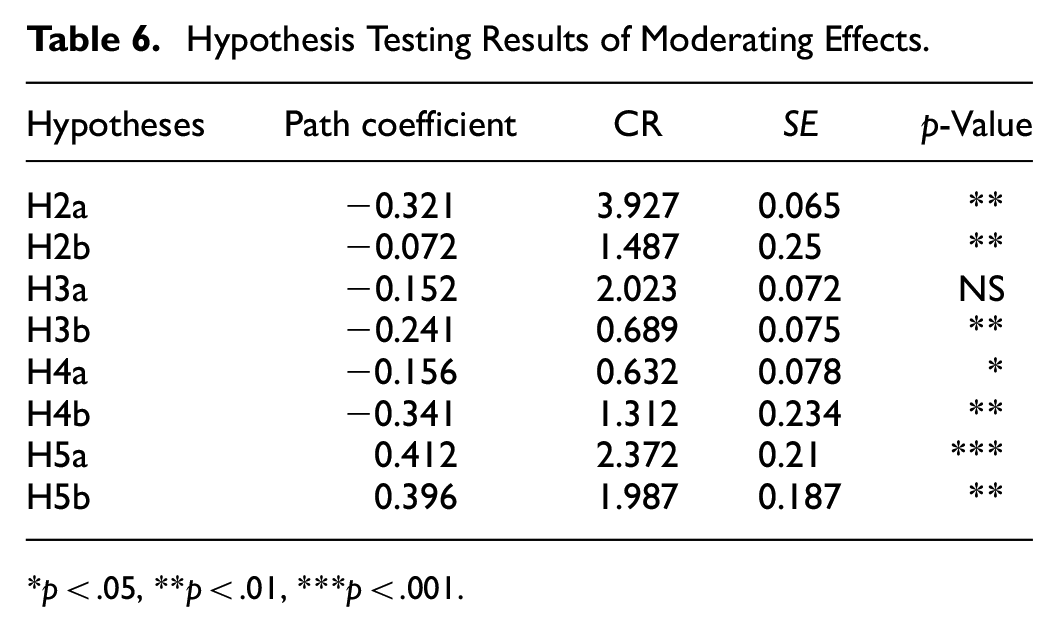
*p < .05, **p < .01, ***p < .001.
Conclusions
Discussion
As strategic plans have extremely essential influences during daily necessity manufacturers’ FFE innovation (Khurana & Rosenthal, 1998; Zhang et al., 2019), distributors’ extra-role behaviors would also give daily necessity manufacturers’ FFE strategic orientation an incentive reinforcement since our findings supported this point of view. We have empirically testified that the distributor’s customer orientation has a positive and significant impact on the daily necessity manufacturer’s NPD performance with the result of supporting H1a. The results reveal that distributors truly know the terminal market mechanisms and deeply understand customers (Autry et al., 2008; Restuccia et al., 2016; Song & Zhao, 2004; Wuyts, 2007). They can pass their experiences and knowledge about the terminal retail market to daily necessity manufacturers right at the beginning of the NPD process like customers and suppliers do (Huang et al., 2023), thus ensuring better outcomes. At the same time, under an open innovation FFE environment, daily necessity manufacturers and distributors can share knowledge back and forth without restriction (Chesborough et al., 2006) so that FFE strategic orientation can be flexible and affective. However, on the other hand, the results also showed that the distributor’s FFE technology orientation has little positive effect on the daily necessity manufacturer’s NPD performance since we rejected H1b. In our opinion, distributors are usually the connecting bridges of daily necessity manufacturers’ logistic chains according to long tail theory (Anderson, 2006), and they may hardly have time and resources to access the most advanced technologies. Moreover, as technologies are progressing at an unrealistic speed, it is difficult to predict what type of technology will win the markets.
FFE external environment uncertainties are the major drawbacks during daily necessity manufacturers’ FFE strategic orientation (Verworn, 2009; Zhang & Doll, 2001). Our findings have confirmed both FFE market uncertainty and FFE economic policy uncertainty’s negative moderating effects on the relationship between the distributor’s FFE strategic orientation and the daily necessity manufacturer’s NPD performance with one exception of FFE technology uncertainty’s moderating effect. Although our empirical results showed that FFE technology uncertainty has a negative effect on the relationship between the distributor’s FFE technology orientation and NPD performance, FFE technology uncertainty’s moderating effect on the distributor’s customer orientation and NPD performance is insignificant. As we stated above, technology changes can be complicated to predict, and the negative effect of FFE technology uncertainty should have an insignificant impact on customers’ preferences. Furthermore, CEOs’ alertness showed positive and significant moderating effects on both distributors’ strategic orientation relationships, proving that CEOs’ alertness has great potential to capture market opportunities (Busenitz, 1996).
Theoretical Contributions
In this study, we explored the FFE innovation of the daily necessity industry, which has long been ignored by researchers. Most researches have only focused on high tech industries (Verworn, 2009; Zhang & Doll, 2001). In this study, we found FFE innovation is the inception of all subsequent daily necessity goods’ NPD procedures; therefore, it is exceptionally meaningful to discover academically (Kim & Wilemon, 2002a; Zhang & Doll, 2001). On the other hand, daily necessities are the goods we use every day, but we hardly pay attention to them. Hence, we delve into daily necessity manufacturers’ FFE strategic orientation in this research and make several theoretical contributions. The theoretical contributions in this study are threefold. First, we involve distributors in daily necessity manufacturers’ FFE strategic orientation for the first time based on FFE external involvement and open innovation theory (Chesborough et al., 2006; Huang et al., 2023) and find that distributors’ extra-role behavior of FFE customer orientation has a positive impact on daily necessity manufacturers’ NPD performance (Wuyts, 2007). This suggests that firms’ daily necessity vertical stakeholders, such as distributors, have a tremendous positive effect on firms’ overall performance. Moreover, it also suggests that FFE strategic orientation should be open to the external environment to gain extra knowledge and resources (Huang et al., 2023). Second, FFE market uncertainty, FFE technology uncertainty and FFE economic uncertainty will always decrease daily necessity manufacturers’ FFE strategic orientation ability. Meanwhile, daily necessity manufacturer CEOs’ alertness can offset this negative impact by increasing NPD performance. Third, by comparing the daily necessity industry to other manufacturing industries, we found that the distributor’s involvement in FFE strategic orientation will create more channels, thus increasing daily necessity firms’ NPD performance according to long tail theory (Anderson, 2006; Huang et al., 2023).
Managerial Implications
Generally, daily necessity manufacturers are believed to be less technology-advanced in the manufacturing world, thus are less important than other high-tech manufacturers in terms of NPD (Anderson, 2006). However, in our research, we proved that utilizing distributors’ terminal market knowledge will help daily necessity manufacturers achieve greater NPD goals since the distributor’s FFE customer orientation will help them establish solid terminal retail market strategies at the beginning of the NPD process. Furthermore, daily necessity firms’ leadership should consider less about FFE technology uncertainty’s negative effect on FFE innovation and strategic orientation because technologies are evolving every day, and it is important to keep the right retailing strategies with customers directly. With the example of the emergence of ChatGPT, people may be unable to predict what future technology will look like. Finally, daily necessity CEOs should be more alert to external environmental uncertainties when forming FFE strategies. CEOs’ alertness can help firms reduce irrelevant pressure and focus on the right choices, especially under the current deglobalization world trend from a post-COVID-19 perspective (Ko & Butler, 2007).
Limitations and Future Research
Even though we fully investigated the relationship between the distributor’s FFE strategic orientation and daily necessity manufacturers’ NPD performance in this study. There are still limitations to this study for future research. First, we have only surveyed distributor’s FFE strategic orientation from the daily necessity firms’ side. However, there should be room for research on interviewing distributors to know how they conduct FFE strategic orientation for daily necessity manufacturers. Second, we have only discussed CEOs’ alertness in this study. However, other psychological habits can also be discussed to understand how CEOs contribute to firms’ success. Finally, there is a lack of case study on the matter of FFE innovation; this should be addressed through more detail to describe how manufacturing firms operate FFE innovation.
Footnotes
Declaration of Conflicting Interests
The author(s) declared no potential conflicts of interest with respect to the research, authorship, and/or publication of this article.
Funding
The author(s) disclosed receipt of the following financial support for the research, authorship, and/or publication of this article: This research received financial support from National Natural Science Foundation of China (72072144, 71672144, 71372173, 70972053); Shaanxi Soft Science Research Plan (2019KRZ007); Science and Technology Research and Development Program of Shaanxi Province (2021KRM183,2017KRM059, 2017KRM057, 2014KRM28-2); Soft Science Research Program of Xi’an Science and Technology Bureau (21RKYJ0009).
Data Availability Statement
The data gathered for this research are third party data through online questionnaires via Chinese website Wenjuanxing. All data can be accessed through corresponding author Jiaxu Huang’s Wenjuanxing account. Due to privacy concern, any person/institution who wants to get access to the data set for academic purposes has to ask Jiaxu Huang to login to his account in order to transfer the data to the data-needing person/institution. Here are the contact details of Wenjuanxing: Website address of logging into Jiaxu Huang’s online questionnaires account on Wenjuanxing:  . Email address of Wenjuanxing: