




Abstract
Today’s customers play a crucial role in value co-creation with a firm by performing extra voluntarily to help the firm achieve its overall benefits. It should be noted that such supportive behavior of customers arises from the evaluation of a firm being responsible. The purpose of this research is to examine how CSR perception type can elicit differentiated customer responses through a moral lens by unveiling the cognitive and affective processes involved. The research design includes three scenario-based experiments. Experimental data analyzed using the SEM approach reveal that customers will have more extra-role behaviors when perceive CSR practices are group-oriented than individual-oriented. Further, the relationship between customers’ CSR perceptions and customer extra-role behaviors is sequentially mediated by customer-company identification and emotional attachment. The findings also reported the moderating role of moral foundations in the relationship between CSR perceptions and customer-company identification in the Chinese context. The findings of this study offer experimental evidence on how CSR type elicit differentiated responses from a moral lens.
Keywords
Introduction
Corporate social responsibility (CSR) is a moral and business imperative for companies today. Against the backdrop of China’s commitment to high-quality development and rural revitalization strategy, socially responsible initiatives have been viewed exclusively as a tool for enhancing reputations and engendering goodwill among customers. Consumer spending drivers as a significantly large part of China’s GDP which makes it vital for companies to meet consumer expectations (SynTao, 2021). It is consistent with the survey results released by Cone Communication (2017), in which, customers are becoming increasingly concerned about CSR, raising expectations toward companies for implementing CSR initiatives, and rewarding socially responsible companies with positive behaviors. Extant studies have presented that customers’ perceptions of CSR will elicit favorable responses from customers (Baskentli et al., 2019; Hur et al., 2020; Lii & Lee, 2012). Only few of these studies have attached importance to the variation in customer responses to CSR perceptions and underlying mechanisms remain relatively unexplored.
Researchers have offered diverse CSR perception types by using different taxonomies, for example, pyramid model-based perspective (Carroll, 1979), MSCIKLD rating-based perspective (Baskentli et al., 2019), firm-based perspective (Buell & Kalkanci, 2021). Baskentli et al. (2019) investigated customers’ pro-company reactions to different CSR perception types (group-oriented vs. individual-oriented) through a moral view. These scholars classified CSR perception types based on MSCIKLD taxonomy which is reported on firm performance. However, to explore customer responses to CSR initiatives should be evaluated based on how customers perceived firm’s socially responsible activities (Lichtenstein et al., 2004; Öberseder et al., 2014) instead of the third-party index.
Customer extra-role behaviors are voluntary and discretionary behaviors, such as providing help to other customers, feedbacks to the firm, and positive word-of-mouth (Groth, 2005), regarded as a way to build advanced relationships between customers and the company (Vlachos & Vrechopoulos, 2012). In order to sustain long-term relationships, it is key for firms to identify which type of CSR initiatives perceived by customers can induce greater extra-role behaviors and point out the underlying mechanism through which CSR perception type may affect differentiated responses from customers. Scholars have explored that the underlying cognitive and affective processes are crucial drivers in customers’ response to CSR initiatives (Fryzel & Seppala, 2016; Raza et al., 2020). However, the underlying processes of how CSR perception type trigger customer extra-role behaviors have remained unclear in the literature.
Furthermore, the present study seeks to extend Baskentli et al.’s (2019) work by providing evidence from China. The Chinese context offers an excellent perspective and a solid ground to examine the current research topics because the cultural values might be different from Western countries. Consequently, different customer responses may occur with certain types of CSR initiatives, and it is also imperative to understand those strategies that enjoy the most favorable attitudes and behavior.
In providing these insights, we contribute to the literature in three ways. First, this study sheds light on the CSR domain-based variation from the perspective of customers and its effect on customer extra-role behaviors that expand the CSR literature in the marketplace. Second, this study extends the extant literature on the underlying mechanism of CSR perception type by proposing a sequential mediation model which incorporates the mediating variables of customer-company identification and emotional attachment. Third, we bridge the two streams of literature explicitly considering customers’ differentiated responses to CSR from the moral lens in the Chinese context.
In the following sections, we draw on extant literature to elaborate on the different effects of CSR perception type on customer responses and propose a conceptual framework for this study and hypotheses. We then offer proper approaches to test these hypotheses. In the last section, we provide a general conclusion with a discussion of findings and implications for companies and future studies.
Theoretical Background and Research Hypotheses
CSR Perception Type and Customer Extra-Role Behaviors
CSR refers to a firm’s contribution to society by doing what is correct in an ethical way (Jung & Hur, 2022; Nave & Ferreira, 2019). CSR domains span a large variety across firms, and customers may have inaccurate perceptions and attach different importance to various CSR domains. Extant studies have proposed multiple taxonomies of CSR initiatives (Cornelius et al., 2008; Jones et al., 2014). They further examined that customer responses are shaped by their perceptions of the firm’s CSR initiatives (Bhattacharya & Sen, 2004). Customers’ CSR perception types often differ significantly from actual CSR initiatives engaged by a particular firm, which in turn have various effects on customer responses (Baskentli et al., 2019). Based on existing literature, this study suggests that customers view CSR actions as individual-oriented or group-oriented indicating whether CSR initiatives are perceived as enhancing the interests and welfare of individuals (i.e., customers, employees) versus collective groups (i.e., environment, society). Such taxonomy conceptualizes CSR domains by a customer-focus approach and is widely discussed in the fields of pro-company behaviors (Baskentli et al., 2019; Shankar & Yadav, 2021).
Customer extra-role behaviors are voluntary and discretionary behaviors, including helping other customers, providing feedback, and producing positive word-of-mouth (Groth, 2005), and are viewed as a way to build advanced relationships between customers and the company (Vlachos & Vrechopoulos, 2012). According to social exchange theory (Emerson, 1976), social interactions can be intangible resources from which individuals expect to obtain benefits and in which reciprocal relationships are formed between individuals. Extant literature in the field of CSR and marketing has proved that customers’ perceptions of CSR initiatives can elicit positive attitudes and behaviors (Karaosmanoglu et al., 2016; Ramesh et al., 2019; Tuan et al., 2019). Based on the preceding discussion, we expect that when customers perceive a company involved in CSR initiatives, they patronize the socially responsible company and believe a certain benefit can be drawn from it. In turn, customers tend to provide resources voluntarily to reward the company.
Scholars proposed that when customers perceive CSR initiatives as serving the public, may generate more positive responses to the company that engaged in the CSR initiatives (Torelli et al., 2012). Karaosmanoglu et al.’s (2016) study investigated customers’ reactions to different CSR domains are likely to be various. The scholars further found that when customers encounter a firm involved in public-serving CSR initiatives, they tend to have greater extra-role behaviors, as compared to firm-serving CSR initiatives. Therefore, we posit that, when customers perceive a firm involved in CSR initiatives as group-oriented, they tend to believe that the firm contributed more to the society compared to individual-oriented CSR initiatives, which in turn, leads to more favorable behaviors. The above discussion leads to the following:
H1. Customers will have greater customer extra-role behaviors toward a firm engaged in group-oriented CSR initiatives, as compared to individual-oriented CSR initiatives.
The Sequential Mediation of Customer-Company Identification and Emotional Attachment
Based on social identity theory, individuals tend to develop a sense of connection and belonging with social entities perceived as having similarities in beliefs and values. Individuals then are motivated to identify with and develop himself/herself as a member of this social group to satisfy their needs for self-defining and self-enhancement (Tajfel, 1979). Extant literature has demonstrated that customers are inclined to develop social identification with a positively perceived company to construct their positive self-identity (Lichtenstein et al., 2004; Pérez et al., 2013). Companies engaged in CSR initiatives convey their socially responsible and meaningful identity triggering customers’ positive perceptions about and identification with the companies. In turn, customers are inclined to express their positive attitude and behaviors to socially responsible companies (Bhattacharya & Sen, 2004; Hur et al., 2018). Deng and Xu (2017) showed customers’ positive evaluation of CSR initiatives can positively affect customer-company identification. Lii and Lee (2012) stated that different CSR perception types will induce different degrees of customer-company identification. Also, prior research suggests that customers may respond more favorably when they perceive CSR initiatives are group-oriented (Shankar & Yadav, 2021), due to this type of CSR is often perceived as focusing on the interests and welfare of the collective group and the whole society at large. Accordingly, we further anticipate that customers’ perceptions of group-oriented CSR initiatives may elicit stronger customer-company identification compared to individual-oriented ones. When a company engaged in CSR initiatives, customers perceive a socially responsible image of the company that facilitates customers’ identification with the company by fulfilling their needs for self-definition and enhancement. More specifically, when compared to individual-oriented CSR initiatives, group-oriented CSR initiatives trigger more favorable customers’ perceptions that the company is endeavoring to serve the public and improve the welfare of the greater good, thereby eliciting stronger identification toward the company. The above discussion leads to the following hypothesis:
H2. Customers will have stronger customer-company identification toward a firm engaged in group-oriented CSR initiatives, as compared to individual-oriented CSR initiatives.
Prior research has verified that customer-company identification is a major driving force of customers’ supporting behavior, such as loyalty, positive word-of-mouth, and recommendation (Bhattacharya & Sen, 2004; Elbedweihy et al., 2016). Based on social identity theory, customers feel motivated to develop connection and oneness with a socially responsible company and will subsequently reveal positive attitudes and behavior toward the company. The above studies support our view that when customers perceive a particular company is engaged in CSR initiatives, they will have a high degree of identification with this socially responsible company, in turn, eliciting customer extra-role behaviors.
H3. Customer-company identification mediates the relationship between CSR perception type and customer extra-role behaviors.
Emotional attachment represents customers’ emotional bonding with the company, including passion, affection, and connection (Thomson et al., 2005). According to self-concept theory, CSR initiatives signal a socially responsible character of the company that may facilitate customers’ needs for self-concept, and in turn lead to emotional attachment to the company. Prior research has investigated that customers’ perceptions of CSR are a key driver of customers’ attachment to a company (Hur et al., 2020; Vlachos, 2012). Gilal et al. (2020) noted that when companies engage in CSR initiatives, customers’ emotional attachment to the company can be increased. Past research noted that different types of CSR lead to different degrees of emotional attachment (Collier & Esteban, 2007). It can hence be argued that CSR initiatives communicate a socially responsible company that is “doing good,” which subsequently elicits customers’ motivation to fulfill a matched positive self and form an emotional attachment to the company. Thus, we hypothesize as follows:
H4. Customers will have stronger emotional attachment toward a firm engaged in group-oriented CSR initiatives, as compared to individual-oriented CSR initiatives.
Customers’ emotional attachment toward a particular company will influence their attitude and behavior (Thomson et al., 2005), and is positively related to their extra-role behaviors, such as tolerating negative information (Hur et al., 2020). Japutra et al. (2014) suggested that customers who are emotionally attached to a particular company may be resilient to negative information about the company and willing to display forgiveness. Cheng et al. (2016) noted that emotional attachment influences customer extra-role behavior via their perceived value. Hence, we expect that emotional attachment is positively related to customer extra-role behaviors.
H5. Emotional attachment mediates the relationship between CSR perception type and customer extra-role behaviors.
According to the social identity theory, the perceived overlap between an individual and a certain group allows the individual derives belongingness from the group which thus induces positive emotions (Bergami & Bagozzi, 2000). Emotional attachment refers to the affective state of a customer toward a company and the strength of the connection between them (Japutra et al., 2019). To illustrate, when customers identify with a company, they are inclined to develop positive and close feelings toward the company. Extant research has offered evidence that the match in the image between customers and companies is positively associated with emotional attachment (Hollenbeck & Kaikati, 2012; Kressmann et al., 2006). Malär et al. (2011) showed that the match between customers’ identity and brand image increases customers’ emotional bonding toward the brand. Therefore, we anticipate that when customers perceive there is a particular match between their image and the company image, customers may feel the company fosters their self-definition and self-enhancement, hence customers will be emotionally attached to the company.
We construct a conceptual framework on the principle of the cognitive-affective processing system theory (Mischel & Shoda, 1995), which emphasizes why and how an individual’s behavior varies across situations (Shoda et al., 2013). According to cognitive-affective processing system theory, Customers’ CSR perceptions are viewed as a stimulus, to process which, triggers the identification (cognitive processing system) and emotional attachment (psychological processing system), in turn, to generate extra-role behaviors (behavior). Thus, the following hypothesis is proposed.
H6. The relationship between CSR perception type and customer extra-role behaviors is sequentially mediated by customer-company identification and emotional attachment.
The Moderating Role of Moral Foundations
Drawing on the moral foundation’s theory (Haidt & Graham, 2007), an individual’s morality is characterized by five dimensions/foundations: Harm/Care, Fairness/Reciprocity, Ingroup/Loyalty, Authority/Respect, and Purity/Sanctity. The first two foundations concerning protecting the rights and interests of individuals are constructed as individualizing moral foundations. The latter three foundations concerning loyalty and obedience to in-group and authority, are constructed as binding moral foundations. CSR initiatives are inherently moral acts and are often perceived through a moral lens by customers (Baskentli et al., 2019). Prior research suggests that customers’ moral concerns affect customers’ responses to moral acts performed by companies, that is, charitable donations and environmental appeals framed with individualizing and binding values (Kidwell et al., 2013; Winterich et al., 2012). Hence, we argue that the degree of customer-company identification elicited by CSR perception type may vary across customers’ moral foundations. Specifically, customers who are more concerned with the protection of individuals (preservation of the group) will respond more favorably toward CSR initiatives perceived as enhancing the interests and welfare of individuals (groups), thus having stronger identification with the socially responsible company. Thus, we hypothesize the following:
H7a. Customers with higher individualizing moral foundations will have stronger identification with a company that engages in CSR initiatives perceived as individual-oriented.
H7b. Customers with higher binding moral foundations will have stronger identification with a company that engages in CSR initiatives perceived as group-oriented.
Drawing on the social identity theory and cognitive-affective processing system theory, Figure 1 presents the proposed conceptual model linking CSR perception type, customer extra-role behaviors, customer-company identification, emotional attachment, and moral foundations.
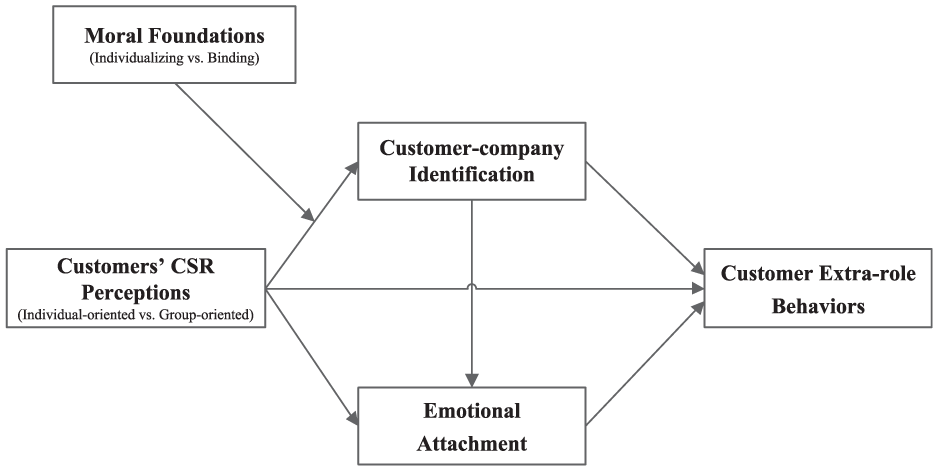
Conceptual model.
Pretest
Considering that industry familiarity and the importance of industries in everyday life could influence customers’ perceptions of CSR initiatives, we conducted the pretest to select industries for designing experimental scenarios. The Blue Book of Corporate Social Responsibility released by the Chinese Academy of Social Sciences (CASS) points out that a total of 19 highly concerned industries are evaluated as having great influence on economic and social development and the environment. We invited 70 MBA students to participate in the pretest. After introducing the definition and category of each industry, participants rated their familiarity with the industries (1 = Not familiar at all, 7 = Very familiar) and the importance of each industry in their daily lives (1 = Not important at all, 7 = Very important). We selected the top three industries based on the results: the Internet industry (Mfamiliar = 4.029, Mimportance = 5.814), the banking industry (Mfamiliar = 3.986, Mimportance = 5.614), and the food industry (Mfamiliar = 3.914, Mimportance = 5.571). Therefore, we created three different scenarios for the three experiments based on CSR initiatives implemented by the Internet, banking, and food industry.
Study 1
The purpose of this study is to examine the effect of CSR perception type on customer extra-role behaviors. According to the pretest in the former section, we used a hypothetical company, Company A, an Internet company, for avoiding potential stereotypes of customers.
Method
Two hundred and twenty MBA students in China participated in the online experiment via the Wenjuanxing platform (Dai & Sheng, 2022). Twenty-nine were excluded due to incomplete answers (response rate = 86.8%, 58.6%female, age ranged from 25 to 40). Study 1 employed a one-factor between-subjects design that included two types of CSR initiatives (CSRP type: individual-oriented vs. group-oriented). Participants were randomly assigned to each experimental group and read the stimuli. Directly after being exposed to the CSR campaigns, respondents rated the customer’s extra-role behaviors.
All variables in this study are measured on a 7-point Likert scale from 1 (strongly disagree) to 7 (strongly agree). We modified the Groth (2005)’s scale to measure customer extra-role behaviors including 12 items. Sample items include “I give suggestions to X on how to improve its services” and “I would recommend X to my friends” (Cronbach’s α = .953).
Results
Manipulation Checks
A one-way ANOVA was conducted, and the results showed that participants in the individual-oriented condition reported a significantly lower rating (Mindividual-oriented = 4.434, Mgroup-oriented = 2.340, F(1, 189) = 98.000, p < .001) than participants in the group-oriented condition (Mindividual-oriented = 2.515, Mgroup-oriented = 5.053, F(1, 189) = 174.510, p < .001), indicating the manipulation of stimuli was successful.
Customer Extra-Role Behaviors
A one-way ANOVA was conducted to test H1. For customer extra-role behaviors, a significant difference was detected between the two CSR perception types: F(1, 189) = 5.380, p < .05. As shown in Figure 2, CSR initiatives perceived as group-oriented elicits more customer extra-role behaviors (Mgroup-oriented = 65.596, SD = 9.734, p < .05)than individual-oriented ones (Mindividual-oriented = 61.773, SD = 12.784). Hence, H1 was accepted.

CSR perception type (CSRP) and customer extra-role behaviors.
Study 2
We conducted Study 2 to further examine the sequential mediating roles of customer-company identification and emotional attachment in the relationship between CSR perception type and customer extra-role behaviors. The experiment was performed in a new scenario, Company B in the banking industry.
Method
Six hundred and forty participants located in China were recruited online through WJX (https://www.wjx.cn, accessed Mar 8, 2025), is a Chinese leading online research platform similar to MTurk, which is widely adopted by international researchers for experimental and survey research (Dai & Sheng, 2022). Fifty-six of them were excluded due to incomplete answers (response rate = 93.4%, 56.2%female, age ranged from 18 to 60). Study 2 employed a one-factor (CSRP: individual-oriented vs. group-oriented) between-subjects design. Participants were randomly assigned to each experimental group and read the stimuli. Afterward, respondents are required to rate the customer’s extra-role behaviors, customer-company identification, and emotional attachment.
We adopted the same measurement of customer extra-role behaviors in Study 1 (Cronbach’s α = .950). According to Currás-Pérez et al. (2013), customer-company identification was measured using five items: “the way I fit in with what I perceive of X”“I am similar to how I perceive X” (Cronbach’s α = .916). The emotional attachment was measured using 10 items adapted from Thomson et al. (2005): “I am strongly connected to X” and “I am passionate about X” (Cronbach’s α = .968). The CR values were .969, .938, .981 respectively, which were higher than .7, indicating good internal consistency of the scale. The square root of AVE values of all the constructs were .741, .751, .836 larger than .5. Thus, all the scales have a reasonable degree of discrimination.
Results
Manipulation Checks
A one-way ANOVA was conducted, and the results revealed that participants in the individual-oriented condition reported a significantly lower rating (Mindividual-oriented = 5.058, Mgroup-oriented = 2.908, F(1, 596) = 370.450, p < .001) than participants in the group-oriented condition (Mindividual-oriented = 2.861, Mgroup-oriented = 4.836, F(1, 596) = 298.740, p < .001), indicating the manipulation of stimuli was successful.
Sequential Mediation Analyses
For customer-company identification, a significant difference was detected between individual-oriented and group-oriented groups (F(1, 596) = 6.900, p < .001). Specifically, customers are likely to have stronger identification toward the company when they perceive the company’s CSR actions are group-oriented (Mgroup-oriented = 25.204, SD = 4.878), as compared to individual-oriented (Mindividual-oriented = 24.188, SD = 4.585, see Figure 3), supporting H2.
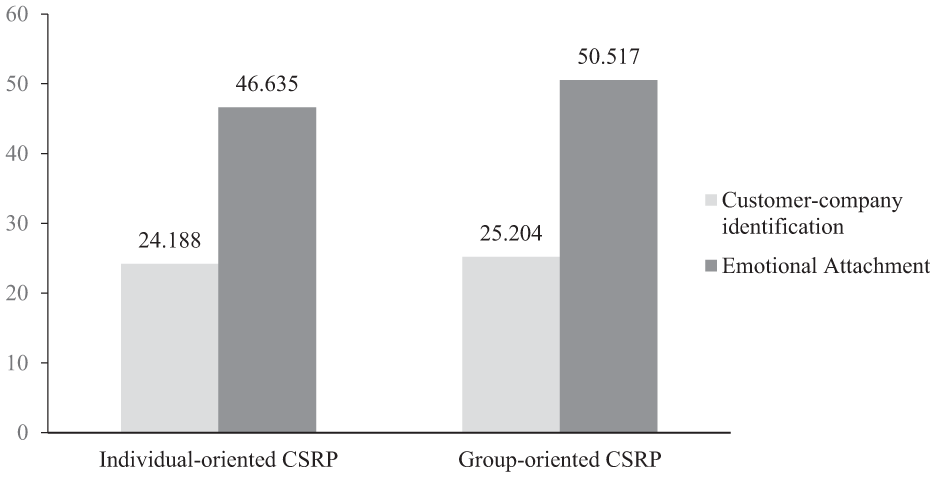
CSRP type, customer-company identification and emotional attachment.
For emotional attachment, there is a significant difference between individual-oriented and group-oriented groups (F(1, 596) = 21.850, p < .001). Specifically, customers are likely to be stronger emotionally attached to the company when the company’s CSR actions are perceived as group-oriented (Mgroup-oriented = 50.517, SD = 9.947), as compared to individual-oriented (Mindividual-oriented = 46.635, SD = 10.349, see Figure 3), supporting H4.
We further tested the sequential mediation process of customer-company identification and emotional attachment using structural equation modeling (SEM). The fit indices indicated that the measurement model was fit for the data (χ2/df = 7.996; root mean square error of approximation (RMSEA) = 0.108; standardized root mean square residual (SRMR) = 0.041; comparative fit index [CFI] = 0.944; Tucker-Lewis index [TLI] = 0.924).
All path coefficients in the structural model analysis were derived. The results for the coefficients are listed in Table 1. The proposed effects were performed in a mediated model using SEM by using STATA 17.0, see Figure 4. We examined the hypotheses through a three-step process. First, as we expected, the effect of CSR perception type on customer extra-role behaviors was mediated by customer-company identification (β = .048, p < .05, 95% CI [0.005, 0.090]), hence H3 was supported. Second, to test the mediating role of emotional attachment in the relationship between CSR perception type on customer extra-role behaviors, which fully supported H5 (β = .035, p < .01, 95% CI [0.013, 0.056]). Finally, we examined the sequential mediation of customer-company identification and emotional attachment. Our results indicated that the sequential mediating effects were statistically significant (β = .030, p < .05, 95% CI [0.002, 0.058]), while the total effect of CSR perception type on customer extra-role behaviors was not significant (β = .027, p > .05, 95% CI [−0.029, 0.084]). Thus, H6 was supported.
Path Coefficients for the Sequential Mediation Process.

Source. Author’s own creation.
Note. CSRP = customers’ CSR perceptions; CEB = customer extra-role behavior; CCI = Customer-company identification; EA = emotional attachment.

Path diagrams of SEM.
Study 3
Study 3 aims to further test the moderating role of moral foundations in the relationship between CSR perception type and customer-company identification. The experiment was performed in a new scenario, Company C in diary industry.
Method
A total of 702 customers located in China participated in the online experiment. Sixty-one were excluded due to incomplete answers (response rate = 91.3%, 51.6% female, age ranged from 18 to 60). Study 3 employed 2 (CSRP type: individual-oriented vs. group-oriented) × 2(moral foundations: individualizing vs. binding) between-subjects design. Respondents were asked to complete the 30-item moral foundation questionnaire (Graham et al., 2011, Cronbach’s α = .916), then were randomly assigned to each experiment group and read the stimuli. Directly after reading the CSR campaigns, respondent provided their ratings on the customer-company identification (Currás-Pérez et al., 2009, Cronbach’s α = .916). After ratings, we asked participants to fill out several demographic questions (e.g., gender, age, education).
Results
Manipulation Checks
A one-way ANOVA was conducted, and the results revealed that participants in the individual-oriented condition reported a significantly lower rating (Mindividual-oriented = 4.435, Mgroup-oriented = 2.721, F(1, 639) = 210.00, p < .001) than participants in the group-oriented condition (Mindividual-oriented = 2.628, Mgroup-oriented = 4.725, F(1, 639) = 326.510, p < .001), indicating the manipulation of stimuli was successful.
Moderation Analysis
A one-way ANOVA was performed to test H2 which states that CSR perception type will induce customer-company identification and its heterogeneous effect on customer-company identification. The results showed that a significant difference was detected between individual-oriented and group-oriented conditions (F(1, 639) = 401.520, p < .001). Specifically, customers are likely to have stronger identification toward the company when they perceive the company’s CSR actions are group-oriented (Mgroup-oriented = 28.708, SD = 4.574), as compared to individual-oriented (Mindividual-oriented = 21.859, SD = 4.026, see Figure 5), supporting H2.

CSRP type and customer-company identification.
We mean-centered the individualizing moral foundations and group-oriented moral foundations before conducting the two-way ANOVA analysis. Results showed a significant interaction of the CSR perception type and moral foundations on customer-company identification (F(1, 637) = 4.130, p = .043, ηp2 = 0.40), thus suggesting the moderating role of moral foundations in the relationship between CSR perception type and customer-company identification.
Planned contrasts revealed that under individual-oriented condition (CSRP = 0), customer-company identification was significant higher when MF = 0 (F(1, 334) = 10.180, p = .002; Mindividualizing = 29.298, SD = 4.569, Mbinding = 27.661, SD = 4.411), as compared to when the MF = 1, suggesting the acceptance of H7a. In other words, customers with individualizing moral foundations have stronger identification toward the company when they perceive the company’s CSR actions are individual-oriented, as compared to customers with binding moral foundations. However, when CSR perceptions were group-oriented (CSRP = 1), customer-company identification does not vary across the moral foundations (F(1, 303) = 0.230, p = .629; Mindividualizing = 21.985, SD = 3.481, Mbinding = 21.760, SD = 4.413; see Figure 6), suggesting H7b was not supported. In other words, when a company’s CSR actions are perceived as group-oriented, customers’ identification toward a company is likely to have no significant difference whether customers with individualizing or binding moral foundations.

Interaction effect of CSRP type and moral foundations on customer-company identification.
General Discussion
This study is guided by questions in marketing practice over whether differentiated customer responses vary with different types of CSR initiatives and the underlying mechanism in between. Through the lens of moral foundations, we provide a novel perspective to investigate a sequential mediation process under the effect of CSR perception type on extra-role behaviors. Across three experiments conducted in the Chinese setting, we demonstrate that CSR perception type can elicit differentiated customer responses through a moral lens by unveiling the cognitive and affective processes involved. The findings are replicated across the three experiments and was consistent with previous studies that suggest CSR actions perceived as focusing on collective groups lead to more positive customer responses (Fryzel & Seppala, 2016). Additionally, in line with our expectation, the effect of CSR perception type and customer extra-role behaviors is sequentially mediated by customer-company identification and emotional attachment. Our findings confirm that CSR initiatives reveal a company’s values which drives customers to identify with the company for self-definition (Baskentli et al., 2019; Bhattacharya & Sen, 2004), and increase their attachment toward the company (Hur et al., 2020). Furthermore, this study identified the moderating role of moral foundations in the relationship between CSR perception type and customer-company identification. Interestingly, this finding is partially supported. Considering China’s culture and traditions, individuals are more concerned about collective groups. During Covid-19, a Chinese food company, Baixiang Food, donated a large number of goods and materials to the public and offered jobs for people with disabilities that staged the phenomenon of “wild consumption” of Baixiang’s products. Accordingly, Chinese customers react positively to group-oriented CSR initiatives that they perceive as group-oriented, despite their own moral concerns. It may provide explanations for the results of this study that considering the implications to the wider collective groups, in reacting to group-oriented CSR initiatives, customers’ responses do not vary across their moral foundations.
Theoretical Contributions
This study contributes to the existing literature in three ways. First, this study develops the taxonomy of CSR perception type from the perspective of Chinese customers that embodies the degree of social responsibility contribution. Extant studies have discussed the various customers’ responses to CSR domains provided by a third party (e.g., KLD classification) that cannot reflect customers’ actual expectations or requirements for CSR. In this regard, this study employed a customer-oriented approach to investigate the various responses to two types of CSR initiatives: group-oriented and individual-oriented, each of which contains two CSR domains. Most of our hypotheses are duly tested empirically and proven to be supported which greatly expands CSR research in consumer behavior.
Second, this study shed light on the underlying mechanisms of CSR perception type and customer extra-role behaviors by building a sequential mediation model. The revealing of cognitive and psychological processes of customers’ response to CSR provides a novel perspective and solid empirical evidence for current literature.
Third, in keeping with the prior research, this study examined customers’ identification of CSR initiatives through their moral relevance and judgment (Baskentli et al., 2019). According to the findings of testing the moderated effect of moral foundations and the congruence effect of CSR perception type and moral foundations on identification, this study provided extra proof and add to the literature by identifying Chinese customers have no significantly different perceptions of group-oriented CSR initiatives due to the collective orientation in Chinese culture.
Managerial Implications
Three major insights can be drawn from our findings. First, firms devoting in CSR initiatives could be a crucial way to instigate customer extra-role behaviors. More importantly, great importance should be attached to the degree of CSR contribution. In specific, acting on environmental protection such as green production, green operation and green management, companies would contribute to the achieving of China’s “dual carbon” goals; giving full play to its own industrial advantages to promote development of residents’ livelihoods and rural businesses for the greater good. Second, firms need to focus on customers’ cognitive judgment and emotional evaluation of CSR initiatives. Socially responsible practice conveys the social identity characteristics of responsibility to customers, which will induce customers’ positive cognitive and emotional responses to corporate good deeds, among which perceived group-oriented initiatives produce more positive outcomes. Therefore, managers need to lay great importance on CSR strategy making to provide effective communication that helps to engender stronger customer-company identification and more intense attachment to the companies. Third, firms should ensure CSR initiatives are well-tailored considering customers’ distinct moral foundations. For instance, companies that launch individual-oriented CSR initiatives, such as protecting customers’ privacies, and caring for employees’ physical and mental health, may get more favorable responses from their customers with higher individualizing moral foundations. It is crucial for companies to bear in mind when carrying out CSR initiatives, they should research the types of their customers’ moral foundations to maximize the effectiveness of CSR initiatives.
Limitations and Directions for Future Research
Despite its theoretical and practical implications, this study has several limitations which provide directions for future studies. Our study is based on Chinese consumers. However, customers’ cognition, emotion, and values in ethical issues may vary on their own cultural backgrounds, and the characteristics of a company (i.e., industry, stages of business development). To increase the validity and generalization of our findings, we encourage scholars to conduct studies in diverse contexts across different countries. In addition, we carried out one lab experiment in study 1 and online experiments in the rest two studies that lacks the observation in real marketplace. We call for future studies to conduct field experiments to replicate our results.
Footnotes

Ethical Considerations
The authors declare the provided manuscript has not been published before nor submitted to another journal or preprint server for consideration of publication.
Consent to Participate
This article does not contain any studies with human or animal participants.
Funding
The authors disclosed receipt of the following financial support for the research, authorship, and/or publication of this article: Humanities and Social Science Fund of Liaoning Province, grant number L21BGL040.
Declaration of Conflicting Interests
The authors declared no potential conflicts of interest with respect to the research, authorship, and/or publication of this article.
Data Availability Statement
Data is available upon reasonable request.