



Abstract
Understanding the depth of leadership and its effects on organizational outcomes have been a topic of complex nature, attracting scholars, and practitioners alike. This becomes more vital for tourism industry, where extent of competitive rivalry is extremely high as employees are vital in this sector. The current research examines the relationship between transactional leadership and organizational citizenship behavior of employees in tourism-related businesses. Furthermore, this study assumes that psychological contract fulfillment can moderate the relationship between leadership and perception of organizational justice, which can then mediate employees’ citizenship behaviors. Current research takes place in Lebanon, where the industry of tourism is highly important. Empirical evidence yielded from data analysis has shown support for moderating effect of psychological contract fulfillment on leadership and perception of justice linkage. This strengthens the perception of justice within the firm, which further proven to be of significance in terms of mediating transactional leadership and extra-role behaviors of employees. Theoretical development as well as practical implications have merged to aid the literature as well as managerial levels of tourism sector.
Keywords
Introduction
Leadership is a key component of any business in constantly changing market environment of modern life. It is crucial that leaders act within the same line as their organizations’ goals as well as exhibiting competence in managing diverse and complex systems of work. Tourism is among the top industries in the world, especially with ease of traveling and advancements in service and hospitality industry. It is the core context of this research to look into concepts of leadership (transactional in particular) and its effects on employees’ behavioral outcomes in tourism sector. Leadership by essence, is a key element in business and management (Cascio & Aguinis, 2008). A considerable number of studies have been conducted to look into the habits and attitudes that yield an effective leadership (Dinh et al., 2014). For instance; research that has explored task leader conduct (i.e., transactional leadership, contingent reward, initiating structure) conveyed that effective leaders can illustrate certain roles, resolve issues, and coordinate maneuvers (Bass, 1985; Burns, 1978; Karam et al., 2019; Podsakoff et al., 2006; Yukl, 2012). Positive effects of leaders on employee attitudes and behaviors have been established in the relevant literature (e.g., Dartey-Baah & Addo, 2019; Gardner et al., 2010). The current research looks into transactional leadership and its influence within an organizational perspective. In this regard, organizational citizenship behavior (OCB) is regarded as an outcome of proper implementation of transactional leadership. In addition, perception of employees regarding organizational justice (OJP) is taken into account to further comprehend underlying factors. This study further investigates the role of Psychological Contract Fulfillment (PCF) as an enhancer on the impact that transactional leadership implies on enabling employee OCB. This research looks into this phenomenon in the context of tourism and hospitality industry, located in Beirut, Lebanon. In addition, current paper aims to highlight vitality of OJP and PCF in this context and to emphasize on involvement of these factors within hotels by leaders. This shapes the assumption of this research that existence of desirable workplace elements will further enhance positive behaviors by staff, which consequently, yields in higher profitability. We emphasize that this is crucial for hotel industry as employees in this sector interact with customers on a constant basis. Thus, having employees with positive behaviors will lead to customers’ satisfaction and/or revisit, recommendation, and retention.
Theoretical Background and Hypotheses
Transactional Leadership and OCB
Numerous indications of the effect of ethical leadership on workers welfare (e.g., Chughtai et al., 2015), conduct (e.g., Walumbwa et al., 2011), classical citizenship behavior (Arain et al., 2019), precautionary conduct (Khan et al., 2018), fulfillment from the task performed (e.g., Yozgat & Meşekıran, 2016), foresight creativity (e.g., Chughtai et al., 2015; Feng et al., 2016) and inventive task conduct (Yidong & Xinxin, 2013) are present. This is while there is a reverse consensus upon the findings in relation with leadership style and its impact on extra role behaviors that are initiated by employees. Transactional Leadership can be described as “swap relationship”; in other words, a framework of objectives and awarding. In this type of leadership an educational institution sets objectives and educators must attain those objectives in return to receiving the award. (Shields, 2010). Transactional Leadership contains a message of ethicality, considering that staff anticipate in return for their work that they would receive justified awards. The “classic” Transactional Leadership (Avolio et al., 1999) proposal of transformational- transactional leadership assumption implies that transactional leadership is progressively affected by transformational leadership.
When it comes to OCB amid employees, leadership tends to impose an influential effect, particularly in the context of tourism industry (e.g., Abu Nasra & Heilbrunn, 2016; Dartey-Baah & Addo, 2019; MacKenzie et al., 2001). Most scholars agree that transformational leadership has an influential fallout when it comes to incentivizing workers and altering their vision toward the tasks required of them. In turn, it results in the workers devoting more to the company and being more productive, these actions are necessary for the firm to thrive and prosper (Coyne et al., 2013; Dartey-Baah & Addo, 2019). Moreover, when comparing transactional leadership with transformational leadership we note that the former imposes less effects on the drive of worker and their view toward their tasks (Bogler, 2001; Coyne et al., 2013).The current research tends to improve the theoretical implication of transactional leadership through inclusion of variables such as, OJP and PCF. This enables leaders to tap beyond boundaries of a set system of leadership, and thus, encourage staff to exhibit extra-role behaviors such as, OCB. As a consequent, this will aid the firm in terms of maintaining a sustainable growth and increased level of competitiveness, which is more vivid for the case of hospitality and tourism industry (Dartey-Baah & Addo, 2019). The majority of research on transactional and transformational leadership have been conducted on Western communities (Arar & Abu Nasra, 2019; Bass, 1997). Employees of this sector in Beirut are familiar with international settings and as mentioned, they interact with customers. According to Lebanese Tourism Sector 2018 in Review, Europeans are the top tourists in number with increase of 11% over 2010 to 2018. This is while Arab tourists decreased in number from 49% to 29% in the same period.
Workers demonstrating OCB do so out of their own desire for OCBs are acknowledged as extracurricular actions and not a part of required tasks. These actions collectively influence the tourism sectors’ environment to operate more effectively and efficiently. Tremendous amount of studies conducted on OCB reflect a result of leadership approach, especially transformational and transactional (Abd El Majid & Cohen, 2015; Cohen et al., 2012; Lian & Tui, 2012; Mekpor & Dartey-Baah, 2017). OCB as a course of conduct is not a part of job duties or description and may not merit staff any immediate awards, yet it prompts advancements (Organ, 1997), and productivity and performance (Podsakoff et al., 1990, 2000). With the aid of a reward plan, transactional leadership can result in incentivizing of the workers. (Bass, 1985). Moreover, transactional leader aims at objectives, pointing out connection between efficiency, awards and evaluation to ensure that dedication is high for task completion among employees. Thus, workers’ attitude and actions are altered in accordance with award and incentives. Transactional leadership is bound by principle of one thing for the other, without trying to tackle a firm’s outcome. A primary theory of transformational–transactional leadership is the augmentation hypothesis (Bass & Avolio, 1993), which argues that transformational leadership provides an anchor for transactional leadership. This style is selected in the current research as observations prove existence of transactional leaders. Furthermore, selection criteria of current study was based on the aforementioned narrative. Selection criteria is explained further in the text. In the light of what was mentioned above, a hypothesis has emerged as below:
Hypothesis 1: Transactional leadership has a direct effect on OCB and its exhibition by employees as an extra-role behavior.
Organizational Justice Perception as a Mediator
To factors are key elements in comprehending the linkage between leaders’ approach and impartiality or what is observed by employees as justice within their organizations. Firstly, worker-supervisor affiliations are usually denoted as social and are distinctive from other types of companionships, due to having the anticipation of lasting longer, and reciprocal dealings that produce a sense of trust, interchangeable courses of conduct, and superior affiliations (Blau, 1964; Mitchell et al., 2012). Secondly, research that looks at manager-oriented impartiality usually concentrates on debates connected to (a) examining one-of-a-kind results of manager-oriented impartiality proportions (i.e., institutional, disseminative, interactive, perceptive impartiality) on firm’s productivity (e.g., Colquitt et al., 2013; Frazier et al., 2010), or (b) investigating how (un)just behaviors associated to a manager compare and contrast to (un)just behaviors associated toward others (e.g., Kurian & Nafukho, 2021; Lavelle et al., 2009). Taking into consideration the actions of the manager and his/her view toward impartiality allows for a more refined understanding of social dealings in relationships, rather than merely looking at independent impacts of leadership attitude or impartiality on end-results.
A considerable amount of studies on the concept of firm’s impartiality has as well looked into the part the manager plays in workers evaluation of (un)just treatment. (Colquitt et al., 2013; Karam et al., 2019; Rupp et al., 2014). It has been noted in a number of studies that impartiality deliberations of the manager (i.e., superior- or manager-oriented impartiality), instead of deliberations of the firm’s departments (e.g., the firm), are highly connected to the workers end results. (Colquitt et al., 2013; Rupp et al., 2014). Studies on impartiality are rooted in social exchange theory (SET) (Colquitt et al., 2013; Karam et al., 2019), which establishes a crucial foundation for a circumstantial grasp on the manager-worker relationship. Social dealings in relationships are denoted by frequently encountering people and job interrelation. Several studies have examined possible mediation between leadership style and OCB, which includes being content with the work, and being devoted to the firm, confidence in the manager (Jung & Avolio, 2000) and system impartiality (Ngodo, 2008). A positive impact along these factors is reported. Perceived organizational justice can be considered as a major element that predicts an array of positive organizational behaviors. This research looks into this topic in the context of tourism industry in Beirut, which extends the borders of extant literature both in leadership and tourism (Kurian & Nafukho, 2021). Hotels of Beirut receive international tourists, which means their employees must be a good fit for a diverse setting. In this sense, it is vital that staff perceive a satisfactory level of justice so that no negative psychological effect is posed. This is a major drive for theoretical assumption made in this section.
The way workers view the firm’s impartial conduct unravels into multiple positive reactions from and may help foresee some actions on the job. It is shown that positive behavioral outcomes are exhibited by staff, when justice is perceived in various sectors, including and not limited to tourism (Kurian & Nafukho, 2021). Relevant to the context of this research, OCB is regarded as a positive behavior toward the firm based on the individuals’ discretion, which further benefits the firm in terms of performance and achieving competitive advantage (Singh & Singh, 2019; Takeuchi et al., 2015). In this sense, it has been noted throughout the literature that perceived organizational justice is influential on behaviors as, commitment and OCB (Chan & Lai, 2017; Gao & He, 2017; Singh & Singh, 2019). POJ has been shown to have mediating force in the context of organizational outcomes and/or behaviors (Arici et al., 2021). Following what was noted, a hypothesis has been derived:
Hypothesis 2: OJP has a mediation role on the linkage between transactional leadership and OCB.
Positive Moderation of Psychological Contract Fulfillment
Psychological Contract Fulfillment (PCF) is described as the promissory comprehension and ideas of a worker about possibilities of firm carrying out what was initially promised (Rousseau, 1995). PCF has also been described as a powerful indicator of essential end results like revenue planning (Collins, 2010), dedication (Fontinha et al., 2014), authentic and creative attitude on job (Chang et al., 2013), OCBs (Ahmad et al., 2019), task execution (Conway & Coyle-Shapiro, 2012; Rodwell et al., 2015) and acquired firm support (Chaudhry & Tekleab, 2013). On the grounds of mutual confidence in each other (Blau, 1964), workers will develop a psychological connection with their manager. Psychological contracts therefore demonstrate “Worker’s ideals, molded by the firm, in accordance with the details of exchange between the workers and their firm” (Rousseau, 1995, p. 9). Leader and follower collectively agree that the leader will ensure secure and good atmosphere/job surroundings, just, unbiased awarding systems, an encouraging work atmosphere, impartial chances to develop their career in exchange for the followers’ dedication and prosperous performance (Ahmad et al., 2019). Thus, the portion of mutuality along with the social exchange theory (Blau, 1964) is a fundamental inferred technique in the relationship which supports the assumptions of this research. The current body of literature mentions two kinds of psychological contracts; transactional and relational contracts. PCF comprises of an all-inclusive appraisal based on meeting the implicit commitments made in both relational and transactional contracts (Colquitt et al., 2014).
PCF is gradually denoted as a primary precedent by which staff develop well-thought opinions regarding their leaders (Lee et al., 2000), which results in altering their course of conduct and perspective (Chaudhry & Tekleab, 2013). Research proposes that when workers attain their part of psychological contract, they anticipate the same from their manager with mutuality and interrelation (Rousseau, 1995). Attaining these requirements will result in the betterment of employees’ productivity and efficiency and extra-role behavior, particularly in tourism sector (e.g., Jehanzeb & Mohanty, 2019). Modern research has also discovered that PCF positively influences the extra role behaviors as well as other positive actions among employees in service sector (Ahmad & Zafar, 2018; Ahmad et al., 2019). PCF is an essential element of forecasting positive behaviors of service employees (Chang et al., 2013) such as, OCB. OCBs are generally thought of as interactive end-results that are significant. Podsakoff et al. (1990) determined five proportions to OCB namely, selflessness, mindfulness, righteousness, thoughtfulness, and citizenship. In this sense, selflessness is the workers act of support and aid to co-workers and individuals on their team; mindfulness is the act of carrying out further duties that are more than what is required; righteousness is the act of valuing the duties asked of them and conducting work under pressure in a positive manner; thoughtfulness is the act of performing certain actions in order to save the firm or others from issues that may arise; and citizenship is the act of displaying a sense of ownership in the firm along with being active when it comes to solving obstacles that may face the firm. This is linked to other variables in the model as OCB can be generated through implementation of OJP and PCF by the leader. It is established that PCF can lead to positive behavioral outcomes such as OCB and innovative work behavior through proper means of conduct by leader (Ahmad et al., 2019).
The origin of the Psychological contract is from the Social Exchange Theory (SET) (Blau, 1964), where exchanges between leader and his/her followers lead to fruition through meaning, and reciprocation. When comparing written agreements between leaders and followers to psychological contract, we find that the latter withholds undocumented concepts such as, well-equipped job environment, career development incentives, and impartial indemnification, in return for a job well-done (Rousseau, 1995). In addition, it was indicated that PCF positively impacts OCB. As a moderator, PCF provides a perception of trust for the employees as their leader can fulfill what is promised to them. As a result, this yields in a sense of justice among employees that is supported by leaders in the firm, particularly in tourism and hotel industry (Ahmad & Zafar, 2018). This is embedded in the premise of organizational support theory (Eisenberger et al., 1986). This theory explains how staff perceive the level of support provided by their organization regarding their contributions, wellbeing, and their social and emotional needs. This enables a path toward a stronger bond between leader and his/her followers in the context of this tourism sector (Yan & Zhou, 2019). This argument leads to the point, where the current research assumes that PCF can result in a moderated bond between leaders’ approach (i.e., transactional) and POJ among employees. This assumption is based on the fact that employees must perceive positive support, justice, and witness PCF in order to oblige to reciprocation and engagement in behaviors such as, OCB. In this regard, current research takes PCF as moderating factor that can positively influence employees’ exhibition of OCB through enhancing the linkage between leadership and perception of justice in tourism-related firms:
Hypothesis 3: PCF is a positive moderator (enhancer) for Transactional leadership and POJ linkage, which creates a conditional indirect effect on OCB.
Research Methodology
Measurements
The current study entails the five dimensional format of OCB developed by Podsakoff et al. (1990) and is derived from the work of Organ et al. (2005). A sample item is, “I work more than the organization requires me to.” This measurement has been common among scholars and has been proven to be reliable and valid. Accordingly, as the current research aims to understand employee behaviors, and effect of leadership on specific extra-role behaviors, it has been taken into consideration that measures used are fit reflections of the context of current research. Similarly, Rousseau’s (1995) scale of measurement for PCF was used with a sample item of “the organization has fulfilled what was told to me.” This measure has been a foundational work in this context, which has been used by a number of scholars (e.g., Ahmad et al., 2019; Chaudhry & Tekleab, 2013). Notably, this measure has been slightly modified to fit the context of current research.
Transactional leadership scale was derived from Multifactor Leadership Questionnaire (MLQ) (short version) developed by Bass and Avolio (1996), which is a well-known measure in the extant literature of leadership. Furthermore, as this measure has been widely used, its validity and reliability are satisfactory to measure elements of leadership with regards to its effects on employee outcomes. A sample item is “leaders track mistakes, deviations and errors and takes necessary actions if needed.” It is also important to note that the used measurement for transactional leadership includes contingent rewards, laissez-faire, and management by exception (passive and active). Additionally, followers’ extra effort, effectiveness of leaders’ behavior and followers’ satisfaction with their leaders are included in the measurement of transactional leadership. POJ has been defined in a variety of categorization (i.e., Beugre, 1998; Greenberg, 1990). This study measures POJ via the scale developed by Colquitt (2001) (cited by Wang et al., 2014) on the basis of four dimensions namely, distributive, informational, procedural, and interactional justice perceived by the employees. Despite variations within the extant literature of organizational justice, this measurement has been commonly used by a number of studies and has merits that cannot be neglected (validity and reliability). A sample item is “the rewards and burdens given to me are similar to those given to others.” All items were designed on a 5-point Likert scale from 1 = totally disagree, 2 = disagree, 3 = neutral, 4 = agree, 5 = totally agree. A self-administered questionnaire survey was designed based on the aforementioned scales to test the hypothesis of current research.
Sampling
As the research is designed to measure employees’ level of OCB, it was deemed appropriate to target staff. Thus, a total number of 420 questionnaires were distributed among employees of selected firms in tourism sector (hotels, travel agencies, and tour operators) of Lebanon. Each firm was selected after conduction of at least one meeting with the manager/owner. This was held to assure the application of research criteria (i.e., transactional leadership). These firms have shown a certain degree of transactional leadership in their system. All employees were included in the survey with a convenience sampling method and with regards to availability of employees and not hindering their tasks. With a percentage of 89.5 response rate, total number of 376 questionnaires remained for final data analysis. The data was rationed based on response bias (contradictory answers n8 = 18), unengaged answers (11) or not returned surveys (15) with a total of 44. The data was collected in a period of 2 months from January 2020 until February. Managers were met in prior to data collection and employees were informed of means and objectives of the survey to ensure understandability of scales and ethical means of research conduct. Questionnaire did not consist of personal information and was anonymous to further decrease bias of response. Furthermore, dimensions of variables were turned into reflections of constructs through mean. The selected firms varied from small tourism agencies to 4-star hotels. This criteria was used to address the issues residing within tourism industry due to high economic and environmental concerns surrounding human activities that are extremely high in this sector (Ahmad & Zafar, 2018). This is more vivid in the case of Lebanon as the region has been facing instability in terms of politics and other forms of territorial issues such as, terrorism, and sectarianism. This further increases the vitality of having employees that exhibit behaviors that are beyond their norms and written contracts through implication of organizational strategies that can be namely, leadership styles, provision of justice, and fulfillment of given responsibilities by the organization toward its employees. In the light of the above, a theoretical model was designed for conceptual framework of current study.
The model above is shaped upon the formula that is derived from mathematical foundation proposed by Hayes (2017). This model represents conditional indirect effect of independent variable on dependent variable (θx M θM Y) through Mi = (a1i + a3i W) bi, where X is Transactional leadership, Y is OCB, W is PCF, M is POJ, a1i is X to W, a3i is XW to M, and bi is M to Y. The direct effect of X on Y is defined as C.
Results
To analyze the collected data for testing the hypotheses of current research, a number of statistical methods and analytical techniques were used. SPSS version 23 and AMOS version 22 were used to conduct CFA, while PROCESS MACRO for SPSS was used to statistically measure moderation effect as well as mediating role of PCF and OJP respectively. Descriptive statistics and means alongside standard deviations are also drawn to exhibit interaction plot of moderating variable. In addition, mediation analysis was conducted to see the degree of conditional mediation effect of POJ (Hayes, 2012, 2017) as well as enhancing effect of PCF. Tables below represent statistical analyses report. A Confirmatory Factor Analysis (CFA) has been conducted to test the validity, reliability and Average Variance Extracted (AVE) of parameters that were included in the theoretical model (see Figure 1).

Theoretical model.
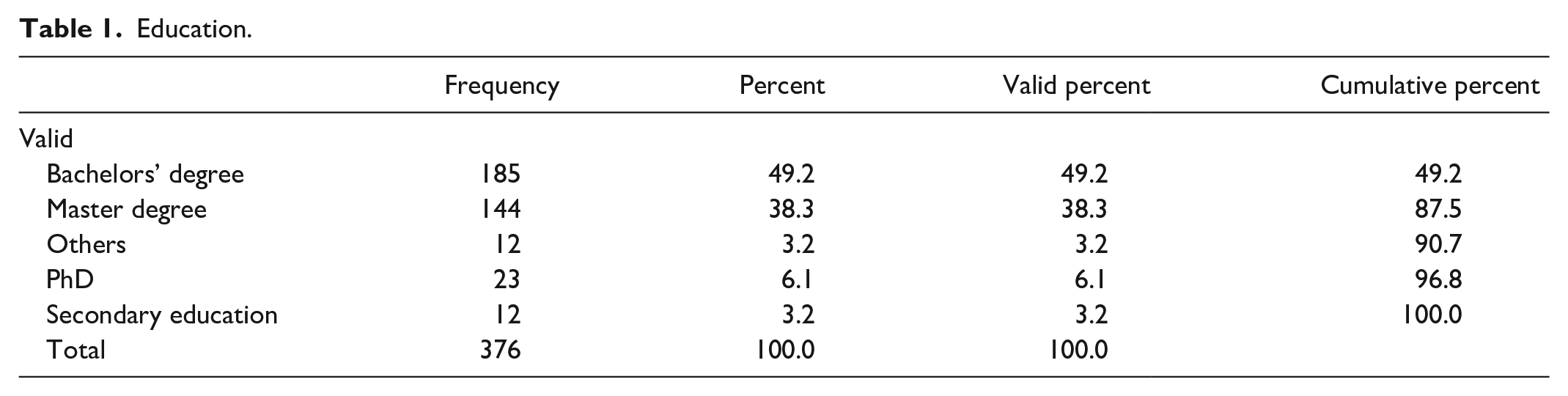
From the total of 376 valid responses, 42% were female and the residual 58% were male. It is also important to note that a two-step linear regression was conducted to ensure mediation effect is taking place. The results of this analysis is attached in the appendix section while education and age statistics are provided below (Tables 1 and 2).
Education.
What is Your Age Range?

Table 3 shows that convergent validity was achieved as the calculated values for factor loading are above 0.5. Furthermore, it can be seen that no loading was below 0.7, which supports the aforementioned statement. Similarly, calculated values of composite reliability and AVE were found to be within satisfactory level as the former is required to be above 0.7, the latter is to be above 0.5 (Hair et al., 2013, 2017; Hayes, 2017).
Loadings, Reliability, and Validity.

The above table shows that perceived organizational justice implies a mediation effect on full level with a significance (p = .034). This is in support of first and second hypotheses. It is also to be noted that a simple linear regression (ANOVA) was conducted (see Appendix) to show the relationship between independent and dependent variables, which was proven to be in support of hypothesis 1 (R-square = 0.405, p = .000, partial and part correlations of .636, t-value = 15.943).
In addition to what was mentioned above, several steps were taken to reduce/eliminate potential common method bias (CMB). In this sense, respondents were pre-assessed regarding their knowledge of the subject at hand. Moreover, anonymity of the questionnaire was established with respondents alongside distance between dependent and independent variables, and randomized items to reduce CMB (Podsakoff et al., 2003). CMB was tested through SPSS and AMOS (factor analysis and Marker method), in which no factor explained more than 50% (all remained below 30%), and Marker apathy reduced CMB from 0.11 to 0.08. As the data collection process was conducted in a single session for each company, Harman’s single-factor test (1967) was deemed appropriate to test the data regarding CMB. The first factor accounted for 11.9% of total explained variance, which implied unlikelihood of CMB in the dataset (RMSEA = .18; TLI = .765; CFI: .701; GFI = .731) (Podsakoff et al., 2003).
Tables below are representations of moderation effect of PCF on the relationship between transactional leadership and POJ. It is important to note that the mediation effect has taken place through the condition of moderator between X and M. This states that the existence of PCF is vital to initially enhance the mediating variable to further implement its effect upon OCB.
Table 5 shows that conditional indirect effect of mediating variable can occur through the existence of moderator, which enhances the mediator (POJ). This supports the third hypothesis for conditioned indirect effect. Furthermore, the moderation effect can be interpreted as R-square is .579 and confidence interval of .001, which provides support for third hypothesis. This is further shown in the interaction plot below using standard deviation and means of constructs.
Discussion
The findings of our data analysis show that there is a mediating effect from perception of organizational justice upon the relationship between transactional leadership and organizational citizenship behavior that is exhibited by employees. Furthermore, it can be seen that low levels of PCF can shield the company from having low levels of TL, which can cover aspects of leadership (if low). In addition, high levels of PCF can greatly increase the possibility of OCB and its occurrence, in particular to the context of tourism sector. This is vital as employees interact with customers and their extra-role behavior can significantly improve the image of the firm and customer satisfaction. Hence, it can be said that the moderation effect has taken place in a positive form, which can be referred to as buffer or enhancer. Mediation analysis has shown a significant change in the direct effect (Table 4), stating the occurrence of mediation effect on its full terms. It can be observed that in the second model (right column) the degree of significance significantly decreases (p = .574), which is the effect of exclusion of mediating variable. However, it is crucial to note that the mediation effect is vividly enhanced through moderation effect of PCF (Table 5), where variations of POJ are explained through existence of PCF with regard to TL. Increase in the calculated value of t and F also indicates the importance of moderating effect. Figure 2 represents the interaction effect in a plot, where PCF enhances leadership and POJ linkage even on lower levels. This implies that leaders are obliged to fulfill their commitments toward the staff, if the endeavor is to enhance their performance and invoking positive behaviors. For the context of tourism industry, it is vital that the linkage of TL and OJP is strengthened by PCF so that employees can sense positivity, safety, fairness, and thus are more likely to exhibit desirable attitudes toward the firm and subsequently, customers. According to the current findings, it is only under this condition that employees of tourism sector will be encouraged to go beyond the norms and engage in behaviors that are not defined in their roles, stating the importance and vitality of leaders’ approach, PCF, and perception of justice. These findings have a twofold contribution that are namely theoretical and empirical development of the literature, and provision of tangible evidence that suggests firms (particularly in tourism) are to fulfill the psychological contract with their employees, if they seek positive behavioral outcomes. Interaction plot statistics are presented in Table 6.
Mediation Analysis.

Moderation Effect Results of PROCESS.

Note. Age, gender, education, place of residence, and years of experience are controlled variables, and unstandardized beta (b) and standard error (se) represent independent variables (TL and PCF).
p < .05. **p < .01. ***p < .001.
Interaction Plot Output.


Interaction plot.
Implications and Conclusion
Current findings suggest that leaders should consider staff’s perception of organizational justice on a profound manner. If employees perceive injustice, then positive behaviors are unlikely to shine. This further leads to unwanted emotions and behaviors toward the organization. It becomes more vital as employees within tourism industry are in constant interaction with their customers. Thus, having employees with positive behaviors and particularly, extra-role behaviors is crucial in this context. More importantly, leaders must ensure that promises to staff are kept. This promotes a psychological foundation for influencing employees and to show support. This enables the leader to exhibit high commitment toward their followers and motivates positive behavior. According to current findings, fulfillment of psychological contract can greatly enhance perception of justice within the firm, which in turn can lead to positive behaviors such as, OCB. This is in consensus with existing literature (e.g., Ahmad & Zafar, 2018; Jehanzeb & Mohanty, 2019; Kurian & Nafukho, 2021; Yan & Zhou, 2019). Psychological contract fulfillment is a key component in terms of strengthening the likelihood of staff exhibiting OCB. As the perception of justice is significantly influenced by sense of contracts being fulfilled, it yields in positive outcomes (e.g., OCB). In terms of managerial aspect, this shows that leaders and subsequently firms are to fulfill their promises toward their staff, if they seek higher levels of performance to enhance their competitiveness. When staff conduct their tasks beyond their official norms, it is assumed that customers are able to receive a better service, which in turn can lead to intentions of revisit and/or spread of WOM/E-WOM, especially in the context of tourism (Al Halbusi et al., 2020; Ma et al., 2013).
The findings of this research show that even if leadership is low (effectiveness), employees can see benefit from their respective firms and thus, are more likely to exhibit positive attitudes and behaviors such as, OCB as PCF can enhance their perception of justice with the firm. Hence, through fulfillment of promises by the organization, even leader can be protected in times of difficulty and/or lack of certain skills of leadership. In the case of Lebanon and its infrastructure, it is important to note and highlight these results for hotel managers, tour operators and tourism agencies as the expanding and growing market within the region requires competitive services, and that Beirut receives a high number of international tourists. This is consistent with Lebanon and especially Beirut that is one of the top tourism destinations among Arab countries as well as MENA region (Middle East and Northern Africa). Thus, we encourage tourism sector authorities to imply a proper style of leadership (i.e., transactional) within their organizations and provide an atmosphere, where staff feel justice within the company and are treated equally. Further, as majority of tourism employees have a high rate of turnover, it is important that promises to staff are fulfilled through HRM practices and other leadership initiatives, which can lead to perception of justice. Consequently, this will enhance behaviors of employees toward the firm. This in turn yields in actions from employees to further satisfy customers with service provision, which is the core of service industry. These findings do not contrast from existing literature of the subject (e.g., Ali Alsheikh et al., 2018; Saez, 2020; Zaraket & Sawma, 2019). This is while no study has directly measured the elements included in this research in the context of tourism sector of Lebanon.
Limitations and Recommendations
The current study is limited in terms of scale availability as the measurements used in this research are made short due to various restrictions in the aspect of conduct. Thus, it is suitable to use full-scales for future research within the same scope. In addition, the current study takes place in one city and the data collection process is undertaken in one stage (cross-sectional). Future studies may increase the number of hotels as well as conducting a multistep survey. Longitudinal analysis can be conducted to assess the changes that leader can cause within hospitality and tourism firms. This can further benefit managers and decision-makers in terms of initiatives and strategies they use for enhancing performance and behaviors of their staff. In addition, mixed-methods can be used as leadership studies can provide a better understanding if both groups of managers/leaders and the staff are surveyed in a specific context. Lastly, it is important to note that indirect effects do not provide a solid basis with cross-sectional data at hand. Therefore, other variables such as, trust in leader, involvement, personality/characteristics, satisfaction, and/or commitment, and similar factors can be included in future models to generalize current findings.
Footnotes
Appendix

| Coefficients a | ||||||||
|---|---|---|---|---|---|---|---|---|
| Model | Unstandardized coefficients | Standardized coefficients | t | Sig. | Correlations | |||
| B | Std. Error | Beta | Zero-order | Partial | Part | |||
| 1 | ||||||||
| (Constant) | 0.822 | 0.081 | 10.180 | .000 | ||||
| Leadership | 0.568 | 0.036 | .636 | 15.943 | .000 | .636 | .636 | .636 |
Dependent Variable: OCB.
Availability of Data and Material
Data supporting the findings of this research is available upon request from the corresponding author (AD) due to privacy/ethical restrictions as it contains names of selected organizations.
Declaration of Conflicting Interests
The author(s) declared no potential conflicts of interest with respect to the research, authorship, and/or publication of this article.
Funding
The author(s) received no financial support for the research, authorship, and/or publication of this article.
