




Abstract
School feeding programs have been introduced with the aim to alleviate hunger and improve pupils’ performance. This study investigates the effects of the school feeding program on pupils’ enrollment, attendance and academic performance in northeastern Nigeria. Primary data were obtained from 180 class teachers at 60 participating primary schools, as well as secondary data from their school records. The linear regression results showed that the duration of the feeding program has a significant positive effect on pupils’ academic performance. The propensity scores matching results revealed that the school feeding program has a positive effect on pupils’ enrollment and class attendance. While the effect of the program was not significant on academic performance, perhaps because the sample size was small or a relatively short duration of the program, making it difficult to detect statistically significant differences in academic performance. Long-term school feeding programs are recommended to encourage pupils’ school attendance which will, in turn, improve performance in the long term.
Plain language summary
Our study aimed to assess the impact of school feeding programs introduced to address hunger and enhance student performance. Specifically, we examined the effects of such programs on pupil enrollment, attendance, and academic achievement in northeastern Nigeria. Data for this research were collected from 180 class teachers at sixty participating primary schools, complemented by secondary data extracted from school records. The findings from our linear regression analysis highlighted a significant positive correlation between the duration of the feeding program and pupils’ academic performance. Propensity scores matching results, on the other hand, indicated that the school feeding program had a positive influence on pupil enrollment and classroom attendance. These findings align closely with the “Human Capital Theory,” emphasizing the pivotal role of adequate nutrition in facilitating cognitive development and academic success. The observed improvements in enrollment, attendance, and academic performance in schools with school feeding programs can be attributed to the provision of nutritious meals, addressing students’ fundamental physiological needs, and enhancing their ability to focus on learning. However, it’s important to acknowledge some limitations in our study. We lacked baseline and recall data at the pupil level, as well as information on the socioeconomic backgrounds of students’ households. Factors such as parental education, household income, and food security status could influence pupil enrollment, attendance, and academic performance. Future research efforts may shed more light on these aspects.
Introduction
Despite Sustainable Development Goal 4, which aims to “ensure that, by 2030, all girls and boys complete free, equitable and quality primary and secondary education that leads to relevant and effective learning outcomes,” there are still approximately 260 million children worldwide who do not attend primary or secondary school (Griebeler et al., 2022; UNDP, 2021; UIS, 2019). In addition, about 73 million primary school children in 60 countries living in extreme poverty are in need of immediate nutritional assistance because they go to school hungry (WFP, 2020). Furthermore, the lack of meals, especially breakfast, is problematic for these most undernourished children (Adolphus et al., 2013; Bundy et al., 2018). Lack of food increases the need to work and generate income instead of attending school. Drake et al. (2012) and Verguet et al. (2020) found that one-tenth of the world’s poorest children are less likely to attend school due to a lack of income to buy food and the need to work, perpetuating intergenerational cycles of poverty. In addition to lack of food, factors such as conflict also affect students’ ability to enroll and attend school regularly. A WFP (2020) study found that children in conflict-affected countries are twice (2.5 times for girls) as likely to be out of school as their peers in stable countries. This contradicts the notion of a good education, which requires that all children have access to primary and secondary education (UIS, 2011).
Although, primary education is officially free and compulsory in Nigeria, about 10.5 million children aged 5 to 14 are not enrolled (UNICEF, 2019). The picture is even bleaker in the northern part of the country, where school attendance is only 53%. Of these attendees, only 47.7% are female, meaning that more than half of the girls in this region are out of school (UNESCO, 2019; UNICEF, 2019). On the other hand, it is estimated that more than 800,000 children in northeastern Nigeria suffer from acute malnutrition, with nearly 300,000 at risk of death due to severe acute malnutrition (WFP, 2020; UNICEF, 2020). This underscores the challenge of bringing out-of-school children back to school.
This underscores the need for the Nigerian government to adopt various strategies to increase primary school enrollment and completion rates. Subsequently, the school feeding program (SFP) was introduced in Nigeria in 2017 as an essential social safety net tool implemented in many countries around the world( FAO, 2020; NHGSFP, 2017). SFPs around the world aim to improve children’s nutrition and school attendance and performance by providing free breakfast, lunch, or snacks. SFPs thus support the realization of children’s rights as articulated in the Convention on the Rights of the Child (OUNHCHR, 1989), which includes the right to food, health, and education, which can contribute to the realization of key socioeconomic rights (McEwan, 2013).
Studies conducted in different countries (Agu et al., 2023; Drake et al., 2017; Zenebe et al., 2018) use indicators such as school enrollment (Metwally et al., 2020; Zenebe et al., 2018), school attendance (Wang & Fawzi, 2020; Zenebe et al., 2018), academic performance (Gelli et al., 2016; Igboji et al., 2022; Zenebe et al., 2018), and health and nutrition (Buttenheim et al., 2011; Chakraborty & Jayaraman, 2019) to assess the impact of SFPs. In addition, studies show that school feeding programs increase students’ motivation to enroll and attend school regularly (Bundy et al., 2018; Drake et al., 2012). However, when it comes to performance, other institutional factors such as the learning environment and teacher quality(Afridi et al., 2014; Gelli, 2010; Grantham-McGregor et al., 1998; Kazianga et al., 2009) may influence the effectiveness of SFP.
The region of northeastern Nigeria where this study was conducted was selected because of its particularities, such as high levels of out-of-school children, Boko Haram attacks, and kidnappings of school children. In addition, food insecurity is prevalent in the area, which affects children’s academic performance. Furthermore, the lack of formal education leads to the manipulation of children into destructive vices such as crime and early marriage (UNICEF, 2020; WFP, 2020).
The theory and context of SFP, which is funded and administered by the Nigerian government, is well defined. However, previous studies conducted in Nigeria on the impact of SFP on school enrollment, attendance, retention, and student academic performance (Agu et al., 2023; Igboji et al., 2022) have not met some principles required for theory-based impact evaluations. These include the use or reporting of mixed methods (qualitative and quantitative data) and the availability of factual and counterfactual analyses (pre- and post-intervention outcomes). Furthermore, to the best of our knowledge, no large-scale study of primary school pupils has been conducted since the implementation of the SFP in 2017 to track its success and assess its impact.
While the theoretical foundation supporting the implementation of school feeding programs is compelling, empirical evidence documenting their actual impact remains a topic of ongoing research and debate. Previous studies have offered valuable insights into the positive effects of such programs, including increased school attendance, reduced dropout rates, and improved academic achievement (Agu et al., 2023; Ashraf et al., 2021; Drake et al., 2017; Gordon & Ruffini, 2021; Kirksey & Gottfried, 2021; Zenebe et al., 2018). Most of these existing studies focus on the effect of the program on pupils’ enrollment, attendance and academic performance (test score), while the effect of the duration of the program has been largely neglected, especially in Nigeria and Africa in general.
By studying the duration of these programs, researchers can assess whether longer-term interventions have a more significant impact on educational outcomes such as attendance and test scores. This information can help policymakers make informed decisions about program duration and funding. Furthermore, understanding the impact of program duration can also inform decisions about the sustainability and scalability of school feeding programs. If longer-term programs are shown to be more effective, it may encourage investment in sustainable, long-lasting initiatives that benefit a larger number of pupils over time.
The objective of this study is to conduct an ex-post evaluation of the impact of the SFP on student enrollment, attendance, and academic performance, as well as the impact of the duration of the feeding program on academic performance. We evaluate the impact of the program using enrollment, attendance, academic performance, and duration of the feeding program as indicators. Enrollment was measured by the enrollment rate, which measures the proportion of primary school-age children enrolled in primary school in a school catchment area (officially registered in a school register) in a given academic term. Attendance is expressed as the percentage of days the child attends school each year, based on current records kept by teachers in daily class registers. Academic performance was assessed using test scores in two subjects, math and English, at the end of a given academic term. The duration of the feeding program was measured in months from the start of the program at the time of data collection. The effect of the duration of the SFP was measured by analyzing the average growth rate of the variables (enrollment, attendance, and academic performance) experienced over a period of time (Erturk et al., 2008; Mahmood et al., 2022).
Several studies have examined the impact of different SFPs in different geographical areas, often with conflicting results (see Chapter 2). However, very little attention has been paid to the effect of the duration of the feeding program on academic performance (Chakraborty & Jayaraman, 2019). Therefore, more studies are needed to understand the effects of SFP duration on school performance and the program under specific local conditions. This study will contribute to the understanding of the selected effects of the SFP in the vulnerable area(s) of northern Nigeria. The empirical results and comparison with the results of other studies on the effects of different SFPs in different parts of the world are expected to provide insights for governmental and non-governmental organizations in the area to better adapt the program so that it is effective in achieving its objectives. To enhance the robustness of our findings, this study also solicits teachers’ perception regarding the effects of School Feeding Programs (SFPs) on pupil’s enrollment, attendance, academic performance and class participation. This additional perspective will provide valuable insights for policymakers, complementing the analysis of school records.
This study answers the following research questions:
Do teachers perceive any impact of the school feeding program on pupils’ participation?
Does the implementation of school feeding programs have a significant impact on school enrollment, attendance rates, and academic performance?
Does the duration of the feeding program have a discernible impact on pupils’ academic performance?
Theoretical Framework and Literature Review
Theoretical Framework
The theoretical underpinning of the study is the combination of the Human Capital Theory of Education and Vroom’s expectancy theory. The Human Capital Theory provides a valuable framework for understanding how the SFP can impact pupils’ education performance (enrolment, attendance, and test scores). The Human Capital Theory recognizes that nutrition plays a fundamental role in the development and maintenance of human capital (Becker, 1967). Adequate nutrition is essential for physical and cognitive development, as well as overall health. School feeding programs aim to address nutritional deficiencies in pupils, particularly in regions where access to nutritious meals at home may be limited (Ashraf et al., 2021; Gelli et al., 2019; Zenebe et al., 2018). By providing regular, balanced meals, these programs contribute to improving pupils’ nutritional status which are crucial for economic development and individual well-being, which in turn positively affects educational performance (Chakraborty & Jayaraman, 2019; Kirksey & Gottfried, 2021). Considers the direct effect of nutrition on cognitive abilities and indirectly through improved health and reduced absenteeism. School feeding programs can be seen as a specific form of investment in human capital, primarily focused on improving nutrition and health, which, in turn, can positively influence education outcomes (Bundy et al., 2018; Gordon & Ruffini, 2021). It is important to note that the human capital theory also suggests that longer participation in education programs, including school feeding can enhance pupils’ human capital, potentially leading to improved future outcomes in the labor market. Therefore, the longer the duration of the feeding program the more likely it affects pupils’ academic performance (Afridi et al., 2014; Chakraborty & Jayaraman, 2019).
Vroom’s expectancy theory states that individuals are motivated to perform when they know that their extra effort will be rewarded (Vroom, 1964). In our context, food is seen as a reward that a child will receive for enrolling and attending school regularly. As such, the SFP motivates and encourages pupils to attend school regularly, thereby reducing absenteeism. Irregular school attendance can lead to a student’s likelihood of dropping out before graduation and poor test scores (Gelli et al., 2016; Kirksey & Gottfried 2021; McEwan, 2013; Wang & Fawzi, 2020).
Literature Review and Hypothesis
In the following section, the findings in the literature regarding the effect of school feeding programs on pupils’ enrolment, attendance, and performance scores are presented.
Effect of School Feeding Program on School Enrolment, Attendance Rate and Academic Performance
Several studies have examined the impact of SFPs on children’s school enrollment around the world, with conflicting results. For example, some studies in Nigeria, Peru, Mali, Sri Lanka and Ethiopia found an increase in the number of pupils enrolled in SFP (Agu et al., 2023; Metwally et al., 2020; Masset & Gelli, 2013; Sulemana et al., 2013; Zenebe et al., 2018). In their study in Bangladesh, Ahmed and del Ninno (2002) found an 8% increase in enrollment in an SFP targeting poor households using a pre-and post-intervention evaluation. In another study in Bangladesh, SFP led to a 20% increase in enrollment in participating schools and a 2% decrease in enrollment in non-participating schools (Ahmed, 2004). Similarly, research conducted by the World Food Program in Malawi (WFP, 1996) found that a short, experimental SFP implemented over a three-month period resulted in a 5% increase in enrollment among beneficiary pupils. On the other hand, studies conducted in Ethiopia, and Laos found no evidence of an increase in the number of children enrolled in schools that implemented SFP (Asmamaw, 2014; Buttenheim et al., 2011). For example, a study conducted in Ethiopia (Asmamaw, 2014) found no significant difference in the increase in enrollment of children between school beneficiaries and nonbeneficiaries. Similarly, another study conducted in Laos (Buttenheim et al., 2011) found no significant difference in school enrollment between beneficiaries and nonbeneficiaries. They attributed the increase to enrollment due to other government policies rather than the SFP, as both beneficiary and non-beneficiary students experienced an increase in enrollment within the program period.
Hypothesis 1 (H1): School feeding program affects pupils’ school enrolment.
Research on the impact of SFPs on reducing absenteeism and increasing attendance is mixed. On the one hand, program results from Nigeria, the United States, Chile, the United Kingdom, Ghana, Ethiopia, and Laos show a positive relationship between the SFP and student attendance (Alderman & Bundy, 2012; Gelli et al., 2016; McEwan, 2013; Zenebe et al., 2018; Wang & Fawzi, 2020). For example, a study by Zenebe et al. (2018) found that recipient children were more likely to report absenteeism than nonrecipient students. Hunger was cited as the main reason for absenteeism among non-beneficiaries (42.8%). Similarly, Yendaw and Dayour’s (2015) study in Ghana found that only 22% of students attended school regularly in the week before the SFP program was implemented, but more than 60% of students attended school regularly in the following week. Another study conducted in United State by Kirksey and Gottfried (2021) reported that implementation of “Breakfast After-the-Bell” (BAB) a form of school feeding program has a statistically significant decline in chronic absenteeism. Specifically, schools with BAB had 3% points lower rates of chronic absenteeism compared to schools without BAB. On the other hand, studies in Ethiopia and Burkina Faso reported no significant increase in school attendance in schools participating in the feeding program (Asmamaw, 2014; Kazianga et al. 2014). In their study of the impact of the SFP on school attendance among Ethiopian students, Asmamau (2014) found no significant differences between beneficiaries and non-beneficiaries and linked attendance to distance from home to school. Regarding gender, studies in Malawi and India reported that girls were more likely to attend school than boys (Afridi, 2011; Edström et al., 2008) because, in poor families, a boy child is more likely to engage in labor activities to supplement household income rather than attend school.
Hypothesis 2 (H2): School feeding program affects pupils’ school attendance.
Previous studies have found mixed evidence on the impact of school meals on pupil achievement. Studies have been conducted in different geographical locations such as Nigeria, the United Kingdom, United State, Ethiopia, Ghana, Burkina Faso, Kenya, India, and Bangladesh. The different school feeding programs significantly improved children’s academic performance (Chepkwony et al., 2013; Gelli et al., 2016; Kazianga et al., 2010). For example, a study conducted in Burkina Faso by Kazianga et al. (2010) found that SFP has a positive impact on pupils’ academic performance. The authors argue that the interventions improve learning outcomes for enrolled children through consistent attendance. Similarly, a study conducted in Bangladesh (Ahmed, 2004) reported a 15.7% increase in test scores among school participants in the SFP. The authors suggested that short-term hunger relief may have improved students’ memory and information-processing efficiency. In a separate investigation carried out in the United Kingdom by Ashraf et al. (2021), it was found that interventions had a positive overall impact on the literacy outcomes of Free School Meals (FSM) students, resulting in a pooled effect size of 0.06 (0.03, 0.08). Nonetheless, when it came to mathematics, there was no observable overall effect on FSM students. In contrast, Adelman et al. (2008) find that literacy scores declined for students in the school feeding groups, but they don’t explain why. Similarly, Grantham-McGregor et al. (1998) found that the introduction of a school breakfast program in Jamaica led to a decline in learning outcomes in poorly managed schools. Moreover, several studies conducted in Ghana, Malawi, India, Burkina Faso, and Kenya found no significant relationship between the school feeding program and children’s academic performance (Afridi et al., 2014; Edström et al., 2008; Gelli et al., 2019; Kazianga et al., 2009). For example, Gelli et al. (2016) reports that the reason for the low or no effect on the academic performance of SFP beneficiary pupils is that the increase in student enrollment rate was not accompanied by an increase in staff capacity. Similarly, Vermeersch and Kremer, (2005) found no effect of SFP on academic performance, which was closely related to the availability of good teachers and not to the feeding program.
Hypothesis 3 (H3): School feeding program affects pupils’ academic performance.
Several authors have argued that the duration of the SFP can affect pupils’ academic performance (Afridi et al., 2014; Singh et al., 2014). For example, Afridi et al. (2014) use difference-in-differences to assess the effect of extending midday meals to upper primary (grades 6–8) in educationally “backward” areas on the learning outcomes of 400 students in 16 Delhi schools. The authors find a significant increase in pupils’ attendance. However, they find no increase in academic test scores over the 4-month period of the study. Another study by Singh (2008) finds improvements in the Peabody Picture Vocabulary Tests in the Young Lives panel of about 500 children in Andhra Pradesh. In another study in India, Chakraborty and Jayaraman (2019) find that children with up to 5 years of SFP have 18% higher reading and 9% higher math test scores than students with less than 1 year of exposure. Agarwal et al. (1989) found that math test scores increased more for pupils who participated in the intervention for 24 months than for other beneficiaries who participated for less time. However, a study in Kenya (Neumann et al., 2003) that examined the impact of a 23-month program found a small effect of program duration on achievement. Examining the influence of the program’s duration aids in assessing how both long-term and short-term feeding interventions impact pupils. This insight is crucial for refining program design and making informed decisions about resource allocation. Moreover, evaluating the enduring effects of school feeding programs provides valuable insights into whether the benefits extend beyond the program’s timeframe and contribute to improved life outcomes for pupils.
Hypothesis 4 (H4): Duration of the school feeding program affects pupils’ academic performance.
Controlling Variables Affecting Pupils’ Performance
Several controlling variables, including parental education, class size, teacher gender, teacher age, teacher qualification, and student class attendance, were included in our linear regression model because of their potential to influence pupil enrollment, attendance, and performance, as previous empirical studies have shown. Previous studies revealed that larger classes lead to lower educational performance, especially in the early years of schooling (Mulera et al., 2017). The authors agreed that larger classes lead to poorer academic performance due to less individualized attention from the teacher and a more disruptive classroom environment. Pupils in small classes are more visible and more likely to participate in learning and social activities during class (Hanushek, 2003; Schanzenbach, 2020). Similarly, Kelley et al. (2020) report that pupil-teacher ratios of less than 18:1 are associated with higher academic achievement in kindergarten through third grade. It is important to emphasize that poor performance is likely if enrollment increases due to SFP without an increase in staff capacity (Gelli, 2010; Grantham-McGregor et al., 1998). Findings on teacher gender show that female teachers positively improve pupils’ academic performance (Mulera et al., 2017) and have higher rates of retention, progression, and completion of primary school(UIS, 2010, 2011) than their male counterparts. Female teachers are more sensitive to their students’ emotions than male teachers. This allows female teachers to develop intimate relationships with their pupils in the lower grades (Gong et al., 2018).
Many studies have shown that improvements in the academic performance of schoolchildren are closely linked to the availability of well-qualified teachers (Canales & Maldonado, 2018). Qualified teachers may be the most important in-school factor in improving student performance because they understand the subject matter and use different teaching methods (Mulera et al., 2017; OECD, 2018). For example, Hanushek and Rivkin (2010) reported that high-quality teachers can improve students’ academic performance by up to 1.5 grade levels per year, while poor teaching can limit students to 50% of expected learning gains.
A positive relationship has been found between teacher age and student academic achievement (Harris & Sass, 2011; Ladd & Sorensen, 2017). According to these studies, an increase in years of experience corresponds to an increase in teacher age, which improves the delivery and quality of teaching methods. On the other hand, Wilson et al. (2014) found that teachers’ enthusiasm decreases with increasing age, which may be related to the boredom of teaching the same material for a long time and increasing academic responsibilities.
School attendance rate is another important factor influencing pupils’ academic performance. Numerous studies have shown that pupils who attend class regularly are more likely to receive higher grades than those who have poor attendance (Jackson et al., 2011; Morrissey et al., 2014). Conversely, other studies have reported no relationship between attendance and performance (Khanam & Ross, 2011), arguing that absenteeism doesn’t always lead to poorer performance.
Methodology
The Study Area
Nigeria’s total population was 195.9 million in 2018, with an annual growth rate of about 3.2% and a mortality rate of 101 deaths per 1,000 live births for children under five. Furthermore, Nigeria’s population is expected to reach 213 million by 2021, with more than 41% of the population under the age of 14, and 410 million by 2050 (National Bureau of Statistics [NBS], 2021). Northeast Nigeria is made up of six states, namely Adamawa, Bauchi, Borno, Gombe, Taraba and Yobe, which cover just under a third of Nigeria’s total area. This region has an estimated population of 23,558,674 or 13.5% of the country’s total population (NBS, 2020). During the reference period, Q4, 2020, the unemployment rate was 33.3%, an increase from 27.1% recorded in Q2, 2020 (NBS, 2021). In Nigeria, the national minimum wage remained unchanged at ₦30,000 per month equivalent to ($83) (World Bank, 2020). This wage is applicable across the entire country, including the northeastern region. It’s important to note that the minimum wage in Nigeria is considerably lower when compared to developed countries like the United States, the United Kingdom, and Germany ranging between $1256—$2300/month (Bossler & Schank, 2023; Dube & Lindner, 2021; Manning, 2021).
Among the 260 million children aged 6 to 18 who are out of school, over 40%, equivalent to 98 million children, reside in sub-Saharan Africa (UNESCO, 2022; WFP 2022). Within this total, Nigeria account for 10.5 million children not attending school (UNICEF, 2020). Sixty percent of Nigeria’s 10.5 million out-of-school children live in the northeast region (UNICEF, 2020). In addition to the security challenges faced in northeast Nigeria, the COVID-19 pandemic in Nigeria has exacerbated the situation in the region (UNICEF, 2020; WFP, 2020). The number of out-of-school children is increasing due to total or partial school closures caused by COVID-19 (UNICEF, 2022). As of 2019, an estimated 7.1 million people in the region are in need of assistance, including 2 million people displaced by the conflict, many of whom are living as IDPs in Nigerian military garrison villages (Stoddard, 2020).
Food security in northeast Nigeria has also deteriorated compared to previous years, with poor and borderline food consumption (reported by 44% of households) almost as high as at the height of the crisis (NBS, 2020; WFP, 2020). Most households lack the economic capacity to meet basic needs, with 60% of the population considered highly vulnerable (NBS, 2020; WFP, 2020). The use of emergency coping strategies has increased from 12% in 2019 to 27% in 2020, and the median household debt has increased by 66%, from 6,000 Nigerian Naira (NGN) to 10,000 NGN (Stoddard, 2020; NBS, 2020; WFP, 2020).
Due to the global COVID-19 pandemic, public and private schools in Nigeria were closed from March 30 to July 7, 2020. During this period, the government continues to distribute food to needy children who are not in school as a palliative measure to alleviate the burden on household food security. However, the data for this study only covers the period when schools were open and operational. Data were collected in areas where Boko Haram activity is low, so no attacks caused school closures in the study area. The study looks at the SFP intervention from 2017 to 2020. However, the implementation of the program was not consistent across all schools, as some schools were initially selected as pilot projects, while others were selected as part of the second batch (Figure 1).

Map of Nigeria showing the Northeastern region and the study area.
Sampling Procedure and Sample Size
A multistage sampling procedure was used to select the classroom teachers. The first step was to purposively select a sample of three out of six states in northeastern Nigeria, namely Adamawa, Bauchi, and Gombe. These states were chosen because they are less vulnerable to Boko Haram terrorist attacks in the northeast region of Nigeria. The next step was to purposively select four local government areas from each state. This was done to avoid local government areas with high rates of kidnapping and banditry. Then, five districts were randomly selected from the initial list of local government areas. In the final stage, one primary school in each of the wards was randomly selected, and then three classroom teachers (grades one to three) were selected for the study, constituting 180 respondents (Table 1).
Sample Selection.

LGA = local governmental area.
Data
Primary survey data were collected by one of the co-authors, assisted by enumerators, using a face-to-face interview with teachers and the kobotoolbox mobile phone application from November to December 2020. The questionnaire included teachers’ perceptions of the SFP effect on pupils’ enrollment, attendance, academic performance, and class participation. We also collected information on teachers’ educational qualifications, age and years of teaching experience. As testing on 10% of the study sample size is recommended (Hertzog, 2008), a pilot test survey was conducted with 18 classroom teachers at all study sites. The results of the pilot survey required adjustments to the questionnaire to make it fully understandable to the teachers.
Secondary: We collected student-level data from a total of 60 schools, encompassing 12,648 students prior to the introduction of the SFP (School Feeding Program) and 16,076 students following its implementation. This dataset included information regarding students’ household backgrounds, school enrollment and attendance records, as well as their academic performance history. For instance, concerning enrollment data, we recorded the total number of students enrolled in each school during two academic sessions: one before the SFP implementation (2018/2019) and the other after (2019/2020). In cases where the program did not run for a full year, we utilized two-term records. To assess class attendance, we obtained the average attendance for a specific class during the 120 days preceding and following the program’s introduction. We derived this information from the school register. We tracked the same class after the program implementation to determine if any changes in attendance had occurred (e.g., pupils in grade one before the intervention were in grade two while we were obtaining after intervention information).
In evaluating academic performance, we used math and English scores for pupils in grades 1 to 3 over the course of two semesters prior to and following the SFP intervention. To clarify, pupils in grade one before the program were in grade two when we collected their data post-intervention, as such we obtained their records at grade two to tracked for possible significant changes. The test has a minimum score of 0 and a maximum score of 100. Other data collected include the staff-student ratio, which we calculated by dividing the number of students enrolled in a school by the number of teachers employed by the school during the SFP. We also obtained data on the number of students in a class by taking record of the number of students in a given classroom from each school.
Quantitative Data Analysis
First, a paired-sample t-test was used to assess students’ level data by comparing the means of selected variables before and after the intervention (enrolment, attendance, and performance).
Second, a linear regression model was used to determine the effect of the school feeding programs on education performance (using Mathematics and English scores as dependent variables) adopted from Chakraborty and Jayaraman (2019) and Afridi et al. (2014) using STATA 14 statistical software.
Linear Regression
Models specification:

Where:
The model was tested for multi-collinearity using a correlation matrix, tolerance coefficients, and a variance inflation factor (VIF), indicating that the variables were independent. The Durbin-Wu-Hausman test did not indicate any effect of potential endogeneity.
Our dependent variable, a continuous variable, used pupils’ average test scores in English and mathematics, as adopted from previous studies (Gelli et al., 2016; Kazianga et al., 2013; Zenebe et al., 2018). The empirical literature was reviewed to identify the factors influencing pupils’ educational performance that were tested in the regression model (socioeconomic variables of teachers and learning conditions and learning situation) (see Chapter 2.1 Empirical models and hypotheses).
Our study did not include the socioeconomic characteristics of the students’ households because we did not have access to this information and the main objective of the study was to examine the effect of SFP on pupils’ school enrollment, attendance and academic performance and the effect of institutional variables that are likely to influence the outcome of the feeding program.
Empirical Strategy
The study’s objective was to evaluate how SFP affected pupils’ school enrollment, attendance, and academic performance. In an optimal scenario, schools would have received the SFP at random, allowing any identified differences in outcomes to be attributed to the school feeding programs (Heckman & Smith, 1995).
Due to endogeneity concerns, a simple pre-post comparison or the use of cross-sectional post-treatment data may not be sufficient to conduct such an impact evaluation. For example (1). Schools with longer SFP durations may differ from those with shorter SFP durations in a number of ways, as they may receive additional support from the government and/or donor community, such as deworming medication, meals during classes, take-home rations, and in-kind transfers in low-income areas that amount to 10% to 15% of household income, which can be a strong motivator for parents to send their children to school (WFP, 2018; Wall et al., 2022). If unobserved by researchers, this may lead to an overestimation of the impact of SFP. (2). Only at the ward level was the school feeding sampling method fully randomized, due to political (conflict) constraints that led to a purposive selection of study areas at several stages. Studies on the impact of SFP on pupils’ enrollment, attendance, and performance (Buttenheim et al., 2011; Drake et al., 2017; Dago & Yogo, 2022) advocate the use of propensity score matching (PSM), which also addresses the problem of self-selection bias (Kazianga et al., 2013). Various tests can be used to detect additional bias and sensitivity to unobservable cross-sectional data (Dago & Yogo 2022). The PSM approach is used to estimate the treatment effect of SFP pupils’ enrollment, attendance, and academic performance in the case of a binary treatment variable (Dehejia & Wahba, 1999; Rosenbaum & Rubin, 1983).
Propensity Score Matching
Propensity score matching (PSM) was used to compare the post-intervention (treatment) group with the pre-intervention (control) group. The Nearest Neighbor Matching (NNM) algorithm was used to analyze the average treatment effect (ATT) of the school feeding program on student enrollment, attendance, and academic performance. Propensity scores are typically presented as follows:

Where M represents the binary SFP status of the students; if pre-intervention = 0 and post-intervention = 1 in the year 2021. Y1 and Y0 represent the outcomes (enrollment, attendance, and academic performance) for the treatment and control groups, respectively, given the propensity score p(X). To account for unobservable hidden bias, Rosenbaum’s bounds were computed (Rosenbaum & Rubin, 1983).
Sample Description
Table 2 shows the descriptive statistics of the variables included in the regression model. After the SFP was implemented, the mean math score was 48.77 and the mean English score was 48.21. The average age of the teachers was 41 years, and most of them were male (57.2%). Approximately 23% of the teachers had a graduate degree and 3.9% had a postgraduate degree as their highest qualification. Teachers in the sample had an average of 16 years of teaching experience.
Description of Variables in the Linear Regression Model.

SFP = school feeding program.
On average, SFP had been implemented in the beneficiary schools 15 months prior to the survey. The average teacher-student ratio was 34 students per teacher, with a minimum of 7 and a maximum of 67. The average number of students in a class was 64. The average attendance rate per 100 school days was 90.3% for boys and 89.4% for girls.
Result and Discussion
Teachers’ Perceived Effect of SFP
Pupils’ School Enrolment, Attendance, and Performance
The results of the perceived impact of SFP on pupils’ enrollment, attendance, and performance by classroom teachers are presented in Figure 2. According to the results of the study, most teachers (88.3%) perceived that the school feeding program increased pupils’ enrolment. This is consistent with the findings of Zenebe et al. (2018), Alderman and Bundy (2012), Snilstveit et al. (2018), Mwendwa and Gori, (2019) who reported that a school feeding program increased pupil enrollment. Furthermore, the findings of this study revealed that most teachers (88.3%) believed that the school feeding program had reduced absenteeism and increased pupil enrollment in the study area. This finding is consistent with previous studies conducted by Gelli et al. (2016), Zenebe et al. (2018), Snilstveit et al. (2018), and Mwendwa and Gori, (2019) who found that school feeding programs increased pupil attendance. Classroom teachers were also asked if school feeding had an impact on pupils’ academic performance. According to the findings, the majority of teachers (70.6%) believe that school feeding programs improve students’ academic performance.

Teachers’ perceived effect of school feeding on pupils’ school enrolment, attendance and performance (N = 180).
Pupils’ Class Participation
Figure 3 shows that 68.3% of the teachers perceived a moderate or great improvement in students taking learning seriously, 55.6% in following directions, and 59.4% in staying active throughout the school day. Teachers’ perceptions of the impact of school meals on pupils’ classroom participation showed that 48.9% of teachers perceived a moderate or great improvement in listening attentively, 42.7% in working independently, and 45.0% in better concentration.

Teachers perceived effect of SFP on pupils’ class participation indicators (N = 180).
School Records Evidence and SFP Implementation Effects
Class Size, Pupil-Teacher Ratio and Duration of SFP
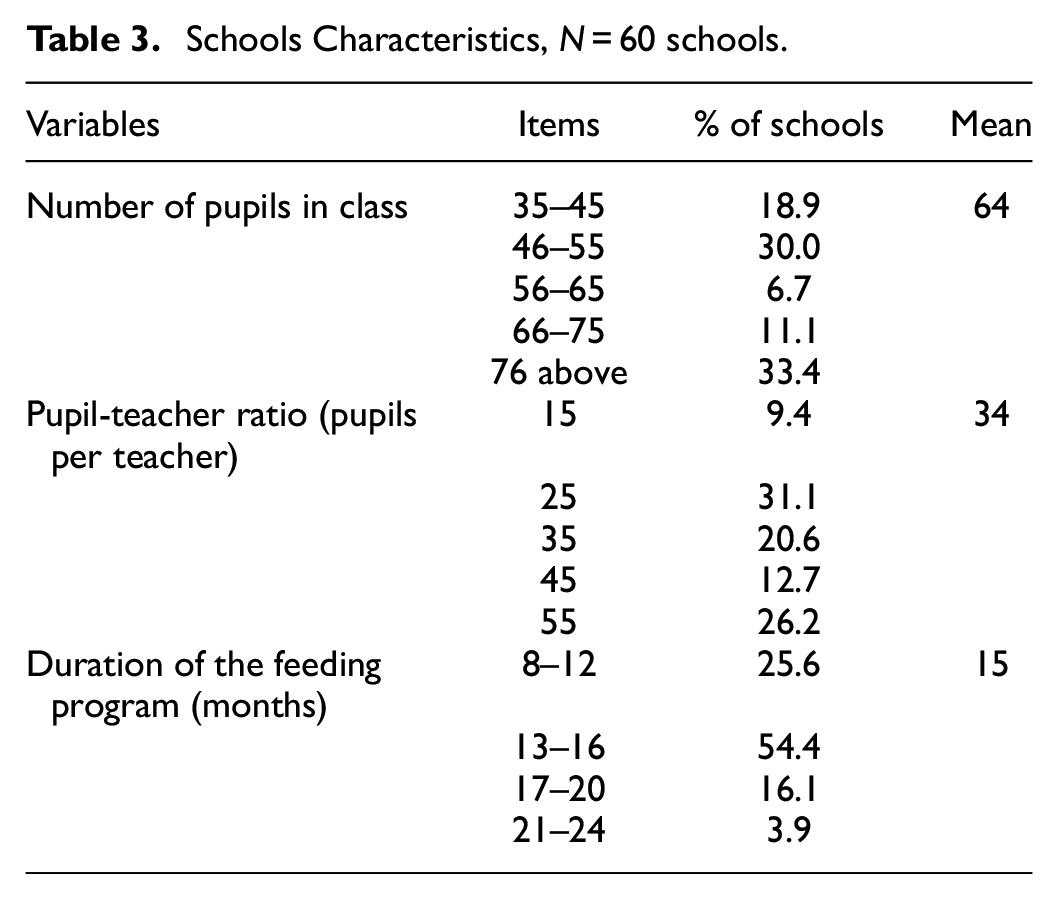
Table 3 shows that 51.2% of classes in the study area had 56 or more pupils, with an average class size of 64 pupils. This is well above the OECD recommendation (OECD, 2022) of 25 to 30 pupils. The pupil-teacher ratio was not consistent across schools in the study area. The results show that 9.4% of the schools have a pupil-teacher ratio of 1:15, 31.1% of the schools have a pupil-teacher ratio of 1:25, 20.6% have a pupil-teacher ratio of 1:35, 12.7% have a pupil-teacher ratio of 1:45, and 26.2% have a pupil-teacher ratio of 1:55. The duration of the SFP varied across schools due to different implementation periods. At the time of data collection, about 27% of the schools were benefiting from the SFP for 8 to 12 months, while 54.4%, 16.1%, and 3.9% of the schools were benefiting from the program for 13-16, 17-20, and 21-24 months, respectively.
Schools Characteristics, N = 60 schools.
Effect of SFP on Enrolment, Attendance, and Performance
Table 4 presents descriptive statistics of changes over time as a result of SFP implementation. The results show that the number of pupils enrolled in school increased by 27%, from 12,648 to 16,076 in the study sample. Average pupils’ attendance increased from 70.58 days (pre-intervention) to 90.86 days (post-intervention). Math and English test scores were used to assess pupils’ academic performance. The average math test score improved from 46.96 to 48.78. Similarly, average English scores increased from 46.53 to 48.21.
Effect of SFP on Enrolment, Attendance and Performance (N = 60 schools).

Pupils enrolled = this is the total number of enrolled pupils in the selected beneficiary school one academic year before the intervention began and one academic year after the SFP began.
School attendance (days) = This is the average number of school days pupils attended during 120 school days before and after SFP intervention.
Average scores in Math and English = this is the average mean score in Math and English on a scale of 0–100 points before and after an intervention.
Pupils’ Enrolment, Attendance, and Performance
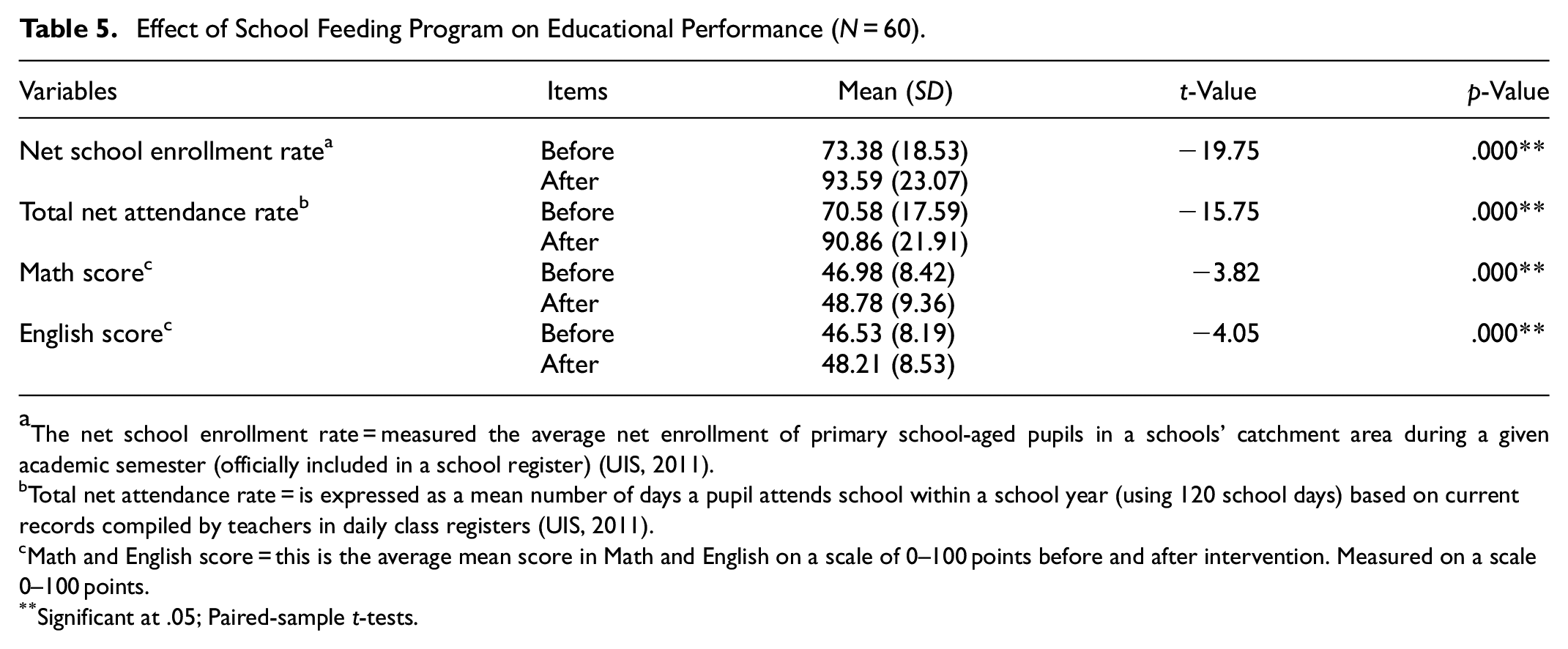
Table 5 shows the comparison of mean pupils’ enrollment, attendance, and performance in math and English before and during the SFP. The results show a statistically significant difference in pupils’ enrollment before and after the intervention, with a mean enrollment of 73.38 and 93.59 students, respectively. This finding is consistent with studies conducted in Peru, Mali, Sri Lanka, Egypt, Ghana, Bangladesh, and Ethiopia on the impact of school feeding programs on children’s school enrollment, which reported a significant increase in the number of pupils enrolled (Aurino et al., 2018; Agu et al., 2023; Masset & Gelli, 2013; Metwally et al., 2020; Zenebe et al., 2018).
Effect of School Feeding Program on Educational Performance (N = 60).
The net school enrollment rate = measured the average net enrollment of primary school-aged pupils in a schools’ catchment area during a given academic semester (officially included in a school register) (UIS, 2011).
Total net attendance rate = is expressed as a mean number of days a pupil attends school within a school year (using 120 school days) based on current records compiled by teachers in daily class registers (UIS, 2011).
Math and English score = this is the average mean score in Math and English on a scale of 0–100 points before and after intervention. Measured on a scale 0–100 points.
Significant at .05; Paired-sample t-tests.
Furthermore, our results showed a statistically significant difference in pupils’ school attendance rates before and after the SFP intervention, with mean attendance rates ranging from 70.58 to 90.86 school days, respectively. This finding is consistent with studies conducted in the United Kingdom, Ghana, Ethiopia, and Laos, which found a positive relationship between the school feeding program and pupils’ attendance rates(Aurino et al., 2018; Kirksey & Gottfried 2021; Metwally et al., 2020; Zenebe et al., 2018).
In terms of achievement, both math and English average scores improved slightly during the program. On a scale of 1 to 100, math scores improved from 46.98 to 48.78, while English scores improved from 46.53 to 48.21. This finding is consistent with the results of several studies conducted in Nigeria, the United Kingdom, Ethiopia, Ghana, Burkina Faso, Kenya, India, and Bangladesh, which found that school feeding programs significantly improved students’ academic performance (Ashraf et al., 2021; Chepkwony et al., 2013; Gelli et al., 2016; Kazianga et al., 2013; Metwally et al., 2020; Zenebe et al., 2018).
Effect of Duration of SFP on Pupils’ Academic Performance
The results of the linear regression model (Table 6) show that pupils with female classroom teachers achieved higher scores in English and mathematics. This is in line with Gong et al. (2018), Mulera et al. (2017) who reported that female teachers are more sensitive to their pupils’ emotions than male teachers. This allows female teachers to establish intimate relationships, which helps to motivate their pupils.
Linear Regression on Factors Affecting Pupil’s Educational Performance.

Source. Own survey.
Performance in English and Math for grades 1–3, measured on a scale 0–100 points.
Furthermore, an increase in teachers’ educational qualifications has a significant positive relationship with pupils’ English and mathematics test scores. An increase in qualifications means that a teacher’s ability to teach increases and pupils learn more. This is consistent with the findings of OECD (2018) and Mulera et al. (2017), who found that qualified teachers can be the most important in-school factor in improving pupils’ performance because they understand the subject matter and use a variety of teaching methods.
The duration of the feeding program has a statistically positive and significant impact on pupils’ English and math scores in our model. A 1-month increase in the duration of the feeding program leads to an increase in English and math achievement of 0.86 and 0.68 points, respectively. The results are consistent with previous research conducted in India and Zambia, which found that prolonged exposure to midday meals has a positive impact on learning outcomes (Chakraborty & Jayaraman, 2019; Singh et al., 2014). Implying that longer-duration school feeding programs provide pupils with regular and consistent access to nutritious meals. Adequate nutrition is crucial for brain development and cognitive functioning. Nutrient-rich meals can enhance pupils’ concentration, memory, and overall cognitive abilities, which are essential for success in math and English.
School attendance has a statistically significant positive effect on academic performance in both English and mathematics. A 1-day increase in school attendance is likely to increase performance in both English and math by 0.577 and 0.459, respectively. This finding is consistent with Jackson et al. (2011), Morrissey et al. (2014), who reported that students with higher attendance are more likely to receive higher grades than those with poor attendance. Similarly, Duran-Narucki (2008) reported that pupils who attend class regularly are more likely to receive good grades than pupils who don’t. This suggests that when schools offer meals consistently, it can incentivize pupils to attend school regularly. Improved attendance rates mean that pupils are more likely to receive consistent instruction in math and English, leading to better performance on tests.
Impact of SFP on Pupils’ Enrollment, Attendance, and Academic Performance
The average treatment effect of the SFP on pupils’ enrollment, attendance, and academic performance (Table 7) shows that the SFP has a significant impact on pupils’ enrollment and attendance. However, the results show that the SFP has no impact on pupils’ academic performance (math and English test scores). This implies that the SFP has the potential to increase enrollment and attendance, but not academic performance. This is consistent with an Indian study by Afridi et al. (2014), which found that midday meals among primary school pupils (grades 6–8) in educationally “backward” areas. The authors found a significant increase in student enrollment and attention. However, they found no improvement in academic test scores over the course of the four-month study. Similarly, another study in Kenya and Chile (Neumann et al., 2003; McEwan, 2013) found the effect of SFP on improved enrollment and attendance, but found a small, though insignificant, effect on academic performance. Figure 4 shows the kernel distribution of the effect of SFP on pupils’ enrollment and attendance, which shows a significant increase in post-intervention pupil enrollment and attendance compared to pre-intervention students. Figure 5 shows the kernel distribution of the effect of SFP on pupils’ math and English test scores, which shows a small, though statistically insignificant, increase in math and English test scores of post-intervention pupils over pre-intervention pupils.
The Average Treatment Effect of SFP on Pupils’ School Enrolment, Attendance and Academic Performance.

Matching algorithm: Nearest neighbor matching, statistical significance: * = 10% level, ** = 5% level, *** = 1% level, treatment: post-intervention (n = 180), control pre-intervention n = 180; standard errors are bootstrapped by 100 replications.

Kdensity distribution of the effect of SFP on pupils’ school enrolment and attendance pre- and post-intervention.

Kdensity distribution of the effect of SFP on Math and English test scores pre- and post-intervention.
Effect of SFP Duration on Pupils’ Enrollment, Attendance, and Performances
The ANOVA results revealed the effect of SFP duration on enrollment, attendance, and student performance in math and English (Table 8). According to the results, increasing the duration of the feeding program has a positive and statistically significant effect on enrollment. In schools with <8 months of implementation, the average enrollment rate was 68 students in the catchment area; between 8 and 15 months of implementation, the average enrollment rate increased to 81.38 students; and when the program reached 16–24 months, the average enrollment rate increased to 144 students. The findings are consistent with those of Chakraborty and Jayaraman (2019), who reported that the longer the duration of the SFP, the higher the enrollment of pupils.
ANOVA Result of the Effect of School Feeding Program Duration on Enrollment, Attendance, and Performance.

Enrollment rate = monthly mean enrollment of primary school-aged pupils enrolled in a school catchment area at a given academic semester after the intervention of SFP (officially included in a school register).
Attendance rate = is expressed on the monthly basic mean number of days pupils attended school within 120 school days (March–November 2020) based on current records compiled by schoolteachers in daily class registers. It should be noted that weekends and holidays were not counted as school days.
Means no significant difference was observed.
Means significant at p < .01.
Extending the duration of the feeding program increases school attendance. Using 120 days of school attendance records, our results showed that when the program was implemented for <8 months, the average class attendance rate was 76.83 days; between 8 and 15 months, it increased to 97.53 days; and between 16 and 24 months, it increased to 116.14 days. In other words, the longer the duration, the more effective the program is at increasing student attendance. The findings are consistent with those of Singh et al. (2014), who claimed that as the duration of the SFP increases, so does its impact on pupils’ attendance in class. Implying that pupils are more likely to attend school regularly when they know they will receive meals. As the program continues, students become accustomed to this added incentive, which can lead to higher attendance rates.
The results showed that the length of the program did not have a statistically significant effect on math scores. In schools where the program lasted less than 8 months, the average student math score was 50.50. In schools with a program duration of 8 to 15 months, the score dropped to 47.88 and increased slightly to 49.75 after 16 to 24 months. The lack of a significant effect on math test scores may indicate that the program is not effectively addressing math-related educational needs. Educators may need to consider curriculum adjustments, such as incorporating more math-focused support or resources, to enhance math proficiency among students.
Differently, our results showed a statistically significant effect of program duration on English scores. In schools with a program duration of less than 8 months, pupils’ average English test score was 34.0, but in schools with an SFP duration of 8 to 15 months, the test score increased to 40.7, and in schools with an SFP duration of 16 to 24 months, students’ average English test score increased to 72.34. This result is consistent with the findings of Chakraborty and Jayaraman (2019), Afridi et al. (2014), who found that the longer the duration of the feeding program, the more effective it is on pupils’ achievement. The positive correlation between program duration and English test scores underscores the importance of ongoing research and evaluation to monitor the effectiveness of such initiatives
The extent of this study does not allow us to understand the causes of the different effects of SFP duration on Math and English test scores.
Conclusions
This study evaluated the impact of the school feeding program on student enrollment, attendance, academic performance, and classroom participation in northeastern Nigeria. It also examined the effect of program duration on pupils’ achievement. The study used data triangulation, combining primary survey data on teachers’ perceptions of the impact of the program and secondary data based on school records from the pre-intervention period and during the SFP.
The perception of 180 teachers from the beneficiary schools who had experience with the program supports the expectation that SFP increases school attendance, enrollment, performance, and active participation of students in class. Similarly, the analysis of school records confirmed this finding and revealed a significant positive effect of SFP on student enrollment and class attendance. Thus, hypotheses 1 and 2 that SFP increases pupils’ enrollment and attendance were approved. The results of the study allow us to recommend the expansion of the program to non-beneficiary schools in the study site in order to extend the positive effects of the program in the area with a high prevalence of child malnutrition. Findings revealed that SFP has no statistically significant effect on academic performance (English and math). Thus, our Hypothesis 3, which stated that SFP increases pupils’ academic performance was rejected.
The findings strongly align with the “Human Capital Theory,” which underscores the importance of adequate nutrition in supporting cognitive development and academic success. The improvements in enrollment, attendance, and academic performance observed in the school with the SFP can be attributed to the program’s provision of nutritious meals, addressing students’ basic physiological needs and enhancing their ability to focus on learning.
The duration of the feeding program was found to have a statistically significant positive effect on pupils’ academic performance in English and mathematics, which supports our Hypothesis 4. Thus, understanding the optimal duration can contribute to the sustainability of the program. Programs that are too short might not have lasting effects, while excessively long programs may be financially unsustainable. The program was originally designed to last 4 years and has been extended indefinitely. Unfortunately, experience shows a high level/(risk?) of disruption in the implementation of the SFP in the area and rather short-term duration of the programs, especially due to rapidly changing political interests and goals.
Policy Implications
These results suggest that investing in school feeding programs can significantly impact pupils’ education. The positive alignment between our theoretical framework and the empirical evidence underscores the potential of such programs to bridge educational inequalities and enhance learning outcomes for disadvantaged students. In this example, the alignment between the “Human Capital Theory” and the actual findings of the study creates a coherent narrative that helps explain the observed impact of the school feeding program on pupils’ education, emphasizing the importance of nutrition in supporting academic success.
The duration of a school feeding program can have a substantial impact on its effectiveness. A longer duration provides more sustained support, potentially leading to greater improvements in students’ well-being, attendance, and academic performance. Thus, policymakers can use information on program duration to set up monitoring and evaluation mechanisms. These processes help ensure that programs are maintained for the appropriate length and assess their effectiveness over time.
Limitations
The lack of baseline and recall data at the pupils’ level and data on the socioeconomic background of students’ households is a limitation of the study, as parents’ education, household income, and food security status may affect students’ enrollment, attendance, and performance. In addition, our study data lack pre-intervention data on staff-pupil ratios and class size, which are needed to understand the trade-offs between increased enrollment due to school feeding and traditional quality indicators such as pupil-teacher and pupil-classroom ratios. Future research may shed light on this issue.
Footnotes
Acknowledgements
The study appreciates the support of the Faculty of Tropical AgriScience, Czech University of Life Science Prague for Funding the data collection under the Internal Grant Agency (grant number: 20223113). To my supervisor, Miraslova Bavorova thank you for all your support in the questionnaire design, data analysis and result discussion. We would like to express our gratitude to all the ministries of education and primary schools that we contacted during data collection in Adamawa, Bauchi, and Gombe states for their cooperation.
Declaration of Conflicting Interests
The author(s) declared no potential conflicts of interest with respect to the research, authorship, and/or publication of this article.
Funding
The author(s) disclosed receipt of the following financial support for the research, authorship, and/or publication of this article: The study appreciates the support of the Faculty of Tropical AgriScience, Czech University of Life Science Prague for Funding the data collection under the Internal Grant Agency (IGA) (grant number: 20223113).

Data Availability Statement
The data that suport the findings of this study are available from the correaponding author upon reasonable request.