




Abstract
During childhood, teachers’ perception of students’ behavioral and academic performance, as well as storytelling and verbal fluency are of special relevance for reaching cognitive developmental milestones. However, little is still known about the interplay between these factors for students’ success. This investigation aimed at exploring narrative skills, verbal fluency, and teachers’ perception of behavioral and academic performance in sixty-one students aged between 6 and 12 years old from a Spanish primary school. The NEPSY-II verbal fluency test and the Bears Family Projective test were administered to students and an ad-hoc questionnaire about pupils’ socioemotional and academic progress in the classroom was completed by their teachers. Students’ stories were audio-recorded and transcribed verbatim, coded, and analyzed using the Bears Family Integrated System. The results demonstrated that these teachers perceived girls with more typical behavior than boys in class. In general, students’ narrative skills were globally related to their academic and behavioral performance as perceived by their teachers. Students that used in storytelling the family as a unit were perceived by their teachers as happier. However, wider verbal fluency in students was unrelated to cohesion and structure in the stories, and only significantly related to more episodes and characters. Finally, students perceived by their teachers with lower academic performance and less typical behavior told more unbalanced stories with more characters’ maladaptive behaviors. In conclusion, these results highlight the importance of measuring verbal fluency and storytelling skills by teachers in primary education as potential risk/protective markers for emotional and behavioral self-dysregulation in class.
Keywords
Introduction
In primary education, reading, comprehension, linguistic, socioemotional, and narrative skills, among others, are relevant to students’ academic performance (Botting, 2002; Fisher et al., 2011; Glaubman et al., 2001; Pesco & Gagné, 2017). Of special consideration, teachers’ feedback and perception of students’ heavily impacts students’ motivation, self-efficacy, and academic performance (Adler, 1975; Ausubel, 2012; Ferla et al., 2009; Natale et al., 2009; Wormington et al., 2012).
For example, teachers’ feedback and perception of students favorably impacts students’ motivation by setting concrete, achievable, and short-term goals, as well as promoting positive emotions (Ausubel, 2012; Pintrich & de Groot, 1990; Reeve, 2010). Positive emotions can be induced and maintained by increasing the interest in the task, activating students’ intrinsic motivation, and facilitating interest in the content (Ainley et al., 2005). In addition, multiple studies have linked teachers’ support of students, high self-efficacy, and good academic performance in the school context (Alivernini & Lucidi, 2011; Diseth et al., 2012; Pajares & Schunk, 2001; Zimmerman et al., 1992).
Moreover, students who perceive greater autonomy and teacher support have a lower dropout rate (Alivernini & Lucidi, 2011; Assor et al., 2005; Bieg et al., 2011). In turn, teachers with higher intrinsic motivation and interpersonal skills for teaching perceive more typical behavioral qualities in their students, who in turn may respond more favorably to these expectations (R. Mäkinen & Kinnunen, 1986; M. Poulou, 2007; van Uden et al., 2013). Finally, the quality of the student-teacher relationship and the pupils’ capacities, including narrative competence, also influence the teacher’s perception of the student, feeding greater student expectations in the teacher (Dowd, 2018; M. S. Poulou, 2017; S.Yoon, 2002).
Multiple studies have indicated that student’s academic performance, sociocognitive competencies, and the teachers’ perception of their students’ work (Fiorentino & Howe, 2004; Gil Flores, 2011; Jones et al., 2018) are positively tied to the ability to tell stories (also known as narrative competence or storytelling). Narrative competence (or storytelling) can be formally defined as the entire set of skills involved in the ability to identify, listen to, tell, understand, be touched by, and act on the stories that one is exposed to, sharing representations, memories, and experiences with a conversational partner (Bamberg & Georgakopoulou, 2008; Berman, 1995; Curenton & Lucas, 2007; L. Mäkinen et al., 2014; Ziegler et al., 2005).
In typically developing children, storytelling is initially embedded in symbolic play (Bretherton, 2014; K. E. Nelson, 1989; K. E. Nelson et al., 2001;), shared proto-conversations and activities with caregivers (Bowlby, 1969; Bretherton & Munholland, 1999; Hipolito-Delgado et al., 2011; Longobardi et al., 2018). Around 2 and 3 years old, the child starts proto-narrations through self-directed and others-directed dialogs with toys and people (K. E. Nelson, 1989; K. E. Nelson et al., 2001; Pinto et al., 2018). Around 4 and 5 years old, children display more recognizable stories with a conversational partner, describing episodes, sequences, and character reactions (Pinto et al., 2019; Stadler & Ward, 2006; Stein & Glenn, 1979). This stage of storytelling co-occurs with sociocognitive development (Zanchi et al., 2020) involving semantic memory (K. Nelson & Fivush, 2004; Roebers, 2022; Sipe & Pathman, 2021; Tulving, 2002), emotional recognition (Beck et al., 2012), and a theory of mind (K. E. Nelson, 1989; Tarchi et al., 2019). Around 7 and 8 years old, children can merge their stories around an argument, problems, and solutions (Botvin & Sutton-Smith, 1977; Esposito et al., 2020; Iandolo et al., 2013; Piaget, 1955) with more complex forms, coherence, and cohesion (Esposito et al., 2020; Isbell et al., 2004). In general, when a child is asked to create a story, conventional schemes, imagination, and fantasy are activated in the structuring of the story (Botvin & Sutton-Smith, 1977; Pinto et al., 2018; Stein & Glenn, 1979; Trionfi & Reese, 2009; Zanchi et al., 2020), reflecting personal experiences and creativity (Bruner, 1991; Glaubman et al., 2001; van Bysterveldt et al., 2012).
Furthermore, storytelling in childhood can be encouraged through different methodologies: asking for a story from images (Berman & Slobin, 1994), using story stems (Merritt & Liles, 1987), playsets (Benson, 1993; Bornstein et al., 1997; Eckler & Weininger, 1989; Iandolo & Alonso-Campuzano, 2021; Ilgaz & Aksu-Koç, 2005; Pellegrini, 1988; Pellegrini & Galda, 1982), dramatization (Nicolopoulou et al., 2015; Paley, 1981; Pellegrini & Galda, 1982; Williamson & Silvern, 1991), recordings (Küntay & Ervin-Tripp, 1997) or a direct verbal request for a story (Leondar, 1977). Among these strategies to encourage a child’s storytelling is the Bears Family Projective, a constructive-thematic projective test that stimulates and assesses child storytelling between the years three and eleven (Bornstein & Tamis-LeMonda, 1995; Iandolo et al., 2012; Iandolo & Alonso-Campuzano, 2021; Venuti & Iandolo, 2003).
Previous research with the Bears Family Projective test showed that the ability to create a story in Italian and Spanish children exhibits a progressive formal evolution between 3 and 11 years old (Esposito et al., 2020; Iandolo et al., 2012, 2020). However, the narrative contents of the Bears Family story do not seem to follow incremental logic (Iandolo, 2011; Iandolo et al., 2013, 2020). Importantly, typical children show a content balance tendency between positive and negative solutions and the behaviors of characters and their relationships (Iandolo, 2011; Iandolo et al., 2012, 2020). On the other hand, children with emotional or behavioral difficulties show a tendency to create Bears Family stories with less content balance, both in favor of a positive or negative bias (Adkins & Gavins, 2012; Colozzo et al., 2011; Gremillion & Martel, 2014; Iandolo et al., 2012, 2020; Joel et al., 2006).
Another key neurocognitive competence associated with language, lexicon access, retrieval, and vocabulary and that evolves with age, reaching maturity around adolescence in typical development, is verbal fluency (Gonzalez et al., 2021; Henry et al., 2015; Hurks et al., 2010; Kavé, 2006; Kave et al., 2008; Kavé & Knafo-Noam, 2015; Korkman et al., 2014; Sauzéon et al., 2004). Verbal fluency tasks examine the spontaneous production of words with restricted search conditions in a limited time according to simple rules that use meaning or semantic categories or target sounds (Henry et al., 2015; Kavé et al., 2013; Troyer, 2000; Troyer et al., 1997). These tasks require access to language functions such as lexical knowledge and literacy (Gonzalez et al., 2021; Nation & Snowling, 2004; Shao et al., 2014) and other functions such as executive functioning, cognitive flexibility, strategic search processes, attention, working memory, and task monitoring (Aita et al., 2019; Amunts et al., 2020; Bolla et al., 1990; Diamond, 2013; Gonzalez et al., 2021; Henry et al., 2015; Hurks et al., 2010; Koren et al., 2005; Pennington & Ozonoff, 1996; Prigatano et al., 2008; Ruff et al., 1997; Sauzéon et al., 2004; Stolwyk et al., 2015; Troyer et al., 1997; Unsworth et al., 2011; Whiteside et al., 2016).
Previous research indicated a positive correlation between verbal fluency and emotional competencies (Beck et al., 2012), educational level (da Silva et al., 2004; Hurks et al., 2010; Kempler et al., 1998; Riva et al., 2000; Sincoff & Sternberg, 1988), academic performance (Aksamovic et al., 2019), narrative and grammatical skills (Kusumawardani & Mardiyani, 2018), social success, and extraversion (Ilmarinen et al., 2015). Moreover, the detection of low verbal fluency skills has been related to diverse neurodevelopment and executive functions difficulties (Barkley & Murphy, 2006; Sandler et al., 1993; Takács et al., 2014; Vaucheret Paz et al., 2017), language disorders (Weckerly et al., 2001), reading disorders, intellectual disability, attention deficit hyperactivity disorder (Barkley & Murphy, 2006; Takács et al., 2014), and other behavioral disorders (Amador-Zavala, 2014).
The current study aimed to investigate the verbal fluency and storytelling abilities of sixty-one Spanish primary school students, as well as their teachers’ perception of their behavioral and academic performance in class. In this regard, three hypotheses were tested.
Method
Study Design
The study adopted a mixed and cross-sectional design to explore verbal fluency and storytelling skills in Spanish children, using psychometric instruments with children and questionnaires to their teachers about students’ behavioral and academic performance in class.
Participants
Sixty-one Spanish children (33 girls, 54%; 28 boys, 46%), aged between 6.7 and 11.9 years old (Months, M = 108.21; SD = 20.62) participated in this study. With their parental consent, primary school students were selected following a multistage cluster random sampling from a classroom in each grade, first to sixth grade (n = 10–11 students per grade), from a primary school in Madrid (Spain). This school met the requirements in the INCLUDED Project (includedeurope.eu), an Erasmus + research-action program (2019–2022) on narrative competence, collaboration, and inclusion in Spain.
Their six teachers (n = 1 per grade) completed an ad-hoc questionnaire about each student’s behavioral and academic performance. They knew the students well (Months known, M = 16.25; SD = 11.11) and interacted frequently with them in class (hours/week, M = 3.33; SD = 1.03). According to teachers’ responses, forty-six participants (75%) did not present difficulties, while fifteen students (15%) manifested some difficulty (Table 1).
Participants (N = 61).

Neurod: Neurodevelopmental disorder, including ADHD, communication disorders, or specific learning disorders.
Func: Functional difficulties, including emotional and behavioral difficulties.
Instruments
Three instruments were used: (1) the Spanish version of the NEPSY-II Verbal Fluency test (Korkman et al., 2014); (2) the Spanish version of the Bears Family Projective test (Bornstein & Tamis-LeMonda, 1995; Iandolo, 2011; Iandolo & Alonso-Campuzano, 2021; Venuti & Iandolo, 2003); and (3) an ad-hoc teacher’s questionnaire about student’s behavioral and academic performance.
The NEPSY-II Verbal Fluency test (Korkman et al., 2014) is a standardized task for children and adolescents between 3 and 16 years old. It assesses semantic and phonological fluency, allowing the detection of possible expressive difficulties. For the semantic task, the test administrator asked the child to list as many animals and food/drinks as possible for 1 min for each concept. For the phonological task, the administrator asked the child to list as many words as possible that begin with “P” and “M” for 1 min for each initial letter. Regarding test reliability, test-retest reliability indexes are 0.64 for the semantic fluency task and 0.79 for the phonological fluency task (Korkman et al., 2014).
The Bear Family Projective Test is a narrative production test for children from 3 to 11 years old (Bornstein & Tamis-LeMonda, 1995; Iandolo, 2011; Iandolo & Alonso-Campuzano, 2021; Venuti & Iandolo, 2003). Test administration is standardized, strictly following the guidelines described in the test manual (Iandolo & Alonso-Campuzano, 2021). The administrator introduced the Bears Family playset to the child, consisting of a family of anthropomorphic bears, a doctor, and a policeman, in three scenarios (kitchen, living room, and park) and asked the child to play with the playset for 10 min (Figure 1). After this phase, the test administrator asked the child to tell a story about the Bears Family for 5 min.
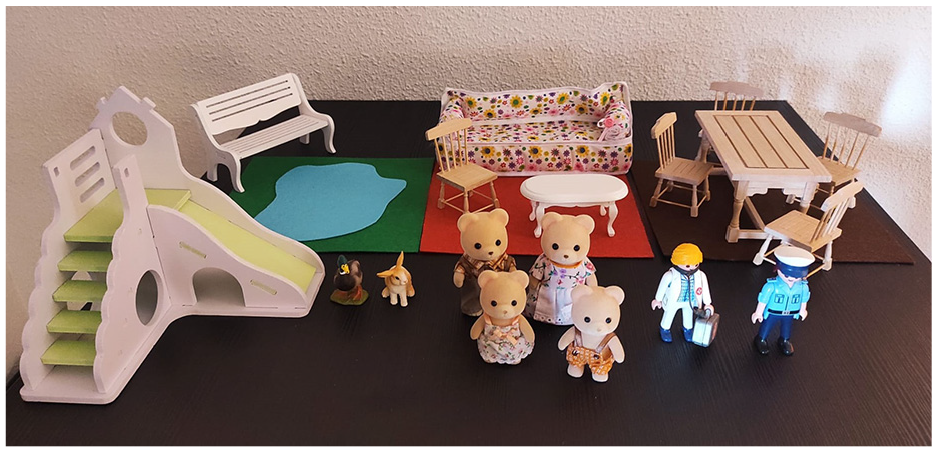
The Bears family playset.
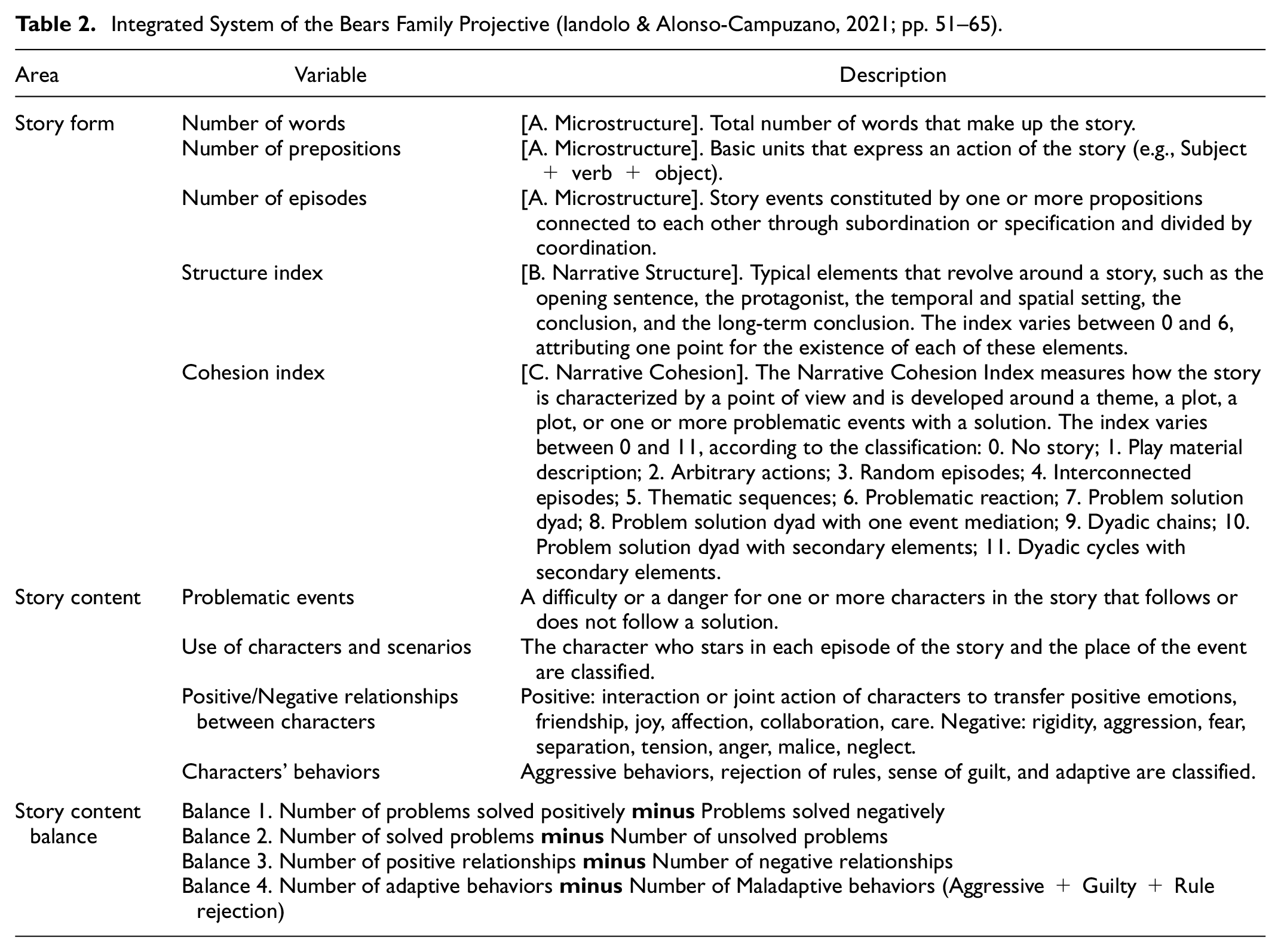
The final story was recorded, transcribed verbatim, and analyzed according to the Bears Family Analysis Integrated System. The Bears Family Integrated System uses three macro dimensions for the formal story analysis (A. Microstructure; B. Narrative Structure Index; C. Narrative Cohesion index) and four balances indexes for the content analysis (Balance 1. Positive and negative solutions; Balance 2. Solved and unsolved problems; Balance 3. Positive and negative relationships; Balance 4. Adaptive and maladaptive behaviors). The content analysis requires measuring the frequency of problematic events, the use of characters and scenarios, positive and negative relationships between characters, and characters’ behaviors to compute the four content balance indexes (Table 2). The formal microstructural dimension shows a reliability index of Cronbach’s Alpha = 0.52, while content balance indexes show reliability a Cronbach’s Alpha = 0.70 (Iandolo & Alonso-Campuzano, 2021).
Integrated System of the Bears Family Projective (Iandolo & Alonso-Campuzano, 2021; pp. 51–65).
The teacher’s questionnaire was an ad-hoc questionnaire designed for this investigation, which asked teachers to answer five questions about each pupil on a seven-point Likert scale (1-low; 7-high). The questions explored the teacher’s perception of student’s on (1) academic performance (how is the student academic performance including his/her grades?); (2) competencies (how is the student work in the classroom?); (3) behavior (how is the student behavior in the classroom?); (4) learning competence (how is the student learning competence?); (5) emotional well-being (how happy is the student in the classroom?); and (6) presence/absence of difficulties in the student (have you observed any difficulty in the student?). Teachers also needed to specify the kind of difficulties indicated by a psycho-pedagogical guidance team or a neuropsychiatric service (e.g., behavioral difficulty, language difficulty, learning difficulty, attention deficit hyperactivity disorder (ADHD), autism spectrum disorder, other difficulties). These difficulties were grouped into two categories: (1) Neurodevelopmental disorders, including ADHD, communication disorders, or specific learning disorders; and (2) functional difficulties, including emotional and behavioral difficulties (Table 1).
Procedure
For this study, we requested the participation of students from a primary school in Madrid (Spain). Parental informed consent was requested and obtained for all participants. The activity was voluntary and free, guaranteeing the European (GDPR UE 2016/67) and Spanish (Law 3/2018, of December 5) privacy standards, approved by the Ethics Committee.
First, we asked teachers to complete a questionnaire about students’ behavioral and academic performance. A researcher trained each teacher about the terms and questions in the questionnaire. Teachers were asked to answer questions about their perception of the students’ academic performance (including their grades) and behavior for the last 4 months, as well as the presence/absence of a child’s difficulty or clinical disorder indicated by the public psycho-pedagogical guidance team or the neuropsychiatric service.
A researcher, trained to administer psychometric tests, assessed each student through the Spanish versions of the NEPSY-II verbal fluency test (Korkman et al., 2014) and the Bears Family Projective Test (Iandolo & Alonso-Campuzano, 2021). The researcher interviewed each student individually, in a 30-min session, during school hours, in a quiet school room reserved for the activity. The students’ Bears Family stories were audio-recorded and transcribed for coding.
Standard instructions were followed for administering and scoring the NEPSY-II verbal fluency test (Korkman et al., 2014) and the Bears Family Projective (Iandolo & Alonso-Campuzano, 2021). For the story analysis, two judges blinded to the research hypotheses analyzed the stories according to the Bears Family Integrated System (Iandolo & Alonso-Campuzano, 2021). The coding order was counterbalanced between judges. Reliability was evaluated randomly in 35% of the sample using Cohen’s kappa index (κ). This index of agreement between judges was high (Microstructure: κ= 0.95; Structure: κ = 0.93; Cohesion: κ = 0.93; Balance 1: κ= 0.92; Balance 2: κ = 0.92; Balance 3: κ = 0.91; Balance 4: κ = 0.91; Global Balance: κ = 0.92). Discrepancies between judges were resolved by recoding the story and averaging the scores if the scoring difference were higher than 20%.
Data Analysis
The data analysis plans provide descriptive statistics for the study variables, accompanied by the outcomes of the Kolmogorov-Smirnov normality test. Subsequently, we delve into the study variables, examining age and gender influence using Spearman, Pearson’s r, and one-factor ANOVA tests. Lastly, we present the results of the three study hypotheses via Spearman, Pearson’s r, one-factor ANOVA, Mann-Whitney test, and stepwise regression models.
Results
The Kolmogorov-Smirnov normality test indicated a normal distribution for most variables in the teacher’s questionnaire, verbal fluency, and the formal aspects of the Bears Family story (Table 3). However, some content variables in the Bears Family story showed a non-normal distribution (Table 4). For this reason, data analysis was conducted by applying both parametric and nonparametric statistics as corresponded. Descriptive statistics of these variables are presented below (Table 3).
Descriptive statistics (N = 61).
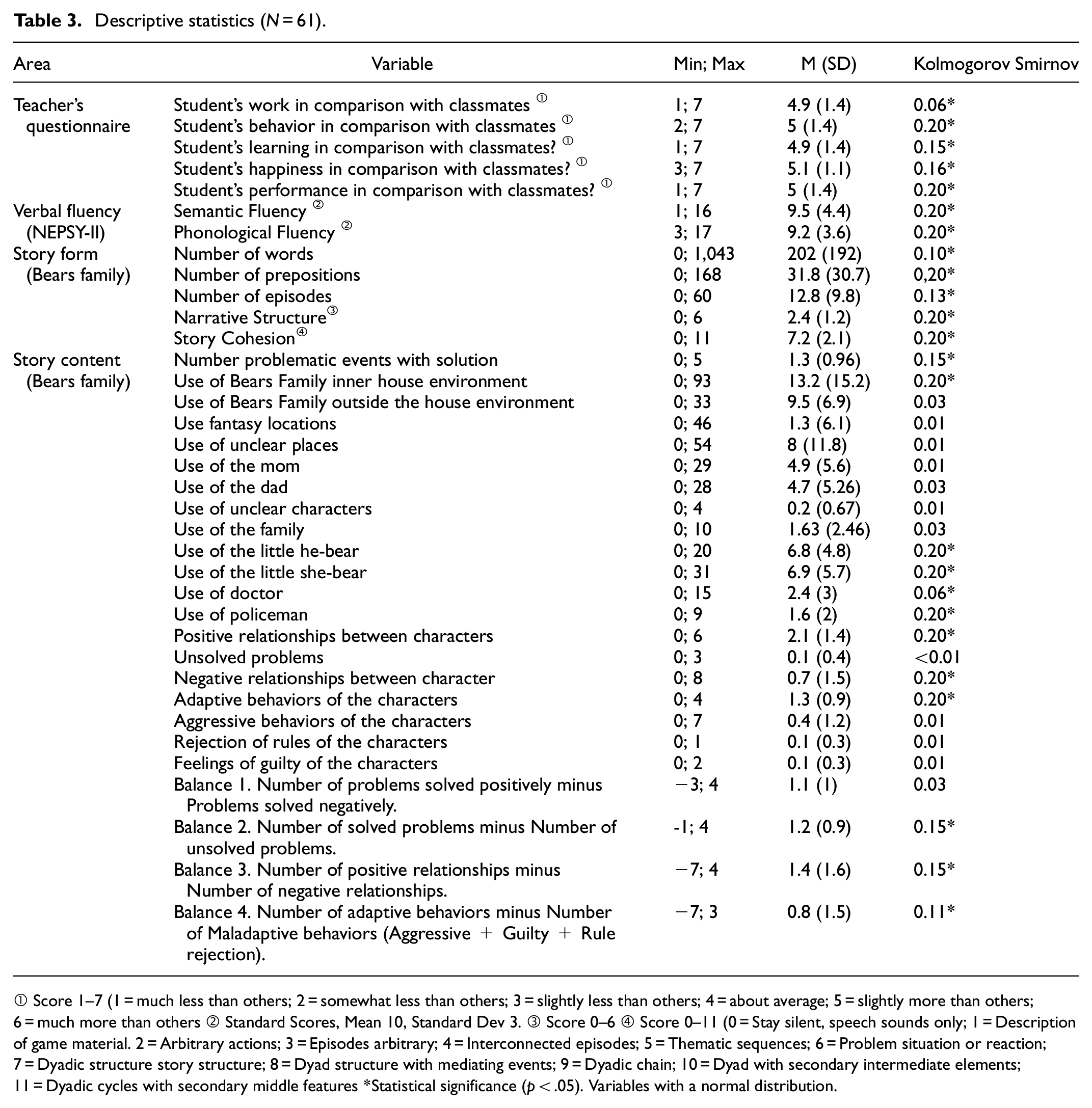
① Score 1–7 (1 = much less than others; 2 = somewhat less than others; 3 = slightly less than others; 4 = about average; 5 = slightly more than others; 6 = much more than others ② Standard Scores, Mean 10, Standard Dev 3. ③ Score 0–6 ④ Score 0–11 (0 = Stay silent, speech sounds only; 1 = Description of game material. 2 = Arbitrary actions; 3 = Episodes arbitrary; 4 = Interconnected episodes; 5 = Thematic sequences; 6 = Problem situation or reaction; 7 = Dyadic structure story structure; 8 = Dyad structure with mediating events; 9 = Dyadic chain; 10 = Dyad with secondary intermediate elements; 11 = Dyadic cycles with secondary middle features *Statistical significance (p < .05). Variables with a normal distribution.
Verbal Fluency Scores (N = 61).

According to the verbal fluency measures, fourteen students (23%) achieved standard scores below their normative age in the semantic fluency task. In the phonological fluency task, thirteen children (21%) scored below their normative age (Table 4).
Ninety-eight percent of the students (60 children) told a story about the Bears Family in the time available for storytelling. A boy in the first year of primary school with behavioral difficulties refused to complete the test.
The influence of age and gender was explored through inferential statistics with one-factor ANOVA, Pearson’s r, and Spearman’s r. Concerning gender, no significant differences were found for story verbal fluency and story variables. The only significant difference was related to the teacher’s perception of students’ behavior, with higher scores in girls (M = 5.43, SD = 1.23) compared to boys (boys M = 4.44, SD = 1.42) [F(1, 62) = 7.01, p < .01]. As expected for age, the results indicated a significant positive correlation between student’s age and semantic fluency (NEPSY-II semantic fluency, Pearson’s r = .35; p < .01), the number of story episodes (Bears Family - episodes, Pearson’s r = .34; p < .01), cohesion index (Bears Family - cohesion, Pearson’s r = .26; p < .05) and characters’ use (Bears Family - father, Spearman’s r = .28; p < .05; doctor, Pearson’s r = .43; p < .01; policeman, Pearson’s r = .38; p < .01).
Hypothesis 1. Students’ verbal fluency and narrative competence will be positively correlated.
Regarding the first hypothesis, correlation analyses partially confirmed it (Figure 2, only significant correlations are displayed). The results showed that students with higher scores in semantic fluency created stories with more episodes (Pearson’s r = .27; p < .05), more set-in fantasy scenarios (Spearman’s r = .34; p < .01), and greater use of male characters (Bears Family - Spearman’s r = .32; p < .05; son - Pearson’s r = .28; p < .05; doctor - Pearson’s r = .39; p < .01; policeman - Pearson’s r = .36; p < .01). Semantic fluency did not show a correlation with students’ story cohesion and structure.

Correlations between verbal fluency and the Bears Family story.
Phonological fluency positively correlated with the story’s number of words (Pearson’s r = .29; p < .05) and episodes (Pearson’s r = .32; p = .05). Regarding playset use, phonological fluency positive correlated with higher use of the set outside the house (Spearman’s r = .34; p < .01), higher frequency of use of the doctor’s (Pearson’s r = .35; p < .01) and the son’s characters (Pearson’s r = .29; p < .05). As for story content, phonological fluency positively correlated with a better balance index between solved and unsolved problems in the story (Balance 1, problems solved vs. not solved, Pearson’s r = .28; p < .03). As for semantic verbal fluency, phonological was not related to story cohesion and structure.
Stepwise linear regression models were used to explore which story variables best predicted children’s verbal fluency. Regarding the relationship between story variables and semantic fluency, stepwise linear regression model indicates the doctor character introduction as a predictor of the student’s phonological fluency [R2 = 0.12, F(1,56) = 7.69, p = .01] and semantic fluency [R 2 = 0.14, F(1,56) = 9.18, p = .01]
Hypothesis 2. Students perceived by their teacher with higher academic performance and more typical behavior will tell stories with more sophisticated form and balanced content.
Regarding the second hypothesis, results confirmed that students with higher academic performance and more typical behavior in class demonstrated higher narrative skills and content balance in the Bears Family story (Figure 3). Data analysis indicated a positive correlation between teacher’s perceptions of academic performance and the level of motivation (Pearson’s r = .80; p < .01).

Correlations between teacher’s questionnaire and the Bears Family story.
Children perceived by the teacher as students with better academic performance and higher level of motivation scored higher in story structure (Pearson’s r = .35; p < .01), showed more adaptive behaviors in characters (Pearson’s r = .26; p < .05), and used more the mother and father characters, as well as the bear family, as a unit in the story (Mother, Spearman’s r = .28; p < .05; Father, Spearman’s r = .33; p < .05; family as a unit, Spearman’s r = .36; p < .01).
In exploring the story variables that best predicted the teacher’s perception of students, a significant stepwise linear regression model indicated that the story’s narrative structure was the most significant predictor of the teacher’s perception of how the student’s academic performance [R2 = 0.12, F(1,55) = 7.72, p = .01].
The students perceived by the teacher with more typical behavior in class told stories more set inside the Bears’ family house (Pearson’s r = .26; p < .05) and demonstrated a higher balance between adaptive and maladaptive behaviors in the characters (Balance 4, adaptive behaviors minus maladaptive behaviors, Pearson’s r = .30; p = .05). The stepwise linear regression model indicated that setting the story in the Bears’ family house [R2 = 0.11, F(1,55) = 6.50, p = .01] and introducing solutions to story problems were the best predictors of the teacher’s perception of the student’s behavior [R2 = 0.21, F(2,54) = 7.39, p = .01].
Finally, the students perceived by the teacher as happier tended to tell stories using the Bears family as a unit character (Spearman’s r = .26; p < .05) and set it in the Bears’ family house (Pearson’s r = .26, p < .05). The successive stepwise linear regression model showed that setting the story in the Bears’ family house was a significant predictor of the teacher’s perception of how happy the student was in class [R 2 = 0.09, F(1,55) = 5.43, p = .03].
Hypothesis 3. Students perceived by their teachers with lower academic performance and less typical behavior will tell stories with less sophisticated form and unbalanced content.
Regarding the third hypothesis, one-factor ANOVA analyses and Mann-Whitney tests showed a statistically significant difference in the contents of the stories created by students with and without difficulties, as rated by the teachers in the questionnaire. Children rated by the teacher as students with difficulty introduced more frequently positive [Difficulty, M = 2.86, SD = 1.70; No difficulty, M = 1.83, SD = 1.20; F(1,11) = 6.47, p < .01] and negative relationships [Difficulty M = 1.36, SD = 1.78; No difficulty, M = 0.49, SD = 1.38; F(1.58) =3.85, p < .05] between characters in their stories in comparison to students with no difficulty. Also, for the stories created by students with difficulty, results showed more aggressive behaviors in characters (Difficulty M = 0.71, SD = 1.38; No difficulty, M = 0.27, SD = 1.1; U = 401,500, p < .05). No significant differences were found between story contents and type of difficulty (Neurodevelopmental vs. functional).
Discussion
These results underline an intimate relationship between primary school students’ narrative competence, verbal fluency, and teachers’ perception of pupils’ behavioral and academic performance.
Regarding teacher’s perception of students, results align with previous studies, for example, indicating a more satisfactory perception of girls’ typical behavior (Etxebarria et al., 2003). Moreover, previous studies point out to the effect of the positive perception by the teacher on promoting school performance (Downey & Vogt Yuan, 2005), self-concept, and motivation (Ferla et al., 2009; Wormington et al., 2012).
Our results also showed an effect of age on semantic fluency, narrative cohesion, the number of story episodes, and use of story’s secondary characters. Previous research in narrative competence development in primary school students have encountered this age-progression in narrative competence in typically developing children during late childhood (Esposito et al., 2020; Iandolo et al., 2013; Piolino et al., 2007; Stenning & Michell, 1985).
The incremental exposition of students to literacy skills and story models during primary education may impact language and storytelling competence development (Isbell et al., 2004; Pinto et al., 2019; Zanchi et al., 2020). In this line, our results suggest a relationship between verbal fluency and some form and content variables in the stories, but not with story structure and cohesion. Children with higher semantic verbal fluency created longer stories and use more characters and settings. The higher semantic verbal fluency may reflect a more prominent capacity to access vast and various verbal content based on all the characters in the playset. Consequently, it may increase story micro-linguistic complexity related to a student’s broader repertory of linguistic skills (Hickmann, 1995; Hudson & Shapiro, 1991; Kintsch, 1988; Kintsch & van Dijk, 1978). Children with better verbal skills have more resources to balance the problems in the story as well as to manage the story’s narrative complexity, with overlapping problems and solutions during the story (Fitzgerald & Teasley, 1986; Marshall & Long, 2010; McCabe et al., 1991). On the other hand, phonological fluency, as a more advanced competence than semantics, may reflect a relationship between story linguistic microstructure components and the child’s metacognitive skills (Kintsch, 1988; Kintsch & van Dijk, 1978; Sternberg et al., 2008).
Furthermore, students with higher academic performance and more typical behavior demonstrated higher narrative skills and more balanced content in adaptive and maladaptive characters’ behaviors. In addition, the more motivated students told more structured stories with more adaptive behaviors. Narrative skills may boost self-expression and metacognition and so impact on the student’s academic performance and behavioral self-regulation (Fiorentino & Howe, 2004; Gil Flores, 2011; Jones et al., 2018). All these competencies are modulated by the type of relationship between students and teachers in the school context (Hipolito-Delgado et al., 2011; Tamés, 1990).
The more frequent use of the Bears Family as a unit in the students perceived as happier by teachers and with more typical behavior in class can be related to students’ mental representations and narratives in terms of shared balanced contents. Balanced stories reflect an adjusted representation of experiences and a balanced view of oneself and others, contributing to emotion and behavior regulation (Bartholomew & Horowitz, 1991; Bretherton, 2000; Bretherton & Munholland, 2008; Chris Fraley, 2002; Joel et al., 2006). In line with this, positive familiar representation, family harmony, parental care, and emotional well-being of children and adults can foster more balanced and resilient mental representations and narratives (Borowsky et al., 2001; Csikszentmihalyi & Rathunde, 2014; Main et al., 2005; Robin, 2008; Santander R et al., 2008; Stearns, 2019). On the contrary, children experiencing stressful events in the family context can introduce unbalanced representations with high anxiety, stress, or sadness, perhaps projecting their personal experiences in their narrative contents (Sutton & Keogh, 2001). For example, a higher frequency of maladaptive characters’ behaviors in the stories was found in the students with difficulties, who also introduced more relationships between characters in their stories.
A positive and negative representational bias in children and adolescents is consistent with previous research on children with neurodevelopmental (Iandolo et al., 2020) and emotional and behavioral difficulties (Colozzo et al., 2011; Ferreira et al., 2005; Horton & Keysar, 1996; Iandolo et al., 2012; Nilsen & Graham, 2009). Unbalanced stories toward more positive or negative representations reflect a storyteller’s positive or negative bias, giving rise to stories in which certain content is overrepresented or undervalued. A bias favoring a more positive or negative representation does not allow one to have a broad view of conflicts and situations, which reflects a potential risk for emotional and behavioral self-dysregulation in a complex social context like the teacher-pupil relationship in the classroom (Booth & Winzar, 1993; Joel et al., 2006; Mathews & Bradley, 1983; Wahler, 2012).
Limitations
The limitations of the present study lie in its correlational nature, potential biases in teacher perception, the influence of the educational context, and other factors that restrict result generalization. Unconsidered factors could have influenced the relationships between storytelling competence, verbal fluency skills, and teachers’ perception of primary school students. Subjective factors or implicit educator prejudices may have biased teachers’ perceptions of student classroom behavior. Given that the study focuses on Spanish students, linguistic and cultural differences could have influenced the results, affecting the interpretation of results in different educational contexts. While some variables, such as students’ age, were considered, factors such as family environment or instructional quality must have also influenced students’ narrative skills and academic performance. The conclusions may not have applied generally to students of other ages or cultural contexts.
Practical Implications
Understanding the interplay between narrative competence, academic performance, teacher perception, and emotional well-being can inform educational practices aimed at promoting holistic development among primary school students.
Teachers’ perceptions of students, particularly regarding gender differences and behavioral patterns, can significantly influence academic performance. Positive perceptions by teachers have been shown to promote better school performance, self-concept, and motivation among students.
Regarding narrative competence, students’ age significantly influences its development among primary school students, and there is a notable improvement in narrative skills as students progress through primary education. This improvement can be attributed to cognitive development, personal experience, increased exposure to literacy skills, and story models. Concerning story formal features, higher verbal fluency scores are associated with longer stories that use more characters and settings. It suggests that enhancing verbal skills can lead to more complex storytelling abilities, improving linguistic proficiency and narrative complexity. Regarding story contents, the frequency of certain elements, can reflect students’ mental representations and emotional well-being. Balanced stories, depicting harmonious family relationships, can be an indicator of emotion regulation and resilience, whereas unbalanced stories may indicate underlying stress or emotional difficulties.
Narrative competence can contribute to self-expression, metacognition, and behavioral self-regulation, ultimately impacting academic performance positively.
Conclusions
This study investigated the relationship between verbal fluency, narrative competence, and teacher’s perception of students’ academic and behavioral performance. The results demonstrated that these teachers perceived girls with more typical behavior than boys in class. Students’ narrative skills were globally related to their academic and behavioral performance as perceived by their teachers. Interestingly, students who used the family as a unit in storytelling were perceived by their teachers as happier. However, wider verbal fluency in students was unrelated to cohesion and structure in the stories, and only significantly related to more episodes and characters, which are indexes of a broader linguistic repertory that can imply overlapping problems that emerge and are solved during the story. Finally, students perceived by their teachers to have lower academic performance and less typical behavior told stories with more deviant characters’ behaviors, maybe reflecting a bias in favor of negative representations of conflicts and situations and higher risk for emotional and behavioral self-dysregulation in class.
In conclusion, these results highlight the importance of measuring and promoting verbal fluency and storytelling skills by teachers in primary education with the final aim of boosting the co-construction of significant knowledge and psychological well-being in childhood (Bruner & Feldman, 1999; Norrick, 2000). Therefore, educational interventions may aim to support storytelling, verbal fluency, sharing, and mentalization of students’ representations, and to foster social inclusion and self-regulation. For example, the co-construction of cooperative stories in class may help balance biased representations and peers’ contributions, learning to regulate elements previously introduced by a groupmate with the teacher’s support and guidance.
Footnotes
Author Contributions
Conceptualization, M.A.S., A.E., C.A.C., and G.I.; formal analysis, M.A.S. A.E., C.A.C., and G.I.; investigation, M.A.S., and G.I.; resources, G.I.; data curation, M.A.S., A.E., and G.I.; writing-original draft preparation, M.A.S., A.E., C.A.C, and G.I.; writing-review and editing, M.A.S., A.E., C.A.C., G.G.C. and G.I.; supervision, G.I.; project administration, G.I.; funding acquisition, G.I. All authors have read and agreed to the published version of the manuscript.
Declaration of Conflicting Interests
The author(s) declared no potential conflicts of interest with respect to the research, authorship, and/or publication of this article.
Funding

Compliance with Ethical Standards
The current study was conducted according to the Declaration of Helsinki guidelines, following the European privacy standards (European General Data Protection Regulation - GDPR UE 2016/67) and the Spanish privacy standards (Ley 3/2018, de 5 de diciembre), approved by the Ethics Committee of the Hospital Universitario de Getafe (protocol code CEIm A12/20), and date of approval: November 19, 2020.
Informed Consent Statement
Informed consent was obtained from all subjects involved in the study.