




Abstract
The Homegrown School Feeding Program Intervention (HGSFPI) is one of the most powerful tools for combating malnutrition and addressing economic and gender inequality. Hence, this study aims to analyze the long-term effects of the HGSFPI on the school outcomes via balanced macro panel data covering the years 1974 to 2023. Panel endogenous switching regression (PESRM) and difference-in-differences (DID) models were used to estimate covariate relationships and policy effect sizes, respectively. The PESRM results indicate that an increase in the pupil-to-teacher ratio increases the rate of dropout and reduces persistence in primary school, probably because of an overcrowded teaching system and fewer contacts per student. However, increased availability of electricity increases educational persistence by increasing the number of hours spent studying and improving facilities in schools. Furthermore, fertilizer application and the food production index increase the rates of completion and enrollment because enhanced food security reduces malnutrition and enhances school attendance. Moreover, increased agricultural productivity indirectly leads to higher household incomes, and improved school enrollment. Similarly, school feeding and rural infrastructure development also contribute to increasing schooling enrollment through enhanced access to and regularity of meals. Consequently, the DID model results show that the intervention decreased the rate of dropout by 10.9% and increased completion, persistence, and attendance rates by 14.2%, 4.6%, and 21.5%, respectively, which suggests the effectiveness of the policy intervention. Thus, increasing policy intervention in treated and control unit regions will facilitate education achievements and sustainable human capital development through poverty and hunger alleviation in a viable manner.
Keywords
Introduction
Home-grown school feeding program intervention (HGSFPI) refers to a policy action in which governments/development donors provide regular, nutritionally sufficient school meals obtained directly through the small farmers of the region. The intervention at once aims to improve the educational achievements of children, such as their enrollment, attendance, persistence, and learning, and at the same time boosts the local agricultural markets and improves the livelihoods of rural people. HGSFPI is based on the principle of local procurement, which unites community connections, reduces transaction costs, and creates stable demand for smallholder production (Burbano et al., 2009; Gelli et al., 2019). HGSFPIs can enhance educational outcomes, and produce local economic multipliers, especially in low-income settings (Aurino et al., 2023; Gelli et al., 2019). The HGSFPI strives to connect nutrition, agriculture, and social protection by providing school children with safe, locally grown, diversified, and well-fortified food (World Food Program [WFP], 2024). It helps feed children by empowering smallholder farmers, building local food markets, and reducing vulnerability to hunger; its long-term vision is to create a hunger-free world by 2025 (African Union Commission and African Union Development Agency – NEPAD, 2022).
School meals constitute a substantial proportion of children’s total daily caloric consumption. Combined lunch and breakfast contribute 30% to 45% of the daily recommended calories, that is, 555 to 830 kcal/day in half-day schools and 60% to 75%, that is, 1,110 to 1,390 kcal/day in full-day schools. For example, a mid-day meal of 150 g sorghum, 40 g black-eyed cowpeas, 5 g vegetable oil, and 2 g iodized salt yields 681 kcal, meeting approximately 37% of the child’s daily caloric needs (FAO & WFP, 2018).
The HGSFPI is more than a nutrition program; it is focused on higher school enrollment, enhanced children’s health, employment opportunities, and better livelihoods for small-scale farmers (Crawford, 2019). It is therefore regarded as one of the strongest weapons against malnutrition by the year 2030 (FAO, IFAD, UNICEF, WFP, & WHO, 2024; WFP, 2020) and as a device for eradicating economic and gender inequality (da Silva et al., 2022; United Nations, 2030). For example, involvement in a program enhances food security for 40% of small-scale farmers relative to 20% of nonparticipating farmers (Barnabas et al., 2023).
Worldwide, school feeding coverage increased by 7% from 2020 to 2022; however, the growth was uneven across all regions. Low-income countries experienced a decline in coverage of 4% over the same years. Today, only 18% of children in low-income countries have access to free school lunches, while 39% have access to lower-middle-income schools and 48% have access to upper-middle-income schools (FAO, IFAD, UNICEF, WFP, & WHO, 2024; Fey & Chad, 2022; WFP, 2020).
All these challenges notwithstanding, the HGSFPI has decreased hunger, improved school enrollment, and promoted local-level economic development in many poor countries (Desalegn et al., 2022a; World Bank [WB], 2020). It has further stabilized smallholder markets, improved farmers’ incomes, stimulated reinvestment in agriculture, and facilitated the cooperation of schools and farming cooperatives (Borghi et al., 2022). In addition, national development plans such as the Ethiopian Growth and Transformation Plan, nutrition-sensitive agriculture policy, and inclusive growth policy have identified and included the HGSFPI as a strategic intervention (African Union Commission and African Union Development Agency – NEPAD, 2022).
However, ongoing financing gaps, infrastructure, and climate-resilient food system gaps hinder the complete achievement of program potential (WFP, 2023). The greatest constraint is overdependence on imported food, lowering economic benefits in the country and compromising sustainability. A case in point is 26% and 31% food aid dependence for Afar and Somali region populations, respectively, constraining the program’s local coverage and sustainability. Furthermore, more than 50% of school feeding operations are donor dependent, and the government does not have enough money to provide meals a day for 19 million children regularly and therefore creates long-term sustainability issues (WFP, 2018).
Before the HGSFPI, there was a typical school feeding program in Ethiopia characterized by the consumption of externally procured food, poor linkages with local agriculture, poor coverage of poor children, and poor coordination of institutions (WFP, 2013; MoE, 2021).
The HGSFPI was therefore initiated as a national effort to correct these deficiencies and achieve lasting educational reform (WB, 2021). However, there must be proper assessment and suitable policy incorporation, particularly for food security and agricultural growth (WFP, 2024).
While overall, school feeding programs worldwide are recognized by developing nations as education and nutrition improvement tools, the particular consequences of locally developed, community-led tactics such as HGSFPIs have yet to be thoroughly studied. Much of the current literature pertains to traditional or international programs, which vary considerably in design and aims (Burbano et al., 2009; Drake, 2016). However, few studies have used rigorous methods such as randomized controlled trials or quasiexperimental designs to measure the effect of the HGSFPI on primary education outcomes such as enrollment, attendance, and learning achievement (Aurino et al., 2023; Gelli et al., 2019).
The past studies (Desalegn et al., 2021, 2022b; Mideksa et al., 2024; Wang & Young, 2021) has examined school meal programs using role and educational outcomes. The current research, on the contrary, presents three pertinent contributions. First, it proposes the HGSFPI which captures the intensity of the program rendering it possible to directly measure of dropout rate and the primary completion, persistency and enrollment without using the traditional measures like attendance/nutrition status. Second, it integrates a DIDs design with PESRM using long-run macroeconomic reforms panel data thereby allowing stronger causal inference about the interaction between HGSFPI, macroeconomic reforms, and mechanized agriculture. Third, it broadens the theoretical scope, by connecting school feeding with agricultural modernization and economic reform, thus reaffirming the role of spill over consequences of agricultural markets and local livelihoods. Totally, the study shows and presents new findings.
Consequently, little is known about the effects of contextual issues such as household poverty, gender disparity, regional characteristics, and the school environment on program effectiveness or sustainability (Sumberg & Sabates-Wheeler, 2011). Knowledge gaps also exist regarding how HGSFPIs might influence learning outcomes through enhanced nutrition, alleviation of hunger, or minimization of child labor (Adelman et al., 2008). Assessments to date have been largely targeted and short-term, thus making it difficult to make general or long-term inferences. Hence, well-designed, context specific, and methodologically rigorous research is needed to ascertain whether and how the HGSFPI enhances learning at the primary school level. In fact, no known study has explored the long-term effect of the HGSFPI on children’s schooling outcomes in terms of specific dropout rates, completion rates, grade persistence rates, and enrollment rates using macro panel data from the period 1974 to 2023 for low-income countries.
Therefore, this study investigated the effects of the HGSFPI on educational outcomes (EOs) in low-income countries. Specifically, what determines the effect of the HGSFPI on educational outcomes and is the HGSFPI positively related to children’s educational outcomes (in this context, children’s dropout rates, school enrollment, primary school completion, and perseverance to the last grade) in primary schools?
Literature Review
Goal of the HGSFPI
The HGSFPI (initiated by the Malabo Declaration (MD) from 2016 to 2025)) addresses the critical issues of child malnutrition, hunger, and lack of access to education in less developed areas (Barnabas et al., 2023). This would be linked to the educational goal of the HGSFPI, which aims to reduce dropout and improve learning outcomes by monitoring and assessing its effectiveness in terms of school enrollment, attendance, retention, and academic performance (FAO & WFP, 2018; Visser et al., 2018). This epitomizes the dual nature of the HGSFPI objectives: moving children’s well-being forward while helping farm economies through the creation of expected markets for smallholder farmers and the aspiration of the MD to end hunger by 2025 (Thomas Olutola & Chinyere Aguh, 2023). It also attempts to realize the socioeconomic impacts of the intervention, aiming to achieve gender equity in education, local employment creation, and the promotion of viable farming practices.
Driver of the HGSFPI
The 2014 MD stressed hunger (SDG2), poverty (SDG1), climate resilience (SDG13), and governance (SDG16). In 2016, the MD targeted a revolution in farming to increase food security, decrease poverty, and guarantee the success of the HGSFPI (African Union Commission and African Union Development Agency - NEPAD, 2022). The program aims to improve local economies and provide students with fresh, nutritious food to foster inclusive economic growth (Aurino et al., 2023; Sumberg & Sabates-Wheeler, 2011; United Nations, 2030). Even though the intervention has flourished in boosting school enrollment, child nutrition, and community participation (WB, 2020), challenges such as underfunding, regional disparities, inadequate infrastructure, weak monitoring systems, political flux, climate change, and the exclusion of marginalized groups still exist (FAO, IFAD, UNICEF, WFP and WHO, 2020). Such gaps require viable funding, equitable coverage, improved meal quality, infrastructure investments, strong monitoring systems, the integration of policies, and climate-resilient food systems (WFP, 2023).
Outcome of the HGSFPI
The HGSFPI has been shown to have a significant effect on increasing enrollment, attendance, and students’ food intake (Adepoju, 2020; Destaw et al., 2021; Mohammed et al., 2023). In addition, it has provided smallholder farmers with a stable and predictable market and increased demand for their produce (Di Prima et al., 2022). In total, the intervention serves approximately 400 million students, who are mainly marked in Sub-Saharan Africa, where more than 243 million face food insecurity issues (Owusu-amankwah et al., 2018). Intervention in education enhances nutrition to improve academic performance, economically increases incomes for smallholder farmers through market stabilization, and socially promotes equity in gender to increase the spread of educational services to girls. The plan also contributes to local economic development by creating jobs and diversifying food production and consumption (Swensson, 2019).
Impediments of the HGSFPI
The factors affecting the full use of HGSFPIs are the repeated trends of delayed food delivery, inadequate infrastructure, and low-quality inputs with a lack of appropriate storage and food preparation facilities in schools (Desalegn et al., 2022a). As already handicapped in dealing with the real sources of economic challenges faced by people, such as poverty and food insecurity, the intervention was further weakened by institutional problems, feeble policy execution, inadequate funding, and weak farmer and administrator training (FAO, IFAD, UNICEF, WFP, and WHO, 2024; Food and Agriculture Organization [FAO], 2017). Other factors of the program include schooling years, pupil-teacher ratios, and electricity availability (FAO, IFAD, UNICEF, WFP and WHO, 2020; WB, 2023a). Some of the economic variables that affect the viability of this package are GDP growth, public spending, fertilizer use, and crop yields (Borghi et al., 2022; ECW, 2023; Global Education Monitoring Report, 2021). Moreover, urbanization, population growth, and political stability have even more overarching effects in shaping the form that the execution and impact of this program would take (OECD, 2022). More specifically, there are operational challenges in the complexity of public procurement rules, with stringent bidding processes and large contract sizes that limit smallholder farmer participation. Other major obstacles were seasonal and regional variations in food production as well as weak institutional capacity at decentralized levels (Swensson, 2019).
Methods
Dataset
The World Development Indicator (WDI) data were used to measure the impact of the HGSFPI on educational outcomes. The data exit https://databank.worldbank.org/source/WDIs. The sample size was 1,300 (26 × 50), with 26 = the number of low-income countries and 50 = the number of years included in this study. Hence, 50 years of balanced macropanel data spanning 1974 to 2023 were used in this study.
Research Design and Data Processing
The raw data were analyzed for completeness and internal consistency via cross-variable checks, following the related standards of data quality (Kline, 2018). The validity of measurement of the outcome variables, the treatment variable (HGSFPI) and the covariates were verified individually. The appropriate methods that were used to address the missing data mechanisms were multiple imputation (Shewhart et al., 2020). The detection of outliers was done using standardized residuals, leverage measures, and boxplots to reduce bias and promote strength (Lai & Zhang, 2017). Recoding of variables was done where necessary to meet assumptions of linearity and homoscedasticity before estimation (Wooldridge, 2010). Reliability checks, pre post and ratio in ratio trend tests and RMSPE diagnostics were carried out on the resultant dataset in order to support the robust causal inference.
Theoretical Background of the Combined Models
The methods aims to reduce selection bias and help to achieve causal analysis using linked models: the Panel Endogenous Switching Regression Model (PESRM), the Difference-in-Differences (DID) estimator and the Linear Regression Endogeneity Treatment (LRET; Maddala, 1993). The PESRM deals the endogenous participation of programs which corrects self-selection bias by estimating outcome regime-specific and endogenous selection equations (Lokshin & Sajaia, 2004). The concept of DID model presents the causal effects via contrastive analysis of pre-post intervention outcome paths in the treated and the control groups based on the parallel-trends assumption (Angrist, 2008; Wooldridge, 2010). LRET is diagnostically used to test endogeneity as an endogenous regressor in a control-function context where endogenous regressor can be discovered with the aid of the residual inclusion with the help of the instrumental variables by Cameron and Trivedi (2022).
Method of Analysis
The Panel Endogenous Switching Regression Model (PESRM) was used to estimate joint participation probabilities and outcomes between users and nonusers (Lokshin & Sajaia, 2004; Maddala, 1993). The effects of the HGSFPI on school enrollment, the dropout rate, primary completion, and persistence to the last grade were measured via a difference-in-differences (DID) model. The LRET was used as a pretest for PESRM (Appendix Tables A1 and A2) and DID to measure the effect size of the policy on educational outcomes (Cameron & Trivedi, 2022).The WDIs are based on macro level but fail to reflect the participation of individual in the HGSFPI. The program is thus developed to be a country-based intensity of treatment explained through program coverage with time. In this framework, the PESRM would be used: a selection equation forecasts the adoption and the strength of the adoption of programs at the country- year level whereas result equations forecast aggregate educational outcomes, namely the dropout rate, primary completion rates, persistency rate, and enrollment rate (Hasebe, 2020). PESRM and DID serve distinct identification: PESRM address selection bias into treatment intensity, and DID measures treatment causes on a parallel trends assumption (Toyama, 2020). However, the DID specification includes several pre-intervention periods and uses graphical and statistical trend diagnostics to trace the treated and the control countries in 2016 (treatment year; Toyama, 2020). The variables of treatment and outcome are also outlined distinctively to maintain the logical consistency in the model (Elwert & Winship, 2014). The quality of DID estimates was explored through visual and statistical testing of the parallel-trends assumption, which is that, similar trajectories of pre-treatment outcomes require a treated and a control unit (Angrist, 2008). The DID regressions used outcome variables (Table 1) and controlled the agricultural productivity, income proxies, fertility, inflation, and demographic structure. Establishment of counterfactual validity and reliability of estimated HGSFPI impact confirmed equivalence of slope of pre-intervention to treated and control groups (Duflo & Mullainathan, 2004; Models et al., 2011).
Hypothesis of Covariates Affecting the HGSFPI.

Source. Extracted by the author via WDI datasets (2024).
Endogenous Switching Regression Model (PESRM) Specification
Covariates affecting both HGSFPI use and educational outcomes (Table 1) were modeled via the PESRM (Gertler et al., 2016; Greene, 2020; Wooldridge, 2010).
Step 1: In the program participation equation, the latent probability of participation is modeled as:

where

Step 2: Treatment and control groups’, the treated group (HGSFPI = 1) outcomes are modeled as:

For the untreated group (HGSFPI = 0), the equations used were as follows:

Here,
DID Model Specification
The HGSFPI started in 2016. The intervention groups included Ethiopia and Afghanistan; Burkina Faso; Burundi; the Central African Republic; Chad; the Congo; Gambia; Guinea-Bissau; Liberia; Madagascar; Malawi; Mozambique; Niger; Rwanda; Sierra Leone; and Uganda. However, the control groups included Eritrea, the Democratic People’s Republic of Korea, Mali, Somalia, South Sudan, Sudan, the Syrian Arab Republic, Togo, and Yemen (WFP, 2023; FAO, IFAD, UNICEF, WFP, and WHO, 2024; World Bank, 2023b). To ascertain the effect of the HGSFPI on learning outcomes, DID estimation was used. Ethiopia as the primary treated unit was matched against a panel of other low-income control countries to account for trends in learning outcomes before and after the intervention period (Gertler et al., 2016).

Pathway Analysis for the Impact of the HGSFPI on Educational Outcomes
The pathway diagram (Figure 1) offers a system view where the HGSFPI acts as an intermediary of the impact of various socioeconomic, agricultural, and infrastructure variables on education outcomes. The policy intervention, in the form of a binary variable, affects four indicators of education: percentage of out-of-school children, primary completion rate, and advancement to the penultimate grade of primary and gross enrollment (Alderman et al., 2016; Burbano et al., 2009; Figure 1). Figure 1 shows a set of covariates that have mixed directional effects. The inputs in education government expenditures on education, the pupil-teacher ratio, and years of education affect the HGSFPI and educational outcomes. The crop production index, arable land per person, and use of fertilizer are farm indicators indicating whether the local food system can provide enough for school feeding programs (Gelli et al., 2019). Demographics such as the 0 to 14-year population percentage and rural population increase are among the factors that drive demand for primary education, whereas economic variables such as per capita growth in GDP, inflation, savings, and political stability drive overall conditions for implementing school-feeding programs (WFP, 2023). Overall, Figure 1 shows that the HGSFPI is an intersectoral policy instrument that bridges investment in agriculture, infrastructure, and governance to improve education outcomes. This finding is consistent with evidence indicating that coupled interventions bridging food systems and education are needed for human capital building and intergenerational poverty alleviation (Alderman et al., 2016; Burbano et al., 2009; Gelli et al., 2019; WFP, 2023; Figure 1).

Impact of HGSFPI pathways on educational outcomes (Table 1).
Trends of Educational Outcome Variables (Results)
Figure 2 shows the changes in primary school enrollment (schoenpg1) in low-income countries from 1974 to 2023, highlighting that growth varies across countries. For example, countries such as Afghanistan, Yemen, and Somalia experience highly erratic patterns; these patterns are partly due to ongoing war and political turmoil. Additionally, decades of violence, including Soviet invasion, Taliban control, and ongoing insurgencies, have significantly damaged Afghanistan’s school system, especially for girls. Similarly, Somalia’s protracted civil war, which began in the early 1990s, has resulted in occasional school delays, while a lack of political stability has left the nation’s schools chronically underfunded and undeveloped. Countries with moderate scholenpg1 growth, such as Eritrea and the Central African Republic (CAR), typically exhibit flat patterns, indicating that economic constraints have limited educational investment (Figure 2). Countries with restricted progress in schoenpg1, such as Eritrea and CAR, have relatively flat patterns, indicating that economic problems have constrained investment in education. Eritrea’s continued focus on military expenditure and international isolation have diverted resources away from education, whereas in CAR, political instability and widespread poverty have hindered educational improvements. Postconflict rehabilitation initiatives have resulted in significant advances in nations such as Rwanda and the Congo. Rwanda experienced significant decreases in schoenpg1 during the 1994 genocide but has made steady advances because of their coordinated efforts to reconstruct schools as part of the nation’s overall recovery. Similarly, Congo’s recent improvements in schoenpg1 reflect stabilization efforts, bolstered by international aid that supports education (Figure 2).

Trend of schoenpg1 (GER) in low-income countries.
Social and cultural barriers also play a significant role in some countries. For example, in Afghanistan and Yemen, conservative norms and resistance to girls’ education, especially in rural areas, have contributed to fluctuations in schoenpg1. Despite international attempts to eliminate the gender gap in education, these issues persist and limit access to education. Foreign aid and donor funding have helped gradually increase schoenpg1 in several countries, including Malawi and Mozambique. International initiatives, including UNICEF, the World Bank, and UNESCO, have worked to remove obstacles to learning by providing financial assistance, resources, and laws focused on eliminating child labor and hunger, which frequently hinder children from attending school. Regular enrollment increases in countries such as Uganda and Mali are also indicative of demographic transitions and population growth, which put pressure on governments to offer access. High fertility rates limit resources, making it difficult for them to keep up with the increased demand for education. In addition, countries such as Burundi and Chad have experienced moderate but steady development, illustrating the impact of educational policy advancements. Chad’s attempts to decentralize learning and extend rural access, together with Burundi’s deployment of free primary schools, have contributed to the gradual growth of schoenpg1 over time (Figure 2). As indicated in Figure 2, the GER calculates overall enrollment at a certain educational level, independent of student age. The entire number of pupils enrolled, including those beyond the official age group, is divided by the total population of the legal age group for that grade, represented as a percentage (UNESCO, 2020).
Figure 3 trends of children out of school (cospsa1), from 1974 to 2023, showing both remarkable progress and persistent challenges across different countries. Countries that have witnessed a significant decline in cospsa1, such as Burkina Faso, Burundi, Eritrea, Ethiopia, Malawi, Mali, Mozambique, Niger, and Rwanda, have experienced great improvement in schoenpg1, particularly since the 2000s (Figure 3). This, in turn, has reduced the number of cospsa1s, thus justifying the effectiveness of various policies and programs in education. The promotion of primary learning and the abolition of primary school fees in Ethiopia resulted in a rapid increase in the number of students. Similarly, the postgenocide education reforms in Rwanda, coupled with its commitment to basic primary education, have resulted in a reduction in the percentage of nonattending children (Figure 3). This has been partly driven by the creation of free primary education in many of these countries, aided by international donors and nongovernmental organizations. Countries with high rates of cospsa1 include the CAR, Chad, Congo, Guinea, Guinea-Bissau, Liberia, Madagascar, Sierra Leone, Somalia, South Sudan, Sudan, and Yemen. Therefore, these problem-ridden countries, which are experiencing violence, instability, and a poorly developed educational base, continue to struggle with high cospsa1 rates. Very significantly, the CAR, Chad, and Somalia, South Sudan have faced serious politico-economic difficulties and not much accessibility to education, as per the current statistical trend. In these regions, civil violence prevails in Somalia and South Sudan; internal displacement affects these places, ensuring that too many children are not going to school on a regular basis. These oscillations are usually caused by short-term foreign relief, whereas long-term successes remain in the realm of daydreams with repeating cycles of conflict and failures of leadership in those countries (Figure 3).

Trend of children out of primary school (COPS) in low-income countries.
Countries that initially faced challenges but have recently improved include Mali, Mozambique, and Niger. These countries had a high percentage of cospsa1 but have recently shown significant declines, which could be indicative of increased investment in schooling and/or the better execution of reforms to reduce educational barriers. Mozambique’s postcivil war rebuild efforts, along with foreign support, have helped increase enrollment in schools, whereas Niger and Mali benefited from educational reforms aimed at increasing rural enrollment and resolving gender inequities. North Korea, which has a persistently low cospsa1, has maintained a relatively high schoenpg1 throughout the years. North Korea’s centralized leadership, which controls issues such as education, ensures that the majority of children attend school (Figure 3). As indicated in Figure 3, COPS refers to the number of children in primary school who do not attend school. These children may not have attended school at all or may have cospsa1 owing to circumstances such as poverty, war, societal hurdles, or a lack of educational infrastructure (UNESCO, 2015).
Figure 4 Primary school completion rate (pcrgtrag1) from 1974 to 2023. Large differences among countries reflect not only improvements in general education but also a different set of challenges. In fact, the countries that have achieved marked improvements are Burkina Faso, Burundi, Eritrea, Ethiopia, Mali, Mozambique, Niger, Rwanda, Togo, and Uganda, whose pcrgtrag1 values increased rather significantly after 2000 (Figure 4). These changes are due to several government policies, such as free primary schools, increases in the number of educational facilities, and teacher recruiting campaigns. International aid and programs, including the millenium development goals and SDGs (like 4), played an enabling role in providing relevant financial and policy support. The postconflict transition of Sierra Leone and Liberia has been hampered by economic insecurity and security concerns that have impacted long-term development prospects. Natural disasters impede schooling in Madagascar and Malawi; violence creates barriers in Sudan and Syria, where ongoing conflict has grave implications. These countries greatly lack instructors and have a strained budget that limits the quality of education (Figure 4). Moreover, widespread poverty compels children to work in particular regions, which reduces both enrollment and pcrgtrag1 (Figure 4). Those countries that have stagnated in pcrgtrag1 include the CAR, Guinea-Bissau, Somalia, South Sudan, and Yemen, which have failed to demonstrate an improvement in pcrtrag1 during the years under consideration. Additionally, long-term violence, political turmoil, and inadequate investment in schooling have contributed to continuously poor pcrgtrag1. Conflicts also had a very significant impact on access to schooling, since schools have often been destroyed, as was the case in Yemen and South Sudan. These countries face tremendous difficulties in realizing sustained advances in education without continued educational support and peace (Figure 4).

Trend of the primary school completion rate (PSCR) in low-income countries.
As indicated in Figure 4, the PSCR is the proportion of pupils who successfully completed their last year of preschool in comparison to the overall number of kids at the official completion age. It measures how successfully an educational system maintains and advances children over elementary school (UNESCO, 2020).
Figure 5 shows the trend of students persisting to the last grade (perlgp1) from 1974 to 2023 in Burkina Faso, Burundi, Eritrea, Ethiopia, Malawi, Mali, Mozambique, Rwanda, Togo, and Uganda, which all have high increases in perlgp1, which has increased from 40% to 50% in previous years to 80% to 90% (Figure 5). Gains such as these can be accredited to a number of factors, including the introduction of the policy of free primary education, heavy investments in school infrastructure, and teacher recruitment drives. Targeted intrusions, such as feeding programs and foreign aid, have also helped increase retention rates in some countries, thereby ensuring that more students remain at school through perlgp1. The increase in perlgp1 for these countries reveals the effectiveness of such policies in increasing access and improving school retention. Afghanistan, Chad, Madagascar, Niger, Sudan, and Sierra Leone have shown significant improvements in perlgp1 but still face serious challenges. In such countries, perlgp1 usually ranges from 30% to 80%, with fluctuations over time. Most of these countries have benefited from postconflict reconstruction and from donor-funded education programs (Figure 5). Most of them battle issues related to the shortage of teachers, economic instability, and the unpredictability of financing for education. For example, Sudan and Afghanistan have to address continuous political and security challenges that shut schools, whereas Niger and Madagascar are prone to natural catastrophes that will quickly keep children out of school. Whereas some have achieved tremendous growth, others are unstable and are likely to fall. Variation in perlgp1 in CAR, Congo, Guinea, Guinea-Bissau, Liberia, and Yemen; in these countries, there is variation in perlgp1 from 30% to 80%. There is no continuous upward swing. These trends are associated with political turmoil, economic struggles, and differences between schools (Figure 5).
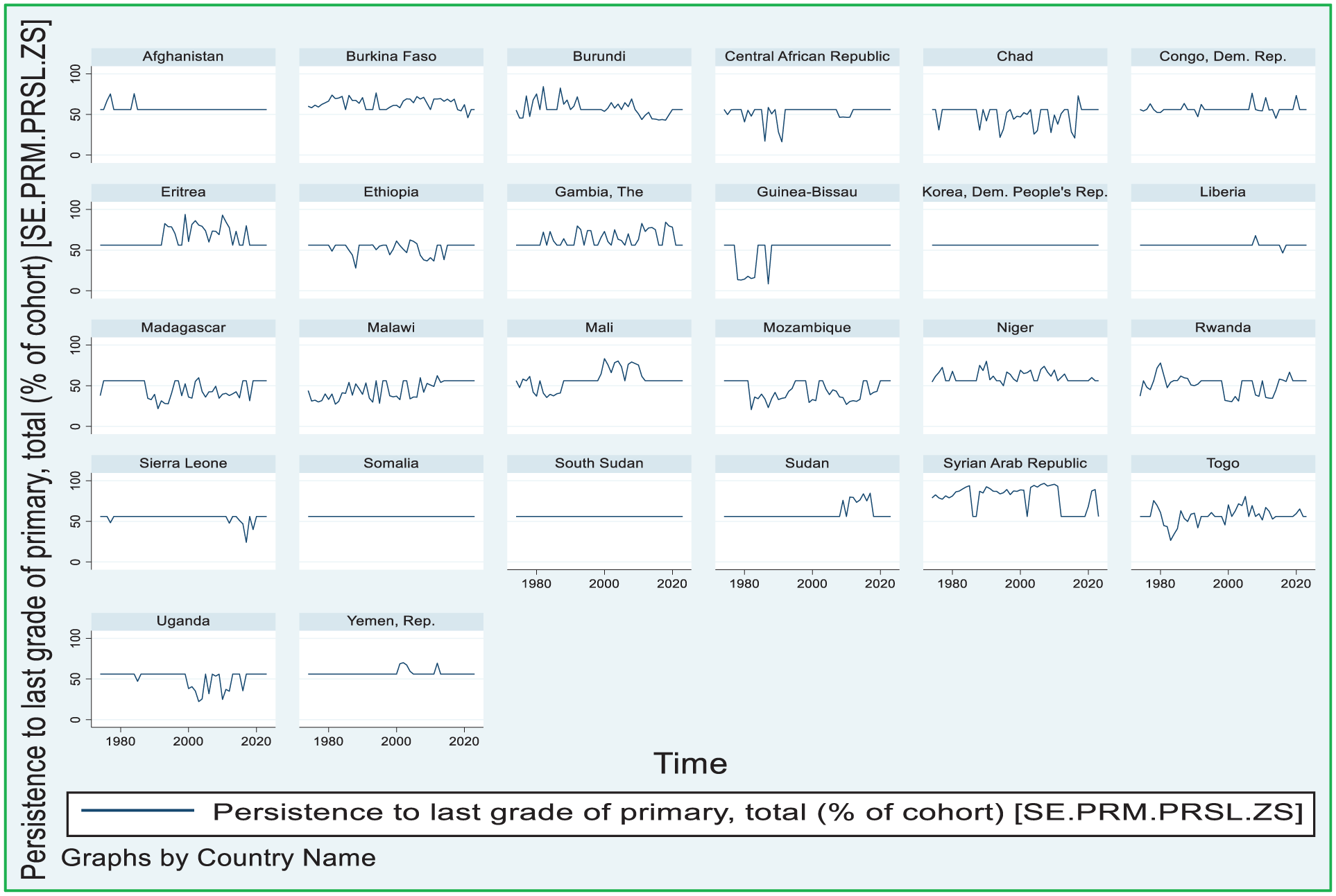
Persistent to the last grade in primary school.
Robustness Tests for Directional Relationships
The null hypothesis (
PESRM (cospsa10 pcrtrag11 perlgp10 schoenpg11 (Outcomes), Selection Equations (HGSFPIs)).

Source. Compiled by the author via the BMPD (2024).
p < .01. **p < .05. *p < .1, that is, 1%, 5%, and 10% levels of significance in sequence.
PESRM Results
PESRM controls for the endogeneity that emanates from factors affecting group assignment-treatment/control and the outcomes. It is particularly suited for panel data and self-selection bias, as it estimates the likelihood of group membership via a selection equation and controls for changes across individuals over time (Lokshin & Sajaia, 2004). The initial equation shows a positive relationship between the pupil-teacher ratio (puplilrp1) and the dropout rate (cospsa10), with a coefficient of 0.338 (p < .05). This finding suggests that an increase in puplilrp1 can result in increased dropout rates, which is supported by the fact that overfilled classrooms adversely affect the performance and retention of students (Hanushek & Wößmann, 2007; UNESCO, 2015). Higher pupil-teacher ratios reduce individual attention, increase teachers’ workload, and remove teachers from classroom management, all of which lower the motivation of students and increase the risk of dropping out. Therefore, decreasing overcrowding and the pupil–teacher ratio can reduce the number of dropouts and enhance the quality of education (Table 2). On the other hand, Puplilrp1 negatively affects persistence to the last grade (perlgp1) at 0.281 (p < .05), indicating that a poor learning environment prevents students from attaining the subsequent grades. This is supported by human capital theory, which holds that investment in schooling enhances long-run performance (Becker, 1993), and empirical studies that show that the quality of the educational environment increases student progress and completion (Michaelowa, 2001). This confirms pre-setted hypothesis one (
Access to electricity (accesstelecofp1) is negatively and significantly related to dropout rates (cospsa10) at 0.018 (p < .05). Electricity leads to improved learning conditions, increased time on domestic chores, and increased access to schooling media, which leads to increased school attendance and continuity (Khandker et al., 2013; OECD/IEA, 2017). In addition, electricity decreases dependence on conventional fuels, preserving time, particularly for girls pursuing education. It further contributes positively to persistency to the last grade (perlgp1), with a coefficient of 0.132 (p < .05), indicating that electricity improves the quality of education as well as ICT-enabled learning (WB, 2011). However, better-connected areas might have lower priority for HGSFPI, as the positive selection coefficient of 0.016 (p < .05) implies. However, disparities in accessibility and technology-distraction can temper the effect of electrification on learning (UNESCO, 2020).
Adjusted savings: the proportion of expenditures on education as a share of the GNI (adjusted leavex1) is negatively related to cospsa10, with a value of 2.832 (p < .05), indicating that greater financial stability leads to lower dropout rates in school. This accords with empirical evidence from the literature that school investment offsets monetary constraints to schooling, including school fees, inputs, and school uniforms (Pritchett, 1999). Moreover, adjusted savingsx1 significantly contributes to HGSFPI enrollment (coefficient 0.177, p < .05), implying that families with better financial positions are more likely to spend more on education for their children and reap the dividends of school-based interventions. Macro stability also provides fiscal space to incur expenditures on education and program performance, such as the HGSFPI.
Tractors per 100 sq. The km of agricultural land (agrimactper1001) is negatively correlated with cospsa10 but positively correlated with perlgp10, as mechanization reduces the workload of child labor and increases the rate of attendance at schools (Beegle et al., 2006). Moreover, mechanization lessens the workload on homework, particularly on farming activities during peak season times, which are apt to coincide with school absence. However, these regions are less likely to be chosen for HGSFPIs because they already have satisfactory food security and improved agricultural output (Table 2). Land per capita (aralhecpp1) negatively affects primary school completion (pcrtrag1) and school enrollment (schoenpg1), that is, greater landholdings increase the price of schooling opportunities, particularly in farm families (Ray, 2000). They are engaged in land preparation, sowing, or harvesting and therefore have greater dropout and absence rates. Instead, mean rainfall (avepindepth1) increases school enrollment and completion because improved rainfall improves agricultural production and household income and decreases the economic need for child labor (Azzarri et al., 2006). Improved rainfall also increases food security, reducing school absenteeism because of hunger.
Farm labor (emploinagri1) is related to educational level in a multifaceted way. It is negatively associated with pcrtrag1 (coefficient = 0.1, p < .05), leading to evidence that child labor is more prevalent among farm families. It has a positive effect on schoenpg1 (coefficient = 0.638, p < .05), indicating the probability that income from employment can reinforce education. The variation may be because while some use children from farm households as workers, others possess incomes that lower the level of expenditure on accessing education. Furthermore, emploinagri1 also positively affects HGSFPI targeting (coefficients = 0.036 and 0.041, p < .05), which aligns with the goal of the school feeding program to alleviate food insecurity among rural, agricultural-dominant populations (Burbano et al., 2009).
Fertilizer use (fertilizer percentage) is also positively related to the completion of primary school (pcrtrag1) and school enrollment (schoenpg1), with coefficients of 0.226 and 0.389 (p < .05), respectively. Enhanced agricultural productivity due to high-density inputs means higher stable incomes and greater food security, both of which encompass school dropout and malnutrition (Alderman et al., 2016; Gelli et al., 2019). Similarly, the food production index (foodproindex1) had a positive effect on Schoenpg1 (coefficient = 0.465, p < .05) and the choice of the HGSFPI (coefficient = 0.271, p < .05), highlighting the linkages among agriculture, nutrition, and education. School feeding programs prefer locally produced food; hence, food-surplus regions could be more appropriate for program implementation (Drèze & Kingdon, 2001).
Length of primary education (priedudy 1) also plays a significant role in HGSFPI (coefficients 0.67, 0.665, p < .05), supporting the necessity of making long-term education investments for sustainable growth (UNESCO, 2015). More extended education cycles are related to improved long-term performance, such as increased cognitive ability, health consciousness, and performance in the labor market. Likewise, the crop production index (croppindex1) has a positive effect on educational level and HGSFPI targeting (coefficients 0.010 & 0.014, p < .05), which indicates that productivity increases household well-being and education access.
Gross domestic savings by GDP (gdsgdp1) has a positive relationship with HGSFPI targeting (coefficients 0.020 & 0.021, p < .05), as the effectiveness of household and national economies’ savings encourages education investments. Saving is also an income shock absorber and keeps children from dropping out of school during economic shocks. However, the livestock production index (livestockpindex1) is inversely correlated with education and the HGSFPI (coefficients = 0.013 and 0.015, p < .05), as pastoral economies require more child labor and greater mobility in the nomadic population, which crosses unbroken schooling (Cockburn & Dostie, 2007). Likewise, political stability and the absence of violence (PSav1) positively influence the choice of the HGSFPI (coefficients 0.028 & 0.014, p < .05), as also indicated by research that connects governance with education and development results (WB, 2011). PSav1 reduces the number of school closures, displacement, and destruction of infrastructure; hence, the implementation and sustainability of programs such as HGSFPI have become easy. The child–population ratio (popuage014) is also strongly related to education and the HGSFPI (coefficients 0.039 & 0.044, p < .05), representing the educational system’s burden and the necessity for targeted interventions in high-burden areas (FAO, 2020).
Finally, final consumption expenditure as a share of GDP (fcexpgdp1) has a negative relationship with the quality of education (coefficient 0.212, p < .05), possibly because of the crowding-out effect and perhaps because higher consumption reduces public and private investment in education (Baldacci & Clements, 2008). Nevertheless, its annual growth rate (fcexpanualgrowth1) is positively and statistically related to education levels (coefficient 0.324, p < .05), indicating that expanding economies can spend more on education (Gupta et al., 2002). Additionally, increased household expenditure can work to decrease dependency on child labor by eliminating financial constraints, thus allowing more investment in schooling for children (Edmonds, 2003) Table 2. Using diverse variables in a PESRM’s selection and outcome equations is not only allowed but also frequently recommended. It increases model identification, resilience, and consistency with theoretical predictions. However, ensuring that the covariates we choose are well justified and supported by the study context and accessible data (Lokshin & Sajaia, 2004).
The Gap of Educational Outcomes (EOs) via the Difference-in-Differences (DID) Model
The year of intervention was 2016; the treated units were Afghanistan, Burkina Faso, Burundi, Central African Republic, Chad, Congo, Ethiopia, Gambia, Guinea-Bissau, Liberia, Madagascar, Malawi, Mozambique, Niger, Rwanda, Sierra Leone, and Uganda, while the nontreated units were Eritrea, Korea, Mali, Somalia, South Sudan, Sudan, and the Syrian Arab Republic, Togo, and Yemen (WFP, 2023; WB, 2023b). The parallel trends assumption was validated under the
DID Model Results for Educational Outcomes in Low-Income Countries (

Source. Compiled by the author via the BMPD (2024).
p < .01.**p < .05. *p < .1 implies 1%, 5%, and 10% levels of significance.
The overall primary school completion rate (pcrtrag1, 14.17; p < .05) also had a positive impact; that is, with increased access to high-quality meals, there was greater school attendance and higher education in the long term. The same impact was already indicated by (Adelman et al., 2008) and (Kristjansson et al., 2016), who illustrated better advancement in school grade and mental functioning with ongoing school feeding. This conclusion is also supported by economic incentives theory: by passing food in-kind, school feeding reduces the cost of household spending and helps stimulate long-term educational aims (Burbano et al., 2009).
Persistence in the last grade of primary school (perlgp1, 4.557; p < .05) also improved, indicating that HGSFPI is associated with improved retention at school. Retention is the foundation of the acquisition of basic skills and is driven by both health and socioeconomic factors. Afridi (2010) findings show that school feeding not only enhances attendance but also increases attention and motivation, leading to better grade advancement. Social protection theory is also behind this, as it argues that safety net interventions such as HGSFPI provide secure learning environments that maximize in-school time (Ummah, 2019).
In particular, gross primary school enrollment (schoenpg1, 21.417; p < .05) increased the most. This finding supports cross-country evidence that school feeding is a valid demand-side intervention to increase access to school, especially for poor individuals (Ahmed, 2004; FAO, 2013). School feeding alleviates short-term liquidity constraints on the household and triggers initial enrollment due to nutritional and economic incentives.
Pretreatment trends differed substantially in the treated group (TG) and control group (CG) according to statistically significant differences. Specifically, cospsa1 was different by 6.4% (t = 7.3, p < .05), pcrtrag1 was different by −10.5% (t = −10.8, p < .05), perlgp1 was different by −7.5% (t = −10.87, p < .05), and schoenpg1 was different by −4.8% (t = −2.75, p < .05). Posttreatment comparisons revealed that cospsa1 was much more strongly reduced in the TG (DID = 4.5%, t = 2.2, p = .026), pcrtrag1 was strongly increased (DID = 14.2%, t = 5.8, p < .05), the gap was bridged for perlgp1 (DID = 4.6%, t = 2.64, p < .05), and schoenpg1 improved the most (DID = 21.4%, t = 4.9, p < .05). These findings validate that HGSFP is a multidimensional education outcome determinant through alleviating food insecurity, child labor substitution, and economic needs in terms of capabilities theory (Sen, 1999) and more recent program assessments (Drake, 2016; Jomaa et al., 2011). More broadly, the results indicate that the HGSFPI has a transformational effect on children’s schooling outcomes through lower dropout rates, improved completion and persistence, and improved school access (Table 3) and as confirmed by hypnosis (
Impact of the HGSFPI on Educational Outcomes: Pre-post and Ratio-in-Ratio Analyses (H2-5)
The pre-post ratio assists in the evaluation of the relative change in the educational outcomes when compared to the prior situation prevailing in the treated and control countries after the execution of the HGSFPI in 2016 (Figure 6). It is based on impact evaluation methods that use ratios of before and after in that it normalizes disparities between baselines (Angrist, 2008). In treated countries, there is a stronger post-intervention child dropout (cospsa1) and is more strongly attained in primary completion (pcrtrag1), persistence (perlgp1), and school enrollment (schoenpg1) and the control countries show more stable trends. The results of these studies support the interests that the identified improvements have been brought about by the intervention, not macro-level processes, and they are consistent with theoretical assumptions about school-feeding incentives (Burbano et al., 2009).

Pre/post ratios of educational outcomes.
The ratio-in-ratio (RiR) provides an approximation of the net treatment effect proportionality by subtracting post-pre ratios across countries receiving the treatment versus controls (Figure 7) thereby supplementing longer length of DID diagnostics that take into account the scale heterogeneity (Goodman-Bacon, 2021). The negativeness of RiR of cospsa1 indicates a relatively larger dropout fall, and the positive RiR of pcrtrag1, perlgp1, and schoenpg1, in particular, indicates the stronger percentage increment. Such findings are consistent with a body of literature that shows that food-for-education programs have a profound impact on the school-going behavior among the low-income setting (Alderman & Bundy, 2012). The mean results of treated and control countries compared before-after and at level (Figure 8) provide a descriptive foundational framework of the DID (Meyer, 1995). Treated countries show initially worse educational indicators, which aligns with a high level of risk populations that are being targeted in the policy, but subsequently show substantial gains post-intervention especially in enrollment as compared to control countries. Based on that, the graphical evidence supports the same findings as the estimates of DID, as well as highlights the statistical and practical implications of the identified positive impact of the HGSFPI on the educational results.

Ratios of educational outcomes.

Educational outcome levels.
Overview of the HGSFPI and DID Parallel Trend Tests
The studies highlight that school feeding programs in the low-income context increase the quality of diets, cognitive achievement and attendance, especially among disadvantaged students (Anderson et al., 2018; Jayanta & Currie, 2004). Similarly, reviews of centrally administered feeding programs in developing countries attest to the increase in child nutrition status, attention at school, and school enrollment (Aurino et al., 2023; Gelli et al., 2019). Theses support our results: the positive effects of HGSFPIs are in line with the rest of the global evidence of the effectiveness of school meal systems regardless of the source of food used locally/centrally. There is strong asymmetry in the distribution of the participation of the HGSFPI between users and nonusers. Amid the sampled population, 65.38% are nonparticipants, and 34.62% are participants (Figure A6). This implies the uptake of the HGSFPI is relatively low, which may be explained by limitations in the coverage of the program, the capacity for implementation. This excess of nonusers also suggests that downstream analysis of the DID-based treatment effect method must cope with a rather peripheral group of the treatment. This is in line with the empirical literature that focuses on the importance of assessing group composition and balance before estimating the effect of treatment (Abadie, 2005; Angrist, 2008).
Figures 1 to 4 in the Appendix empirically supports the parallel-trends assumption that the DID to estimating requires (Angrist, 2008; Wooldridge & Imbens, 2013). In the child dropout, primary completion, persistency to the last grade, and school enrollment, the trends in the state of both treated and the control group show a significant similarity in the pre-intervention trajectory changing the data between the years 2000 and 2015. Such an agreement can be explained by similar effects of international and national educational policies (Glewwe & Kremer, 2006; Lewin, 2009; UNESCO, 2015; WB, 2018). After 2016, one can observe slight deviations, but these may be due to the influence of the HGSFPI (Duflo & Mullainathan, 2004). Results in Table 3 above shows, the DID estimates, there are major improvements in the countries of treatment: a decreased dropout rates, and higher primary completion and grade persistency and significant gains in enrolling to school, which is consistent with the existing literature on the positive educational impacts of HGSFPI (Adelman et al., 2008; Aurino et al., 2023; Drake, 2016; Kristjansson et al., 2016). Robustness-Tests, like, stable pre-intervention gaps, placebo tests that have no expected effects, verify that treated and control units followed parallel curves before 2016 (Goodman-Bacon, 2021). The overall result of these pieces of evidence is that the parallel-trends assumption is satisfied and supports the causal interpretation of the post-2016 effects of HGSFPI.
RMSPE Ratio for Results Robustness and DID Trend Test (H2–5)
Root Mean Squared Prediction Error (RMSPE) diagnostics show that there are no changes in model performance in all the post-intervention results. In the case of child dropout, the RMSPE ratio equals 0.914, which indicates a better post-treatment predictor and no predictive structural break after the application of HGSFPI in 2016. The ratios near unity are alienable with accepted DID and denote a well-posed counterfactual trajectory (Abadie, 2021). This helps to internalize the internal validity of the estimated ATET and addresses the issue in prediction instability (Angrist, 2008; Duflo & Mullainathan, 2004).
In the case of primary completion, the RMSPE ratio is equal to 1.066, which demonstrates a slight higher prediction error after the treatment but within normal diagnostic ranges, which indicates no significant degradation of the predictive accuracy and so that the possibility of an assumption made is that being parallel in the trend is valid (Abadie, 2021; Goodman-Bacon, 2021). The persistence RMSPE ratio is 0.741, which is significantly smaller after the treatment and a high predictable induction, and therefore, shows a high model stability and no specification failure (Abadie, 2021; Duflo & Mullainathan, 2004). In school enrollment, the ratio of RMSPE is 0.907, which once again demonstrates that there are stable and better post-treatment predictive accuracies. Ratios close to unity validate a uniform counterfactual approximation and enhance the inference of the estimated ATET supporting the best-practice DID and synthetic-control inference (Abadie, 2021; Duflo & Mullainathan, 2004; Goodman-Bacon, 2021).
Conclusions
Panel endogenous switching regression (PESRM) and difference-in-differences (DID) models were used to evaluate the effects of policy interventions and socioeconomic determinants on learning outcomes. The PESRM results indicate that a higher pupil-to-teacher ratio leads to higher dropout rates and a lower completion rate, probably caused by overcrowded classrooms and scarce teacher availability, which discourages students. Conversely, access to electricity reduced dropout and enhanced last-grade persistency through improved learning conditions and reduced domestic labor burdens. Additionally, farming mechanization was related to lower dropout rates and increased persistence via the alleviation of child labor loads. Similarly, fertilizer use and improved food production indices are associated with intensified school enrollment and completion rates. This implies that increased nutrition at the household level stimulates continued schooling. Similarly, more arable land (hectares per person) indicates a lower school completion rate, as access to arable land leads children to be drawn into farm labor, suggesting that children’s education versus labor demand conflict. As the DID model results show, the positive impacts of the Homegrown School Feeding Program Intervention (HGSFPI) included a 10.9% decrease in the number of dropouts, a 14.2% increase in completion, a 4.6% increase in grade continuation, and a 21.5% increase in enrollment. These results follow directly from free lunch, which alleviates hunger and offsets the poor’s opportunity costs of coming to school. In addition, better nutrition can increase learning over enhanced use and cognitive function, lowering absenteeism and grade repetition. This sharp progress in attendance implies that school feeding increases both the economic and social attractiveness of schools, particularly in poor areas. In total, the HGSFPI delivers short-term gains in nutrition and long-term benefits in educational outcomes such as enrollment, low dropout rates, completion rates and last-grade persistence rates in primary school and human capital development. The cumulative results of pre-after ratios, ratio-ratio and before-after intervention all show the same direction that the HGSFPI has brought about significant changes in educational outcomes. The effect on the dropout rates and gains on the completion, persistence, and school enrollment were observed in the treated countries on a relative basis compared to the control groups. These DID estimate support the theoretical assumption that school-feeding incentives improve educational outcomes. Thus, the HGSFPI improved educational outcomes, which confirms the intervention role for needy populations (Figure A5).
Policy Implications and Suggestions
Multisectorial interventions are essential to have effective educational policy in low-income settings. Reduction of child labor by increasing employment and training characterized skills, electrification of country areas, and mechanization of farm communities can afford more school-going children. An increase in agricultural productivity and food security through increased use of fertilizers and increased production of farm output helps increase the rates of enrollment and retention. The expansion of the HGSFPI to the under-served and under-performing districts is critical to the growth of the human capital formation. The success of these programs will depend on the instability of the local procurement systems that existed between schools and the smallholder farmers and must be well-founded with proper financing, sufficient physical storage facilities and procedural processes. Accountability requires the presence of institutional capacity building among school administrators, and education officers. Detailed monitoring and evaluation systems inclusive of nutrition sensitive standards, food diversification procedures, and physical learning outcomes are fundamental toward guiding evidence-based program modifications. Additional enrollment, attendance and sustainability of school-feeding programs, are further consolidated through complementary community outreach programs and incentive based measures.
Limitations
This study uses over 50 years of macro panel data to quantify trends in low-income countries. The reliance on country-level aggregates may hide differences within countries regarding the effects of programs, which highlights the need to complement micro-level analyses over longer periods of time. The study also does not adjust for intrahousehold processes in addition to external shocks such as pandemics and migration, which affect education outcomes. Additionally, the indicators of operation covered in the dataset may not cover all the indicators relevant to the HGSFPI. Future research should also use additional sources of data, like the records of the WFP to increase internal validity and explanatory power. The differences in the countries with respect to data quality, conventions of reporting and measurement may further erode the comparability of the treated and control units. So, this can limiting conclusion on extended cognitive and educational benefits.
Footnotes
Appendix
The parallel trend assumption for the DID model is as follows:
Robustness tests of the child dropout rate (cospsa1), child primary school completion rate (pcrtrag1), child persistence to the last grade in primary school (perlgp1) and child primary school enrollment rate (schoenpg1) are as follows:
Acknowledgements
I would like to thank Bahir Dar University, and Bonga University, for their support during this study.

Author Contributions
Gedefaw Abebe Abiye: Contributed to conceptualization, data curation, formal analysis, investigation, methodology development, and software implementation. He also drafted the original manuscript. Serge Svizzero: Contributed to conceptualization, investigation, methodology, supervision, and visualization. In addition, he was involved in manuscript review and editing. Daregot Berihun Tenessa: Contributed to conceptualization, data curation, investigation, and methodology. He also contributed to supervision and manuscript review and editing.
Funding
The authors received no financial support for the research, authorship, and/or publication of this article.
Declaration of Conflicting Interests
The authors declared no potential conflicts of interest with respect to the research, authorship, and/or publication of this article.
Data Availability Statement
The data supporting the results or analyses presented in the paper can be found via request from the corresponding author.