




Abstract
This article investigated the impact of human capital and technology on economic growth in Nigeria. We employed annual time series data for the period of 35 years (1975-2010) and applied autoregressive distributed lag approach to cointegration to examine the relationship between human capital, technology, and economic growth. Two proxies of human capital (secondary and tertiary school enrollments) were used in two separate models. The cointegration result revealed that all the variables in the two separate models were cointegrated. Furthermore, the results of the two estimated models showed that human capital in form in secondary and tertiary school enrollments have had significant positive impact on economic growth. More so, technology also shows significant positive impact on economic growth. In a nutshell, both human capital and technology are important determinants of growth in Nigeria. Therefore, improvement of the educational sector and more funding for research and development (R&D) to encourage innovations are needed to facilitate Nigeria’s sustained economic growth.
Introduction
The role of human capital and technology in determining growth has been subjected to debate for a long time, from a theoretical basis to empirical testing. For instance, the new growth theory as pointed out by Lucas (1990) revealed that human capital is a significant determinant of economic growth, whereas Romer (1990) asserted that economic growth depends upon research and development (R&D) and spillovers from the R&D process. Human capital is a key source of increasing returns and divergence in growth rates between developed and underdeveloped countries in the endogenous growth model (Lucas, 1988; Romer, 1986). The model was later modified and extended further by Rebelo (1991), Romer (1990), and Stokey (1991). Barro (1991) began its application by regressing cross-country per capita income growth on a set of ancillary variables including the primary school enrollment ratio as a proxy variable for human capital and found that the initial level of human capital was a significant determinant for economic growth. Similarly, Kyriacou (1991) constructed a cross-country human capital index from data on average school years in the labor force and school enrollment ratios. From the cross-country regression of per capita income growth, the coefficient of initial human capital stock was positive and significant but that of human capital growth was negative and insignificant. Analogously, technology is a significant factor influencing economic growth, and the variations in growth rates. Noticeably, this in itself is something that evolutionary economics has in common with the new growth theory (Verspagen, 2000).
Economic growth entails increases in per capita real gross domestic product (GDP), viz broadening of the production scale in an entire country, or efficient usage of her economic resources to produce goods and services (Kibritcioglu & Dibooglu, 2001). Human capital is the total stock of knowledge, skills, competencies, and innovative abilities possessed by the population (Ugal & Betiang, 2009). The best method of developing human capital is formal education, starting with an initial level of education, continuing with various forms of post primary education and postsecondary education (Myers, 1964). Moreover, education is one of the key areas of public intervention in the social subsectors in developing countries such as Nigeria, where remarkable results were attained. However, the remarkable development of the Nigerian educational system has nevertheless revealed unsatisfactory results in attaining a universal primary education and suppressing the regional and gender gaps in the right of entry. The world economy changes toward more knowledge-based sectors that include manufacturing, telecommunications, and information and communication technology (ICT), with ICT-based services and R&D. Human capital development and skills turn out to be a crucial subject for planners and policymakers involved in economic development, both at the national and regional levels (Adelakun, 2011).
Like any other developing or developed country with a market economy, Nigeria’s main source of per capita output is an increase in productivity (Adelakun, 2011). Growth in per capita output is a vital element of economic well-being. Technology and equipment are the output of human minds and can only be made productive by people. The attainment of a fruitful program depends on human innovative ideas and creativeness. In addition, issues such as inappropriate employment of human capital in Nigeria, uneven distribution of skilled manpower, and a poor reward system hindering the achievement and development of human capital relating to the strategy have remained unresolved. The percentage of illiteracy in Nigeria is very high and majority of the workforce are unskilled, and they make use of out-of-date capital, equipment, and techniques of production. Their marginal productivity is, therefore, very low, and this results in low real income, savings, investment, and a subsequently low rate of capital formation. In line with the aforementioned issues, this article examines the role of human capital and technology in determining economic growth in Nigeria.
The remainder of the article is organized in the following sequence: “Literature Review,” “Method and Data,” “Results and Discussion,” and “Conclusion and Policy Suggestions.” The section “Literature Review” discusses the related literature on the impact of human capital and/or technology on economic growth. The section “Method and Data” presents the econometric technique of estimation and description of the data. The section “Results and Discussion” presents and discusses the findings of the study. Last, the section “Conclusion and Policy Suggestions” concludes and provides policy recommendations.
Literature Review
A number of empirical studies have been conducted in trying to find out the relationship that exists between human capital, technology, and economic growth, at both country and cross-country levels. The first framework proposed by Nelson and Phelps (1966) argued against the role of human capital as a factor input, instead suggesting that human capital aids in domestic innovation and adaption of foreign technologies. Therefore, in line with this, a country’s economic growth can be determined by the quality of its human capital, in which higher productivity can be achieved through innovation and rapid speed of technological diffusion in the country. Theoretically, the relationship between human capital, technology, and economic growth is a straightforward one, as against the empirical studies that generated mixed outcomes in which different studies employ different variables as proxy to human capital in determining growth. For example, Mankiw, Romer, and Weil (1992) and Barro (1991) found a positive and significant relationship between human capital and growth, while Dulleck and Foster (2008), who conducted a cross-country study, found the lowest (often negative) relationship between equipment investment (as proxy to human capital) and economic growth for countries with a low level of human capital, while highest in countries with an intermediate range and somewhat in between for countries with the highest level of human capital. High investment in equipment can facilitate technology transfer; hence, industrialization can also be achieved in countries with different levels of human capital.
Amir, Mehmood, and Shahid (2012) applied the Johansen cointegration test and error correction model technique on a Cobb-Douglas production function model to determine the impact of human capital on economic growth, with emphasis on the intermediary role of technology in Pakistan. Their result in the first model “without technology” has shown a positive relationship between primary, college and university (proxies to human capital) with economic growth, but secondary level education and vocational education have a negative relationship with growth in the short run. From the second model “with technology,” the result indicated a negative relationship between technology and growth, but with the exception of primary education, which appears positive. Similarly, the qualities of health and education as proxy to human capital have been found to have a positive effect on economic growth, especially higher education (Arabi & Abdalla, 2013). Categorizing countries into low, middle, and high income groups, Qadri and Waheed (2013) reported that human capital is positively related to economic growth, and the rate of returns on human capital in the low-income countries is higher than the rate of returns on human capital in the middle- and higher-income countries across the world. Furthermore, a strong cointegration relationship has also been reported by Lee (2005) between physical, human capital, and economic growth for Korea’s sustained economic growth based on the growth accounting technique. However, de Oliveira, Santos, and Kiker (2000) revealed a trade-off between the forms of human capital proxies (overeducation and undereducation); there is a positive relationship between overeducation and economic growth, while there is a negative relationship between undereducation and economic growth, but based on the tenure (i.e., employer’s preference relative to demand for overeducated labor). For Nigeria, a good number of studies conducted on human capital and economic growth also revealed similar findings of a positive relationship (e.g., Adawo, 2011; Adelakun, 2011; Kanayo, 2013; Sankay, Ismail, & Shaari, 2010). Conversely, Zaman (2012) indicated a weak relationship between human capital and economic growth for 100 sampled countries using the panel data estimation technique.
On the combined impact of human capital and technology on economic growth, Banerjee and Roy (2014) examined the significance of human capital, technological progress, and trade in determining India’s long-run growth by applying an improved growth accounting framework and autoregressive distributed lag (ARDL)-based cointegration technique to identify the factors that drive long-run productivity growth. Their results indicated that both the domestic technology capability building and foreign technology spillovers are important forces in determining India’s long-run growth. Human capital has turned out to be the most significant factor. Trade plays a facilitating role by making available frontier technology in an embodied form from the rest of the world. From African experience, Alani (2012) conveyed that a constant and decreasing return to scale exists between technological progress, productivity, and growth in Uganda. That is an increase in level of technology; capital stock and labor were found to increase economic growth. Based on the reviewed literature, it could be observed that the findings are not consistent but rather mixed. As such, the role of human capital and technology on growth cannot be assumed to be positive or negative for all countries unless empirically tested. Therefore, this study seeks to test the role of human capital and technology on economic growth from the Nigerian experience. Most important, this study is distinguished from the existing studies based on the approach to the problem. This study separated human capital into two components (secondary and tertiary school enrollments) to avert the potential problem of multicollinearity, which could render the results unreliable. In addition, each component of human capital and technology were slotted into the same model to assess their impact on growth. This makes it easier to see the impact of each component of human capital on growth in the presence of technology. This kind of approach is uncommon in most existing literature reviewed.
Method and Data
This study uses an ARDL approach to cointegration technique. We decided to use the ARDL approach to check for the long-run cointegration relationship among the variables and derive the error correction version (ECM) of the ARDL specification so as to determine the short-run dynamic. However, there are alternative approaches that could have been used to achieve the same objective, such as Johansen and Juselius (1990) and conventional Johansen (1998) cointegration tests. But we decided to use the ARDL approach to cointegration because of its advantages over the aforementioned tests. Although the conventional cointegration method estimates the long-run relationship within the context of a system of equations, the ARDL method employs only one single reduced form of equation (Pesaran & Shin, 1995). The ARDL can be applied to the variables irrespective of whether they are purely I(0), purely I(1), or mixed (Sulaiman & Abdul-Rahim, 2014). With ARDL, it is possible for different variables to have different lags, which are impossible with the standard cointegration test. Furthermore, with ARDL, both long-run and short-run coefficients could be obtained simultaneously (Chindo, Abdulrahim, Waziri, Huong, & Ahmad, 2015; Emran, Shilip, & Alam, 2007). Finally, the ARDL model could be used with limited sample data (30-80 observations) in which the set of critical values were developed by Narayan (2004).
Model Specification
The model used in this study is the human capital theory model based on Romer (1990). The theory states that growth is influenced by not only labor and capital but also human capital as shown:

where
Introducing technology explicitly into the model (Equation 1), we have the following:

Transforming the function (Equation 2) into econometric model, we have the following:

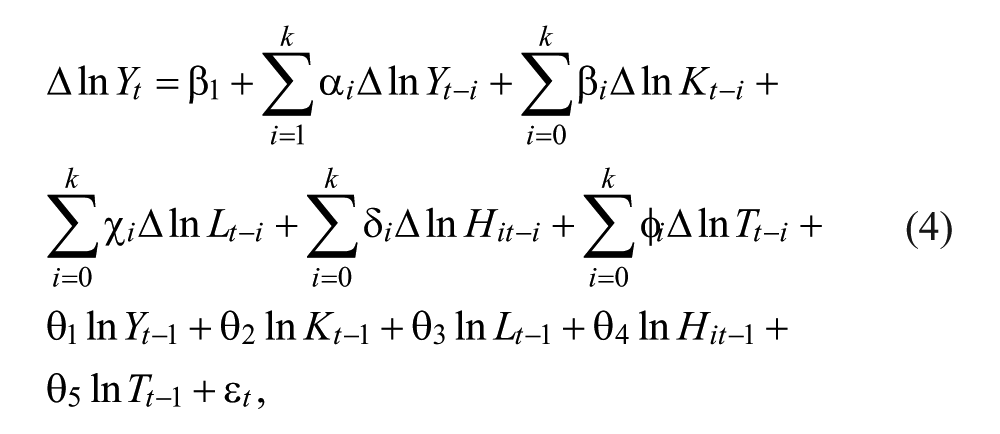
From Equation 3, the unrestricted error correction model (ECM) for ARDL is specified below:
where
To test the long-run cointegration relationship among the variables, the following hypotheses are stated:


The null hypothesis of no cointegration will be tested against the alternative using the F test, which has a non-standard distribution that depends on whether the variables included in the model are purely I(0), I(1), or mixed; the number of regressors; and whether the model has an intercept and/or trend. Considering the sample size of this study, which is small, the critical values reported by Narayan and Narayan (2005), which are based on a small sample size of between 30 and 80, will be used. The test uses asymptotic critical value bounds, which depend on whether the variables are I(0), I(1), or mixed.
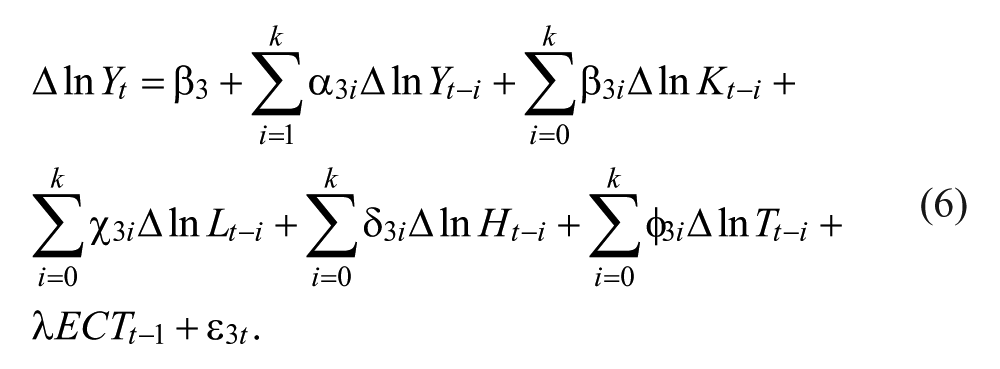
There are two sets of critical values generated, which are I(0), known as the lower bound, and I(1), known as the upper bound. When the F statistics exceed the upper bound, we reject the null hypothesis and conclude that cointegration exists. If they fall below the lower bound, we cannot reject the null hypothesis, and if they fall between the two bounds, a conclusion cannot be made (inconclusive). However, if we find an evidence of a long-run relationship among the variables, the following long-run (Equation 5) and short-run (Equation 6) models will be estimated simultaneously:

and the error correction term (ECT) in Equation 6 is defined as:
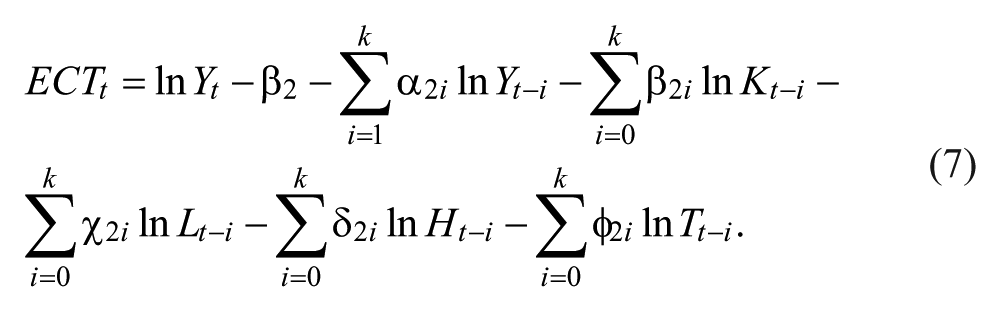
where λ in Equation 6 is the coefficient of the error correction term, which measures the speed of adjustment of the variables toward convergence to equilibrium. In addition, the coefficient provides information about the long-run relationship among the variables. To complete the estimation process, diagnostic tests will be conducted to assess the reliability and efficiency of the estimates.
The series used in the study were all obtained from World Development Indicators (WDI) and the central bank of Nigerian database for the period of 1975 to 2010 (35 years) based on data availability. Where real GDP was used to proxy economic growth, secondary and tertiary school enrollments were used as two proxies for human capital, labor force was used to proxy labor, gross fixed capital formation was used to proxy capital, and expenditure on R&D was used to proxy technology.
Results and Discussion
To begin the estimation process, it is crucial to ensure that none of the underlined variables exceed I(1), as having I(2) variable(s) in the model makes the ARDL approach invalid. In other words, the methodology is only applicable to a model with variables that are either purely I(0), I(1), or mixed. Consistently, we employed augmented Dickey Fuller (ADF) and Phillips Peron (PP) to identify the order of integration of the variables. The result of these two tests presented in Table A1 (in the appendix) revealed that labor is I(0) while capital, real GDP, expenditure on R&D, secondary school enrollment, and tertiary school enrollment are I(1). The mixed nature of the order of integration of the variables justifies the fitness of the ARDL approach to this estimation.
Having identified the order of integration of the variables, we proceeded to test for long-run relationship among the variables in Equation 4. As suggested by Narayan and Narayan (2005), for cointegration to be said to exist, the calculated F-statistic value based on ordinary least squares (OLS) estimation must be above the upper bound critical value of Narayan and Narayan’s table. Prior to carrying out the task, optimum lag lengths for Models 1 and 2 were selected, respectively, based on Schwarz information criterion (SIC; see Table A2 in the appendix). SIC suggested Lags 2 and 1 for Models 1 and 2, respectively. The cointegration result presented in Table 1 shows that both Models 1 and 2 are cointegrated as the calculated F statistics (5.342 and 7.031) based on the optimum lags selected exceed the upper bound of the critical bounds table developed by Narayan and Narayan at 1% and 5%, respectively. This result indicates that the variables in each model have a long-run relationship. As such, we could go on to estimate the long-run model of the ARDL specification.
The Bounds Test Results.

Note. Based on Narayan Table Case III (Narayan, 2005).
Denote Model 1 and 2’s cointegrated F statistics with their corresponding critical bound values, respectively.
Table 2 presents the results of the long-run and short-run equations for Model 1 (with secondary school enrollment as a proxy to human capital). The long-run result discloses that human capital in the form of secondary school enrollment has significant positive impact on economic growth at 5%. To be specific, an increase in human capital would lead to an increase in economic growth, which is in accordance with the theoretical provisions. The result corroborates the findings by other similar researches conducted for Nigeria (Adawo, 2011; Adelakun, 2011; Kanayo, 2013; Sankay et al., 2010) where positive relationship was reported between human capital and economic growth. This result also substantiates the findings of Amir et al. (2012) who reported a similar result for Pakistan. Practically and theoretically, technology is believed to have a direct positive impact on growth. This is because technology helps to speed up the production process, increases labor productivity, improves the quality of products being produced, enhances the communication between the producers and consumers, and lots more. All these processes at the end contribute to increasing growth. Our result for the technology variable shows positive and significant impact on growth. This is quite consistent with the theoretical expectation and, also, it is in line with findings by Alani (2012) who reported a positive relationship between technology and growth for Uganda. Furthermore, Banerjee and Roy (2014) reported a similar result for India. Other theoretical variables in the model, which include labor and capital, have also been found to be significant and had a positive impact on growth, which is in accordance with the theoretical provisions. In contrast, the short-run results indicate that human capital is negative but insignificant. This suggests that human capital based on secondary school enrollment does not have significant impact on growth in the short-run period. That is, human capital is not an effective variable that could stimulate growth in the short run. However, technology is positive and significant at the 5% level. This means that technological advancement accelerates growth even in the short-run period. The result, which concords with the theory, sounds quite meaningful as an advancement in technology usually has an immediate impact on growth. The coefficients of labor and capital still validate the theory in the short run, which are positive and significant at the 5% level. The ECT coefficient (−0.523) substantiates the long-run relationship among the variables and denotes that the speed of adjustment of the variables’ convergence to equilibrium is 52.3%. The reported adjusted R2, Durbin-Watson statistic, and F statistic suggest that the model is a good fit.
The Estimated Long-Run and Short-Run Coefficients Based on Schwarz Bayesian Criterion for Model 1 (With Secondary School Enrollment as a Proxy to Human Capital).

Note. ECT = error correction term.
Significant at 10% level. **Significant at 5% level. ***Significant at 1% level.
Table 3 presents the long- and short-run results of Model 2, which incorporated tertiary school enrollment as a proxy to human capital. The long-run results show that human capital has a direct and significant relationship with economic growth at the 5% level. In other words, an increase in human capital based on tertiary school enrollment increases economic growth significantly. This is in conformity with the theory and reality, as over the last decade, the growth rate of the Nigerian economy has remarkably risen and sustained. The development, however, may not be unconnected with the fact that Nigeria has witnessed a large increase in the number of tertiary institutions (especially universities), which led to an increase in the enrollment rate and also increased the number of graduates being turned out every year substantially. Subsequently, the supply of labor in the labor market both in quantity and quality also increased substantively. This result is in harmony with Adelakun (2011), Sankay et al. (2010), Adawo (2011), and Kanayo (2013) who reported a positive relationship between human capital and economic growth in Nigeria. The finding could further be supported by Amir et al. (2012) and Arabi and Abdalla (2013) who reported similar results for the case studies of Pakistan and Sudan, respectively. The technology variable, just as in Model 1, is positive and significant at the 5% level. This result is coherent with the result obtained by Alani (2012) for Uganda. It means that in the presence of either secondary or tertiary school enrollment in the model, technology still maintains its positive and significant level toward determining economic growth. Furthermore, it justifies the theoretical postulation of the impact of technology on economic growth as it has been empirically proven. As such, the importance of technology to Nigeria’s growth is paramount. The coefficients of labor and capital are all positive and significant in determining growth, which are consistent with the theory. The second part of Table 3 presents the short-run results where human capital in form of tertiary school enrollment is positive and significant at the 5% level. This means that a rise in tertiary enrollment improves growth in the short run. In the same vein, technology proves to be positive and significant at the 5% level. This finding supports the notion that technology improves growth even in the short-run period. Other variables in the model, labor and capital, are found to be positive and significant, which is in agreement with the theory. The coefficient of the ECT, −0.505, confirms the long-run relationship and indicates that the disequilibrium would be corrected at the adjustment speed of 50.6%. The adjusted R2, Durbin-Watson statistic, and F statistic indicate that the model is a good fit.
The Estimated Long-Run and Short-Run Coefficients Based on Schwarz Bayesian Criterion for Model 2 (With Tertiary School Enrollment as a Proxy to Human Capital).

Note. ECT = error correction term.
Significant at 10% level. **Significant at 5% level. ***Significant at 1% level.
Like any other time series analysis, diagnostic tests are imperative to assessing the validity, efficiency, and reliability of our models’ estimate. If the models pass the major diagnostic tests, then the estimate could be reliable. On the contrary, if the models could not surpass the major diagnostic tests, then the deduced inference would be void. The results in Table A3 (in the appendix) denote that Models 1 and 2 have passed all but one (functional form) of the diagnostic tests. Therefore, on the general note, our models could produce a reliable outcome having passed the major diagnostic tests of autocorrelation, heteroscedasticity, and normality.
As suggested by Pesaran, Shin, and Smith (2001), we have conducted a stability test for the two models based on Cusum and CusumSQ tests. It is suggested that for a model to be stable along the sampled period, the residuals must be within the straight lines of the critical bounds at a 5% significance level. Model 1’s results are depicted by Figures 1 and 2, whereas Figures 3 and 4 portray the results for Model 2. All the figures show that the two models are reasonably stable over the studied period.

Plot of cumulative sum of recursive residuals for Model 1.
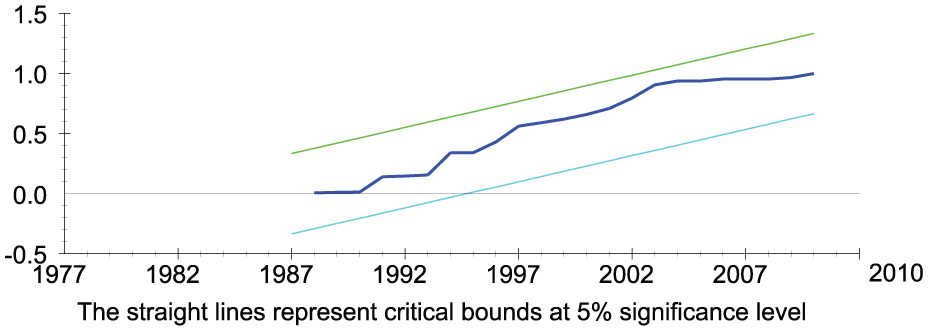
Plot of cumulative sum of squares of recursive residuals for Model 1.

Plot of cumulative sum of recursive residuals for Model 2.

Plot of cumulative sum of squares of recursive residuals for Model 2.
Conclusion and Policy Suggestions
The role of human capital and technology toward determining economic growth cannot be overemphasized based on the theory. Empirically, while some literature has proven this assertion, others have disproved it. On the general note, there are mixed results on this issue. It is against this background that this article investigated the impact of human capital and technology on economic growth in Nigeria over the period of 1975 to 2010. Employing annual data, the study applied the ARDL approach to cointegration owing to the nature of the data, as the order of integration of the variables was mixed. As such, ARDL was used to test the long-run relationship between growth and its determinants, and also to ascertain the impact of human capital and technology on growth in both the long run and short run. Two separate equations were specified with human capital in different forms (secondary and tertiary school enrollments), while technology, labor, and capital remain the same. Our results indicate that both models were found to be cointegrated, which is a prerequisite for estimation of the long-run relationship. The results of the long-run models of our two equations reveal that human capital using both secondary and tertiary school enrollment impact positively and significantly on the economic growth in Nigeria. Thus, human capital and technology are important variables to economic growth in the Nigerian context. At the same time, labor and capital were also having positive and significant impact on growth. In contrast, in the short run, human capital was only significant in the form of tertiary school enrollment. Secondary school enrollment was, however, insignificant in determining growth of Nigerian economy in the short run. More important, technology still conforms to the theory in the short run as it has been found to be positive and significant in the presence of both secondary and tertiary school enrollments as proxies to human capital. Technology is, therefore, instrumental to growth in Nigeria not only in the long run but also in the short run. Our findings further reveal that labor and capital were significant in promoting growth in the short run. The ECTs for the two models had confirmed the long-run relationship and indicated a moderate speed of adjustment of the variables’ convergence to equilibrium in the long run. On the general note, the two models passed diagnostic tests, including the stability tests of cusum and cusumSQ. This further strengthens the inferential power of the two models, as well as their reliability.
The policy suggestion based on the findings of our study is that human capital and technology are not only theoretically growth-driven variables but also empirically tested growth-driven variables. Essentially, Nigeria’s government needs to improve and supply facilities to schools at both secondary and tertiary levels to promote growth. At the same time, more funding is needed for research and development to encourage innovations and inventions in both schools and research centers across the country. These, coupled with sincere commitment, would substantially accelerate economic growth of the country.
Footnotes
Appendix
Declaration of Conflicting Interests
The author(s) declared no potential conflicts of interest with respect to the research, authorship, and/or publication of this article.
Funding
The author(s) received no financial support for the research and/or authorship of this article.