




Abstract
Green technological innovation (GTI) has the dual externalities of promoting technological advancements and facilitating environmental protection. GTI assists manufacturing clusters respond to emission reduction and environmental protection challenges. Non-geographic proximity is vital in promoting knowledge sharing among organizations, facilitating GTI’s effective implementation; in this regard, a gap exists in the current literature. Using data from 330 cluster firms in China’s fine chemical industry and drawing on the knowledge-based view, this study explores how cognitive and social proximities affect GTI in cluster firms. The key findings are as follows: First, cognitive and social proximities are crucial factors driving GTI. Second, knowledge sharing mediates the relationship between proximity and GTI. Third, technological distance positively moderates the relationship between social proximity and green product innovation, and that between social proximity and end-of-pipe technological innovation. These findings have critical implications for cluster firms looking to cultivate network relationships based on distinct types of GTI.
Keywords
Introduction
With global warming, environmental protection, and emission reduction have become new challenges for economic development. An industry cluster is an important form of industrial organization that supports the Chinese traditional manufacturing industry’s development. Industrial clusters have contributed to the rapid growth of regional economies. However, they simultaneously pose problems for ecological and sustainable development. Extensive development models with high emissions, consumption, and pollution have been unsustainable. Manufacturing industry clusters with high emissions face the arduous tasks of energy conservation, emission reduction, and ecological environment protection. Green technological innovation (GTI) helps manufacturing firms in clusters cope with the challenges of emission reduction and environmental protection. Therefore, GTI has become an important research topic in academia and practice.
GTI is a technological innovation that beneficially affects the ecological environment, which specially emphasizes reducing pollution and environmental burdens throughout the product life cycle and reducing negative impacts of resource and energy use (Abdullah et al., 2016; Zhang et al., 2018). GTI has dual externalities of promoting technological progress and protecting the ecological environment (Rennings & Zwick, 2002). However, firms in clusters face difficulties implementing GTI. GTI implementation indicates that cooperation and knowledge interaction between firms in the cluster and innovation network entities are weak, and opportunistic behavior appears relatively easily (Jakimowicz & Rzeczkowski, 2019; Wasiluk & Saadatyar, 2020). When firms in a cluster engage in knowledge interaction and technological innovation cooperation with external firms, the cognitive and management barriers cannot be underestimated (Ardito et al., 2018; Asakawa, 2001), which may impair the GTI of firms in the cluster. They must adjust and change according to each other’s situation (Han & Xu, 2021). Obtaining the diversified technologies and resources required for GTI is difficult for cluster firms.
Proximity is related to relevance, similarity, and distance within organizations and technology and geography among organizations (Knoben & Oerlemans, 2006). This is an important perspective for analyzing the competitiveness of clusters because clusters are the main form in agglomeration economies. The different dimensions of proximity affect knowledge sharing, innovation risks, and collaborative performance among entities (Boschma, 2005). Existing research lacks a non-geographic proximity-related study of GTIs of firms in a cluster.
Hence, through a literature review, we selected three dimensions of proximity that were highly related to GTI in cluster firms. These proximity dimensions are social proximity, cognitive proximity, and technological distance. Moreover, we determined the influence mechanism of cognitive and social proximity on GTI—based on the knowledge-based view (KBV). In this mechanism, tacit and explicit knowledge sharing plays a mediating role, while technological distance plays a moderating role. GTI is divided into three types—specifically, green product innovation (GPI), clean process innovation (CPI), and end-of-pipe technological innovation (ETI). This theoretical model complements existing research on GTI in cluster firms from the perspective of non-geographic proximity. Formulating GPI, CPI, and ETI strategies based on cognitive and social proximity is conducive for cluster firms. This study helps cluster firms establish and maintain GTI partnerships according to the type of GTI to ensure effective and efficient knowledge sharing. Consequently, this can help optimize cluster enterprises’ GTI strategies from different perspectives.
The remainder of this paper is organized as follows: The Literature Review section discusses the existing research relevant to the topic. The Hypothesis Development section details the underlying assumptions and proposes theoretical predictions. The Methods section covers the measurements of the variables, data collection, descriptive statistical analysis, and empirical results. The Discussion section analyzes the study’s results. Finally, the Conclusion section presents the overall findings and discusses the theoretical and managerial implications, limitations, and scope for future research.
Literature Review
We conducted a literature review from three perspectives—specifically, GTI, proximity, and KBV.
GTI
Compared with traditional technological innovation, GTI increases the positive externalities of ecological environmental protection and solves the problem of the coordinated progress in technology and environmental protection (Fernando et al., 2019). Owing to its additional positive environmental externalities, GTI differs from traditional technological innovation in numerous aspects. Moreover, uncertainty in the GTI results has increased (De Marchi, 2012; Jaffe et al., 2005). GTI has increased the interaction between upstream and downstream firms in the industrial chain. Further, GTI requires more complex and diverse knowledge and technology (Arfi et al., 2018; Hojnik & Ruzzier, 2016).
Scholars have divided GTI into GPI, CPI, and ETI (Frondel et al., 2007; Schiederig et al., 2012; Zhang et al., 2018). First, GPI refers to the development of products that can avoid wasting raw materials and energy and control the generation of source pollution. For example, the development of environment-friendly, biodegradable materials that can be completely degraded by composting. Second, CPI regulates pollution and produces minimal waste in the manufacturing process through process updates, equipment transformations, or innovation. For example, technological innovations in conversion catalysts, special reactor design, and related process technology development can improve process energy efficiency and carbon benefits. Third, ETI is aimed at treating generated waste—that is, the treatment of pollution problems, such as waste gas, wastewater, noise, and solid waste (Frondel et al., 2007; Yarime, 2009). For example, in the battery production process, a combination of high-desalination membrane and low-pressure membrane products for the generated wastewater allows most of the wastewater to be reused in the production unit and recovery of resources from the wastewater.
Although the research on GTI at the firm level is abundant, the influencing factors of type of firms and dimensions of GTI require further investigation. Research on the GTI of cluster firms is important, especially for fine chemical firms with high resource consumption and serious pollution concerns. In the face of increasing pressure for environmental protection, fine chemical firms are actively implementing GTI practices, and the “Made in China 2025” plan has brought them numerous opportunities for GTI. However, few studies have focused on this unique sample.
Although scholars have agreed that relying on inter-organizational R&D cooperation to develop GTI is necessary, the study of the binary relationship of firms in clusters from evolutionary economic geography’s perspective is still limited. Furthermore, inter-organizational relationships’ impact on GTI needs further examination (Dangelico & Pontrandolfo, 2015; Zhao et al., 2018).
Proximity
A cluster of firms is a group of geographically close firms linked by value chains, shared resources, common technology, common buyers, or distribution channels. Firms in a cluster are interrelated through these factors and are embedded in the local social and cultural environment. Currently, research on clusters pays special attention to proximity.
Boschma (2005) proposed a multidimensional proximity analysis framework of cognitive, organizational, social, institutional, and geographic proximity based on the integration of the pioneering work of the French Proximity Dynamics School. In recent years, several scholars have used multidimensional proximity to study the embeddedness of local and nonlocal networks, seek knowledge and innovation sources across cluster boundaries, and study various modes of innovation cooperation. Research on non-geographic dimensions has the complications of a large number of dimensions, ambiguous meanings, and overlapping concepts.
Knoben and Oerlemans (2006) analyzed the overlap of meanings and found that four dimensions at the organizational level are sufficient to cover the impact of the various proximities (cognitive, social, technological, and geographic proximity) on innovation. Additionally, some scholars are accustomed to using “distance” to describe the difference in a certain dimension between subjects, such as “technological distance” and “cognitive distance” (Amores-Salvadó et al., 2021; Gilsing et al., 2008; Li, Heimeriks et al., 2021).
The relationship between geographic proximity and GTI is currently the most discussed among the above four proximity dimensions. Geospatial is often used as a starting point for regional studies, but the role of geographic proximity is primarily to facilitate cognitive, social, and technological proximity (Boschma, 2005). With the advances in information technology, evolving research has placed greater emphasis on the role of temporary and virtual proximity. Moreover, geographic proximity is not considered necessary for GTI. The knowledge and practices required for GTI are not geographically centralized (Albino et al., 2014; Verdolini & Galeotti, 2011; Wagner, 2007). Hence, the current research focuses on GTI of clusters that have evolved from an agglomeration economy to an innovation network. The decentralized nature of innovation network nodes helps firms obtain the heterogeneous resources required for GTI.
To unleash the innovation potential of clusters, firms must cooperate with all participants, including competitors, with an open attitude (Wasiluk & Saadatyar, 2020). Numerous scholars believe that different dimensions of proximity are essential for GTI (Hansen, 2014; Liu et al., 2021; Seuring & Müller, 2008; Shaw & Gilly, 2000). Cognitive, social, and technological proximity play important roles in cooperative learning and innovation processes. However, knowledge regarding their effects on GTI is limited.
KBV
The KBV posits that knowledge has value, scarcity, and inimitability. Firms can form their own knowledge base through knowledge diffusion, accumulation, and collisions between internal and external knowledge. Moreover, they can continuously enrich their knowledge base to enhance their core competitiveness (Barney, 1991). Knowledge is fundamental to technology-based firms. Only when innovative technologies are transformed into knowledge do they provide opportunities for firms to learn, absorb, transform, and apply them. The coupling of old and new knowledge is an important manifestation of the knowledge flow between firms. Unlike explicit knowledge, tacit knowledge is key for firms to gain core capabilities. The firm’s main task is effectively obtaining the knowledge needed from outside and integrate it with its own. KBV can enable the recognition of the impact mechanism of proximity on a firm’s GTI. Specifically, proximity can motivate knowledge sharing as well as increase its effectiveness. Firms create more green knowledge by further identifying new knowledge and merging it with previous knowledge, which is important for firms’ GTI (Grant & Baden-Fuller, 2004). Moreover, KBV provides an important theoretical basis for explaining the relationship and mechanism between proximity and GTI.
Different dimensions of GTI in cluster firms must be explored further. Existing research on GTI in cluster firms lacks non-geographic proximity-related focus. And knowledge regarding the mechanisms of non-geographical proximity is scant. Therefore, based on the KBV, this study focuses on the relationships among cognitive proximity, social proximity, technological distance, and the three types of GTI (GPI, CPI, and ETI).
Hypothesis Development
Social Proximity
Social Proximity and GTI
According to Coenen et al. (2004), social proximity is derived from the embeddedness of social networks. Social proximity refers to the degree of social network embedding of firms. The literature has indicated that trust can be obtained by embedding in social networks (Currall & Inkpen, 2002; Ireland & Webb, 2007). Economic sociology theory posits that the foundation for implementing innovative activities is effective interaction between knowledge subjects. Researchers have attempted to study the impact of social proximity on innovation (Heringa et al., 2014; Molina-Morales et al., 2014). A close and stable partnership promotes mutual trust, reduces innovation uncertainty and cooperation costs, and facilitates innovation activities (Giuri & Mariani, 2013). In recent years, an increasing number of scholars have recognized social proximity as a proximity dimension with independent effects. Social proximity significantly impacts innovation, even if organizations are not geographically proximity (Steinmo & Rasmussen, 2016).
Mutual trust between firms is easier to gain by embedding in social networks, which is manifested from informal relationships, reduced opportunistic behavior, and trust in competencies (Blumberg, 2001; Han & Xu, 2021; Presutti et al., 2019; Tsai & Ghoshal, 1998). GTI is more uncertain and riskier than traditional innovation (De Marchi, 2012). The uncertainty and risk of GTI can be reduced through trust mechanisms (Courrent & Gundolf, 2009). Social proximity transforms relationships into channels for the efficient transfer of knowledge. Most of the social proximity—in the nonlocal context of firms in a cluster—stems from business contacts and past experience of working together. Social proximity provides opportunities for knowledge transfer. Research has highlighted that innovation based on trust in partners is exclusive and closed (Al-Tabbaa & Ankrah, 2016). The higher the social proximity, the more resources firms may invest in collaborative innovation. GTI requires more complicated and diversified abilities than other innovations (Arfi et al., 2018; Hojnik & Ruzzier, 2016). Social relationships based on trust are instrumental in maintaining connections among firms, advancing mutual engagement, and promoting the effective interflow of tacit knowledge (Anand et al., 2021). Higher social embeddedness helps firms acquire the knowledge needed for GTI, builds channels for firms in clusters to enter new markets and technologies, and overcomes the old technology paradigm’s lock-in risks. Therefore, we propose the following three research hypotheses:
Hypothesis 1a: Social proximity positively impacts GPI.
Hypothesis 1b: Social proximity positively impacts CPI.
Hypothesis 1c: Social proximity positively impacts ETI.
Social Proximity and Knowledge Sharing
Social proximity stems from trust in the capabilities (skills and knowledge) of partner firms and willingness to share technical knowledge (Das & Teng, 2001). Social proximity paves the way for cooperation whereby the firm can focus on the skills and values of its partners. Social proximity enhances knowledge-sharing among firms by enabling recurrent interactions. Social proximity helps overcome the stickiness of nonlocal knowledge flow and reduces the knowledge loss of long-distance knowledge transfer. Therefore, for geographically dispersed green knowledge and innovation activities, the stronger the social proximity, the better the cooperative GTI performance.
Social proximity enables cluster firms to spend more resources on knowledge sharing related to GTI rather than expending resources to understand the behavior of partners and worry regarding the risks associated with knowledge sharing. Further, social proximity affects the transmission of tacit knowledge (Wasiluk & Saadatyar, 2020). Tacit knowledge may be more critical to GTI than explicit knowledge. Moreover, some scholars have highlighted that excessive trust restricts knowledge sharing and organizational learning (Chung et al., 2015; Yli-Renko et al., 2001). We believe that its overall impact is positive. Thus, this study proposes the following hypotheses:
Hypothesis 2a: Social proximity positively impacts tacit knowledge sharing.
Hypothesis 2b: Social proximity positively impacts explicit knowledge sharing.
Knowledge Sharing and GTI
Considering its additional environmental dimensions, GTI requires more complicated and diversified abilities than other innovations (Arfi et al., 2018; Hojnik & Ruzzier, 2016). Firms in clusters typically do not have all the required resources. Firms in clusters participating in GTI should pay close attention to their ability to acquire new knowledge and solve problems through knowledge-sharing.
Tacit knowledge is of vital importance in corporate innovation, knowledge creation, new market expansion, and corporate competitive advantages’ enhancement (Usman et al., 2019). Cooperation among firms aims to acquire tacit knowledge, promote the development of new markets, and create new knowledge (Ranucci & Souder, 2015). Explicit knowledge is easy to obtain, internalize, and use; therefore, it also plays a vital role in GTI. Firms face the challenges of a lack of technical skills and difficulty in fulfilling industry environmental protection standards. In this case, the purpose of cooperation between cluster firms and external firms is obtaining explicit technical knowledge that has been coded and formalized to enhance technical learning (Usman et al., 2019). Tacit and explicit knowledge complement each other and promote the GTI of cluster firms. Hence, we propose the following hypotheses:
Hypothesis 3a: Explicit knowledge sharing positively impacts GPI.
Hypothesis 3b: Explicit knowledge sharing positively impacts CPI.
Hypothesis 3c: Explicit knowledge sharing positively impacts ETI.
Hypothesis 4a: Tacit knowledge sharing positively impacts GPI.
Hypothesis 4b: Tacit knowledge sharing positively impacts CPI.
Hypothesis 4c: Tacit knowledge sharing positively impacts ETI.
Mediating Role of Knowledge Sharing
Knowledge sharing is the process whereby firms acquire knowledge. According to resource-based theory, knowledge is an important resource for firms’ innovation. Firms in a cluster discover and acquire knowledge from different sources through the established social proximity, to effectively integrate and use the knowledge to improve GPI, CPI, and ETI.
Knowledge sharing among organizations is reflective of social network theory (Balle et al., 2019). Firms represent nodes within the network. Social proximity drives the formation of networks, and knowledge flows further strengthen the connections between the nodes and affect firm performance (Dong & Yang, 2016). Consequently, the following hypotheses are proposed:
Hypothesis 5a: Explicit knowledge sharing mediates the relationship between social proximity and GPI.
Hypothesis 5b: Explicit knowledge sharing mediates the relationship between social proximity and CPI.
Hypothesis 5c: Explicit knowledge sharing mediates the relationship between social proximity and ETI.
Hypothesis 6a: Tacit knowledge-sharing mediates the relationship between social proximity and GPI.
Hypothesis 6b: Tacit knowledge sharing mediates the relationship between social proximity and CPI.
Hypothesis 6c: Tacit knowledge sharing mediates the relationship between social proximity and ETI.
Cognitive Proximity
Cognitive Proximity and GTI
Cognitive proximity refers to the similarities between cooperative goals and corporate culture. Cognitive proximity enables firms to understand and evaluate similarities in organizational processes, policies, and values, such that they can effectively exchange knowledge with each other. The similarity of cooperation goals helps establish a trusted relationship (Tsai & Ghoshal, 1998), and firms exert themselves in the struggle for a common goal. Similar corporate culture enable firms to understand partners’ purpose or actions; be willing and able to cooperate; and jointly plan, make decisions, and solve problems in cooperative innovation (Krause et al., 2007), which is of great importance to GTI. The knowledge and practices of GTI are geographically dispersed. Cluster firms must adjust and change, especially in nonlocal contexts (Ardito et al., 2018). Cognitive proximity can counter this risk by breaking through barriers in cognition, culture, and management that appear in cross-regional R&D relationships. Thus, promoting knowledge transfer and integration required by GTI is possible.
Presutti et al. (2019) verified with customers the positive impact of cognitive proximity on innovation performance—by empirically analyzing small- and medium-sized Italian high-tech industrial clusters. Additionally, firms with cognitive proximity in the context of GTI usually have environmental protection goals that are particularly important for cooperative innovation. For example, the Asahi Kasei Corporation has stated that both parties must have a common vision to improve the environment. The Haier Group Corporation has regarded environmentally friendly production concepts as an important selection criterion for its partners. Consensus among partners on environmental protection goals will help achieve GTI-related environmental goals. Therefore, this study advances the following hypothesis:
Hypothesis 7a: Cognitive proximity positively impacts GPI.
Hypothesis 7b: Cognitive proximity positively impacts CPI.
Hypothesis 7c: Cognitive proximity positively impacts ETI.
Cognitive Proximity and Knowledge Sharing
Explicit knowledge is easily textualized and replicable, and cognitive proximity affects the manner and outcomes of explicit knowledge sharing across firms. According to the analysis of social networks’ relational embeddedness, cognitive proximity increases inter-firm interaction and positioning (Gulati et al., 2012) and encourages members to engage in cooperative behavior (Nahapiet & Ghoshal, 1998). This facilitates knowledge compilation and reduces the project screening uncertainty. Moreover, firms search for and evaluate cognitively proximate individuals; thus, cognitive proximity alters the path of knowledge flow (Nahapiet & Ghoshal, 1998). Knowledge flow follows the path of least resistance (Gomez-Rodriguez, et al., 2012), forming path dependence. Cognitive proximity promotes the non-redundancy of knowledge-sharing realization paths. Additionally, cognitive proximity reduces the cost of interaction, expands the scope of interaction, and optimizes short-range links to accelerate transmission and reduce distortion. Combined with the resource-based theory of integrating resources to generate new resource viewpoints (Das & Teng, 2000), cognitive proximity encourages firms to form “cognitive consistency” and accelerates the generation of green project knowledge.
Tacit knowledge is embedded in individual competencies and organizational knowledge bases. From the perspective of self-categorization theory, the similarity between perceptions forms cognitive groupings that generate mutual attraction (Turner et al., 1987). Cognitive proximity increases inter-firm interactions (Gomez-Rodriguez, et al., 2012), facilitating firms’ understanding and knowledge absorption (Gavetti & Porac, 2018). Experiences that are difficult to write can deepen the understanding, benefit, imitate, and improve the effects of tacit knowledge sharing. Furthermore, cognitive proximity reduces the knowledge-sharing cost caused by the inconsistency of subjective cognition and stickiness of tacit knowledge between the sharing parties. Blau (2017)—beginning from social exchange theory based on cost-benefit analysis—found that organizations gain more knowledge sharing and achieve common goals. Therefore, cognitive proximity promotes the gradual improvement and perfection of tacit knowledge to form a knowledge base that supports GTI.
GTI requires relatively complementary knowledge from multiple sources; therefore, firms need similar cognitive systems to share knowledge. The knowledge of firms in a cluster is often rooted in the cluster, and transferring it outside the cluster is an intricate process. Knowledge—when in cognitive proximity—can be transferred and acquired more effectively. Based on these arguments, we propose the following hypotheses:
Hypothesis 8a: Cognitive proximity positively impacts tacit knowledge sharing.
Hypothesis 8b: Cognitive proximity positively impacts explicit knowledge sharing.
Mediating Role of Knowledge Sharing
Proximity triggers knowledge acquisition, enabling firms to create knowledge in the process of interactive learning (Bathelt et al., 2004). Cognitive proximity establishes channels for firms in clusters to interact and cooperate; share market and technological knowledge; and encourage firms to identify, acquire, and create knowledge, thereby promoting GTI. Cognitive proximity enhances inter-organizational linkages, enabling smooth knowledge-sharing flows in knowledge networks, which, in turn, affects innovation performance (Wang et al. 2018). Therefore, we propose the following hypotheses:
Hypothesis 9a: Explicit knowledge sharing mediates the relationship between cognitive proximity and GPI.
Hypothesis 9b: Explicit knowledge sharing mediates the relationship between cognitive proximity and CPI.
Hypothesis 9c: Explicit knowledge-sharing mediates the relationship between cognitive proximity and ETI.
Hypothesis 10a: Tacit knowledge-sharing mediates the relationship between cognitive proximity and GPI.
Hypothesis 10b: Tacit knowledge sharing mediates the relationship between cognitive proximity and CPI.
Hypothesis 10c: Tacit knowledge sharing mediates the relationship between cognitive proximity and ETI.
Technological Distance
Cognitive proximity affects the relationship between social and cognitive proximities and GTI in two ways. First, social and cognitive proximities expand firms’ reach and innovation collaboration, but the GTI outcomes are not invariably beneficial. Scholars, such as Ghisetti et al. (2015), have highlighted that GTI solutions usually need to fulfill multiple needs. Hence, firms must address varied technical problems, require complementary knowledge in diverse technical fields, and implement system combinations and cross-applications (Horbach et al., 2013; Nemet, 2012; OECD, European Commission, & Nordic Innovation, 2012; Sampson, 2007). For firms in a cluster, cooperating with firms with a larger technological distance may enable them to avoid falling into the “ability trap” and is more likely to promote the development of external resources, relationships, and opportunities. R&D partnerships with firms close in technology may increase the path dependence of cluster firms, leading to technology lock-in and weakening their ability to deal with the complex technical problems of GTI. Technologically diversified partners can share the risks and costs of GTI with firms in clusters (Chrisman & Patel, 2012). Technological distance can promote the establishment of more effective long-term relationships among firms and increase opportunities for GTI. By contrast, R&D cooperation with partners in the same technology field may reduce knowledge-sharing opportunities.
Second, social and cognitive proximities enable companies to share knowledge and collaborate in innovation. However, cooperative innovation is accompanied by the risk of knowledge spillover or leakage (Melander & Tell, 2014). Knowledge sharing may lead to knowledge leakage, especially when knowledge is highly similar (Ahmad et al., 2014). These unexpected knowledge spillovers can undermine innovation (Balle et al., 2019). When partners’ technical fields are similar, the two parties are likely to have a competitive relationship, and the firms will understand each other’s strategies (Boschma, 2005). To prevent competitors from gaining a competitive advantage, the quantity and quality of knowledge sharing and cooperative innovation between firms will decrease, and innovation risks will increase. Technological distance may reduce this negative effect. In summary, this study assumes that technologically close partners will hinder the development of GTI for firms in clusters, while partners with greater technological distance will promote GTI. Thus, the following hypotheses are proposed:
Hypothesis 11a: Technological distance positively moderates social proximity’s direct effect on GPI.
Hypothesis 11b: Technological distance positively moderates social proximity’s direct effect on CPI.
Hypothesis 11c: Technological distance positively moderates social proximity’s direct effect on ETI.
Hypothesis 12a: Technological distance positively moderates cognitive proximity’s direct effect on GPI.
Hypothesis 12b: Technological distance positively moderates cognitive proximity’s direct effect on CPI.
Hypothesis 12c: Technological distance positively moderates cognitive proximity’s direct effect on ETI.
Figure 1 illustrates the conceptual model used in this study. Cognitive and social proximities are explanatory variables, GPI, CPI, and ETI are explained variables, tacit knowledge sharing and explicit knowledge sharing are mediator variables, and technological distance is moderating variable.

Conceptual model.
Methods
Measurements
The scales used herein are well-established scales and have been verified by other scholars. However, these scales lack local adaptability and specificity to the research situation. Therefore, we implemented the following two tasks: First, we conducted a bidirectional English-Chinese translation and comparative examination (Douglas & Craig, 2007). Second, we invited experts from fine chemical firms and relevant government departments and conducted three in-depth interviews to analyze the items and evaluate the degree to which each item expressed the relevant meaning. According to the evaluation results and suggestions, some items were deleted, modified, improved, and optimized to adapt to the research situation and research objects. The content scale design of this questionnaire included the following nine parts: characteristics of firms and respondents, social proximity, cognitive proximity, technological distance, explicit knowledge sharing, tacit knowledge sharing, GPI, CPI, and ETI. The study variables were measured using a seven-point Likert scale. Among them, cognitive proximity is measured by a second-order facet, including two first-order factors (shared goals and shared culture). Table 1 presents the items used for measurement.
Summary of Measurements of Variables.

Sample and Data Collection
The research object was fine chemical firms in a cluster, and the main respondents were corporate executives, safety and environmental protection department managers, production managers, managers of technical departments, sales managers, and purchasing managers. After pretesting with fine chemical firms in a chemical park in North China, the questionnaire items were adjusted, resulting in a formal questionnaire. The survey was administered between May and October 2020. The sample comprises fine chemical firms from North, East, and Northwest China chemical clusters. The samples’ geographical, scale, and industry distributions reflect the overall situation of the Chinese fine chemical firms in the cluster. Two main methods were used to collect the questionnaires—namely, interviewing respondents to issue paper questionnaires and distributing them by e-mail. The former method yielded a more satisfactory response rate than the latter.
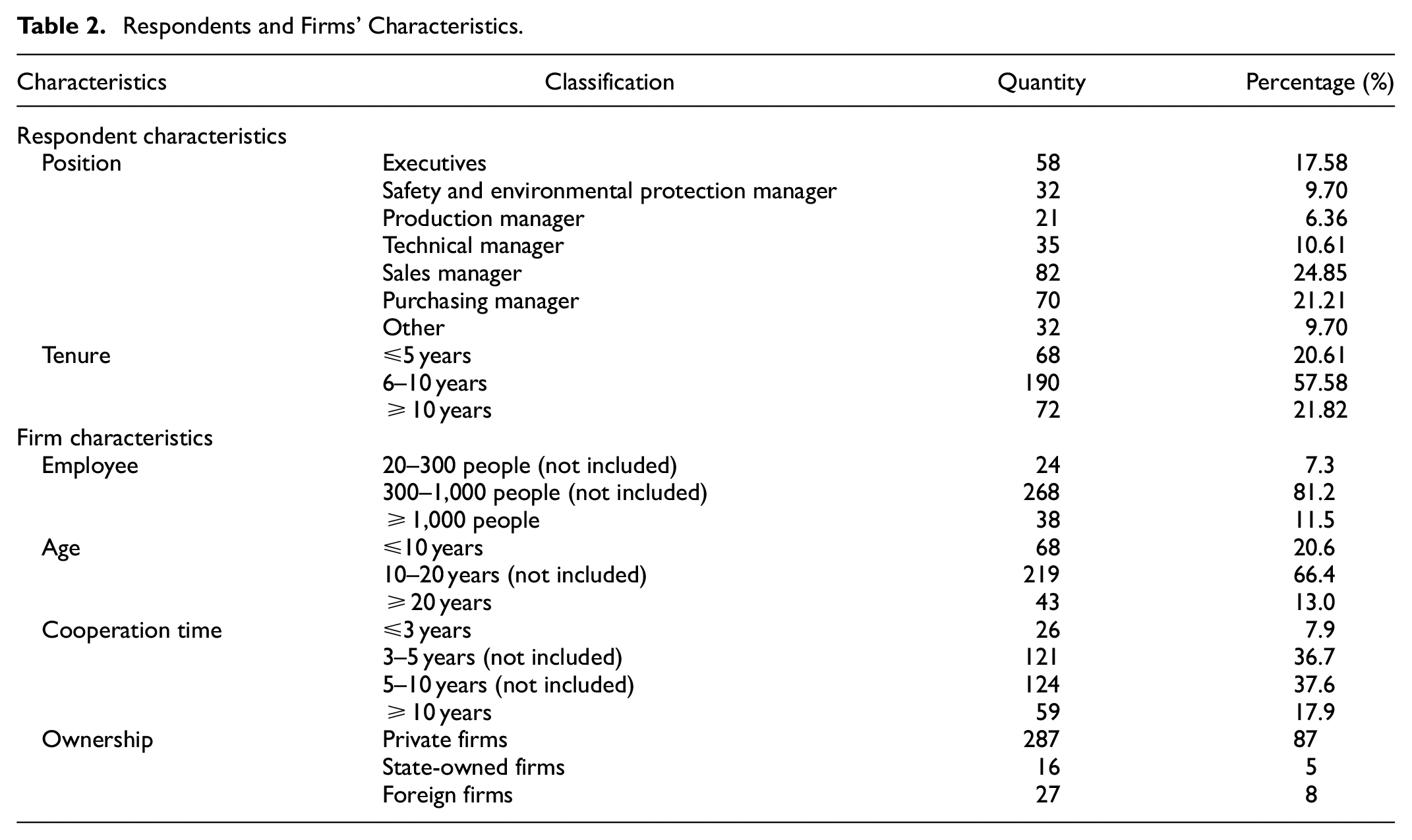
Overall, 533 questionnaires were distributed, of which 346 were returned. After screening, the questionnaires of firms that were not in the cluster, had the same score, had missing data, or had significantly inconsistent scores, were excluded. For the remaining questionnaires, we checked the business profiles of firms from the company and Qcc.com websites. Firms with no green technological R&D activities or those providing only non-technical services were excluded from the study, and 330 valid questionnaires were retained. The effective response rate was 64.9%. A t-test was performed on the paper and electronic questionnaires, and the statistical results presented no significant differences between the two methods of distributing questionnaires (p > .001). Therefore, the returned samples were unbiased and could be used for statistical analyses. Table 2 presents the sample’s characteristics.
Respondents and Firms’ Characteristics.
Common Method Bias Test
We used a two-stage prevention and detection approach (Harman’s single-factor test) to avoid common method bias. The questionnaire’s first page provided reminders, explained that this research was only for academic purposes, and assured that the questionnaire responses would remain anonymous and confidential. The respondents were encouraged to answer the questions truthfully. In questionnaire items’ arrangement, the antecedent, intermediary, and result items were separated to avoid errors in answering owing to the associations among the variables (Podsakoff et al., 2003). For posthoc testing, we used Harman’s one-factor test to detect whether a common method bias existed among the variables (Podsakoff & Organ, 1986). The cumulative factor explained up to 69.79% of the variance, while the first factor explained only 19.99%. The results indicated no serious common method bias in the data collected from a single subject.
Data Analysis Technique
Partial Least Squares (PLS) was used for data analysis. PLS is a structural equation modeling analysis technique derived from the statistical method of path analysis and is based on regression analysis, an important technique for studying causal models involving multiple reconstructions. PLS can handle more research variables and complex research models, and allows relatively robust parameter estimation results to be obtained for small sample sizes (Hair et al., 2017). Accordingly, this study adopts the PLS analysis measurement model and structural model.
Descriptive Statistical Analysis
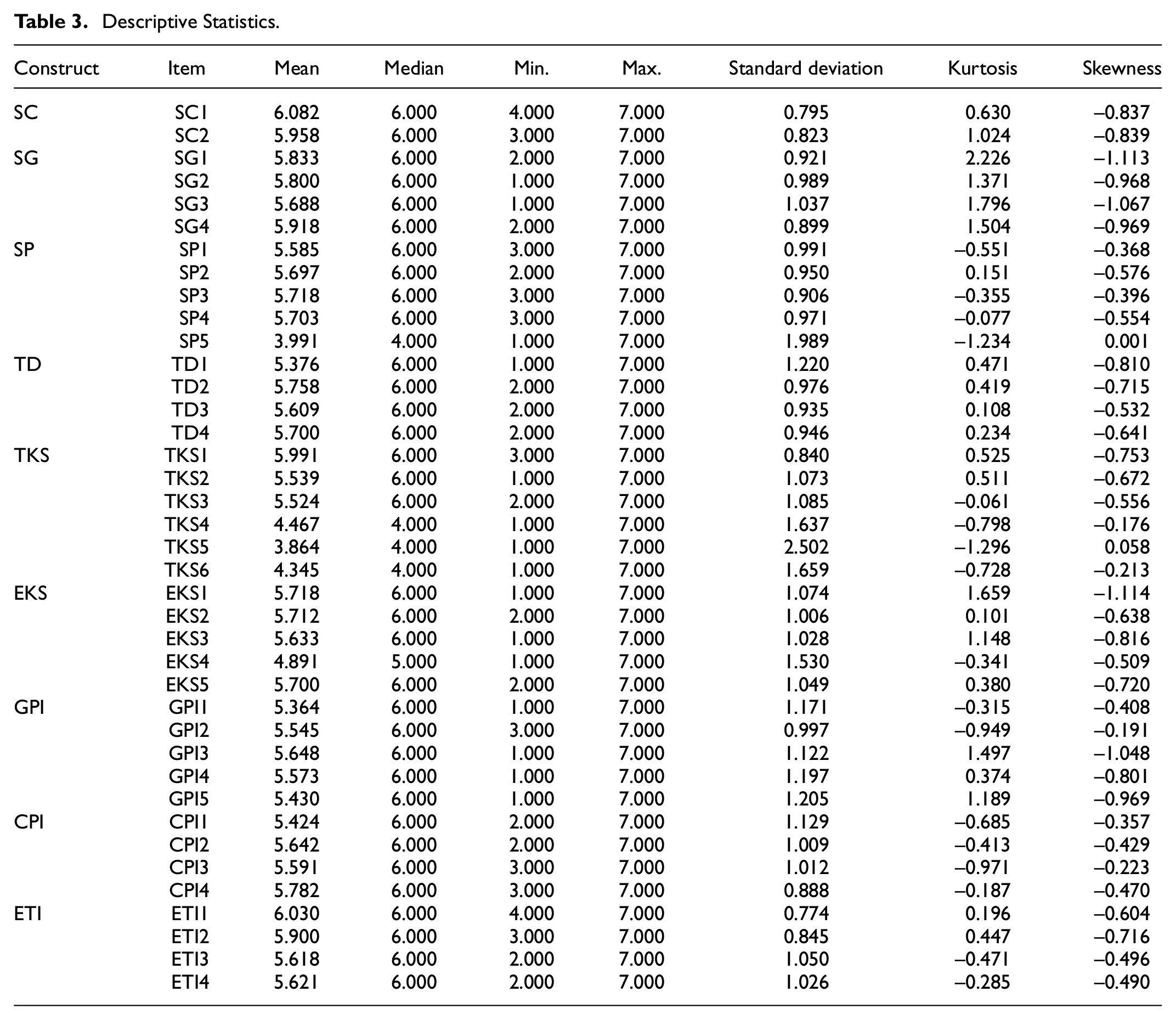
After collecting sample data, we performed descriptive statistical analysis on the same. Descriptive statistics provide an initial understanding of the data—including measures including mean, standard deviation, skewness, and kurtosis (Table 3; where SG represents shared goals, SC represents shared culture, SP represents social proximity, TKS represents tacit knowledge sharing, and EKS represents explicit knowledge sharing in the statistical analysis.) The item means ranged from 4.345 to 6.158, with standard deviations ranging from 0.774 to 1.659, indicating that all items could be retained. The skewness coefficients herein ranged from −1.114 to 1.126, while the kurtosis coefficients ranged from −1.240 to 2.226—all fulfilling the normal distribution requirements.
Descriptive Statistics.
Reliability and Validity
Convergent Validity
Regarding convergent validity, three indicators—namely, reliability, composite reliability (CR), and average variance extracted (AVE)—were considered for each item. Table 4 presents the factor loading and convergent validity tests’ results.
Factor Loading and Convergent Validity.

According to Hair et al. (1998), factor loadings should be greater than 0.5 for individual item reliability. The test found that the factor loadings of SP5 and TKS5 were lower than 0.45 and were, thus, deleted. The factor loadings of the remaining items presented in Table 3 range from 0.712 to 0.944, indicating good reliability.
Internal consistency was used to test reliability. Table 4 summarizes the results. The Cronbach’s α of each variable is between .851 and .928. The Cronbach’s α is higher than .7 (Hair et al., 2011). The CR values of all aspects are greater than .7 (Hair et al., 1998), indicating that this study’s items exhibit good internal consistency. The AVE values ranged between 0.627 and 0.887, all greater than 0.5 (Fornell & Larcker, 1981).
Discriminant Validity
Discriminant validity was determined by comparing factor loadings and cross-loadings. The variables’ factor loadings were greater than the cross-loadings of the items and other variables. Therefore, the data passed the discriminant validity test (Table 5). Hair et al. (2011, 2012) and Henseler et al. (2016) recommend comparing factor loadings and cross-loadings to identify discriminant validity.
Discriminant Validity.

Note. Numbers in bold are factor loadings for variables.
Additionally, we used a bootstrapping algorithm to calculate the confidence intervals for the correlation coefficients. Discriminant validity is indicated if the confidence interval for the correlation coefficient does not contain 1 (Torkzadeh et al., 2003). The confidence intervals for all correlation coefficients in this study do not contain 1, thereby indicating discriminant validity (Table 6).
Correlation Coefficients and Confidence Intervals.

Structural Model’s Assessment
The coefficient of determination (R2) is the main criterion used to judge the model’s quality. The R2 of the endogenous latent variable is approximately .67 for high explanatory ability, .33 for moderate explanatory ability, and .19 for weak explanatory ability (Chin, 1998). Geisser (1974) proposed predictive relevance (Q2) to measure the PLS path model’s prediction accuracy. According to Sarstedt et al. (2014), Q2 is based on a blindfolding procedure, which removes single points from the data matrix, averages the deleted points, and estimates the model parameters. If Q2 is greater than zero, the construct has good predictive power. Table 7 presents the analysis results, indicating that the structural model has strong explanatory power.
R2 and Q2

Goodness of Fit (GOF) is a global criterion for structural models. It is calculated by multiplying the average AVE by the average R2 and, thereafter, computing its square root:

According to Wetzels et al. (2009), a GOF value of 0.1 is weak, 0.25 is moderate, and 0.36 is strong. The GOF value in this study was 0.748, indicating a good model fit.
Before performing path analysis, we examined whether a collinearity problem existed between the explanatory variables, the indicator for which is the variance inflation factor (VIF). Table 8 summarizes the results. The VIF’s maximum value was 4.47, which is lower than the recommended value of 5, indicating that the collinearity problem was not serious.
Variance Inflation Factor Value.

Hypotheses Testing and Results
Direct Effect
Table 9 presents the coefficients, standard deviations, t values, p values, and confidence intervals for the direct effects. Table 9 reveals that social proximity exerts significant positive effects on GPI, CPI, and ETI. Thus, H1a, H1b, and H1c are verified. Furthermore, the positive impact of social proximity on CPI (β = 0.583, p < .001) and ETI (β = 0.552, p < .001) are stronger than that on GPI (β = 0.177, p < .05), suggesting that social proximity significantly promotes CPI and ETI. Cognitive proximity has significant positive effects on GPI, CPI, and ETI. Thus, H2a, H2b, and H2c are verified. Cognitive proximity’s positive impact on GPI (β = 0.294, p < .001) is stronger than that on CPI (β = 0.107, p < .05) and ETI (β = 0.146, p < .05), demonstrating that cognitive proximity significantly promotes GPI.
Direct Effect Test Results.

Moreover, Table 9 indicates that social proximity positively and significantly impacts tacit knowledge sharing and explicit knowledge sharing (β = 0.432, p < .001; β = 0.692, p < .001). Cognitive proximity is an important path to foster tacit as well as explicit knowledge sharing (β = 0.457, p < .001; β = 0.202, p < .001). Explicit knowledge sharing significantly promotes GPI, CPI, and ETI (β = 0.176, p < .01; β = 0.138, p < .01; β = 0.190, p < .05). Tacit knowledge sharing significantly promotes GPI and CPI (β = 0.254, p < .001; β = 0.137, p < .01). The output indicates that tacit knowledge sharing does not significantly predict ETI (t = .642, p = .521), and all the other paths contribute significantly to the model.
Meanwhile, Figure 2 presents the coefficients, p-values, and R2 values for the direct effects in the research model. The output suggests that for all endogenous variables, R2 > .67, indicating the model’s large explanatory power.

Coefficients, p values, and R2 for direct effects.
Mediation effect
A statistical mediation analysis was performed using bootstrapping, which can be used for small sample sizes and has high statistical power. Table 10 reports the estimated results of the mediating effect, standard deviations, t-values, and p-values for the effects. Explicit knowledge sharing significantly mediates the relationship between social proximity and the three GTI dimensions (for GPI, estimate = 0.122, p < .01; for CPI, estimate = 0.096, p < .01; for ETI, estimate = 0.132, p < .05). Thus, H5a, H5b, and H5c are supported. Tacit knowledge sharing significantly mediates the relationship between social proximity and GPI (estimate = 0.110, p < .001) and CPI (estimate = 0.059, p < .05).
Mediation Test Results.

However, tacit knowledge sharing does not significantly mediate the relationship between social proximity and ETI (estimate = −0.016, p = .525). Thus, H6a and H6b are supported, but H6c is not supported. Explicit knowledge sharing significantly mediates the relationship between cognitive proximity and the three GTI dimensions (for GPI, estimate = 0.036, p < .05; for CPI, estimate = 0.028, p < .05; for ETI, estimate = 0.038, p < .05). Thus, H9a, H9b, and H9c are supported. Tacit knowledge sharing does not significantly mediate the relationship between cognitive proximity and ETI (estimate = 0.059, p = .529). Thus, H10c is not supported, but H10a and H10b are supported (estimate = 0.116, p < .05; estimate = 0.011, p < .05, respectively).
Moderation Effect
Table 11 presents the statistical moderation analysis of technological distance and elucidates the estimates, standard deviations, t-values, and p-values for the moderation effects.
Moderation Test of Technological Distance Results.
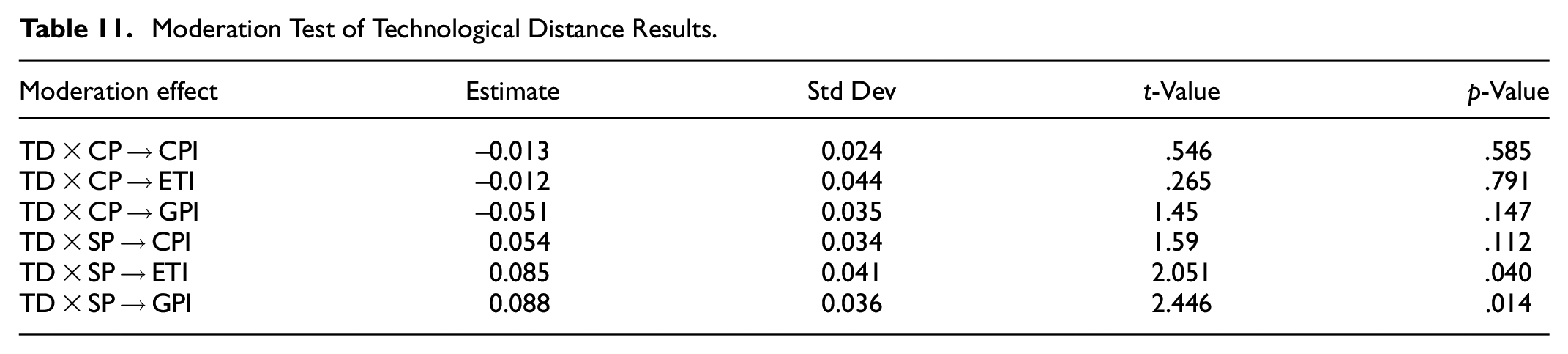
The results indicate that the interaction between technological distance and social proximity is statistically significant (p = .014), which is interpreted in the moderation analysis as the moderator (technological distance) mediating the relationship between social proximity and GPI. Thus, H11a is supported. A simple slope analysis is presented in Figure 3.

Simple slope analysis: TD × SP → GPI.
Technological distance and social proximity are statistically significant (p = .040), indicating that technological distance moderates the relationship between social proximity and ETI. Thus, H11c is supported. A simple slope analysis is presented in Figure 4. Technological distance and social proximity are not statistically significant (p = .112), which is interpreted as technological distance not moderating the relationship between social proximity and CPI.

Simple slope analysis: TD × SP → ETI.
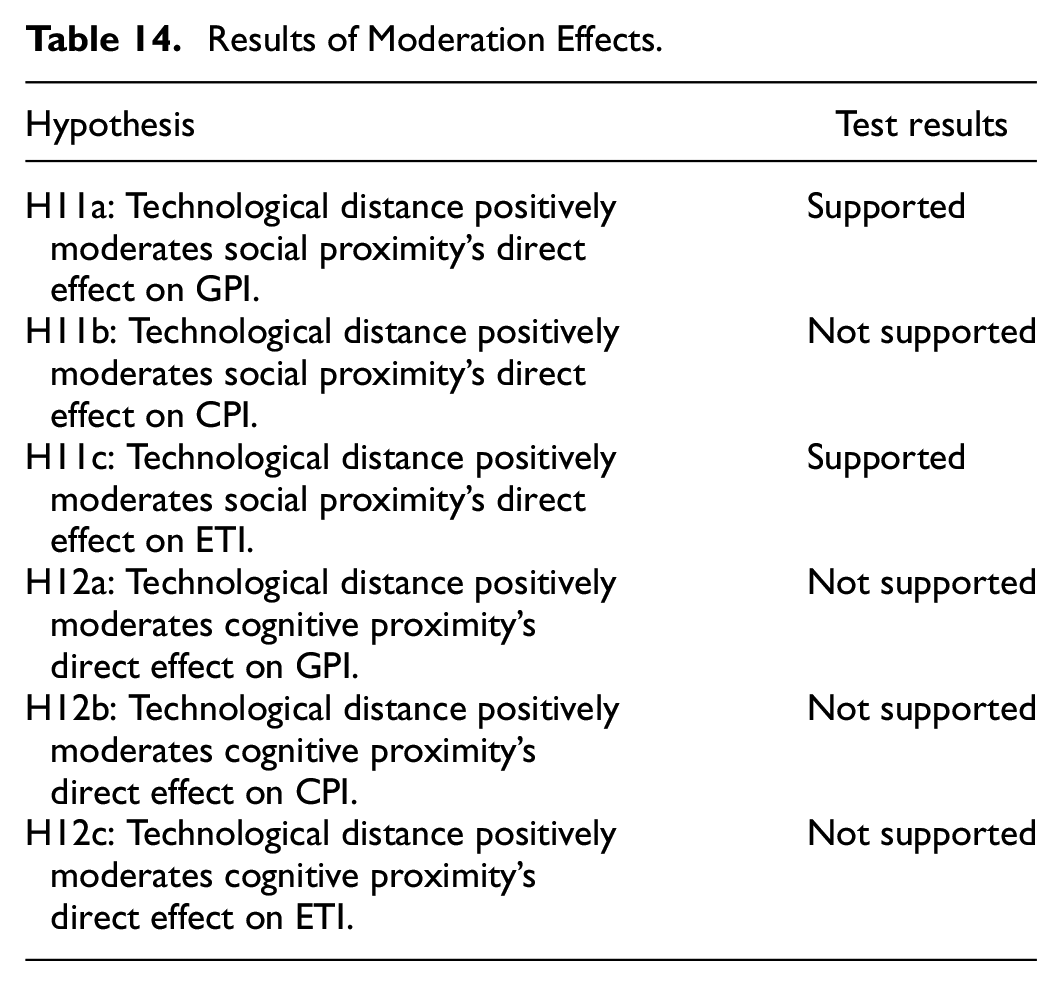
Technological distance and cognitive proximity exhibit no significant interactions (p > .05). Thus, H12a, H12b, and H12c are not supported. The results of the direct effect, indirect effect, and moderation effect tests are summarized in Tables 12 to 14, respectively.
Results of Direct Effects.

Results of Mediation Effects.

Results of Moderation Effects.
Discussion
Our findings expand the understanding of social proximity as a key driver of GTI (Li, Zhang et al., 2021; Tsouri et al., 2022). Social proximity’s positive impact on CPI and ETI was more robust than that on GPI. This is because social proximity reflects the level of trust and acknowledgment of capabilities among firms. This can improve cooperation among firms and allow them to share responsibility for the risks, costs, and benefits of innovation (Courrent & Gundolf, 2009). CPI and ETI are more complex and riskier, and reducing risk and cost may facilitate implementation.
Cognitive proximity is the least-studied dimension of proximity (García-Villaverde et al., 2018). Notably, we found that cognitive proximity is an important factor driving GPI of firms in a cluster. A possible reason for this conclusion is that when the cognitions between the subjects are similar—such as having a common goal of opening up the green product market or wishing to bind upstream and downstream green partners—it provides an internal driving force for the subjects. In this scenario, the firms participating in the innovation network are more inclined to develop new green products to seize market share. And participating firms are more inclined to develop new green products to seize market share.
Explicit knowledge sharing mediates the relationship between the two proximity dimensions (social and cognitive proximities) and the three types of GTI. Tacit knowledge sharing mediates the relationship between the two proximity dimensions and two kinds of GTI (GPI and CPI). However, Tacit knowledge sharing did not mediate the relationship between social proximity/cognitive proximity and ETI. A possible reason is that when organizations face a scarcity of technology and skills and fulfilling the requirements of high regulation is challenging, the purpose of inter-firm cooperation may be to obtain coded and formalized explicit technical knowledge (Usman et al., 2019).
This study uses fine chemical firms in clusters as the sample. Consequently, we found that chemical firms usually produce minimal possible waste during the production process. However, in-depth research on end-of-pipe pollutant-treatment technologies is lacking. Moreover, for fine chemical firms, end-of-pipe technology (devices) is usually not merely for a certain production line or a certain set of processes but is common or shared among production lines. In China, two ways exist for fine chemical firms to obtain end-of-pipe technologies—one is purchasing them from innovation sources, and the other is obtaining them from process packages together with production process technologies during technology transfer. Therefore, knowledge sharing regarding end-of-pipe technology is primarily related to explicit technical knowledge. Moreover, the results indicate that further subdividing GPI into CPI and ETI and conducting research on these sub-aspects separately is necessary. Social and cognitive proximities may lead to unequal opportunities for firms in a cluster to acquire external knowledge and cooperate for GTI.
Technological distance positively moderates the direct effect of social proximity on GPI and ETI. GPI is more complex than general product innovation, covering varied applications and satisfying diverse needs. Therefore, firms require a systematic combination of knowledge from diverse technical fields from various industries. Innovation cooperation among technologically similar firms may enhance the path dependence of firms in a cluster, thereby reducing the possibility of GPI.
Conclusion
This study examines the relationship between two non-geographical proximity dimensions of cluster firms (cognitive and social proximities) and the resulting GTI (GPI, CPI, and ETI) based on the KBV. To this end, the moderating role of technological distance and mediating role of knowledge sharing (tacit and explicit) were assessed. We applied statistical analysis methods to data from 330 fine-chemical cluster firms in China.
The results reveal a positive correlation between the two proximity dimensions and GTI: The positive impact of social proximity on CPI and ETI was stronger, and the positive impact of cognitive proximity on GPI was the greatest. Furthermore, our findings reveal that technological distance positively moderates the relationships of social proximity with GPI and ETI.
Additionally, explicit knowledge sharing mediates the relationship between the two proximity dimensions and three types of GTI. However, tacit knowledge-sharing mediates the relationship between the two proximity dimensions and two types of GTI (GPI and ETI). The mediating effects of tacit knowledge-sharing between the two proximity dimensions and ETI are not significant.
First, this study contributes to the literature on GTI in cluster firms. Our results are specific to GTI but underscore the positive impact of social proximity, cognitive proximity, and technological distance in innovation. while prior studies have examined the effects of proximity on firm-level innovation performance, these studies’ results have been inconsistent, with some studies reporting positive effects (Li, Zhang et al., 2021; Liu et al., 2021; Martínez Ardila et al., 2020; Tsouri et al., 2022) and others reporting negative effects (Ardito et al., 2018; Broekel & Boschma, 2012; Cassi & Plunket, 2014). Innovation heterogeneity may lead to different research results, such as differences in innovation types (e.g., GTI). The effect of non-geographic proximity on GTI, and the mechanism of the effect still needs empirical evidence.
Second, we complement the growing literature on inter-organizational networks by examining the effects of social proximity and cognitive proximity, and the moderating role of technological distance. Depending on the proximity, individual participants may gain different benefits from their network relationships.
Third, our findings contribute to a more comprehensive understanding of the heterogeneity of knowledge sharing in network relationships and its relationship to GTI. This theme is attracting more attention in economic geography and network research (Hansen, 2014; Lopolito et al., 2022). Firms’ investments in high levels of social proximity and cognitive proximity help explain firms’ knowledge sharing, and the resulting firm’s GTI.
The results can help managers simplify the search for partners for GTI cooperation, by effectively evaluating the partner characteristics using social proximity, cognitive proximity, and technological distance. It provides strategies to mitigate innovation risks caused by poor partner selection. This helps exert the effect of technology partners’ heterogeneous and complementary resources on GTI. These results should be used to align knowledge management strategies based on GTI strategies and help cluster firms explore knowledge interactions with partners from activities across cluster boundaries.
Specifically, for GPI, cluster firms should emphasize the development of cognitive proximity with technology partners and—on this basis—share green-technology-related knowledge with technology partners. Additionally, building social relationships with partners at a certain technological distance to deepen mutual trust is more conducive to the development of GPI than that with partners closer in technology. For CPI, firms should expend effort on social proximity, and social relationships based on trust will be beneficial to cluster firms’ CPI. For ETI, if end-of-pipe technology is not the cluster firm’s technical expertise, establishing a trust-based partnership with firm that owns the end-of-pipe technology enhance ETI in the cluster firm.
The empirical results describe fine chemical cluster firms in China. This may reflect the peculiar characteristics of fine chemical clusters and their associated firms. Additionally, the samples were inevitably influenced by national culture; therefore, the results may reflect the national values of China to some extent.
As firms in different industries perceive different environmental protection pressures and have different green demands, the subsequent step can be to conduct similar research and verification on cluster firms in other industries and countries. Considering the methods applied, future studies could combine multiple case studies to obtain more complete results. Finally, researchers can study the data over several years. Essentially, understanding the evolutionary relationship between proximity and GTI of cluster firms will be helpful.
Footnotes
Declaration of Conflicting Interests
The author(s) declared no potential conflicts of interest with respect to the research, authorship, and/or publication of this article.
Funding
The author(s) received no financial support for the research, authorship, and/or publication of this article.

Data Availability Statement
The datasets generated during and/or analyzed during the current study are available from the corresponding author on reasonable request.