



Abstract
Based on the perspective of multidimensional proximity, this paper examined the relationships between cognitive and social proximities with key customers and green product innovation performance via the mediation of green value co-creation by using data from 211 fine chemical small and medium-sized enterprises in clusters in China. Moderating effects of geographical distance and green project duration were assessed to further explore the relationship. The results revealed that social and cognitive proximities can promote green co-production and enhance green product innovation performance. Moreover, the relationship between social proximity and green co-production is hindered when customers are geographically distant or short duration partners of green projects. Eventually, this study was quite different from previous research by relating proximities to green value co-creation and green innovation performance in the context of small and medium-sized enterprises in emerging markets. The study provides a research framework for related research on green innovation.
Keywords
Introduction
Under the current trend of human environmentalism, environmental awareness brings new market opportunities and drives continuous innovation and value creation (Miranda et al., 2021). Manufacturing enterprises are integrating the concept of sustainable development into the design or development of products for the purpose of enhancing their competitive advantages, which is especially true for small and medium-sized enterprises (SMEs). In recent years, value co-creation has attracted the attention of researchers in the field of marketing and management. By participating in value co-creation, organizations may not only increase market coverage, revenues, and profits (Füller et al., 2011; Oh et al., 2015), but also get access to external resources and knowledge so as to improve innovation capabilities and stay competitive. As discussed in recent literature (Chang, 2019), the relevance of value co-creation has been turned into the context of green innovation. To maintain a long-term business relationship with customers and achieve preferred supplier status, SMEs must incorporate the concept of environmental protection into product design and business operations, create barriers to entry and meet the requirements of value co-creation with customers (Kim et al., 2020).
According to recent literature (Ben Arfi et al., 2018; Hojnik & Ruzzier, 2016), green product innovation (GPI) requires more complex and diverse knowledge and technologies than traditional innovations because of the additional environmental dimension. A single company typically does not have all of these resources required (Horbach et al., 2013). Companies that engage in GPI campaigns should attach more importance to acquiring new knowledge and ability in solving problems by collaborating with external actors (Hojnik & Ruzzier, 2016). In addition, GPI gets riskier returns with greater uncertainty (De Marchi, 2012), and companies are trying to reduce corresponding failure risks through collaborating with customers (Cainelli et al., 2015 ).
Compared with large enterprises, SMEs have relatively weak financial strength in the process of green transformation. Meanwhile, they will encounter technical difficulties due to insufficient technical capabilities and information asymmetry. It can be seen that GPI is more complex and costly for SME suppliers (De Marchi, 2012), which thus makes it necessary for the green innovators of manufacturing SMEs to establish more intensive research and development (R&D) relationships. By co-creating value with customers, SMEs may not only enlarge their market coverage and raise profits (Foroudi et al., 2019; Füller et al., 2011; Oh et al., 2015), but also obtain external resources and knowledge so as to improve GPI, implement green strategy and remain competitive. Therefore, SMEs should share value and innovation goals with large customers in the current competitive market.
Nevertheless, prior studies discussed the relationship between internal and external drivers and organizational context factors and GPI (Khan et al., 2021), few of which focus on value co-creation from the perspective of environmental management (Chang, 2019), especially in the context of SMEs. How to break through the “cooperation barrier” between SMEs and customers to promote green value co-creation (GVCC) is a research gap.
In recent years, the application of proximity in solving GPI problems of industry clusters, as well as R&D and cooperation problem between enterprises has received the increasing attention of scholars, whose attention to proximity has also extended from single geographical proximity to cognitive, social, institutional, and other dimensions of proximity (Boschma, 2005; Knoben & Oerlemans, 2006). Social and cognitive proximities are two organizational proximities of particular relevance under the background of GVCC. It must be recognized that social and cognitive proximities between SMEs and their customers are not all equal, whose investigation may be conducive to explaining the differences between resulting green value creation and green innovation performance. In addition, it is noteworthy that innovation development may be affected by the distance between partners in terms of geography due to geographically dispersed environmental knowledge (Ardito et al., 2019; Presutti et al., 2019; Verdolini & Galeotti, 2011). However, it is unclear whether and how the remote distance of customers mitigates or intensifies the influence of social and cognitive proximities in GVCC. Existing research seldom discussed the mechanism of interaction between spatial and non-spatial proximities in the context of GPI, but only takes it as a situational factor with influence and comes to different conclusions. At present, no empirical research was conducted on the relationship between the interaction of proximity dimensions and GVCC in the context of GPI.
In addition, existing literature failed to take into account the impact of the duration of cooperative innovation projects in spite of studying the impact of the input of cooperative innovators on their revenues when conducting research on cooperative innovation. In the context of green value co-creation, green project duration has an influence on both the output of innovation projects (Dey et al., 2010) and the input of innovators (Bhaskaran & Krishnan, 2009). Therefore, consideration should be given to green project duration in the design of cooperative GPI contracts.
To fill the above gap, this study aimed to answer three interrelated questions:
(a) What is the relationship between cognitive and social proximities and GVCC and GPI?
(b) What is the influence of the interaction among cognitive, social, and geographic proximities on GVCC?
(c) What is the influence of the interaction among cognitive and social proximities and green project duration on GVCC?
Hypotheses were proposed to answer the above research questions and tested through making a survey of 211 fine chemical SMEs in the mature chemical industry clusters in China. The focus was on fine chemical SMEs in chemical industry clusters for two reasons: First, upstream and downstream industries are highly correlated in chemical industry clusters. Fine chemical enterprises have higher viscosity to downstream customers and usually establish a stable cooperative relationship with them, which makes the industry suitable for studying customer value co-creation from the perspective of proximity. Second, China is a big country of the chemical industry which is an important pillar industry of the national economy (MIIT, 2016). Chemical SMEs account for more than 80% of all chemical enterprises. However, China’s chemical industry has problems like serious environmental pollution and low production efficiency. With the increase of customer demand for green products and the improvement of national environmental protection requirements, downstream enterprises have made higher demands on the R&D capabilities of SMEs in green products and their level of environmental protection (Xu & Han, 2021), which poses a number of challenges to fine chemical SMEs in China.
The remainder of this paper was organized as follows: In the next section, hypotheses were introduced. Then, the methodology and results were introduced and discussed. Finally, the main findings, research implications, and management suggestions were summarized, and future research directions were discussed.
Theory and Hypotheses
Green Product Innovation
Green product innovation (GPI) aims to save resources, prevent pollution, recycle products, and eliminate the use of toxic and hazardous materials in product development, so as to reduce the negative impact on the environment during the entire life cycle of the product. For example, use environmentally friendly materials, replace organic solvents with water, and use clean energy for production. Ottman et al. (2006) described green products as products that reduce pollution and protect the natural environment by saving energy and resources, reducing or eliminating toxic substances. Kivimaa and Kautto (2010) proposed that GPI include improving the durability or recyclability of products, reducing raw materials, choosing raw materials that are more environmentally friendly, and removing harmful substances. Lin et al. (2013) pointed out that GPI aims to change product design by using non-toxic compounds or biodegradable materials in the production process to reduce environmental impact and improve energy efficiency.
Cognitive Proximity, Social Proximity, and Geographical Distance
Based on the theory of evolutionary economic geography, we combine spatial distribution, network embedding and cognitive similarity of SMEs with GPI. With the development of proximity research, scholars have expanded from a single dimension of geographical proximity to multiple non-geographic proximity dimensions. Social proximity refers to the degree of social embedding. Enterprises gain mutual trust by embedding in social networks, which is manifested in the existence of informal relationships between enterprises, avoidance of opportunism, and trust in competence. Boschma (2005) defines social proximity between organizations as trust based on shared experience, friendship and relatives. The economic behavior of enterprises is affected by their dual relationship and the entire relationship network structure (Oerlemans & Meeus, 2005). Partners utilize social proximity to conduct trust-based interactions in professional networks or social networks.
Cognitive proximity includes shared goals and shared Culture (Inkpen & Tsang, 2005; Nahapiet & Ghoshal, 1998) Shared goals indicate the similarity of perceptions between enterprise and key customer on the implementation of cooperation and the results of cooperation. Shared Culture express the similarity of organizational culture, rules, and practices that guide enterprises’ behavior. Cognitive proximity was first proposed by Nooteboom (1999), which refers to the similarity in the way enterprises perceive, interpret, understand and evaluate the world. Cognitive proximity is related to corporate culture, values, vision, and goals (Knoben & Oerlemans, 2006).
Green Value Co-creation
Chang (2019) proposed the concept of green value co-creation (GVCC) based on value co-creation defined by Ranjan and Read (2016). According to Chang (2019), GVCC means that customers actively share the concept of environmental protection with SMEs and participate in creating green value in no less one production or consumption phase. Based on SDL, this study held that GVCC is dynamic fusion process in which all partners (including enterprises, customers, and other stakeholders) actively participate in the cooperation of GPI based on the pursuit of their own value and promote the effective connection and integration of respective resources and elements to create green value and achieve a win-win situation. GVCC is divided into two dimensions: green co-production (GCP) and green value-in-use (GVIU).
GCP refers to the process of enterprise collaboration in the development of green innovation, which contains three underlying elements, namely equity, interaction, and knowledge sharing. Equity is manifested in the willingness of companies to share control with customers and provide customers with a convenient environment. Interaction means the major interface between companies and their customers undertaking GCP. Knowledge sharing can help to build competence, address dynamic concerns, and GVCC (Fisher & Smith, 2011). Generating from customer use, GVIU refers to the experience of customers in learning the way of using, repairing and maintaining GPI. GVIU is composed of three elements—experience, personalization as well as relationships. To be specific, the experience is the artifact of green products and services (Bolton, 2004), and comes from the connection of customers with green products in physical, cognitive, and emotional dimensions (Edvardsson et al., 2005). Personalization is manifested as the immersive and extraordinary experience of customers, the application of their professional capabilities and the supportive environment of their unique use process. Relationships are embodied as collaboration, communication, participation, the use of common resources and reciprocity.
Cognitive Proximity and Green Value Co-creation
Shared goals help to establish trust relationship, and work hard to achieve the common goal, thereby affecting the realization of GVCC. Shared goals encourage SMEs to share resources and ideas with their customers, enhance mutual understanding and integrate knowledge (Marlow et al., 2018). Enterprises with shared goals trust each other more (Alvarado-Alvarez et al., 2021). And trust has a positive relationship with knowledge sharing. When actors participating in the share common goals, they have similar views on how to act with each other, promote mutual understanding and exchanging of ideas and resources (Molina-Morales et al., 2014). Secondly, shared culture enables organizations to understand the intentions and behaviors of partners, grants the willingness, and ability to GVCC. And shared culture is conducive to joint planning, decision-making and problem solving (Nguyen et al., 2019). This is particularly important for GVCC that relies on the interaction and collaboration between the upstream and downstream industrial chains. SMEs face the risk of adjustment and conversion in GVCC. Higher cognitive proximity promotes the formation of green innovation network (Liu et al., 2021), thereby promoting GVCC. In the context of GPI, shared culture enables enterprises to share environmental protection concepts. Shared culture greatly affects the quantity and quality of knowledge sharing in GVCC (Ruiz-Ortega et al., 2021). Cognitive proximity can promote information sharing and decision-making synchronization between upstream and downstream enterprises (Nguyen et al., 2019).
GVCC is a combination of multiple complementary resources from heterogeneous sources. Therefore, organizations need a similar cognitive framework to effectively transfer and acquire knowledge. Accordingly, the following two research hypotheses were proposed:
H1: Cognitive proximity with key customers directly and positively affects GCP.
H2: Cognitive proximity with key customers directly and positively affects GVIU.
Social Proximity and Green Value Co-creation
GVCC has a higher risk than traditional value co-creation. Social proximity can reduce unethical business behavior (Courrent & Gundolf, 2009) and reduce the risk of GVCC. Innovation based on trust is considered to be exclusive (Al-Tabbaa & Ankrah, 2016). The higher social proximity is, the more resources both enterprises may invest in GVCC (Crisp & Jarvenpaa, 2013; Magrizos et al., 2021). GVCC requires more complex and diverse knowledge and skills (Ben Arfi et al., 2018; Hojnik & Ruzzier, 2016). Trust-based social relationships are conducive to maintaining connections between companies, promoting interactive learning, and promoting the exchange of tacit knowledge (Bstieler et al., 2015), which is the basis of GVCC. Social proximity builds the foundation for cooperation between entities, making SMEs, and customers pay more attention to each other’s skills and value. The stronger social proximity is, the more the stickiness of knowledge transfer can be overcome (Crescenzi et al., 2016). Social proximity may reduce the loss of knowledge in knowledge transfer. Social proximity allows SMEs to devote more resources to knowledge sharing related to GPI, instead of consuming resources to monitor the behavior of partners. Social proximity reduces the risks associated with knowledge sharing.
Therefore, Social proximity is an important factor affecting GVCC. Accordingly, the following two research hypotheses were proposed:
H3: Social proximity with key customers directly and positively affects GCP.
H4: Social proximity with key customers directly and positively affects GVIU.
Green Value Co-creation and Green Product Innovation
The purpose of GPI is to provide downstream-oriented green products. And it is necessary to create green value with downstream customers. As enterprises try to improve recyclability, the interdependence between suppliers and customers is increasing. In addition, companies cannot have all the knowledge of GPI and thus need more cooperation with external organizations to succeed in GPI (Goodman et al., 2017) which is especially true for SMEs with weaker R&D and anti-risk capabilities. GVCC is a process of mutually beneficial interaction and resource integration among SMEs and customers on the basis of interdependence, which can improve the information chain, value chain, and technology chain and tap multi-party green value (Gummesson & Mele, 2010). SMEs may exchange information and resources with key customers and seize cooperation opportunities to create and share green value, jointly respond to market competition, and promote GPI (Shams & Kaufmann, 2016). Similarly, GPI is based on the interaction of SMEs and customers. And they achieve the greatest organizational benefits by integrating their respective green value creation goals. SMEs may pay more attention to GVCC with key customers when conducting GPI, and realize the integration of various innovation elements (such as manpower, material resources, and markets information), thereby maximizing the benefits of GPI. In the process of GVCC the entities may attach importance to the opinions of partners and exchange knowledge, which inspires the passion and vitality of GPI. Therefore, GVCC promotes the learning and absorption of knowledge through the establishment of effective partnerships, thereby enhancing GPI. By GVCC, it is possible to break through the boundary between SME and key customer. Through GVCC, the individual needs of partners are activated and innovative thinking is broadened, thereby creating good intellectual support for GPI, which in turn promotes the growth of GPI. Because of sharing the benefits of common innovation achievements with companies, customers will make positive contributions to improving GPI. Customers cannot only provide the ideas of green products, but also work with companies to create new products, test finished products, and make suggestions on product improvement, while companies can obtain market and technical knowledge related to environmental protection from customers and network partners (Morgan et al., 2018) to learn about market trends and needs and implement the green strategy.
Through GVCC, SMEs complete value creation with customers directly and indirectly in no less than one production and consumption phase (Ranjan & Read, 2016). In this process, suppliers and customers share experience and suggestions, participate in formulating and implementing unique GPI goals and strategies, and obtain more external partners through value creation networks, which is beneficial to developing green solutions and co-creating green products. Therefore, it was assumed that: Customer GVCC behavior has a positive relationship with the GPI performance of SMEs.
H5: GCP is positively correlated with the GPI of SMEs.
H6: GVIU is positively correlated with the GPI of SMEs.
Mediating Effect of GVCC
In the cooperation between SME and key customer, it is difficult for actors with different cognitive backgrounds, interest orientations, and other organizational differences to conduct benign coupling and interaction, which may reduce the enthusiasm for participating in cooperation and the effect of cooperation (Yong & Qi, 2018). In this case, cognitive proximity and social proximity may increase the willingness of the actors to participate in cooperation and resource investment (Vargo & Lusch, 2016; Wang & Zhu, 2018). Therefore, cognitive proximity and social proximity increase GVCC activities, such as the exchange of advantageous resources and elements. The realization of GPI has to go through the cooperation of all participants. GVCC is the result of the active participation and resource interaction and integration of SME and key customer. Social proximity and cognitive proximity between SME and key customer may help reduce conflicts and contradictions caused by organizational distance in GVCC. GVCC may realize the cognitive identity or emotional connection between SME and key customer, reduce the risk of cooperation, and further strengthen interaction between each other, thereby enhancing GPI of SME (Shams & Kaufmann, 2016).
It can be said that GVCC plays a role as a bridge between social proximity, cognitive proximity, and GPI for SMEs. That is, GVCC enhances the positive role of social proximity and cognitive proximity, while promoting GPI of SMEs. Therefore, it was assumed that: GVCC mediates the effect of cognitive proximity and social proximity with key customers on the GPI of SMEs.
H7a: GCP mediates the effect of cognitive proximity with key customers on the GPI.
H7b: GCP mediates the effect of social proximity with key customers on the GPI.
H8a: GVIU mediates the effect of cognitive proximity with key customers on the GPI.
H8b: GVIU mediates the effect of social proximity with key customers on the GPI.
Moderating Effect of Geographical Distance
Geographical distance reflects the geographic distance between enterprises. Geographical distance affects the difficulty and cost of knowledge sharing, knowledge integration, and thus the impact of social proximity and cognitive proximity on GVCC. When the SME and customer are geographically far away, the SME needs to spend more time to identify the search range of knowledge that may be valuable. Geographical proximity increases the possibility of SMEs connecting and exchanging knowledge with other organizations in the network, and promotes the formation of the network (Park & Koo, 2021). Long-distance knowledge sharing may lead to loss or distortion of knowledge. In addition, Ardito et al. (2019) suggested that geographical distance limits the ability of partners to repeat interactions. Geographical distance and cognitive proximity need to be considered together (Cao et al., 2019; Liu et al., 2021), collectively affecting the capability of building up effective communications (Spithoven et al., 2021). Managing and maintaining GVCC requires SMEs to invest a lot of costs. Especially keeping in touch with remote customers will increase its costs. When the geographical distance is small, economies of scope are generated due to the agglomeration effect, which reduces the transaction costs of both parties. There are more opportunities for face-to-face communication and interaction between SMEs and customers. They can easily exchange information, resources and ideas, which is conducive to SMEs to quickly acquire technical knowledge and market knowledge. SMEs may apply the knowledge to technology research and development, which further strengthens the positive role of social proximity and cognitive proximity.
Therefore, the following hypotheses were proposed:
H9a: Geographical distance has a negative moderating effect on the positive relation between cognitive proximity with key customers and GCP.
H9b: Geographical distance has a negative moderating effect on the positive relation between cognitive proximity with key customers and GVIU.
H9c: Geographical distance has a negative moderating effect on the positive relation between social proximity with key customers and GCP.
H9d: Geographical distance has a negative moderating effect on the positive relation between social proximity with key customers and GVIU.
Moderating Effect of Green Project Duration
The duration of green cooperation projects may affect the relation between proximities and GVCC in many ways. Firstly, GVCC process is an input-output process in which customers as value co-creators invest their time, energy, knowledge, and other resources to generate experience, value, loyalty, satisfaction, etc. Customers do not always provide simple knowledge. Schwartz et al. (2012) pointed out that time may be a key factor in these relationships so that both parties can obtain and understand the spread of knowledge in the value-creation network, which is especially true for tacit knowledge transfer calling for frequent personal interaction. Secondly, an emphasis is placed on the equal status of customers and companies in GVCC. Each partner makes approximately the same contribution during long-term cooperation, which thus ensures reciprocity and is deemed to turn the network into a reciprocal channel for knowledge, information, and technology transfer (Dahl & Pedersen, 2004; Niedergassel & Leker, 2011). In contrast, shorter project duration may prevent mutual communication between SMEs and customers, thereby weakening the cooperative relationship and reducing the likelihood of successful GVCC. Thirdly, it takes time and constant efforts for each partner to develop trust and common goals. A stable partnership is in need of long-term development. The relationship between partners tends to strengthen over time. The initial trust and common goals of partners will further develop with the progress of projects. Therefore, the following hypotheses were proposed:
H10a: Green project duration has a positive moderating effect on the positive relation between social proximity with key customers and GCP.
H10b: Green project duration has a positive moderating effect on the positive relation between cognitive proximity with key customers and GVIU.
H10c: Green project duration has a positive moderating effect on the positive relation between cognitive proximity with key customers and GCP.
H10d: Green project duration has a positive moderating effect on the positive relation between social proximity with key customers and GVIU.
The research framework of this research is presented in Figure 1. In addition, the summary of operational definitions is shown in Table 1.

Research framework.
Operational Definition.

Methodology and Measurement
Measurement of Constructs
Measurement items were first determined through literature review and expert interviews. Items and responses are on a Likert 7-point scale ranging between high disagreement and agreement for the measurement of these variables. Measurement item and literature source are shown in Table 2.
Measurement Item and Literature Source.
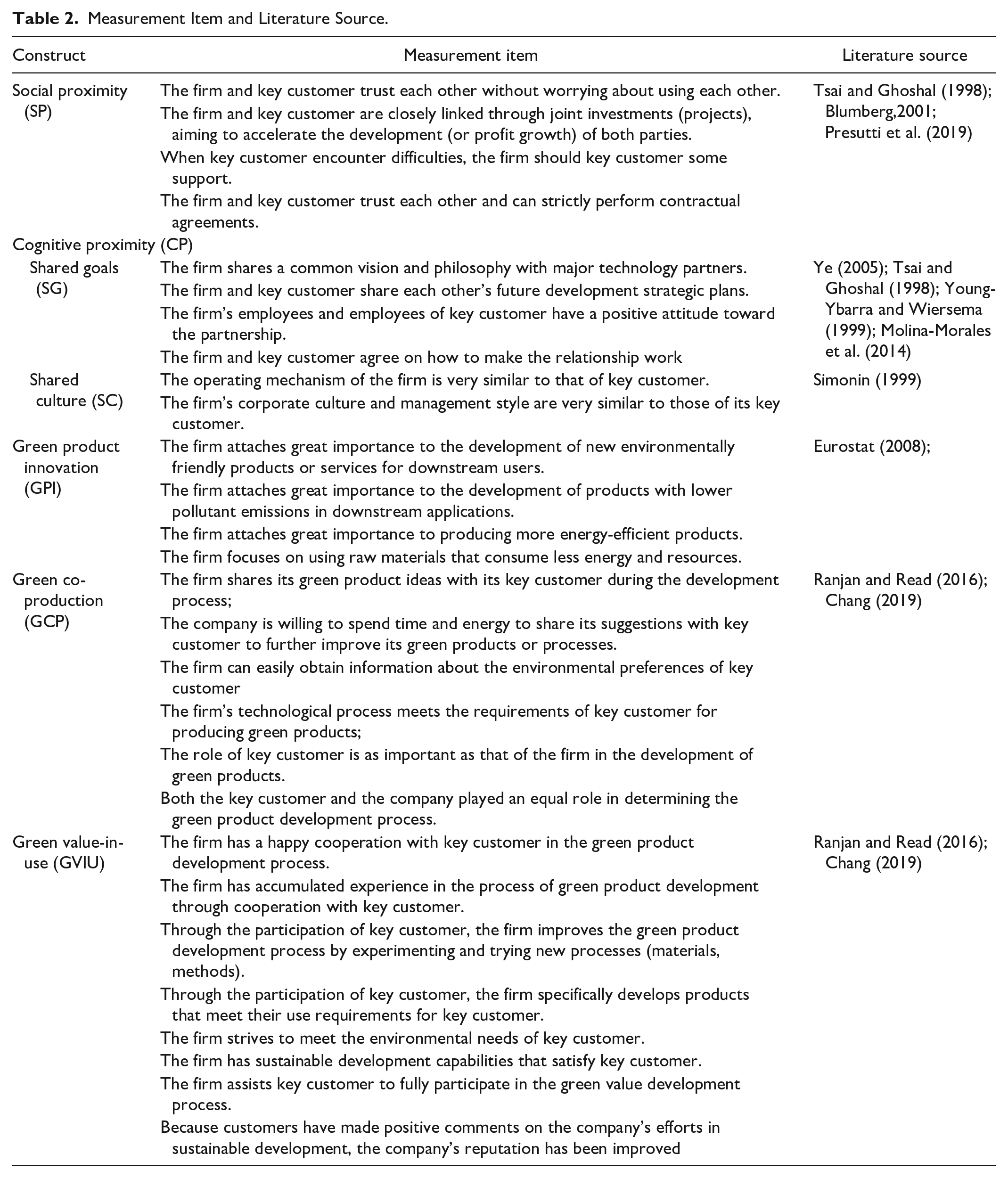
GCP refers to the process of collaborating with companies during the course of GPI, whose measurement contains six items (Chang, 2019; Ranjan & Read, 2016). GVIU evaluates and determine the value of products or services based on their use. Therefore, GVIU refers to the experience of customers in learning the way of using, repairing and maintaining green products, whose measurement includes eight items (Chang, 2019; Ranjan & Read, 2016).
Two main aspects of cognitive proximity are shared goals and culture between SMEs and customers (Inkpen & Tsang, 2005; Nahapiet & Ghoshal, 1998). A second-order construct was used for measuring cognitive proximity. Inkpen and Tsang (2005) suggested that shared goals refer to the degree of sharing a common understanding, method of achieving common missions and outcomes by suppliers and customers. Shared culture represents the degree of sharing codes of conduct directing or governing relationships. This study draws on the scale proposed by Ye (2005) to measure shared goals, which integrates the scales of Tsai and Ghoshal (1998) and Young-Ybarra and Wiersema (1999). Shared culture was measured using a two-item scale based on Simonin (1999). The scale was subsequently used and verified in other studies.
Based on the degree of trust between SMEs and their key customers, social proximity with key customers was measured according to prior literature (Nooteboom et al., 1997; Presutti et al., 2019; Zaheer et al., 1998). The focus was on four dimensions of trust between organizations, including the shortage of opportunity behavior, the creation of joint investment, competence trust, as well as the existence of informal relations.
The two most common methods for measuring GPI are patents and surveys. Many chemical companies in China have not applied for patents for their GPI. Therefore, this research adopts survey methods. The scale of GPI refers to the EU Community Innovation Questionnaire.
As to the geographical distance between SMEs and key customers, key customers were divided into those located inside and outside the chemical industry cluster in accordance with previous studies (Boschma, 2005; Presutti et al., 2019; Rallet & Torre, 2000). The variable was defined to be equal to 0 and 1 for customers located inside and outside the chemical industry park respectively. A total of 111 (52.6%) customers were located in the district. In order to ensure the sufficient homogeneity of chemical industry clusters involved in this study to integrate into the same sample, the analysis of mean differences was carried out on the studied variables of companies belonging to each of these chemical industry clusters. To test bias, executed Anova and Schefft were executed between pairs of clusters, showing no significant difference.
Green project duration refers to the duration of green project collaboration between SMEs and key customers. The variable was defined to be equal to 1 for “duration of 5 years and above” and 0 for “duration of less than five years,” respectively. The green project duration of 98 and 113 enterprises was less and more than 5 years respectively.
Data Collection and Sample
In recent decades, the development of chemical industry clusters has become an effective strategy for the development of enterprises and industries. Geographic proximity and business strategic consensus strengthen the cooperation between enterprises (Antonelli, 2000; Felzensztein et al., 2010) and promotes innovation and overall competitiveness. The agglomeration of the chemical industry facilitates the effective environmental monitoring of local governments. However, enterprises are increasingly dependent on the external flow of knowledge resources due to the complex process of GPI.
The data of this study were based on the survey of chemical industry clusters in North and East China from December 2018 to December 2019. The data collection process of the study includes two stages. First, we conducted pre-investigation to test the comprehensibility of the questionnaire. A lfarge-scale questionnaire survey was subsequently conducted.
Our target samples of large-scale questionnaire survey are fine chemical SMEs in chemical industry clusters in China. Considering the smooth completion of investigation and the representativeness of the samples, we used a typical survey method. The chemical industry clusters investigated are located in Shandong Province and Jiangsu Province in China. The chemical industry is a traditional industry in Shandong and Jiangsu provinces. The two provinces have long ranked first and second in terms of the scale of chemical industry in China. Chemical industry clusters are highly concentrated in Shandong and Jiangsu provinces. Jining New Material Industry Park, Yantai Chemical Industry Park, Qilu Chemical Industry Park, and Weifang Zhuliu Chemical Industry Park in Shandong Province, as well as Nanjing Jiangbei New Material Science and Technology Park, Taixing Economic Development Zone in Jiangsu Province, are famous for fine chemical industry. These chemical industry clusters are important fine chemical production bases. And All of them form a clear and complete industrial chain or clusters of special products. We obtained a sample pool of fine chemical SMEs from the above-mentioned chemical parks. We distributed questionnaires to these target companies. Before emailing the questionnaire, we called each sample company to explain the purpose of the study and the content of the questionnaire, and confirm job title of the respondents. Respondents were asked to return the completed questionnaire by email within 2 weeks. In order to improve the response rate, we conducted a second-round data collecting by field visits. The respondents we selected included manager of safety and environmental protection department, production manager, technical department manager, sales manager, purchasing manager, and senior executive. Different respondents answered questions about different constructs in the questionnaire. Questions of all constructs in one questionnaire were collected at the same time in the same survey. Respondents answering questions about constructs of three proximity dimensions (social, cognitive, and geographical proximity) were sales managers. Respondents answering questions about GCP and GVIU were technical department managers or senior executives. Respondents answering questions about GPI were managers of safety and environmental protection department or production managers. In this study, different respondents were asked to answer questions of different constructs in one questionnaire for two reasons. First of all, items of different constructs involve different aspects of information, such as the company’s production, R&D, customer relations, and other specific conditions. Manager of the corresponding department should be well aware of the details in their management areas. Senior executives should have a good understanding of GVCC. In this sense, their (perceived) answers are more meaningful. Secondly, it may reduce the impact of common method variance (CMV) caused by the self-report method, which is one of the strategies to overcome CMV.
A 633 questionnaires were sent, and 223 questionnaires were recovered. After screening, it was found that four questionnaires were from non-clustered enterprises, and seven questionnaires had the same item selection scores, missing item data, or obvious inconsistencies in the scores, which were excluded. On this basis, the company’s business description was checked from the company’s website or Qcc.com website. Companies that did not have green technology R&D activities or only provided non-technical services were excluded from the research, and 210 valid questionnaires were retained. Profiles of sample firms are shown as Table 3. The effective response rate was 34.9%. In order to verify the appropriateness of the interviewees, we also asked respondents about the years of work experiences in the company. Overall, 21% of respondents in the final data set have worked in their current company for 10 years or more. 58% have worked in their current company for 6 to 10 years. Variance analysis was applied to perform the t-test of paper questionnaires and electronic questionnaires. The results indicated that the two ways of distributing questionnaires were not significantly different (p > .001). In addition, the questionnaires of early and late respondents were selected. And t-test results of the mean of all constructs showed that there was no significant difference between the mailing method and the field interview respondents (p > .05). Therefore, collected questionnaires are unbiased and can be combined for data processing.
Profiles of Sample Firms.

Podsakoff et al. (2003) suggested that some strategies were taken in order to overcome common method variance (CMV). First, different respondents answered questions about different constructs in the questionnaire. This research made sure that the responses of respondents were anonymous and confidential, and encouraged respondents to answer questions truthfully. In addition, researchers separated the constructs of antecedents, intermediaries and consequences, assured respondents that the experimental results were only used for academic research, and focused on keeping their questionnaires strictly confidential. Therefore, CMV bias was mitigated. In addition, CMV was tested using Harman’s one-factor test. The exploratory factor analysis of 28 questions revealed that the explanatory variance for the first factor was 16.954% and it was a non-integrated factor. Therefore, the impact of CMV was not so serious.
Empirical Results
The research model was tested using partial least squares structural equation modeling (PLS-SEM) (Hair, 2017). SmartPLS 3.2.8 was applied. PLS was used in this research for the following reasons. This research made an attempt at developing a complete research framework with multiple constructs to investigate the GPI of SMEs, and therefore considered multiple types of proximities, green project duration, and GVCC. However, only 211 questionnaires were valid due to time and cost constraints. PLS is able to analyze small-size samples. PLS can overcome the problem of multicollinearity and has the advantage of analyzing complex predictive models (Hair et al., 2014). The analysis of outer and inner models was involved in analysis.
Results of the Outer Model
The outer model was used for assessing the reliability and validity of multiple-item constructs in this research. Individual Item Reliability is the degree to which each item is explained by the latent variable. Individual Item Reliability was assessed based on the value of the factor loadings (λ). The factor loadings of the research were 0.625 to 0.931. Most factor loading values of the observation variable exceeded 0.7, a criterion suggested in literature (Hulland, 1999), with the exception of GVIU5. Item GVIU5 was taken away in the subsequent analysis because its factor loading was lower than 0.6. Internal consistency reliability was evaluated through composite reliability (CR). If the CR value of the latent variable is higher, the measurement item is highly correlated, which means that the latent variable can be measured. In general, its value should exceed 0.7 (Bagozzi & Yi, 1988). In this study, all the CRs of constructs surpassed the threshold of .7, as shown in Table 4, demonstrating that these constructs had good internal consistency. Average of variance extracted (AVE) represents the percentage of the latent variable value measured by the observed variables. AVE was used for evaluating both reliability and convergence validity. Fornell and Larcker (1981) suggested that 0.5 be the critical criterion. As shown in Table 4, the AVE values of five constructs were between 0.5 and 0.8, indicating that they had convergence validity. Cronbach’s α can also be called internal consistency. It is often used for reliability analysis. Cronbach’s α is preferably greater than .7 (Hair et al., 2011). In this study, the items retained after factor analysis were further tested by internal consistency reliability analysis. The results are shown in Table 4. Values of Cronbach’s α are between .700 and .921.
Construct Reliability and Convergence Validity.
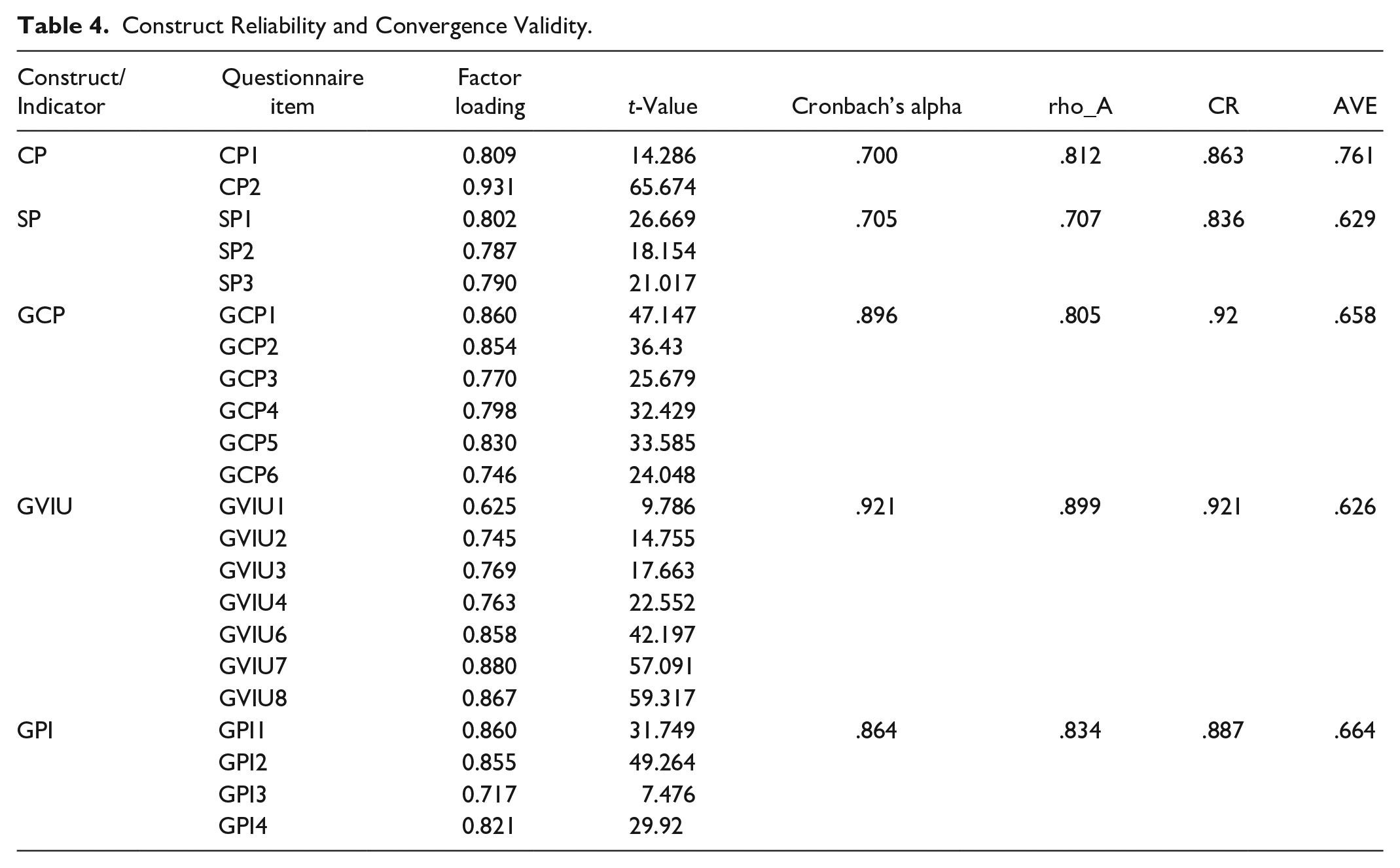
This study uses three methods to judge discriminative validity. First, Table 5 demonstrates that each square root value of AVEs (diagonal elements) was more than the values of the correlation coefficient between constructs (corresponding off-diagonal elements). Therefore, the analysis of the findings indicated that the model obtained adequate discriminant validity. Second, through the comparison of factor loadings and cross loadings, we can distinguish whether the data has discriminative validity. This method means that the factor loading of an indicator to its facet should be greater than the cross loading. (Hair et al., 2011, 2012; Henseler et al., 2016). As shown in Table 6, the factor loading of any aspect in this study is greater than the cross loading. Therefore, the data passed the discriminative validity test. Third, Henseler et al. (2015) proposed the heterotrait-monotrait ratio (HTMT) (Voorhees et al., 2016). It is the ratio of the mean value of index correlation between different dimensions to the mean value of index correlation between the same dimensions. Henseler et al. (2014) proposed that if the HTMT value is higher than .90, the discriminative validity is poor. In this study, the range of values is from 0.479 to 0.808, which indicates that all constructs of the model have discriminative validity, as shown in Table 7.
Discriminative Validity—Criteria of Fornell and Larcker.
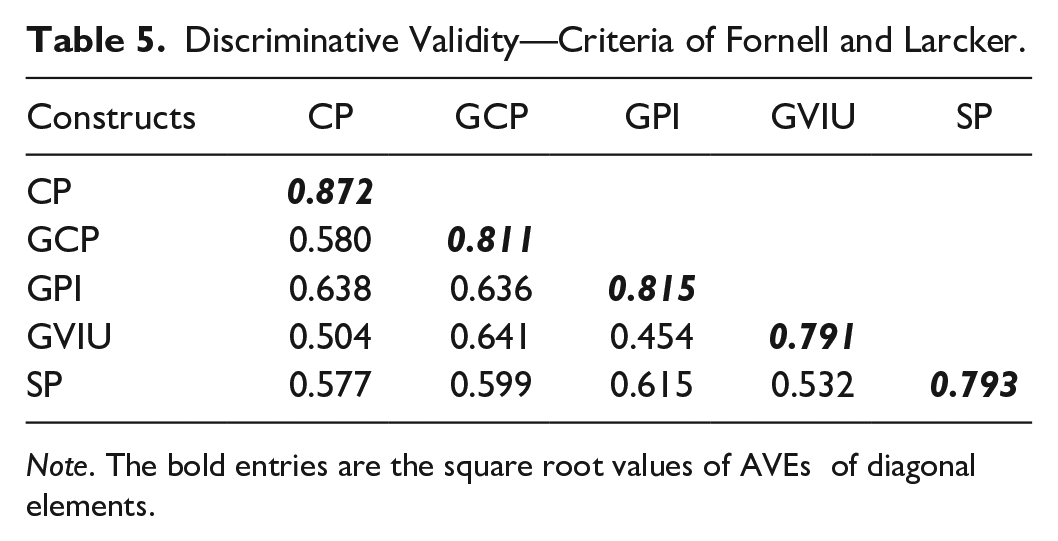
Note. The bold entries are the square root values of AVEs of diagonal elements.
Discriminative Validity—Cross Loading.

Note. The bold entries are the factor loadings of indicators.
Discriminative Validity

Results of the Inner Model
R2 is the main indicator for judging the quality of the model. The R2 value of endogenous latent variables greater than 0.33 indicates moderate explanatory power (Chin, 1998). If Q2 is greater than 0, it means that the facet has good predictive power (Geisser, 1974). The analysis results of this study are shown in Table 8. R2 ranges from .341 to .441. And Q2 is greater than 0, showing that the model has strong explanatory power.
Q² and R2.

The inner model was evaluated by estimating the significance and size of the path coefficients and R² of dependent variables. Path coefficients and T-values are summarized in Figure 2 and Table 9. We adopted bootstrapping to calculate the average number of path coefficients, standard deviation and path significance. In the study, bootstrapping was set to 5,000 times of repeated sampling. And the parameters and standard errors of re-sampling were used to calculate t value, judging whether it was significant. The results indicates that cognitive proximity is positively and significantly associated with GCP (β = .351; t = 5.407; p < .001), thereby supporting H1. The results indicates that cognitive proximity is positively and significantly associated with GVIU (β = .295; t = 4.191; p < .001), thereby supporting H2. Social proximity is positively and significantly associated with GCP (β = .396; t = 5.902; p < .001), thereby supporting H3. And Social proximity is positively and significantly associated with GVIU (β = .362; t = 4.866; p < .001), thereby supporting H4. GCP is positively and significantly associated with GPI (β = .585; t = 9.376; p < .001), thereby supporting H5. GVIU had no significant positive effect on GPI (β = .079; t = 1.102; p > .05). For GVIU -> GPI, path coefficient is .079. T value is 1.102, and p value is greater than .05. Therefore, H6 is unsupported.

Test results of direct effect by PLS analysis.
Test Results of Direct Effect Hypotheses.

By following the mediator analysis procedure proposed by Nitzl et al. (2016), the indirect effects of cognitive and social proximities on GPI performance were examined. The bootstrap resampling method was adopted to multiply the direct paths generating the evaluation of indirect ones. A 95% bias-corrected confidence interval (percentile) was established for mediation. When the indirect effect is significant, there is a mediating effect. As shown in Table 10, the estimated indirect effect of CP -> GCP-> GPI is 0.205. T value is 4.618. P value is .000, and the confidence interval does not contain 0. Therefore, the results indicated the significant mediating effect of GCP between cognitive proximity and GPI, supporting H7a: GCP mediates the effect of cognitive proximity with key customers on the GPI. For SP -> GCP-> GPI, the estimated indirect effect is 0.232. T value is 4.638. P value is .000. And the confidence interval does not contain 0. The results revealed the significant mediating role of GCP between social proximity and GPI, thereby supporting H7b: GCP mediates the effect of social proximity with key customers on the GPI. For CP -> GVIU -> GPI, the estimated indirect effect is 0.023. T value is 1.007. P value is 0.315. And the confidence interval contains 0. For SP -> GVIU -> GPI, the estimated indirect effect is 0.029. T value is 1.014. P value is 0.312. And the confidence interval contains 0. The mediation effect of GVIU is not significant, thereby H8a and H8b are not supported in the study.
Indirect Effect Evaluation.

As to the moderation effect analysis, the multi-group analysis was applied because both moderators were categorical variables. We comprehensively considered the significant differences in path coefficients, the direction of influence (i.e., positively significant effects or negatively significant effects), and the difference test of the path coefficients when the path coefficients were both significant.
To test the moderation effect of geographical distance, samples were divided into two groups, namely key customers located inside and outside the chemical industry cluster. The results are reported in Table 11. According to the multi-group analysis, for CP -> GCP, the moderation effect of geographical distance is not significant, thereby H9a is not supported. For CP -> GVIU, the moderation effect of geographical distance is not significant, thereby H9b is not supported. For SP -> GCP, geographical distance has a negative moderation effect. In other words, GCP of SMEs will be significantly lower when large geographical distance is faced with an increase in social proximity compared with small geographical distance, thereby supporting H9c. In addition, the findings of the study shows that social proximity and geographical distance has no significant moderation effects on GVIU. Therefore, H9d is not supported.
Test Results of Multigroup Analysis (Geographical Distance).

Samples were divided into two groups to measure the moderation effect of green project duration. Subsamples were classified on the basis of green project duration, including “duration of 5 years and above” and “duration of less than 5 years.” The multi-group analysis revealed the significant difference between two subsamples regarding the relationship between social proximity and GCP, thereby supporting H10c. That is, green project duration positively moderates the positive relationship between social proximity with key customers and green value co-production. The findings showed that cognitive proximity and green project duration had no significant moderation effects on GCP. Cognitive proximity and green project duration had no significant moderation effects on GVIU. Social proximity and green project duration had no significant moderation effects on GVIU. Therefore, H10a, H9b, H10d are not supported in the study. The results of the multigroup analysis are shown in Table 12.
Test Results of Multigroup Analysis (Green Project Duration).

Note. *p < .05.
Conclusions and Implications
Main Findings
In this paper, the relationships between cognitive and social proximities with key customers and GPI performance were explored via the mediation of GVCC from the perspective of multidimensional proximity. In addition, the mediating effects of geographic distance with key customers and green project duration on the relationships were evaluated. In this research, GVCC was composed of GCP and GVIU. The findings show that social and cognitive proximities promote GCP, thereby promoting GPI. Moreover, the results indicated that the geographical distance of SMEs with key customers negatively influences the role of social proximity in GCP. The study demonstrated that social proximity exhibits a more positive effect on GCP for SMEs with longer green project duration, leading to a positive GPI. Contrary to the expectations, no significant positive effects were found between GVIU and GPI performance,
Theoretical Implications
The relationship between proximity and innovation has attracted widespread attention from scholars in recent years. However, most of the existing literatures focus on the relationship between proximity and traditional innovation. There is a lack of empirical research on the relationship between multi-dimensional proximity and GPI. This paper verifies the conceptual model of the relationship of social proximity, cognitive proximity, geographical distance, GVCC, and GPI through empirical research. This conceptual model provides a research framework for related research on GPI.
First, GVCC is an emerging research field. Previous research focused on companies in advanced economies. Little empirical evidence of value co-creation was found in emerging economies. Research in this aspect was supplemented by focusing on the specific type of innovation (namely GPI) and unit of analysis (namely GVCC). Previous research on the relation of social proximity and value co-creation are inconsistent (Wu et al., 2020; Zhang, Gupta, et al. 2020). The conclusion is unclear. Our result is consistent with the views of scholars such as Wu et al. (2015), who believe social proximity plays a positive role in value co-production. For the relationship between cognitive proximity and GVCC, our results are in line with the findings of Liu et al. (2021) and Wu et al. (2015), that is, cognitive proximity has a positive effect on value co-creation. but it is inconsistent with the view of Zhang, Gupta, et al. 2020, Donati et al. (2020), and Cao et al. (2019). As far as the study sample is concerned, there is no significant influence of social proximity and cognitive proximity on GVIU, which may reflect a significant increase in the variability and richness of customer opinions, insights, and experience. Therefore, it is difficult to effectively promote GPI with pertinence. However, the above scholars’ conclusions are mainly for traditional technological innovation, and there is still a lack of relevant empirical research on GPI. GPI represents a technological frontier. At present, SMEs generally lack experience, market and technological uncertainties are increasing. And there is no widely accepted standard product for specific technological solutions, all of those increase risks of GVCC. The possible reasons for the conclusions of the study are as follows. Social proximity reflects the degree of recognition and trust between companies, which can enhance the degree of collaboration between SME and key customer and enable them to share innovation risks, innovation costs and benefits. When the cognition between SME and key customer is similar, such as the common goal of developing the green product market, or the common willingness which is binding green partners of upstream and downstream, cognitive proximity may provide the internal motivation for the entities participating in GVCC. The research found geographical distance plays a moderating role in the relationship between social proximity and GCP. The possible reasons for the conclusion are as follows. Cognitive, cultural and management barriers in the process of cross-regional knowledge interaction cannot be underestimated. SMEs in clusters face adjustment and conversion risks in a non-local context, which becomes an obstacle to obtaining the knowledge required for GPI. SMEs in clusters have stronger local roots, and have a deeper embedded degree of local social relations and technological paths. This kind of embeddedness leads to sticky environmental knowledge in clusters, which is difficult to transfer to non-local enterprises located far away.
Second, studies on the determinants of GPI theoretically focused on environmental factors (such as environmental regulations, stakeholder pressure and market demand), internal firm capabilities (dynamic ecological capacity, green absorption, and adaptation capacity), etc. (He et al., 2018; Zhang, Zhao et al. 2020). However, the level of collaboration was the focus of this study in which these variables are also the key drivers of GPI (Dangelico, 2017). Previous literature extensively discussed whether it was necessary to develop GPI of higher value by depending on the innovation cooperation between organizations. Even so, little in-depth research was conducted on GVCC promoting GPI. Our empirical results confirms that the proposed effect of GCP. Our findings coincide with the study of Chang (2019) that GCP is positively related to GPI. And GCP is an effective transmission mechanism. Namely, GCP serves as an important bridge between proximity dimensions and GPI, effectively verifying the practicality of GVCC in GPI.
Third, this study explained organizational distance/proximity with customers as the key factor affecting GPI, elucidated the change of cooperative innovation performance from the perspective of the distance/proximity of participants, and expounded their “cooperation barrier” effectively and reasonably. According to the recent research of Hansen (2014), research on cooperative GPI projects cannot underrate proximity. The scope of this study was accepted and increased by revealing the effects of multidimensional proximity on GVCC. As far as we know, the effects of different proximity dimensions on GVCC have never been tested.
Fourth, existing literature failed to consider the influence of the duration of cooperative innovation projects when studying the design of cooperative innovation contracts. This study explored the influence of green project duration on GVCC, provided a useful perspective for explaining the different effects of proximity on GVCC, further expanded and enriched the relevant theories of cooperative GPI contracts. Project duration should be considered as an important factor in the design of cooperative GPI contracts.
Practical Implications
From a practical point of view, the results have implications for business strategy of Chinese SMEs, as well as local governments. First, SMEs need to rely on GVCC to promote GPI. Customer customization GPI should be developed. SMEs need to seek breakthroughs in product quality, technology, as well as gaps and weaknesses in the industrial chain to meet customers’ individualized, diversified, and green requirements for products. By participating in the GVCC, the gathering of various green innovative elements will be guided to SMEs. And the construction of an enterprise-oriented and market-oriented green technological innovation system need to be accelerated. Second, social and cognitive proximities with customers can be regarded as a corporate strategy, providing a new paradigm for GPI. SMEs should invest more resources to gain the trust and recognition from customers. If there are suitable green projects, SME is suggested to jointly invest with customers, thereby reducing the uncertainty of GPI. SMEs need to implement cooperative green projects with longer duration for more green innovation value. Third, SMEs need to adhere to innovative development concepts, ecological development concepts, and green development concepts, gradually form an industrial structure and production method that saves resources and protects the environment. Besides, SMEs need to set specific, measurable, achievable, and method-oriented goals in GVCC. Besides, SMEs and customers should clearly communicate these goals, and strengthen customers’ belief in achieving goals. Fourth, it is necessary to give full play to the interaction between geographical proximity and social proximity to promote the development of clusters. Take industrial parks, industrial bases and industrial towns as carriers to implement green innovation incentive policies. Cultivate a number of advantageous industrial clusters with high degree of intensive agglomeration, strong green innovation ability, close cooperation and supporting facilities, great radiation driving effect and strong market competition, so as to promote the integration and development of SMEs.
Limitations and Future Research Directions
The research has a few limitations which should be addressed in future studies. Firstly, samples came from the chemical industry. Other industries can be explored for comparison in future research. Secondly, this research was conducted in China. In future studies, other countries can be selected to verify whether these conclusions can be generalized to other cultural backgrounds and make a comparison with this research. Thirdly, the relationship between multidimensional proximity and GPI was studied. Future studies should focus on green process innovation, and other frameworks to enhance theoretical contributions. Fourthly, survey data in this study were cross-sectional data, and longitudinal data were not provided to analyze dynamic changes. Future studies should include time-related study, and use other more advanced study tools, combined with qualitative study. In spite of these limitations, this research has reference significance for future studies.
Footnotes
Author Note
Mei Han is now affiliated to Weifang Vocational College, China.
Declaration of Conflicting Interests
The author(s) declared no potential conflicts of interest with respect to the research, authorship, and/or publication of this article.
Funding
The author(s) received no financial support for the research, authorship, and/or publication of this article.
