




Abstract
Entrepreneurship and tourism are linked as relevant aspects of study due to their influence on the society’s development. In attempt to identify the main theoretical contributions in the 21st century, a bibliometric study was carried out, based on publications of tourism entrepreneurship in the Web of Science (WoS) and Scopus databases. As a result, data from 268 documents were obtained and processed in VosViewer. The main findings place Haber, Altinay, and Hallak as the most cited authors; when analyzing co-authorship, co-citation, and bibliographic coupling by authors, the distribution changes in relation to the contribution. England, Australia, and United States are the main countries that originate publications on the subject and have an impact on their dissemination; and Tourism Management is the Journal with the highest number of citations. The topics were grouped into three clusters: (1) Sustainable Rural Tourism, (2) Small business and lifestyle, and (3) Social entrepreneurship, with a predominantly human and social focus over the economic vision. This study can be the basis for further studies about adjacent, related, or emerging topics to entrepreneurship in tourism, as well as to generate practical proposals for new or potential entrepreneurs.
Introduction
Entrepreneurship is constantly affected by social, cultural, and economic factors (Castaño et al., 2015) which makes it impossible not to associate it with another concept that is influenced by the same aspects: tourism. It is considered that today, tourism is no longer a luxury but a popular necessity; (Gómez et al., 2016) however, tourism is still being promoted that no longer fully complies with today’s requirements (Higgins, 2018).
Entrepreneurship has received increased attention among tourism researchers and despite its growth, the literature on the issue remains scattered. (Solvoll et al., 2015). In this sense, there are studies about tourism entrepreneurship in rural localities to diversify productive activities (Komppula, 2014); public policy regarding support for entrepreneurship in the tourism sector (Devkota et al., 2020; Işık et al., 2019); role of entrepreneurship of small and medium-sized enterprises in the tourism sector (Castaño et al., 2015; Ciochina et al., 2016); the competitiveness of a tourism destination in relation to the entrepreneurial capacity of tourism enterprises (Valeri & Fadlon, 2019); education in relation to entrepreneurship in the tourism activity (Cruz del Río-Rama et al., 2017); and creative tourism entrepreneurship in rural communities (Bakas et al., 2019; Ratten et al., 2019; Teixeira & Ferreira, 2019).
Research on entrepreneurship in tourism has led to new topics, such as: sustainable, community, institutional, and social entrepreneurship; been the last one the most popular (Daniele & Quezada, 2017; Solvoll et al., 2015; Zebryte & Jorquera, 2017). It is an emerging issue that is conceptualized as innovative actions that achieve both economic benefit and social wealth. (Lucas et al., 2019). In fact, linking tourism and social entrepreneurship makes a lot of sense, since combining both terms, it provides an opportunity for meaningful action that goes beyond what corporate social responsibility has been able to offer (Sheldon & Daniele, 2017).
Based on the above, this paper focuses on a documentary review with bibliometric analysis to identify theoretical contributions of the first 20 years of this century related to conceptual and empirical studies about entrepreneurship in tourism. To this end, the document is composed of five sections. The first is the introductory section, in which the study situation is described in general terms; followed by the theoretical and referential framework that supports the study; and the third section is the method, which describes how the study was conducted, as well as the databases and software used. Subsequently, section four includes the main findings shown in tables, graphs, and their wording; and finally the conclusion of the research in the last part.
Theoretical Framework
Entrepreneurship
Entrepreneurship is a word that has become fashionable in recent years with the emergence of dot com companies, but in reality this word began to be used much earlier (Jolonch, 2014). In the mid 80’s, research on this topic began to be of interest, especially in the areas of management, economics, psychology, and sociology (Chepurenko, 2015). It consists in acting in a creative and innovative way, breaking existing structures (Zacca & Dayan, 2017). Entrepreneurship can generate new businesses, jobs, market coverage, and innovation (Pesántez et al., 2020).
There is no certainty that all the authors who research about this topic refer to the same thing (Mwatsika et al., 2018), since most of them visualize it as a methodology and not as a situation influenced by the environment (Acs et al., 2016). This is how entrepreneurship is directly related to the response to the environment in a creative and innovative way, and the actions that the entrepreneur commits to carry out at the moment of starting his company (Palanivelu & Manikandan, 2015; Rosero & Molina, 2008).
There is agreement among researchers analyzing the topic that entrepreneurship is a skill that the younger generations must obtain (Obschonka et al., 2017). In this sense, political and economic systems try to generate conditions to encourage more and more citizens to become entrepreneurs, with the only purpose of improving their living conditions and those of society as a whole (Torres, 2019). In addition, traditional incubators have increased by 292%, and intermediate technology incubators by 142%, which confirms the importance of social entrepreneurship within the economy (Valdez, 2015).
Tourism
Tourism is one of the most important economic activities in several countries since it impacts not only the economic aspect, but also the quality of life of a community, its development, and the conservation of natural resources (Julca, 2016; Ruiz, 2008). These economic impacts can be both positive and negative; the first ones are focused on the income generated, while the most significant negative impacts are insufficient infrastructure, public services, and housing, among others (Álvarez, 2007).
Due to the pandemic, tourism in 2020 generated a loss of income 10 times greater than the global economic crisis of 2009 (Organización Mundial del Turismo [OMT], 2020b). Evidently, the consequences of the pandemic for tourism businesses and the livelihoods of their workers are enormous. In Madeira, 45% of the working population was unemployed; in Hungary, 41,500 jobs were lost; and in Jamaica, an estimated 300,000 people lost their jobs (OMT, 2020a). Recovery will be gradual and medium-term; travel restrictions, gradual containment of the virus and low consumer confidence are some of the main limitations to achieve it (OMT, 2020b).
Bibliometrics
Bibliometrics background can be traced back as far as the 18th century, with the studies of Frömmichen (Cortés, 2007). It is a field of research that studies the literature using a quantitative method (Bonilla et al., 2015), also, with a multidisciplinary profile due to the contribution of Statistics, Sociology, and Computer Science (Solano et al., 2009). It provides an invaluable contribution to the existing research of a field (Ferreira et al., 2016), and is useful for a variety of projects, as it provides an overview of a research field and analysis of leading researchers (Bonilla et al., 2015).
By analyzing citations of academic publications, metrics have been generated to evaluate the impact of scientific journals, studies, and researchers (Akhavan et al., 2016; Ponce & Lozano, 2010). These bibliometric metrics or indicators emerged from the application of scientometric methods to the research evaluation (Glänzel & Moed, 2013). The number of citations is more significant than the number of articles as it measures the influence of a researcher; however, in many other studies, the preference is to use the total number of publications (Bonilla et al., 2015; Licea & Santillán, 2002).
Bibliometrics coverage tends to be high in the natural and life sciences, which give high priority to journal publications (Bornmann & Mutz, 2015); yet, it is gradually being extended to all disciplines (Aria & Cuccurullo, 2017). In addition, it has been shown that bibliometric evaluations have an impact, positive or negative, on the editorial activities of individuals (Wildgaard et al., 2014).
Bibliometrics in Tourism
In the field of tourism, there is a wide variety of bibliometric studies that show that publications on tourism, leisure, and accommodation have increased over the last 40 years (Mulet et al., 2019). In a research related to tourism and its economic impact, the processing of data through three software tools stands out: VOSviewer, Pajet y Sci2 Tool (Comerio & Strozzi, 2019).
Sustainable tourism emerged in the 1970’s as a new research approach. Since then, the body of literature on sustainable tourism has grown (Garrigos et al., 2018; Serrano & Sianes, 2019) to such an extent that in the last decade, it has had a considerable increase (Garrigos et al., 2019). The general aspect of sustainable tourism has been studied over a period of 25 years (Ruhanen et al., 2015), related to open innovation (Della Corte et al., 2019), as well as in sensitive areas (Sánchez et al., 2018). A bibliometric study of bibliometric research in tourism was also conducted, describing emerging themes and critical discussions for theory development and future research (Koseoglu et al., 2016).
As can be seen in the aforementioned articles, most of the bibliometric studies focus directly on the evolution of sustainable tourism, which has become a trend due to its impact on the current situation. Likewise, most of the mentioned studies use the Web Of Science (WoS) database to collect the information and its analysis in the VOSviewer software; nevertheless, in an interesting analysis of the first 15 years of this century in a tourism magazine, they collected the data using Publish or Perish software, later they were analyzed through SPSS and Excel (Strandberg et al., 2016).
Method
During the first days of January 2022, the Web of Science Core Collection was searched, consisting of: Science Citation Index Expanded (SCI-EXPANDED), Social Sciences Citation Index (SSCI), Arts & Humanities Citation Index (A&HCI), Conference Proceedings Citation Index—Science (CPCI-S), Conference Proceedings Citation Index—Social Science & Humanities (CPCI-SSH), Book Citation Index—Science (BKCI-S), Book Citation Index—Social Sciences & Humanities (BKCI-SSH), and Emerging Sources Citation Index (ESCI). In the title and the keywords, it was written the words “Entrepreneurship” and “Tourism,” as well as synonyms and related words that broadened the search spectrum, using the following commands: (Tour* OR travel OR globetrotting OR journey OR trip OR traversing OR vacation) AND (entrepreneur* OR enterprise OR venture OR endeavor OR “business development” OR pioneerdom). The period of 2001 to 2020 was selected, which represents the first two decades of this century. The following Web of Science categories were identified: hospitality, leisure, sport tourism, business, management, and economics; furthermore, it was delimited by document types: articles, proceedings papers, book chapters, and books. A total of 471 documents were obtained from this search.
In the same period, a search was carried out in the Scopus database, using the same criteria and parameters. Only in the case of the thematic categories, due to the difference in the structure of the database and data presentation, the chosen subject areas were: (1) Business, Management, and Accounting and (2) Economics, Econometrics, and Finance. It generated 761 results.
An Excel document containing a total of 1,232 documents from Scopus and Wos was integrated in order to homologate the content, with the following items: Authors, Article Title, Source Title, Publication Year, Cited, Reference Count, DOI, Language, Document Type, Conference Title, ISSN, EISSN, and ISBN. Subsequently, the articles included in both databases were identified. As a result, 195 publications were identified in WoS, 485 in Scopus, and 276 in both. All abstracts were read and it was found that eight of them did not correspond to the subject of this study, so they were excluded, leaving 268 documents that are found in both databases and that are the subject of the analysis in this report. The latter are those considered for analysis in this study in .txt format and in VOSviewer (Van Eck & Waltman, 2010).
A list of words, authors, organizations, and countries was reviewed to standardize the terms used for a more accurate analysis. This was the result of a thesaurus file of 159 word definitions, 19 for authors, and 4 for organizations, which were used at the time of the above calculations.
In this software, network maps were created based on the previously mentioned database, with the stipulated types and units from Table 1. To study the subjects, the analysis of co-occurrence of words was used with key words, choosing those that were mentioned at least twice; for the normalization, the method of association strength, and clustering with the predetermined criteria was chosen.
Types of Analysis and Counting Method.

The graphs, as well as the tables showing the relationships between authors, sources, documents, organizations, and countries are presented, considering as the main data the number of citations, which are shown in the following section.
Results
The main findings of this study are initially presented with the chronological statistics of the publications made during the last 20 years. Figure 1 shows a disproportionately increasing trend in the number of publications related to entrepreneurship in tourism; although the first publication was in 2001, it was not until 2007 that there was an increase, although it was smaller with a clearer trend in the last 7 years. The documents are distributed according to their type in 235 journals, 12 books, and 12 conference proceedings. All written in English, with the exception of an interesting paper entitled: Entrepreneurship: Cuban perspective on the creation of family businesses (Silveira et al., 2016).
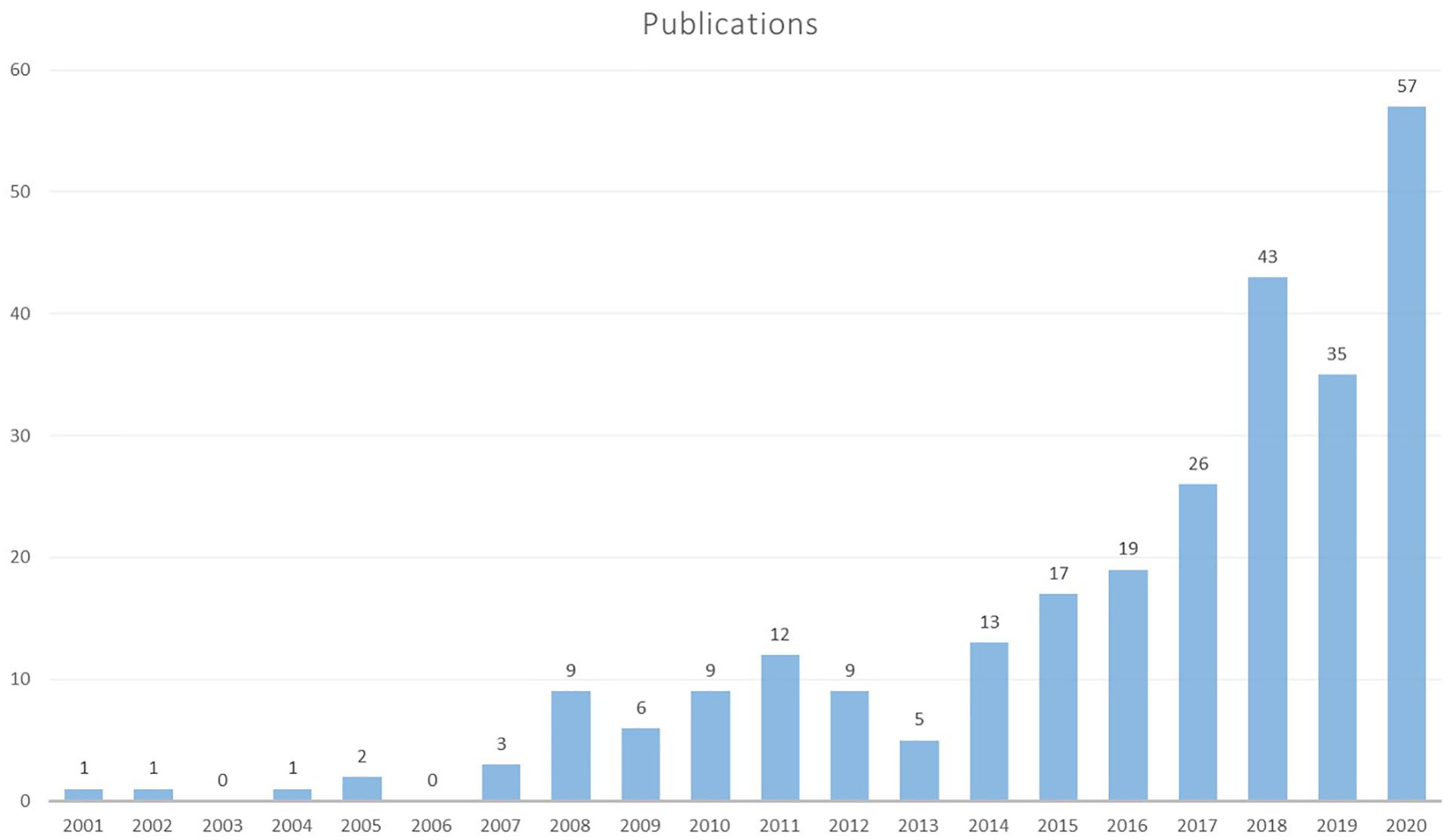
Published documents by year in Wos/Scopus.
The 20 most cited documents are listed in Table 2, highlighting those with more than 100 citations. First, with 204 citations the article by Russell and Faulkner (2004). Two Australian destinations were studied through chaos and complexity theory in conjunction with the tourism life cycle model, finding that one of them gained a competitive advantage over the other.
Top 20 Most Cited Documents.

The second document with the highest number of citations is Sebele (2010) with 176 citations. This paper studies the relationship between the protection of natural resources and the perception of the inhabitants of a community in Botswana regarding tourism activities. It concludes that community enterprises, when efficiently managed, can promote environmental stewardship.
Komppula’s (2014) study with 173 citations, established the main objective of increasing the understanding of the role of entrepreneurs in improving competitiveness in a rural tourism destination in Finland.
Tew and Barbieri (2012) analyzed farm households in Missouri, and businesses derived from tourism activity, highlighting a favorable perception to generate agritourism ventures, with 170 citations.
The study by Haber and Reichel (2007), with 140 citations, shows the entrepreneurial process of small tourism ventures, known as “blifestyle businesses.”
The article of McGehee et al. (2007), cited 136 times, shows the results of an investigation whose objective was to explore gender in the motivation for agritourism entrepreneurship among Virginia farm families. It was found that the alternative farming objectives of men and women were similar.
The seventh paper with the highest number of citations, with 122, is the one by Lerner and Haber (2001), who investigated the performance factors of Israeli small tourism enterprises through four theoretical approaches: environmental setting, institutional support, entrepreneurial human capital, and the company’s service package.
The paper by Zhao et al. (2011) was cited 121 times. It explains tourism entrepreneurial development in Guangxi, China through social capital, which is positively related to both an individual’s capacity for entrepreneurship and an individual’s likelihood of establishing a tourism business.
Finally, three more articles have over 100 citations: Carlisle et al. (2013) with 118 citations, studied innovation and entrepreneurship in African Indian communities; Gurel et al. (2010) with 110 citations, analyzed the relationship between entrepreneurial characteristics, sociocultural background, and entrepreneurial intention of university students in the United Kingdom and Turkey (Gurel et al., 2010) and Hallak et al. (2010) researched how place identity, entrepreneurial self-efficacy, and community support influence the entrepreneurial performance of small and medium-sized tourism business owners. From 11th to 20th place, the number of citations ranges from 66 to 99.
Data Analysis by Author
The most cited authors are shown in Figure 2. Haber with three documents, totaling 314 citations, being number 1 in the ranking of cited authors. Following, is Altinay with three papers, who has 219 citations, Hallak with four publications has a total of 218 citations. In fourth and fifth place are Rusell and Faulkner, who are at or close to the top of the list, similar to Table 2, since with only one document they have a total of 204 citations. Mcgehee has four publications totaling just under 200 citations, placing the author in sixth place. Domenico and Miller are authors who have three published papers and an equal number of citations with 128. The next ones, with only one publication they have more than 100 citations: Sebele, Tew, Jennings, Kim, Lerner, Echtner, Ritchie, and Zhao y Carlisle.
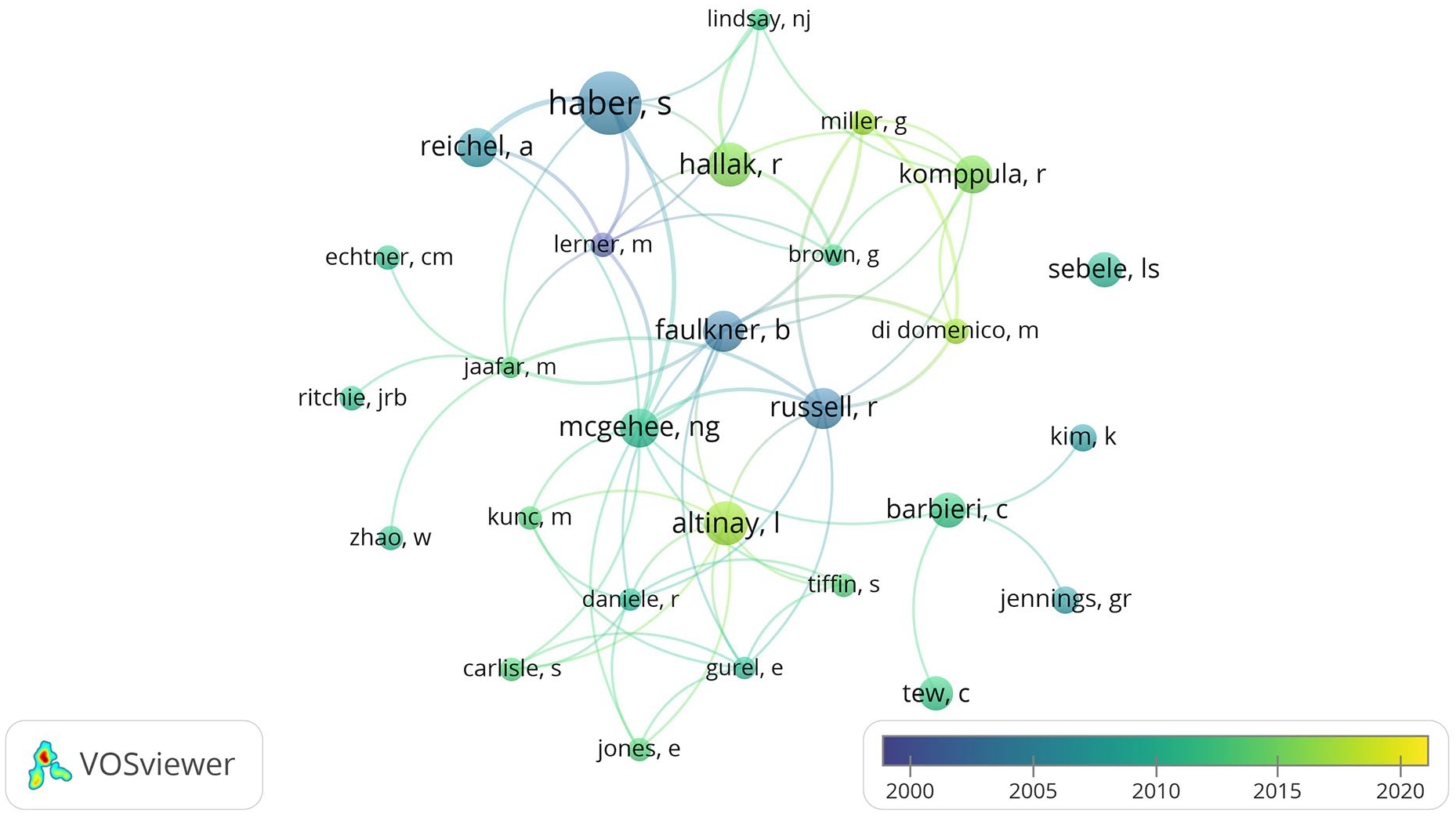
Most cited authors of the topic in Wos/Scopus.
When performing a temporal analysis of Figure 2, it can be seen that Haber, Rusell, and Faulkner, who occupy positions 1, 4, and 5 of the most cited authors, their publications on average correspond to the year 2004, being the oldest of the period considered for this paper. On the contrary, Altinay and Hallak, position 2 and 3 of the most cited authors respectively, are those who have the most recent publications with that level of citation, whose average are from the years 2015 and 2016.
To calculate the co-authorships, each author was chosen to have at least one document and at least one citation, with a total of 576 authors. The total link strength of the co-authorship was calculated and resulted in the largest connected element network of 16 elements whose data are shown in Table 3, and the graphic in Figure 3. Clearly, Köseoglu is the author with the highest number of citations with 61, as well as the second highest number of co-authorship citations (link) with 8 and 10 publications with co-authors (Total Link Strength). Followed by Okumus with 56 citations and relationship with 5 co-authors, and 6 publications; Fu with 53 citations, 6 co-authors, and 7 publications; Wu with 48 citations and 3 co-authorships in the same number of publications. It is worth highlighting Xu as the author with the highest number of relationships to other authors with 10 and the highest Total Link Strength with 13, despite not being the highest in the number of citations with 48.
Co-Authorship by Authors.


Top authors by coauthorship.
In a detailed review, Wang is the third highest link value with 7 and a total link strength with 8, however, he has only 8 citations of his publications. The rest of the authors from position 8 to 16 in Table 3 and Figure 3, who appear smaller in size in the periphery, their number of citations are similar to link and total link strength.
In relation to the co-citation analysis, the criterion for compliance was that the authors had 25 citations, and a network of 25 authors was generated, all of whom have been co-cited with most of the other authors. In Figure 4, it is shown that Getz, which is based on the relationships, has the highest total link strength of 891, and also the highest citation value with 112. Three more articles have over 100 citations: Carlisle, Kunc, Jones, and Tiffin with 118 citations, studied innovation and entrepreneurship in African Indian communities.

Top authors by co-citation.
Considering the number of citations, Morrison is next with 91, and a total link strength of 791; and in third place, comes Hall with 515 times co-cited with other authors, with a total of 84 citations of his publications. Ateljevic, Thomas, and Shaw, in that order, complete the top places with the highest value in both citation and total link strength.
Table 4 shows the results of the bibliographic coupling by authors. Authors with at least one published paper and 100 or more citations were taken as a basis, resulting in a network of 28 authors. It can be observed that Hallak is the third author with the third highest number of citations, but the first in the relationship with other authors (26) in the use of cited references; also, it is the highest in total link strength with 677 cited references, similar to those used by the other authors with whom it has a similar relationship.
Bibliographic Coupling by Author.

Despite being in the sixth position in relation to the number of citations received in his articles, Mcgehee is the second in link with 26, which is similar to the case of Brown and Lindsay who have the third highest value of both, total link strength with 460, and their link in the used references, which are 26 with other authors, but they only have just over 100 citations.
Finally, those who have the highest citation scores do not have the highest values of bibliographic linkage. Russell and Faulkner have a link score of 22 and total link strength of 129, Barbieri has a link score of 16 and total link strength of 115; Komppula, 18 and 55 respectively; and Sabele 4 and 8.
Data Analysis by Countries, Organizations, and Sources
Figure 5 shows the main countries according to their contribution in scientific indicators. England, Australia, and United States stand out. England is the leader in citations of publication, with 1,080 in total, and link co-authorship with 14, as well as in number of documents with 41; and second in link bibliographic coupling with 26. Australia is the country with the second highest number of citations with 996, third in documents with 30, and in link co-authorship with 10, as well as fourth in link bibliographic coupling with 22.

Countries with the highest number of citations of the topic.
China with 529 citations and Canada with 404 are the fourth and fifth country in this indicator. A remarkable dispersion is identified since there are countries from four different continents in the first five places with the highest number of citations.
Table 5 shows the organizations to which the researchers belong and their contribution to the development and dissemination of the topic of entrepreneurship in tourism. The top 3 universities, according to the number of citations of the studies, carried out in them by researchers are: Griffith University (Australia), The Hong Kong Polytechnic University (Hong Kong), and University of Surrey (United Kingdom), with 370, 343, and 333, respectively.
Data by Organizations.
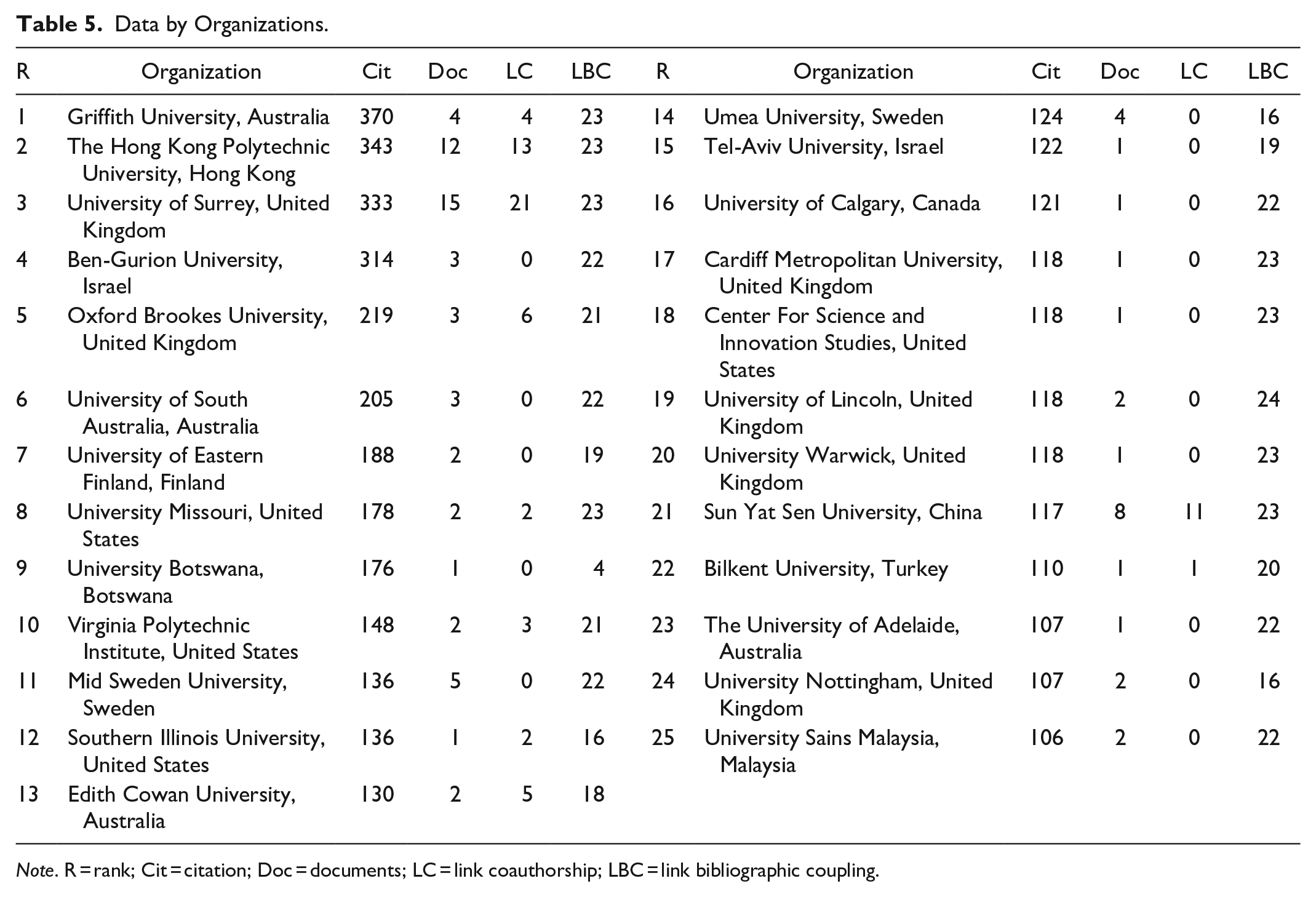
Note. R = rank; Cit = citation; Doc = documents; LC = link coauthorship; LBC = link bibliographic coupling.
The University of Surrey, United Kingdom, stands out, since it has the highest rate of publications with 15, as well as of co-authorships with 21, in addition to the highest Link bibliographic coupling with 23. Likewise, the Hong Kong Polytechnic University, Hong Kong, has 12 documents, 13 link co-authorships, and 23 link bibliographic coupling. Sun Yat Sen University, China, ranks third in papers with 8, as well as in co-authorships with 11 and 23 link bibliographic coupling; however, it is in 21st position in terms of citations received for these publications.
The organizations that show the highest level of link bibliographic coupling, in addition to those mentioned above, are: University of Lincoln, United Kingdom with 24; University Missouri, United States; Cardiff Metropolitan University, United Kingdom; Center for Science & Innovation Studies, United States; University Warwick, United Kingdom; and Sun Yat Sen University, China, with 23, each one of them.
The following universities have more than 150 citations, ordered from the highest to lowest: Ben-Gurion University, Israel; Oxford Brookes University, United Kingdom; University of South Australia, Australia; University of Eastern Finland, Finland; University Missouri, United States; and University Botswana, Botswana.
Figure 6 includes the main Journals, based on the number of citations and co-citation, being the top 5 the next ones in a descendant order: Tourism Management, Annals of Tourism Research, Journal of Business Venturing, Entrepreneurship Theory and Practice, and Academy of Management Review.
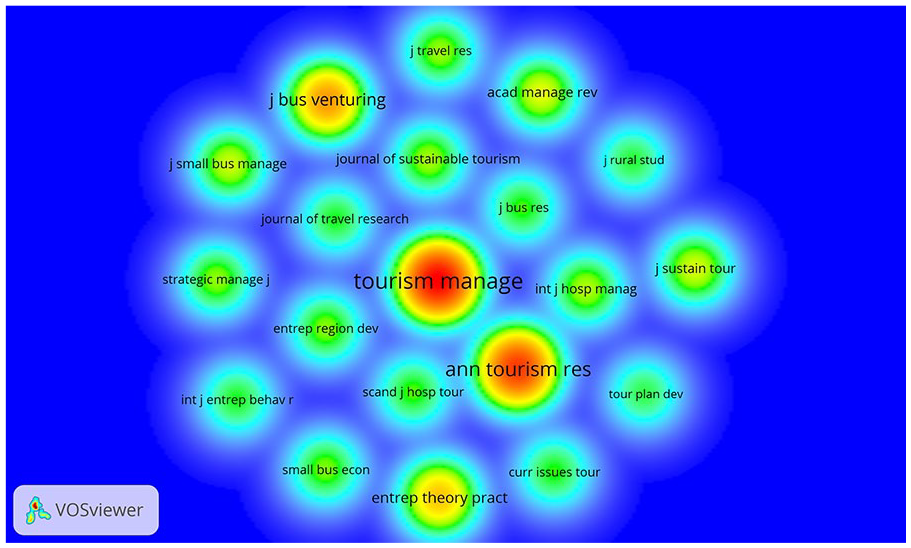
Tops journals by citations and co-citation.
Table 6 shows the top 20 journals according to citation and co-citation. The order of ranks from 1 to 4 is increasing in both indicators; however, Academy of Management Review, ranked fifth according to citations, has a co-citation total link strength of 3,240 times that journal has been co-cited with others, which is a lower number than the seventh and eighth places.
Sources by Citation and Co-Citation.

Note. R = rank; Cit = citation; CTLS = co-citation total link strength.
Similarly, Strategic Management Journal ranked 11th, based on the number of citations, and it has a co-citation total link strength of 2,834, exceeding the value of this indicator from places 9th and 10th.
Among the Journals included in the Table, 11 of them have a specialized theme focus on tourism since their names explicitly include the words Tourism, Venture, Travel, Hospitality; only three alludes to Entrepreneurship, while the rest of the journals are about Management or Business in general.
Analysis of Words and Topic Clusters
Figure 7 shows the words most frequently mentioned in the documents, as well as the number of times that the word co-occurs with another word, in order from most to least important according to the values, and excluding the main theme of the work, which is entrepreneurship in tourism, are: rural tourism, sustainability, small business, innovation, social entrepreneurship, and lifestyle.

Top words co-ocurrence.
There are other words, which, although they are among the most important, represent emerging topics that generate the possibility of broadening the study of these subjects in relation to the main topic: gender, networks, agritourism, identity, family business, female entrepreneurship, start-up, wine tourism, and Airbnb.
The analysis of co-occurrence of words, generated grouping in three topic clusters, which were named based on the main topics, as well as the relationship between them within the same group. Therefore, Cluster 1 (see Figure 8): was de-nominated as Sustainable Rural Tourism (26 elements and 29% of the total network) integrated by: innovation, performance, creativity, entrepreneurial orientation, knowledge management, regional development, tourism education, tourism SMES, culture, decision-making, entrepreneurial skills, entrepreneurship education, governance, immigrant, resource-based view, and wellness tourism. Highlights the study of the physical location of rural tourism businesses and their orientation to the market (Polo et al., 2015), about sustainable wine tourism (Duarte et al., 2020), tourism as a way of local development Post-apartheid in South Africa (Stoffelen et al., 2020), the attempted conversion of rural agricultural enterprises to tourism (Ryglová, 2007) and the role of women entrepreneurs in the development of sustainable tourism in marginalized rural areas (Martini et al., 2020).
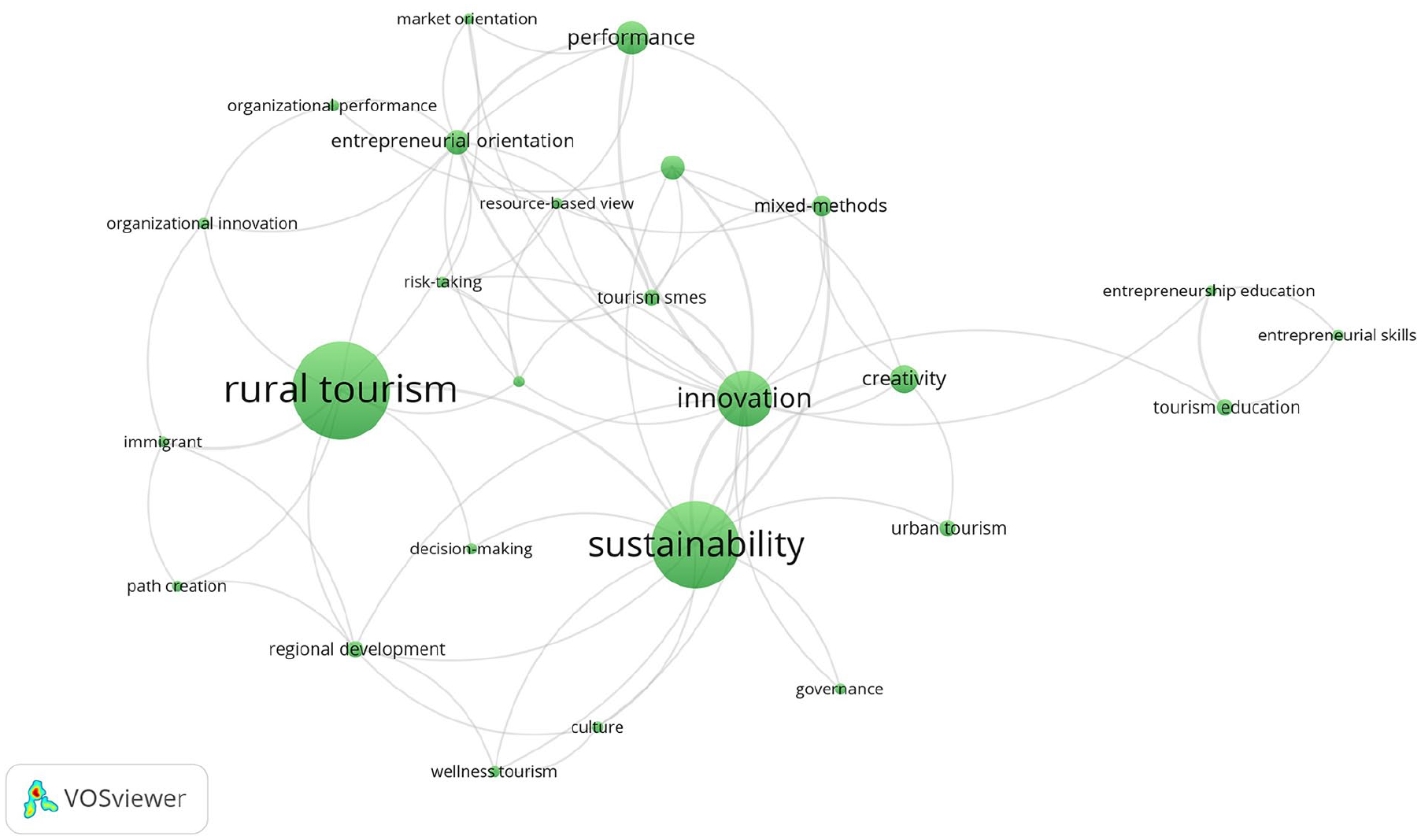
Topic cluster 1: sustainable rural tourism.
Cluster 2: Small business and lifestyle (26 elements and 29% of the total network), composed by: hospitality, motivation, economic growth, rural-development, entrepreneurial behavior, business performance, clusters, family business, place identity, self-efficacy, start-up, education, self-employment, and tourism-led growth (see Figure 9). Among the main investments is the focus on wellness as an opportunity for small business development in coastal tourism (Page et al., 2017) and in wine tourism regions (Dawson et al., 2011); lifestyle mobility is recognized as the one that blurs the line between leisure and work (Sun & Xu, 2017) and generates a desire for alternate living (Zhang et al., 2020). The important role of women in this type and size of companies is identified, however, their intention to make their companies grow is not achieved in most cases (Ali, 2018); but despite the stress generated by their multiple simultaneous roles, they do female entrepreneurial networking (Kankanamge, 2018)

Topic cluster 2: small business and lifestyle.
Cluster 3: Social entrepreneurship (39 elements and 42% of the total network), mainly composed of: gender, nature-based tourism, networks, social capital, agritourism, tourism policy, community-based tourism, identity, indigenous, female entrepreneurship, rural entrepreneurship, and wine tourism (see Figure 10). The social approach to entrepreneurship is a phenomenon that has recently emerged with a conceptual framework on the subject and alternative ones (Aquino et al., 2018), which is explored in documentary form in its relationship with gastronomy (Celebi et al., 2020) and is even addressed using Max Weber’s typology of rationality (Mody et al., 2016). Some of the studies conducted are particularly noteworthy, like one research that was developed in Canada on social entrepreneurship in the hospitality industry and its relationship with sustainable tourism (de Lange & Dodds, 2017); in addition, social entrepreneurs of tourism in rural areas with benefits for all stakeholders (Peng & Lin, 2016); through business models with a balance between profit and social impact (Zebryte & Jorquera, 2017); and with a market approach (Sigala, 2016)

Topic cluster 3: social entrepreneurship.
Conclusions
Entrepreneurship in tourism is an increasingly studied topic, and the last 7 years show a clear growing trend. In these contributions, authors with only one publication have an important impact on the main indicators of citation, co-authorship, co-citation, and bibliographic coupling; however, the first places of cited authors have more than one publication. In the analysis of co-authorship by author, there is a predominance of researchers from the Asian continent, which is not present in the other criteria mentioned.
England is the country with the highest number of citations in the field, since several authors from that country publish the highest number of papers. Australia and United States are the other two main countries that generate publications on the subject; three countries from three different continents. Regarding the journals, two thirds are specialized in tourism, and the rest on general aspects of management and business.
In this main subject of tourism entrepreneurship and through the results of co-occurrence of words, the subjects are located in three main groups: (1) Sustainable Rural Tourism, (2) Small business and lifestyle, and (3) Social entrepreneurship. Three thematic lines with their own characteristics can be observed, in which the first of them is the one that generates more relationships within its own themes that compose it, as well as with the other groups. This is due to the fact that they are part of a larger grouping with a strong interrelation among them, in such a way that common aspects that unite them stand out, such as: gender, the indigenous peoples, agritourism, innovation, wine tourism, performance, creativity, motivation, and nature-based tourism.
The concept of entrepreneurship can suggest an idea of management, business, firm, company, and in general, an economic vision of organizations. Although the results refer to business models, performance, economic growth, and market orientation, most of them are far from that. The topics with the greatest impact are related to aspects focused on the human and social aspects. The development of the communities, the role of women, the perception of the inhabitants and the repercussions of the conversion of primary activities to tourism, to mention the most important ones, are emphasized.
The main contribution of this document is circumscribed in the visualization of the tourism activity and the enterprises resulting from it, from a perspective that goes beyond the economic and managerial. Emphasizing the role of minorities and the underprivileged in rural, marginal, and indigenous areas as part of communities that through this activity can obtain a better quality of life.
This study was limited to WOS and Scopus publications from the first 20 years of the 21st century. This shows the most recent and high impact contributions, but excludes the history of the last century in relation to the subject. It is visualized that it was at the beginning of this century the first publications, it cannot be ruled out the previous existence of studies in that sense. In addition, when delimiting these publications that were included in both WOS and Scopus, those included in one or the other database were omitted.
The above reflection allows us to suggest subsequent studies in which the period of time is extended to add documents with greater coverage, a clearer image of the documentary and scientific historical reality. Likewise, it is recommended to integrate a database with the documents from both WOS and Scopus, in such a way that it is an input that privileges inclusion over exclusion.
This contribution can be a reference of what has been published, in order to deepen in the future, the study of adjacent, related or emerging topics of entrepreneurship in tourism, as well as to generate practical proposals for new or potential entrepreneurs.
Footnotes
Declaration of Conflicting Interests
The author(s) declared no potential conflicts of interest with respect to the research, authorship, and/or publication of this article.
Funding
The author(s) disclosed receipt of the following financial support for the research, authorship, and/or publication of this article: This study was supported by the Program for Promotion and Support of Research (PROFAPI) of the Sonora Institute of Technology (ITSON).
